

 let’s connect


What is Local SEO and Why Does It Matter?
Local SEO is the strategic practice of optimizing your digital presence to attract customers searching for businesses, products, or services in specific geographic areas. Here's what you need to know:
- Local SEO focuses on appearing in Google's Map Pack (the top three local business results) and location-based organic search results.
- It requires optimizing your Google Business Profile, managing online reviews, building local citations, and creating location-specific content.
- 46% of all Google searches have local intent, making local SEO essential for any business serving customers in physical locations.
- 98% of customers search online for nearby companies, with most making purchase decisions based on these search results.
- With 76% of people visiting a business within 24 hours of searching locally, local SEO directly impacts foot traffic and revenue.
- The strategy differs from traditional SEO by emphasizing proximity, local relevance, and real-world verification through consistent business information across platforms.
The Local Search Revolution Transforming Business in 2026
The landscape of local search has undergone a fundamental transformation. Effective brand management ensures consistent messaging and visual identity across Google Business Profiles, review sites, and all local search touchpoints. What was once a supplementary marketing channel has become the primary way customers discover and evaluate local businesses. The statistics paint a compelling picture of this shift.
98% of customers now search online for nearby companies, representing a near-universal behavior change in how consumers find local services. Knowing when to start a new SEO campaign for growth is especially critical for local businesses, where 46% of all Google searches now carry local intent.
This represents a dramatic evolution from just a few years ago. In 2019, only 30% of searches had local intent. The acceleration to 46% by 2026 demonstrates how deeply location-based search has become embedded in consumer behavior. Mobile adoption, improved location signals, and the integration of AI technologies have all contributed to this explosive growth.
Real-world case studies demonstrate how businesses dominate local search results through systematic optimization of Google Business Profiles, reviews, and local content.
The urgency of local search cannot be overstated. 76% of people who search for something nearby visit a business within 24 hours, and 88% of local mobile searches lead to store visits within a week. Even more immediately actionable, 60% of mobile users contact businesses directly from search results, creating instant conversion opportunities for businesses that optimize their local presence. Professional search engine optimization services provide the expertise needed to navigate the rapidly evolving local search landscape and AI-driven ranking factors.
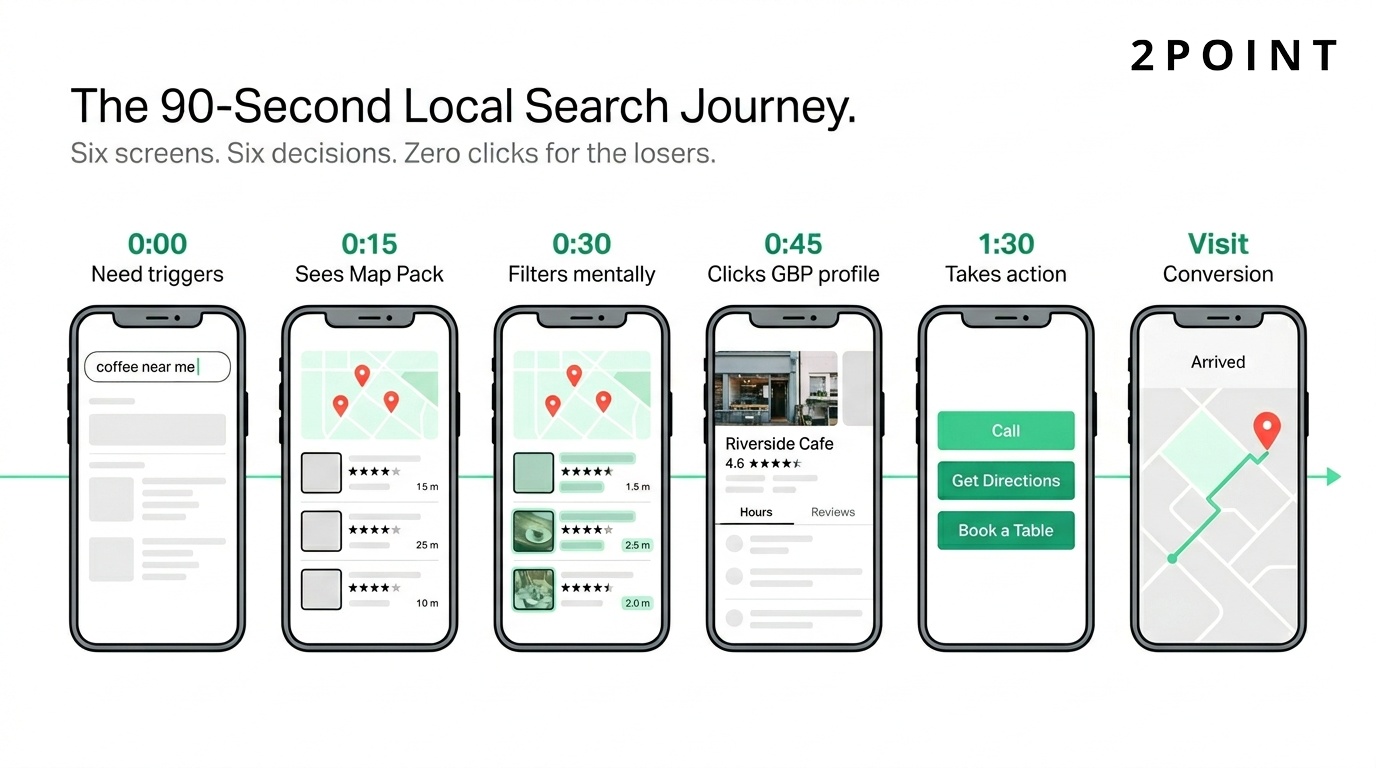
The consumer journey has fundamentally changed. Customers no longer browse yellow pages or rely solely on word-of-mouth recommendations. They pull out their smartphones, type "near me" or their city name plus a service, and make decisions based on what Google shows them. If your business doesn't appear in those critical top results, you've effectively disappeared from the consideration set of potential customers actively looking for what you offer.
AI has transformed this landscape even further. Search engines now understand context, intent, and nuance in ways that were impossible just a few years ago. They can interpret conversational queries, understand implicit location signals, and deliver hyper-personalized results based on individual user behavior patterns. This evolution requires businesses to adapt their strategies accordingly, optimizing not just for keywords but for the complex web of signals that modern search algorithms evaluate.
How Does Local SEO Differ from Traditional Search Engine Optimization?
Local SEO and traditional SEO share foundational principles but diverge significantly in their execution, ranking factors, and strategic focus. Understanding these differences is essential for developing an effective local search strategy.
Geographic Intent Versus Informational Intent
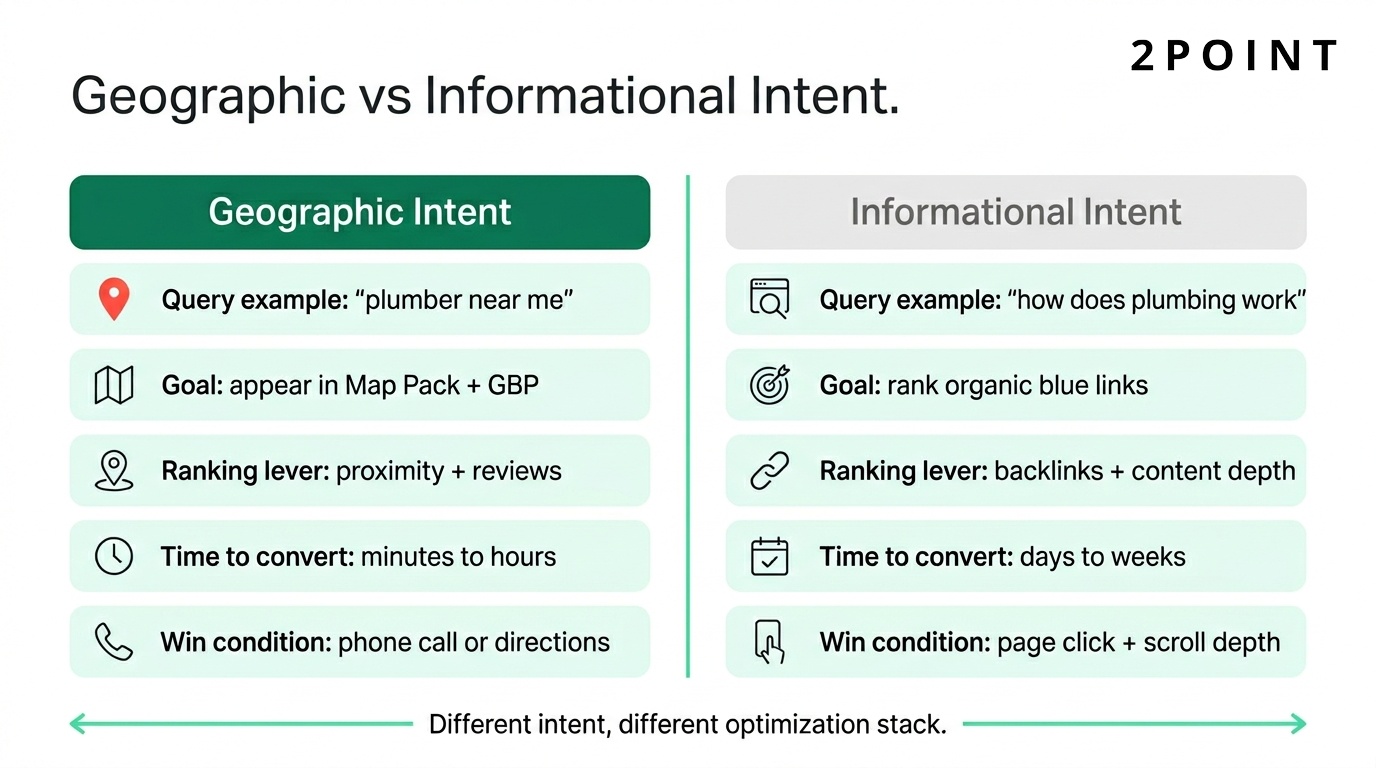
Traditional SEO primarily targets informational queries where users seek knowledge, research, or general information without specific location requirements. Someone searching for "how to fix a leaky faucet" wants instructions, not a plumber. Local SEO, by contrast, targets transactional and navigational queries with clear geographic intent. When someone searches "emergency plumber near me," they need immediate service in their specific location.
This distinction affects everything from keyword research to content strategy. Local searches typically include geographic modifiers (city names, neighborhoods, "near me" phrases) or carry implicit local intent that search engines recognize through location signals from the user's device.
Proximity as a Fundamental Ranking Factor
Perhaps the most significant difference is that local SEO treats physical distance as a primary ranking factor. Traditional SEO evaluates relevance, authority, and technical optimization, but location is irrelevant for most queries. Local SEO, however, prioritizes businesses closest to the searcher's location, all else being equal.
This means a business with a less authoritative website might outrank a more established competitor simply because it's physically closer to the person searching. Google's local algorithm explicitly weighs proximity when determining which businesses to display in the Map Pack and local organic results.
Real-World Verification Requirements
Traditional SEO operates entirely in the digital realm. You can rank for competitive keywords without ever proving your physical existence. Local SEO requires extensive real-world verification. You must prove to Google that your business physically exists at the address you claim, operates during the hours you specify, and provides the services you advertise.
This verification happens through multiple mechanisms: postcard verification for Google Business Profiles, NAP (Name, Address, Phone) consistency across hundreds of online directories and citations, and validation through third-party data sources that Google trusts. Your digital presence must accurately reflect your physical reality.
Google Business Profile Versus Organic Website Rankings
Traditional SEO focuses almost exclusively on optimizing your website to rank in organic search results. Local SEO requires managing two distinct presences: your Google Business Profile and your website. While Google Business Profiles dominate Map Pack visibility, a professionally built website remains essential for organic rankings and converting visitors into customers.
Businesses appearing in the Map Pack receive 126% more traffic and 93% more actions than those ranking in positions 4-10. This makes GBP optimization as important, if not more so, than traditional website SEO for local businesses. Your profile serves as a mini-website that Google controls, and optimizing it requires different strategies than website optimization.
What Are the Core Ranking Factors for Local Search in 2026?
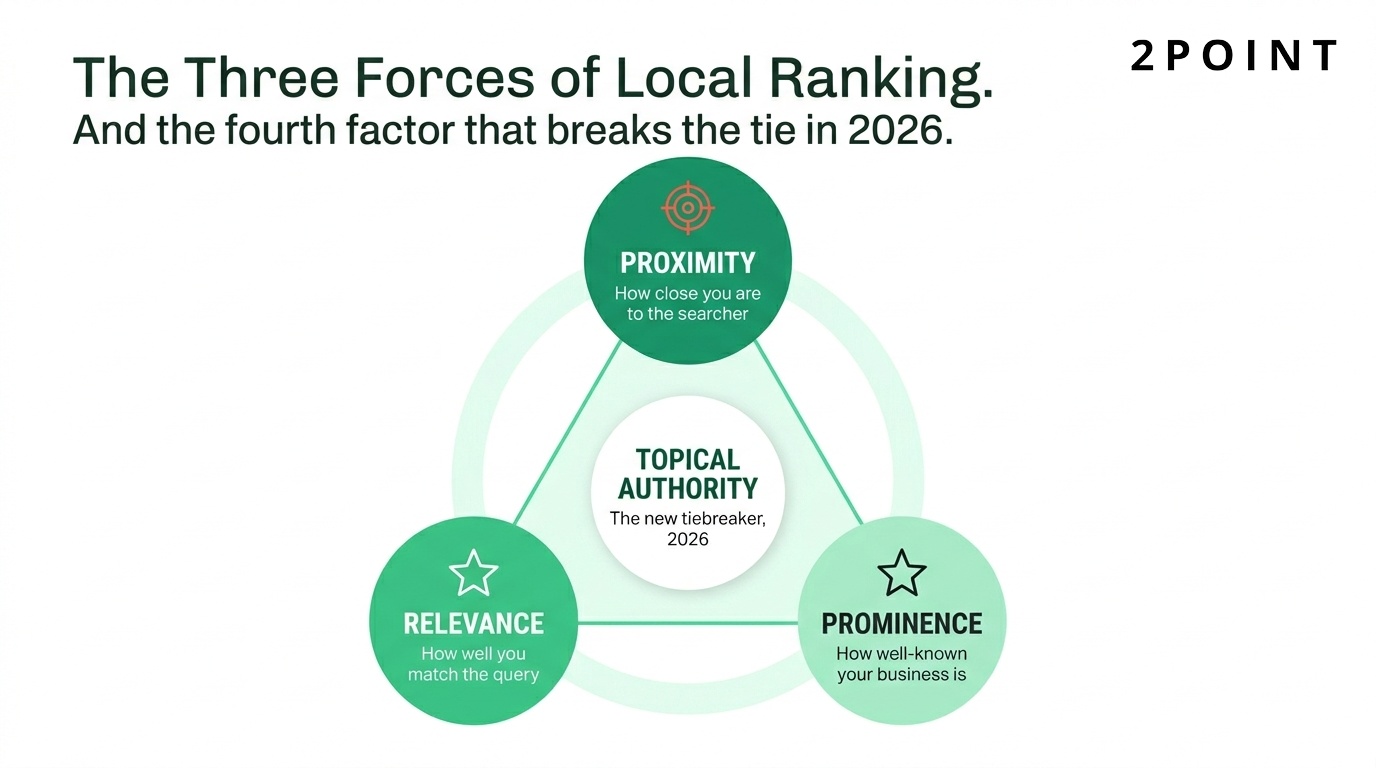
Google evaluates local businesses using three primary dimensions: relevance, distance, and prominence. However, the way these factors are weighted and interpreted has evolved significantly, particularly with the integration of AI technologies and user behavior signals. Maintaining brand consistency across agents and platforms strengthens the relevance signals Google evaluates, ensuring your business information is accurate and trustworthy everywhere.
Relevance in the AI Era
Relevance measures how well your business matches what the searcher is looking for. In 2026, this extends far beyond simple keyword matching. Google now considers user interaction patterns when determining relevance, analyzing how searchers engage with your profile, whether they call, request directions, or visit your website.
Content freshness has become a significant relevance signal. Businesses that regularly update their Google Business Profiles with posts, photos, and new information signal to Google that they're active and engaged. Service category accuracy matters immensely; selecting the right primary and secondary categories ensures Google understands precisely what you offer and when to show your business for relevant queries.
The system also evaluates how comprehensively you've filled out your profile. Every empty field is a missed opportunity to communicate relevance. Attributes, business descriptions, service menus, and product catalogs all contribute to Google's understanding of whether your business matches the searcher's needs.
Distance Considerations
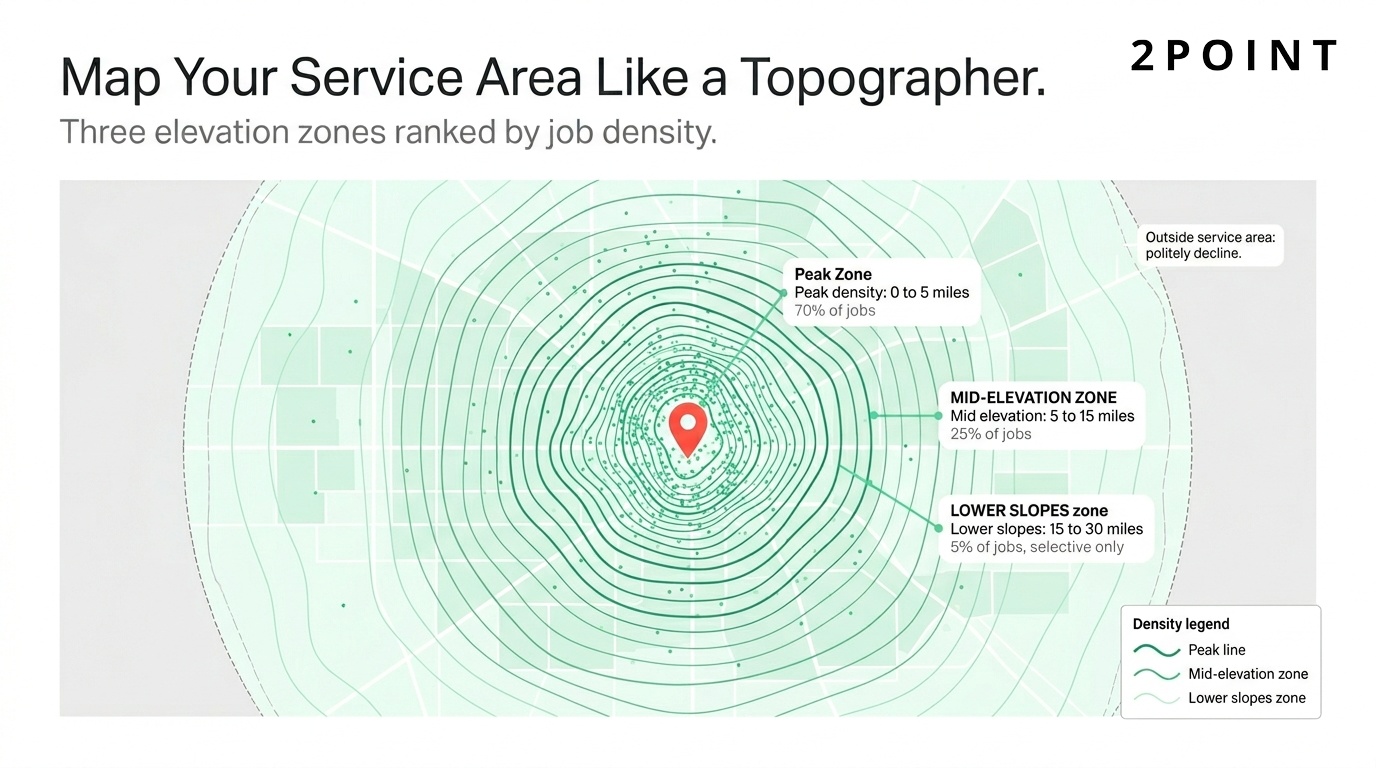
Distance represents the physical proximity between your business and the searcher. While this seems straightforward, it involves several nuanced considerations. Service area businesses without a physical storefront must carefully define their service areas to appear in relevant searches. The accuracy and specificity of your service area definition directly impacts your visibility.
Location verification quality also matters. Businesses with verified, consistent addresses across multiple data sources receive preferential treatment over those with questionable or inconsistent location information. Google trusts verified locations more because they've proven their physical existence.
For businesses with physical locations customers visit, Google distinguishes between the precise location (for map display and distance calculations) and the service area (for search visibility). A restaurant needs a precise location; a plumber needs a defined service area. Properly configuring these settings ensures you appear in searches from the right geographic areas.
The Evolution of Prominence
Prominence measures how well-known and authoritative your business is, both online and in the physical world. Recent reviews are weighted more heavily than old ones, making consistent review generation essential for maintaining prominence. Implementing a referral program alongside local SEO amplifies word-of-mouth, generating reviews and citations that boost prominence signals.
Professional premium brand creation strengthens your prominence signals by establishing a cohesive visual identity that reinforces authority across all local search surfaces.
Google tracks engagement metrics across your digital presence. High click-through rates from search results, frequent profile views, regular customer interactions, and sustained user engagement all signal prominence. Businesses that consistently generate activity appear more prominent than dormant competitors. Building high-authority brand citations across trusted directories and publications strengthens the prominence signals that Google evaluates for local rankings.
Profile completeness serves as a foundational prominence indicator. Google rewards businesses that thoroughly populate every section of their profile with higher visibility. This extends to photo quantity and quality, post frequency, Q&A participation, and regular information updates.
Links from other websites, particularly local ones, contribute significantly to prominence. A business mentioned in local news articles, referenced by community websites, or linked from other local businesses' sites demonstrates real-world prominence that Google values.
Why Topical Authority Has Become the Number One Local Ranking Factor
Topical authority has emerged as the #1 local ranking factor because it represents a comprehensive signal of business quality and expertise. Topical authority means demonstrating deep expertise in your specific field while proving you're a known entity in your particular geography.
Building topical authority requires creating comprehensive content that thoroughly covers your service areas and specialties. A law firm can't just have a page about "legal services"; it needs detailed content about each practice area, common legal questions, case studies, and location-specific legal considerations. This depth signals expertise to both users and search algorithms.
You establish authority by proving you're a known entity in your geography. This happens through local press mentions, community involvement, partnerships with other local businesses, participation in local events, and consistent presence in local conversations. Google rewards businesses that demonstrate real community integration rather than just digital optimization.
Neighborhood-level authority matters increasingly. Businesses that create content specific to the neighborhoods they serve, participate in neighborhood associations, and demonstrate knowledge of local communities rank better than those taking a generic citywide approach. This hyper-local focus has become essential for competitive local markets.
Who Actually Needs Local SEO?
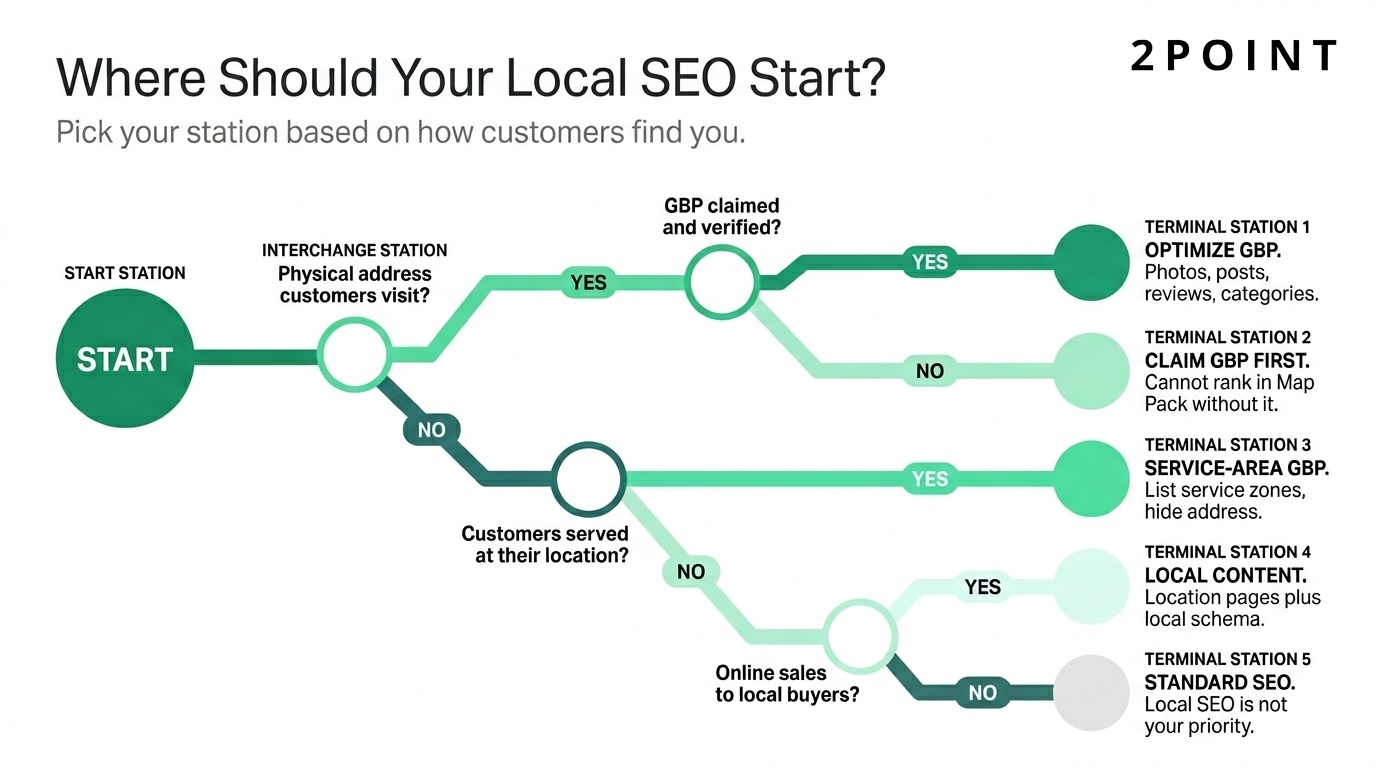
Local SEO isn't just for restaurants and retail stores. Any business serving customers in specific geographic areas benefits from local search optimization, though the strategies vary by business model. Local businesses can amplify their SEO foundations with paid social reach through Facebook advertising, combining organic local visibility with targeted social campaigns. Local businesses achieve the strongest results when local SEO is part of a broader multi-channel marketing strategy spanning search, social, email, and paid advertising. Social media marketing plays a growing discovery role for local businesses, particularly hospitality and food services where visual content drives consideration. Multi-location enterprises need an omnichannel marketing strategy that coordinates local SEO with paid advertising, social media, and CRM systems.
2POINT serves businesses across multiple locations, providing local SEO expertise tailored to each market's competitive landscape.
Brick-and-Mortar Businesses
Physical retail locations, restaurants, healthcare facilities, professional offices, and any business where customers come to a physical location represent the core audience for local SEO. These businesses benefit most directly from Google Maps visibility and driving foot traffic through local search.
Service Area Businesses
Plumbers, electricians, landscapers, home cleaning services, and other businesses that travel to customer locations need local landing pages and service area optimization despite not having a customer-facing location. These businesses hide their address but define service areas to appear in relevant local searches.
Multi-Location Enterprises
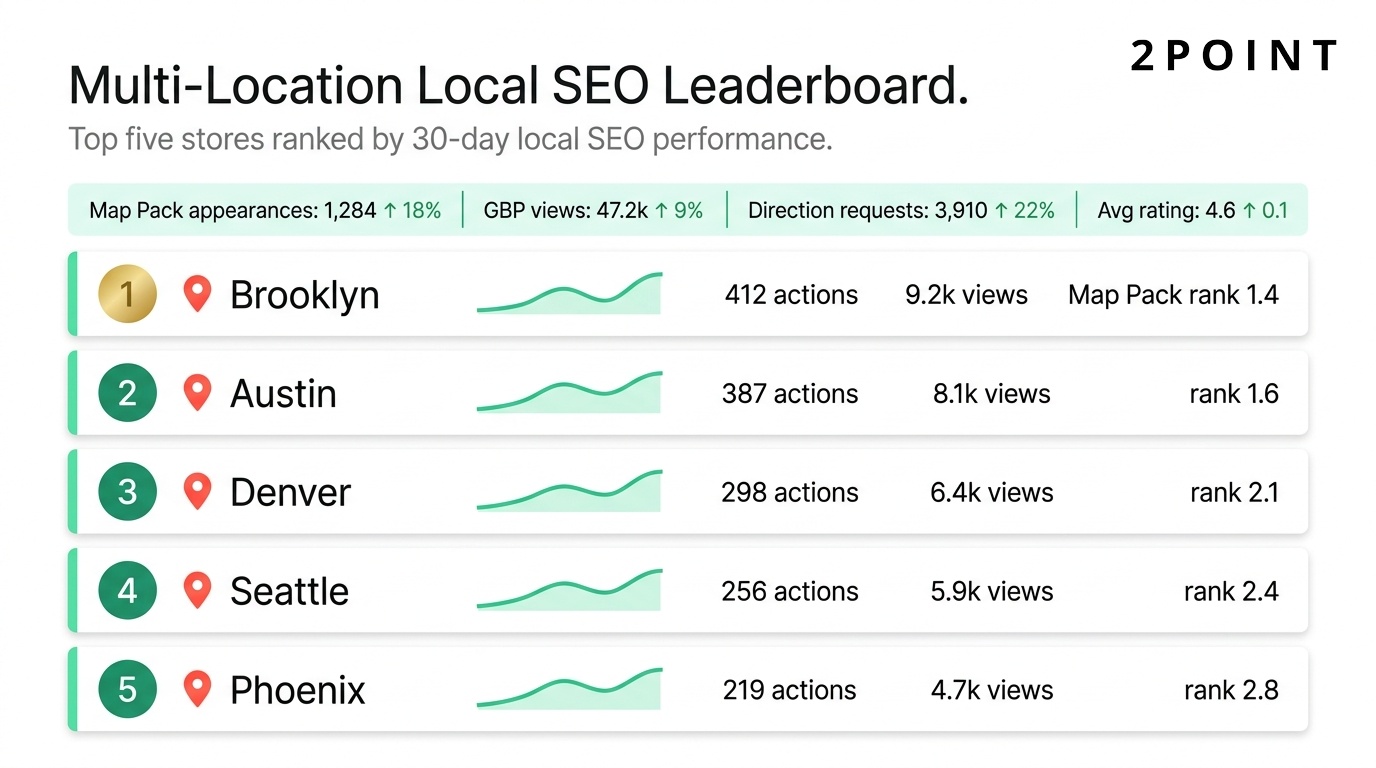
Franchises, chains, and businesses operating in multiple locations face unique challenges requiring franchise local SEO strategies. Each location needs individual optimization while maintaining brand consistency, requiring sophisticated management approaches.
Professional Services
Lawyers, accountants, financial advisors, real estate agents, and insurance brokers all compete in local markets. These professionals need to balance location-based visibility with demonstrating expertise and credibility in their specialties.
Healthcare Providers
Doctors, dentists, chiropractors, therapists, and medical practices depend heavily on local visibility. Healthcare local SEO involves industry-specific platforms, HIPAA considerations, and managing provider-specific profiles alongside practice-level optimization.
Hospitality and Food Services
Hotels, bed-and-breakfasts, restaurants, cafes, and bars need local SEO to capture both travelers searching for accommodations or dining and locals looking for nearby options. Reviews carry exceptional weight in these industries.
Home Services Contractors
HVAC technicians, roofers, painters, carpenters, and general contractors compete intensely in local markets. Emergency service providers particularly benefit from optimizing for urgent, high-intent local searches that often convert immediately.
How Is AI Transforming Local Search in 2026?
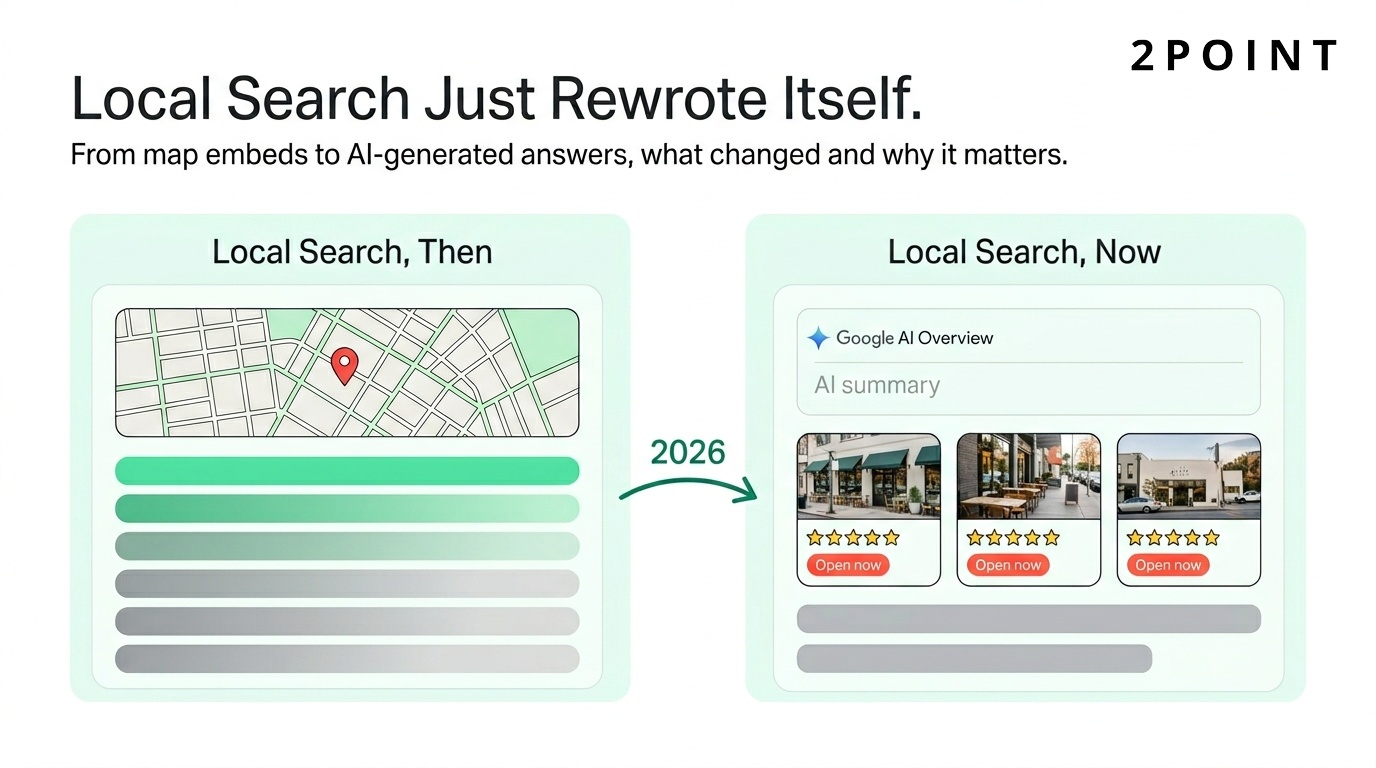
Artificial intelligence has fundamentally altered how local search results are generated, displayed, and consumed. The changes go far beyond incremental improvements, representing a paradigm shift in search behavior and result delivery. As AI systems increasingly answer local queries directly, businesses should consider emerging platforms like ChatGPT advertising to maintain visibility in AI-mediated discovery. The broader impact of AI on digital advertising is particularly visible in local search, where AI Overviews now appear for 40% of local business queries.
The Explosive Growth of Google AI Overviews
Google AI Overviews, which provide AI-generated answers at the top of search results, have experienced explosive growth. AI Overviews grew from 6.5% visibility in January 2025 to 13.1% by March 2025, effectively doubling their presence in just two months.
For local business queries specifically, the impact is even more dramatic. 40.16% of local business queries now trigger AI Overviews, meaning nearly half of local searches present users with AI-generated summaries before showing traditional results.
These AI Overviews prioritize different information than traditional search results. They extract facts, aggregate information from multiple sources, and present synthesized answers rather than links to websites. Businesses appearing in AI Overviews gain significant visibility, but the format reduces click-through rates as users get answers without visiting websites.
The content that appears in AI Overviews tends to be concise, factual, and well-structured. Businesses benefit from creating clear, direct answers to common questions, using structured data markup, and maintaining accurate, consistent information across all platforms that AI systems might reference.
AI Local Packs Versus Traditional Three-Packs
A new format has emerged: AI Local Packs, which differ from the traditional three-pack of businesses displayed with maps. AI Local Packs appear on 7% of tracked keywords, introducing an alternative way Google displays local business results.
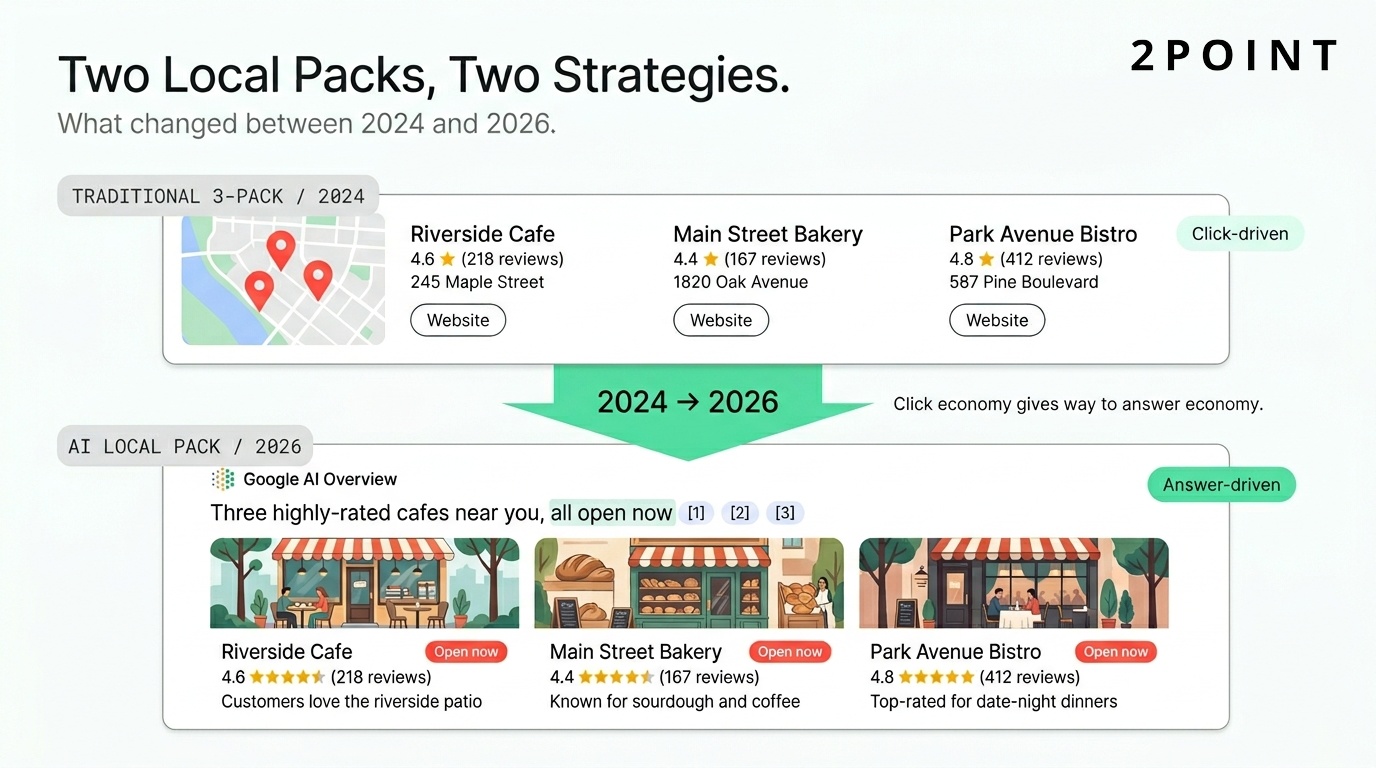
The most concerning discovery is reduced business diversity. AI Local Packs feature 5,943 unique businesses compared to 18,330 in traditional packs, meaning AI-generated results show 68% fewer unique businesses overall. This concentration of visibility creates a winner-take-most dynamic where the top businesses dominate even more than before.
The selection criteria for AI Local Packs emphasize factors like review quality and quantity, profile completeness, and user engagement metrics. Businesses with exceptional reviews, thoroughly optimized profiles, and strong engagement signals are more likely to appear in these AI-curated results.
Strategic responses require doubling down on excellence rather than mediocrity. When AI systems select fewer businesses to display, the quality bar rises. Businesses must achieve outstanding ratings, maintain extremely active profiles, and generate consistent positive customer interactions to remain visible.
What Is Answer Engine Optimization and How Does It Relate to Local SEO?
Semrush AEO vs SEO guide explains how Answer Engine Optimization (AEO) focuses on providing direct, complete answers to questions rather than ranking pages in search results. While traditional SEO aims to position your page at the top of a list of links, AEO aims to have your information selected as the answer itself.
HubSpot AEO vs SEO guide is cited for a clear comparison between Answer Engine Optimization (AEO) and Search Engine Optimization (SEO). They prioritize structured data, clear factual statements, and authoritative sources over traditional ranking signals like backlinks or keyword density.
For local businesses, AEO becomes critical because AI assistants and AI-powered search features increasingly answer local queries directly. When someone asks their voice assistant "who's the best dentist near me," the AI provides a specific answer rather than a list of options. Being that answer requires optimization specifically for AI comprehension and selection.
HubSpot AEO vs SEO guide highlights how AI trust signals—like transparency, accuracy, and authority—play a key role in optimizing for answer engines. Strong local SEO creates the foundation of accurate information, consistent citations, and authoritative profiles. AEO optimization ensures that AI systems can easily extract, understand, and trust that information when generating answers.
Why Are Zero-Click Searches Changing Local SEO Strategy?
Zero-click searches, where users get their answer without clicking through to any website, have become the dominant search behavior. This trend forces a fundamental rethinking of local SEO success metrics and strategies.
The Declining Click-Through Rate Reality
A study of 179 law firm profiles showed a consistent 2-year decline in clicks from Google Business Profiles despite stable or even improving rankings. Businesses maintain their visibility but receive fewer website visits, a troubling trend for businesses relying on website traffic for conversions.
Calls from Google Business Profiles are decreasing despite stable rankings, indicating that users increasingly complete their desired actions without ever contacting the business through traditional channels. They're finding what they need directly in search results and making decisions without further interaction.
This shift stems from Google providing more information directly in search results. Users see business hours, photos, menus, pricing, availability, and reviews without clicking. When search results answer the user's question completely, there's no reason to visit a website.
What Users Want Without Clicking
The information users seek without leaving Google reveals what businesses must optimize for visibility in the zero-click era. Prices displayed directly in search results let users comparison shop without visiting websites. Business hours visibility is critical as users check whether you're open before deciding to visit.
Recent work or portfolio viewing through Google Business Profile photos lets users evaluate quality without website visits. Direct appointment booking integrated into search results enables users to schedule services without ever visiting your website, reducing friction but also reducing your ability to influence the conversion process.
The strategic implication is clear: optimize the information that appears in search results as carefully as you optimize your website. Your Google Business Profile, structured data, and the details Google extracts from your web pages matter more than ever.
How Should Businesses Adapt to Zero-Click Reality?
Shifting from traffic metrics to visibility metrics becomes essential. If users don't need to click to accomplish their goals, measuring success by clicks and website traffic misses the real impact of local search visibility.
New key performance indicators should include impression share (what percentage of relevant searches show your business), actions taken directly from search results (calls, direction requests, messages), and brand recognition metrics. You might not get the click, but if users are seeing your business, learning your name, and forming positive impressions, you're building valuable brand equity.
Optimizing for in-SERP conversions means making it as easy as possible for users to take action without leaving Google. Enable messaging, integrate booking systems, display prices and availability, keep information current, and encourage review generation. These optimizations serve users where they are rather than forcing them to visit your website.
Attribution challenges intensify in the zero-click world. If a user sees your business in search results, notes your name, and calls you directly later without clicking anything, traditional analytics miss this entirely. Implementing offline and online human touchpoints tracking becomes essential for understanding the true impact of your local search presence.
How Are Local Services Ads Changing the Competitive Landscape?
Paid advertising has invaded local search results with unprecedented visibility, fundamentally altering the competitive dynamics and forcing businesses to reconsider their paid versus organic strategy balance. Our complete local search advertising guide provides in-depth strategies for maximizing paid local visibility alongside organic SEO efforts. Professional advertising services help businesses implement Local Services Ads alongside organic SEO for comprehensive local visibility. Unlike traditional PPC advertising, Local Services Ads operate on a pay-per-lead model that charges only when customers contact your business directly. Local businesses can extend their reach beyond search with CTV advertising, which offers radius-based geographic targeting on streaming platforms.
The Dramatic Growth of Local Advertising
Local Pack ads grew from 1% visibility in early 2025 to 22% by January 2026, representing a 22-fold increase in just one year. This explosive growth means paid results now appear far more frequently in local searches than ever before.
Local Services Ads increased from 11% visibility to 31% during the same period, nearly tripling their presence. These Google Guaranteed ads appear at the very top of search results, above both organic results and traditional Google Ads.
Local advertising spend is projected to grow 12% annually through 2028, indicating sustained investment as businesses recognize the value of prominent paid placement in local search results.
When Should You Invest in Local Services Ads?
Local Services Ads make sense for businesses in competitive markets where organic visibility is difficult to achieve quickly. Service-based businesses like plumbers, electricians, locksmiths, and home repair services particularly benefit because these categories often trigger Local Services Ads.
Businesses needing immediate visibility while building organic presence should consider paid options. Local SEO takes months to show results; Local Services Ads deliver instant visibility. Using both creates a comprehensive presence that maximizes visibility during the organic ramp-up period.
Industries where trust and verification matter significantly benefit from the "Google Guaranteed" badge on Local Services Ads. This verified badge provides instant credibility that can overcome skepticism and generate more calls than unverified competitors.
Integration with Organic Local SEO Efforts
The most effective approach combines paid and organic strategies rather than choosing one over the other. Local leads SEO builds sustainable, long-term visibility that doesn't depend on continuous spending. Local Services Ads provide immediate results and protect against competitors who appear above you organically.
Budget allocation recommendations suggest investing 60-70% of resources in organic local SEO for sustainable growth while allocating 30-40% to paid search for immediate visibility and competitive defense. This balance provides both short-term results and long-term sustainability.
ROI comparison studies show organic local search typically delivers higher long-term ROI but requires patience and consistent effort. Paid search delivers immediate, predictable results but costs continuously and stops working when you stop paying. The ideal strategy leverages both approaches synergistically.
What Is Hyper-Localization and Why Does It Matter in 2026?
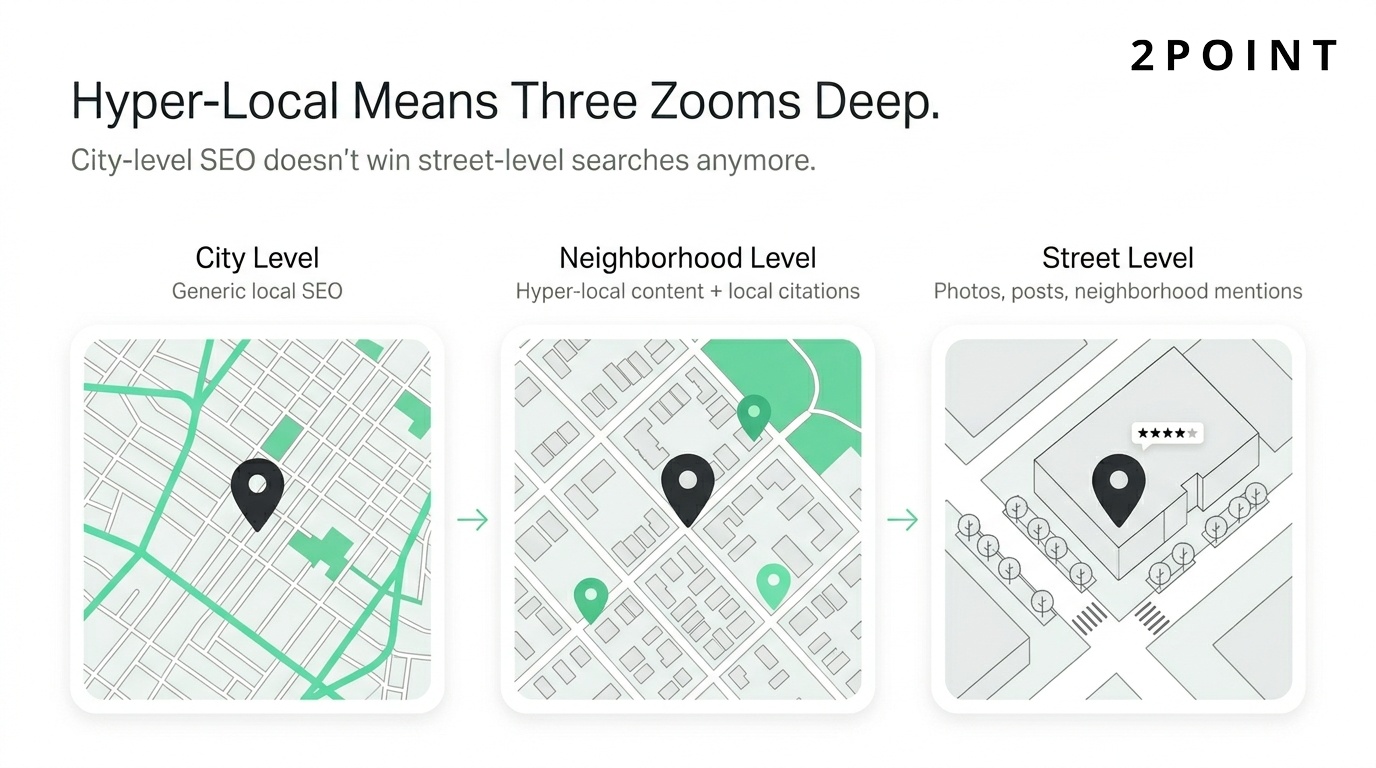
Hyper-localization represents the evolution from city-level to neighborhood-level targeting, reflecting how search engines increasingly personalize results based on precise location and community context.
Why Neighborhood-Level Optimization Matters
Hyper-local targeting matters in 2026 because search results vary significantly even within the same city. Someone searching in downtown differs from someone in a residential neighborhood, and search engines tailor results accordingly.
Google rewards neighborhood-specific activity when determining which businesses to display for local searches. A business actively engaged in a particular neighborhood often ranks higher for searches originating from that area than competitors from other parts of the city.
Implementing hyperlocal strategy requires understanding the distinct characteristics of each neighborhood you serve. Different areas have different demographics, needs, concerns, and cultures. Generic city-wide content fails to resonate like neighborhood-specific content that speaks directly to local concerns.
Proving You're Active in Specific Neighborhoods
Google tracks real-world activity signals to verify neighborhood presence. These signals include mentions on neighborhood-specific websites, participation in local events documented online, partnerships with other neighborhood businesses, and content that demonstrates detailed neighborhood knowledge.
Community engagement verification happens through various channels. Sponsoring a local Little League team that posts photos online, participating in neighborhood clean-up events that get social media coverage, or partnering with a neighborhood school for a fundraiser all create digital footprints that validate your local presence.
Mastering neighborhood SEO requires creating content that demonstrates genuine local knowledge. Writing about neighborhood history, covering local events, discussing neighborhood-specific concerns, and providing resources relevant to that specific community all signal authentic local engagement.
Multi-Location Implications
Single-location businesses are seeing traffic decline as multi-location competitors dominate search results across broader geographic areas. This trend favors businesses with multiple locations who can optimize each individual location for neighborhood-level searches.
Strategic expansion considerations now include SEO benefits alongside traditional business factors. Opening a second location in a different neighborhood provides geographic diversification that protects against localized algorithm changes and expands your visibility across more neighborhoods.
Managing multiple locations effectively requires sophisticated approaches detailed in multi-regional local SEO strategies. Each location needs individual optimization, unique content, separate citation building, and neighborhood-specific engagement while maintaining brand consistency.
How Should Businesses Respond to Increased SERP Volatility?
Search engine results pages in 2026 display with unprecedented variation and unpredictability, requiring businesses to adapt their monitoring, strategy, and expectations.
Understanding Dynamic Result Layouts
AI-driven SERP variations mean search results change dramatically based on countless signals. Time of day, user search history, device type, precise location, and inferred intent all influence which results appear and how they're formatted.
Two users searching the same query from nearby locations might see completely different results. This personalization makes traditional rank tracking less meaningful. Position 1 for one user might be position 5 for another or not appear at all for a third based on their individual context.
Module-based visibility rather than position-based ranking better reflects modern search reality. Instead of asking "what position do we rank," businesses should ask "what percentage of relevant searches display our business in some format?" This shift from positions to visibility share more accurately measures local search performance.
Testing frequency has accelerated as Google constantly experiments with result formats, feature placements, and algorithm variations. What works today might not work tomorrow, requiring continuous monitoring and rapid adaptation.
Adapting to New SERP Features
AI Overviews placement at the top of results pushes traditional organic results further down the page. Businesses must optimize for appearing within AI-generated content rather than just ranking in traditional organic positions.
Local Pack variations now include different formats depending on the query. Sometimes three businesses appear, sometimes four, sometimes a carousel of dozens. Understanding which queries trigger which formats helps businesses optimize for the most valuable result types.
Carousel integrations appear more frequently, showing scrollable business options rather than static lists. Optimizing photos, ensuring profile completeness, and generating strong reviews matters even more for carousel visibility where users quickly swipe through options.
Video result integration brings multimedia content directly into local search results. Businesses investing in video content, particularly walkthrough videos, service demonstrations, and customer testimonials, gain additional visibility opportunities in these enhanced results.
How Do You Optimize Your Google Business Profile in 2026?
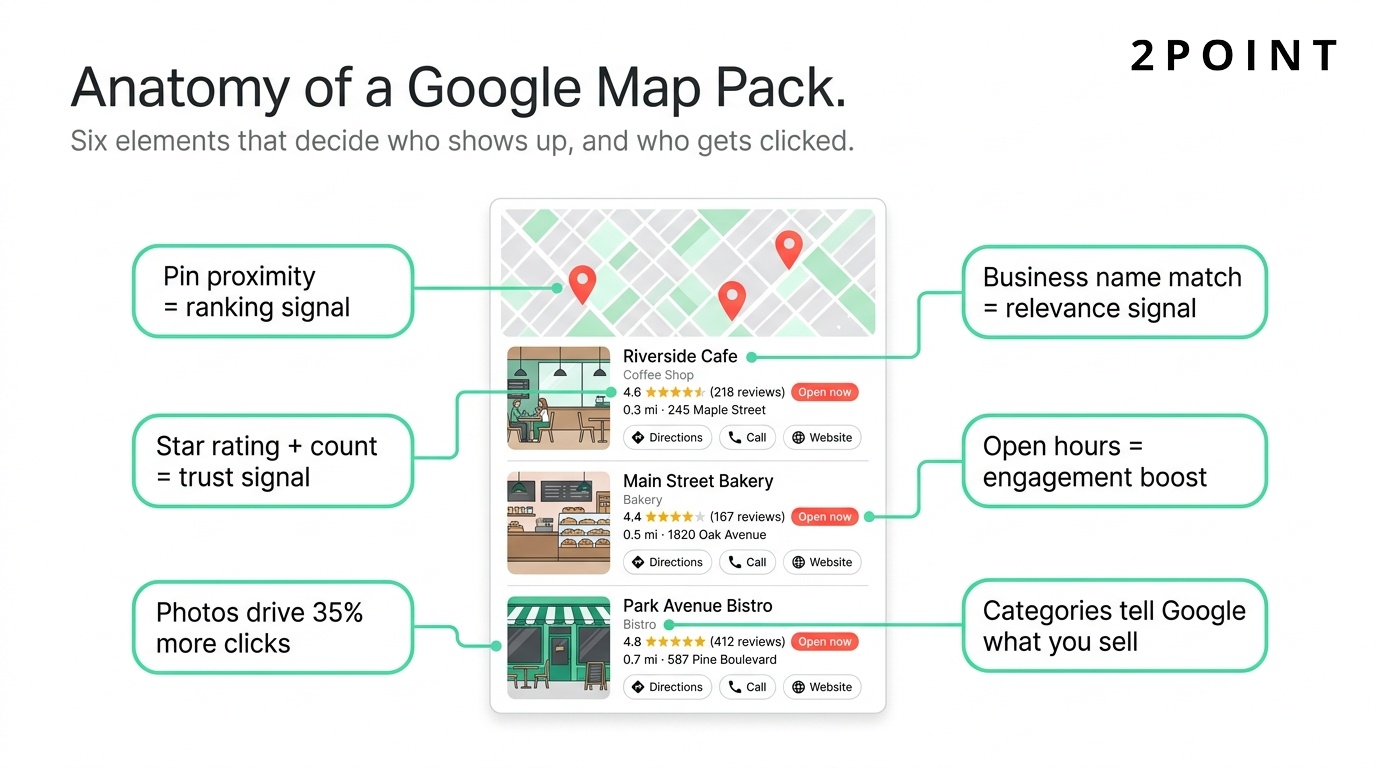
Your Google Business Profile serves as your primary asset for local search visibility. Optimization extends far beyond simply claiming your listing to encompass comprehensive management of every profile element.
Why Your Google Business Profile Is Critical
Google Business Profile functions as an AI-powered local marketing platform that gives you direct presence in Google's ecosystem. It's no longer just a listing; it's a dynamic platform for customer engagement, content distribution, and conversion optimization.
First impression statistics demonstrate the profile's importance. Customers are 2.7 times more likely to consider your business reputable with a complete profile, establishing credibility before any direct interaction occurs.
Complete profiles generate 70% more likelihood of visits and 50% more likelihood of purchase compared to incomplete profiles. These aren't marginal improvements; they're business-transforming differences that justify significant investment in profile optimization.
Engagement Growth Statistics
Google Business Profile actions increased 41% year-over-year, with calls, directions, website visits, and bookings all surging. This growth indicates users increasingly engage with businesses directly through their profiles rather than clicking through to websites.
Mobile-first interaction patterns dominate, with most GBP interactions happening on smartphones. Users search while mobile, make immediate decisions, and take action (call, navigate, visit) within seconds. This urgency requires profiles optimized for instant comprehension and immediate action.
What Makes a Profile "Complete" in 2026?
Profile completeness in 2026 means substantially more than filling in basic fields. Every single field must be accurately filled. Business name, address, phone, website, hours, categories, attributes, services, products, and descriptions all require attention.
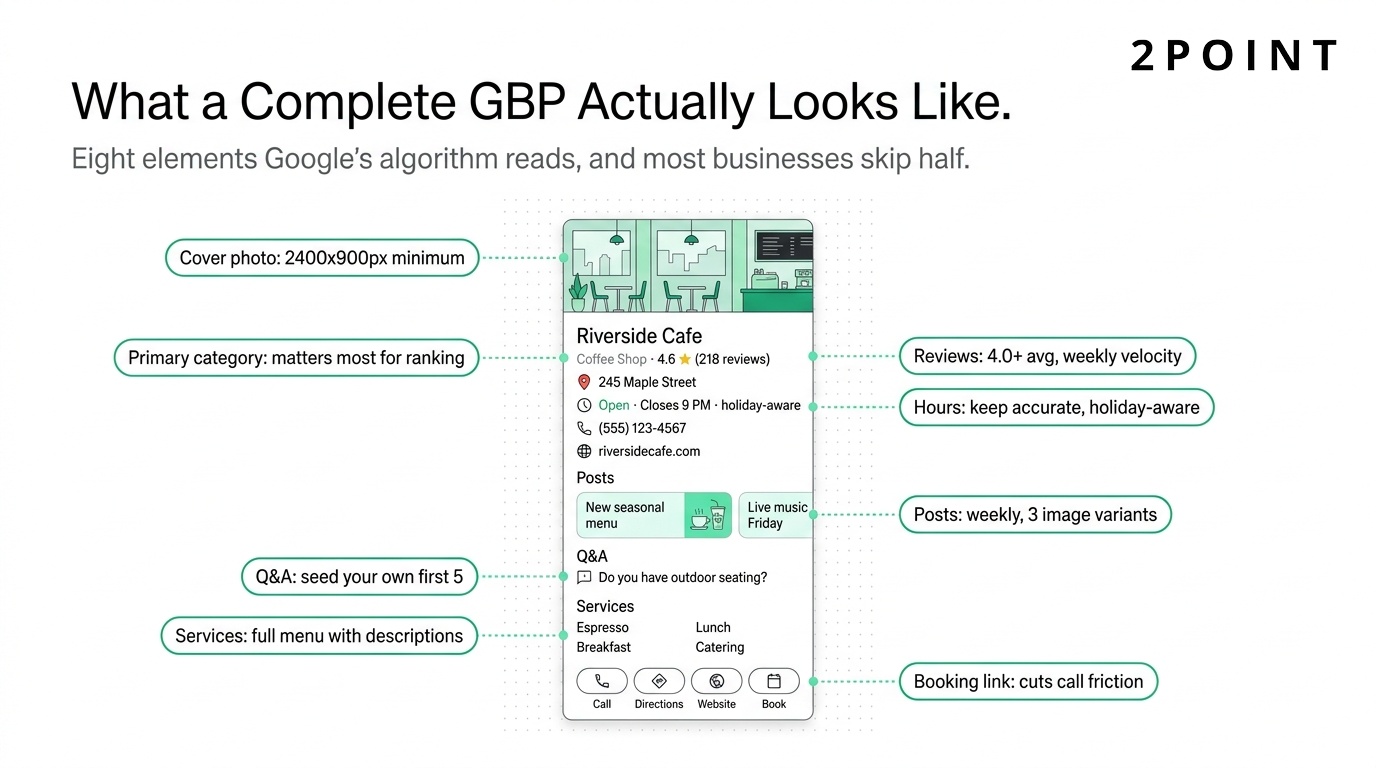
Regular update schedules matter more than one-time optimization. Businesses that update their profiles weekly show Google they're active and engaged, earning algorithmic favor over static competitors. Adding new photos, publishing posts, updating hours for holidays, and refreshing descriptions all signal vitality.
Photo libraries need depth rather than just quantity. A diverse collection showing your exterior, interior, team, products, services, and customer experiences provides comprehensive visual representation. Service menu completeness ensures Google understands exactly what you offer, matching you with relevant searches.
Attribute selection strategy requires choosing every relevant attribute Google offers. From "wheelchair accessible" to "LGBTQ+ friendly" to "outdoor seating," attributes help Google match your business with specific user needs and preferences.
How Should You Manage Business Information in Your Google Business Profile?
Accurate, consistent business information forms the foundation of local SEO success. Even minor inconsistencies or errors can significantly impact visibility and customer trust.
NAP Consistency Requirements
NAP (Name, Address, Phone) consistency means presenting identical business information everywhere it appears online. 62% of consumers avoid businesses with incorrect information, making accuracy critical for credibility and conversions.
Name consistency requires using your exact legal business name as it appears on official documentation. Avoid variations, abbreviations, or marketing names that differ from your legal entity. Address formatting must remain identical across all platforms, including abbreviations (St vs Street), suite numbers, and zip code formats.
Phone number consistency includes area codes and formatting. Using (555) 123-4567 on one platform and 555-123-4567 on another creates inconsistency that confuses both search engines and customers. Choose one format and use it universally.
Category Selection Strategy
Primary category selection represents the most important categorization decision. Your primary category should match the core of what your business does, not what you wish it did. A restaurant that occasionally caters shouldn't list "Caterer" as its primary category.
Secondary categories expand your visibility for related searches without diluting your primary focus. A pizza restaurant might add "Italian Restaurant," "Delivery Restaurant," and "Takeout Restaurant" as secondary categories to appear in related searches.
Service area definitions for businesses without physical storefronts require precision. Define the specific cities, zip codes, or radius you serve. Too broad and you'll appear in irrelevant searches; too narrow and you'll miss potential customers just outside your defined area.
Business Description Optimization
Character limits allow 750 characters for your business description. Use them wisely to communicate your unique value proposition, services offered, areas served, and what makes you different from competitors.
Keyword integration should feel natural rather than forced. Mention your services and locations conversationally within the description rather than stuffing keywords unnaturally. AI systems evaluate readability and naturalness, penalizing obvious keyword manipulation.
Call-to-action inclusion encourages users to take specific actions. Phrases like "Call us today," "Visit our showroom," or "Schedule your free consultation" provide clear next steps for interested prospects.
Unique value proposition clarity helps users understand why they should choose you over competitors. What makes your business different? Mention specializations, years of experience, unique processes, or exceptional customer service that sets you apart.
What Photo Strategy Maximizes Google Business Profile Visibility?
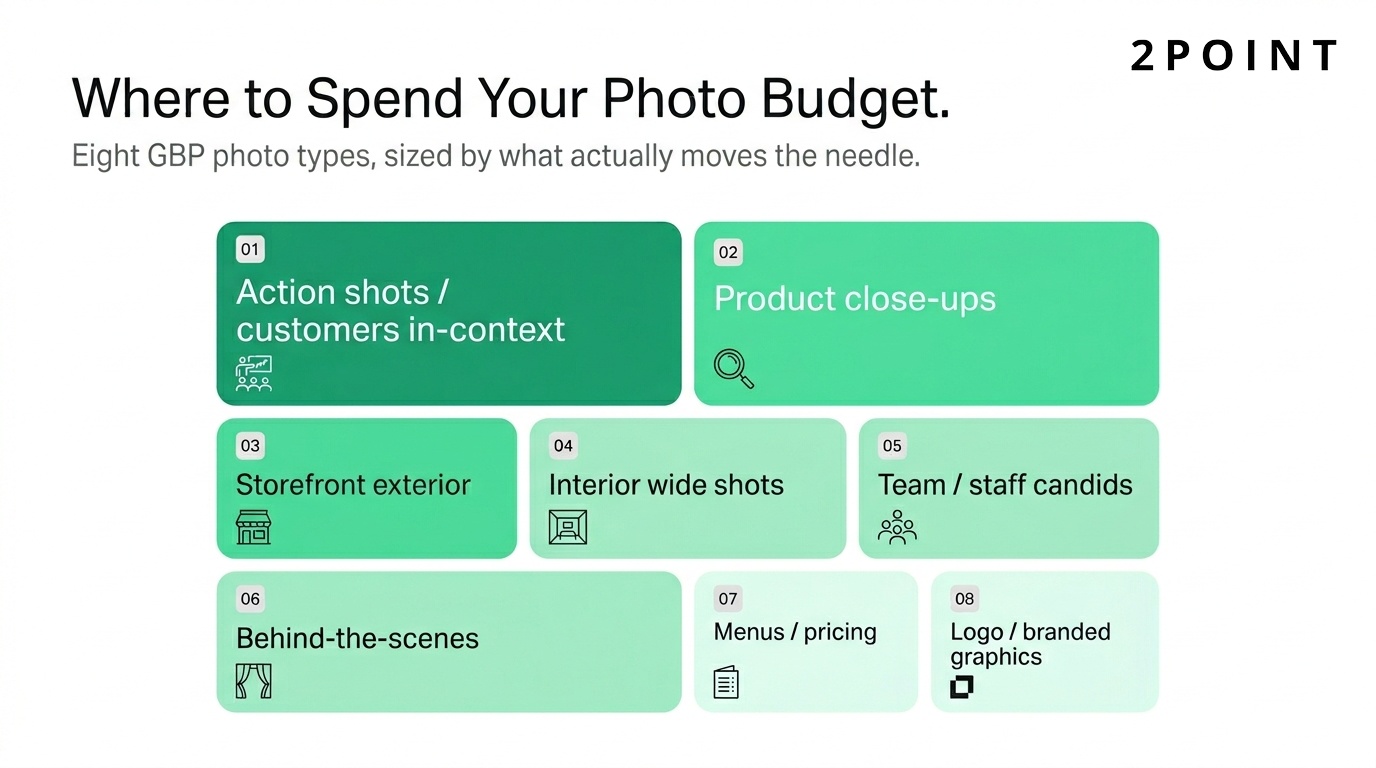
Visual content dramatically impacts both user engagement and search visibility. Strategic photo management has become one of the highest-leverage optimization activities for local businesses.
Photo Volume Requirements
Businesses with 100+ photos receive 42% more direction requests and 35% more website clicks compared to businesses with minimal photos. Volume matters because it demonstrates engagement, provides comprehensive visual representation, and gives users more information to evaluate your business.
Upload frequency should target 3-5 new photos weekly to maintain an active, fresh profile. Regular photo additions signal to Google that your business is actively managed and engaged with its online presence.
Photo Types and Categories
Exterior shots show your building, signage, parking, and surrounding area so customers can easily identify your location. Interior ambiance photos give potential customers a sense of your space, helping them visualize their experience before visiting.
Products and services photos showcase what you offer, allowing visual evaluation before contact. Team member photos humanize your business and build personal connection. Work-in-progress images demonstrate your process and build trust through transparency.
Before-and-after transformations provide powerful visual proof of your capabilities, particularly valuable for contractors, healthcare providers, and service professionals whose work produces visible results. Customer experience photos show real people enjoying your services, creating aspirational content that motivates action.
AI Photo Scanning and Verification
AI verifies service claims through photo analysis, cross-referencing images with your stated services. If you claim to offer patio installation but have no photos of patios, AI recognizes this inconsistency and may doubt your claims.
Quality standards for AI recognition require clear, well-lit, focused images. Blurry, dark, or poor-quality photos don't provide the visual information AI systems need to understand and categorize your services. Professional or high-quality smartphone photos substantially outperform low-quality images.
EXIF data embedded in photos includes information about when and where photos were taken. Preserving this data rather than stripping it out provides additional verification signals. Geotagging benefits come from photos tagged with your business location, providing another data point confirming your physical presence.
How Should You Use Google Posts Effectively?
Google Posts allow businesses to share updates, offers, events, and products directly in search results and on your profile. Strategic post management keeps your profile dynamic and engaging.
Posting Frequency Impact
Weekly updates result in a 30% increase in customer interactions, demonstrating that regular posting directly impacts engagement. Posting 2-3 times per week generates 34% higher engagement than monthly posting, showing that consistency matters more than occasional bursts of activity.
Frequency beats intensity. Rather than posting seven times in one day then disappearing for a month, spread posts evenly throughout weeks and months. This consistent presence signals active management and gives users fresh content each time they view your profile.
Post Types and Use Cases
Updates communicate business news, changes, announcements, and general information about your business. New services, team additions, operational changes, or company milestones all fit the update format.
Offers promote special discounts, limited-time deals, or exclusive promotions. These posts should include clear terms, expiration dates, and calls-to-action that create urgency and drive immediate action.
Events announce upcoming activities, webinars, in-person gatherings, or time-specific happenings. Event posts include dates, times, and registration or attendance information, appearing in Google's event discovery features.
Products showcase new items, featured products, or seasonal offerings. Product posts can include pricing, descriptions, and direct purchase links, turning your profile into a mini e-commerce storefront.
Post Optimization Techniques
Compelling headlines grab attention in the limited space available. Front-load important information and use action words that encourage engagement. Clear calls-to-action tell users exactly what you want them to do: "Shop now," "Learn more," "Book today," or "Call for details."
Visual consistency across posts creates recognizable branding. Using consistent image styles, color schemes, and formatting helps users immediately identify your posts as they scroll through their feed.
Link strategies direct traffic to specific landing pages rather than just your homepage. Deep linking to relevant pages improves conversion rates by sending users exactly where they need to go.
Seasonal alignment ties posts to relevant times of year, holidays, local events, or industry-specific seasons. This relevance increases engagement and makes posts feel timely rather than generic.
How Do You Manage Q&A on Your Google Business Profile?
The Questions and Answers section allows anyone to ask questions about your business, and anyone (including you) can answer. Proactive management turns this feature from a liability into an asset.
Proactive Q&A Seeding
Self-answering common questions gives you control over the narrative. Rather than waiting for customers to ask questions, anticipate their concerns and post questions yourself with comprehensive answers. This ensures accurate information appears first.
Comprehensive FAQ coverage addresses questions about hours, parking, accessibility, pricing, appointment processes, and anything else customers typically ask. Thorough Q&A sections reduce repetitive customer service inquiries while improving search visibility.
Keyword integration opportunities exist because Q&A content is indexed and searchable. Crafting questions and answers that naturally incorporate relevant keywords helps your business appear for related searches.
Structured answer formats using lists, clear paragraphs, and organized information make answers easy to scan and comprehend. Users appreciate well-formatted answers that quickly address their concerns.
Reactive Q&A Monitoring
Response time importance cannot be overstated. Unanswered questions signal neglect and create opportunities for competitors or malicious actors to provide misleading answers. Set up notifications for new questions and respond promptly.
Answer quality standards require comprehensive, helpful responses rather than curt one-word answers. Treat each question as an opportunity to showcase your expertise and customer service quality.
Flagging inappropriate questions removes spam, offensive content, or questions from competitors attempting to harm your reputation. Google allows businesses to suggest inappropriate questions for removal.
Community building through Q&A happens when you engage genuinely with people asking questions, thank them for their interest, and provide value even to people who haven't yet become customers.
What Role Do Services and Products Features Play in Optimization?
The Services and Products sections of your Google Business Profile provide structured ways to showcase what you offer, improving both user experience and search visibility.
Services Menu Optimization
Detailed service descriptions explain what each service includes, the process involved, and what customers can expect. Comprehensive descriptions help users understand exactly what they're getting, reducing uncertainty and increasing conversions.
Pricing transparency builds trust when appropriate for your business model. Some industries benefit from displaying prices; others require consultation. Display ranges or starting prices when exact pricing varies by customer needs.
AI cross-references your service listings with your website content to verify consistency and comprehensiveness. Ensure your website describes the same services with similar language to strengthen AI's confidence in your service offerings.
Service category hierarchy organizes complex service menus into logical groups. Rather than listing 30 services in random order, group related services under category headings that help users navigate your offerings.
Products Showcase
Product photography should be clear, well-lit, and show products from multiple angles. Consistent background and lighting create professional presentation that builds trust.
Descriptions and specifications provide necessary details for informed purchasing decisions. Include dimensions, materials, colors available, or other relevant attributes.
Pricing display, when appropriate, helps users make decisions without needing to contact you first. This convenience increases conversion likelihood for price-conscious shoppers.
Inventory integration for retailers can show real-time availability, preventing frustration from users arriving to purchase out-of-stock items. Seasonal product rotation keeps offerings current and relevant, showing fresh products for holidays, seasons, or changing inventory.
How Can You Optimize Booking and Messaging Features?
Integrated booking and messaging reduce friction in the customer journey, allowing users to take action without leaving Google search results.
Direct Booking Setup
Integrated scheduling systems connect your appointment calendar directly to your Google Business Profile. When users search for your business, they can book appointments immediately without visiting your website or calling.
Third-party booking platform connections work with services like Calendly, Acuity Scheduling, Booksy, or industry-specific platforms. Google integrates with numerous scheduling tools, allowing businesses to leverage existing systems.
Appointment types configuration lets you define different service types, durations, and availability. A dentist might offer cleaning appointments, consultations, and emergency slots, each with different time allocations.
Availability management requires keeping your connected calendar current. Double-bookings or showing availability when you're actually unavailable creates frustrating customer experiences that damage reputation.
Messaging Best Practices
Response time expectations are high for messaging features. Users expect same-day responses, ideally within hours. Slow responses cause users to move on to competitors who respond faster.
Automated versus personal responses balance efficiency with authenticity. Automated acknowledgments ("Thanks for your message, we'll respond within 2 hours") provide immediate feedback while personal follow-ups address specific questions.
Conversion optimization through messaging involves asking qualifying questions, providing helpful information, and smoothly transitioning interested prospects toward booking, calling, or visiting. FAQ automation handles common questions instantly, reserving human time for complex inquiries requiring personal attention.
What Insights and Analytics Should You Track?
Google Business Profile Insights provide valuable data about how users find and interact with your business. Understanding these metrics enables data-driven optimization.
Key Metrics to Track
Search query data shows exactly what terms people use to find your business. This information guides content creation, keyword optimization, and helps you understand customer language and intent.
Discovery searches represent users finding you while searching for a category or service. These searches indicate you're appearing in relevant general searches. Direct searches show users specifically looking for your business by name, measuring brand awareness.
Actions taken (calls, directions, website clicks) measure profile effectiveness at driving conversions. High impression numbers mean nothing without corresponding actions. Photo view statistics indicate user interest in your visual content and which photos attract the most attention.
Competitive Benchmarking
Market position insights compare your performance to similar businesses in your area. Understanding where you rank relative to competitors helps identify strengths to leverage and weaknesses to address.
Performance comparisons show whether you're gaining or losing ground. Tracking trends over time reveals whether your optimization efforts are working or if you're falling behind market changes.
Opportunity identification happens when you analyze competitors outperforming you in specific metrics. If a competitor gets 3x more direction requests, investigate their profile to understand what they're doing differently.
Why Are Reviews So Critical for Local SEO Success?
Online reviews have evolved from nice-to-have social proof to essential ranking factors and trust signals that directly impact visibility and conversions.
Consumer Behavior Statistics
87% of consumers read online reviews for local businesses, making reviews nearly universal in the customer research process. Reviews are no longer supplementary information; they're primary evaluation criteria.
54% visit a business's website after reading positive reviews, showing that reviews directly drive traffic and interest. Positive reviews create momentum that moves prospects through the conversion funnel.
90% of consumers won't engage without scanning feedback first, eliminating businesses without reviews from consideration entirely. Businesses with fewer than 10 reviews face conversion penalties as users perceive them as unproven or potentially risky choices.
Reviews as Ranking Signals
Reviews directly influence local search rankings through multiple mechanisms. Review quantity matters; more reviews signal popularity and reliability. Review velocity (how frequently you receive new reviews) indicates current business activity and customer satisfaction.
Rating thresholds create cutoff points where businesses below certain star ratings struggle to appear prominently. Most experts recommend maintaining at least a 4.0-star average to remain competitive in local search results.
Review recency weighs heavily in current algorithms. Ten reviews from the past month outperform 50 reviews from two years ago. Google prioritizes businesses with ongoing, current customer feedback over those with stale review profiles.
AI Sentiment Analysis of Reviews
AI evaluates reviews beyond simple star ratings, extracting thematic information about speed, quality, friendliness, and specific service attributes. A 5-star review saying "fast service" signals different strengths than a 5-star review praising "attention to detail."
Thematic interpretation means AI understands context and extracts specific business attributes from natural language reviews. Reviews mentioning "parking" help Google understand your parking situation; reviews discussing "staff friendliness" contribute to customer service perception.
Sentiment patterns affecting visibility occur when numerous reviews mention similar themes. Consistent praise for specific attributes reinforces those strengths in Google's understanding of your business. Conversely, recurring complaints about the same issues create negative signals.
How Is Anonymous Reviewing Changing the Review Landscape?
Google's introduction of anonymous review options has altered review dynamics, potentially increasing volume while changing the nature of feedback businesses receive.
Google's Anonymous Review Feature
Users can now hide their name and image when leaving reviews, reducing the personal accountability that previously discouraged some negative reviews. This anonymity lowers the barrier for leaving honest feedback but also potentially enables less constructive criticism.
The likely increase in overall review volume benefits businesses overall as higher review counts improve visibility and credibility. However, the balance between positive and negative reviews may shift.
Potential for more negative reviews due to anonymity requires businesses to strengthen their review generation strategies, ensuring they proactively request reviews from satisfied customers to balance anonymous criticism.
Adapting to Anonymous Feedback
Response strategies for anonymous reviews should maintain the same professionalism and helpfulness as responses to named reviews. Address concerns genuinely, offer solutions, and demonstrate that you take all feedback seriously regardless of reviewer identity.
Maintaining professionalism proves especially important when responding to harsh anonymous criticism. Avoid defensive, dismissive, or sarcastic responses that damage your reputation more than the negative review itself.
Pattern identification becomes more important when reviews are anonymous. If multiple anonymous reviews mention the same issue, treat it as a legitimate operational problem requiring attention rather than dismissing it as trolling.
Operational improvements from feedback demonstrate that you value all reviews. Using anonymous feedback to identify and fix genuine problems turns criticism into opportunity for meaningful business improvement.
What Strategies Generate More Reviews Ethically?
Review generation requires consistent, ethical processes that encourage satisfied customers to share their experiences without violating platform policies or customer trust.
Ethical Review Acquisition
Asking all customers, not just obviously happy ones, maintains integrity and complies with platform policies. Review gating (only requesting reviews from satisfied customers) violates Google's guidelines and creates artificially inflated ratings.
Timing requests appropriately increases response rates. Ask soon after positive interactions when satisfaction is highest and the experience is fresh. For service businesses, request reviews immediately after service completion; for products, wait until the customer has received and used the item.
Multi-channel request methods include email campaigns, SMS follow-ups, in-person requests, printed materials with QR codes, and post-transaction thank-you pages. Diversifying request channels increases overall response rates.
Making it easy to leave reviews removes friction that prevents willing customers from following through. Provide direct links to your review profile, use QR codes that open review forms directly, and offer clear instructions.
Review Request Tactics
Email campaigns automated through your CRM or booking system can trigger review requests at optimal times. Personalized emails referencing specific services or purchases feel more genuine than generic templates.
SMS follow-ups work particularly well for service businesses where you have customer phone numbers. Text messages have higher open rates than email, and brief messages with direct review links make leaving reviews convenient.
In-person requests work exceptionally well when made at moments of high satisfaction. A satisfied customer who just received excellent service often agrees immediately to leave a review when asked personally.
QR codes and short links posted at your business, on receipts, or on business cards let customers leave reviews without typing URLs or searching for your profile. Reduced friction increases follow-through rates.
Post-service timing matters more than most businesses realize. Requesting reviews within 24 hours of service completion captures maximum satisfaction before other experiences dilute the memory.
How Should You Respond to Reviews?
Review responses demonstrate customer service quality to both the reviewer and future prospects reading reviews. Strategic response management builds reputation and influences purchasing decisions.
Response Time Importance
Speed signals active management and customer care. Reviews responded to within 24-48 hours show businesses that value feedback and actively engage with customers. Slow or absent responses suggest neglect and reduced customer service priority.
Monitoring systems setup ensures you see new reviews immediately. Enable notifications, check review platforms daily, or use reputation management tools that aggregate reviews from multiple sources and alert you to new feedback.
Responding to Positive Reviews
Personalization over templates creates authentic engagement. Reference specific details from the review rather than posting generic "Thanks for your review!" responses that apply to any review.
Specific detail references show you actually read the review: "We're so glad you enjoyed the shrimp scampi and that Maria provided excellent service." This personal touch reinforces positive feelings and impresses potential customers reading reviews.
Gratitude expression should feel genuine and enthusiastic. Thank reviewers for taking time to share their experience, acknowledge that their feedback means a lot, and express hope that they'll return.
Invitation to return encourages repeat business: "We look forward to serving you again soon" or "We can't wait to see you back for another visit." This subtle call-to-action plants seeds for future transactions.
Keyword integration opportunities exist in review responses. Naturally mentioning services, locations, or specialties in responses helps with local SEO without feeling forced or manipulative.
Responding to Negative Reviews
Emotional regulation is critical. Take time to process negative reviews before responding. Angry, defensive responses damage your reputation more than the negative review itself. Respond professionally, calmly, and constructively.
Public acknowledgment combined with private resolution balances transparency with detailed problem-solving. Publicly acknowledge the concern, apologize if appropriate, and offer to discuss details privately: "We're sorry for this experience. Please contact us at [email/phone] so we can make this right."
Apology frameworks should be genuine when mistakes occurred but avoid excessive self-flagellation. "We apologize that we didn't meet your expectations" acknowledges the issue without accepting blame for unreasonable complaints.
Solution offering demonstrates commitment to customer satisfaction. Explain how you'll address the problem or invite the reviewer to give you another chance: "We've addressed this issue with our team and would love the opportunity to provide the experience you deserved."
Taking conversations offline prevents public arguments and allows detailed discussion of sensitive issues. "Please contact our manager directly at [contact] to discuss this further" moves the conversation to appropriate channels.
Turning critics into advocates sometimes happens when businesses respond exceptionally well to complaints. Customers who experience problems followed by outstanding recovery often become loyal advocates, impressed by how the business handled adversity.
Why Should You Expand Beyond Google Reviews?
While Google reviews remain most important for local SEO, multi-platform review presence strengthens overall online reputation and reaches customers where they make decisions.
Alternative Review Platforms
37% of U.S. consumers use Instagram for reviews, particularly for restaurants, retail, and visually-oriented businesses. Instagram reviews come through tags, mentions, and stories rather than formal review platforms.
29% use TikTok for local business reviews, especially younger demographics researching restaurants, experiences, and local services. TikTok reviews happen through video content, reactions, and recommendations rather than star ratings.
Industry-specific platforms matter depending on your field. Yelp dominates restaurant and hospitality reviews; Healthgrades serves healthcare providers; Avvo ranks lawyers; Zillow features real estate agents. Building presence on relevant industry platforms expands your review footprint.
Facebook recommendations add another review source, particularly for businesses with active Facebook presences. Facebook's recommendation system differs from traditional reviews but influences potential customers researching businesses.
Platform Prioritization
Google serves as the foundation because of its dominant search market share and direct impact on local rankings. Focus 60% of review generation efforts on Google reviews to maximize SEO benefits.
Industry-specific secondary platforms receive the next priority tier. Healthcare providers should emphasize Healthgrades; lawyers should build Avvo profiles; restaurants need strong Yelp presence. Allocate 30% of efforts to your most relevant industry platform.
Social proof on social media represents the remaining 10% of effort. Encouraging customers to share experiences, tag your business, and post about their visits creates valuable social signals and reaches prospects through trusted peer recommendations.
Testimonial aggregation on your website collects reviews from all platforms into a centralized display. Showcase your best reviews on your website to maximize their impact with visitors already interested enough to visit your site.
What Are the Quality Benchmarks for AI Search Platforms?
Artificial intelligence search platforms use different algorithms and data sources than traditional Google search, creating new quality standards businesses must meet for visibility.
AI Search Platform Standards
ChatGPT-recommended businesses average 4.3 stars, establishing a high quality bar. Businesses below this threshold face reduced likelihood of AI recommendation.
Perplexity.ai recommends businesses averaging 4.1 stars, slightly lower than ChatGPT but still above the general Google average. This suggests Perplexity may accept slightly broader quality ranges.
Google Gemini recommendations average 3.9 stars, closest to general market averages but still requiring above-average ratings. Meeting these quality thresholds ensures eligibility for AI recommendations.
Contact Information Accuracy Issues
Only 68% of business information on ChatGPT and Perplexity matches Google Business Profile data, revealing significant data inconsistencies across AI platforms. This discrepancy creates customer frustration and lost opportunities when inaccurate information appears in AI responses.
Verification across platforms requires checking how your business appears in ChatGPT, Perplexity, Gemini, and other AI platforms. Search for your business name and verify that contact information, hours, and services match your actual offerings.
Claiming business profiles on AI platforms where possible establishes control over your information. While many AI platforms don't yet offer direct profile management, future systems will likely allow businesses to claim and manage their AI platform presence.
Regular auditing of AI platform data ensures ongoing accuracy. Check quarterly how your business appears in major AI search tools and contact the platforms when inaccuracies appear, requesting corrections.
What Are Local Citations and Why Do They Matter?
Local citations are online mentions of your business name, address, and phone number on directories, websites, and platforms across the internet. They serve as trust signals that verify your business's legitimacy and location.
Understanding Citations
Structured citations appear in formal business directories with consistent data fields: business name, address, phone, website, hours, categories. Examples include Yelp, Yellow Pages, Chamber of Commerce directories, and industry-specific directories.
Unstructured citations mention your business within content, articles, or reviews without formal directory structure. A local newspaper article mentioning your business name and location creates an unstructured citation.
Direct citations explicitly list your NAP information. Indirect citations mention your business name without full contact details but still contribute to brand recognition and local relevance signals.
Citations function as trust signals for search engines. When your business appears consistently across numerous reputable sources, search engines gain confidence that you're a legitimate business operating at the stated location.
Why Citations Matter in 2026
Ranking factor weight for citations has evolved. While not as dominant as they were five years ago, citations remain important verification signals, particularly for new businesses establishing credibility.
Business verification function means citations help search engines confirm your business exists and operates where you claim. Multiple consistent citations from trusted sources validate your Google Business Profile information.
Discovery channels open when your business appears in directories where potential customers search. Users browsing Yelp, industry directories, or local business listings might discover your business independently of Google search.
AI data source verification happens when AI systems cross-reference business information across multiple sources. Consistent citations across numerous platforms increase AI confidence in your business details.
How Do You Build Citations Effectively?
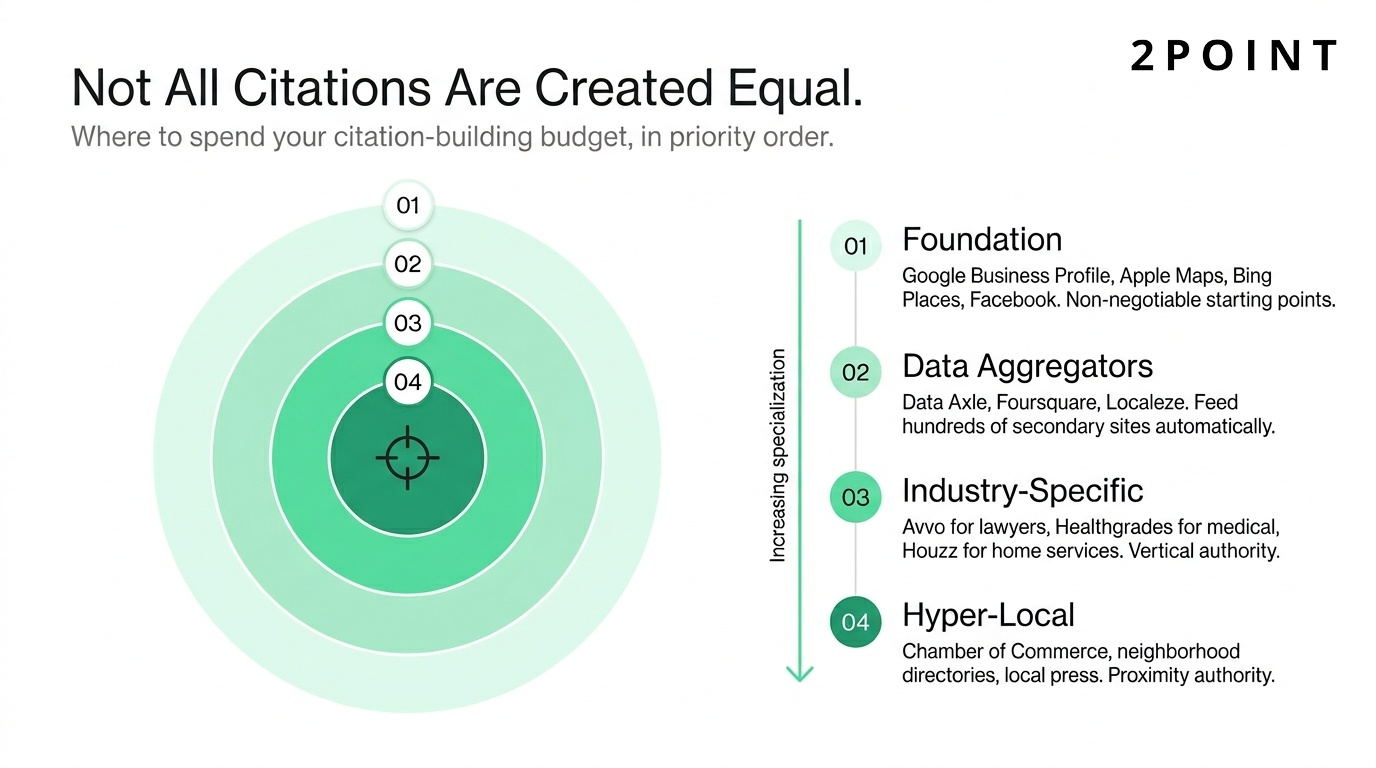
Strategic citation building focuses on quality sources, consistency, and tier-based prioritization rather than merely maximizing citation quantity.
Priority Citation Sources
Major data aggregators distribute business information to hundreds of smaller directories. Data Axle, Neustar Localeze, Foursquare, and Factual serve as upstream sources that feed data to downstream directories. Ensuring accuracy with these aggregators creates cascading benefits across many platforms.
Google Business Profile remains the foundational citation that all others should match. Every other directory should perfectly mirror the information in your GBP to maintain consistency.
Apple Maps has gained importance for iPhone users and Siri searches. Claiming and optimizing your Apple Maps listing ensures visibility for this significant user segment.
Bing Places serves Microsoft's search engine and powers Yahoo Local. While smaller than Google, Bing still captures meaningful search volume worth optimizing for.
Facebook Business Page functions as both a social platform and a business directory. Many users search Facebook for local businesses, and your Facebook presence contributes to overall online visibility.
Industry-specific directories matter more than generic ones. A restaurant gains more value from a Zomato or OpenTable listing than a general business directory.
Tier-Based Citation Building Approach
Tier 1 citations are universal sources every business needs: Google Business Profile, Apple Maps, Bing Places, Facebook, Yelp, and major data aggregators. Build these first for all businesses regardless of industry.
Tier 2 citations include industry-specific directories relevant to your field. Healthcare providers need Healthgrades and Zocdoc; lawyers need Avvo and Justia; home services need HomeAdvisor and Angi. Research directories specific to your industry and build presence on the most authoritative platforms.
Tier 3 citations encompass local and regional directories. Chamber of Commerce websites, local business associations, city business directories, and regional economic development sites all provide valuable local signals. These citations particularly benefit businesses emphasizing local community connections.
Tier 4 citations represent niche and micro-local opportunities. Neighborhood association websites, local blogs mentioning area businesses, community event sites, and hyperlocal platforms create the deepest local signals. These citations take more effort to build but provide strong neighborhood-level authority.
Neighborhood-Level Citations
A neighborhood blog link provides more local SEO value than a generic national directory because it demonstrates genuine community integration. These hyper-local citations signal authentic neighborhood presence rather than just directory spam.
Local neighborhood associations often maintain business member directories or resource pages. Joining and getting listed provides valuable local citations and demonstrates community involvement.
Community blogs and news sites covering neighborhood events, local business profiles, or area resources create powerful local citations. Pitch story ideas to local bloggers or offer to sponsor community content.
Chamber of Commerce listings in your specific city or neighborhood provide authoritative local citations while offering networking and community benefits beyond SEO.
Business improvement districts (BIDs) in urban areas maintain business member directories that provide strong local citations and demonstrate your participation in organized community development efforts.
Why Is NAP Consistency So Critical?
NAP (Name, Address, Phone) consistency means presenting identical business information across every online platform. Inconsistencies confuse search engines and erode customer trust.
The NAP Formula
Exact name matching requires using your precise business name as it appears on official documents everywhere online. "ABC Plumbing" should never appear as "ABC Plumbing LLC" in some places and "ABC Plumbing, Inc." in others.
Address formatting standards demand identical presentation down to abbreviations and punctuation. Decide whether you'll use "Street" or "St," whether to include or exclude the suite number, and how to format your zip code, then use that exact format everywhere.
Phone number consistency extends to formatting choices. Using (555) 123-4567 on some platforms and 555-123-4567 on others creates inconsistency. Choose one format and maintain it universally.
The impact of inconsistencies is severe: 62% of consumers avoid businesses with incorrect information, translating directly to lost revenue and conversion opportunities.
Common Consistency Issues
Suite or unit number variations create confusion. "Suite 100," "Ste 100," "#100," and "Unit 100" all refer to the same location but appear inconsistent to search algorithms. Choose one format and use it everywhere, including or excluding suite numbers consistently.
Abbreviation differences like "Street" versus "St" or "Avenue" versus "Ave" seem minor but create database mismatches. Data systems recognize these as different addresses even when humans understand they're identical.
Phone number formatting inconsistencies include differences in how numbers display: (555) 123-4567, 555-123-4567, 555.123.4567, or +1-555-123-4567. These all represent the same number but appear different to algorithms checking consistency.
Business name changes require updating every citation when you rebrand or alter your business name. Leaving old names on some directories while updating others creates severe inconsistency penalties.
Multi-location NAP management becomes complex when one business operates several locations. Each location needs its own consistent NAP across all platforms, requiring careful tracking and management systems.
Citation Audit Process
Manual checking methods involve searching for your business name plus "address" or "phone" and reviewing the first several pages of results. Document every instance of your NAP and note any inconsistencies.
Citation tracking tools like BrightLocal, Whitespark, or Yext automate the discovery process, scanning hundreds of directories to find citations and flag inconsistencies. These tools save significant time for businesses with substantial citation footprints.
Inconsistency identification prioritizes which problems to fix first. Focus on major platforms, authoritative sources, and data aggregators before obscure directories with minimal impact.
How Do You Clean Up Citation Problems?
Citation cleanup addresses duplicate listings, incorrect information, outdated entries, and abandoned platforms to restore NAP consistency.
Identifying Problem Citations
Duplicate listings occur when multiple entries exist for the same business location. This happens when different people create listings, automated systems scrape inaccurate data, or old listings persist alongside new ones. Duplicates confuse search engines and split your authority across multiple profiles.
Incorrect information includes wrong addresses, disconnected phone numbers, outdated hours, or inaccurate business descriptions. These errors occur through data aggregation mistakes, user edits, or failure to update platforms after business changes.
Outdated listings persist on platforms you've forgotten about or platforms that pulled old data. Businesses that moved locations, changed phone numbers, or rebranded often have zombie listings with old information still appearing in search results.
Abandoned platforms where you once maintained profiles but no longer update need either deletion or revival. Platforms like Foursquare, Merchant Circle, or industry-specific directories you've neglected create consistency problems.
Correction Strategies
Claiming unclaimed listings gives you control over business information. Many directories allow business owners to claim profiles, providing editing access and verification status that lends authority to your listing.
Update submission processes vary by platform. Some allow immediate edits after claiming; others require verification steps before changes take effect. Document the update process for major platforms to streamline future corrections.
Platform-specific procedures differ significantly. Yelp, Bing, and industry directories each have unique processes for claiming, verifying, and updating listings. Learning each platform's requirements prevents frustration and ensures successful updates.
Documentation for verification often requires proving business ownership through utility bills, business licenses, tax documents, or other official paperwork. Having this documentation ready accelerates the verification process across multiple platforms.
Monitoring and Maintenance
Quarterly citation audits catch new inconsistencies before they cause significant damage. Schedule regular reviews of your top 20-30 citations to ensure accuracy remains consistent.
Automated monitoring tools alert you when new citations appear or existing ones change. Some services track your business across hundreds of directories and notify you of changes, enabling rapid correction of problems.
Change management protocols document how to update all citations when business information changes. Moving locations, changing phone numbers, or rebranding requires systematic updates across dozens or hundreds of platforms.
Expansion to new platforms should include citation building as a standard checklist item. Whenever you establish presence on a new directory or platform, ensure your NAP matches all other sources.
How Does Link Building Support Local SEO?
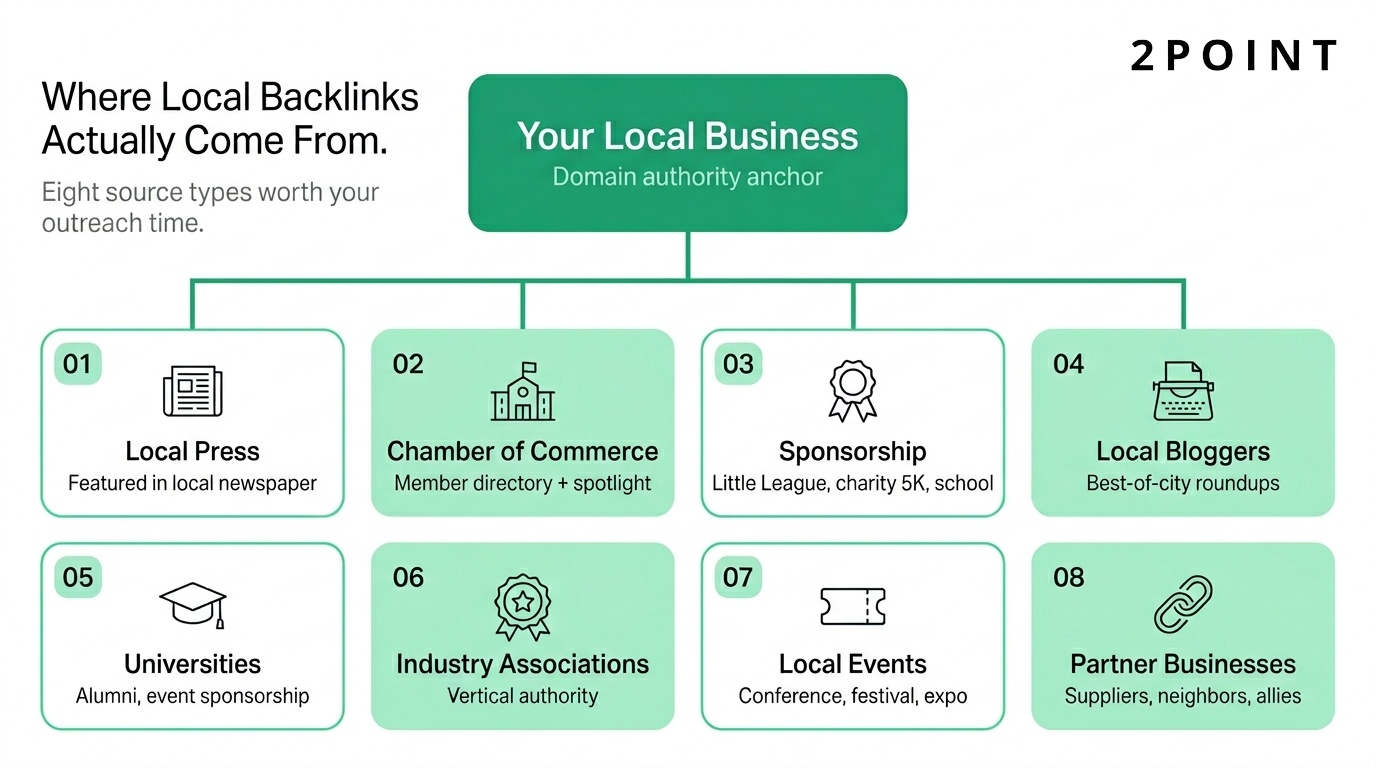
While local business link building differs from traditional SEO link building, earning links from local websites, community organizations, and relevant sources strengthens local authority and rankings.
Local Link Value
71% of local SEO marketers maintain dedicated link building strategies, demonstrating that sophisticated practitioners recognize link importance despite growing emphasis on Google Business Profile optimization.
Quality dramatically outweighs quantity in 2026. One link from a respected local newspaper provides more value than dozens of links from low-quality directories or spammy websites. Focus on earning links from authoritative, relevant sources rather than accumulating maximum link volume.
Relevance and geographic proximity create ideal link profiles. Links from businesses, organizations, and websites in your geographic area signal local authority more effectively than links from unrelated geographic regions.
Local Link Opportunities
Local news coverage provides some of the most valuable local links. Getting featured in newspaper articles, local news websites, or community publications creates authoritative links that signal community prominence.
Sponsorships and partnerships with local organizations, sports teams, charities, or community events often result in website mentions and links. These relationships provide both marketing exposure and link building benefits.
Community event involvement generates links when event organizers, participants, or sponsors mention your business on their websites. Sponsoring a local festival, participating in charity events, or hosting community gatherings creates link opportunities.
Local resource pages curated by chambers of commerce, city websites, or community organizations provide valuable links. Getting listed on "best local businesses" or "community resources" pages provides both traffic and SEO value.
Chamber of Commerce membership typically includes a profile on the chamber website with a link to your site. These authoritative local links benefit most businesses regardless of the direct traffic they generate.
Educational institution connections offer valuable local links. Offering internships, guest speaking, or sponsorships to local schools and universities can result in links from .edu domains, which carry particular authority.
Link Building Tactics
Creating linkable local content means producing resources others want to reference. Local industry guides, neighborhood resources, community event calendars, or unique local data create link-worthy assets.
Local scholarship programs generate links from schools promoting the opportunity and organizations sharing scholarship resources. Even modest scholarships create meaningful link opportunities from authoritative educational domains.
Community surveys and reports produce original data that journalists and bloggers reference, earning links when they cite your research. Surveying local attitudes, producing industry reports, or compiling local statistics creates citation-worthy content.
Expert roundups featuring local business leaders, community influencers, or industry experts encourage participants to share and link to the finished piece, multiplying its reach and link value.
Local infographics visualizing community data, neighborhood statistics, or local industry information create highly shareable assets that naturally earn links when others republish or reference them.
How Should You Optimize Your Website for Local Search?
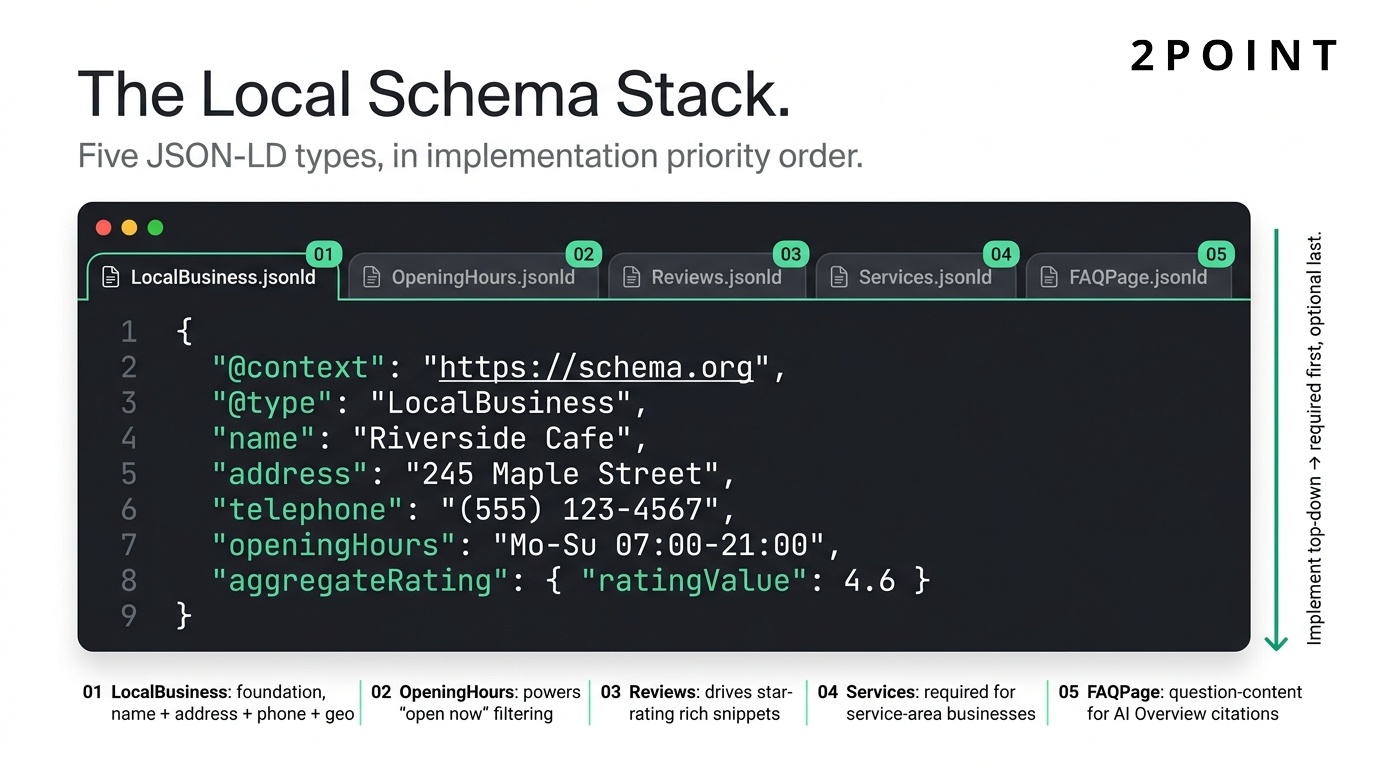
Your website serves as the foundation of your digital presence. Optimizing it for local intent ensures search engines and users immediately understand your geographic relevance.
Homepage Optimization
Location prominence in title tags places your primary service area in the title: "Best Plumber in Seattle | ABC Plumbing." This immediately signals geographic relevance to both search engines and users.
Geographic modifiers in H1 headings reinforce local relevance: "Seattle's Most Trusted Plumbing Service Since 1995." Primary headings that include location signals help search engines understand your geographic focus.
Service area descriptions explicitly state where you operate. Don't assume search engines understand your service area; clearly state "Proudly serving Seattle, Bellevue, Redmond, and surrounding King County" or similar geographic descriptions.
Embedded Google Maps showing your location or service area provides visual confirmation of your geographic focus. The embedded map serves as another data point verifying your location information.
Schema markup for local businesses provides structured data that search engines can easily parse. LocalBusiness schema includes your NAP, hours, geographic coordinates, and other structured information search engines prioritize.
Click-to-call functionality makes phone numbers tappable on mobile devices, removing friction from the contact process. Many local searches occur on mobile devices with high intent to call, making easy contact critical.
Directions integration links directly to mapping applications, allowing mobile users to navigate to your location with one tap. This convenience improves user experience and increases the likelihood of in-person visits.
Location-Specific Service Pages
Individual pages for each service and location combination maximize local relevance for specific searches. A multi-service business operating in multiple cities benefits from "Service Name + City Name" pages: "Roof Repair in Seattle," "Roof Repair in Tacoma," etc.
City-specific landing pages target each major city in your service area with dedicated pages discussing your services in that specific location context. These pages incorporate local keywords, mention local landmarks, and address city-specific considerations.
Local landing pages for service area businesses without physical storefronts need individual pages for each served community. A plumber serving ten cities should have ten location pages, even without physical offices in each city.
Service area definitions explicitly list served communities rather than using vague "surrounding area" language. Spell out specific cities, neighborhoods, or zip codes to maximize clarity for both users and search engines.
Local keyword integration incorporates geographic modifiers naturally throughout page content. Mention neighborhoods, landmarks, and local references that demonstrate genuine local knowledge rather than superficial keyword insertion.
About and Contact Page Optimization
Detailed location information includes your physical address with clear formatting, parking instructions, nearby landmarks, and photos of your building or office. This information helps customers find you and reinforces your local presence for search engines.
Team photos with local context show your team in recognizable local settings or reference local backgrounds in bios. "John has lived in Seattle for 20 years and knows the unique plumbing challenges of older neighborhood homes" demonstrates local expertise.
Community involvement showcase highlights local charity work, event sponsorships, associations, or community participation. This content reinforces that you're not just located in the community but actively engaged with it.
Multiple contact methods provide phone, email, contact forms, and messaging options. Different customers prefer different contact methods; accommodating preferences increases conversion likelihood.
Operating hours with timezone display prevents confusion for businesses serving multiple time zones or users searching from different locations. Specify "Monday-Friday 8:00 AM - 6:00 PM Pacific Time" rather than assuming time zone awareness.
What Content Strategy Supports Local SEO?
Creating valuable, locally-relevant content builds authority, attracts local links, and provides opportunities to target local search terms naturally.
E-E-A-T for Local Businesses
Expertise demonstration requires showing deep knowledge of your field through detailed, helpful content. Surface-level generic content doesn't differentiate you or establish expertise.
Experience sharing means discussing specific projects, clients (with permission), and real-world examples that demonstrate hands-on experience rather than theoretical knowledge. Case studies, project galleries, and specific examples build credibility.
Authoritativeness building happens through credentials, certifications, industry association memberships, awards, and recognition. Prominently display qualifications that establish you as an authoritative source in your field.
Trustworthiness signals include transparent policies, clear contact information, security certificates, professional presentation, and social proof through reviews and testimonials. Trust factors particularly matter for local service businesses where customers invite you into their homes or trust you with important decisions.
Standing out from AI-generated content requires human touches that automation can't replicate: personal stories, specific local knowledge, original photos, and unique perspectives that reflect genuine experience rather than generic information.
Local Content Types That Rank
Local news commentary positions you as an engaged community member aware of local happenings. Discussing how local events, developments, or changes affect your industry demonstrates local integration.
Neighborhood guides showcase your knowledge of different areas you serve. Writing about neighborhood characteristics, local amenities, or area-specific considerations relevant to your services proves local expertise.
Local event coverage including photos, recaps, or announcements positions your business as community-engaged. Covering local festivals, charity events, or community gatherings you attend creates locally-relevant content.
Community spotlight features highlighting other local businesses, local residents doing interesting things, or community organizations builds relationships while creating valuable local content.
Local industry trends discussing regional developments, local market conditions, or area-specific industry news provides timely, relevant content that serves local audiences.
City and neighborhood history content leverages local knowledge and interest in area heritage. Historical content often earns links from local history enthusiasts and organizations.
"Best of" local lists curating local resources, businesses, or attractions provides value to both residents and visitors while incorporating numerous local keywords and potentially earning links.
Content Differentiation Strategy
Writing content competitors haven't covered requires identifying gaps in existing content and creating unique resources that fill those gaps. Research what your competitors publish and deliberately create different, better, or more comprehensive content.
Avoiding copycat content traps means resisting the temptation to rehash the same topics in the same ways as competitors. Similar content creates no competitive advantage and provides no reason for search engines to rank your version over existing alternatives.
Unique local angles differentiate generic topics through local context. Rather than writing generic "How to Choose a Contractor," write "How to Choose a Contractor in [Your City]: Understanding Local Building Codes and Permit Requirements."
Primary research and surveys generate original data that can't be found elsewhere. Conduct customer surveys, compile industry statistics, or produce original research that creates citation-worthy, unique content.
Original photography and media provide unique visual assets that competitors can't duplicate. Your original photos of your work, your area, and your processes create authenticity that stock photos can't match.
Human Versus AI Content Balance
Data-first content strategy means prioritizing unique, human-created content that provides information not available elsewhere. AI can summarize existing information but can't create genuinely new insights.
Prioritizing unique human content for cornerstone pages, local landing pages, and key conversion pages ensures your most important content showcases human expertise and authentic local knowledge.
When AI assistance is appropriate includes outlining, research summarization, editing assistance, and generating variations of content ideas. AI works best as a tool supporting human creativity rather than replacing human authorship.
Authenticity as differentiator becomes increasingly valuable as generic AI content proliferates. Genuine human perspective, personal experience, and authentic voice stand out against algorithmically-generated content that lacks personality and real-world grounding.
How Should You Optimize for Voice Search?
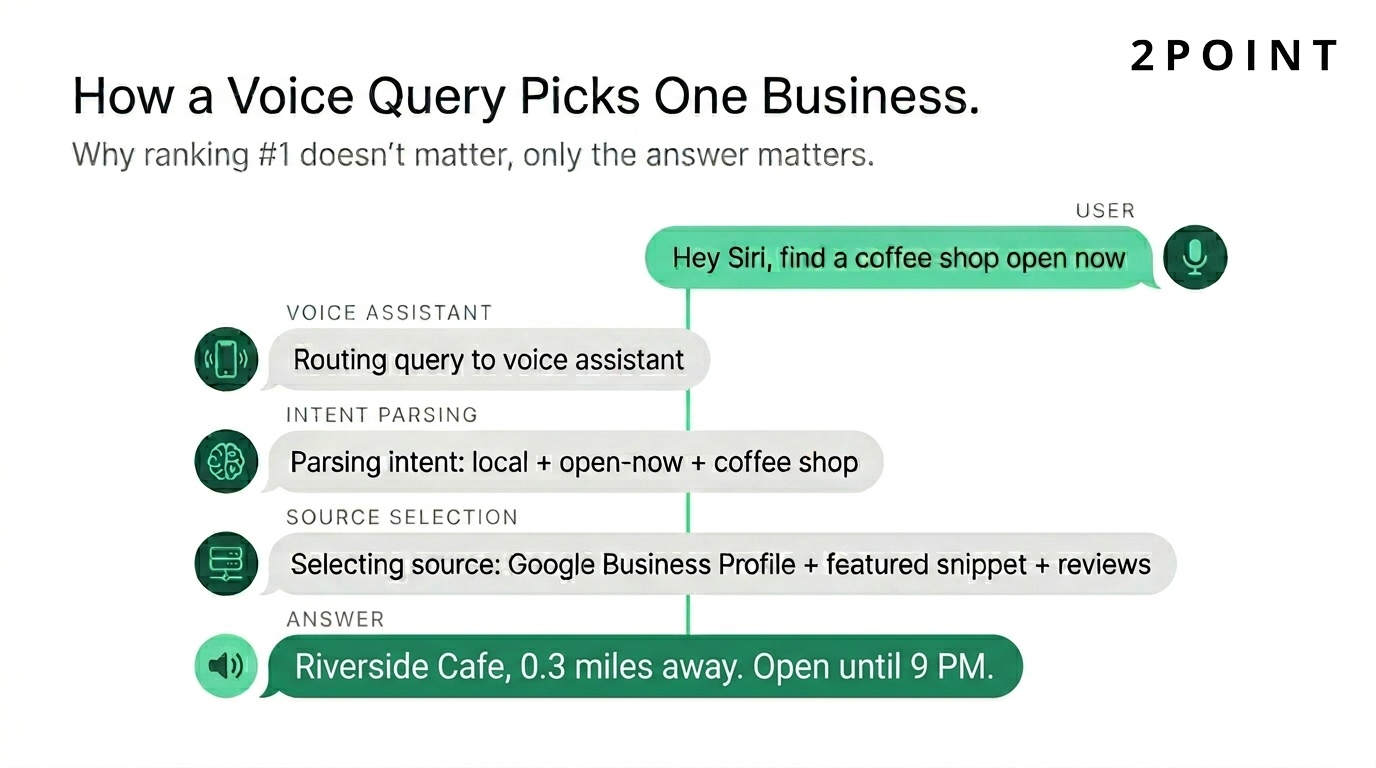
Voice search has transformed search behavior, requiring optimization for conversational queries and question-based content.
Voice Search Landscape
157 million U.S. voice assistant users are expected in 2026, representing nearly half of the U.S. population. Voice search has moved from novelty to mainstream search behavior.
32% of consumers use voice search daily, making voice optimization essential rather than optional for businesses wanting to capture this audience.
Mobile voice search dominance occurs because voice search is particularly convenient on mobile devices. Users driving, walking, or otherwise occupied use voice search to multitask.
Smart speaker proliferation in homes creates new contexts for local business discovery. Users ask smart speakers for recommendations, hours, phone numbers, and other business information.
How Voice Search Differs
Conversational query structure means voice searches use natural language rather than keyword phrases. Users speak complete sentences and questions rather than typing truncated keywords.
Question-based searches dominate voice queries. Voice searches typically begin with who, what, where, when, why, or how, requiring content structured to answer these question formats.
Longer query length characterizes voice search because speaking is faster than typing, and voice interfaces encourage natural conversation. Voice searches average seven words compared to three for typed queries.
Natural language patterns require content written conversationally. Content optimized for voice search reads like natural speech rather than keyword-focused written text.
Immediate action intent drives many voice searches. Voice users often seek immediate solutions: finding open businesses, getting directions, making calls, or booking appointments.
Optimizing for Voice Queries
Conversational content structure means writing as people speak rather than formal written English. Semrush AEO vs SEO guide shows that using natural language like "We provide GBP management 2026 services..." rather than stilted keyword insertions makes content more voice-search friendly.
Question-and-answer format structures content around specific questions users ask. Creating dedicated sections or pages answering common questions increases voice search visibility.
Natural language examples throughout content help search engines understand conversational contexts. Using colloquial phrasing and common expressions makes content match voice search patterns.
Featured Snippet Optimization
Answer Block targeting requires concise, direct answers to specific questions. Content cluster for local SEO strategies can help organize information to increase featured snippet eligibility.
Paragraph-length answers of 40-60 words provide ideal length for featured snippets. Longer answers get truncated; shorter answers may not provide sufficient information.
List format optimization structures answers as numbered or bulleted lists when appropriate. Lists work particularly well for step-by-step instructions or enumerated points.
Table structures present comparison information in easily-scannable formats. Structured data in tables increases likelihood of rich snippet selection.
Position zero strategies focus on ranking in the featured snippet space above traditional organic position 1, capturing maximum visibility for target queries.
Why Is Mobile Optimization Critical for Local SEO?
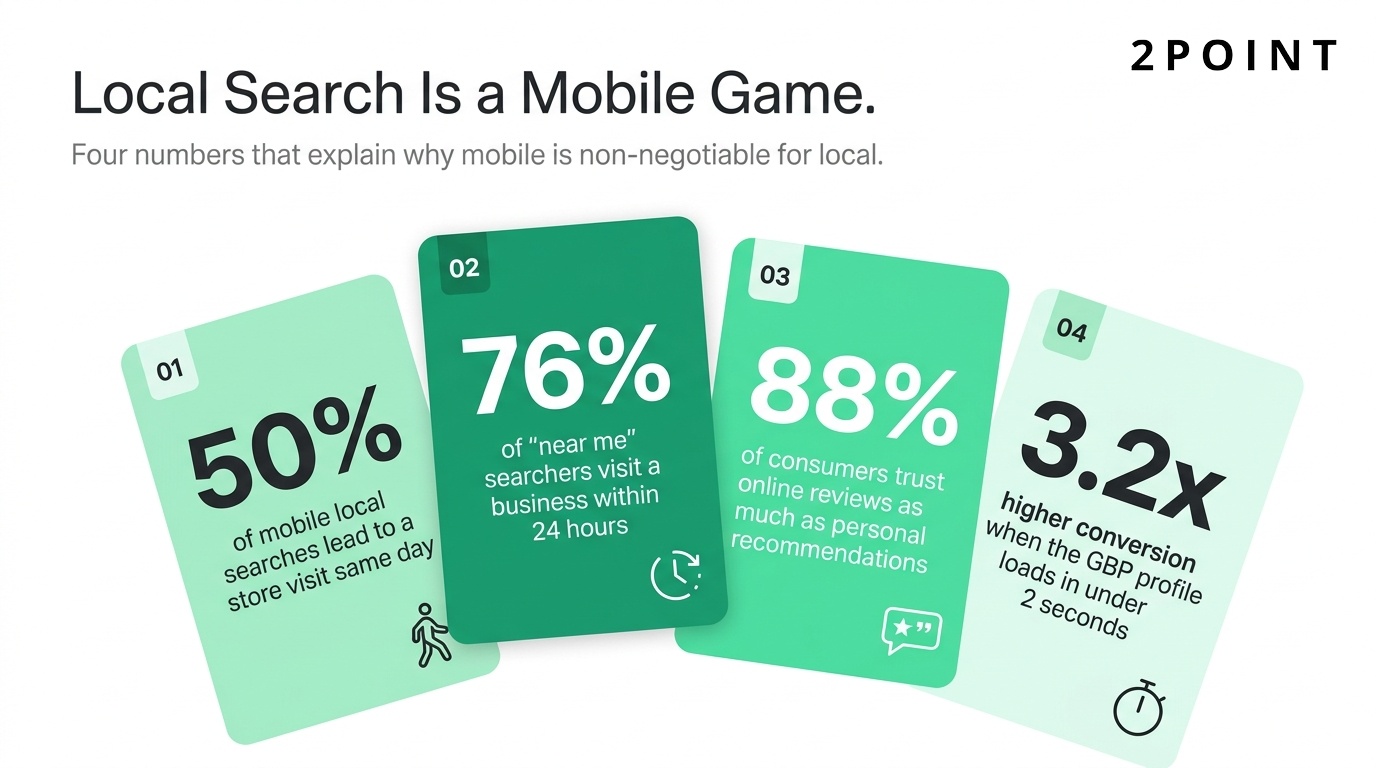
Mobile local SEO matters because most local searches occur on mobile devices, often with immediate intent to visit, call, or purchase.
Mobile Usage Statistics
62% or more of global web traffic comes from mobile devices, making mobile the dominant browsing method. Websites not optimized for mobile fail for the majority of users.
77% of retail visits originate from mobile searches, demonstrating mobile's dominance in driving local foot traffic. Mobile optimization directly impacts physical store visits and revenue.
Most local searches occur on mobile devices as users search while on-the-go, looking for nearby options while driving, walking, or traveling.
Mobile User Behavior
On-the-go search intent characterizes mobile local search. Users search from parking lots deciding where to eat, from homes looking for emergency services, or while shopping comparing prices.
Immediate need searches often carry high urgency. "Emergency dentist near me," "open restaurants near me," or "24-hour pharmacy" represent users with pressing needs requiring immediate solutions.
High conversion intent makes mobile local search particularly valuable. Users searching on mobile often convert within hours or even minutes, unlike desktop research sessions that may represent early-stage browsing.
Quick decision-making on mobile requires instant information access. Mobile users won't wait for slow sites, navigate complex menus, or search extensively for contact information.
Mobile Technical Optimization
Core Web Vitals measure loading performance, interactivity, and visual stability. Google explicitly uses these metrics as ranking factors, making technical performance essential for visibility.
Page load time impacts conversions directly. Even one-second delays reduce conversions significantly. Mobile users on cellular connections are particularly sensitive to slow loading.
Image optimization for mobile requires compression, appropriate sizing, and modern formats that load quickly without sacrificing quality. Large unoptimized images destroy mobile performance.
Code minimization removes unnecessary characters, comments, and whitespace from HTML, CSS, and JavaScript, reducing file sizes and improving load times.
Caching strategies store frequently-accessed elements locally on user devices, dramatically reducing load times for repeat visits and improving overall user experience.
Mobile-First Design Principles
Responsive design requirements ensure websites adapt seamlessly to any screen size. Fixed-width desktop designs that don't reflow for mobile screens create unusable experiences.
Touch-friendly elements need sufficient size and spacing for finger taps. Buttons and links too small or too close together frustrate mobile users and reduce conversions.
Readable font sizes prevent users from needing to zoom to read content. Text should be legible at default zoom levels on mobile devices without accessibility adjustments.
Simplified navigation reduces complexity for small screens. Streamlined menus, clear hierarchy, and intuitive mobile navigation patterns improve usability.
Thumb-friendly button placement positions important actions within easy reach of thumbs holding phones in natural positions, reducing strain and improving conversion rates.
Frequently Asked Questions About Local SEO
What is local SEO and how does it work?
Local SEO is the process of optimizing your online presence to attract customers from geographically-related searches on Google and other search engines. It works by optimizing your Google Business Profile, building local citations, managing reviews, creating location-specific content, and earning local links to signal to search engines that your business serves specific geographic areas. Search engines then display your business for location-based queries from users in your service area.
How long does local SEO take to show results?
Most businesses see initial improvements in 3-6 months, with significant ranking changes typically occurring within 6-12 months of consistent optimization. However, local SEO requires ongoing effort rather than one-time implementation. Competitive markets take longer to see results than less competitive niches. Building sustainable visibility requires continuous profile management, review generation, content creation, and citation maintenance.
How much does local SEO cost?
Local SEO costs vary widely based on whether you handle it internally, hire freelancers, or work with agencies. DIY approaches cost your time plus tool subscriptions ($50-300 monthly for tracking and management software). Freelance consultants typically charge $75-200 per hour. Agencies charge $500-5,000+ monthly depending on market competitiveness and service scope. Most small businesses should budget $1,000-2,500 monthly for comprehensive local SEO services.
Can I do local SEO myself or should I hire an expert?
You can handle basic local SEO yourself by optimizing your Google Business Profile, generating reviews, and building basic citations. However, hiring a local SEO expert provides strategic guidance, advanced optimization, competitive analysis, and sophisticated tactics most business owners lack time or expertise to implement. The decision depends on your budget, time availability, technical comfort, and market competitiveness.
What's the difference between local SEO and regular SEO?
Regular SEO focuses on ranking for informational queries without geographic intent, while local SEO targets location-based searches. Local SEO emphasizes Google Business Profile optimization, review management, local citations, and proximity as ranking factors. Traditional SEO focuses primarily on website optimization, content quality, and backlinks. Local SEO requires proving your physical business existence and maintaining consistent NAP information across platforms, which traditional SEO doesn't require.
How important are Google reviews for local SEO?
Google reviews are extremely important, functioning as direct ranking factors and primary trust signals. Businesses need at least 10 reviews to appear credible, with 4.0+ star averages recommended for competitive visibility. Review quantity, velocity (frequency of new reviews), recency, and sentiment all impact rankings. 87% of consumers read reviews for local businesses, making reviews critical for both SEO and conversions.
What is a Google Business Profile and do I need one?
A Google Business Profile (formerly Google My Business) is your business's listing on Google that appears in Maps, local search results, and the knowledge panel. Every business serving customers in physical locations or specific service areas needs a GBP. It's free, directly impacts local search visibility, and serves as your primary asset for appearing in the Map Pack—the three businesses displayed with maps at the top of local search results.
How do local citations affect my rankings?
Local citations verify your business's existence and location by listing your NAP (Name, Address, Phone) consistently across directories and websites. While less impactful than Google Business Profile optimization and reviews, citations remain important verification signals, particularly for new businesses. Inconsistent citations confuse search engines and reduce trust, potentially harming rankings. Focus on quality citations from authoritative sources rather than maximum citation quantity.
What's the difference between the Map Pack and organic local results?
The Map Pack (also called the Local Pack or 3-Pack) displays three businesses with maps at the top of local search results, driven primarily by Google Business Profile optimization. Organic local results appear below the Map Pack as traditional blue links, influenced more by website SEO. Map Pack positions receive 126% more traffic and 93% more actions than organic positions 4-10, making Map Pack visibility extremely valuable.
How do I rank in the Google Map Pack?
Ranking in the Map Pack requires comprehensive Google Business Profile optimization including complete profile information, regular posts and photos, consistent review generation with 4.0+ star average, accurate citations matching your GBP, relevant business categories, strong user engagement signals, and proximity to the searcher. Creating location-specific website content and earning local links support Map Pack rankings. Using a local SEO checklist helps ensure you've addressed all critical ranking factors.
Can negative reviews hurt my local SEO?
Negative reviews don't directly hurt rankings unless they dramatically lower your overall star rating below 4.0 or come in unusually high volume suggesting serious business problems. Businesses with 4.0-5.0 stars and occasional negative reviews often rank better than businesses with perfect 5.0 ratings from only a few reviews. The key is maintaining a strong overall rating through consistent positive review generation and responding professionally to all reviews, including negative ones.
How does AI search affect local SEO?
AI-powered search features like Google AI Overviews, ChatGPT, and Perplexity are transforming local search by providing direct answers rather than lists of websites. 40.16% of local business queries now trigger AI Overviews, reducing click-through rates but increasing the importance of accurate, structured business information. AI systems prioritize highly-rated businesses (4.1-4.3+ stars) with complete profiles and consistent information across platforms when recommending businesses.
What is the Google Map Pack (3-Pack)?
The Google Map Pack, also called the Local 3-Pack or Local Pack, is the cluster of three business listings displayed at the top of Google's search results for queries with local intent.
It appears for queries like "plumber near me" or "coffee shop in [city]" and is driven primarily by Google Business Profile data, not your website's SEO. Map Pack ranking depends on proximity, relevance, prominence, review quality, and category accuracy. Earning a Map Pack position typically drives 5-7x more clicks than a position-one organic result for local queries.
How do I optimize for "near me" searches?
Optimize for "near me" searches by claiming and fully completing your Google Business Profile, maintaining consistent NAP (name, address, phone) across all citations, generating regular reviews with a 4.0+ average, and publishing location-specific content on your website.
Google interprets "near me" as a geographic intent signal and uses the searcher's real-time location to surface nearby businesses. The fastest wins are GBP completeness (categories, hours, photos), accurate location targeting, and review velocity. These signals tell Google you're both relevant and active in your area.
What are the most important local SEO ranking factors in 2026?
The four most important local SEO ranking factors in 2026 are: (1) Google Business Profile completeness and engagement, (2) review quantity, recency, and average rating, (3) NAP consistency across citations, and (4) topical authority demonstrated through location-specific content and local backlinks.
Topical authority has overtaken raw proximity as the new tiebreaker, especially in competitive markets. Google increasingly rewards businesses that demonstrate genuine expertise in their service area through original content, neighborhood-specific landing pages, and earned local press coverage, not just businesses that happen to be nearby.
How do I get my business to show up on Google Maps?
To get your business on Google Maps, claim and verify a Google Business Profile at business.google.com. After verification (usually a postcard with a code, or instant for some service categories), your business appears on Maps within 24-72 hours.
Verification options vary by business type: postcard verification is most common, but service-area businesses, agencies, and some categories may verify by phone, email, or video call. Make sure your business name, address, primary category, and hours are accurate before requesting verification; corrections after verification can trigger re-review.
How do I get more Google reviews ethically?
Get more Google reviews ethically by asking happy customers for a review at the moment of satisfaction, sending a personalized follow-up email or text within 48 hours of service, and providing a direct review link to remove friction.
Never offer compensation, discounts, or incentives in exchange for reviews; this violates Google's policies and can result in review removal or profile suspension. The highest-converting review requests are personal, timely, and specific (e.g., "Mind sharing your experience with [staff member] today?"). Aim for steady weekly velocity rather than review spikes, which can trigger Google's spam filters.
How often should I post on my Google Business Profile?
Post on your Google Business Profile at least once per week, with two to three posts weekly being optimal for visibility. Profiles with consistent posting see 35% more views and 42% more direct actions (calls, direction requests) than profiles that post less than monthly.
Mix your post types: weekly Updates for news and content, Offer posts for promotions, Event posts for time-sensitive activities, and Product posts for new launches. Each post should include a high-quality image, a clear call-to-action button, and 100-300 words of key
What is hyperlocal SEO?
Hyperlocal SEO is the practice of optimizing for searches at the neighborhood, district, or street level rather than the city level. It targets queries like "best pizza in Williamsburg" or "barber shop near 5th and Main" rather than broader queries like "pizza in Brooklyn."
Hyperlocal optimization combines neighborhood-specific landing pages, citations in hyper-local directories, mentions in neighborhood blogs and press, and Google Business Profile signals such as neighborhood-specific photos and Q&A. It matters because 30%+ of local searches now include neighborhood-level qualifiers, and businesses that win at the neighborhood level dominate "near me" searches in dense urban markets.
What is local schema markup, and which types do I need?
Local schema markup is structured JSON-LD code added to your website that tells Google your business type, address, hours, services, and reviews in a machine-readable format. The five most impactful types for local businesses are LocalBusiness, OpeningHoursSpecification, AggregateRating, Service, and FAQPage.
The LocalBusiness schema is the foundation; every local business needs it on the homepage and the contact page. Layer in OpeningHoursSpecification for accurate "open now" filtering, AggregateRating + Review for star-rating rich snippets, Service for service-area businesses, and FAQPage to earn AI Overview citations. Validate every implementation in Google's Rich Results Test before pushing live.
How does Google AI Overview affect local businesses?
Google AI Overview affects local businesses by reducing click-through rates by 15-40% on informational local queries, while simultaneously increasing the importance of being cited inside the AI-generated answer. Roughly 40% of local business queries now trigger an AI Overview.
The defense is two-part: optimize your Google Business Profile and on-site content to be the source of AI Overview quotes (so you keep brand visibility even without the click), and double down on commercial-intent local queries, "best plumber in [city]," "[service] near me open now", where users still need to click through to take action. AI Overview's impact is heaviest on "what is" and "how does" local queries, lightest on transactional ones.
Should I respond to every review?
Yes, respond to every review, positive and negative, within 48 hours when possible. Response rate is a direct ranking signal in Google's local algorithm, and consumers are 2.4x more likely to choose a business that responds consistently.
For positive reviews, keep responses brief, specific to what the reviewer mentioned, and signed by a real person (not the brand). For negative reviews, acknowledge the issue, take the conversation offline with a contact email or phone number, and never argue publicly, even when the reviewer is wrong. Templated responses work for positive feedback but signal disengagement on negative reviews.
Can a service area business rank without a physical storefront?
Yes, service-area businesses can rank in Google's local results without a physical storefront by setting up a service-area Google Business Profile that hides the street address but lists the geographic zones served.
Service-area businesses include plumbers, electricians, mobile groomers, and cleaning services, as well as any business that travels to customers.
To rank well, define your service zones precisely (cities, ZIP codes, or radius), maintain a real, verifiable business address (even if it's a home office that's hidden from public view), generate reviews mentioning specific neighborhoods served, and publish location pages on your website for each major service zone.
How do I track local SEO performance?
Track local SEO performance by monitoring four core metrics weekly: Google Business Profile insights (profile views, search queries, direction requests, calls), Map Pack rank tracking for your priority keywords, review volume and average rating trends, and citation health via tools like BrightLocal, Whitespark, or Moz Local.
Set up Google Analytics 4 with a dedicated segment for organic local traffic (filtering for branded + location keywords), and connect Search Console for query-level visibility. The leading indicator that always moves first is GBP profile views. When those rise, calls and direction requests typically follow within two to four weeks. Multi-location businesses should add competitive benchmarking using local rank tracking grids.
