

 let’s connect


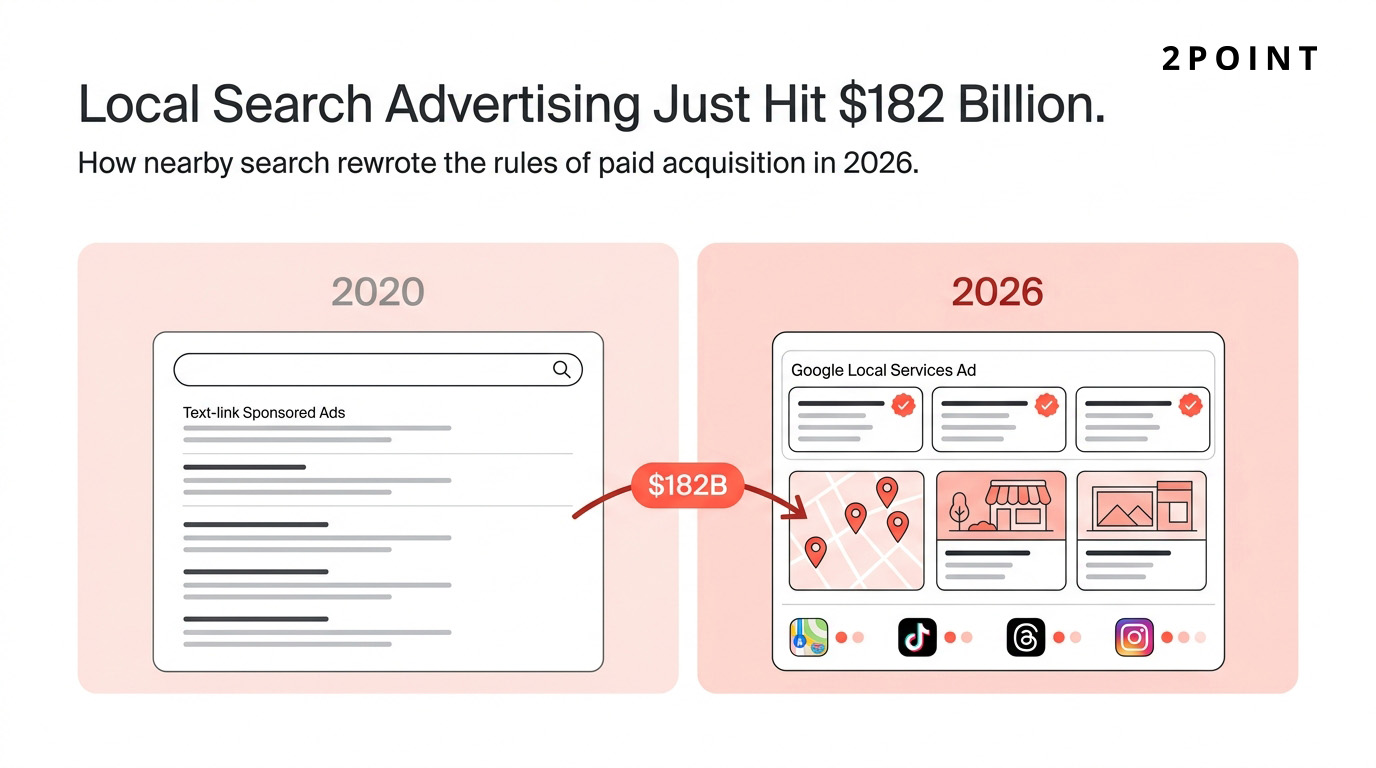
Local search advertising represents the most direct path between consumer intent and business revenue in digital marketing. Here's what you need to know:
- Local search ads are geographically-targeted advertisements appearing when users search for nearby businesses or services on platforms like Google Maps, Google Local Services Ads, and Apple Maps.
- The market has reached $182 billion in 2026, driven by the fact that 46% of all Google searches have local intent.
- These ads use pay-per-lead models instead of traditional pay-per-click, meaning you only pay when customers actually contact your business through calls, messages, or bookings.
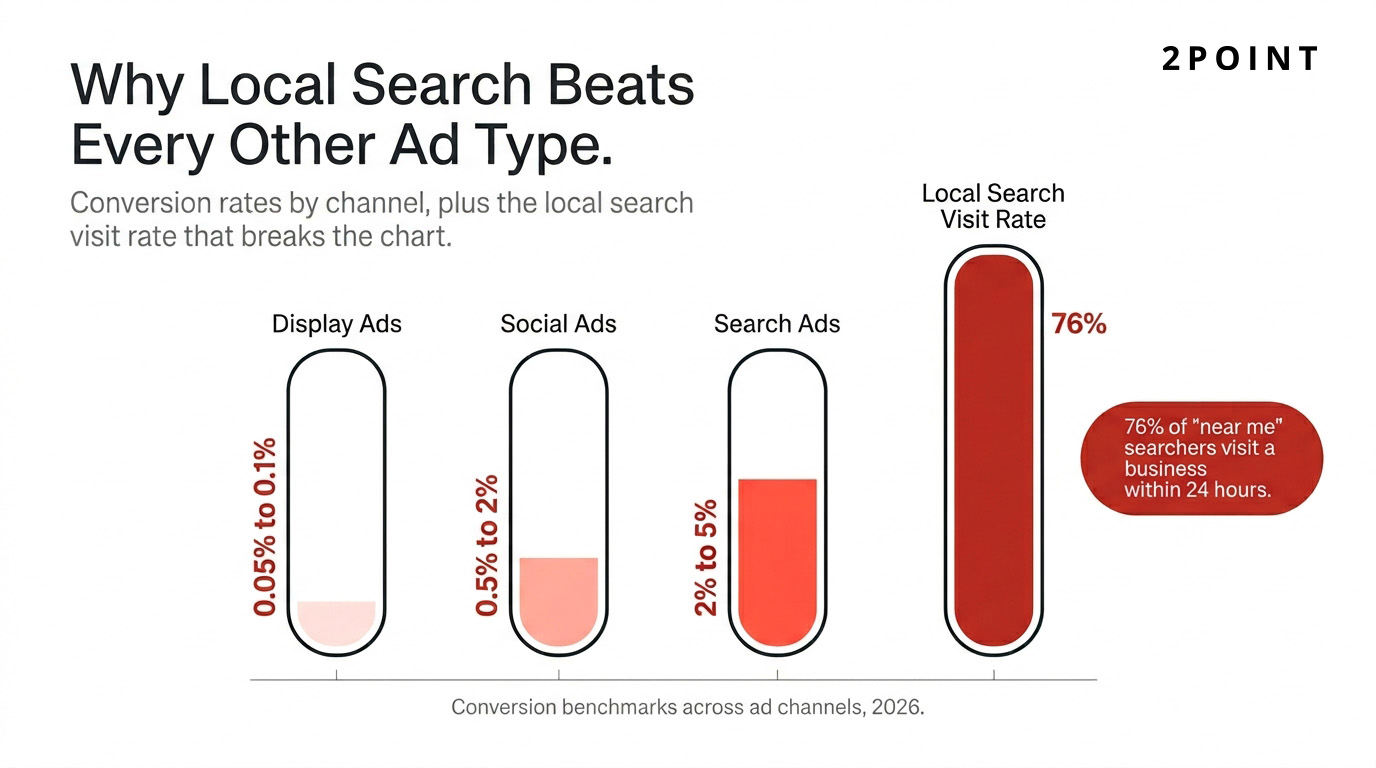
- 76% of people who search for something nearby visit a business within 24 hours, making local search advertising extraordinarily effective for driving foot traffic.
- Major platforms including Google Maps, Apple Maps (launching summer 2026), TikTok, and connected TV are fundamentally reshaping how consumers discover local businesses.
- AI-powered search experiences now dominate local queries, with Google showing AI Overviews for 57-80% of local searches.
- Success requires optimizing your Google Business Profile, which makes businesses 2.7 times more likely to be considered reputable when complete.
- Voice search accounts for over 50% of local queries and will reach 65% by mid-2026.
The $182 Billion Local Search Advertising Landscape in 2026
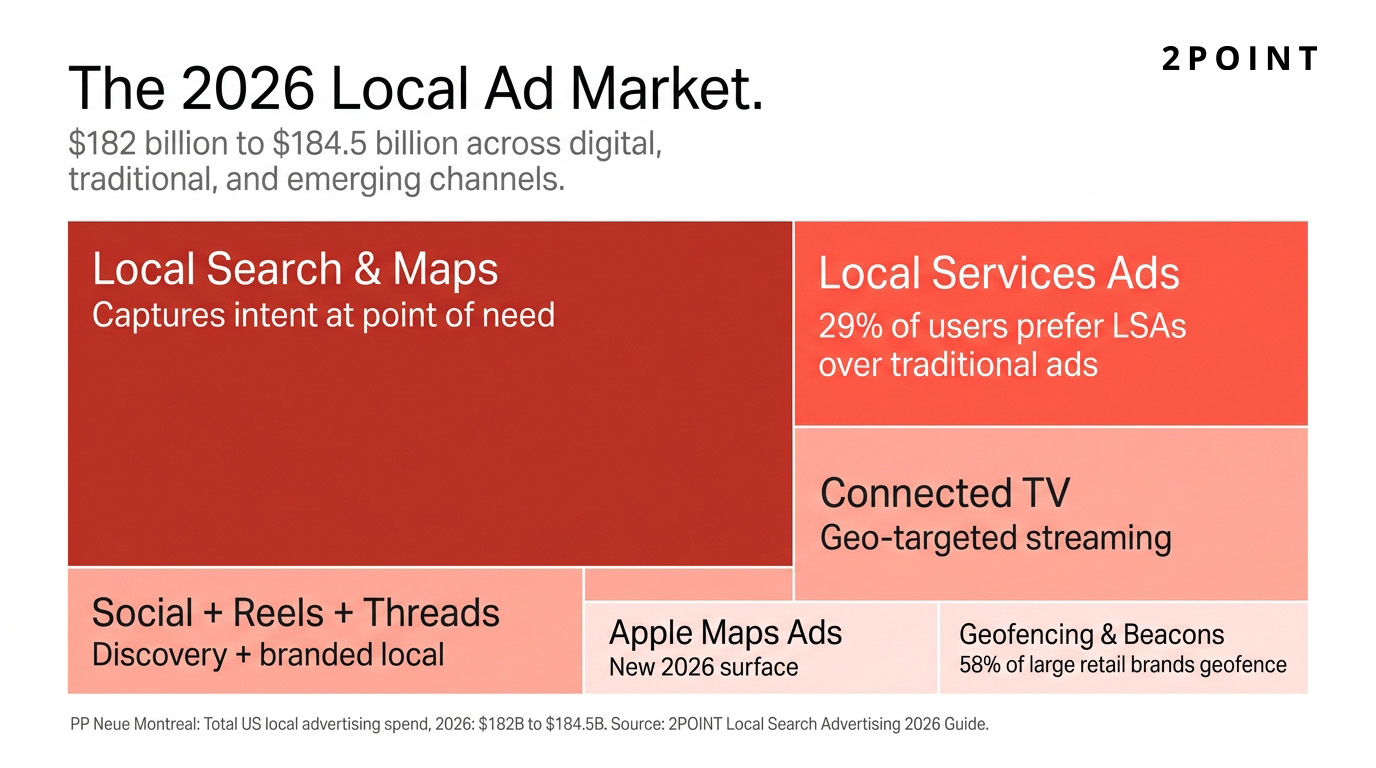
The local advertising ecosystem has evolved into a sophisticated, multi-channel marketplace worth more than many Fortune 500 companies. Understanding this landscape provides critical context for strategic investment decisions and platform selection. While local search advertising delivers immediate paid visibility, local SEO builds sustainable organic presence that compounds over time without ongoing ad spend. 2POINT serves businesses across multiple locations, helping local advertisers dominate search results in their specific geographic markets.
Market Size and Growth Trajectory
Local advertising in 2026 commands an estimated $182 billion to $184.5 billion market. This represents sustained growth despite economic headwinds and industry disruption. The digital component drives this expansion, with 72% of publishers reporting digital revenue either up or flat.
Perhaps more telling, 85% of industry participants anticipate similar or better performance continuing through 2026. This optimism stems from several converging factors: mobile adoption saturation meaning nearly universal access to location-based services, improved location signal integration enabling precision targeting, and platform innovations creating new inventory opportunities.
The growth isn't uniform across channels. Traditional media continues declining while digital formats capture market share. This shift mirrors broader consumer behavior changes, with audiences migrating from linear television and print publications to on-demand, personalized digital experiences where advertisers can target based on real-time location and intent signals.
Connected TV Reshaping Local Advertising
Connected TV represents the most dramatic transformation in local advertising since the smartphone. US CTV ad spending will grow 15.1% in 2026, with local markets alone generating $3.6 billion excluding political advertising.
The velocity of this channel shift becomes clear when examining market share. CTV commanded 19% of local TV spending in 2025, a remarkable penetration for a relatively new advertising format. Meanwhile, traditional cable TV suffered a nearly 20% decline in 2025.
Consumer behavior validates these advertising trends. Streaming now captures 47.5% of TV viewing time compared to cable's 20.2%. For local advertisers, CTV advertising offers unprecedented targeting for local businesses, allowing radius-based geographic targeting combined with demographic and behavioral audience segmentation. Local advertisers entering the CTV space should understand programmatic CTV buying to efficiently manage inventory across streaming platforms.
This creates new strategic opportunities for businesses like restaurants, auto dealerships, and home service companies. A plumber can now advertise specifically to homeowners within a 15-mile radius who have recently searched for bathroom remodeling, delivering relevance previously impossible.
Platform Diversity and Multi-Channel Complexity
The local advertising ecosystem has fragmented across an expanding array of platforms, each demanding specialized expertise. Meta's location-based advertising products, detailed in our Facebook advertising guide, provide powerful social targeting that complements search-based local discovery. Major technology companies including Google, Meta, TikTok, Apple, and Amazon continue pushing deeper into local advertising while traditional publishers fight to maintain relevance. Managing campaigns across Google, Apple Maps, TikTok, CTV, and social platforms requires a coordinated multi-channel marketing approach.
National brands increasingly behave like local advertisers, recognizing that personalized, location-specific messaging outperforms generic national campaigns. Digital out-of-home advertising attracts record investment as programmatic buying enables dynamic creative optimization based on time, weather, traffic patterns, and nearby events.
Successful local advertisers adopt an omnichannel marketing strategy rather than siloed channel management, coordinating messaging across search, social, CTV, and AI platforms.
This diversity creates operational complexity. Managing campaigns across Google search ads, hyper-local map ads, local map ads with spatial features, Meta's location-based products, TikTok's local feed, CTV providers, and DOOH networks requires juggling distinct ad formats, measurement standards, buying processes, and optimization strategies. Facebook Ads targeting for high-ticket services provides powerful location-based segmentation that complements Google's local search advertising products.
Each channel operates with different auction dynamics, creative requirements, and performance benchmarks. Google Local Services Ads use pay-per-lead pricing while traditional Google search ads remain pay-per-click. CTV campaigns optimize toward completion rates while social platforms emphasize engagement metrics. DOOH measures impressions based on verified traffic counts and dwell time.
Successful local advertisers in 2026 adopt integrated strategies rather than siloed channel management. They establish consistent messaging and brand identity across touchpoints while tailoring creative and offers to each platform's unique strengths and audience expectations.
Industry Challenges and Adaptation
Despite market growth, publishers and platforms face significant headwinds. Subscription model pressures have intensified dramatically, with a 383% year-over-year increase in subscription challenges as consumers resist paying for content amid economic uncertainty.
AI-generated search summaries reduce referral traffic to publisher websites. When Google answers user questions directly through AI Overviews, click-through rates to underlying sources decline. This disrupts the traditional traffic-to-advertising revenue model many local news sites and directories depend on.
Advertiser brand-safety concerns intensify as platforms struggle with content moderation at scale. Reduced spending by small businesses, facing economic pressure and questioning ROI, compounds these challenges. Many local advertisers, particularly in sectors like retail and hospitality, have tightened budgets while demanding better attribution and measurable results. Small local businesses facing budget constraints can explore programmatic ad platforms that offer flexible payment options and real-time bidding at competitive rates.
Publishers adapt through several strategies. They develop first-party data assets to reduce dependency on third-party cookies and improve targeting capabilities. Many launch proprietary advertising products leveraging unique audience relationships. Investment in AI tools helps automate content creation and ad operations, reducing costs while maintaining quality.
The future trajectory favors digital channels with superior targeting, measurement, and ROI transparency. Traditional formats like print directories, broadcast radio, and linear TV will continue declining. Growth concentrates in search advertising, social media, CTV, and location-based mobile advertising where performance can be precisely tracked and optimized.
How Do Consumers Search for Local Businesses in 2026?
Consumer search behavior has fundamentally transformed in ways that reshape advertising strategy. Understanding these patterns helps businesses allocate budgets effectively and optimize campaigns for maximum impact.
Local Search Intent and Frequency Statistics
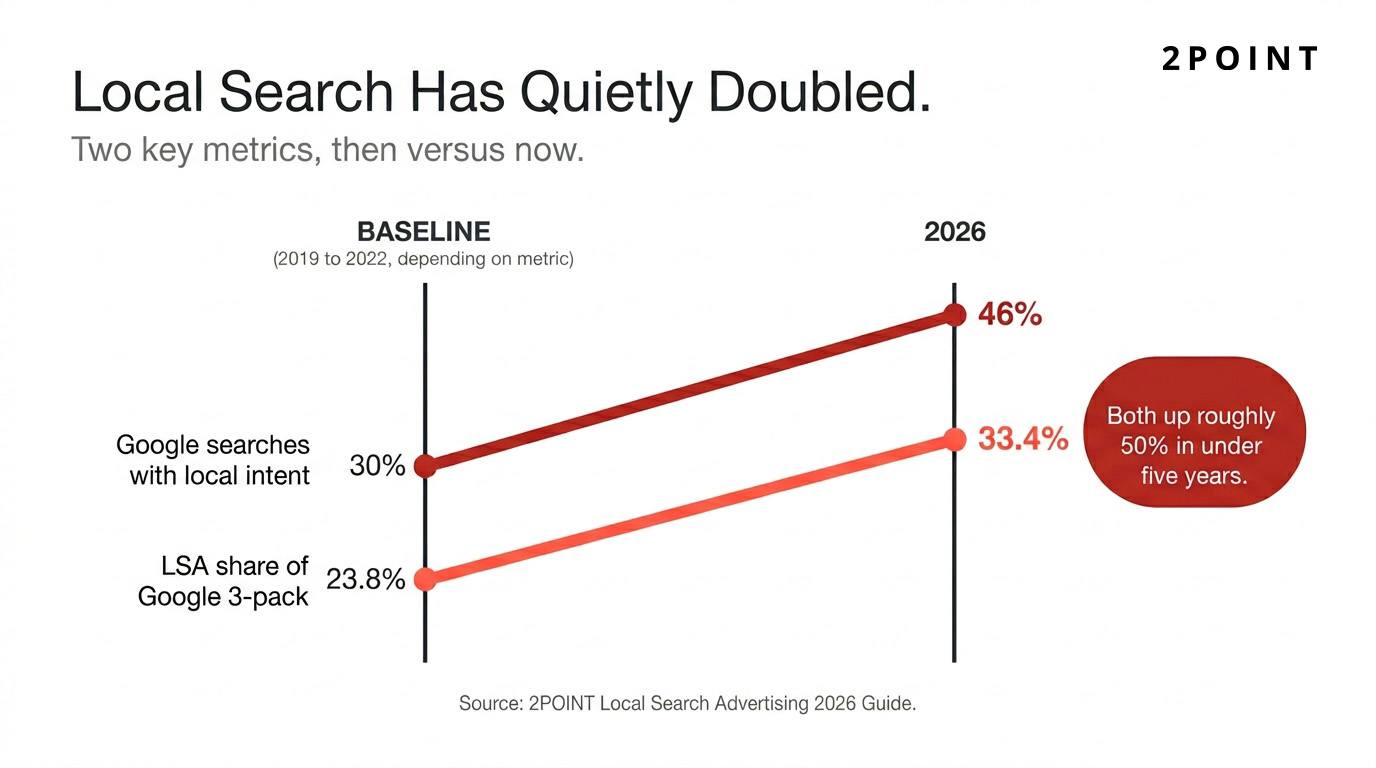
46% of all Google searches have local intent, representing approximately 8.5 billion daily searches globally. This figure has grown dramatically from 30% in 2019, reflecting smartphones becoming the primary device for immediate-need searches.
Search frequency demonstrates strong habitual behavior. 80% of US consumers search for local information at least weekly, while 32% search daily. This consistent engagement creates continuous opportunities for businesses to capture attention at critical decision-making moments.
The "near me" modifier has become ubiquitous in local search behavior. 46% of consumers report they "always" or "often" add "near me" to their searches. Google reports a 200% increase in "near me" and "where to buy" searches over two years.
This language shift reflects changing user expectations. Consumers expect search engines to understand context, including their physical location, and deliver geographically relevant results without explicit location entry. Optimizing for these queries requires robust local SEO foundations and presence across location-based advertising platforms.
The Extraordinary Search-to-Visit Conversion Rate
Combining paid local advertising with organic search engine optimization creates comprehensive visibility for the 76% of local searchers who visit a business within 24 hours. Even more striking, 72% visit stores within five miles of their current location.
These conversion rates dramatically exceed typical digital advertising benchmarks. Display advertising typically converts at 0.05-0.1%, social media advertising at 0.5-2%, and traditional search advertising at 2-5%. Local search's 76% visit rate represents an entirely different magnitude of intent and urgency.
This extraordinary performance stems from the nature of local searches. People search for nearby businesses when they have immediate needs: finding a restaurant for dinner tonight, locating an urgent care clinic for a sick child, or identifying a locksmith after being locked out. The compressed decision timeline and physical proximity requirement create ideal conditions for conversion.
For advertisers, these statistics justify premium investment in local search visibility. The advertising cost-per-acquisition remains favorable even at higher cost-per-click rates because conversion probability is so elevated. A $10 click generating a 76% chance of a store visit delivers substantially better ROI than a $2 click with a 2% conversion probability.
Where Consumers Discover Local Businesses
Business information sites dominate local discovery, with 61% of consumers using platforms like Google, Yelp, TripAdvisor, and the Better Business Bureau to find and evaluate local businesses. These platforms aggregate business information, customer reviews, photos, and other decision-making inputs into centralized destinations.
Google's ecosystem plays an outsized role in discovery. Search results, Google Maps, and Google Business Profiles create multiple touchpoints where consumers encounter businesses. Reviews and ratings displayed directly in search results significantly influence click-through decisions and purchase intent.
Multi-platform discovery behavior is common. Consumers rarely rely on a single source. They might discover a business on Google Maps, verify it on Yelp, check its social media presence, visit the website, then return to Google to read more reviews before deciding. This cross-platform journey makes consistent business information and strong review profiles across multiple platforms essential.
Social media marketing plays a secondary but growing discovery role for local businesses, particularly for restaurants, salons, and boutiques with strong visual appeal. Instagram and TikTok drive discovery through location tags, hashtags, and user-generated content featuring businesses. However, these platforms typically influence consideration rather than initial discovery for most local service categories.
Voice and Conversational Search Transformation
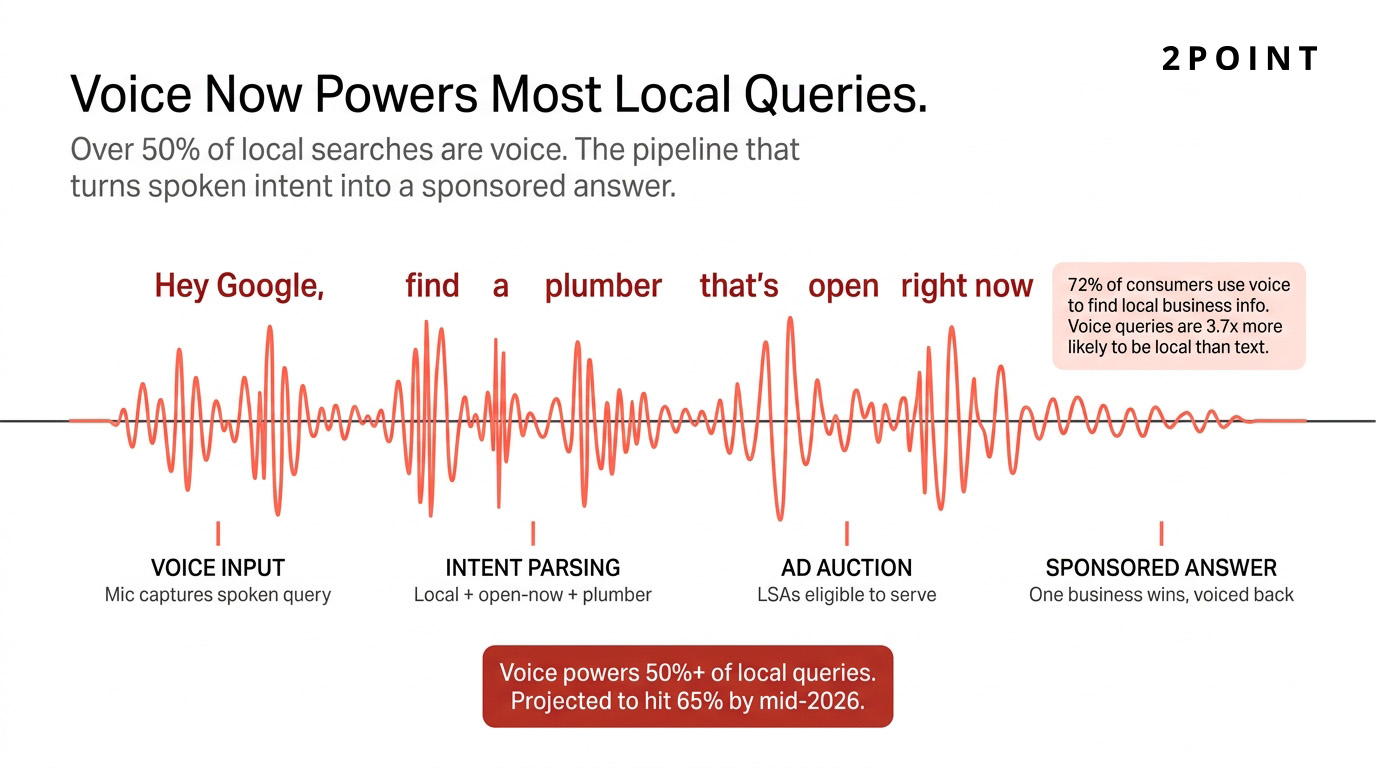
Voice search has fundamentally changed how consumers find local businesses. Voice searches account for more than 50% of all local queries, with projections to hit 65% by mid-2026. This shift from typing to speaking creates distinct query patterns and user expectations.
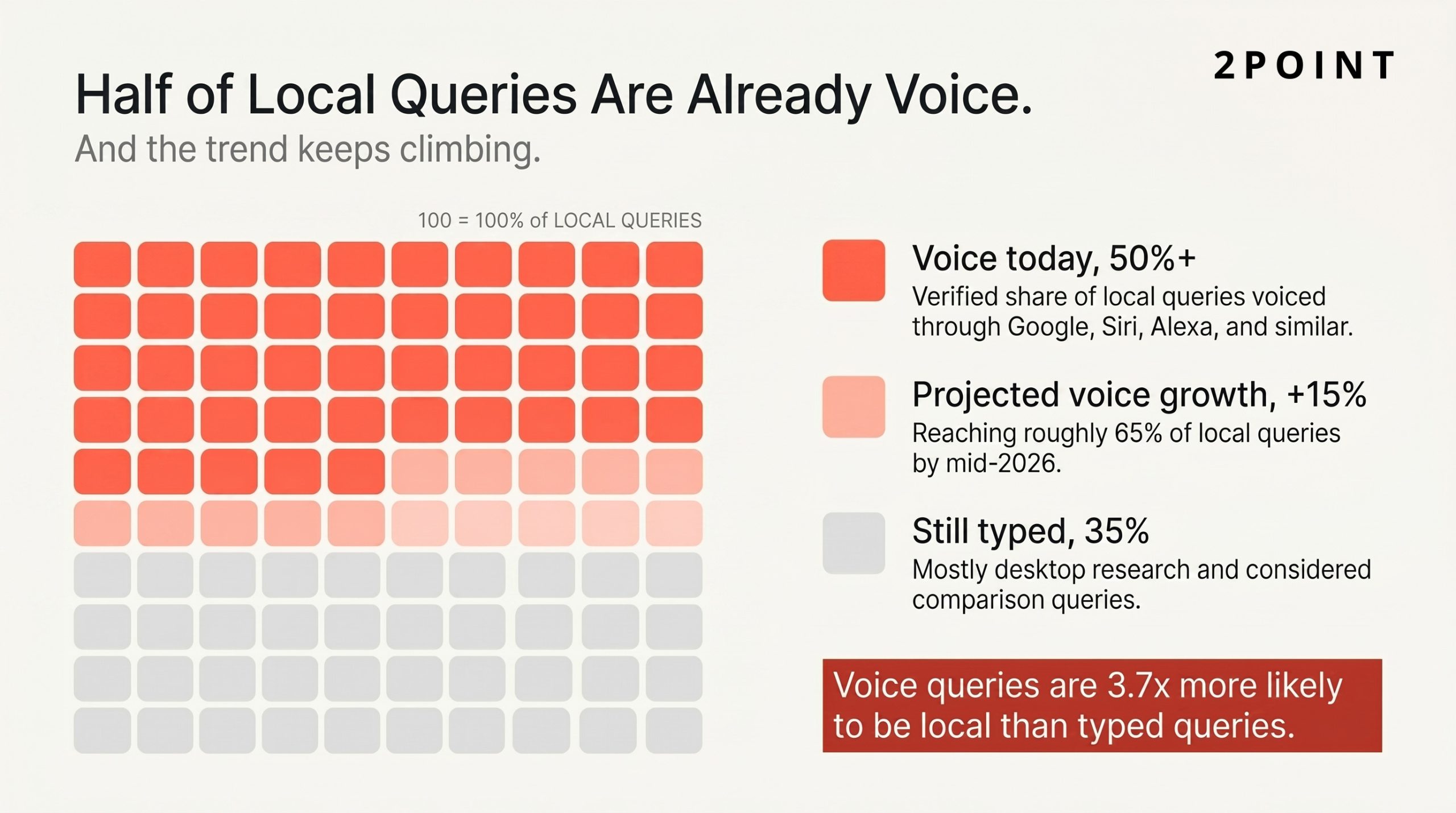
Voice searches skew dramatically toward local intent. They are 3.7 times more likely to be local in nature than text searches. Users ask questions like "Where's the nearest coffee shop?" or "What Italian restaurants are open now?" rather than typing shorter keyword strings.
Businesses optimized for natural language queries enjoy nearly double the conversion rate of those focused only on traditional keyword optimization. This requires content answering common questions in conversational formats and schema markup enabling search engines to extract relevant answers.
72% of consumers use voice search to find local business information, while 75% of voice-enabled speaker owners use voice weekly for local searches. Smart speakers in homes, voice assistants in cars, and smartphone voice search create multiple contexts where consumers seek local information hands-free.
Optimizing for conversational search intent means developing content that addresses who, what, where, when, why, and how questions related to your business. Structured data markup helps search engines identify this information and deliver it in voice results. Implementing conversational search schema becomes essential for maintaining visibility as voice search grows.
What Are Google Local Services Ads and How Do They Work?
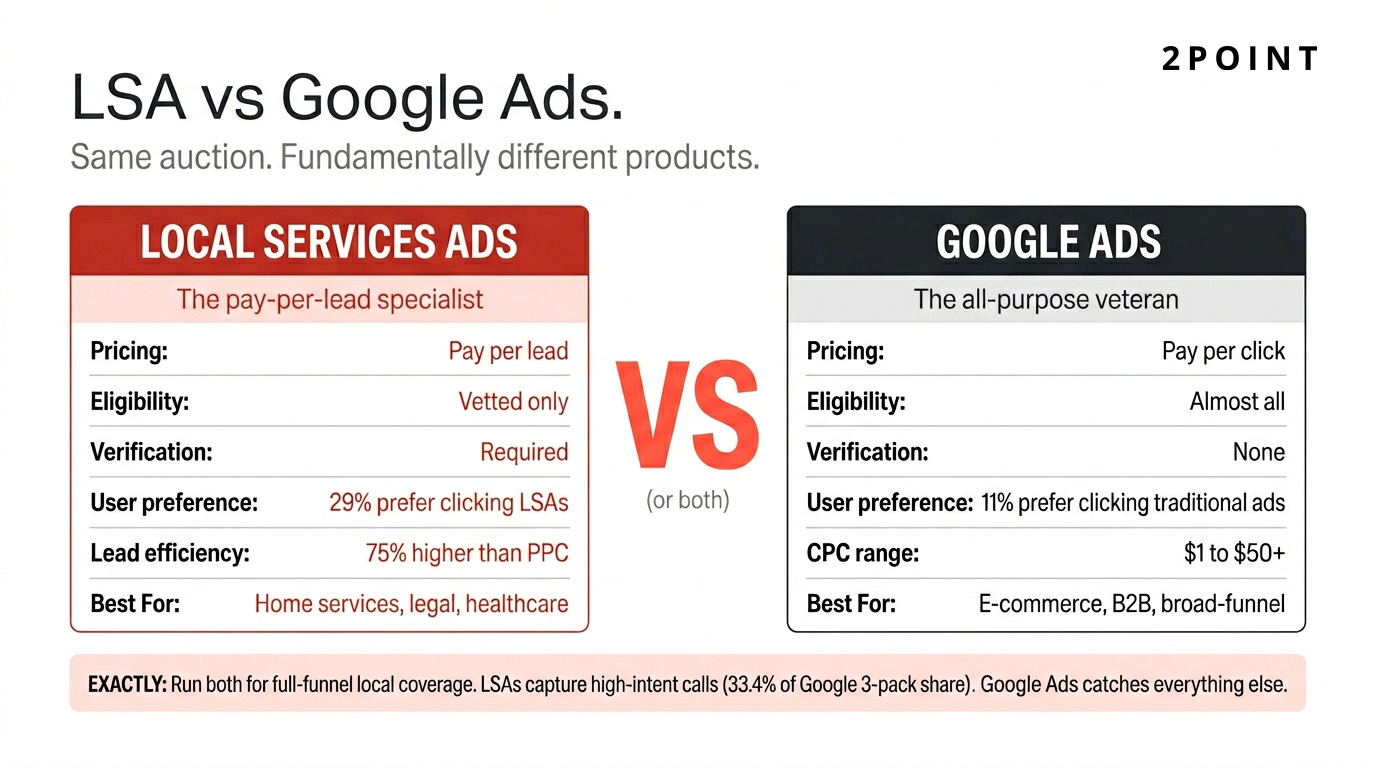
Google Local Services Ads represent the most significant evolution in local search advertising since Google AdWords launched. Unlike traditional pay-per-click advertising, Local Services Ads operate on a pay-per-lead model that fundamentally changes the risk-reward calculation for advertisers.
How Google Local Services Ads Work
Local Services Ads appear at the very top of search results, above traditional paid search ads and organic listings. This premium placement captures attention from users with the highest commercial intent. The ad format displays your business name, rating, service area, hours, and a Google-verified badge directly in search results.
The revolutionary aspect is the payment model. You only pay when customers contact you through calls, form fills, messages, or bookings initiated directly from the ad. Unlike traditional pay-per-click where you pay for clicks regardless of outcome, Local Services Ads charge only when genuine customer engagement occurs.
Unlike traditional PPC advertising where you pay for clicks regardless of outcome, Local Services Ads charge only when genuine customer engagement occurs. There's no risk from accidental clicks, competitor click fraud, or users clicking without serious intent. You pay exclusively for qualified leads, though lead quality can vary and requires active management.
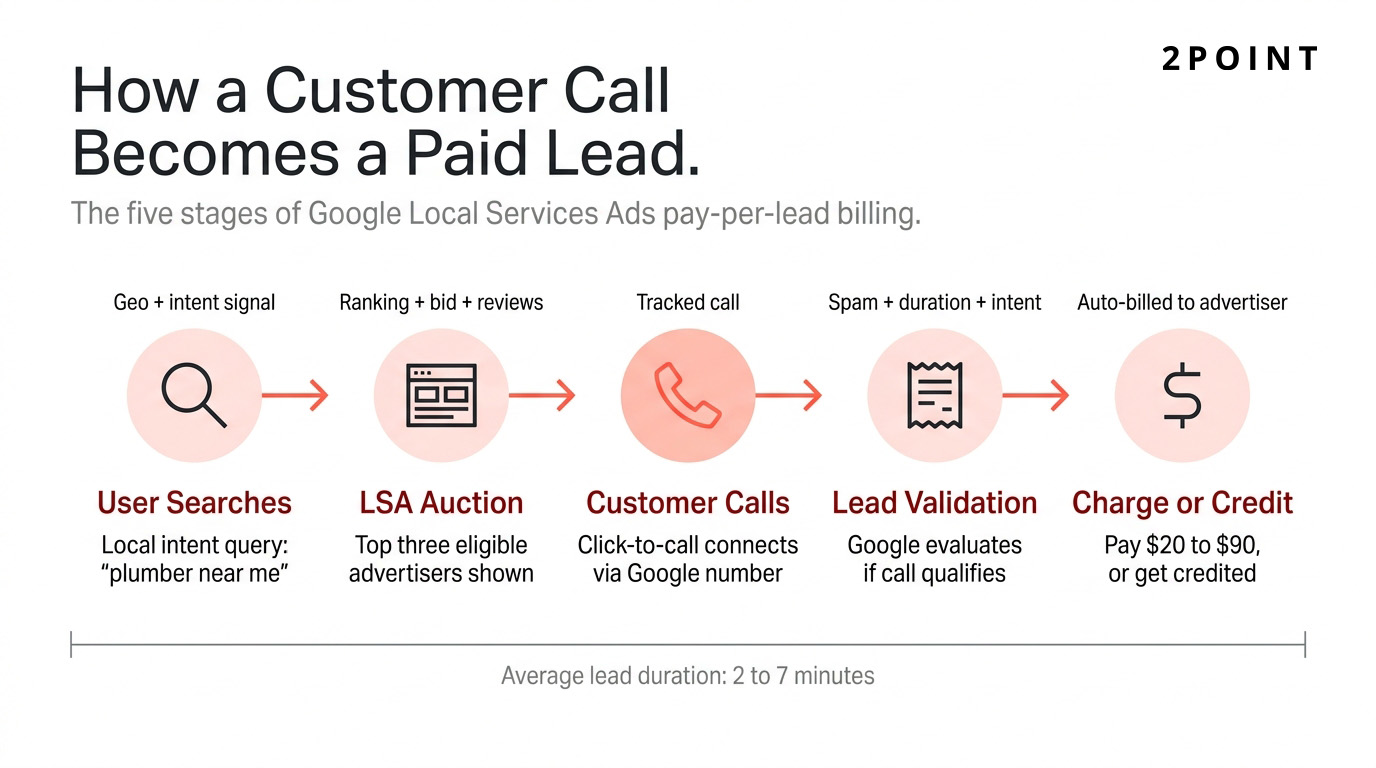
While Local Services Ads function without requiring a landing page, having a professional website still builds credibility for customers who research beyond Google's interface. This streamlined experience particularly benefits mobile users who can call or message immediately without navigating to external websites.
The program focuses on service-based businesses across specific categories including home services (plumbing, electrical, HVAC, cleaning), business services (legal, accounting, marketing), health services, learning and care services, wellness and beauty services, and automotive services. Google gradually expands eligible categories based on market demand and verification feasibility.
The Google Verified Badge and Trust Signals
Every Local Services Ad displays a Google Verified badge, which Google recently introduced to create a consolidated, transparent experience. This verification provides visual confirmation that Google has vetted the business through background checks, license verification, and insurance validation where applicable. Professional premium brand creation strengthens trust signals across local advertising platforms, reinforcing the credibility that Google verification and reviews establish.
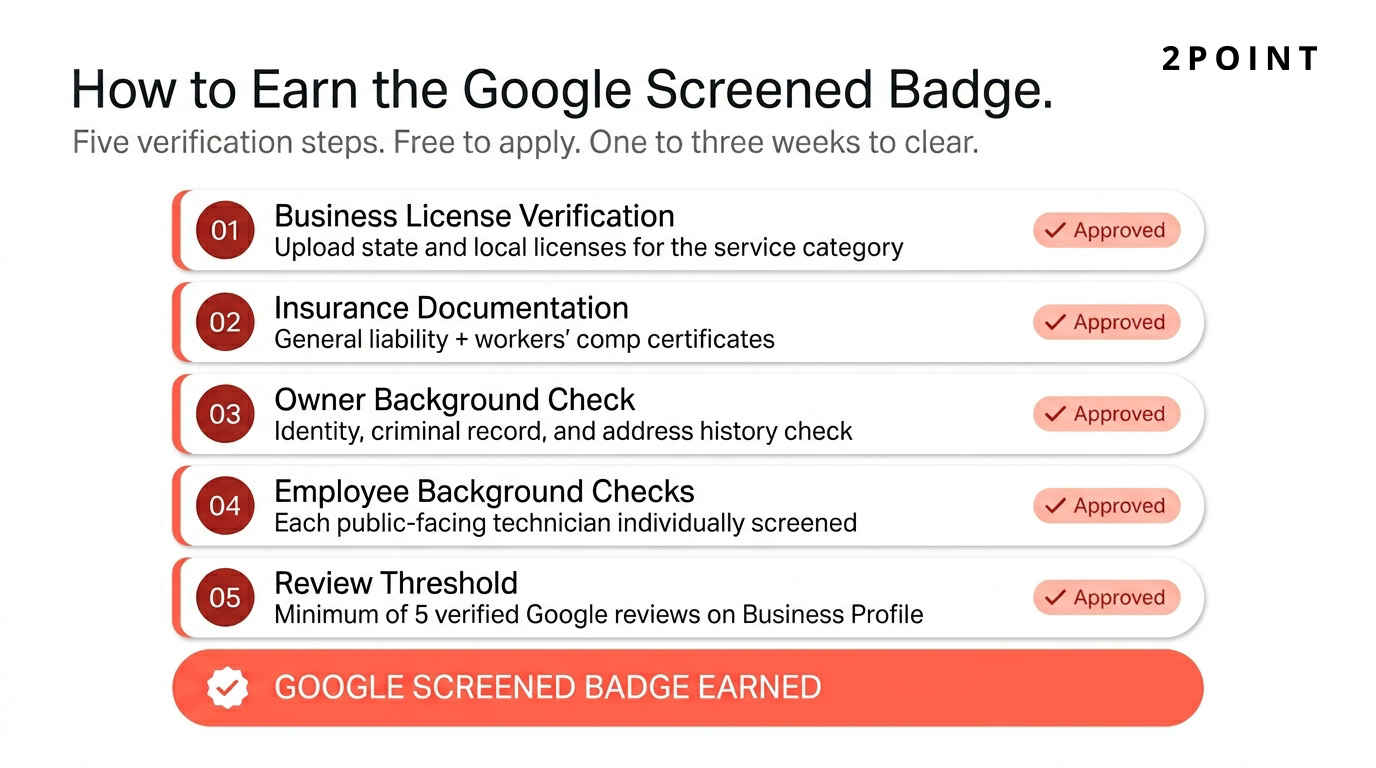
The verification process requires businesses to complete several steps depending on their industry. Most businesses must pass background checks for all employees who engage with customers. Trades requiring professional licenses must provide proof of current, valid licensing. Many categories require proof of insurance meeting minimum coverage thresholds.
This verification addresses consumer concerns about inviting service providers into their homes or trusting them with important projects. The Google Verified badge serves as a third-party trust signal that encourages first-time customers to choose your business over unverified competitors.
Reviews play a critical role in Local Services Ad performance. Google recommends maintaining at least five reviews to remain competitive, though top performers typically have dozens or hundreds. Star ratings display prominently in ad listings, and higher-rated businesses often receive preferential positioning.
The verification and review requirements create a quality filter that benefits both consumers and legitimate businesses. Consumers gain confidence in their selections, while quality businesses differentiate themselves from unlicensed or uninsured competitors who cannot participate in the program.
LSA Performance and Consumer Preference
Consistent brand management across Local Services Ads, Google Maps, and other local advertising surfaces builds the trust that drives consumer preference and conversion. 29% of consumers prefer clicking on Local Services Ads compared to just 11% for traditional Google Ads. This nearly 3x preference stems from the trust signals, simplified contact process, and prominence of LSAs in search results. Clear differentiation between your brand promise and value prop helps local ads resonate with consumers who compare multiple businesses in search results.
Performance metrics support this preference. Businesses report dramatically improved lead generation efficiency with Local Services Ads, as documented in real-world case studies of local advertising success. The pay-per-lead model typically delivers lower cost-per-acquisition, though actual costs vary significantly by geography and industry.
Lead quality presents ongoing challenges. Google has implemented spam filtering improvements and invalid lead detection enhancements to address advertiser concerns about low-quality leads. Businesses can dispute leads they consider invalid, requesting refunds for spam, wrong service requests, or duplicate contacts.
Response time significantly impacts performance. Google displays average response time in your ads, and customers increasingly prefer messaging and direct booking options over phone calls. Businesses with faster response times and multiple contact methods typically generate more leads and higher conversion rates.
The messaging vs. calling preference varies by industry and customer demographics. Younger consumers overwhelmingly prefer text-based communication, while older demographics still favor phone calls. Offering both options maximizes lead capture across demographic segments.
LSA Optimization Best Practices
Professional advertising services ensure Local Services Ads, Google Maps campaigns, and multi-platform local strategies are optimized for maximum lead generation. Start by selecting all relevant job types within your category. Google matches your ads to searches based on the job types you enable, so conservative selection limits visibility unnecessarily.
Set service areas broadly, preferably at the county level rather than restricting to specific postal codes. Google's algorithm handles proximity relevance in ad delivery, and broader service areas increase impression opportunities without sacrificing lead quality. You can always decline leads outside your preferred coverage zones.
Budget strategy selection significantly impacts performance. The "Maximize Leads" option allows Google's algorithm to automatically optimize bids across job types and geographies to deliver maximum lead volume within your budget. This typically outperforms manual "Max Per Lead" bidding unless you have specific cost-per-lead constraints requiring strict controls.
Auto-optimization works well for most businesses because Google's machine learning analyzes millions of signals to predict which ad placements will generate leads at the lowest cost. The algorithm improves over time as it accumulates performance data specific to your business.
Customer communication preferences continue evolving. Enable messaging and direct booking features where available. These options increasingly drive engagement, particularly from younger consumers who avoid phone calls. Quick response to messages (within minutes rather than hours) generates substantially higher conversion rates.
Budget allocation should reflect competitive intensity in your market and your business capacity. Set budgets high enough to remain visible during peak search times. Many businesses reduce budgets when booked at capacity rather than pausing campaigns entirely, maintaining some visibility while controlling lead flow.
What New Platform Opportunities Exist for Local Search Advertising?
The local search advertising landscape is experiencing rapid expansion as major technology platforms launch or enhance location-based advertising products. These new opportunities create competitive advantages for early adopters while fragmenting advertiser attention across more channels. AI-powered platforms including ChatGPT advertising represent an emerging channel where local businesses can reach consumers during conversational product and service research. The impact of AI on digital advertising is reshaping local platforms, from Google Maps' Gemini-powered conversational queries to Apple Maps' new ad inventory.
Apple Maps Search Advertising Launch in Summer 2026
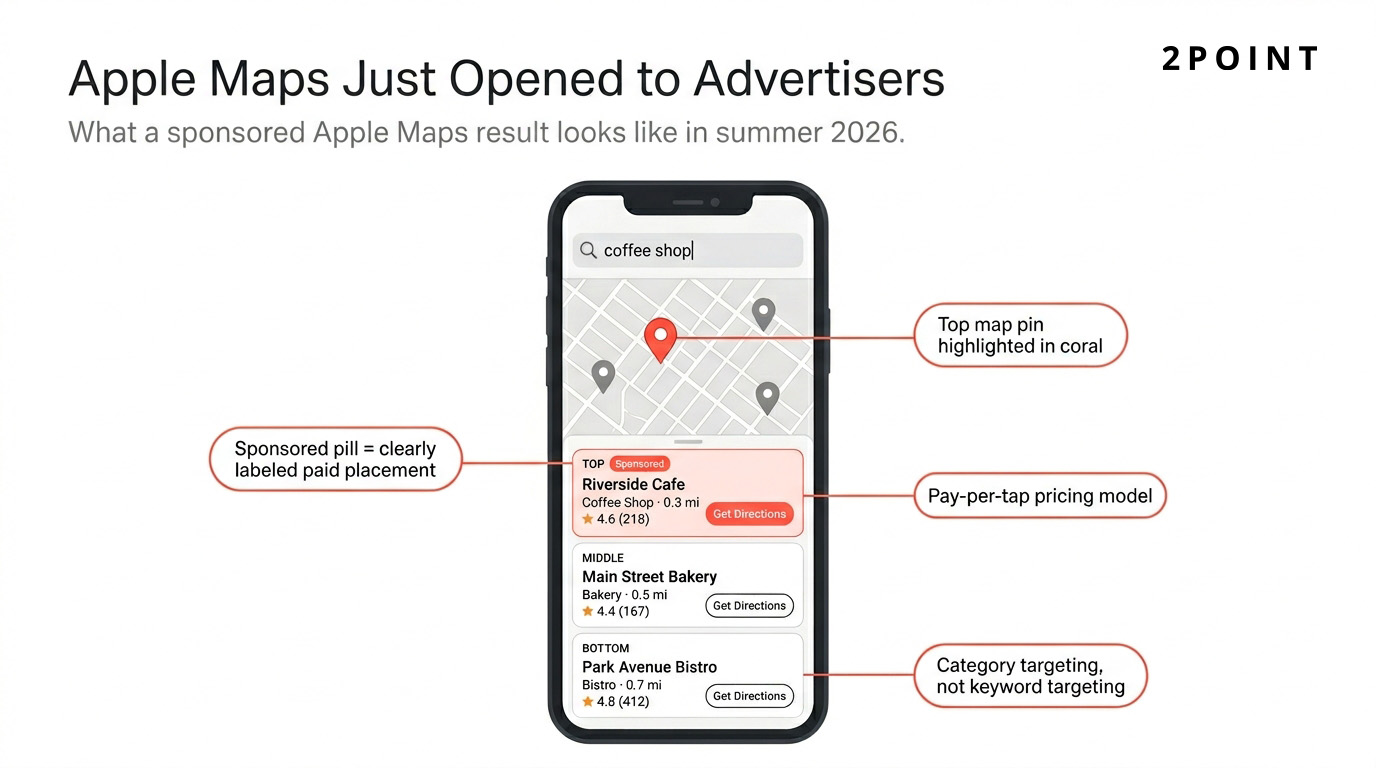
Apple plans to introduce search advertising in Apple Maps as early as summer 2026, representing a significant new inventory source for local advertisers. The bidding system will operate similarly to Google Maps, with businesses bidding to appear at the top of category search results.
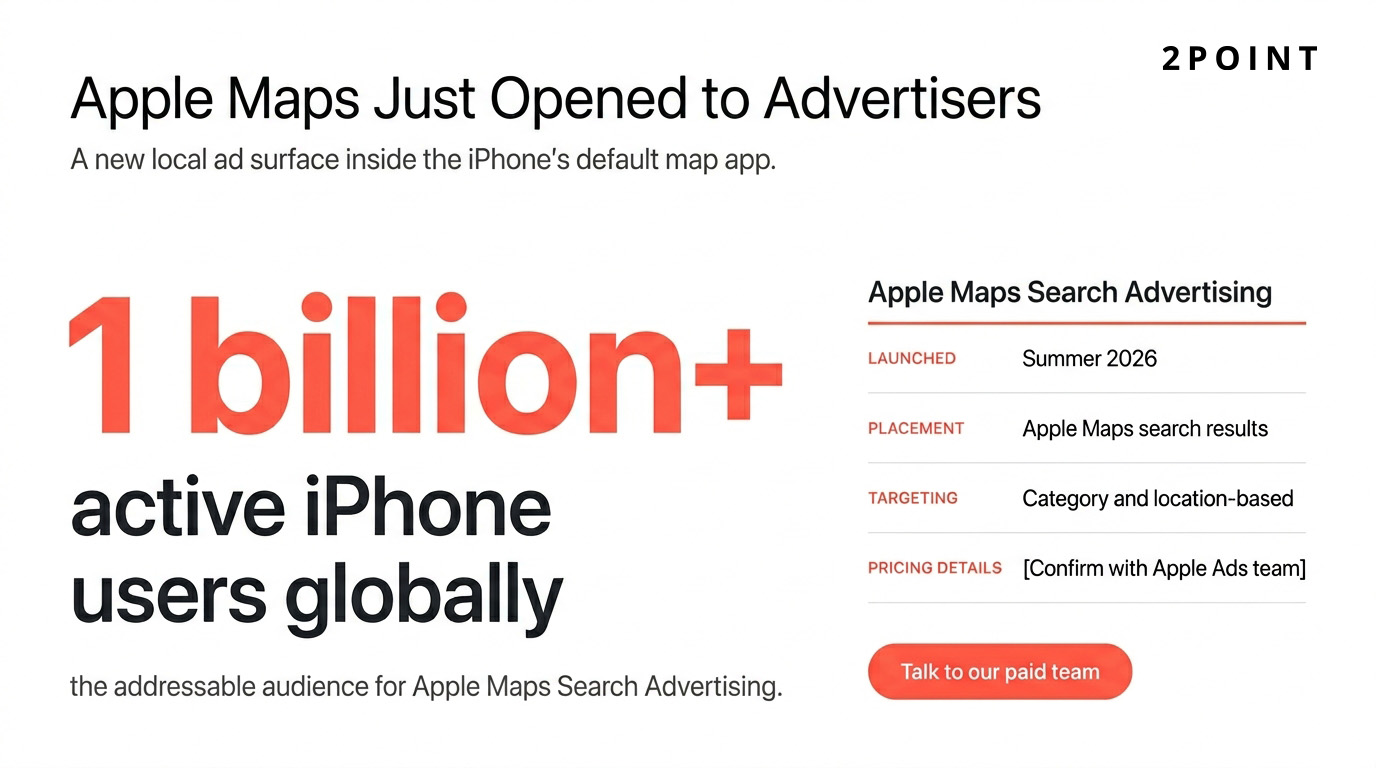
The target audience makes Apple Maps advertising particularly valuable. The platform reaches more than 1 billion active iPhone users globally, with demographic skew toward higher-income markets in the US, UK, and other developed economies. iPhone users typically demonstrate higher spending capacity and engagement with premium services.
Apple's hardware momentum supports the advertising opportunity. The company sold a record 247 million iPhones in 2025, expanding its potential advertising audience. The services division, which includes advertising, generated $100 billion in revenue in 2025, with advertising projected to reach $8.5 billion in 2026.
Strategic implications favor early adoption. New advertising platforms typically offer lower competition and better ROI during launch phases as advertisers gradually discover and adopt them. Businesses that establish strong presence on Apple Maps advertising from launch may enjoy sustained advantages over later entrants.
The Apple ecosystem's privacy-first positioning may actually enhance advertising effectiveness. Users who opt into location sharing on Apple devices have made conscious privacy trade-offs, potentially indicating higher engagement with location-based services compared to platforms where location sharing is default or less transparent.
Google Maps' Biggest Update in a Decade
Google rolled out what it calls the biggest Google Maps update in a decade during March 2026. The update introduces Immersive Navigation, which uses AI-powered 3D visuals to help users preview routes and destinations before traveling. This creates new advertising opportunities around high-intent navigation sessions.
The Gemini-powered "Ask Maps" feature enables conversational local queries. Users can ask complex questions like "Where can I find outdoor seating Italian restaurants with parking near downtown?" and receive relevant results. This natural language interface connects businesses with consumers using conversational search intent rather than traditional keyword strings.
Promoted pins and map search ads benefit from this update. The enhanced visual experience draws more engagement to the map interface, increasing impressions and interactions with advertising inventory. New ad formats tied to high-intent local searches provide fresh opportunities for businesses to capture attention.
Integration with Google's existing advertising ecosystem creates advantages over standalone map advertising platforms. Advertisers can leverage existing Google Ads accounts, audience data, and attribution models while expanding into map-based inventory. This unified approach reduces operational complexity compared to managing completely separate platforms.
TikTok's Local Content Feed
TikTok launched a dedicated local content feed in March 2026, requiring users to share their location to access hyperlocal content alongside the main For You page. This creates new discovery opportunities for local businesses through both organic content and paid promotion.
The local feed taps into existing user behavior. 54% of TikTok users aged 25-44 gather product information on the platform, demonstrating commercial intent beyond entertainment. The local feed channels this intent toward nearby businesses, potentially driving foot traffic and immediate purchases.
Implications for local service businesses extend beyond traditional e-commerce. Restaurants, salons, fitness studios, and entertainment venues can showcase their locations, atmospheres, and customer experiences through short-form video. User-generated content featuring local businesses gains new distribution through the local feed, amplifying organic reach.
Integration with existing TikTok advertising products enables precise targeting. Businesses can create location-targeted campaigns promoting special offers, new services, or events to users within specific geographic radiuses. The visual, engaging format suits businesses with strong aesthetic appeal or personality-driven branding.
Video Ads in Local Search Results
Google is testing video ads within the local pack search results, potentially transforming how businesses showcase themselves directly in search. These video ads would appear among standard text-based listings, creating visual differentiation that captures attention more effectively than static listings.
Video formats enable businesses to showcase locations, products, and services more comprehensively than text and images alone. A restaurant can display its ambiance, signature dishes being prepared, and happy customers. An auto repair shop can demonstrate its equipment, cleanliness, and expertise. This visual storytelling builds trust and differentiates businesses from competitors.
The high-intent context makes video ads particularly valuable. Unlike social media video advertising where users browse entertainment content, video ads in local search results appear when users actively seek services. This intent alignment should generate higher engagement and conversion rates compared to interruptive video advertising in other contexts.
Production considerations require planning. While smartphone video has become acceptable quality for many purposes, businesses should invest in professional production for ads appearing in high-stakes search results. Poor video quality can damage brand perception, negating the visibility advantage.
Early testing suggests significant visibility and engagement increases for businesses using video ads compared to standard text listings. As the format rolls out more broadly, video may transition from differentiator to requirement for maintaining competitive presence in local search results.
How Is AI and Generative Search Disrupting Local Discovery?
Artificial intelligence has fundamentally restructured how search engines deliver local business information. These changes create both opportunities and challenges for local advertisers navigating a rapidly evolving landscape.
AI Overviews Dominating Local Search Results
Google now shows AI Overviews for 57-80% of local queries, with significant variation across cities and industries. These AI-generated summaries appear above traditional organic listings, reshaping the search results page and user behavior.
AI Overviews synthesize information from multiple sources to provide direct answers to user questions. For local searches like "best coffee shops downtown," the AI Overview might summarize common recommendations, highlight distinguishing features of top-rated options, and provide quick-reference information like hours and locations.
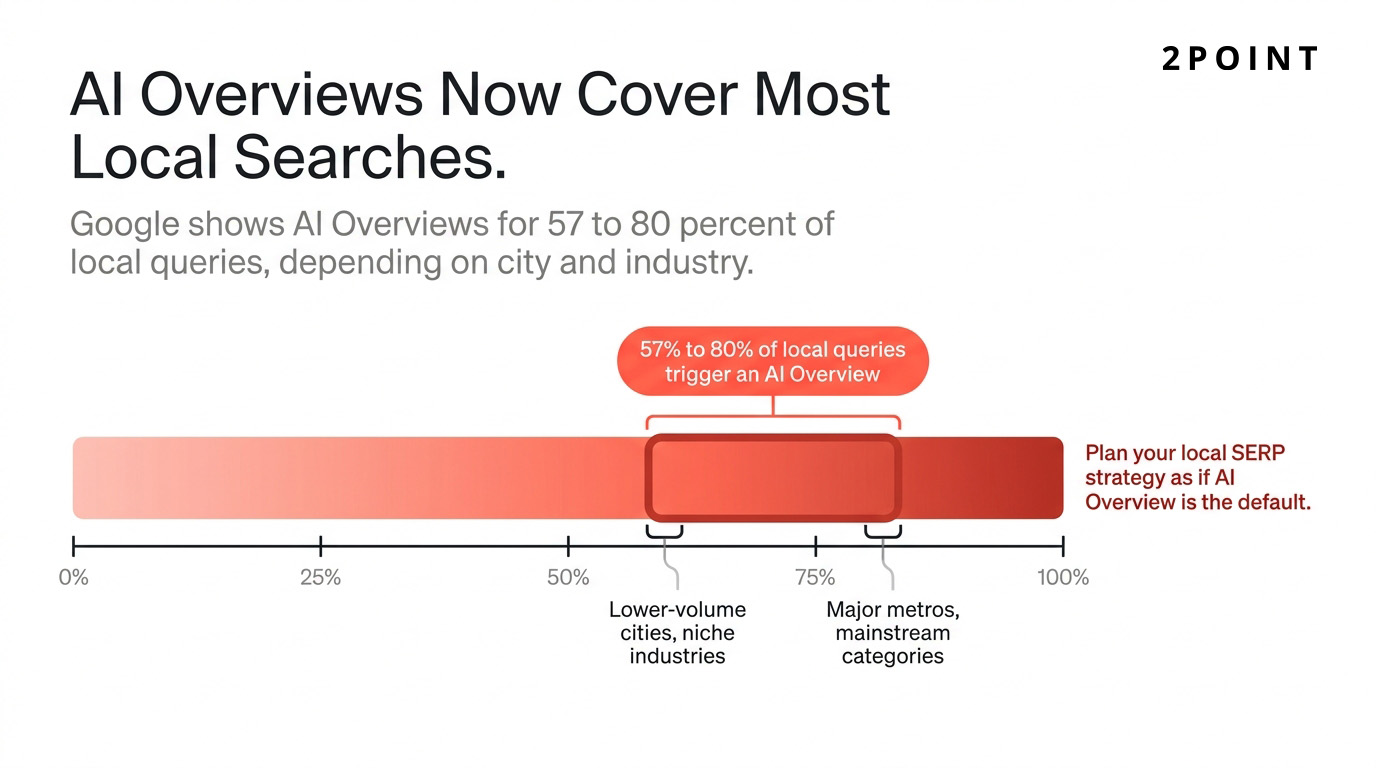
Traditional organic listings receive less visibility as AI Overviews consume screen real estate, particularly on mobile devices where above-the-fold space is limited. Businesses must now optimize for inclusion in AI Overviews rather than simply ranking in traditional organic results.
What appears in AI Overviews depends on multiple factors including review prominence, presence in authoritative local guides, quality content on business websites, and structured data implementation. Businesses with comprehensive information across multiple platforms increase their likelihood of AI Overview inclusion.
The shift from traditional search results to AI recommendations has led some experts to declare that "GEO becomes the new SEO" (Generative Engine Optimization replacing Search Engine Optimization). This reflects the reality that optimizing for AI-powered search requires different strategies than traditional SEO focused on ranking factors and link building.
Small Business AI Adoption Rates
Small businesses have rapidly adopted AI tools for marketing and operations. 98% of small businesses use at least one AI-enabled software tool, indicating near-universal integration into business operations. These tools range from simple automation for scheduling and customer communication to sophisticated marketing platforms.
40% of small businesses use generative AI tools like ChatGPT for content creation, customer service chatbots, and marketing copy development. This adoption rate will likely accelerate as tools become more accessible and benefits become more apparent.
However, an execution gap exists between AI adoption for ideation versus implementation. 86% use AI for campaign ideation, but only 44% for ongoing campaign management. This suggests businesses find value in AI for creative thinking and planning but struggle to implement AI for operational execution.
AI is becoming an "operating layer" embedded throughout marketing workflows rather than a standalone tool. Businesses use AI for audience research, content creation, ad copy testing, bid optimization, and performance analysis. This integration improves efficiency and enables smaller teams to execute sophisticated campaigns.
Cross-channel AI orchestration demonstrates superior performance compared to siloed, single-channel AI applications. Businesses using AI to coordinate messaging, timing, and budget allocation across search, social, and display advertising report better overall results than those applying AI to individual channels in isolation.
ChatGPT and AI Chatbot Search Behavior
Consumer behavior with AI chatbots reveals interesting patterns for local business discovery. 75% of ChatGPT users employ keywords rather than natural language when searching for local services, despite the platform's conversational capabilities. This suggests users haven't fully adapted behavior to conversational AI's potential.
Users rarely stop at one result. They view an average of 3.7 local businesses from ChatGPT results, with only 27% looking at just one business. This comparison shopping behavior mirrors traditional search but occurs within the AI interface rather than requiring multiple platform visits.
Data accuracy presents significant challenges. Only 68% of business contact information in AI chatbot responses matches information in Google Business Profiles. This discrepancy creates customer frustration and lost business when consumers receive incorrect phone numbers, addresses, or hours.
The accuracy problem stems from AI models training on outdated data, pulling information from multiple conflicting sources, or hallucinating details when uncertain. For businesses, this reinforces the critical importance of NAP (Name, Address, Phone) consistency across all online platforms.
Maintaining accurate business information everywhere it might appear becomes more important, not less, in an AI-powered search environment. AI models aggregate data from numerous sources, and inconsistencies confuse the models, potentially resulting in incorrect information being provided to consumers.
Zero-Click Search Evolution for 2026
Zero-click search is evolving beyond simple information delivery to include interactive elements within search results. Users can increasingly complete transactions without ever leaving the search page, including booking appointments, checking live inventory, and even initiating virtual consultations.
This transformation represents a fundamental shift in the search experience. Previously, search results served as gateways to websites where actual interactions occurred. Now, search results themselves become destinations where users complete entire customer journeys.
For local businesses, zero-click search creates both opportunities and challenges. The opportunity is immediate conversion without friction from navigation to external websites. Customers can book appointments or make reservations directly from search results with minimal steps, reducing abandonment.
The challenge is reduced website traffic. When customers complete actions without visiting your website, you lose opportunities for additional engagement, upsell, brand storytelling, and data collection. Website analytics become less comprehensive as a greater share of customer interactions occur on platform-controlled interfaces.
Businesses preparing for zero-click search optimization will dominate when these features roll out widely. This preparation includes implementing structured data markup enabling direct bookings, integrating with Google's reservation systems where available, and ensuring business profiles contain comprehensive information answering common questions.
Strategic positioning requires balancing visibility in zero-click interfaces with maintaining strong owned digital properties. Businesses should enable direct booking and quick actions in search results while simultaneously creating compelling reasons for customers to visit websites for deeper engagement with brand stories, detailed product information, and exclusive offers.
Why Is Google Business Profile the Foundation of Local Search Success?
Google Business Profile remains the single most important factor in local search visibility and credibility. Understanding its impact on consumer behavior and search rankings guides strategic optimization efforts.
Consumer Trust and Purchase Behavior
Complete Google Business Profiles dramatically impact consumer perception and behavior. Consumers are 2.7 times more likely to consider a business reputable when it has a complete Business Profile. This trust signal influences not just clicks but actual purchase decisions and business selection.
Visit likelihood increases substantially with profile completeness. Consumers are 70% more likely to visit a business with a complete profile compared to businesses with incomplete or minimal information. This translates directly to foot traffic and revenue opportunities.
Purchase consideration follows similar patterns. Consumers are 50% more likely to consider purchasing from businesses with complete profiles. The completion signals professionalism, legitimacy, and active business operation, all of which build consumer confidence.
What constitutes a "complete" Business Profile includes accurate business name, address, and phone number, comprehensive business hours including special hours for holidays, appropriate business categories (primary and secondary), detailed business description, high-quality photos showcasing location and services, current customer reviews with owner responses, and regular posts featuring updates, offers, or events.
These elements collectively create trust signals that influence consumer decisions. Photos provide visual proof of business quality and atmosphere. Reviews offer social proof from other customers. Regular posts demonstrate active management and engagement. Together, they build credibility that incomplete profiles cannot match.
Ranking Factor Hierarchy
Google Business Profile factors have the biggest impact on local pack rankings (the map results appearing for local searches), while on-page factors remain strongest for local organic rankings below the map. Understanding this distinction helps businesses prioritize optimization efforts.
The top three local pack ranking influences are:
- Primary GBP category: This tells Google what your business does and determines which searches you're eligible to appear for.
- Proximity of address to the searcher: Google prioritizes nearby businesses, making accurate address information critical.
- Keywords in GBP business title: While Google prohibits keyword stuffing, legitimate business names containing relevant keywords gain ranking advantages.
Category selection requires strategic thinking. Choose the most specific primary category that accurately describes your core business. Google allows multiple additional categories, so select all relevant options to increase eligibility for various search queries.
Proximity optimization is limited since you cannot change your physical address. However, businesses can optimize service areas to appear for searches throughout their coverage zones. Service area businesses (plumbers, electricians, delivery services) should configure coverage areas rather than relying solely on address proximity.
Business title optimization requires careful balance. Google's guidelines prohibit adding keywords to business names for ranking purposes. However, if your legal business name legitimately includes location or service keywords (like "Seattle Plumbing Experts LLC"), you gain natural ranking advantages. Never violate Google's naming guidelines as penalties can result in profile suspension.
AI Local Search Visibility Factors
AI-powered search evaluates local businesses differently than traditional algorithmic search. The top three factors influencing AI search visibility are:
- Presence on expert-curated "Best Of" lists: AI models weight authoritative editorial selections heavily when determining which businesses to recommend.
- Dedicated pages for each service: Comprehensive service pages help AI understand your offerings and match them to specific queries.
- Prominence on industry-relevant domains: Citations and mentions on authoritative websites in your industry signal expertise and legitimacy.
AI evaluates local business authority through signals indicating expertise, trustworthiness, and quality. Being featured in "Best Restaurants in [City]" articles from local news outlets, appearing in industry directories and professional associations, and maintaining detailed service descriptions all contribute to AI's assessment of your business's authority.
Strategies to improve AI visibility include pursuing coverage in local media and guide publications, creating comprehensive content for each service you offer, building relationships with industry organizations and directories, and maintaining consistent business information across all platforms where you appear.
Multi-Location Performance Opportunities
Multi-location brands show improving performance in competitive local searches. They now capture 33.4% of Google 3-pack presence for competitive keywords, up from 23.8% in 2022. This improvement suggests Google's algorithms better recognize and rank chain businesses in local results.
Significant opportunities exist for chains in categories like salons, auto repair, and restaurants where independent businesses traditionally dominated local results. Multi-location brands with professional management, standardized quality, and resources for optimization can increasingly compete with local independents.
Multi-location management challenges include maintaining unique content for each location (avoiding duplicate content penalties), managing reviews across dozens or hundreds of locations, ensuring NAP consistency across all locations and platforms, and creating location-specific offers and posts at scale.
Strategies for scaling local presence include implementing location page templates with customization for each address, using review management platforms to monitor and respond at scale, establishing corporate guidelines with local customization flexibility, and leveraging local landing pages to capture service area searches beyond physical locations.
Technology platforms specifically designed for multi-location local SEO help manage the operational complexity. These tools automate listing management, review monitoring, reporting, and optimization across hundreds or thousands of locations while maintaining location-specific customization where beneficial.
How Does Location-Based Marketing Technology Enable Precise Targeting?
Location-based marketing technology creates unprecedented precision in reaching consumers based on physical location and movement patterns. Understanding the technology infrastructure and application strategies maximizes advertising effectiveness.
Global GPS and Location Technology Adoption
The foundation for location-based advertising rests on widespread GPS and location tracking adoption. More than 6.8 billion smartphones globally support GPS and location tracking, creating a massive addressable audience for location-targeted campaigns.
Device adoption alone doesn't guarantee advertising reach. 72% of mobile devices have location services enabled, meaning users have granted permission for apps and services to access their location. This opt-in creates an audience receptive to location-relevant information and offers.
Technology enables personalized messaging within 50 meters to 2 kilometers of businesses or target locations. The precision ranges from hyper-local (within a building or block) to broader neighborhood targeting, depending on campaign objectives and privacy regulations.
Privacy considerations and opt-in requirements have increased importance. Regulations like GDPR in Europe and CCPA in California mandate explicit consent for location data collection and use. Advertisers must ensure compliance while maintaining effective targeting, balancing precision with user privacy expectations.
The technology infrastructure supporting location-based advertising includes GPS satellites providing positioning data, cellular triangulation offering location approximation when GPS is unavailable, Wi-Fi positioning using known access point locations, and Bluetooth beacons for indoor location precision.
Search Result Advertising Market Share
Search result advertising represents 17% of the Location Based Marketing Market Share. These ads appear when users search for local products or services, aligning advertising with active intent and immediate needs.
Consumer behavior supports search result advertising's effectiveness. 69% of smartphone users search for businesses within 5 kilometers of their current location. This concentrated geographic search behavior creates ideal conditions for location-targeted advertising with high conversion probability.
Integration with other location-based tactics creates synergies. Businesses can combine search advertising with geofencing around competitor locations, beacon technology in their own stores, and location-based social media advertising to create comprehensive location marketing strategies.
Performance metrics for search result advertising typically exceed other location-based formats. The combination of high-intent search behavior with geographic proximity produces strong click-through rates and conversion rates, justifying premium cost-per-click rates.
Geofencing Adoption and Applications
Geofencing technology creates virtual boundaries around physical locations like retail stores, malls, or event venues. When users enter these defined areas, they become eligible for targeted advertising or notifications. 58% of large retail brands use geofencing, indicating mainstream adoption among sophisticated marketers.
Applications extend beyond basic promotion. Retailers use geofencing around competitor locations to capture consideration-phase shoppers with competitive offers. Event venues employ geofencing to promote concessions, merchandise, or future events to attendees. Service businesses create geofences around service call locations to request reviews immediately after job completion.
Campaign design requires strategic thinking about radius size, messaging timing, and offer relevance. Geofences that are too small miss audience opportunities, while overly large boundaries dilute relevance and waste budget on users unlikely to visit. Immediate notification upon entry works for some scenarios (entering a mall) while delayed messaging suits others (after leaving a competitor location).
ROI considerations depend on conversion tracking and attribution. Businesses must connect geofence-triggered advertising to in-store visits, purchases, or other desired outcomes. Location analytics platforms help measure foot traffic lift from geofencing campaigns, quantifying impact beyond digital metrics.
Beacon Technology for Proximity Marketing
Bluetooth beacons installed in retail stores enable proximity marketing within 10-30 meter transmission radiuses. 46% of large retail brands have implemented beacon technology, using it to enhance in-store experiences and drive specific actions.
Beacon applications include welcoming messages when customers enter stores, product information and reviews when customers browse specific aisles or departments, personalized offers based on purchase history and current location, and mobile payment facilitation at checkout areas.
The technology requires users to have Bluetooth enabled and the business's mobile app installed, creating adoption barriers. However, customers who opt in demonstrate high engagement and typically represent valuable repeat customers worth the investment in beacon infrastructure.
Implementation considerations include beacon placement strategy to cover desired zones without overlap or dead spots, app development to handle beacon signals and deliver appropriate content, content strategy determining what messages to send in which locations, and privacy transparency ensuring users understand data collection and use.
Beacon technology works particularly well for businesses with existing mobile apps and customer loyalty programs. The combination enables personalized experiences that drive engagement, purchases, and long-term loyalty through relevant, timely communication based on physical store presence.
What Local Advertising Metrics and ROI Should You Track?
Measuring local advertising performance requires tracking metrics aligned with business objectives while accounting for multi-channel customer journeys. Understanding which metrics matter most guides optimization and budget allocation decisions.
Essential Local Advertising KPIs
Cost-per-lead remains the foundational metric for pay-per-lead platforms like Google Local Services Ads. Track both average cost-per-lead and trends over time to identify seasonal patterns and competitive intensity changes. Compare cost-per-lead across service categories and geographic areas to optimize budget allocation toward best-performing segments.
Lead-to-customer conversion rate connects advertising to actual revenue. Not all leads convert to paying customers, and conversion rates vary significantly by industry, service value, and competitive intensity. Track conversion rates by lead source, allowing comparison between Local Services Ads, traditional search ads, social advertising, and other channels.
Customer acquisition cost (CAC) measures total marketing spend divided by new customers acquired. This comprehensive metric includes all advertising costs, agency fees, and internal marketing labor. Compare CAC to customer lifetime value (LTV) to ensure sustainable unit economics where LTV exceeds CAC by sufficient margin to justify the investment.
Store visit lift quantifies how advertising drives physical location visits. Google and Facebook provide store visit reporting connecting ad exposure to subsequent location visits measured through smartphone location data. This metric particularly matters for businesses where in-person visits drive revenue rather than online conversions.
Share of local voice measures your visibility relative to competitors in local search results. Tools like BrightLocal and Whitespark track rankings, review presence, and overall local search footprint compared to identified competitors. Improving share of voice typically correlates with market share gains.
Review velocity and sentiment track not just total reviews but the rate of new review acquisition and overall sentiment trends. Consistent review generation indicates healthy customer satisfaction and engagement. Declining review velocity or worsening sentiment signals problems requiring immediate attention.
Attribution Challenges and Solutions
Local advertising attribution faces unique challenges. Customers often research online but purchase in-store, creating tracking gaps. They might see your ad on mobile, visit your website on desktop, then visit your location days later. Traditional digital attribution models fail to capture these complex journeys.
Multi-touch attribution attempts to credit all touchpoints in the customer journey rather than just the last click. A customer might discover your business through a Local Services Ad, read reviews on Yelp, visit your website, see a retargeting ad, then call to book an appointment. Multi-touch attribution assigns fractional credit to each interaction.
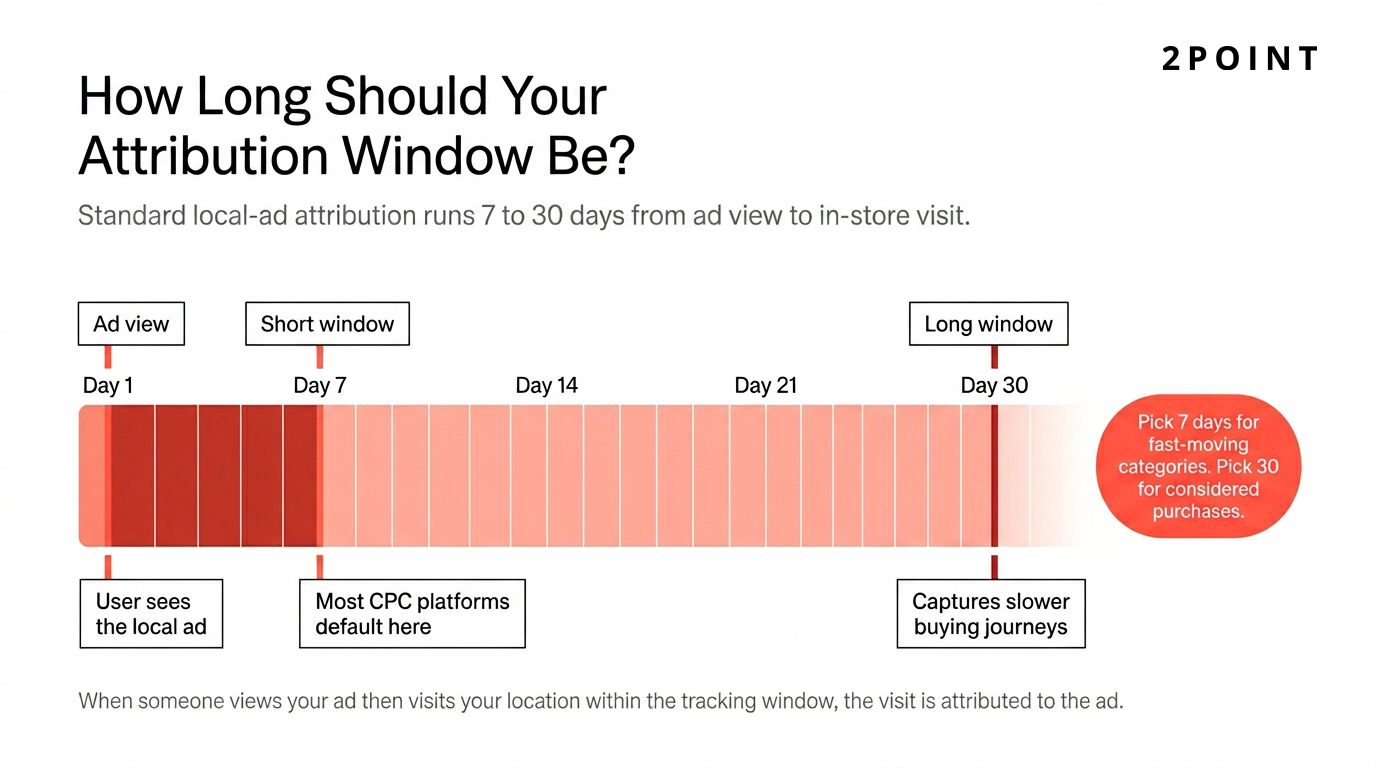
Location-based attribution uses smartphone location data to connect ad exposure to store visits. When someone views your ad then visits your location within a tracking window (typically 7-30 days), the visit is attributed to the advertising exposure. This measurement requires sufficient location data volume to produce statistically significant results.
Call tracking assigns unique phone numbers to different advertising channels, enabling attribution of inbound calls to specific campaigns. When implementing call tracking, maintain consistent phone numbers on your Google Business Profile and citations to avoid NAP inconsistency issues. Use call tracking numbers on your website and in ads while keeping your primary number constant on directories.
Survey-based attribution simply asks new customers how they found you. While less sophisticated than technological solutions, direct inquiry often provides accurate attribution data, especially when customers have simple, linear discovery paths. Train staff to consistently ask and record customer sources.
Benchmarking Local Advertising Performance
Industry benchmarks provide context for performance evaluation. Local search advertising benchmarks vary significantly by vertical, geography, and competition levels. Home services (plumbing, HVAC, electrical) typically see higher cost-per-lead than less urgent services like landscaping or interior design.
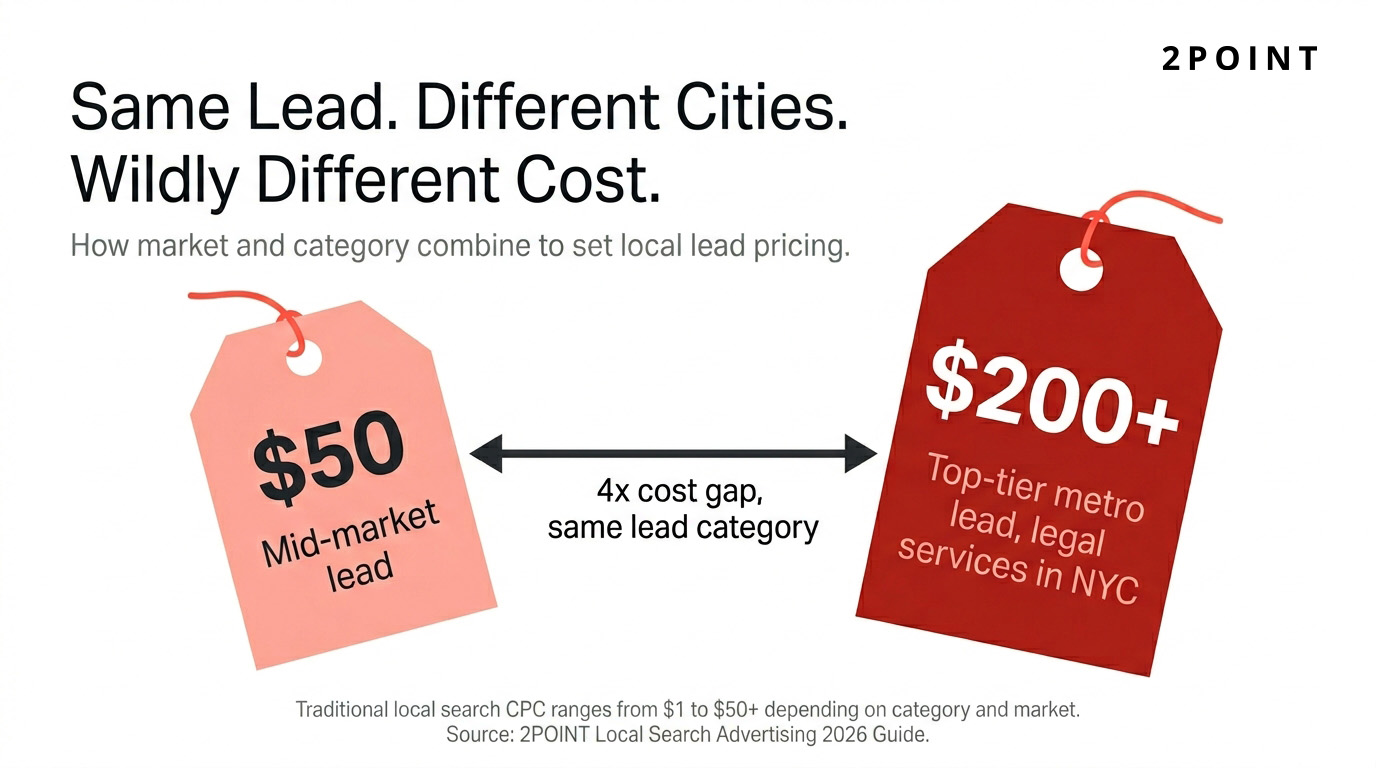
Geographic variations reflect competitive intensity and cost-of-living differences. Advertising in major metropolitan markets costs substantially more than smaller cities or rural areas. A lead for legal services in New York City might cost $200+ while the same lead in a mid-sized market costs $50.
Seasonal patterns affect most local businesses. Tax preparation services concentrate business in winter and early spring. Landscaping peaks in spring and summer. HVAC companies see different service demands by season (heating vs. cooling). Adjust benchmarks and expectations based on seasonal business patterns.
Competitive intensity impacts all performance metrics. New competitors entering your market typically increase cost-per-click and cost-per-lead while reducing conversion rates. Monitor competitor activity and adjust budgets and strategies when competitive landscapes shift.
Platform-specific benchmarks recognize performance differences across channels. Google Local Services Ads typically deliver lower cost-per-acquisition than traditional search ads due to higher intent and trust signals. Social media advertising generally shows lower conversion rates but may deliver lower cost-per-impression for awareness building.
Optimizing Local Ad Spend Across Channels
Budget allocation should reflect channel performance and business capacity constraints. Start with minimum viable investments across multiple channels to gather performance data. Redirect budget toward best-performing channels while maintaining presence on secondary channels for audience diversity.
Business capacity constraints should govern spending levels. If your service business is booked three weeks out, reducing advertising spend prevents paying for leads you cannot serve promptly. Maintain enough visibility to fill scheduling gaps while avoiding oversaturation that damages customer experience.
Testing discipline improves results over time. Regularly test new platforms, ad formats, targeting approaches, and creative messages. Allocate 10-20% of budget to testing while maintaining 80-90% in proven strategies. This balance enables innovation without risking core performance.
Seasonal budget adjustments maximize ROI. Increase spending during peak seasons when conversion rates are highest and customer value is greatest. Reduce but don't eliminate spending during slower periods to maintain visibility and capture available demand at potentially lower costs.
Geographic expansion follows proven success in initial markets. Once you've optimized campaigns in your primary market, expand to adjacent geographies using similar strategies. This systematic approach reduces risk while enabling growth into new customer bases.
How Should Multi-Location Businesses Approach Local Search Advertising?
Multi-location businesses face unique challenges and opportunities in local search advertising. Scale creates both advantages and complexities requiring specialized strategies and tools.
Centralized vs. Decentralized Campaign Management
Centralized campaign management consolidates all advertising decisions, creative development, and budget allocation at corporate headquarters. This approach ensures brand consistency, enables sophisticated strategies requiring coordination, and achieves operational efficiency through standardization.
Advantages include consistent brand messaging across all locations, economies of scale in creative production and media buying, centralized expertise with dedicated specialists, and simplified reporting with standardized metrics and dashboards.
Disadvantages include reduced local market responsiveness, less accountability from location managers who don't control marketing, potential disconnect between corporate strategy and local market realities, and difficulty addressing location-specific competitive situations.
Decentralized management empowers individual locations or regional managers to make advertising decisions within corporate guidelines. This approach increases local market relevance and manager accountability while enabling rapid response to local opportunities and challenges.
Advantages include greater local market relevance, increased manager ownership and accountability, faster response to local competitive situations, and better alignment between marketing and local business conditions.
Disadvantages include potential brand inconsistency across locations, inefficiency from duplicated efforts, variable marketing expertise across locations, and complex reporting aggregating performance across independently managed campaigns.
Hybrid approaches combine centralized strategy and brand standards with local execution flexibility. Corporate provides approved messaging frameworks, creative templates, and budget allocations while local managers customize tactics, offers, and timing to their specific markets. This model balances consistency with relevance.
Location Page Optimization at Scale
Every location needs a dedicated page on your website optimized for local search. These pages should include unique content about each location to avoid duplicate content penalties, embedded Google Maps showing the location, location-specific customer testimonials and reviews, locally relevant photos showing the actual location, detailed directions and parking information, and location-specific offers or promotions.
Template-based approaches enable scaling while maintaining quality. Develop location page templates with standardized sections and design while requiring customization of specific elements. Standardize navigation, branding, and conversion paths while customizing location details, staff information, and local content.
Content differentiation prevents duplicate content issues. Even if all locations offer identical services, customize descriptions with local landmarks, neighborhood names, and location-specific benefits. Mention proximity to popular destinations or unique location features that differentiate each page.
Local link building strengthens individual location page authority. Pursue local citations and links for each location through local business directories, chamber of commerce memberships, community organization sponsorships, and local media coverage and partnerships.
Schema markup implementation helps search engines understand location relationships. Use LocalBusiness schema on each location page, Organization schema connecting locations to the parent brand, and appropriate industry-specific schema (Restaurant, AutoDealer, MedicalBusiness) for your business type.
Review Management Across Multiple Locations
Review volume and quality significantly impact local search performance, making review management critical for multi-location businesses. Challenges include monitoring reviews across dozens or hundreds of locations on multiple platforms, ensuring consistent response quality and timing, addressing location-specific issues revealed in reviews, and maintaining high overall ratings while some locations inevitably underperform.
Centralized review monitoring tools aggregate reviews from all locations and platforms into unified dashboards. These platforms send alerts when new reviews are posted, flag negative reviews requiring immediate attention, track response rates and times across locations, and provide performance comparisons across locations.
Response protocols establish guidelines for consistency while allowing local personalization. Create approved response templates for common review types, require response within defined timeframes (ideally within 24 hours), empower local managers to address specific issues mentioned, and maintain brand voice consistency across all locations and responders.
Review generation programs systematically request reviews from satisfied customers. Implement post-service email or SMS campaigns requesting reviews, train staff to request reviews from happy customers, provide easy review submission links and instructions, and incentivize customers appropriately within platform guidelines (never pay for reviews).
Problem location intervention addresses underperforming locations dragging down overall brand perception. Identify locations with below-average ratings requiring improvement, analyze review themes to diagnose root causes, implement operational improvements addressing issues, and launch targeted review generation campaigns to dilute old negative reviews with recent positive ones.
Franchise-Specific Local Advertising Considerations
Franchise businesses face additional complexity from divided ownership between franchisors and franchisees. Advertising fund management typically collects percentage-based contributions from franchisees into cooperative advertising funds. These funds finance national branding and local market campaigns benefiting all franchisees.
Clear agreements establish how funds are allocated between national brand building and local market support, who controls advertising decisions and approves creative, how performance is measured and reported, and what franchisees can do independently versus through cooperative programs.
Brand compliance requirements protect brand integrity while limiting franchisee flexibility. Franchisors typically mandate approved messaging and creative, require use of standard logos and brand elements, prohibit certain advertising approaches or channels, and reserve final approval on all public-facing marketing.
Local market flexibility within guidelines enables franchisees to address specific market conditions. Approved tactics might include local promotional pricing within specified parameters, partnerships with local organizations and events, sponsorship of local teams or causes, and local targeting customization within national campaign frameworks.
Technology platforms designed for franchise marketing streamline operations. These systems provide brand-compliant creative templates franchisees can customize, centralized media buying with local targeting customization, automated reporting showing performance by location and market, and compliance monitoring ensuring franchisees follow brand guidelines.
Successful franchise local advertising balances brand consistency with local relevance. Strong brand standards ensure customer experience consistency while local customization addresses specific market needs and competitive situations. For more strategies, explore our guide on franchise local SEO and reputation management.
What Are the Most Common Local Search Advertising Mistakes to Avoid?
Even experienced advertisers make preventable mistakes in local search advertising. Understanding common pitfalls helps businesses avoid wasted spend and missed opportunities.
Google Business Profile Errors That Kill Visibility
Incomplete business profiles dramatically reduce visibility and credibility. Many businesses claim their Google Business Profile but fail to complete all sections. Missing business hours, incomplete service descriptions, lack of photos, and absence of business attributes all reduce ranking potential and consumer trust.
Incorrect category selection limits search eligibility. Choosing overly broad categories reduces relevance for specific searches. Selecting inappropriate categories can result in appearing for irrelevant searches while missing target queries. Research competitors' category choices and select the most specific primary category accurately describing your core business.
Inconsistent NAP (Name, Address, Phone) information across platforms confuses search engines and consumers. Your business name, address, and phone number must match exactly across your Google Business Profile, website, citations, and advertising. Even small variations like "St." versus "Street" or included/excluded suite numbers create inconsistency signals.
Ignoring Google Business Profile posts wastes free visibility opportunities. Posts appear directly in your Business Profile and can promote events, offers, products, or updates. Businesses posting regularly demonstrate active management and engagement, potentially improving rankings while keeping customers informed.
Failing to respond to reviews damages reputation and rankings. Google considers review responses a ranking factor and consumers view response rates as indicators of customer service quality. Respond to all reviews, both positive and negative, promptly and professionally to maximize benefit.
Budget and Bidding Strategy Mistakes
Setting budgets too low prevents gathering sufficient performance data for optimization. Minimum viable budgets depend on market size and competition but generally require enough spend to generate at least 20-30 conversions monthly for meaningful statistical analysis. Inadequate budgets result in sporadic visibility and incomplete performance pictures.
Improper bid strategy selection undermines campaign goals. Manual bidding requires constant monitoring and adjustment, often underperforming automated strategies with insufficient management. Automated bidding strategies like Maximize Conversions or Target CPA typically outperform manual bidding when campaigns have sufficient conversion volume for machine learning optimization.
Geographic targeting errors waste budget on non-serviceable areas or miss opportunity zones. Setting radius targeting too conservatively limits reach while excessive geographic breadth drives irrelevant traffic. Define service areas based on actual service capability and customer density rather than arbitrary radius distances.
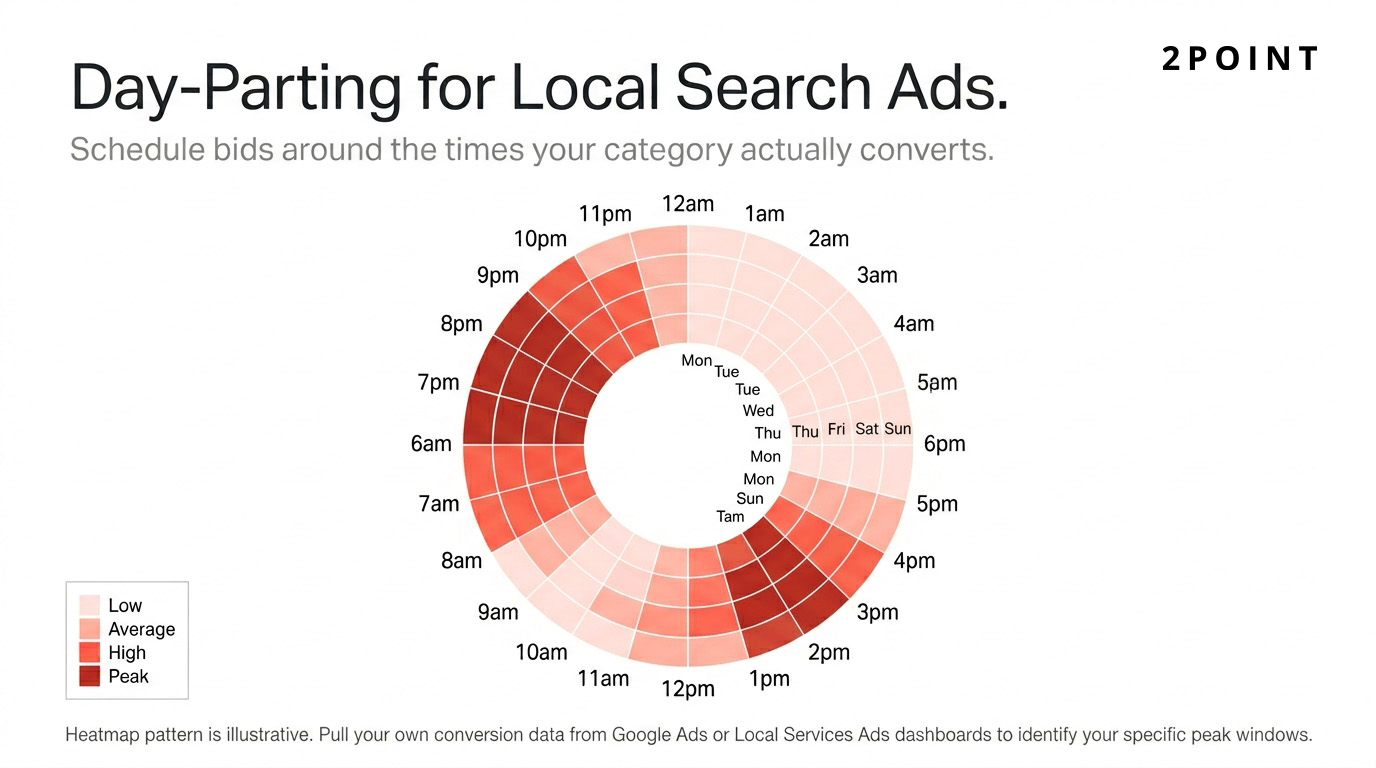
Dayparting mistakes cause inefficient spending during low-conversion hours. Many businesses generate better results concentrating budgets during business hours when they can answer phones and respond to leads promptly. Advertising during closed hours often generates lower-quality leads and worse conversion rates.
Ignoring seasonal patterns misses opportunities and wastes money. Most local businesses experience seasonal demand fluctuations. Advertising budgets should increase during peak seasons when conversion rates and customer value are highest while reducing during slower periods when acquisition costs exceed reasonable thresholds.
Creative and Messaging Failures
Generic, non-localized messaging fails to leverage local advertising's primary advantage. Using the same ad copy nationwide misses opportunities to reference local landmarks, neighborhoods, events, or competitors. Localized messaging demonstrating genuine community connection outperforms generic corporate copy.
Missing calls-to-action reduce conversion rates. Every ad should clearly tell users what action to take: Call Now, Book Appointment, Get Quote, Visit Today. Vague messaging without specific action requests generates fewer conversions from the same traffic.
Neglecting mobile optimization damages performance since most local searches occur on smartphones. Ads must display properly on small screens, landing pages must load quickly on mobile connections, and contact methods must enable one-tap calling or messaging rather than requiring form completion.
Weak value propositions fail to differentiate from competitors. Simply listing services without explaining why customers should choose you generates mediocre results. Highlight specific advantages: guaranteed response times, unique expertise, superior warranties, or exceptional customer service.
Inconsistent branding across channels confuses consumers and dilutes brand recognition. Messaging, visual identity, and brand personality should remain consistent whether customers encounter you through search ads, social media, your website, or in-person interactions.
Tracking and Measurement Deficiencies
Inadequate conversion tracking prevents performance optimization. Without knowing which campaigns, keywords, and ads drive actual business results, optimization becomes impossible. Implement comprehensive conversion tracking including phone calls, form submissions, appointment bookings, and in-store visits where measurable.
Failing to connect online activity to offline outcomes misses critical attribution for local businesses. Many customer journeys begin online but complete in physical locations. Store visit tracking, call tracking, and customer source surveys help connect online advertising to offline revenue.
Ignoring lead quality in favor of lead quantity creates inefficiency. Not all leads have equal value. A campaign generating 100 low-quality leads converting at 2% underperforms one generating 30 high-quality leads converting at 20%. Track lead quality metrics and conversion rates, not just lead volume.
Insufficient reporting frequency allows problems to persist uncorrected. Monthly reporting catches issues too late to prevent significant waste. Weekly performance reviews enable rapid response to problems while identifying expansion opportunities quickly enough to capitalize on them.
Single-channel attribution oversimplifies complex customer journeys. Customers typically interact with businesses multiple times across multiple channels before converting. Last-click attribution credits only the final touchpoint while ignoring earlier awareness and consideration influences. Multi-touch attribution provides more accurate performance understanding.
Frequently Asked Questions About Local Search Advertising
What exactly is local search advertising?
Local search advertising consists of geographically-targeted paid advertisements appearing when users search for nearby businesses or services on platforms like Google, Apple Maps, and social media. Unlike traditional digital advertising, these ads use pay-per-lead or pay-per-action models and target users based on physical proximity to your business. The ads appear above organic search results and connect high-intent searchers directly with local service providers through calls, messages, or bookings.
How much does local search advertising typically cost?
Costs vary dramatically by industry, location, and competition level, ranging from $10-$500+ per lead. Google Local Services Ads for home services average $15-$50 per lead in mid-sized markets but can exceed $100 in competitive metropolitan areas. Traditional local search ads operate on cost-per-click ranging from $1-$50+. Budget recommendations start at $1,000-$2,000 monthly minimum to gather meaningful performance data, though competitive markets may require $5,000-$10,000+ for significant visibility.
Is local search advertising worth it for small businesses?
Yes, local search advertising delivers exceptional ROI for most small businesses due to the extraordinarily high 76% search-to-visit conversion rate within 24 hours. The pay-per-lead model reduces risk compared to traditional advertising where you pay regardless of results. Small businesses with service areas under 25 miles, immediate capacity to serve new customers, and ability to invest at least $1,000 monthly typically see positive returns within 30-90 days when campaigns are properly optimized.
How is local search advertising different from regular Google Ads?
Local search advertising differs in payment model (pay-per-lead vs. pay-per-click), positioning (top of results above traditional ads), trust signals (verification badges and reviews prominently displayed), and targeting (geography-first rather than keyword-first). Traditional Google Ads require landing pages and website traffic while Local Services Ads enable direct contact from search results. The verification requirements and review integration create higher consumer trust, resulting in 29% of users preferring to click Local Services Ads versus 11% for traditional search ads.
What industries benefit most from local search advertising?
Home services (plumbing, HVAC, electrical, locksmith), legal services, healthcare providers, auto repair and services, real estate agents, restaurants and food services, personal services (salons, spas, fitness), and professional services (accounting, consulting) benefit most. These industries share common characteristics: local service delivery, emergency or time-sensitive needs, high transaction values justifying advertising costs, license or certification requirements that verification highlights, and strong correlation between online search and offline purchase decisions.
Can local search advertising work for businesses without physical locations?
Yes, service area businesses without physical storefronts (plumbers, electricians, mobile detailers, home health services) often achieve excellent results with local search advertising. Google Business Profiles support service area configuration rather than requiring address display. These businesses should define service areas geographically, use local landing pages for different coverage zones, emphasize service area keywords, and leverage Local Services Ads which work particularly well for mobile service providers.
How quickly can I expect results from local search advertising?
Initial lead generation typically begins within 24-48 hours of campaign launch, though volume and quality improve over 2-4 weeks as Google's algorithms optimize delivery. Meaningful performance assessment requires 30-60 days of data to account for variation and establish baseline conversion rates. Maximum optimization typically occurs after 90 days once sufficient conversion data enables effective machine learning optimization. Seasonal businesses may require full seasonal cycles to properly evaluate annual performance and ROI.
Do I need a website to run local search advertising campaigns?
Google Local Services Ads do not require websites since customers contact you directly from search results, though having a website improves credibility. Traditional local search ads require landing pages for users who click, making websites essential for those formats. Even with Local Services Ads, websites provide additional information for researching customers, improve overall online presence for organic search, and enable retargeting campaigns. A basic, mobile-optimized website with location information, services, contact details, and customer reviews provides sufficient foundation for local advertising.
How important are online reviews for local search advertising success?
Reviews are critically important, influencing both ad rankings and consumer click decisions. Google recommends maintaining at least five reviews to remain competitive in Local Services Ads, though top performers typically have 25-100+. Star ratings display prominently in ads, and businesses with 4.5+ star averages significantly outperform those below 4.0. Review recency matters as much as volume, with consistent recent reviews signaling active, quality service. Businesses should implement systematic review generation processes requesting feedback from satisfied customers within 24-48 hours of service completion.
What's the difference between local SEO and local search advertising?
Local SEO focuses on earning free organic visibility through optimized Google Business Profiles, website content, citations, and backlinks, requiring ongoing effort with results developing over months. Local search advertising delivers immediate paid visibility through sponsored placements, offering precise control over budget and targeting with faster results. Local SEO provides sustainable long-term visibility without per-click costs while advertising offers short-term flexibility and scalability. Most businesses benefit from integrated strategies combining both approaches for maximum visibility and cost-efficiency.
Should I manage local search advertising in-house or hire an agency?
In-house management works when you have dedicated marketing staff with platform expertise, time for ongoing optimization and monitoring, and budget scale justifying the overhead (typically $5,000+ monthly ad spend). Agencies make sense when you lack internal expertise or capacity, manage multiple locations requiring coordination, want access to advanced tools and reporting, or spend exceeds $3,000-$5,000 monthly. Consider that advertising agency costs typically range from 10-20% of ad spend plus setup fees, which should be weighed against the value of professional management and optimization expertise.
How do I measure ROI from local search advertising campaigns?
Calculate ROI by tracking total advertising costs (ad spend plus management fees) against revenue generated from advertising-sourced customers. Implement conversion tracking for calls, form submissions, and bookings, use unique phone numbers or call tracking to attribute phone leads, survey new customers about discovery source, and track customer lifetime value rather than just initial transaction value. ROI formula: [(Revenue from Advertising - Advertising Costs) / Advertising Costs] x 100. Positive ROI above 200-300% typically justifies continued investment while accounting for customer acquisition costs and operational overhead.
What are Google Local Services Ads (LSA)?
Google Local Services Ads, also called LSAs, are a pay-per-lead ad format that puts vetted local service businesses at the very top of Google search results, above traditional Google Ads and the Map Pack.
LSAs appear for high-intent local queries like "plumber near me" or "electrician in [city]" and are limited to specific service categories such as home services, legal, real estate, and healthcare. Unlike standard Google Ads, you only pay when a customer contacts you directly through the ad, which makes LSAs one of the highest-ROI ad formats for local service businesses in 2026.
How are Google Local Services Ads different from regular Google Ads?
Google Local Services Ads are pay-per-lead and require business verification, while regular Google Ads are pay-per-click and require no vetting. LSAs sit above regular Google Ads in the results layout and only run for eligible service categories.
The practical difference: with Google Ads, you pay every time someone clicks your ad, even if they never call, while with LSAs, you only pay when a verified customer contacts you. LSAs also require a Google Screened or Google Guaranteed badge, which you earn by passing background and license checks. Most local service businesses run both formats together because they target different points in the buyer journey.
How does Google LSA pay-per-lead pricing actually work?
Google LSA pay-per-lead pricing charges you only when a potential customer calls, messages, or books through your ad and the lead is genuinely valid. The average cost per lead in 2026 ranges from $20 to $90, depending on the service category and city.
Google credits you for invalid leads, such as spam or wrong-number calls, or out-of-area requests, but you have to dispute them in the LSA dashboard. Plumbers, lawyers, and HVAC technicians sit at the higher end of the cost-per-lead range; cleaning services, garage door repair, and locksmiths sit at the lower end.
Set a weekly budget rather than a daily one because lead volume is highly variable.
How do I qualify for the Google Screened or Google Guaranteed badge?
To earn the Google Screened or Google Guaranteed badge, your business must pass Google's vetting process, which includes a background check of the business owner, license and insurance verification, and meeting a minimum review threshold. Verification is free.
The Google Guaranteed badge applies to home service businesses (plumbers, electricians, HVAC, locksmiths) and offers customers a money-back guarantee up to $2,000.
The Google Screened badge applies to professional services (lawyers, financial planners, real estate agents) and confirms credentials, but doesn't include a guarantee. Verification typically takes 1 to 3 weeks and is required to run Local Services Ads.
How do I get my business to appear in the AI Local Pack?
To appear in the Google AI Local Pack, optimize your Google Business Profile completely, generate consistent reviews with a 4.0+ average, ensure NAP consistency across citations, and publish location-specific content with FAQPage and LocalBusiness schema markup.
The AI Local Pack pulls from Google Business Profile data, third-party citations, and structured content, then synthesizes a recommendation rather than ranking ten links. Businesses with active posts, high-velocity reviews, and clear category targeting are cited more often. Add "open now" hours accuracy, recent photos, and customer-question Q&A seeding to improve AI Overview pickup for local queries.
What is geofencing advertising, and how does it work?
Geofencing advertising is a location-based targeting strategy that uses GPS or RFID signals to deliver ads to mobile devices when they enter a defined geographic area, such as a neighborhood, a competitor's storefront, or a trade show venue.
When a user's phone enters the geofence, advertisers can serve display ads, push notifications, or social ads in their mobile apps. Common geofencing use cases include conquesting competitors (targeting people physically near competitor locations), event-based targeting (concerts, conferences, stadiums), and addressable retargeting after an in-store visit. Most major ad platforms now support geofencing, including Google Ads, Meta, and programmatic DSPs.
How much does geofencing advertising typically cost?
Geofencing advertising typically costs between $4 and $14 per thousand impressions (CPM), or $1,000 to $5,000 per month for small- to mid-sized campaigns. Cost varies based on geofence size, audience density, and platform.
Smaller, more precise geofences (a single competitor address or a single event venue) cost less in absolute spend but hit a tighter audience. Citywide or zip-code-level geofences cost more but reach broader audiences with weaker intent. Most local businesses see the best ROI from tight geofences around competitor locations and high-traffic destinations relevant to their service category.
Can I advertise on Apple Maps in 2026?
Yes, Apple Maps Search Advertising launched in summer 2026, allowing local businesses to bid on category-based keywords (like "coffee shop" or "auto repair") and appear at the top of Apple Maps search results.
Apple Maps ads run on a pay-per-tap model, with category, keyword, and location radius targeting. With over 500 million Apple Maps users globally and Maps as the default navigation app on every iPhone, Apple Maps advertising represents a significant new local channel for businesses willing to manage a second platform alongside Google. Early advertisers report lower CPCs than Google Local Services Ads in similar categories.
What's the difference between Google Maps ads and Google Search ads?
Google Maps ads appear inside the Maps app, or the map result on a search results page, while Google Search ads appear in the standard text results section of Google. Maps ads are inherently location-based; Search ads are not.
Maps ads include a clickable pin marker, business photos, hours, and direction buttons, making them better for driving foot traffic and phone calls. Search ads are better for driving website traffic. Most local advertisers run both formats from a single Google Ads campaign with location extensions enabled, so the same ad surfaces in either context based on the user's query and location.
How do AI Overviews affect local search advertising performance?
AI Overviews reduce click-through rates on informational local queries by 15-40%, but commercial-intent queries with strong conversion signals are largely unaffected. Local Services Ads and Map Pack listings still appear above AI Overviews on most local queries.
The strategic shift: invest more in commercial-intent local advertising (Local Services Ads, Map Pack-targeted Google Ads, branded queries) where users still need to take action, and less in pure top-of-funnel "what is" or "how does" local content, where AI Overviews now answer the question without a click. Track AI-referral traffic in GA4 separately from organic and paid to spot the trend on your own queries.
What targeting options are available for local search ads?
Local search ads offer five core targeting layers: location radius (around an address or zip code), keyword targeting, audience targeting (in-market, affinity, custom intent), demographic targeting (age, gender, income), and ad-schedule targeting (specific days and hours).
The most effective local-ad campaigns layer all five. A plumber, for example, might run ads within a 15-mile radius of their service base, targeting keywords like "emergency plumber near me," to in-market homeowner audiences, on weekday evenings when emergency leads spike. Adding location-based bid adjustments (raising bids in high-converting zip codes) typically improves ROAS by 20-40%.
Should I bid on competitor brand names in local search ads?
Yes, bidding on competitor brand names in local search ads is legal and often profitable, but Google does not allow you to use a competitor's trademarked name in the ad copy itself. You can bid on the keyword as long as the ad text describes only your own business.
Competitor-brand bidding works best when you can offer a clear differentiator (faster response time, lower price, longer guarantee, broader service area). Watch your quality score because Google may flag low-relevance ads, and expect higher CPCs since competitor terms tend to score lower for relevance. Some businesses see 2-3x ROAS on competitor terms compared to generic category keywords.
How do I track phone calls from local search ads?
Track phone calls from local search ads by enabling Google Ads call tracking, which assigns a forwarding number to each ad and routes calls through Google so you can attribute every call back to a specific keyword, ad group, and campaign.
Add call-extension or call-only ad formats to capture mobile-tap call conversions, then import call data into Google Analytics 4 for full-funnel attribution.
For Local Services Ads, the LSA dashboard already shows every lead by source. Third-party call-tracking platforms like CallRail, WhatConverts, or CallTrackingMetrics provide more granular attribution, including call recording, missed-call alerts, and offline conversion uploads to Google Ads.
What's a good cost-per-lead for Google Local Services Ads?
A good cost-per-lead for Google Local Services Ads ranges from $25 to $60 in most service categories, with home services (plumbing, HVAC, garage doors) averaging $30 to $50 and professional services (lawyers, real estate agents, financial advisors) averaging $50 to $90.
Compare your cost-per-lead to your average customer lifetime value rather than just industry benchmarks. If your average customer is worth $800 over their lifetime and your close rate on LSA leads is 35%, you can comfortably pay $100+ per lead and still profit. Track the weekly lead-to-customer conversion rate because lead quality varies more than lead volume.
How do I optimize local search ads for voice and conversational queries?
Optimize local search ads for voice queries by adding long-tail conversational keywords ("plumber open right now near me," "best HVAC company that takes emergencies"), enabling location extensions and call extensions, and writing ad copy that mirrors how people speak rather than how they type.
Voice queries are 4 to 6 words longer than typed queries on average and almost always include intent qualifiers like "near me," "open now," "best," or "with reviews." Mirror this language in ad copy, headlines, and sitelink extensions. Pair this with the FAQ schema and conversational H2 headings on your landing pages so the same content can be cited inside AI Overviews and voice-assistant answers.
