

 let’s connect


What Is Integrated Marketing? (Quick Definition)
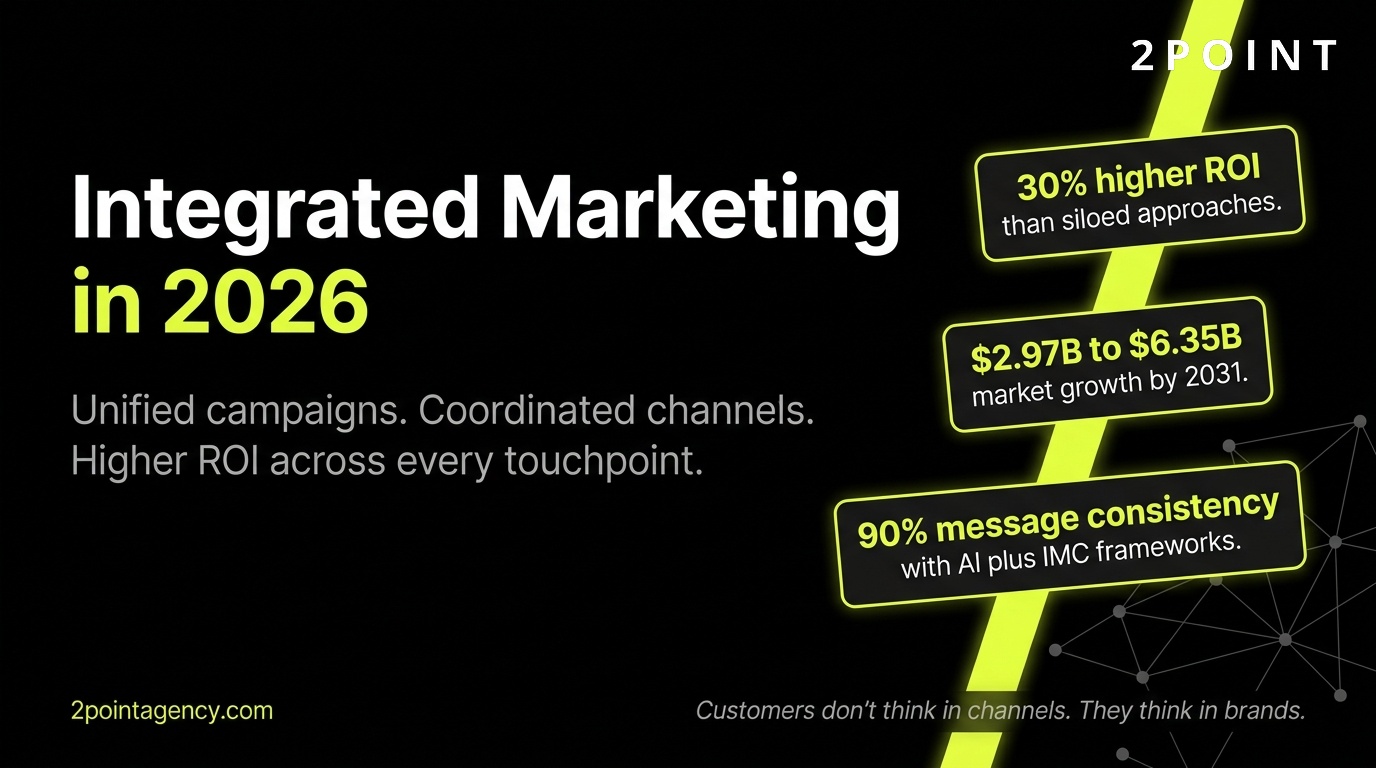
Integrated marketing is a strategic framework that coordinates all marketing channels to deliver consistent messaging across every customer touchpoint. Here's what you need to know:

- It unifies advertising, PR, content, email, social media, and sales into a cohesive strategy rather than isolated campaigns.
- Integrated campaigns deliver up to 30% higher ROI compared to siloed approaches through channel amplification.
- The strategy ensures brand messages align across platforms, solving the fragmented attention problem in 2026.
- It creates seamless customer experiences whether audiences discover your brand through Instagram, Google search, or a sales call.
- Organizations master this approach to build trust through consistency and maximize marketing investment efficiency.
- The global integrated marketing communications market reached $2.97 billion in 2024, growing to $6.35 billion by 2031.
Introduction: Why Every Marketing Dollar Depends on Integration
Your customers scroll TikTok during lunch, listen to podcasts during their commute, conduct Google searches throughout the workday, and check email before bed. They move fluidly between seven or more platforms daily. When your brand messaging shifts between these touchpoints, you lose momentum. When a customer sees one value proposition on LinkedIn, a different message on your website, and conflicting information from sales, trust erodes.
Integrated marketing communications (IMC) solves this challenge by coordinating every channel to deliver unified brand experiences. This strategic framework has evolved from a 1990s academic concept developed at Northwestern University's Medill School into a business imperative. The global IMC market reached $2.97 billion in 2024 and will grow at 11.5% annually to reach $6.35 billion by 2031.
This growth reflects a fundamental shift in how successful organizations approach marketing. Companies recognize that integration is no longer optional. The brands capturing market share in 2026 are those that coordinate experiences across all touchpoints rather than operating in departmental silos. They understand that customers don't think in channels—they experience your brand holistically.
This guide provides the complete framework for building integrated marketing strategies that deliver measurable results. You'll learn current trends reshaping the practice, including AI-driven personalization and privacy-first strategies. We'll examine real campaign examples from Coca-Cola, Apple, Dove, and other brands that successfully coordinated multiple channels. You'll discover step-by-step implementation frameworks, understand how to overcome common challenges like organizational silos and tooling complexity, and learn measurement approaches that prove ROI to stakeholders.
Why Integrated Marketing Matters More Than Ever in 2026
The marketing landscape has fundamentally transformed. Customers expect seamless experiences whether they discover your brand through Instagram, conduct research via Google search, or speak with a sales representative. Fragmented approaches create confusion at each disconnected touchpoint. Integrated strategies build trust and deliver measurable business results by ensuring consistency across every interaction.
The Fragmented Attention Economy
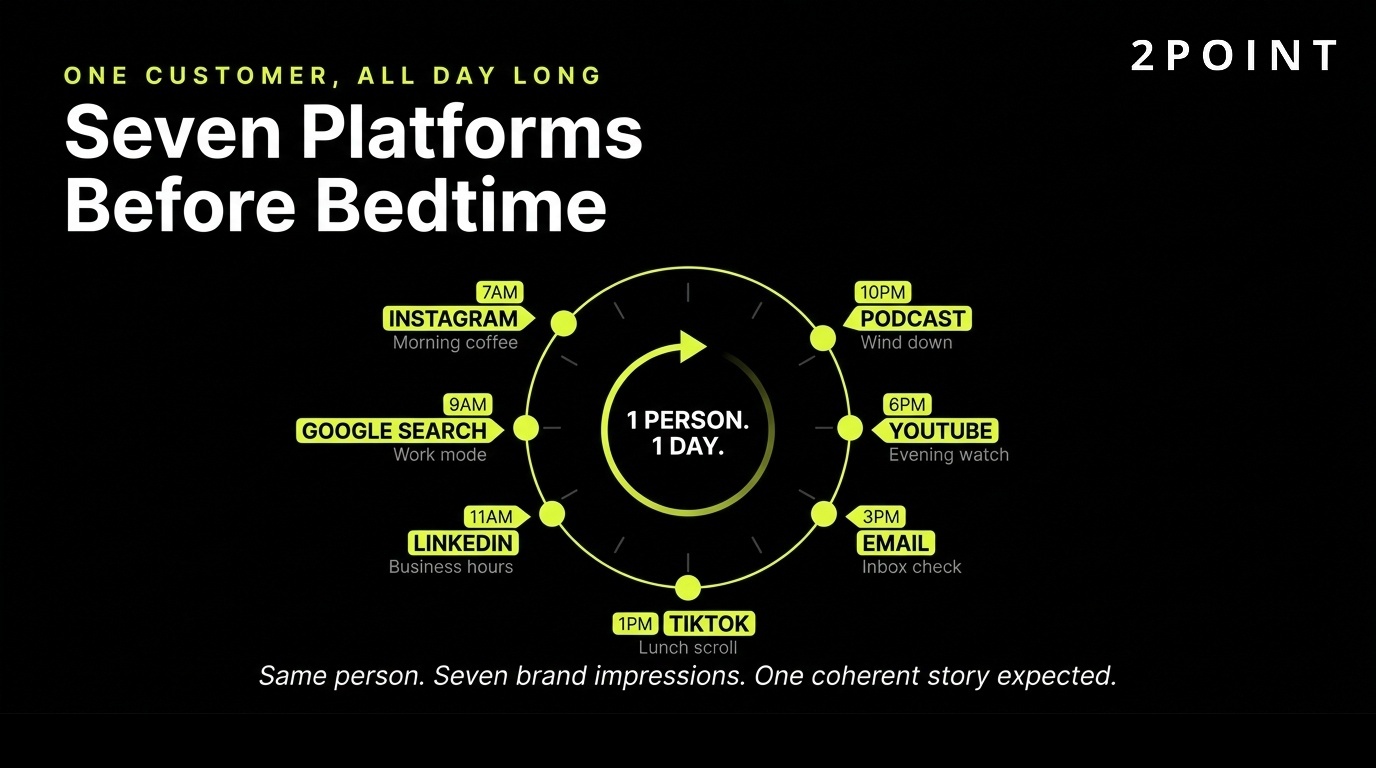
Consumers bounce between platforms constantly. They check Instagram during morning coffee, conduct Google searches during work hours, listen to podcasts during commutes, watch YouTube videos during lunch breaks, browse LinkedIn in the evening, and scroll TikTok before bed. Marketing professionals now manage an average of seven different tactics, reflecting this "generalist reality" where most marketers handle "everything" rather than specializing in single channels.
This fragmentation creates a fundamental challenge: each platform represents a potential touchpoint where customers form impressions about your brand. Without consistent messaging, brands waste these opportunities. A prospect who sees your LinkedIn ad promising one benefit, visits a website highlighting different features, and receives a sales call emphasizing yet another value proposition must work to understand what your brand actually stands for. This cognitive friction increases abandonment rates and customer acquisition costs.
Northwestern's 2025 research on IMC practices reveals that this channel proliferation has made integration more difficult and more necessary simultaneously. Brands that successfully coordinate messaging across all seven touchpoints create compound recognition—each exposure reinforces previous impressions rather than creating new questions. This consistency allows marketing investments to build momentum rather than resetting with each channel.
Measurable ROI Benefits of Integration

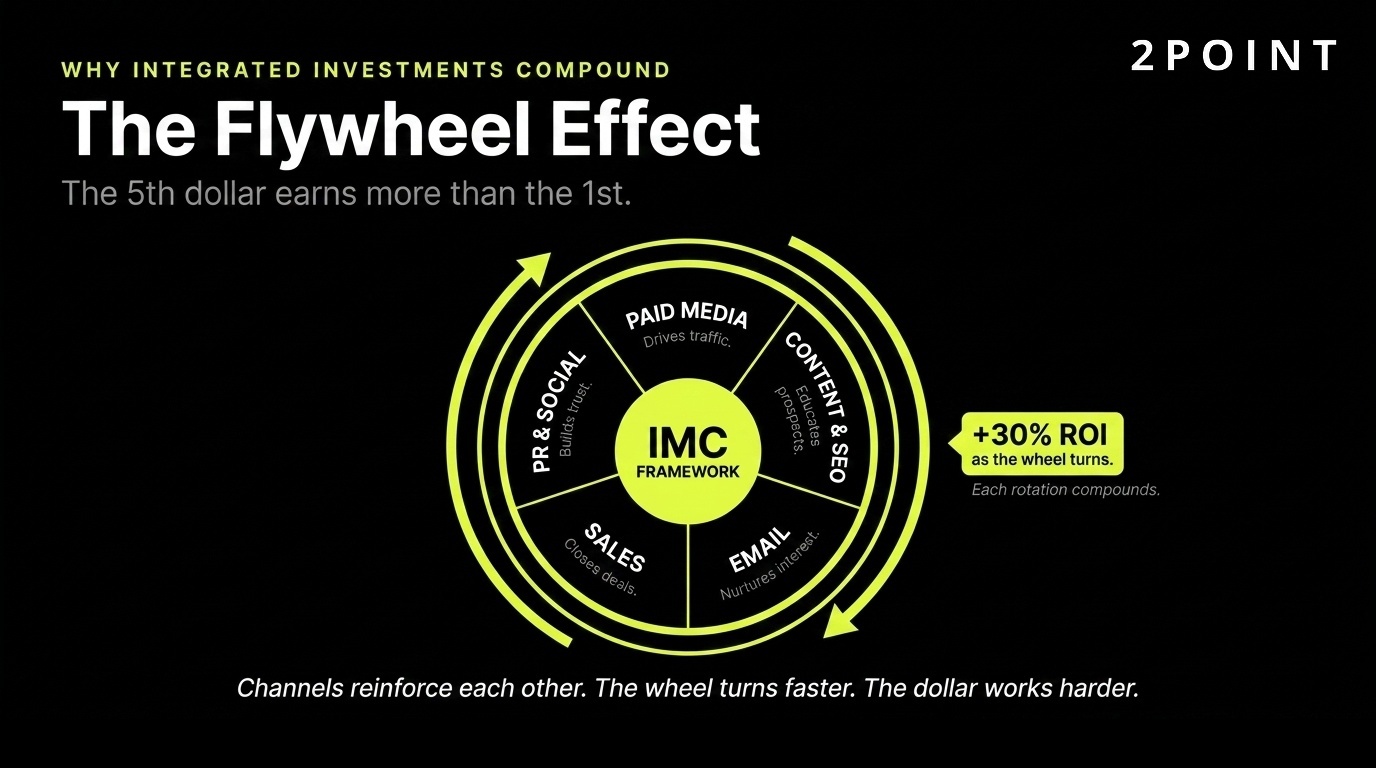
The business case for integrated marketing is quantifiable. Integrated campaigns deliver 30% higher ROI compared to siloed approaches. This performance difference stems from what researchers call the "flywheel effect"—the fifth dollar invested in IMC generates more return than the first, whereas siloed spending shows diminishing returns as channels compete rather than collaborate.
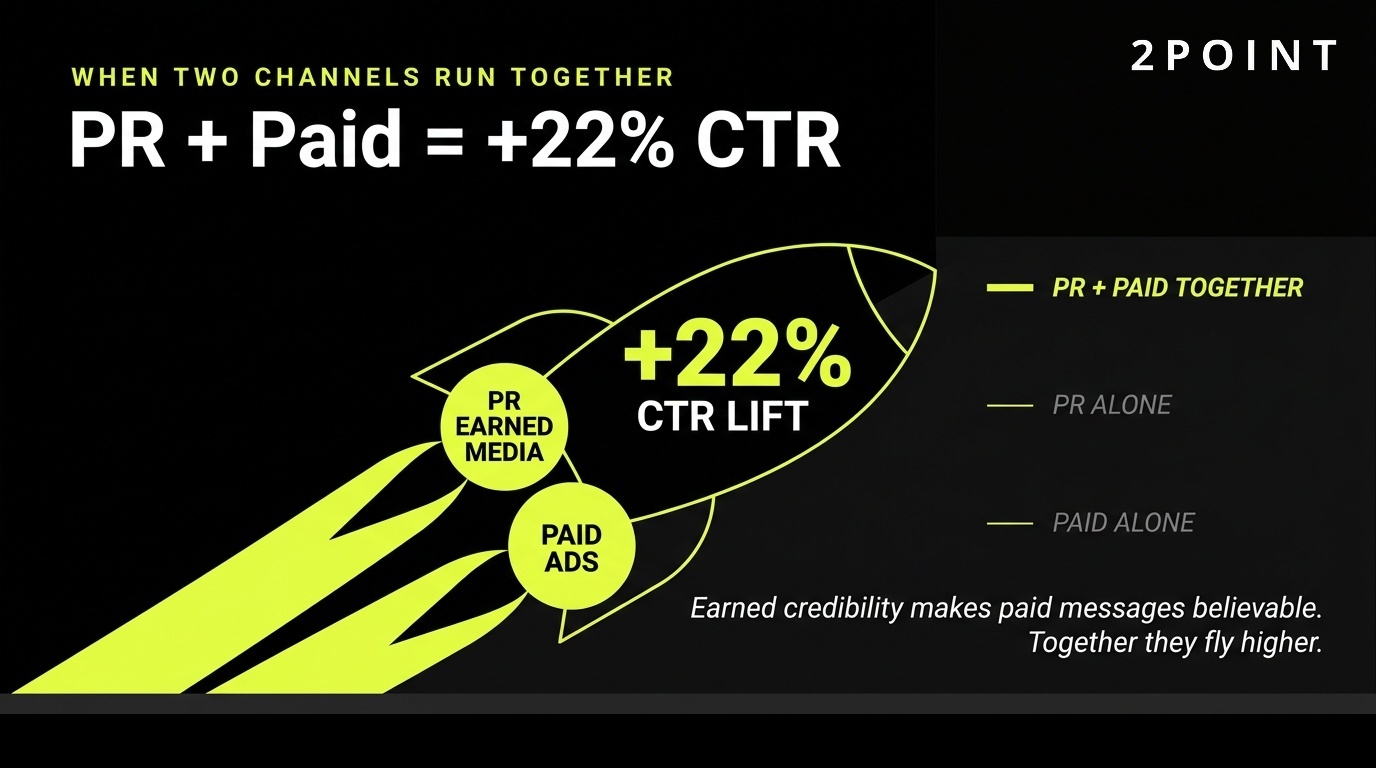
Consider the channel amplification that occurs with proper integration. PR-earned media increases paid advertising click-through rates by 22% when campaigns run concurrently because earned credibility makes paid messages more believable. Content marketing assets that appear in isolation generate baseline traffic, but when sales teams reference those same resources in conversations, email campaigns promote them to targeted segments, and paid ads drive traffic to them, their cumulative impact multiplies.
Organizations using AI within unified frameworks maintain message consistency scores above 90% versus 64% for those without integration strategies. This consistency directly impacts conversion rates because prospects encounter reinforced messages rather than contradictory ones. Attribution clarity also improves when channels function as a system—you can trace how display ads generated awareness, content marketing educated prospects, email nurturing maintained engagement, and sales conversations closed deals, with each channel playing a distinct role in the customer journey.
The amplification effect works because integrated channels don't just reach more people—they reach the same people repeatedly with coordinated messages. Display ads might feature customer testimonials extracted from case studies. Those ads target audiences built from CRM data combined with contextual signals. They drive traffic to landing pages where messaging matches the ad promise. Sales teams reinforce these same value propositions in follow-up calls. This coordination creates a seamless experience where each touchpoint builds on previous ones rather than starting from zero.
Building Trust Through Consistency
Repeated exposure to consistent core messages across touchpoints reinforces brand identity and builds trust. When customers see the same value propositions on LinkedIn, your website, sales presentations, and customer success stories, it creates confidence that your brand delivers what it promises. This consistency operates on a psychological level—humans trust patterns and become skeptical when messages shift.
Contrast this with inconsistent experiences where marketing promises one benefit, sales emphasizes different features, and customer support contradicts both. These disconnects erode trust and force prospects to spend mental energy reconciling conflicting information. Many simply abandon the evaluation process rather than working to understand what's true. Consistency builds credibility, making it more likely consumers will remember and engage with the brand across multiple touchpoints.
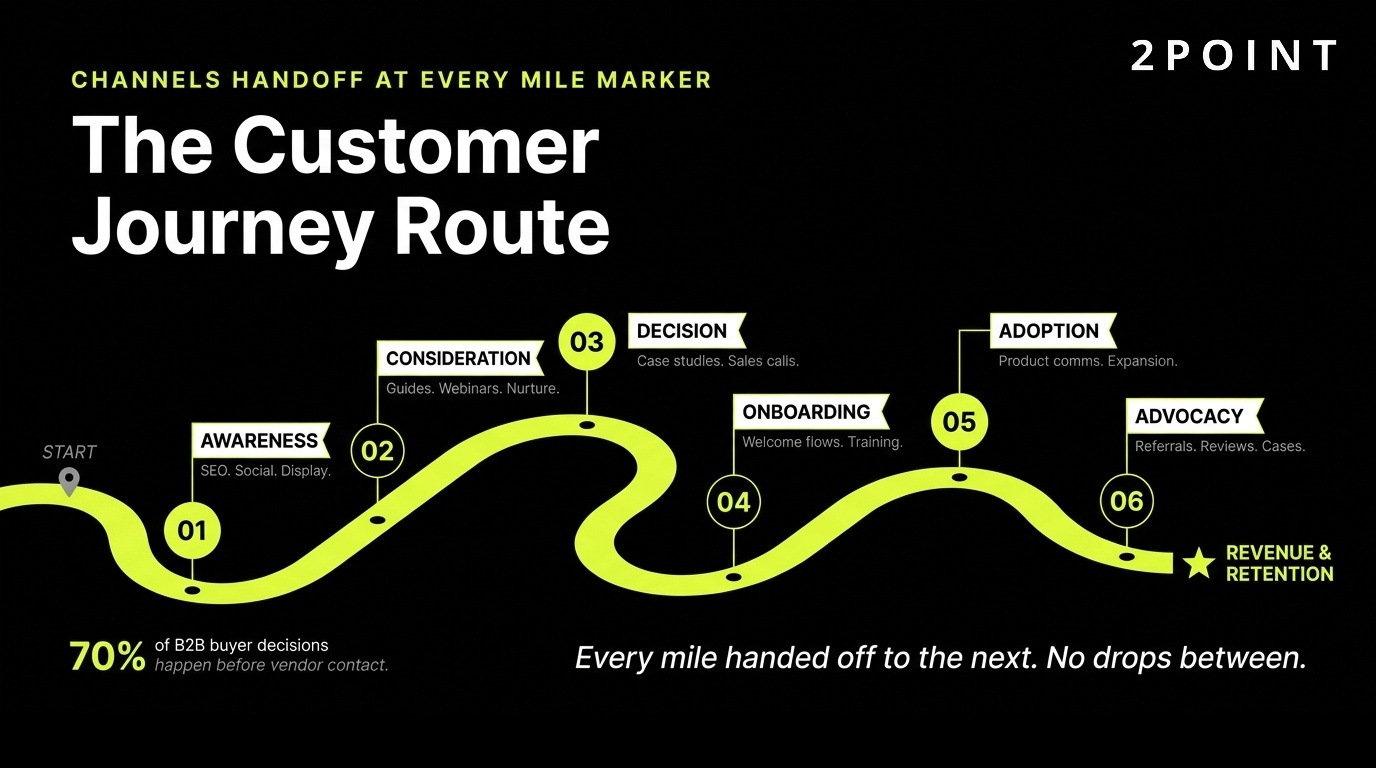
This trust-building function becomes increasingly valuable as customers conduct more research before engaging with sales teams. B2B buyers complete 70% of their decision-making process before contacting vendors. They're evaluating your brand across multiple digital touchpoints—website, social media, review sites, content resources—and forming conclusions about whether you're credible. Consistent messaging across these touchpoints creates the pattern recognition that signals trustworthiness.
The Rising Stakes: Market Growth and Competition
The global integrated marketing communications market demonstrates how quickly this strategic approach has become standard practice. The market reached $2.97 billion in 2024 and will grow at 11.5% CAGR to reach $6.35 billion by 2031. North America holds over 40% market share at $1.19 billion in 2024, while Europe accounts for 30%+ at $889.56 million.

This growth signals a fundamental shift in competitive dynamics. Companies recognize IMC as competitive advantage rather than optional enhancement. Organizations mastering integration capture market share from competitors still operating in silos because they deliver superior customer experiences with greater marketing efficiency. As more organizations adopt integrated approaches, the performance gap widens—brands without coordination will find themselves at increasing disadvantage against competitors who coordinate every touchpoint.
The 8 Core Marketing Channels in Your Integrated Strategy

Successful integrated marketing doesn't mean maintaining presence on every possible platform. It means choosing the right channels for your audience and ensuring they work together cohesively. Each channel has unique strengths, but integration multiplies their impact by creating coordinated customer experiences that build momentum across touchpoints.
Paid Media: Search, Social, Display, and Programmatic
Paid media spans Google Ads, Meta advertising, LinkedIn campaigns, programmatic display, and traditional channels including TV, radio, outdoor advertising, and print. The 2026 landscape has shifted dramatically with third-party cookie deprecation. Paid media now relies on contextual targeting and first-party data activation rather than tracking-based approaches. Platforms like Amazon DSP and Walmart Connect enable advertisers to reach audiences based on purchase behavior and browsing context without invasive tracking.
Integration transforms paid media from expensive brand awareness into conversion-driving campaigns. Consider this example: display ads feature customer testimonials sourced from case studies your content marketing team created. The creative assets come from your social media campaigns, maintaining visual consistency. These ads target audiences built from CRM data combined with contextual signals. They drive traffic to landing pages where messaging matches the ad promise exactly. Sales teams reference the same value propositions in follow-up calls, reinforcing what prospects saw in ads.
Without integration, paid media becomes disconnected from other customer touchpoints. Prospects click ads expecting certain solutions but land on generic websites. Sales teams don't know which campaigns influenced prospects, so they start conversations from scratch. Marketing automation doesn't trigger relevant follow-up because data lives in separate systems. This disconnection wastes ad spend because each channel must independently convince prospects rather than building on previous touchpoints.
Content Marketing and SEO
Content marketing creates valuable resources—blog posts, comprehensive guides, webinars, case studies, whitepapers—that attract and educate your audience while supporting organic search visibility. Quality content answers customer questions at each stage of their journey, from awareness-stage educational content to decision-stage comparison guides. SEO ensures this content appears when prospects search for solutions to problems your product solves.
Integration multiplies content value exponentially. A comprehensive buyer's guide generates organic search traffic through SEO. Your sales team excerpts sections for one-pagers used in prospect conversations. That same guide becomes the basis for a webinar that your PR team pitches to trade publications as expert commentary. LinkedIn sponsored content promotes it to target accounts. Marketing automation triggers email nurture sequences when prospects download it. A single content asset feeds six different channels because integration extracts maximum value from production investment.
Isolated content that doesn't feed other channels wastes the significant time and expertise required for quality creation. When content marketing strategies integrate with sales enablement, every resource serves dual purposes—generating inbound interest while equipping teams to close deals. This coordination ensures content marketing best practices align with broader business objectives rather than existing as isolated blogging efforts.
Social Media Marketing
Social media functions as a two-way engagement hub combining organic community building with paid targeting capabilities. The 2026 landscape emphasizes authentic short-form video—TikTok, Instagram Reels, YouTube Shorts—over polished production. Successful social media marketing requires focused platform strategies rather than maintaining weak presence everywhere.
Integration transforms social media from vanity metrics into business impact. Social content amplifies blog posts, shares customer success stories, promotes events, provides real-time customer service, and generates user-generated content (UGC). That UGC becomes testimonial content for paid ads and website landing pages. Social listening informs content marketing topics and product development. Community questions identify gaps in educational resources.
Influencer marketing has evolved into a core component, with emphasis on authenticity over celebrity endorsements. Successful influencer marketing partnerships integrate into broader campaigns rather than functioning as isolated sponsorships. Influencers create content that lives across multiple channels—social posts, YouTube videos, blog contributions, event appearances—while maintaining your core brand message adapted to their authentic voice.
Email Marketing and Marketing Automation
Email functions as the personalization engine, delivering tailored content based on behavior, stage in buyer journey, and expressed interests. Marketing automation platforms—HubSpot, Marketo, Salesforce Marketing Cloud—trigger emails based on actions prospects take across other channels, creating responsive experiences that feel personalized because they react to individual behavior patterns.
Integration creates seamless automated journeys. Someone downloads a white paper through content marketing. Marketing automation adds them to a nurture sequence delivering related resources over several weeks. They see retargeting ads referencing the topic they showed interest in. Sales receives notifications about high-engagement prospects and delivers personalized outreach mentioning the specific resources they consumed. The prospect gets invited to a relevant webinar addressing their demonstrated interests. Every touchpoint builds on previous ones because data flows between systems and messaging coordinates across channels.
Without integration, email becomes batch-and-blast campaigns disconnected from customer actions on other channels. Prospects who just spoke with sales receive generic nurture emails. High-value customers get the same messages as cold prospects. Engagement data stays trapped in the email platform rather than informing decisions across other channels. This disconnection wastes email's primary advantage—the ability to deliver personalized, timely communication at scale.
Public Relations and Earned Media
PR builds brand credibility through media coverage, thought leadership placements, industry awards, speaking opportunities, and analyst relations. Earned media carries higher trust than paid advertising because third-party validation signals that others find your perspectives valuable enough to share with their audiences.
Integration amplifies PR impact across all channels. PR campaigns launch alongside product releases, coordinated with product marketing to ensure messaging consistency. Media mentions become assets that sales teams share with prospects as credibility signals. PR-earned media running concurrently with paid campaigns improves ad click-through rates by 22% because earned credibility makes paid messages more believable. Press releases and executive commentary become content marketing assets, extending their value beyond initial publication.
Isolated PR efforts that don't connect to other channels miss opportunities. Media placements that sales teams never learn about can't influence deals. Thought leadership content that doesn't feed into email nurture or social media reaches limited audiences. Awards that don't appear on websites and in sales presentations waste their credibility-building potential. Integration ensures every PR win amplifies across all customer touchpoints.
Sales Enablement and Direct Outreach
Sales teams function as a marketing channel when equipped with consistent messaging, customer stories, and content assets. Sales enablement provides one-pagers, presentation decks, case studies, competitive battlecards, demo scripts, and objection-handling guides that reinforce what marketing promises. This coordination ensures prospects hear consistent value propositions whether they're consuming marketing content or speaking with sales representatives.
Integration creates bidirectional value flow. Sales feedback informs content marketing topics—the questions prospects ask repeatedly become blog posts and guides. Sales calls reference marketing campaigns prospects have seen, creating continuity rather than starting conversations from scratch. CRM data flows back to marketing for retargeting and personalization—someone who discussed specific features with sales sees content addressing those topics. This coordination makes both teams more effective by ensuring they work as a unified system rather than competing for prospect attention.
Building a successful marketing team requires breaking down the traditional walls between marketing and sales. Organizations that succeed at this integration often restructure around customer journey stages rather than functional departments, ensuring someone owns coordination across all touchpoints. Aligning marketing teams with sales creates the organizational foundation for true integration.
Events and Experiential Marketing
Events—conferences, trade shows, webinars, product launches, customer gatherings—create high-touch experiences where prospects engage directly with your brand. Experiential marketing extends beyond traditional events to include pop-up experiences, branded installations, and interactive demonstrations. These channels create memorable impressions and relationship-building opportunities that digital channels can't replicate.
Integration extends event impact before, during, and after the experience. Pre-event email campaigns and social promotion build attendance. Content marketing creates resources attendees receive. Sales teams prioritize outreach to registered prospects. During events, social media amplifies key moments in real-time. Post-event follow-up coordinates across email, sales outreach, and retargeting ads, all referencing the specific sessions prospects attended or booth conversations they had. Recorded sessions become content assets. Attendee data informs account-based marketing strategies.
Isolated events that don't connect to other channels deliver limited ROI. Attendees who never receive follow-up lose momentum. Sales teams who don't know which prospects attended miss warm outreach opportunities. Event content that doesn't live beyond the day wastes production investment. Integration transforms one-day events into months-long engagement campaigns.
Customer Marketing and Advocacy Programs
Customer marketing focuses on existing customers rather than prospects—driving adoption, preventing churn, generating expansion revenue, and creating advocates. Advocacy programs formalize customer participation in marketing through case studies, testimonials, referrals, online reviews, and speaking opportunities. This channel becomes increasingly valuable as trust in traditional advertising declines and peer recommendations drive purchasing decisions.
Integration transforms satisfied customers into multi-channel assets. A customer success story becomes a written case study, video testimonial, social media post series, sales presentation example, event speaking opportunity, and PR placement. Customer data informs personalization across all channels—someone using specific product features sees content addressing advanced use cases. Advocacy program participants receive exclusive benefits, creating community and deepening relationships. This coordination ensures customers experience continued value after purchase while their experiences become credible proof points for prospects.
Without integration, customer marketing exists as a separate function disconnected from acquisition efforts. Success stories live in isolated repositories that sales teams can't easily access. Customer insights don't inform product marketing or content creation. Renewal campaigns run independently from expansion opportunities. This disconnection wastes the most credible marketing asset—satisfied customers willing to share their experiences.
5 Game-Changing Trends Reshaping Integrated Marketing in 2026
The practice of integrated marketing continues evolving rapidly in response to technological advances, consumer behavior shifts, and regulatory changes. These five trends create both opportunities and requirements for modern marketers, transforming how integration operates across channels and what success looks like.
Agentic AI and Autonomous Campaign Execution
Agentic AI platforms—Salesforce Agentforce, HubSpot Breeze AI agents, custom GPT implementations—now autonomously execute campaigns across channels, making real-time optimization decisions without human approval for every action. These systems adjust ad spend allocation, personalize email sequences, generate social content, optimize send times, and identify high-value prospects to prioritize. The technology enables teams to produce 10x more content and operate with unprecedented speed.
This capability creates a paradox. AI can generate massive volumes of content and run sophisticated campaigns across multiple channels simultaneously. Without strategic guardrails, however, these platforms create 10x more inconsistency rather than 10x more impact. Different AI agents optimizing for channel-specific metrics—maximizing email open rates, social engagement, paid media conversions—can inadvertently create conflicting brand narratives. One agent might emphasize price competitiveness to improve conversion rates while another highlights premium quality to build brand perception.
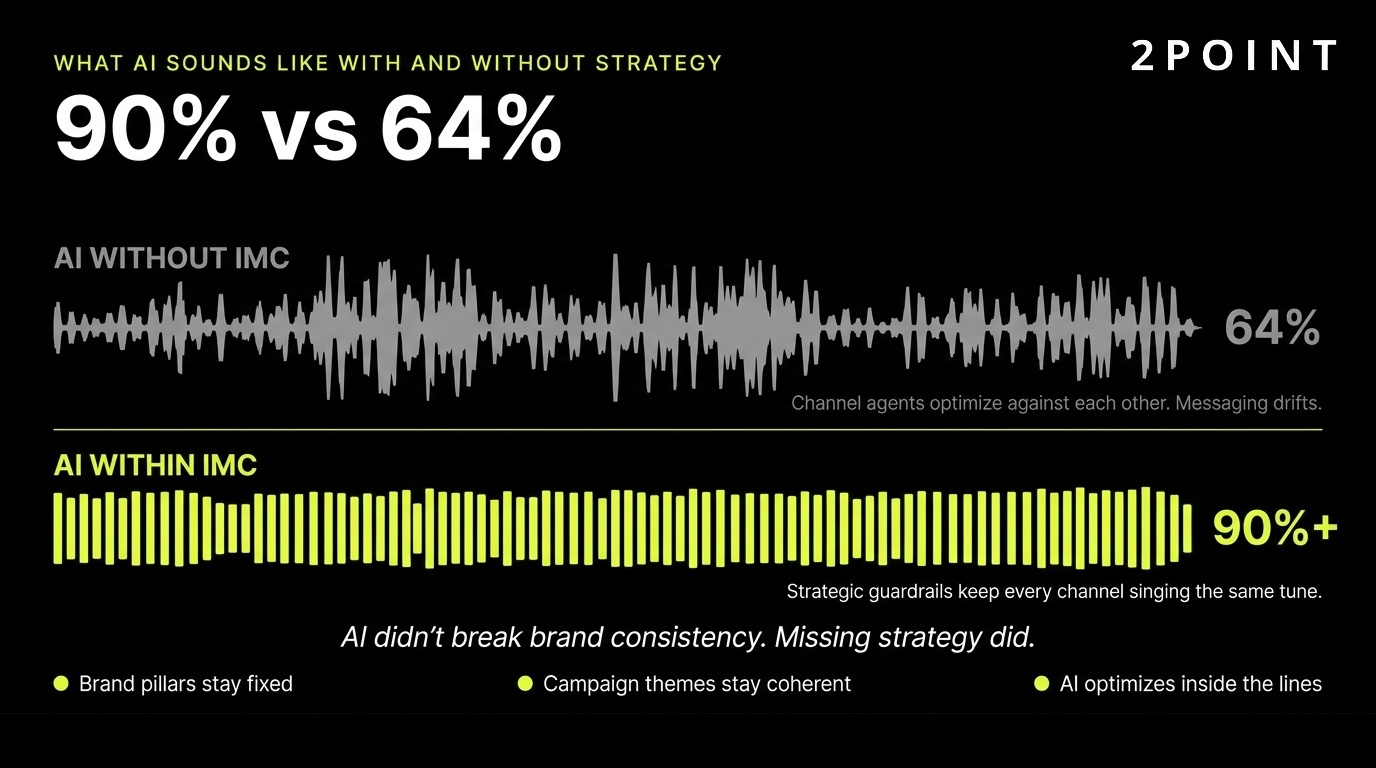
IMC's unified strategy becomes the "operating system" that governs what AI can autonomously adjust versus what must stay consistent. Teams using AI within IMC frameworks maintain 90%+ message consistency versus 64% without unified strategies. The framework establishes which elements remain fixed—brand positioning, core value propositions, visual identity standards—and which elements AI can optimize—creative formats, timing, tactical offers, audience micro-segments.
Successful implementation requires message architecture (covered in detail in the implementation section) that defines strategic boundaries within which AI operates freely. This approach combines human strategic thinking with machine execution speed, enabling organizations to maintain brand coherence while operating at the scale and speed AI enables. Technological advancements in marketing continue accelerating, making strategic frameworks more essential rather than less.
Privacy-First Marketing and First-Party Data Strategies
The 2026 marketing landscape operates under fundamentally different data rules than previous years. Third-party cookies are deprecated across major browsers. Privacy laws—GDPR, CCPA, and emerging regulations in additional jurisdictions—require consent-based data collection with clear usage disclosure. Consumers increasingly expect transparency about how their information is collected and used, with privacy considerations influencing brand perception and purchase decisions.
This shift forces marketers to build first-party data strategies—collecting information directly through gated content, newsletter subscriptions, preference centers, surveys, loyalty programs, account creation, and direct interactions. The challenge lies in providing sufficient value exchange to convince prospects to share data willingly. Generic newsletter signups no longer suffice. Successful approaches offer premium content, personalized experiences, exclusive access, or tangible benefits in exchange for information.
Integration provides the advantage: unified customer data platforms (CDPs) consolidate first-party data from all touchpoints, enabling privacy-compliant personalization across channels. Someone who attends your webinar (behavioral data), fills out a preference center indicating interests (explicit data), and engages with specific emails (engagement data) receives experiences informed by this complete profile—without third-party tracking. Winning strategies are transparent about data collection and deliver clear value for information shared.
Organizations treating privacy compliance as pure restriction miss the strategic opportunity. First-party data collected with consent is higher quality than third-party data purchased from brokers. Customers who actively choose to share preferences are more engaged than those tracked passively. Transparent data practices build trust that strengthens customer relationships. Integration enables organizations to maximize value from first-party data by activating it across all channels rather than trapping it in isolated systems.
Omnichannel Personalization at Scale
Omnichannel personalization delivers the right message to the right person at the right time across all relevant touchpoints—web, mobile app, email, in-store, customer service, sales interactions. Technology platforms like Adobe Experience Cloud and Salesforce Marketing Cloud create unified customer profiles and deliver personalized content in real-time based on behavior, preferences, and context. Advanced CDPs integrate data from websites, mobile apps, email engagement, and offline behavior into single customer views.
The psychology driving omnichannel importance is simple: customers expect seamless experiences. They start research on mobile during commute, continue on desktop at work, make purchases on tablets at home, and expect customer service to know their history regardless of contact channel. Brands that deliver this coherence see higher conversion rates and customer lifetime value because they reduce friction at every touchpoint.
Integration is the requirement that enables omnichannel personalization. The technology platforms provide capabilities, but without centralized data and unified messaging frameworks, organizations get channel-specific personalization that creates jarring disconnects. A customer who just purchased receives promotional emails encouraging them to buy. Someone who contacted support about a problem sees social ads promoting the problematic feature. A prospect who told sales they're not interested receives aggressive nurture campaigns. These disconnects happen when channels optimize independently rather than coordinating around unified customer understanding.
Successful omnichannel strategies establish clear data governance—defining which systems serve as source of truth for different data types, how frequently information syncs between platforms, and which actions trigger updates across channels. They create cross-functional teams responsible for customer experience across touchpoints rather than channel-specific teams optimizing their individual metrics. This organizational structure enables the coordination that technology makes possible.
Short-Form Video and Platform Evolution
Short-form video—TikTok, Instagram Reels, YouTube Shorts—has rapidly reshaped media consumption, particularly among younger generations. Brands increasingly emphasize authentic, entertaining content over polished production. The algorithm-driven distribution model means content can reach massive audiences organically if it resonates, making short-form video a high-leverage channel for brands that master platform-native storytelling.
The 2026 shift involves focused platform strategies—choosing 2-3 platforms to dominate rather than maintaining weak presence everywhere. Organizations recognize that algorithm success requires consistent posting, community engagement, trend participation, and content optimization based on performance data. Spreading resources across six platforms produces mediocre results across all of them. Concentrating on two platforms where your audience actually engages produces breakthrough results.
Integration approach transforms short-form video from isolated viral moments into systematic brand building. Short-form content repurposes core messages into platform-native formats—taking key points from comprehensive blog posts, customer testimonials, product demos, or educational content and adapting them for 15-60 second videos. Brands use trending audio and formats while maintaining consistent messaging and brand personality. Content drives traffic to owned properties—website, email list, YouTube channel—where deeper engagement happens.
Isolated viral videos without integration provide vanity metrics—millions of views with limited business impact. Integration converts attention into customer relationships by ensuring social content connects to conversion pathways. Someone entertained by a TikTok video can access more substantive content, join email lists, or explore products because the brand strategically links short-form content to other channels rather than treating each video as a standalone piece.
Tooling Complexity and the Martech Consolidation Imperative
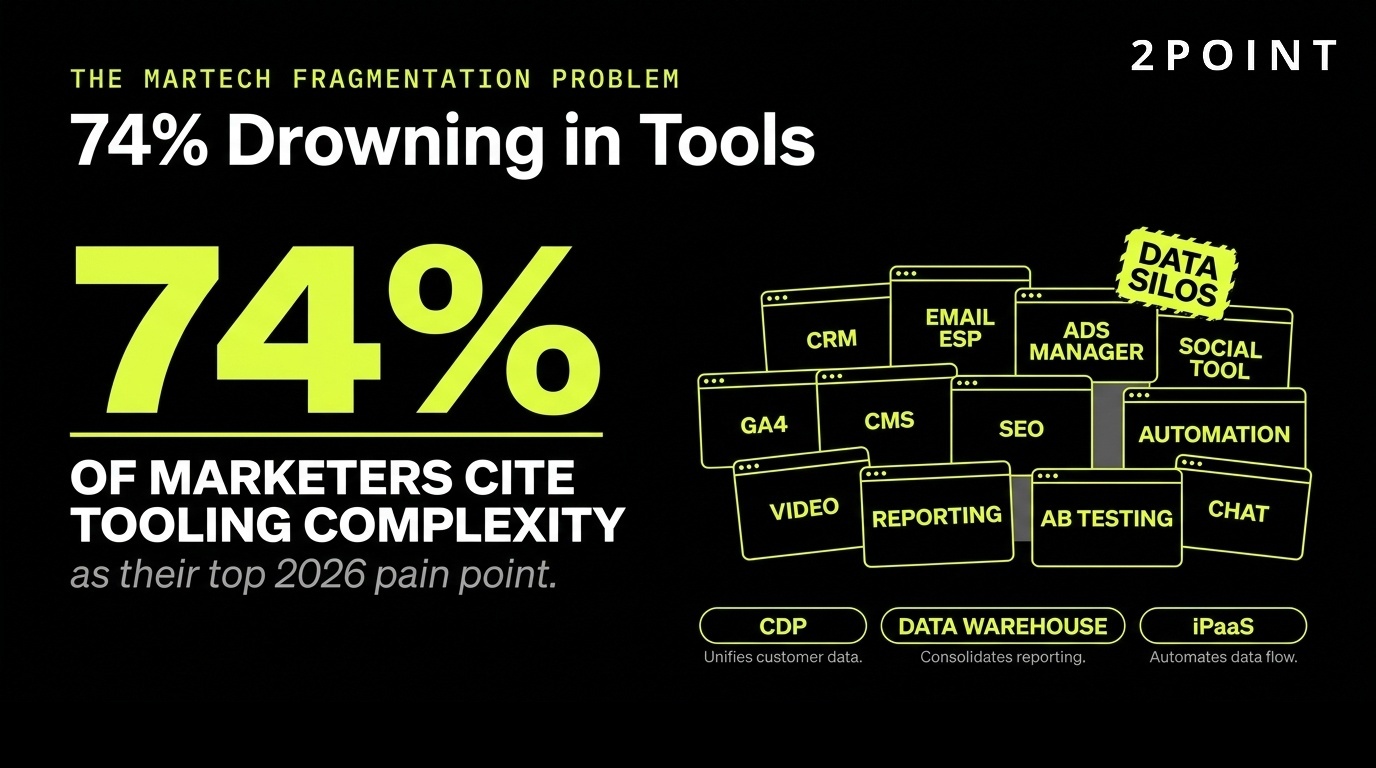
74% of marketers cite tooling complexity as their top pain point in 2026. Data fragments across Google Analytics 4, CRM platforms, marketing automation, social media management, advertising platforms, and 3-5 additional specialized tools. This fragmentation makes it difficult to understand customer journeys, measure campaign performance accurately, or coordinate experiences across touchpoints.
Technology decisions depend on scale. Teams with under $500K monthly marketing spend typically use integrated platforms—HubSpot, Salesforce Marketing Cloud, or similar suites—that bundle marketing automation, basic CRM, email, landing pages, and reporting. These platforms provide adequate functionality for most needs while maintaining data in a single system. Teams spending over $1M monthly typically require best-of-breed stacks because integrated platform reporting can't handle the volume and complexity, leading them to adopt specialized tools for each function.
Regardless of stack choice, success requires data integration layers. CDPs, data warehouses, and iPaaS solutions consolidate metrics across tools, enabling unified reporting and cross-platform automation. Without these integration layers, reporting becomes manual spreadsheet exercises compiled weekly or monthly, causing optimization decisions to lag by weeks behind performance changes. Real-time decision-making requires real-time data access across all platforms.
The critical insight: technology alone doesn't create integration—organizational design does. Tools enable coordination, but without clear process ownership, defined data standards, and cross-functional collaboration, even the best platforms deliver fragmented results. Successful organizations treat martech consolidation as an organizational change initiative, not merely a technology implementation project. They establish governance around data definitions, develop a comprehensive marketing plan, and align marketing goals before selecting tools to support these strategies.
7 Brilliant Integrated Marketing Campaign Examples
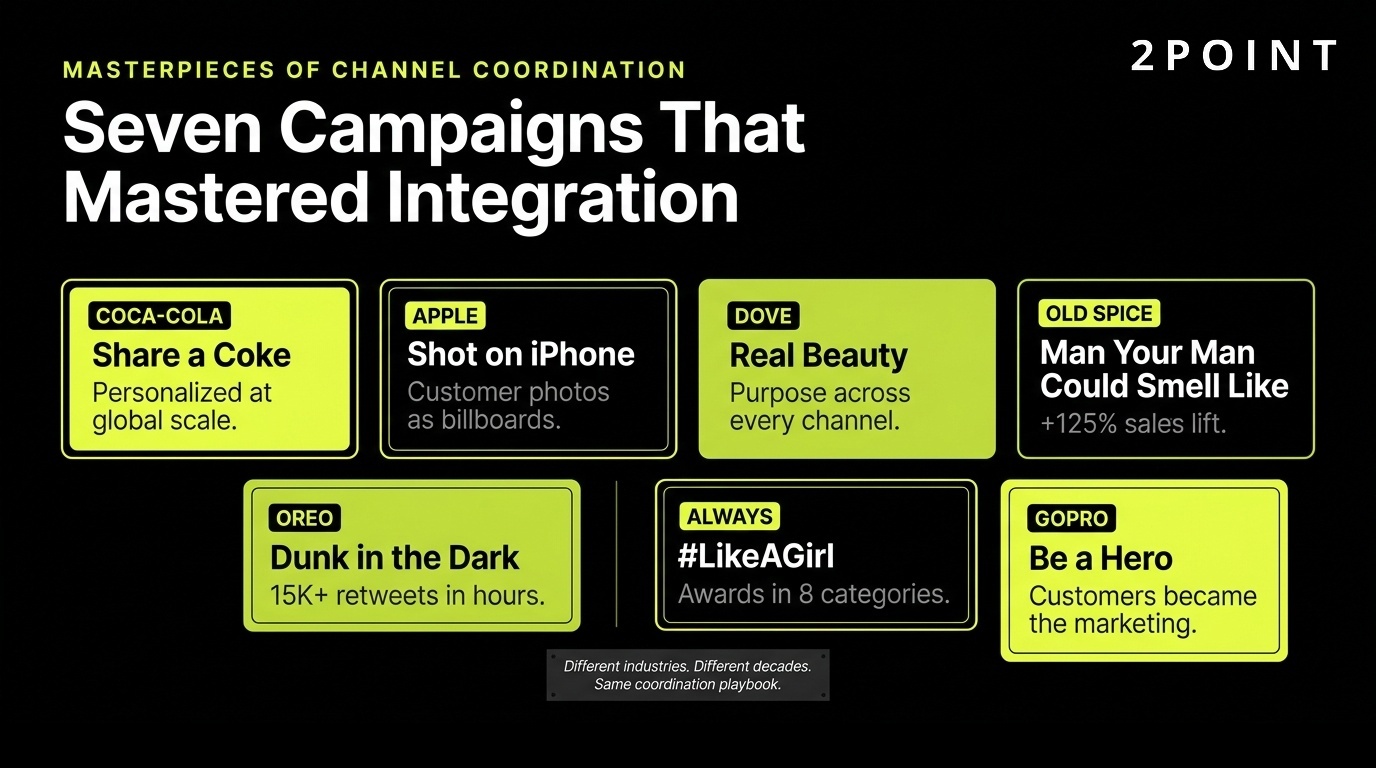
Learning from brands that successfully coordinated multiple channels provides practical insights into what integration looks like in practice. Each example demonstrates different integration strategies applicable to various business contexts, showing how channel coordination amplifies impact beyond what isolated tactics could achieve.
Coca-Cola's "Share a Coke" Campaign: Personalization at Global Scale
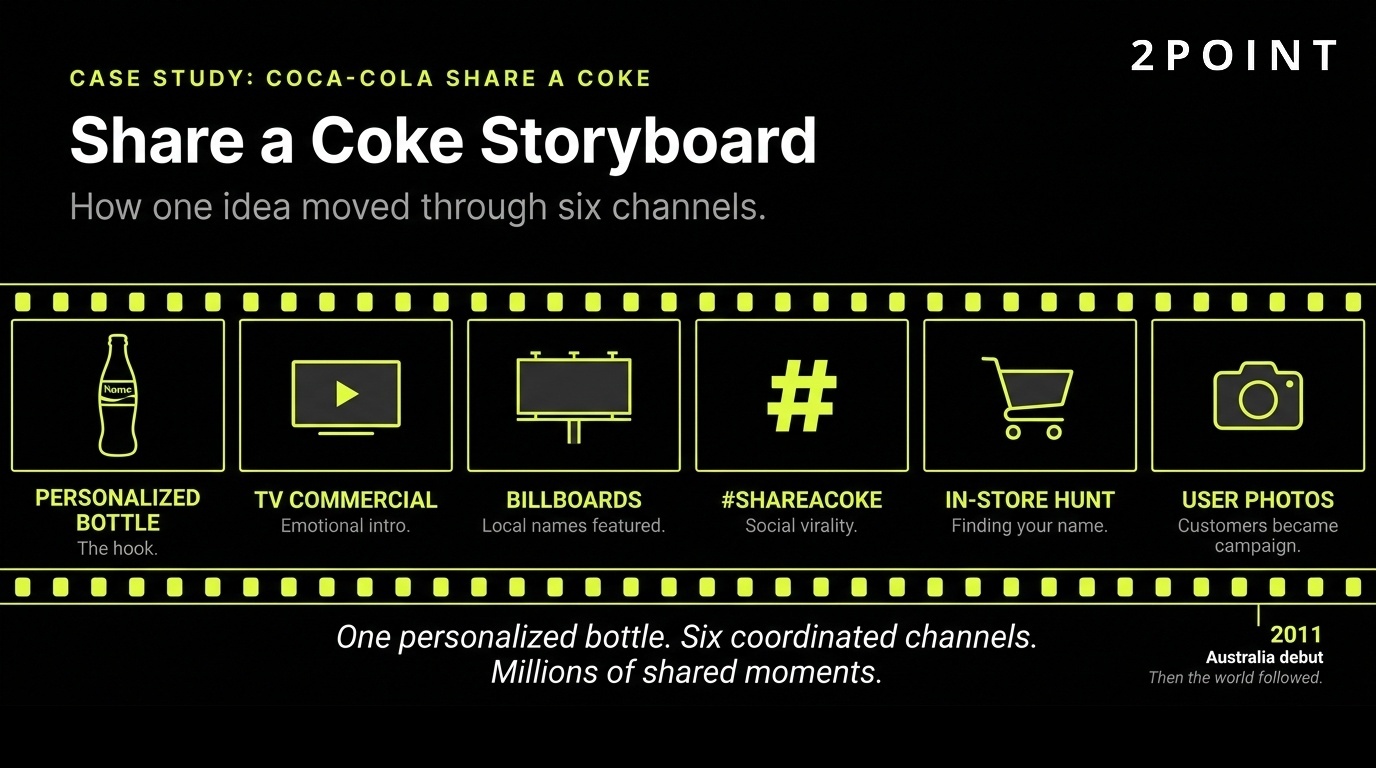
Coca-Cola's "Share a Coke" campaign replaced the iconic Coca-Cola logo on bottles with popular names, encouraging customers to find bottles with their names or friends' names and share a Coke together. This simple personalization concept launched in Australia in 2011 and expanded globally, demonstrating how physical product personalization can drive digital engagement.
Channel integration made the campaign memorable. TV commercials introduced the concept and created emotional connections around sharing moments. Social media amplified participation through #ShareaCoke, which became viral as millions of customers photographed personalized bottles and shared images across Instagram, Facebook, and Twitter. Billboards showcased popular names in local markets. In-store displays made finding specific names part of the shopping experience. Coca-Cola even created online experiences where customers could order bottles with custom names not available in stores.
The business impact was substantial: increased sales, deeper brand loyalty, and millions of user-generated content pieces that extended campaign reach far beyond paid media investment. The key lesson is that personalization doesn't require sophisticated technology—physical products can drive digital engagement when campaigns integrate thoughtfully across channels. The campaign succeeded because every touchpoint reinforced the same core idea: Coca-Cola is about sharing moments, and now you can literally share a Coke that feels personal.
Apple's "Shot on iPhone" Campaign: User-Generated Content as Brand Proof
Apple's "Shot on iPhone" campaign showcases iPhone camera capabilities through photos and videos created by everyday users rather than professional photographers. Launched in 2015 and ongoing, the campaign demonstrates product quality through authentic customer content that's more credible than any traditional advertising could achieve.
Integration strategy placed user-generated photos across every possible touchpoint. Billboards in major cities featured striking photos taken on iPhone. Online galleries showcased thousands of submissions. TV commercials highlighted video capabilities through customer-shot footage. In-store displays demonstrated camera features using real customer examples. Social media galleries encouraged ongoing participation and provided endless content stream. Apple even created tutorial content showing how customers captured featured photos, turning the campaign into educational content that drove product adoption.
The strategic genius lies in how the campaign simultaneously marketed product features and built community. Customers became brand ambassadors by sharing photos and videos, providing social proof more credible than any Apple-produced content. The campaign created continuous content supply through user submissions while demonstrating that iPhone cameras enable professional-quality results in normal users' hands. Entertainment became the marketing vehicle, with channel integration ensuring consistent brand message across touchpoints.
Dove's "Real Beauty" Campaign: Purpose-Driven Integration
Dove's "Real Beauty" campaign launched in 2004 to challenge conventional beauty standards by featuring women of all shapes, sizes, ages, and ethnicities. The campaign evolved over years, maintaining consistent purpose-driven messaging while adapting to new platforms and cultural moments.
Channel coordination reinforced the core message everywhere. TV commercials featured real women instead of professional models. Print ads appeared in magazines traditionally showing airbrushed beauty ideals, creating striking contrast. Social media campaigns encouraged women to share unedited photos celebrating real beauty. Educational programs taught young girls to develop confident relationships with their appearance. Website content provided resources about body confidence. Each touchpoint challenged beauty industry standards while positioning Dove products as aligned with authentic self-acceptance rather than unattainable perfection.
The campaign created a movement that resonated with millions, building lasting brand loyalty by aligning product marketing with social values. Purpose and profit blended because Dove understood that modern consumers, particularly younger generations, prefer brands that stand for something beyond products. The integration lesson: purpose-driven campaigns succeed when values integrate across all touchpoints rather than existing as isolated advertising messages disconnected from actual business practices.
Old Spice "The Man Your Man Could Smell Like" Campaign: Humor and Real-Time Engagement
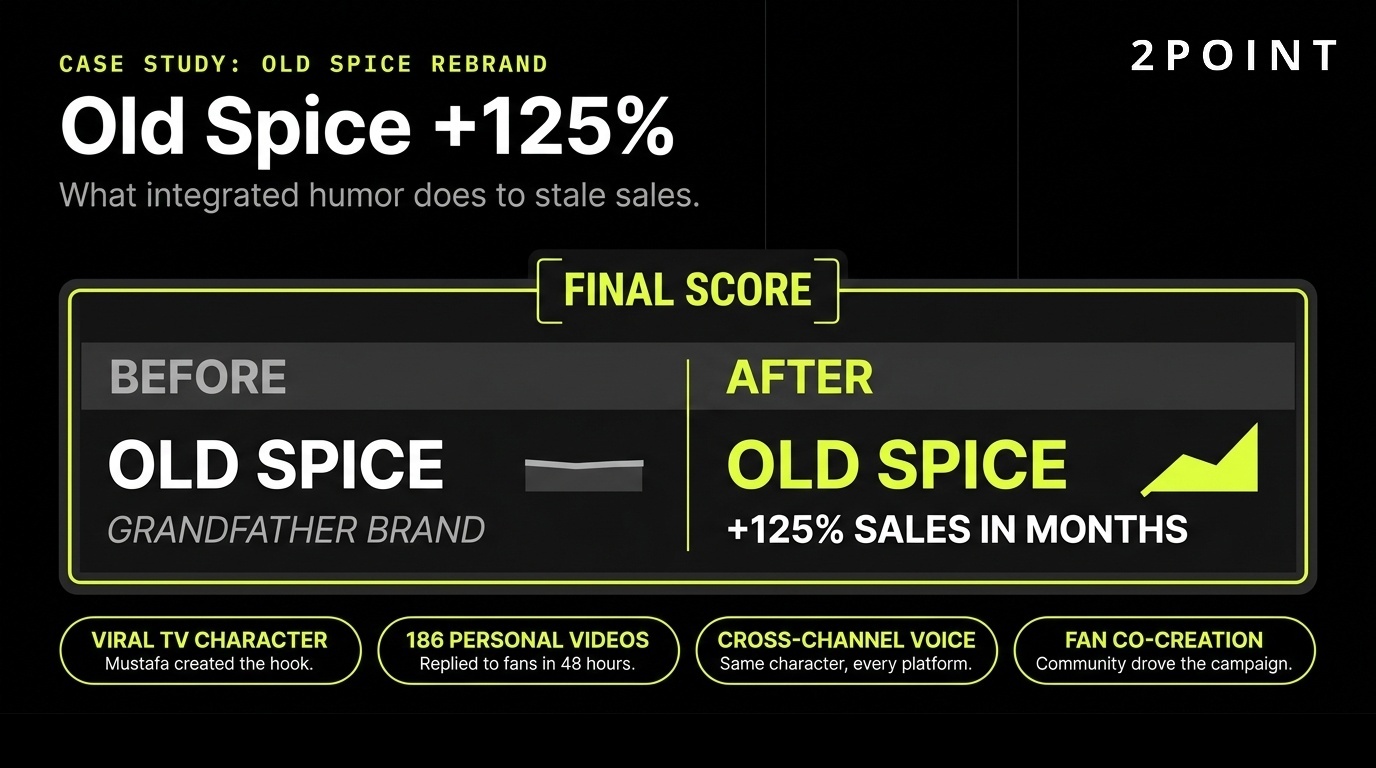
Old Spice's 2010 campaign featured Isaiah Mustafa delivering witty monologues that became instantly quotable and went massively viral. The campaign successfully repositioned Old Spice from outdated grandfather's brand to relevant choice for younger men, demonstrating how humor and personality can revitalize brands through integrated campaigns.
Integration strategy extended beyond traditional advertising into innovative real-time engagement. TV commercials introduced the character and created viral moments that generated organic sharing across social media. The campaign then launched personalized video responses where Mustafa answered questions and comments from fans on Twitter and Facebook, creating 186 personalized videos in 48 hours. This interactive approach created community and entertainment value that extended far beyond traditional advertising reach.
Business results validated the approach: 125% sales increase within months of launch, proving humor's business impact when executed across platforms. The key lesson involves real-time engagement and platform-specific interaction amplifying traditional advertising when core message remains consistent. Mustafa's character personality stayed constant whether appearing in TV spots, responding to Twitter users, or showing up in print ads. This consistency allowed creative flexibility across formats while maintaining brand recognition.
Oreo's "Dunk in the Dark" Tweet: Real-Time Marketing Excellence
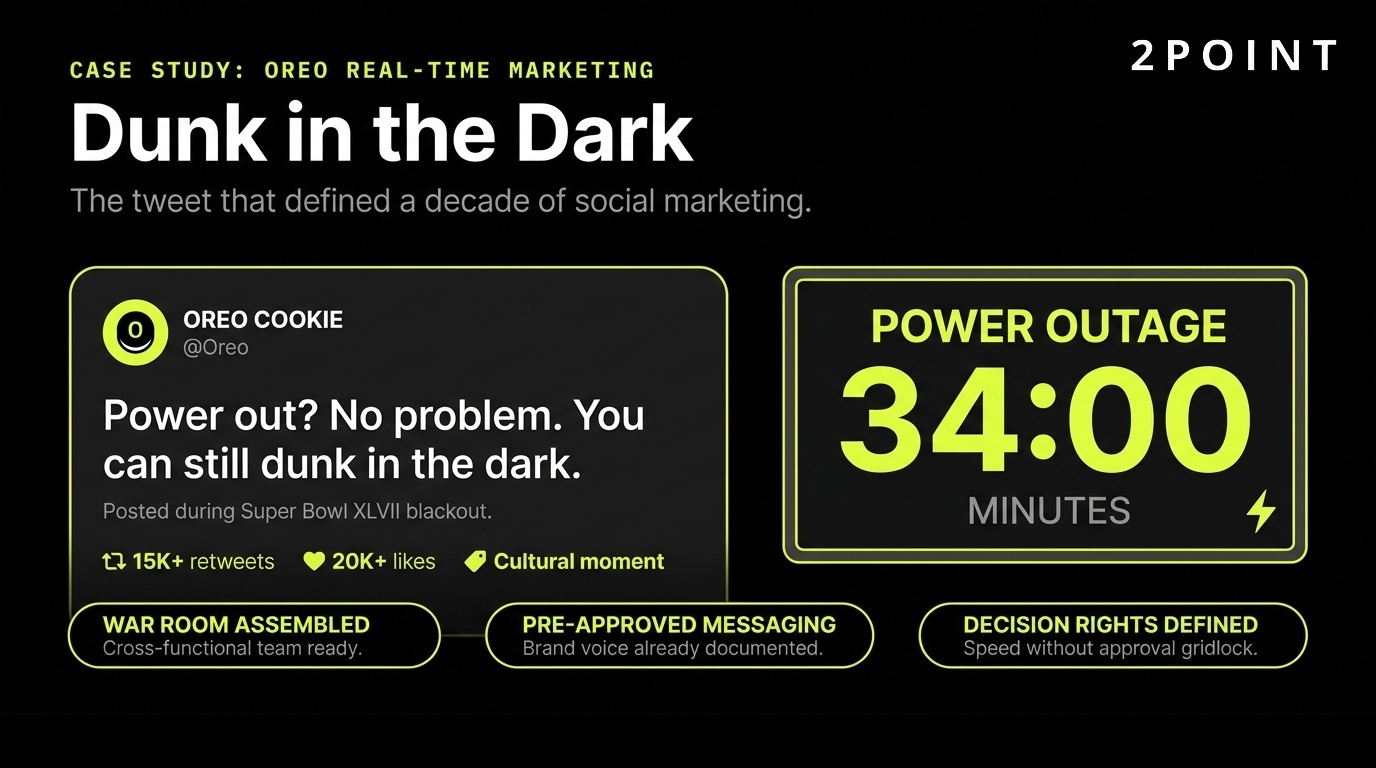
During the 2013 Super Bowl, a power outage halted the game for 34 minutes, creating an unexpected cultural moment. Oreo's social media team responded within minutes with a simple image and text: "Power out? No problem. You can still dunk in the dark." The tweet garnered over 15,000 retweets within hours and became a legendary example of agile social media marketing.
The success relied on integration infrastructure most people never saw. Oreo had assembled a cross-functional team in a social media "war room" during the Super Bowl, including strategists, creatives, copywriters, and legal/compliance reviewers. They had pre-approved messaging frameworks that enabled real-time response while maintaining brand voice. When the unexpected moment happened, they could capitalize immediately because approval processes supported speed rather than blocking it.
The lesson for integrated marketing: your strategy must include governance enabling speed. Pre-approved messaging frameworks, clear decision rights, and cross-functional collaboration allow teams to capitalize on unexpected moments without sacrificing consistency or risking brand damage. Organizations that require weeks for legal review of every social post can't execute real-time marketing. Those with strategic guardrails can respond to cultural moments while maintaining brand integrity.
Always "#LikeAGirl" Campaign: Purpose and Performance
Always' "#LikeAGirl" campaign challenged gender stereotypes by confronting how the phrase "like a girl" is used as insult. The campaign launched with video showing that young girls demonstrate confidence and strength when asked to run or throw "like a girl," while older participants demonstrate weakness and incompetence, revealing how stereotypes develop as girls mature.
Channel coordination reinforced the empowerment message across touchpoints. The initial video went viral on social media, generating millions of organic shares. Traditional advertising placed the message in TV spots during high-visibility programming. Social media campaigns encouraged girls and women to share what they're proud to do "#LikeAGirl." Educational partnerships brought the message into schools. Website content provided resources for parents and educators about supporting girls' confidence during puberty.
The campaign won awards across eight categories and generated considerable global awareness, proving purpose-driven campaigns deliver business results when integrated across touchpoints. The key lesson mirrors Dove's approach: purpose must be authentic and consistent. Always didn't just run empowerment advertising—they aligned product messaging, educational initiatives, and corporate communications around the same values, creating credibility that advertising alone cannot achieve.
GoPro "Be a Hero" Campaign: Community-Powered Content Engine
GoPro's campaign evolution demonstrates integration adapting to expanded market opportunities. Initially targeting extreme sports enthusiasts who wanted to capture skateboarding, surfing, and skydiving, GoPro recognized broader opportunities as customers shared everyday adventures—family vacations, hiking trips, tourist experiences—captured with GoPro cameras.
Integration approach turned customers into the marketing department. User-generated content showcasing product versatility appeared across every channel—social media, traditional advertising, television commercials, billboards, in-store displays, and website galleries. GoPro created programs encouraging content submission, curated the best examples, and distributed them across paid and owned channels. This approach simultaneously demonstrated product capabilities and built community of brand advocates who felt invested in GoPro's success.
Strategic brilliance lies in how GoPro let customers define use cases rather than limiting product positioning to original extreme sports focus. The campaign demonstrated ability to reinvent and rebrand by integrating customer perspectives across all touchpoints. The lesson for integrated marketing: when your product enables content creation, customers become your marketing department—if you integrate their content across all channels systematically rather than treating UGC as supplementary to "real" marketing content.
How to Build Your Integrated Marketing Strategy: Step-by-Step Framework
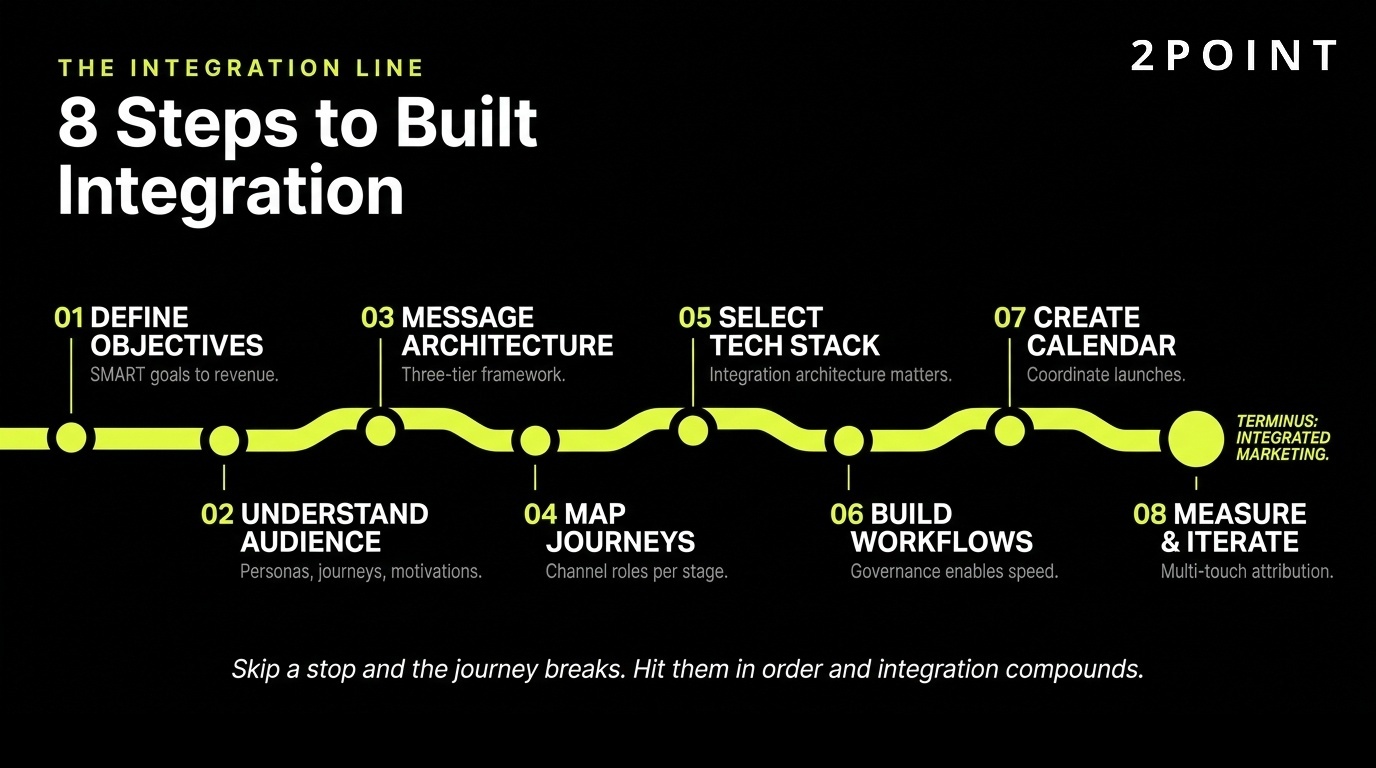
Understanding why integration matters and seeing successful examples provides foundation. This section delivers the practical implementation guide—moving from theory to actually building your integrated marketing strategy. Integration requires intentional planning and organizational alignment, not just simultaneous channel activity.
Step 1: Define Clear Objectives and Success Metrics
SMART objectives—Specific, Measurable, Achievable, Relevant, Time-bound—ensure focused strategy execution and ROI measurement. Vague goals like "increase brand awareness" provide no guidance for tactical decisions or success evaluation. Specific objectives like "generate 500 qualified leads from target accounts in manufacturing sector by end of Q2" enable teams to develop targeted strategies and measure progress precisely.
Integrated strategies typically pursue multiple objectives simultaneously across different funnel stages. Awareness campaigns generate leads while strengthening brand perception. Content marketing educates prospects while supporting SEO. Sales enablement closes deals while gathering customer insights that inform future campaigns. Understanding how objectives relate helps prioritize channels and budget allocation.
Define metrics for each objective category:
- Awareness objectives: reach, impressions, share of voice, brand recall, search volume for branded terms, social media followers
- Engagement objectives: content consumption (downloads, video views), social engagement (comments, shares), email metrics (open rates, click rates), time on site, pages per session
- Conversion objectives: leads generated, marketing qualified leads (MQLs), sales qualified leads (SQLs), pipeline created, opportunities influenced, revenue attributed
- Retention objectives: customer satisfaction scores (NPS, CSAT), repeat purchase rate, customer lifetime value, expansion revenue, churn reduction
Well-structured IMC directly impacts ROI by aligning marketing efforts with measurable business outcomes, avoiding vanity metrics that look impressive but don't connect to revenue. Setting up KPI dashboards helps teams monitor marketing performance metrics continuously rather than evaluating success only at campaign completion.
Step 2: Build Deep Audience Understanding
Understanding target audiences is key to IMC strategy success. Generic messaging fails across all channels because it resonates with no one specifically. Precise audience insight enables personalization that feels relevant because it addresses specific needs, challenges, and motivations that different segments actually experience.
Gather audience intelligence through multiple research methods:
- Demographics and firmographics: age, location, income, education, company size, industry, job title, seniority—the basic segmentation variables
- Behavioral data: purchase patterns, content consumption habits, channel preferences, engagement history, product usage, feature adoption
- Psychographic insights: motivations driving purchase decisions, pain points your solution addresses, values influencing brand preference, aspirations your brand helps achieve, fears preventing purchase
- Customer journey mapping: touchpoints where decisions happen, information needs at each stage, emotional states throughout process, barriers preventing progression
Develop consumer personas that segment audiences and optimize communication for specific groups. Effective personas include representative quotes, day-in-the-life narratives, specific goals and challenges, information sources they trust, and objections they typically raise. These personas guide content creation, channel selection, messaging development, and campaign personalization.
Integration advantage emerges when unified audience understanding informs every channel. Sales teams reference the same personas marketing targets. Content addresses the specific questions personas ask at each journey stage. Paid media targets lookalike audiences based on high-value persona characteristics. Email nurture delivers content aligned with persona needs. Without this coordination, channels fragment audiences across disconnected definitions rather than building comprehensive understanding of the same people.
Step 3: Create Your Message Architecture
Message architecture solves the personalization-consistency paradox by establishing three tiers: what must stay consistent across all touchpoints, what can adapt by channel while staying on-brand, and what can be fully personalized based on audience segment and context. This framework enables teams to maintain brand coherence while delivering relevant, personalized experiences.
Tier 1: Core Brand Pillars (unchanging across all channels)
- Brand promise—the fundamental value you deliver to customers
- Brand positioning—how you're different from alternatives and why that matters
- Core value propositions—the 3-5 primary benefits that define why customers choose your brand
- Brand personality and voice—the human characteristics your brand embodies consistently
Tier 2: Campaign Themes (consistent within campaigns, flexible between campaigns)
- Campaign messaging—the specific narrative or theme this campaign emphasizes
- Visual identity—photography style, color palette, graphic elements for this campaign
- Key proof points—the specific statistics, customer stories, or differentiators this campaign highlights
- Calls to action—the desired actions and conversion points
Tier 3: Tactical Adaptations (personalized by channel, audience, and context)
- Format adjustments—adapting content length and format to channel requirements (LinkedIn article vs. Instagram caption vs. email)
- Tone variations—maintaining brand voice while adapting formality to platform norms (professional LinkedIn vs. casual TikTok)
- Audience-specific hooks—leading with benefits most relevant to specific segments
- Contextual offers—tailoring incentives and next steps based on customer journey stage
Document your message architecture in a brand playbook that marketing, sales, customer success, and external partners reference. Include examples showing how core messages adapt across channels while maintaining consistency. Provide templates for common content types pre-populated with Tier 1 elements, allowing teams to customize Tier 2 and 3 elements within strategic boundaries.
Step 4: Map Customer Journeys and Assign Channel Roles
Customer journey mapping identifies all touchpoints where prospects and customers interact with your brand, from initial awareness through purchase and ongoing relationship. Map journeys for each primary persona, recognizing that different audiences take different paths and require different information at each stage.
Journey stages typically include:
- Awareness: prospect recognizes problem but doesn't know solutions exist
- Consideration: actively researching solution categories and potential vendors
- Decision: evaluating specific vendors and making purchase decision
- Onboarding: implementing solution and achieving initial value
- Adoption: expanding usage and deepening engagement
- Advocacy: actively recommending solution to others
Assign primary and supporting roles to each channel at each stage. For example, awareness stage might use SEO-optimized content as primary channel (prospects actively searching for information) supported by social media and paid search. Consideration stage might feature comprehensive guides and webinars as primary channels supported by email nurture and sales development outreach. Decision stage might rely on case studies and sales conversations as primary channels supported by targeted ads and customer testimonials.
Define how channels hand off between stages. Someone who downloads an awareness-stage guide enters email nurture, sees retargeting ads, and becomes eligible for sales outreach after demonstrating sufficient engagement. This coordination ensures prospects experience seamless progression rather than disconnected interactions as they move through the journey.
Conducting a digital marketing audit helps identify gaps and inefficiencies in current customer journeys, revealing where prospects drop off due to disconnected experiences or missing content.
Step 5: Select Your Technology Stack and Integration Architecture
Technology enables integration but doesn't create it automatically. Select platforms based on your organization's scale, complexity, and resources, recognizing that the best technology poorly implemented delivers worse results than adequate technology implemented well.
For teams with under $500K monthly marketing spend:
Integrated platforms like HubSpot, Salesforce Marketing Cloud, or similar suites provide adequate functionality while maintaining data in unified systems. These platforms bundle marketing automation, basic CRM, email, landing pages, social media management, and reporting. The advantage is simplicity—teams don't manage data integration between multiple vendors. The limitation is reporting depth and advanced functionality compared to best-of-breed solutions.
For teams spending over $1M monthly:
Best-of-breed stacks typically become necessary because volume and complexity exceed integrated platform capabilities. These organizations might use Salesforce for CRM, Marketo for marketing automation, separate data warehouse for reporting, specialized tools for advertising management, social media, and content management. This approach provides advanced functionality but requires dedicated integration infrastructure.
Essential integration architecture components regardless of stack choice:
- Customer Data Platform (CDP): consolidates customer data from all sources into unified profiles, enabling personalization across channels
- Data warehouse or lake: centralizes performance data for cross-platform reporting and analysis
- iPaaS (integration Platform as a Service): connects applications and automates data flow between systems
- Marketing analytics platform: aggregates performance data across channels for unified reporting
Establish clear data governance before implementing technology. Define which systems serve as source of truth for different data types (CRM for account data, marketing automation for engagement data, product for usage data). Document how frequently information syncs between platforms. Determine which actions trigger updates across channels. This governance prevents conflicts when the same customer information exists in multiple systems with different values.
An all-in-one marketing approach simplifies integration for smaller teams, while larger organizations benefit from flexibility to select specialized tools for each function—provided they invest in integration infrastructure connecting these tools effectively.
Step 6: Develop Cross-Functional Workflows and Governance
Integration fails when organizational structure works against coordination. Traditional structures organized around channels—social media team, content team, advertising team, email team—create silos where each team optimizes their individual metrics without coordinating across the customer experience.
Successful integrated marketing requires structural changes:
- Customer journey ownership: assign individuals or teams responsible for entire journey stages (awareness, consideration, decision) across all channels rather than single-channel optimization
- Regular cross-functional planning: weekly or biweekly meetings where channel teams coordinate upcoming campaigns, share performance insights, and identify collaboration opportunities
- Shared success metrics: evaluate teams based on customer journey progression and business outcomes (pipeline, revenue) rather than channel-specific vanity metrics (impressions, followers)
- Centralized content operations: establish single source for brand assets, messaging guidelines, and content libraries that all teams reference
Define approval workflows balancing brand consistency with execution speed. Create three approval tiers: pre-approved templates requiring no review (social posts using standard formats, email templates with approved messaging), standard content requiring marketing manager review (blog posts, landing pages, campaign emails), and high-stakes content requiring executive review (major campaign launches, PR statements, legal-sensitive communications). This structure prevents bottlenecks while maintaining necessary oversight.
Establish clear decision rights. Define who owns messaging decisions, visual identity, channel budget allocation, technology selection, and campaign priorities. Ambiguity about decision rights creates either paralysis (everything requires consensus) or chaos (teams make conflicting decisions). Building a successful marketing team requires clarity about roles, responsibilities, and decision authority that supports coordination rather than hindering it.
Step 7: Create Your Content and Campaign Calendar
Integrated campaigns require coordinated timing across channels. Content calendars provide visibility into what's publishing when, enabling teams to identify opportunities for amplification and avoid conflicts where different messages compete for attention simultaneously.
Build a master calendar including:
- Content publication dates (blog posts, guides, videos, webinars)
- Campaign launch and end dates across all channels
- Product releases and company announcements
- Industry events and seasonal moments relevant to your audience
- Social media promotion planned for each content asset
- Email campaigns and automated nurture programs
- Paid media campaigns and flight dates
- Sales enablement deliverables and training sessions
Use calendar review meetings to identify integration opportunities. A product launch might coordinate blog post, email announcement, social media campaign, paid advertising, sales enablement materials, PR outreach, and customer webinar—all launching the same week with consistent messaging adapted to each channel. Website updates, landing pages, and case studies support the launch. This coordination creates concentrated impact rather than diffused effort.
Build content programs, not just individual pieces. A single research report becomes the foundation for blog post series, social media content for weeks, email nurture sequence, webinar content, sales one-pagers, and PR pitches. This approach extracts maximum value from production investment while maintaining message consistency because all derivative content draws from the same source material.
Step 8: Establish Measurement Framework and Reporting Cadence
Integrated marketing requires integrated measurement. Channel-specific metrics (email open rates, social media engagement, ad impressions) remain useful for tactical optimization but don't prove business impact. Organizations need attribution models showing how channels work together to drive outcomes that matter—pipeline, revenue, customer acquisition, retention.
Implement multi-touch attribution tracking how multiple touchpoints contribute to conversions. First-touch attribution credits the channel that generated initial awareness. Last-touch attribution credits the final interaction before conversion. Multi-touch models distribute credit across all touchpoints, providing more accurate understanding of how channels work together. Advanced approaches weight touchpoints differently based on journey stage or time proximity to conversion.
Create dashboards at three levels:
- Executive dashboard: high-level business metrics (pipeline generated, revenue attributed, customer acquisition cost, customer lifetime value) with monthly or quarterly views
- Marketing leadership dashboard: channel performance and campaign results with weekly views, enabling strategic adjustments
- Channel-specific dashboards: tactical metrics for optimization with daily or real-time views, allowing teams to adjust underperforming content or campaigns quickly
Establish regular reporting cadence. Weekly team reviews examine current campaign performance and identify tactical adjustments. Monthly leadership reviews evaluate progress against objectives and inform budget allocation decisions. Quarterly strategic reviews assess whether overall strategy is working or requires fundamental changes. This rhythm ensures teams measure marketing impact consistently and make data-informed decisions.
Using data analytics to drive marketing decisions requires more than collecting metrics—it requires translating data into actionable insights that inform strategic and tactical choices. Organizations that leverage analytics in marketing effectively combine quantitative performance data with qualitative customer feedback to understand not just what's happening but why.
Common Challenges in Integrated Marketing (And How to Overcome Them)
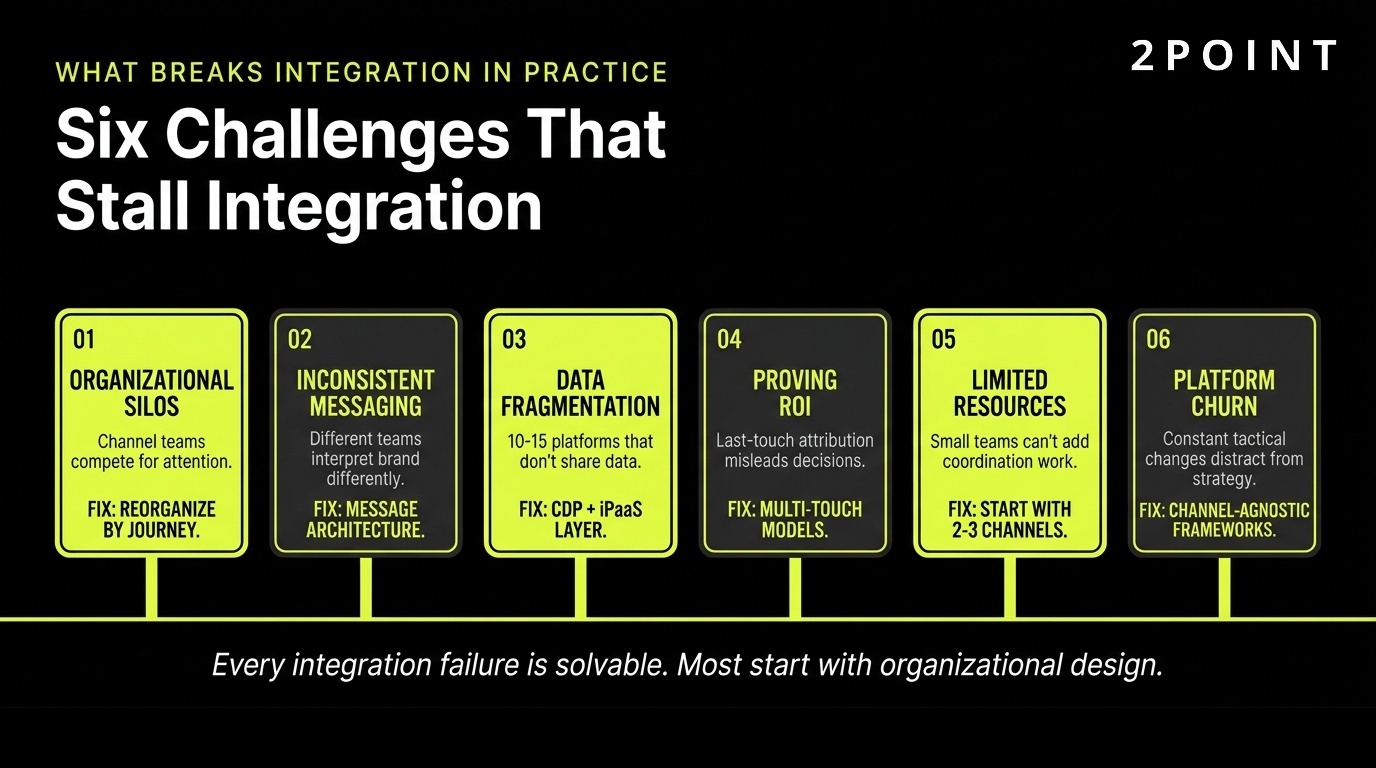
Understanding what integrated marketing should look like and actually implementing it are different challenges. Organizations encounter predictable obstacles when moving from siloed to integrated approaches. Recognizing these challenges and knowing proven solutions increases success likelihood.
Challenge 1: Organizational Silos and Departmental Turf Wars
Marketing teams often organize around channels—social media specialists, content marketers, advertising managers, email marketers—each optimizing their specific domain. Sales and marketing frequently operate as separate departments with limited communication. Customer success focuses on retention while marketing focuses on acquisition. These structural divisions create silos that work against integration.
The symptom: different teams run campaigns simultaneously that compete for the same audience attention with conflicting messages. Sales doesn't know which marketing campaigns prospects have seen. Marketing doesn't know which messages resonate in sales conversations. Customer success insights about common questions don't inform content strategy.
Solution approaches:
- Restructure around customer journeys: assign teams responsible for journey stages (awareness, consideration, decision, retention) across all channels rather than channel-specific teams
- Implement shared objectives: evaluate teams based on business outcomes (pipeline, revenue) that require cross-functional collaboration rather than channel-specific vanity metrics
- Create collaboration rituals: weekly cross-functional planning meetings, shared Slack channels for campaign coordination, joint campaign post-mortems
- Establish executive sponsorship: senior leadership must reinforce that integration is priority, model collaborative behavior, and remove obstacles teams encounter
Aligning marketing teams with sales and customer success requires changing incentive structures, not just encouraging collaboration. When teams are measured and rewarded based on isolated metrics, they'll optimize for those metrics regardless of impact on overall customer experience.
Challenge 2: Inconsistent Messaging and Brand Dilution
Without clear message architecture and brand guidelines, different teams interpret brand positioning differently. Social media adopts casual tone that conflicts with formal email style. Advertising emphasizes price competitiveness while sales focuses on premium quality. Content marketing targets one audience while paid media targets another. This inconsistency confuses prospects and dilutes brand identity.
The symptom: customers encounter different brand personalities, value propositions, and messages depending on which channel they engage with, creating uncertainty about what your brand actually stands for.
Solution approaches:
- Develop comprehensive brand guidelines: document core messaging, visual identity standards, voice and tone principles, approved terminology, and prohibited language
- Create message architecture: establish three-tier framework defining what stays consistent (brand pillars), what adapts by campaign (themes), and what personalizes by audience (tactical adaptations)
- Build shared content libraries: centralize approved assets, messaging templates, and brand resources that all teams reference
- Implement review processes: establish approval workflows ensuring brand consistency without creating bottlenecks
- Conduct regular brand audits: quarterly reviews examining consistency across all touchpoints, identifying drift, and reinforcing guidelines
Message architecture must live in accessible formats teams actually use—not 100-page PDFs no one reads. Create practical tools: email templates pre-populated with approved messaging, social media post frameworks, presentation decks with standard slides, and one-page reference guides for common scenarios.
Challenge 3: Data Fragmentation Across Disconnected Systems
Marketing technology stacks typically include 10-15 platforms: CRM, marketing automation, advertising platforms, social media management, analytics, content management, SEO tools, and specialized applications. When these systems don't share data, organizations lack unified customer understanding and can't coordinate experiences effectively.
The symptom: someone who just purchased receives promotional emails encouraging them to buy. High-value customers get the same generic messages as cold prospects. Sales teams don't see marketing engagement data. Marketing can't access sales conversation notes. Attribution reports only capture partial customer journeys because data lives in isolated systems.
Solution approaches:
- Implement Customer Data Platform (CDP): consolidate customer data from all sources into unified profiles, enabling consistent personalization across channels
- Deploy integration middleware: use iPaaS solutions connecting applications and automating data flow between systems
- Establish data governance: define which systems serve as source of truth for different data types and how frequently information syncs
- Create unified reporting infrastructure: build data warehouse consolidating performance metrics across platforms for cross-channel analysis
- Simplify technology stack: evaluate whether specialized tools add sufficient value to justify integration complexity or whether consolidation makes sense
Data integration is technical challenge requiring dedicated resources. Organizations can't simply ask channel managers to "make sure systems sync"—they need data engineers, integration specialists, or managed services handling technical implementation. Budget for integration infrastructure, not just platform licenses.
Challenge 4: Proving ROI and Attribution Complexity
Integrated marketing distributes customer touchpoints across multiple channels and extended timeframes. Someone might see social media ad, visit website weeks later through organic search, download content, receive nurture emails, attend webinar, and finally convert after sales conversation. Which channel deserves credit? How do you prove marketing's contribution to revenue?
The symptom: executives question marketing value because attribution is unclear. Channel managers argue about budget allocation based on last-touch attribution that over-credits bottom-funnel tactics. Marketing can't demonstrate which integrated campaigns drive pipeline versus which channels waste budget.
Solution approaches:
- Implement multi-touch attribution: track all touchpoints contributing to conversions and distribute credit appropriately rather than using last-touch models
- Use marketing mix modeling: statistical analysis quantifying each channel's contribution to outcomes, accounting for factors like seasonality and external events
- Track campaign influence: identify all opportunities where prospects engaged with marketing before sales created opportunity, even if marketing didn't directly source the lead
- Establish leading and lagging indicators: measure early-stage engagement (content downloads, email engagement) that predicts later-stage conversions, enabling proactive optimization
- Calculate customer lifetime value: demonstrate marketing's role in acquiring customers who generate long-term revenue, not just initial purchase
Perfect attribution is impossible—accept directional accuracy instead. Focus on understanding which channels work together to drive results rather than precisely allocating credit percentages. Use consistent methodology over time so trends remain valid even if absolute numbers have some uncertainty.
Challenge 5: Limited Resources and Bandwidth Constraints
Integrated marketing requires coordinating multiple channels simultaneously—more planning, more content production, more analysis, more meetings. Small teams already stretched thin struggle to add integration work on top of existing responsibilities. The result: integration becomes another initiative that gets discussed but never fully implemented.
The symptom: teams understand integration value but can't find time to implement. Campaigns launch on individual channels without coordination. Planning happens reactively rather than strategically. Important integration work (building message architecture, implementing attribution, creating content calendars) gets perpetually postponed.
Solution approaches:
- Start with high-impact integration points: don't try integrating everything simultaneously—begin with 2-3 channels that reach your primary audience and expand gradually
- Repurpose content systematically: create one comprehensive asset (research report, guide) then derive multiple formats (blog series, social content, email nurture, webinar) rather than creating everything from scratch
- Automate repetitive tasks: use marketing automation, scheduling tools, and AI assistance for tactical execution, freeing human time for strategic work
- Establish quarterly planning cycles: batch strategic work into dedicated planning periods rather than trying to plan strategically weekly
- Outsource specialized tasks: consider agencies or freelancers for content production, advertising management, or technical implementation while internal teams focus on strategy and coordination
Integration actually reduces workload long-term by eliminating duplicated effort and wasted tactics. Initial implementation requires investment, but coordinated strategies operating from shared plans and content libraries require less ongoing effort than disconnected channel teams each planning and creating independently.
Challenge 6: Keeping Pace with Platform Changes and New Channels
Social media platforms update algorithms constantly. Advertising platforms modify targeting capabilities. New channels emerge requiring evaluation. Google changes ranking factors. Privacy regulations evolve. This constant change makes it difficult to establish stable integrated strategies when the foundation keeps shifting.
The symptom: teams spend excessive time reacting to platform changes, rewriting strategies to accommodate new channel realities, and evaluating whether to invest in emerging platforms, leaving insufficient time for actual execution.
Solution approaches:
- Focus on strategic consistency: maintain consistent brand positioning, audience focus, and value propositions regardless of tactical channel changes
- Build channel-agnostic frameworks: develop message architecture and content strategies that work across platforms rather than channel-specific approaches
- Evaluate new channels systematically: establish criteria for assessing new platforms (audience presence, engagement patterns, competitive activity) rather than jumping on every trend
- Subscribe to reliable industry sources: follow 2-3 trusted publications covering platform changes rather than monitoring everything, reducing information overwhelm
- Conduct quarterly strategy reviews: evaluate significant platform changes and competitive shifts quarterly rather than constantly reacting to minor updates
Channel tactics will always change—that's normal. Strategic integration based on customer needs and consistent brand positioning remains stable even as tactical execution evolves. Focus most energy on strategic elements that endure rather than constantly chasing tactical trends.
Measuring Integrated Marketing Success: Key Performance Indicators
Integrated marketing success requires metrics proving business impact, not just channel activity. Organizations need measurement frameworks showing how coordinated channel efforts drive outcomes that matter—awareness, engagement, conversion, revenue, and retention. This section defines essential KPIs at each funnel stage and explains how to prove integration works.
Awareness Stage Metrics
Awareness metrics measure how effectively integrated campaigns reach target audiences and generate recognition. These top-funnel indicators predict future engagement and conversion by demonstrating growing market presence.
Essential awareness KPIs:
- Reach and impressions: unique individuals exposed to brand messages across all channels (deduplicated to avoid counting same person multiple times)
- Share of voice: your brand's visibility compared to competitors in relevant conversations, search results, and media coverage
- Branded search volume: people searching specifically for your company name or products, indicating awareness driving active interest
- Social media audience growth: follower increases across platforms, weighted by engagement quality rather than raw numbers
- Website traffic (new visitors): first-time website visitors discovering your brand through various channels
- Brand recall and recognition: survey data measuring unaided and aided brand awareness in target markets
Integration impact on awareness: coordinated campaigns reach audiences through multiple touchpoints, creating compound recognition that isolated single-channel efforts can't achieve. Someone who sees display ad, social media content, and search result for your brand develops stronger awareness than seeing only one touchpoint.
Engagement Stage Metrics
Engagement metrics measure how effectively content and experiences maintain audience attention and deepen relationships. These mid-funnel indicators show whether awareness converts into genuine interest and consideration.
Essential engagement KPIs:
- Content consumption: downloads, video views, webinar attendance, time spent with content assets
- Email engagement: open rates, click-through rates, forwards, replies indicating active interest
- Social media engagement: comments, shares, saves, and mentions showing audience investment beyond passive viewing
- Website engagement: pages per session, time on site, repeat visits, scroll depth on key pages
- Content sharing: audience amplification of your content through their networks
- Community participation: forum posts, user-generated content, event attendance, group membership
Integration impact on engagement: coordinated content experiences guide audiences through logical progressions rather than disconnected interactions. Someone who downloads guide receives related email content, sees social posts expanding on concepts, and gets invited to webinar exploring topics in depth—each touchpoint builds on previous engagement.
Conversion Stage Metrics
Conversion metrics measure how effectively integrated campaigns generate qualified leads and pipeline that sales teams can work. These metrics connect marketing activity directly to business outcomes, proving contribution to revenue generation.
Essential conversion KPIs:
- Leads generated: prospects providing contact information through forms, gated content, event registration
- Marketing qualified leads (MQLs): leads meeting scoring criteria indicating genuine interest and qualification
- Sales qualified leads (SQLs): MQLs that sales accepts as worthy of active pursuit
- Pipeline created: dollar value of opportunities influenced or sourced by marketing
- Conversion rates: percentages of visitors becoming leads, leads becoming MQLs, MQLs becoming SQLs, SQLs becoming opportunities
- Lead velocity: rate of qualified lead growth month-over-month, indicating momentum
Integration impact on conversion: coordinated touchpoints build trust and educate prospects effectively, increasing conversion rates at each funnel stage. Someone who encounters consistent messaging across awareness, engagement, and conversion touchpoints converts at higher rates than those experiencing disconnected or contradictory messages.
Revenue Stage Metrics
Revenue metrics prove marketing's contribution to actual business results. These bottom-funnel indicators demonstrate ROI and justify marketing investment by connecting activities to closed revenue and customer acquisition.
Essential revenue KPIs:
- Revenue attributed to marketing: closed deals where marketing touchpoints influenced buyer journey
- Marketing sourced revenue: deals where marketing directly generated initial contact
- Customer acquisition cost (CAC): total marketing and sales cost divided by new customers acquired
- Marketing cost per opportunity: marketing spend divided by opportunities created
- Average deal size: revenue per closed deal, segmented by marketing source and channel
- Sales cycle length: time from first marketing touchpoint to closed deal, showing integration efficiency
Integration impact on revenue: coordinated campaigns reduce sales cycle length and improve close rates by delivering well-educated, engaged prospects to sales teams. Integrated approaches typically show higher average deal sizes because comprehensive nurture builds preference for premium offerings rather than competing solely on price.
Retention Stage Metrics
Retention metrics measure post-purchase success—whether customers remain satisfied, expand usage, and become advocates. These metrics prove customer lifetime value and recurring revenue impact, demonstrating marketing's role beyond initial acquisition.
Essential retention KPIs:
- Customer retention rate: percentage of customers renewing or continuing service
- Net revenue retention: revenue from existing customers accounting for expansion, downgrades, and churn
- Customer lifetime value (CLV): total revenue expected from customer over entire relationship
- Net Promoter Score (NPS): customer satisfaction and likelihood to recommend
- Expansion revenue: additional purchases from existing customers through upsells and cross-sells
- Advocacy actions: referrals generated, reviews written, case study participation, community contributions
Integration impact on retention: coordinated customer experiences across onboarding, support, education, and expansion opportunities increase satisfaction and lifetime value. Customers who receive consistent value reinforcement through multiple touchpoints remain engaged rather than becoming passive users vulnerable to competitive alternatives.
Cross-Channel Attribution Approaches
Attribution models assign credit to marketing touchpoints contributing to conversions. Different models provide different insights into channel performance and customer journey patterns.
Common attribution models:
- First-touch attribution: credits channel generating initial awareness—useful for understanding top-funnel performance
- Last-touch attribution: credits final touchpoint before conversion—over-values bottom-funnel tactics while undervaluing awareness efforts
- Linear attribution: distributes credit equally across all touchpoints—simple but treats all interactions as equally valuable
- Time-decay attribution: weights recent touchpoints more heavily—reflects reality that recent interactions influence decisions more
- U-shaped attribution: emphasizes first and last touches while giving some credit to middle touchpoints—recognizes importance of awareness and conversion moments
- W-shaped attribution: highlights first touch, lead conversion, and opportunity creation—useful for longer B2B sales cycles
- Custom algorithmic attribution: machine learning models that weight touchpoints based on actual impact on conversion likelihood
No single model is perfect. Use multiple views to understand channel contributions from different perspectives. First-touch shows awareness drivers. Last-touch identifies conversion catalysts. Multi-touch reveals how channels work together throughout journeys.
Building Your Measurement Dashboard
Effective dashboards provide relevant insights to different audiences without overwhelming them with excessive data. Create tiered views serving distinct purposes:
Executive dashboard (monthly/quarterly view):
- Pipeline and revenue attributed to marketing
- Customer acquisition cost trends
- Marketing ROI and efficiency ratios
- Customer lifetime value metrics
- High-level channel performance comparison
Marketing leadership dashboard (weekly view):
- Campaign performance against goals
- Channel contribution to pipeline
- Conversion rate trends by stage
- Content performance rankings
- Lead quality indicators
Channel specialist dashboards (daily/real-time view):
- Campaign-specific metrics (CTR, CPC, engagement rates)
- Content performance by topic and format
- Audience segment behavior patterns
- A/B test results and optimization opportunities
- Budget pacing and spend efficiency
Visualization matters. Use trend lines showing changes over time rather than single-point snapshots. Include comparison context—performance versus goals, previous periods, or benchmarks. Highlight anomalies requiring attention. Make dashboards actionable by linking metrics to specific optimization opportunities.
The Future of Integrated Marketing: What to Prepare For
Integrated marketing continues evolving in response to technology innovation, consumer behavior shifts, and regulatory changes. Organizations building strategies today must anticipate tomorrow's landscape to ensure approaches remain effective as conditions change. These emerging trends will reshape integrated marketing practice over the next 3-5 years.
AI-Generated Content at Scale Within Strategic Frameworks
Generative AI tools now produce blog posts, social media content, email copy, ad variations, and visual assets at unprecedented scale and speed. This capability will expand dramatically as models improve. Organizations will generate 100x more content than currently possible with human-only production.
The challenge: maintaining brand consistency and strategic alignment when AI produces most content. Without strong frameworks, organizations create massive volumes of generic content that achieves nothing. The competitive advantage belongs to organizations that combine AI execution speed with human strategic direction.
Preparation steps: develop robust message architecture defining what must stay consistent versus what AI can optimize. Create detailed brand voice documentation that AI models can reference. Implement review processes ensuring AI-generated content serves strategic objectives rather than just filling content calendars. Train teams to become AI directors rather than content creators—focusing on strategy, quality control, and optimization rather than first-draft production.
Privacy-First Identity and Contextual Targeting
Third-party cookie deprecation and expanding privacy regulations will continue limiting tracking-based personalization. The future relies on first-party data strategies and contextual targeting that reaches audiences based on content consumption rather than individual tracking.
Retail media networks—Amazon DSP, Walmart Connect, Target Roundel—will expand influence because they offer closed-loop attribution within privacy-compliant environments. Advertisers reach audiences based on shopping behavior within these ecosystems without requiring cross-web tracking.
Preparation steps: build first-party data collection strategies offering clear value exchange for information sharing. Develop content experiences that naturally gather preference data through interactive tools, assessments, and personalization centers. Invest in contextual targeting capabilities that reach audiences based on content topics and publisher contexts. Create stronger owned media properties (email lists, communities, loyalty programs) where you control the customer relationship.
Immersive Experiences Through AR and VR
Augmented reality and virtual reality technologies will mature from novelty to practical marketing tools. Apple Vision Pro and similar devices will make spatial computing mainstream. Brands will create immersive experiences where customers visualize products in their environments, attend virtual events, and interact with 3D brand worlds.
Integration challenge: AR/VR experiences must connect to broader customer journeys rather than existing as isolated gimmicks. Someone who virtually places furniture in their room should seamlessly transition to purchase, receive coordinated follow-up, and experience consistent brand across digital and physical touchpoints.
Preparation steps: experiment with AR features (virtual try-on, product visualization) in mobile apps and web experiences. Develop 3D asset libraries that work across platforms. Consider how immersive experiences integrate with existing channels—can virtual event attendance trigger email nurture, inform sales outreach, or influence personalization across other touchpoints?
Voice and Conversational Interfaces
Voice search, smart speakers, and AI assistants will handle increasing percentages of information queries and purchases. Conversational AI will enable natural-language interactions with brands through messaging apps, website chat, and voice interfaces. These channels require different content strategies than traditional text-based interfaces.
Integration opportunity: conversational interfaces that remember customer context and preferences across sessions create seamless experiences. Someone who asks Alexa about product availability should later see relevant content in email, encounter consistent information if they visit website, and hear sales representatives reference their expressed interests.
Preparation steps: optimize content for voice search using natural-language phrases and question-based formats. Develop conversational content strategies addressing how people speak versus how they type. Ensure conversational AI platforms integrate with CRM and marketing automation so interactions inform broader customer understanding. Create voice interaction guidelines maintaining brand personality in conversational contexts.
Sustainability and Purpose-Driven Marketing Integration
Consumer expectations around corporate social responsibility, environmental sustainability, and social impact continue rising. Purpose-driven marketing will evolve from occasional campaigns to integrated identity—brands must demonstrate authentic commitment across all touchpoints, not just advertising.
Skepticism toward "greenwashing" means surface-level sustainability claims without operational backing will damage brands rather than help them. Integration requires aligning purpose claims in marketing with actual business practices, supply chain transparency, and measurable impact.
Preparation steps: ensure sustainability or social impact claims made in marketing reflect authentic operational commitments. Integrate purpose storytelling across all channels—not just dedicated "corporate social responsibility" content separate from product marketing. Provide transparency about progress and challenges rather than only highlighting successes. Engage customers in purpose initiatives through participation opportunities, not just awareness messages.
Hyper-Personalization Through Predictive AI
Predictive AI models will anticipate customer needs before they explicitly express them, enabling proactive personalization. Systems will predict when customers need support, which products they'll want next, when they're at risk of churning, and which messages will resonate—then automatically orchestrate appropriate experiences.
This capability will enable true one-to-one marketing at scale—every customer receives individually optimized experiences across all touchpoints based on predicted preferences and behaviors. The integration requirement becomes ensuring these personalized experiences maintain brand consistency while adapting to individual contexts.
Preparation steps: collect comprehensive behavioral data across all touchpoints to enable accurate predictive models. Implement machine learning platforms capable of real-time decisioning about which content, offers, and experiences to deliver. Define strategic boundaries—which elements can AI personalize freely versus which must stay consistent. Train teams to oversee AI systems and intervene when predictions seem questionable.
Frequently Asked Questions About Integrated Marketing
What is integrated marketing?
Integrated marketing is a strategic approach that coordinates all marketing channels—advertising, content, social media, email, PR, sales—to deliver consistent messaging across every customer touchpoint. It ensures audiences receive unified brand experiences whether they discover your company through Google search, social media, sales outreach, or any other channel, building trust through consistency and maximizing ROI through channel amplification.
How does integrated marketing differ from traditional marketing?
Traditional marketing often operates in silos where different teams manage separate channels independently, creating disconnected customer experiences. Integrated marketing coordinates all channels around unified strategy, ensuring consistent messaging, shared customer data, and orchestrated touchpoints that build on each other rather than competing for attention. This coordination delivers higher ROI because channels amplify each other instead of operating in isolation.
What are the main benefits of implementing integrated marketing?
Integrated marketing delivers up to 30% higher ROI than siloed approaches through channel amplification, where coordinated touchpoints reinforce each other. Additional benefits include improved brand consistency that builds customer trust, better attribution understanding showing which channels drive results, reduced wasted spend on disconnected tactics, shorter sales cycles from well-coordinated nurture, and enhanced customer experiences that improve satisfaction and retention.
How much does it cost to implement integrated marketing?
Implementation costs vary widely based on organization size, technology requirements, and whether you handle execution internally or hire agencies. Small businesses might spend $50K-$150K annually on integrated platforms and basic execution, while mid-market companies typically invest $250K-$1M annually including technology, content production, and paid media. Enterprise organizations often exceed $5M annually across platforms, teams, and multi-channel campaigns, but ROI improvements typically justify these investments.
What technology is required for integrated marketing?
Essential technology includes marketing automation platforms (HubSpot, Marketo, Salesforce Marketing Cloud), CRM systems for customer data, and analytics tools for performance measurement. Larger organizations benefit from Customer Data Platforms consolidating information across sources, data warehouses enabling cross-platform reporting, and integration middleware connecting applications. The specific stack depends on scale, but all successful implementations require systems that share data rather than creating isolated silos.
How long does it take to see results from integrated marketing?
Initial improvements in brand consistency and message coordination appear within 1-2 months of implementation. Measurable ROI improvements typically become visible within 3-6 months as coordinated campaigns launch and attribution data accumulates. Full transformation delivering maximum benefits usually requires 12-18 months because it involves organizational change, technology implementation, content development, and optimization based on performance data. Quick wins come from coordinating existing channels; transformational impact requires sustained commitment.
Can small businesses benefit from integrated marketing, or is it only for large enterprises?
Small businesses often benefit more from integration because limited resources make coordination essential. A small team that coordinates 3-4 channels effectively outperforms larger teams running 7+ channels in silos. Small businesses can start with basic integration—ensuring website, email, and social media deliver consistent messages—then expand as resources grow. Integrated platforms like HubSpot provide small business-accessible tools that larger enterprises might need custom implementations to achieve.
How does integrated marketing relate to omnichannel marketing?
Integrated marketing is the strategic framework ensuring consistent messaging across channels, while omnichannel marketing focuses on delivering seamless customer experiences as people switch between channels. Integration provides the foundation that enables omnichannel execution—without consistent messaging and shared data, you can't deliver the seamless transitions that define omnichannel experiences. Think of integrated marketing as the strategy and omnichannel as the customer-facing result.
What's the biggest mistake companies make when implementing integrated marketing?
The most common mistake is treating integration as purely a technology problem rather than an organizational change initiative. Companies buy expensive platforms expecting automatic coordination, but integration requires cross-functional collaboration, shared objectives, unified customer data, and consistent messaging frameworks. Technology enables integration but doesn't create it. Successful implementations focus on organizational alignment first, then select technology supporting coordinated execution.
How do you measure the success of integrated marketing?
Success measurement requires tracking business outcomes—pipeline generated, revenue attributed to marketing, customer acquisition cost, customer lifetime value—rather than channel-specific vanity metrics. Use multi-touch attribution showing how channels work together to drive conversions. Monitor message consistency scores across touchpoints. Track customer journey completion rates measuring how effectively integrated experiences move people through stages. Compare performance before and after integration implementation to quantify impact.
What role does content marketing play in integrated marketing?
Content marketing serves as the foundation providing substance that other channels distribute and promote. A comprehensive guide generates organic traffic (SEO), gets promoted via social media, becomes email nurture content, provides sales enablement resources, generates PR thought leadership opportunities, and supplies advertising messages—one asset feeding multiple channels. Integration maximizes content ROI by systematically distributing each piece across all relevant touchpoints rather than publishing it once and moving on.
How is AI changing integrated marketing?
AI enables content production at unprecedented scale, automates campaign execution across channels, and personalizes experiences for individual customers. The challenge is maintaining strategic consistency when AI generates most content. Successful organizations use message architecture as guardrails defining what AI can optimize versus what must stay consistent. AI handles tactical execution and personalization within strategic boundaries that humans define, combining machine speed with human strategic judgment.
