


 let’s connect


What Is Email Marketing and Why Does It Matter in 2026?
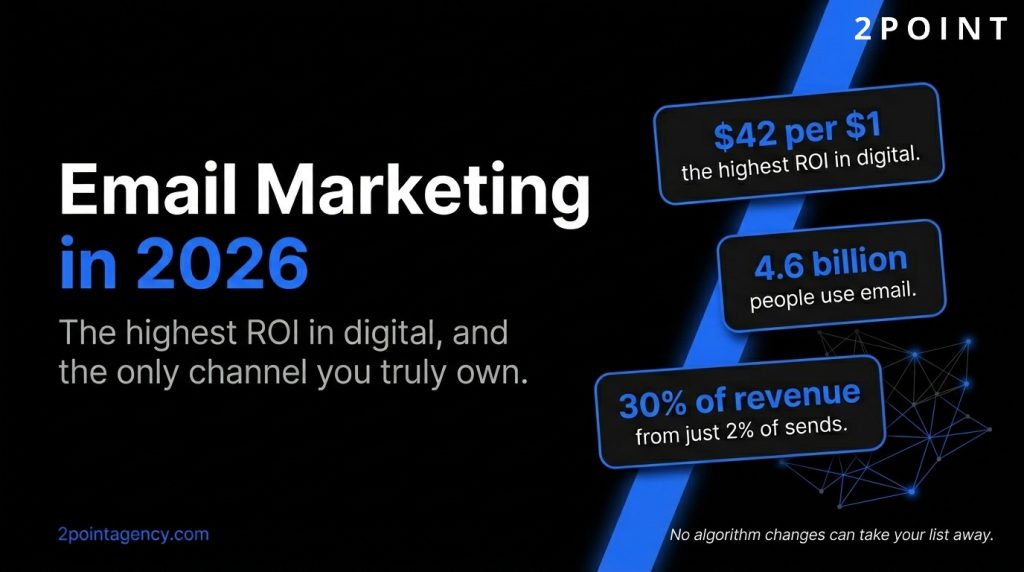
Email marketing is a digital marketing strategy that uses email to promote products, build relationships, and drive conversions. Here’s why it remains the most powerful marketing channel available:
- Email delivers $36-42 for every dollar spent—the highest ROI of any digital marketing channel.
- 4.6 billion people worldwide use email, creating unprecedented reach for businesses of all sizes.
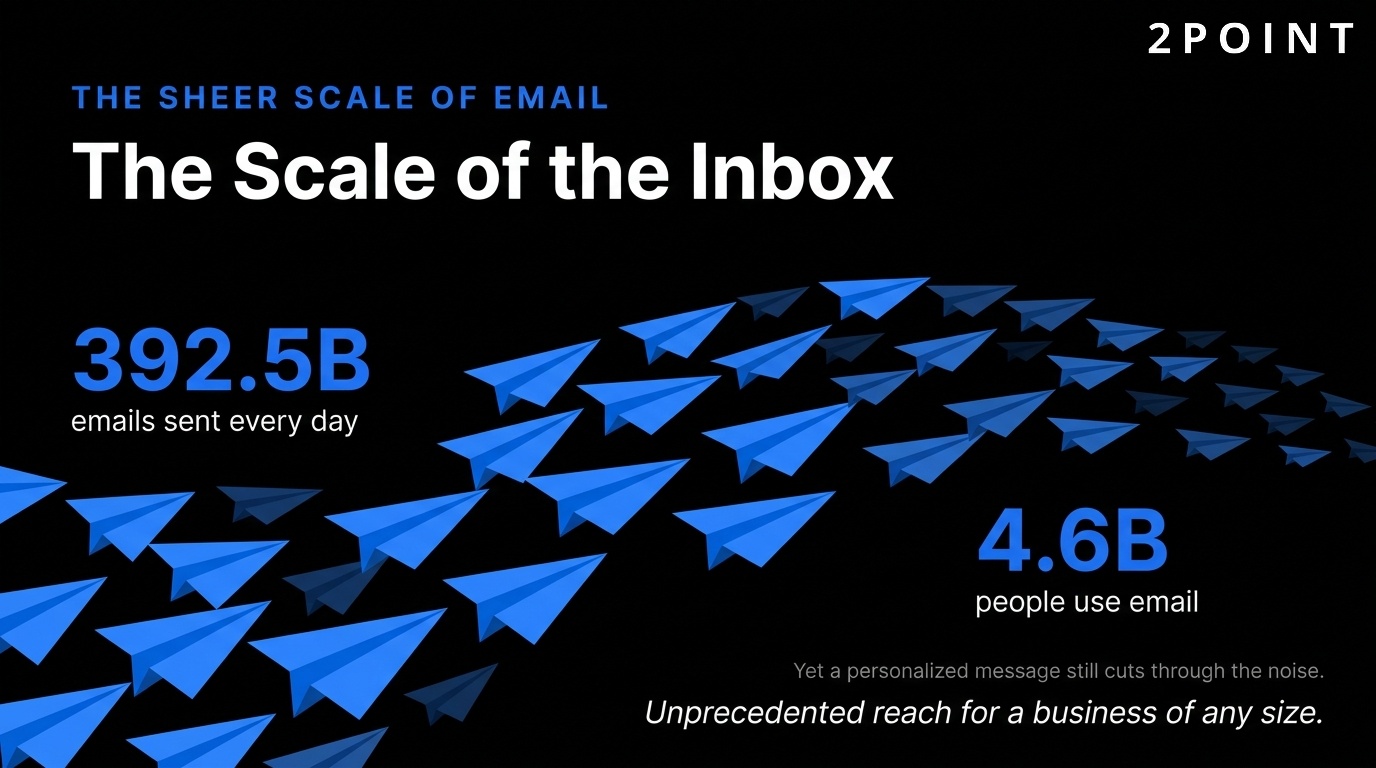
- 392.5 billion emails are sent daily, yet personalized messages still cut through the noise.
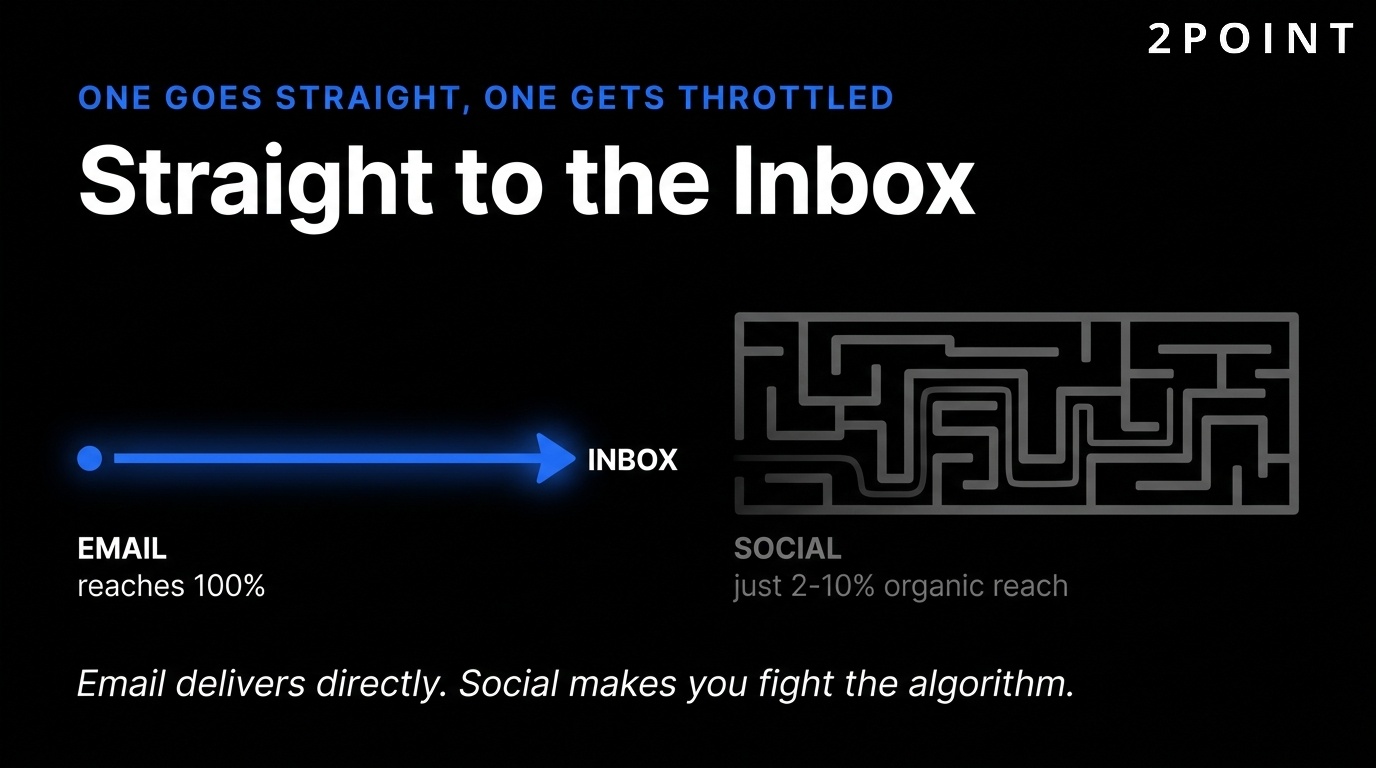
- Unlike social media where algorithms limit reach to 2-10% of followers, email delivers messages directly to subscribers.
- Modern email automation and AI-powered personalization generate 30% of ecommerce revenue from just 2% of sends.
- Businesses can measure every click, conversion, and dollar earned with precision that traditional marketing cannot match.
- Email remains the only marketing channel you truly own—no platform changes can eliminate your subscriber list.
In 2026, email marketing has evolved beyond simple newsletters into a sophisticated revenue engine powered by artificial intelligence, behavioral triggers, and hyper-personalization. Whether you’re running an ecommerce store, B2B company, or content business, email delivers predictable, scalable growth that other channels cannot replicate.
How Does Email Marketing Deliver Unmatched Return on Investment?
Email marketing consistently outperforms every other digital marketing channel when measuring return on investment. Understanding why helps businesses allocate budgets more effectively and set realistic performance expectations.
Why Email Generates $36-42 for Every Dollar Spent
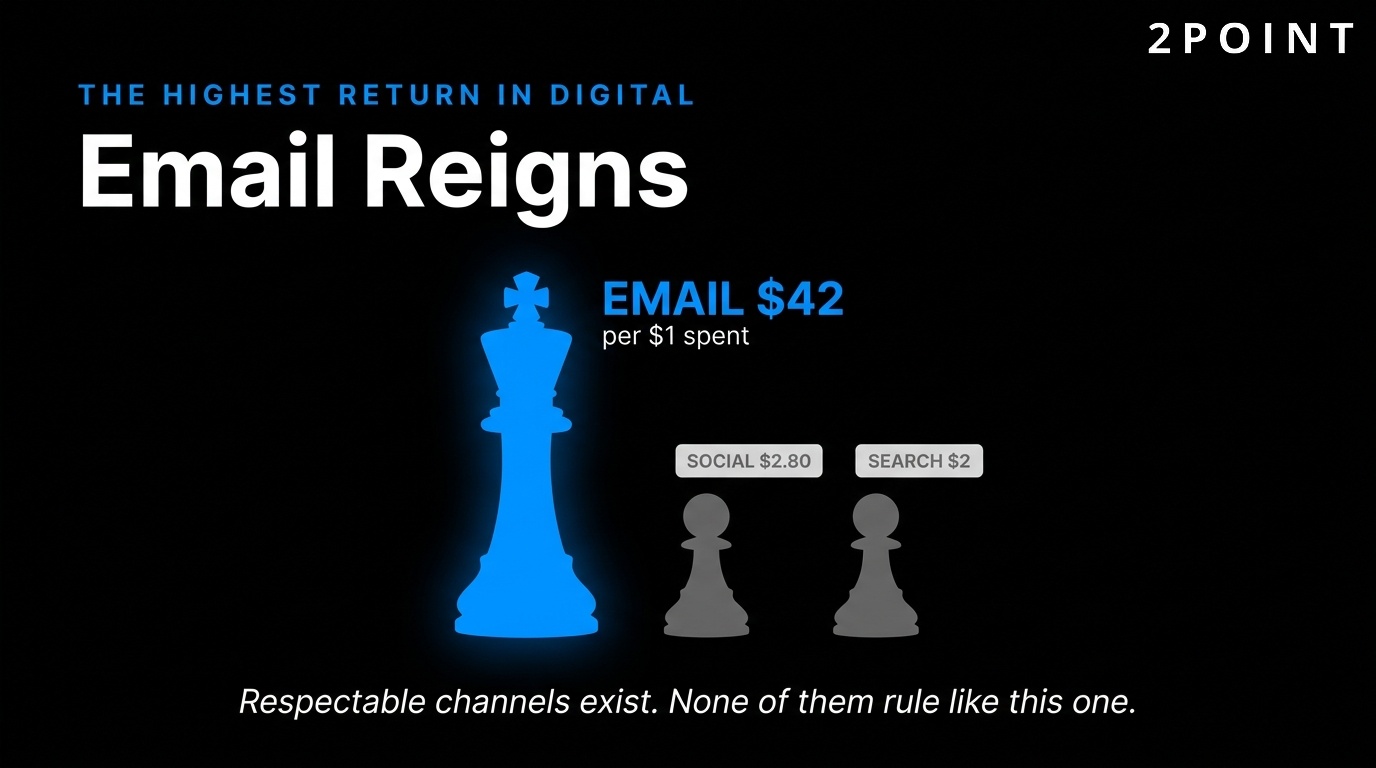
The average email marketing ROI stands at $36-42 per dollar invested, but this figure tells only part of the story. US merchants using Omnisend achieve $76 per dollar spent, while 18% of companies report ROI exceeding $70:1. Compare this to paid search at $2 per dollar, social advertising at $2.80, and display ads at $1.35, and the gap becomes staggering.
Several structural advantages explain email’s performance dominance. First, you own your email list—no platform can suddenly change algorithms or increase prices. Second, email reaches 100% of your audience (assuming proper deliverability), while social media posts reach just 2-10% organically. Third, email subscribers have explicitly opted in, signaling higher intent than passive social followers.
The cost structure also favors email dramatically. Sending 10,000 emails costs $50-200 depending on your platform, while reaching 10,000 people on Facebook could cost $500-2,000 in advertising. Email platforms charge based on list size or send volume, creating predictable costs that scale linearly rather than exponentially.
Email marketing also compounds over time. A well-maintained list grows in value as you collect more behavioral data, refine segmentation, and improve personalization. A six-month-old subscriber who has opened 20 emails and purchased twice is exponentially more valuable than a new signup, yet your cost to reach them remains identical.
What Separates High-Performing Email Programs from Average Ones
The top 8% of email programs achieve ROI of 45:1 or higher, but these results require specific strategic choices. High performers focus on relationship-building over constant promotion—they send educational newsletters and valuable content, not just discount codes. They implement advanced segmentation that goes beyond demographics into behavioral patterns and predictive modeling.
Authentication and deliverability form the foundation of elite performance. Top programs maintain SPF, DKIM, and DMARC records properly configured, ensuring messages reach inboxes rather than spam folders. Programs using advanced analytics achieve 43% higher ROI because they test continuously, measure accurately, and iterate based on data rather than assumptions.
Automation separates winners from the rest. Rather than relying solely on broadcast campaigns, advanced AI adopters are 75% more likely to achieve 45:1+ ROI. These programs deploy sophisticated triggered sequences—welcome series, abandoned cart recovery, browse abandonment, post-purchase nurturing, and re-engagement campaigns—that respond to subscriber behavior in real-time.
The best programs also prioritize list quality over list size. They regularly clean inactive subscribers, implement double opt-in to ensure genuine interest, and use progressive profiling to collect data gradually rather than demanding everything upfront. This focus on engagement quality rather than vanity metrics creates sustainable long-term performance.
Email Marketing ROI Compared to Social Media Advertising
The financial comparison between email and social media reveals a striking disparity. Social media advertising delivers 2.5-3:1 ROI, respectable but far below email’s 36-42:1 average. Organic social reach has collapsed to 2-10%, forcing brands to pay for visibility they once received free.
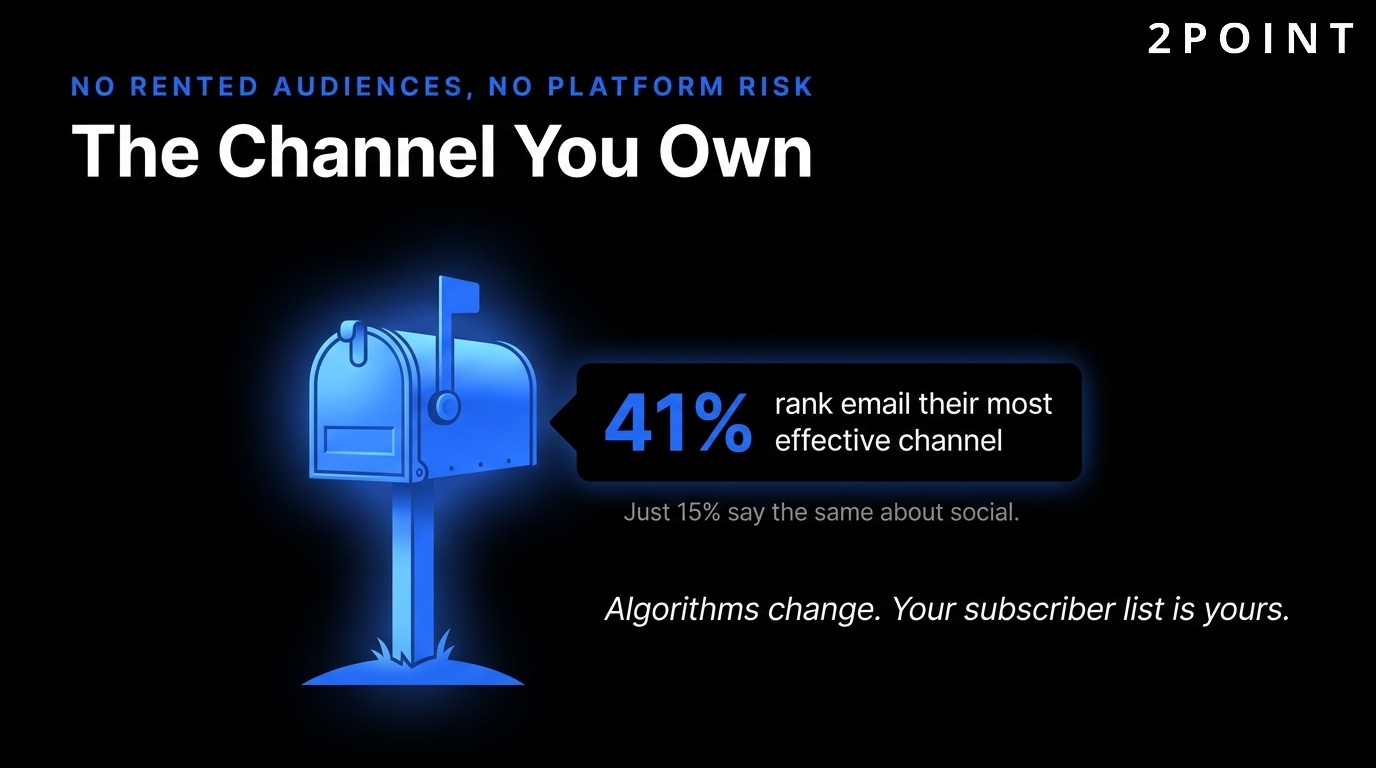
Social platforms function as rented land—you build an audience on someone else’s property, subject to their rules and algorithms. Instagram can throttle your reach, Facebook can increase ad costs, TikTok can change content policies overnight. Email subscribers live in your database, insulated from platform changes. 41% of marketers rank email as their most effective channel, compared to just 15% choosing social media.
The targeting precision differs fundamentally between channels. Social platforms offer demographic and interest-based targeting, but email enables behavioral segmentation based on actual purchase history, browsing patterns, engagement levels, and lifecycle stages. A subscriber who abandoned a $500 shopping cart receives a different message than someone who has never purchased, creating relevance impossible with social advertising’s broader strokes.
Social media excels at top-of-funnel awareness and discovery, while email dominates conversion and retention. Smart marketers use both strategically—social to attract new audiences, email to convert and retain them. But when budget forces prioritization, email’s superior ROI makes it the foundation worth building first.
Why 75% of Marketers Are Increasing Email Marketing Investment

Three-quarters of marketers are maintaining or increasing email investment in 2026, a vote of confidence based on proven results. The email marketing industry is growing from $7.14 billion to a projected $24.19 billion by 2033, driven by AI capabilities, automation sophistication, and measurable performance.
Economic uncertainty paradoxically strengthens email’s position. When budgets tighten, executives demand accountability and proven ROI. Email delivers both—every send generates trackable data on opens, clicks, conversions, and revenue. Alternative projections show growth from $13.72 billion in 2026 to $22.93 billion by 2031, reflecting sustained confidence in the channel.
B2C brands particularly favor email, with e-commerce, retail, and direct-to-consumer companies ranking it as their top revenue driver. The rise of first-party data strategies, driven by cookie deprecation and privacy regulations, has increased email’s strategic importance. As third-party targeting becomes restricted, owned audiences accessible via email become more valuable.
Investment flows toward automation and AI capabilities that amplify results without proportionally increasing costs. A company can send 10x more emails without hiring 10x more staff by implementing proper automation, creating operational leverage that executive teams find compelling when evaluating channel investments.
How Is Artificial Intelligence Transforming Email Marketing Strategy?
Artificial intelligence has moved from experimental feature to essential infrastructure in email marketing. The technology reshapes how marketers create content, segment audiences, optimize timing, and measure performance.
What Percentage of Marketers Are Using AI in Email Programs
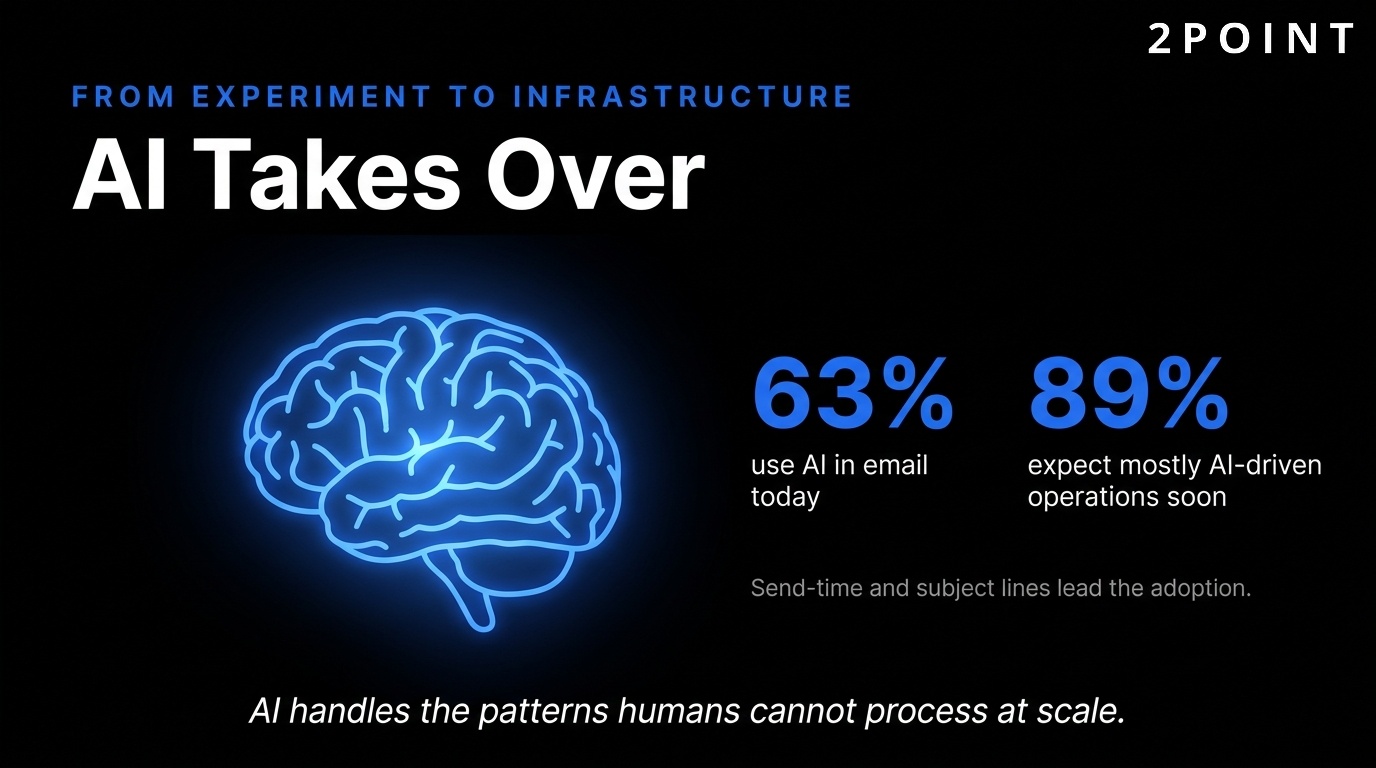
63% of email marketers currently use AI capabilities, with adoption accelerating rapidly. 89% expect 75% of their email operations to be AI-driven by the end of 2026, indicating a massive shift in how email programs operate. This transformation reflects AI’s proven impact on performance rather than speculative hype.
Send-time optimization leads AI adoption, with two-thirds of marketers using algorithms to determine optimal delivery times for individual subscribers. Subject line generation ranks second, followed by content personalization and audience segmentation. These applications share a common trait—they analyze patterns in large datasets that humans cannot process efficiently.
51% of marketers believe AI-powered email performs better than traditional methods, driven by measurable improvements in open rates, click-through rates, and revenue per send. The technology excels at identifying micro-patterns—noticing that a subscriber segment opens emails consistently at 2:47 PM on Thursdays, or that subject lines mentioning specific products outperform brand-focused alternatives by 18%.
Smaller companies particularly benefit from AI democratization. Tools that once required data science teams now operate as simple toggles in email platforms, allowing businesses with modest budgets to compete with enterprise programs. This accessibility drives adoption rates higher across company sizes and industries.
How AI-Powered Personalization Increases Email Revenue
AI personalization lifts per-send revenue by 17-26%, translating directly to bottom-line impact. Subject line optimization through AI increases open rates by 26%, while send-time optimization adds an additional 14% lift. When combined, these improvements compound rather than simply add together.
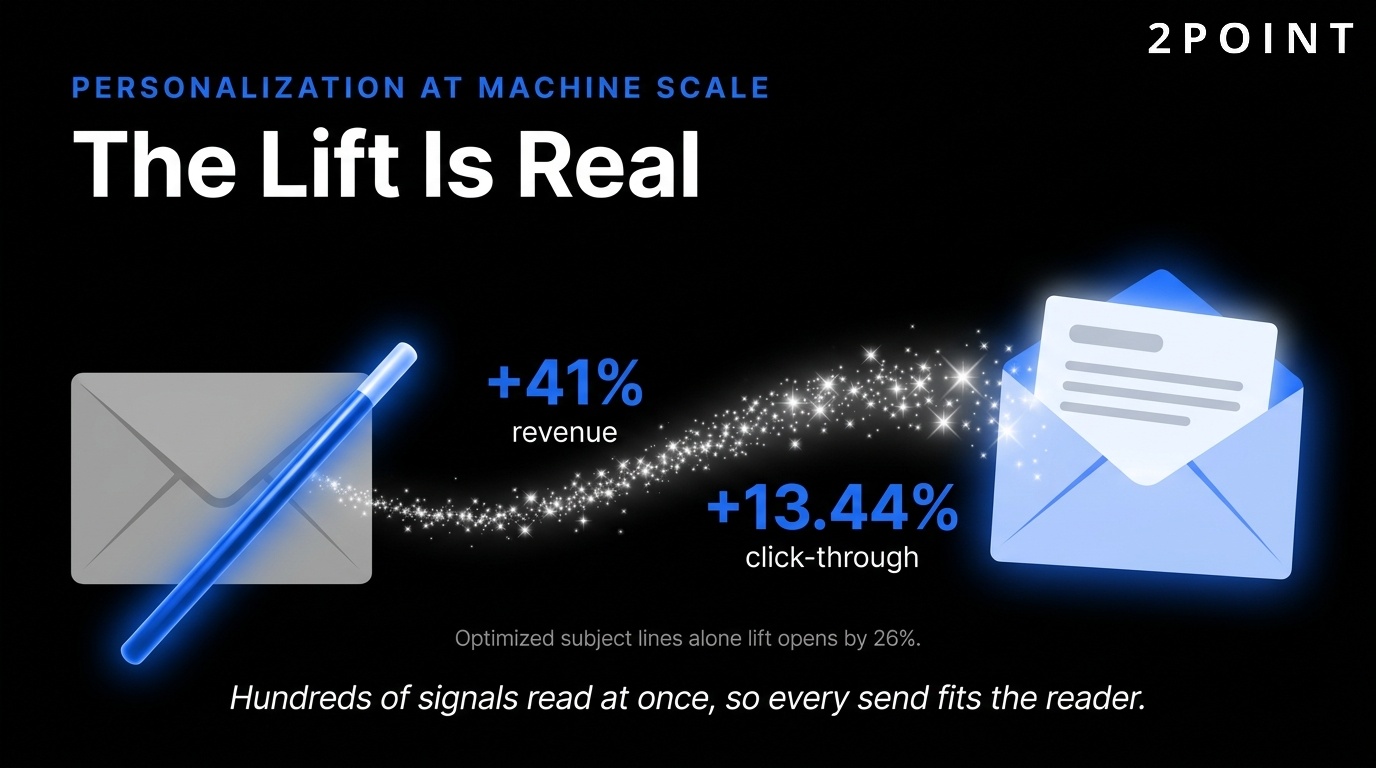
AI-driven personalization boosts overall revenue by 41% and click-through rates by 13.44%, according to comprehensive performance analysis. The technology achieves this by analyzing hundreds of variables simultaneously—past purchase behavior, browsing history, email engagement patterns, device preferences, time zone, and dozens of other signals—to predict what content will resonate with each subscriber.
Product recommendations represent the most visible application. Instead of showing the same featured products to everyone, AI analyzes purchase history and browsing behavior to display items each subscriber is most likely to purchase. An AI system might recognize that customers who bought running shoes also purchased fitness trackers within 30 days, and adjust recommendations accordingly.
The content personalization goes beyond product recommendations to include messaging tone, content length, image selection, and call-to-action phrasing. Some subscribers respond to urgency (“Only 3 hours left!”), while others prefer value propositions (“Save 25% on your next order”). AI identifies these preferences through behavioral analysis and adjusts content dynamically.
AI-Generated Content and Creative Production Efficiency
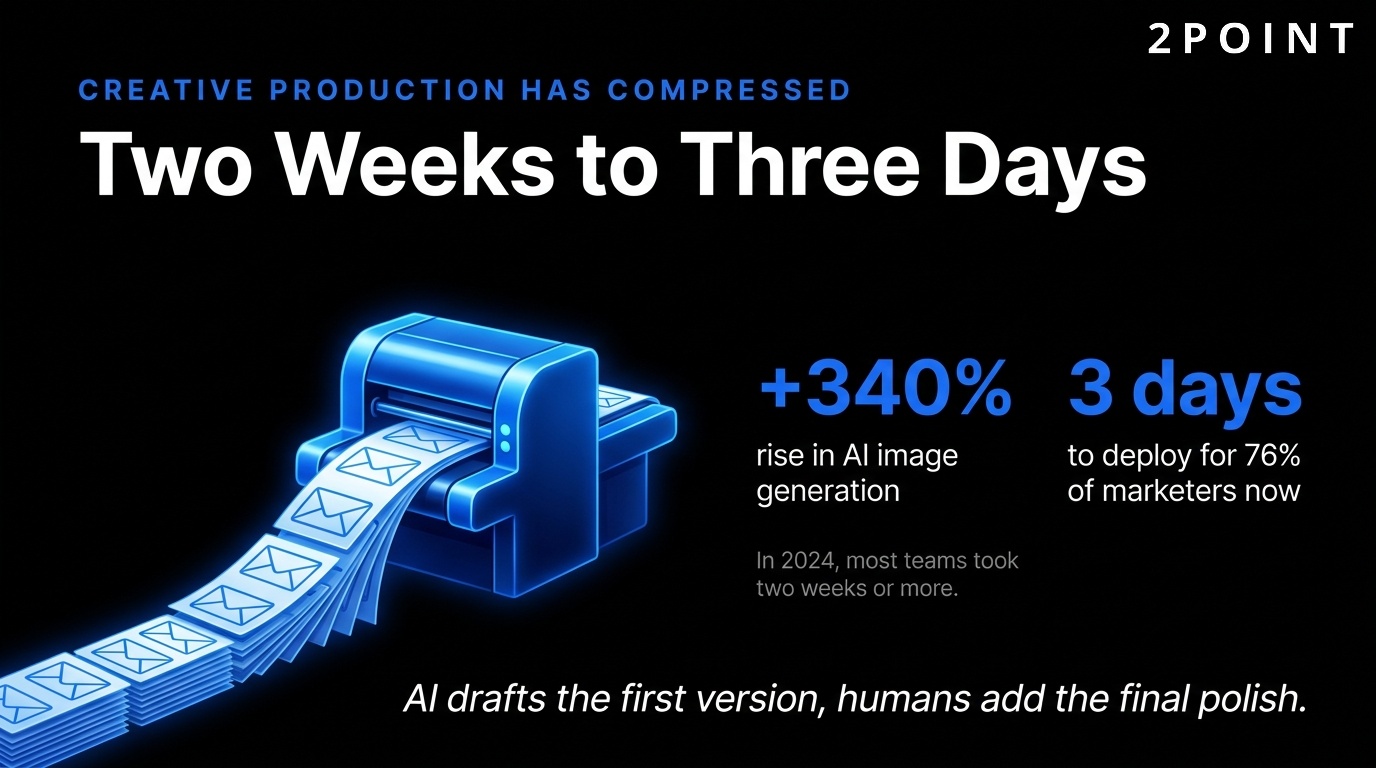
AI image generation usage has increased 340% in email marketing, dramatically accelerating creative production. Nearly 100% of marketers expect to adopt AI personalization, reflecting its transformation from optional enhancement to competitive necessity.
Production timelines have compressed dramatically. 76% of marketers deploy emails within 3 days in 2026, compared to 62% taking 2 or more weeks in 2024. AI copywriting tools generate subject line variations, body copy drafts, and call-to-action options in seconds, while image generators create custom visuals without photoshoots or graphic designers.
The quality versus speed debate has evolved. Early AI-generated content often felt generic or robotic, but modern systems trained on brand voice and style guidelines produce output requiring only minor human refinement. Smart marketers use AI for first drafts and ideation, then apply human judgment for final polish and strategic alignment.
Cost implications extend beyond time savings. A company that previously required a copywriter and designer for each email can now produce more content with leaner teams. This efficiency enables increased send frequency without proportional cost increases, improving overall program performance through consistent subscriber engagement.
Implementing AI Without Sacrificing Brand Authenticity
The challenge in AI adoption lies in maintaining brand voice and human connection while leveraging technological efficiency. 39% of marketers say AI hyper-personalization will have the biggest impact on automation strategy, but implementation requires careful balance.
Successful AI implementation starts with clear brand guidelines that train the systems. Rather than using generic AI tools, leading programs fine-tune models on their existing content library, teaching the AI to write in their specific voice. This training includes approved vocabulary, prohibited terms, sentence structure preferences, and tone variations for different contexts.
Human oversight remains essential, particularly for high-stakes communications. Advanced AI adopters achieve 75% higher likelihood of 45:1+ ROI, but they use the technology strategically rather than blindly. AI handles routine personalization, subject line testing, and send-time optimization, while humans craft strategic messaging, review quality, and make judgment calls on sensitive topics.
Transparency builds trust with subscribers. Some brands explicitly mention AI involvement (“Recommendations powered by AI”), while others integrate it invisibly. The right approach depends on your audience—tech-savvy subscribers may appreciate the transparency, while others prefer seamless experiences without technical details.
What Email Automation Strategies Generate the Most Revenue?
Email automation transforms the economics of email marketing by creating leverage—small upfront investments in setup generate ongoing returns without proportional ongoing effort. Understanding which automation types perform best helps prioritize implementation.
Why Automated Emails Generate 16x More Revenue Than Campaigns
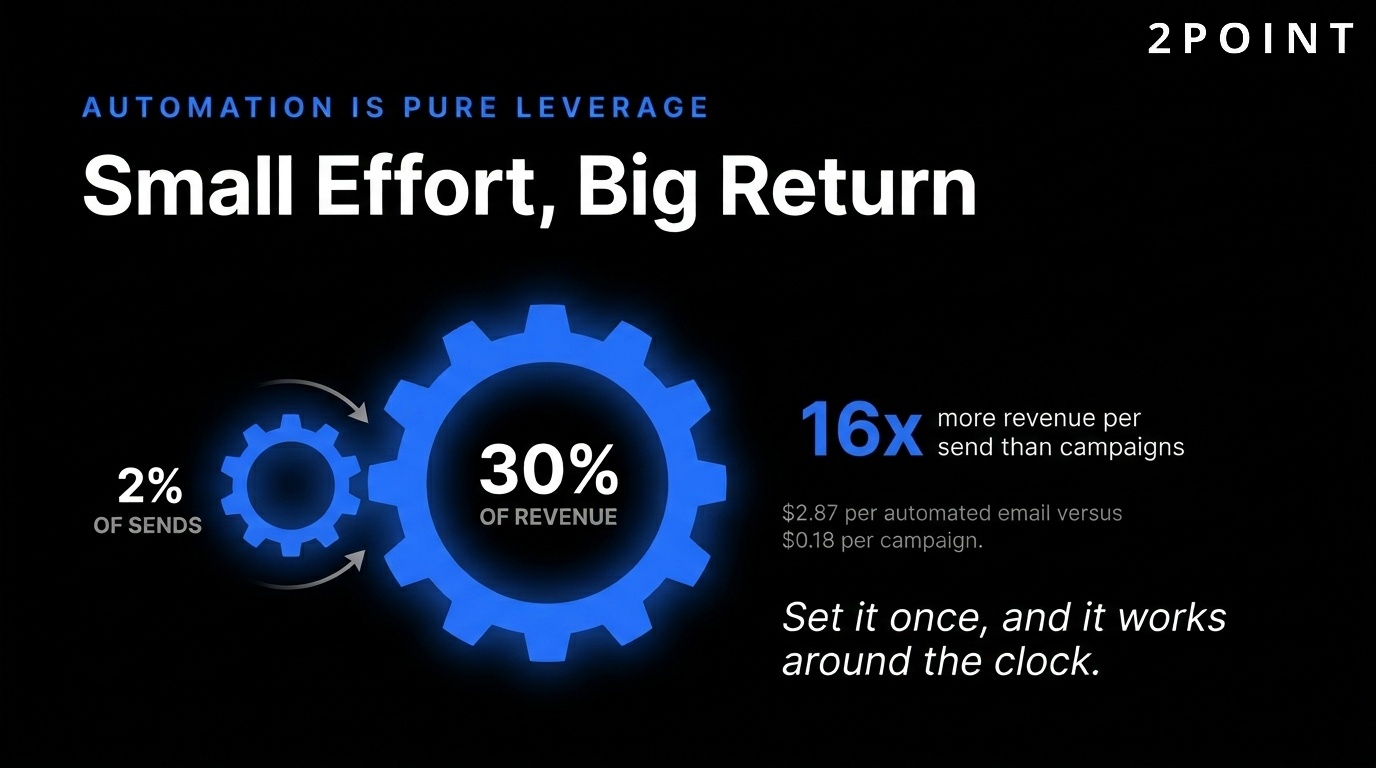
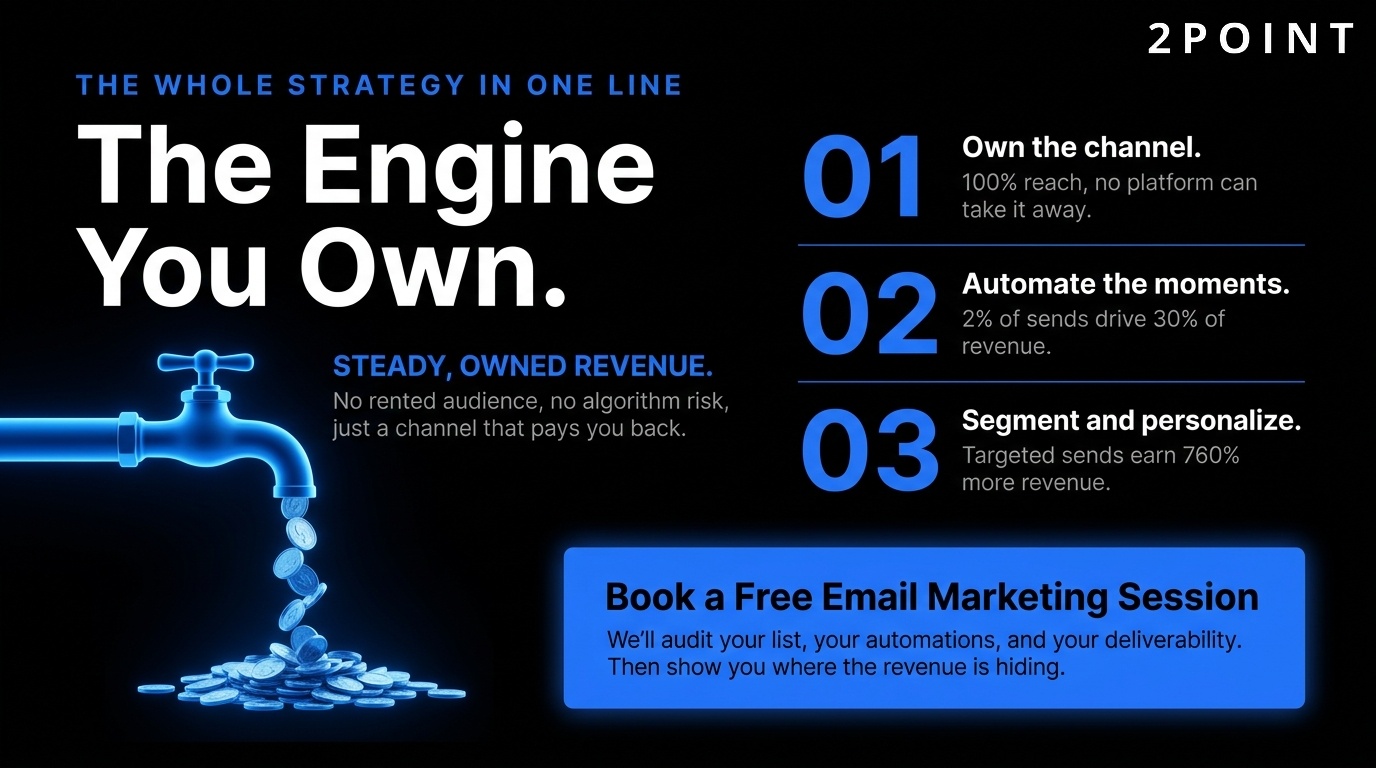
Automated emails account for just 2% of total sends but drive 30% of revenue, demonstrating extraordinary efficiency. Automations earn 16x more per send than broadcast campaigns, a difference explained by timing, relevance, and personalization.
Performance metrics reveal the gap clearly. Automated emails achieve 38% open rates compared to 30.7% for campaigns, while revenue per email reaches $2.87 for automations versus $0.18 for campaigns. This sixteen-fold difference reflects automation’s ability to send the right message at precisely the right moment in the customer journey.
Companies with automated workflows generate 320% more revenue than those relying solely on campaigns. The compounding effect occurs because automations work 24/7 without additional effort once configured. A welcome series set up once sends to every new subscriber automatically, accumulating value over months and years.
Behavioral triggers create relevance impossible with scheduled campaigns. When someone abandons a shopping cart, an automated email sent 1 hour later capitalizing on their demonstrated purchase intent outperforms a weekly newsletter mentioning similar products. Timing and context amplify every message’s effectiveness dramatically.
Which Automated Email Types Deliver the Highest Performance
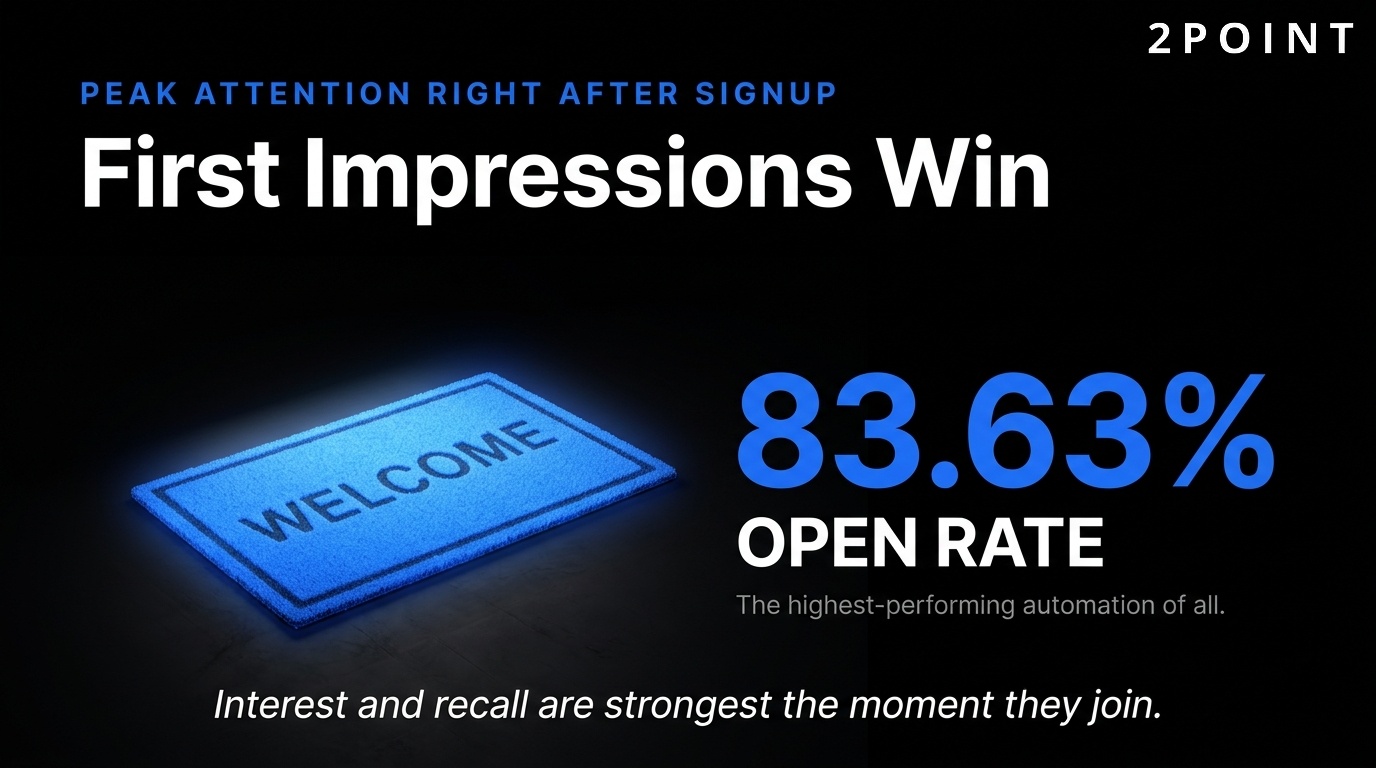
Welcome emails achieve 83.63% open rates, making them the highest-performing automation type. These messages benefit from peak subscriber attention immediately after signup, when interest and recall remain strongest. Smart welcome sequences introduce brand values, set expectations for future emails, and often include first-purchase incentives that convert while enthusiasm is high.
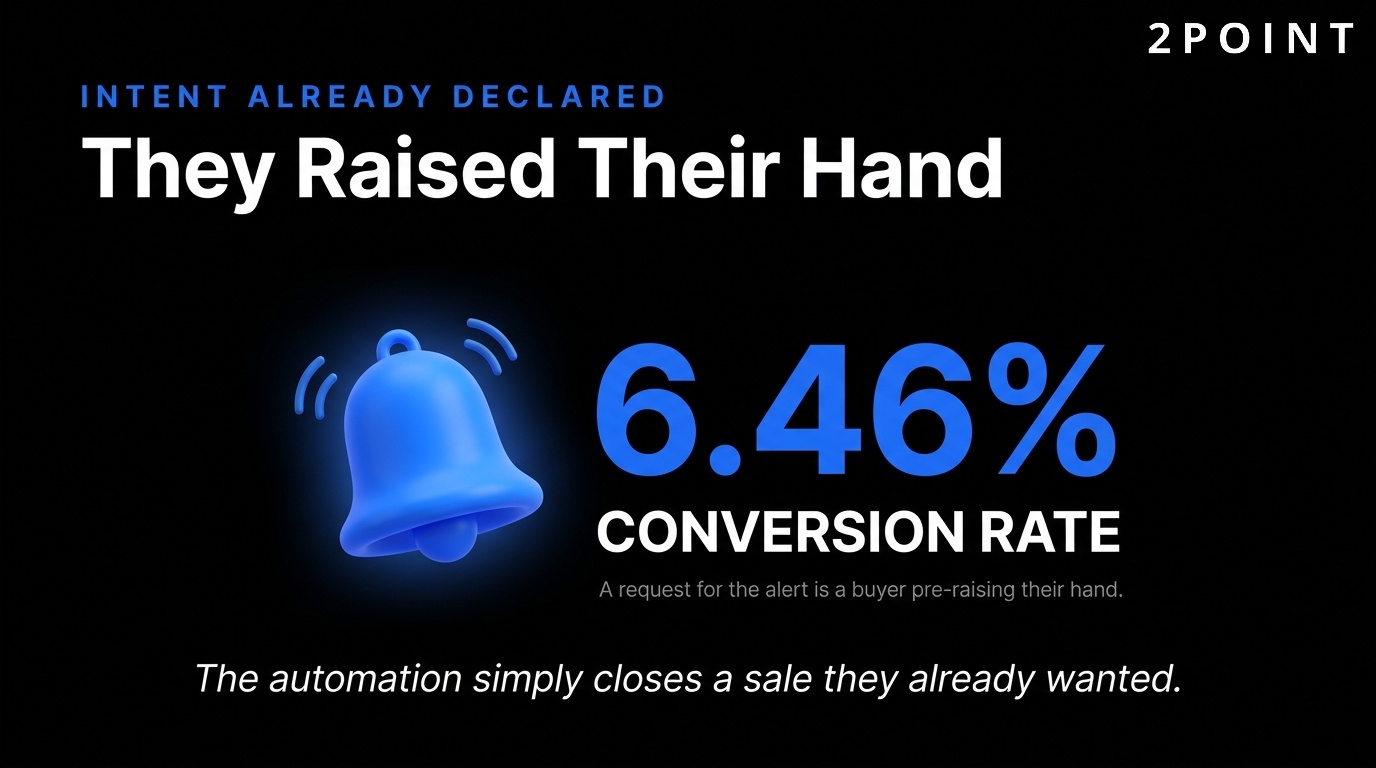
Back-in-stock notifications convert at 6.46%, exceptional rates explained by explicit purchase intent. When someone requests notification for an out-of-stock item, they have essentially pre-raised their hand as a buyer. The automation simply closes the transaction when inventory returns.
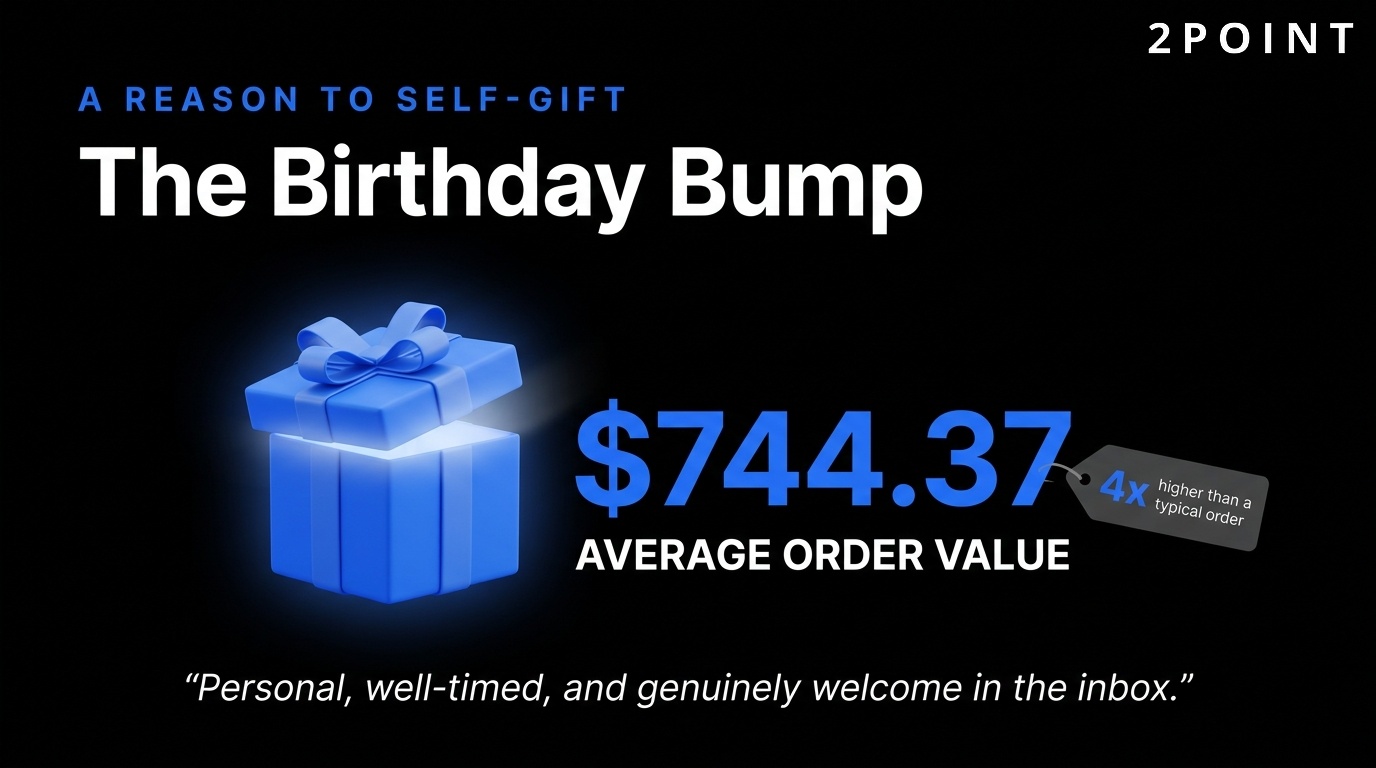
Birthday emails generate $744.37 average order value, four times higher than typical ecommerce orders. These messages work because they provide a socially acceptable reason to self-gift or indulge, especially when paired with exclusive discounts. The personalization feels genuine rather than manufactured, creating positive brand associations.
Abandoned cart sequences represent the workhorse of ecommerce automation. Three-email sequences (sent at 1 hour, 24 hours, and 72 hours) typically recover 10-15% of abandoned carts, translating to substantial revenue. Each email in the sequence serves a different purpose—the first reminds, the second addresses objections, the third adds urgency or incentive.
How to Build Effective Automated Email Sequences
Creating high-performing automations requires strategic thinking about triggers, timing, content, and exit conditions. Global automated emails reach 38% open rates on average, but proper implementation can push performance significantly higher.
Start with clear trigger definitions. Welcome sequences trigger on list signup, abandoned cart sequences on cart creation without purchase, browse abandonment on product views without cart addition. The trigger specificity determines relevance—too broad and messages feel generic, too narrow and volume becomes insufficient to justify setup effort.
Timing intervals matter enormously. Send welcome emails immediately while attention is highest. Wait 1-2 hours for abandoned cart emails, allowing genuine interruptions to resolve while cart contents remain top-of-mind. Extend to 24 hours for the second touch, then 48-72 hours for final attempts. Test these intervals because optimal timing varies by industry, price point, and purchase complexity.
Content progression should tell a story across the sequence rather than repeating the same message. A three-email abandoned cart series might follow this arc: Email 1 reminds what they left behind with product images and descriptions, Email 2 addresses common objections through customer testimonials or FAQ content, Email 3 creates urgency through limited-time discounts or low stock warnings.
Exit conditions prevent awkward experiences. Someone who purchases should immediately exit all purchase-encouragement sequences. Someone who unsubscribes or marks emails as spam should be removed entirely. These rules seem obvious but require explicit configuration in most platforms, as default settings often allow completed customers to continue receiving cart abandonment reminders.
Testing and Optimizing Automated Email Performance
Marketers who regularly A/B test automated sequences achieve 86% higher returns, yet many treat automations as “set and forget” campaigns. The compounding nature of automations makes optimization particularly valuable since improvements benefit every future subscriber.
44% of marketers analyze email performance weekly, but automation testing requires different approaches than campaign testing. Test one variable at a time—subject lines, send delays, discount amounts, content structure—because automations typically have lower volume that requires longer test periods to reach statistical significance.
Subject line testing in welcome emails often reveals surprising insights. Testing “Welcome to [Brand]!” against “Here’s your exclusive 15% off” might show the discount wins initially but the brand-focused subject creates better long-term engagement. Track both immediate metrics and downstream behavior to understand true impact.
Timing optimization deserves continuous attention. An abandoned cart email sent at 1 hour might perform well, but testing 30 minutes, 2 hours, and 4 hours could reveal a sweet spot specific to your audience and products. Email service providers with built-in analytics make this testing straightforward through time-based performance breakdowns.
How Does Personalization and Segmentation Impact Email Marketing Results?
Generic mass emails increasingly fail in an environment where subscribers expect relevance. Personalized email strategies and sophisticated segmentation separate high-performing programs from struggling ones.
What Revenue Gains Come from Email Personalization
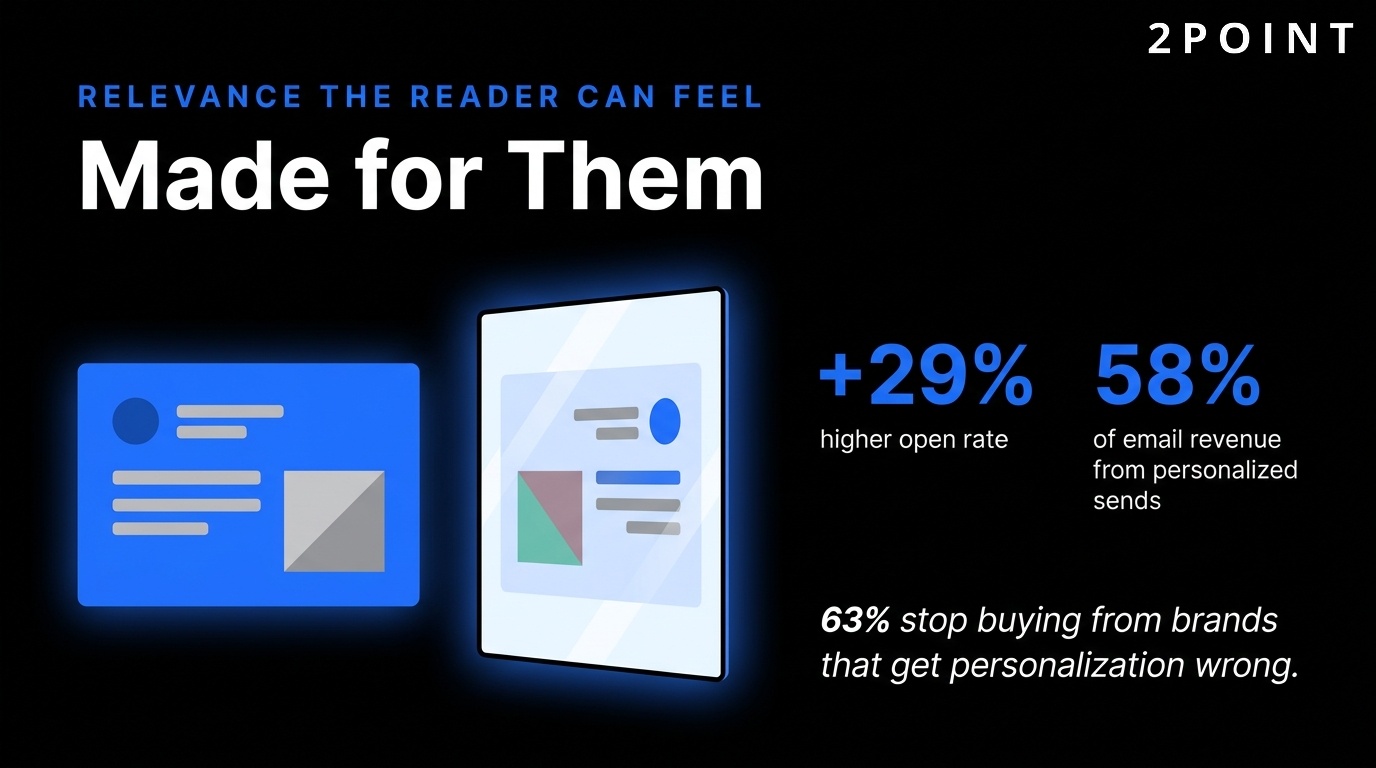
Personalized emails achieve 29% higher open rates and 41% higher click-through rates compared to generic messages. 58% of total email revenue comes from segmented and personalized campaigns, despite these representing a smaller portion of total sends.
The negative consequences of poor personalization create urgency for improvement. 63% of consumers stop buying from brands with poor personalization, while 76% express frustration with lack of personalization. These aren’t minor irritations—they represent lost customers and damaged brand relationships.
Personalization extends far beyond inserting first names into subject lines. Modern personalization includes product recommendations based on browsing history, content selection based on past engagement, timing optimization based on individual open patterns, and messaging tone adjusted to purchase history and lifecycle stage. A VIP customer who has spent $5,000 over three years deserves different treatment than a first-time browser.
The economic logic is straightforward. Sending 10,000 identical emails might generate 300 opens and 30 clicks. Sending 10 different versions to 1,000-subscriber segments, each tailored to segment interests, might generate 400 opens and 50 clicks from the same list. The effort investment in segmentation and personalization pays returns on every send moving forward.
Does Using Subscriber Names in Emails Improve Performance
Emails containing the recipient’s name achieve 18.30% open rates versus 15.70% without names, a meaningful but modest improvement. This gap has narrowed as name personalization became ubiquitous—it no longer differentiates like it did when first introduced.
Name personalization works best in specific contexts. Welcome emails benefit from name usage, as do birthday messages and re-engagement campaigns. Promotional emails see smaller lifts, perhaps because subscribers recognize these as automated bulk messages regardless of personalization tokens. 64% of marketing emails now use dynamic content, making name insertion alone insufficient for competitive advantage.
Execution quality matters more than the personalization itself. “Hi [First Name]” feels lazy and robotic, while “Sarah, we thought you’d love this based on your recent purchase” demonstrates genuine personalization. The difference lies in specificity—anyone can insert a name token, but referencing actual behavior requires sophisticated data integration.
Name personalization can backfire when implemented poorly. Emails starting “Dear John Doe” or “Hi [First Name]” when data is missing create worse impressions than no personalization. Always test for blank fields, unusual characters, or obvious fake names (many subscribers use “Mickey Mouse” or similar when forced to provide names). Fallback to generic greetings like “Hi there” when name data quality is questionable.
How Advanced Segmentation Increases Email Marketing Revenue
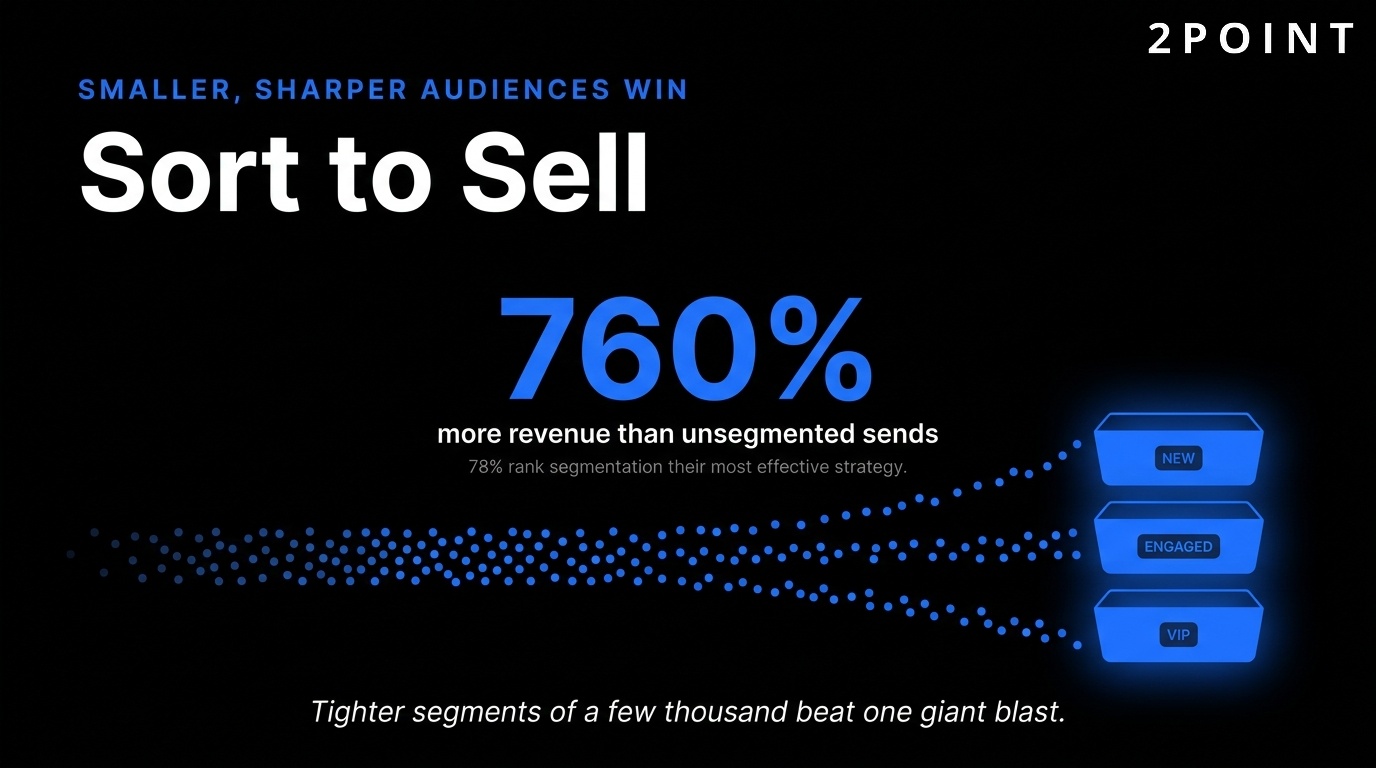
Segmented campaigns generate 760% more revenue than unsegmented broadcasts, one of the most dramatic performance gaps in email marketing. Hyper-segmented campaigns targeting 500-2,000 contacts outperform broad segments by 3.4x on conversion, showing that smaller, more targeted audiences beat larger generic ones.
Segmented campaigns achieve 30% more opens and 50% more clicks than unsegmented sends, while 78% of marketers rank segmentation as their most effective email strategy. The consensus reflects proven results across industries and company sizes.
Behavioral segmentation outperforms demographic segmentation because it reflects actual intent rather than assumed preferences. A 25-year-old and a 55-year-old who both purchased the same product last month have more in common than two 25-year-olds with different interests. Purchase history, browsing behavior, email engagement levels, and lifecycle stage create more actionable segments than age, gender, or location alone.
Combining multiple criteria creates powerful micro-segments. “Customers who purchased running shoes in the last 60 days AND have opened at least 3 emails AND have not yet bought apparel” represents a highly specific, valuable segment perfect for targeted apparel promotions with social proof from other runners. This precision targeting feels helpful rather than creepy because it demonstrates understanding of subscriber interests.
What Segmentation Strategies Should Marketers Prioritize
Effective segmentation starts with data collection strategy. Progressive profiling—gathering information gradually rather than demanding everything upfront—builds detailed profiles without overwhelming subscribers. Ask for birth month at signup, then request preferences after first purchase, then collect additional details through preference centers and surveys.
Engagement-based segmentation provides immediate value with minimal data requirements. Create segments for highly engaged (opened last 5 emails), moderately engaged (opened 2-4 of last 10), and disengaged (no opens in 60 days) subscribers. Send different content frequencies and types to each group—your most engaged subscribers can handle more emails, while disengaged subscribers need lighter touch and re-engagement focus.
Lifecycle stage segmentation aligns messaging with customer journey position. New subscribers receive welcome content and brand education, active customers get product updates and usage tips, lapsed customers receive win-back offers, and VIP customers enjoy exclusive previews and premium support. Each stage has distinct needs that generic messaging cannot address effectively.
Purchase behavior creates valuable ecommerce segments. First-time buyers need post-purchase nurturing building confidence in their decision, repeat buyers appreciate loyalty rewards and early access, and high-value customers merit VIP treatment with dedicated support and special perks. Browse abandonment, cart abandonment, and product category preferences offer additional segmentation opportunities.
How Do Email Authentication and Deliverability Requirements Affect Marketing Success?
The best email content in the world generates zero revenue if it never reaches subscriber inboxes. Authentication and deliverability have moved from technical concerns to strategic imperatives in 2026.
What Are the Mandatory Email Authentication Requirements in 2026
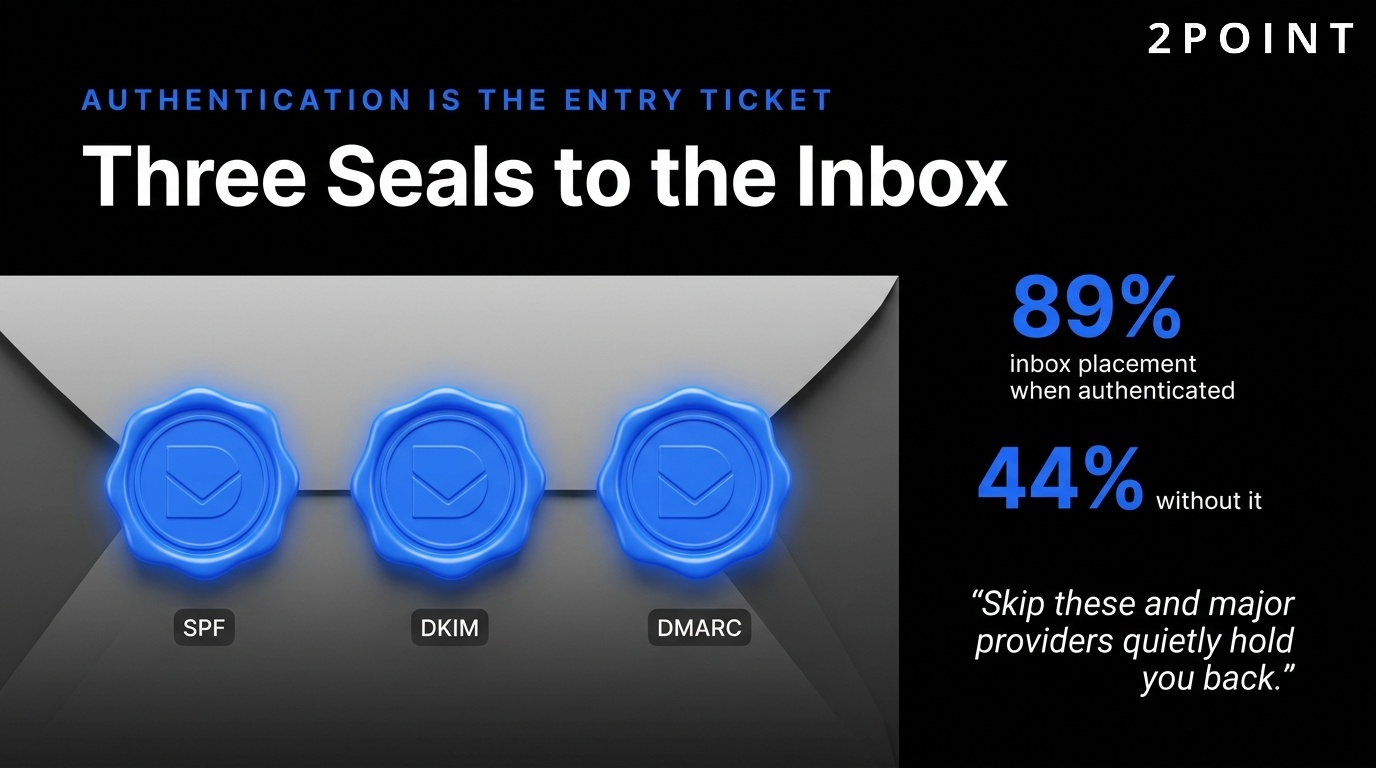
Google and Yahoo enforced strict authentication requirements beginning in Q1 2024, fundamentally changing email sender obligations. Senders without proper SPF, DKIM, and DMARC see just 44% inbox placement compared to 89% for authenticated domains, a gap that directly impacts revenue.
66.2% of senders have implemented SPF and DKIM, but only 53.8% have DMARC records, and many of those use permissive “p=none” policies that don’t provide full protection. Perhaps most concerning, more than 25% of marketers remain unsure about their authentication status.
SPF (Sender Policy Framework) records specify which mail servers are authorized to send email on your domain’s behalf. DKIM (DomainKeys Identified Mail) adds a digital signature verifying emails haven’t been altered in transit. DMARC (Domain-based Message Authentication, Reporting, and Conformance) tells receiving servers what to do with emails that fail SPF or DKIM checks—quarantine them, reject them, or deliver them anyway.
These protocols protect against email spoofing and phishing, but they also function as minimum entry requirements for inbox placement. Major providers like Gmail and Yahoo use authentication status as a primary deliverability signal, reasoning that legitimate senders should have no difficulty implementing basic authentication. Failing this test suggests either technical incompetence or malicious intent, neither of which deserve inbox placement.
What Inbox Placement Rates Can Marketers Expect in 2026
Global average inbox placement stands at 87.2%, though alternative measurements show 83.5% depending on methodology. Provider-specific rates vary significantly: Gmail achieves 87.2% inbox placement (down from 89.8% in early 2024), while Microsoft and Outlook deliver just 75.6% with spam rates exceeding 14%.
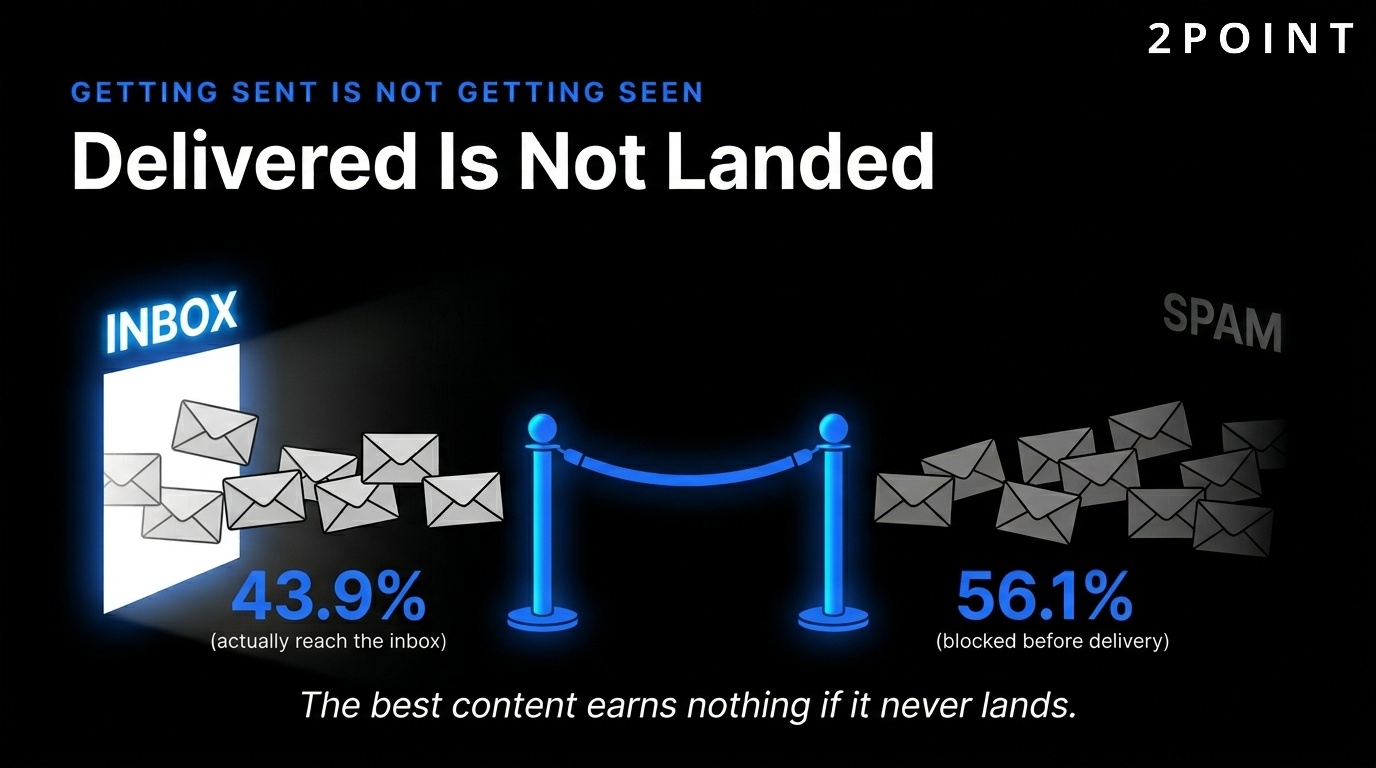
The gap between “delivered” and “inbox placement” surprises many marketers. Only 43.9% of emails globally reach inboxes, with 56.1% blocked before delivery. Delivered emails might land in spam folders, promotions tabs, or other filtered locations where open rates drop by 60-80% compared to primary inboxes.
These benchmarks represent averages across all senders. Brands with strong sender reputations achieve 95%+ inbox placement, while those with poor reputations see sub-50% rates. The cumulative effect of authentication, engagement history, complaint rates, and content quality determines where each sender falls within this range.
Gmail’s placement rate decline from 89.8% to 87.2% reflects tightening standards and increased filtering sophistication. The platform now analyzes engagement patterns, sender reputation scores, authentication quality, and dozens of other signals when making placement decisions. What worked in 2024 may not work in 2026 without continuous adaptation.
How to Implement Email Authentication Correctly
Setting up authentication requires coordination with DNS providers and email sending platforms, but the process is straightforward when broken into steps. Start by accessing your domain’s DNS management panel through your hosting provider or registrar (GoDaddy, Cloudflare, Namecheap, etc.).
For SPF records, add a TXT record to your domain containing authorized sending servers. Your email service provider will supply the exact text string, which typically looks like “v=spf1 include:sendingdomain.com ~all”. The record lists which servers can send mail on your behalf, protecting against spoofing attempts.
DKIM implementation requires generating a public-private key pair through your email platform, then adding the public key as a TXT record in your DNS. The email platform signs outbound messages with the private key, and receiving servers verify the signature using your public DNS record. This cryptographic approach proves email authenticity and integrity.
DMARC records build on SPF and DKIM by specifying handling policies for authentication failures. Start with “p=none” to monitor without impacting delivery, then graduate to “p=quarantine” (send failures to spam) and eventually “p=reject” (block failures entirely). Include a reporting email address to receive daily reports on authentication results and potential spoofing attempts.
What Factors Beyond Authentication Affect Email Deliverability
Authentication forms the foundation, but engagement metrics, complaint rates, and content quality determine ultimate inbox placement. 80% of recipients mark emails as spam if they “look like spam”, even from authenticated senders.
Engagement rates signal email quality to ISPs. High open and click rates suggest subscribers value your messages, earning better placement. Consistently low engagement or spikes in deletions without opening trigger reputation penalties. Email providers reason that subscribers vote with their behavior—ignored emails deserve lower priority regardless of technical authentication.
List hygiene prevents deliverability problems before they start. Remove hard bounces immediately, as attempting delivery to invalid addresses damages sender reputation. Consider sunsetting subscribers who haven’t engaged in 6-12 months, especially if they never open emails. A smaller, engaged list outperforms a larger, disengaged list on both deliverability and revenue.
Content triggers still matter despite sophisticated filtering. Excessive capitalization, multiple exclamation points, phrases like “Click here now!!!”, and misleading subject lines all flag spam filters. So do HTML errors, broken links, and suspicious URL shorteners. Use spam testing tools before sending to identify and fix red flags.
Why Is Mobile Optimization Essential for Email Marketing in 2026?
Mobile devices dominate email consumption, making mobile optimization non-negotiable for serious email marketers. Poor mobile experiences don’t just reduce engagement—they actively damage brand perception.
How Many People Read Email on Mobile Devices
41% of email views occur on mobile devices, with Gmail users showing 75% mobile usage. 64% of consumers check email on phones and tablets, while 47% use mobile apps compared to just 26.9% using desktop clients.
81% of consumers prefer using smartphones for email, a preference driven by convenience and constant device availability. These statistics understate mobile’s dominance because they measure opens—actual purchasing behavior shows desktop conversion rates remain higher, suggesting many consumers browse on mobile then complete purchases on desktop.
Mobile usage patterns differ from desktop. Mobile users typically scan rather than read carefully, scroll continuously rather than clicking between sections, and decide to engage or delete within seconds. Emails must capture attention immediately, communicate value quickly, and make interaction effortless on small touchscreens.
Holiday shopping shows mobile’s growing importance. 44.2% of holiday email opens occurred on mobile devices, when purchase intent runs highest. Failing to optimize for mobile means losing conversions during peak revenue periods.
What Happens When Emails Aren’t Optimized for Mobile
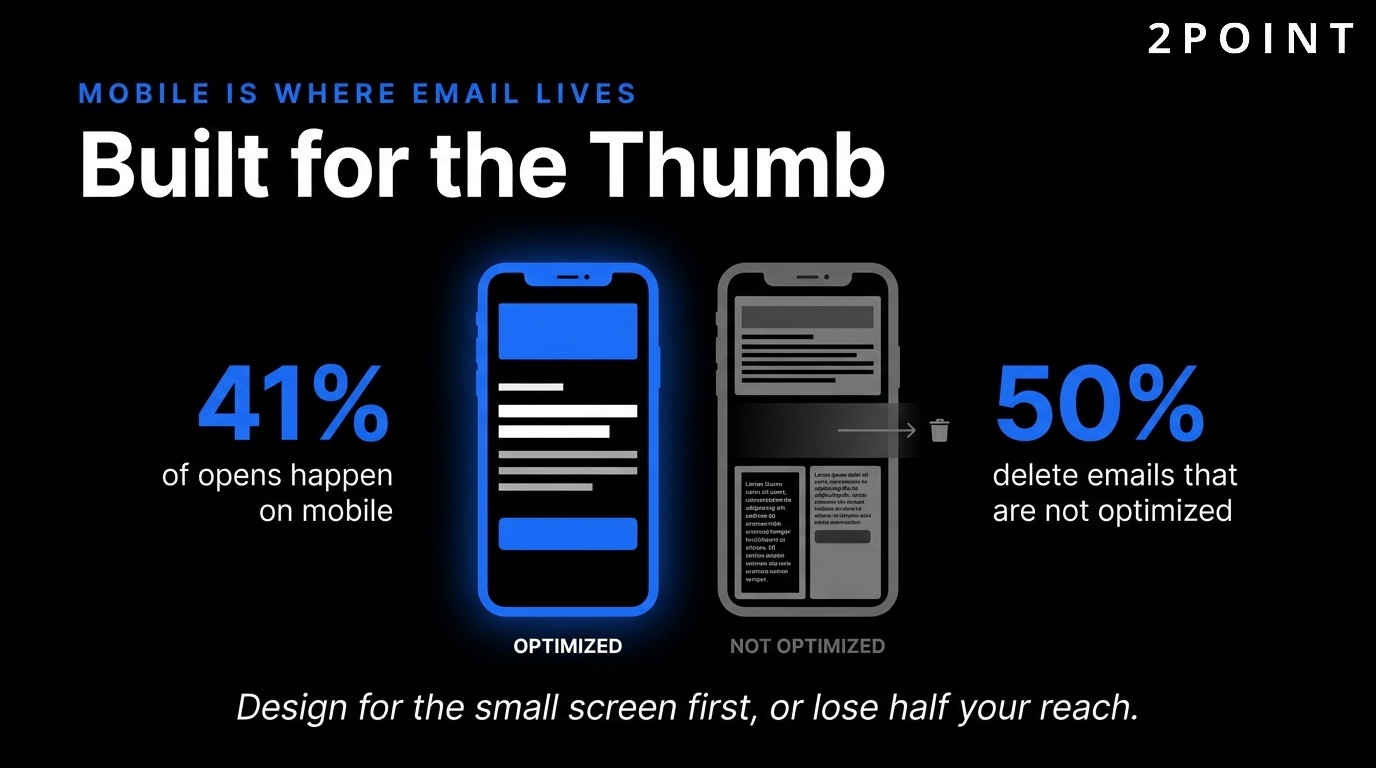
50% of users delete emails that aren’t mobile-optimized, immediately eliminating half your potential reach. Yet only 47% of companies design fully responsive emails, leaving massive opportunity on the table.
The consequences extend beyond deletion. Non-optimized emails create negative brand impressions—if a company can’t format an email properly in 2026, what does that suggest about their products, services, or attention to detail? First impressions matter enormously, and many subscribers form opinions about brands based solely on email experiences.
Common mobile optimization failures include text too small to read (requiring pinch-and-zoom), buttons too small to tap accurately, horizontal scrolling required to view full content, images that don’t load or scale properly, and multi-column layouts that collapse awkwardly. Each failure point increases deletion likelihood and decreases brand perception.
The economic impact is direct. An ecommerce brand sending 100,000 emails weekly might generate $10,000 in revenue. If 41% of opens occur on mobile but only half of those emails are mobile-optimized, they’re potentially losing $2,000 weekly ($104,000 annually) from mobile optimization failures alone. The fix requires one-time design investment but generates returns forever.
What Mobile Email Design Best Practices Should Marketers Follow
Single-column layouts work best for mobile, eliminating horizontal scrolling and adapting naturally to narrow screens. Multi-column designs that work beautifully on desktop often collapse into awkward stacked blocks on mobile, disrupting visual hierarchy and making content difficult to follow.
Touch targets must be large enough for accurate tapping—44×44 pixels minimum for buttons and links, with adequate spacing between tappable elements. Fingers are far less precise than mouse cursors, and accidental taps frustrate users. Make primary calls-to-action especially prominent, occupying most of the screen width on mobile views.
Font sizes need mobile-specific consideration. Body text should be 14-16px minimum, avoiding the need for zooming. Headlines can go larger, but keep line length reasonable—40-60 characters per line reads comfortably on mobile screens. Use adequate line spacing (1.4-1.6) to prevent text feeling cramped.
Preview text optimization becomes crucial on mobile where screen real estate is limited. The first 35-50 characters of preview text appear in mobile email lists, functioning as a secondary subject line. Write compelling preview text explicitly rather than letting it default to “View in browser” or similar wasted opportunities. 15% of users experience increased unique mobile clicks from responsive design.
How to Test Email Rendering Across Devices and Clients
Email clients render HTML differently—what looks perfect in Gmail may break in Outlook, while Apple Mail might display colors differently than Yahoo. Testing across environments prevents embarrassing deliveries and ensures consistent brand presentation.
Testing tools like Litmus and Email on Acid provide screenshots showing how emails render in dozens of clients and devices. These services test desktop clients (Outlook, Apple Mail, Thunderbird), webmail (Gmail, Yahoo, Outlook.com), and mobile apps (iPhone Mail, Android Gmail) simultaneously. The investment pays for itself by catching rendering issues before they reach subscribers.
Manual testing complements automated tools. Send test emails to your own devices—iPhone, Android phone, iPad—and actually open them in different apps. Automated screenshots don’t show loading speed, animation functionality, or interactive element behavior. Real-device testing reveals these issues quickly.
Establish a pre-send checklist including rendering tests, link verification, personalization token checks, image loading confirmation, and spam score analysis. High-performing programs test extensively before every send, treating quality assurance as non-negotiable rather than optional.
What Email Marketing Metrics and Benchmarks Should You Track in 2026?
Measuring email performance requires understanding which metrics matter, how to interpret them accurately, and how your results compare to industry standards.
How Have Open Rates Changed with Apple Mail Privacy Protection
Average email open rates stand at 30.7%, though alternative measurements show 32.55% across industries. However, Apple Mail Privacy Protection inflates reported rates to 42-43% for affected subscribers, creating measurement challenges.
Apple’s privacy feature pre-loads images automatically, triggering tracking pixels whether subscribers actually read emails or not. This protects user privacy but makes open rates less reliable as engagement indicators. Five-year trend data shows growth from 26.6% to 30.7%, but some of this increase reflects measurement inflation rather than genuine engagement improvement.
Smart marketers are shifting emphasis from open rates to click rates and conversions, which remain accurate measurements. You might not know if someone opened an email, but clicking a link represents unambiguous engagement. This shift aligns with business objectives—clicks indicate interest, while opens are merely a proxy.
Interpreting open rates now requires segmentation. Compare Apple Mail users separately from other clients to understand true engagement patterns. Use opened-vs-clicked analysis (click-to-open rate) to measure content quality independent of subject line effectiveness. And focus on trend lines over time rather than absolute numbers, since consistent methodologies make relative comparisons valid even if absolute figures are inflated.
What Click-Through Rates Indicate Strong Email Performance
Average click-through rates hit 2.5%, meaning one in 40 recipients clicks a link. Click-to-open rates reach 6.8%, up 21% year-over-year, suggesting improving content quality even as total email volume increases.
Click-to-open rate (CTOR) measures clicks as a percentage of opens rather than total sends, isolating content performance from subject line effectiveness. A campaign with a 25% open rate and 2% click rate has an 8% CTOR (2 ÷ 25), meaning 8% of people who opened clicked through. CTOR increases suggest your content delivers on subject line promises more effectively.
22% of email campaigns get opened within the first hour, front-loading engagement into a narrow window. This concentration means send time optimization matters enormously—sending at 2pm versus 2am might double or triple your click-through rate by catching subscribers when they’re actively checking email.
Industry variations in click rates are substantial. B2B typically sees lower click rates (1.5-2%) than B2C (2.5-3.5%), but B2B clicks often carry higher value per interaction. Promotional emails generate more clicks than newsletters, but newsletter clicks may indicate stronger brand engagement. Context matters when evaluating whether performance is strong or needs improvement.
How Do Email Conversion Rates Vary by Industry
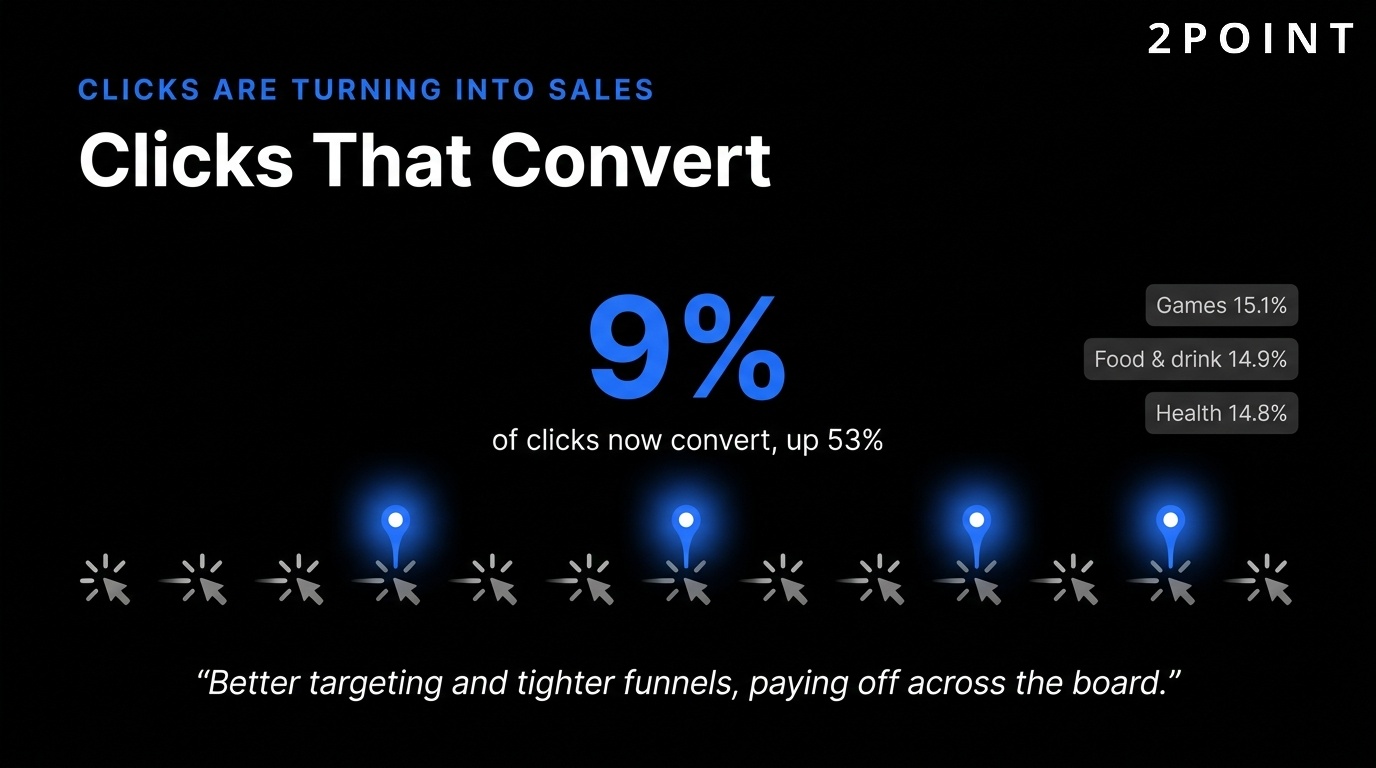
Click-to-conversion rates jumped 53% year-over-year, rising from 5.9% to 9%, a remarkable improvement suggesting better email targeting, landing page optimization, and overall funnel performance. Not every click converts, but converting one in eleven clicks represents strong efficiency.
Industry-specific conversion data reveals dramatic differences. Games achieve 15.1% conversion, food and drink reach 14.9%, and health hits 14.8%, all well above average. These categories benefit from impulse purchases, lower price points, and frequent repeat buying behavior.
59% of consumers say emails influence their purchase decisions, while 52% have purchased specifically because of a marketing email. Email’s influence extends beyond direct click-to-purchase paths, often serving as consideration stage touchpoints that drive eventual conversion through other channels.
Conversion attribution complexity increases in multi-touch journeys. A subscriber might see your email, click through to browse, return via Google search days later, and finally purchase after retargeting ads. Email touched the journey, but last-click attribution would credit paid search instead. Sophisticated marketers use multi-touch attribution models that recognize email’s role throughout the funnel.
Why Marketers Are Moving Beyond Vanity Metrics
15% of marketers still rely on open rates as their primary success measure, a concerning statistic given open rate limitations. Progressive marketers are shifting to revenue attribution, customer lifetime value, and engagement quality over volume.
22% increase in multi-channel attribution and marketing qualified lead (MQL) reporting reflects this evolution. Rather than celebrating high open rates, sophisticated programs measure how email contributes to pipeline, speeds deal cycles, and increases customer retention rates.
The metrics hierarchy should flow: engagement (opens, clicks) → conversion (purchases, signups, downloads) → revenue (sales, recurring payments, customer lifetime value). Top-funnel metrics matter only if they lead to bottom-funnel results. A 50% open rate means nothing if zero purchases result, while a 15% open rate that generates $10,000 in sales represents success.
Attribution models help quantify email’s true contribution. First-touch attribution credits email when it introduces prospects, last-touch when it closes sales, and multi-touch when it assists anywhere in the journey. No single model perfectly captures reality, but comparing multiple models reveals email’s influence more accurately than simplistic vanity metrics.
How Does Email Marketing Strategy Differ for B2B Companies?
B2B email marketing requires different approaches than B2C because of longer sales cycles, multiple decision-makers, higher price points, and relationship-driven sales processes.
Why Do B2B Marketers Rank Email as Their Most Effective Channel
50% of B2B marketers say email is their most effective channel, outranking content marketing, social media, and events. 81% use email newsletters as their primary content marketing method, reflecting email’s ability to nurture relationships over extended buying cycles.
77% of B2B companies use email newsletters, making them nearly universal in business marketing. 31% of B2B marketers say newsletters are best for lead nurturing, which makes sense given the format’s ability to deliver consistent value without aggressive sales pressure.
B2B purchases involve committees, lengthy evaluations, and risk mitigation. A $50,000 software purchase might touch IT, finance, operations, and C-suite executives over six months. Email excels at nurturing these complex journeys by delivering targeted content to different stakeholders, building credibility through thought leadership, and maintaining top-of-mind awareness throughout extended decision processes.
The personal nature of B2B relationships makes email particularly effective. Sales reps can send personalized emails from their own addresses, building direct relationships while marketing automation handles broader nurturing. This hybrid approach—combining human touch with scalable automation—works better in B2B than impersonal broadcast campaigns.
What Email Frequency Works Best for B2B Audiences
47% of B2B buyers read 3-5 pieces of content before engaging with sales, creating opportunities for email to deliver this content systematically. However, B2B audiences typically tolerate less frequent emails than B2C consumers.
Weekly or bi-weekly newsletters work well for most B2B contexts, providing regular value without overwhelming busy professionals. Monthly is too infrequent—subscribers forget who you are between sends—while daily is too aggressive except for news-focused industries where frequent updates provide genuine value.
Segmentation by engagement and buying stage allows frequency customization. Active opportunities in late-stage evaluation might receive daily touchpoints from sales reps plus weekly marketing emails. Early-stage leads might get bi-weekly educational content. Customers receive product updates and feature announcements as relevant. Different segments have different tolerances and needs.
Testing reveals optimal frequency for your specific audience. Send identical content on different schedules to randomized segments—weekly versus bi-weekly, for example—and measure engagement rates, unsubscribe rates, and ultimately conversion rates. The schedule that maximizes engagement while minimizing unsubscribes represents your optimal frequency.
How Should B2B Email Content Differ from B2C
B2B email content prioritizes education over promotion, thought leadership over discounts, and long-term relationship building over immediate conversions. A B2C brand might send “24-hour flash sale” emails, while a B2B company sends “New research: How CFOs evaluate automation ROI.”
Case studies, whitepapers, webinars, and industry insights perform well in B2B email because they help buyers build business cases internally. A VP can forward your email to their team or executives, saying “This is relevant to our evaluation.” That forwarding capability makes informational content more valuable than promotional material in B2B contexts.
Personalization in B2B extends to company characteristics, not just individual traits. Segment by company size, industry, technology stack, or growth stage, then customize content accordingly. An email about scaling infrastructure resonates with high-growth startups but not with stable enterprises, while content about enterprise integration matters to large companies but not small ones.
Sales and marketing alignment becomes critical in B2B email. Marketing generates leads and nurtures early-stage opportunities, then hands them to sales at appropriate moments. This handoff requires tight coordination, shared definitions of qualified leads, and technology integration ensuring both teams see the same customer data and interaction history.
What B2B Email Metrics Matter Most for Revenue Attribution
B2B marketers need different metrics than B2C because the goal is pipeline contribution rather than immediate purchases. Track how many marketing qualified leads (MQLs) come from email, how email engagement correlates with sales opportunity progression, and how email-sourced leads compare in close rate and deal size to leads from other sources.
Engagement scoring helps quantify lead quality. Assign points for email opens (1 point), clicks (3 points), content downloads (5 points), and webinar attendance (10 points), then use cumulative scores to prioritize sales follow-up. Someone who opened 10 emails and downloaded three whitepapers scores far higher than someone who opened one email and never clicked.
Influence metrics capture email’s role across the buyer journey. A deal might be sourced by an event but influenced by 15 email touches over four months. Without influence tracking, email gets no credit despite playing a crucial nurturing role. CRM integration and multi-touch attribution models make this measurement possible.
Velocity metrics measure how email affects deal speed. Do leads who engage with email content move through pipeline stages 20% faster than non-engaged leads? Does email nurturing reduce sales cycle length from 180 days to 150 days? These time-based improvements have significant financial implications even when revenue totals stay constant.
What Are the Most Important Email Marketing Compliance and Privacy Requirements?
Legal compliance in email marketing protects both subscribers and senders. Violations carry substantial penalties, while proper compliance builds trust and improves deliverability.
What Does GDPR Require from Email Marketers
The General Data Protection Regulation (GDPR) applies to any email sent to European Union residents, regardless of where the sender is located. Key requirements include explicit consent before sending marketing emails, clear information about data usage, easy unsubscribe mechanisms, and the right for subscribers to access or delete their data.
Explicit consent means affirmative action—pre-checked boxes don’t qualify. Subscribers must actively check a box or click a button indicating they want marketing emails. The consent request must clearly explain what subscribers are agreeing to, how often they’ll receive emails, and how to withdraw consent later.
Data minimization principles require collecting only necessary information. Asking for job title, company size, and industry might be justified for B2B marketers who need this data for segmentation, but requesting birthday, home address, and phone number when you’ll never use them violates proportionality principles.
Legitimate interest provides an alternative legal basis for certain B2B communications, particularly to business email addresses about industry-relevant topics. However, legitimate interest requires careful balancing—your interest in marketing must not override subscriber privacy rights. When in doubt, obtain explicit consent rather than relying on legitimate interest claims.
How Does CAN-SPAM Apply to Email Marketing
The CAN-SPAM Act governs commercial email in the United States, setting requirements that seem straightforward but catch many marketers. Every marketing email must include a clear, functional unsubscribe mechanism that processes requests within 10 business days. Post-unsubscribe, you cannot send additional marketing emails to that address.
Subject lines must accurately reflect email content—misleading subject lines violate CAN-SPAM and damage deliverability. “Re: Your order” when no order exists, or “Important account update” for promotional content, both create compliance issues. While creative subject lines are fine, deceptive ones are illegal.
Physical postal addresses must appear in every email, typically in the footer. This can be your business address, a registered agent’s address, or a P.O. box you’ve registered with the postal service. The requirement exists to establish sender identity and provide a non-electronic contact method.
Affiliate marketing creates particular compliance risks. If you’re sending email on behalf of another company, both you and that company bear compliance responsibility. Clear affiliate agreements specifying list ownership, consent requirements, and brand guidelines protect all parties from violations.
What Privacy-First Email Practices Build Subscriber Trust
Beyond legal requirements, privacy-respecting practices differentiate ethical marketers from spammers. Transparency about data usage—explaining clearly what information you collect, how you use it, and who you share it with—builds trust that pays dividends in engagement and retention.
Progressive profiling collects data gradually rather than demanding everything upfront. Ask for email addresses at signup, then request additional information after subscribers have received value from your emails. This approach respects subscriber comfort while still building detailed profiles over time.
Data security practices prevent breaches that damage both subscribers and brands. Encrypt stored email addresses and personal information, limit employee access to subscriber data based on job requirements, use secure APIs for platform integrations, and maintain regular security audits. One breach can destroy years of trust-building.
Preference centers give subscribers control over email frequency, content types, and topics. Someone might want product updates but not promotional offers, or prefer weekly digests over daily emails. Offering these choices reduces unsubscribes by letting people customize experiences rather than opting out entirely.
How Should Marketers Handle Subscriber Data Responsibly
Ethical data handling starts with list acquisition. Never purchase email lists—these violate terms of service for major email platforms, create deliverability problems, and often include spam trap addresses that destroy sender reputation. Build your list organically through website signups, content downloads, events, and partnerships with complementary brands.
Regular list cleaning removes inactive subscribers who haven’t engaged in 6-12 months. While this reduces list size, it improves engagement rates, deliverability, and costs by eliminating paying for contacts who’ll never convert. Many successful programs sunset inactive subscribers automatically, sending a final re-engagement email before removal.
Secure integrations between your email platform and other tools (CRM, e-commerce, analytics) must follow data protection principles. Use platforms with SOC 2 certification, enable two-factor authentication, limit API key distribution, and audit integrations regularly to ensure abandoned services no longer have data access.
Breach response procedures should be documented before problems occur. Know who to notify (legal counsel, affected subscribers, regulators in some jurisdictions), how quickly notifications must occur (typically 72 hours under GDPR), and what remediation steps to take. Hoping you’ll never need these procedures doesn’t eliminate the obligation to prepare them.
What Email Design Trends and Best Practices Should Marketers Follow in 2026?
Email design evolves continuously as technology advances and subscriber expectations shift. Current trends balance visual appeal with functionality, creativity with accessibility.
How Are Interactive Email Elements Changing Engagement
Interactive elements like accordions, carousels, image galleries, and polls transform emails from static documents into engaging experiences. Subscribers can browse product catalogs, complete surveys, or watch countdown timers without leaving their inbox, reducing friction and increasing conversion rates.
AMP for Email enables advanced interactivity, allowing subscribers to book appointments, complete forms, or make purchases directly within emails. Adoption remains limited because only Gmail and Yahoo support AMP fully, but early adopters report 2-3x higher engagement rates from interactive versus static emails.
Gamification elements like scratch-off discounts, spin-to-win wheels, or progress bars toward rewards make emails memorable and shareable. These work particularly well for consumer brands targeting younger demographics who expect interactive digital experiences. The novelty factor creates word-of-mouth marketing as subscribers share interesting emails.
Accessibility considerations require that interactive elements remain usable for subscribers with disabilities. Provide text alternatives to images, ensure interactive elements work with screen readers, maintain sufficient color contrast, and allow keyboard navigation through clickable elements. Universal design benefits everyone, not just those with disabilities.
What Role Do Dark Mode and Accessibility Play in Email Design
Dark mode adoption has grown substantially as operating systems and apps default to dark interfaces. Emails designed only for light backgrounds can become unreadable in dark mode—light gray text on white backgrounds inverts to light gray on black, losing all contrast.
Dark mode optimization requires testing how your emails render when subscribers have dark mode enabled. Use transparent backgrounds rather than white, choose colors that work in both modes, and avoid light text on light backgrounds or dark text on dark backgrounds. Some email platforms offer dark mode previews to streamline testing.
Accessibility extends beyond dark mode to include subscribers using screen readers, those with color blindness, or people with cognitive disabilities. Alt text for all images describes content for screen reader users, while semantic HTML structure helps assistive technologies interpret content correctly.
Plain text alternatives should accompany all HTML emails, both for accessibility and for the 1-2% of subscribers whose email clients don’t render HTML properly. Many marketers ignore plain text versions, but doing so excludes a small segment unnecessarily. Modern email platforms auto-generate plain text from HTML, minimizing extra work.
How Should Brands Use Animation and Video in Email Marketing
Animated GIFs have become email staples, adding motion to static layouts without requiring video player support. Product showcases benefit from rotating through multiple angles, tutorials can demonstrate step-by-step processes, and subtle animations like loading bars or countdown timers create urgency.
Video in email faces technical challenges—most email clients don’t support embedded video players. Workarounds include animated GIF previews that link to hosted video, or static thumbnails with play buttons linking to landing pages. The video itself lives on YouTube, Vimeo, or your website, with email serving as the trailer.
File size considerations matter enormously for mobile subscribers on limited data plans. Optimize GIFs aggressively, stripping metadata and reducing color palettes to minimize file sizes below 500KB ideally. Large files cause slow loading or blocking by email clients, undermining the benefits animation provides.
Animation accessibility requires attention—rapid flashing or movement can trigger seizures in susceptible individuals. The Web Content Accessibility Guidelines recommend no more than three flashes per second, and offering static alternatives to animated content. These precautions protect vulnerable subscribers while maintaining engaging experiences for others.
What Email Design Mistakes Damage Brand Perception
Inconsistent branding across email campaigns confuses subscribers and weakens brand recognition. Use consistent colors, fonts, logo placement, and voice across all emails. Brand templates ensure consistency even when multiple team members create content.
Over-designed emails that prioritize aesthetics over functionality often backfire. Complex layouts may look impressive to designers but confuse subscribers about what action to take. The best email designs guide attention strategically toward conversion goals rather than showcasing design skill.
Neglecting load times by including unnecessarily large images frustrates mobile subscribers especially. Compress all images, use appropriate formats (JPG for photos, PNG for graphics with text or transparency), and consider progressive JPEGs that load incrementally rather than all at once.
Typography mistakes like tiny font sizes, all-caps text, or multiple fonts in one email create reading difficulties. Stick to one or two complementary fonts maximum, use sentence case for body text, and maintain minimum 14px font sizes. These basics sound simple but violations remain common.
How Can Email Marketing Integrate with Other Marketing Channels?
Email performs best as part of an integrated marketing strategy rather than operating in isolation. Strategic integration amplifies results across all channels.
How Does Email Marketing Support Social Media Strategy
Email builds owned audiences that social platforms cannot take away, while social media attracts new subscribers for email lists. This symbiotic relationship makes both channels stronger. Include social share buttons in emails so subscribers can easily share content with their networks, extending reach beyond your list.
Social proof in emails—displaying Instagram posts featuring your products, or sharing customer testimonials from Twitter—creates authenticity that pure advertising cannot match. User-generated content converts better than brand-created content because it comes from authentic customer experiences.
Cross-promotion between channels moves subscribers to higher-engagement platforms. Email subscribers often become social followers, while social followers become email subscribers. Each channel serves different purposes—social for discovery and community, email for conversion and retention.
Influencer partnerships amplify email reach when influencers promote your email newsletter to their audiences, or when you feature influencer content in emails. These collaborations introduce your brand to new audiences who trust the influencer’s recommendations.
What Role Does Email Play in Content Marketing Funnels
Content marketing and email work together seamlessly. Blog posts, videos, podcasts, and other content assets attract audiences through search and social, then email nurtures those audiences toward conversion. The content provides value that earns attention, while email maintains ongoing relationships.
Newsletter-first businesses like Morning Brew and The Hustle prove email can be the primary distribution channel for content rather than a supporting player. They create content specifically for email consumption, then repurpose it for other channels—the reverse of traditional content marketing flows.
Gated content like whitepapers, templates, and tools serves as effective lead magnets that grow email lists. Visitors exchange email addresses for valuable content, then automated email marketing funnel sequences nurture these new subscribers toward purchase.
Content performance data from email informs content strategy. If emails about specific topics generate 2x higher click rates than others, create more content on those topics. Email engagement reveals what your audience actually cares about versus what you assume they want.
How Can Email and Paid Advertising Work Together
Email list targeting in Facebook, Google, and LinkedIn advertising creates highly efficient campaigns. Upload your email list, let platforms match addresses to user accounts, then serve ads exclusively to subscribers or create lookalike audiences resembling your best customers.
Retargeting email clickers with display ads keeps your brand top-of-mind across multiple touchpoints. Someone who clicked your email product link but didn’t purchase sees retargeting ads over the following week, increasing eventual conversion probability through repeated exposure.
Ad creative testing in email before launching expensive paid campaigns reduces risk. Test subject lines as ad headlines, preview text as ad descriptions, and call-to-action language as ad CTAs. Email tests cost nearly nothing, while paid campaigns can waste thousands on ineffective creative.
Customer match exclusions prevent wasting ad spend on current customers unless you specifically want to reach them. Upload customer email lists to ad platforms with exclusion instructions, ensuring acquisition campaigns target only new prospects rather than converting existing customers again.
How Email Supports Customer Experience Across Touchpoints
Transactional emails like order confirmations, shipping notifications, and password resets sit at the intersection of customer service and marketing. These functional messages get opened at 2-3x the rate of marketing emails, creating opportunities for gentle cross-sells or feedback requests.
Post-purchase sequences guide customers through onboarding, share usage tips, request reviews, and encourage repeat purchases. These automated nurture programs increase customer lifetime value by ensuring customers extract maximum value from initial purchases, building satisfaction that drives retention.
Customer feedback collection through email surveys provides product improvement insights while making customers feel heard. Keep surveys brief (3-5 questions maximum), explain how feedback will be used, and close the loop by sharing what changes resulted from previous feedback.
Re-engagement campaigns win back inactive customers before they churn completely. “We miss you” emails with special offers or new product announcements often reactivate dormant accounts, generating revenue from customers who otherwise would be lost.
What Are the Biggest Email Marketing Challenges and How Can Marketers Overcome Them?
Email marketing faces obstacles ranging from technical deliverability issues to strategic content challenges. Understanding common problems and proven solutions accelerates success.
How Can Marketers Improve Low Email Engagement Rates
Low engagement typically signals relevance problems—your content doesn’t match subscriber interests or expectations. Audit your content strategy by surveying subscribers about preferences, analyzing which email types generate highest engagement, and comparing performance to initial signup promises.
Segmentation refinement often solves engagement problems by sending more relevant content to smaller groups. Rather than one email to 10,000 subscribers achieving 20% open rates (2,000 opens), five segmented emails to 2,000 each might achieve 35% opens (3,500 total opens) by better matching content to interests.
Send frequency adjustment addresses fatigue or invisibility. Too many emails overwhelm subscribers, causing disengagement or unsubscribes. Too few emails cause subscribers to forget who you are between sends. Test frequency systematically—increase or decrease by 25% for randomized segments, then measure impact on engagement and unsubscribes.
Re-engagement campaigns identify whether disengaged subscribers can be won back or should be removed. Send “We’d love to hear from you” emails asking if they still want to receive your content, making unsubscribing easy. Subscribers who don’t respond or re-engage should be removed since they damage deliverability without providing value.
What Should Marketers Do About Rising Unsubscribe Rates
Some unsubscribes are healthy—people change jobs, interests evolve, circumstances shift. A 0.5-1% unsubscribe rate per send is normal. Higher rates (2%+) signal problems requiring investigation.
Exit surveys ask departing subscribers why they’re leaving, providing actionable feedback. Common reasons include too frequent emails, no longer relevant content, or never wanted emails in the first place (suggesting list acquisition problems). Address the most common issues systematically.
Preference centers reduce unsubscribes by offering alternatives to complete opt-out. Let subscribers reduce frequency, change content types, or pause emails temporarily. Many subscribers who would unsubscribe entirely will instead adjust preferences if given options.
Sunset policies automatically remove persistently inactive subscribers before they mark emails as spam or complain. Someone who hasn’t opened in 180 days is unlikely to suddenly re-engage, and continuing to email them damages sender reputation. Send a final re-engagement email, then remove non-responders.
How Can Small Teams Manage Sophisticated Email Programs
Automation and AI tools democratize sophisticated email marketing, allowing small teams to execute programs that previously required large staffs. Modern email platforms include drag-and-drop automation builders, AI content suggestions, and pre-built templates that eliminate technical barriers.
Prioritization focuses limited resources on highest-impact activities. Automated welcome series, abandoned cart recovery, and purchase follow-ups generate outsized returns relative to setup effort. Implement these first, then expand to more complex programs as time allows.
Outsourcing and agencies supplement internal teams without hiring full-time staff. Contractors can design templates, write copy, or manage technical implementation, while your team focuses on strategy and relationship building. The freelance economy makes specialized expertise accessible to businesses of all sizes.
Platform consolidation reduces complexity by handling multiple functions in one tool. Rather than integrating separate email, CRM, landing page, and automation platforms, all-in-one solutions like HubSpot, ActiveCampaign, or Klaviyo eliminate integration headaches while reducing total costs.
How to Maintain Email Performance During Economic Uncertainty
Economic downturns change subscriber behavior—purchase frequency may decline, average order values may drop, and sensitivity to pricing increases. Email strategy must adapt to these shifts without abandoning long-term growth objectives.
Value-focused messaging emphasizes ROI, durability, and practical benefits over luxury or status. During uncertainty, subscribers prioritize needs over wants. Email content highlighting how products save money, last longer, or solve real problems outperforms aspirational messaging.
Increased email frequency can work during downturns because subscribers spend more time researching before purchasing, consuming more content during extended consideration periods. Test frequency increases carefully, monitoring engagement and unsubscribe rates, but don’t assume reduced purchasing means reduced email appetite.
Flexible offers accommodate varying budget constraints. Offering payment plans, smaller package sizes, or lower-priced entry products keeps your brand accessible even as budgets tighten. Email can segment by engagement or purchase history, offering premium products to best customers while showing budget options to others.
Frequently Asked Questions About Email Marketing
What is email marketing and how does it work?
Email marketing uses email to send commercial messages to groups of people who have opted in to receive communications from your business. It works by building an email list through website signups or lead magnets, then sending targeted campaigns or automated sequences designed to build relationships, provide value, and drive conversions through personalized content delivered directly to subscriber inboxes.
How much does email marketing cost for small businesses?
Email marketing platforms charge based on list size or monthly send volume, typically ranging from free for lists under 500-2,000 subscribers to $20-100 monthly for small businesses with 5,000-25,000 subscribers. Most small businesses spend $50-200 monthly on email software, making it one of the most affordable marketing channels with an average ROI of $36-42 per dollar spent.
What is a good open rate for email marketing in 2026?
Average email open rates stand at 30.7-32.55% across industries in 2026, though Apple Mail Privacy Protection inflates reported rates for some subscribers. Rather than fixating on absolute open rate numbers, focus on trends over time, compare your performance to your own baselines, and emphasize click-through rates and conversions which remain accurate engagement measures.
How often should businesses send marketing emails?
Optimal email frequency varies by industry, audience, and content type, but most businesses perform best with 1-4 emails weekly for B2C or 1-2 emails weekly for B2B. Test frequency systematically by sending different schedules to randomized segments, then measure engagement rates, unsubscribe rates, and revenue per subscriber to identify your audience’s sweet spot between too frequent and too infrequent.
Is email marketing more effective than social media marketing?
Yes, email marketing delivers 36-42:1 ROI compared to social media’s 2.5-3:1 ROI, with 41% of marketers ranking email as their most effective channel versus 15% choosing social media. Email reaches 100% of your audience directly while social algorithms limit organic reach to 2-10%, and you own your email list while social audiences live on rented platforms subject to algorithm changes.
What are the legal requirements for email marketing?
US email marketing must comply with CAN-SPAM requiring clear unsubscribe mechanisms, accurate subject lines, and physical addresses in footers. GDPR applies to EU residents and requires explicit opt-in consent, clear data usage explanations, and easy data access or deletion. Canada’s CASL requires express consent before sending commercial emails, with more stringent rules than US law.
How do you build an email list without buying contacts?
Build email lists organically through website signup forms offering value propositions, content upgrades that provide bonus material in exchange for email addresses, lead magnets like templates or tools, social media promotions, in-person event signups, webinar registrations, and partnerships with complementary brands for co-marketing. Never purchase email lists as this violates platform terms, damages deliverability, and generates poor quality leads.
What email metrics matter most for measuring success?
The most important metrics form a hierarchy: engagement (open rates, click-through rates), conversion (purchase rates, signup rates, download rates), and revenue (sales attributed to email, customer lifetime value, revenue per subscriber). While open and click rates indicate content health, focus ultimately on revenue metrics that demonstrate business impact rather than vanity metrics that don’t connect to bottom-line results.
How does AI improve email marketing performance?
AI improves email performance through send-time optimization that identifies when individual subscribers most likely engage, subject line generation that predicts high-performing headlines, content personalization that customizes messages based on behavior patterns, and predictive segmentation that identifies which subscribers are most likely to convert. AI adopters achieve 17-26% revenue lifts and 75% higher likelihood of exceeding 45:1 ROI.
What is the difference between email campaigns and automated email sequences?
Email campaigns are one-time broadcasts sent to your entire list or segments at scheduled times, typically for promotions, announcements, or newsletters. Automated email sequences are triggered by subscriber actions or time delays, sending a series of related messages automatically like welcome sequences, abandoned cart recovery, or post-purchase nurturing, achieving 16x higher revenue per send than campaigns.
Why do emails go to spam instead of the inbox?
Emails land in spam folders due to poor sender reputation from low engagement or spam complaints, missing authentication records like SPF, DKIM, or DMARC, spam-trigger content including excessive punctuation or misleading subject lines, blacklisted IP addresses, invalid recipient addresses creating hard bounces, or subscriber inactivity suggesting emails are unwanted. Proper authentication, list hygiene, and engagement-focused content improve inbox placement.
Can email marketing work for B2B companies?
Yes, 50% of B2B marketers rank email as their most effective channel, with 81% using newsletters as their primary content marketing method. B2B email marketing works by nurturing extended buying cycles through educational content, supporting multiple decision-makers with targeted messaging, building thought leadership that establishes credibility, and maintaining top-of-mind awareness throughout 6-18 month sales processes typical in business purchases.