FOLLOW US

Last update: May 22, 2026 Reading time: 72 Minutes
Email automation has evolved from scheduled newsletters to intelligent, behavior-driven communication systems. These platforms analyze customer actions in real time, triggering personalized messages that arrive at precisely the right moment. The technology combines customer data, behavioral triggers, and AI-powered personalization to create seamless customer experiences that convert.
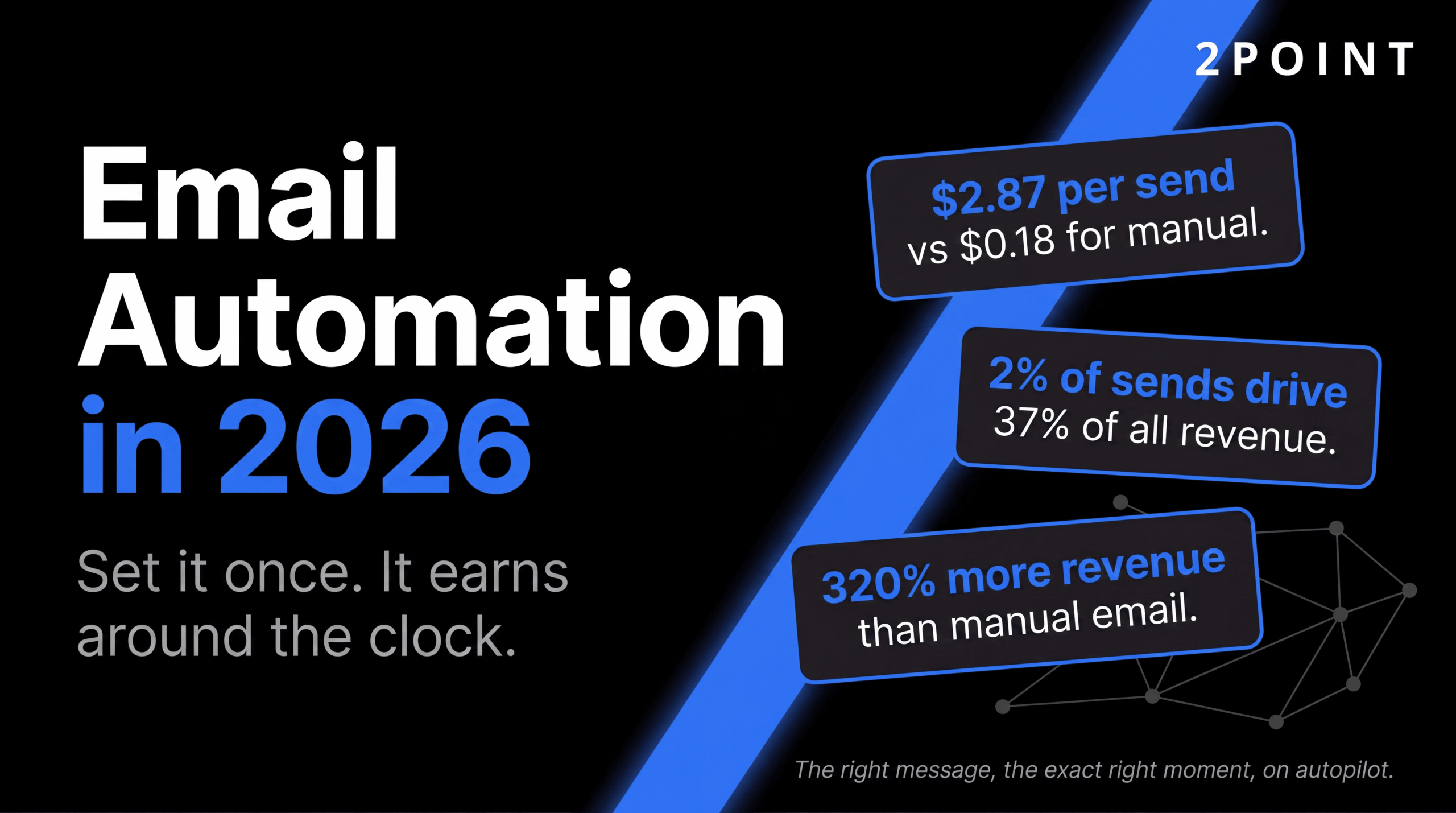
The performance gap between automated and manual campaigns has widened dramatically. While traditional email blasts generate modest results, automated workflows capitalize on intent signals and engagement patterns. This difference translates directly to revenue: automated messages earn $2.87 per send compared to $0.18 for manual campaigns, a 16x advantage that compounds across thousands of customer interactions.
Looking ahead, marketing automation continues to reshape how businesses communicate. AI capabilities now extend beyond basic personalization to predictive analytics, dynamic content generation, and autonomous optimization. Organizations that master these systems gain sustainable competitive advantages through enhanced customer experiences and operational efficiency that manual processes simply cannot match.
Email automation delivers measurable financial returns that far exceed manual campaign performance. The average $36 return for every $1 invested in email marketing becomes even more impressive when automation enters the equation. Automated campaigns generate 320% more revenue than non-automated emails, transforming email from a communication channel into a revenue engine.
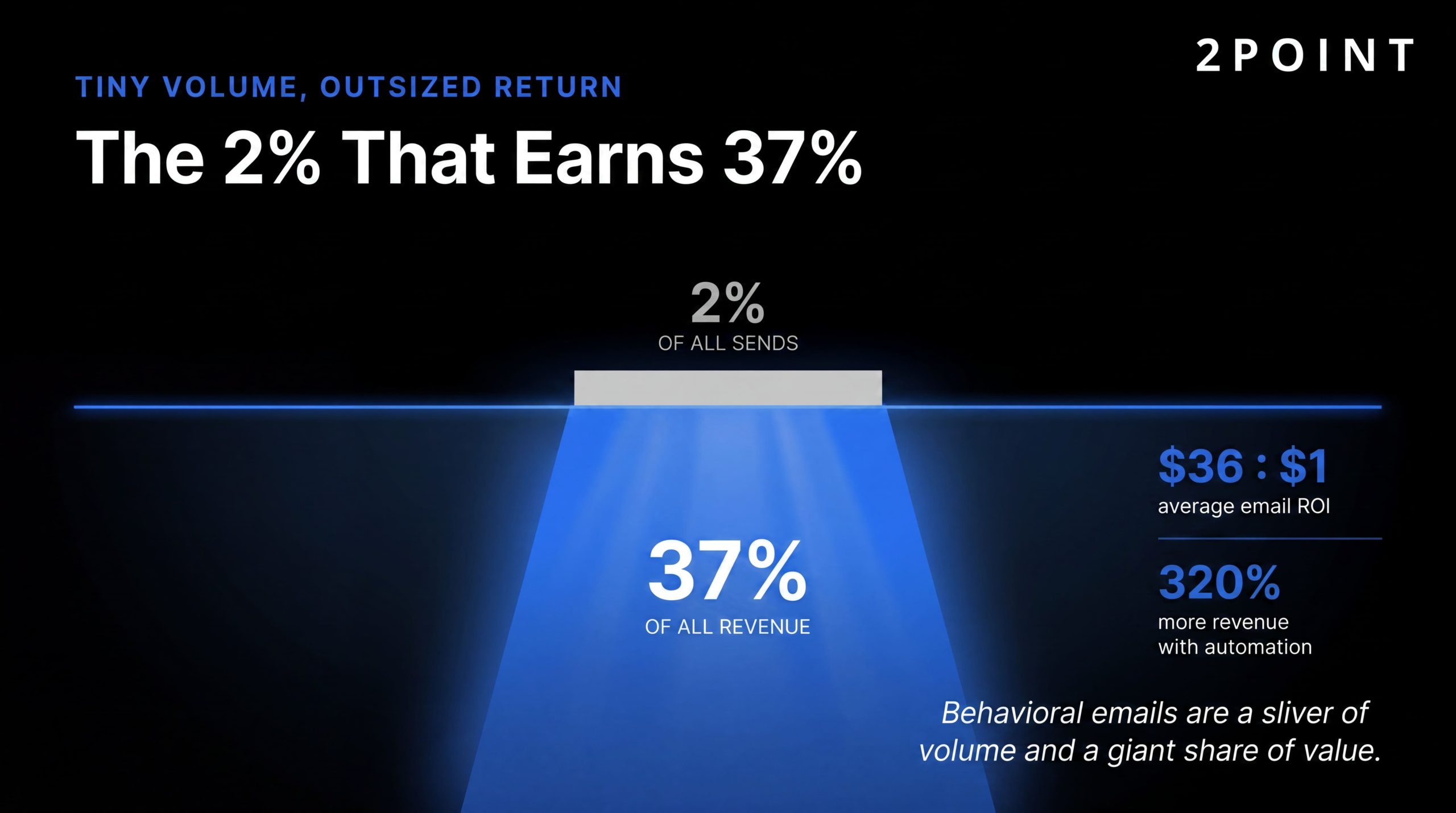
The concentration of value in automated behavioral emails reveals strategic insight: while these messages account for only 2% of total send volume, they capture 37% of all email-attributed revenue. This disproportionate impact stems from relevance and timing. Automated workflows respond to customer intent signals, delivering messages when recipients are most receptive to action.
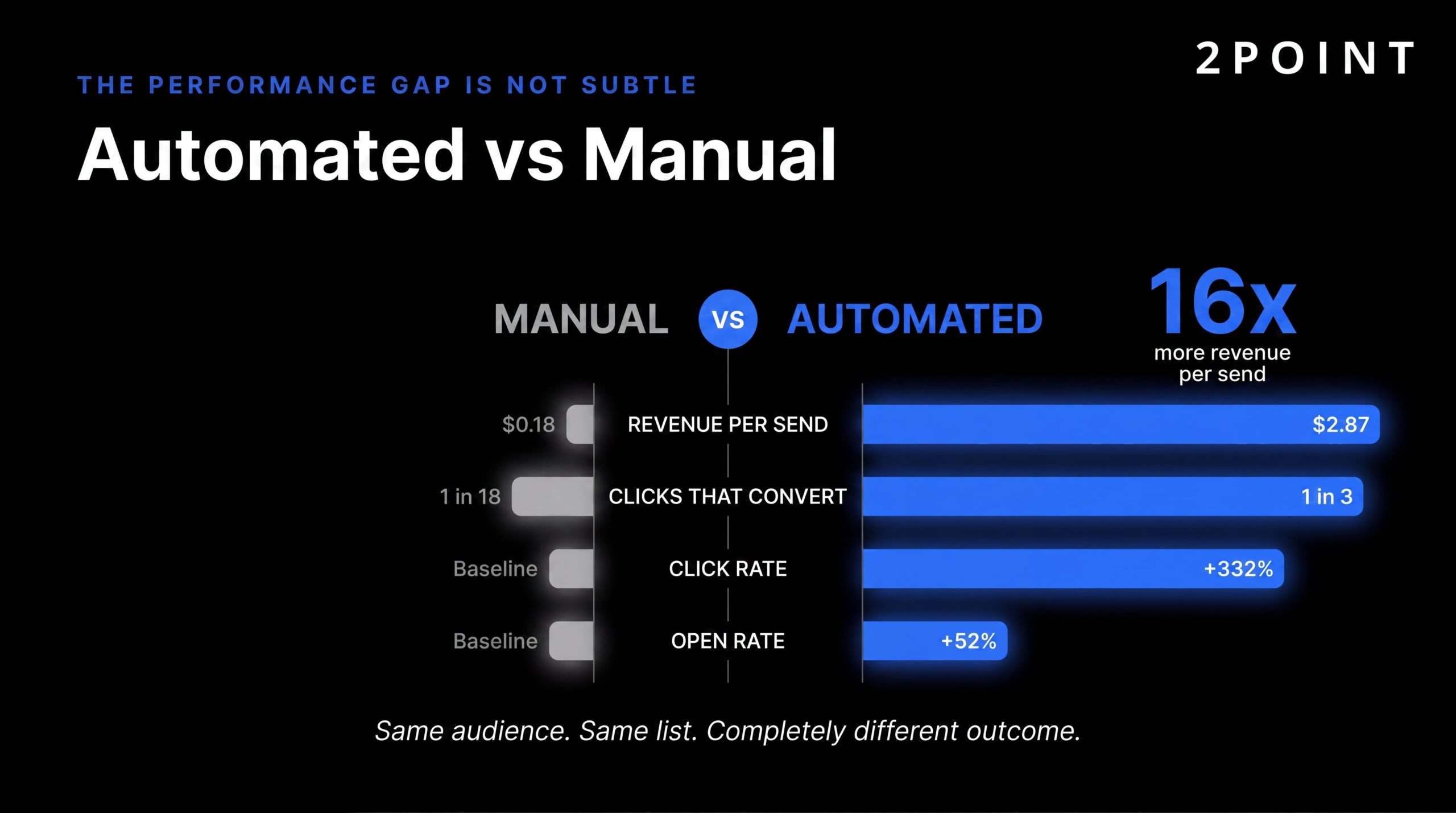
The revenue-per-send metric crystallizes this advantage. Automated emails earn $2.87 per send while manual campaigns generate just $0.18, representing a 16x performance difference. For businesses sending thousands of emails monthly, this gap translates to substantial revenue differences. Real-world results validate these benchmarks: Omnisend’s US merchants achieve $76 return per $1 spent, rising to $79:$1 when combining email with SMS automation.
Performance variation within automation itself warrants attention. The top 10% of automated workflows generate 30x higher returns than regular campaigns, indicating that workflow design and optimization significantly impact results. Organizations that continuously refine trigger conditions, content, and timing extract maximum value from automation infrastructure. This optimization process transforms good automation into exceptional performance, creating compounding returns as customer databases grow and systems learn from expanding datasets.
Engagement metrics reveal automation’s superiority across every performance indicator. Open rates for automated emails run 52% higher than manual campaigns, meaning recipients demonstrate greater interest in messages triggered by their behavior. This engagement advantage compounds: automated emails achieve 332% higher click rates, with average click-through rates reaching 5.4% compared to much lower rates for broadcast emails.
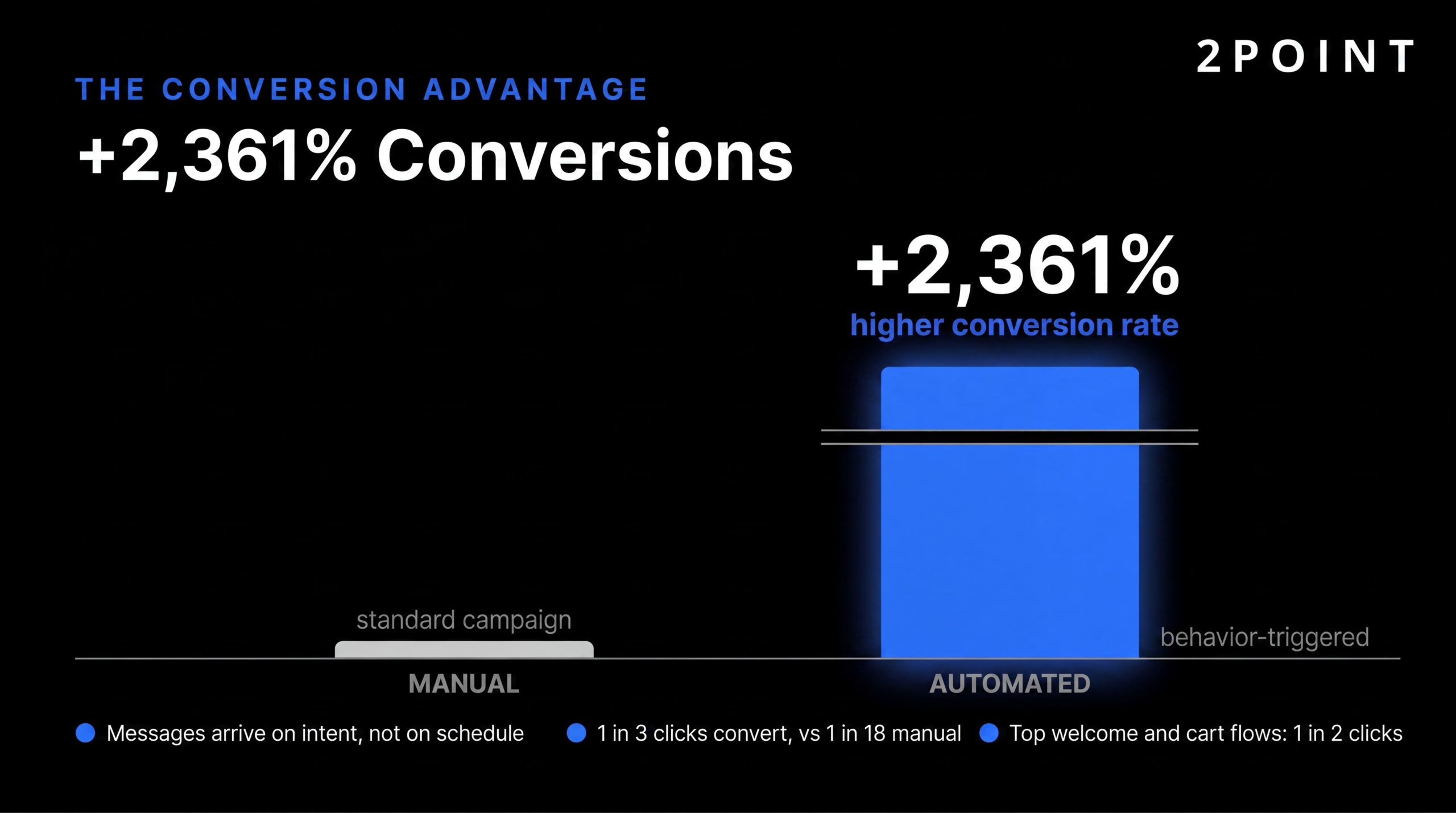
Conversion performance separates truly effective marketing from mere communication. Automated emails deliver 2,361% higher conversion rates than standard campaigns. This dramatic difference stems from contextual relevance: automated messages arrive when customers signal interest through browsing, cart additions, or other behavioral triggers. The timing alignment between customer intent and message delivery creates natural conversion opportunities.
Click-to-conversion ratios illustrate this relationship. For automated campaigns, 1 in 3 people who click make a purchase, compared to just 1 in 18 for scheduled campaigns. This sixfold conversion advantage means automated campaigns require fewer clicks to generate revenue. High-performing workflows like welcome and abandoned cart sequences achieve even better ratios: 1 in 2 clicks result in purchases, demonstrating how proper workflow design maximizes conversion efficiency.
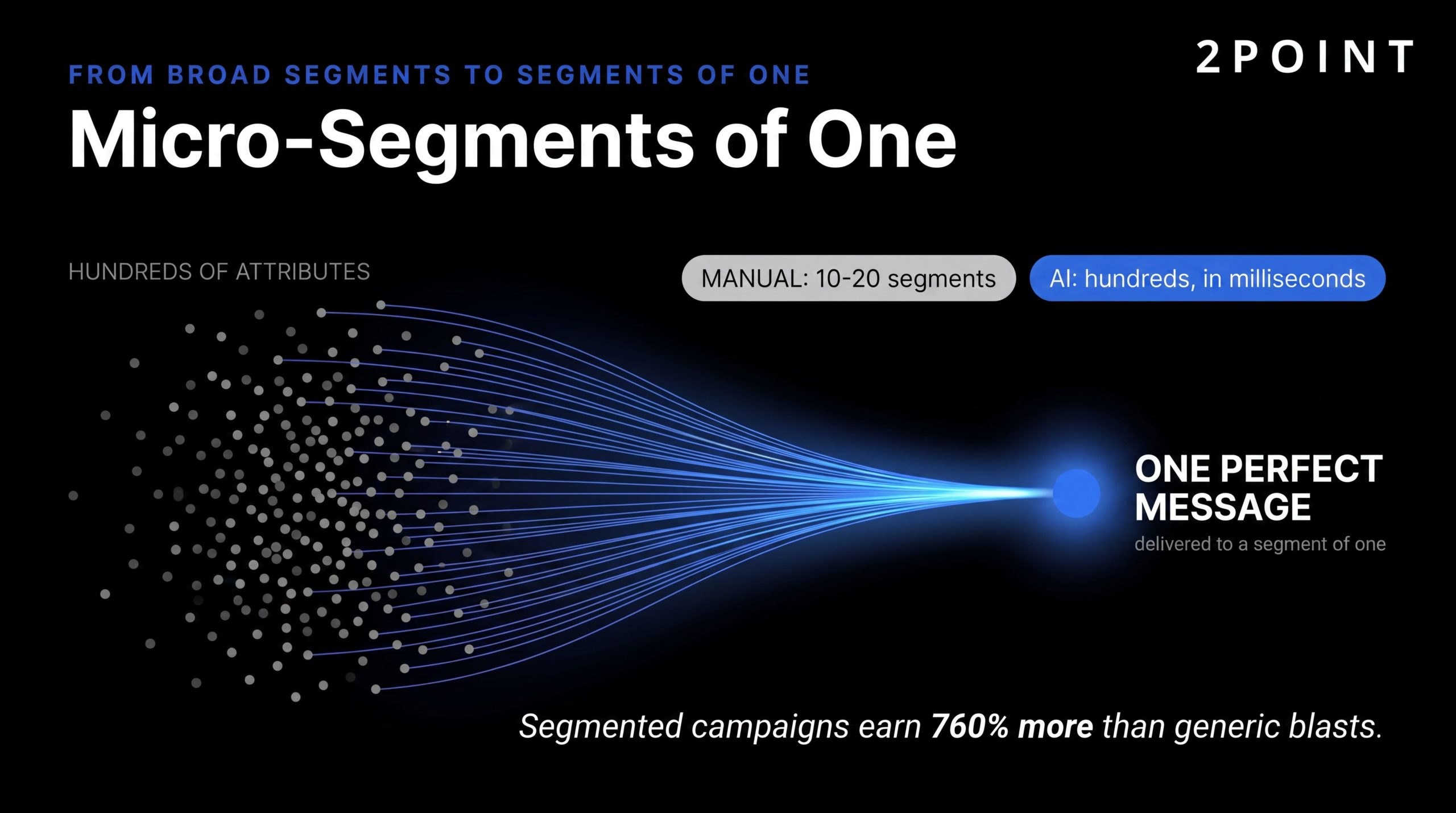
Segmentation amplifies these engagement benefits. Organizations that segment email lists for targeted automation see dramatic results: segmented campaigns generate 760% more revenue than non-segmented approaches. This performance boost reflects how personalization at scale creates relevance. Automated systems can evaluate dozens of customer attributes instantly, routing recipients into appropriate segments and delivering customized content that manual processes cannot match. The combination of behavioral triggers and intelligent segmentation creates engagement rates that redefine email channel expectations.
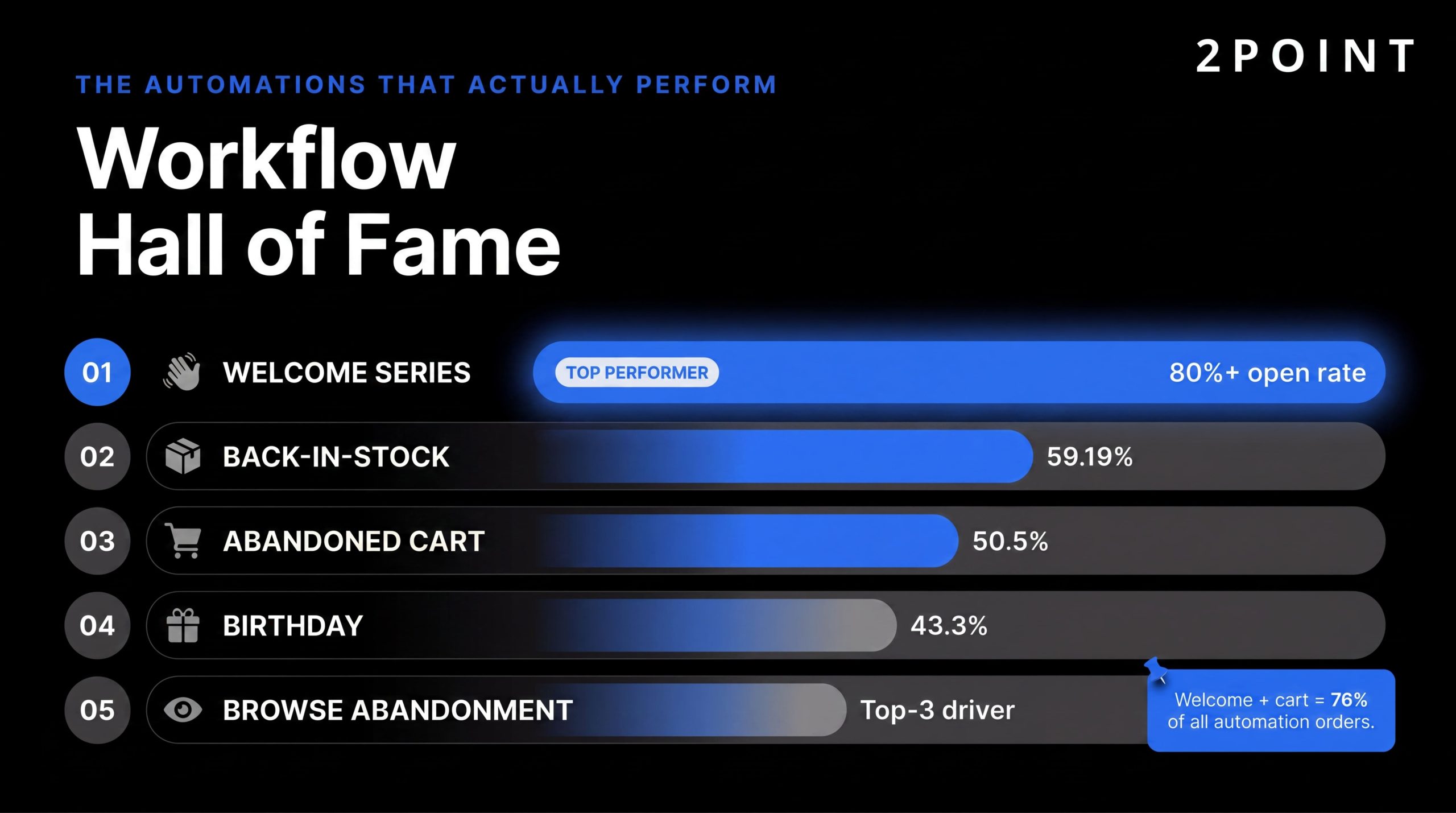
Specific automation types demonstrate exceptional performance, with welcome and onboarding sequences leading all categories. These emails achieve open rates exceeding 80%, with typical ranges between 58-70%. This engagement level doubles the opens and quadruples the clicks of other email types, establishing welcome series as the single most valuable automation workflow any business can implement.
Abandoned cart recovery represents another high-impact automation. These messages generate 50.5% open rates, 15% higher than other marketing emails. When combined with welcome emails, abandoned cart sequences account for 76% of all automation-related orders. The revenue concentration in these two workflows highlights strategic priorities: businesses implementing just welcome and abandoned cart automation capture the majority of available automation value.
Birthday and occasion-based emails demonstrate how personalization in email drives engagement. Birthday campaigns achieve 43.3% open rates with 14.3% click-to-conversion rates. These numbers reflect the power of timely, personally relevant communication. Back-in-stock alerts perform even better, generating 59.19% open rates and 5.34% conversion rates by matching customer interest with product availability.
The collective impact of top automation workflows proves their strategic value. Abandoned cart, welcome, and browse abandonment emails together represent 87% of all automated orders. This concentration indicates that businesses should prioritize these core workflows before expanding to more complex automation. Real-world examples validate performance benchmarks: one merchant’s welcome email generated $235,000 in attributed sales across 3,000+ orders, demonstrating the revenue potential of properly implemented automation sequences.
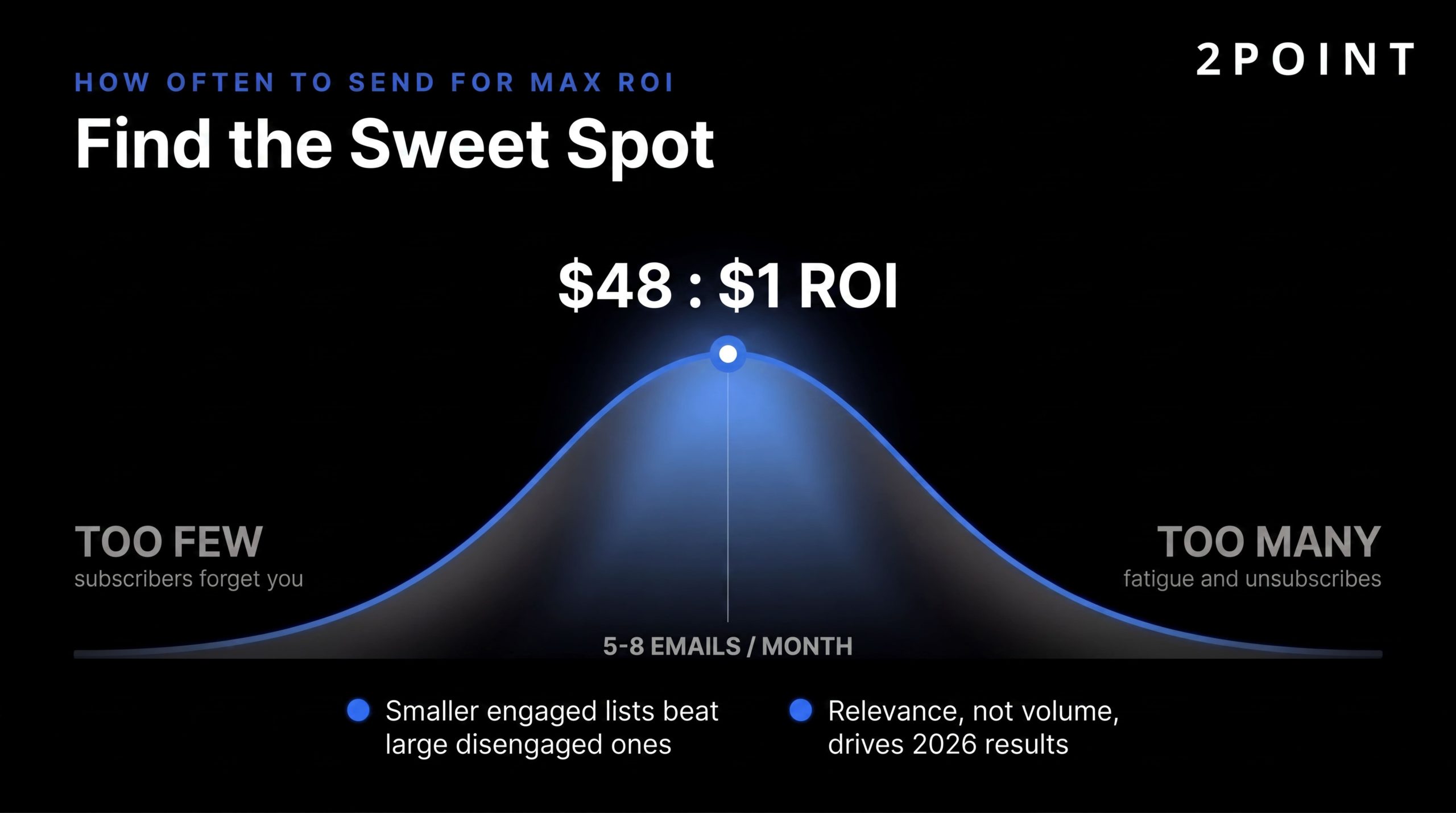
Automation volume optimization balances reach with engagement quality. Research shows brands sending 5-8 emails per month via automation achieve the highest ROI at $48:$1. This frequency range allows sufficient touchpoints without overwhelming recipients or triggering fatigue. The sweet spot reflects strategic restraint: more emails do not automatically generate proportional returns.
Quality fundamentally outweighs quantity in 2026 email strategy. Smaller, engaged email lists consistently outperform large, disengaged databases. This dynamic reflects deliverability realities: inbox providers increasingly use engagement signals to determine placement. Sending to unengaged recipients damages sender reputation, reducing deliverability even to active subscribers. Organizations focused on engagement metrics rather than list size build sustainable email programs that maintain high inbox placement rates.
The trend toward fewer, more targeted campaigns accelerates in 2026. Rather than increasing send frequency, leading marketers improve message relevance through enhanced segmentation and personalization. This approach aligns with consumer preferences and deliverability requirements. Engagement-based suppression has become standard practice, automatically excluding inactive recipients to protect sender reputation and maintain deliverability for engaged segments.
Automation adoption rates reveal significant growth opportunity. Currently, 64% of marketers use automation, but only 10% have fully automated customer journeys. This gap indicates that most organizations use automation tactically rather than strategically. The opportunity lies not in sending more emails but in building comprehensive automation architectures that cover the full customer lifecycle. Organizations that develop mature automation programs capture disproportionate value by systematically addressing every customer journey stage with appropriate, triggered communication.
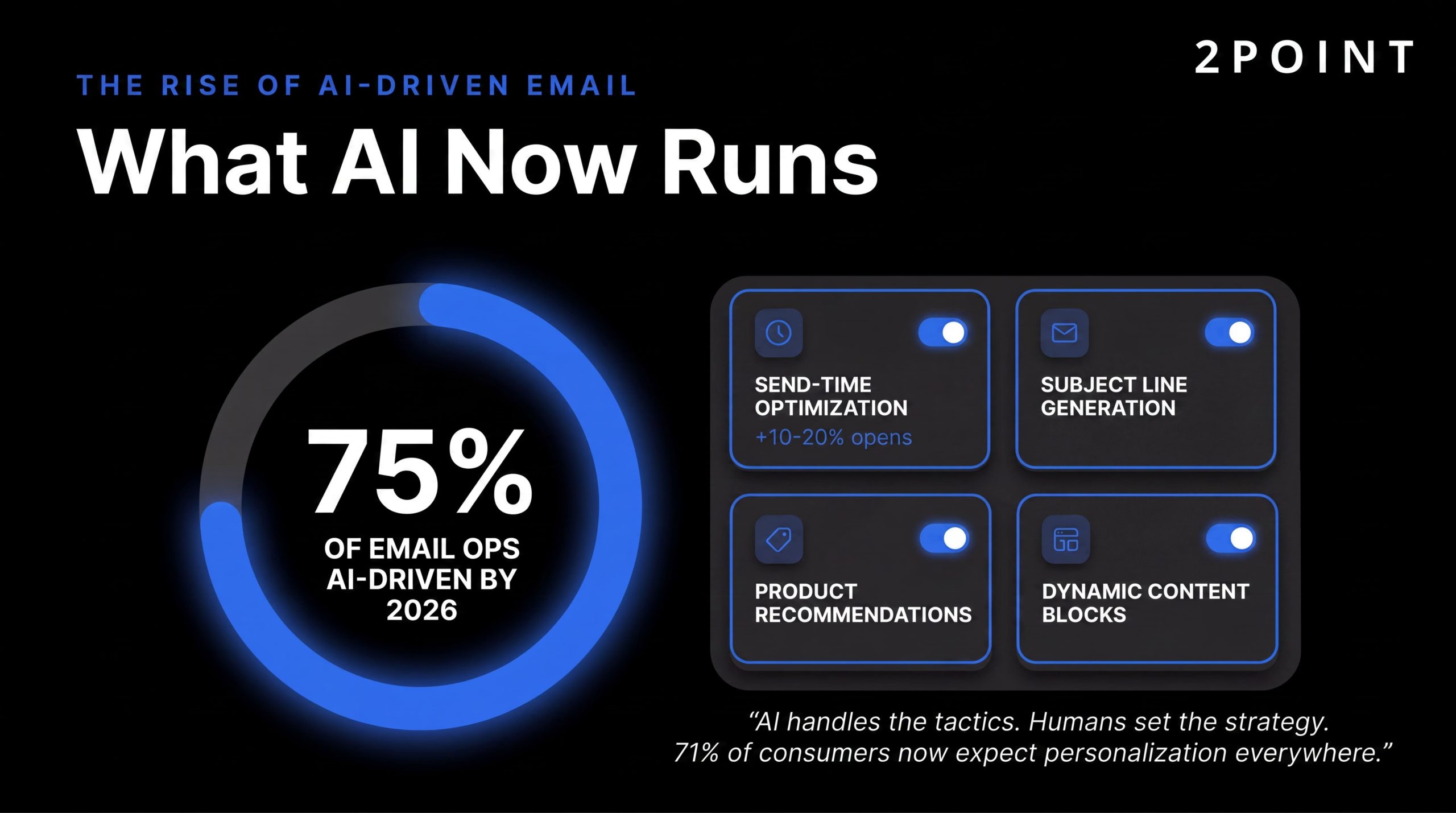
AI has evolved email personalization far beyond simple name insertion. Modern systems now automatically adjust subject lines based on each contact’s likelihood to open, personalize entire email layouts according to recipient preferences, and recommend products through predictive behavior modeling. These capabilities represent a fundamental shift from rule-based personalization to intelligent, adaptive systems that learn and improve continuously without manual intervention.
Consumer expectations have shifted to match these capabilities. Now 71% of consumers expect personalized experiences across all digital channels. Email remains uniquely positioned to meet this expectation because it combines rich customer data with direct, one-to-one communication. AI systems analyze engagement patterns, purchase history, browsing behavior, and demographic data to create individualized experiences for each recipient.
Visual content generation represents the latest AI frontier in email. The use of AI-generated images in emails increased 340% from 2024 to 2025, reflecting how generative AI tools enable rapid creation of customized visual content. These systems can produce product images, lifestyle photography, and branded graphics tailored to recipient preferences and campaign objectives, dramatically reducing production time while increasing creative options.
Dynamic content personalization now operates at scale previously impossible with manual processes. AI systems can evaluate dozens of customer attributes in milliseconds, selecting optimal content blocks, product recommendations, and calls-to-action for each recipient. The send-time optimization feature analyzes individual engagement patterns to determine when each subscriber is most likely to open and click, scheduling delivery at the precise moment that maximizes engagement. This level of individualization creates experiences that feel hand-crafted while operating at scale across thousands or millions of recipients.
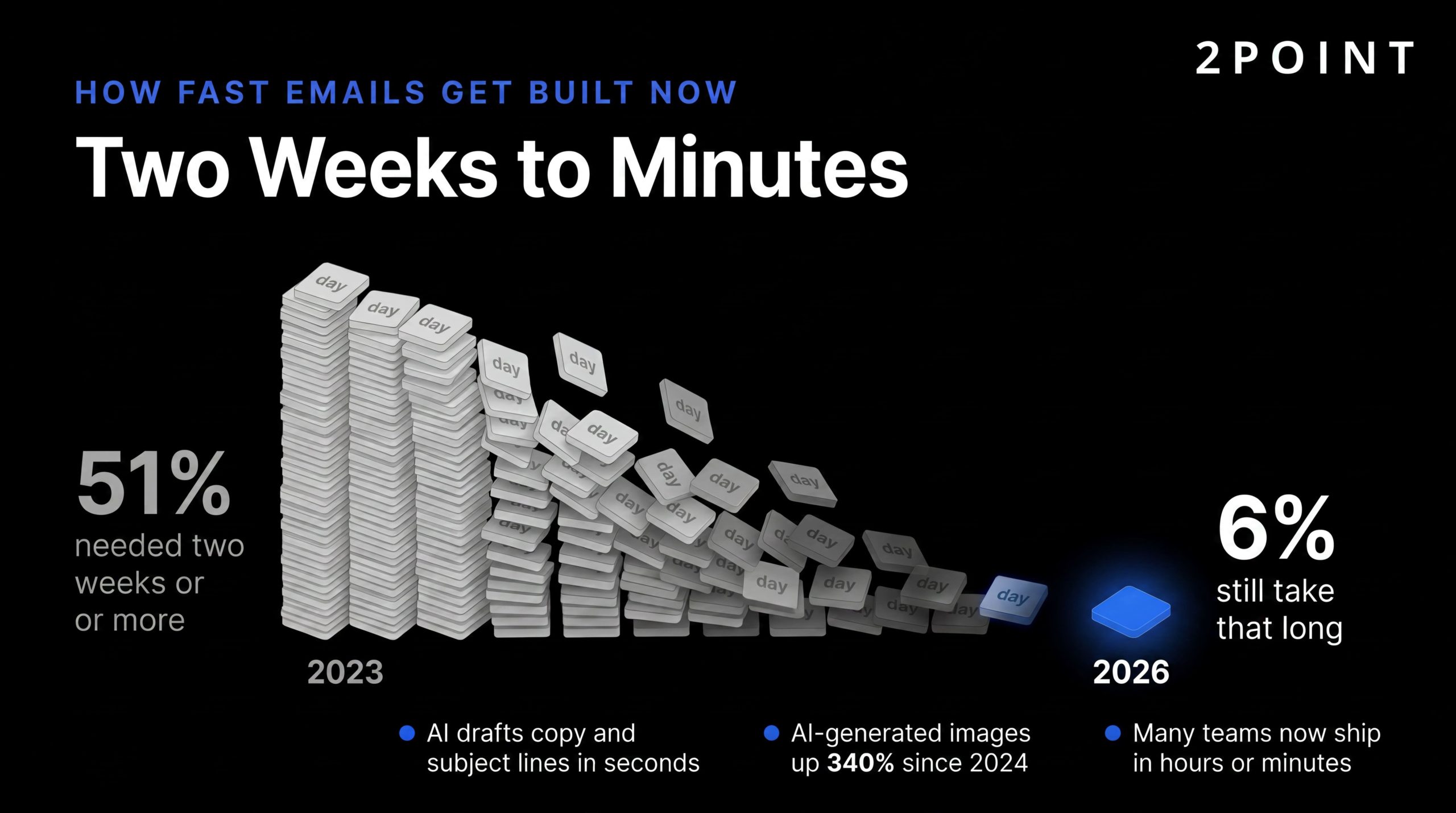
Email production timelines have compressed dramatically through AI assistance. In 2023, 51% of marketers needed two weeks or more to create a single email. Today, only 6% take that long, with many teams producing complete campaigns in hours or minutes. This acceleration stems from GPT-powered copy generators, AI subject line optimization tools, and automated design systems that handle technical execution while marketers focus on strategy.
AI reduces manual effort across the entire email creation process. Copy generation tools produce multiple subject line options, body content variations, and call-to-action alternatives in seconds. Design assistance features suggest layouts, color schemes, and image placements based on campaign objectives and brand guidelines. These capabilities eliminate hours of manual work, allowing teams to produce more campaigns with the same resources or redirect effort toward higher-value strategic activities.
Testing and optimization have become seamless through AI integration. Rather than manually configuring A/B tests and waiting for statistical significance, modern platforms automatically test variations and route traffic to winning versions. AI systems analyze campaign performance in real time, suggesting improvements to subject lines, content, and send times without human input. This continuous optimization creates performance gains that accumulate over time as systems learn what resonates with specific audience segments.
The built-in intelligence in modern platforms eliminates entire categories of manual work. Predictive send-time optimization determines ideal delivery windows for each recipient. Automated content selection chooses optimal images and product recommendations. Subject line scoring predicts performance before sending. Design elements automatically adjust for mobile versus desktop display. These features transform email marketing from a labor-intensive execution function into a strategy-focused discipline where human expertise directs AI capabilities toward business objectives.
AI systems now analyze engagement patterns to trigger adjustments automatically, shifting email automation from reactive to proactive. These platforms identify micro-trends in customer behavior, predicting future actions and adjusting communication strategies in real time. Intent-based targeting replaces demographic segmentation, routing customers into appropriate workflows based on behavioral signals rather than static attributes.
Micro-segmentation capabilities enable unprecedented personalization at scale. Where manual processes might create 10-20 segments, AI systems can evaluate hundreds of attributes simultaneously, placing each recipient in precisely targeted micro-segments of one. This granularity ensures every subscriber receives content aligned with their current position in the customer journey, recent browsing behavior, purchase history, and engagement patterns.
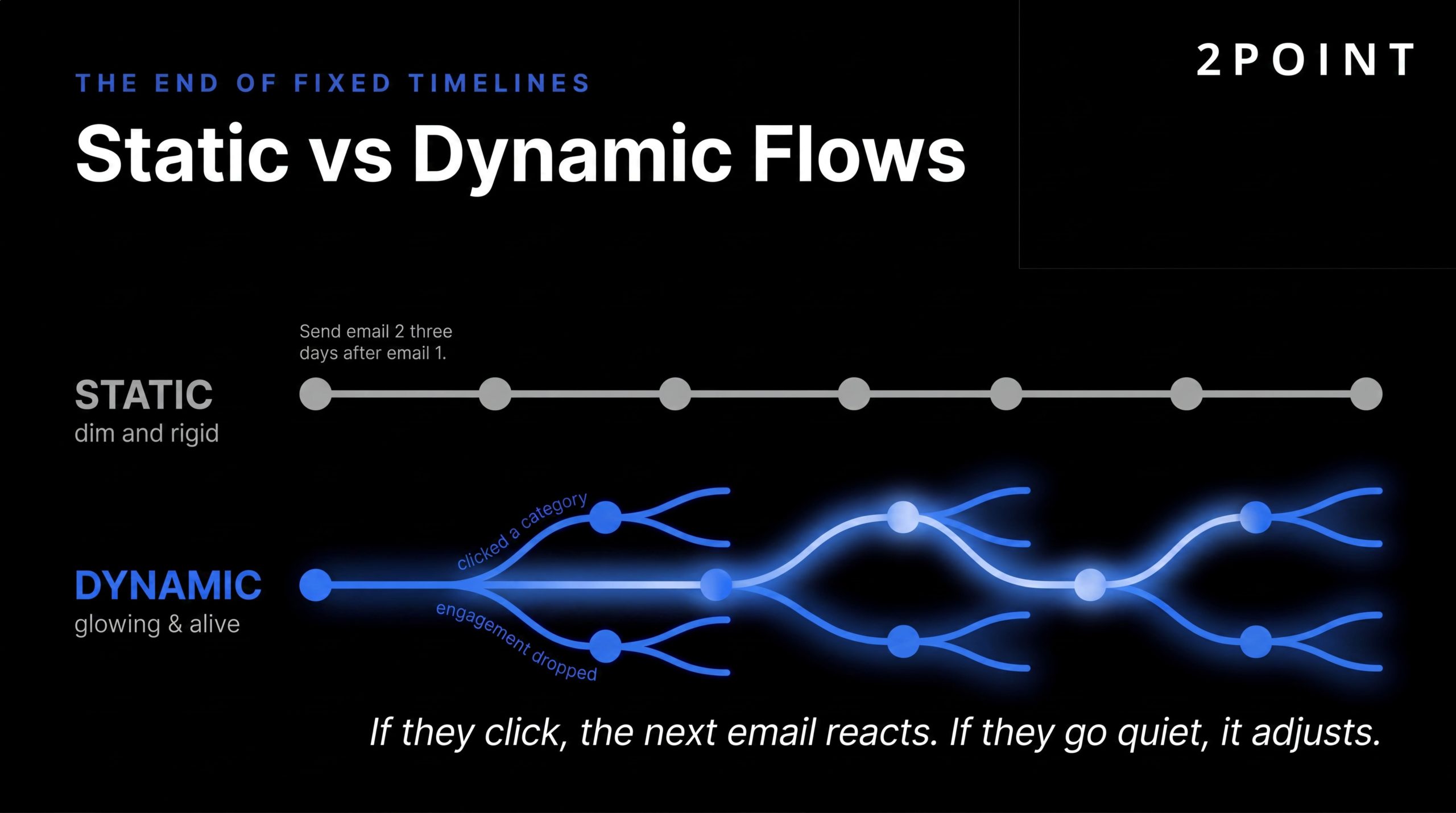
Dynamic email flows represent the latest evolution in marketing automation workflows. Rather than following static timelines (“send email 2 three days after email 1”), modern systems respond to real-time customer behavior. If a recipient clicks on a specific product category, the next email immediately features related items. If engagement drops, the system automatically adjusts send frequency or content type. This responsiveness creates personalized experiences that adapt to individual customer rhythms.
The shift from rule-based triggers to intelligent, adaptive systems marks a fundamental transformation. By 2026, marketing experts predict up to 75% of email strategy operations will be fully AI-driven. This doesn’t mean human strategists become obsolete but rather that AI handles tactical execution while humans focus on strategic direction, creative development, and customer experience design. Organizations that successfully integrate AI capabilities gain sustainable advantages through systems that continuously learn and improve without constant manual intervention.
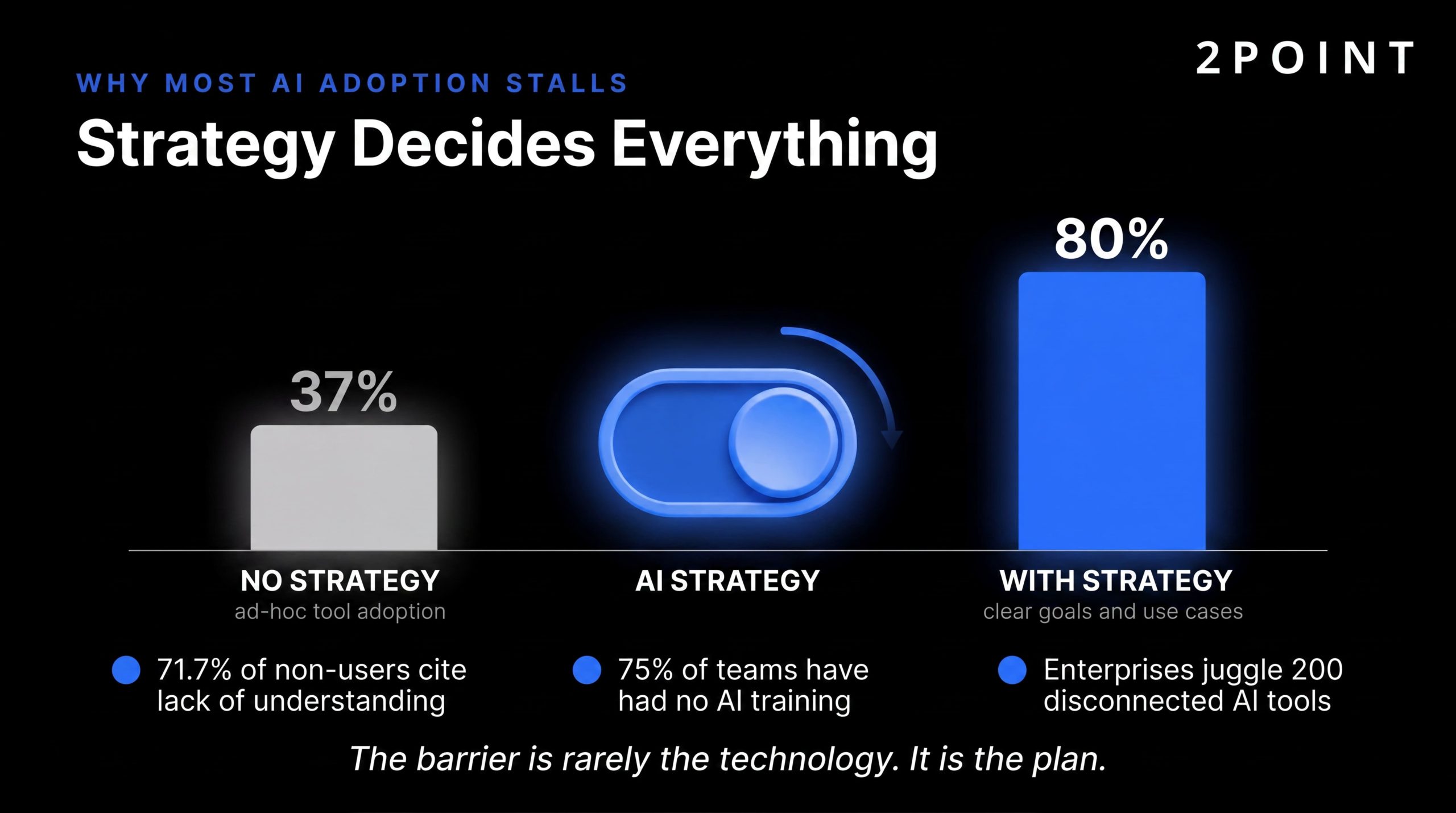
Despite widespread AI availability, effective utilization remains limited. The gap between capability and implementation stems largely from knowledge deficits: 71.7% of non-users cite lack of understanding as the main barrier. This knowledge gap extends across organizations, with 75% reporting no AI training for their marketing team and 59% of marketing operations teams lacking AI and automation expertise.
Strategic approach dramatically impacts AI success rates. Organizations without a formal AI strategy report only 37% success compared to 80% with a defined strategy. This gap highlights that AI adoption requires deliberate planning, clear objectives, and systematic implementation rather than ad-hoc tool adoption. The strategy must define specific use cases, success metrics, and integration approaches that align AI capabilities with business objectives.
Tool proliferation creates integration challenges. Enterprises now run an average of 200 AI tools, yet struggle to make them work together effectively. This fragmentation leads to data silos, duplicated effort, and suboptimal results. The solution lies not in adopting more tools but in building integrated systems where AI capabilities connect across platforms, sharing data and insights to create unified customer experiences.
The barriers to AI adoption are organizational rather than technical. Technology exists to power sophisticated email automation and personalization, but organizations struggle with change management, skill development, and strategic integration. Practical recommendations for building AI competency include starting with focused pilot programs, investing in team training, defining clear success metrics, creating cross-functional AI working groups, and partnering with vendors that provide implementation support. Organizations that treat AI adoption as a strategic transformation rather than a technology purchase achieve substantially better results.
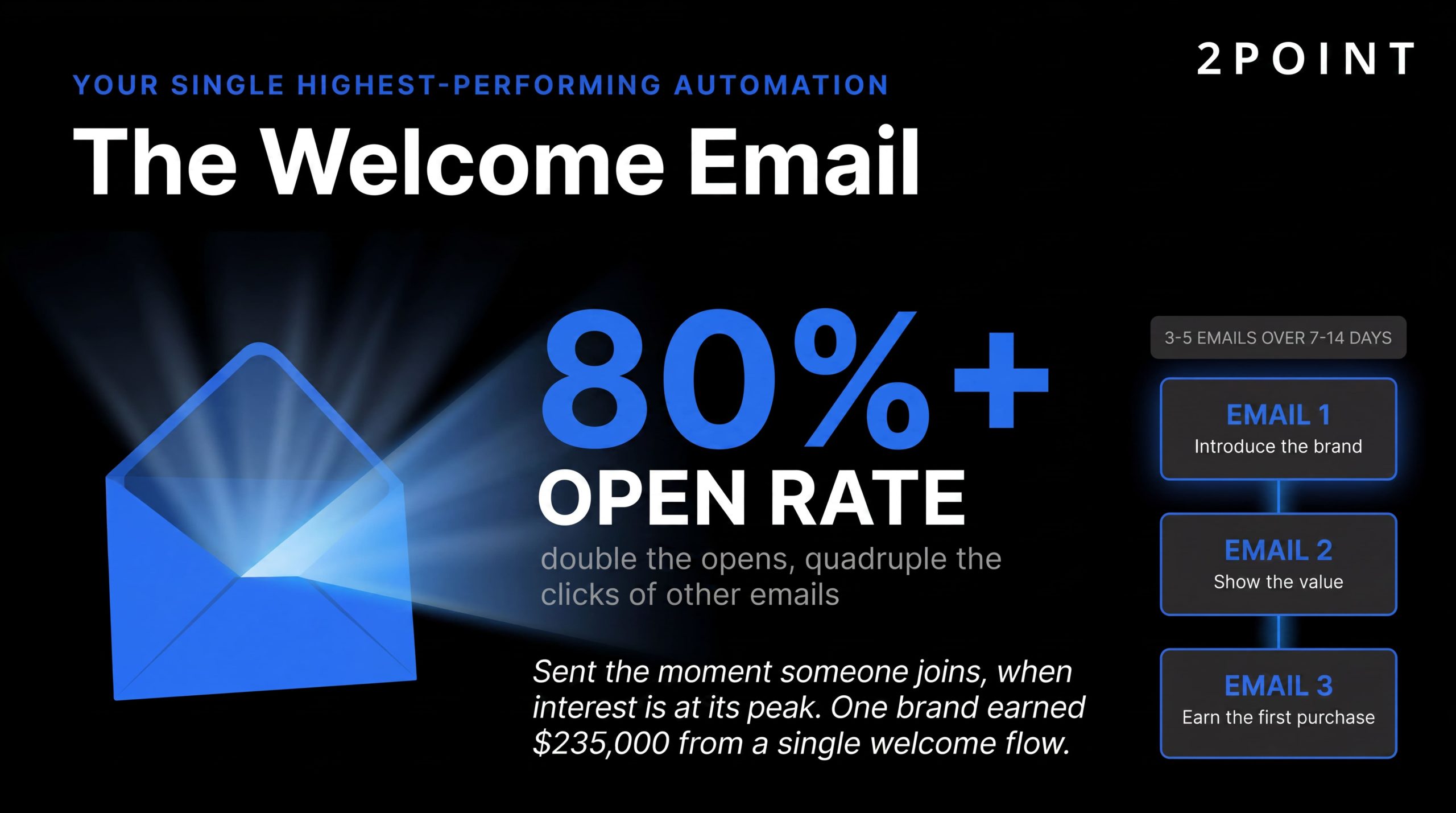
Welcome emails represent the single most valuable automation any business can implement. These messages achieve open rates exceeding 80%, with typical performance ranging from 58-70% opens and 12-22% click-through rates. This engagement level doubles the opens and quadruples the clicks of other email types, making welcome series the foundation of effective email automation.
The strategic value extends beyond immediate metrics. Welcome sequences allow brands to introduce their story, values, and unique positioning when subscribers are most receptive. One example demonstrates this potential: To’ak Chocolate generated 40% of total email revenue from automated campaigns, with welcome emails playing a central role. This revenue concentration occurs because welcome emails reach subscribers at peak interest, immediately after they’ve taken action to join a list.
Implementation best practices maximize welcome series performance. Timing matters: the first email should arrive immediately upon subscription, capitalizing on the subscriber’s current interest. Series length typically ranges from 3-5 emails over 7-14 days, balancing relationship development with engagement maintenance. Content should mix brand storytelling, value demonstration, product education, and social proof to build trust and encourage first purchases.
Welcome automation delivers disproportionate returns for minimal investment. Unlike complex segmentation or advanced personalization, a basic welcome series requires modest technical setup and content creation yet produces exceptional results. For businesses just starting with automation, implementing a welcome series should be the first priority. The combination of high engagement, revenue generation, and relationship building makes welcome emails the most impactful automation workflow available.
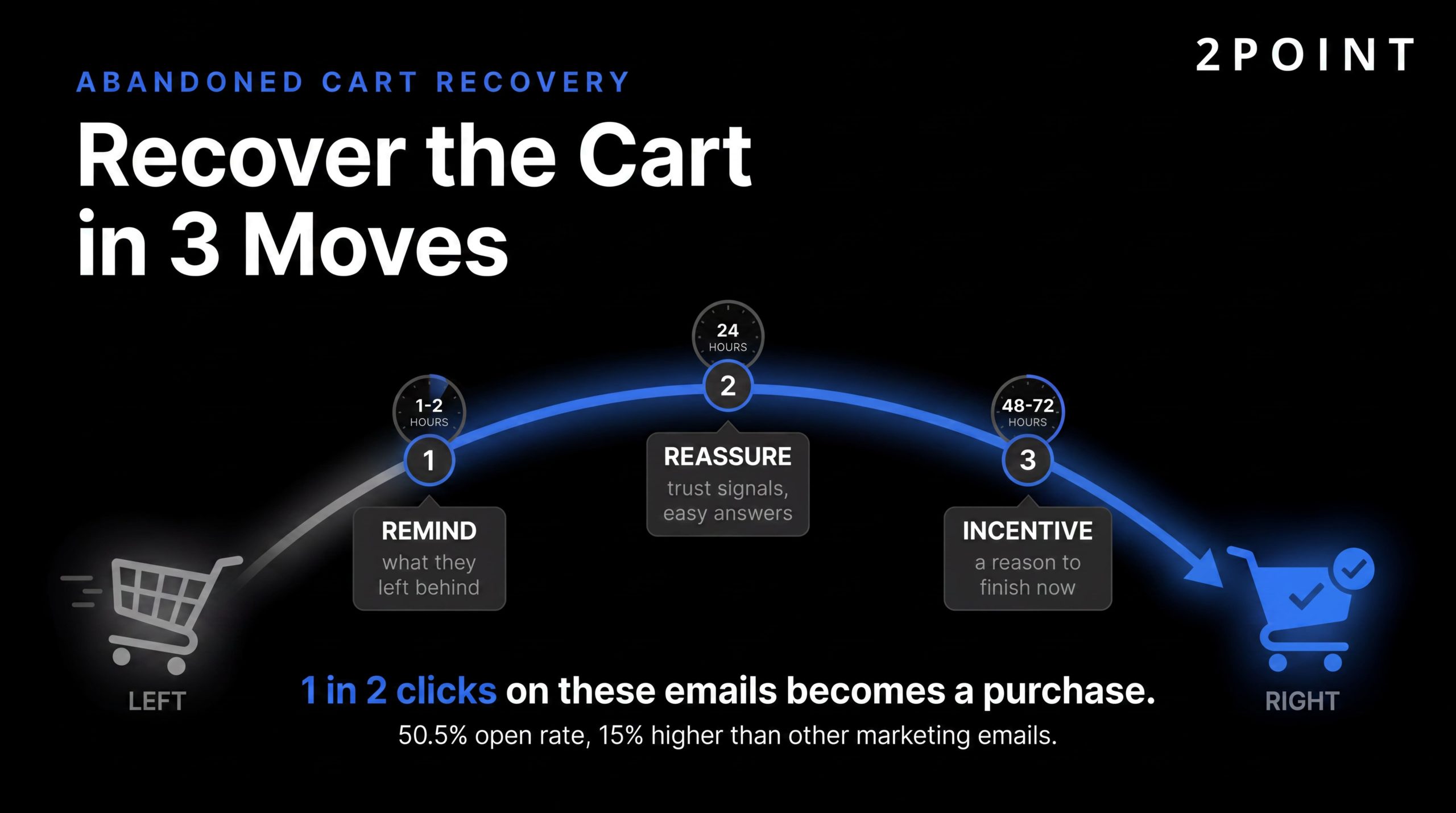
Abandoned cart automation transforms revenue leakage into recovery opportunity. These emails generate 50.5% open rates, 15% higher than other marketing emails. More importantly, 1 in 2 people who click on abandoned cart emails make purchases, demonstrating extraordinary conversion efficiency. When combined with welcome emails, abandoned cart sequences account for 76% of all automation-related orders.
Real-world results validate abandoned cart automation’s revenue impact. FLEXTAIL’s welcome email generated $235,000 in attributed sales spanning 3,000+ orders, illustrating how proper automation implementation converts intent into revenue. These workflows capitalize on demonstrated purchase interest, reaching customers who’ve already invested time browsing products and adding items to carts.
Tactical implementation significantly affects recovery rates. Optimal sending sequences typically include three emails: the first within 1-2 hours of abandonment, the second at 24 hours, and the third at 48-72 hours. Timing windows balance urgency with persistence, giving customers multiple opportunities to complete purchases without feeling pressured. Content elements should include clear product images, easy cart recovery links, trust signals, and strategic incentive deployment (typically reserved for the final email).
Mobile optimization has become critical as cart abandonment increasingly occurs on smartphones. Messages must render perfectly on small screens with prominent, touch-friendly buttons. The abandoned cart recovery process should minimize friction, allowing completion in minimal steps without requiring re-entry of product selections or customer information. Organizations that view cart abandonment as a natural part of the purchase journey rather than a failure can systematically recover significant revenue through well-designed automation sequences.
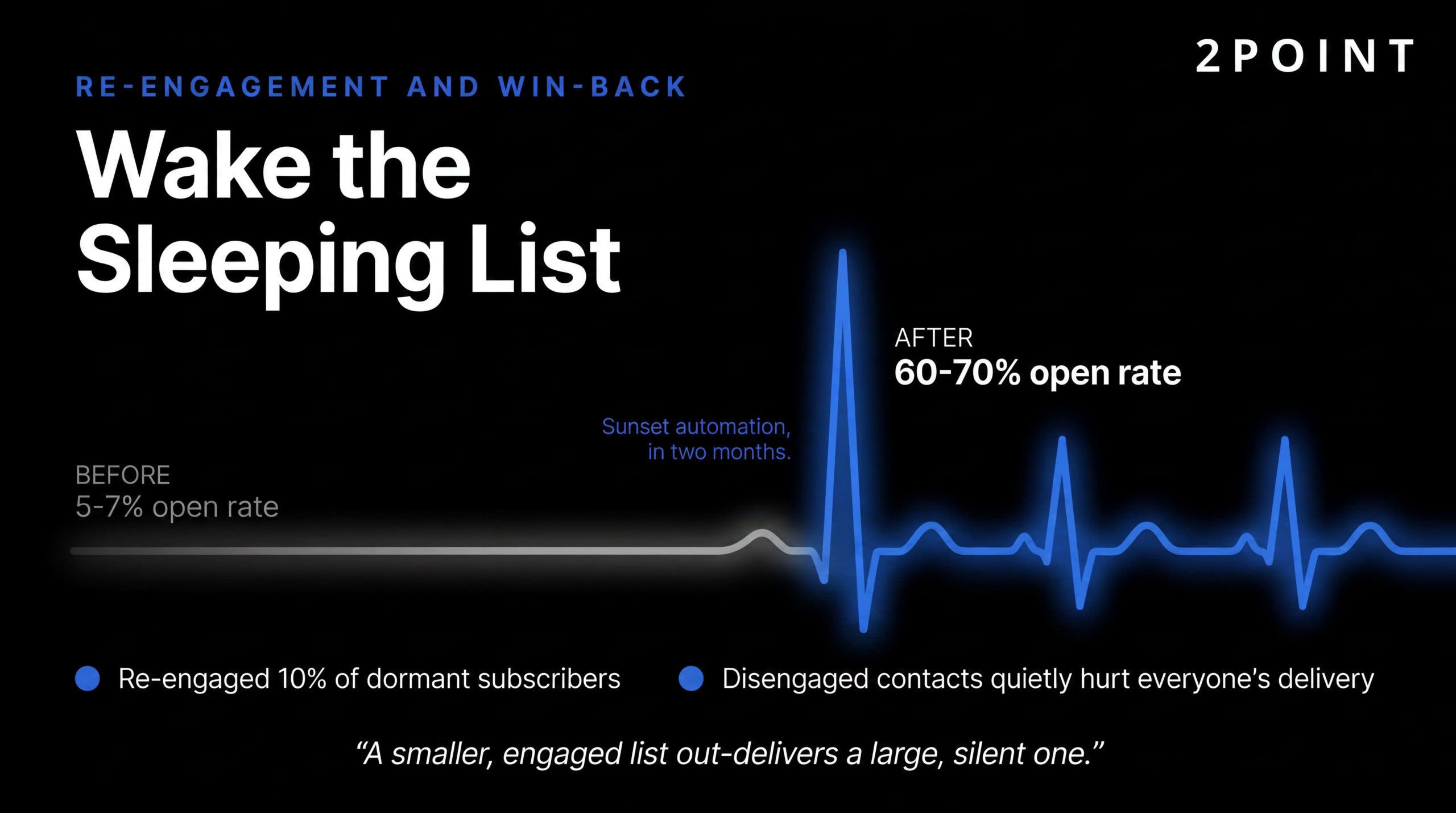
List hygiene directly impacts deliverability and overall email program performance. Inactive subscribers damage sender reputation, reducing inbox placement even for engaged recipients. Re-engagement automation addresses this challenge systematically, attempting to reactivate dormant subscribers before removing them entirely. One case study demonstrates the potential: AcreValue’s sunset automation increased open rates from 5-7% to 60-70% and re-engaged 10% of inactive subscribers in two months.
The deliverability imperative has intensified in 2026. Gmail’s spam filtering now operates at the recipient level, with AI models personalizing inbox placement based on each subscriber’s engagement history with sender domains. This means disengaged segments actively harm delivery for engaged subscribers. Engagement-based suppression and sunset policies have shifted from best practices to technical requirements for maintaining deliverability.
Strategic re-engagement elements include defining inactive periods (typically 60-90 days without opens or clicks), creating compelling reactivation offers, implementing progressive engagement sequences, and establishing clear sunset policies. The content approach should acknowledge the lapsed relationship, provide value reminders, and create clear paths for re-engagement or unsubscription. Transparency builds trust: explicitly offering easy opt-out options paradoxically increases engagement by demonstrating respect for subscriber preferences.
Retention economics justify investment in win-back automation. Acquiring new customers costs substantially more than retaining existing ones, making every reactivated subscriber valuable. Organizations that systematically implement re-engagement workflows maintain healthier lists, stronger sender reputations, and better overall deliverability. The combination of improved inbox placement and cost-effective retention makes re-engagement automation essential for sustainable email programs.
Browse abandonment captures intent signals earlier in the purchase journey than cart abandonment. These workflows trigger when visitors view products without adding them to carts, enabling communication with customers still in the research phase. As part of the top three automation types, browse abandonment contributes to the 87% of automated orders from high-performing workflows. This earlier intervention can guide undecided shoppers toward purchase decisions.
Birthday and occasion-based emails demonstrate how personal relevance drives exceptional engagement. Birthday campaigns achieve 43.3% open rates with 14.3% click-to-conversion rates. These numbers reflect the power of timely, personally relevant communication. The emotional resonance of birthday recognition creates positive brand associations while providing natural opportunities for special offers that feel genuine rather than promotional.
Back-in-stock alerts match customer interest with product availability, generating 59.19% open rates and 5.34% conversion rates. These workflows capitalize on demonstrated demand, notifying customers when previously unavailable items return to inventory. The timing alignment between customer desire and product availability creates natural purchase opportunities with minimal friction.
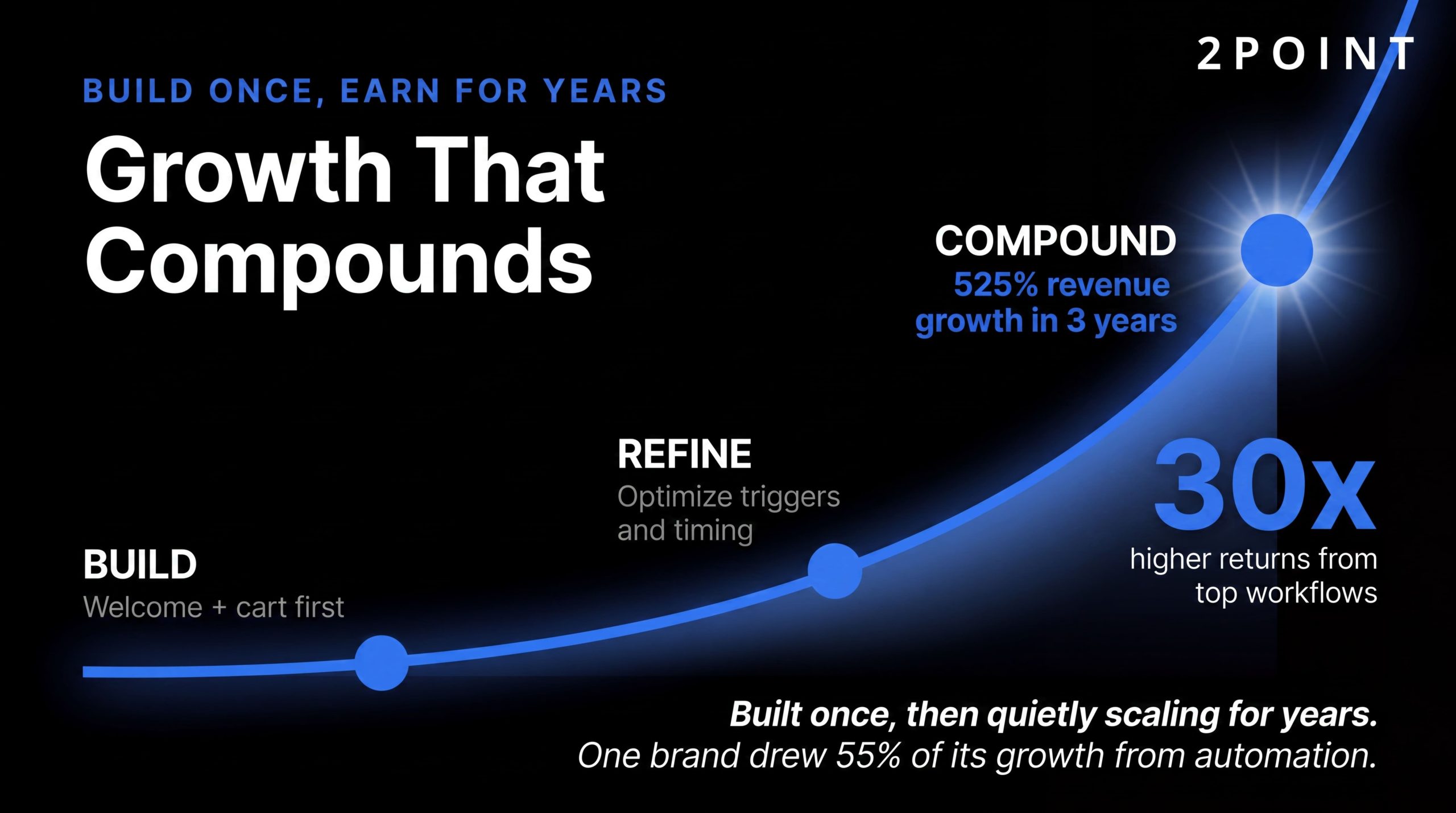
Implementation priorities depend on business model and resources. Organizations should build welcome and abandoned cart workflows first, capturing the majority of available automation value before expanding to additional types. The Dukier case study illustrates long-term potential: 525% revenue growth over three years with 55% attributed to email automations. This trajectory shows how systematic automation expansion compounds returns over time. Expected timeline to results varies by workflow type, with welcome and abandoned cart generating immediate impact while browse abandonment and back-in-stock typically require 60-90 days to demonstrate full potential.
Privacy-centric approaches have shifted from optional best practices to mandatory requirements. GDPR, CCPA, and emerging regulations globally establish baseline privacy standards that email marketers must navigate. Third-party data access continues to shrink through platform restrictions and regulatory constraints, fundamentally changing how organizations acquire and use customer data for targeting and personalization.
Email remains one of the most reliable channels for first-party and zero-party data collection. Unlike social platforms or advertising networks controlled by third parties, email lists represent owned assets with direct relationships. Subscribers voluntarily share information through signup forms, preference centers, and engagement behavior, providing rich datasets for personalization without third-party intermediaries. This owned-channel advantage becomes increasingly valuable as external data sources become restricted.
Trust development through transparent data practices has emerged as competitive advantage. Organizations that clearly communicate data usage, provide easy opt-out mechanisms, and demonstrate respect for subscriber preferences build stronger relationships. The performance dynamic has reversed: smaller, highly engaged lists now outperform large, disengaged databases. Quality over quantity reflects both deliverability requirements and consumer expectations for relevant, permission-based communication.
Practical implications reshape list-building strategies. Permission-based approaches prioritize clear value exchanges: subscribers receive specific benefits in return for email addresses and engagement data. Preference centers allow granular control over message types and frequency. Progressive profiling gradually collects additional data points across multiple interactions rather than requiring extensive information upfront. Organizations that frame data collection as mutual benefit rather than extraction build sustainable email programs aligned with privacy-first expectations and regulatory requirements.
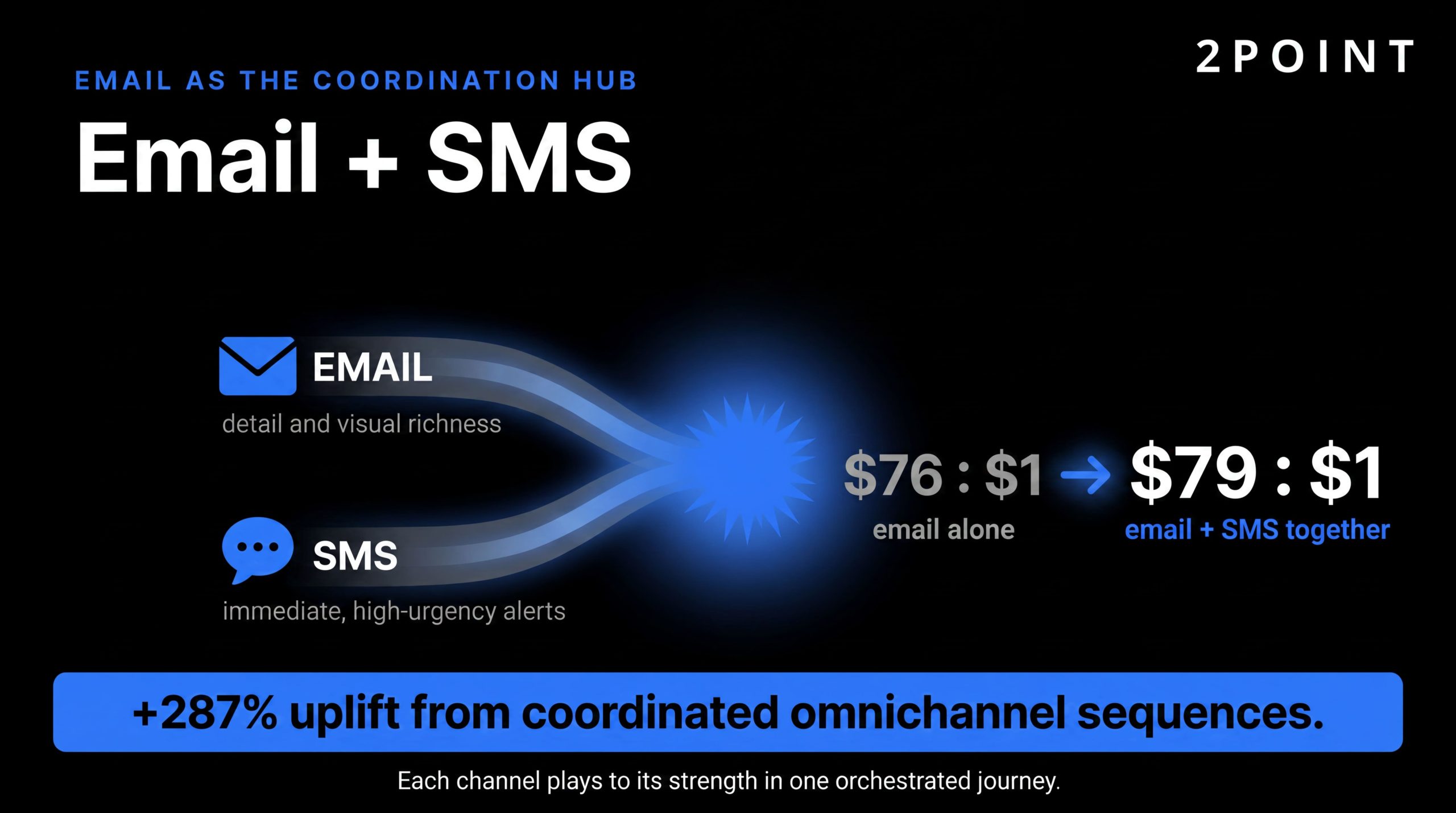
Email functions as the backbone of integrated multichannel strategies, working in coordination with SMS, social media, and web personalization. This integration creates seamless customer experiences where message sequences span platforms, each channel playing specific roles based on strengths. The 287% performance uplift from coordinated omnichannel sequences has caused B2B marketing teams to restructure entire outbound approaches around integrated workflows rather than channel silos.
Email and SMS combinations deliver exceptional results. Brands building both channels achieve $79 return per $1 spent, compared to $76 for email alone. This 4% improvement may seem modest but compounds significantly at scale. The channel pairing works because each serves distinct purposes: email provides detailed content and visual richness while SMS delivers immediate, high-urgency messages. Coordinated workflows leverage both strengths, using SMS for time-sensitive alerts and email for comprehensive information.
The 2026 landscape features tighter platform connections creating truly seamless customer journeys. Customer data platforms sync information in real time across channels, enabling workflows that respond to customer actions regardless of touchpoint. A customer who browses products on mobile, adds items on desktop, and abandons may receive SMS reminders, email product information, and retargeting ads in coordinated sequence. This orchestration requires technical integration but delivers experiences that feel personalized and coherent rather than fragmented.
The strategic shift positions email as coordination hub rather than isolated channel. Email systems increasingly function as central repositories for customer data and engagement history, feeding other platforms with insights while incorporating signals from external sources. Organizations that view email marketing funnels as components of larger customer journey maps create more sophisticated automation that guides customers across touchpoints toward conversion and retention objectives.
Email has evolved from static broadcasts to interactive experiences. In 2025, 97% of marketers used at least one interactive element in their campaigns. These features transform emails from passive consumption to active engagement, allowing recipients to take actions directly within messages without visiting external pages. The friction reduction accelerates customer journeys while providing richer engagement data.
Emerging interactive formats include in-email shopping carts that enable product selection and checkout without leaving the inbox, clickable product galleries that allow browsing multiple items within the message, polls and surveys that gather preference data through simple clicks, and gamified content that rewards engagement with discounts or exclusive access. These elements create experiences previously impossible in email, blurring boundaries between email and web applications.
Benefits extend beyond novelty. Interactive emails generate higher engagement rates through novel, compelling experiences. They provide richer customer preference data through micro-interactions that reveal interests and priorities. Purchase journey friction reduces when customers can complete actions within emails rather than clicking through to websites. These advantages compound: each improvement in conversion rate translates to significant revenue gains at scale.
Mobile optimization remains critical as interactive experiences expand. Adults now spend nearly 7 hours daily on screens with mobile accounting for over half of web traffic. Mobile email dominance intensifies: 50% of people delete emails not optimized for mobile. Interactive elements must function flawlessly on small screens with touch interfaces. Organizations implementing interactive content must test extensively across devices and email clients, ensuring experiences degrade gracefully when advanced features aren’t supported while maintaining core functionality universally.
Accessibility has transitioned from optional consideration to essential requirement. Legal mandates in many countries require digital content accessibility for people with disabilities. Beyond compliance, accessible design expands reach to broader audiences while improving experiences for all users. The business case combines ethical imperatives with practical benefits: accessible emails perform better universally while protecting organizations from legal risk.
W3C-recommended standards provide implementation guidance. These include semantic HTML structure that screen readers can interpret, sufficient color contrast for visual clarity, descriptive alt text for images, keyboard navigation support, and clear visual hierarchy. Organizations following these standards create emails that work across assistive technologies while maintaining design quality and brand consistency.
Consistent branding integration amplifies accessibility impact. Organizations maintaining consistent design, tone, and messaging across touchpoints see up to 23% revenue increases. This consistency builds recognition and trust, important because customers typically need multiple touchpoints before making purchase decisions. Accessible design extends brand consistency benefits to all recipients regardless of abilities or assistive technology usage.
Practical implementation focuses on universal design principles that benefit everyone. Clear typography improves readability for recipients with visual impairments and those reading on small screens. Logical content structure aids screen reader users and skimmers alike. Descriptive link text helps all users understand destination before clicking. Organizations approaching accessibility as better design rather than compliance checkbox create emails that serve broader audiences more effectively while strengthening brand reputation through inclusive practices.
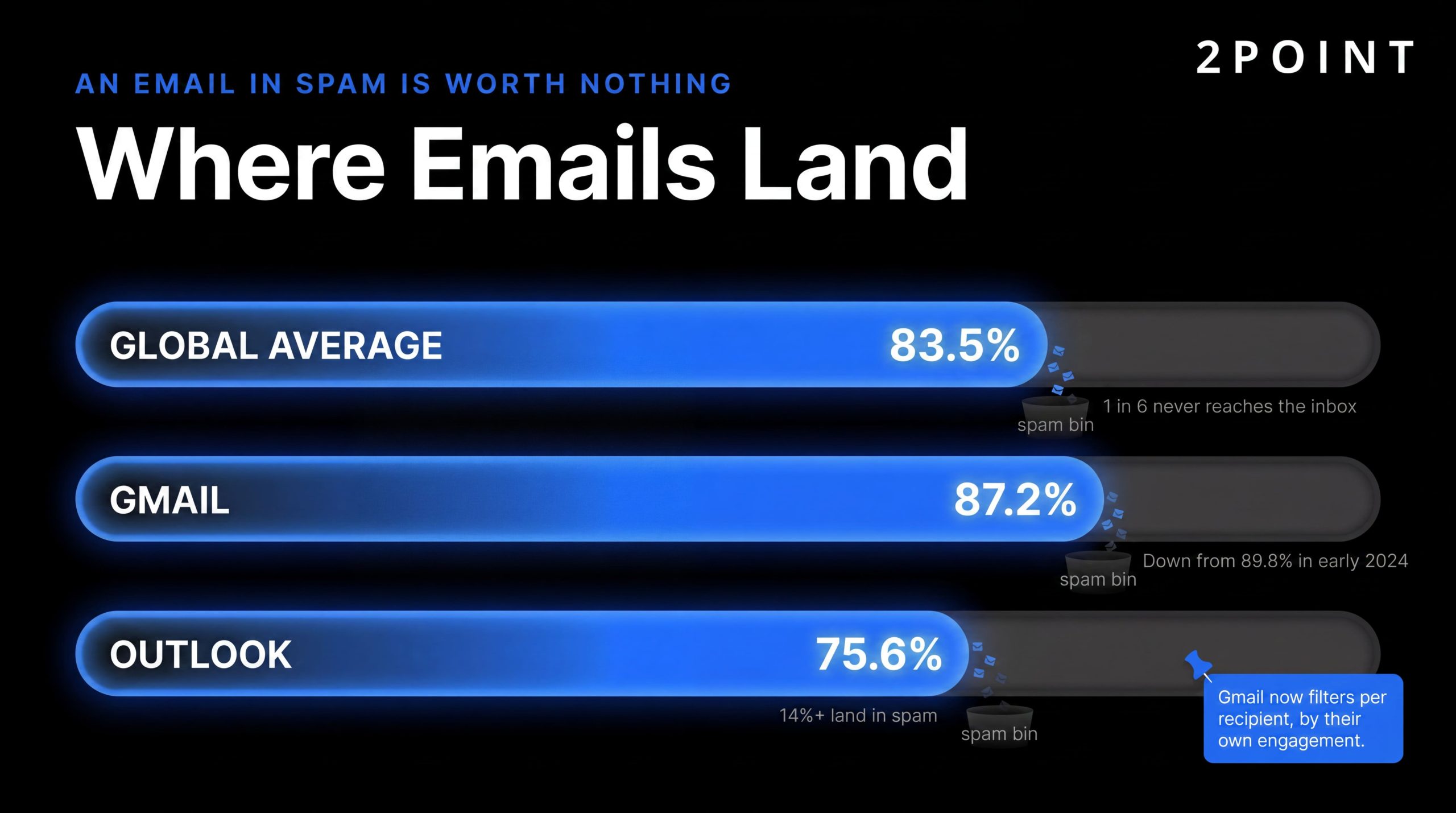
Deliverability represents the foundation of email automation success. The global average inbox placement rate stands at 83.5%, meaning roughly 1 in 6 emails lands in spam folders where they generate zero engagement or revenue. This baseline masks significant provider variation: Gmail achieves 87.2% inbox placement (down from 89.8% in early 2024 following bulk-sender requirement enforcement) while Microsoft/Outlook delivers just 75.6% with 14%+ spam rates, the lowest of major providers.
The simple reality: an email in spam is worth exactly nothing. All automation sophistication, personalization, and content quality becomes irrelevant if messages never reach primary inboxes. This makes deliverability optimization critical to automation ROI. Organizations can achieve perfect open rates on delivered emails yet generate suboptimal results if delivery rates are poor. The mathematical impact compounds: 15% deliverability loss multiplied by engagement and conversion rates creates substantial revenue gaps.
Gmail’s spam filtering now operates behaviorally at the recipient level. AI models personalize inbox placement based on each subscriber’s engagement history with sender domains. This means identical emails sent to two recipients may land in primary inbox for one and spam for another based on their individual engagement patterns. The sender-level reputation metrics that dominated email deliverability for years now combine with recipient-specific behavioral analysis, creating complex placement dynamics that require new approaches.
Technical infrastructure, sender reputation, engagement patterns, and authentication protocols all influence deliverability. Organizations must monitor placement rates by provider, track spam complaint rates, maintain engagement-based suppression policies, and continuously optimize for deliverability alongside traditional metrics like opens and clicks. The 2026 expectation: inbox placement rate will become a standard dashboard KPI alongside revenue and engagement, reflecting its fundamental importance to email program performance.
Disengaged subscribers actively damage deliverability for engaged segments. Recipient-level filtering means that sending to inactive addresses on a list harms placement for active subscribers because providers view overall engagement rates when determining sender reputation. This dynamic makes engagement-based suppression a technical requirement rather than optional best practice. Organizations that fail to suppress inactive segments sacrifice deliverability for their entire database.
The AcreValue case study demonstrates re-engagement value: open rates increased from 5-7% to 60-70% with sunset automation that re-engaged 10% of inactive subscribers in two months. This improvement stems from focusing communication on engaged segments while systematically attempting to reactivate dormant subscribers before removal. The result: higher engagement signals to inbox providers improve placement for the entire list.
Strategic implementation requires defining engagement windows, creating sunset policies, and building re-engagement sequences. Typical engagement windows range from 60-120 days depending on business model and natural purchase cycles. Re-engagement campaigns offer compelling reasons to return while providing easy opt-out paths. Sunset policies systematically remove subscribers who remain unengaged after reactivation attempts, maintaining list quality and protecting sender reputation.
Quality maintenance requires ongoing oversight. Customer abandonment patterns vary: 86% of customers abandon trusted brands after just two poor experiences. Errors like broken links, missing images, or incorrect personalization undermine automation effectiveness and damage sender reputation. Regular quality assurance testing catches issues before they affect thousands of recipients. Organizations that treat list health as critical infrastructure rather than administrative task build sustainable email programs with strong, stable deliverability.
Email spoofing and phishing threats continue to intensify, making authentication protocols critical for both security and deliverability. SPF (Sender Policy Framework), DKIM (DomainKeys Identified Mail), and DMARC (Domain-based Message Authentication, Reporting, and Conformance) work together to verify sender legitimacy and protect domains from impersonation. Implementing all three protocols improves deliverability while protecting brands from fraudulent use of their domains in phishing attacks.
SPF specifies which mail servers are authorized to send email on behalf of a domain. ISPs check SPF records when receiving emails, verifying that messages originate from legitimate sources. DKIM adds encrypted signatures to emails, allowing receiving servers to verify message integrity and confirm they haven’t been altered in transit. DMARC builds on SPF and DKIM, providing policies for how receiving servers should handle messages that fail authentication checks while sending reports back to domain owners about authentication results.
The three protocols create layered security that inbox providers increasingly require for optimal placement. Organizations implementing proper authentication demonstrate legitimacy to ISPs, improving trust scores that influence deliverability. Authentication also protects against domain reputation damage from phishing attacks using spoofed sender addresses. The defensive value alone justifies implementation: fraudulent emails appearing to come from your domain damage customer trust and sender reputation simultaneously.
Implementation requires technical configuration but delivers permanent benefits. Organizations should work with IT teams or email service providers to configure DNS records properly, test authentication status across major ISPs, monitor DMARC reports for authentication failures, and gradually move from monitoring to enforcement policies. Proper authentication has become table stakes for professional email programs. Organizations neglecting these protocols face deliverability disadvantages and security vulnerabilities that undermine all other optimization efforts.
Gmail’s late 2024 rollout of AI-generated email summaries fundamentally changed recipient email experiences. These summaries now appear across mobile and desktop, displaying AI-written abstracts before subscribers decide whether to open messages. The critical insight: these summaries remain invisible in most marketer analytics. Organizations optimizing subject lines and preview text without considering AI summary generation miss a crucial element of recipient decision-making.
Adoption rates indicate significant reach: over 25% of inboxes actively use AI to summarize, categorize, or prioritize email. This percentage continues growing as features roll out across platforms and users discover benefits. The AI intermediation layer between email content and recipient attention requires strategic adaptation. Messages must work effectively both when viewed directly and when filtered through AI interpretation layers.
Email clients have evolved into intelligent workspaces functioning as task managers, lightweight CRMs, and document archives rather than passive message lists. Modern inboxes proactively surface relevant information, automatically categorize incoming mail, suggest actions based on content analysis, and learn from user behavior to improve prioritization. These capabilities fundamentally change how recipients interact with email, creating new opportunities and challenges for marketers.
Strategic implications reshape content approaches. Subject lines and preview text become even more critical as they feed AI summarization algorithms. Content structure should support AI interpretation: clear hierarchies, concise key points early, and logical information flow help AI generate accurate summaries. Organizations should test messages through AI summary features to understand how content translates into automatically generated abstracts. The focus shifts from crafting perfect messages to creating content that works effectively whether consumed directly or through AI mediation layers.
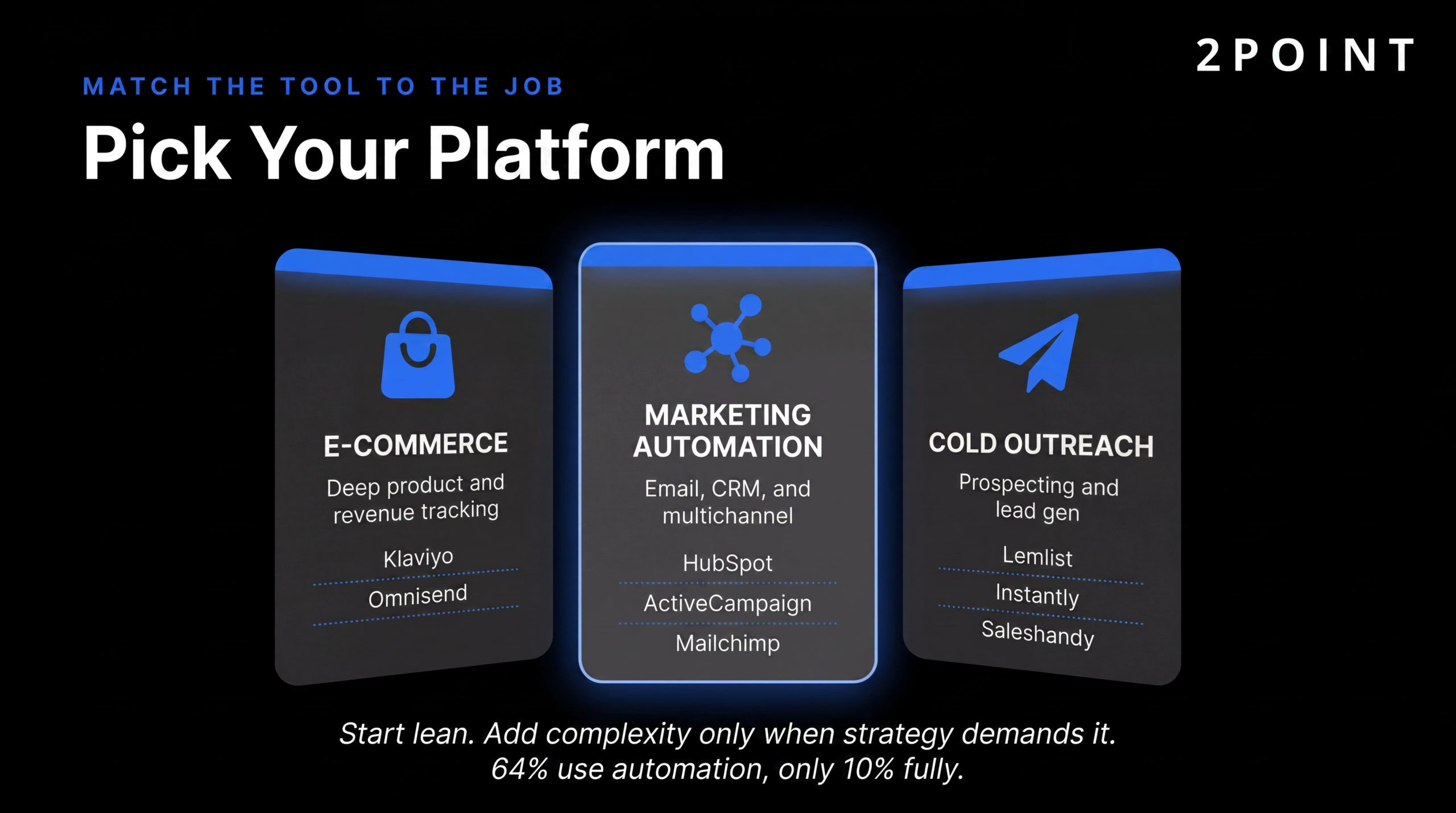
Platform categories serve distinct needs and business models. E-commerce-focused platforms like Klaviyo and Omnisend provide deep product catalog integration, revenue attribution, and e-commerce-specific workflows. Marketing automation platforms like ActiveCampaign, HubSpot, Mailchimp, and GetResponse offer broader capabilities spanning email, CRM, and multi-channel automation. Cold outreach tools like Saleshandy, Lemlist, Instantly.ai, and Brevo specialize in prospecting and lead generation sequences.
Email automation doesn’t require enterprise-level investment. Platforms like Mailchimp, ActiveCampaign, and HubSpot offer scalable solutions for businesses at every stage, with entry-level plans supporting sophisticated automation at modest cost. The recommendation: start lean to clarify which features truly support strategy before expanding to more complex or expensive platforms. Many organizations over-invest in capabilities they never utilize while under-investing in implementation and optimization.
Key evaluation criteria should guide platform selection. Integration capabilities determine how well the platform connects to existing systems like CRM, e-commerce platforms, and analytics tools. Automation workflow complexity defines how sophisticated sequences can become. Reporting features reveal whether the platform provides insights needed for optimization. Pricing structure should align with business model and growth trajectory. Ease of use affects adoption speed and team productivity. AI capabilities indicate platform readiness for emerging automation approaches.
Specialized tools address specific needs. AI email assistants like Lindy offer no-code platforms with 7,000+ integrations for inbox management and automated responses. CRM-integrated platforms like Saleshandy now handle deal tracking alongside email automation, representing convergence between communication and relationship management. Organizations should map automation requirements to platform capabilities, selecting solutions that address current needs while supporting growth into more sophisticated strategies over time.
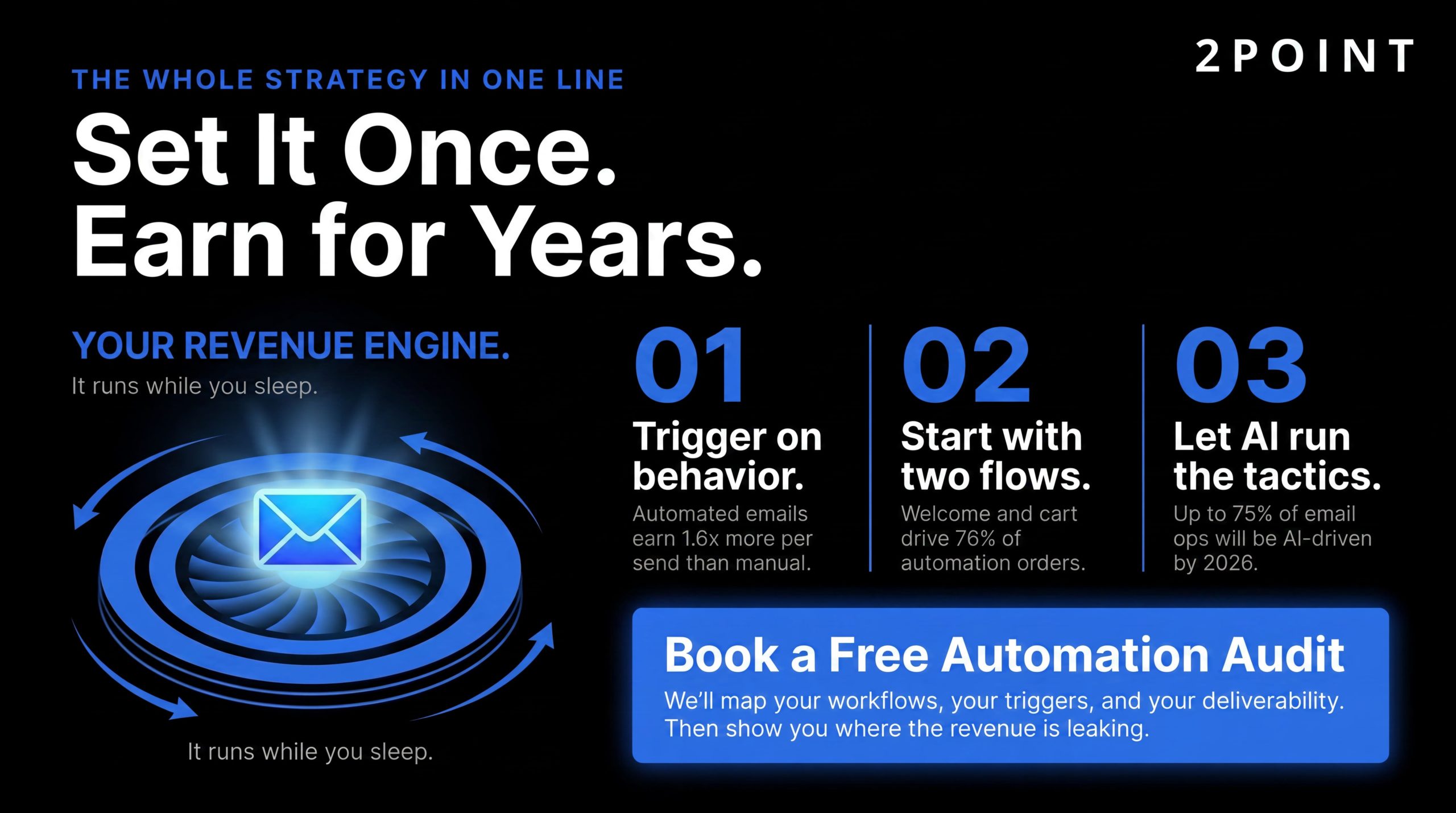
Prioritization maximizes early returns from automation investment. Start with welcome and abandoned cart emails, which together account for 76% of all automation-related orders. Building just these two workflows captures the majority of available automation value. This focused approach proves strategic: rather than attempting to automate everything simultaneously, organizations gain momentum and demonstrate ROI with high-impact workflows before expanding to additional types.
Automation delivers strategic value beyond time-saving. These systems close gaps in lifecycle marketing, ensuring appropriate communication at every customer journey stage. The resource reallocation enables teams to focus on creativity and high-impact activities rather than manual execution. Freed from repetitive tasks, marketers can develop better strategy, create more compelling content, and optimize performance across channels.
The upfront investment in workflow development pays long-term dividends. Email automations are built once, then refined based on performance metrics. This represents a scalable activity requiring minimal ongoing build time with only small optimizations necessary. Unlike manual campaigns that require fresh creation for each send, automated workflows generate returns continuously once implemented. The investment/return ratio improves dramatically over time as automated sequences reach more customers without proportional cost increases.
Building workflow elements requires systematic approach. Trigger selection determines what customer actions or timeline events initiate sequences. Timing sequences establish how long to wait between messages in multi-email workflows. Content creation develops messages that address specific customer needs at each workflow stage. Testing protocols ensure workflows function correctly across scenarios and customer segments. Organizations treating automation development as strategic investment rather than technical project achieve better results through careful planning and iterative optimization.
Email automation reaches maximum effectiveness when connected to broader customer data infrastructure. CRM integration enables sophisticated segmentation and personalization by providing rich customer profiles that inform targeting decisions. The data flow creates a virtuous cycle: customer actions across touchpoints feed automation triggers while email engagement data enriches customer profiles with additional behavioral signals and preference information.
Benefits of integrated systems compound. Unified customer views consolidate data from email, web, purchase history, and customer service interactions, creating comprehensive profiles that inform communication strategy. Coordinated multi-channel campaigns leverage these profiles to deliver consistent experiences across touchpoints. Improved attribution connects email engagement to revenue, providing clearer ROI measurement. Enhanced personalization draws from complete customer histories rather than email behavior alone.
Common integration challenges include data synchronization delays, field mapping complexity, and duplicate record management. Solutions involve careful planning during initial setup, regular data quality audits, and clear data governance policies. Organizations should establish what data flows between systems, how frequently synchronization occurs, how conflicts resolve when data differs across platforms, and who owns data quality maintenance.
Platform convergence accelerates integration trends. Tools like Saleshandy now include CRM capabilities handling deal tracking, eliminating integration complexity by combining functions in single platforms. This convergence benefits organizations seeking simpler technology stacks while maintaining sophisticated capabilities. The trade-off: integrated platforms may offer less depth in individual functions than best-of-breed specialized tools. Organizations should evaluate whether consolidation or integration better serves their specific needs and technical capabilities.
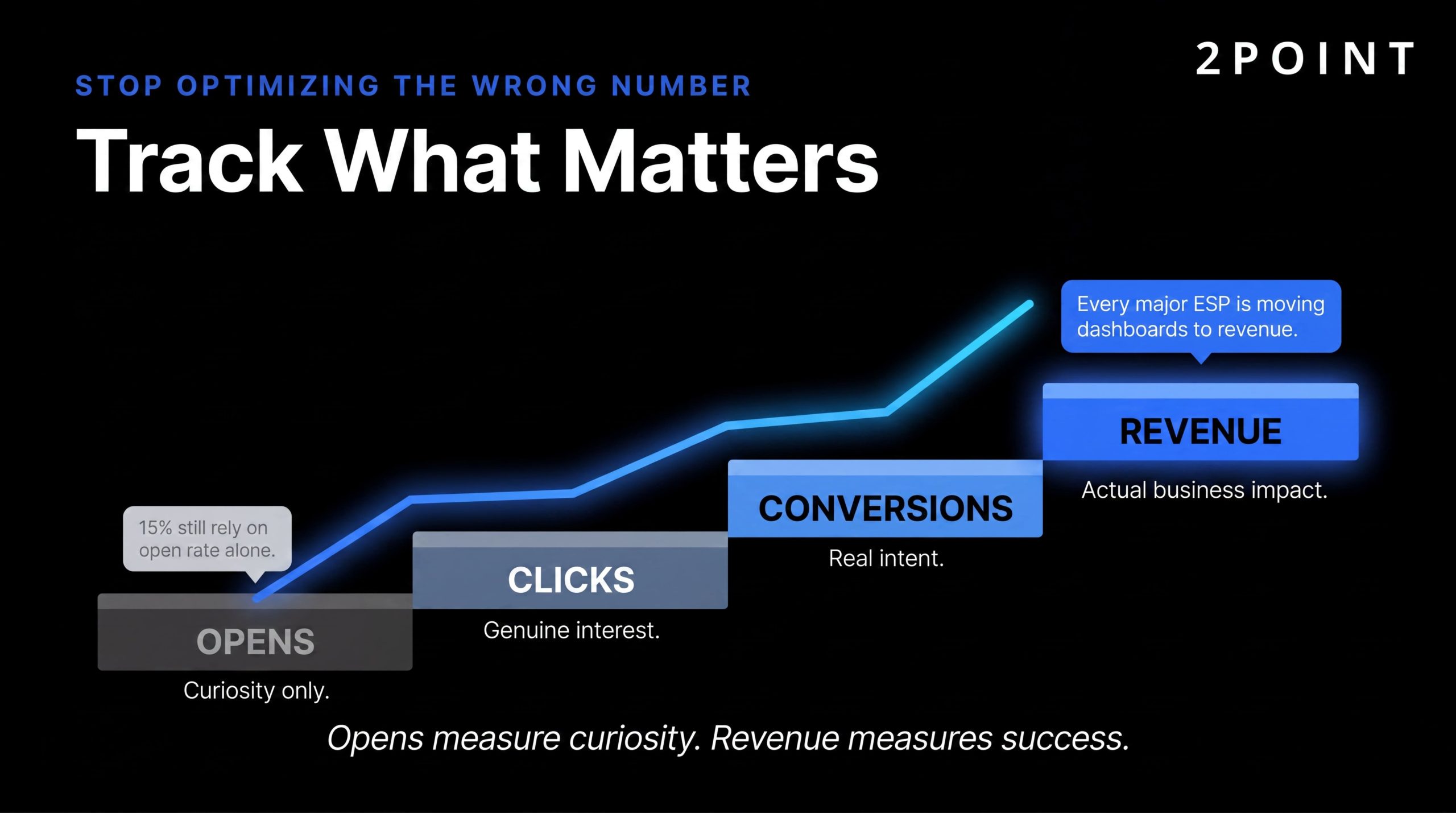
Vanity metrics continue to dominate despite limited strategic value. Currently, 15% of email marketers still rely on open rates as primary success measure, though unique click-through rate (CTR) gains popularity as second most common metric. This focus misallocates attention: open rate measures curiosity while CTR indicates interest and purchase intent provides actual business value. The hierarchy matters because optimization toward wrong metrics produces suboptimal business results.
The expected shift positions engagement as key deliverability factor. Strong sender credibility built on high engagement boosts inbox placement, creating positive feedback loops where engaged audiences improve deliverability, which increases reach, which expands engaged audience. Optimizing for open rate in 2026 resembles measuring website success by page views while ignoring conversion rate: directionally useful but strategically insufficient.
An encouraging trend: all four key metrics trend upward simultaneously for the first time in six years, suggesting industry-wide alignment around quality signals. Opens, clicks, conversions, and revenue per email all improve concurrently, indicating that organizations focusing on engagement and relevance see performance gains across all dimensions. This convergence validates quality-focused strategies over volume-based approaches.
Revenue attribution has become the ultimate measure of email automation success. Every major ESP is expected to restructure default dashboards around revenue attribution within 12 months, reflecting industry recognition that business impact matters more than engagement proxies. Organizations should track revenue per email, customer lifetime value by acquisition source, automation-attributed revenue percentage, and segment-level performance. These metrics directly connect email activities to business results, enabling strategic resource allocation and investment decisions based on actual contribution rather than engagement approximations.
B2B email has transformed from batch-and-blast to sophisticated multi-stakeholder orchestration. The 2026 landscape features intent-based targeting, account-based marketing with personalized messaging for each stakeholder role, leaner sequences with smarter logic, first-party data focus, and micro-segmentation. These approaches recognize B2B complexity: multiple decision-makers, longer sales cycles, and higher-value transactions requiring different strategies than B2C communication.
Email remains central to B2B marketing strategy. Currently, 50% of B2B marketers identify email as the most impactful channel in multi-channel strategy, while 71% use email newsletters as part of content marketing. This prevalence reflects email’s unique ability to deliver detailed information, nurture relationships over extended periods, and reach decision-makers directly in professional contexts.
B2B businesses use content to educate subscribers and convert leads through value-first approaches. Rather than immediate purchase requests, B2B email sequences typically provide educational resources, industry insights, case studies, and thought leadership. This content-centric strategy builds credibility and positions senders as trusted advisors rather than transactional vendors. The longer sales cycles characteristic of B2B require sustained engagement over months, making automation essential for maintaining consistent communication without overwhelming marketing teams.
Account-based marketing automation coordinates messaging across buying committees. Modern workflows can identify multiple stakeholders within target accounts, delivering role-specific content that addresses individual concerns while maintaining coordinated account-level strategy. This sophistication requires integration between email platforms, CRM systems, and intent data sources. Organizations implementing ABM automation report higher conversion rates, shorter sales cycles, and improved alignment between marketing and sales teams through systematic, coordinated outreach to high-value accounts.
E-commerce email automation delivers exceptional returns: automated/triggered emails yield 30x more revenue per recipient than batch campaigns. This performance advantage stems from behavioral targeting that connects communication to demonstrated customer interest. Additionally, 80% of retail companies consider email marketing their most effective customer retention strategy, highlighting its central role in e-commerce success.
Key e-commerce workflows extend beyond basic abandoned cart recovery. Post-purchase sequences confirm orders, provide shipping updates, request reviews, and introduce complementary products. Product recommendation engines analyze purchase history and browsing behavior to suggest relevant items. Replenishment reminders trigger when consumable products likely need reordering based on typical usage patterns. VIP/loyalty programs reward repeat customers with exclusive access and special offers. Review request automations systematically gather social proof that influences future purchases.
Segmentation strategies based on purchase history, browsing behavior, and customer lifetime value enable precise targeting. First-time buyers receive onboarding sequences different from repeat customers. High-value customers get early access to new products and premium support. Price-sensitive segments receive promotion-focused communication while brand-loyal segments hear about new arrivals and exclusive products. This segmentation ensures each customer receives relevant communication aligned with their relationship stage and preferences.
Platforms like Klaviyo and Omnisend are purpose-built for e-commerce with product feed integrations and advanced revenue attribution. These tools automatically sync product catalogs, enabling dynamic content that always reflects current inventory and pricing. Revenue attribution connects email engagement directly to purchase behavior, quantifying each workflow’s contribution to total revenue. This e-commerce-specific functionality provides advantages over general marketing automation platforms, particularly for businesses where product catalog complexity and revenue attribution are priorities.
SaaS businesses face unique automation needs centered on trial conversion, feature adoption, and churn prevention. The customer journey differs fundamentally from transactional e-commerce: success requires ongoing product usage rather than single purchase completion. Email automation for SaaS must guide users through learning curves, demonstrate value continuously, and prevent cancellation through proactive engagement.
Trial conversion sequences aim to demonstrate value before subscription decisions. These workflows typically include onboarding tutorials, feature highlights, use case examples, and success stories that illustrate product benefits. Timing matters: messages should align with typical user progression, introducing advanced features only after basics are mastered. Behavioral triggers based on product usage enable personalized sequences: active users receive different communication than those who haven’t logged in recently.
Feature adoption campaigns introduce functionality systematically, preventing overwhelm while showcasing breadth of capabilities. Rather than explaining every feature immediately, these sequences progressively reveal value over weeks or months. Usage data triggers appropriate communication: if a user hasn’t utilized a specific feature relevant to their use case, targeted emails explain benefits and provide tutorials. This approach maximizes product value realization, increasing satisfaction and reducing churn.
Upgrade and upsell automations identify opportunities based on usage patterns and account characteristics. When customers approach plan limits or consistently use advanced features, targeted communication presents upgrade benefits. Annual billing promotions offer discounts for extended commitments. Add-on features get introduced to accounts whose usage patterns suggest need. Churn prevention workflows detect engagement declines and proactively offer support, training, or incentives before cancellation occurs. The sophistication of SaaS automation reflects product complexity and the ongoing nature of customer relationships requiring continuous value demonstration rather than one-time conversion.
Professional services firms face extended sales cycles requiring sustained relationship development. Lead nurturing automation addresses this challenge through systematic, educational sequences that build credibility over time. Unlike product sales that can close quickly, professional services often require multiple touchpoints, consultations, and trust-building before engagement begins.
Educational content forms the foundation of professional services email strategy. Thought leadership articles, industry analysis, case studies, and best practice guides position firms as experts while providing genuine value to prospects. This content-first approach recognizes that prospects research thoroughly before committing to professional services engagements. Email automation ensures consistent delivery of valuable content without requiring manual campaign creation for each touchpoint.
Segmentation by industry, company size, and service interest enables relevant communication. Law firms might segment by legal specialty and company size. Consulting firms might segment by industry vertical and problem type. Financial advisors might segment by assets under management and service needs. This segmentation ensures prospects receive content relevant to their specific situations rather than generic messaging that fails to resonate.
Lead scoring integration helps identify sales-ready prospects. Automation systems track email engagement, content downloads, webinar attendance, and website behavior, assigning scores that indicate purchase readiness. When scores reach thresholds, automated alerts notify sales teams to initiate direct outreach. This integration between automated nurturing and personal sales engagement creates efficient funnels that maximize conversion while respecting prospect timing. The extended cycles characteristic of professional services require patience and systematic engagement that automation delivers more consistently than manual approaches.
Behavioral segmentation outperforms demographic targeting by focusing on actions rather than attributes. Purchase history, browsing behavior, email engagement patterns, and product interactions reveal intent and preferences more accurately than demographic data alone. This action-based approach creates segments that reflect current customer needs rather than static characteristics that may not indicate immediate interests.
Engagement-based segments identify active versus dormant subscribers, enabling appropriate treatment for each group. Active segments receive regular promotional content and new product announcements. Moderately engaged segments get re-engagement campaigns with compelling offers. Inactive segments enter sunset workflows that attempt reactivation before removal. This tiered approach maintains list quality while maximizing value from each segment.
Purchase behavior segmentation creates powerful targeting opportunities. First-time buyers receive post-purchase sequences different from repeat customers. High-value customers get VIP treatment and exclusive access. Customers whose purchase patterns indicate specific interests receive relevant product recommendations. Lapsed customers who previously purchased regularly trigger win-back campaigns. These segments reflect actual customer relationships rather than assumed preferences.
Product interaction data enables sophisticated personalization. Customers who browse specific categories receive related product recommendations. Customers who view items without purchasing get browse abandonment emails. Customers who purchase complementary products see cross-sell opportunities. This behavioral intelligence creates relevance at scale, ensuring each recipient receives communication aligned with their demonstrated interests. The result: higher engagement, stronger conversion rates, and improved customer experiences that feel individually tailored despite operating through automated systems.
AI recommendation engines analyze vast datasets to predict which products individual customers will find most relevant. These systems evaluate purchase history, browsing behavior, items in cart, products viewed by similar customers, trending items, and seasonal patterns. The algorithmic sophistication far exceeds manual curation, identifying patterns and correlations that humans cannot process at scale.
Collaborative filtering examines what similar customers purchased to suggest products. If customers who bought item A frequently also purchase item B, the system recommends item B to new customers who’ve purchased item A. This approach leverages collective intelligence from entire customer bases, surfacing relationships that may not be obvious from individual customer analysis alone.
Content-based filtering recommends products similar to items customers have shown interest in. If a customer browses running shoes, the system suggests other athletic footwear and running apparel. This approach maintains relevance by staying within established interest areas rather than making unrelated suggestions that may feel random or intrusive.
Hybrid approaches combine multiple recommendation strategies for optimal results. Modern systems might use collaborative filtering for returning customers with rich purchase histories while defaulting to content-based or trending item recommendations for new customers with limited data. Machine learning continuously optimizes which approach works best for different customer segments and contexts. Implementation in email automation enables every message to include personalized product recommendations that increase click-through rates, average order values, and overall revenue per email sent.
Send time significantly impacts email engagement, yet optimal timing varies by individual rather than following universal patterns. Machine learning systems analyze each subscriber’s open and click patterns, identifying when they typically engage with email. This individual-level optimization outperforms batch sends scheduled for assumed peak times that may not align with specific recipient behaviors.
The technology tracks engagement timestamps across dozens or hundreds of messages, building statistical models of each person’s email checking habits. Some recipients consistently open emails during morning commutes. Others engage during lunch breaks or evening downtime. The patterns vary widely, making one-size-fits-all send times suboptimal for large portions of every list.
Implementation varies by platform. Some systems automatically schedule each email delivery at the predicted optimal time for individual recipients, meaning a single campaign sends gradually over several hours as optimal windows arrive for different subscribers. Other platforms recommend optimal send times by segment, enabling manual scheduling that approximates individual optimization without requiring hours-long send windows.
The performance impact justifies implementation complexity. Open rate improvements of 10-20% are common when shifting from fixed send times to individual optimization. These gains compound across subsequent engagement: higher opens lead to more clicks, which generate more conversions. Organizations implementing send time optimization should monitor results by segment to ensure algorithms perform well across different customer groups and adjust strategies if certain segments show degraded performance.
Dynamic content enables single email templates to display different content for different recipients based on their attributes, behaviors, or preferences. Rather than creating separate campaigns for each segment, dynamic emails contain conditional content blocks that automatically show or hide based on recipient data. This approach dramatically reduces campaign creation time while increasing relevance.
Common dynamic content applications include product recommendations that vary by recipient, location-specific information like store addresses or regional offers, gender-specific product displays, content in preferred language, and images that reflect browsing history. The technical implementation involves defining rules that determine which content version each recipient sees based on data in their customer profile or behavioral history.
Benefits extend beyond efficiency. Dynamic content increases relevance by ensuring each recipient sees content aligned with their interests and characteristics. It enables sophisticated personalization at scale that manual segmentation cannot match. It reduces campaign proliferation by consolidating multiple segment-specific campaigns into single dynamic templates. Testing becomes easier because variations exist within single campaigns rather than across multiple versions.
Implementation requires structured customer data and platform capabilities that support dynamic content rules. Organizations should start with simple implementations like gender-specific product displays or location-based information before advancing to complex, multi-variable dynamic content. Testing across recipient types ensures proper rule execution and content display. When implemented effectively, dynamic content transforms generic broadcasts into highly personalized experiences that drive engagement and conversion while actually reducing campaign creation workload.
Customer acquisition costs significantly exceed retention expenses, making win-back campaigns valuable for recovering lapsed relationships. These workflows target customers who previously purchased but have become inactive, attempting to reestablish engagement through compelling offers, product updates, or simple reconnection. The economic logic is straightforward: reactivating a previous customer costs far less than acquiring a new one while typically generating higher lifetime value due to established purchase history.
Defining “dormant” depends on business model and typical purchase cycles. E-commerce businesses might consider customers inactive after 90 days without purchase. Software subscriptions would focus on canceled accounts. Professional services might define inactivity as 6-12 months without engagement. The key is establishing thresholds that reflect meaningful disengagement while allowing time for natural purchase cycle variation.
Effective win-back content acknowledges the lapsed relationship directly rather than pretending continuous engagement. “We’ve missed you” messaging feels authentic while creating opportunity to explain what’s new since the customer last engaged. Special reactivation offers provide tangible reasons to return. Product or feature updates highlight improvements that address previous limitations. Customer success stories demonstrate ongoing value.
The AcreValue case study demonstrates win-back potential: their sunset automation increased open rates from 5-7% to 60-70% and re-engaged 10% of inactive subscribers in two months. This success stems from systematic approach combined with compelling offers and clear value propositions. Organizations implementing win-back campaigns should test different messages, offers, and timing to identify what resonates with their specific dormant segments. Success metrics should track reactivation rates, subsequent purchase rates, and long-term retention of reactivated customers to calculate true campaign ROI.
Email automation amplifies loyalty program effectiveness by delivering timely rewards notifications, status updates, and exclusive offers. Rather than requiring customers to check portals for points balances or available rewards, automated emails proactively communicate loyalty benefits. This integration ensures program value stays top-of-mind, increasing engagement and redemption rates that drive repeat purchases.
Tier progression notifications celebrate advancement through loyalty levels while highlighting new benefits available at higher tiers. These messages leverage achievement psychology, creating positive associations with brands while incentivizing additional purchases needed to reach next levels. The timing is critical: notifications should arrive immediately upon tier achievement to maximize emotional impact and celebrate the milestone.
Exclusive VIP campaigns segment by loyalty status, delivering differentiated experiences that make high-value customers feel recognized and appreciated. Early access to new products, special sales, or limited editions creates tangible benefits that justify loyalty program participation. VIP-only content, events, or experiences deepen emotional connections beyond transactional relationships. These exclusive experiences transform loyalty from points accumulation into genuine brand affinity.
Points expiration warnings prevent value forfeiture while driving redemption behavior. Automated reminders notifying customers of soon-to-expire points create urgency that converts dormant loyalty currency into active purchases. Birthday bonuses, anniversary rewards, and surprise-and-delight gifts add emotional resonance to what could otherwise feel purely transactional. The integration between loyalty programs and email automation creates systematic engagement that builds long-term relationships while generating measurable revenue through increased purchase frequency and higher average order values from loyal customer segments.
The customer journey continues after purchase, yet many organizations focus exclusively on acquisition while neglecting post-purchase engagement. Automated post-purchase sequences fill this gap, confirming orders, providing shipping updates, offering product education, and laying groundwork for repeat purchases. These workflows transform single transactions into ongoing relationships while reducing support burden through proactive communication.
Order confirmation emails serve practical functions while setting tone for the relationship. Beyond transaction details, these messages can include expected delivery timelines, return policy information, and customer service contact methods. The immediate delivery (within minutes of purchase) provides reassurance while capturing attention at peak interest. Open rates for order confirmations typically exceed 70%, making them valuable real estate for cross-sell suggestions or loyalty program invitations.
Shipping notifications keep customers informed while building anticipation. Multiple touchpoints (processing, shipped, out for delivery, delivered) maintain engagement throughout fulfillment. These functional updates can include product use tips, complementary product suggestions, or invitations to share purchases on social media. The practical value ensures high engagement rates, creating opportunities for secondary marketing messages that avoid feeling intrusive.
Post-delivery sequences shift focus to product satisfaction and relationship development. Product education emails help customers maximize value from purchases through use tips, recipes, styling suggestions, or maintenance guidance. Review request automations systematically gather social proof while identifying satisfaction issues before they escalate to public complaints. Replenishment reminders for consumable products arrive when items likely need reordering, combining helpfulness with revenue generation. Cross-sell sequences suggest complementary products based on purchase history. These touchpoints maintain engagement between purchases, increasing customer lifetime value while building relationships that transcend individual transactions.
Subscription businesses require specialized automation addressing recurring billing, renewal management, and churn prevention. Unlike one-time purchase models, subscriptions demand ongoing value demonstration and proactive engagement to maintain revenue. Email automation becomes critical infrastructure for managing subscriber lifecycle from initial conversion through long-term retention.
Renewal reminder sequences prepare subscribers for upcoming billing, reducing surprise charges that trigger cancellations. These communications typically begin 30-60 days before renewal, providing ample time for decision-making. Content should highlight value received during the subscription period, feature upcoming enhancements, and offer incentives for annual commitments when applicable. Payment failure recovery automations address declined cards immediately, providing update links before subscriptions lapse.
Usage-based engagement monitoring identifies at-risk subscriptions before cancellation occurs. Declining login frequency, reduced feature usage, or abandoned workflows signal disengagement. Automated check-in sequences can offer assistance, share relevant resources, or gather feedback about barriers to usage. This proactive outreach demonstrates commitment to subscriber success while addressing issues before they lead to churn.
Cancellation prevention workflows trigger when subscribers initiate cancellation, presenting retention offers, addressing common objections, or offering pause options instead of permanent cancellation. These last-chance sequences recover some percentage of would-be cancellations while gathering valuable feedback about why subscribers leave. Win-back campaigns target canceled subscribers with reactivation offers, new features, or pricing adjustments that address previous objections. The systematic approach to subscription lifecycle management through email automation reduces churn rates while maximizing customer lifetime value, directly impacting recurring revenue and business sustainability.
Privacy regulations have proliferated globally, creating complex compliance landscapes for email marketers. GDPR (General Data Protection Regulation) in the European Union establishes strict requirements for consent, data processing, and individual rights. CCPA (California Consumer Privacy Act) and its successor CPRA create similar frameworks in California. Dozens of other jurisdictions have implemented or are developing privacy laws, creating patchwork compliance requirements for organizations operating internationally.
Core principles span most privacy regulations. Consent must be freely given, specific, informed, and unambiguous. Individuals have rights to access their data, request deletion, and opt out of certain processing. Organizations must implement appropriate security measures, conduct privacy impact assessments for high-risk processing, and report breaches within specified timeframes. Privacy by design requires embedding data protection into systems and processes from inception rather than adding it afterward.
Email-specific implications affect list building, data retention, and communication practices. Pre-checked consent boxes are prohibited; subscribers must take affirmative action to opt in. Consent must be granular, allowing separate preferences for different message types. Subscriber data cannot be used for purposes beyond those disclosed at collection without obtaining new consent. Unsubscribe mechanisms must be simple and immediate. Data retention policies must define and enforce appropriate timeframes for deleting inactive subscriber information.
Compliance requires both technical and organizational measures. Platforms should support consent management, preference centers, and automated data deletion. Policies must document legal bases for processing, data retention periods, and security measures. Training ensures teams understand compliance requirements and implement them consistently. Regular audits verify ongoing compliance as regulations evolve. Organizations operating globally should implement frameworks meeting the strictest applicable standards to simplify compliance across jurisdictions while protecting subscriber rights universally.
CAN-SPAM (Controlling the Assault of Non-Solicited Pornography and Marketing Act) establishes requirements for commercial email in the United States. While less restrictive than GDPR, CAN-SPAM creates baseline standards that all US-focused email programs must meet. Violations carry substantial penalties, with fines up to $51,744 per email in violation, making compliance critical for avoiding legal and financial risk.
Key requirements include accurate header information (from, to, and routing information must be accurate and identify the sender), honest subject lines (subject lines cannot deceive recipients about content), clear identification of messages as advertisements (unless prior relationship exists), disclosure of sender location (valid physical postal address must appear), obvious opt-out mechanisms (unsubscribe options must be clear and conspicuous), rapid opt-out processing (requests must be honored within 10 business days), and monitoring of third parties (organizations are liable for email sent on their behalf).
Best practices exceed minimum requirements, building subscriber trust while ensuring compliance. Clear sender identification helps recipients recognize emails and reduces spam complaints. Prominent, functional unsubscribe links in every email respect subscriber preferences and meet legal requirements. Immediate opt-out processing (rather than waiting the allowed 10 days) improves subscriber experience. Preference centers allow granular control over message types and frequency rather than all-or-nothing unsubscribe. Regular compliance audits catch issues before they generate violations.
Email service providers typically include compliance features, but responsibility remains with senders. Organizations should verify that platforms support required elements, implement documented processes for honoring unsubscribe requests, maintain suppression lists to prevent re-sending to opted-out addresses, and train team members on compliance requirements. The combination of technical safeguards and operational processes creates sustainable compliance that protects organizations while respecting subscriber preferences and legal rights.
Modern consent management extends beyond simple opt-in/opt-out to granular preference control. Rather than treating email permission as binary, sophisticated preference centers allow subscribers to specify exactly what communication they want to receive. This approach respects individual preferences while maximizing engaged audience size by retaining subscribers who might otherwise unsubscribe due to unwanted message types.
Effective preference centers include message type selections (promotional, educational, transactional), frequency controls (daily, weekly, monthly), topic or category preferences (products or content areas of interest), and channel choices (email, SMS, push notifications). The interface should be intuitive and mobile-friendly, ensuring subscribers can easily adjust preferences without frustration. Changes should take effect immediately or within clearly stated timeframes.
Consent documentation proves critical for regulatory compliance. Systems should record when consent was obtained, what was consented to, how consent was obtained, and IP addresses or other technical identifiers. This documentation demonstrates compliance if challenged by regulators or subscribers. Consent should be version-controlled, tracking changes over time as terms or purposes evolve.
Progressive consent gathering collects permissions gradually rather than requesting everything upfront. Initial signup might capture email address and basic preferences. Subsequent engagement opportunities gather additional permissions for SMS, detailed interest areas, or expanded data collection. This approach reduces friction at entry while building more complete profiles over time. Regular preference confirmation emails ensure preferences remain current and demonstrate ongoing respect for subscriber control. Organizations treating preference management as relationship builder rather than compliance checkbox create better subscriber experiences while actually improving engagement through more relevant, wanted communication.
Email accessibility ensures content reaches all recipients regardless of disabilities or assistive technology usage. Legal frameworks like the Americans with Disabilities Act (ADA) in the US and similar laws globally establish requirements for digital accessibility. Beyond compliance, accessible design expands reach, improves user experience universally, and demonstrates organizational values around inclusion.
Core accessibility principles include semantic HTML that screen readers can interpret logically, sufficient color contrast for visual clarity (WCAG requires 4.5:1 ratio for normal text, 3:1 for large text), descriptive alt text for all images, keyboard navigation support for interactive elements, clear visual hierarchy that guides reading order, and readable font sizes (14px minimum, 16px preferred). These technical requirements create emails that work across assistive technologies while improving usability for all recipients.
Alt text deserves particular attention. Every image should include descriptive alternative text that conveys meaning or function for screen reader users. Decorative images should use empty alt attributes (alt=””) to prevent unnecessary screen reader announcements. Complex images like charts should include extended descriptions in surrounding text or accessible captions. Call-to-action buttons should have descriptive labels that make purpose clear without visual context.
Testing across assistive technologies ensures accessibility implementation works in practice. Screen readers like JAWS, NVDA, or VoiceOver reveal how content is experienced by blind users. Keyboard-only navigation testing verifies that all interactive elements are accessible without a mouse. Color blindness simulators check whether information conveyed through color alone remains understandable. Organizations should include accessibility in standard QA processes, treating it as essential functionality rather than optional enhancement. The result: emails that reach broader audiences, comply with legal requirements, and demonstrate commitment to inclusive communication practices.
A/B testing provides empirical evidence for optimization decisions, replacing opinions with data. Systematic testing improves performance incrementally, with gains compounding over time. However, effective testing requires methodology: random tests without strategic focus waste resources without generating meaningful insights. Organizations should develop testing roadmaps that systematically optimize high-impact elements.
Subject lines represent the most common test target, directly influencing open rates. Variables include length, personalization, emoji usage, urgency indicators, and question versus statement formats. Testing should isolate single variables to clearly attribute results. Sample sizes must reach statistical significance (typically requiring thousands of recipients per variation). Duration should account for sending time effects by testing over similar timeframes.
Content testing examines message bodies, calls-to-action, images, and layouts. Single versus multiple calls-to-action, button colors, content length, personalization depth, and image versus text-heavy approaches all affect engagement. Product recommendation strategies, social proof placement, and urgency element positioning warrant testing. Each test should have clear hypothesis and success metrics defined before launch.
Testing frequency balances learning velocity with statistical rigor. Testing too frequently prevents reaching significance while testing too infrequently slows optimization. Most organizations should run 2-4 tests monthly across major campaigns, allowing two weeks per test for adequate sample size. Multivariate testing examines multiple variables simultaneously but requires substantially larger audiences to achieve statistical significance. Organizations should document results systematically, building institutional knowledge about what works for specific audiences rather than repeating tests indefinitely.
Multivariate testing examines multiple variables simultaneously, revealing interaction effects between elements. While A/B testing isolates single variables, multivariate approaches test combinations like subject line + send time + call-to-action button color together. This complexity requires larger audiences but reveals synergies or conflicts between elements that sequential A/B tests might miss.
Implementation requires technical capabilities beyond basic A/B testing. Platforms must support multiple simultaneous variations and proper statistical analysis of results. Sample size requirements increase exponentially with variables tested: while A/B tests might need 1,000 recipients per variation for significance, multivariate tests with three variables and two variations each require 8,000 total recipients to properly test all combinations.
Use cases focus on high-value campaigns where optimization impact justifies complexity. Welcome email series, abandoned cart sequences, and major promotional campaigns warrant multivariate testing due to revenue impact. Low-volume campaigns lack sufficient traffic for meaningful results. Organizations should master A/B testing before attempting multivariate approaches to ensure analytical capability and statistical literacy needed for proper interpretation.
Analysis focuses on identifying winning combinations rather than isolated element performance. The optimal subject line when paired with one call-to-action might differ from the optimal subject line with another call-to-action. These interaction effects reveal nuances that sequential testing cannot capture. Organizations should document winning combinations and test whether they perform consistently across future campaigns or represent one-time results. The complexity and resource requirements of multivariate testing mean it should complement rather than replace simpler A/B testing that addresses most optimization needs.
Optimization is ongoing process rather than one-time project. Markets evolve, audiences change, competitors adjust, and platform capabilities expand. Organizations that continuously optimize maintain performance advantages while those treating optimization as occasional activity see results stagnate or decline. The approach requires culture and process changes alongside technical capabilities.
Baseline measurement establishes starting points for improvement. Organizations should document current performance across key metrics: open rates, click rates, conversion rates, revenue per email, and deliverability indicators. Segmented baselines reveal variation across customer types, message categories, or automation workflows. These benchmarks enable objective assessment of whether changes improve or degrade performance.
Testing roadmaps prioritize high-impact optimization opportunities. Rather than random testing, strategic approaches focus on elements with greatest potential impact. Subject lines affect opens which influence all downstream metrics. Calls-to-action directly impact conversion. Send timing affects opens and engagement. Personalization influences relevance and conversion. Strategic roadmaps systematically address these high-leverage elements before optimizing minor details.
Regular review cycles institutionalize continuous improvement. Monthly performance reviews examine trends, identify anomalies, and adjust strategies. Quarterly deep-dives analyze automation workflows, segment performance, and strategic alignment. Annual assessments evaluate platform capabilities, competitive positioning, and major strategic shifts. This rhythm of review ensures optimization remains active rather than getting deprioritized by daily execution demands. Organizations embedding optimization into regular workflows achieve sustained performance improvements that compound over years.
Analytics transform data into actionable insights when interpreted strategically. Raw metrics like open and click rates provide starting points, but deeper analysis reveals patterns, trends, and opportunities that surface-level numbers obscure. Organizations should develop analytical capabilities that extract maximum insight from available data rather than simply monitoring dashboards.
Cohort analysis compares performance across customer segments, time periods, or campaign types. Does performance vary by acquisition source, indicating some channels attract more engaged subscribers? Do recent subscribers engage differently than long-term list members? Do certain product categories drive higher engagement than others? These comparisons reveal strategic insights about where to focus acquisition efforts, which content resonates, and how relationships evolve over time.
Funnel analysis tracks customer progression through email sequences. What percentage open the first welcome email? Of those, how many click? Of clickers, how many purchase? Where do drop-offs concentrate? These conversion funnel insights pinpoint friction points and optimization opportunities. A sequence with high open rates but low clicks suggests content or call-to-action problems. High click rates but low conversion may indicate website or offer issues rather than email problems.
Attribution analysis connects email engagement to business outcomes. Which automation workflows drive the most revenue? What’s the contribution of email versus other channels in multi-touch customer journeys? How does email-attributed revenue compare to investment in platform costs and team time? These economic analyses justify continued investment while identifying highest-performing strategies worthy of expansion. Organizations should integrate email analytics with broader business intelligence, understanding email’s role within complete customer acquisition and retention economics rather than viewing it in isolation.
Automation capability doesn’t justify maximizing send frequency. Every triggered workflow adds to total recipient email volume, creating cumulative burden. Organizations implementing multiple automations without considering total subscriber experience risk fatigue, declining engagement, and increased unsubscribe rates. Strategic restraint often produces better results than comprehensive automation.
Frequency capping prevents overwhelming subscribers with automated messages. Systems should track total emails sent to individuals across all workflows, suppressing additional sends when thresholds are exceeded. This cross-workflow view prevents scenarios where subscribers simultaneously receive welcome series, abandoned cart reminders, product recommendations, and promotional emails within days. The individual workflows may be perfectly designed yet collectively create negative experiences.
Signs of over-automation include declining engagement rates over time, increasing unsubscribe rates, rising spam complaints, and recipient feedback about too many emails. Analytics should track engagement trends by email volume, identifying whether subscribers receiving more automated emails show lower engagement than those receiving fewer. Negative correlations suggest over-automation problems requiring workflow consolidation or frequency reduction.
Quality beats quantity in email strategy. Organizations should prioritize highest-impact workflows and restrain impulses to automate everything possible. The optimal approach delivers value through each message rather than maximizing touchpoints. Subscribers should anticipate emails with interest rather than dreading another message. Organizations achieving this balance see sustained engagement, strong deliverability, and positive brand associations where email becomes relationship builder rather than nuisance.
Mass email approaches waste automation potential. Sending identical messages to entire lists ignores the data and capabilities that make email powerful. Recipients increasingly expect relevance, with 71% expecting personalized experiences across digital channels. Generic content that fails to reflect individual interests, behaviors, or preferences underperforms dramatically compared to properly segmented approaches.
The segmentation paradox: many organizations collect rich customer data yet fail to use it for targeting. Purchase history, browsing behavior, engagement patterns, and demographic information sit unused while broadcast campaigns treat all subscribers identically. This missed opportunity stems from lack of strategic segmentation planning rather than technical limitations. Organizations should map available data to potential segments and systematically implement targeting based on most valuable differentiators.
Starting simple accelerates implementation over waiting for perfect segmentation. Basic segments based on engagement level (active, moderately active, inactive), customer status (prospect, first-time buyer, repeat customer), or product interest enable substantial improvements over no segmentation. These foundational segments can expand over time as data richness and analytical sophistication increase. The important step is moving from one-size-fits-all to differentiated communication.
Content relevance directly impacts all performance metrics. Segmented campaigns generate 760% more revenue than non-segmented approaches, reflecting how personalization drives engagement and conversion. Organizations investing in automation infrastructure should invest equally in segmentation strategy, ensuring sophisticated sending capabilities pair with relevant content that justifies recipient attention and engagement.
Mobile devices dominate email consumption: adults spend nearly 7 hours daily on screens with mobile accounting for over half of web traffic. Email specifically shows strong mobile preference, with 50% of recipients deleting emails not optimized for mobile. Organizations neglecting mobile optimization immediately lose half their potential audience through poor experiences that damage engagement and revenue.
Mobile optimization requirements differ from desktop design. Single-column layouts work better on narrow screens than multi-column designs. Font sizes must be larger (minimum 14px for body text) for readability on small displays. Buttons need sufficient size and spacing for touch accuracy without precision mouse cursor. Image file sizes should optimize for mobile bandwidth. Content hierarchy becomes critical when scrolling replaces at-a-glance viewing.
Testing across devices and email clients reveals rendering issues before launch. Emails render differently across iPhone Mail, Gmail app, Android native email, and desktop clients. Organizations should test major variations to ensure acceptable experiences universally. Litmus, Email on Acid, and similar tools provide screenshot previews across dozens of environments. Regular testing catches problems before they reach subscribers.
Responsive design automatically adapts layouts based on screen size, providing appropriate experiences across devices from single code base. This approach reduces development complexity compared to maintaining separate mobile and desktop versions. Modern email platforms include responsive templates as standards. Organizations building custom templates should implement responsive techniques or risk degraded mobile experiences that undermine otherwise strong content and strategy.
Sophisticated automation means nothing if emails don’t reach inboxes. Organizations obsessing over subject line optimization while neglecting deliverability fundamentals waste resources on campaigns that never get opened because they land in spam. Deliverability foundation includes authentication (SPF, DKIM, DMARC), engagement-based list management, infrastructure reputation, and content quality.
Common deliverability mistakes include sending to purchased lists that damage sender reputation immediately, neglecting authentication protocols that mark emails as suspicious, ignoring engagement metrics and continuing to send to unengaged recipients, using spam-trigger content or misleading subject lines, and failing to monitor deliverability indicators like inbox placement rates and spam complaints. Each mistake compounds: poor practices create negative feedback loops where declining reputation further reduces deliverability.
Recovery from deliverability problems takes significantly longer than prevention. Damaged sender reputation requires weeks or months to rebuild through consistent good practices. Organizations in deliverability trouble must reduce send volumes, focus on highly engaged segments, improve content quality, implement aggressive list hygiene, and gradually rebuild reputation. This process suspends aggressive growth strategies, making prevention far preferable to cure.
Proactive monitoring catches issues early. Organizations should track inbox placement rates by provider (Gmail, Outlook, Yahoo), monitor spam complaint rates, watch for sudden engagement drops that signal deliverability problems, and review authentication status regularly. Many email service providers offer deliverability dashboards and alerts. Organizations taking deliverability seriously assign responsibility explicitly rather than assuming platforms handle everything automatically. The foundation of successful email automation is reaching inboxes consistently—everything else depends on this fundamental requirement.
Email automation continues to evolve through technological advancement and changing consumer expectations. AI capabilities expand beyond current personalization and optimization to more sophisticated applications. Predictive models will forecast customer needs before explicit signals emerge, triggering proactive communication. Natural language generation will create individually customized message copy at scale. Computer vision will analyze customer-generated images to understand preferences and trigger relevant product recommendations.
Voice integration may connect email and voice assistants, enabling subscribers to interact with email content through spoken commands. “Alexa, read my emails” could evolve into “Alexa, show me that product from the email I received yesterday.” This voice-email convergence creates new interaction models requiring different content strategies and technical implementation than current text-and-image approaches.
Augmented reality email experiences could allow virtual product trials within messages. Fashion retailers might enable trying on clothes virtually. Furniture companies could show how pieces look in subscriber homes. Cosmetics brands might offer virtual makeup application. These immersive experiences blur lines between email, e-commerce, and entertainment while reducing purchase friction through try-before-buy functionality.
Blockchain applications could verify sender authenticity cryptographically, potentially solving persistent phishing and spoofing problems. Decentralized identity systems might give subscribers more control over personal data while enabling richer, consensual data sharing. These fundamental infrastructure changes could reshape trust dynamics and privacy frameworks that currently constrain email marketing practices.
AI automation expansion doesn’t eliminate human roles but transforms them. As tactical execution becomes automated, human value concentrates in strategy, creativity, and emotional intelligence that machines cannot replicate. The marketer’s role evolves from campaign executor to strategist who directs AI capabilities toward business objectives while maintaining authentic human connection in brand communication.
Strategic direction remains fundamentally human. AI can optimize tactics within defined parameters but struggles with broader questions about brand positioning, competitive differentiation, and long-term vision. Humans define which customer problems to solve, what brand personality to project, and how to balance short-term performance with long-term relationship building. These strategic decisions guide AI execution rather than being replaced by it.
Creative development leverages human cultural understanding and emotional intelligence. While AI can generate copy variations, humans conceptualize campaign themes, craft compelling narratives, and ensure authentic brand voice. Emotional resonance, humor, cultural sensitivity, and creative risk-taking remain human domains where AI assistance amplifies rather than replaces human creativity. The best outcomes combine human creative direction with AI execution scale.
Ethical oversight requires human judgment as AI capabilities expand. Decisions about personalization boundaries, data usage limits, and communication frequency involve values and ethics beyond algorithmic optimization. Humans must ensure AI systems respect privacy, avoid manipulation, and maintain authentic relationships rather than purely optimizing metrics. This ethical guardrail function becomes more important as AI capabilities increase and potential for misuse expands.
Success with advanced automation requires organizational readiness beyond technical implementation. Skill development, process adaptation, and cultural change enable effective utilization of sophisticated capabilities. Organizations should assess current state honestly and develop systematic plans for building necessary competencies rather than assuming technology alone delivers results.
Team skill development addresses current gaps that limit automation effectiveness. 75% of marketing teams report no AI training, while 59% of marketing operations teams lack AI and automation expertise. Organizations should invest in training covering automation strategy, platform capabilities, data analysis, and ethical AI use. External expertise through consultants or agencies can accelerate learning while building internal capabilities.
Process redesign aligns workflows with automation capabilities. Manual approval processes that worked for occasional campaigns create bottlenecks when automation generates dozens of message variations. Organizations should streamline review procedures, implement clear governance frameworks defining what requires approval, and create feedback loops that continuously improve automated systems. The goal: processes that enable rapid iteration while maintaining quality and brand consistency.
Data infrastructure investment ensures automation systems have fuel they need. Fragmented data across disconnected systems limits personalization and segmentation potential. Organizations should prioritize data integration, implement customer data platforms that unify information, establish data quality standards and monitoring, and create clear data governance defining ownership and usage policies. Strong data foundation enables sophisticated automation that fragmented data cannot support.
Short-term optimization can undermine long-term sustainability if not balanced with relationship building and list health maintenance. Organizations should develop strategies that deliver immediate performance while strengthening foundation for continued success years into the future. This balance requires resisting temptation to maximize short-term metrics at long-term expense.
Permission and trust remain fundamental to sustainable email programs. Growing lists through questionable tactics, pushing frequency beyond subscriber tolerance, or exploiting personalization in creepy ways may boost short-term metrics while damaging long-term relationships. Organizations should prioritize subscriber experience, transparent data practices, and value delivery that makes recipients genuinely welcome email communication.
List quality outweighs list size consistently. The 10,000-subscriber list with 40% engagement outperforms the 100,000-subscriber list with 5% engagement across all meaningful metrics: deliverability, conversion rates, and revenue. Quality-focused growth strategies prioritize attracting genuinely interested subscribers over maximizing raw numbers. This approach builds sustainable programs rather than impressive but hollow vanity metrics.
Continuous learning and adaptation enable long-term success as technologies, regulations, and consumer expectations evolve. Organizations should allocate resources to experimentation, monitor industry developments, participate in professional communities, and maintain willingness to discard approaches that no longer work. The email marketing landscape in 2026 differs dramatically from 2020 and will continue evolving. Sustainable programs build adaptability into operations rather than treating current practices as permanent solutions.
Email automation is a system that sends targeted messages to subscribers based on predefined triggers, schedules, or customer behaviors without manual intervention for each send. It works by connecting customer data to conditional workflows that automatically deliver relevant content when specific conditions are met, such as when someone subscribes, abandons a cart, or reaches a birthday.
Email automation platforms range from free tiers with limited features to $50-500+ monthly depending on subscriber count and capabilities. Most small businesses can start with affordable platforms like Mailchimp, Sender, or MailerLite for under $50 monthly, scaling investment as lists grow and automation needs become more sophisticated. The ROI typically justifies costs quickly since automated emails generate substantially more revenue than manual campaigns.
Email marketing is the broad practice of using email to communicate with customers, while email automation specifically refers to triggered, behavior-based message sequences that send automatically. All email automation is email marketing, but not all email marketing is automated—many campaigns still involve manual sending of one-time broadcasts to entire lists rather than triggered sequences responding to individual customer actions.
Email automation works effectively for B2B companies, professional services, SaaS businesses, and e-commerce equally. The workflows differ by industry: B2B focuses on lead nurturing and educational sequences, SaaS emphasizes onboarding and feature adoption, and e-commerce prioritizes cart recovery and product recommendations. Currently 50% of B2B marketers identify email as their most impactful channel, demonstrating strong B2B effectiveness.
Modern email automation platforms are designed for non-technical users with drag-and-drop workflow builders and pre-built templates. Basic automation like welcome series and abandoned cart sequences require no coding knowledge. More sophisticated personalization and integration may benefit from technical assistance, but most businesses can implement effective automation using platform-provided tools and resources without developers.
AI now powers predictive send-time optimization, automatically generates subject lines and content variations, creates product recommendations through behavioral analysis, and continuously optimizes campaigns without manual intervention. By 2026, experts predict up to 75% of email strategy operations will be fully AI-driven. However, 75% of marketing teams still lack AI training, creating a significant opportunity gap.
Welcome series and abandoned cart emails should be top priorities, as they together account for 76% of all automation-related orders. Welcome emails achieve open rates exceeding 80% while abandoned cart messages generate 50.5% open rates with 1 in 2 clicks converting. These two workflows deliver maximum ROI for minimal implementation effort, making them ideal starting points for any automation program.
Properly implemented automation improves deliverability by sending highly relevant, engagement-focused messages that generate positive subscriber signals inbox providers reward. However, automation that sends too frequently or to unengaged subscribers damages deliverability. Global inbox placement averages 83.5%, with Gmail at 87.2% and Outlook at just 75.6%. Success requires engagement-based list management and authentication protocols alongside automation implementation.
Email marketing generally delivers $36 return per $1 spent, with automation generating 320% more revenue than non-automated emails. Automated messages earn $2.87 per send versus $0.18 for manual campaigns, a 16x advantage. Omnisend merchants in the US see $76:$1 ROI, rising to $79:$1 with email plus SMS. These benchmarks demonstrate exceptional returns that justify automation investment for most businesses.
Common mistakes include over-automating and overwhelming subscribers, sending generic content without segmentation, neglecting mobile optimization when 50% delete non-mobile-friendly emails, and ignoring deliverability fundamentals. Avoid these by implementing frequency caps across workflows, using behavioral and demographic segmentation, testing across mobile devices, and maintaining authentication protocols plus engagement-based list hygiene. Quality beats quantity: fewer, more relevant automated messages outperform high-volume generic approaches.
Modern email platforms offer extensive integration capabilities with CRM systems, e-commerce platforms, customer data platforms, and marketing tools. These integrations enable sophisticated segmentation, behavioral triggers based on actions across systems, and unified customer profiles that inform personalization. Some platforms like Saleshandy now include built-in CRM functionality, while others integrate with existing systems. Integration quality varies by platform, making it an important evaluation criterion during selection.
Beyond basic open and click rates, track revenue per email, automation-attributed revenue percentage, customer lifetime value by acquisition source, inbox placement rate, and segment-level performance. Currently 15% of marketers still rely primarily on open rates, but the industry is shifting toward revenue attribution as the ultimate success measure. Every major ESP is expected to restructure dashboards around revenue attribution within 12 months, reflecting recognition that business impact matters more than engagement proxies.


© 2POINT, INC 2026
(c) 2POINT, INC 2026

 let’s connect



