FOLLOW US


Join 1000+ business owners and marketing managers getting digital marketing tips.
Last update: Feb 2, 2026
Reading time:
5 Minutes
For years, we’ve built social strategies around a single assumption:
Instagram lives in your hand.
It’s vertical. It’s personal. It’s something you scroll in between moments.
That assumption just changed.
Instagram has launched a version of the platform designed for televisions, starting with Amazon Fire TV. Reels are now treated as full-screen content for groups, not just mobile clips for one.
This is not a small product update.
It’s a signal and this shouldn’t come as a surprise, as YouTube has seen massive growth of their Shorts specifically on televisions.
Short-form video is no longer confined to personal screens. It is entering shared spaces.
And that changes what “social content” actually means.

Up until now, Reels lived in private moments.
They were built for thumbs and earbuds.
TV changes the context entirely.
A Reel on a phone is something you consume.
A Reel on a TV is something you experience together.
That distinction matters.
Phone content is personal. TV content is communal.
When your content appears on a television, it is no longer competing with notifications and swipes. It is sitting in the same space as Netflix, YouTube, live sports, and everything else people choose to put on their biggest screen.
It’s a different kind of moment, and it asks more of what you create.
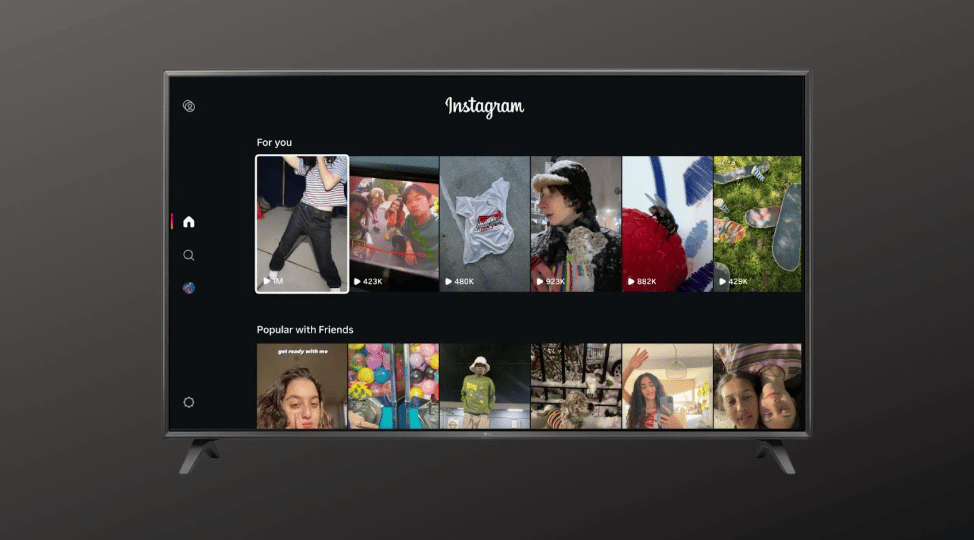
Short-form video is stepping into long-form territory. Not in duration, but in expectation.
The viewer is farther away. The screen is larger. The environment is shared. The attention is passive.
That means content now has to:
This isn’t really about reach or impressions.
It’s about where you live in someone’s mind.
Phone content comes and goes.
TV content lingers.
It plays while people talk.
It fills quiet rooms.
It becomes background to real life.
And the things we see in those moments are the ones we remember later.
Not because they were loud.
Because they were there.
We have seen this story before.
YouTube started as a website.
Then it became an app.
Then it became a television network.
Instagram is now following the same path.
The line between “TV” and “social” is dissolving.
Short-form video is no longer a side format. It is becoming a primary distribution layer for attention in shared environments.
This shift has implications most brands have not thought through yet.
If your content only works when someone is holding a phone six inches from their face, it will not translate to a living room.
If your message depends on subtle cues, small text, or insider context, it will disappear.
If your value is not obvious in the first few seconds, it will be ignored.
This does not mean every brand needs cinematic production.
It means intention now matters.
Clarity matters.
Context matters.
Instagram on TV is not about screens.
It’s about space.
Your content is no longer confined to personal moments. It can now live in rooms. It can be ambient. It can be part of an environment.
The brands that win in this next phase will not be the loudest.
They will be the clearest.
They will understand that short-form video is no longer just mobile media.
It is shared media.
It is ambient media.
It is living-room media.
And the companies that adapt early will not just show up more.
They will belong in more places.
Your content is no longer confined to personal moments. It can now live in rooms. It can be ambient. It can become part of an environment.
That’s the shift.
The brands that win in this next phase will not be the loudest.
They will be the clearest.
They will understand that short-form video is no longer just mobile media.
It is shared media.
It is ambient media.
It is living-room media.
And once content starts living in those spaces, the rules change. Because every new channel follows the same pattern.
The early brands learn faster.
They pay less for attention.
They build relevance before the space becomes crowded.
By the time something feels “mainstream,” the advantage is already gone.
Instagram on TV is still early. Most brands are not thinking about it. Most strategies are still built for phones. That window will not stay open long.
The companies that lean in now will not just be testing a new format. They will be shaping how their category shows up in shared spaces.
Waiting feels safe.
Being early creates leverage.
And in digital marketing, leverage is everything.
So the real question is simple:
Will you be watching this happen, or will you be part of it?
Are you ready for the big screen?
Creating content for the living room is very different than building content for a phone.
If you’re not prepping your social strategy to support this new medium you’re missing the opportunity to be an early adopter. Don’t wait until it’s already “normal” or consumers move on to the “next big thing”. Gain the advantage now!

Let me guess. You're already planning your Super Bowl Sunday.…
For years, we’ve built social strategies around a single assumption:…

There are a thousand ways to grow a business. But…
A few simple equations is all it takes to know…

There's a thousand ways to make money in business... But…


 let’s connect


 view our work



