

 let’s connect


Most marketing teams still operate like attention is scarce. It isn’t.
Attention is cheap, abundant, and instantly accessible.
You can buy it on demand across every major platform.
And yet, performance isn’t improving.
- Conversion rates are flat
- Cost per acquisition is rising
- More traffic isn’t producing more customers
What the Market Looks Like Now
Over the past 12-24 months, three things have happened:
Content production costs collapsed due to AI. Media buying became more efficient thanks to automation. And creative volume requirements increased across every channel.
The result:
- More ads
- More content
- More competition for the same outcomes
But here’s the important part:
The quality floor has risen, not the ceiling.
Most brands now look “good enough.”
Which means attention no longer differentiates anything.
An impression doesn’t signal interest. A click doesn’t signal intent. Web traffic doesn’t signal trust.
It just means you were visible.
Where Performance Actually Comes From
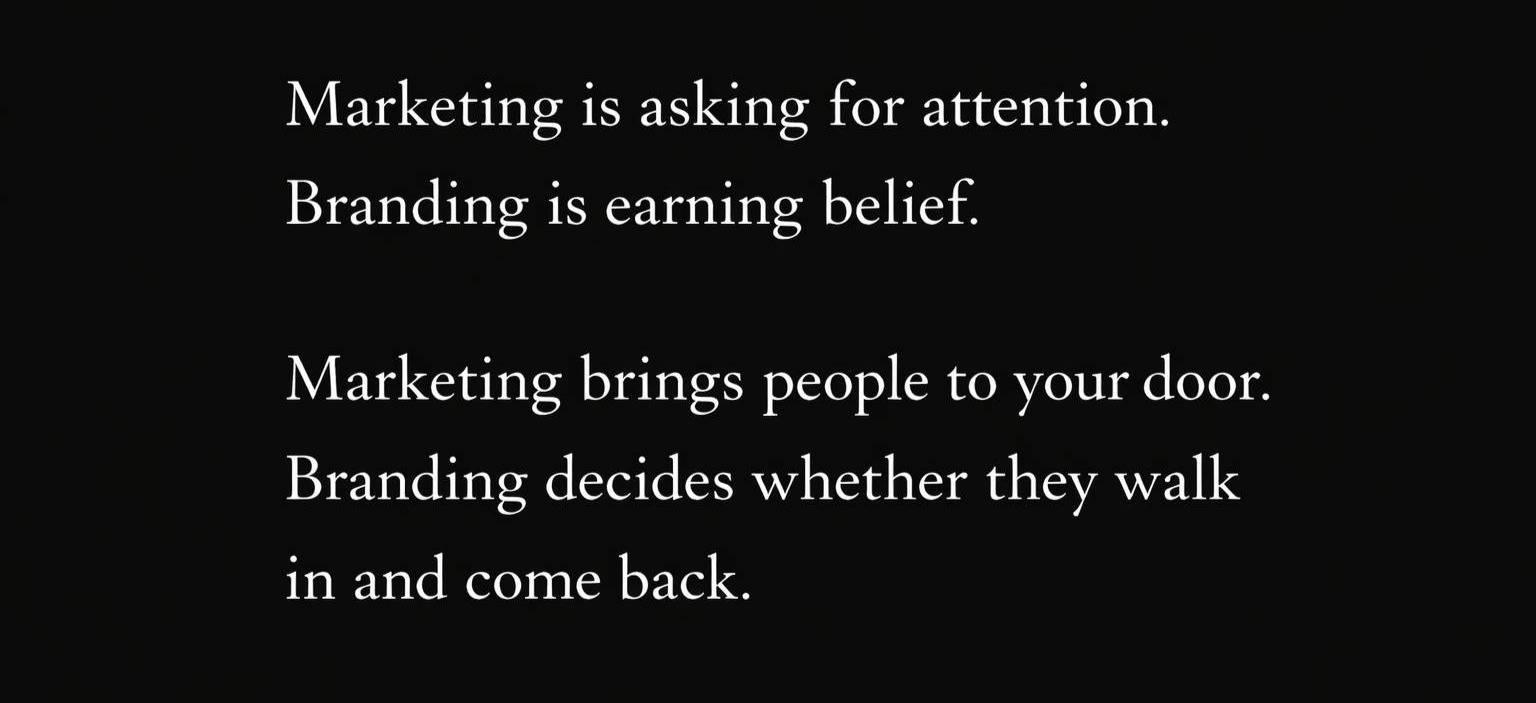
Across most campaigns, the drop-off isn’t happening at the ad level.
It’s happening after the click.
The pattern is consistent:
You get a strong CTR
Still manage an acceptable CPC
But your overall conversion rate is weak
That gap is the problem.
Not:
“How do we get more traffic?”
But:
“Why doesn’t this traffic convert?”
The answer, in most cases, is lack of Trust/Belief in your brand.
What Belief Looks Like in Data
You won’t see “belief” as a metric in your dashboard.
But you can infer it.
❌ Low time spent on site
❌ High bounce rates for pages
❌ Frequent form abandonment
❌ Unstable conversion rates across similar traffic sources
These are not traffic problems. They are perception problems.
Two brands can drive identical traffic from identical audiences and produce completely different outcomes.
The difference is how quickly and clearly they establish:
- Credibility
- Value
- Trust
Why This Is Happening

Every guru & marketing leader has been preaching about the attention economy for the last 10 years. And because everyone solved for attention at the same time, the advantage has been chipped away.
And when everything looks polished, polish stops signaling quality.
This is where most teams make the wrong adjustment.
They increase spend. They test new audiences. They launch more campaigns.
All of which operate at the same layer:
Attention.
What High-Performing Campaigns Do Differently
They don’t just acquire attention.
They convert it into belief.
There are three consistent patterns:
1. The transition from ad-to-site is tight
The message, tone, and expectation set in the ad carries through immediately.
No disconnect.
No re-interpretation required.
The user doesn’t have to “figure out” what’s being offered.
2. The website answers belief questions instantly
Within seconds, the user can determine:
Is this credible?
Is this established?
Is this worth my time?
This is driven by design, structure, and clarity.
3. The experience feels intentional
Not templated.
Not generic.
Not interchangeable.
Small details lead to a memorable experience:
- Motion
- Layout
- Hierarchy
- Visual identity
These are not just aesthetic, they are some of the primary variables that impact conversions.
What You Should Do

Audit where your funnel is actually breaking.
If CTR is strong but conversion rate is weak, the issue is almost never targeting or budget.
It’s post-click.
1. Evaluate your site like a first-time visitor.
You have ~3-5 seconds to answer:
What is this? Why should I trust it? Why should I care?
If those answers aren’t obvious, your site isn't forming trust.
2. Align your ad and landing experience.
If your ad sets a specific expectation, your site needs to fulfill it immediately.
Any gap introduces doubt.
Doubt kills conversion.
Tip: Repeat your ad copy in your landing pages
3. Stop measuring success purely at the traffic layer.
CTR and CPC are inputs.
Conversion rate and cost per acquisition are outcomes.
Trust & Belief are the invisible performance enhancers between the metrics.
Take Action
Attention will get you seen. It will not get you chosen.
The accounts that continue to scale are not the ones buying the most traffic.
They’re the ones converting the highest percentage of it.
And that comes down to one thing:
How effectively they build belief after the click.
Are you building trust through your marketing?
If the answer is no or "I'm not sure" the answer is no.
Your business and your team will not reach the next level of marketing capabilities until you solve that problem. If you aren't sure what steps to take, hit the button below and we'll find the solution that fits your business.
