let’s connect


What is LLM SEO, and why does it suddenly matter?
Search just changed under your feet. AI tools now answer first, and only sometimes send a click. So if your content isn’t showing up inside ChatGPT, Gemini, Perplexity, or Google AI Overviews, prospects are hearing about your competitors before they ever think to search for you.
That’s where this guide comes in. You’ll get the LLM SEO basics, the five building blocks worth memorizing, and a 3-step quickstart you can ship this week.
If you already run traditional SEO, this SEO agency playbook is the layer to add before your next planning cycle.
TL;DR
LLM SEO is the practice of optimizing content so large language models like ChatGPT, Gemini, and Perplexity cite, trust, and recommend your brand inside AI-generated answers. It combines entity signals, structured formatting, and machine accessibility.
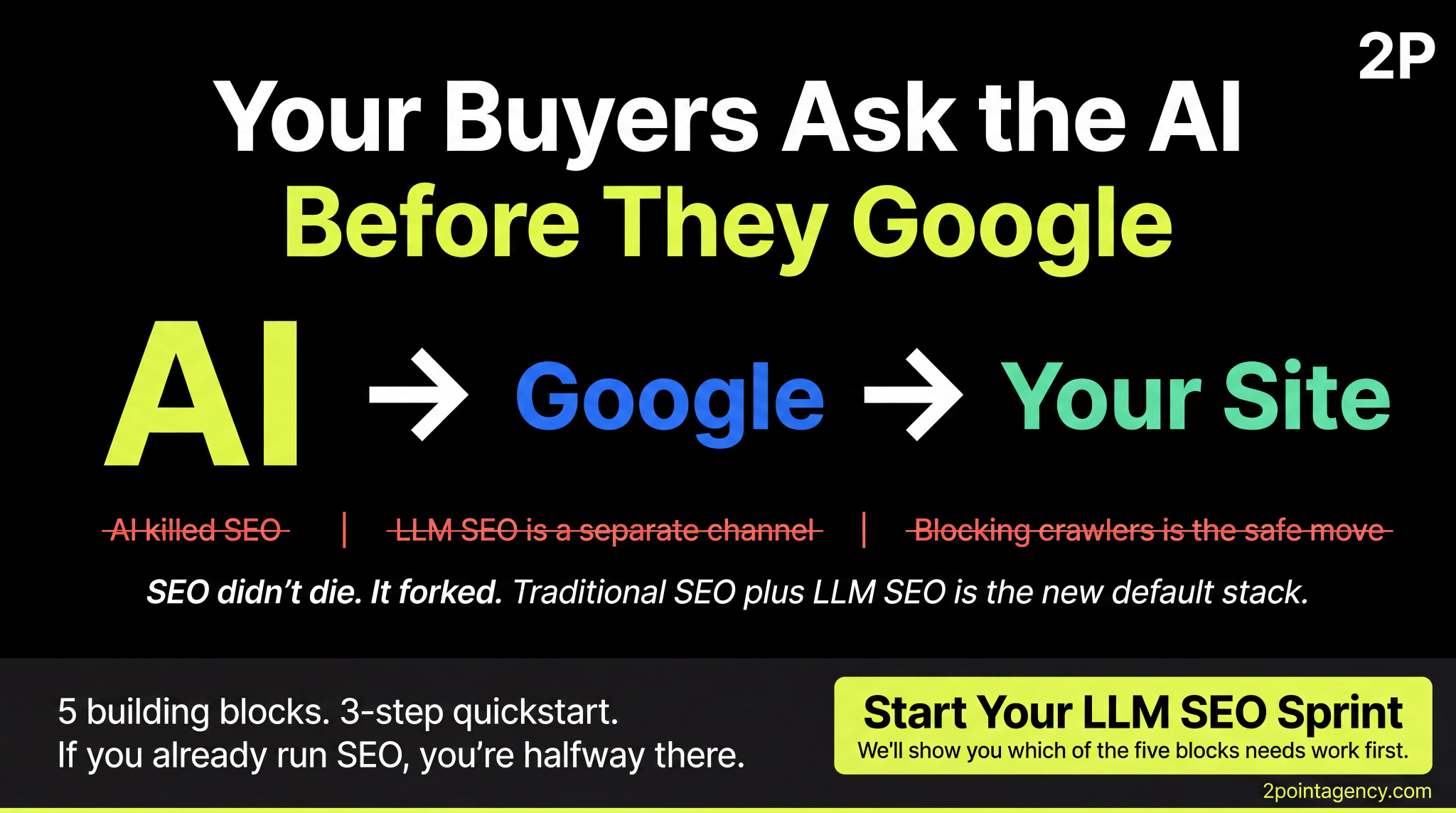
So it matters because buyers now ask the AI before they Google.
What Is LLM SEO?
The Plain-English Definition
So, what is LLM SEO, in plain English? It’s the practice of optimizing content so that large language models cite, trust, and recommend your brand inside AI-generated answers.
Think of it as SEO for the era where AI answers the question before the user clicks.
In other words, the LLM SEO meaning stays close to traditional SEO at its core. Same goal of being found. Different mechanics for how you get picked.
That’s because models like ChatGPT, Gemini, and Perplexity pull from trusted documents, score them on relevance and authority, then write a synthesized response. You either get cited inside that response, or you don’t.
A 30-Second Mental Model
Here’s the easiest way to picture it. Think of an LLM as a fast research assistant. It scans the web, picks a small handful of sources, summarizes them in plain English, and hands you the answer.
So your job in LLM SEO is simple: be one of the sources it picks every time someone asks about your category. That’s the whole meaning of LLM SEO in one sentence.
LLM SEO Explained in 3 Sentences (Plain-English)
Here’s the shortest version you can keep on a sticky note. LLMs are AI systems trained to read, understand, and summarize content across the web. LLM SEO is about making your content easy for those systems to cite, recommend, and trust.
So why does it matter? Because your customers now ask the AI before they Google, your content either earns a citation or gets summarized into someone else’s answer.
Why LLM SEO Matters Now
Search behavior is shifting toward AI tools and AI-generated summaries inside Google itself. Brand visibility now lives in citations, recommendations, and ‘best of’ mentions, not just the SERP positions you’ve been tracking for the last decade.
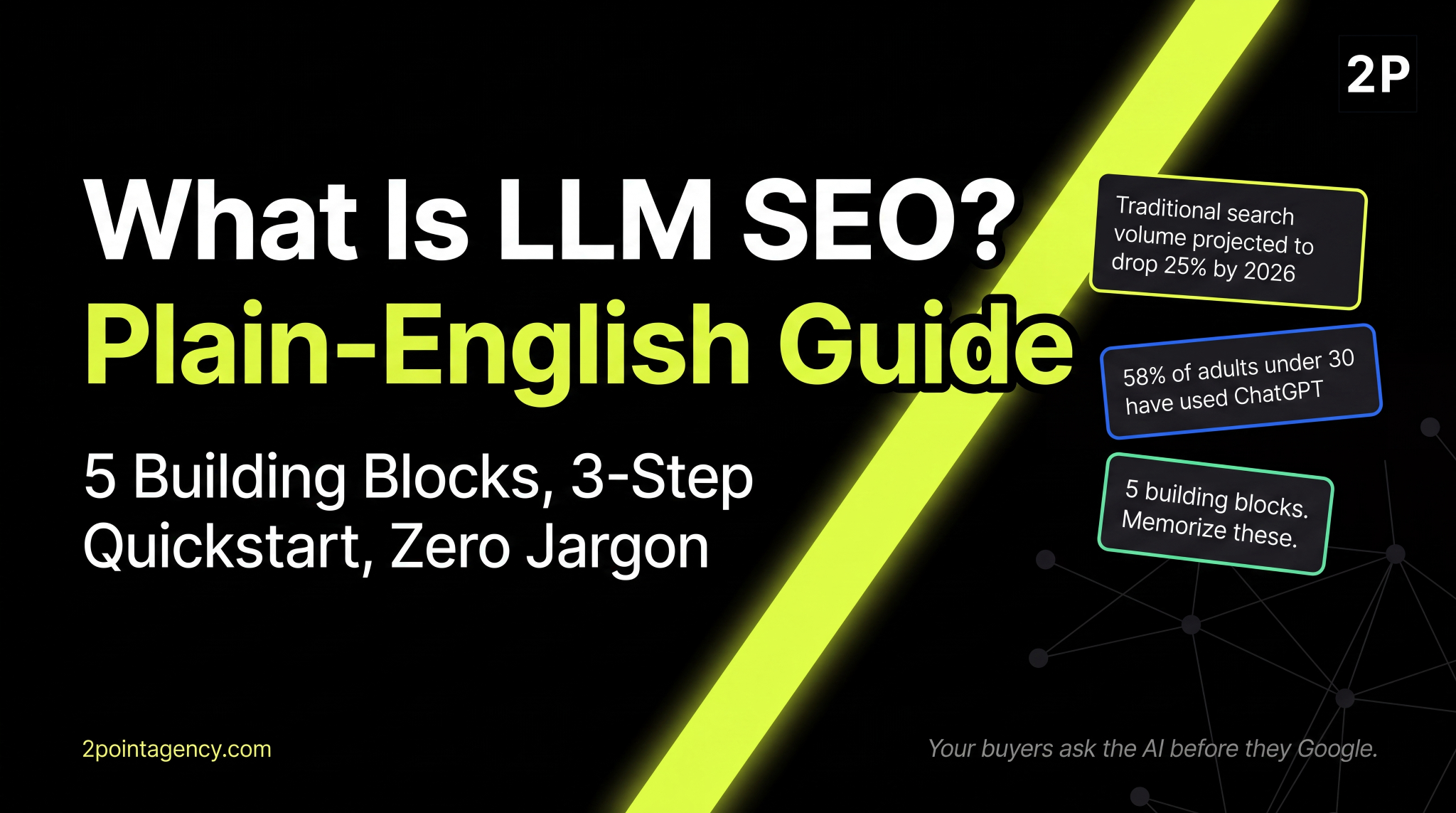
According to a Gartner press release on search-engine forecasting, traditional search engine volume is projected to drop 25% by 2026 as users move queries to AI chatbots and virtual agents. That doesn’t mean SEO is dead. It means the entry point is moving, and your llm seo basics need to be in place before that traffic shift fully lands.
If your competitor is cited and you aren’t, the next prospect will hear about them, not you.
LLM SEO vs Traditional SEO vs AEO vs GEO
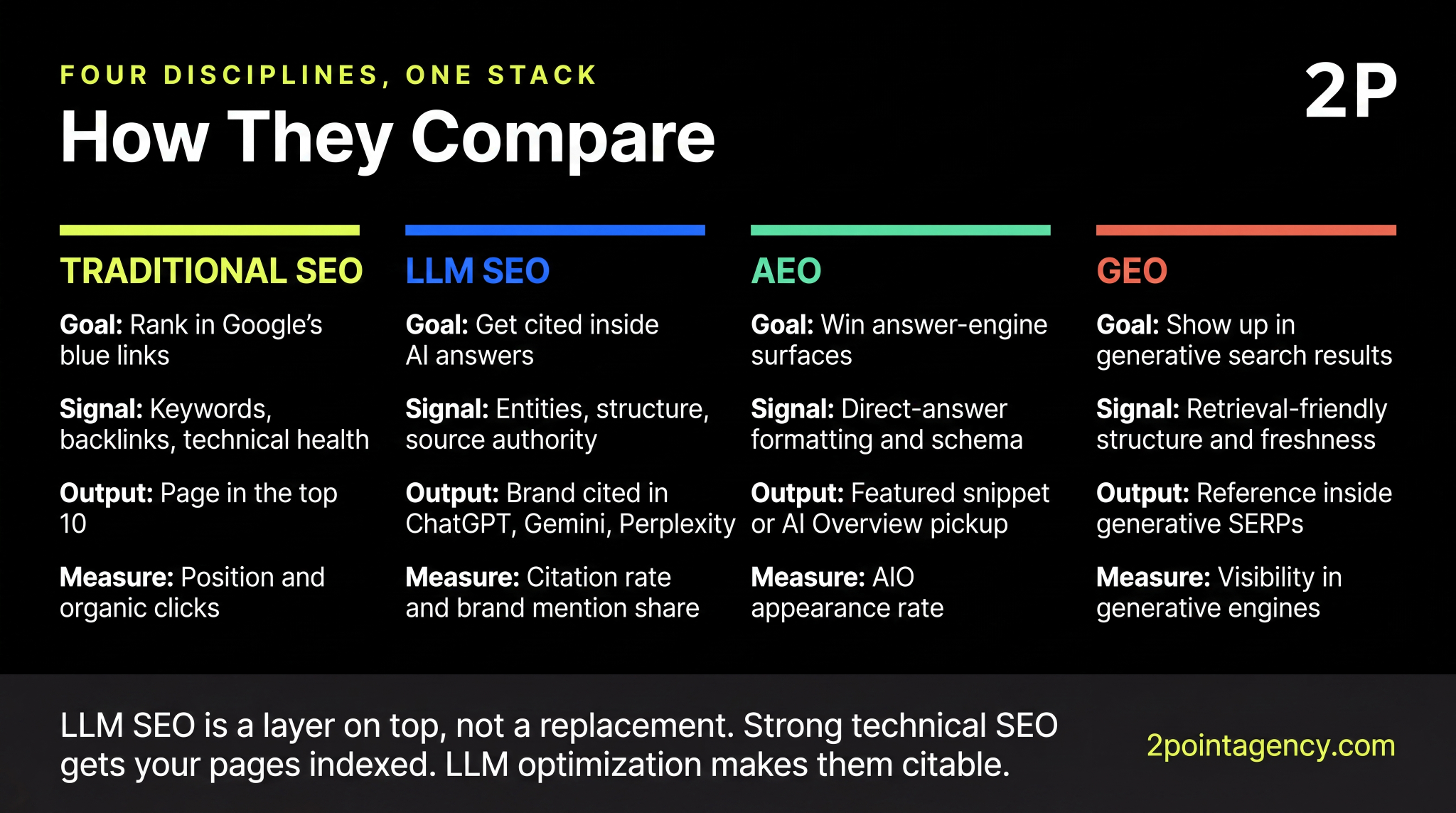
LLM SEO vs traditional SEO is the comparison most teams ask about first. So here’s the quick read across all four disciplines that matter in 2026.
Quick Comparison Table
| Traditional SEO | LLM SEO | AEO | GEO | |
| Goal | Rank in Google’s blue links | Get cited inside AI answers | Win answer-engine surfaces | Show up in generative search results |
| Primary signal | Keywords, backlinks, technical health | Entities, structure, source authority | Direct-answer formatting and schema | Retrieval-friendly structure and freshness |
| Output | Page in the top 10 | Brand cited in ChatGPT, Gemini, Perplexity | Featured snippet or AI Overview pickup | Reference inside generative SERPs |
| How you measure it | Position and organic clicks | Citation rate and brand mention share | AIO appearance rate | Visibility in generative engines |
How They Overlap
Here’s the takeaway in any LLM SEO vs traditional SEO conversation: LLM SEO is a layer on top, not a replacement.
So strong technical SEO gets your pages indexed, while LLM optimization makes them citable once they are.
In other words, the two work together. If you’ve already invested in pillar content, schema, and editorial depth, you’re halfway through your LLM SEO basics already. From there, the AI search layer builds directly on what you have.
Plain-English Term Decoder
You’ll hear four acronyms thrown around, and they overlap more than they differ. Here’s the quick decode:
- AEO (Answer Engine Optimization): Optimizing content for direct-answer surfaces like featured snippets and AI Overviews.
- GEO (Generative Engine Optimization): Optimizing for generative search results across engines like ChatGPT, Gemini, and Perplexity.
- AIO (AI Overview Optimization): Specifically optimizing for Google’s AI Overview block at the top of some search results.
- LLM SEO: The umbrella term covering all three above.
So the simplest AI SEO definition is “any SEO work targeting AI-mediated discovery.” LLM SEO sits within that AI SEO definition with the most specific scope.
The 5 Building Blocks of LLM SEO
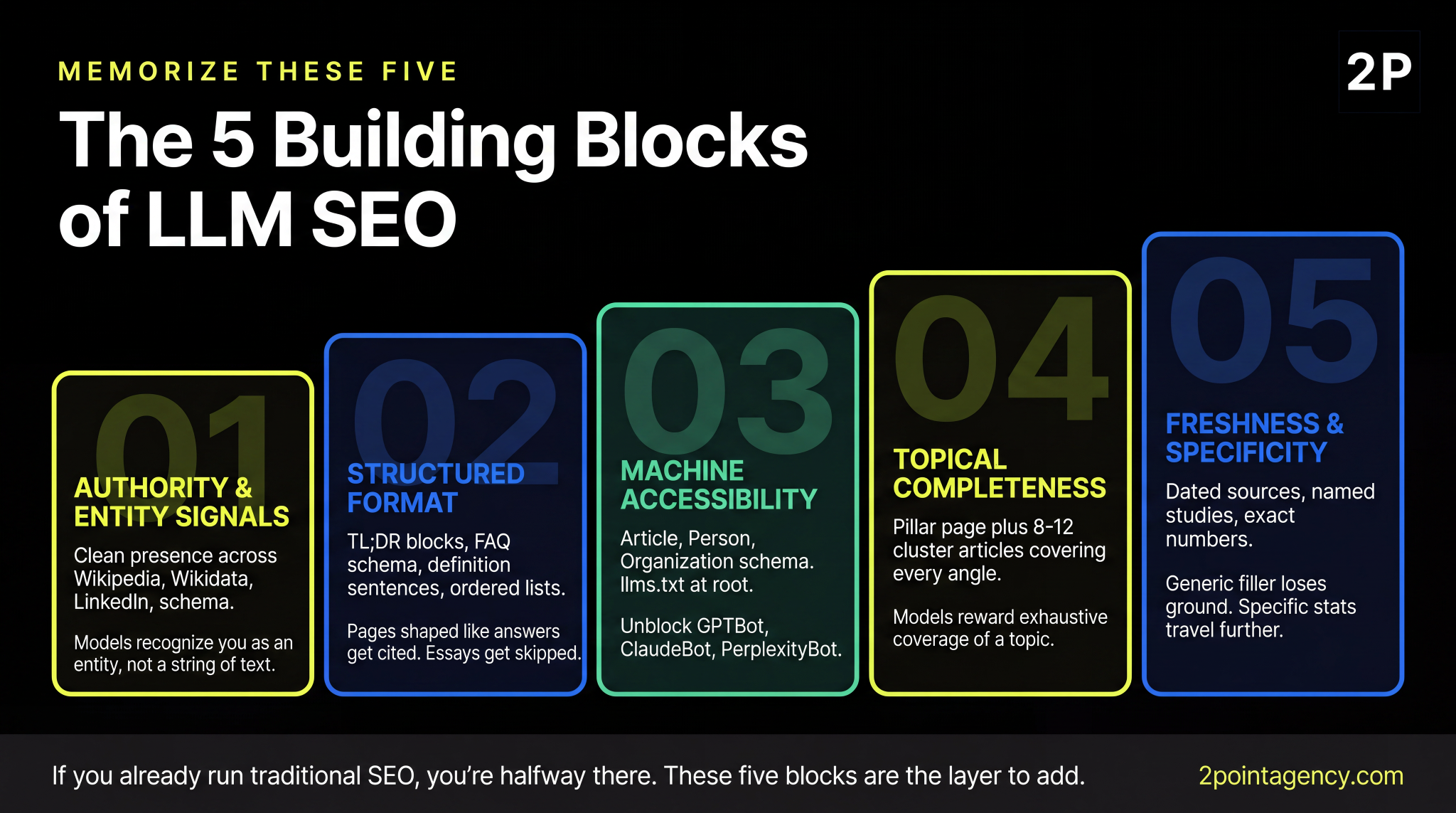
Now for the foundation. These five are the LLM SEO basics you actually need to memorize, and getting them running covers most of what models score when deciding who to cite.
1. Authority and Entity Signals
Start with how models see you. Models don’t read your brand as a string of text. Instead, they recognize brands and authors as entities, each with a knowledge graph footprint.
So a clean presence across Wikipedia, Wikidata, LinkedIn, and Crunchbase provides the model with a stable anchor. From there, verifiable author bylines, expert quotes, and consistent NAP (Name, Address, Phone) data for local entities all reinforce the same trust signal.
2. Structured, Skim-Friendly Content
Next, models cite the pages already shaped like an answer. So use clear H2 and H3 hierarchy, TL;DR blocks under every H1, FAQ schema at the bottom, and a definition sentence in your opening paragraph.
In other words, the goal is plain-English summaries that an LLM can paste directly into a response. That format usually wins the citation, since models reach for the source that already did the synthesis work.
3. Machine Accessibility
Now for the technical layer. This is where you make sure the bots can actually read your content.
So start with the schema. Add Article, Person, Organization, FAQPage, and HowTo schema to your editorial pages. From there, publish an llms.txt file at your domain root, then review your robots.txt so you aren’t blanket-blocking GPTBot, ClaudeBot, or PerplexityBot.
Quick context worth knowing: OpenAI’s crawler guide shows that GPTBot, OAI-SearchBot, and ChatGPT-User each handle different jobs (training, search, and live user requests), so blocking one does not block the others.
4. Topical Completeness
Then comes depth. LLMs reward sites that cover a topic exhaustively, and the pillar-and-cluster model that already serves traditional SEO does double duty here.
So a pillar page anchored by 8 to 12 supporting articles signals real expertise. From there, each supporting cluster gives the model multiple touchpoints to land on, which makes your domain harder to skip when the topic comes up in an AI answer.
5. Freshness and Specificity
Finally, freshness closes the loop. Date-stamped content, “Last Updated” signals, and year references like “in 2026” all signal to the model that your page is current.
So vague claims age out faster than dated, sourced numbers. That is why generic filler keeps losing ground on AI surfaces, while specific stats, named methodologies, and recent case studies travel further across citation pipelines.
How LLMs Decide Which Sources to Cite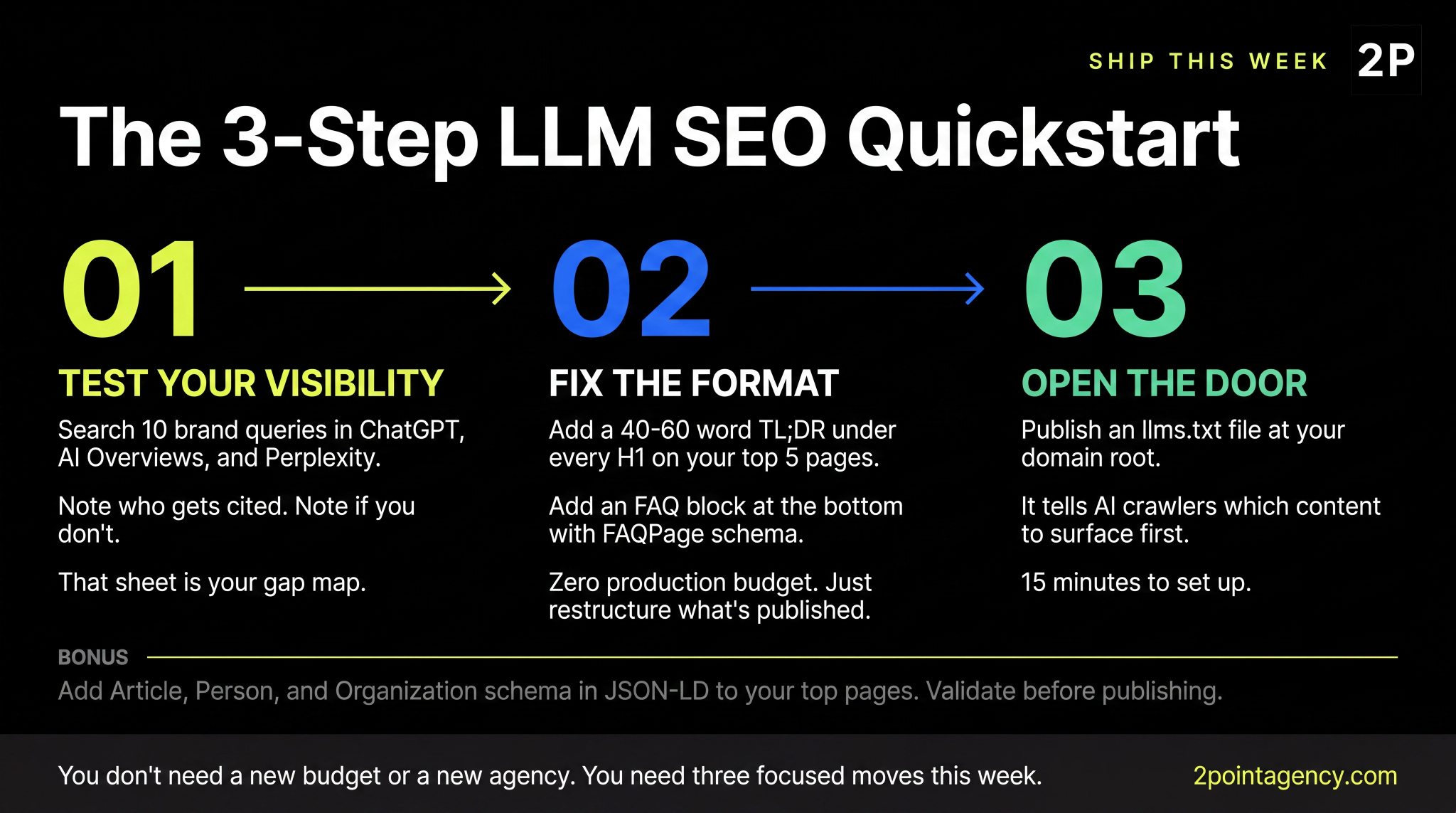
So, how do you actually get picked? LLMs don’t crawl in real time the way Google does. Instead, they retrieve from indexed sources and then synthesize.
That’s why selection logic favors a specific mix: high authority, structured format, recent updates, topical match, and machine-accessible markup. So you can’t fake any one of these. They work as a system, where each input affects how often you end up cited.
Who Should Care About LLM SEO?
Honestly, almost any team with a content pipeline has a stake. But here are the clearest cases:
- B2B brands are losing top-of-funnel visibility as buyers research inside ChatGPT and Perplexity before ever booking a demo.
- DTC and ecommerce brands competing in AI shopping surfaces across ChatGPT, Gemini, and Perplexity.
- SaaS and service businesses with niche audiences and high customer LTV.
- Local businesses appearing in Google AI Overviews for “near me” queries are increasingly skipping the map pack.
- Publishers whose traffic mix is shifting from organic clicks to AI citations.
If any of those describe you, LLM SEO for beginners is the right entry point. The playbook below is designed for teams running their first AI visibility sprint.
Common Misconceptions About LLM SEO
Misconception 1: AI Killed SEO
SEO didn’t die. It forked. So traditional SEO plus LLM SEO is the new default stack, and cutting your SEO investment because of AI gives up the foundation your LLM SEO strategy is supposed to sit on.
Misconception 2: LLM SEO Is a Separate Channel
It isn’t. LLM SEO builds on existing SEO work by reusing and reformating content you already have, so it doesn’t need a separate budget.
In practice, AI-friendly content is mostly the same content you’ve been writing, restructured for how models pull and cite information.
Misconception 3: Blocking AI Crawlers Is the Safe Move
It usually isn’t. Blocking GPTBot, ClaudeBot, and PerplexityBot makes you ineligible for AI citation entirely.
So treat the access decision strategically. The goal is to optimize content for AI discovery while protecting only what genuinely shouldn’t sit inside a training set.
How to Get Started With LLM SEO (3-Step Quickstart)
If you’re looking for LLM SEO for beginners, moves you can ship this week. Run this quickstart in order.
Step 1: Run a 10-query AI visibility test
Start with a baseline. Search 10 brand-relevant queries inside ChatGPT, Google AI Overviews, and Perplexity, then note who gets cited and whether you do. That single sheet becomes the gap map you’ll work from.
Step 2: Add TL; DRs and FAQ blocks to your top 5 pages
Once you know the gaps, fix the format. Add a 40 to 60-word TL;DR under every H1, plus an FAQ block at the bottom marked up with FAQPage schema.
This is the fastest way to optimize content for AI pickup with zero production budget, since you’re restructuring what’s already published.
Step 3: Publish an llms.txt file at your domain root
From there, ship an llms.txt file to the root of your domain.
It tells AI crawlers which assets you want surfaced first, which is the cleanest way to point models at your strongest content. The exact lines to start with take about 15 minutes to set up.
Bonus Step: Add schema to your top pages
Finally, mark up your top pages with Article, Person, and Organization schema in JSON-LD.
Then, validate every page with the Schema Markup Validator before publishing, so a CMS quirk doesn’t quietly break the markup.
Tools That Help With LLM SEO
You don’t need a bloated stack. Here’s the short, working set most teams actually need to track and ship LLM SEO work:
- AI visibility trackers. Profound, AthenaHQ, Otterly, and Peec.ai for monitoring brand citations across ChatGPT, Gemini, Perplexity, and Google AI Overviews.
- SEO tools with AI features. Ahrefs Brand Radar, Semrush AI Toolkit, and Google Search Console’s AI reports for tracking how your existing pages perform on AI surfaces.
- Schema validators. Google Rich Results Test and Schema Markup Validator to catch broken markup before it ships.
Mini Glossary of Related Terms
A few terms worth knowing as you start running LLM SEO work:
- AEO (Answer Engine Optimization): Optimizing for direct-answer SERP features and AI Overviews.
- GEO (Generative Engine Optimization): Optimizing for generative search engines like ChatGPT, Gemini, and Perplexity.
- AI Overviews: Google’s AI-generated answer block at the top of some SERPs, which rolled out broadly to U.S. users in May 2024.
- llms.txt: A plain-text file at your domain root telling AI crawlers which pages to prioritize.
- RAG (Retrieval-Augmented Generation): The retrieve-then-summarize technique most LLM search products use to ground answers in real sources.
- Fan-out queries: When an LLM expands a single user query into multiple sub-queries to gather sources.
So bookmark these. They appear in most LLM SEO conversations, and knowing the difference saves time when teams use them interchangeably.
FAQs
Is LLM SEO the same as AI SEO?
LLM SEO and AI SEO overlap heavily, but they’re not identical. AI SEO is the broader umbrella term covering any SEO work targeting AI-mediated discovery, including AEO and GEO. LLM SEO specifically focuses on optimizing for Large Language Models like ChatGPT, Gemini, and Perplexity.
The clearest AI SEO definition treats it as the parent category, with LLM SEO as the most specific child. Most teams use them interchangeably, which is fine as long as everyone shares the same definition of LLM SEO.
Do I need a separate strategy for LLM SEO?
You don’t need a separate strategy. You need a separate layer on top of the SEO program you already run.
Most of the work is restructuring existing content, adding TL;DR and FAQ blocks, implementing more schema types, and building entity signals. If you have a strong content engine, you can ship llm seo basics across your top 20 pages in a single sprint without hiring anyone. Treat it as a workflow upgrade, not a new budget line.
Will LLM SEO send me traffic?
The traffic mix shifts. You’ll see fewer pure-informational clicks because AI Overviews and ChatGPT now answer those queries directly. You’ll also see higher-intent commercial visits because users who click through after reading an AI summary are usually in evaluation mode.
Add citation-driven brand exposure that doesn’t always click, and the picture broadens. Track citation share alongside organic sessions to see the real impact of how you optimize content for AI surfaces.
How long does LLM SEO take to show results?
AI citation visibility can shift in days when you publish a strong, well-structured page on a topic that models actively retrieve. Entity recognition usually takes 60 to 90 days, since updates to Wikipedia, knowledge graphs, and third-party profiles propagate slowly.
The whole picture is less predictable than Google rankings because retrieval logic and training cycles vary by vendor. Set a 90-day baseline review for your llm seo work, not a 30-day one.
What’s the easiest first move?
Add a TL;DR block and FAQ schema to your top 5 commercial pages. It is free, fast, and immediately upgrades your eligibility to appear in AI Overviews and to be cited by ChatGPT or Perplexity.
Combine that with a refreshed author byline and an llms.txt file at your domain root, and you have a starting point for an LLM SEO definition you can defend internally. Layer in entity work and topical pillars over the next quarter.