

 let’s connect


For 2 years, AI in marketing meant a faster way to write copy.
That's rapidly changed. True AI-use in marketing is significantly more dynamic and compelling.
The shift happening now goes much deeper than prompting a chatbot.
Instead, AI plans, executes, and iterates across your marketing stack without you managing every step.
That is what "agentic ai" is, and it's already inside most of the marketing tools your team uses every day.
What "Agentic AI" Actually Means
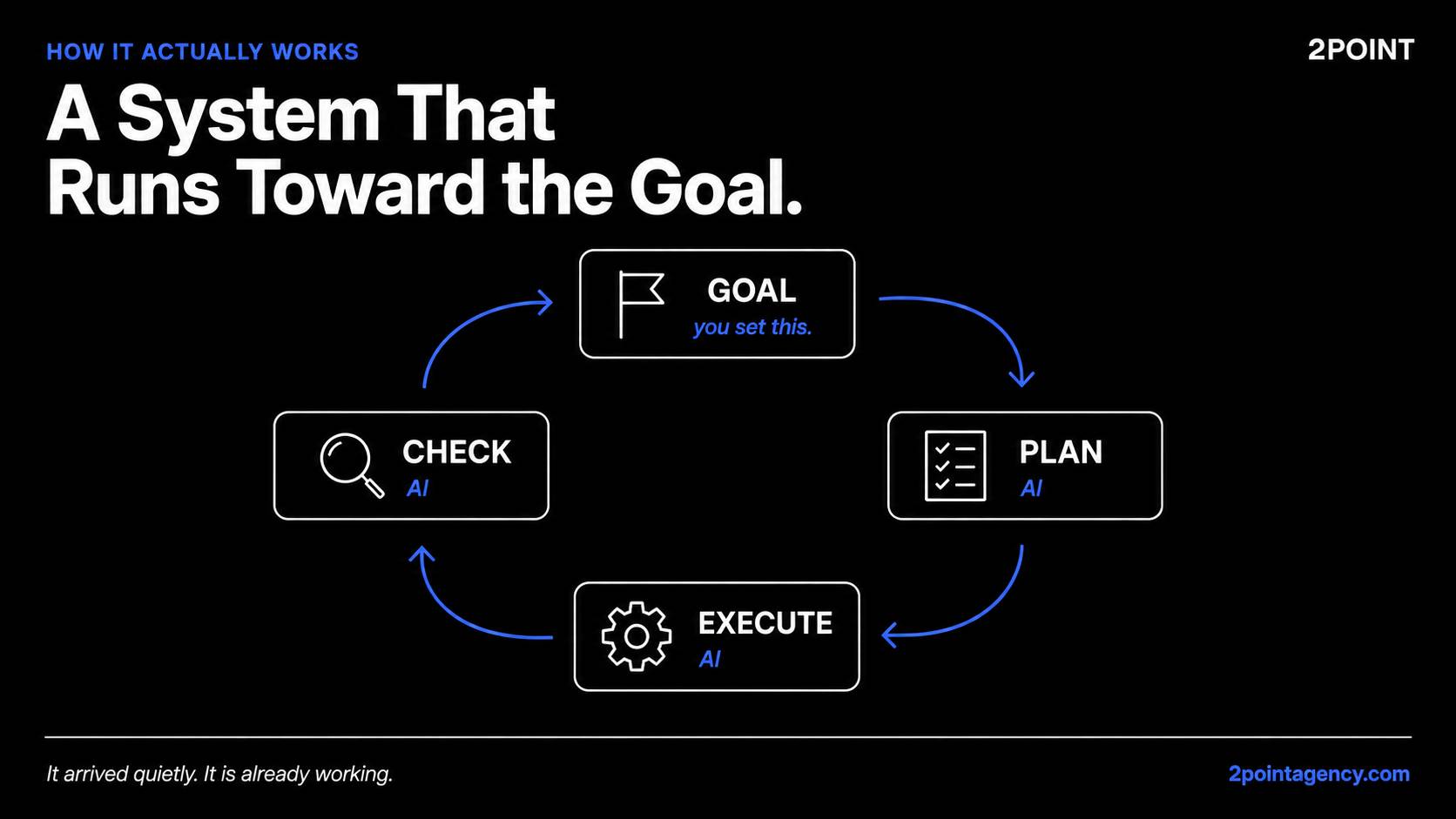
An AI agent receives a goal, breaks it into steps, uses tools to execute those steps, checks its own output, and keeps going until the goal is met.
In a marketing context, that looks like this:
- You define the outcome you want
- The agent audits your current state
- Builds the execution plan
- Runs the tasks
- Flags what needs human judgment.
The difference is a system that runs toward a goal versus a tool that waits to be told what to do next.
Where It Is Already Showing Up
You do not have to go looking for this. Agents have appeared everywhere.
Meta's Advantage+ is making campaign-level decisions automatically, adjusting creative mix, audience expansion, and budget allocation in real time.
Google's Performance Max has been doing this for 2 years.
Klaviyo's AI features now recommend send times, subject lines, and segment splits based on behavioral signals.
Even our (2POINT's) own AI products have agentic capabilities.
Most teams are treating it like a "new feature" and aren't taking the opportunities very seriously.
What It Changes First
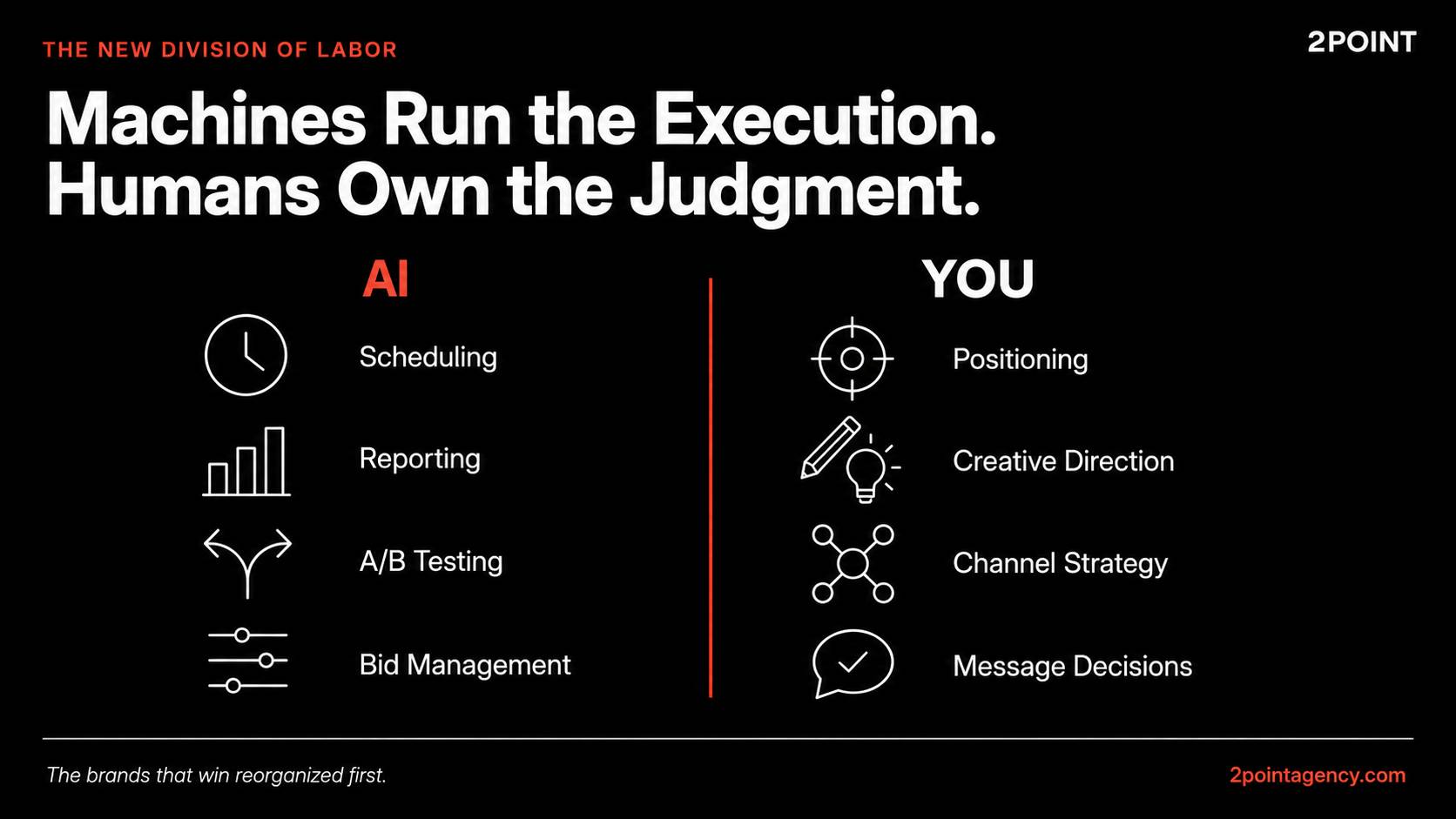
The first thing agentic AI disrupts is execution work:
- Scheduling
- Reporting
- A/B test setup
- List segmentation
- Bid management.
If your team spends meaningful hours per week on any of those your productivity and workflow can improve dramatically.
The teams making the best use of AI are using it to fill junior admin, analytics, and organization work while redirecting human hours toward strategy and creativity.
The second thing it disrupts is speed.
Campaigns that used to take a week to set up now go live in hours.
That speed advantage is only valuable if you have a clear point of view on what to test and why.
That is what limits business using AI from being exceptional.
You still need to:
- Know your customer
- Read the market
- Make the important calls
What You Should Do
Audit where your team's time actually goes.
Look at the last 2 weeks of execution work.
How much of it was repeatable and rule-based? That's where you start.
Stop managing every lever manually.
If you are still micromanaging bid adjustments and audience exclusions inside automated campaign types, you are working against the system.
Learn where to set the guardrails and let the machine run inside them.
Invest in creative and strategy capacity.
AI handles the repeatable work.
The hours you free up need to go somewhere with a higher ceiling (positioning, creative direction, channel strategy).
Pick 1 workflow to automate this month.
Do not try to transform your entire operation at once.
Start with 1 repeatable task, find the AI tools that cover it, and compress the time. Build from there one step at a time.
Remember This
The brands pulling ahead reorganized around a new division of labor: machines run the execution, humans own the judgment.
That reorganization is a competitive decision. Most of your competitors have not made it yet.
Are you still running your marketing like the tools have not changed?
Every month you wait, the gap between your team and the ones that reorganized gets wider.
We work with teams across every channel to build marketing operations that actually scale.
