

 let’s connect


For the better part of a decade, the SEO contract was simple.
You publish content. Google indexes it. Someone searches. They find you. They click. They become a lead.
Simple. Repeatable. Reliable.
Thousands of businesses were built entirely on that contract. Rankings meant traffic. Traffic meant revenue. The math was almost too easy.
Google just announced they're replacing the contract entirely.
And this time, they didn't do it quietly.
What Happened at Google I/O
On May 19th, 2026, Google held its annual developer conference. By the time the keynote was over, they had announced the single largest redesign of Search in 25 years.
Not a feature update. Not a new algorithm. A structural rebuild.
The search box itself was redesigned to accept longer natural-language inputs, images, and video. The interface now functions as a conversation opener, not a keyword entry field.
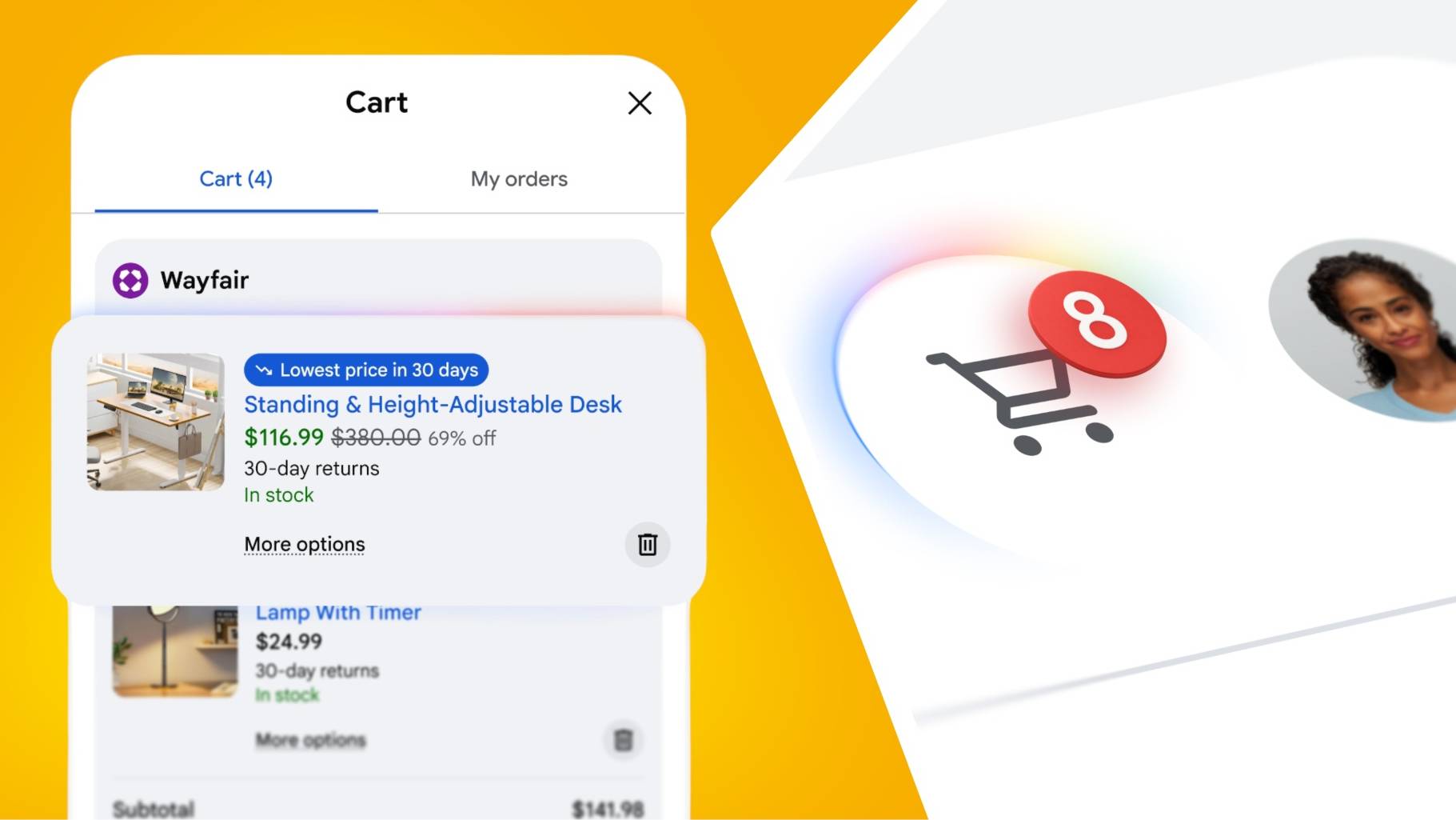
One day later at Google Marketing Live, they rolled out four new ad formats that live inside AI Mode alongside organic results. Conversational ads written by Gemini in real time to match the exact query. Highlighted Answers that blend sponsored recommendations into AI-generated lists with no visual separation from organic content. A Universal Cart that lets users check out from Nike, Walmart, Target, and Wayfair without ever visiting a single website.
And two days after that, on May 21st, they pushed a broad core algorithm update. No explanation. No companion blog post. Just the update.
Three moves in three days. Search architecture. Ad formats. Ranking systems.
Google moved all three levers simultaneously.
The Number That Changes Everything
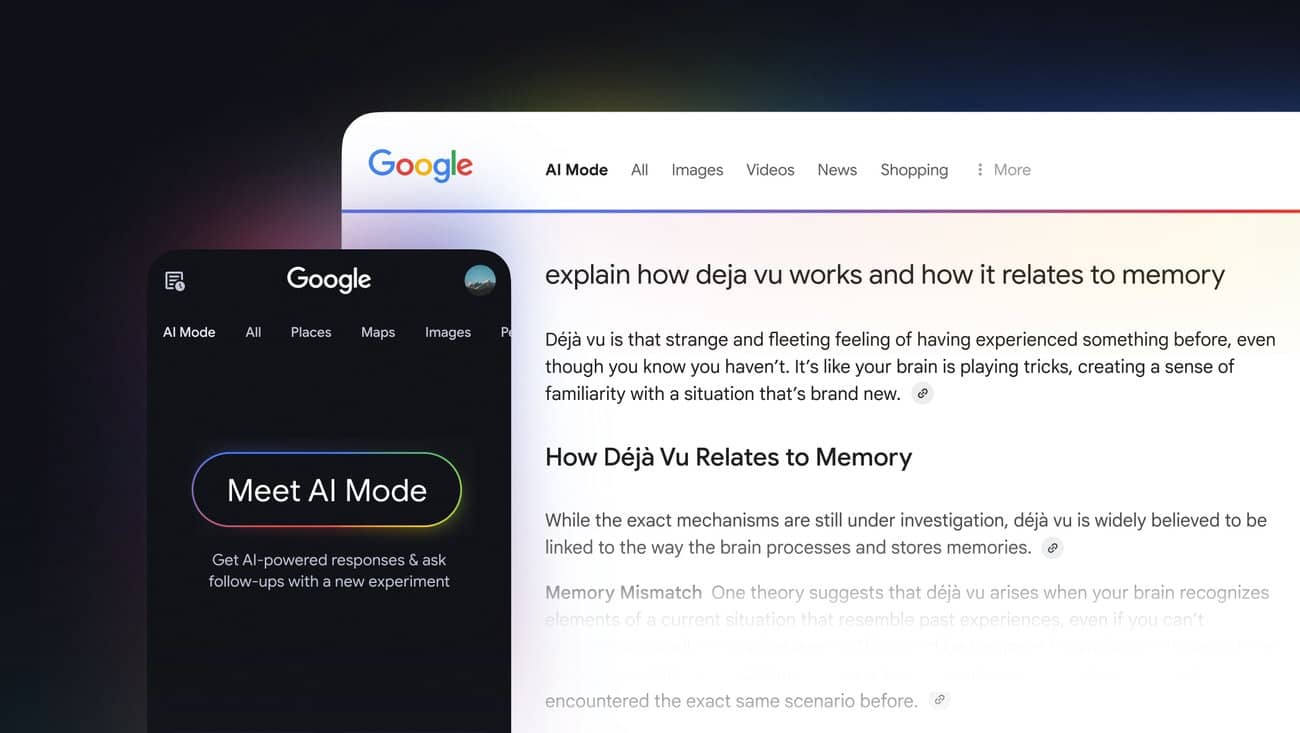
Google's own data report, published May 19th by their VP of Data Science, contained one statistic that should be required reading for every marketer and founder.
AI Mode hit 1 billion monthly active users in under one year.
Queries more than doubled every quarter since launch.
The average AI Mode query is now 3x longer than a traditional search query.
One in six searches in AI Mode involve no text at all. Voice, image, or video.
These are not edge case behaviors. They are the new default for how people search. And the structural implication is straightforward: content built around short-tail keyword strings is increasingly misaligned with how real searches are being entered.
Google's own data on what people type into AI Mode: the top five first words are what, how, I, is, can. The top embedded keywords are find, information, identify, explain, summarize.
Those are conversation openers. Not keyword queries.
The brands whose content is structured around answering questions in natural language are the ones getting cited. The ones still optimizing for discrete keyword density are getting passed over.
Why Your Rankings Aren't Protecting You Anymore
Here's what most SEO reports won't tell you.
The traffic problem isn't about your rankings disappearing. It's about what happens above them.
Google's SVP of Knowledge, Nick Fox, explained publicly how AI Mode works under the hood.
The user asks one question. Google's AI searches the web at machine speed, cross-references dozens of sources, and delivers a complete answer. No clicking required.
The research on what this does to organic traffic is not subtle.
When an AI Overview appeared above a traditional result, click rates dropped from 15% to 8%. That's a 46.7% relative decline. Nearly half your potential traffic, absorbed by the answer layer above your result.
Zero-click searches, meaning searches where no website gets visited at all, climbed from 56% in May 2024 to 69% by May 2025. In one year.
And those numbers predate AI Mode hitting 1 billion users.
The compounding effect of a search experience built to answer questions without generating clicks, at that kind of scale, is not a future problem. It is a present one.
Google Also Became Your Competitor in Ecommerce
This part of the I/O announcement got the least coverage. It deserves the most.
The Universal Cart went live in the US on May 19th. It allows users to add products from multiple retailers into a single Google-hosted cart and complete the purchase through Google Pay without visiting any merchant website.
Google's own framing: "The retailer always remains the merchant of record."
That sentence is doing a lot of work.
What it means in practice: your SEO can succeed at the discovery layer and generate zero website sessions. The customer found your product. Google processed the transaction. Your analytics saw nothing.
This is not hypothetical infrastructure. It launched three days ago.
For ecommerce brands whose SEO strategy is built around driving traffic to product pages, this is a direct displacement of the conversion event. The product gets discovered through content you optimized. The sale closes inside Google. You fulfill the order.
Whether that trade-off is acceptable depends on your margin structure and how much of your CRO happens on-site. But the assumption that organic rankings lead to website visits, which lead to conversions, which lead to revenue, no longer holds cleanly.
The New Three-Outcome Model
A few years ago, ranking number one was a binary win. You showed up. People clicked.
Today, when someone searches for something related to your business, there are three possible outcomes.
Outcome 1: An AI answer appears and the user never clicks anything.
Your ranking position is irrelevant here. The content was useful enough to train the model that answered the query. You got credit for none of it.
Outcome 2: An AI answer appears and your content is cited as a source.
Research shows being cited inside an AI Overview increases your click rate by up to 35% compared to a standard organic listing. This is the new number one spot. It is also the outcome that requires the most content investment to earn.
Outcome 3: No AI answer appears and your organic result gets clicked.
Still common for transactional and local searches. Becoming rare for informational queries. Shrinking as a percentage of total search volume every quarter.
The entire game has shifted from ranking to being cited. And being cited requires a volume and quality of content that most brands are not producing.
What Google Actually Told Advertisers
At Google Marketing Live, the ad product announcements were framed as good news for marketers.
Conversational Discovery Ads let Gemini write ad copy dynamically in response to the exact query. Highlighted Answers place sponsored recommendations inside AI-generated lists alongside organic results. AI-powered Shopping Ads generate a custom product explainer per query. A Business Agent ad format puts a live chatbot inside the ad unit itself.
The language from Google's official announcement:
That's a real number from a real survey. It also means the buying decision is increasingly happening inside the AI conversation, before the user ever visits your site or sees your organic content.
The organic and paid boundary in search results has dissolved. The space that used to separate a number one ranking from a paid placement no longer exists in AI Mode.
The Open Question Google Didn't Answer
Google's own data report, the one confirming 1 billion users and doubling query volume, contains an honest admission buried in the methodology.
Whether rising query volume translates into comparable referral traffic, or whether it increasingly represents queries resolved without a click, is "a separate measurement problem the marketing industry is actively working to answer."
That's Google saying: we know search is growing, but we don't know, or won't say publicly, whether that growth is producing website visits for anyone.
The industry doesn't have a clean answer yet. Neither does Google, at least not officially.
What we do know is that AI Overviews suppress clicks by nearly half when they appear. That they're now in 1 in 4 searches, closer to 1 in 2 for informational content.
That zero-click rates are at a 10-year high. And that Google just announced a transaction layer that can capture conversions without routing traffic to merchant websites.
That is enough signal to act on.
What the Brands Winning This Transition Have in Common
The structural shift in how Google works has not made content irrelevant. It has made volume and structure more important than they have ever been.
96% of content cited in AI Overviews comes from sources with verified credibility signals. The AI isn't guessing who to trust. It's citing the publishers with enough topical breadth and authority to have earned that designation.
Topical breadth means covering a subject comprehensively, not just ranking for a handful of high-volume terms.
The brands building that kind of topical authority are not doing it with a 4-post-per-month content calendar. They are publishing at a scale that most traditional content operations cannot sustain.
Planning queries in AI Mode are growing 80% faster than AI Mode overall. Brainstorming queries are growing 30% faster. The users flooding into AI Mode are not looking for product pages. They are researching, comparing, planning, and deciding. The brand whose content answers those questions at scale is the one that gets cited when the buying decision gets made.
That is where the opportunity sits.
The Content Volume Problem
Here is the uncomfortable math most SEO strategies are avoiding.
If ranking signals now reward topical depth, if citations require breadth across hundreds of related queries, if the new search box accepts natural language at 3x the length of traditional queries, and if AI Mode doubles its query volume every quarter while your content calendar publishes twice a week...
The gap between your content output and the coverage you need to compete for citations is not closing. It is widening.
Manual content operations are structurally unable to close it. Not because the writers aren't good. Because the output ceiling of a human team is fixed, and the surface area required to compete in AI search is not.
The brands winning the transition are solving this with automated content infrastructure like AIObot, not better writers.
What You Should Do
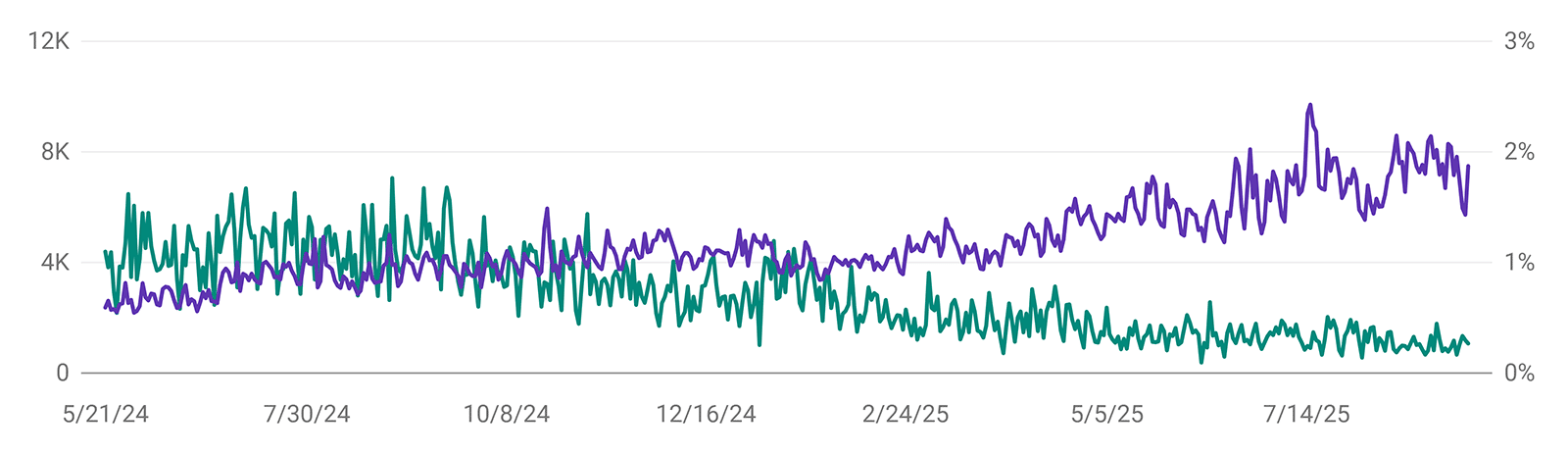
Pull your Search Console data from the last 90 days and look at impressions versus clicks. If impressions are flat or growing but clicks are declining, you are already losing traffic to the AI answer layer above your results.
Audit your content structure. Is it written to answer questions in natural language, or is it built around keyword density?
The query patterns feeding AI Mode are conversational.
The content that earns citations matches that register.
Assess your topical coverage. Pick the five topics most important to your business.
Count the number of pages on your site that address each one from different angles.
If the answer is fewer than 20 per topic, you do not have the surface area to compete for citations at scale.
Map the new buyer journey. Where in the AI Mode conversation does your product or service become relevant?
What questions are being asked in the planning and brainstorming phase, the fastest-growing query categories in AI Mode, that your content could be answering?
Solve the volume problem. This is not optional.
The brands that will dominate AI search visibility over the next 24 months are the ones publishing at a scale that creates genuine topical authority.
That requires either a very large content team or automated infrastructure that can match the pace at which AI search is growing.
Google's AI Is Reading Your Content Right Now.
It's deciding whether there's enough of it, and whether it's structured in the right way, to cite you in front of 1 billion users.
The window to build that kind of authority before your competitors do is not permanent.
Every week you're not publishing, someone else in your category is.
Are you showing up in AI search?
Most brands don't know the answer. That's the problem. AIObot was built to solve it. An automated content engine trained on your brand, your industry, and professional SEO frameworks, publishing optimized articles around the clock so your site builds the topical authority AI Mode rewards.
If you want to see what that looks like for your business, hit the button below.
