

 let’s connect


For a decade, the Meta ads playbook was the same.
Build your audiences. Layer your interests. Write copy that matches the segment.
Point the pixel at your best buyers and let it learn.
Meta rewrote that playbook in October 2025.
Most advertisers are still running the old one.
What Actually Changed
Meta's Project Andromeda is not a targeting update. It is a targeting replacement.
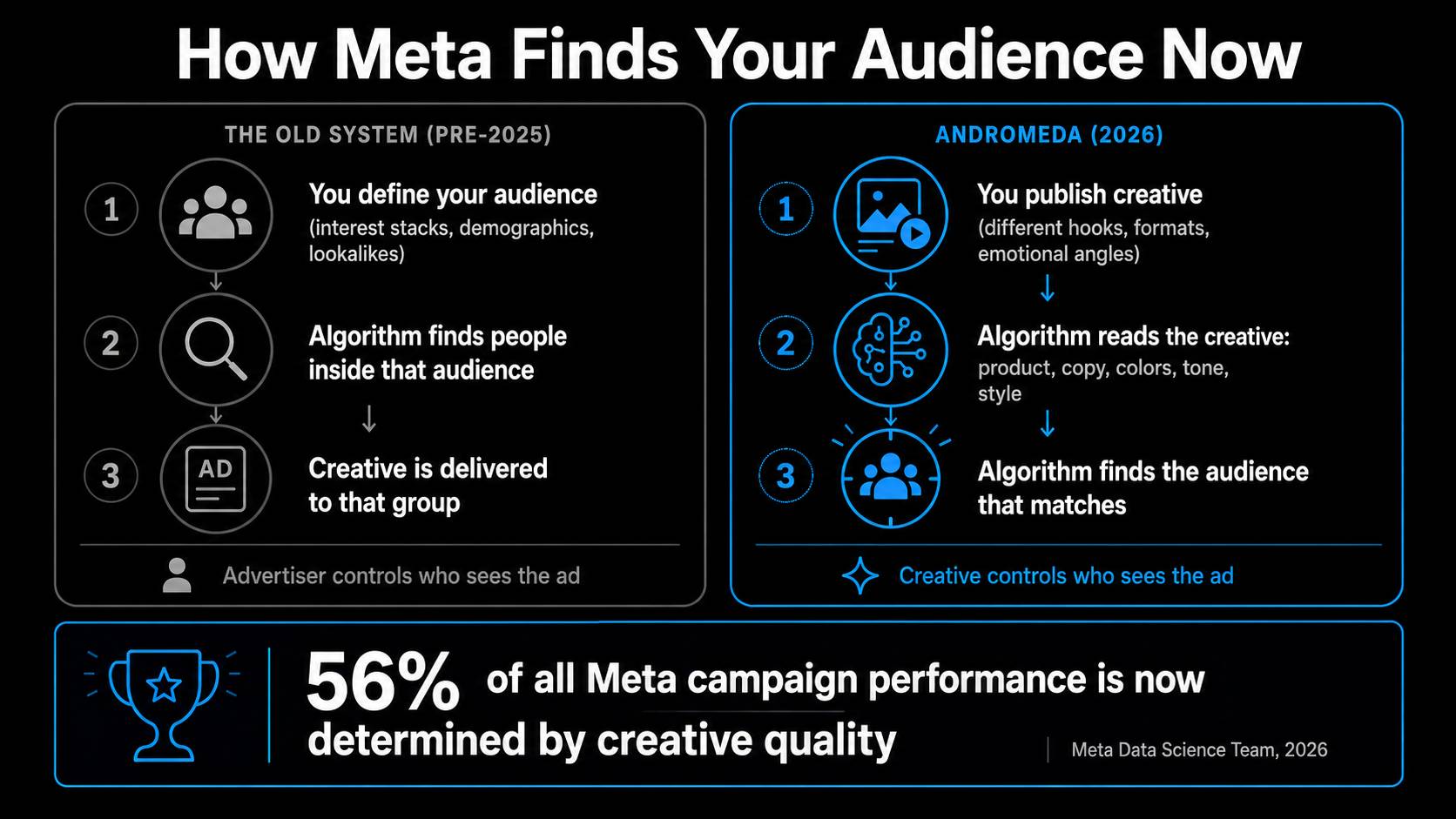
Under the old system, you defined the audience and the algorithm
found people inside it.
Under Andromeda, the algorithm reads the creative itself: the product, the copy, the colors, the visual style, the emotional tone.
It uses those signals to find the users most likely to respond.
You no longer tell Meta who the ad is for.
The ad tells Meta.
What the Data Shows
Meta's own data science team now attributes 56% of all campaign performance to creative quality.
Not targeting. Not bidding. Not budget or placement.
Creative. More than every other variable combined.
The field data backs it up.
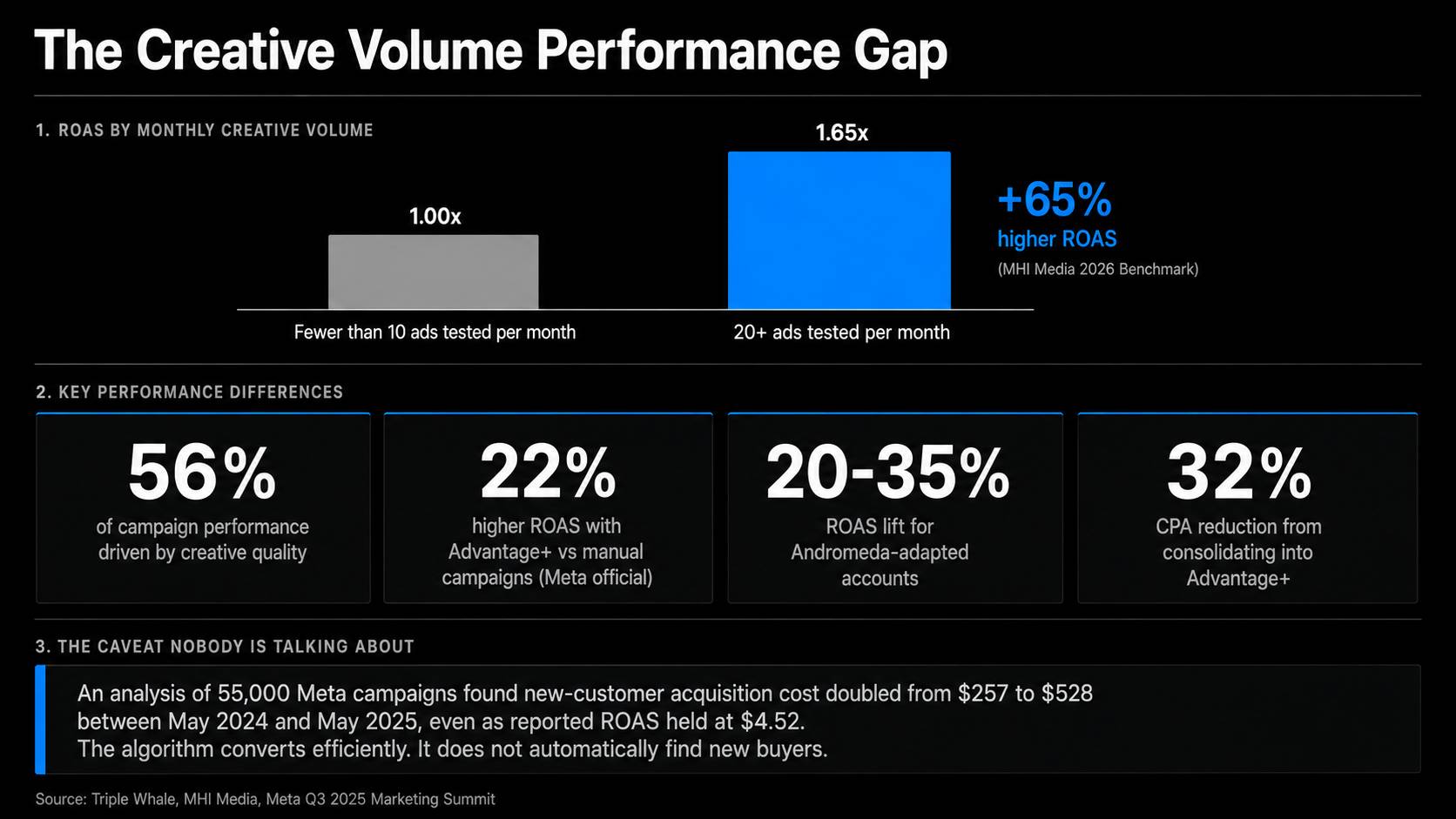
Advertisers who adapted to Andromeda's creative-first structure are reporting 20 to 35% higher ROAS compared to accounts still running legacy campaigns.
Brands testing 20 or more new ads per month achieve 65% higher ROAS than those testing fewer than 10, according to MHI Media's 2026 benchmark.
Advantage+ Sales Campaigns grew 70% year-over-year in Q4 2024 and crossed a $20 billion annual revenue run rate.
The Part Most Advertisers Are Missing
Here is what the ROAS numbers alone do not tell you.
An analysis of 55,000 Meta campaigns found that new-customer acquisition cost via Advantage+ more than doubled between May 2024 and May 2025, from $257 to $528, even as reported ROAS held near $4.52.
The system is efficient at converting. It is not automatically efficient at finding new buyers.
The algorithm takes the path of least resistance.
If your creative only resonates with your existing customer base, that is who sees it.
Creative diversity is not about testing two headlines. It is about giving the algorithm enough surface area to find new audiences on your behalf.
Scaling Meta in 2026 is a creative production problem.
If your creative volume does not grow with your budget, your performance will not either.
What You Should Do
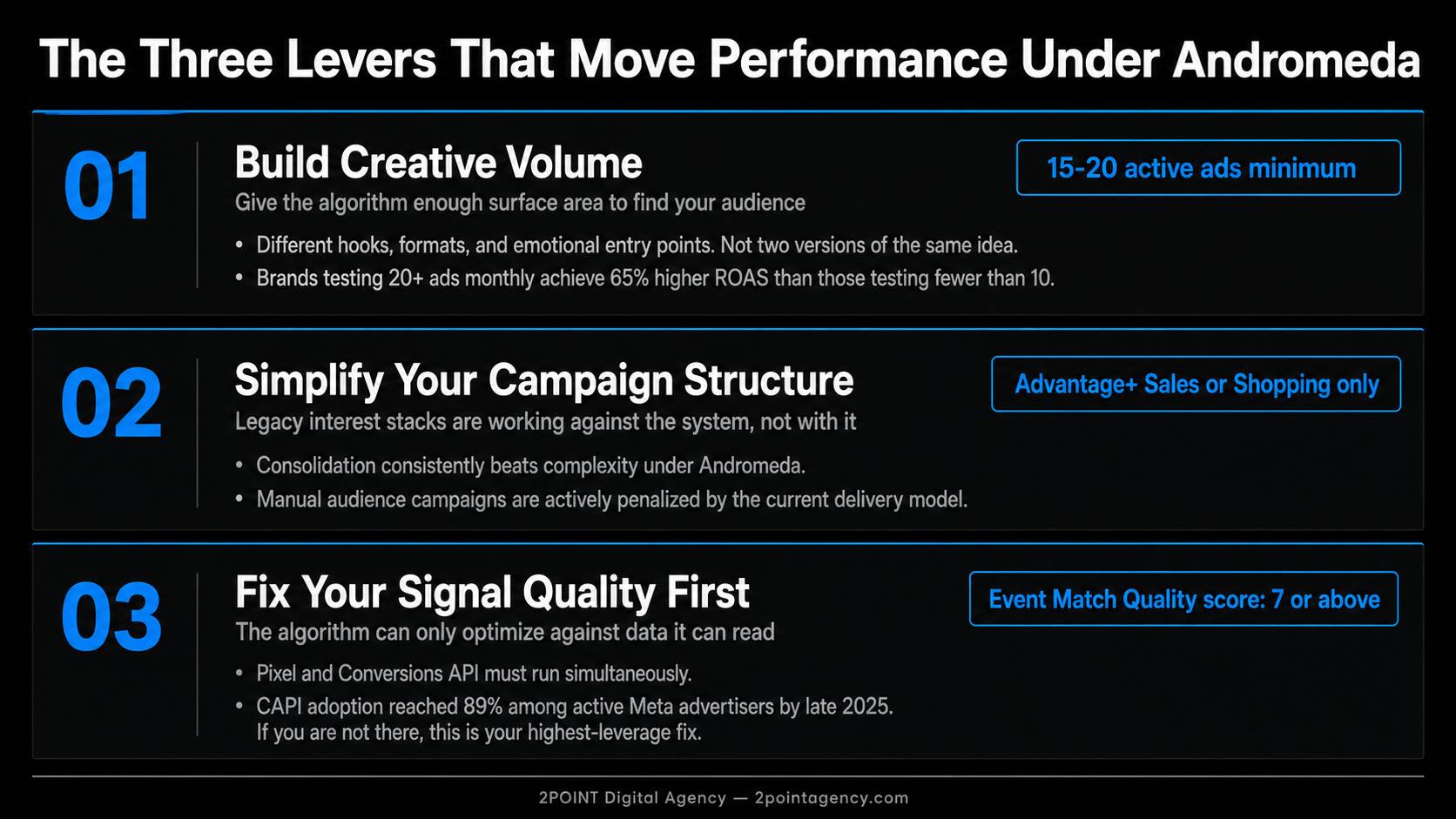
Three variables that move performance under Andromeda:
1. Build Creative Volume
Run 15 to 20 active ads with different hooks and formats at any given time.
Not two versions of the same idea. Different angles, different emotional entry points, different formats.
Most brands running fewer than 10 active ads are leaving significant performance on the table.
2. Simplify Your Campaign Structure
Advantage+ Shopping or Advantage+ Sales should be your primary campaign type.
Legacy interest stacks and layered audiences work against the current system.
Consolidation consistently beats complexity now.
3. Fix Your Signal Quality First
The algorithm needs clean data to optimize against.
Pixel and Conversions API should run simultaneously. Check your Event Match Quality score in Events Manager: anything below 7 is degrading delivery.
CAPI adoption reached 89% among active Meta advertisers by late 2025.
If you are not there yet, that is the highest-leverage fix available to you right now.
Media buying used to be the skill. Creative was the support function.
That equation has flipped.
By most practitioner estimates, 80% of performance work in 2026 is creative strategy and production.
The same logic is running on Google Performance Max, on TikTok, on every platform building AI delivery systems.
Meta is just furthest along.
Your audience settings are not the lever anymore. Your brief is.
Are you giving the algorithm enough to work with?
Are You Running Enough Creative Variants Right Now?
Most accounts we audit are running four or fewer active ads.
That gap is showing up directly in ROAS.
If your Meta account needs a creative strategy reset built for the way the algorithm actually works in 2026, we can help.
