

 let’s connect


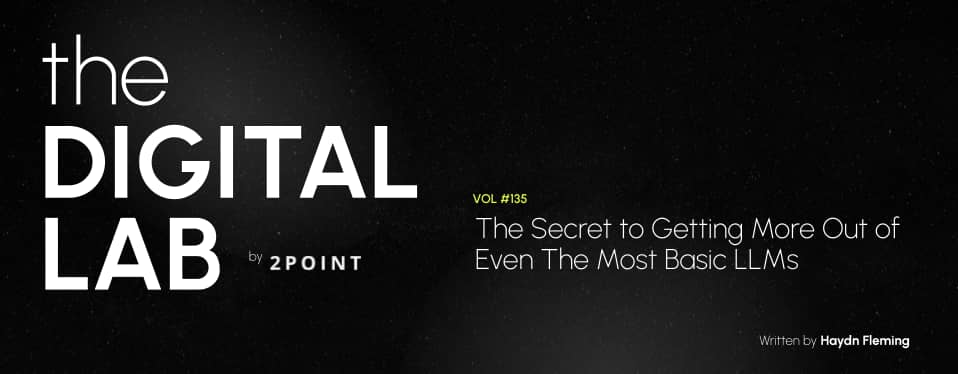
Most people are using AI like a vending machine.
Type something vague. Get something generic. Decide AI "doesn't really work for us."
Or worse, you use it anyway and it makes your business look terrible.
The tool is not the problem. The prompt is.
There is a five-part formula that separates people getting remarkable output from people getting filler they delete.
Once you see the difference, you will never go back to the old way you used AI.
Why Generic Prompts Produce Generic Content
AI does not have opinions about your business. It has no idea who your customer is, what voice sounds right, or what format you actually need.
When you give it nothing, it fills in the blanks with the average text it finds on the entire internet. This is by definition, generic.
So generic is exactly what it produces.
The fix is giving it everything it needs before it starts writing.
The Formula: Role + Context + Task + Format + Constraints
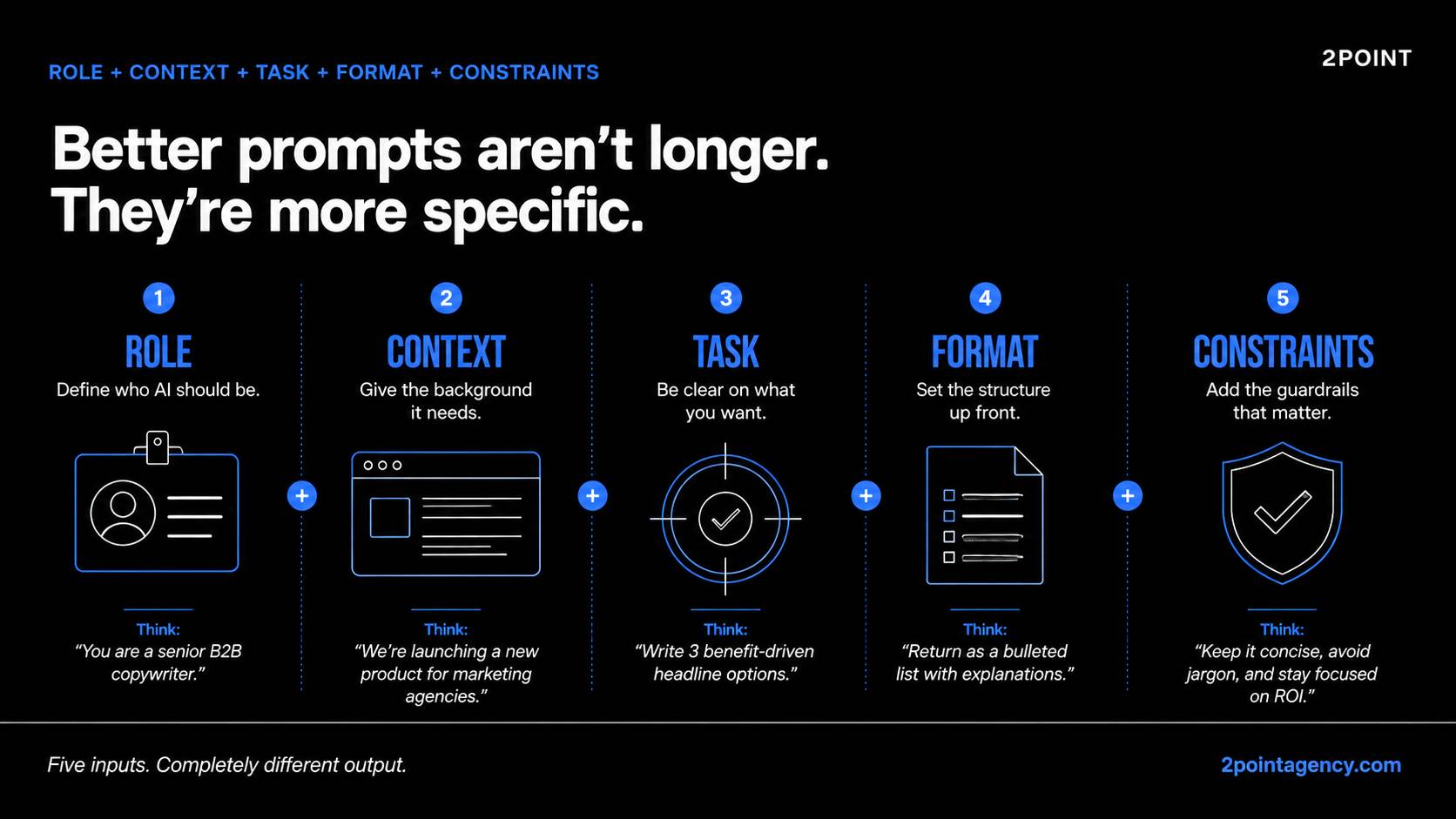
Every strong prompt answers five questions.
- Role tells the AI who to be.
Not "write me a blog post." But "you are a senior B2B strategist with 10 years writing for C-suite decision makers."
- Context gives it the situation.
Your industry. Your audience. What they care about. What they already know. What objection they usually raise.
- Task says exactly what to produce.
Not "write something about email." But "write a 200-word subject line test framework explaining why short subject lines outperform long ones."
- Format specifies the structure. Numbered list. 5 bullet points. A 3-section email. A 1,200-word article with a CTA at the end.
Specify it. Do not let the AI guess.
- Constraints set the limits. Conversational tone. No jargon. Avoid the phrase "in today's digital landscape." Under 600 words. Sentence case only.
The Difference in Practice
Here is what a bad prompt looks like:
Write me a blog post about marketing.
Here is the same brief as a strong prompt:
You are a senior B2B content strategist. Write a 1,200-word article for CMOs at mid-size SaaS companies on how to reduce customer acquisition cost using AI tools. Use a conversational but authoritative tone. Structure it with an opening hook, three numbered sections, and a CTA pointing to a free audit. Avoid buzzwords. End with a rhetorical question.
The output is barely recognizable as coming from the same tool.
Three Templates to Save Right Now
For marketing:
"You are a [type of copywriter]. Write [number] ad headlines for a [type of business] targeting [audience description]. Each headline must be under [character limit], lead with [emotion or angle], and end with [outcome]. [Formatting rules]."
For sales:
"You are a [role] at a [type of company]. Write a [length] cold email to a [prospect description] who [current situation]. The tone is [tone]. Close with [specific CTA type], not [what to avoid]."
For operations:
"You are a [role]. Summarize this [document or transcript] in [number] sections: [section names]. Use [format]. Flag anything that [condition]."
The more specific the brief, the more useful the output.
What You Should Do
- Save the formula: Role + Context + Task + Format + Constraints.
Put it somewhere you will see it every time you open an AI chat. - Pick one prompt you run regularly. Rewrite it using all five parts.
Run both versions side by side and compare.
If you ask your AI platform to run multiple side-by-side tests, it will.
Giving you a really clear difference across multiple use cases.
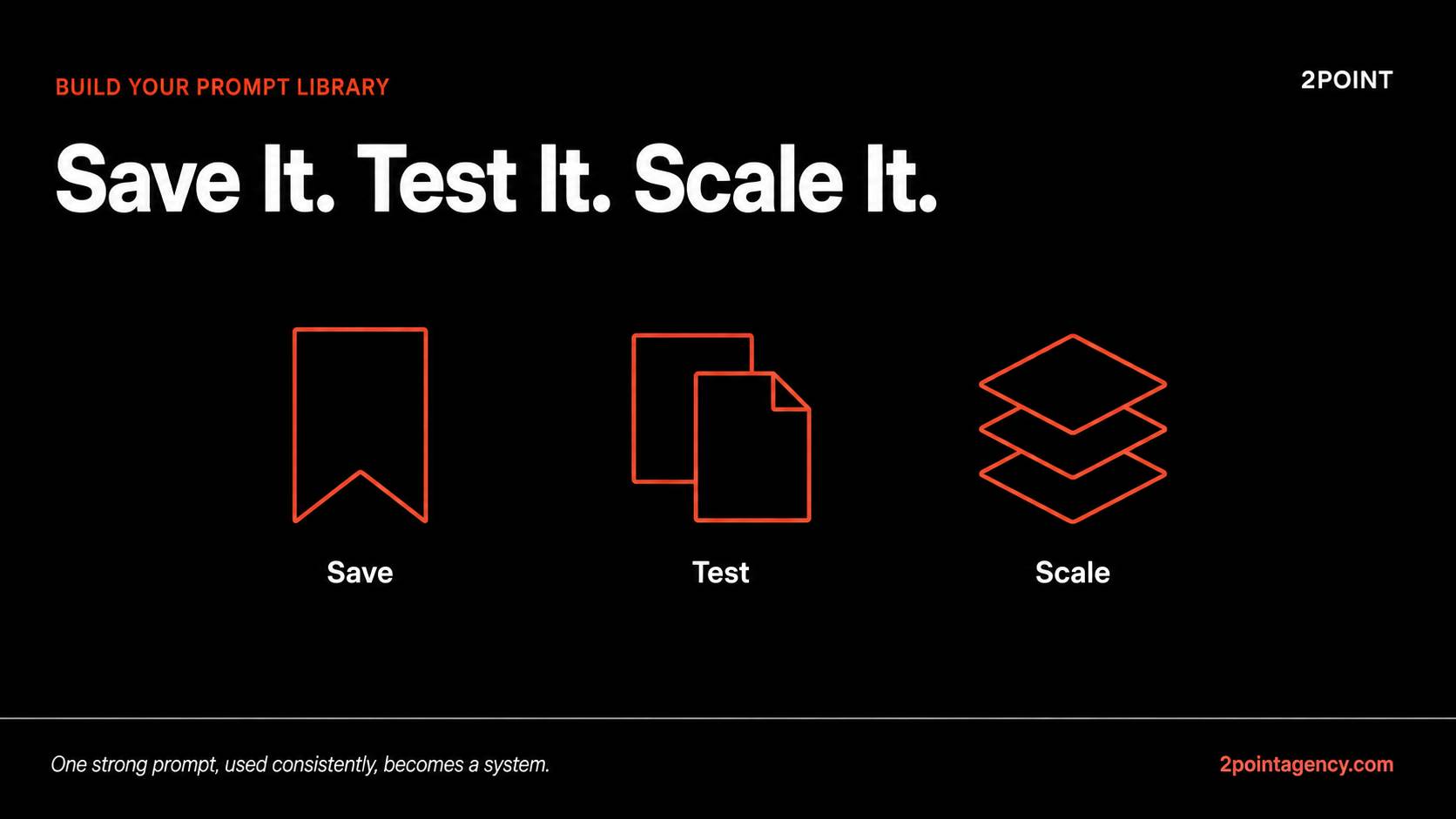
- Build a library. When a prompt produces something genuinely strong, save it.
You are building a system, not doing one-off tasks.
Some AI platforms like ChatGPT and Claude can save them for you as "skills" that can be recalled and used any time you want.
The difference between a team that is 10x more productive and one that is spinning its wheels is almost never switching which AI you are using.
It comes from building better practices with how you use AI.
Are you getting full value from the AI tools you are already paying for?
Most businesses have the subscriptions. Very few have the process.
At 2POINT, we build AI tools tailored for teams that want to take advantage of innovative AI-use in marketing.
You can't find this stuff anywhere else.
