

 let’s connect


For the better part of two decades, SEO had a simple contract with the internet.
- You create great content.
- Google indexes it.
- People search for something.
- Your page shows up.
- They click.
- They become a customer.
Simple. Predictable. Repeatable.
Thousands of businesses were built entirely on the back of that contract. Rankings meant traffic. Traffic meant revenue. The formula was almost boring in its consistency.
And then, starting around mid-2024, Google quietly started rewriting the contract.
In fact, they started replacing it entirely.
However, most people didn’t notice until the traffic stopped coming.
What Changed
Here’s a story that might feel familiar.
Let’s say you run a financial planning firm. You’ve been writing detailed blog posts about Roth IRA conversions for three years. You’ve earned your position on page one, top five results even, consistent traffic, consistent leads.
That ranking didn’t disappear.
But something did appear above it.
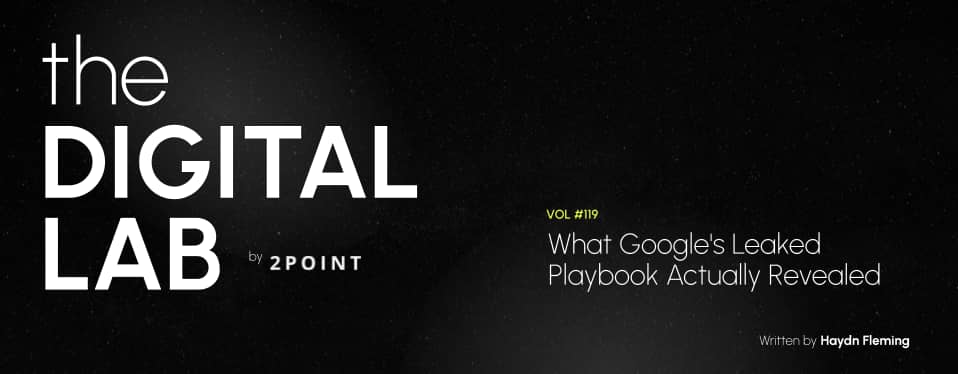
An AI-generated summary at the very top of the page, written in plain English, answering the exact question your blog post would have answered. No click required. The user gets the answer. They close the tab. They never visit your site.
Google calls these AI Overviews.
They launched them to all U.S. users in May 2024.
By January 2026, they’re appearing in nearly 1-in-4 searches.
For health, finance, and educational content? That number is closer to 1-in-2.
The research is unambiguous on what happens to your traffic when one appears above your result.
A Pew Research Center study tracked 68,000 real search queries. When an AI Overview appeared, the click rate dropped from 15% to 8%. That's a 46.7% relative decline. Nearly half your potential traffic, gone.
And that’s for the searches where you still rank.
Zero-click searches (searches that end without anyone visiting any website at all) climbed from 56% in May 2024 to 69% by May 2025. In one year.
That’s a structural shift in how the internet has worked since it's creation.
Five Major Algorithm Updates in 18 Months
The AI Overviews story doesn’t exist in isolation.
Alongside deploying AI answers, Google ran five major core algorithm updates between August 2024 and March 2026. Five. In 18 months. That’s historically unusual. Historically aggressive.
Each one was framed the same way in their public announcements:
The real-world data is... different.
The August 2024 update was supposed to rescue small, independent publishers who had been crushed by previous changes. A poll of affected site owners found 44% saw traffic declines. Only 27% improved. Sites in the travel industry were among the worst hit, 32% of travel publishers lost more than 90% of their organic traffic.
The March 2025 update surfaced a pattern the SEO community keeps noticing: Reddit, Yelp, Quora, and major retail brands kept climbing in rankings. Niche expert sites, the ones run by people who actually specialize in the topic, kept falling.
Think about that for a second.
A generalist community forum outranking a dedicated expert site on that expert’s own topic.
Nobody at Google has explained why this keeps happening.
Their public guidance hasn’t changed in years.
In 2024, Google’s Playbook Got Leaked
Here’s where it gets interesting.
In May 2024, over 2,500 pages of Google’s internal engineering documentation were accidentally published online. Fourteen thousand ranking signals. Exposed.
Google confirmed the documents were real.
What was in them? A few things that Google had publicly denied for years.
NavBoost. A system that uses click-through rates and user engagement, how long someone stays on your page, whether they scroll, whether they bounce back to Google immediately, as ranking signals. For years, Google said click data didn’t directly influence rankings. The leaked documents, and later sworn testimony from Google executives during the federal antitrust trial, confirmed it does.
Chrome data. The documents suggest Google uses browsing behavior from the Chrome browser itself as an input into its ranking systems. What people do after they visit your site, scroll depth, return visits, session duration, may all be feeding the algorithm.
Page authority. A page-level authority score that Google had consistently denied existed in this form. It does. And it plays a significant role in how topically relevant your site is considered to be.
This matters because content and user experience are no longer just good ideas. They’re ranking infrastructure. If people visit your page and immediately leave, Google knows. And it counts against you.
What Google Said (And Didn’t)
For seven years, a man named Danny Sullivan served as Google’s Search Liaison, essentially the public face of Google’s search team. The person who engaged directly with the SEO community, acknowledged when updates caused problems, and offered at least some transparency.
On August 1, 2025, that job ceased to exist.
Sullivan moved to an internal role. No replacement was appointed.
Before he left, Sullivan made his position clear: “Good SEO is good GEO.”
He was talking about Generative Engine Optimization, the emerging discipline of getting AI systems to cite your content. His argument was that the fundamentals hadn’t changed. Create genuinely useful content, build real authority, give people a great experience.
He also confirmed, almost casually, that Google has no plans to show AI Overview performance data in Search Console.
Meaning: your traffic is being affected by a major system, and Google isn’t giving you the tools to measure it.
The rest of the industry leaped to fill the gap with AI Visibility tools.
The Uncomfortable Truth
Lily Ray is one of the most respected voices in SEO. In late 2025 she published a piece that quietly summarized the moment the entire industry is in.
She described the “vicious cycle of SEO.” Practitioners discover a tactic. It works. Everyone scales it. Google identifies the pattern, flags it as manipulative, and algorithmically demotes everyone doing it. Then a new tactic emerges. Repeat.
- Keyword stuffing.
- Link schemes.
- Fake reviews.
Same cycle, different era.
The only thing that survives every update is the thing that can’t be manufactured at scale.
- Original research.
- Genuine expertise.
- Real authority.
- A trusted brand.
This isn’t just philosophical. Google’s own data backs it up.
Studies show that 96% of content cited in AI Overviews comes from sources with verified credibility signals. The AI isn’t randomly picking who to cite. It’s citing the sources it’s been trained to trust.
And here’s the irony that nobody talks about enough:
The content that earns AI citations is mostly the same content that ranks well in traditional search. The recipe hasn’t changed. The distribution surface has.
You’re Not Just Competing for Clicks Anymore
A few years ago, ranking #1 was a binary win. You showed up. People clicked. Done.
Today, there are three outcomes when someone searches for something related to your business:
1. An AI answer appears and the user never clicks anything.
Your ranking isn't a factor here.
2. An AI answer appears and you’re cited as a source.
Research shows this actually increases your click rate by up to 35% compared to a regular listing. This is the new “#1 spot.”
3. No AI answer appears and your organic result gets clicked.
Still common for transactional searches. Increasingly rare for informational ones.
ChatGPT, Perplexity, and Google’s own AI Mode are all growing fast. But Google still processes over 14 billion searches every single day.
For context, ChatGPT processes about 37 million.
Google isn’t slowing down.
What’s going away is the assumption that ranking well automatically means traffic.
The Takeaway
Google’s algorithm, AI systems, and human readers are all converging on the same preference: content that was clearly created by someone who actually knows what they’re talking about, for people who actually want to know.
That’s it. That’s the whole strategy.
The businesses that are going to win in this environment are the ones that build real authority in their space through original research, genuine perspective, and credible authorship.
Don’t panic about AI Overviews. Don’t abandon SEO.
Because here’s what’s true right now, and will be true for the foreseeable future:
Google’s AI is reading your content.
It’s deciding whether to trust you enough to cite you in front of millions of people.
The question is whether you’ve given it a reason to.
Are you taking your Search Engine Optimization seriously this year?
Millions of business leaders are "phoning in" SEO by using outdated strategies with marketing partners that haven't adapted to the shift. Don't be one of them.
If you want a second opinion...
