

 let’s connect


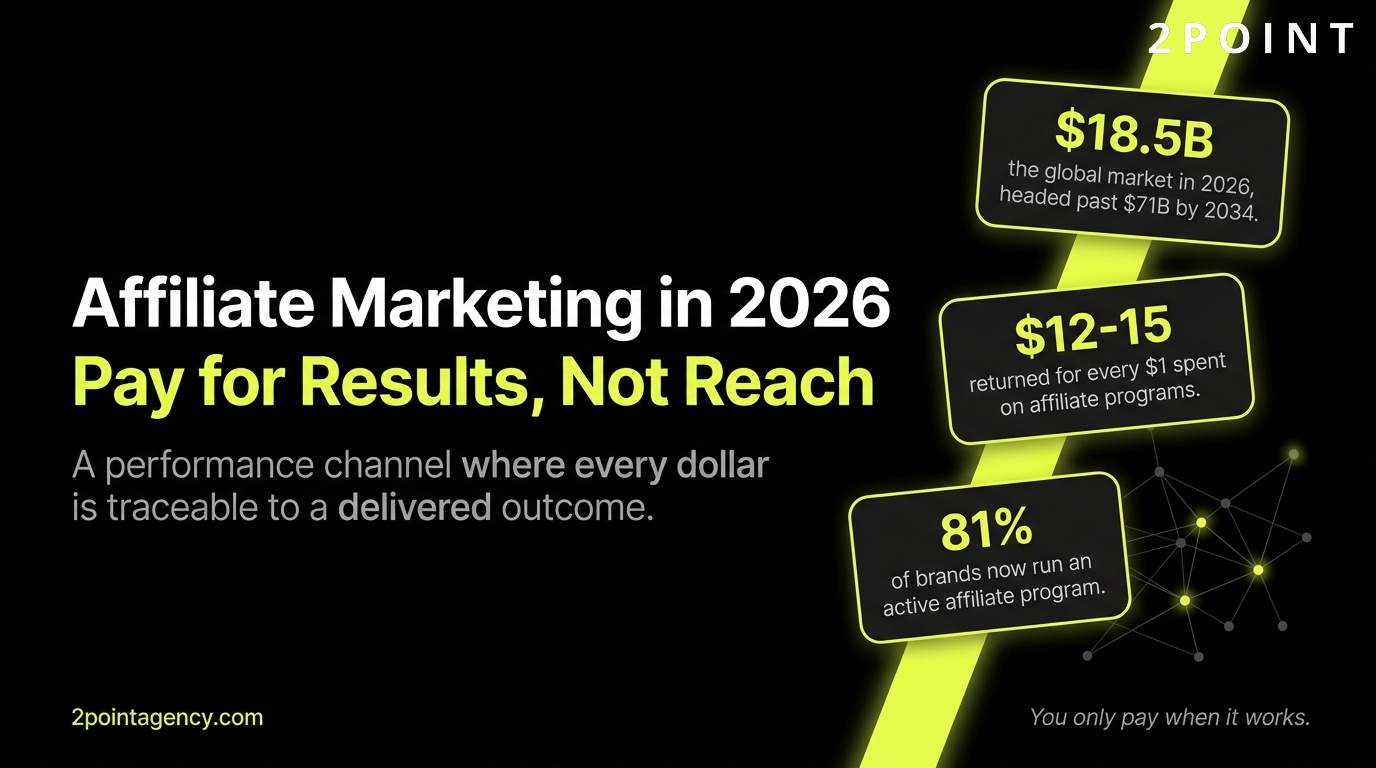
- Affiliate marketing is a performance-based model where brands pay partners a commission for driving traffic, leads, or sales.
- The global affiliate marketing industry is valued at $18.5 billion in 2026 and projected to exceed $71 billion by 2034.
- U.S. affiliate spending alone reaches $13 billion in 2026, climbing to $15.8 billion by 2028.
- 81% of brands and 84% of publishers now run active affiliate programs.
- Average ROI is $12 to $15 for every $1 spent, outperforming most paid channels.
- Top niches include education, travel, SaaS, and retail, with monthly earnings ranging from $8,000 to $15,000.
- Nearly 80% of affiliate marketers now use AI tools for content creation, SEO, or campaign analysis.
- Affiliates with a diversified omnichannel presence consistently outperform single-channel operators.
- Commission models include cost-per-sale, revenue share, and hybrid structures, with SaaS programs offering 20 to 70% rates.
- Fraud, algorithm changes, and cookieless tracking are the top three challenges requiring active management.
The State of Affiliate Marketing in 2026: Market Size, Growth, and Industry Maturity

Affiliate marketing has moved well beyond its early reputation as a side hustle tactic. In 2026, it represents one of the most structured, data-rich, and institutionally backed channels in the entire digital marketing ecosystem. Understanding where the market stands today is essential for any brand, publisher, or agency deciding how to allocate resources.
Global Market Valuation and Growth Projections
The global affiliate marketing industry currently sits at a valuation of $18.5 billion in 2026, with projections placing it at $71.74 billion by 2034, representing a compound annual growth rate of 15.2%. That trajectory is not an outlier. It reflects sustained demand from both the brand side, which wants accountable, results-driven spend, and the publisher side, which wants scalable income tied to real audience value.
The United States continues to lead global spending. U.S. affiliate marketing spend reached $13 billion in 2026 and is projected to hit $15.8 billion by 2028, representing 65% growth from 2023. That figure alone signals how deeply affiliate programs have been integrated into enterprise marketing budgets. It is no longer a test-and-learn line item. It is a core channel.
The affiliate platform infrastructure market tells a parallel story. Platform infrastructure reached $23.84 billion in 2026, growing to an estimated $35.70 billion by 2033. Investment in the technology that powers affiliate tracking, attribution, and payment processing reflects the seriousness with which brands and tech providers are treating this channel. For beginners, this signals a maturing ecosystem with professional tooling. For established businesses, it signals robust infrastructure capable of supporting enterprise-scale programs.
Regional Market Distribution and Emerging Opportunities
Geography plays a significant role in where affiliate marketing dollars flow and where growth opportunity is most pronounced. North America commands approximately 40% of the global market share, with the United States alone holding 38% of total global affiliate spend. This dominance reflects the maturity of American e-commerce, the breadth of affiliate networks headquartered stateside, and the density of both brands and publishers operating in the region.
Europe is not standing still. The region is expanding at a steady 6.5% CAGR, with the United Kingdom posting 17% year-over-year growth as brands there increase affiliate program investment following shifts in paid social economics. European regulatory complexity, particularly around GDPR and cookie consent, has also pushed brands toward affiliate models that rely less on intrusive retargeting.
The most exciting growth story belongs to Asia-Pacific, which is expanding at a 10 to 13% CAGR, driven by mobile commerce adoption, rising middle classes, and the rapid maturation of e-commerce infrastructure in markets like India, Indonesia, and Southeast Asia. Latin America adds another compelling dimension, with regional e-commerce opportunity reaching $215.31 billion in 2026. Middle East and African markets are growing at 7% or more annually, offering ground-floor positioning for brands willing to build localized programs now.
Industry Adoption Rates: How Brands and Publishers Are Investing
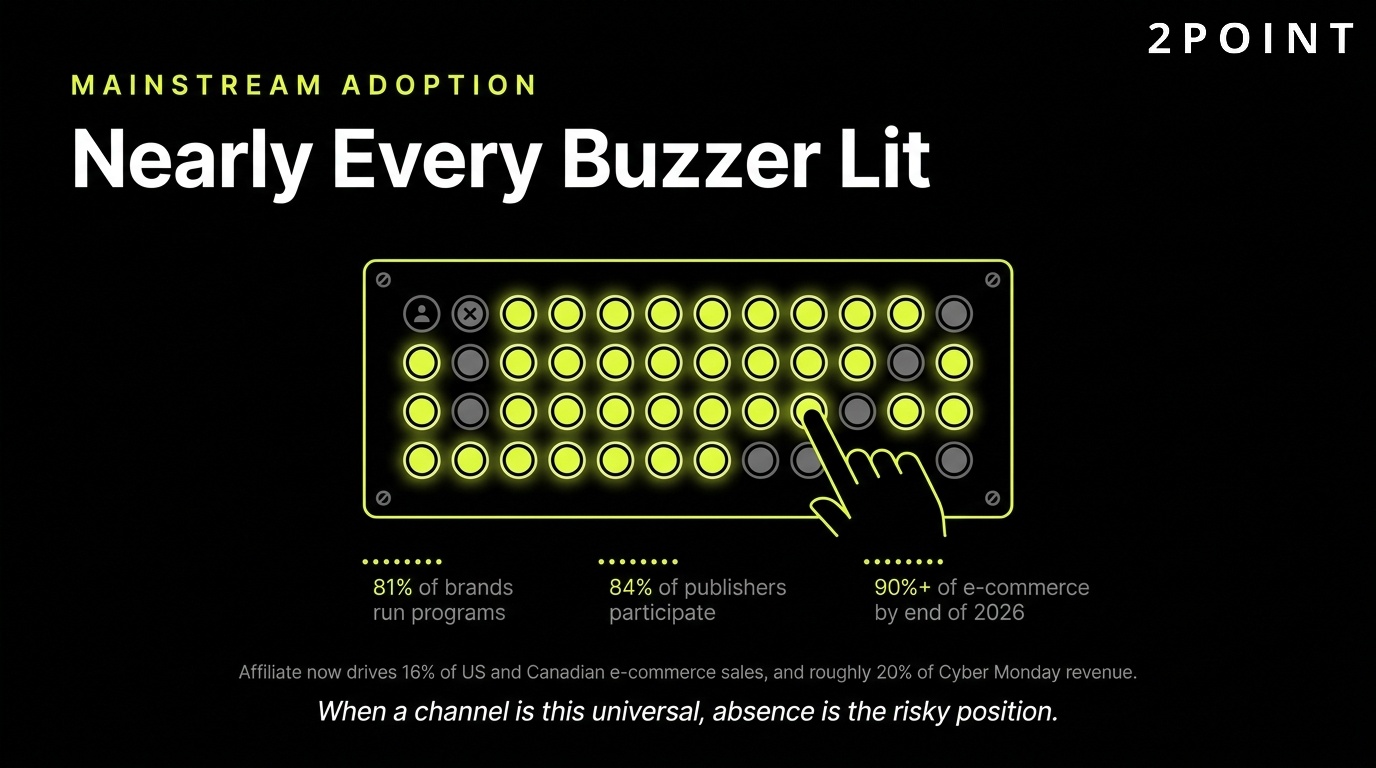
Adoption metrics confirm that affiliate marketing has crossed the threshold from early adopter territory into mainstream business practice. 81% of brands and 84% of publishers now operate affiliate programs, and over 90% of e-commerce businesses are expected to leverage some form of affiliate marketing by the end of 2026. That near-universal adoption reflects a fundamental shift in how companies think about distribution: if a publisher or creator can reach your audience authentically, and you only pay when a result is delivered, the economics are almost always favorable.
Affiliate marketing now drives 16% of total e-commerce sales in the United States and Canada. That is not a marginal contribution. On Cyber Monday 2024 alone, affiliate-driven traffic accounted for roughly 20% of total U.S. e-commerce revenue, demonstrating the channel's capacity to perform at scale during high-competition periods. On the publisher side, 31% of web publishers cite affiliate marketing as their single top revenue source, outranking display advertising and sponsored content.
Why Affiliate Marketing Has Reached Institutional Status
There is a meaningful difference between a channel that works and a channel that has reached institutional status. Affiliate marketing is now firmly in the latter category. The signal is clearest in the venture capital data: $1.6 billion in venture funding has been raised for AI-driven affiliate platforms in recent years. Investors do not commit that kind of capital to a tactic they consider temporary or fringe.
Professionalization is another indicator. The average affiliate marketing manager now earns $81,697 per year, a salary range consistent with mid-level roles in digital marketing, paid media, and content strategy. Companies are hiring dedicated affiliate managers, building internal teams, and creating formal program governance structures. This mirrors the trajectory that SEO and paid search followed as they evolved from experimental tactics into disciplines with career paths, certifications, and organizational ownership.
The combination of market scale, venture investment, mainstream adoption, and professional infrastructure creates a compelling case: affiliate marketing is not a supplementary tactic to consider when budgets allow. It is a core distribution channel that deserves strategic attention, dedicated resources, and rigorous performance management.
ROI, Conversion Rates, and Performance Metrics That Prove Affiliate Marketing Works
Every marketing channel eventually has to justify itself against measurable returns. Affiliate marketing does this exceptionally well, largely because its performance-based structure forces accountability from the outset. The numbers below represent real benchmarks from operating programs, not theoretical projections.
Return on Investment: Why Affiliate Marketing Outperforms Traditional Advertising
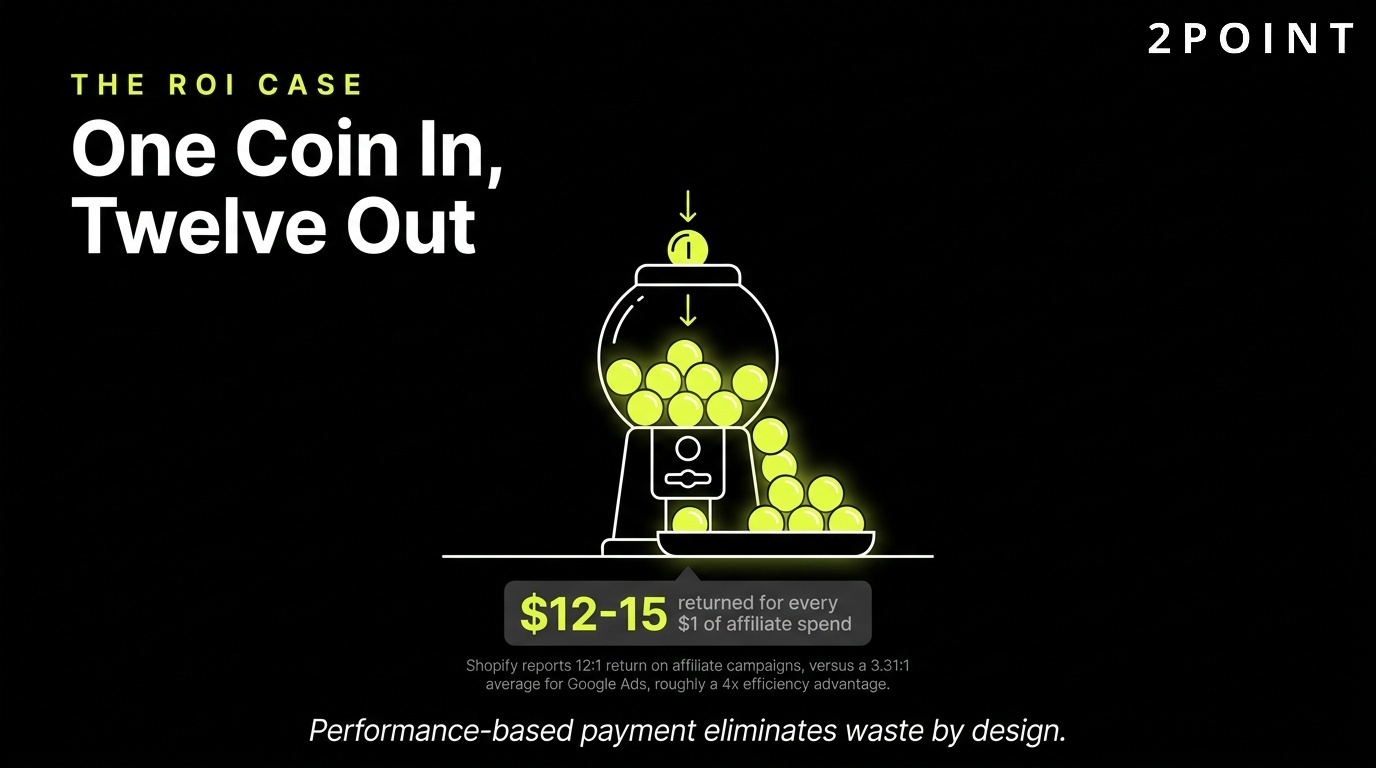
The headline ROI figure for affiliate marketing is striking. Brands consistently report $12 to $15 in revenue for every $1 spent on affiliate programs. Shopify has reported a 12:1 return on ad spend for affiliate campaigns, a figure that stands in sharp contrast to Google Ads' average ROAS of 3.31:1 as of April 2025. That is roughly a 4-times advantage in return efficiency, and it does not require upfront creative production costs or bidding budget risk.
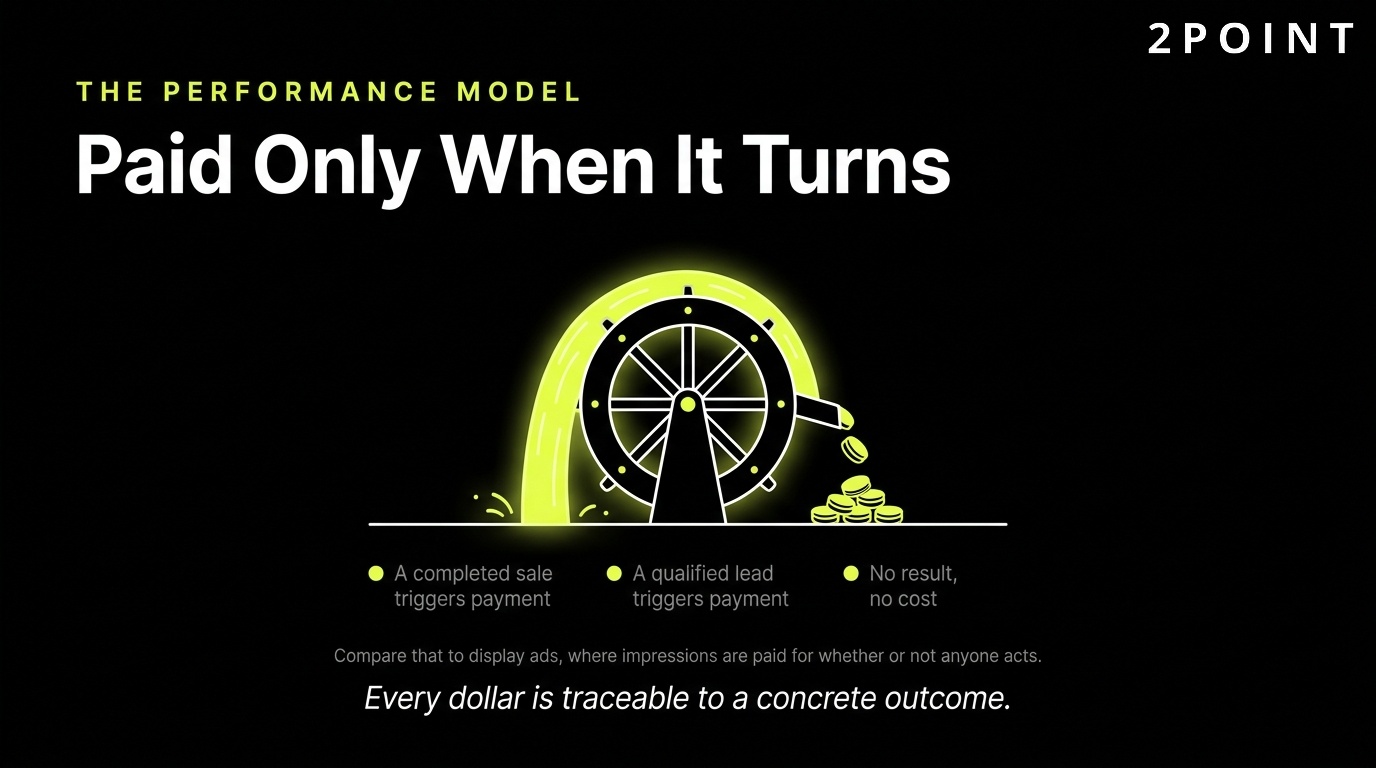
The structural reason affiliate marketing produces superior ROI is straightforward: brands only pay when a desired outcome occurs. Whether that outcome is a completed sale, a qualified lead, or a new subscription, the payment is triggered by performance. Compare this to CPM display advertising, where you pay for impressions regardless of whether a single person clicks or converts. The performance-based model eliminates waste by design, making every dollar traceable to a concrete result.
This efficiency becomes especially pronounced in competitive verticals where paid search costs are high. A single click in insurance or financial services on Google can cost $50 or more. An affiliate driving that same high-intent traffic and being paid on a CPA basis is often a dramatically more cost-effective alternative, particularly when the affiliate has already built trust with their audience through long-form content or established community relationships. Understanding and measuring ROI in marketing channels is a skill that consistently separates high-performing programs from average ones.
Conversion Rates and Click-Through Performance
Affiliate marketing conversion rates vary significantly by niche, content type, and traffic quality, but the industry benchmarks provide useful orientation. The overall average affiliate conversion rate sits at 0.5 to 1% across all traffic types, while content affiliates operating in review or comparison formats regularly achieve 3 to 5% conversion rates. Average click-through rates for affiliate links range from 0.7 to 1.2%, which is competitive with display advertising and well above most cold email campaigns.
A more useful metric for many publishers is revenue per thousand visitors. Affiliate websites generate an average of $149.76 per 1,000 visitors, which compares favorably to display advertising RPMs in most niches. The key distinction is that this figure reflects targeted, intent-driven traffic arriving at content designed to inform a purchase decision, rather than passive eyeballs on a banner ad. High-quality organic traffic routed through well-optimized affiliate content consistently outperforms generic audience traffic on a revenue-per-visitor basis.
Customer Lifetime Value and Repeat Purchase Behavior
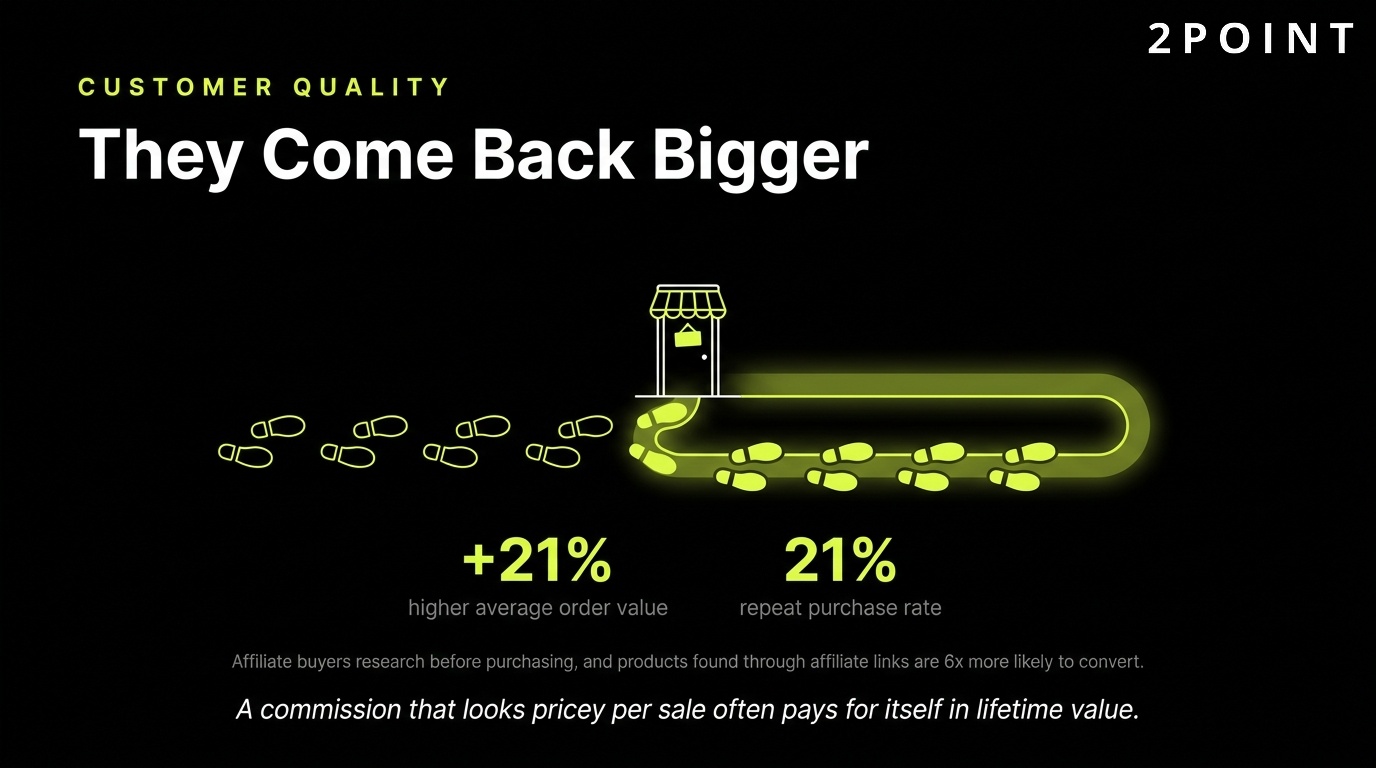
One of the underappreciated advantages of affiliate marketing is the quality of the customers it delivers. Affiliate-acquired customers show a 21% higher average order value and a 21% repeat purchase rate compared to customers acquired through other channels. This is not coincidental. Affiliates, particularly content creators and review publishers, tend to attract buyers who have done significant research before making a purchase. These are informed, high-intent customers who arrive knowing what they want and why they want it.
For brands focused on customer lifetime value rather than purely first-purchase CPA, this behavioral difference is significant. A customer with 21% higher AOV and a meaningful repeat purchase rate may easily justify a commission rate that looks expensive on a single-transaction basis. Brands building LTV-optimized programs increasingly structure their affiliate offers with this in mind, offering higher commissions on subscription products or using tiered structures that reward affiliates who bring in sticky customers rather than one-off buyers.
Revenue Impact: How Much Affiliates Actually Contribute to Business Growth
The aggregate revenue impact data makes the strongest case for affiliate marketing as a primary growth lever, not a supplementary tactic. 65% of retailers report that their affiliate programs increased annual revenue by up to 20%. That is not a marginal lift. It represents a meaningful share of growth being attributable to a channel that carries no upfront media spend risk.
On specific high-volume dates, affiliate marketing's contribution becomes even more pronounced. Affiliate-driven traffic accounted for approximately 20% of U.S. e-commerce revenue on Cyber Monday 2024. Products promoted through affiliate links are 6 times more likely to result in a purchase than products discovered through unprompted browsing. That conversion multiplier reflects the trust and intent amplification that good affiliates provide, turning casual interest into committed purchasing behavior through their content, recommendations, and community influence.
Most Profitable Niches and Verticals in Affiliate Marketing for 2026
Not all niches are created equal in affiliate marketing. The combination of commission rates, audience purchasing intent, product price points, and recurring revenue potential creates a wide range of earning outcomes across verticals. Choosing the right niche is often the single most important strategic decision an affiliate marketer makes.
Top-Earning Niches: Education, Travel, Beauty, and Tech
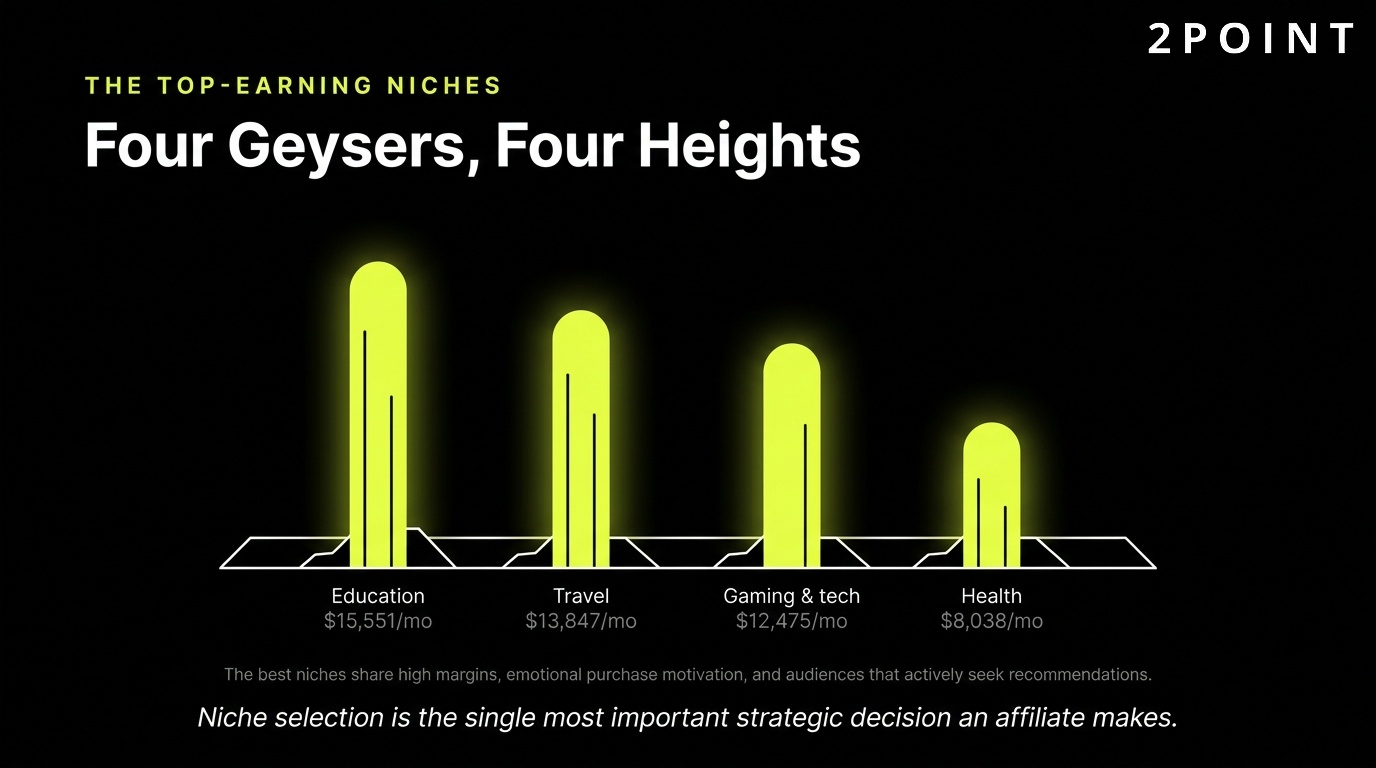
The education and eLearning sector leads all niches in average monthly affiliate income, with top performers earning $15,551 per month on average. The reasons are structural: online course platforms and credentialing programs carry high price points, strong emotional purchase motivation, and recurring enrollment cycles. Travel affiliates follow closely at $13,847 average monthly income, driven by the high transaction values of flights, hotels, and vacation packages combined with the research-intensive nature of travel decision-making.
Gaming, eSports, and technology affiliates average $12,475 per month, buoyed by a passionate, purchase-ready audience and consistently high-ticket items ranging from gaming hardware to software subscriptions. Health and wellness rounds out the top tier at $8,038 average monthly income. These niches all share common characteristics: high margins at the product level, emotionally driven purchasing behavior, and audiences that actively seek recommendations before buying. Affiliates who establish authority in any of these areas can build durable, scalable revenue streams that compound over time.
SaaS and Software Products: The Recurring Revenue Goldmine
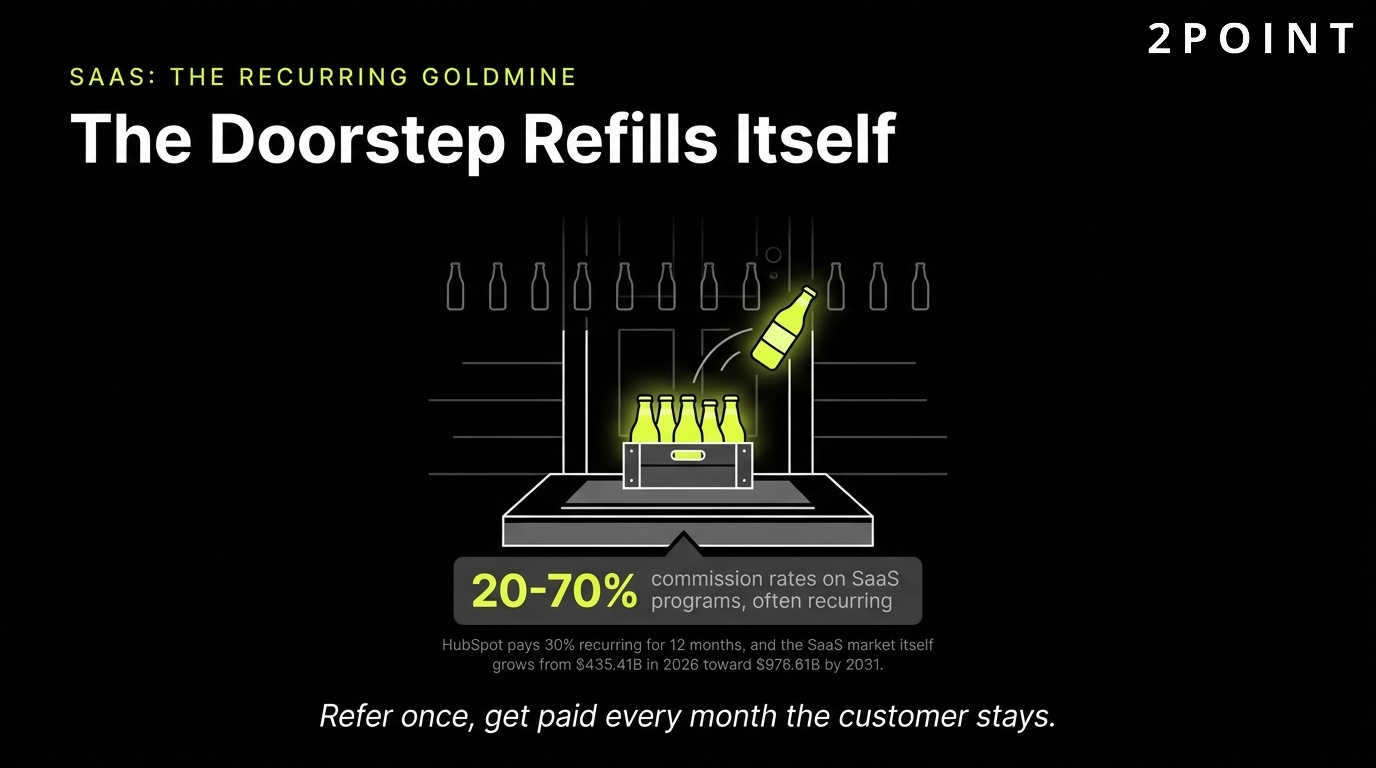
Among all affiliate verticals, SaaS products offer the most compelling long-term economics. Commission rates for SaaS affiliate programs range from 20 to 70% of the sale price, and many programs offer recurring commissions on monthly or annual subscription renewals rather than a single one-time payout. HubSpot, for example, offers 30% recurring commission for 12 months, meaning a single referral of a mid-tier HubSpot customer can generate several hundred dollars in commission over the course of a year.
The scale of the underlying market amplifies this opportunity. The global SaaS market is projected to reach $435.41 billion in 2026, growing to $976.61 billion by 2031 at a 17.55% CAGR. Nearly every business function, from CRM software to project management to email automation, is now addressed by a SaaS product with an affiliate program. Affiliates who can credibly review, compare, and recommend software tools to professional audiences are positioned to capture some of the highest EPCs available in any affiliate vertical.
E-commerce, Retail, and Physical Products
By volume, retail remains the dominant segment in affiliate marketing. Retail represents 44% of total affiliate revenue by industry, followed by telecom at 25%, travel and leisure at 16%, and other categories making up the remainder. The sheer scale of e-commerce spending creates consistent opportunity even at relatively modest commission rates.
Amazon Associates remains the dominant affiliate network in this space, holding a 46.61% global market share among affiliate networks. Despite commission rates that range from 1 to 10% depending on category, Amazon's breadth of product catalog, consumer trust, and conversion rate create strong EPC performance for content affiliates operating in product review or comparison formats. Physical product affiliates typically operate at lower commission percentages than SaaS counterparts, but the volume of available products and the universal consumer familiarity with online retail provide a stable, predictable foundation for building affiliate businesses.
Financial Services, B2B, and Emerging Verticals
Financial services represent one of the highest-EPC verticals in affiliate marketing, driven by the naturally research-intensive behavior of consumers comparing loans, credit cards, insurance policies, and investment platforms. The alignment between financial consumer intent and affiliate content formats, particularly detailed comparison articles and calculators, creates strong conversion economics even when raw commission rates appear moderate.
B2B affiliate programs experienced approximately 17% growth in 2025, as more software vendors, professional services firms, and enterprise tool providers recognized affiliates as an efficient way to reach business decision-makers. Emerging verticals also include sustainable and ethical brands, where 30% of consumers express a preference for sustainable brands by 2026. Affiliates who align their content with values-driven purchasing behavior can build highly loyal audiences with strong conversion rates and above-average order values, particularly in categories like sustainable fashion, ethical food, and eco-friendly home products.
How AI and Technology Are Transforming Affiliate Marketing in 2026
Technology has always shaped affiliate marketing, from the earliest tracking pixels to modern multi-touch attribution systems. But the current wave of AI adoption represents a more fundamental transformation. It is changing how content gets created, how audiences get reached, how attribution gets measured, and how search results get generated. Affiliates and brands who understand these shifts will maintain competitive advantages. Those who ignore them risk structural disadvantage.
AI Adoption Rates and Use Cases Among Affiliate Marketers
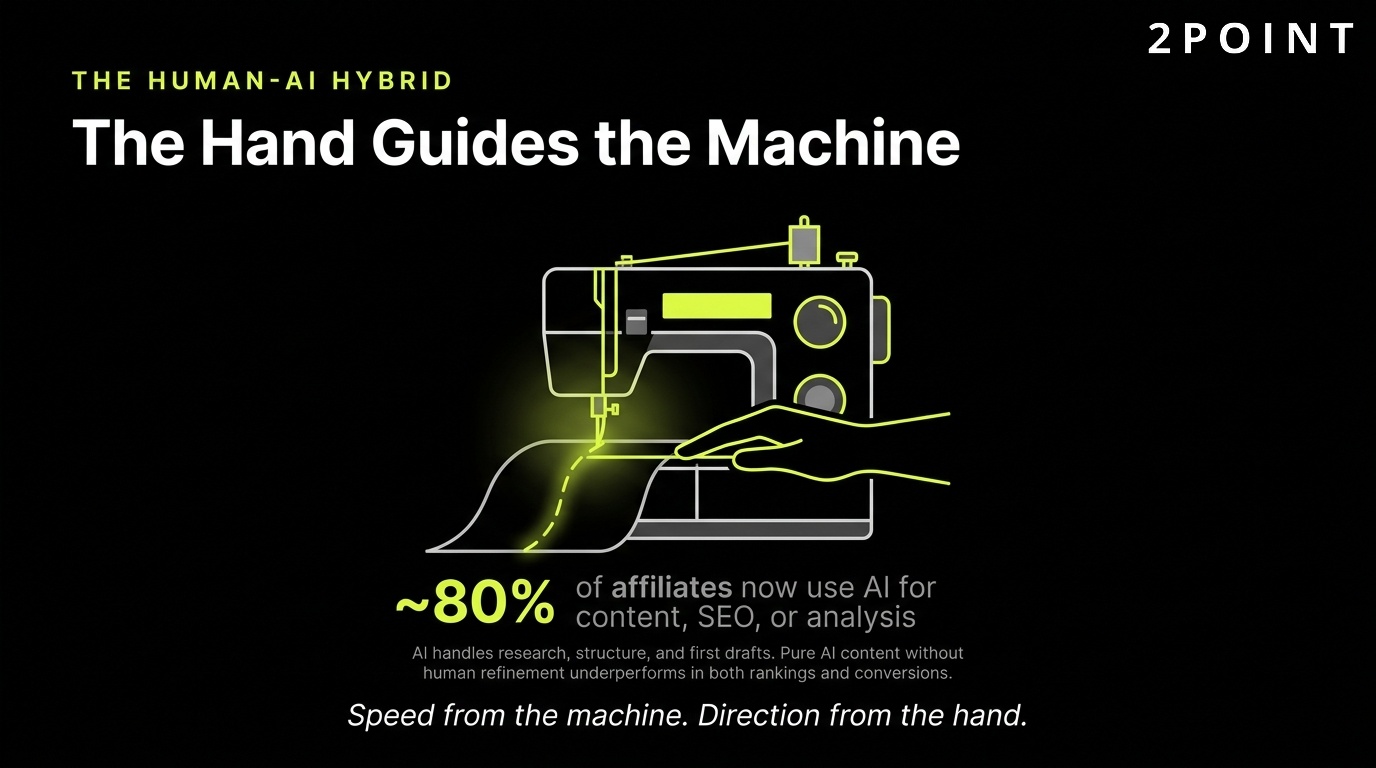
The adoption curve for AI in affiliate marketing has been steep. Nearly 80% of affiliate marketers now use AI tools for content creation, SEO analysis, or campaign optimization. The global AI in marketing market reached $20.45 billion in 2024 and is growing at 25% annually through 2030, reflecting the breadth of applications being built and deployed.
Common use cases include content ideation and first drafts, keyword research and gap analysis, A/B testing of headlines and calls to action, and audience segmentation for personalized affiliate email sequences. AI tools have made it possible for individual affiliates to produce content at a volume that previously required a full editorial team, dramatically lowering the resource barrier to building authority sites and review platforms. However, the most effective practitioners use a human-AI hybrid approach, where AI handles research, structure, and first drafts while human expertise provides the editorial judgment, personal experience, and authentic voice that search engines and audiences have learned to value. Pure AI content without human refinement consistently underperforms in both search rankings and conversion rates.
Cookieless Tracking and Privacy-First Attribution Solutions
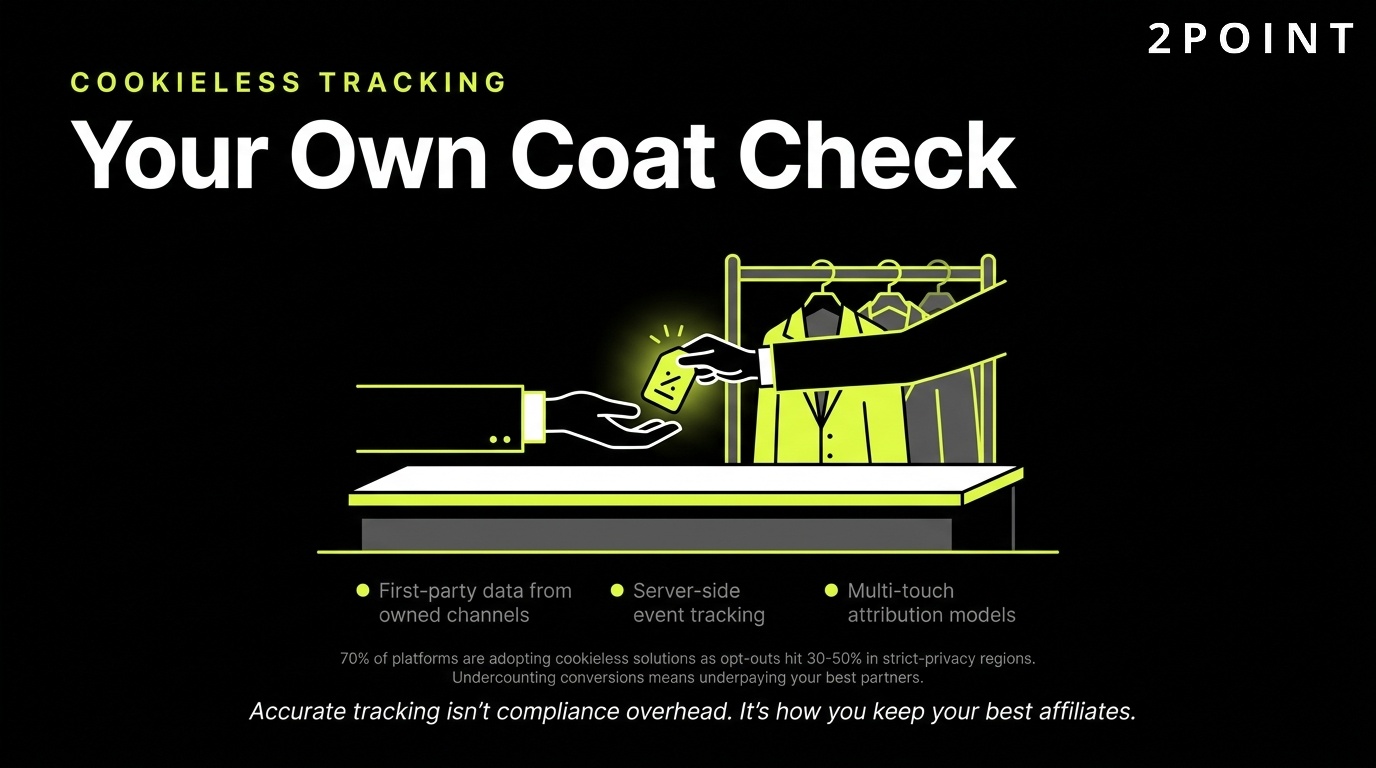
The deprecation of third-party cookies has created one of the most significant technical challenges in affiliate marketing's recent history. 70% of affiliate platforms have adopted or are actively adopting cookieless tracking solutions, ranging from first-party data strategies to server-side tracking implementations. In strict-privacy regions, third-party cookie opt-out rates range from 30 to 50%, creating meaningful gaps in traditional last-click attribution models.
The practical solutions being deployed include first-party data collection through owned channels like email lists and loyalty programs, server-side event tracking that does not rely on browser-stored cookies, and multi-touch attribution models that assign credit across the full customer journey rather than only to the last click. For brands managing affiliate programs, the investment in proper tracking infrastructure is not optional. Undercounting conversions leads to undercompensating affiliates, which leads to losing the best partners to competitors who track more accurately. Privacy-first attribution is not just a compliance issue; it is a program health issue with direct impact on partner retention and program quality.
Video Content and AI-Enhanced Creative Performance

Video has become the highest-converting content format in affiliate marketing. Marketers using video content as part of their affiliate strategy report 49% higher conversion rates compared to text-only approaches. The mechanism is well understood: video creates emotional connection, enables product demonstrations that still images cannot replicate, and builds the parasocial trust that drives purchasing decisions in creator-audience relationships.
AI-powered editing tools, script generators, and thumbnail optimization platforms have removed much of the production barrier that historically kept affiliate marketers from investing in video. A solo affiliate can now produce polished product review videos, create voiceover tutorials, and batch-produce short-form social content using AI assistance at a fraction of the time cost required two years ago. The platforms driving video affiliate growth include YouTube for long-form review content, TikTok Shop for impulse-purchase verticals, and Instagram Reels for fashion, beauty, and lifestyle categories. The combination of AI production tools and platform-native shopping features is accelerating the shift toward video as a primary affiliate traffic and conversion channel.
Answer Engine Optimization and the Search Evolution
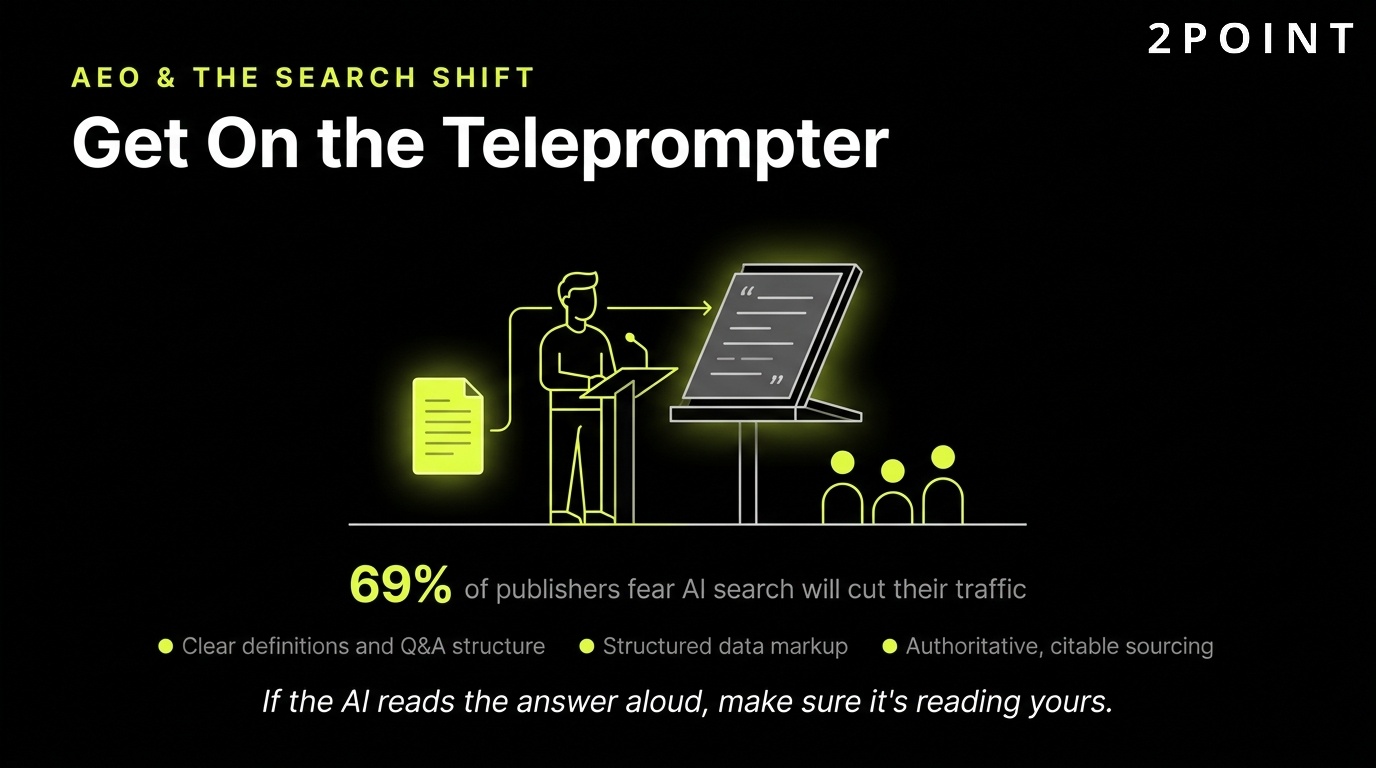
The most consequential long-term technology shift for affiliate marketers is the evolution of search itself. Google's AI Overviews and similar large language model-powered search features are changing how content gets discovered and credited, with 69% of publishers expressing concern that AI search features will reduce organic traffic and affiliate revenue. When a language model summarizes an answer directly in the search results page, the traditional click-through to a review article is bypassed entirely.
Answer Engine Optimization (AEO) is the emerging response to this shift. Rather than optimizing purely for keyword rankings, AEO focuses on structuring content to be cited, summarized, and surfaced by AI systems. This requires a different approach to content architecture: clear definitions, structured data markup, concise paragraph formatting, authoritative sourcing, and FAQ sections designed to answer the exact questions users ask conversational AI. Affiliates who adapt their content strategy to serve both traditional search rankings and AI summarization will be better positioned to maintain traffic levels as the search landscape continues to evolve. This is closely related to the broader evolution of digital marketing's future and how brands must adapt content to be found in AI-mediated environments.
Influencer-Driven Affiliate Marketing and the Creator Economy
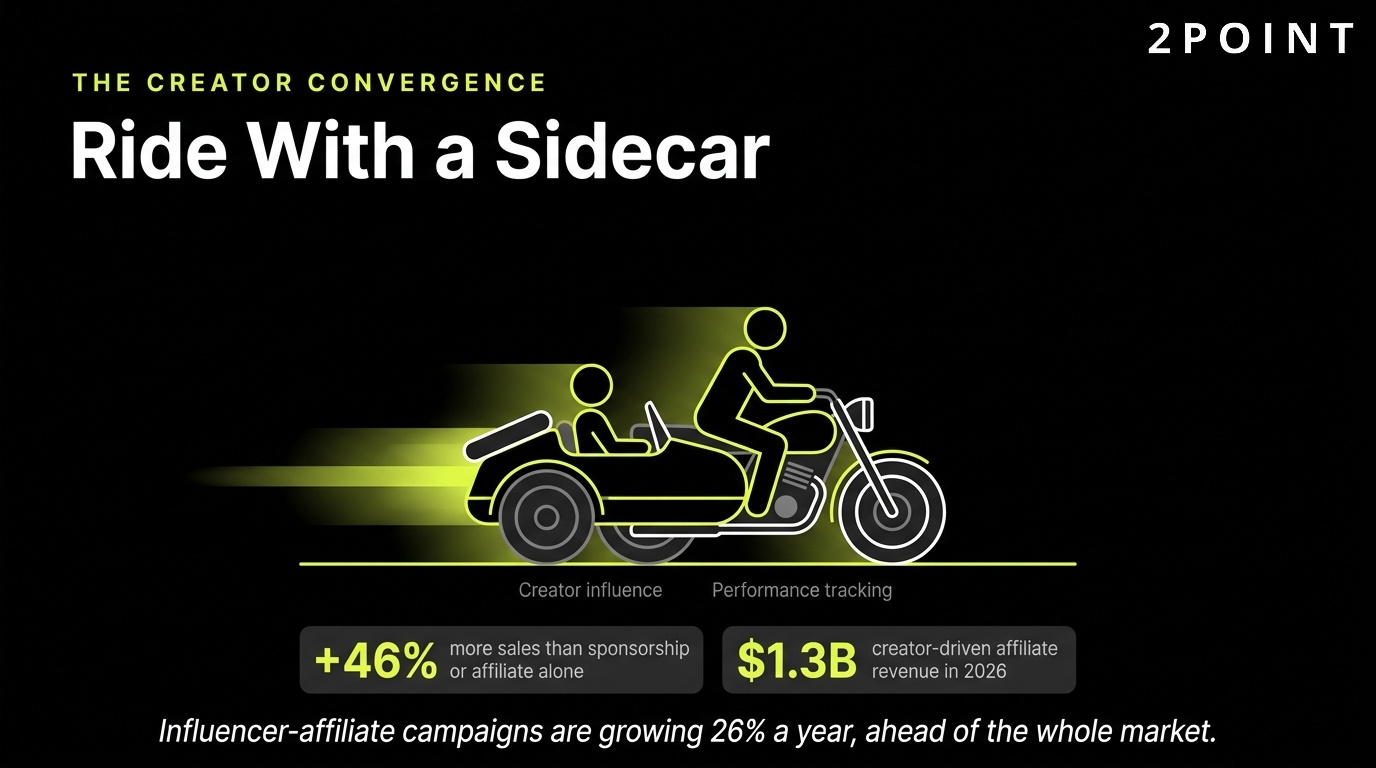
The convergence of influencer marketing and affiliate marketing has produced one of the most dynamic growth areas in the channel. Creators who once charged flat fees for sponsored content are increasingly moving toward performance-based partnerships, aligning their compensation with the commercial outcomes they deliver. This shift benefits both parties and is reshaping how brands think about creator relationships.
Creator-Driven Revenue and the $1.3 Billion Opportunity
Creator-driven affiliate revenue is projected to reach $1.3 billion in 2026, reflecting the growing commercial role of content creators in the purchase journey. Influencer-driven affiliate campaigns are growing at 26% year-over-year, significantly outpacing overall affiliate market growth, which suggests that creator-affiliate hybrid models are gaining adoption faster than traditional publisher-based approaches.
The reasons creators convert so effectively are rooted in trust and specificity. A creator who has built an audience around a particular topic, whether it is personal finance, fitness, home renovation, or indie gaming, has demonstrated expertise and consistency to an audience that has opted in to their content. When that creator recommends a product through an affiliate link, they are leveraging a relationship that took months or years to build. This is fundamentally different from a banner ad serving to cold traffic. The purchase recommendation comes embedded in a trusted relationship, which is why influencer marketing combined with affiliate mechanics produces some of the highest conversion rates available in digital advertising.
Micro and Nano-Influencers: The Trust Advantage
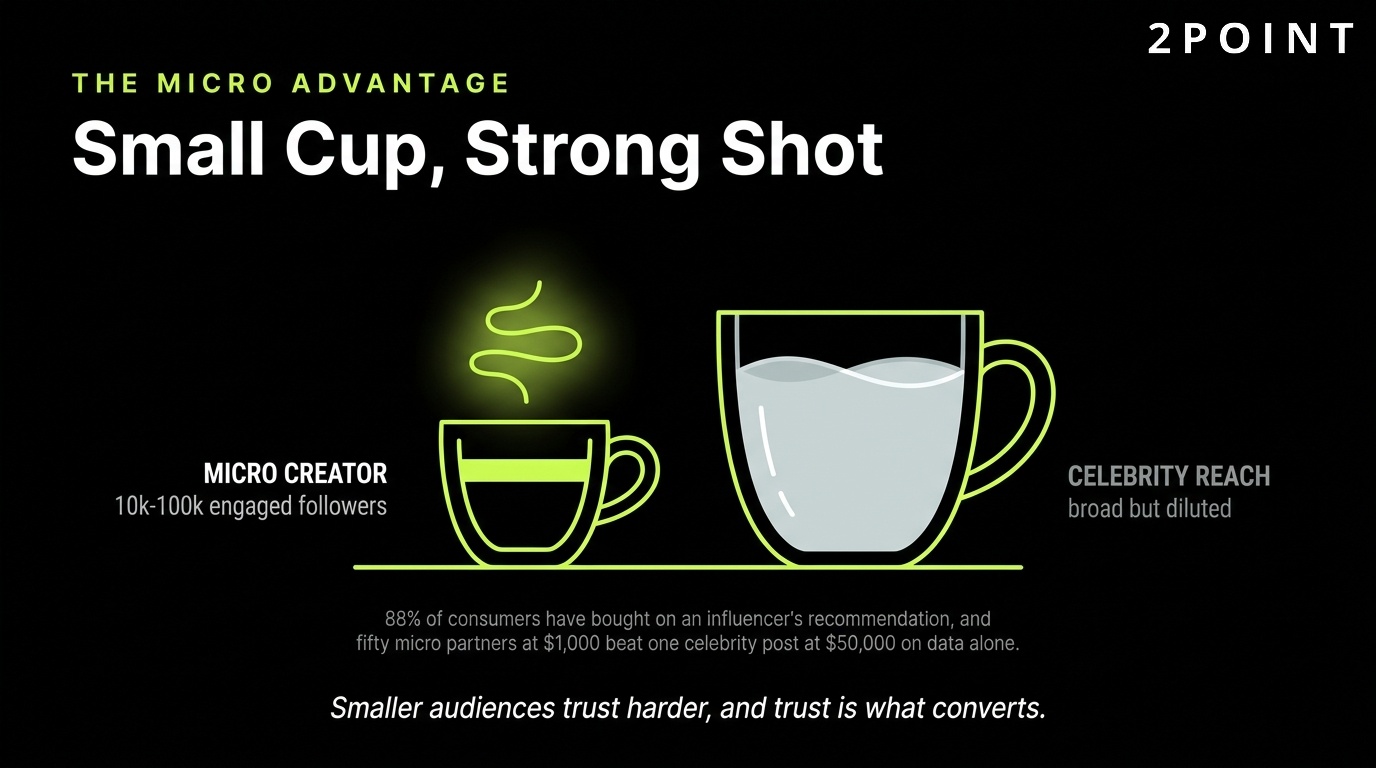
Counterintuitively, the creators driving the most reliable affiliate conversion outcomes are often not the biggest names. Micro and nano-influencers with follower counts between 10,000 and 100,000 are growing at 25% annually, and the commercial logic is compelling. Smaller audiences are typically more engaged, more homogeneous in their interests, and more trusting of the creator's recommendations because the relationship feels personal rather than transactional.
The consumer behavior data supports this. 88% of consumers have purchased a product following an influencer recommendation, and hybrid influencer-affiliate models drive 46% more sales than either pure sponsorship or pure affiliate approaches alone. Micro-influencers also offer cost efficiency. Rather than spending $50,000 on a single post from a celebrity influencer, a brand can work with 50 micro-influencers at $1,000 each, generating more touchpoints, more authentic content variations, and performance data that identifies which audience segments and content styles convert most effectively. The ability to measure effectiveness in influencer-affiliate campaigns is more straightforward when commission tracking links are in place, making the ROI case for micro-influencer programs consistently stronger than celebrity placements.
Social Commerce Integration: TikTok Shop, Instagram Shopping, and Direct Links
Social commerce has compressed the distance between content discovery and purchase completion. TikTok Shop's evolution through 2024 and 2025 has created what platform executives describe as "interactive points of sale," where a creator can demonstrate a product in a short video and link directly to a purchase page without the viewer ever leaving the application. This reduction in friction has measurable conversion implications. Social commerce maturity in 2026 means creators are no longer just content producers. They are operating as direct sales channels with real-time performance data.
The platform comparison for affiliate conversions in 2026 breaks down roughly as follows. TikTok Shop excels in impulse-purchase categories: beauty, fashion, gadgets, and food products where an engaging demonstration can trigger immediate buying intent. Instagram Shopping and Reels perform strongly in lifestyle and aspirational categories where aesthetic presentation drives desire. YouTube maintains dominance for considered purchases in technology, software, and financial products, where detailed long-form reviews influence high-ticket decisions. Understanding which platform serves which purchase intent category is essential for brands building social commerce affiliate programs.
How Brands Can Build Successful Influencer-Affiliate Partnerships
Building a high-performing influencer-affiliate program requires structure, patience, and a genuine commitment to partner relationships. The most effective programs use a diversified program architecture that combines creator affiliates with editorial publishers, comparison and review sites, and deal-focused platforms. This diversification ensures that different buyer stages and content preferences are served simultaneously, rather than relying on any single partner type.
A principle worth emphasizing in program design is quality over volume: 100 genuinely aligned affiliates who understand your product, trust your brand, and have audiences with purchase intent in your category will consistently outperform 1,000 broadly recruited partners with generic audiences and low engagement. Relationship management is the operational expression of this principle. Personalized outreach, timely commission payments, transparent communication, and acknowledging top performers create the partner loyalty that translates into priority placement, authentic endorsements, and sustained promotional effort. The commission structure itself should reward authentic promotion, not just raw clicks, using bonuses for conversion rate performance, LTV contributions, or new customer acquisition targets.
Commission Structures, Payment Models, and Earning Potential
Understanding how affiliate commissions work, and how they interact with traffic quality and niche selection, is foundational knowledge for both brands setting up programs and affiliates choosing which ones to join. Commission structure is not just an accounting decision. It is a strategic signal that communicates what behavior you want to incentivize and which partners you expect to attract.
Common Commission Types: CPA, Revenue Share, and Hybrid Models
| Commission Model | How It Works | Best Suited For | Typical Rate Range |
|---|---|---|---|
| Cost Per Sale (CPS/CPA) | Affiliate paid when a sale is completed | E-commerce, physical products, retail | 3–15% of sale value |
| Revenue Share | Affiliate earns a percentage of ongoing customer revenue | SaaS, subscriptions, financial services | 20–70% recurring |
| Hybrid Model | Combines upfront CPA with ongoing revenue share | Super affiliates, high-volume partners | CPA + 10–30% recurring |
| Cost Per Lead (CPL) | Affiliate paid for qualified lead submission | B2B, financial services, insurance | $5–$200+ per lead |
| Cost Per Click (CPC) | Affiliate paid per click on affiliate link | High-traffic publishers, media networks | $0.10–$5.00 per click |
The model you choose signals the type of partners your program will attract and the conversion behavior you are willing to pay for.
CPS/CPA is the most common model in e-commerce because it ties payment directly to completed revenue events, making ROI calculation straightforward. Revenue share models are the dominant structure in SaaS, where the recurring nature of subscription billing makes ongoing commission economically viable. The SaaS commission range of 20 to 70% reflects the high customer lifetime values that make generous commissions financially sensible even at those rates. HubSpot's program, offering 30% recurring commission for 12 months, exemplifies how leading SaaS companies use commission generosity as a competitive tool for attracting quality affiliate partners.
Realistic Income Expectations for Affiliate Marketers
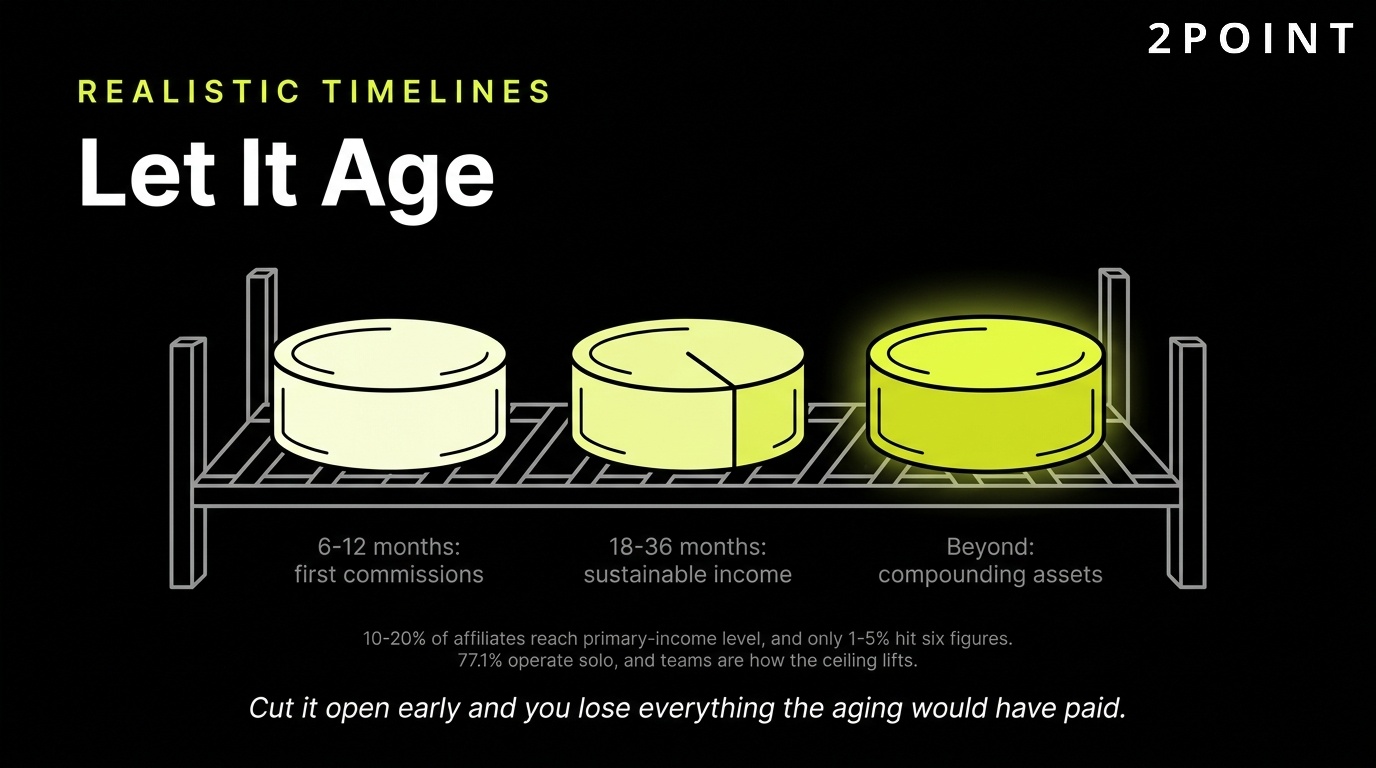
The affiliate marketing income landscape is characterized by significant dispersion. The gap between beginner and expert earnings can be 100 times or more, reflecting differences in niche selection, traffic scale, content quality, and program management skills accumulated over years. Setting honest expectations is important both for avoiding disillusionment and for developing a realistic roadmap for income progression.
At the program level, 10 to 20% of active affiliates earn enough from affiliate marketing to treat it as their primary income source. Only 1 to 5% reach six-figure annual income from the channel alone. The majority of affiliates earn supplementary income ranging from a few hundred to a few thousand dollars per month, which is still meaningful but requires appropriate expectation management when entering the field.
Operationally, 77.1% of affiliate marketers operate as solo individuals without team members. This reflects the low barrier to entry but also the ceiling on scalability that comes with solo operation. Building a team, systematizing content production, and investing in tracking and optimization infrastructure is how high-earning affiliates graduate from five-figure to six-figure and beyond. For full-time professionals managing enterprise affiliate programs, the average affiliate marketing manager salary of $81,697 per year provides a useful benchmark for the institutional earning level in this field.
What Determines Your Earnings: Traffic, Niche, and Conversion Optimization
Three variables interact to determine affiliate earning outcomes more than any others: traffic source quality, niche profitability, and conversion optimization discipline. On traffic, 78.3% of affiliate marketers rely on SEO as their primary acquisition tactic, reflecting the long-term compounding value of organic search traffic compared to paid alternatives. SEO-driven content generates conversions for months or years after publication, creating a leverage dynamic that paid traffic cannot replicate at scale.
Niche selection, as detailed in the verticals section, creates substantial income differentiation even at similar traffic volumes. An affiliate operating in education with 50,000 monthly visitors will typically outperform an affiliate in lower-margin categories with twice the traffic. Product selection strategy also matters: trend-based product selection yields 47.16% more revenue than commission-rate-based selection. Chasing the highest commission percentage often means promoting products with low consumer demand and poor conversion rates, while promoting products that align with active search trends generates real transaction volume regardless of margin percentage. Using data analytics to identify trend-aligned products before saturation is one of the clearest competitive advantages available to sophisticated affiliates.
Earnings Per Click and Why It Matters More Than Commission Rate
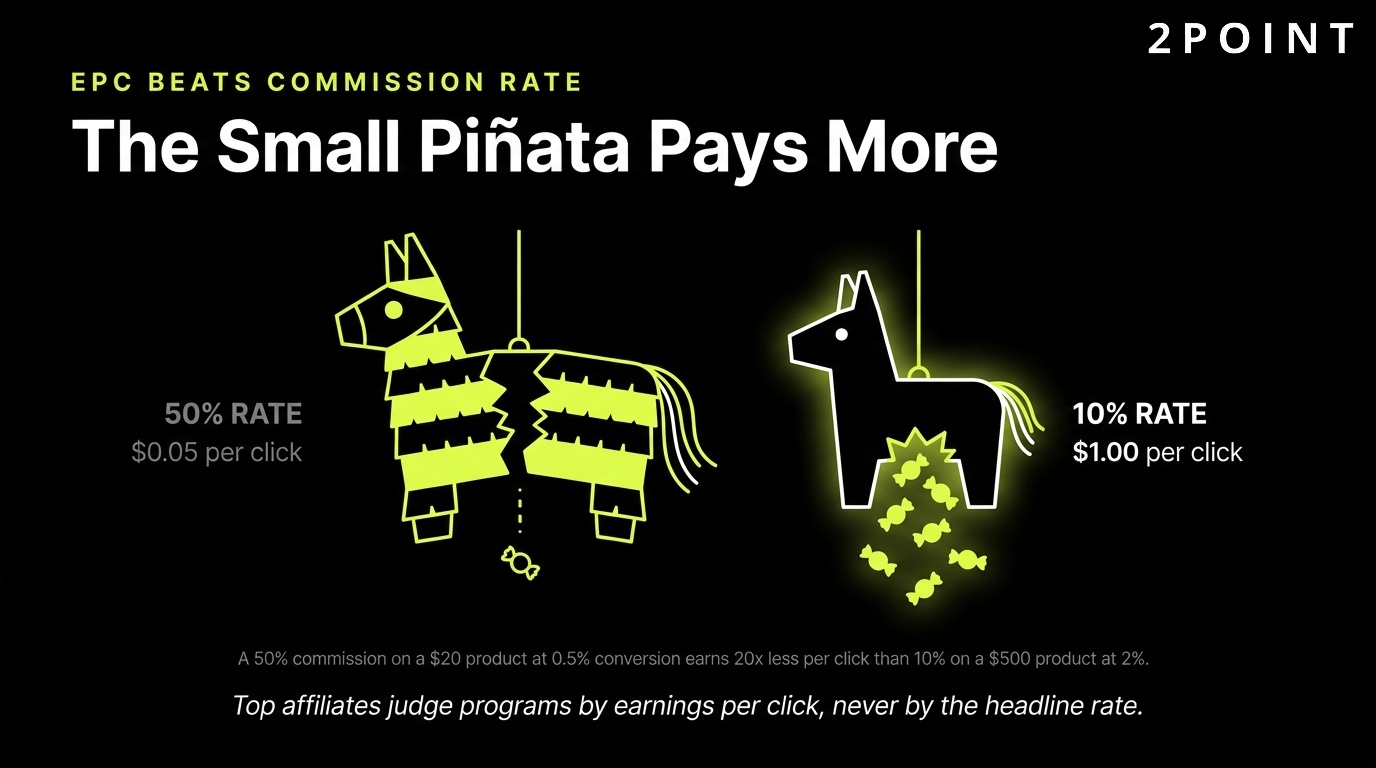
From a publisher perspective, the single most important performance metric is not the advertised commission rate. It is earnings per click, or EPC: the average revenue generated each time a visitor clicks on an affiliate link. A program offering a 50% commission on a $20 product with a 0.5% conversion rate produces an EPC of $0.05. A program offering a 10% commission on a $500 product with a 2% conversion rate produces an EPC of $1.00. The second program is 20 times more valuable to the publisher despite its lower headline commission percentage.
This distinction explains why top affiliates, particularly those with high-traffic authority sites, evaluate programs on EPC rather than commission rate. Financial services programs illustrate this clearly: an insurance comparison program may offer attractive CPA payouts, but if the advertiser's landing page converts poorly or the product-audience fit is weak, the effective EPC may be lower than a more modest commission from a product that converts consistently. For brands building programs, investing in landing page optimization and funnel performance is not just good marketing practice. It is directly tied to how attractive your program appears to publishers comparing EPC data across competing offers.
Traffic Generation and Marketing Channels for Affiliates
Affiliate revenue is downstream of traffic. Without consistent, high-quality visitor flow to your affiliate content, even the best program selection and commission rates will produce minimal results. Understanding which channels produce the most valuable traffic, and how to combine them for maximum stability, is a critical operational skill for affiliate marketers at every level.
SEO and Organic Search: The Primary Traffic Driver
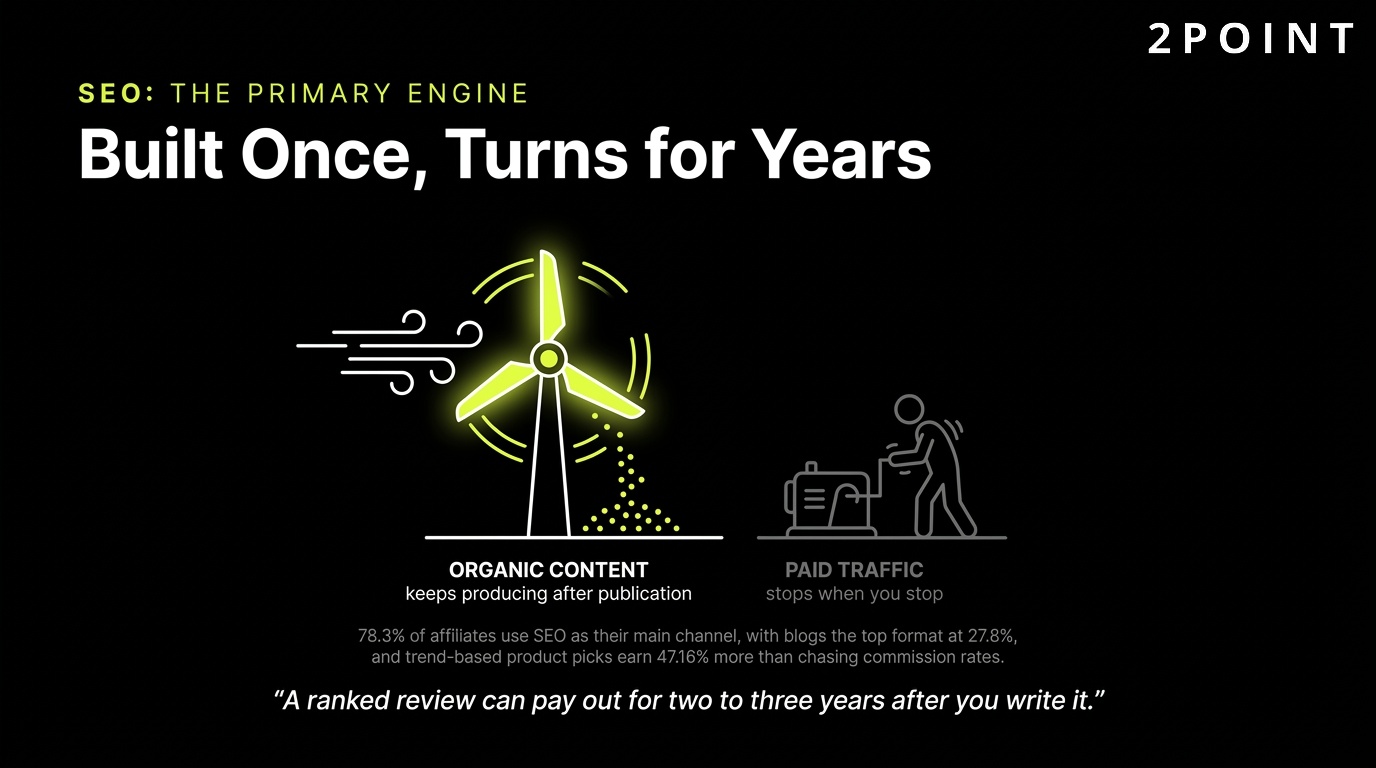
Search engine optimization remains the dominant traffic acquisition strategy for affiliate marketers, with 78.3% of practitioners using SEO as their main channel. The appeal is structural: well-executed SEO creates durable, compounding traffic assets that continue generating income without ongoing per-click costs. A well-ranked product review or comparison article can drive consistent affiliate revenue for two to three years after publication with minimal maintenance, creating a return profile unavailable through any paid channel.
Blog content remains the leading format for affiliate promotion. 27.8% of brands use blogs as their primary channel for affiliate content delivery, reflecting the format's suitability for detailed reviews, comparisons, and tutorials that address high-intent search queries. The strategic challenge in 2026 is algorithm volatility. 69% of affiliate publishers report concern about Google algorithm changes reducing organic traffic, a concern validated by the significant traffic disruptions experienced by content sites during Google's 2024 Helpful Content and Core Updates. Building content that genuinely serves user intent rather than gaming ranking signals remains the most durable defense against algorithm risk. Understanding how to write effective marketing copy that serves both human readers and search algorithms is a foundational skill for affiliate content creators.
Social Media Platforms: Facebook, Instagram, TikTok, and YouTube
Social media provides both direct affiliate traffic and audience-building opportunities that support long-term conversion performance. Facebook remains the preferred platform for 75.8% of affiliate marketers due to its broad demographic reach, group community functionality, and relatively mature advertising infrastructure. Mobile device usage is the dominant access mode for social affiliate traffic, with 62% of affiliate-driven visits originating from mobile devices. This has direct implications for content format, landing page design, and checkout flow optimization.
Platform-specific strategies vary by format and audience. Facebook groups and long-form posts work well for community-oriented niches like personal finance, parenting, and home improvement. Instagram Stories and Reels drive discovery and impulse behavior in visual categories. TikTok Shop has become particularly effective for consumable and lifestyle products where short demonstration videos can trigger immediate purchase decisions. YouTube's long-form review format continues to perform strongly for considered purchases in technology, software, and financial products. 52% of publishers are actively experimenting with new promotion formats in response to platform algorithm changes and traffic volatility, reflecting a healthy adaptive posture across the industry. A multi-platform marketing approach reduces dependency on any single channel and creates resilience against platform-specific disruptions.
Paid Advertising: When and How to Use Paid Traffic
Paid advertising and affiliate marketing are not mutually exclusive. 82% of six-figure affiliate websites use both paid advertising and organic affiliate tactics, combining the scalability of paid traffic with the margin efficiency of affiliate commissions. The strategic use cases for paid traffic in affiliate marketing are specific: validating new offers before investing in long-form SEO content, scaling campaigns where organic ranking would take too long, and competing in high-intent commercial search queries where organic ranking is difficult due to established competition.
Platform selection for paid affiliate traffic depends on the offer type and audience profile. Google Search Ads work well for capturing bottom-of-funnel intent in research-heavy categories. Facebook and Instagram Ads support top-of-funnel awareness and audience building for affiliates with strong retargeting infrastructure. Native advertising through networks like Taboola and Outbrain offers cost-effective reach for content-style affiliate pieces in broad consumer categories. Risk management in paid affiliate campaigns requires precise conversion tracking, offer-specific landing page testing, and careful monitoring of advertiser terms of service to avoid disqualification from commission programs due to bidding on branded keywords or using misleading ad copy.
Email Marketing, Content Marketing, and Omnichannel Strategies

The affiliates who build the most resilient, long-term businesses do not rely on a single traffic channel. An omnichannel presence combining blog content, email marketing, social media, and video consistently outperforms single-channel operations by reducing platform dependency and creating multiple audience touchpoints. When one channel experiences a downturn due to algorithm changes or platform policy shifts, others continue generating traffic and revenue.
Email marketing plays a particularly important role in affiliate monetization because it represents owned audience access that is not subject to platform algorithm changes. An email list of 50,000 engaged subscribers provides direct affiliate promotion access that no SEO update can remove. Content marketing in the form of reviews, tutorials, and product comparisons serves as the primary conversion vehicle, with email used to drive that content to a warm audience ready to engage. The combination of content marketing with performance-based affiliate monetization creates one of the highest-margin content business models available because production costs are largely fixed while revenue scales with audience size and conversion optimization improvement.
Challenges, Risks, and How to Navigate Them Successfully
Affiliate marketing's strengths are real, but so are its operational challenges. Understanding the risks, from fraud and algorithm volatility to compliance complexity and program management overhead, is essential for building programs that remain profitable and sustainable over time. Awareness is the first step toward mitigation.
Fraud, Fake Traffic, and Click Bots
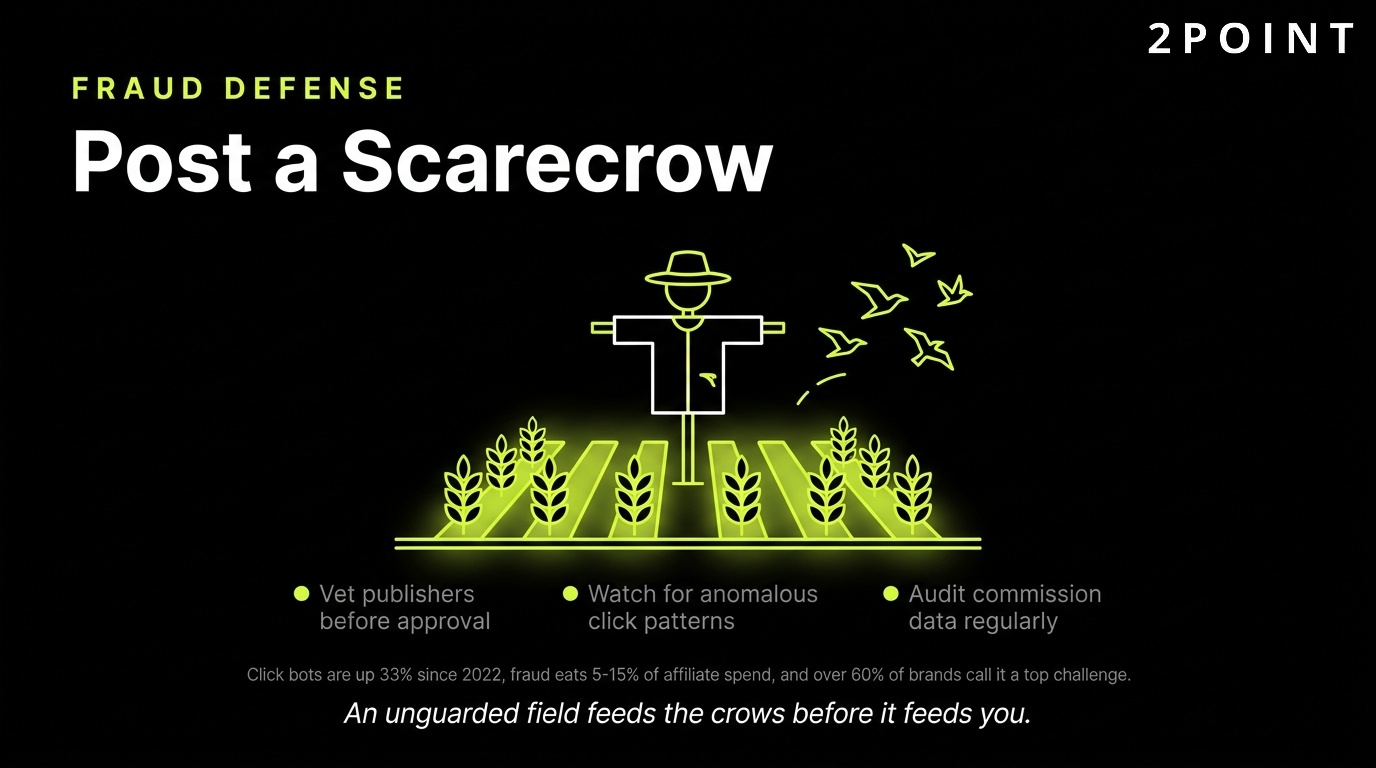
Affiliate fraud is a persistent, costly, and increasingly sophisticated problem. Click bots and fake traffic generation have increased 33% since 2022, costing the digital advertising ecosystem an estimated $71 billion annually. Within affiliate marketing specifically, estimated fraud rates range from 5 to 15% of total affiliate spend, and over 60% of brands operating affiliate programs cite fraud as a top operational challenge.
Fraud manifests in several forms: click bots that simulate affiliate link clicks without genuine user intent, cookie stuffing that injects affiliate attribution without legitimate promotional activity, and manufactured conversions using stolen payment credentials. Protection strategies include platform vetting with verified publisher requirements, real-time traffic analysis to identify anomalous click patterns, conversion quality monitoring to flag suspiciously high conversion rates or unusual geographic concentrations, and working with networks that provide fraud detection as part of their tracking infrastructure. The investment in fraud prevention tooling typically pays back quickly by eliminating invalid commission payments and improving the quality signal of your affiliate data.
Algorithm Updates, Ad Blockers, and Traffic Volatility
Google's algorithm updates have been a source of significant volatility for SEO-dependent affiliates. While only 25.1% of affiliates report being negatively affected by algorithm updates, the impact on those who are affected can be severe, with some sites losing 50 to 90% of organic traffic after a single core update. The Helpful Content System and subsequent updates have been particularly consequential for thin affiliate sites relying on low-value review content without genuine expertise or original analysis.
Ad blocker adoption is a parallel challenge. Blocker usage is projected to reach 40% of internet users by 2026, with implications for both display-dependent revenue models and affiliate link visibility. While most affiliate links are not technically blocked by default ad blocker configurations, some aggressive configurations do block affiliate tracking parameters. 69% of publishers are concerned about Google AI reducing their organic traffic, reflecting anxiety about the structural shift toward AI-summarized search results that may reduce traditional click-through rates from search pages. The mitigation strategy is consistent: build diversified traffic sources, create genuine audience relationships, and produce content with depth and authenticity that earns citation rather than relying solely on ranking signals.
Compliance, Disclosure Requirements, and Platform Policy Risks
Regulatory compliance in affiliate marketing operates at multiple levels: FTC disclosure requirements in the United States, ASA guidelines in the United Kingdom, GDPR data handling requirements across Europe, and platform-specific terms of service that govern how affiliate links can be used across social networks, search advertising platforms, and email marketing services. FTC guidelines require clear, conspicuous disclosure of affiliate relationships whenever a recommendation or review contains affiliate links. Non-compliance carries reputational and financial risk, and enforcement has increased as the FTC has devoted more resources to online marketing oversight.
Platform policy compliance adds another layer of complexity. Many affiliate programs prohibit bidding on branded keywords in paid search. Some platforms restrict certain affiliate link types or require disclosure in specific formats. Amazon Associates has strict terms around cookie usage, link modification, and offline promotion. Staying current with program terms, platform policies, and regulatory requirements is not optional overhead. It is a core operational responsibility that protects program access and prevents sudden revenue disruption from account termination or commission clawbacks.
Program Management Complexity and Resource Requirements
Running a high-performing affiliate program is more operationally demanding than its passive income reputation suggests. Managing partner relationships, monitoring performance data, updating creative assets, auditing commission accuracy, handling attribution disputes, and recruiting new quality partners all require consistent time and attention. For brands, this often means the difference between a program that drives meaningful revenue and one that is nominally active but poorly optimized.
The operational challenge scales with program size. A brand with 50 active affiliates can manage the program with a dedicated part-time resource. A brand with 5,000 affiliates across multiple networks needs dedicated technology, clear governance processes, and potentially a full affiliate management team. Managed marketing services can bridge this gap for brands that want professional program management without building a full in-house team. Technology investments in affiliate management platforms, fraud detection, multi-touch attribution, and partner communication tools are typically justified at moderate program scales and become essential at enterprise scale. Integrating customer feedback from affiliate-acquired customers into program optimization also helps identify which partner types and promotional formats deliver the highest-quality customer relationships over time.
Building and Scaling a Successful Affiliate Marketing Program
Whether you are a brand launching your first affiliate program or an affiliate publisher trying to scale beyond five-figure monthly income, the same foundational principles apply: strategic focus, quality relationships, technical rigor, and consistent optimization. The following section provides a practical framework for both perspectives.
How Brands Should Launch and Structure Their Affiliate Programs
Launching a brand affiliate program begins with three foundational decisions: network or in-house platform, commission model, and recruitment strategy. Network options include established platforms like ShareASale, CJ Affiliate, Impact, and Rakuten, which provide access to existing publisher bases and integrated tracking infrastructure. In-house platforms built on technology like Post Affiliate Pro or Tapfiliate offer greater customization and direct partner relationships but require more technical setup and ongoing management.
Commission structure should be designed around the economics of your customer lifetime value, not competitor benchmarks alone. Calculate the maximum sustainable commission by working backward from your LTV: if your average customer generates $500 in gross margin over 12 months, a 15% commission on a $100 initial purchase costs $15 and represents excellent economics. Build your program around commission rates that attract quality partners and remain financially sustainable as the program scales. Recruitment should prioritize relevance over volume. Target publishers, creators, and comparison sites whose audiences have demonstrated purchase intent in your product category, rather than mass-recruiting from affiliate networks without audience qualification.
Affiliate Marketer Success Framework: From Launch to Scale
For individual affiliates building businesses, the path from launch to sustainable income follows a recognizable progression. Phase one is niche selection and audience building, where your primary objective is establishing topical authority and accumulating organic traffic through consistent, high-quality content production. During this phase, income is minimal. The investment is in content assets and search ranking that will pay dividends over a multi-year horizon.
Phase two is monetization optimization, where you test different affiliate programs within your niche, optimize landing page and content formats for conversion, build an email list, and develop data-based understanding of which content types, products, and promotional approaches produce the best EPC. Phase three is scaling through content multiplication, channel diversification, paid traffic testing, and potentially team building to remove production bottlenecks. At each phase, the strategic discipline is the same: make decisions based on data, invest in relationships with both your audience and your affiliate partners, and build systems that generate revenue without requiring your direct involvement in every step of the process.
Choosing the Right Affiliate Networks and Programs
The affiliate network and program landscape in 2026 is extensive, covering everything from Amazon Associates and major retail networks to niche SaaS programs and direct brand partnerships. Evaluating programs goes beyond commission rate to include payment reliability and terms, EPC data from network dashboards, product-audience fit and conversion likelihood, creative asset quality, and support responsiveness from the advertiser's affiliate management team.
| Network or Program Type | Best For | Average Commission Range | Notable Strength |
|---|---|---|---|
| Amazon Associates | Physical products, broad retail | 1–10% | Universal trust, conversion rate |
| CJ Affiliate (Commission Junction) | Enterprise brands, retail, travel | 4–20% | Brand diversity, reporting tools |
| ShareASale | Mid-market brands, niche products | 5–25% | Merchant variety, easy access |
| Impact | Performance marketers, enterprise | 5–30% | Advanced tracking, contract flexibility |
| Direct SaaS Programs | Tech affiliates, B2B publishers | 20–70% recurring | Highest EPC potential, recurring income |
Selecting the right network involves matching program economics and partner support quality to your specific traffic type and audience behavior.
Optimization Strategies: Testing, Data, and Continuous Improvement
The difference between a plateau-level affiliate operation and a consistently growing one usually comes down to testing discipline. Systematic A/B testing of headlines, calls to action, link placement within content, product selection, and landing page elements generates compounding improvements that accumulate into significant performance differences over 12 to 24 months. Even a 10% improvement in conversion rate across a high-traffic content site can translate into tens of thousands of dollars in additional annual commission.
Data infrastructure matters proportionately more as programs scale. Connecting affiliate tracking data with your broader analytics stack, including behavioral data from on-site tools, email engagement data, and customer purchase data from your CRM, enables attribution analysis that reveals which affiliate touchpoints contribute most to high-LTV customer acquisition. Adapting strategies based on this data, rather than making decisions on intuition or surface-level metrics, is what separates programs that optimize toward genuine business outcomes from those that optimize toward vanity metrics. The brands and affiliates who treat their programs as data-driven operations rather than set-it-and-forget-it automations will continue to outperform as market conditions evolve.
Affiliate Marketing Strategies That Drive Results in 2026
Having covered the market context, performance metrics, channels, and challenges, this section synthesizes the most consistently effective strategic approaches for 2026. These are not theoretical frameworks. They are practical approaches backed by the data and trends detailed throughout this guide.
Content-First Strategy: Building Authority Before Monetization
The most durable affiliate businesses in 2026 are built on genuine topical authority rather than thin promotional content. The Google algorithm shifts of the past two years have systematically penalized affiliate sites that produce review and comparison content without demonstrable subject matter expertise. The response, for any affiliate who wants long-term traffic stability, is to build content that would be valuable even without the affiliate links: detailed tutorials, original research, genuine product testing with real results, and expert opinions developed through actual use.
This content-first approach takes longer to generate income than shortcut methods. But it creates compounding assets: search rankings that are more algorithm-resistant, audience trust that increases referral and return visit rates, and brand relationships with advertisers who want to be associated with authoritative publishers. Brand story consistency across your affiliate content also contributes to audience retention and trust, particularly for creator-affiliates whose personal brand is the primary conversion asset.
Performance Marketing Integration: Connecting Affiliate to the Broader Funnel
Affiliate marketing is most powerful when treated as an integrated component of the broader performance marketing ecosystem rather than an isolated channel. The highest-ROI programs connect affiliate acquisition data with paid retargeting, email nurture sequences, loyalty programs, and CRM tracking to understand the full customer journey from affiliate introduction to long-term retention. This integrated view reveals attribution insights that single-channel program management cannot produce.
For example, an affiliate may drive a prospect who does not convert on first click but later converts through a brand search ad campaign. Last-click attribution credits the paid search campaign and misses the affiliate's role in the discovery journey. Multi-touch attribution that accounts for the affiliate introduction produces a more accurate ROI picture and may justify higher commission rates for affiliates who drive top-of-funnel discovery rather than last-click conversions. This integrated marketing approach to affiliate attribution requires investment but produces substantially more useful data for program optimization decisions.
Relationship-Driven Partnership Development
Technology enables affiliate programs to scale, but relationships are what differentiate good programs from great ones. The best affiliate partnerships in 2026 operate more like strategic business relationships than transactional marketing arrangements. Brands that invest in regular communication with top affiliates, provide early access to new products, offer custom commission arrangements, and co-create promotional content build partner loyalty that persists through competitive pressure and market volatility.
For affiliate publishers, relationship development with affiliate managers at advertiser brands provides access to higher commissions, exclusive promotional terms, and advance notice of offers and launches that allow them to plan content calendars strategically. The affiliates consistently earning in the top 10% of any niche are typically those who have invested in genuine relationships with both their audiences and their advertiser partners, creating trust-based ecosystems that perform well independent of any single algorithm or platform policy change. The role of branding in affiliate marketing, for both publishers building personal brands and advertisers seeking quality placement, continues to grow as audiences become more sophisticated at distinguishing authentic recommendations from mercenary promotion.
Future-Proofing: AEO, AI, and the Next Generation of Affiliate Discovery
Preparing for the next evolution of affiliate marketing requires active engagement with emerging discovery mechanisms. AEO, or Answer Engine Optimization, represents the most significant structural shift in content discoverability since the mobile revolution. As users increasingly ask questions to AI assistants rather than typing queries into search boxes, affiliate content that is structured as direct, authoritative answers to specific questions will be better positioned for citation in AI-generated responses.
Practically, this means investing in structured data markup, writing content with explicit question-and-answer architecture, citing authoritative sources, and building content that answers the full spectrum of questions a buyer in your niche would ask from awareness through purchase decision. The digital marketing impact of AI-mediated discovery will continue to grow, and affiliates who adapt their content architecture now will be positioned to benefit as AI search matures. The broader opportunity is significant: as AI tools democratize content production, differentiation through genuine expertise, real-world experience, and authentic relationships will become more valuable, not less. The affiliate marketers who invest in those differentiators today are building the competitive advantages that will define their success over the next decade. Teams at 2POINT who work across content, performance, and digital strategy regularly help brands navigate exactly this intersection, where affiliate program design meets the evolving content and discovery landscape that determines long-term channel performance.
Conclusion
Affiliate marketing in 2026 is a mature, institutionally backed, data-rich channel that offers compelling economics for both brands and publishers operating with the right strategic foundations. The combination of an $18.5 billion global market, $12 to $15 ROI per dollar spent, and 81% brand adoption makes it impossible to treat as a secondary consideration in any serious digital marketing strategy.
The key insights from this guide are worth distilling into clear principles. Choose niches based on profitability metrics and trend data rather than personal interest alone. Build programs around partner quality over quantity, recognizing that a smaller group of highly aligned affiliates consistently outperforms a large group of loosely relevant ones. Invest in technical infrastructure including cookieless tracking, multi-touch attribution, and fraud detection, because program data quality directly determines the quality of optimization decisions. Embrace the human-AI hybrid approach to content creation, using AI for efficiency while preserving the authentic expertise and voice that both search algorithms and human audiences reward.
Stay ahead of the structural shifts reshaping the channel: social commerce integration, answer engine optimization, and the growing convergence of influencer and affiliate models. The affiliates and brands that treat these not as threats but as opportunities for early positioning will find competitive advantages that compound significantly over time. Affiliate marketing rewards consistency, strategic patience, and genuine value creation more reliably than almost any other performance channel. The market data and growth trajectory confirm that the best time to build or optimize an affiliate program is now.

Frequently Asked Questions About Affiliate Marketing
What is affiliate marketing and how does it work?
Affiliate marketing is a performance-based model where a brand pays external partners, called affiliates, a commission for driving specific outcomes such as sales, leads, or sign-ups. The affiliate promotes the brand through content, links, or advertisements, and earns payment only when a defined conversion event occurs. Tracking is managed through unique affiliate links or codes assigned to each partner.
How much money can you realistically make with affiliate marketing?
Income varies widely: 10 to 20% of active affiliates earn enough to treat it as their primary income source, while only 1 to 5% reach six figures annually. Beginners typically earn supplementary income in the range of a few hundred to a few thousand dollars per month. Top earners in high-value niches like education, SaaS, and travel can generate $10,000 to $15,000 or more per month through established content assets and high-quality traffic.
What is the average ROI for affiliate marketing programs?
Brands running affiliate programs report an average return of $12 to $15 in revenue for every $1 spent on the channel. This compares favorably to Google Ads, which averages approximately 3.31:1 ROAS. The performance-based payment structure eliminates waste by tying all costs to delivered results.
What are the best niches for affiliate marketing in 2026?
The highest-earning niches in 2026 are education and eLearning ($15,551 average monthly income), travel ($13,847), gaming and technology ($12,475), and health and wellness ($8,038). SaaS affiliate programs offer some of the highest commission rates at 20 to 70% with recurring payment structures, making them particularly attractive for long-term income building.
Affiliate marketing vs. influencer marketing: what is the difference?
Affiliate marketing is a performance-based model where compensation is tied to measurable outcomes like sales or leads. Influencer marketing traditionally involves flat-fee sponsorships paid for content creation regardless of conversion results. The two models are increasingly converging, with hybrid influencer-affiliate arrangements that combine creative influence with performance accountability growing at 26% year-over-year.
How do you track affiliate conversions without third-party cookies?
Cookieless tracking solutions include first-party data collection through owned channels, server-side tracking that processes conversion events on the server rather than in the user's browser, and probabilistic attribution models that use anonymized behavioral signals. 70% of affiliate platforms have already adopted or are adopting these solutions in response to browser privacy changes and third-party cookie deprecation.
Is affiliate marketing passive income or does it require ongoing work?
Affiliate marketing can generate passive income from established content assets, but building those assets requires significant upfront investment in content creation, SEO, audience development, and program optimization. Mature affiliate businesses with large libraries of ranking content can generate income with relatively low ongoing effort, but reaching that stage typically takes one to three years of consistent work. Maintenance, optimization, and new content creation remain necessary to sustain and grow income over time.
What commission structures are most common in affiliate marketing?
The most common structures are cost-per-sale, where the affiliate earns a percentage of each completed transaction; revenue share, where the affiliate receives a portion of ongoing subscription revenue; and hybrid models combining an upfront CPA with recurring commissions. SaaS programs typically use revenue share at 20 to 70%, while e-commerce programs most often use CPS at 3 to 15%.
How do you prevent affiliate fraud in your program?
Fraud prevention starts with vetting publishers before approval, using platforms with built-in fraud detection, monitoring conversion patterns for anomalies such as unusually high conversion rates or unexpected geographic concentrations, and auditing commission data regularly for signs of click bots or cookie stuffing. Working with reputable affiliate networks that enforce publisher quality standards reduces exposure significantly compared to running an unmanaged direct program.
Does affiliate marketing still work with Google's AI search updates?
Affiliate marketing remains effective, but the channel is evolving in response to AI-mediated search. Content that demonstrates genuine expertise, provides authoritative answers to specific questions, and is structured for AI summarization through clear headings and FAQ formats is better positioned in the current search landscape. Affiliates who diversify traffic sources beyond organic search and invest in Answer Engine Optimization are most resilient to ongoing algorithm changes.
What is EPC in affiliate marketing and why does it matter?
EPC stands for earnings per click, which is the average revenue an affiliate earns each time someone clicks their affiliate link. It is calculated by dividing total commission earned by total clicks generated. Publishers use EPC to compare programs because it accounts for both commission rate and conversion rate together, giving a more accurate picture of real earning potential than commission percentage alone.
How long does it take to see results from affiliate marketing?
Most new affiliates begin seeing meaningful traffic and initial commissions within 6 to 12 months of consistent content creation and SEO investment. Reaching a sustainable income level that could replace part-time or full-time employment typically takes 18 to 36 months, depending on niche competition, content quality, and promotional investment. Programs that supplement organic content with paid traffic testing can accelerate the validation phase, though this introduces cost risk during the learning period.
