

 let’s connect


What Is AI Marketing and Why Does It Matter in 2026?
AI marketing is the use of machine learning, natural language processing, and predictive analytics to automate tasks, personalize customer experiences, and optimize campaigns in real time. By 2026, it has evolved from an experimental technology into core business infrastructure, reshaping every stage of the marketing funnel. Here is what you need to know immediately:
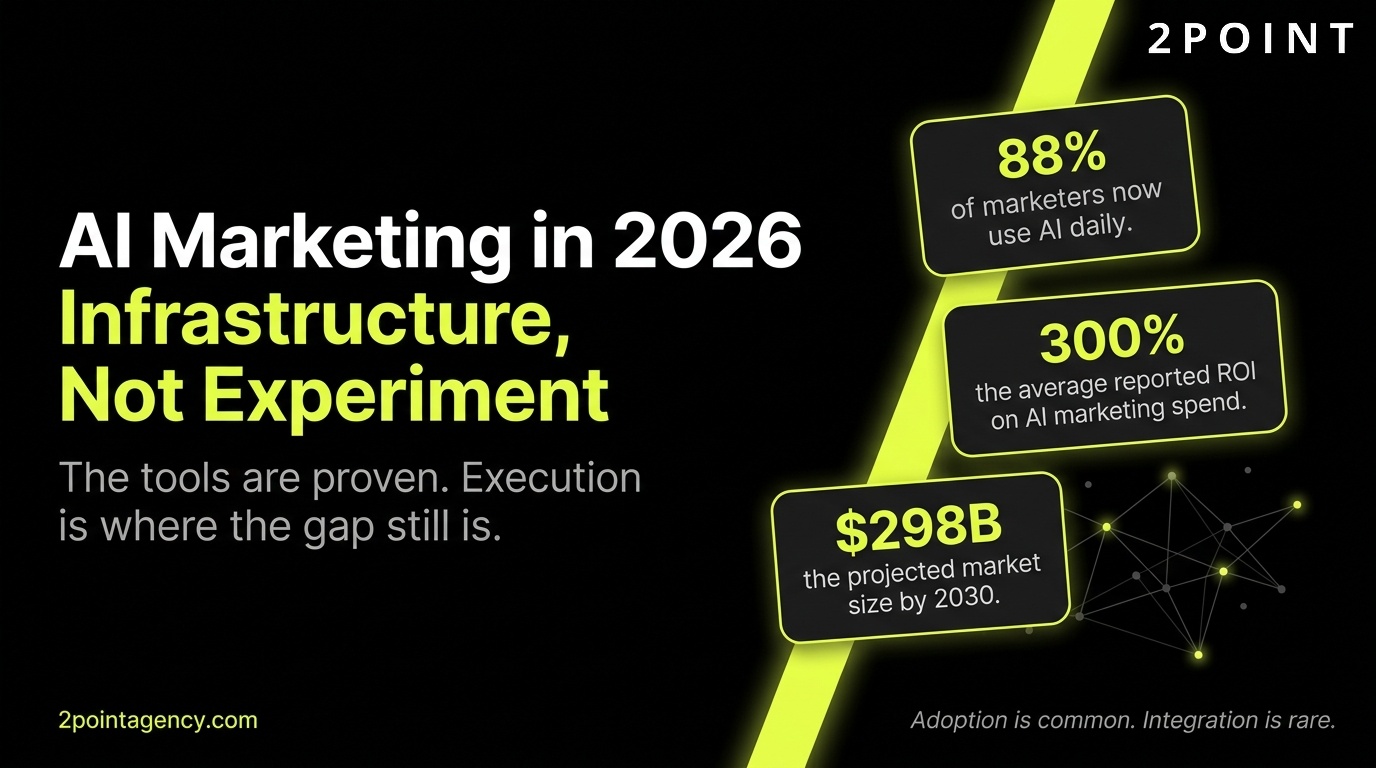
- 88% of marketers now use AI daily, reporting an average 300% return on investment.
- The global AI marketing market reached $107.5 billion in 2025, up from $15.8 billion in 2021.
- The market is projected to reach $298 billion by 2030, representing sustained double-digit annual growth.
- AI now orchestrates entire campaigns autonomously, from audience discovery to real-time budget reallocation.
- Traditional keyword-based search is giving way to AI-generated answer engines, requiring an entirely new optimization strategy.
- Predictive AI forecasts behavior before it happens; generative AI creates personalized content at scale.
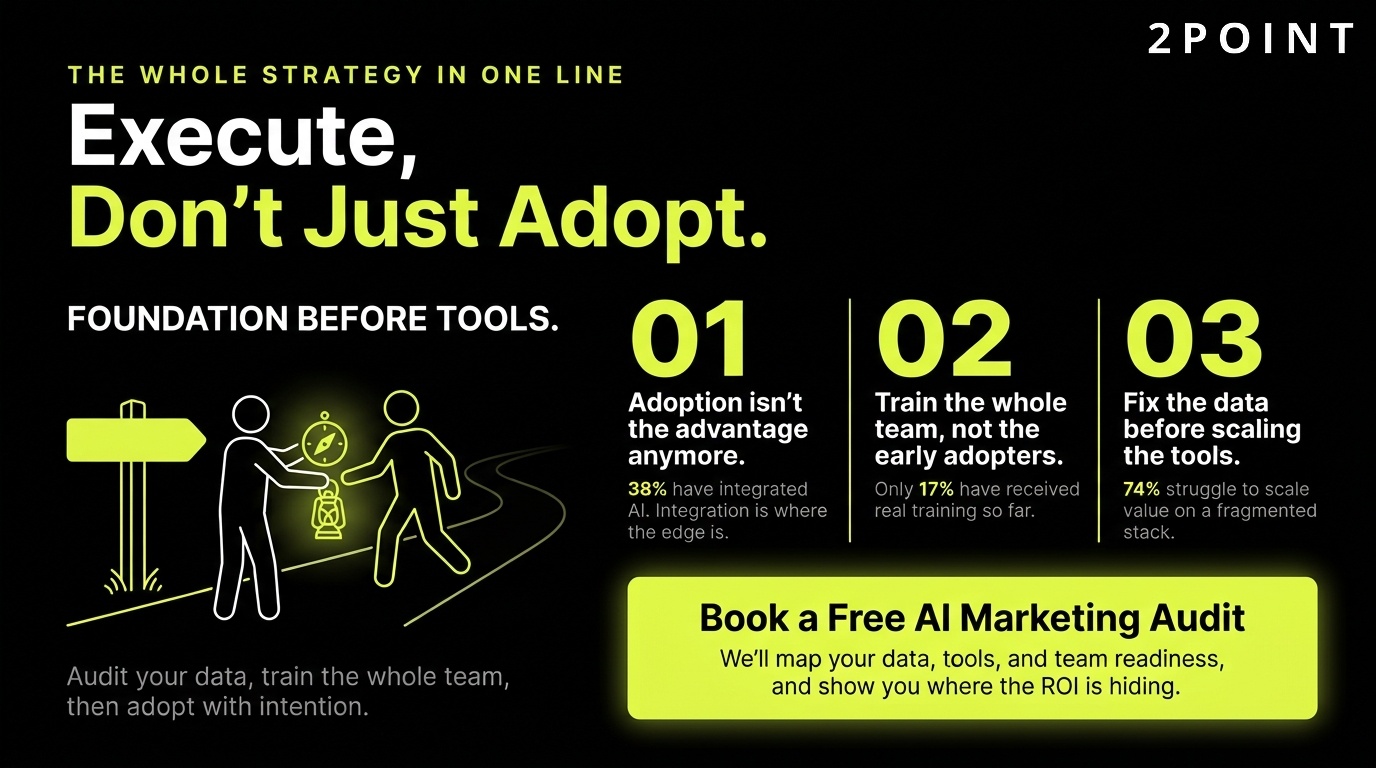
- Only 38% of organizations have fully integrated AI into their marketing processes, meaning the competitive window is still open.
- Marketers who master AI execution now are building advantages that will compound for years.
This guide covers every dimension of AI in marketing: market size and adoption data, core capabilities, the 2026 landscape shifts, tool categories, implementation challenges, performance benchmarks, ethical considerations, and the future trajectory. Whether you are just starting your AI marketing journey or scaling an existing program, the information here will sharpen your strategy and accelerate your results.
The AI Marketing Explosion: Market Size and Adoption Rates
The growth of AI marketing is not a trend line on a chart. It is a fundamental restructuring of how organizations discover, engage, and retain customers. AI has reached critical mass, and adoption is no longer optional for any organization that intends to compete at scale. Understanding the market data helps contextualize both the urgency and the opportunity.
Market Size Projections and Investment Patterns
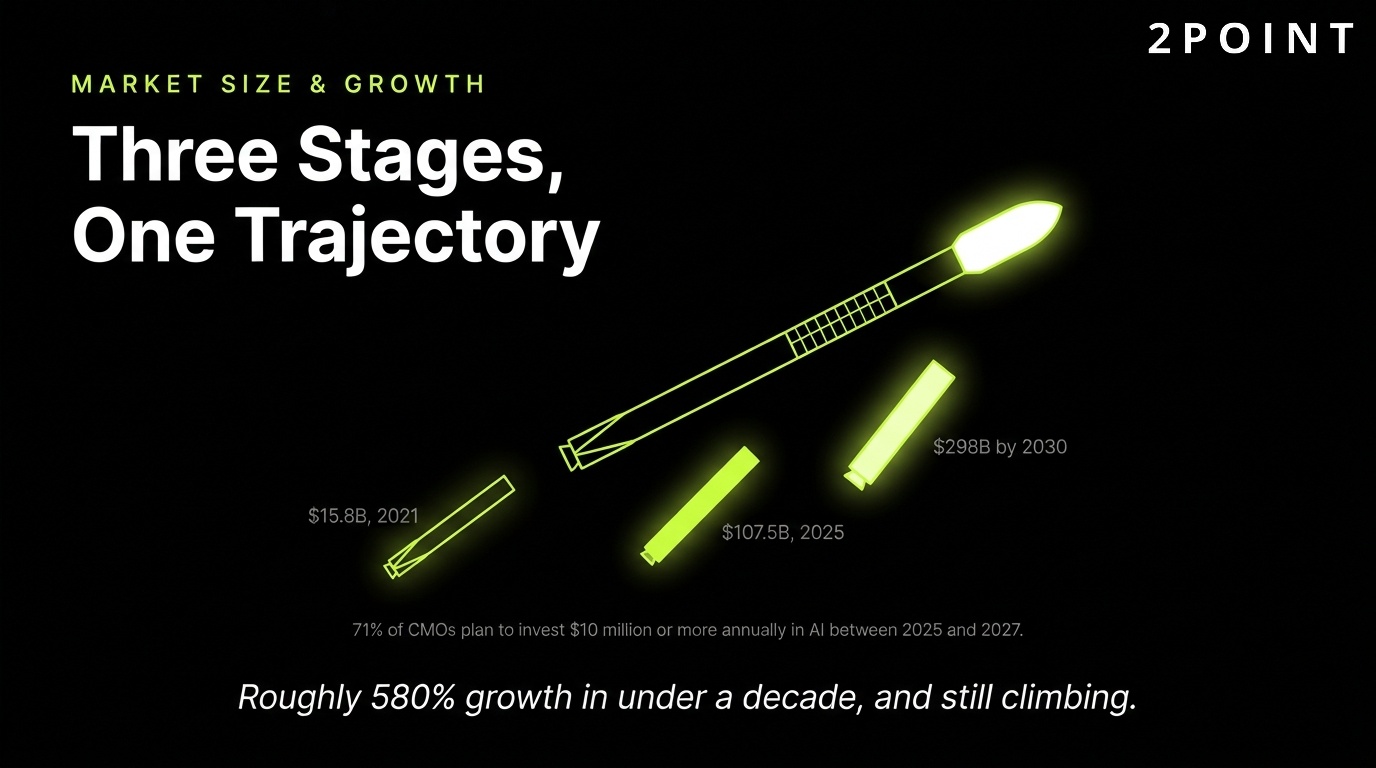
The numbers tell an unambiguous story. The global AI marketing market stood at approximately $15.8 billion in 2021. By 2025, it had grown to $107.5 billion, and analysts project it will reach $298 billion by 2030. That is roughly 580% growth in under a decade, a trajectory that outpaces virtually every other technology category in marketing history.
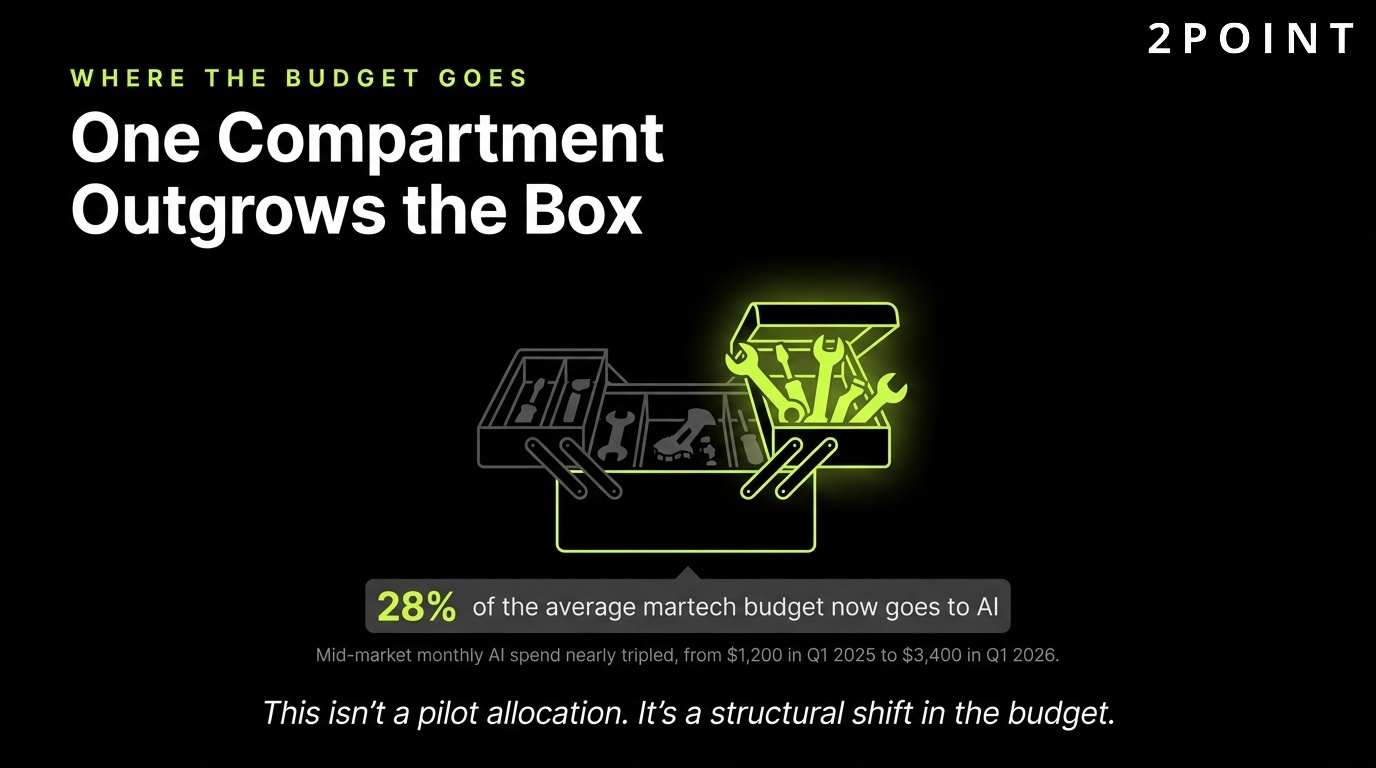
Enterprise investment is accelerating proportionally. 71% of Chief Marketing Officers plan to invest $10 million or more annually in AI between 2025 and 2027, and AI now accounts for 28% of the average marketing technology budget. These are not pilot allocations; they reflect a strategic conviction that AI is the primary lever for competitive differentiation.
The mid-market data is equally revealing. Median monthly AI marketing spend tripled from approximately $1,200 in Q1 2025 to $3,400 in Q1 2026. Mid-sized organizations, historically slower to adopt enterprise technology, are now accelerating investment at a pace that mirrors early-adopter enterprise behavior from two years prior. This compression of the adoption curve means the window for competitive advantage from AI investment is narrowing rapidly.
| AI Marketing Market Metric | 2021 Baseline | 2025 Current | 2030 Projection |
|---|---|---|---|
| Global Market Size | $15.8 billion | $107.5 billion | $298 billion |
| CMOs Investing $10M+ Annually | N/A | 71% | Accelerating |
| AI Share of Avg. Martech Budget | N/A | 28% | Majority share |
| Mid-Market Monthly AI Spend | N/A | $3,400/month (Q1 2026) | Continued growth |
The key takeaway from this market data is that AI marketing investment has already moved from discretionary to structural across all organizational sizes, with the fastest growth occurring at the mid-market level.
Adoption Rates Across Marketing Functions
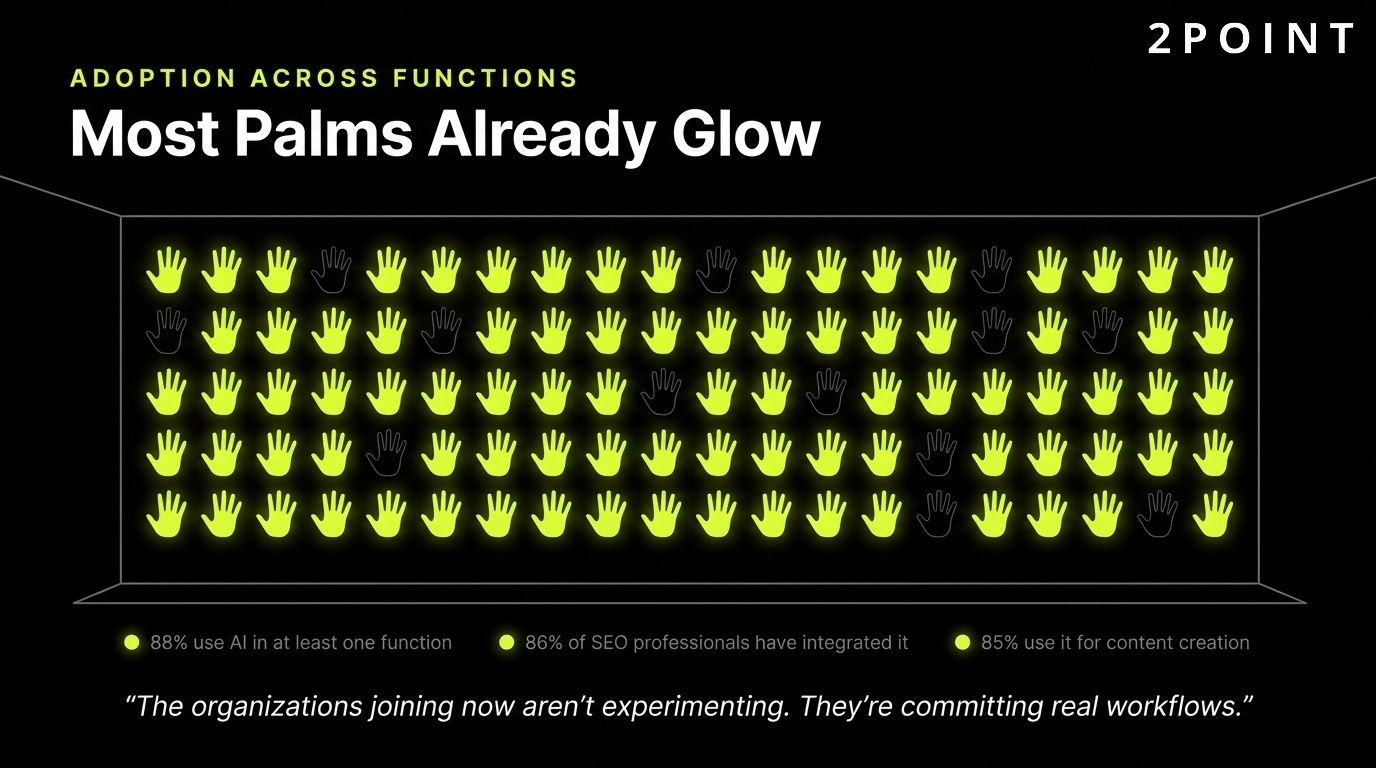
Market spend data reflects intent; adoption data reflects reality. 88% of organizations now use AI regularly in at least one marketing function, up from 78% in 2024. That single percentage point increase understates the story: the organizations joining the AI-active cohort in 2025 and 2026 are not experimenters. They are committing real budgets and workflows to AI-powered execution.
Function-level adoption reveals where AI has become genuinely embedded. 76% of marketing teams use AI in core operations, 86% of SEO professionals have integrated AI into their workflows, and 85% of marketers use AI for content creation. These are majority-adoption figures across mission-critical functions, not fringe usage.
The more instructive data point is the implementation gap. Only 38% of organizations have fully integrated AI into their marketing processes, while 43% remain in experimentation mode. This gap is where competitive advantage is won or lost in 2026. Tools are ubiquitous. Execution is rare. Organizations that have moved beyond piloting into deep workflow integration are achieving measurably better outcomes, and the gap between them and late-stage experimenters is widening with each quarter. For teams working to use analytics to drive marketing strategies, AI provides the speed and scale that human analysis alone cannot match.
Who Is Leading and Who Is Lagging
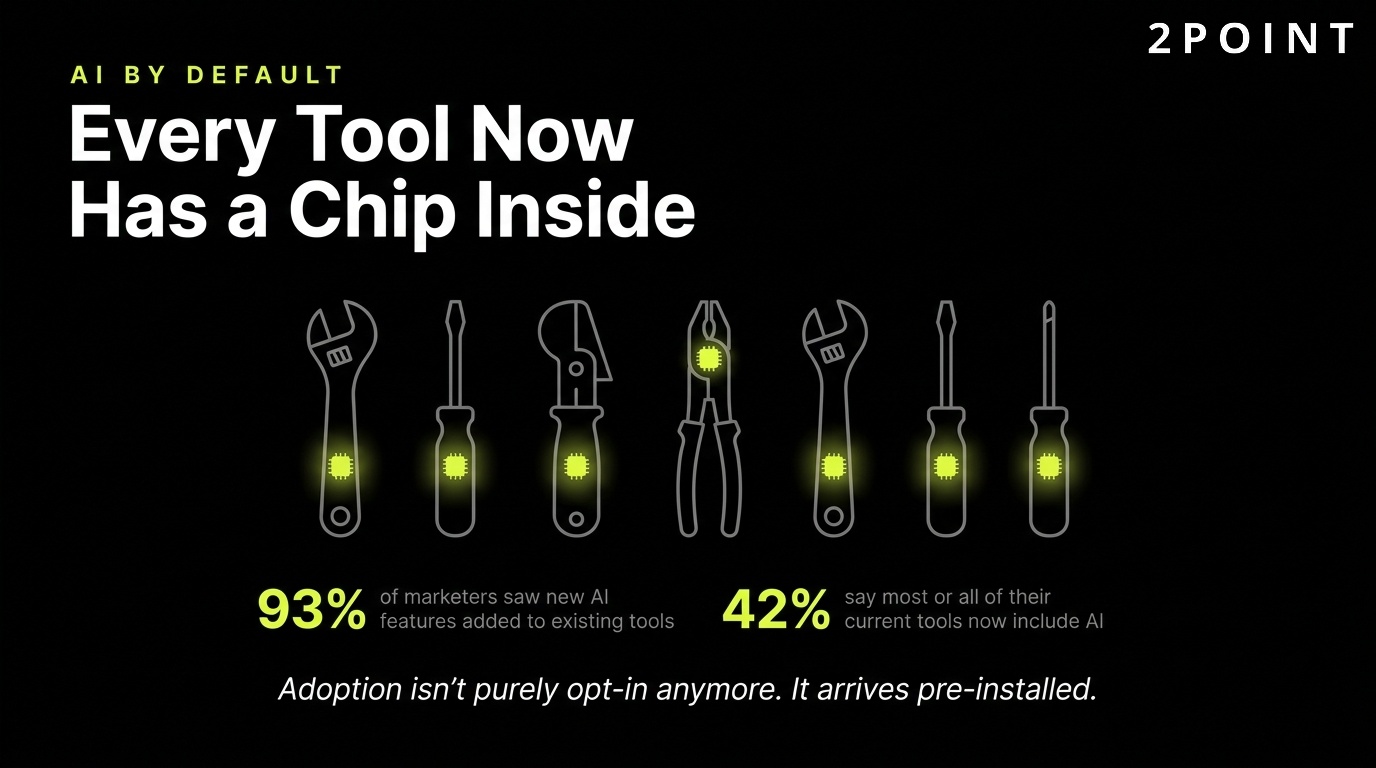
The tool environment has shifted dramatically. 93% of marketers report that new AI features were added to existing tools in 2024, with 42% saying most or all of their current tools now include AI capabilities. The implication: AI adoption is no longer purely opt-in. Platforms are embedding AI by default, meaning organizations interact with AI whether they have a formal strategy or not.
Early adopters are scaling fast with measurable advantages. Organizations using AI decisioning consistently report 25% faster campaign execution, 12% higher task completion rates, and 40% improvement in output quality compared to traditional workflows. These are not marginal gains; they represent a structural productivity advantage that compounds over time.
Late movers face a widening gap that extends beyond tool access. The real disadvantage is organizational: early adopters have built data infrastructure, trained teams, redesigned workflows, and accumulated AI-specific institutional knowledge. Tools can be purchased in days; capabilities take months to build. The 2026 competitive question has shifted from "should we adopt AI?" to "how fast can we execute, and how deep can we integrate?" Organizations still answering the first question are already behind the curve.
How AI Marketing Actually Works: Core Capabilities Explained
AI marketing is not a single technology. It is a category spanning predictive analytics, generative content creation, autonomous decision-making, and real-time personalization. Understanding what each capability does, and how they combine in practice, is essential for building a coherent AI marketing strategy rather than accumulating disconnected tools.
Predictive AI vs. Generative AI in Marketing
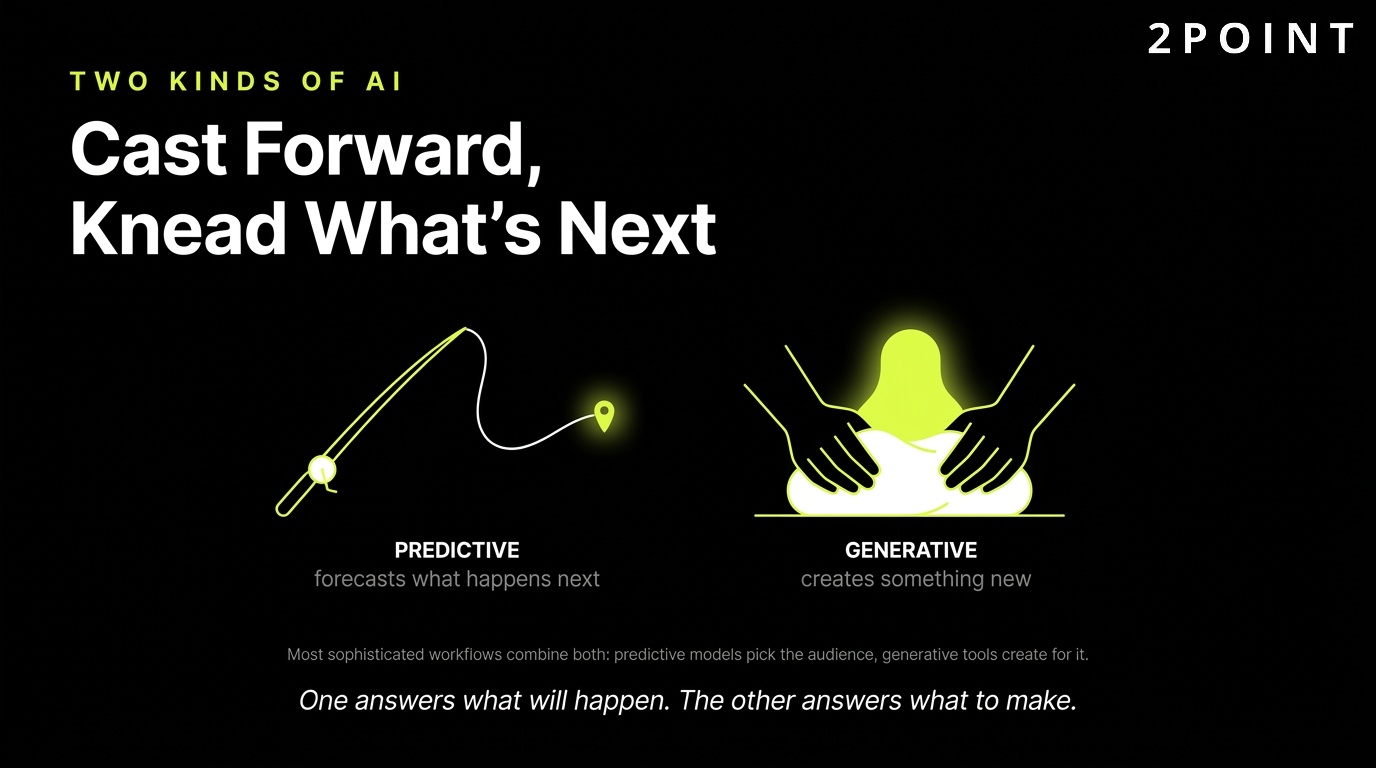
The two core categories of AI in marketing serve distinct but complementary functions. Understanding the difference clarifies where to apply each and how to integrate them effectively.
Predictive AI analyzes historical and real-time data to forecast future behavior. In marketing, this means identifying prospects most likely to convert, predicting which customers are at risk of churning, forecasting campaign performance before launch, and recommending optimal timing, channel, and messaging combinations based on what has worked historically. Predictive models operate on patterns in existing data to answer the question: "What will happen next?"
Generative AI creates new content from patterns learned across massive datasets. In marketing, this means drafting ad copy, generating product descriptions, writing email subject line variations, producing visual concepts, and building content calendars. Generative models answer the question: "What should we create for this audience, goal, or context?"
Most sophisticated marketing workflows now combine both: predictive models identify which audiences to target and when, generative tools create personalized content for those segments, and predictive systems then optimize delivery timing and channel mix. This integrated approach enables the autonomous campaign orchestration that is becoming the new standard for high-performing marketing teams. Effective analysis of customer behavior is the data foundation on which both predictive and generative AI systems depend.
Content Creation and Production Acceleration
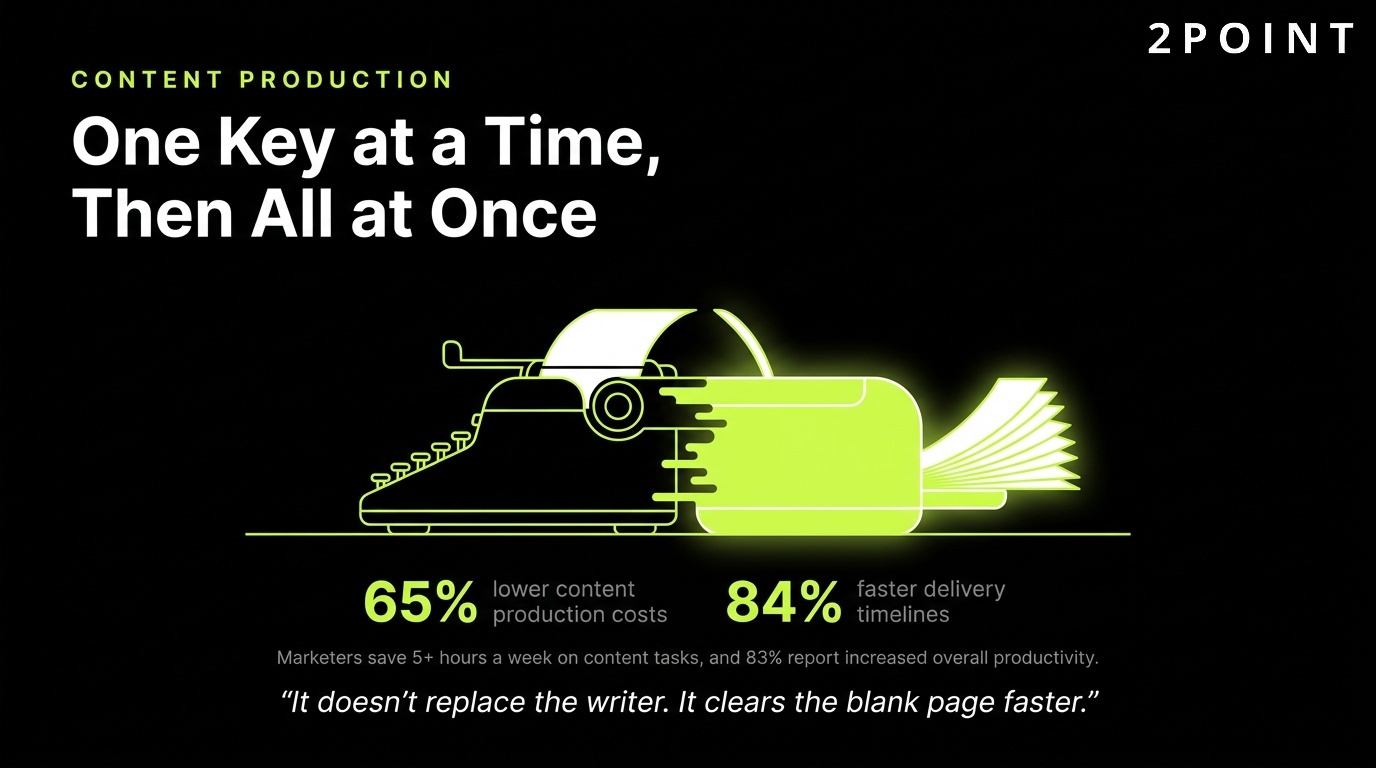
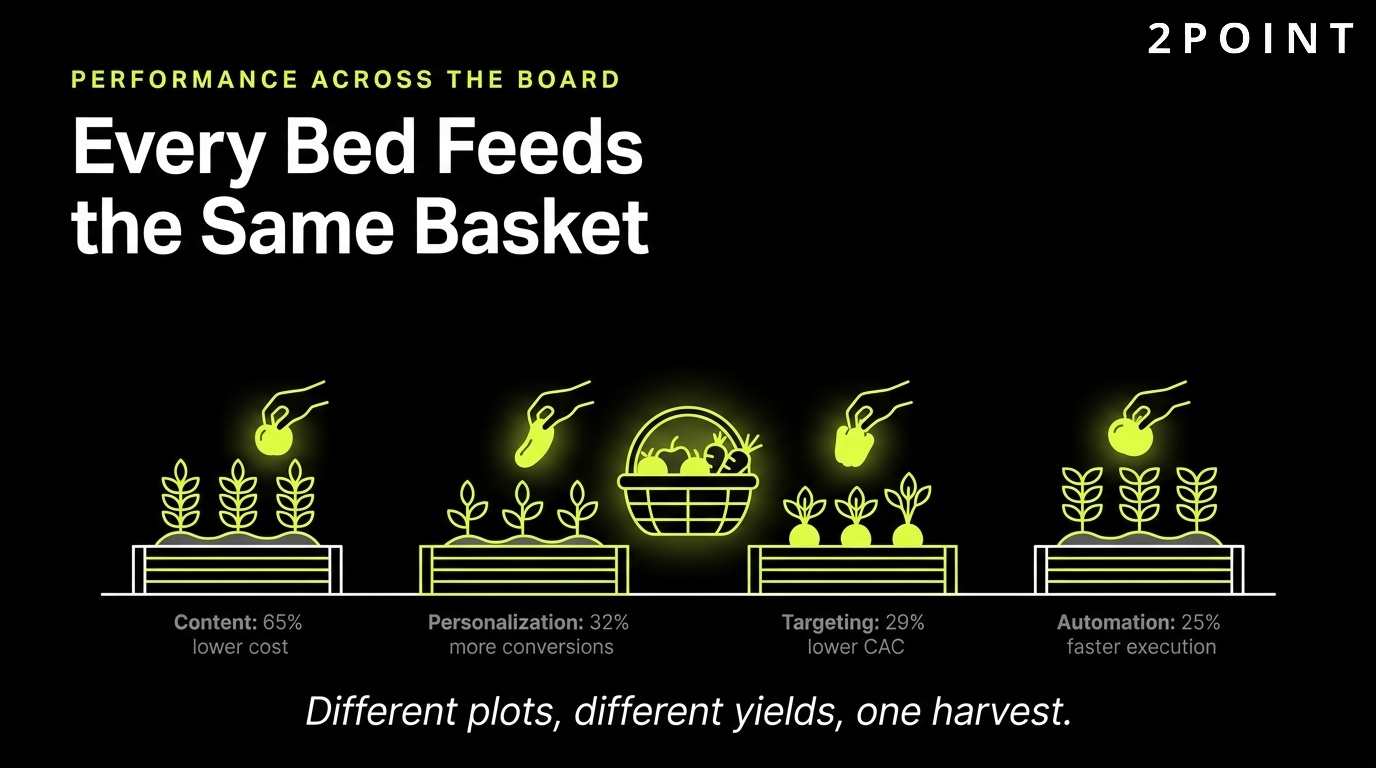
Content creation is the most widely adopted AI marketing application, and the productivity gains are substantial. Organizations using AI for content production report 65% reductions in production costs and 84% faster delivery timelines compared to traditional workflows. Marketers save an average of five or more hours per week on content-related tasks, and 83% report increased overall productivity after AI adoption.
The mechanism is important to understand clearly. AI does not replace human marketing strategists or creative directors. It eliminates the time-consuming analytical groundwork: parsing datasets for audience insights, monitoring competitor messaging, studying trend signals, generating and testing messaging variations at scale. Tasks that once consumed hours of a senior marketer's time complete in seconds, redirecting human attention toward higher-judgment work like strategic positioning, brand voice decisions, and campaign architecture.
The practical workflow is collaborative: AI handles first drafts and volume variations, humans refine for brand consistency and strategic coherence, and AI optimizes distribution. This model yields both speed and quality because each party contributes what it does best. For teams building effective content marketing techniques, AI becomes the engine that makes ambitious production schedules achievable without proportional headcount increases.
Personalization at Scale
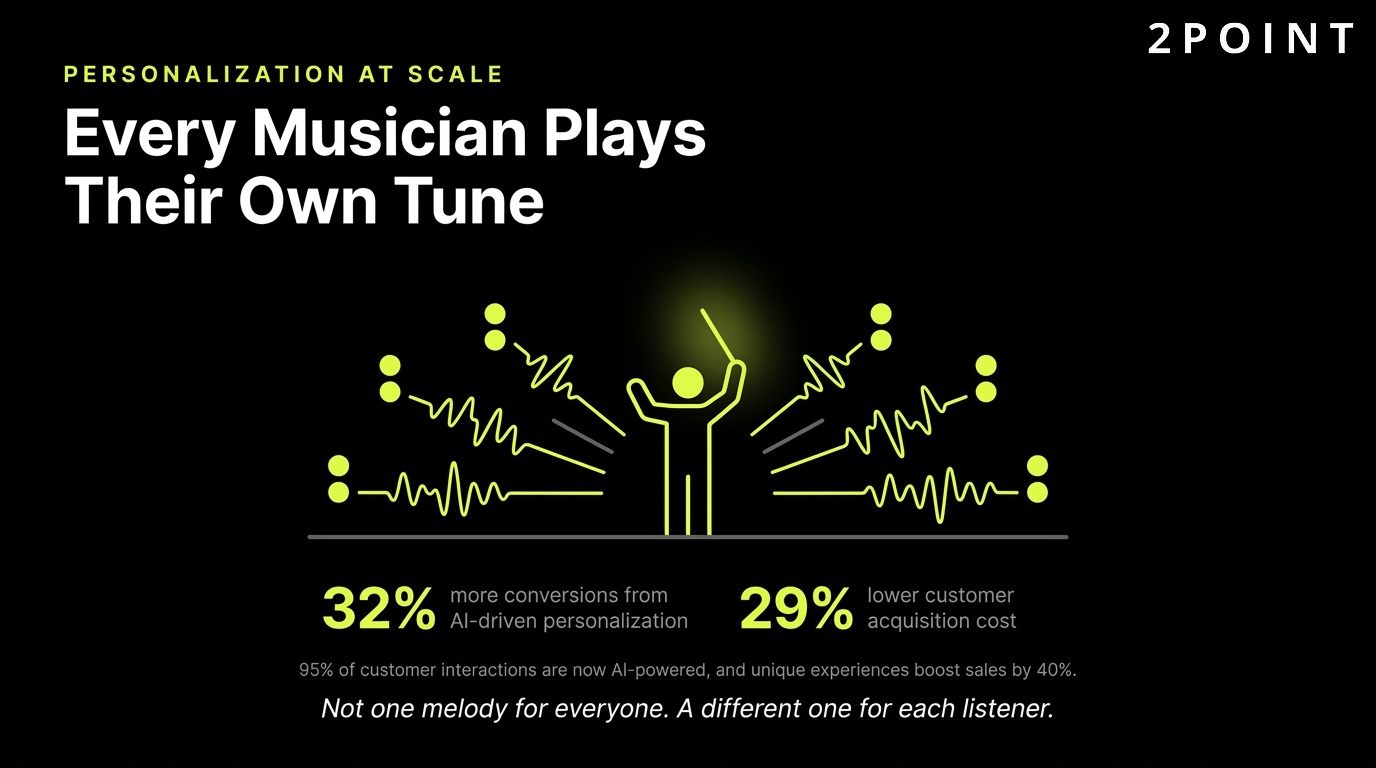
Personalization at scale was, until recently, a marketing aspiration rather than a practical reality. Segment-based targeting was the closest approximation: group customers by demographics or behavior, then deliver modestly differentiated messages. AI has fundamentally changed what is possible. 95% of customer interactions are now AI-powered, and organizations deploying AI-driven personalization campaigns report 32% more conversions and 29% lower customer acquisition costs compared to non-personalized approaches.
The mechanism enabling this is real-time behavioral signal processing. AI systems continuously ingest browsing patterns, purchase history, engagement data, and contextual signals (time of day, device type, recent activity) to dynamically adjust messaging, offers, and channel strategy for each individual. This is not segmentation; it is individualization executed simultaneously across millions of touchpoints. The customer experience shifts from "we know people like you want this" to "we know you specifically are ready for this right now."
The commercial stakes are significant. Consumer desire for unique, personalized experiences boosts sales by 40%, and AI is the only technology capable of delivering that uniqueness at the scale modern marketing demands. Organizations still relying on broad segmentation are leaving measurable revenue on the table while their AI-powered competitors capture it. Building brand loyalty in this environment requires personalization infrastructure that meets customers where they are, not where averages suggest they should be.
Campaign Automation and Autonomous Decision-Making
The evolution of marketing automation has moved from isolated task automation (scheduling email sends, managing bid adjustments) to end-to-end campaign orchestration. In 2026, advanced AI systems autonomously handle audience discovery, creative variation testing, channel deployment, real-time performance measurement, and budget reallocation across channels simultaneously. The insight-to-action cycle has collapsed from weeks to hours.
This is agentic AI in practice: systems that do not merely recommend actions but execute decisions within strategically defined parameters. Marketing teams transition from doing to supervising, setting strategy and guardrails while AI manages tactical execution. The performance implications are significant: organizations using AI-assisted decisioning report 25% faster campaign execution, and AI search traffic has grown 527% year-over-year, reflecting the scale at which AI now mediates discovery.
The practical implication for marketing leadership: the skills gap is not between those who use AI tools and those who do not. It is between those who know how to supervise AI effectively (setting objectives, evaluating outputs, refining strategy based on AI-generated insights) and those who do not. Automation eliminates low-judgment tasks; it elevates the importance of high-judgment strategic thinking. Understanding how to build and optimize a marketing funnel with AI-powered stages is becoming a foundational competency for modern marketing leaders.
The 2026 AI Marketing Landscape: What Has Changed and What Is Coming
2026 is an inflection point. Several transformative shifts are converging simultaneously, and each one reshapes a fundamental assumption about how marketing works. Understanding these shifts is not about predicting the future; it is about operating effectively in a present that has already changed dramatically.
The Search Revolution: From SEO to Answer Engine Optimization
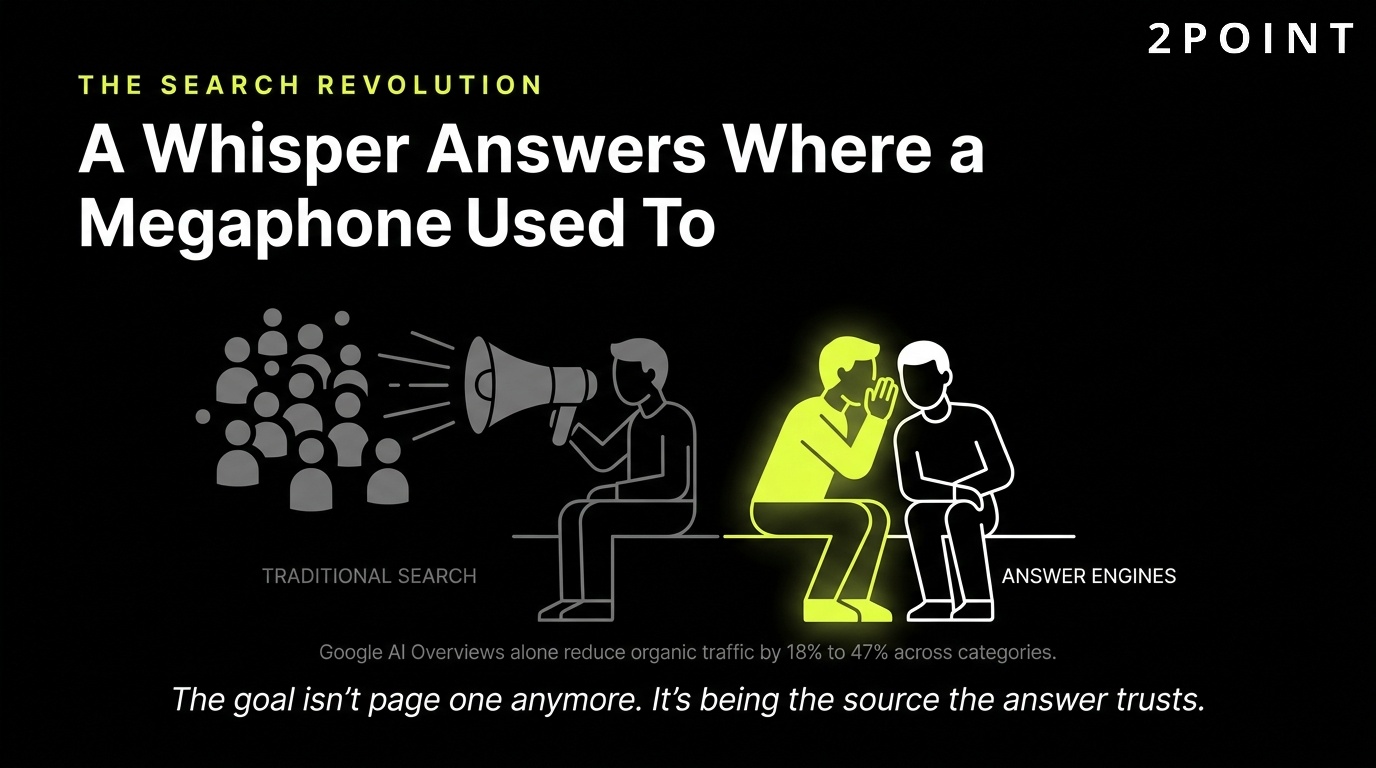
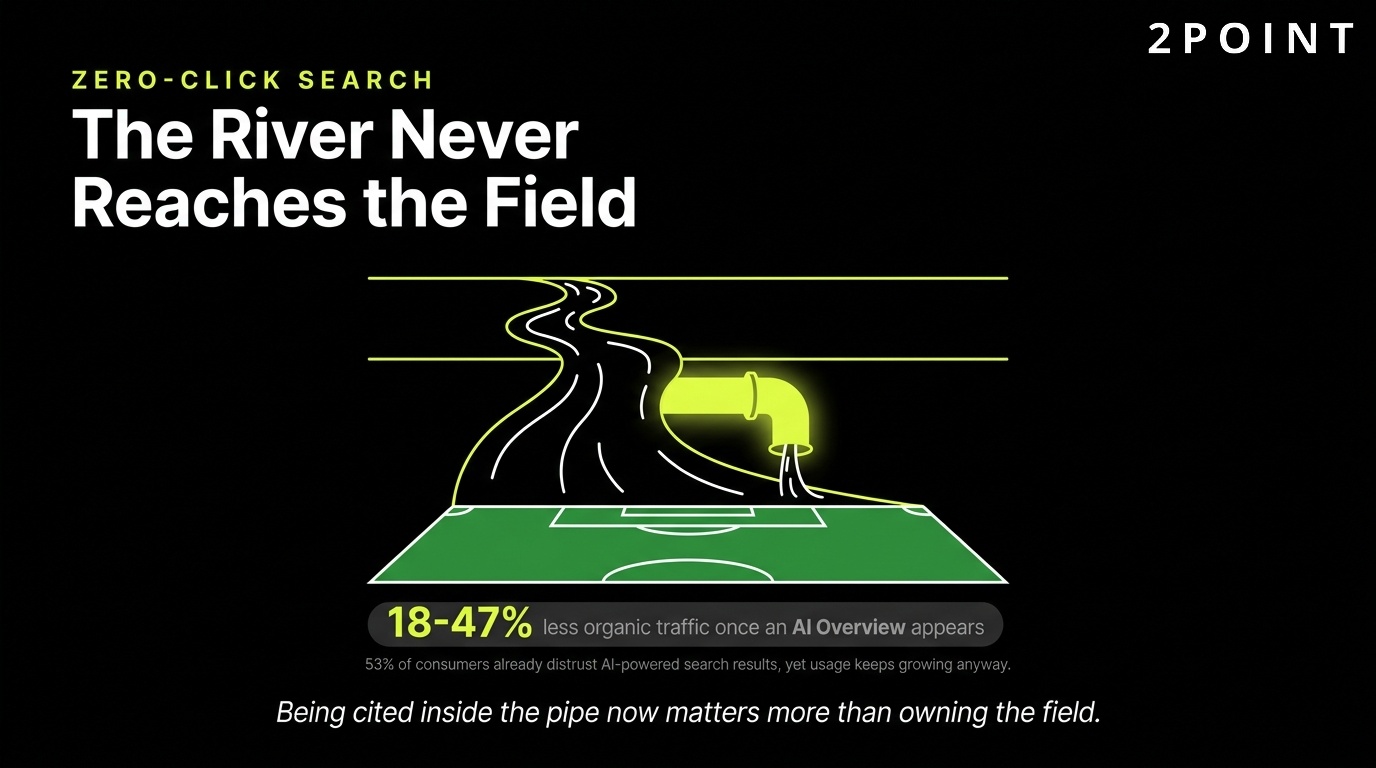
The disruption to traditional search is the most significant structural change in digital marketing since the rise of Google. In 2026, zero-click search dominates interactions across ChatGPT, Perplexity, Gemini, Bing AI, and Meta AI. Users ask conversational questions, receive instant comprehensive answers, and never visit source websites. The traffic impact for publishers and brands optimized for traditional search has been severe: Google AI Overviews alone reduce organic traffic by 18% to 47% across categories, with content-heavy publishers absorbing the heaviest losses.
The strategic response is a pivot from Search Engine Optimization to Answer Engine Optimization (AEO). Rather than optimizing for keyword rankings in a results page, marketers now optimize for inclusion and favorable positioning within AI-generated responses. The goal is not "rank on page one" but "be the source AI cites, recommends, or draws from when answering relevant questions." This requires structured data, authoritative content positioning, brand mention cultivation across authoritative sources, and ensuring factual accuracy in all published content that AI systems might index.
The behavioral shift driving this is profound. Consumers no longer search "plumber near me" and compare a list of results. They say "Can you find someone to fix my sink this afternoon?" and the AI selects a provider, books the appointment, and confirms the details. The human never sees a list of options. Brand visibility in this environment requires being present in AI training data and recommendation systems, not just search rankings.
Trust remains a legitimate challenge. 53% of consumers report distrust of AI-powered search results, raising questions about accuracy and bias. However, the behavioral trend is irreversible: usage grows despite skepticism because convenience outweighs caution for most queries. Traditional SEO playbooks built around keyword density, backlink volume, and meta optimization are not obsolete overnight, but their primacy is definitively over. AEO is the new frontier for organic visibility.
Agentic AI and Autonomous Campaign Management
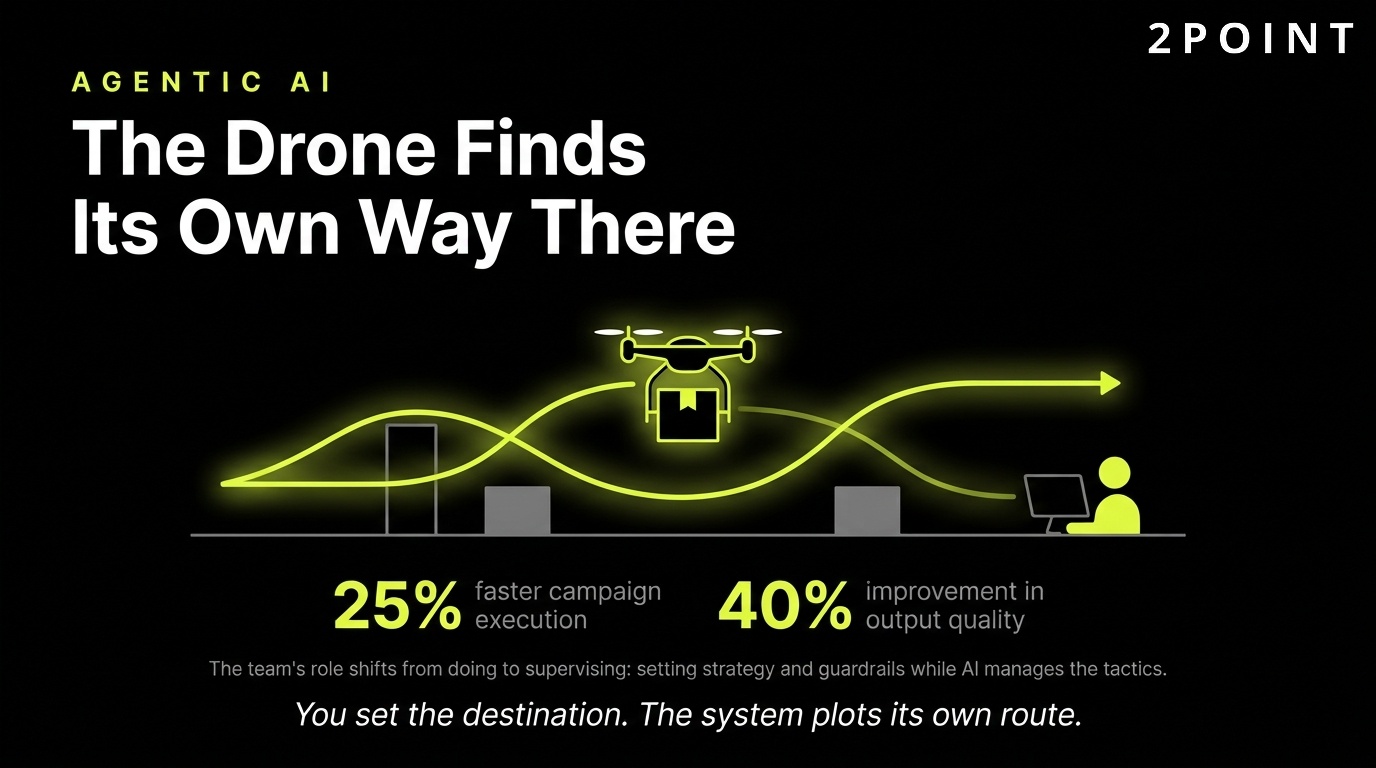
Agentic AI represents the evolution beyond tools into something qualitatively different: AI agents that autonomously execute multi-step workflows with minimal human intervention, pursuing defined objectives across systems and channels. These systems handle customer notifications, trigger personalized reorder prompts, deliver contextual guidance throughout customer journeys, and manage entire campaign sequences from initiation through optimization. The traditional model of channel-based execution (one team owns email, another owns paid, another owns social) gives way to fluid, agent-driven journeys that adapt dynamically to individual customer behavior.
The architectural implication is significant. Traditional marketing technology stacks require human orchestration: someone must connect the CMS to the ESP to the CDP to the analytics platform, translate insights into decisions, and execute campaigns across channels. Agentic systems operate across these platforms autonomously to achieve objectives specified in plain language. A marketing leader might instruct an agent to "increase repeat purchase rate by 15% among customers who purchased in the last 90 days" and the agent builds, tests, deploys, and optimizes the campaign without step-by-step human direction.
Organizations using AI-assisted decisioning report 25% faster execution, 12% higher task completion rates, and 40% improvement in output quality compared to manually managed campaigns. These gains compound over time as AI agents accumulate performance data and refine their decision-making. The competitive divide in 2026 is not between organizations with AI tools and those without. It is between organizations that have mastered agent supervision (strategic direction, guardrail setting, outcome evaluation) and those still managing execution manually.
Machine Customers and AI-to-AI Commerce
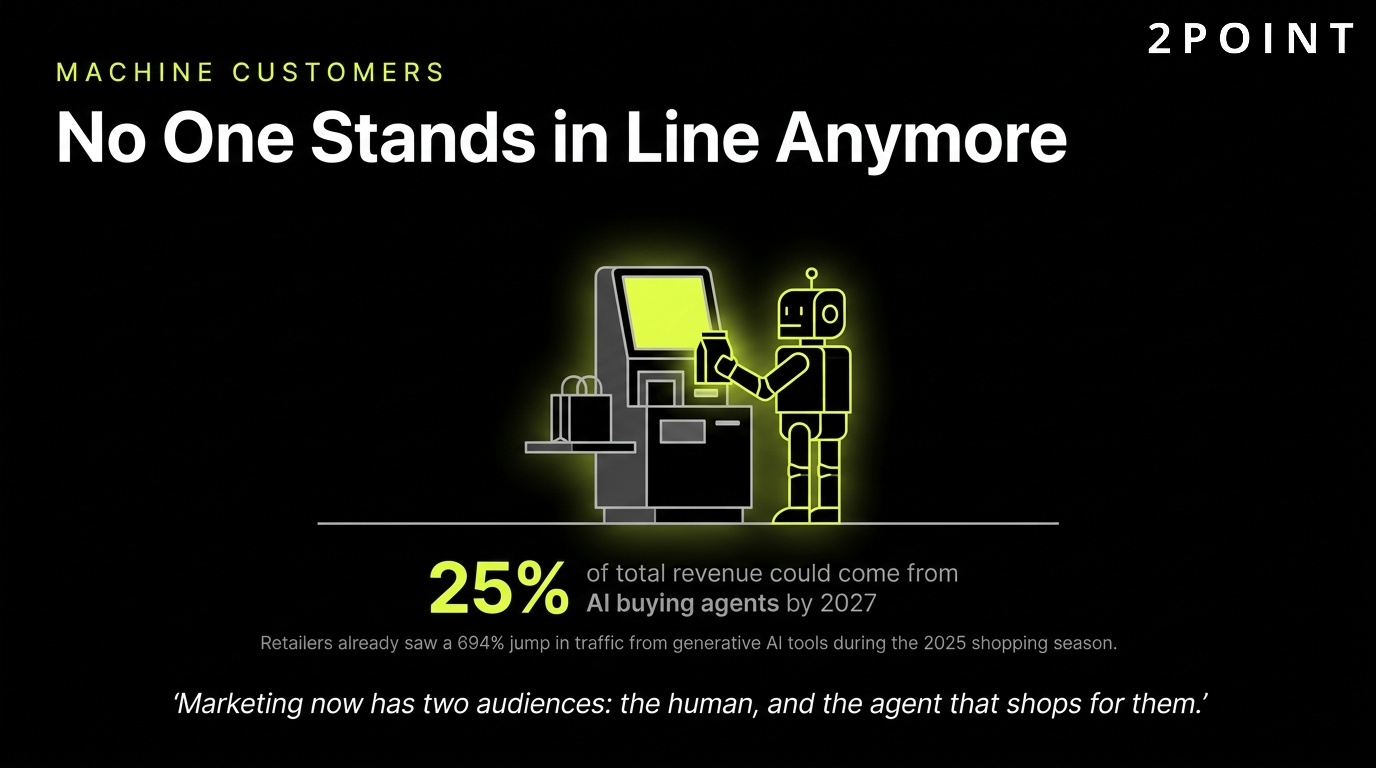
A genuinely novel development in 2026 is the emergence of "machine customers": AI buying assistants that research, evaluate, compare, and purchase on behalf of human users. These agents operate as proxies in the purchasing process, applying user-specified criteria to discover and select products or services without human involvement at each step. Forward-thinking organizations expect machine customers to generate 25% of total revenue by 2027.
Early signals from the 2025 shopping season were striking: retailers observed a 694% increase in site traffic originating from generative AI tools, though the absolute user base remains small relative to direct traffic. The trajectory is clear. As personal AI assistants become more capable and trusted with financial transactions, the proportion of purchases mediated by AI agents will grow substantially.
The marketing implication requires a fundamental rethinking of audience targeting. Marketing must now address two distinct audiences: human decision-makers who engage emotionally and narratively, and the AI agents that advise or act on their behalf with purely functional evaluation criteria. Optimizing for AI agent comprehension requires structured data (machine-readable product specifications, pricing, availability), brand positioning within AI training datasets, and ensuring that your organization is accurately and favorably represented when AI agents evaluate options on behalf of potential customers.
Content Authenticity and the Trust Challenge
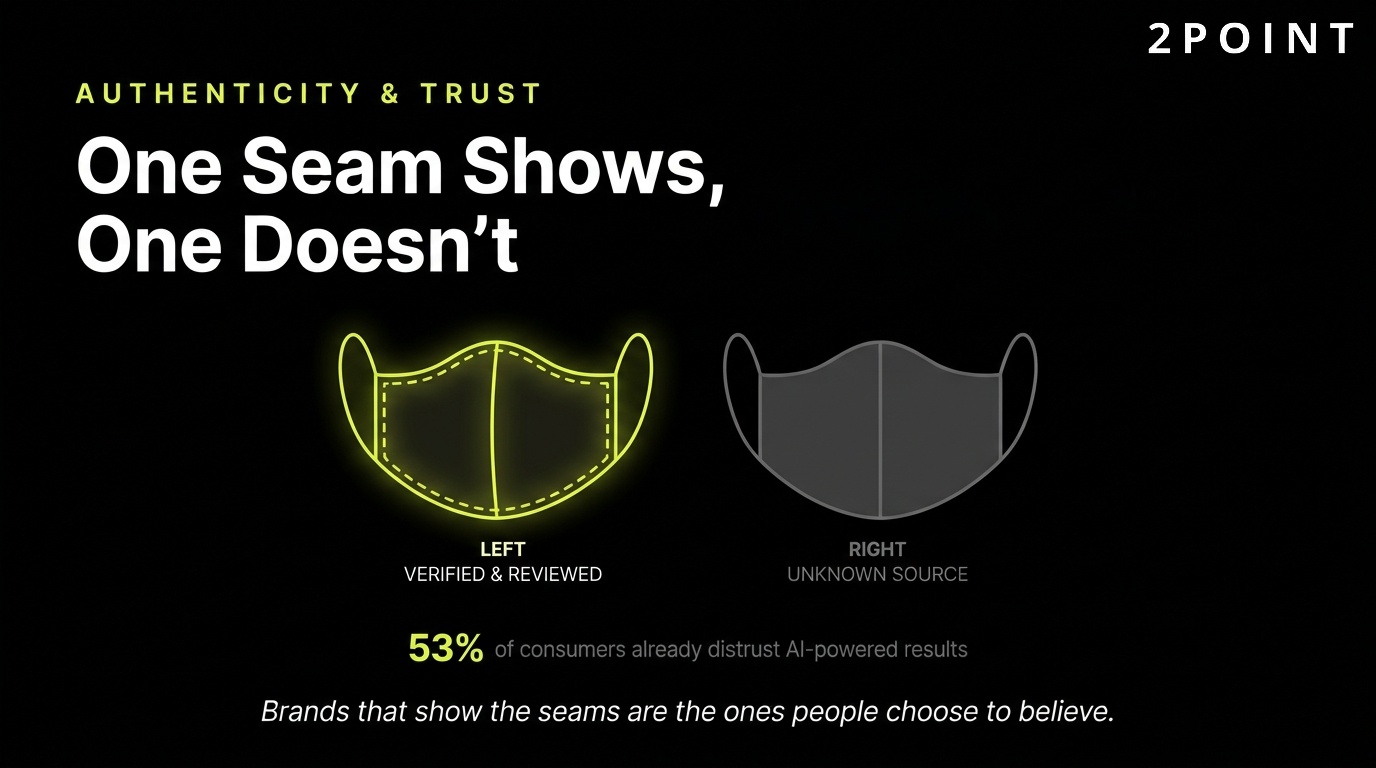
As AI generates content at unprecedented scale, authenticity has emerged as a primary brand differentiator. The concern is structural: when AI can produce unlimited volumes of plausible-sounding content, the question of whether information is genuine, accurate, and trustworthy becomes both more important and harder to answer. Brands that verify creator identities, ensure content provenance, and demonstrate human oversight of AI-generated outputs will differentiate themselves from those relying entirely on autonomous content production.
The trust challenge intensified in February 2026 when OpenAI introduced advertising within ChatGPT, forcing users to navigate the distinction between organic AI recommendations and paid placements within the same conversational interface. This development altered the fundamental trust contract of AI assistants: consumers now question whether the AI serves their interests or the interests of advertisers who have paid for placement. With 53% of consumers already reporting distrust of AI-powered search results, the commercialization of AI recommendation surfaces accelerates existing skepticism.
The practical response for marketers involves building trust through verifiable authenticity: clearly labeling AI-generated content, implementing content provenance systems that trace origin and human review, maintaining transparency in how AI is used in customer-facing communications, and ensuring that AI-generated content passes human review for accuracy and brand alignment before publication. Brands that build trust infrastructure now will be positioned to benefit as consumer skepticism forces a market-wide reckoning with AI content quality.
AI Marketing Tools: Categories, Capabilities, and Selection Criteria
The AI marketing tool landscape has expanded dramatically, but volume of options does not guarantee quality of outcomes. The organizations seeing the strongest returns are not those with the most tools; they are those with the right tools deeply integrated into coherent workflows. This section categorizes the primary tool types, explains their capabilities, and provides practical guidance for selection.
Content Creation and Generative AI Tools
Content generation tools represent the largest and most rapidly evolving category of AI marketing technology. These platforms span text generation (ad copy, blog content, email sequences, social media posts, product descriptions), visual creation (image generation, design concepts, branded assets), and multimedia production (video scripts, audio content, presentation materials). 85% of marketers now use AI for content creation, reflecting the category's dominance as the entry point for AI adoption.
The value proposition is straightforward: these tools eliminate blank-page paralysis, accelerate iteration through rapid variation generation, and enable volume scaling that human-only teams cannot match. A team of three content producers with strong AI tools can execute at the output level of a team of ten working traditionally, and with comparable quality when humans maintain strategic direction and editorial review.
Selection criteria for content generation tools should prioritize three factors. First, integration with existing workflows: tools that require constant context-switching between platforms impose hidden productivity costs that erode the time savings they theoretically provide. Second, brand voice consistency: evaluate whether the tool supports fine-tuning or customization to your specific tone, terminology, and style requirements. Generic outputs that require extensive editing reduce the efficiency gains. Third, quality control mechanisms: tools that incorporate human review triggers, confidence scoring, or fact-checking workflows reduce the risk of publishing AI hallucinations or off-brand content. The best content marketing strategies treat AI as a production accelerant, not a replacement for strategic editorial judgment.
Analytics, Insights, and Predictive AI Platforms
Analytics and predictive platforms represent AI marketing's intelligence layer: tools that ingest data from multiple sources, identify patterns invisible to human analysts, and generate actionable recommendations. Specific capabilities include customer churn prediction, conversion probability scoring, next-best-action recommendation engines, multi-touch attribution modeling, and pre-launch campaign performance forecasting.
The strategic shift these platforms enable is from reactive optimization (analyzing what happened and adjusting accordingly) to predictive planning (forecasting what will happen and acting before outcomes lock in). Organizations that plan predictively consistently outperform those that react to results, because they allocate budget, creative resources, and channel focus toward highest-probability outcomes before campaigns launch rather than after they underperform.
64% of marketers report that AI actively enables innovation rather than merely supporting existing tasks, and predictive platforms are the primary driver of this perception. By surfacing non-obvious patterns in customer behavior (unexpected churn triggers, surprising conversion sequences, counterintuitive audience overlaps) these tools generate genuine strategic insight rather than just automating existing analysis. Selection criteria should prioritize data integration breadth (how many of your existing systems does it connect with natively?), model transparency (can it explain why it made a recommendation in terms your team can act on?), and action enablement (does a recommendation directly trigger execution, or does it require manual handoff?). Effective analyzing of customer behavior through AI-powered platforms turns behavioral data into revenue-generating decisions rather than interesting reports.
Marketing Automation and Orchestration Platforms
Automation and orchestration platforms have evolved substantially from their first-generation rule-based predecessors. Early marketing automation required extensive setup: manually defined trigger conditions, sequential workflow maps, and constant rule updates as customer behavior patterns shifted. Current AI-powered orchestration platforms learn from outcomes autonomously, adapting sequences, timing, and channel selection in real time based on individual engagement signals.
Functional capabilities span email sequence automation, social media scheduling and engagement, paid media bid management, lead scoring and routing, cross-channel campaign coordination, and increasingly, agentic workflow execution. The leading trend in 2026 is consolidation: teams managing fewer platforms with deeper native integration, replacing sprawling point-solution stacks with unified orchestration hubs that handle multiple functions with consistent data access.
The performance gains from well-implemented orchestration are material: 25% faster campaign execution frees teams to focus on strategy rather than operational logistics. Selection criteria should address three dimensions. Flexibility: does the platform support both rule-based and AI-driven decisioning, allowing your team to progress from structured automation toward adaptive AI as capabilities mature? Integration depth: does it connect natively with your CRM, analytics, and ad platforms, or does it require middleware that creates data latency and maintenance overhead? Scalability: does performance hold as data volume and campaign complexity grow, or does it degrade in ways that limit ambition? For teams expanding their email marketing for lead generation, AI-powered orchestration platforms provide the personalization depth and timing precision that manual email management cannot achieve at scale.
How to Choose the Right AI Marketing Tools for Your Team
Tool selection should begin with use case, not features. Start by mapping your highest-impact friction points: where are your team's biggest time sinks? Where does quality suffer because of bandwidth constraints? Where do you lose revenue because decisions are made too slowly or with insufficient data? The AI tools that address these specific friction points will generate measurably better ROI than tools selected because of impressive feature lists or vendor marketing.
The skills gap is a critical selection factor that is frequently overlooked. 58% of marketers cite skills gaps as their top challenge, yet only 17% have received comprehensive AI training. Tools that are powerful but steep in learning curve will sit underutilized regardless of their theoretical capabilities. Prioritize platforms with strong onboarding, accessible support, and community resources that enable your team to develop proficiency without dedicated AI specialists on staff.
Consider total cost of ownership rather than per-tool pricing. Point solutions often appear cheaper individually, but integration complexity, context-switching overhead, and data synchronization challenges accumulate significant hidden costs. Platforms offering multiple capabilities (content creation plus analytics plus automation) frequently provide better value than assembling best-of-breed point solutions that require custom integrations. Run structured pilots before committing: define clear success metrics (time saved per week, output quality scores, user satisfaction ratings), run for 60 to 90 days, then evaluate against baseline. This evidence-based approach reduces the risk of tool sprawl and ensures that every platform in your stack earns its place through demonstrated, measurable contribution.
The Implementation Challenge: Why Adoption Does Not Equal Success
The central paradox of AI marketing in 2026: adoption is near-universal, but success is not. 88% of marketers use AI daily, yet 42% of companies abandoned most of their AI initiatives in 2025, and 80% of those experimenting with AI report no tangible material impact. The gap between deploying tools and realizing value is where most organizations are currently stuck. Understanding why execution lags adoption is the prerequisite for closing the gap.
The Skills Gap Crisis in AI Marketing
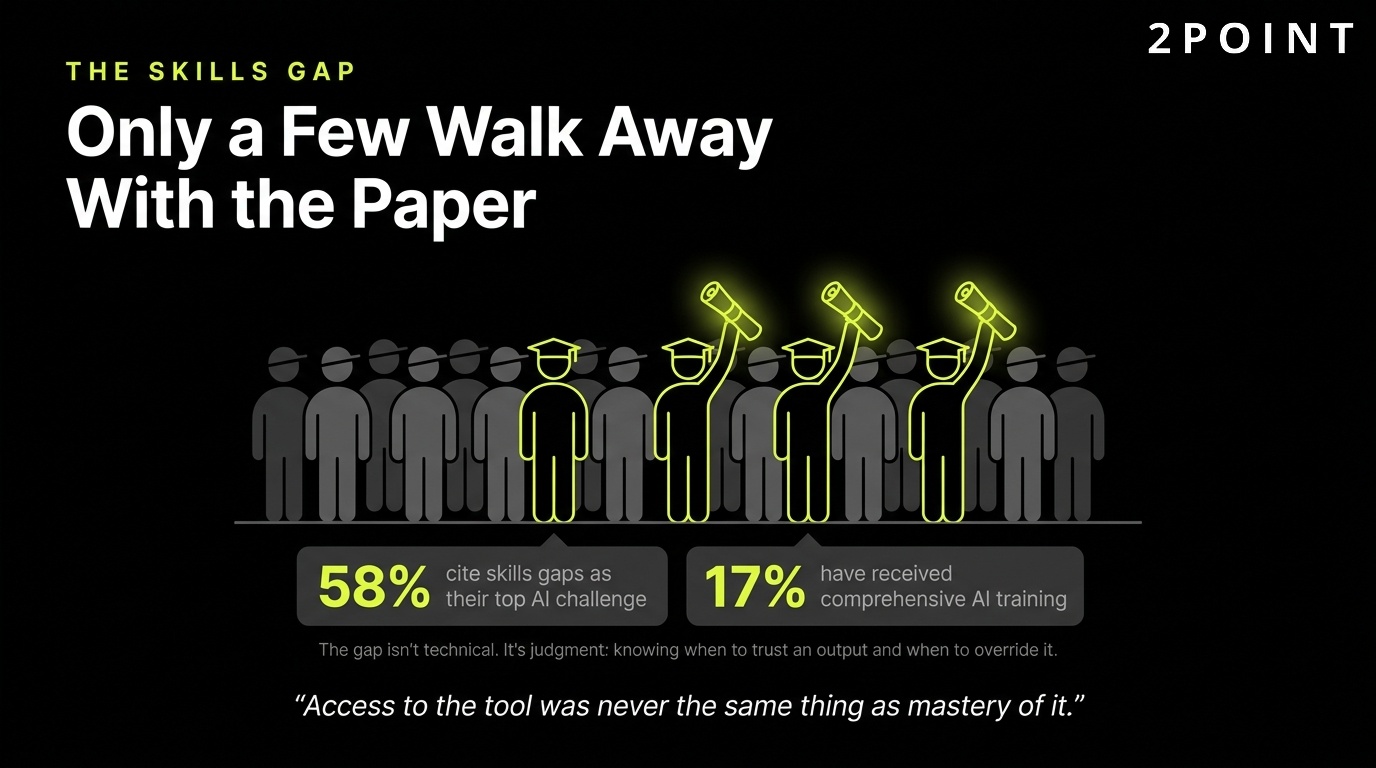
The skills gap is the most frequently cited barrier to AI marketing success, and the data confirms the severity. 58% of marketers identify skills gaps as their primary challenge, yet only 17% have received comprehensive AI training. The disconnect reveals an organizational failure: platforms procure AI tools without investing in the human capability required to use them strategically.
The skills gap is not primarily technical. Most marketers do not need to understand model architecture or fine-tuning mechanics to use AI effectively. The critical gap is in judgment: knowing when AI output is reliable versus when it requires correction, recognizing hallucinations and confidently overriding them, designing workflows that appropriately blend AI efficiency with human creative and strategic oversight, and evaluating AI-generated recommendations against business strategy rather than accepting them uncritically.
Organizations under-invest in training because they assume accessibility implies mastery. Modern AI interfaces are intuitive, leading leadership to conclude that teams will self-educate through use. They will not, at least not at the speed required to generate competitive advantage. Structured training programs covering AI fundamentals, use-case workshops, prompt engineering best practices, and quality evaluation frameworks are essential investments. Leading organizations treat AI fluency as a core marketing competency, tracked and developed through formal learning programs with the same rigor applied to skills like analytics or campaign management. The relationship between AI capability and confidence matters enormously: teams that understand what AI can and cannot do use it more boldly and more effectively.
Integration Complexity and Data Challenges
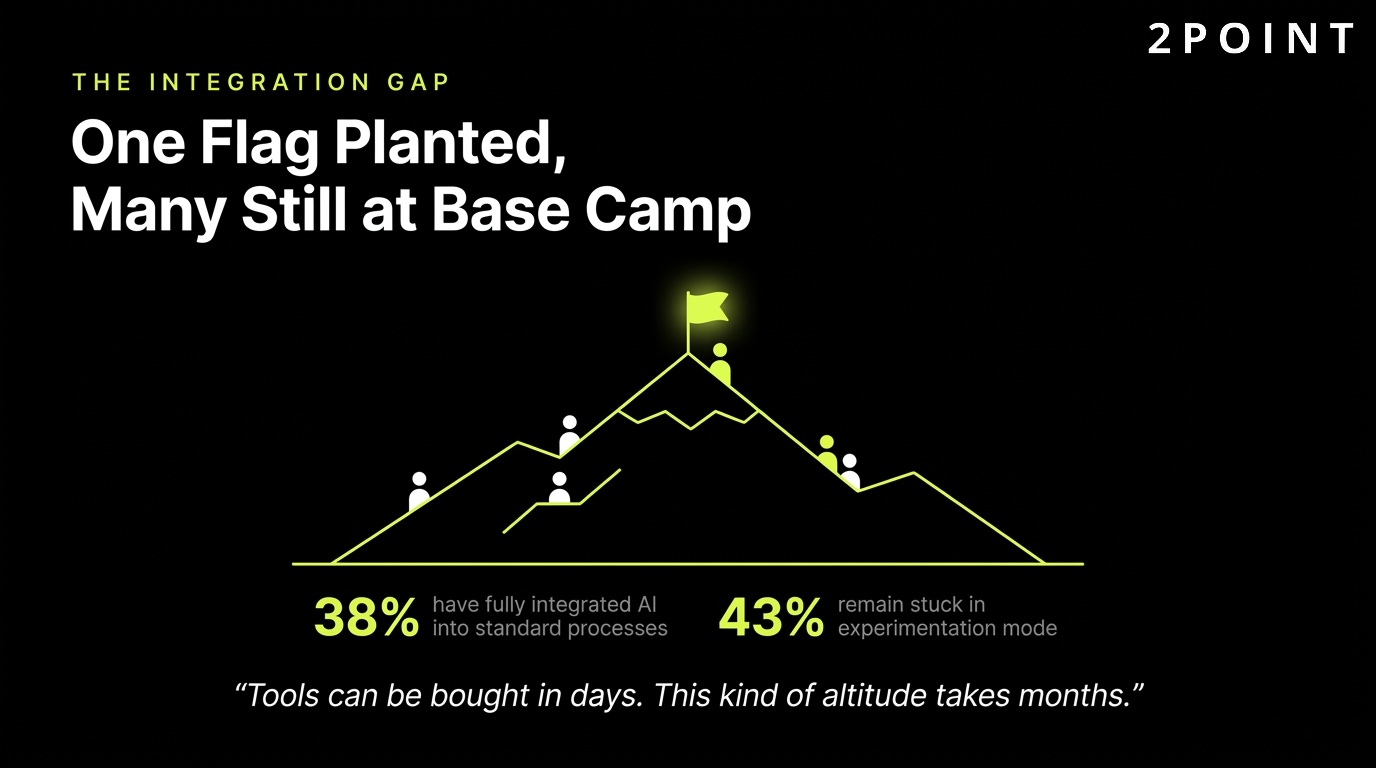
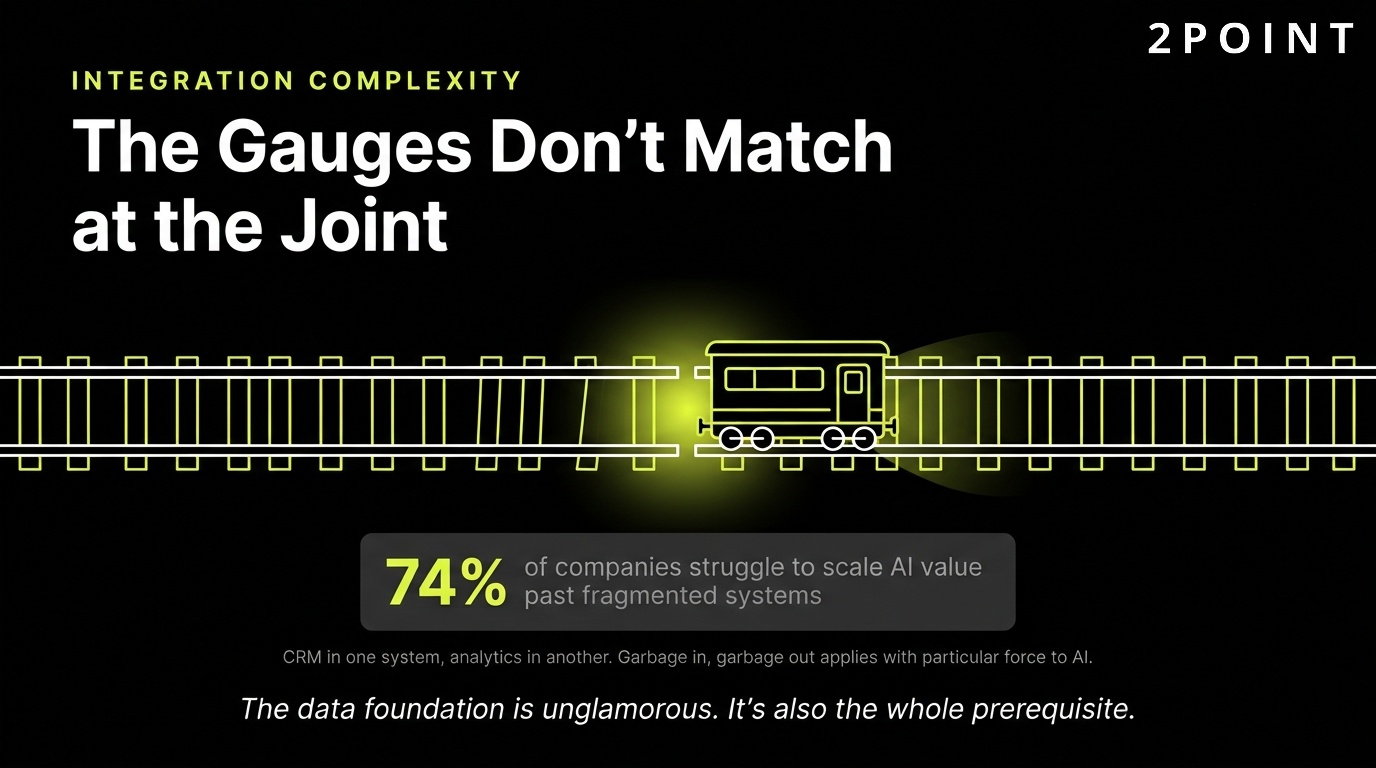
74% of companies report difficulty scaling AI value beyond initial pilots, and integration complexity is a primary cause. AI tools are only as good as the data they operate on. Organizations with fragmented technology stacks (CRM in one system, web analytics in another, ad platform data in a third, customer service data in a fourth) find that AI tools generate unreliable insights because they cannot access a complete, consistent view of customer behavior. Garbage in, garbage out applies with particular force to machine learning systems that amplify whatever patterns exist in their training data.
The integration overhead is substantial in practice. Each new AI tool requires API connections, data field mapping, sync frequency decisions, and ongoing maintenance as source systems update. For small marketing teams already stretched thin, this infrastructure burden falls either on marketing operations staff (if they exist) or on already-overloaded marketers who lack technical depth. The result: AI tools sit partially connected, operating on subsets of available data and producing recommendations that reflect the limitation.
The solution requires strategic architecture decisions, not just procurement decisions. Organizations realizing strong AI value in 2026 have invested in foundational data infrastructure: Customer Data Platforms that centralize behavioral data, data warehouses that unify signals across touchpoints, and integration middleware that maintains clean data flows across the stack. This is less exciting than launching a new AI content tool, but it is the unglamorous prerequisite that determines whether AI investment pays off. Short-term tool wins that create long-term technical debt are a costly trap; the organizations avoiding it are building data infrastructure first and adding AI capabilities on top of a clean foundation. Using customer feedback as a structured data input to AI systems also improves model quality, creating a positive feedback loop between customer intelligence and marketing performance.
The Execution Gap: From Pilot to Production
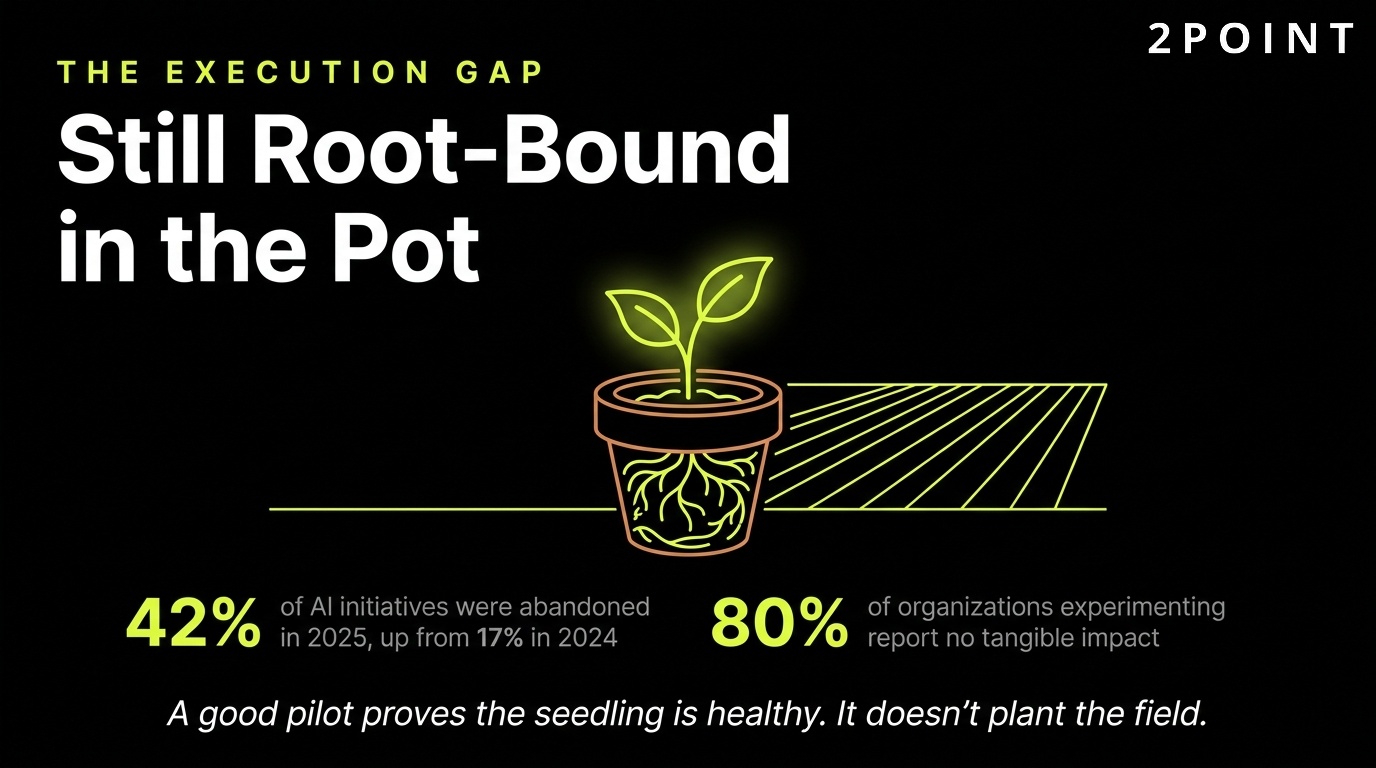
The execution gap is where most AI marketing investment evaporates. 88% of marketers use AI tools daily, but only 38% have fully integrated AI into standard marketing processes. 43% remain in experimentation mode, running pilots that demonstrate local value without generating organizational transformation. The consequence is stark: 42% of companies abandoned most of their AI initiatives in 2025, up from 17% in 2024, and 80% of organizations experimenting with AI report no tangible material impact on business results.
Understanding why pilots succeed while scaling fails is essential. Organizations typically run isolated experiments: one team tests AI content generation, achieves good results, celebrates the win. But the experiment remains isolated because scaling it would require changing other teams' workflows, updating approval processes, retraining staff, and redesigning the operating model around AI-augmented execution. These changes require organizational will and cross-functional coordination that a successful pilot does not automatically generate. AI becomes a sidecar to existing workflows rather than a transformation of them.
The solution requires treating AI integration as an organizational change initiative with executive sponsorship, cross-functional coordination, and dedicated resources. This means process redesign (mapping current workflows, identifying AI integration points, redesigning for AI-human collaboration), training programs that reach all team members rather than just early adopters, updated success metrics that measure business outcomes (revenue impact, efficiency gains, customer satisfaction) rather than activity metrics (tools deployed, content volume generated), and governance structures that ensure quality and compliance as AI usage scales. Organizations that have made this shift are producing compounding returns; those still in the pilot phase are accumulating costs without proportional gains.
Building an AI-Ready Marketing Organization
Becoming AI-ready is an organizational design challenge as much as a technology challenge. Four prerequisites consistently differentiate organizations that achieve sustained AI marketing value from those that do not.
Governance and policy clarity comes first. Who approves AI tool adoption? Who sets usage policies? Who monitors outputs for quality, accuracy, and compliance? Without clear answers, AI usage proliferates inconsistently, creating compliance exposure and quality variability. Governance frameworks do not need to be bureaucratic; they need to be clear and consistently applied.
Workflow redesign is the prerequisite that is most frequently skipped. Organizations that automate existing broken processes simply create faster failures. The correct sequence is: map existing workflows, identify inefficiency and friction points, optimize the process itself, then apply AI to the optimized version. AI amplifies whatever it is applied to, positive or negative.
Team structure adaptation reflects the operational reality of 2026. Pod-based execution models (combining strategy, creative, analytics, and technology capabilities in unified teams) are becoming the default structure for high-performing marketing organizations. These structures reduce handoff friction, enable faster acting on AI insights, and ensure that the people making strategic decisions have immediate access to the analytical capabilities AI provides.
Incentive alignment is the often-overlooked cultural component. If teams are rewarded for volume and speed but not for AI-enabled quality or innovation, they will use AI to produce more of what they were already producing rather than to create genuinely better outcomes. Incentive structures that reward experimentation, learning, and AI-driven improvement create the cultural conditions for genuine transformation rather than surface-level adoption. The organizations that get this right are building durable competitive advantages; those that do not will find that AI investment produces activity without impact.
AI Marketing Performance: Benchmarks, ROI, and Measuring Effectiveness
Investment without measurement is speculation. AI marketing generates real, quantifiable returns for organizations that implement it effectively, and understanding the performance benchmarks helps set realistic expectations, build internal business cases, and identify when implementation is underperforming relative to potential. Here is what the data shows about AI marketing ROI across functions.
Return on Investment Benchmarks Across AI Marketing Applications
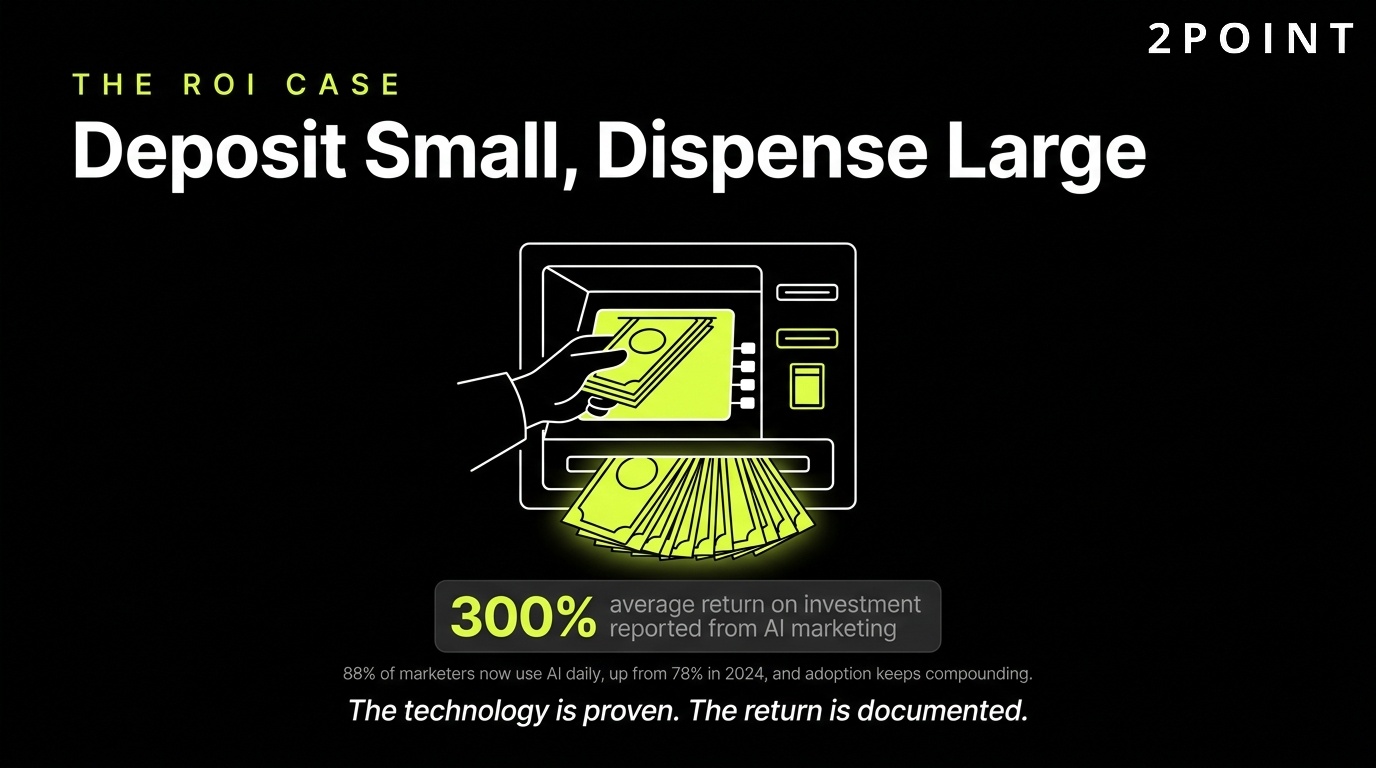
The headline ROI figure from AI marketing is striking: organizations using AI marketing report an average 300% return on investment. This figure encompasses the full range of applications, from content production efficiency gains to conversion rate improvements driven by personalization to reduced customer acquisition costs from predictive targeting. Unpacking it by application provides more actionable guidance.
| AI Marketing Application | Primary Performance Benefit | Reported Benchmark |
|---|---|---|
| Content Production | Cost and time reduction | 65% lower costs, 84% faster delivery |
| AI-Driven Personalization | Conversion rate improvement | 32% more conversions |
| Predictive Targeting | Customer acquisition cost | 29% reduction in CAC |
| Campaign Automation | Execution speed | 25% faster execution |
| AI-Powered Email Marketing | Open and click rates | Significant improvement over manual |
| Marketing Team Productivity | Hours saved per marketer | 5+ hours per week, 83% report gains |
The overall pattern across these benchmarks is consistent: AI marketing delivers measurable performance improvements across every major application area, with the strongest ROI typically coming from personalization and predictive targeting rather than pure efficiency gains.
Understanding how to measure effectiveness in online marketing campaigns is critical when implementing AI, because AI-powered campaigns require updated measurement frameworks that account for multi-touch attribution, real-time optimization cycles, and the compounding nature of personalization improvements over time.
How AI Impacts Customer Acquisition and Retention
AI's impact on customer acquisition operates through two primary mechanisms: improved targeting precision and accelerated conversion optimization. On the targeting side, predictive models identify high-probability prospects with significantly greater accuracy than demographic or behavioral segmentation alone. By analyzing patterns across thousands of conversion events, these models surface audience characteristics that human analysts might not identify, enabling more efficient ad spend allocation. The result is the 29% reduction in customer acquisition costs cited consistently across multiple research sources.
On the conversion side, real-time personalization dramatically improves the relevance of every touchpoint in the acquisition journey. When landing pages, email sequences, ad creative, and offer structures adapt dynamically to individual visitor characteristics and behavioral signals, conversion rates improve materially. The 32% conversion lift from AI-powered personalization campaigns represents genuine revenue impact, not just efficiency savings.
For customer retention, AI enables proactive intervention at scale. Churn prediction models identify at-risk customers before they lapse, enabling targeted retention campaigns with messaging and incentive structures calibrated to the specific reasons that customer profile typically churns. This shifts retention from reactive (discounting churned customers to win them back) to proactive (preventing churn before it occurs), which is substantially more cost-effective. Building brand loyalty through AI-powered proactive engagement is increasingly a differentiator for organizations that have invested in customer data infrastructure.
Measuring AI Marketing ROI: A Practical Framework
Measuring AI marketing ROI requires a framework that captures both efficiency gains (doing the same work faster and cheaper) and effectiveness gains (achieving better outcomes). Organizations that measure only one dimension systematically underestimate the total value of AI investment.
Start with baseline documentation before AI implementation: current content production time per piece, current cost per acquisition, current conversion rates by channel and segment, current team hours spent on specific task categories. This baseline is essential for measuring genuine impact rather than assuming it.
Track efficiency metrics over the first 90 days of implementation: time saved per marketer per week, reduction in content production cycle time, decrease in campaign build and launch time. These metrics are easy to measure and typically show results quickly, building organizational confidence and justifying continued investment.
Shift measurement focus to effectiveness metrics over the 90 to 180 day window: conversion rate changes attributable to AI-powered personalization, customer acquisition cost trends, email open and click rates, campaign performance against historical benchmarks. These metrics take longer to manifest because they require sufficient data volume to show statistical significance, but they represent the actual business impact of AI investment.
For advanced practitioners: track second-order effects over 6 to 12 months: customer lifetime value changes for segments receiving AI-powered personalization, retention rate improvements from proactive churn intervention, brand equity signals (organic search performance, direct traffic growth, review sentiment) that reflect the cumulative impact of better customer experiences. Using social proof signals as AI measurement inputs can also surface qualitative indicators of campaign effectiveness that quantitative metrics miss.
AI Marketing Ethics, Privacy, and Responsible Use
As AI marketing capabilities expand, so do the ethical responsibilities of organizations deploying them. The power to personalize at scale, predict behavior, and automate decisions creates obligations around privacy, fairness, and transparency that responsible organizations must address proactively rather than reactively.
Data Privacy and Compliance in AI Marketing
AI marketing's personalization capabilities depend on data, and the legal landscape governing that data has become increasingly complex. GDPR in Europe, CCPA and its successors in California, and a growing patchwork of state and national privacy regulations impose obligations on how customer data is collected, stored, processed, and used in automated decision-making. AI systems that make targeting, pricing, or content decisions based on personal data must operate within these frameworks or expose organizations to significant legal and reputational risk.
The practical compliance requirements for AI marketing teams include: transparent disclosure of how customer data is used in AI systems, consent mechanisms that meet the specificity requirements of applicable regulations, data minimization practices that limit AI training data to what is necessary for the stated purpose, and human oversight requirements for AI decisions that materially affect individuals (credit offers, employment-related communications, health-adjacent content). Organizations operating across multiple jurisdictions face the additional complexity of harmonizing these requirements, as what is permissible under one framework may be restricted under another.
Beyond compliance, customer trust is an independent driver of responsible data practices. 53% of consumers already distrust AI-powered search and recommendation systems. Organizations that handle customer data with visible care, communicate clearly about how AI is used in their marketing, and provide meaningful control mechanisms build trust that translates into commercial value. The organizations that treat privacy compliance as a floor rather than a ceiling, going beyond legal minimums to genuinely prioritize customer data rights, are building the trust infrastructure that will differentiate them as AI-generated content and recommendations proliferate. Maintaining transparency in marketing communications is not just an ethical obligation; it is a competitive differentiator in a landscape where consumer skepticism of AI-mediated experiences is growing.
Algorithmic Bias and Fairness in AI Marketing
AI systems learn patterns from historical data, and historical marketing data frequently reflects biases: demographic targeting that systematically underserves certain groups, historical underinvestment in specific markets, or correlation patterns that encode socioeconomic disparities. When AI systems are trained on this data and given autonomy over targeting, content personalization, and offer presentation, they can perpetuate and amplify existing biases at scale without any intentional human decision to do so.
The risks are both ethical and commercial. Algorithmically biased targeting that excludes qualified customers from relevant offers represents direct revenue loss. Bias that results in discriminatory outcomes in regulated categories (financial services, housing, employment) creates legal liability. Bias that becomes publicly visible creates brand reputation damage that affects the broader customer base beyond the directly affected segment.
Responsible AI marketing practice requires regular bias auditing: systematically reviewing targeting decisions, conversion outcomes, and content variations across demographic segments to identify patterns that suggest discriminatory outcomes, even when no discriminatory intent exists. The goal is not political compliance; it is ensuring that AI systems serve your actual addressable market rather than a subset of it shaped by historical data limitations. Organizations with diverse marketing teams conducting these audits are substantially more likely to identify and correct bias patterns than those relying on AI systems to self-police.
The Human Oversight Imperative
As AI systems become more autonomous, the importance of human oversight increases rather than decreases. Agentic AI that can execute multi-step campaigns without human intervention introduces new categories of risk: compounding errors that scale before detection, off-brand outputs that reach large audiences before review, and strategic misalignment when AI optimizes for specified metrics that are proxies rather than true representations of business objectives.
Effective human oversight of AI marketing systems requires clear governance structures (who is accountable for AI output quality?), defined review cadences (what outputs are reviewed before publishing versus after?), escalation protocols (what triggers human intervention in an autonomous AI workflow?), and quality metrics that detect degradation quickly. The organizations getting this right treat AI supervision as a distinct skill, investing in training that helps marketers understand how to evaluate AI outputs critically, identify when AI is optimizing for the wrong objective, and design safeguards that prevent automation from creating problems at the scale it creates solutions.
The Future of AI Marketing: What Comes Next
Understanding where AI marketing is heading helps organizations make investment decisions today that position them well for the landscape emerging over the next two to three years. Several trajectories are clear enough to plan around with confidence.
Multimodal AI and Cross-Channel Personalization
The next generation of AI marketing systems will operate fluidly across modalities: text, image, video, audio, and interactive formats, with consistent brand voice and personalization logic applied across all simultaneously. Current AI tools tend to specialize by medium; a content generation tool produces text, a separate image generation tool creates visuals, a video platform handles motion. The integration of these capabilities into unified systems that orchestrate cross-modal personalized experiences is the direction the technology is moving.
The marketing implication is significant. A customer identified as high-conversion probability by predictive models might receive a personalized video ad on social media, a dynamically generated email with imagery matched to their browsing history, and a website landing page with copy adjusted to their inferred decision-making style, all generated and orchestrated by a single AI system operating on a unified customer profile. This level of cross-channel personalization coherence is currently the aspiration of leading organizations; within two to three years, it will be technically achievable for organizations with the data infrastructure to support it. Exploring how video ads integrate into AI-powered personalization strategies will be an important area of focus as multimodal capabilities mature.
AI-Powered Influencer and Social Commerce
Influencer marketing is undergoing its own AI transformation. Identification tools now analyze creator audiences at granular levels of behavioral and psychographic alignment, moving beyond follower count and engagement rate to predict actual commercial impact. Content performance modeling allows brands to forecast which creators will drive conversion for specific product categories before committing campaign budgets. And increasingly, AI is being used to generate influencer-style content directly, raising new questions about authenticity and disclosure that the industry and regulators are actively working to resolve.
Social commerce integration with AI creates additional opportunities. Platforms increasingly enable direct purchase within social feeds, and AI can optimize the full journey from awareness content to purchase completion within a single platform session. The social media marketing landscape in 2026 is deeply integrated with AI capabilities at every stage: content creation, audience targeting, performance optimization, and increasingly direct commerce facilitation. Understanding the challenges of influencer marketing in an AI-saturated environment, including questions of authenticity, disclosure, and AI-generated content, is increasingly relevant for brands navigating this space.
Predictive Content Strategy and AI Storytelling
The next frontier in AI-assisted content marketing is predictive content strategy: using AI to identify content opportunities before they peak, positioning brands as authoritative sources on topics that are trending upward in audience attention and search behavior before competitors recognize the opportunity. This requires AI systems that monitor signals across search trends, social conversations, news cycles, and platform algorithm changes to surface strategic content opportunities in real time.
Simultaneously, AI is advancing in its ability to support narrative development. While human marketers maintain creative and strategic direction over storytelling approaches, AI can now draft narrative frameworks, identify emotional resonance patterns in successful campaigns, test story variations against audience segments, and refine messaging based on engagement signals. The combination of predictive opportunity identification and AI-assisted narrative development creates a powerful strategic content capability for teams that have invested in building the human AI collaboration model effectively.
AI Marketing Strategy: A Practical Roadmap for Implementation
Theory without execution is irrelevant. Here is a practical, phased roadmap for organizations moving from AI experimentation to AI-powered marketing execution, structured to build capability progressively while generating quick wins that maintain organizational momentum.
Phase One: Foundation Building (Months 1 to 3)
The foundation phase establishes the prerequisites for AI marketing success before adding tools. Start with an honest audit of your current state: What data do you have? How clean and accessible is it? Where is it siloed? What are the highest-friction points in your current marketing workflows? What skills does your team currently have relative to what AI-powered execution requires? This audit surfaces both the opportunities and the gaps that will determine which AI investments generate returns versus which create overhead without value.
Parallel to the audit, establish governance: document who owns AI adoption decisions, set usage policies covering acceptable applications and quality review requirements, and define accountability for AI output quality. Governance established early prevents the compliance and quality issues that disrupt scaling later. Finally, invest in foundational training: ensure all team members have baseline AI fluency (what AI can and cannot do, how to evaluate outputs critically, how to write effective prompts) before deploying tools widely. The 17% comprehensive training figure cited earlier reflects an industry failure; correct it internally before adding tools.
Phase Two: Focused Tool Adoption (Months 3 to 6)
With foundation in place, introduce AI tools systematically against the highest-impact friction points identified in your audit. Start with one or two applications, not five. The common failure mode is deploying multiple tools simultaneously, overwhelming teams and preventing any single application from being implemented deeply enough to generate meaningful data. A focused approach to content generation or analytics implementation, done thoroughly, will generate more learning and more ROI than a scattered multi-tool deployment.
Run structured pilots with clear success criteria defined in advance: time saved per week, output quality rating (human evaluation on a consistent rubric), team satisfaction score, and business metric change (traffic, conversions, cost). After 60 to 90 days, evaluate against these criteria honestly. If a tool is not meeting expectations, diagnose whether the failure is in the tool, the implementation, the training, or the use case match before deciding to continue or switch. Keep the learning; change the approach if needed.
Phase Three: Workflow Integration and Scaling (Months 6 to 12)
Successful pilots earn the right to scaling. This phase involves redesigning workflows to embed AI as standard operating practice rather than an optional add-on. Redesign processes around AI capabilities: if content production previously involved a writer, editor, and designer working sequentially over two weeks, and AI can reduce that to a three-day collaborative process, rebuild the process map, the approval chain, and the resource allocation to reflect the new reality.
Scaling also requires expanding training as you expand tool usage, ensuring that team members joining AI-augmented workflows have the skills to use them effectively from day one. Consider appointing internal AI champions: team members with strong AI fluency who can support peers, identify new use cases, and maintain organizational momentum between formal training cycles. Measure relentlessly throughout this phase: update your baseline metrics and track business impact against the investments made. Organizations that maintain rigorous measurement discipline during scaling build the evidence base that justifies continued investment and surfaces optimization opportunities as capabilities grow.
Conclusion: The AI Marketing Imperative for Organizations Ready to Execute
AI marketing has crossed the threshold from competitive advantage to competitive necessity. The market data is unambiguous: $107.5 billion in current market size growing toward $298 billion, 88% daily adoption rates, 300% average ROI, and measurable performance improvements across every marketing function where AI has been thoughtfully implemented. The technology is proven. The ROI is documented. The early adopter window for easy competitive differentiation has largely closed.
What remains open is the execution gap. The 38% of organizations that have fully integrated AI into their marketing operations are outperforming the 43% still experimenting, not because they have better tools but because they have built the organizational capabilities, data infrastructure, training programs, and governance frameworks to use AI strategically rather than tactically. This is the competitive divide that matters in 2026: not who has AI, but who has built the organization to execute with it.
The practical path forward requires honest assessment of current capabilities, strategic investment in foundation before tool proliferation, commitment to training all team members rather than just early adopters, and governance structures that ensure AI deployment serves business objectives with appropriate quality control. Organizations that make these investments now are not just optimizing their current marketing; they are building the institutional capabilities that will compound in value as AI capabilities continue to advance.
The shift from search to answer engines, the emergence of agentic AI, the rise of machine customers, and the growing consumer expectation for personalized experiences at every touchpoint are all trends that reward organizations with strong AI marketing foundations. The question is not whether to invest in AI marketing. The question is whether your organization is building the depth of integration required to make that investment generate the returns the data shows are achievable.
At 2POINT, this intersection of strategic clarity, practical execution, and measurable results is where we focus our work with clients. The organizations achieving exceptional AI marketing outcomes are not the ones with the largest tool budgets; they are the ones with the clearest strategy, the most capable teams, and the discipline to execute consistently against well-defined goals.
Frequently Asked Questions About AI Marketing
What is AI marketing, exactly?
AI marketing is the application of machine learning, natural language processing, predictive analytics, and generative AI to automate marketing tasks, personalize customer experiences, and optimize campaign performance in real time. It encompasses everything from AI-generated ad copy and predictive audience targeting to autonomous campaign management and AI-powered analytics platforms.
How much does AI marketing cost for a small or mid-sized business?
AI marketing costs vary widely based on tool selection and implementation scope. Mid-market organizations spent a median of $3,400 per month on AI marketing tools in Q1 2026, up from $1,200 in Q1 2025. Many foundational tools have accessible entry-level pricing, and the ROI data (300% average return) suggests that most organizations recover their investment within months of effective implementation.
Is AI marketing replacing human marketers?
AI marketing is not replacing human marketers; it is changing what human marketers do. AI handles repetitive, data-intensive, and high-volume tasks (content drafts, performance analysis, bid optimization), freeing human marketers to focus on strategy, creative direction, brand positioning, and judgment-intensive decisions that AI cannot reliably make. The organizations achieving the best results are those using AI to amplify human capability, not substitute for it.
What is the difference between predictive AI and generative AI in marketing?
Predictive AI analyzes historical and real-time data to forecast future outcomes: which prospects will convert, which customers will churn, how a campaign will perform before it launches. Generative AI creates new content from learned patterns: ad copy, email subject lines, product descriptions, and visual concepts. Most advanced marketing workflows combine both, using predictive models to identify targeting opportunities and generative tools to produce personalized content for those segments.
What are the biggest challenges organizations face when implementing AI marketing?
The three most common barriers are skills gaps (58% of marketers cite this as their top challenge, and only 17% have received comprehensive AI training), integration complexity (74% of companies struggle to scale AI value due to fragmented data systems), and the execution gap (88% use AI daily but only 38% have fully integrated it into standard workflows). Addressing all three requires organizational investment, not just technology procurement.
How does AI marketing handle customer data privacy?
Responsible AI marketing requires compliance with applicable data privacy regulations (GDPR, CCPA, and others), transparent disclosure of how customer data is used in AI systems, meaningful consent mechanisms, and data minimization practices. Beyond compliance, organizations should implement human oversight of AI decisions that materially affect individuals and communicate clearly with customers about how AI is used in their marketing experiences.
What is Answer Engine Optimization, and how is it different from SEO?
Answer Engine Optimization (AEO) is the practice of optimizing content to be cited, referenced, or recommended within AI-generated responses from systems like ChatGPT, Perplexity, and Google AI Overviews, rather than ranking in traditional search results pages. Traditional SEO targets keyword rankings in result lists; AEO targets inclusion in AI-generated answers that users receive without visiting source websites. AI Overviews alone reduce organic traffic by 18% to 47%, making AEO an increasingly essential complement to traditional SEO.
AI marketing vs. marketing automation: what is the difference?
Traditional marketing automation executes predefined, rule-based workflows (send email after X days, trigger sequence if user visits page Y). AI marketing uses machine learning to make dynamic decisions, adapt in real time, generate content, predict behavior, and continuously optimize without manual rule updates. Modern marketing automation platforms increasingly incorporate AI capabilities, blurring the boundary, but the core distinction is between rule-following (automation) and learning and adapting (AI).
What is agentic AI in the context of marketing?
Agentic AI refers to AI systems that autonomously execute multi-step marketing tasks toward defined objectives without step-by-step human direction. Unlike tools that respond to individual prompts, agentic AI manages entire campaign sequences: audience discovery, creative testing, channel deployment, performance measurement, and budget reallocation, all operating autonomously within parameters set by human marketers. This shifts the marketing team's role from execution to supervision and strategy.
How do I measure the ROI of AI marketing investment?
Measuring AI marketing ROI requires baseline documentation before implementation (current production time, cost per acquisition, conversion rates, team hours by task) and then tracking both efficiency metrics (time saved, cost reductions) and effectiveness metrics (conversion rate changes, customer acquisition cost trends, retention improvements) over 90 to 180 days. True ROI measurement also captures second-order effects like customer lifetime value improvements and brand equity signals that reflect the cumulative impact of better customer experiences.
Are there risks to using AI-generated content in marketing?
Yes. AI-generated content carries risks including factual inaccuracies (hallucinations), off-brand tone or messaging, potential bias inherited from training data, and consumer trust concerns as AI content proliferates. Mitigating these risks requires human review workflows, brand voice training or customization of AI tools, regular quality auditing, and transparent labeling of AI-generated content where appropriate. 53% of consumers already distrust AI-powered recommendations, making quality control and transparency critical for maintaining brand credibility.
What is the best first step for a business just starting with AI marketing?
The best first step is an honest audit of your current state: what data you have and how accessible it is, where your highest-friction workflow bottlenecks are, and what AI skills your team currently possesses. This audit identifies the specific use cases where AI investment will generate the fastest and clearest returns, preventing the common mistake of purchasing tools before understanding the problems they need to solve. Start with one focused application, implement it thoroughly, measure the results, and expand from demonstrated success rather than theoretical potential.
