

 let’s connect


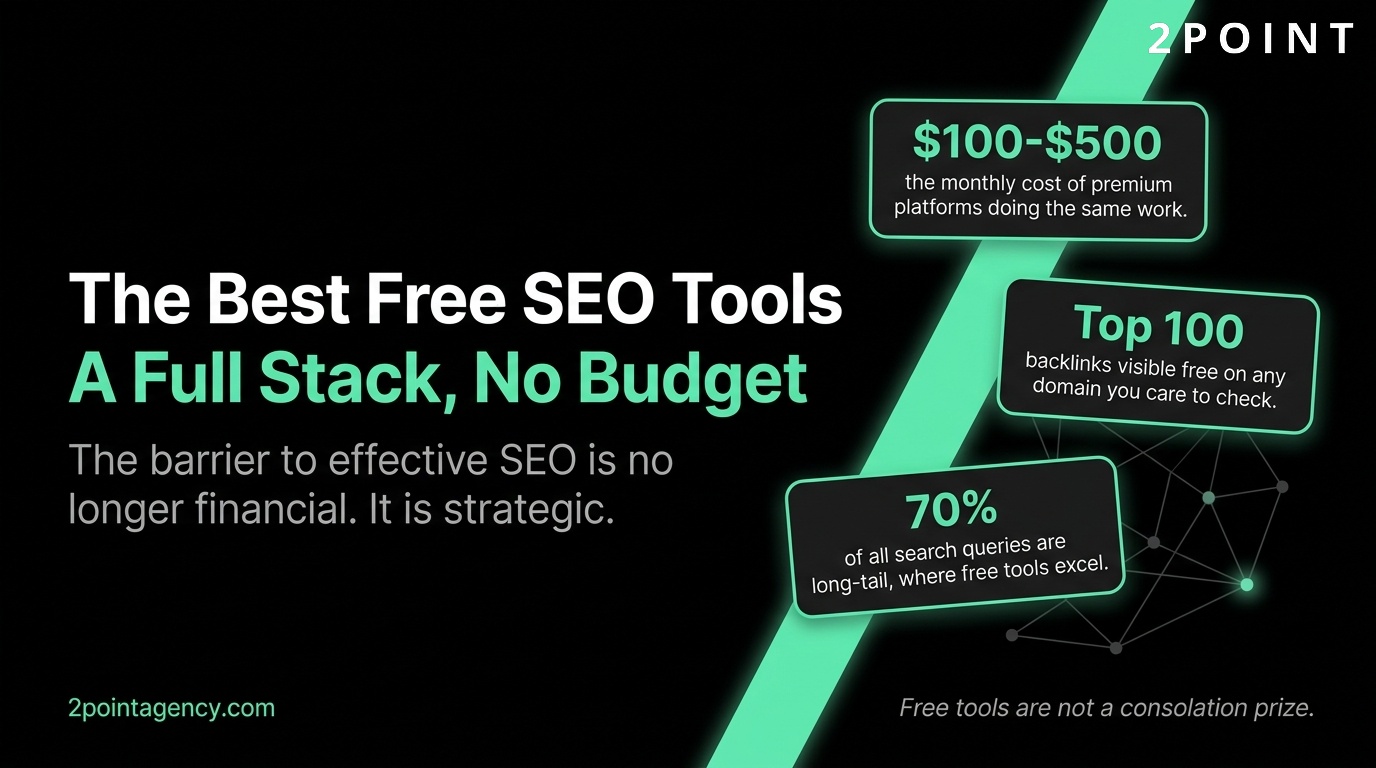
What Are the Best Free SEO Tools Available Right Now?
- Google Search Console monitors your site's performance, indexing status, and Core Web Vitals directly from Google.
- Ahrefs Free Backlink Checker reveals your top 100 backlinks, referring domains, and Domain Rating at no cost.
- Google Keyword Planner delivers search volume data and competition metrics straight from Google's own ad network.
- Semrush's free keyword tool provides keyword difficulty scores, CPC data, and intent classification for limited daily searches.
- WordStream's Free Keyword Tool adds industry-specific filtering and location targeting for local businesses.
- Neil Patel's Backlink Checker offers Domain Authority snapshots and competitor link profile analysis.
- Google Autocomplete generates hundreds of long-tail keyword ideas using real user search behavior.
- SE Ranking's Backlink Checker tracks new and lost links with freshness updates on 58% of its database every 90 days.
- Google Trends validates keyword momentum, reveals seasonality, and identifies rising search topics.
- Together, these tools cover keyword research, backlink analysis, technical audits, and AI search visibility tracking.
Why Free SEO Tools Matter More Than Ever in 2026
The conversation around search engine optimization has shifted dramatically over the past few years. What once required a significant monthly software budget can now be accomplished with a carefully assembled stack of free tools. Whether you are a solopreneur building your first website, a small business owner trying to compete locally, or a marketing professional validating strategy before committing budget, the ecosystem of no-cost SEO tools in 2026 is more capable than anything that existed in paid platforms just five years ago. Understanding why this matters and how to take advantage of it is the first step toward building a sustainable, data-driven SEO practice.
The Cost Barrier to SEO Has Collapsed
Premium SEO platforms have historically been priced between $100 and $500 per month, and enterprise tiers often push well beyond that ceiling. For large agencies managing dozens of client accounts, those costs are easy to justify. For everyone else, they represent a genuine barrier to entry. A solo marketer, a local restaurant owner, or a freelancer building their first content site cannot reasonably absorb hundreds of dollars in monthly software costs before seeing a single return on investment.
The good news is that the market has responded. As Marketer Milk notes, "For a small business, a solo marketer, or anyone learning the ropes, paying hundreds of dollars a month for features you touch occasionally is hard to justify." Free tools now provide access to capabilities that were strictly premium three to five years ago, including keyword difficulty scoring, backlink database queries, technical site auditing, and competitive analysis. The quality gap between free and paid has narrowed to the point where most businesses operating one to three websites can execute a professional-grade SEO strategy without opening their wallets.
This collapse of the cost barrier is not just good news for small operators. It also means that agencies and in-house teams can reduce tool redundancy by using free tools for specific research tasks while reserving paid platforms for monitoring and reporting at scale. Learning how to use SEO tools effectively starts with understanding what each tool does best, regardless of its price tag.
AI Search Changes the Game for Free Tool Users

The 2026 search landscape looks fundamentally different from what existed even two years ago. Google AI Overviews now appear at the top of millions of search results, synthesizing answers from multiple sources and frequently bypassing traditional organic rankings. ChatGPT, Perplexity, and other AI platforms are fielding billions of queries that never touch Google at all. For website owners, this creates an urgent question: am I visible in AI-generated answers, and how do I know?
According to DashThis, free tools have adapted to this shift in meaningful ways. Google Search Console now includes reporting on AI Overview performance, giving site owners visibility into when their content is cited within AI-generated answer blocks. This is not a minor feature update. It represents a fundamental expansion of what free tools can tell you about your search presence. A small business that understands which of its pages are being cited in AI Overviews can double down on that content structure, earning outsized visibility without competing directly on traditional organic ranking factors alone. The playing field has leveled considerably for those who know how to read the data.
The Strategic Advantage of Tool Combination
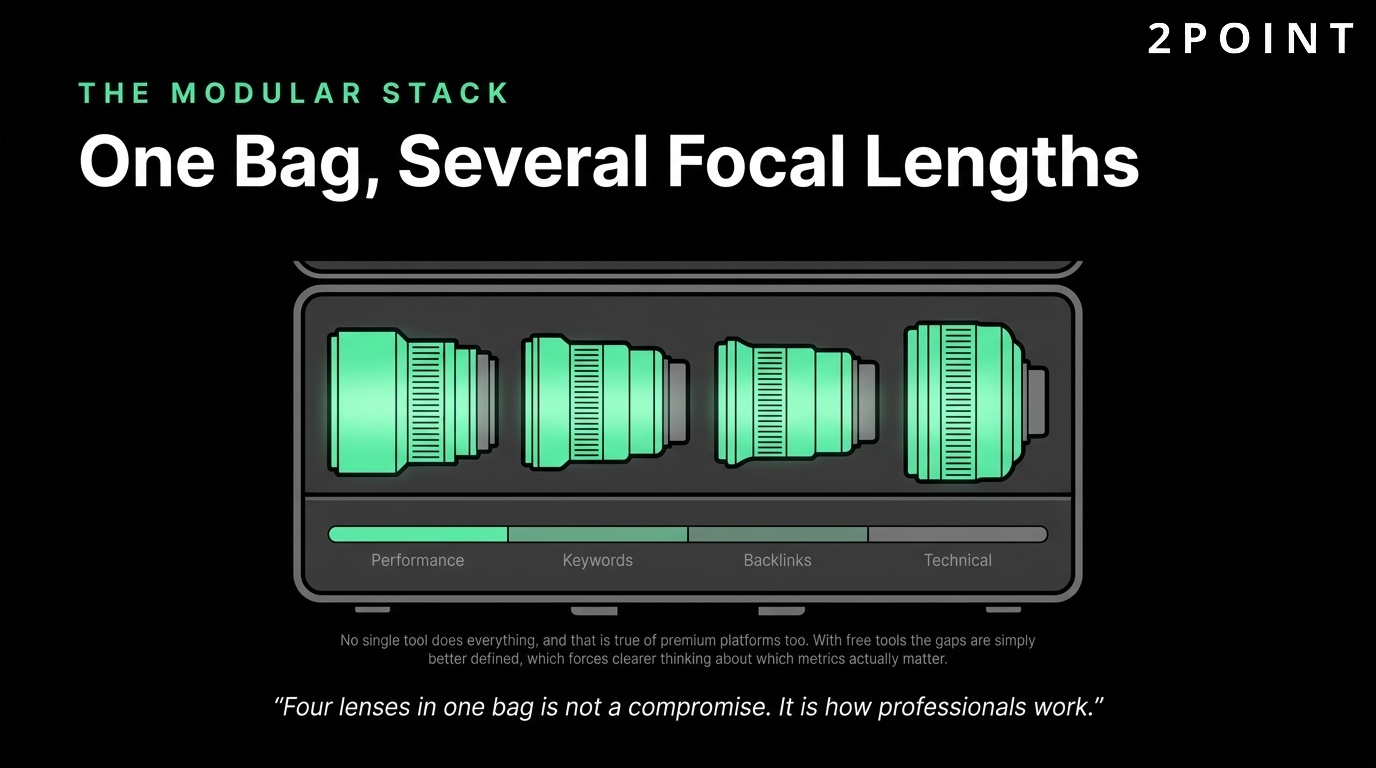
One of the most important mental shifts for anyone building a free SEO tool stack is accepting that no single tool does everything. This is not a limitation unique to free tools. Even Semrush, Ahrefs, and Moz at their most expensive tiers each have meaningful blind spots. The difference with free tools is that the gaps are more clearly defined, which actually forces better strategic thinking about which metrics matter most for your specific goals.
As CMSWire reports, "No single free tool does everything, so most marketers combine a handful: one for crawling, one for keyword research, one for speed, one for backlinks." The modular approach works beautifully when you think of your tool stack in layers. Start with the foundation layer, which is Google's own suite of tools providing performance data, indexing insights, and search volume information. Build outward with a keyword research layer that adds difficulty scoring, intent classification, and long-tail expansion. Then add a backlink layer for competitive link analysis and link building prospecting. Finally, incorporate a technical layer for site health monitoring. This structured approach transforms what could feel like a patchwork of disconnected tools into a coherent, professional SEO workflow.
When Free Tools Beat Paid Platforms
There are specific scenarios where reaching for a free tool is not just an acceptable compromise but actually the smarter decision. When you are learning SEO fundamentals, free tools expose you to core concepts without the noise of advanced features you are not yet ready to use. When you are validating whether a new website niche has viable SEO potential before investing in development and content creation, a 15-minute session with Google Keyword Planner and Ahrefs' free backlink checker gives you enough data to make a confident go or no-go decision.
Managing one to three websites is another scenario where free tools consistently outperform paid alternatives on value per dollar. The monitoring overhead, reporting capabilities, and keyword tracking features that justify premium pricing become meaningful only at scale. Many professional agencies, even those with active paid subscriptions to multiple platforms, still reach for free tools for specific research tasks because those tools provide the cleanest, most direct data for that particular job. Zapier's analysis of keyword research tools confirms that experienced SEO professionals frequently prefer the clarity of purpose-built free tools over the complexity of feature-heavy paid dashboards for targeted research sessions. This is an important point: free tools are not a consolation prize. In the right context, they are the right tool for the job.
Google's Free SEO Foundation Tools
Before exploring specialized third-party tools, every serious SEO practitioner must have a complete command of Google's own free offerings. These tools provide direct access to data that no third-party platform can fully replicate, because they come from the source itself. Google Search Console, Google Keyword Planner, Google Autocomplete, and Google Trends collectively form the foundation layer of any effective free SEO strategy. Building on top of these tools is where specialized platforms add value. But treating them as optional or secondary is one of the most common and costly mistakes in SEO practice.
Google Search Console: Your Essential Starting Point
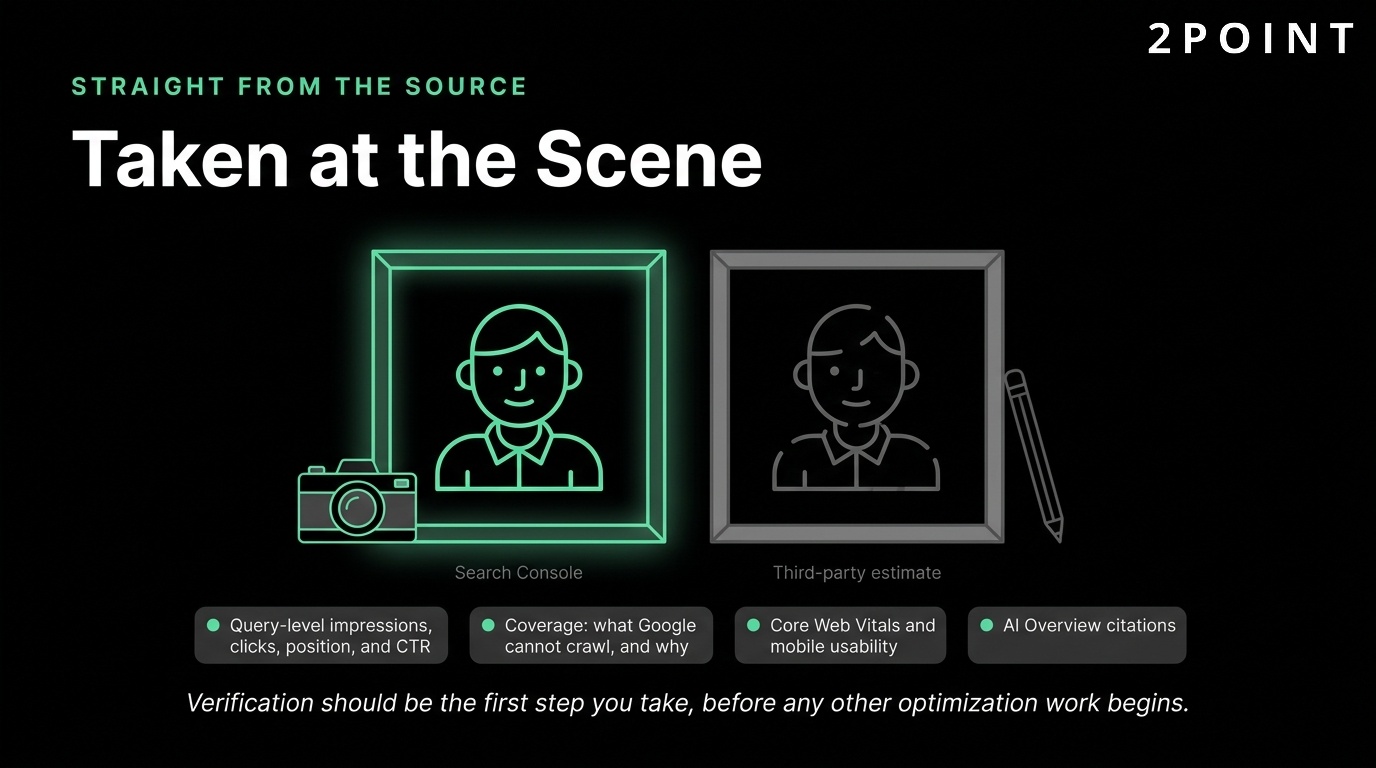
Google Search Console (GSC) is, without question, the single most important free tool available to any website owner. It functions as the direct communication channel between your website and Google's indexing and ranking systems. No third-party platform, regardless of price, can replicate what GSC provides because it is Google's own reporting interface for what is happening to your site within its search ecosystem.
The Performance Report is where most practitioners spend the majority of their time. It reveals the exact queries driving impressions and clicks to your site, the pages those queries land on, your average position for each query, and your click-through rate. This query-level data is extraordinarily valuable because it shows you what Google already thinks your site is about and where you have existing ranking momentum worth building upon. As DashThis observes, "Google Search Console (GSC) is so big and vital that almost all website owners ranking on Google use it to know more about their site's performance."
Beyond performance data, GSC covers indexing status through the Coverage Report, which identifies pages Google cannot crawl or index and explains why. The Mobile Usability section flags pages that fail mobile experience standards. Core Web Vitals reporting tells you whether your pages meet Google's performance thresholds for loading speed, interactivity, and visual stability. Security Issues alerts notify you immediately if your site is compromised. And as of 2026, the AI Overviews reporting section adds an entirely new dimension: you can now see which of your pages are being cited within Google's AI-generated answer blocks, giving you direct insight into your AI search visibility. This makes GSC an even more essential tool than it has ever been. If you are building an SEO-friendly website, GSC verification should be the very first step you take before any other optimization work begins.
Google Keyword Planner: The PPC Tool That Powers SEO
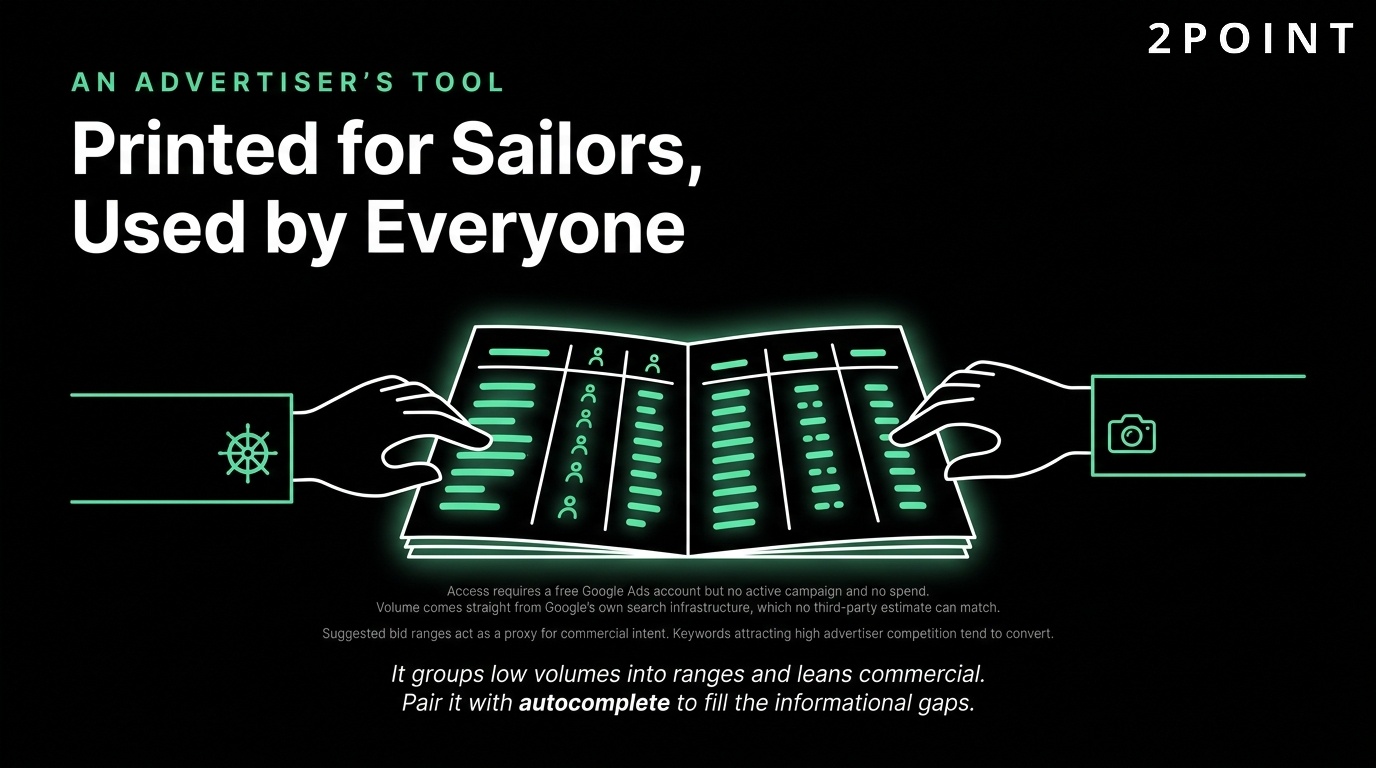
Google Keyword Planner was built for paid search advertisers, but it has become an indispensable resource for organic SEO practitioners because of one irreplaceable advantage: it draws its data directly from Google's own search infrastructure. No other tool can match the accuracy of volume estimates that come from Google itself. When Keyword Planner tells you a keyword receives a certain level of monthly searches, that number is as close to ground truth as any publicly available tool can provide.
Access requires a Google Ads account, but you do not need to run any active campaigns or spend any money. Create a free account, navigate to the Keyword Planner within the Tools menu, and select "Discover new keywords." From there you can enter seed keywords, your website URL, or both, and the tool will generate hundreds of related keyword ideas with search volume ranges, competition levels, and suggested bid ranges. The bid ranges are particularly useful for organic SEO because they function as a proxy for commercial intent. Keywords with high bid prices attract advertiser competition for a reason: they convert. As Zapier notes, this combination of data makes Keyword Planner one of the most reliable starting points for any keyword research workflow.
The primary limitation is that Keyword Planner groups smaller volume keywords into ranges rather than precise numbers, and its recommendations skew toward commercial and transactional intent because it is designed for advertisers. Supplement it with autocomplete data and Semrush's free keyword tool to fill in the informational keyword gaps and get more granular on specific volume figures. Understanding how to interpret SEO metrics like competition scores and search volume ranges is essential for getting maximum value from this tool.
Google Autocomplete: The Hidden Long-Tail Generator
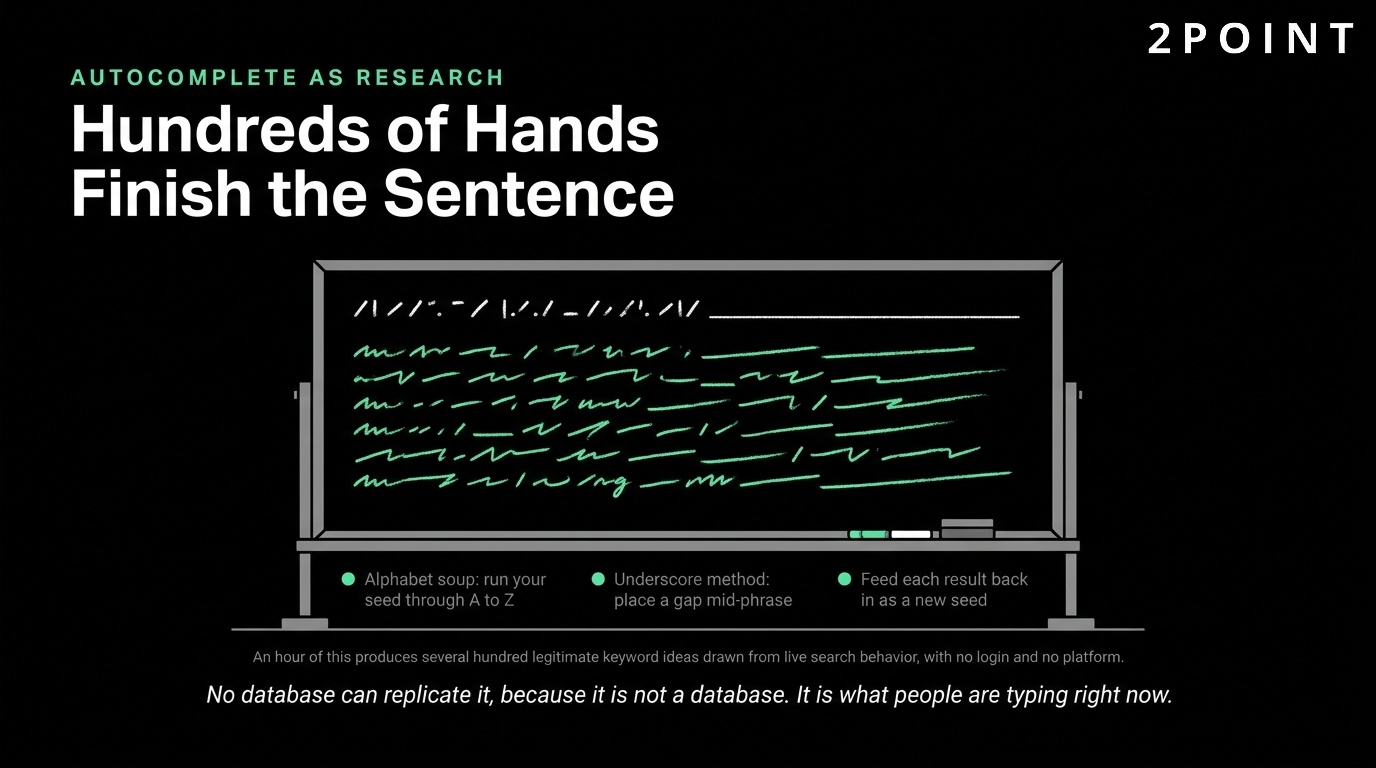
Google Autocomplete is simultaneously the most widely used and the most underutilized free SEO tool in existence. Every person who uses Google interacts with it multiple times per day, yet very few SEO practitioners systematically mine it for keyword intelligence. The reason it is so valuable is that it reflects actual user behavior in real time. Google's autocomplete suggestions are generated based on what real users are searching for right now, weighted by recency, location, and search frequency. No algorithm or keyword database can replicate this because it draws from live search behavior rather than historical data samples.
The two most powerful extraction techniques are the underscore method and alphabet soup. The underscore method involves typing a keyword with an underscore placeholder where you want Google to suggest completions, for example "free SEO _ for small business." Alphabet soup involves typing your seed keyword followed by each letter of the alphabet in sequence to reveal the full range of autocomplete suggestions. As LowFruits explains, "It's also one of the best long-tail keyword research tools out there because Autocomplete naturally creates longer, more specific phrases." These longer phrases represent genuine user questions and needs, and they typically carry less competitive pressure than head terms, making them ideal targets for content that can rank relatively quickly.
A systematic workflow for autocomplete extraction looks like this: start with your core topic keyword, run through the alphabet soup to collect A through Z suggestions, then take each promising suggestion and treat it as a new seed keyword for a second round of extraction. Within an hour, you can generate several hundred legitimate keyword ideas that reflect real user intent, all without spending a cent or logging into any platform. This data pairs powerfully with volume estimates from Keyword Planner to create a prioritized content calendar grounded in both relevance and search demand.
Google Trends: Understanding Search Momentum
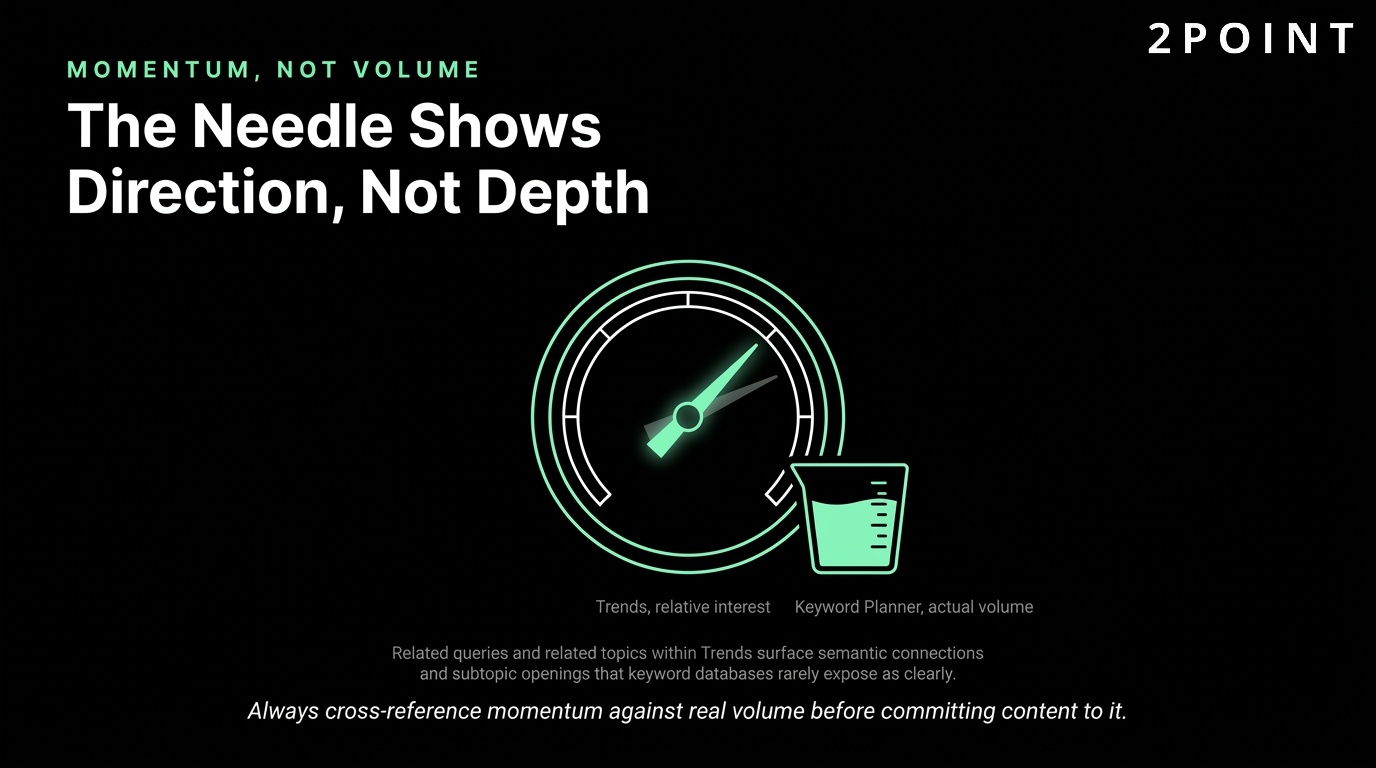
Search volume is a static number. Google Trends transforms that static number into a dynamic story about where a keyword is headed. Trends reveals whether a keyword's search interest is growing, declining, stable, or seasonal, and it breaks that data down by region, time period, and related topics. For content planning, this information is enormously valuable because it helps you invest your writing time in keywords with upward momentum rather than topics that are losing relevance.
The related queries section within Trends is particularly useful for keyword expansion. It shows you what people are searching for alongside your target keyword, which often reveals semantic connections and subtopic opportunities that no keyword database surfaces as clearly. The related topics feature takes this further by showing you broader thematic associations that can inform your site's overall content architecture. DashThis highlights Trends as a core component of any free SEO foundation because it adds the dimension of time that other tools completely omit. One important limitation to keep in mind: Trends reports relative search interest on a scale of zero to 100, not absolute volume. Always cross-reference Trends momentum data with actual volume figures from Keyword Planner or another source before making content investment decisions based on interest scores alone.
Best Free Keyword Research Tools Beyond Google
Google's native tools provide an excellent foundation, but they do not cover every dimension of effective keyword research. Specifically, they lack robust keyword difficulty scoring, intent classification at scale, competitor keyword gap analysis, and the kind of topical depth mapping that modern SEO requires. The tools in this section fill those gaps, and they do so without charging a monthly subscription fee. Together with the Google suite, they form a complete free keyword research toolkit capable of supporting content strategies for websites of virtually any size and complexity.
Semrush Free Keyword Tool: Premium Data Without the Price
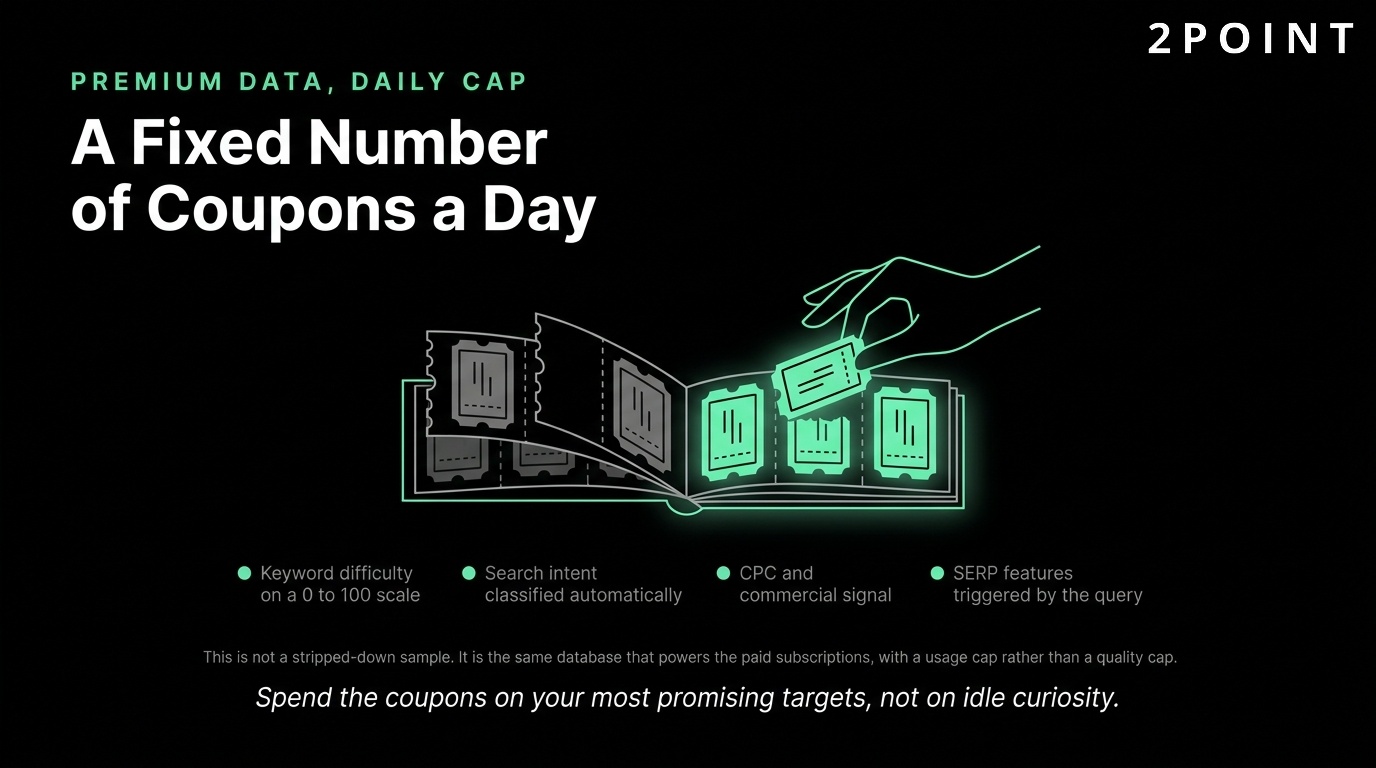
Semrush is one of the most respected names in professional SEO software, and its free tier keyword tool gives non-paying users access to the same underlying database that powers its premium subscriptions. The free version limits the number of searches you can run per day, but within those limits, the quality of data you receive is genuine enterprise-grade intelligence. This is not a stripped-down sample. It is the real thing with a daily usage cap.
Within each keyword report, Semrush provides keyword difficulty score on a zero to 100 scale, monthly search volume, cost-per-click data, intent classification (informational, navigational, commercial, or transactional), and SERP feature indicators showing whether the keyword triggers featured snippets, video carousels, or local packs. As TechRadar notes, "The free Keyword Tool gives you a limited number of broad match keyword suggestions with core metrics like search volume, keyword difficulty, CPC, and intent." The intent classification alone makes it worth incorporating into your research workflow, because understanding whether a keyword reflects a user who wants information versus one who is ready to buy fundamentally changes the type of content you need to create to rank for it and the conversion path you need to build around it. Use your daily free searches strategically during the research phase to evaluate your most promising keyword targets before committing to a content creation schedule.
WordStream Free Keyword Tool: Industry-Specific Intelligence
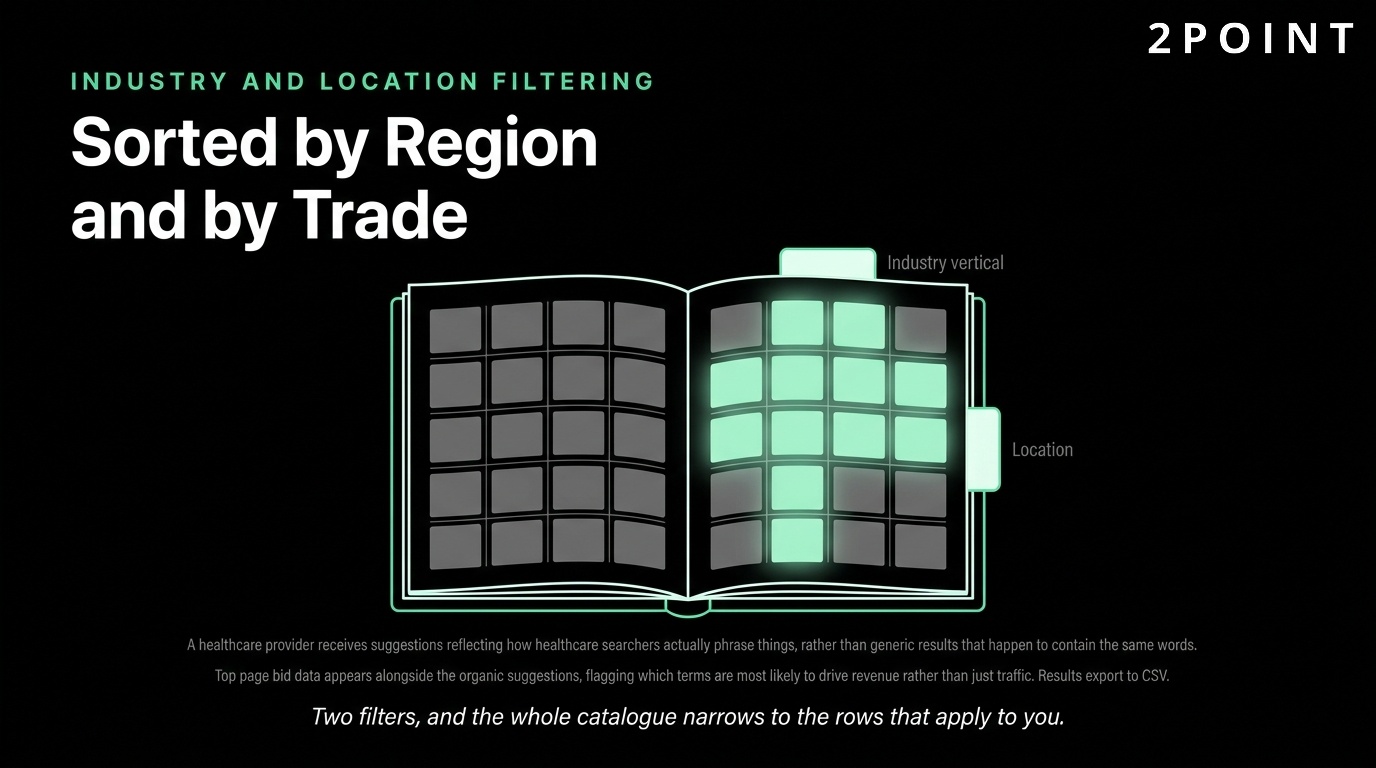
WordStream occupies a distinctive niche among free keyword research tools because of one feature that no other no-cost platform matches: industry filtering. When you run a keyword search through WordStream, you can filter results by industry vertical, which dramatically improves the relevance of the suggestions you receive. A healthcare provider searching for patient-related keywords will get suggestions that reflect the language and intent patterns of healthcare searchers specifically, rather than generic broad-market results that happen to contain the same words.
Location targeting adds another layer of precision that makes WordStream especially valuable for local businesses. You can narrow keyword suggestions to a specific country, region, or city, and the tool adjusts its results and estimated metrics accordingly. This is critically important for businesses whose customer base is geographically bounded. As WordStream states, "Our Free Keyword Tool uses the latest Google search data to deliver accurate, targeted ideas to inform your organic content creation and paid advertising campaigns." The top page bid data that appears alongside organic suggestions functions as a commercial intent signal, helping you identify which keywords in your list are most likely to drive revenue rather than just traffic. WordStream's export functionality lets you download your keyword lists in CSV format for integration into your content planning spreadsheets, making it easy to build on this data without manually transcribing results.
Keyword Tool (KeywordTool.io): The Long-Tail Specialist
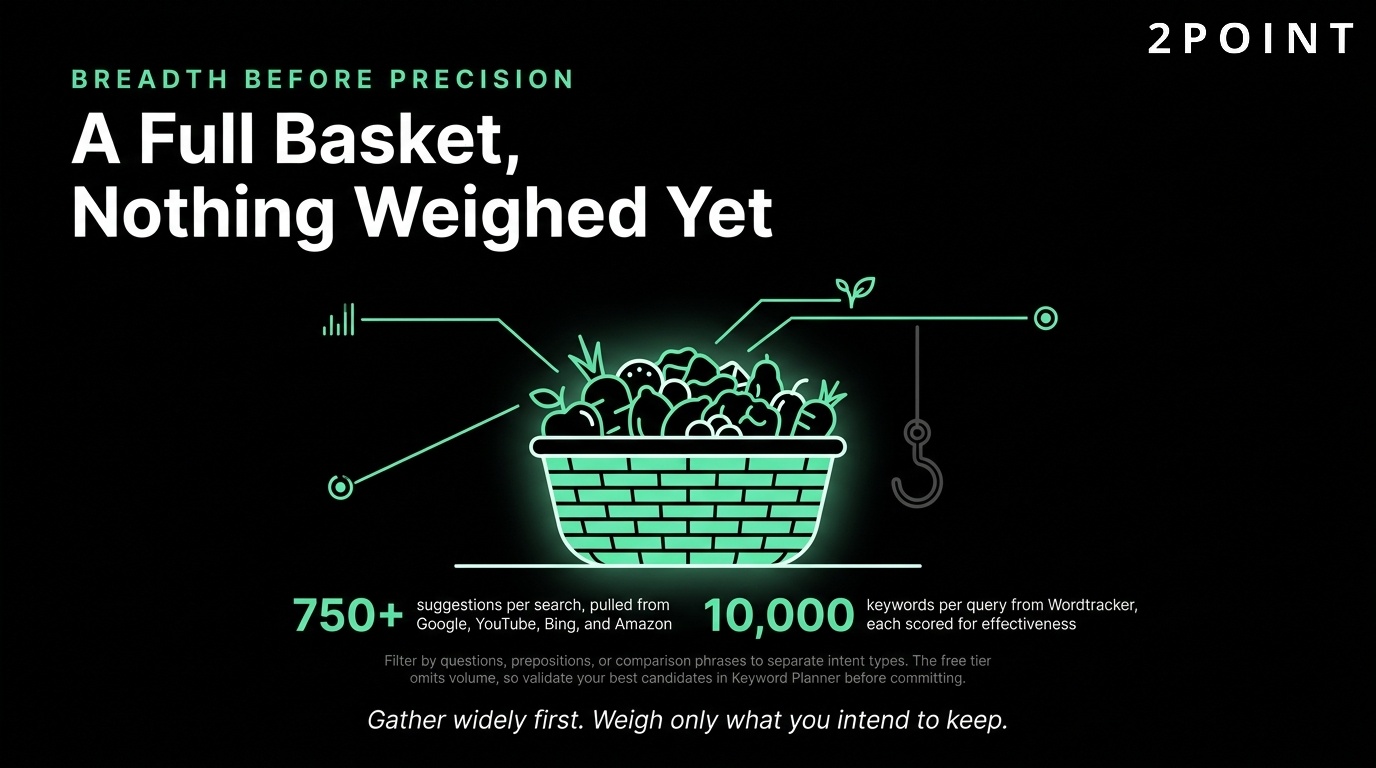
KeywordTool.io occupies a specific and valuable niche in the free SEO tool landscape: it is the most efficient tool available for generating large volumes of long-tail keyword suggestions quickly. While most keyword tools generate dozens of suggestions per search, KeywordTool.io generates upwards of 750 suggestions by systematically pulling autocomplete data from Google, YouTube, Bing, Amazon, and other platforms simultaneously. This makes it uniquely useful for content ideation sessions where the goal is breadth rather than precision.
The filtering system within KeywordTool.io adds structure to what could otherwise be an overwhelming list of suggestions. You can filter results to show only questions (how, what, why, when, where, who), only preposition-based phrases (for, with, without, near, before, after), or only comparison phrases (versus, vs., or, alternative to). Each filter category surfaces a different type of search intent, helping you plan content that addresses users at different stages of their decision journey. The platform claims 99.99% uptime reliability and requires no account creation for basic searches, reducing friction for quick research sessions. The significant limitation of the free tier is the absence of search volume data. You see the keywords themselves but not how frequently they are searched. Use KeywordTool.io for ideation and discovery, then validate your top candidates in Google Keyword Planner to confirm which ones have meaningful search demand before investing in content creation.
Wordtracker: 10,000 Keywords Per Search
Wordtracker stands apart from the Google-dependent keyword tools by drawing from its own proprietary database, which aggregates search data from sources beyond Google's ecosystem. This means it sometimes surfaces keyword opportunities that tools relying exclusively on Google's autocomplete or Keyword Planner data miss. The database is particularly strong for identifying semantic keyword clusters and topically related terms that can enrich a piece of content without requiring you to create separate pages for each individual variation.
The platform's free tier allows searches returning up to 10,000 keyword suggestions per query, which is substantially more expansive than most free tools. Each suggestion comes with a Keyword Effectiveness Index (KEI) score, which combines search volume with competition data to produce a single efficiency metric indicating how easy it would be to rank for a keyword relative to the traffic it could deliver. Practically speaking, a high KEI signals an opportunity worth prioritizing: reasonable search demand with manageable competition. This makes Wordtracker particularly useful for topical depth research, where you are trying to build out a comprehensive content cluster around a core subject area rather than optimizing for a single high-volume head term. For semantic keyword mapping and identifying the supporting content that should surround your primary pages, Wordtracker provides a perspective that complements Google-native tools effectively.
Free Backlink Checker Tools Compared
Backlinks remain one of the most influential ranking factors in Google's algorithm, and understanding your backlink profile is essential for both protecting your current rankings and identifying opportunities to build authority. The challenge has historically been that comprehensive backlink data required expensive subscriptions to platforms like Ahrefs, Semrush, or Majestic. That is no longer the case. Multiple high-quality free backlink checker tools now provide actionable link analysis without any cost. The key is understanding what each tool measures and how to interpret the metrics it provides.
Ahrefs Free Backlink Checker: Industry-Leading Database Access
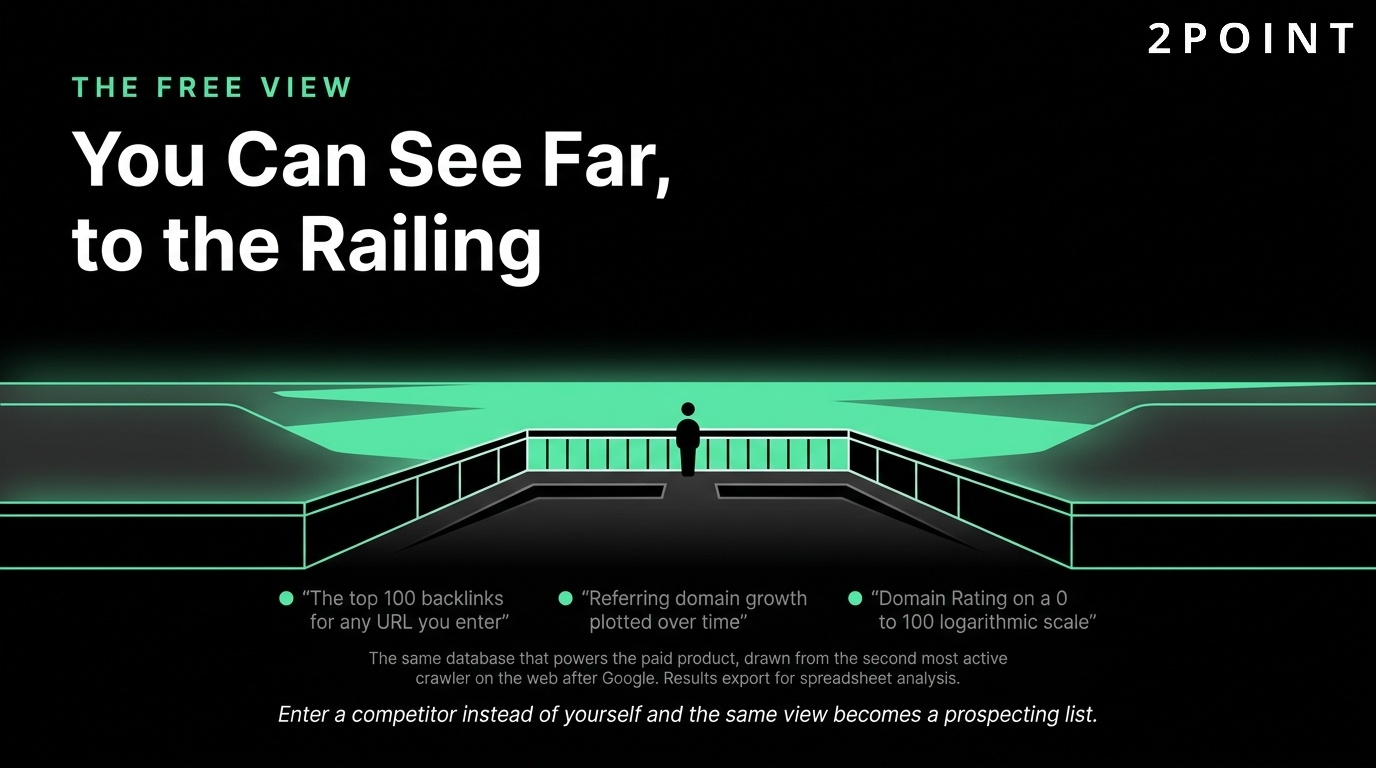
Ahrefs is widely regarded as having the most comprehensive backlink database in the industry outside of Google itself. The company's web crawler operates continuously, updating the database with remarkable frequency. The free tier of Ahrefs' Backlink Checker provides access to this industry-leading database with sensible limitations: you can see the top 100 backlinks pointing to any URL, referring domain trends over time, and the site's Domain Rating (DR) score.
Domain Rating is Ahrefs' proprietary metric for measuring a website's overall link authority on a logarithmic scale from zero to 100. A higher DR indicates a stronger, more authoritative backlink profile, which generally correlates with better ranking potential across a site's pages. As Ahrefs states, "Ahrefs has the second most active web crawler after Google, which means we have the best backlink database in the industry." The free tool presents this data through interactive graphs showing referring domain growth over time, giving you a visual sense of whether a site's link profile is growing, stagnant, or declining. For competitive research, you can enter a competitor's domain to see their top 100 backlinks, which surfaces the most authoritative sites linking to them and reveals potential link building targets for your own outreach. Export functionality within the free tool allows you to download these results for further analysis in a spreadsheet, making it a practical starting point for a structured link building prospecting workflow.
Semrush Backlink Checker: 43 Trillion Links at Your Fingertips
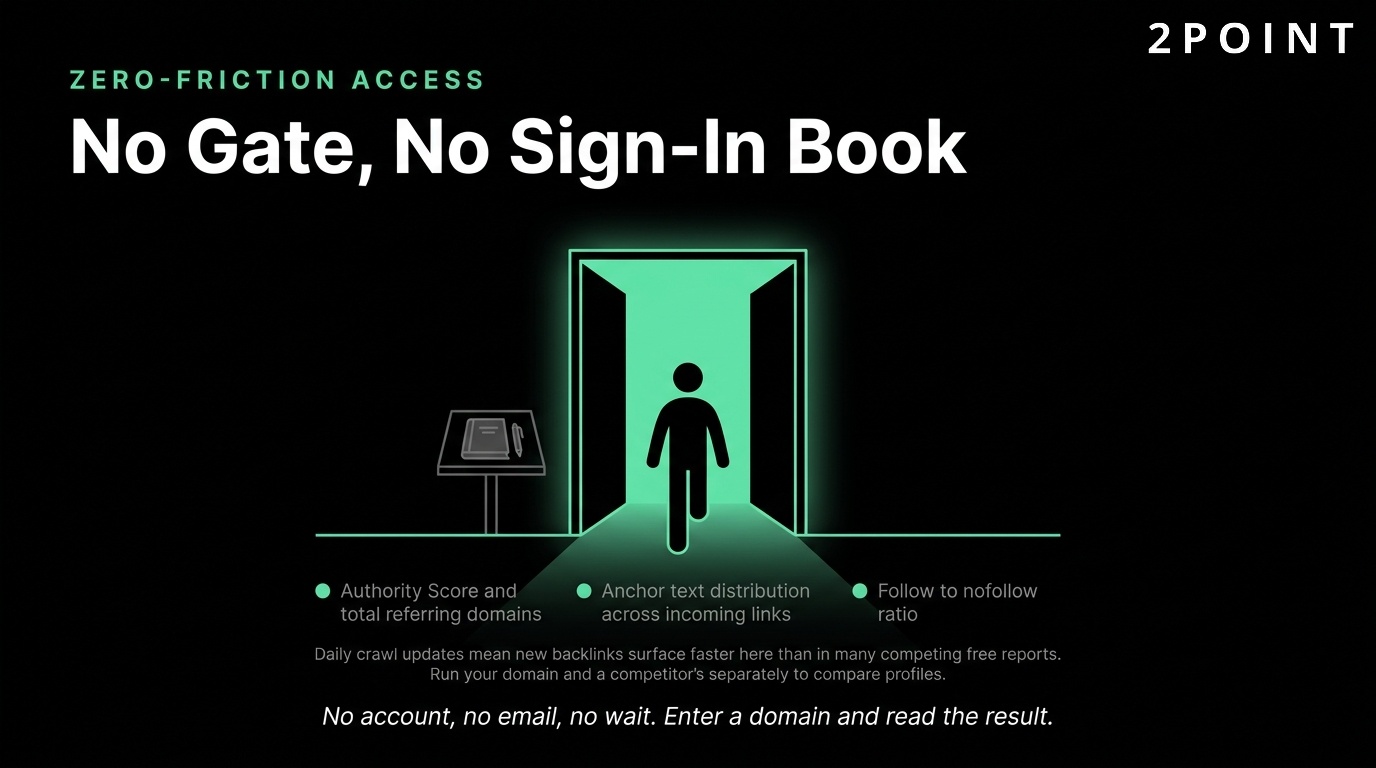
Semrush's free backlink analysis tool offers one feature that sets it apart from most alternatives: it requires no registration. You can navigate to the tool, enter any domain URL, and receive an immediate snapshot of that site's backlink profile without creating an account or providing any personal information. For quick competitive research or client prospecting, this zero-friction access is a genuine convenience advantage.
The data returned covers Authority Score (Semrush's equivalent of Ahrefs' Domain Rating), the total number of referring domains, anchor text distribution across the site's incoming links, and the ratio of follow to nofollow backlinks. Each of these dimensions tells a different story about link profile health. A wildly unnatural anchor text distribution can signal over-optimization or a manipulative link building history. An unusually high proportion of nofollow links might indicate that the site's links are coming primarily from user-generated content platforms rather than editorial placements. Daily crawl updates mean that new backlinks appear in Semrush's free reports faster than in many competing tools. For competitive gap analysis, enter both your domain and a competitor's domain in separate free queries to compare their link profiles and identify referring domains that link to them but not to you. These represent your most targeted outreach opportunities.
Neil Patel's Free Backlink Checker: Domain Authority Focus
Neil Patel's Ubersuggest platform includes a free backlink checker that takes a slightly different analytical angle than Ahrefs or Semrush. The tool centers its reporting around Domain Authority (a Moz-originated metric that Ubersuggest has adopted as its primary link quality signal) and presents backlink data in a way that is particularly accessible for practitioners who are newer to link analysis.
The free tool displays a backlink growth chart showing how the total number of referring domains pointing to a site has changed over time. This trajectory is often more informative than a static count, because a site with 500 referring domains and growing momentum is in a fundamentally stronger position than one with 800 referring domains and a declining trend. As Neil Patel describes it, "The Free Backlink Checker gives you a clear snapshot of any website's backlink profile, including Domain Authority, total backlinks, referring domains, NoFollow links, anchor text, and backlink growth over time." Anchor text reporting within the tool identifies the most common text used when other sites link to your target URL, which can reveal both genuine topical relevance and potential over-optimization patterns worth addressing. For quick competitor research during a client pitch or a discovery call, this tool delivers a professional-grade summary in under a minute.
SE Ranking Backlink Checker: Freshness as Competitive Edge
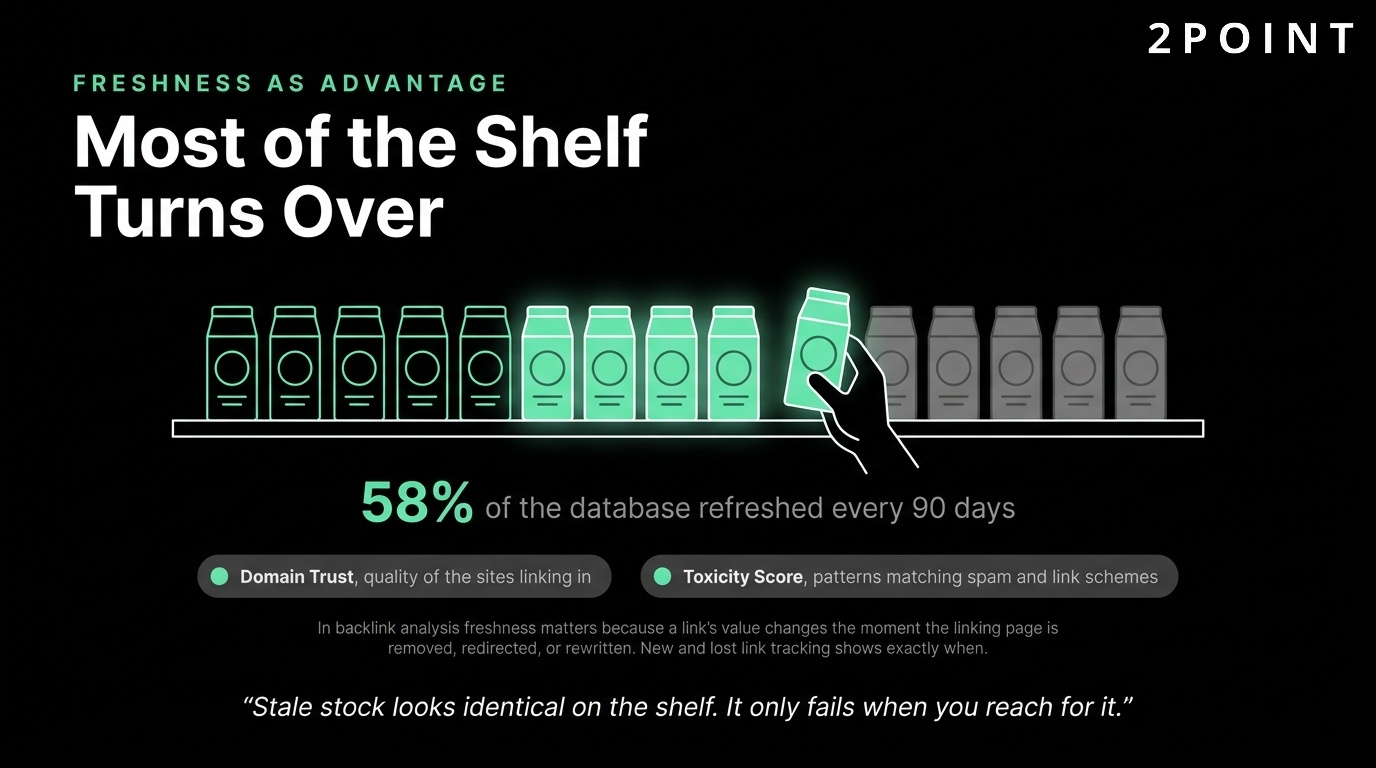
SE Ranking distinguishes its free backlink checker with an emphasis on data freshness that most competitors cannot match. The platform updates 58% of its backlink database every 90 days, which translates to more current data than you typically receive from free tiers of other tools. In backlink analysis, freshness matters enormously because the SEO value of a link can change rapidly if the linking page is removed, redirected, or dramatically altered.
The tool introduces two proprietary metrics that add analytical depth beyond simple DR or DA scores. Domain Trust evaluates the quality of a site's backlink profile based on the trustworthiness of the sites linking to it. Toxicity Score identifies potentially harmful links based on patterns associated with spam, link schemes, and low-quality link sources. Together, these metrics help you quickly assess whether a backlink profile is a genuine authority asset or a potential liability. New and lost backlink tracking shows you when sites gain or drop links over specified time periods, which is valuable both for monitoring your own profile and for tracking competitor link building activity. The anchor text distribution report and page-level link equity analysis round out a tool that delivers surprisingly comprehensive functionality for a free-tier offering. Connecting these insights to your broader SEO metrics tracking ensures you are interpreting backlink changes in the context of overall ranking performance.
Specialized Free Backlink Analysis Tools
Beyond the major all-in-one platforms that include free backlink checker functionality, several specialized tools focus exclusively on link analysis and offer unique metrics or perspectives that the larger platforms do not replicate. Adding one or two of these specialized tools to your backlink analysis workflow can reveal dimensions of link quality and competitive positioning that broader tools miss entirely. The following four tools each bring a genuinely distinct analytical framework to the process of understanding and improving your site's link profile.
Majestic Backlink Checker: Trust Flow and Citation Flow
Majestic has been a significant force in backlink analysis for over a decade, and its proprietary metrics, Trust Flow and Citation Flow, remain among the most sophisticated link quality measurements available in the free tool space. Trust Flow measures the quality of links pointing to a site based on a carefully curated set of "seed sites" that Majestic's team has determined to be highly trustworthy. The score reflects how close, in link graph terms, a site sits to these trusted sources.
Citation Flow complements Trust Flow by measuring the quantity of links pointing to a site regardless of quality. The ratio between the two metrics is where the real analytical insight lives. A site with high Citation Flow and low Trust Flow has accumulated many links but most of them come from low-quality or spammy sources. A site where Trust Flow closely matches or exceeds Citation Flow has a link profile dominated by genuinely authoritative, editorially earned links. This ratio analysis makes Majestic exceptionally useful for evaluating link prospects during outreach campaigns: you want to earn links from sites with strong Trust Flow scores, not just high Citation Flow numbers. Majestic also offers Topical Trust Flow, which breaks down a site's authority by subject category, helping you assess whether a potential linking partner operates in a topically relevant niche for your site's authority building goals.
SEO Review Tools Backlink Checker: Best Performing Content Insights
SEO Review Tools takes a content-performance angle on backlink analysis that makes it uniquely useful for content strategy work. Rather than leading with domain-level authority metrics, this tool surfaces which specific pages on a target site have attracted the most backlinks, giving you direct insight into what type of content earns links within a particular niche or from a particular audience.
This most-linked-pages view is one of the most valuable pieces of competitive intelligence available at no cost anywhere in the SEO tool landscape. When you identify which of a competitor's pages have earned the most referring domains, you are seeing direct evidence of what content their audience finds worth linking to. That information becomes the blueprint for your own linkable asset strategy. Create content that serves the same audience need with greater depth, better design, or more current information, and you have a strong foundation for outreach to the same referring domains. The tool also breaks down the referring domain landscape by showing the relationship between a page's total backlinks and the diversity of domains those links come from, helping you distinguish between a page with 500 links from 5 domains (weaker signal) versus 500 links from 400 domains (much stronger signal). This distinction is critical for accurate competitive assessment.
Understanding Backlink Quality Metrics Across Platforms
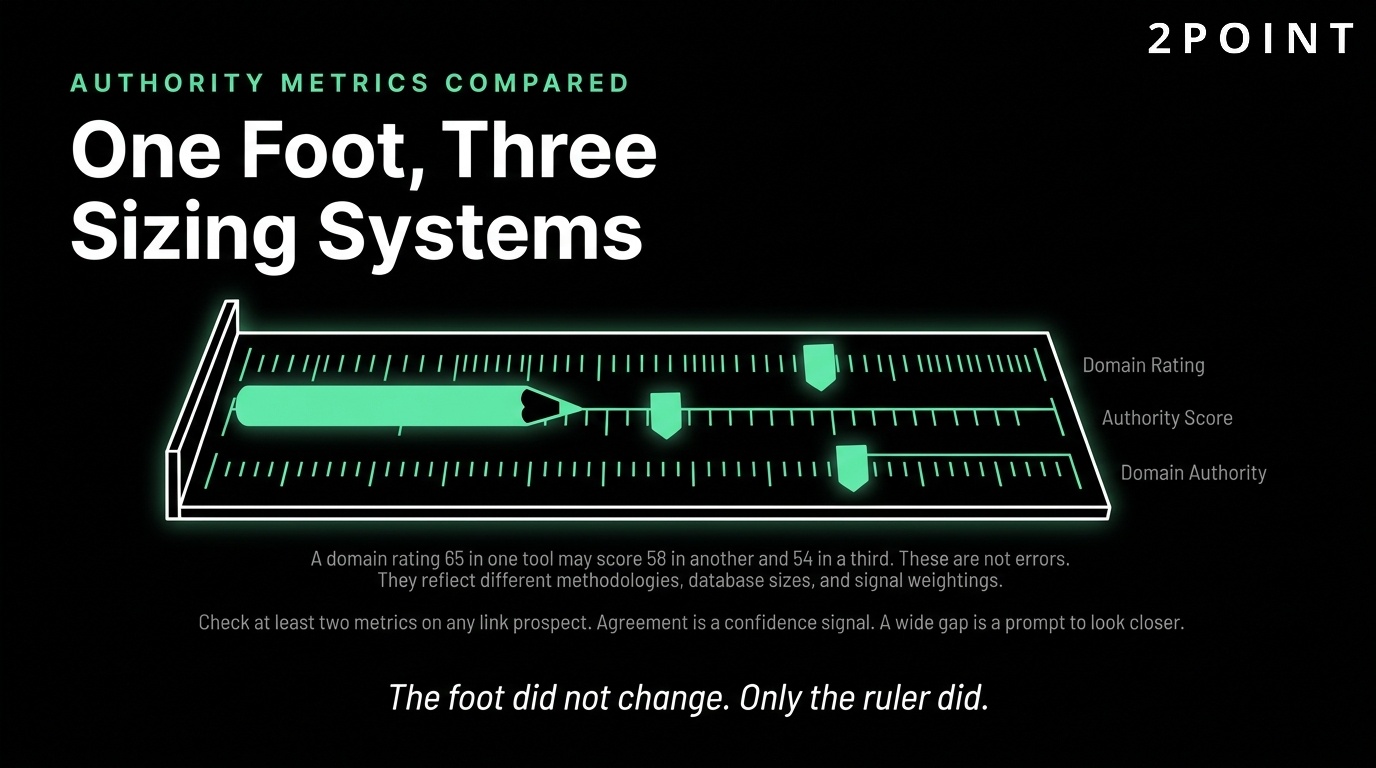
One of the most confusing aspects of using multiple free backlink checker tools is that each platform uses different proprietary metrics to measure link authority, and those metrics rarely agree precisely. A domain with a Domain Rating of 65 in Ahrefs might show an Authority Score of 58 in Semrush, a Domain Authority of 54 in Moz, and a Domain Trust score of 61 in SE Ranking. These discrepancies are not errors. They reflect genuinely different methodologies, different database sizes, and different weighting of various link quality signals.
| Authority Metric | Platform | Primary Signal | Scale | Best Used For |
|---|---|---|---|---|
| Domain Rating (DR) | Ahrefs | Quality and quantity of referring domains | 0 to 100 | Link prospecting and competitive benchmarking |
| Authority Score (AS) | Semrush | Link power, organic traffic, spam factors | 0 to 100 | Overall site health and authority assessment |
| Domain Authority (DA) | Moz / Ubersuggest | Linking root domains and link quality | 0 to 100 | Quick authority comparisons and outreach targeting |
| Trust Flow (TF) | Majestic | Proximity to curated trusted seed sites | 0 to 100 | Link quality assessment and spam detection |
| Domain Trust (DT) | SE Ranking | Quality of incoming links with toxicity scoring | 0 to 100 | Toxic link identification and disavow decisions |
No single authority metric should be treated as definitive. The most reliable practice is to check at least two metrics when evaluating a link prospect, using agreement between platforms as a confidence signal and significant discrepancies as a prompt for deeper investigation.
As this analysis on Dev.to outlines, link diversity matters as much as individual link quality. A backlink profile with 200 referring domains is significantly more resilient than one with 2,000 total backlinks from 10 domains. Toxic link identification, available in various forms across SE Ranking, Semrush, and Majestic, helps you determine whether your profile contains links that might trigger Google's spam filters and whether creating a disavow file is warranted.
Strategic Backlink Research Workflow
Collecting backlink data from multiple free tools is only valuable when you follow a structured workflow that converts raw data into prioritized action. The most effective free-tool backlink research process moves through four stages: analyze your own profile, audit for quality issues, identify competitor link gaps, and prioritize outreach targets based on attainability and authority value.
Start by running your own domain through Ahrefs' free backlink checker and SE Ranking's tool. Download the results from each and consolidate them into a single spreadsheet, removing duplicates. Flag any referring domains with low Trust Flow or high Toxicity Scores for further review. Next, run your top three competitors through the same tools and create a combined list of their referring domains. Identify domains that link to one or more competitors but not to your site. These represent your most targeted outreach opportunities because those sites have already demonstrated a willingness to link to content similar to yours. As Link Assistant recommends, set up monthly monitoring using email alerts or calendar reminders to re-run these checks, comparing current results against your baseline to catch new links (which validate your outreach efforts) and lost links (which may require follow-up to restore). When the complexity of this process exceeds what free tools can efficiently manage, that is typically the trigger point for evaluating whether a paid backlink monitoring tool delivers enough ROI to justify its cost.
Keyword Research Strategy with Free Tools
Having access to powerful free keyword research tools is only valuable when those tools are used within a coherent strategic framework. Keyword research is not about collecting the longest possible list of terms. It is about identifying the specific words and phrases that connect real user intent with content your site can credibly and competitively address. A structured approach to keyword research with free tools can produce results that rival what agencies achieve with premium subscriptions, provided you follow a disciplined process and resist the temptation to chase volume without considering competition and intent.
The Four-Stage Keyword Research Framework
Effective keyword research using free tools follows four sequential stages, each building on the output of the previous. Skipping stages or treating keyword research as a single undifferentiated activity is one of the most common reasons content investments fail to generate organic traffic.
As Zapier defines it, "Keyword research is the process of finding the exact words and phrases people type into Google and AI search platforms when they search for something related to your website or business." With that definition in mind, here is how the four-stage framework applies to free tools specifically:
- Brainstorm seed keywords: Use your industry knowledge, product or service descriptions, and customer language to generate 15 to 30 core topic terms. Supplement this with Google Autocomplete alphabet soup to surface the specific language your audience uses, which may differ from internal industry terminology.
- Expand with volume data: Take your seed keywords into Google Keyword Planner, Semrush's free keyword tool, and WordStream to generate expanded lists with volume estimates, competition scores, and CPC data. Use daily free search limits strategically by prioritizing your most commercially important seed keywords first.
- Analyze intent and competition: For each keyword that shows meaningful volume, review Semrush's intent classification and difficulty score. Set a threshold based on your site's current authority (a newer site should target difficulty scores below 40, while an established site can pursue higher difficulty terms). Eliminate keywords where the intent does not match your content capabilities.
- Map keywords to content and journey stages: Assign each surviving keyword to a specific content format (blog post, landing page, FAQ, comparison article) and a stage in the user journey (awareness, consideration, decision). This mapping prevents keyword cannibalization and ensures your content library serves users at every point in their path to conversion.
Long-Tail Keyword Discovery Techniques
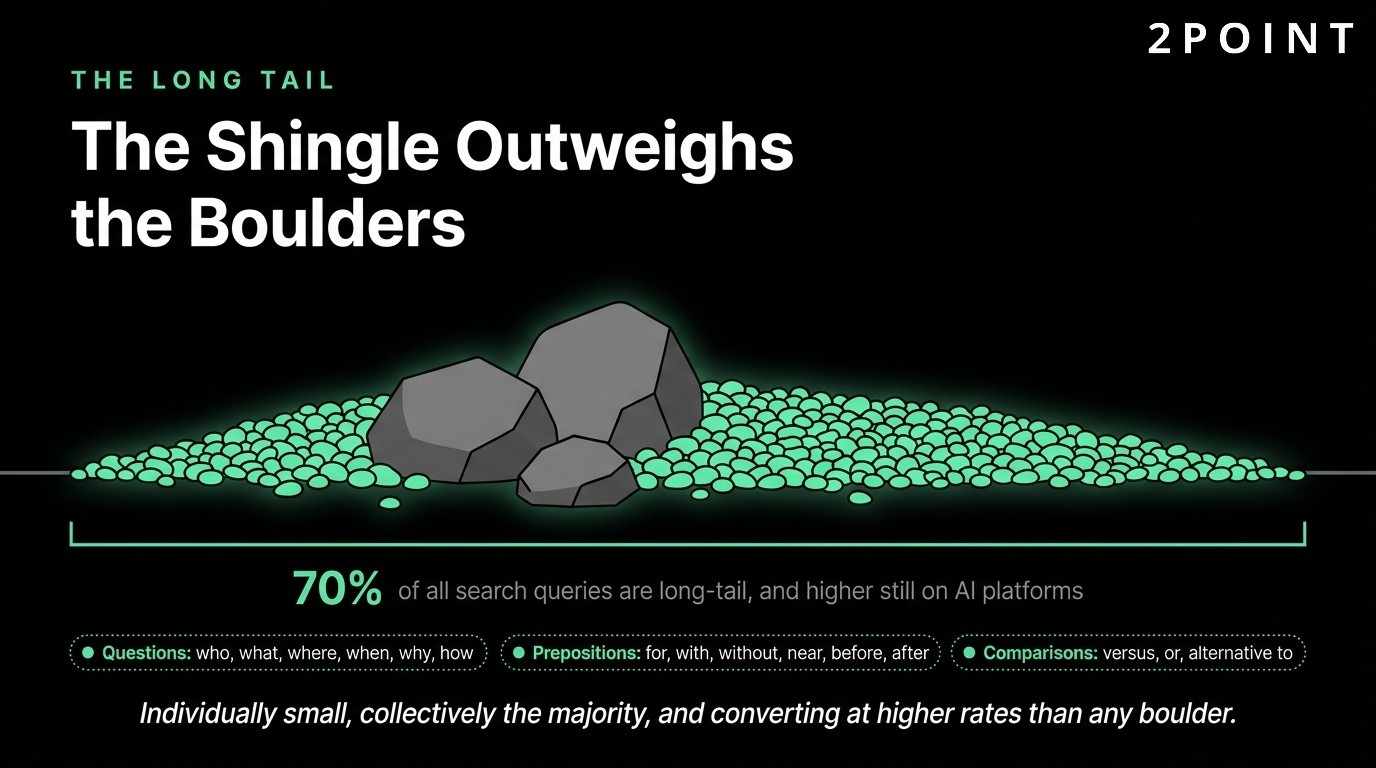
Long-tail keywords, those containing three or more words and reflecting highly specific search intent, represent the most efficient opportunity available to most websites using free keyword research tools. While individual long-tail terms carry less search volume than broad head terms, they collectively account for the majority of all search queries, and they convert at significantly higher rates because they reflect users who have already narrowed their focus to something specific.
According to research cited by LowFruits, approximately 70% of all search queries are long-tail in nature. This proportion is even higher in AI-powered search platforms like Perplexity and ChatGPT, where users tend to enter full questions rather than abbreviated search strings. Free tools are particularly well-suited to long-tail discovery because autocomplete-based tools like KeywordTool.io and Google Autocomplete excel at generating exactly these types of phrases. Question keywords using who, what, where, when, why, and how represent one major long-tail category and align naturally with featured snippet and AI answer box opportunities. Preposition keywords using for, with, without, near, before, and after represent a second category that typically reflects transactional or comparative intent. Comparison keywords using versus, vs., or, and alternative to represent a third category that serves users actively evaluating options, making them powerful targets for bottom-of-funnel content with strong commercial intent.
Search Intent Classification and Content Matching
One of the most consequential decisions in any keyword strategy is matching the content format to the search intent behind each keyword. Creating informational blog content for a keyword where the overwhelming majority of searchers want to make an immediate purchase guarantees poor conversion rates regardless of how well the page ranks. Conversely, creating a sales-focused landing page for a keyword where users are clearly in early research mode generates high bounce rates that can suppress rankings over time.
The four intent categories provide the framework for this matching process. Informational intent keywords ("how does X work," "what is X," "best practices for X") call for comprehensive, educational content in blog post or guide format. Navigational intent keywords ("brand name login," "brand name pricing") call for direct access pages rather than content creation. Commercial intent keywords ("best X tools," "X reviews," "top X alternatives") call for comparison content, listicles, or review articles that help users evaluate options. Transactional intent keywords ("buy X online," "X pricing," "free trial X") call for optimized landing pages designed to convert. Semrush's free keyword tool auto-classifies intent for each keyword in its reports, making this analysis significantly faster than manual SERP interpretation. However, always verify the classification by examining the actual SERP results for your target keyword. The content types that appear on page one are the most reliable signal of what Google's algorithm has determined satisfies user intent for that query. For a deeper understanding of how this fits into broader content marketing and SEO integration, the content-intent matching process is the critical bridge between keyword selection and content execution.
Competitive Keyword Gap Analysis
Competitive keyword gap analysis is the process of identifying keywords that your competitors rank for in meaningful positions that your site does not yet target or rank well for. This analysis is one of the highest-leverage activities available in SEO because it lets you skip the speculation phase of keyword discovery and go directly to validated opportunities where demand is proven by your competitors' existing rankings.
With free tools, the gap analysis process is more manual but still highly effective. Start by identifying your top three to five organic search competitors using Google Search Console's performance data, looking for domains that frequently appear alongside yours in the SERP for your current ranking keywords. Run each competitor domain through Semrush's free site overview (limited queries per day), noting the keywords they rank for in their top-performing pages. Cross-reference this against your own GSC query data to identify terms they rank for where you have no impressions at all. As Marketer Milk recommends, prioritize the gaps where competitor keywords show high volume (above 500 monthly searches) combined with moderate or low difficulty scores (below 50 in Semrush's scoring). These high-volume, low-difficulty gaps represent the quickest wins in your content roadmap and should become the top priorities in your next content planning cycle. This approach to managing SEO campaigns strategically ensures you are responding to data rather than assumptions.
Building Your Free SEO Tool Stack for Small Businesses and Solo Operators
Free SEO tools for small businesses represent the most democratizing development in digital marketing of the past decade. The question is no longer whether you can access professional-grade SEO data without a premium subscription. You can. The more pressing question is which combination of free tools produces the most complete and actionable intelligence for the time you can invest in using them. This section answers that question with a specific, curated stack and the workflow to support it.
The Essential 7-Tool Starter Kit
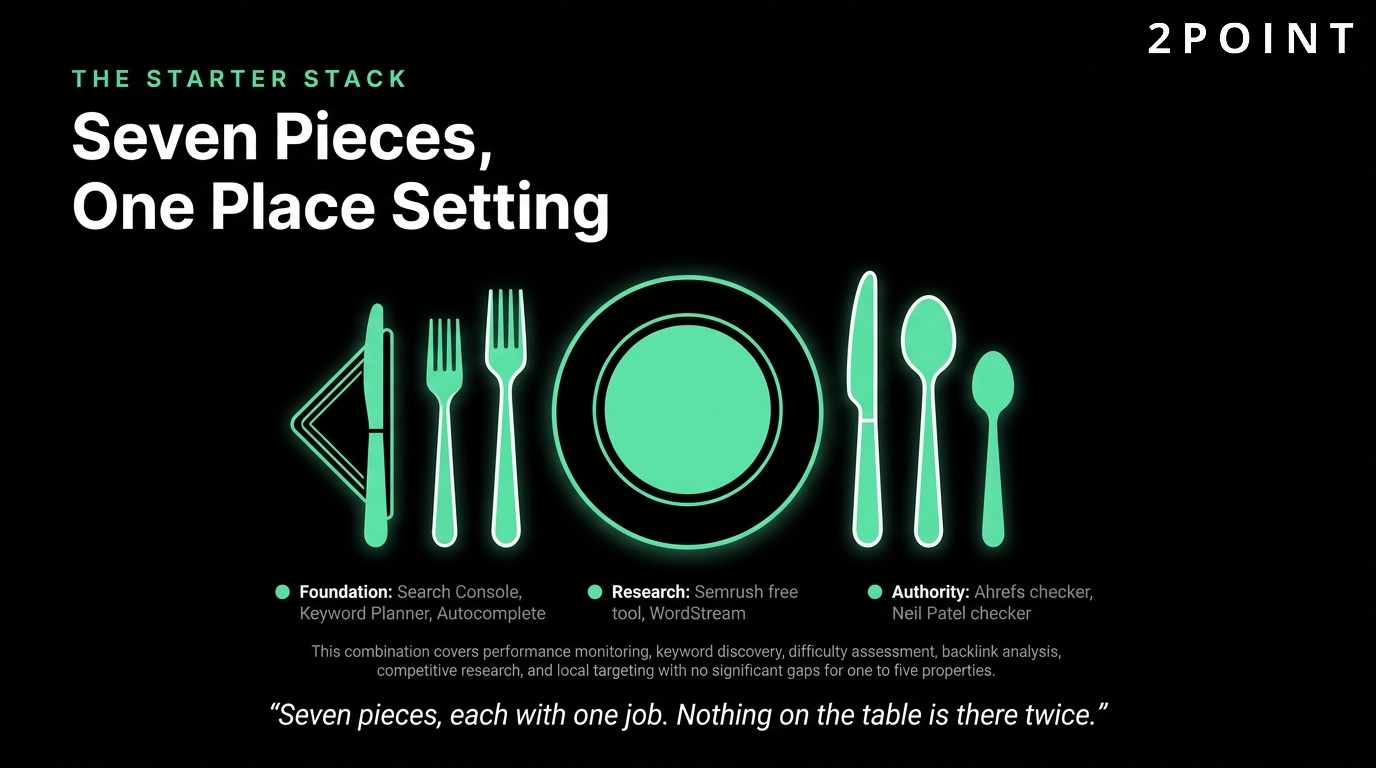
The following combination of free tools covers every core dimension of SEO analysis: performance monitoring, keyword discovery, difficulty assessment, backlink analysis, competitive research, and local targeting. Each tool has been selected for a specific role, and together they create a workflow with no significant gaps for sites managing one to five web properties.
| SEO Tool Layer | Free Tool | Primary Function | Key Metric Provided |
|---|---|---|---|
| Foundation Monitoring | Google Search Console | Performance tracking, indexing, AI Overview visibility | Impressions, clicks, CTR, position, AI citations |
| Volume Data | Google Keyword Planner | Search volume and competition data from Google | Monthly search volume ranges, competition level, CPC |
| Long-Tail Expansion | Google Autocomplete | Real-time user behavior keyword generation | Hundreds of user-intent keyword variations |
| Backlink Analysis | Ahrefs Backlink Checker | Backlink profile and Domain Rating analysis | Top 100 backlinks, referring domains, DR score |
| Difficulty Assessment | Semrush Free Keyword Tool | Keyword difficulty, intent, and CPC evaluation | KD score, search intent, SERP features |
| Industry Research | WordStream Free Keyword Tool | Industry-filtered and location-targeted keywords | Industry-specific suggestions, top page bids |
| Competitor Monitoring | Neil Patel Backlink Checker | Competitor link profile and DA tracking | Domain Authority, backlink growth trend, anchor text |
This seven-tool stack, sourced from DashThis's comprehensive free tool analysis, creates complete coverage across the five core SEO disciplines without requiring a single paid subscription.
Workflow Integration and Data Management

Owning seven tools produces value only when you have a system for using them together. Without a workflow and data management structure, you end up with disconnected spreadsheets, inconsistent data formats, and the nagging sense that you have more information than insight. The solution is a simple but disciplined data management approach built around a Google Sheets master keyword document and a monthly reporting routine.
Structure your master keyword spreadsheet with columns for: keyword, search volume (from Keyword Planner), keyword difficulty (from Semrush), search intent (from Semrush), target URL or content status, current Google position (from Search Console), and monthly click trend (from Search Console). Populate new rows from your research sessions and update the position and click data monthly by exporting from Search Console. This creates a living document that captures both opportunity (keywords without target pages) and performance (how existing pages are trending over time). CMSWire recommends supplementing this with a monthly backlink monitoring log that records new and lost referring domains from your Ahrefs and SE Ranking checks, giving you a complete picture of your site's authority trajectory alongside its keyword performance. Connecting your analytics tools to this reporting structure ensures that traffic and conversion data from Google Analytics can be correlated with the SEO performance indicators from your tool stack.
When to Upgrade to Paid Tools
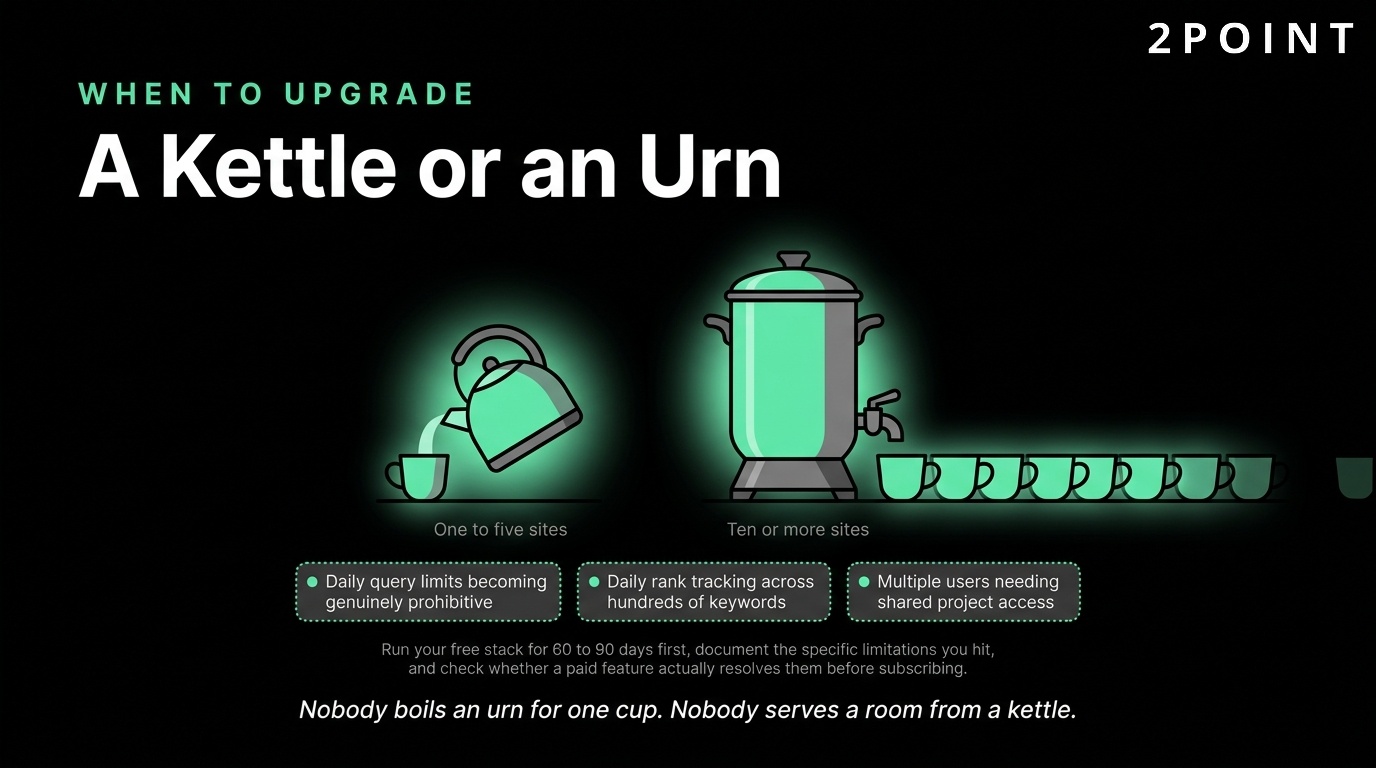
The transition from free to paid tools should be driven by specific operational needs, not by aspiration or peer pressure. Several clear trigger points indicate when the cost of a premium tool is genuinely justified by the efficiency and capability it provides. Managing ten or more websites simultaneously is the most common trigger, because the daily query limits of free tools become genuinely prohibitive at that scale. Needing daily rank tracking across hundreds of keywords is another clear trigger, because no free tool provides this capability reliably. Team collaboration requirements, where multiple users need simultaneous access to shared project data, also typically require a paid platform.
When evaluating which premium feature justifies cost first, rank tracking and a comprehensive keyword database are typically the highest-value additions for most businesses. Zapier's analysis suggests using free tools to establish baseline performance data before committing to any paid subscription. Run your free tool workflow for 60 to 90 days, document your results, and then evaluate whether the specific limitations you encounter during that period correspond to features in a paid tool you are considering. If the answer is yes and the time you spend working around free tool limitations has a clear cost in terms of hours invested, the upgrade calculus becomes straightforward. A useful hybrid approach is to use free tools for all research and discovery work while using a paid tool exclusively for rank tracking and team reporting, keeping the paid subscription at its lowest viable tier. Understanding SEO pricing structures helps contextualize the value comparison between doing work yourself with free tools versus outsourcing to an agency with access to full premium platforms.
Tool Selection Criteria and Avoiding Analysis Paralysis
The SEO tool landscape is vast and growing constantly. New free tools launch regularly, and existing tools expand their free tier offerings as competitive pressure increases. This abundance can paradoxically produce worse SEO outcomes than a simpler toolkit would, because practitioners spend time evaluating and learning tools instead of implementing strategies and creating content. Tool accumulation without implementation is one of the most common traps in SEO practice at every experience level.
As Zapier notes, "You shouldn't have to be a 10-year SEO industry veteran to use keyword research tools, the best tools offer simple, straightforward suggestions." Start with Google's free suite before adding anything else. Only add a specialized tool when you encounter a specific question your current stack cannot answer. When you do add a tool, use it for at least 30 days before evaluating whether it earns its place. The decision framework for any tool addition should answer three questions: What specific metric or insight am I currently missing? Which tool provides it with the least friction and learning curve? And will having this data change any decisions I am currently making without it? If the answer to the third question is no, the tool is not worth adding regardless of how impressive its feature set appears in a demonstration.
Advanced Free Tool Techniques for Experienced Practitioners
Once the foundational free tool stack is operational and producing consistent data, several advanced techniques allow practitioners to extract significantly more value from these same tools without adding cost or complexity. These methods are not obscure workarounds. They are strategic applications of existing tool features that most users overlook because the features are not prominently highlighted in standard tool documentation or tutorials.
AI Search Optimization with Free Tools
The emergence of AI Overviews in Google Search and AI-native search platforms like Perplexity has created a new frontier for SEO visibility that did not exist in meaningful form before 2024. Optimizing for AI citation is different from traditional SEO optimization in important ways, but free tools now provide the data you need to pursue it systematically.
Google Search Console's AI Overview reporting (added as a significant 2025 update and fully developed by 2026) shows which of your pages are being cited in AI-generated answer blocks and how many impressions those citations generate. Start by identifying which existing pages already receive AI Overview impressions. These pages have the content structure and authority that Google's AI system finds credible enough to cite. Analyze what they have in common: typically, they feature clear definitional statements near the top, well-organized headers that directly answer specific questions, and factual claims supported by authoritative sources. Replicate this structure across your other content to increase the proportion of your pages that qualify for AI citation. DashThis confirms that this type of structured optimization for AI answer extraction is now a core component of competitive SEO strategy, not an experimental tactic. Entity optimization using Google Trends and autocomplete helps you understand the semantic context Google's AI associates with your topic area, which you can then reflect in your content to strengthen topical relevance signals. The authority signals confirmed by your backlink checkers also directly influence AI citation likelihood, as higher-authority domains earn citations at significantly higher rates than low-authority sites on equivalent topics.
Local SEO with Free Tools
Local SEO represents one of the areas where the free tool ecosystem is most comprehensively equipped to support the full optimization workflow without any paid tool requirement. Every major component of local search optimization has a free tool that covers it effectively. Understanding local SEO importance is the first step, and implementing it with the right free tools is both achievable and highly effective for businesses serving geographic markets.
Google Business Profile is the foundational free tool for local search visibility. A fully optimized GBP listing with accurate categories, complete attributes, regular posts, and actively managed reviews is the single most impactful thing most local businesses can do for local pack rankings, and it costs nothing. For local keyword research, both Google Keyword Planner and WordStream's Free Keyword Tool offer geographic filtering that lets you research search demand specifically within your target service area. Use these tools to identify local modifier keywords, such as your service category combined with your city name or neighborhood, as well as "near me" variants that trigger map pack results. WordStream's location targeting is particularly valuable here because it provides industry-specific filtering alongside geographic targeting, which is highly relevant for local service businesses in competitive verticals like legal, medical, and home services. Track your local pack appearances through Google Search Console's performance report, filtering by query to see how frequently your GBP listing appears for geographically modified searches. Pair this with the guidance on how to leverage local SEO for visibility to build a complete, actionable local search strategy. For specific local content optimization strategies, the approach to local SEO content optimization applies directly to the keyword research outputs these free tools provide.
Content Gap Analysis Without Paid Tools
Content gap analysis at its most sophisticated requires paid tools that can compare keyword rank sets across multiple domains simultaneously. But a manual version of this analysis using free tools produces remarkably useful results for practitioners willing to invest the methodological effort. The manual approach is more time-intensive but forces a deeper engagement with the competitive landscape that often produces more nuanced insights than automated gap reports.
The process begins with identifying the top 10 organic results for your most important target keywords using a simple Google search in a private browsing window to eliminate personalization bias. Visit the top three to five ranking pages for each keyword and extract the H2 and H3 headings, which reveal the subtopics and questions those pages address. Create a matrix comparing which subtopics each competitor covers and which they omit. Gaps where multiple competitors address a subtopic but you do not are weaknesses to address. Gaps where no competitor covers a subtopic represent opportunities to create differentiating content. Supplement this manual SERP analysis with Google Autocomplete to identify questions and subtopics that no current top-ranking page directly addresses. These autocomplete-surfaced questions reveal real user needs that existing content does not fully satisfy, creating openings for new content that can rank quickly by serving unmet intent. Marketer Milk recommends cross-referencing this analysis with Search Console query data to find keywords where your site ranks in positions 11 through 20. These "page two" keywords are the highest-priority quick wins in your content roadmap because you already have some ranking momentum. Improving content depth, adding missing subtopics, or earning a few additional backlinks to these pages can move them onto page one without starting from zero. This type of analytical thinking also connects to the broader SEO impact on business revenue, because page one rankings in these gap positions can produce measurable traffic and sales increases with relatively modest effort.
Link Building Prospecting with Free Backlink Checkers
Earning high-quality backlinks is one of the most challenging and time-consuming activities in SEO, but free backlink checker tools make the prospecting phase significantly more targeted and efficient. The core insight that makes free tool prospecting viable is that the most productive link building targets are rarely unknown sites you discover through cold research. They are sites already demonstrating a clear pattern of linking to content similar to yours, and free backlink tools reveal exactly who those sites are.
Start by running your top three content competitors through Ahrefs' free backlink checker and Neil Patel's backlink tool and downloading the results for each. Consolidate all referring domains into a single spreadsheet and sort by Authority Score or Domain Rating. Any domain that links to two or more of your competitors but not to you represents a high-confidence outreach target, because it has already demonstrated a willingness to link to content in your niche from multiple independent sources. Filter this list by removing domains below a DR or DA threshold appropriate to your niche (typically 25 to 30 as a minimum quality threshold) and by removing obviously irrelevant domains whose topical relevance to your content area is unclear. Broken link building is another effective tactic that free backlink tools support well. Identify resource pages and link roundups in your niche through competitor backlink profiles, then check whether any pages they link to have moved or returned 404 errors. Offering your own content as a replacement to the referring site is a low-friction outreach approach with a higher-than-average acceptance rate because you are solving a real problem for the linking site owner rather than asking them to take an action that only benefits you. For sites in specific verticals like real estate SEO, this type of targeted prospecting using free backlink tools can identify the specific authority sites in the vertical worth pursuing for link placements.
Conclusion: Your Complete Free SEO Tools Action Plan for 2026
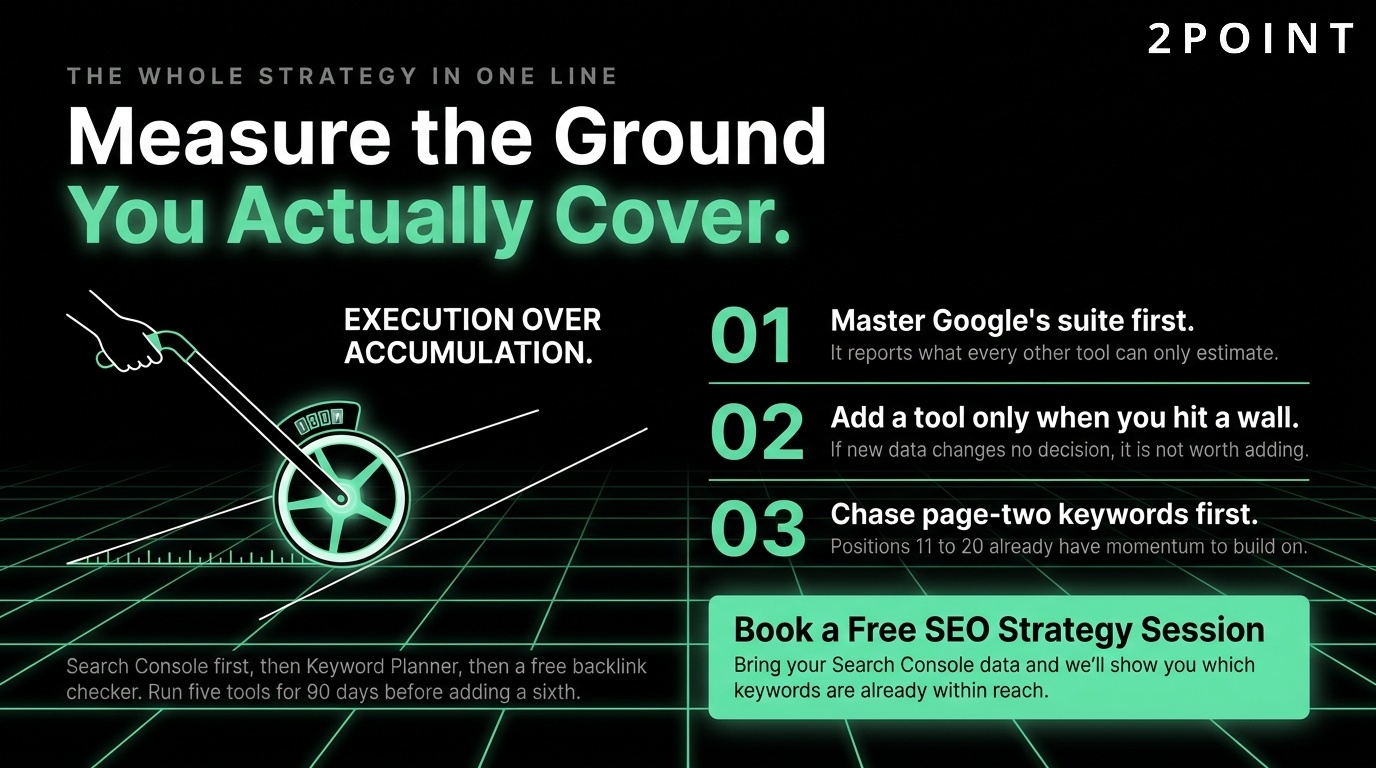
The evidence is clear and the tools are available: comprehensive, professional-grade SEO is fully achievable without a premium tool subscription. The ecosystem of free SEO tools available in 2026 covers every essential dimension of search optimization, from keyword discovery and intent analysis to backlink profiling and technical site auditing. The barrier to effective SEO is no longer financial. It is strategic, and specifically, it is about knowing which tools to use, in what sequence, and how to convert the data they provide into decisions that move your site forward.
The strategic combination that serves most website owners most effectively is a three-layer stack built on a clear architecture. The foundation layer, composed of Google Search Console, Google Keyword Planner, Google Autocomplete, and Google Trends, provides direct access to Google's own data about your site's performance, indexing status, and the keywords driving searches in your market. This layer is non-negotiable. Operating without it is equivalent to navigating without a map. As DashThis emphasizes, the Google tools alone provide more actionable intelligence than many practitioners realize, and mastering them before adding anything else is the most efficient path to SEO competence.
The keyword research layer, adding Semrush's free tool, WordStream, KeywordTool.io, or Wordtracker depending on your specific research needs, fills the gaps in Google's native tools by providing keyword difficulty scoring, intent classification, industry-specific filtering, and long-tail expansion at scale. Use these tools during focused research sessions rather than continuously, maximizing the value of daily free query limits by planning your research sessions in advance around specific content planning questions.
The backlink layer, built around Ahrefs' free backlink checker supplemented by SE Ranking, Neil Patel's tool, or Majestic depending on which authority metrics are most relevant to your analysis needs, gives you the competitive intelligence to understand where your site stands in terms of link authority and what opportunities exist to improve it. Run backlink analysis monthly rather than daily, using each session to update your referring domain log, identify new outreach targets from competitor profiles, and flag any newly appearing toxic links for review.
The 2026 landscape has added one more dimension to this stack: AI search visibility. Google Search Console now reports on AI Overview citations, and this data should be reviewed alongside traditional performance metrics in your monthly reporting routine. Sites that optimize their content structure for AI answer extraction are earning a form of SERP real estate that does not require traditional ranking in position one, and the free tools available today are fully capable of supporting that optimization work. CMSWire's analysis confirms that the most effective free tool users treat their stack as a professional workflow rather than a collection of disconnected resources, investing time in the data management and reporting infrastructure that connects tool outputs to strategic decisions.
The practical starting recommendation is this: if you are building your free tool stack from zero, begin with Google Search Console verification and one week of data collection before touching anything else. Add Keyword Planner and spend two weeks on foundational keyword research and intent analysis. Add Ahrefs' free backlink checker to understand your current link profile. Then choose one supplemental keyword research tool based on your specific niche and one supplemental backlink tool based on which authority metric your prospective link partners prioritize. Run this five-tool stack consistently for 90 days, executing against the content and link building strategies the data reveals, before evaluating whether any additions are warranted.
Implementation is what separates sites that grow from sites that stagnate. Data without action is wasted, regardless of how sophisticated the tool that produced it. The practitioners who earn the most from free SEO tools are not the ones with the most elaborate stacks. They are the ones who use a focused, appropriate stack with disciplined consistency and respond to what the data tells them with decisive content creation and link building execution. The tools are here. The data is available. The strategy is in your hands. Teams at 2POINT work with businesses at every stage of their SEO journey, and the most consistent observation is that the best results come from practitioners who master the fundamentals and execute relentlessly. Start there, and the results will follow.
Frequently Asked Questions About Free SEO Tools
What are the best free SEO tools for beginners in 2026?
The best starting point for beginners is Google Search Console, which provides direct performance data from Google at no cost. Pair it with Google Keyword Planner for search volume data and Ahrefs' free Backlink Checker for link analysis. These three tools together cover the most critical dimensions of SEO without requiring any paid subscription or advanced technical knowledge.
Is Google Search Console really free, and what does it include?
Google Search Console is completely free to use for any verified website owner. It includes performance reporting on queries, pages, clicks, impressions, and average position. It also covers indexing status, mobile usability, Core Web Vitals, security issues, and, as of 2026, AI Overviews reporting showing when your pages are cited in AI-generated answer blocks.
Can free keyword research tools provide accurate search volume data?
Google Keyword Planner provides the most accurate volume data available because it draws directly from Google's own search infrastructure. Other free tools like Semrush's free tier and WordStream provide volume estimates that are generally reliable for relative comparison purposes. The limitation of most free keyword tools is that they show volume ranges rather than precise numbers, particularly for lower-volume terms.
How do free backlink checker tools compare to paid options like Ahrefs or Semrush?
Free tiers of tools like Ahrefs and Semrush draw from the same underlying databases as their paid versions but limit the number of results returned per query (typically the top 100 backlinks rather than unlimited). For competitive research, link prospecting, and monthly monitoring on one to five sites, free backlink tools provide sufficient data. Paid plans become necessary when you need unlimited queries, daily monitoring across many sites, or bulk data exports for large-scale link audits.
Do I need multiple free SEO tools, or can one tool do everything?
No single free tool covers all SEO dimensions effectively. A complete free tool stack needs at least one tool for performance monitoring (Google Search Console), one for keyword research and volume data (Keyword Planner or Semrush free), and one for backlink analysis (Ahrefs or SE Ranking free). Each tool specializes in a specific function, and combining them creates a workflow that matches or exceeds what many paid platforms provide for most use cases.
Are free SEO tools good enough for small businesses, or do they need paid plans?
For most small businesses managing one to three websites, free SEO tools are fully sufficient for executing a professional SEO strategy. The free tiers of Google Search Console, Ahrefs, Semrush, and WordStream collectively cover keyword research, competitor analysis, backlink monitoring, and performance tracking. Paid plans become more valuable when managing multiple client sites simultaneously or needing automated rank tracking across large keyword sets.
What is the difference between Domain Rating, Domain Authority, and Authority Score?
Domain Rating (DR) is Ahrefs' metric measuring the strength of a site's backlink profile on a scale of zero to 100. Domain Authority (DA) is Moz's equivalent metric used by Ubersuggest and other tools. Authority Score is Semrush's version, which incorporates organic traffic signals alongside link data. All three measure similar concepts but use different methodologies, so scores will vary across platforms for the same domain.
How do I use Google Autocomplete as a keyword research tool?
Type your seed keyword into Google search and note the dropdown suggestions that appear. Use the alphabet soup technique by adding each letter of the alphabet after your keyword to surface the full range of suggestions. For question keywords, type "how to [keyword]," "what is [keyword]," and "why does [keyword]" to surface the questions real users are asking. These suggestions reflect live search behavior and are among the most reliable signals of user intent available for free.
Can free SEO tools help with AI search optimization in 2026?
Yes. Google Search Console now includes AI Overviews reporting, allowing website owners to see which pages are being cited in AI-generated answer blocks and how many impressions those citations generate. This data is available in the free version of GSC and is one of the most valuable new data points for adapting SEO strategies to AI-powered search. Structuring content with clear headers, direct answers, and factual statements improves AI citation likelihood without requiring any paid tools.
How often should I run free backlink checker reports?
Monthly backlink checks are sufficient for most websites. Run your own domain through at least two free backlink tools each month to track new and lost referring domains. Run your top three competitors quarterly to identify new link building opportunities. Daily monitoring is generally unnecessary without active link building campaigns and is more practical only with paid tools that provide automated alerts for new backlink acquisition.
What is the main limitation of free SEO tools compared to paid platforms?
The primary limitations of free tools are daily query limits, data caps on results returned per search, and the absence of automated monitoring and alerting features. Free tools require manual, session-based research rather than continuous background monitoring. They also typically lack multi-user collaboration features, historical data depth, and bulk analysis capabilities that agencies and large in-house teams require at scale.
Should I use free SEO tools before hiring an SEO agency?
Using free SEO tools before engaging an SEO services provider is a highly effective way to establish baseline performance data and develop informed expectations for the engagement. Running Google Search Console for 60 to 90 days before your first agency meeting gives you performance benchmarks, identifies current ranking keywords, and reveals technical issues. This data makes agency discussions more productive and helps you evaluate proposed strategies against real evidence rather than speculation.
