

 let’s connect


What Is Event Marketing and Why Does It Matter in 2026?
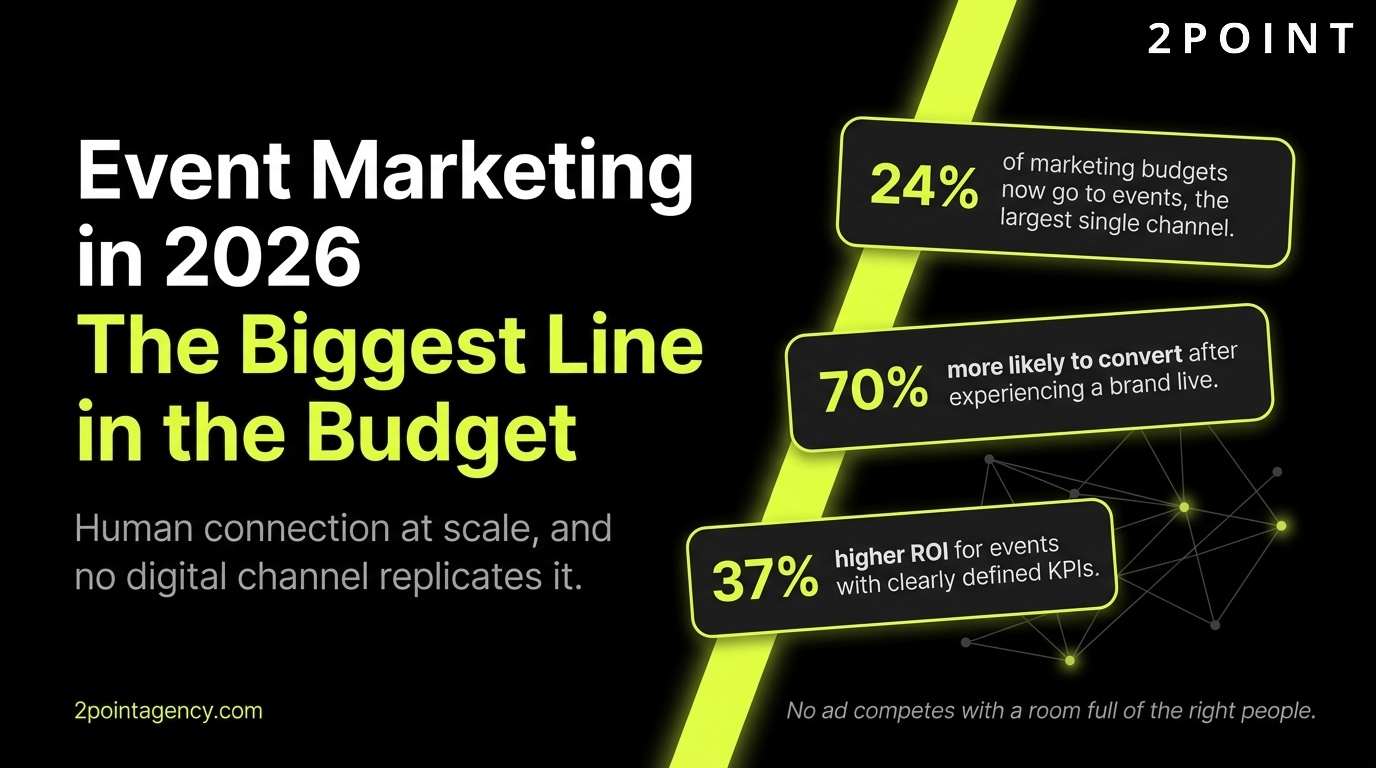
Event marketing is the strategic promotion of brands, products, or services through in-person, virtual, or hybrid events designed to create meaningful engagement and drive measurable business outcomes. In 2026, it stands as the single largest allocation within most marketing budgets, commanding investment that no other channel receives at scale.
- Event marketing uses structured experiences to connect brands directly with audiences in ways digital ads cannot replicate.
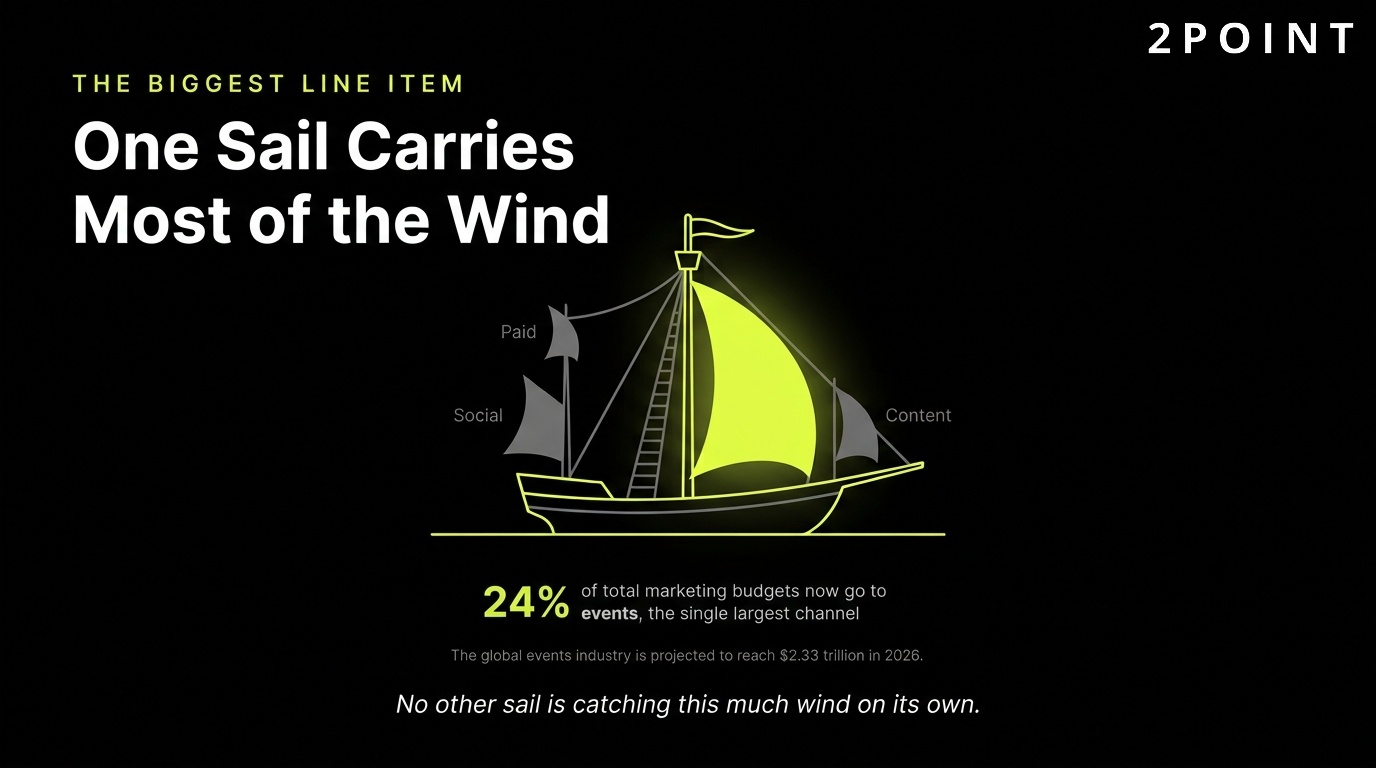
- The global events industry is projected to reach $2.33 trillion in 2026, reflecting sustained post-pandemic recovery and growth.
- 24% of total marketing budgets now go to events, the highest single-channel allocation across all marketing disciplines.
- In-person events account for 60% of the event format mix, virtual events 35%, and hybrid formats 5%.
- Events drive lead generation, accelerate pipeline, build brand awareness, and foster community at a scale other channels struggle to match.
- B2B organizations report that events influence purchasing decisions even when those touches never receive formal CRM credit.
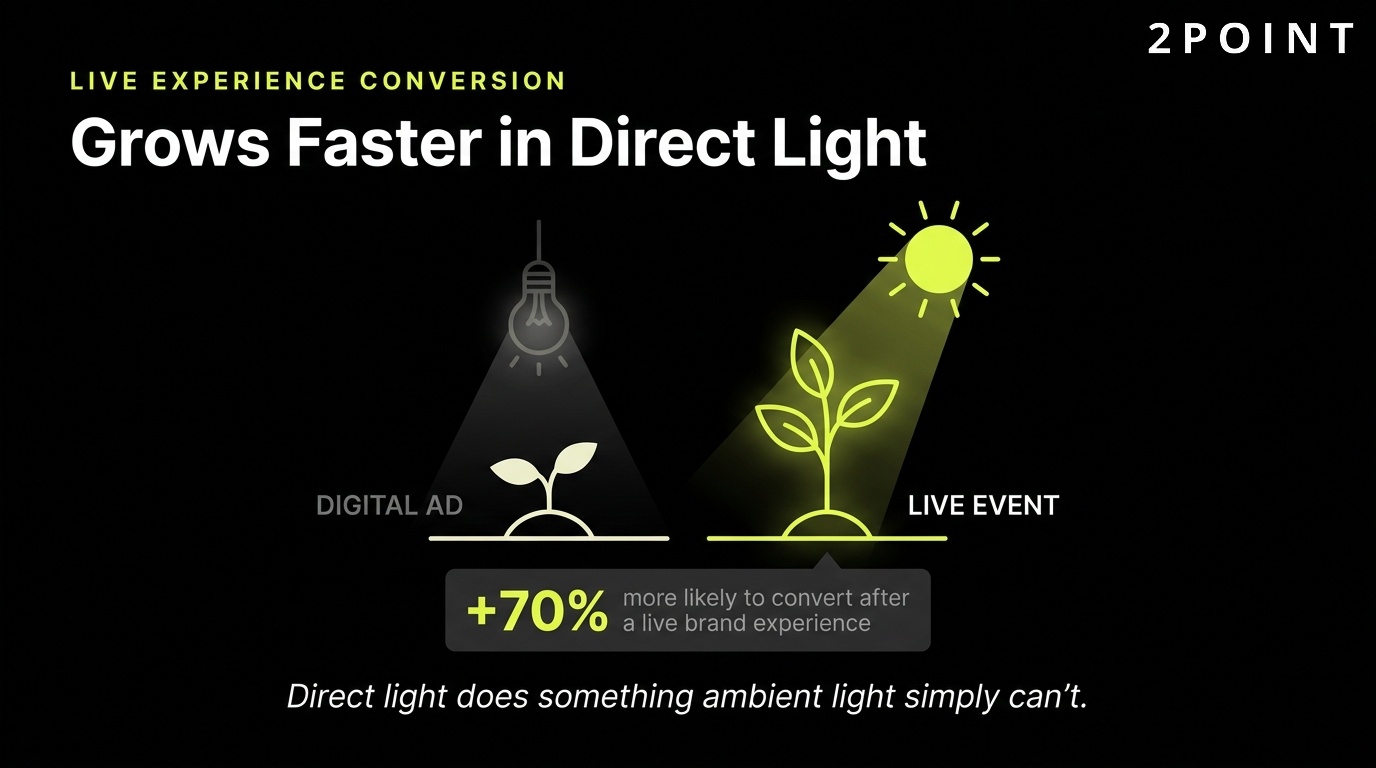
- Attendees who experience a brand live are 70% more likely to convert to customers compared to those reached through passive digital channels.
Building Your Event Marketing Strategy Framework
Before a single registration page goes live or a promotional email gets sent, the event marketing teams that consistently outperform their peers share one distinguishing characteristic: they start with strategy. The difference between an event that accelerates revenue and one that consumes budget without clear returns almost always traces back to the quality of the strategic foundation laid weeks or months before the event itself. This section walks through the four pillars of that foundation.
Setting Clear Event Objectives and KPIs
Every effective event marketing program begins with a clear answer to a deceptively simple question: what does success look like? Without a precise answer, even a brilliantly executed event becomes impossible to evaluate, and impossible-to-evaluate investments rarely survive budget scrutiny. The goal-setting process needs to connect event objectives directly to broader business priorities so that marketing, sales, and executive leadership all see the same definition of value.
A useful framework for defining event objectives operates across four dimensions: attendance and reach (how many qualified people attend), lead generation (how many new prospects enter your pipeline), pipeline acceleration (how many existing opportunities advance or close), and brand impact (measurable shifts in awareness, perception, or preference). Each dimension requires its own KPIs, and those KPIs need to be specific enough to drive decisions. "Generate awareness" is an objective. "Increase brand recall by 15% among financial services decision-makers who attend" is a KPI.
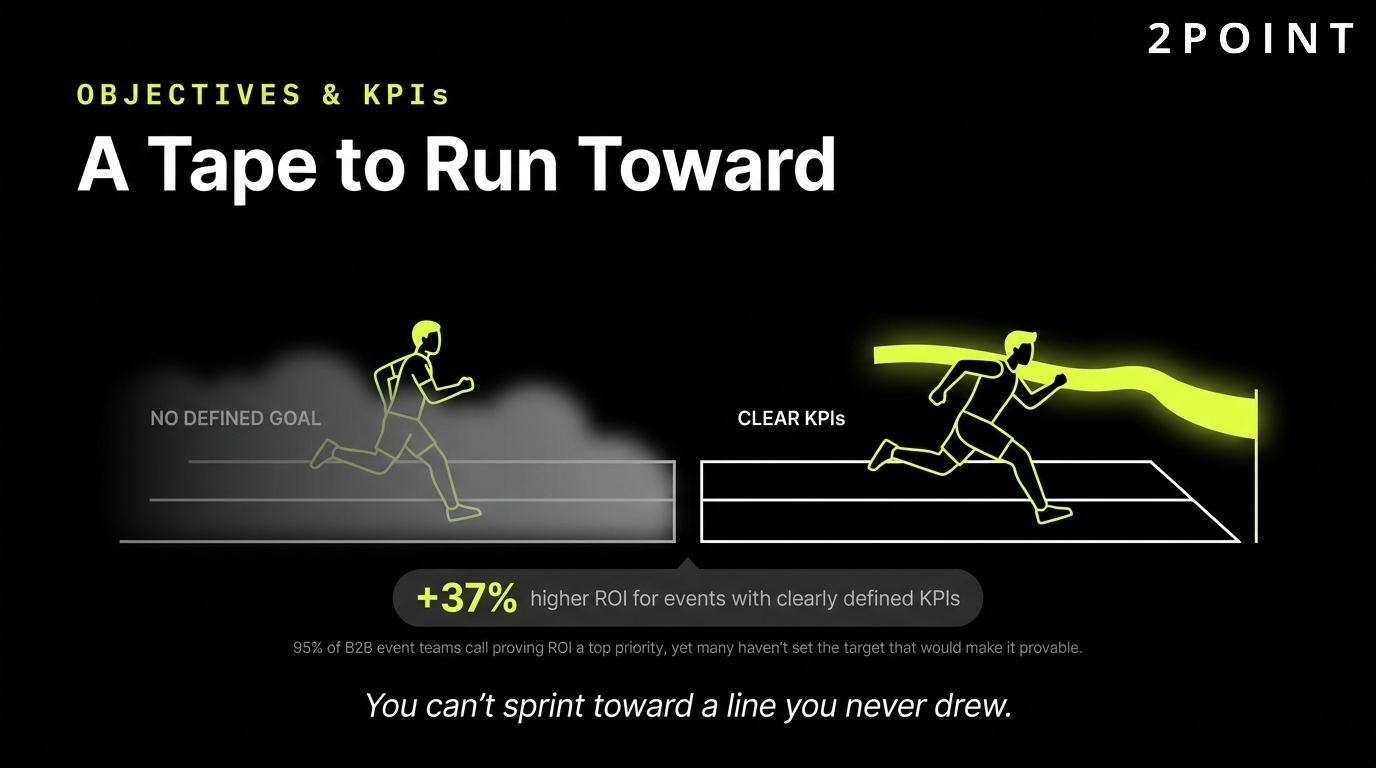
The stakes of getting this right are significant. Research shows that events with clearly defined KPIs deliver 37% higher ROI than those without them. Yet 95% of B2B event teams report that proving event ROI is a top priority, suggesting that many teams are still chasing a solution to a problem they could partially solve through better goal-setting upfront.
Objectives should also be calibrated to event type. A flagship annual conference warrants multi-dimensional objectives spanning brand, pipeline, and community. A targeted webinar for mid-funnel prospects might focus almost exclusively on opportunity creation and sales handoff quality. A trade show appearance should optimize around lead volume, lead quality, and qualified meeting bookings. Matching the objective scope to the event scope prevents both overreach and underperformance.
Crafting Your Event Value Proposition
The event marketing landscape in 2026 is saturated. Professionals receive dozens of event invitations weekly across email, LinkedIn, and digital advertising. An event that cannot articulate a compelling, differentiated reason to attend will struggle with registration regardless of promotional budget. The value proposition is the single most important strategic asset in your pre-event marketing toolkit, and it deserves far more attention than most teams give it.
A strong event value proposition answers three questions simultaneously: who is this for (the specific audience), what will they gain (the concrete outcome), and why here rather than anywhere else (the unique benefit). The template looks like this: "[Target audience] will [specific outcome] through [unique approach or experience]. Consider how that formula applies in practice: "Senior marketing leaders will leave with a tested framework for connecting event spend to revenue, delivered through a half-day workshop with their peer group and not a sales pitch." That sentence does more promotional work than three paragraphs of feature descriptions.
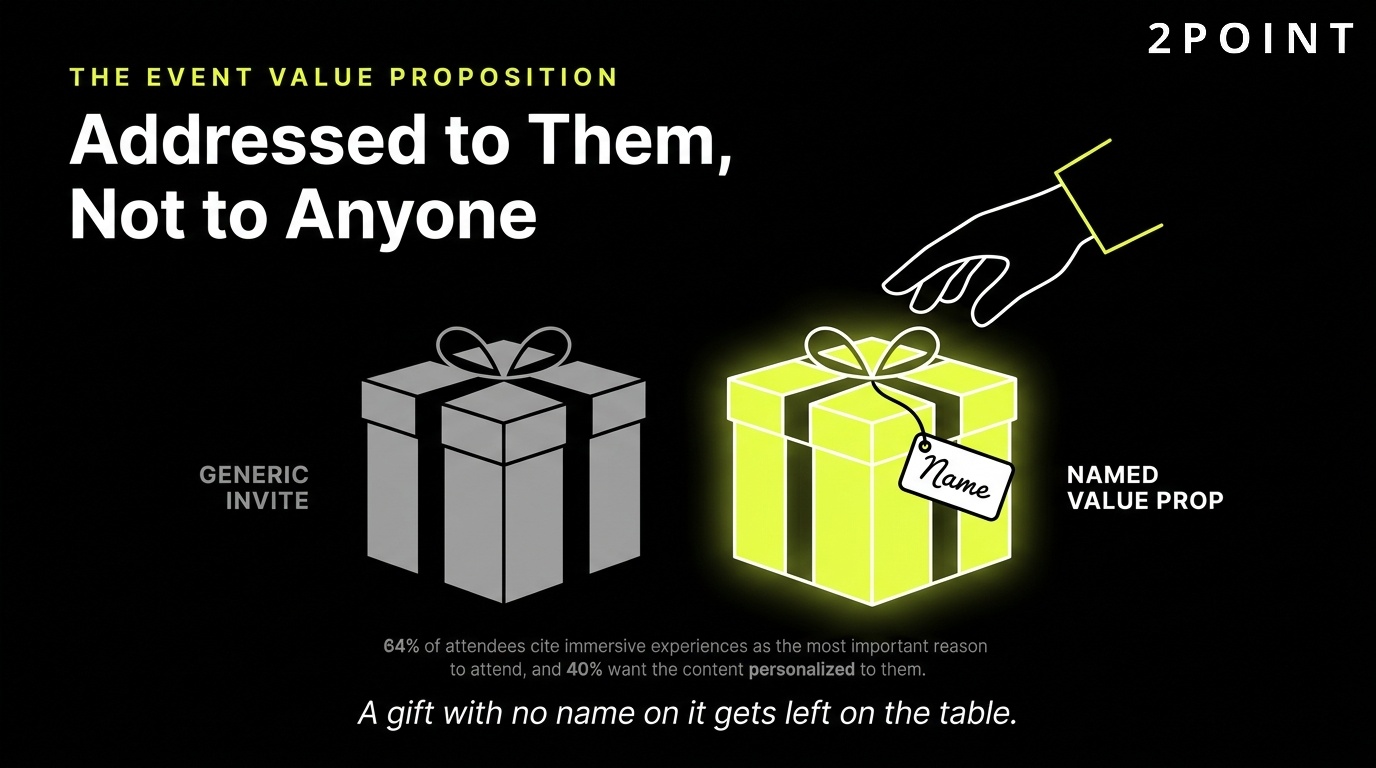
Differentiation in 2026 means going beyond content quality. 64% of attendees cite immersive experiences as the most important element of an event they choose to attend. This shifts the value proposition conversation from "what topics will we cover" toward "what will attendees actually do, feel, and accomplish." Meanwhile, 40% of organizers cite content personalization as their top improvement factor, which means a value proposition built around relevance to specific roles or industries will resonate more strongly than a generic "something for everyone" positioning.
Communicating your value proposition effectively requires adapting the core message across channels without diluting it. Your event landing page, email subject lines, social posts, and paid ads should each express the same essential promise in formats appropriate to the medium. Consistency of promise with variety of expression is the goal.
Budget Planning and Resource Allocation
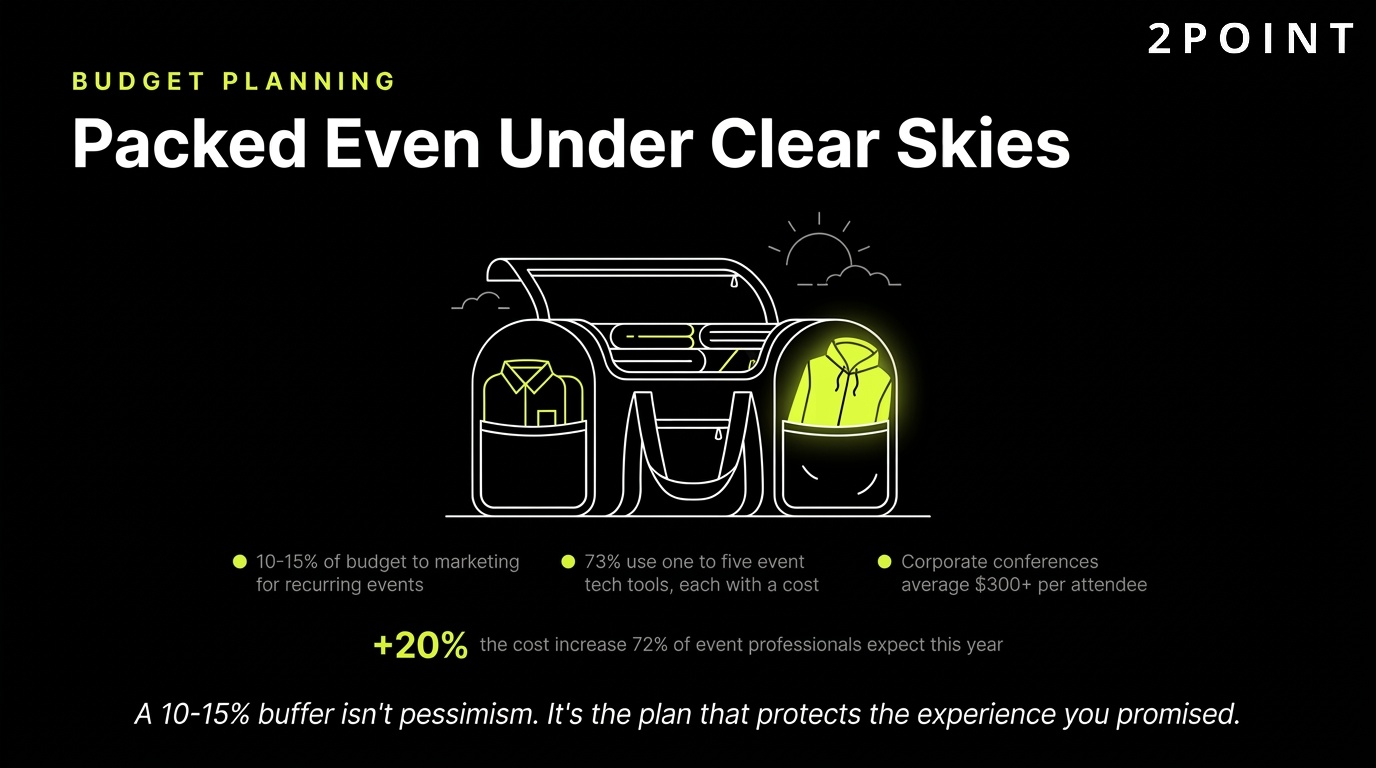
Event budgeting involves two distinct calculations that teams often conflate: the total event cost and the marketing portion of that cost. The marketing allocation, covering promotion, advertising, content creation, and agency support, generally follows a percentage-of-budget approach tied to event maturity. Recurring events typically allocate 10-15% of the total event budget to marketing, while new events require 15-20% to build initial awareness and registration momentum.
Benchmarking total event costs requires understanding the format you are operating in. Corporate conferences average over $300 per attendee, a figure that climbs significantly for premium experiences with high production values, keynote talent, and curated catering. Virtual events carry lower per-attendee costs but require investment in platform licensing, content production quality, and engagement facilitation that many teams underestimate when switching formats.
Technology represents a growing line item that deserves its own budget category. 73% of companies use between one and five event technology solutions, each carrying licensing costs, integration fees, and staff time for management. Build technology costs into your budget planning from the start rather than discovering them mid-execution.
Perhaps the most important budgeting insight for 2026 is this: cost pressure is real and widespread. 72% of event professionals expect costs to rise by up to 20% this year, driven by venue pricing, labor costs, and technology subscription increases. Building a contingency buffer of at least 10-15% into your total event budget is not pessimism; it is practical planning that protects the experience you promised attendees from last-minute compromises.
Choosing the Right Event Format for Your Goals
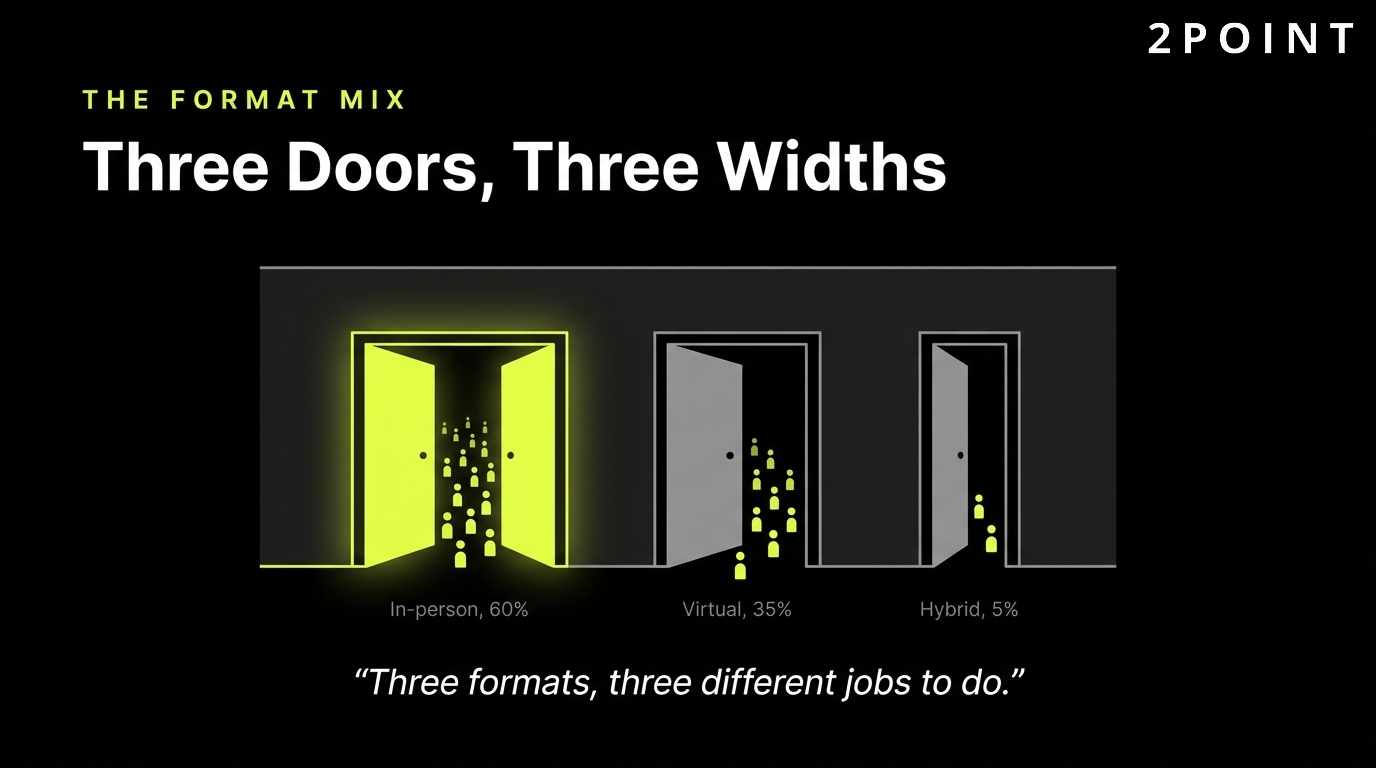
Format selection is one of the highest-leverage decisions in event strategy because it shapes everything downstream: budget, technology requirements, audience reach, depth of engagement, and measurability. The good news is that 2026 offers more format options than any previous era of event marketing, and the performance data for each is increasingly robust. The challenge is making the choice strategically rather than defaulting to habit.
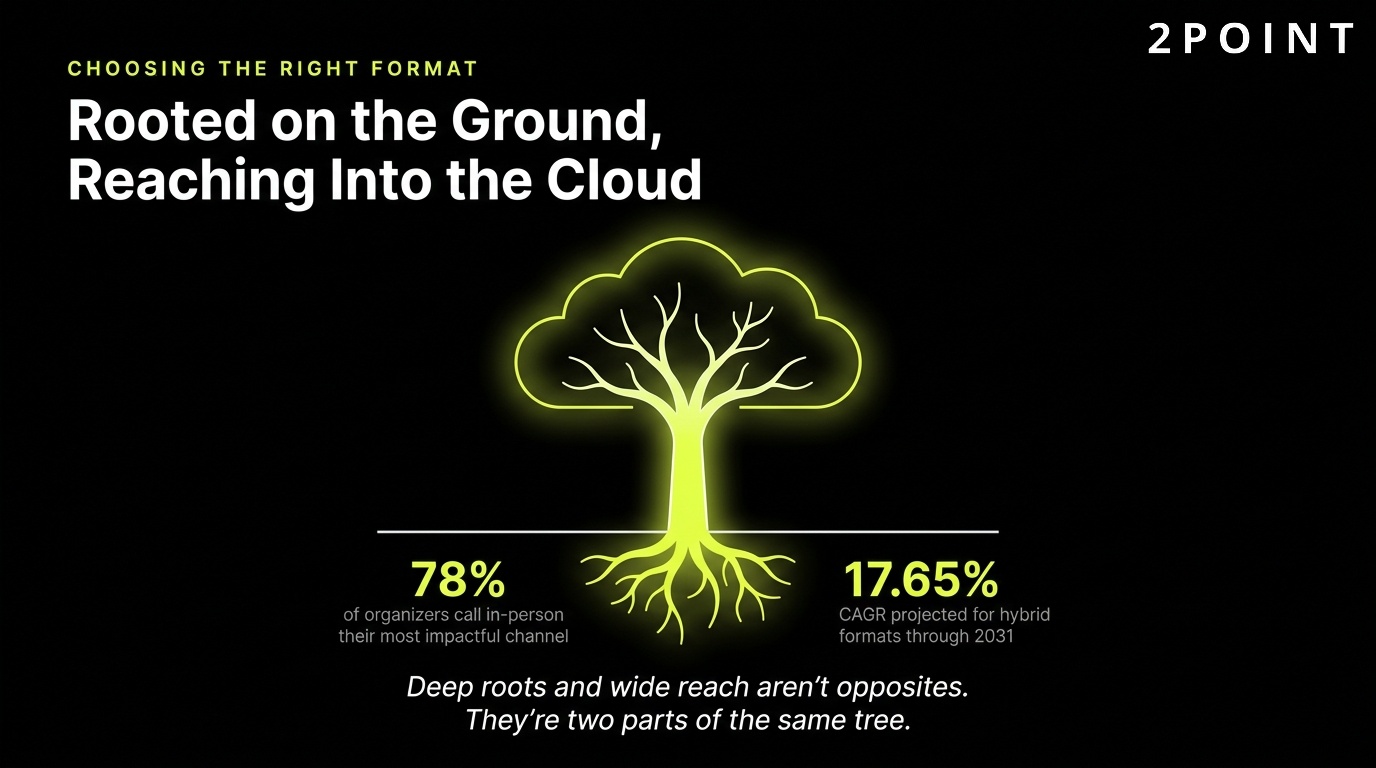
In-person events continue to dominate in terms of impact. 78% of organizers say in-person conferences are the most impactful marketing channel available to them, and 82% of attendees prefer in-person events when given a choice. The preference stems from the relationship depth, spontaneous networking, and brand immersion that physical co-presence creates. When your goal is deep pipeline acceleration, executive relationship building, or high-impact brand experiences, in-person is almost always the right answer.
Virtual events carry a different but complementary value proposition. They expand geographic reach, reduce attendee time commitment, and lower the barrier to participation for early-stage prospects who are not yet ready to invest travel time. 59% of event professionals say virtual events have become a permanent fixture in their portfolio, which reflects their value for top-of-funnel awareness, global audience building, and cost-efficient content delivery. Creating a compelling virtual event requires the same strategic rigor as an in-person event, with additional focus on keeping remote participants engaged.
Hybrid formats are expanding rapidly, with a 17.65% compound annual growth rate projected through 2031. They offer the breadth of virtual and the depth of in-person but require more sophisticated technology infrastructure and intentional design to ensure the virtual experience does not feel like a degraded version of the physical one. Micro-events, small and focused gatherings for curated audiences, are emerging as a powerful complement to large flagship events, offering the intimacy and relevance that big conferences cannot provide at scale.
Event Marketing Trends Reshaping the Industry in 2026
The event marketing industry is not simply recovering from prior disruption; it is being actively rebuilt around new capabilities, new audience expectations, and new definitions of what an event can accomplish. Understanding the trends shaping 2026 is not about chasing novelty. It is about identifying which emerging approaches have sufficient evidence behind them to warrant strategic investment, and which are still in the experimental phase.
AI Integration Across Event Workflows
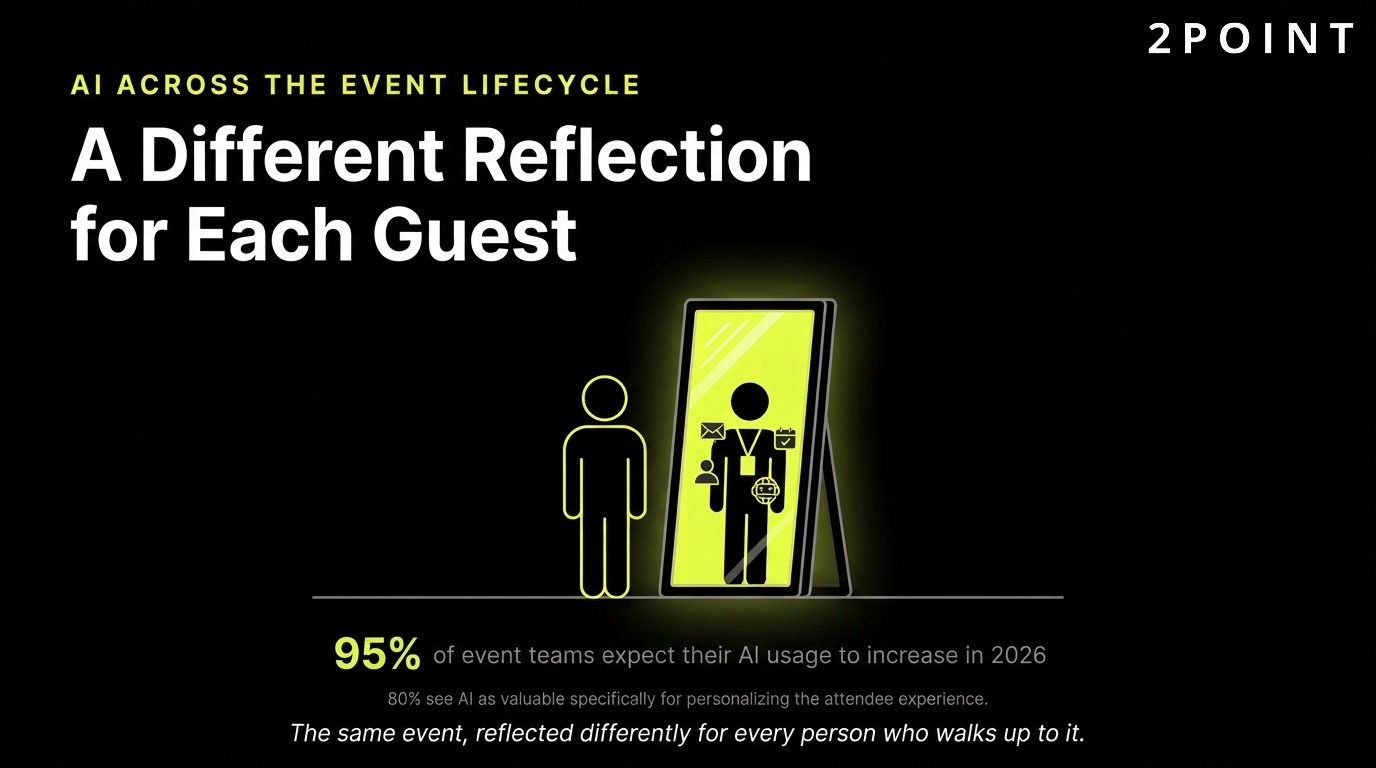
Artificial intelligence has moved from speculative technology to practical infrastructure across event marketing workflows faster than almost any other marketing discipline. The numbers reflect genuine industry momentum rather than hype: 95% of event teams expect their AI usage to increase in 2026, and the applications driving that growth span the entire event lifecycle.
In pre-event marketing, AI is being used to optimize email send times and subject lines, identify high-propensity registrants from account data, generate personalized outreach at scale, and analyze registration conversion funnel data in real time. During events, AI powers session recommendation engines, facilitates attendee-to-attendee matching for networking, and processes sentiment signals from live polls and social feeds. Post-event, AI accelerates lead scoring, content distribution, and follow-up personalization based on actual attendee behavior data.
The personalization opportunity is particularly significant. 80% of event professionals see AI as valuable specifically for personalizing attendee experiences, which aligns with the broader finding that personalization is the top improvement area organizers want to address. The practical path to AI-powered personalization starts with data infrastructure: you cannot personalize at scale without unified attendee profiles that connect registration data, behavioral signals, and CRM context. Integrating your marketing automation workflow with your event platform creates the data foundation that makes meaningful AI-driven personalization possible.
For teams new to AI in event marketing, the most practical starting points are email optimization, post-event lead scoring, and content recommendation on event apps. These use cases have clear inputs, measurable outputs, and existing vendor support. More ambitious applications like real-time agenda adjustment and AI-facilitated networking are available but require more mature data infrastructure to deliver their full value.
From Audience Building to Community Building
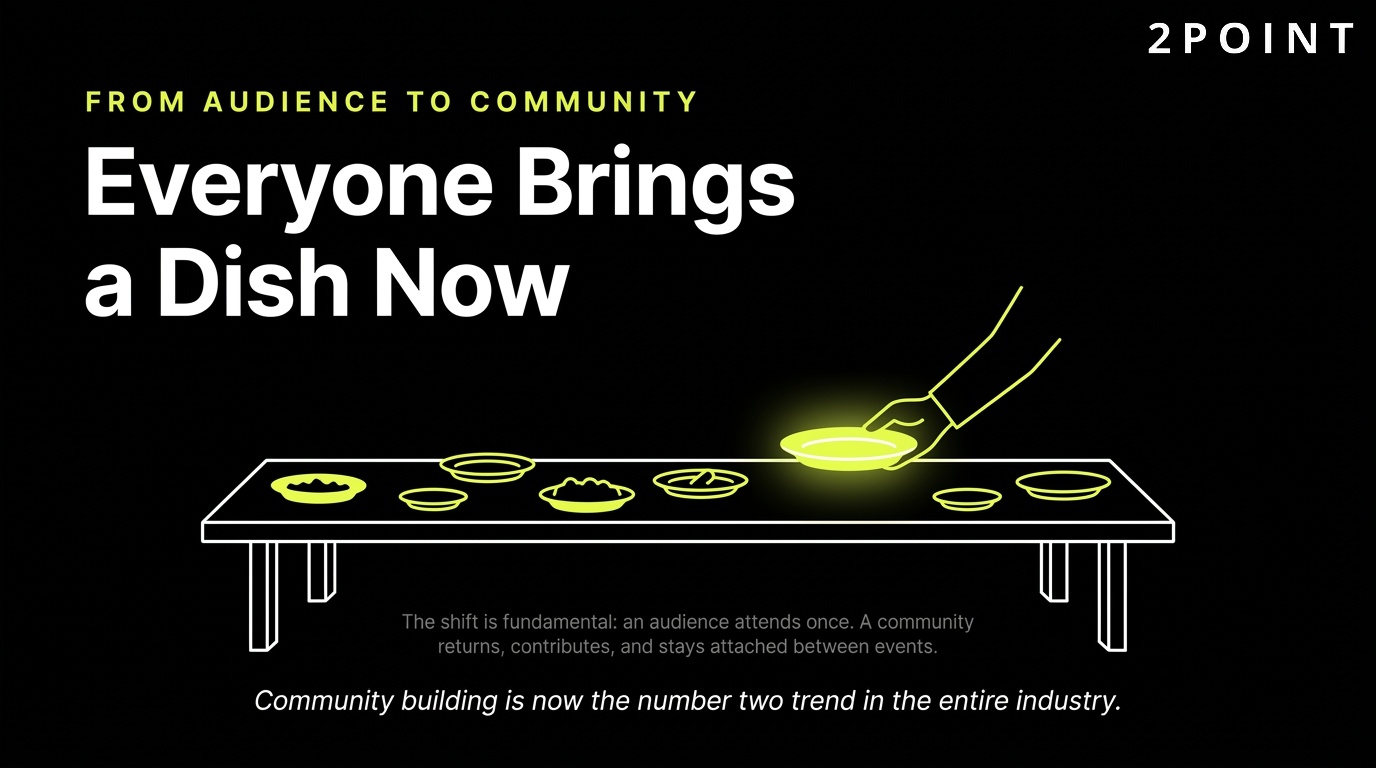
Community building has risen to the number two trend in event marketing for 2026, according to Eventex's 2026 industry ranking. The shift it represents is fundamental: moving from events as isolated encounters to events as touchpoints in an ongoing relationship. An audience attends. A community participates, contributes, and returns. The distinction matters enormously for long-term brand and business impact.
The strategic implication is that event design must account for what happens before and after the event, not just during it. Community-oriented event programs invest in digital spaces where attendees can connect between events, share knowledge, and build peer relationships that deepen their attachment to the brand hosting the community. These spaces range from branded Slack workspaces and LinkedIn groups to purpose-built community platforms with dedicated functionality for discussion, resource sharing, and member discovery.
Measuring community value requires expanding your event metrics beyond traditional attendance and lead generation KPIs. Meaningful community indicators include member retention rate between events, engagement frequency in community spaces, peer-to-peer referrals generated by community members, and the correlation between community participation and customer retention or expansion. These metrics take longer to accumulate than event-day registration counts, but they tell a far more complete story about the long-term business value of your event investment.
Practically, community building starts with intentional design choices at the event itself: structured networking sessions, peer roundtables, mentorship pairings, and content co-creation workshops. Each of these experiences creates the relational foundations that community platforms then sustain between events. The technology is the enabler; the community-oriented design is the essential ingredient.
Content Co-Creation and Participant Engagement
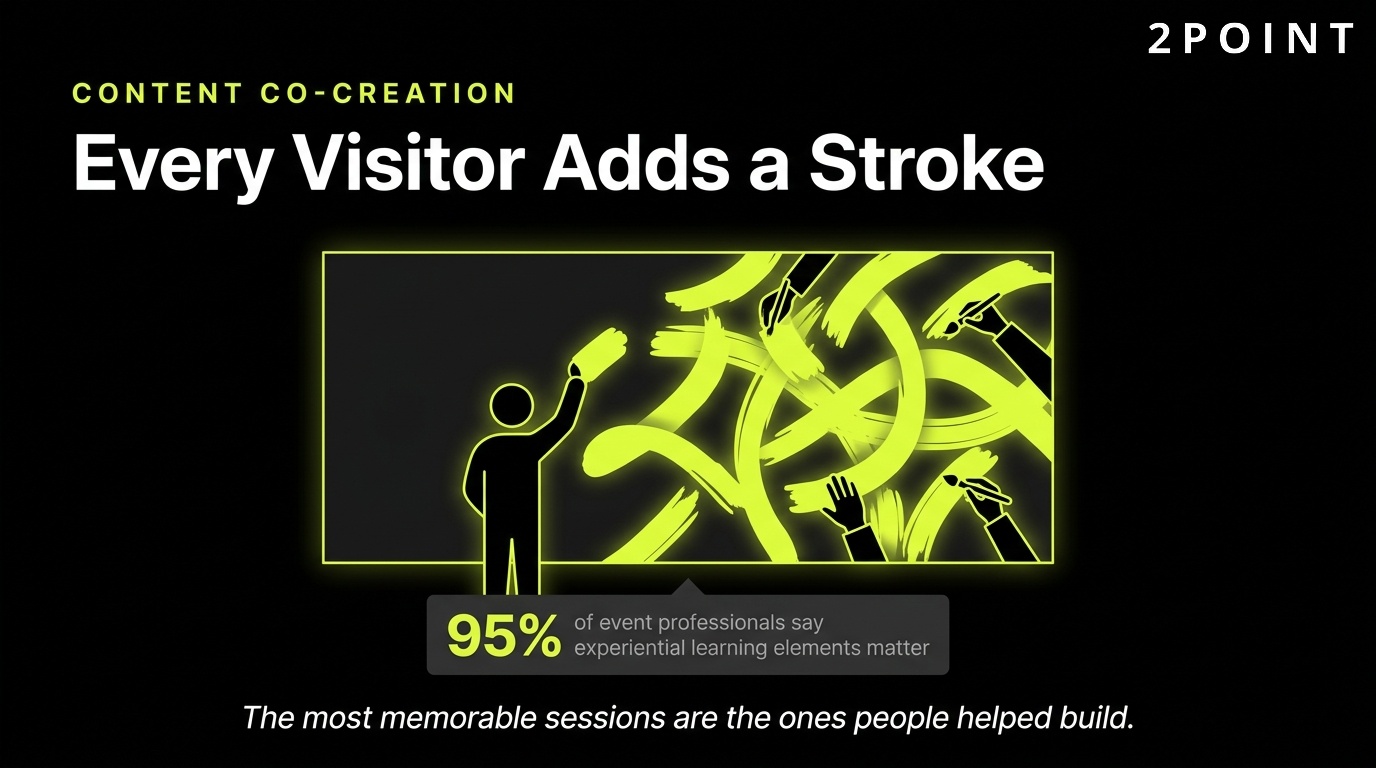
The broadcast model of event content, where expert speakers present to passive audiences, is giving way to participation models where attendees actively shape the content they experience. This evolution reflects a broader cultural shift in how professionals learn and how brands build credibility. The most memorable event sessions in 2026 are increasingly those where participants contribute knowledge, challenge assumptions, and leave having shared as well as received.
Content co-creation takes many forms. Open-space or unconference formats let attendees propose and lead their own sessions on the topics most relevant to them. Collaborative workshops produce artifacts, frameworks, or decisions that participants take home and use. Live polling and real-time question curation give audiences genuine influence over how sessions develop. Panel formats with high audience interaction ratios consistently outperform lecture-style presentations on satisfaction measures.
The data supports this directional shift. 95% of event professionals say incorporating experiential learning elements is important to their event design. Experiential learning by definition requires active participation, not passive consumption. Technologies that enable this include live Q&A platforms, collaborative digital whiteboards, in-event voting and polling tools, and mobile apps that allow real-time session feedback and content contribution.
For organizers, the shift toward co-creation requires letting go of some control over content outcomes in exchange for higher engagement, deeper learning retention, and greater attendee ownership of the event experience. The design challenge is creating structures that guide productive contribution without stifling the organic participation that makes co-creation valuable in the first place.
The Rise of Micro-Events and Curated Experiences
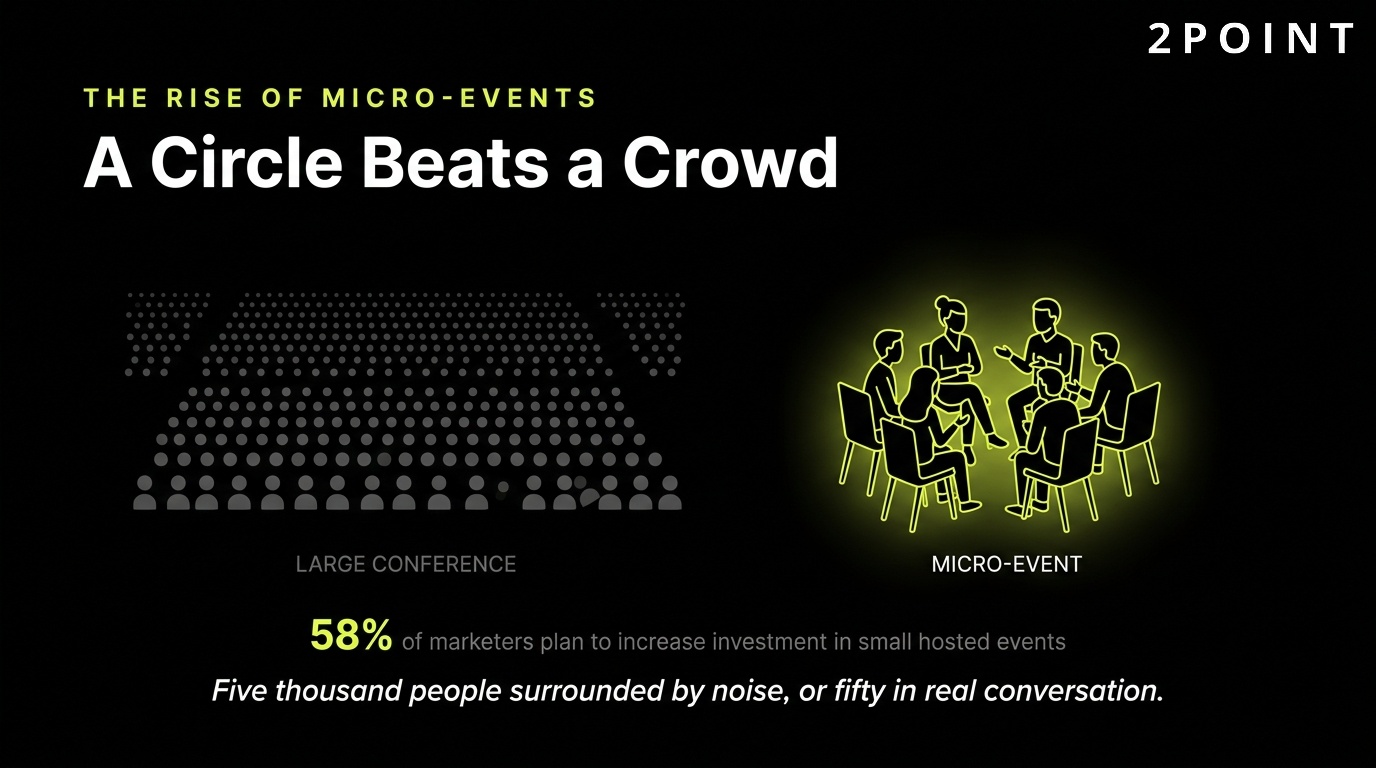
The large-scale conference is not disappearing, but it is being supplemented by a new category of intentionally smaller, more focused gathering designed for depth rather than breadth. Micro-events, typically defined as events with fewer than 100 attendees in highly curated settings, are gaining momentum as event marketers seek the intimacy, relevance, and dialogue quality that large conferences cannot efficiently deliver.
The appeal is straightforward. A 50-person executive roundtable produces more candid conversation, more meaningful networking, and more direct sales dialogue than a 5,000-person conference where your target accounts are surrounded by noise and competing vendor attention. Micro-events allow organizers to handpick the audience, tailor the content to that group's specific challenges, and create an environment where relationship-building can happen naturally and quickly.
Industry data confirms the momentum behind this format. 40% of event professionals plan to host more events in 2026, while another 40% plan to maintain their current volume. Critically, 58% of marketers plan to increase their investment in small, hosted in-person events specifically, suggesting the volume growth is disproportionately concentrated in the micro-event category rather than large-scale productions.
The most effective approach combines both scales. A flagship annual event creates broad awareness, attracts press coverage, and serves as a community gathering point. A portfolio of regional micro-events throughout the year deepens relationships with high-value accounts, maintains momentum between flagship events, and reaches prospects who cannot justify travel to a large national conference. These two formats are not competitors; they are complements in a well-designed event marketing calendar.
Measuring Event ROI and Proving Business Impact
Ask any event marketer what keeps them up at night, and measurement comes up in nearly every conversation. The challenge of connecting event investment to business outcomes is as old as event marketing itself, but 2026 brings both encouraging progress and persistent structural challenges. Understanding the current state of event ROI measurement is essential before you can build a framework that actually serves your organization.
The Current State of Event Attribution
The measurement landscape for event marketing has improved meaningfully in recent years. 40% of event professionals report difficulty proving ROI in 2026, down significantly from 70% who reported the same challenge in 2025. That improvement reflects better technology integration, more sophisticated attribution tools, and growing organizational maturity around event measurement practices.
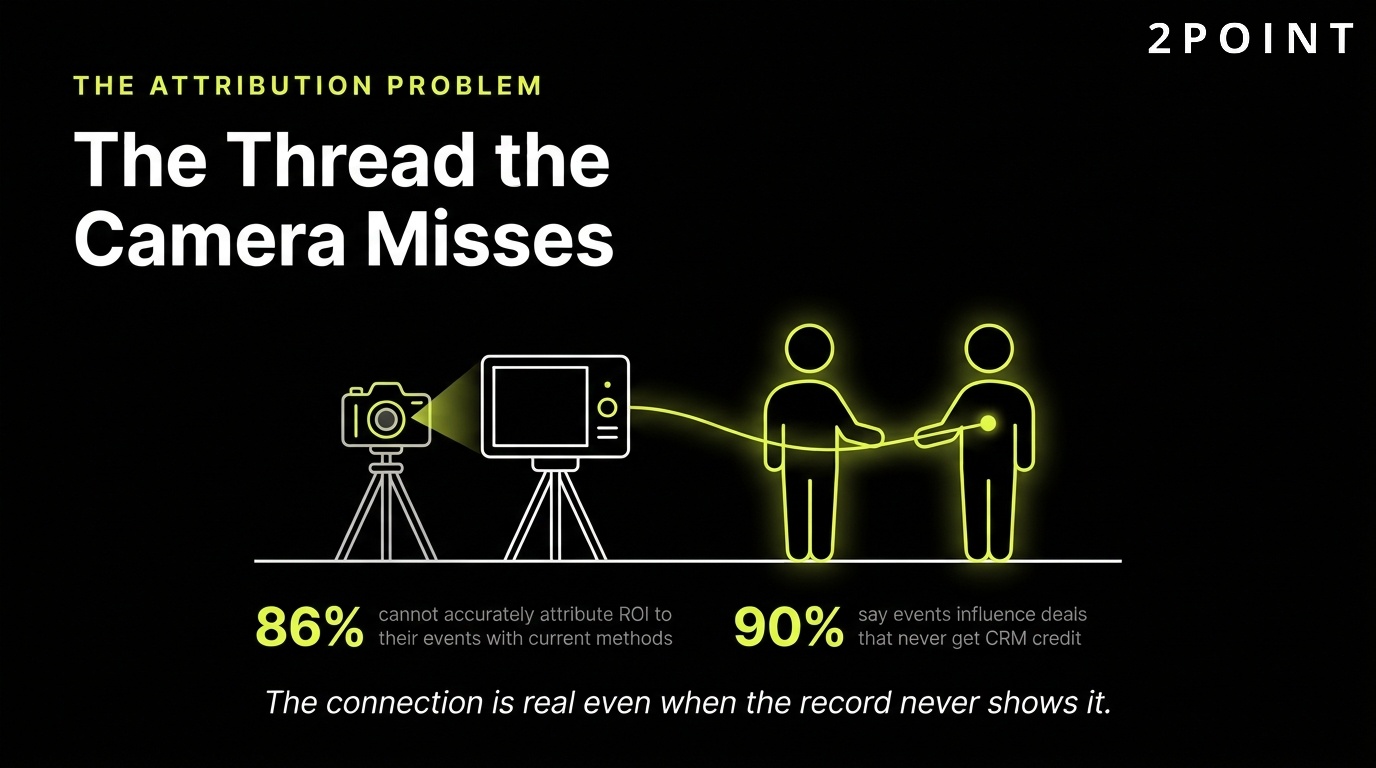
However, the persistent challenges are substantial. 98% of event marketers still struggle to justify event spend to leadership, suggesting that even teams who can measure ROI often cannot communicate it in ways that resonate with finance and executive stakeholders. Meanwhile, 86% report they cannot accurately attribute ROI to their events using current methods, and perhaps most troublingly, 90% say events influence deals that never receive credit in their CRM systems.
The root cause of poor attribution lies in how traditional marketing measurement models were designed. First-touch and last-touch attribution models miss the relationship-building and pipeline acceleration value that events create at multiple points in the buyer journey. A prospect who attended your user conference two years ago, reconnected with your team at a trade show last quarter, and just entered an active deal opportunity touched your brand through events at least twice, but neither touch may appear as an attributed event influence in standard CRM reporting.
Multi-touch attribution models offer a partial solution, and purpose-built event intelligence platforms offer a more complete one. The most effective measurement approaches combine CRM integration for tracking opportunity progression, account-level data matching to connect event attendance to revenue outcomes, and qualitative capture (post-event surveys, sales notes) to record influence that technology cannot automatically detect.
Event ROI Benchmarks by Channel and Format
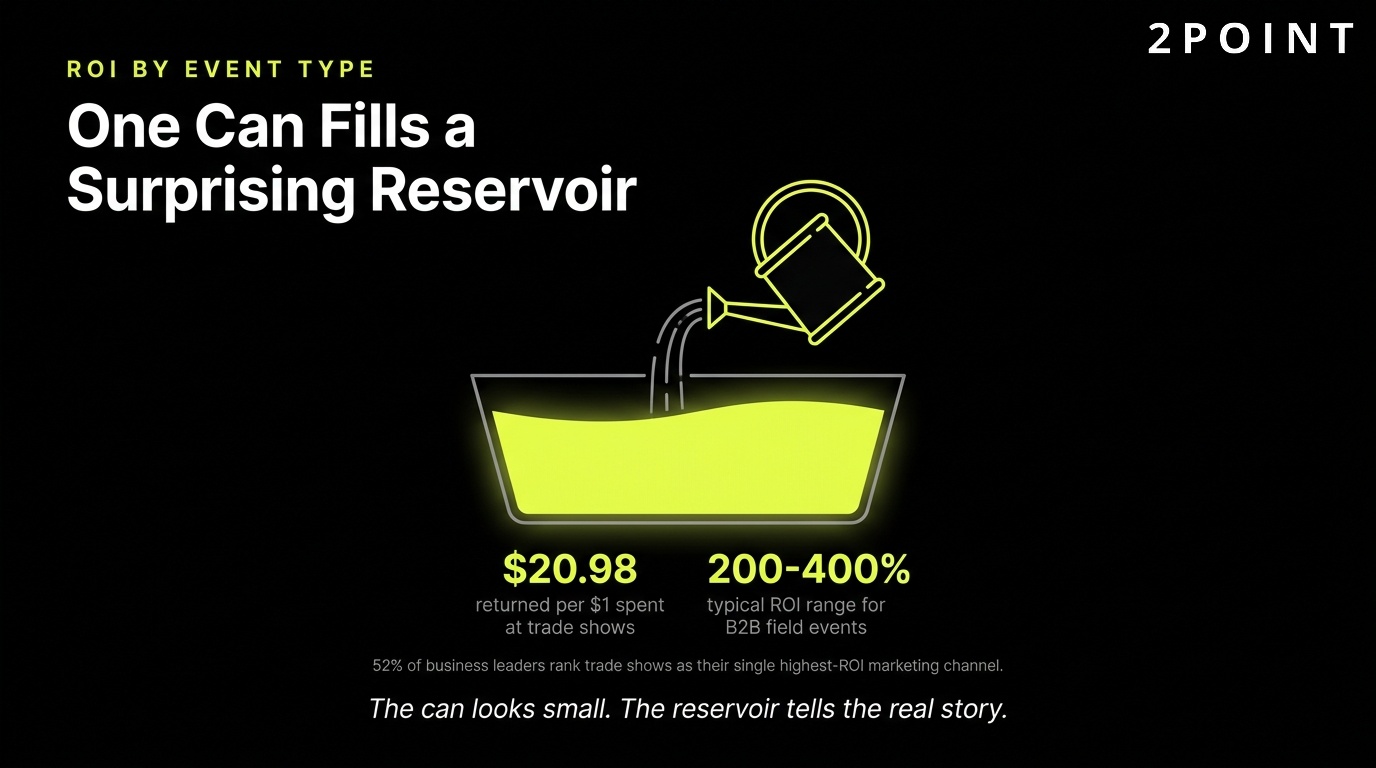
Understanding what "good" looks like across event types and formats is essential for setting realistic expectations, building business cases, and evaluating performance. The benchmarks below reflect current industry data and provide context for how different event investments tend to perform.
| Event Type / Channel | ROI Benchmark | Key Data Source |
|---|---|---|
| B2B Field Events | 200-400% ROI | EventBudgetCal |
| Trade Shows | $20.98 return per $1 spent | Wave Connect |
| Trade Shows vs. Other Channels | 52% of business leaders rank highest ROI channel | Wave Connect |
| Fortune 500 Exhibition | 14% report 5:1 or better ROI | Wave Connect |
| Hybrid Events (B2B) | 86% positive ROI within 7 months | Industry Aggregate |
| In-Person Registration-to-Attendance | 70-85% conversion rate | EventBudgetCal |
| Virtual Registration-to-Attendance | 35-55% conversion rate | EventBudgetCal |
The most important takeaway from this benchmark comparison is that event ROI, when properly measured, consistently outperforms most alternative marketing channels, with trade shows and B2B field events delivering among the highest returns available to marketing organizations.
Lead Generation and Pipeline Metrics
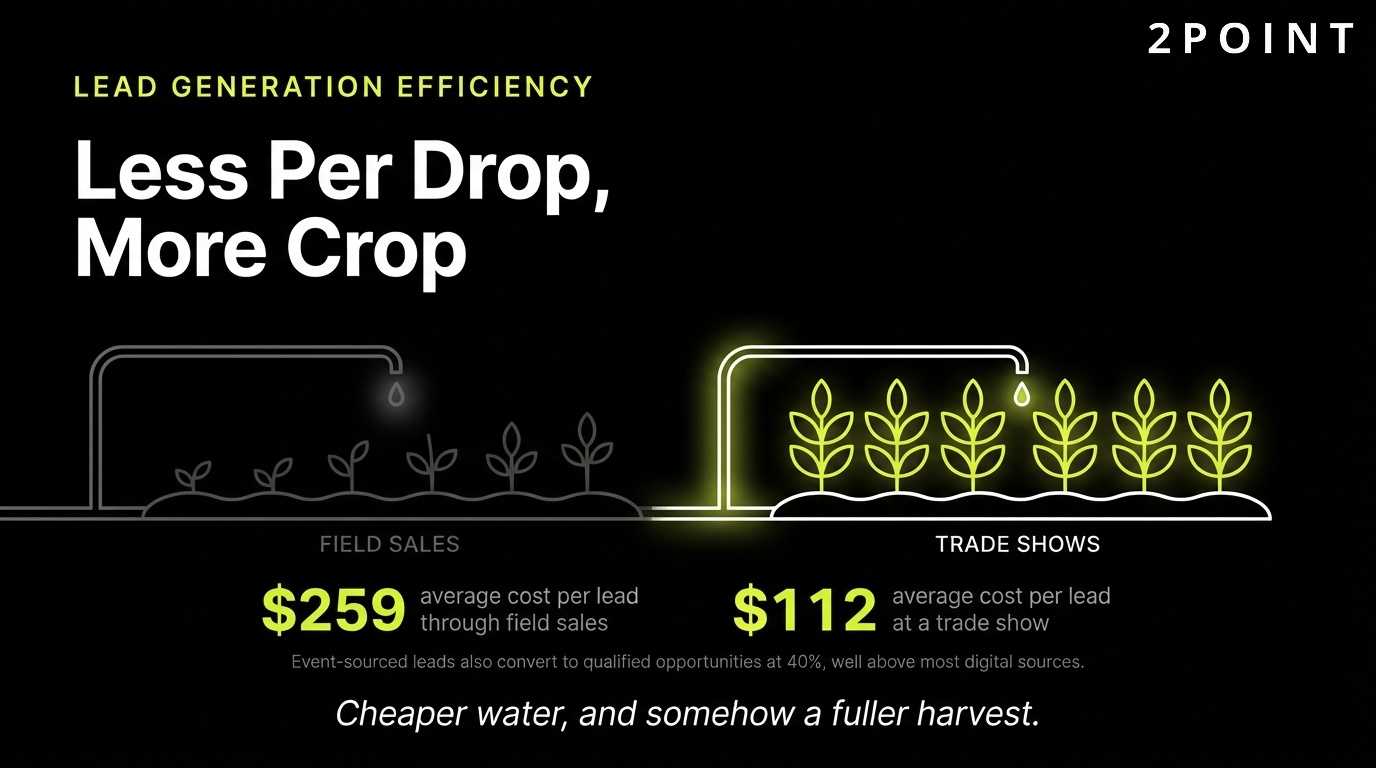
Lead generation is frequently the primary stated objective for event marketing investment, and the performance data is compelling when events are executed with proper tracking infrastructure. The cost efficiency of event-sourced leads relative to other acquisition channels is particularly striking when you account for both volume and conversion quality.
Consider the cost-per-lead comparison: trade shows generate leads at an average cost of $112, compared to $259 for field sales. That efficiency advantage compounds when you factor in conversion rates. Event-sourced leads convert from initial contact to qualified opportunity at a 40% rate, which is substantially higher than most digital lead sources. The combination of lower acquisition cost and higher conversion rate makes a compelling financial case for event investment even before accounting for the pipeline acceleration and brand impact that events also deliver.
The pipeline impact extends beyond new leads. 52% of B2B SaaS marketers attribute at least half of their closed-won business to event influence, and 72% report that prospects who attend events close faster than those who do not. Speed-to-close improvement is a particularly valuable metric because it directly affects revenue predictability and sales cycle efficiency, both outcomes that finance and executive stakeholders care deeply about.
Capturing these metrics requires intentional tracking infrastructure. Every event attendee who is an active prospect or customer should be flagged in your CRM with the event, date, and interaction type. Sales teams need clear processes for logging event conversations and their outcomes. Opportunity records should carry event influence fields that allow you to pull accurate pipeline attribution reports weeks and months after the event concludes. Without this infrastructure, the lead generation value of events becomes anecdotal rather than measurable.
Building Your Event Measurement Framework
A robust event measurement framework organizes KPIs by the primary objective each event serves, ensuring that you are measuring what actually matters for that specific investment rather than applying a generic scorecard that conflates different types of success.
| Primary Event Goal | Key Metrics to Track | Measurement Timing |
|---|---|---|
| Brand Awareness | Reach, impressions, brand recall lift, social mentions, media coverage | During and immediately post-event |
| Demand Generation | New leads, cost per lead, lead quality score, SQLs generated | Event day plus 2-week follow-up period |
| Pipeline Acceleration | Opportunities influenced, average deal size change, speed-to-close improvement | 30-90 days post-event |
| Customer Retention | Customer NPS change, expansion revenue, renewal rates for attendees vs. non-attendees | 90-180 days post-event |
| Community Building | Community membership growth, engagement rate, peer referrals generated | Ongoing, tracked quarterly |
The most effective measurement frameworks combine immediate metrics with long-term impact indicators, recognizing that the full business value of event marketing often unfolds over months rather than days.
79% of event teams now have their event platform integrated with CRM or marketing automation, which provides the technical foundation for this kind of multi-dimensional, time-extended measurement. Teams that have not yet achieved this integration should treat it as a priority investment because it is the single most important enabler of credible event ROI reporting.
Pre-Event Marketing Strategy and Promotion
The most well-designed event cannot succeed if the right people do not know it exists, or if they know it exists but are not convinced it is worth their time. Pre-event marketing is the discipline of solving both of those problems simultaneously, building awareness among your target audience while compelling them to register and commit to attending. Effective pre-event marketing is not a single campaign; it is an integrated multi-channel program that builds momentum progressively over the weeks or months before your event.
SEO and Organic Discoverability
Search engine optimization for events operates on a timeline that most event teams underestimate. Ranking on the first page of Google for relevant event-related queries takes months of consistent content and technical optimization, which means your SEO work needs to begin long before your promotional sprint. Event pages that are published one month before the event date and optimized at the same time rarely achieve meaningful organic traffic before the registration window closes.
On-page optimization for event landing pages should follow the same principles as any high-value content asset: a keyword-rich title tag and meta description, header tags that reflect actual search queries your audience would use, and body content that addresses the who, what, when, where, and why of your event in clear language. Event schema markup is particularly valuable because it enables Google to display your event in rich result formats including event listings in search results, which significantly increases click-through rates from organic traffic.
A content marketing approach that supports event discovery creates blog posts, guides, and thought leadership content around the themes your event will address. These assets attract organic search traffic from potential attendees who are researching the topics your event covers, and they provide natural pathways to your event registration page. Speaker interviews, preview content, and perspective pieces on the challenges your event addresses all serve double duty: they support SEO and they build anticipation among your existing audience. As part of a broader marketing plan, event-specific content can serve both promotional and long-term brand authority goals.
For in-person events, local SEO deserves specific attention. Optimizing for location-based queries ("marketing conference [city] 2026") can drive significant registration volume from professionals in your event's host city or region who are actively searching for nearby professional development opportunities. This audience often has lower registration barriers because they do not need to justify travel costs.
Multi-Channel Promotional Strategy
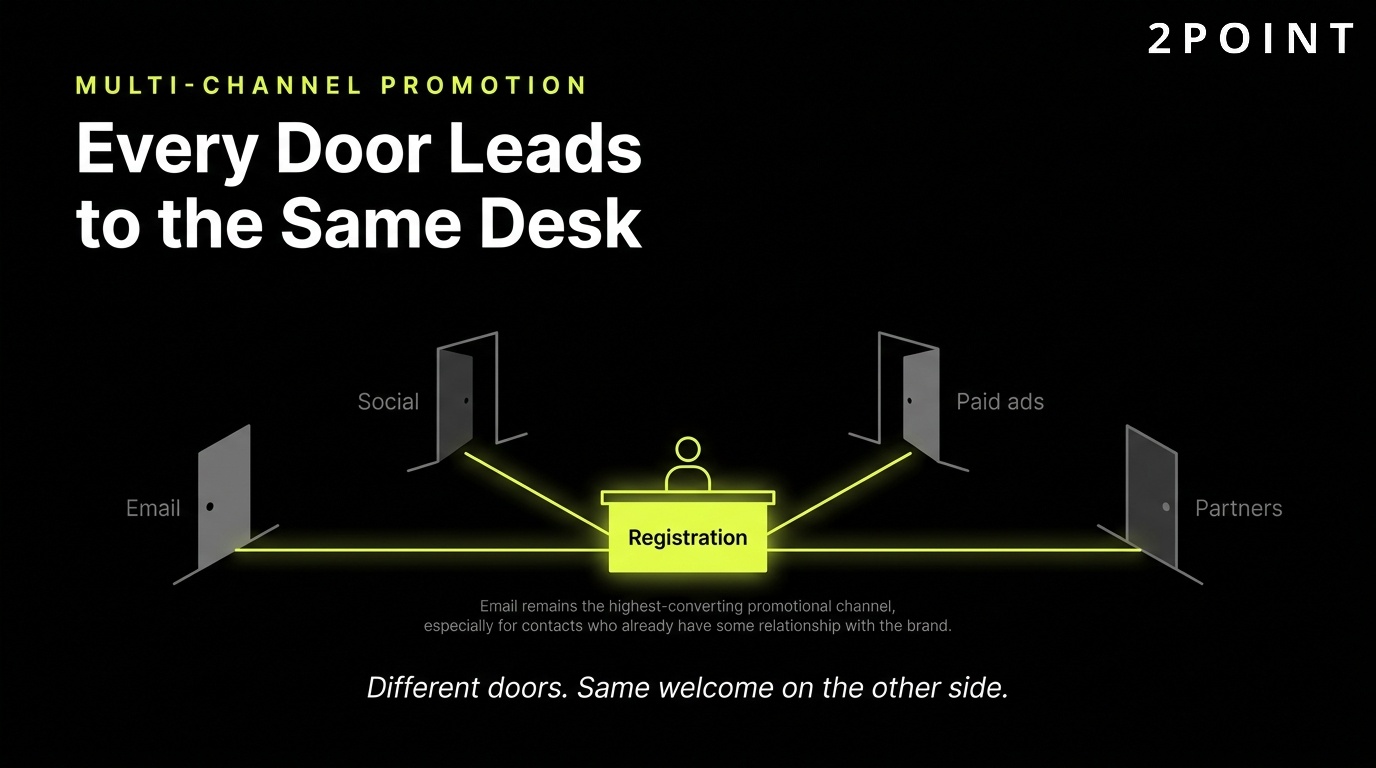
The most effective pre-event promotional programs use multiple channels in a coordinated sequence rather than broadcasting the same message across all platforms simultaneously. Email, social media, paid advertising, and partner amplification each play distinct roles in moving potential attendees from awareness through consideration to registration, and timing their use intentionally produces better results than launching everything at once.
Email marketing remains the highest-converting channel for event promotion, particularly for existing contacts who already have some relationship with your brand. A well-structured email sequence for a major event might include a save-the-date announcement, a content-forward invitation that explains the value proposition in depth, a speaker highlight series, a social proof message featuring early registrants or testimonials from past attendees, and a final urgency-driven message in the week before early-bird pricing ends. Incorporating email marketing automation into your event promotional sequence allows you to trigger relevant messages based on registrant behavior and segment non-registrants for retargeting without manual list management.
Social media amplification works best when it combines organic content, paid promotion, and activated third-party voices. Organic social builds community among existing followers and gives registrants content to share. Paid social allows you to reach lookalike audiences and retarget website visitors who viewed your event page without registering. Partner and sponsor social amplification extends your reach into networks you could not otherwise access. Taken together, these layers create the kind of multiple-exposure promotion that drives registration conversion in an attention-fragmented environment. Understanding the full range of social media marketing benefits can help you allocate your promotional efforts more strategically across platforms.
Landing Page Optimization and Conversion
Your event landing page is doing the most important conversion work in your entire pre-event marketing program. Every click from every channel, whether email, social, paid ad, or partner referral, lands here. A landing page that fails to communicate value clearly, load quickly on mobile, or make registration frictionless will undercut the performance of every other promotional investment you make. This page deserves disproportionate attention and testing investment.
High-converting event landing pages share several structural characteristics. The hero section above the fold must immediately communicate the event name, date, location or format, and the primary value proposition in language that resonates with your target audience. Social proof, including speaker names and credentials, logos of past attendees or sponsors, and testimonials from previous events, should appear early in the page to establish credibility before the visitor has scrolled far. A clear, prominent registration call-to-action needs to appear multiple times as the visitor scrolls, not just at the bottom.
Mobile optimization is not optional. The majority of email and social traffic now comes from mobile devices, which means your event page must render perfectly on smartphone screens, load in under three seconds, and present a registration form that is completable without frustration on a small touchscreen. Registration forms themselves should ask for only the information you genuinely need at the registration stage. Every additional field reduces completion rates, and information you want but do not need at signup can be collected through pre-event surveys or during check-in.
A/B testing should be a continuous practice rather than a one-time exercise. Test headline variations, hero imagery, call-to-action button copy, form length, and social proof placement over the course of your registration window. Even modest conversion rate improvements on a page receiving significant traffic can translate to meaningful registration volume increases that justify the testing investment many times over.
Leveraging Speakers and Influencers
Your speakers are among your most powerful promotional assets, and most event teams significantly underutilize them. A confirmed keynote speaker or panel participant who shares your event with their professional network exposes your event to a pre-qualified audience of professionals who trust that person's judgment about what is worth their time. That implied endorsement is more persuasive than any paid advertisement you can create.
Activating speakers as promotional partners starts with making it easy for them to participate. Create shareable assets in advance: pre-written social posts with event hashtags, speaker announcement graphics formatted for LinkedIn and Instagram, email signature badges, and short promotional video clips they can post to their channels. Provide a simple promotional calendar with suggested posting dates and the platforms where their amplification will have the most impact. The easier you make it, the more speakers will actually do it.
Industry influencers who are not formal speakers can also be valuable promotional partners, particularly when their audience closely matches your target attendee profile. Influencer partnerships for event marketing work best when the influencer has a genuine connection to the event topic and can speak authentically about why it is worth attending, rather than simply broadcasting a promotional message to their followers. Measuring influencer impact on registration requires UTM parameters on all influencer-specific links so you can track registration volume and quality from each partner's audience separately.
Event Technology Stack and Integration
Technology is the operational backbone of modern event marketing. The right technology stack makes it possible to manage registration at scale, deliver personalized experiences, capture behavioral data, and connect event outcomes to business results. The wrong stack, or a stack that does not integrate properly, creates data silos, manual work, and measurement gaps that undermine the strategic value of your events.
Core Event Platform Requirements
Evaluating event management platforms requires clarity about which capabilities are non-negotiable for your use case and which are nice-to-have enhancements. The non-negotiable foundation includes registration and ticketing functionality with flexible pricing options, attendee data management with segmentation capabilities, integrated email communication tools, and reporting and analytics that go beyond simple headcounts to include behavioral engagement data.
Mobile experience has moved from optional enhancement to core requirement. 73% of conference attendees expect modern technology at in-person events, with event mobile apps being one of the most visible expressions of that expectation. Apps that include personalized agendas, networking directories, real-time session feedback, and interactive maps significantly enhance the attendee experience while simultaneously generating behavioral data you can use for follow-up personalization and long-term engagement measurement.
Platform satisfaction in the event technology market remains a challenge. 64% of event professionals plan to change their event management vendor within the next year, suggesting widespread dissatisfaction with current platforms. This high churn rate reflects the rapid pace of capability development in the space, combined with the growing demands that event marketers are placing on their technology. If you are evaluating platforms, prioritize integration depth, reporting flexibility, and AI-readiness over feature surface area alone.
CRM and Marketing Automation Integration
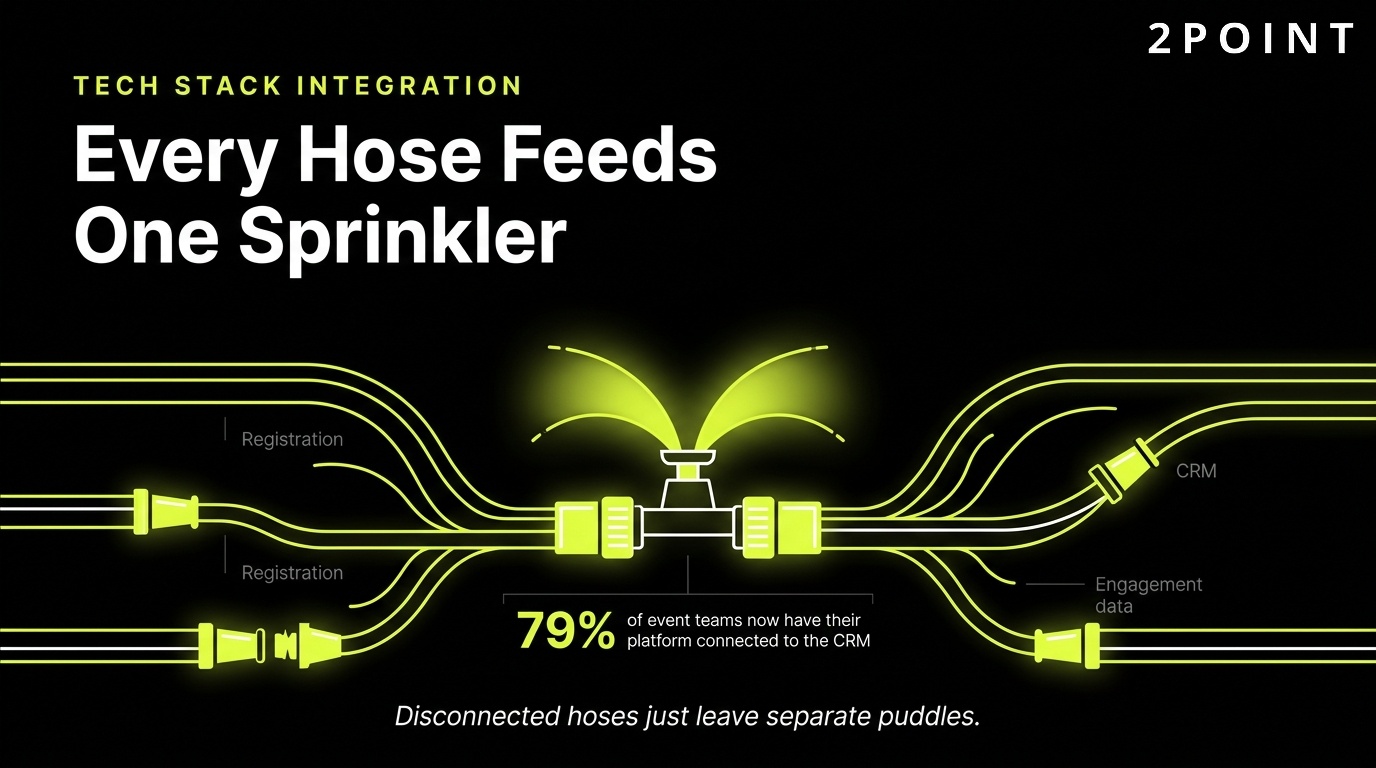
The integration between your event platform and your CRM is the single most important technical investment in your event marketing stack. Without it, attendee data lives in a separate system from your customer and prospect records, lead follow-up relies on manual exports, and the pipeline impact of your events remains invisible in your revenue reporting. With it, every registration, session attendance, engagement interaction, and post-event conversation automatically enriches the customer record in your CRM and triggers appropriate follow-up workflows.
79% of event teams have already integrated their event platform with CRM or marketing automation systems, which means the 21% who have not are operating at a significant competitive disadvantage in terms of measurement, follow-up speed, and data quality. The integration should be bidirectional: event platform data flows into the CRM to enrich prospect and customer records, and CRM data flows back into the event platform to enable personalized communications based on account status, deal stage, or customer history.
Post-event follow-up automation is one of the highest-value applications of this integration. A well-designed automation workflow can trigger different follow-up sequences based on session attendance patterns, engagement scores, and lead quality ratings calculated from behavioral data. A prospect who attended three sessions on your enterprise product and visited the pricing booth receives a different outreach than one who attended only the keynote. This level of personalization at scale is only possible when your event and marketing automation platforms share data in real time. Using automation tools in marketing can dramatically reduce the manual burden of post-event follow-up while improving the relevance and timeliness of your outreach.
Event Tech Budget and Vendor Selection
Event technology investment varies considerably by organization size and event complexity. 24% of event organizations spend between $10,000 and $50,000 annually on event technology, while 21% spend between $50,000 and $250,000. These figures reflect significant variation in the breadth of tools purchased and the scale of events they support.
The build versus buy decision arises most often around custom integrations and specialized reporting. In most cases, buying purpose-built event technology and connecting it through APIs or middleware is faster, cheaper, and more reliable than building custom solutions. The exception is when your event program has genuinely unique requirements that no commercial platform addresses, which is relatively rare outside of very large enterprise environments.
Vendor selection should weight integration ecosystem heavily. 73% of organizations use between one and five event tech solutions, which means your chosen platforms need to play well together. Evaluate each vendor's native integrations with your existing CRM, marketing automation, and analytics platforms before committing. A platform that requires extensive custom development to connect to your existing stack carries hidden costs that will exceed any upfront savings from a lower licensing price.
Emerging Technologies: AI, Data Platforms, and Attribution Tools
Beyond the core platform stack, a new category of specialized event intelligence tools is gaining adoption among sophisticated event marketing teams. Predictive attendee data platforms use account firmographic data, intent signals, and historical event attendance patterns to identify which accounts are most likely to be at specific industry events, enabling targeted outreach before and during events to maximize relationship coverage. These platforms are particularly valuable for B2B teams managing large trade show and conference calendars where proactive meeting scheduling is a key success driver.
Account-level attribution tools represent another significant capability advancement. Rather than tracking individual lead touches, these platforms analyze event participation at the account level and correlate attendance patterns with revenue outcomes across the entire customer lifecycle. This approach surfaces insights that individual-level attribution misses entirely, such as the pattern that accounts with three or more employees attending your events over a rolling 12-month period close at a significantly higher rate than those with one or fewer attendees.
AI-powered session analytics tools that process real-time engagement data, sentiment signals from polling responses, and speaker performance indicators are moving from experimental to production-ready status. 95% of event teams expect AI usage to increase across their workflows, and the technology infrastructure to support that expansion is increasingly mature and accessible. Understanding current video marketing trends is also relevant here, as AI-powered video analysis tools are beginning to be applied to event session recordings for content performance measurement and repurposing.
B2B Event Marketing Strategy
Business-to-business event marketing operates under specific constraints and opportunities that distinguish it from consumer-facing event programs. The buying cycles are longer, the decision-making involves multiple stakeholders, the relationship between event investment and revenue is more complex to demonstrate, and the audience expects a higher standard of relevance and professionalism. At the same time, the ROI potential of B2B events when executed strategically is among the highest available across all B2B marketing channels.
B2B Budget Allocation and Investment Trends
Event spending within B2B marketing budgets has returned to and in many cases exceeded pre-pandemic levels. 17% of B2B marketing budgets now go to events, reflecting a restoration of confidence in live experiences as core pipeline drivers. This figure varies significantly by industry and business model: software and enterprise technology companies, where deal values are high and relationship quality is a primary competitive differentiator, tend to invest at the higher end of the range, while manufacturing and lower-average-contract-value businesses often invest at lower percentages.
Investment trajectory for 2026 is strongly positive. 86% of B2B marketers plan to increase their event spending in 2026, a remarkable consensus figure that reflects both the demonstrated value of events and growing confidence in the measurement tools available to justify that investment. However, the nature of that investment is evolving: 55% plan to maintain the same number of events while increasing per-event investment, suggesting a strategic shift toward fewer, higher-impact experiences rather than volume expansion.
Building the business case for increased event investment requires speaking the language of the stakeholders who approve the budget. Finance stakeholders respond to cost-per-lead comparisons, pipeline influence calculations, and ROI benchmarks from comparable organizations. Sales leadership responds to speed-to-close improvements and deal size correlations with event attendance. Executive stakeholders respond to competitive differentiation arguments and strategic relationship building at industry events. Having data-ready versions of each argument, tailored to each audience, is essential for securing and protecting event budget in complex organizations.
Account-Based Event Marketing
Account-based marketing and event marketing are natural allies because both disciplines prioritize depth of engagement with a defined set of high-value targets over broad reach to undefined audiences. Integrating ABM strategy with your event program means treating events not as standalone campaigns but as coordinated touchpoints in a multi-channel account engagement strategy designed to advance specific named accounts through your pipeline.
Pre-event ABM integration starts with identifying which target accounts have employees registered for or likely to attend each event on your calendar. This intelligence allows your sales and marketing teams to coordinate targeted outreach before the event, secure meetings in advance, and ensure that your event presence is staffed and prepared to engage specific accounts with relevant, personalized conversations rather than generic booth interactions.
VIP experiences and executive programs are among the most powerful account-based event tactics available. A private dinner for six target account executives, a curated site visit for prospects who share an industry challenge, or a hosted executive roundtable for current enterprise customers all create the kind of intimate, relevant interaction that large conference environments cannot replicate. These experiences work best when they are designed around the genuine interests and challenges of the accounts being invited, rather than as thinly veiled sales presentations. The alignment between customer-centric marketing principles and event design is particularly evident in account-based event programs.
Managing Multi-Stakeholder Event Decisions
One of the defining realities of B2B event marketing in 2026 is that event budget decisions rarely rest with a single decision-maker. Multi-stakeholder committee approval is the norm at mid-market and enterprise organizations, which means event marketers must build alignment across marketing, sales, finance, and often executive leadership before major event investments can proceed. Understanding this dynamic and designing your internal communication strategy around it is as important as the event strategy itself.
Cross-functional alignment starts with involving key stakeholders in event strategy conversations before budget requests are submitted. When sales leadership has contributed to the event objectives and understands how the event serves their pipeline goals, they become advocates rather than skeptics when finance reviews the budget. When executive sponsors see their relationship-building priorities reflected in the event program, they are more likely to support the investment and participate actively in the event itself.
Documentation and reporting frameworks serve double duty in multi-stakeholder environments: they satisfy the approval process upfront and they provide the performance reporting structure that demonstrates value afterward. Create a one-page event brief for each major event that articulates objectives, target audience, expected outcomes, and measurement approach in plain language. Distribute a post-event report in the same format that shows actual performance against those pre-agreed metrics. This consistency builds credibility over time and makes subsequent budget conversations progressively easier.
Customer Marketing at Events
Customer-focused events are often the most underinvested component of B2B event portfolios, despite delivering some of the strongest and most measurable business outcomes. The economics are compelling: retaining and expanding existing customers is consistently less expensive than acquiring new ones, and events are among the most effective retention and expansion tools available. 70% of attendees report being more likely to become a customer after experiencing a brand at a live event, and the same dynamic applies in reverse: customers who experience your brand at dedicated customer events deepen their attachment and expand their investment.
Customer speaker programs serve multiple strategic purposes simultaneously. They give customers a platform and recognition that they value, which deepens the relationship. They provide authentic social proof that no paid content can replicate, which accelerates conversion for prospects. They create a community of brand advocates who are invested in the event's success and who bring their professional networks into your orbit. Recruiting, preparing, and supporting customer speakers is one of the highest-ROI activities in customer marketing.
Advisory board gatherings and power-user events create a different but equally valuable type of customer engagement. Small, invitation-only gatherings that give customers meaningful input into product direction, company strategy, or industry thought leadership make participants feel genuinely valued and heard. This type of participation drives the kind of deep brand loyalty that shows up in renewal rates, expansion revenue, and organic referral behavior long after the event concludes.
Personalization and Attendee Experience Design
The gap between an event that attendees describe as "good" and one they describe as "transformative" almost always comes down to how personally relevant the experience felt to each individual. Personalization in event marketing has moved from a nice-to-have differentiator to a core expectation, driven by the same consumer conditioning that has made Netflix recommendations and personalized e-commerce experiences the norm. Meeting that expectation at event scale requires both strategic design and enabling technology.
Content Personalization Strategy
Content personalization in events means ensuring that each attendee encounters sessions, speakers, and discussion topics that directly address their specific role, industry, challenge, or stage of buyer journey. 40% of event organizers cite content personalization as their single most important improvement priority, a significant consensus figure that reflects how strongly the market is moving in this direction.
Track and pathway design is the structural foundation of content personalization. Rather than a single agenda that everyone follows, track-based programs allow attendees to self-select into content streams aligned with their role (practitioner, manager, executive), their industry (financial services, healthcare, technology), or their primary challenge (growth, efficiency, compliance). This self-selection produces higher satisfaction scores and stronger engagement metrics than one-size-fits-all programming because each attendee feels the content was designed specifically for someone like them.
AI-powered session recommendation engines take personalization a step further by using registration data, past event behavior, and real-time engagement signals to suggest sessions that individual attendees might not have discovered through manual agenda browsing. These recommendations become more accurate as the event unfolds and the system accumulates more behavioral data, creating a feedback loop that improves the quality of recommendations over the course of a multi-day event. Building a solid marketing goals framework that includes personalization metrics can help you measure the impact of these investments over time.
On-Site Personalized Activations
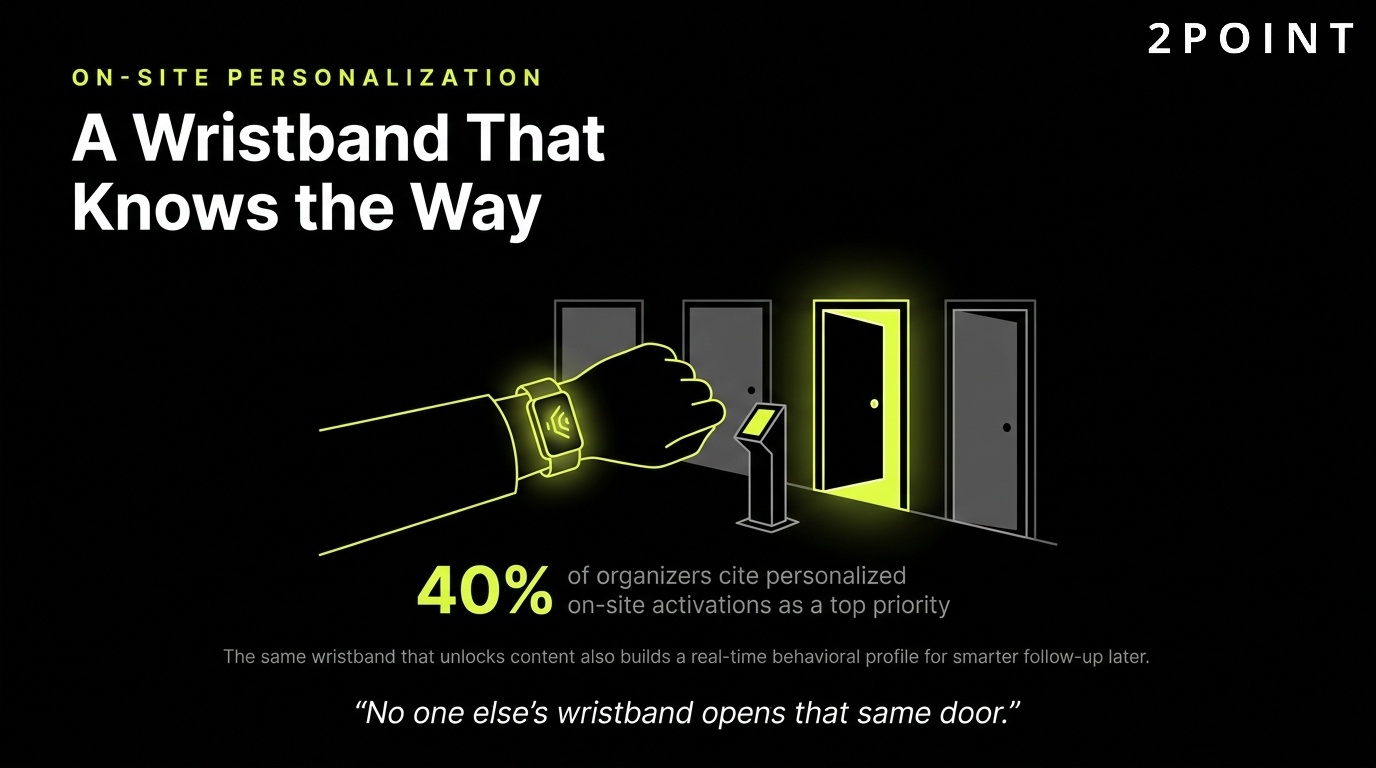
On-site personalization moves beyond content scheduling to the physical experience of attending the event. 40% of event organizers cite personalized on-site activations as a key priority for improving attendee experience. Technology is the primary enabler of this type of personalization at scale, with smart badges, event apps, and interactive kiosks playing central roles.
Smart badge technology allows attendees to tap or scan badges at stations throughout the venue to unlock personalized content, add sessions to their agenda, express interest in exhibitors, or exchange contact information with other attendees. The data generated by these interactions creates a real-time behavioral profile for each attendee that can inform both in-event personalization and post-event follow-up. When a prospect interacts with your product demo station, visits the pricing kiosk, and attends an ROI-focused breakout session, all within the same event day, that behavioral signal has significant sales qualification value that traditional lead forms cannot capture.
Curated networking and professional matchmaking represent one of the most highly valued personalization services event teams can offer. Rather than leaving networking to chance in open reception environments, structured matchmaking uses attendee profile data to identify high-value connection opportunities and facilitate those meetings through app-based scheduling, curated roundtable assignments, or facilitated introduction sessions. The brand impression created by this kind of thoughtful facilitation is remarkably durable: 64% of consumers maintain positive brand impressions for more than a month following a brand activation experience.
Creating Immersive and Experiential Elements
Immersive experiences sit at the intersection of event design and experiential marketing, creating moments that engage multiple senses, require active participation, and produce memories that outlast the event itself. 64% of attendees cite immersive experiences as the most important element of a memorable event, and 95% of event professionals say incorporating experiential learning elements is important to their event design strategy.
Immersive event elements range from hands-on product demonstrations where attendees use your product to solve a real challenge in a structured setting, to simulation environments that let prospects experience the outcome your product delivers before they buy it, to interactive installations that engage visitors through art, technology, or physical experience. The common thread is that participants do something rather than watch something, and the doing creates emotional and cognitive engagement that passive consumption cannot achieve.
Production investment for immersive elements can range from modest to significant depending on the complexity of the experience you are creating. Before investing heavily, consider what specific emotional or informational outcome you want participants to experience, and design the simplest possible activation that reliably produces that outcome. Over-engineered immersive experiences that require extensive technical support and have high failure risk often deliver less impact than simpler, reliably executed activations that consistently land the core experience you intended.
Networking Facilitation and Community Connection
For most professional event attendees, networking is the primary or secondary reason they choose to attend. Content can be consumed on-demand after the fact; the relationships formed at events cannot be replicated through any other channel. Yet networking at most events is left almost entirely to chance, with organizers providing a physical space and time and hoping that meaningful connections emerge organically. Intentional networking facilitation dramatically improves connection quality and quantity without requiring complex technology.
Structured networking formats that consistently outperform open mingling include roundtable discussions organized by topic or challenge, speed networking sessions with facilitated introductions, mentor-mentee pairing programs, and pre-scheduled one-on-one meeting systems where attendees can book time with speakers, sponsors, and peers before the event begins. Each of these formats reduces the social friction of approaching strangers by providing a context and purpose for the interaction that makes starting conversations natural rather than awkward.
The community connection facilitated during an event needs a pathway to continue after attendees return home. Post-event community platforms, whether branded digital spaces or curated professional groups, allow the relationships formed at your event to deepen over time and give participants a reason to remain engaged with your brand between event dates. Community building has been ranked as the number two trend in the event industry for 2026, reflecting a broad industry recognition that the highest-value events are those that create ongoing communities rather than isolated encounters.
Experiential Marketing and Brand Activations
Experiential marketing is the broader discipline within which event marketing operates, encompassing all forms of brand activation designed to create direct, memorable interaction between a brand and its audience. Understanding the experiential marketing context helps event marketers position their work within the larger brand and marketing strategy conversation and access investment arguments that extend beyond traditional demand generation metrics.
Experiential Marketing Investment Trends
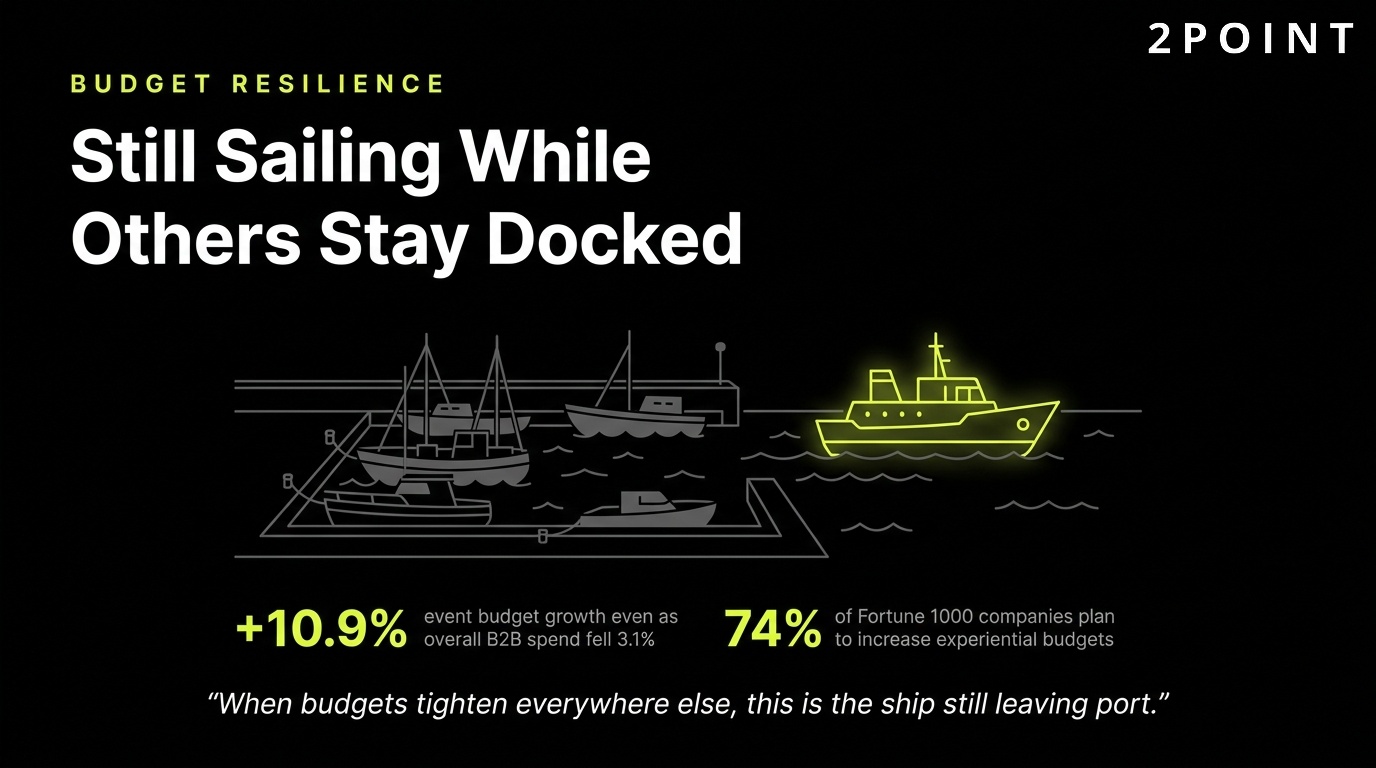
Investment in experiential marketing is growing at a rate that outpaces overall marketing spending, even during periods of broader budget pressure. 51% of companies plan to increase their experiential marketing investment through 2026, and the commitment is particularly strong among large organizations: 74% of Fortune 1000 companies plan to increase their experiential budgets in the same period.
The resilience of experiential marketing investment against broader budget pressure is particularly notable. Event budgets are growing at 10.9% while overall B2B marketing spending has declined by 3.1%, a divergence that reflects both the measurable business impact of events and the growing recognition that human connection at scale is a form of competitive advantage that digital marketing channels cannot replicate.
The strategic rationale for this investment resilience connects to the customer journey. Experiential marketing reaches customers and prospects at a moment of genuine engagement and voluntary attention, unlike interruptive advertising which competes against content the audience actually wants to consume. This quality-of-attention advantage produces emotional responses, behavioral changes, and memory formation that translate into durable brand effects. Organizations that understand this dynamic protect their experiential investment even in challenging budget environments because they recognize it as infrastructure rather than discretionary spending. A well-designed marketing mix that includes experiential components alongside digital, content, and direct marketing tends to outperform single-channel strategies across most audience segments.
Types of Brand Activations and Event Experiences
The experiential marketing landscape encompasses a wide variety of activation formats, each with distinct audience demographics, production requirements, and brand impact profiles. Understanding the distribution of where brands are investing helps in selecting formats that align with your audience and objectives.
| Activation Format | Market Share | Primary Brand Benefit |
|---|---|---|
| Sporting Events | 51% | Mass reach, emotional association, broad demographic |
| Festivals and Cultural Events | 39% | Cultural alignment, younger demographic, social sharing |
| Sponsorships | 38% | Association credibility, audience segment alignment |
| Pop-Up Events | 36% | Novelty, local market penetration, product trial |
| Community Events | 33% | Local brand affinity, authentic engagement, trust building |
| Product Samplings | 26% | Direct product trial, immediate conversion opportunity |
| Corporate Events | 28% of total market | Relationship depth, pipeline acceleration, brand loyalty |
Choosing the right activation format requires matching your brand's communication objective and target audience demographics to the context and attendee mindset of each event type, rather than defaulting to the format your competitors are using.
Sponsorship and Exhibition Strategy Evolution
The traditional trade show booth model, a branded table with brochures and a bowl of branded candy, has been largely overtaken by activation-first approaches that prioritize genuine engagement over passive presence. Sophisticated exhibitors and sponsors in 2026 design their event presence around experiences, conversations, and value exchange rather than logo placement and lead scanning. This shift reflects both evolving attendee expectations and growing sponsor demand for demonstrable ROI from their event investments.
Effective sponsorship activations in the current environment typically involve one or more of the following: a branded experience that lets attendees interact with the sponsor's product or service directly, a curated content session where the sponsor provides genuine expertise rather than a sales pitch, a networking facilitation element that creates value for attendees while creating engagement opportunities for the sponsor, or a community contribution like a charitable component that aligns with attendee values and creates positive brand association.
For event organizers, creating sponsorship programs that work for both sponsors and attendees requires understanding what each stakeholder group actually values. Attendees value content quality, networking relevance, and experience originality. Sponsors value qualified audience access, measurable engagement, and lead generation efficiency. The best sponsorship packages find the overlap between these two value sets and design activations that serve both audiences simultaneously, creating the foundation for sponsor relationships that renew year over year rather than requiring constant replacement.
Long-Term Brand Impact from Events
The brand-building value of events operates on a timeline that differs from most marketing channels. Unlike a digital ad campaign whose performance can be measured within days or weeks, the brand impact of a meaningful event experience accumulates over months and manifests in behaviors that are often difficult to directly attribute to the event itself. Understanding this timeline is essential for making the case for events as brand-building investments, not just demand-generation tactics.
The durability of event-created brand impressions is well-documented. 64% of consumers report maintaining positive brand impressions for more than one month after a brand activation experience, a longevity that vastly exceeds the recall rates of digital advertising. 70% of event attendees report being more likely to become a customer of a brand after experiencing it at a live event, connecting the brand impression directly to commercial intent.
Connecting short-term event activations to long-term brand equity requires tracking brand health metrics across your target audience at regular intervals, not just immediately following events. Brand awareness surveys, net promoter score tracking among event attendees versus non-attendees, and share-of-voice measurement in your industry category all provide evidence of the brand-building work that events perform over time. Using content marketing to extend the reach and longevity of event-generated content is one of the most efficient ways to amplify the brand-building impact of your event investment beyond the audience who attended in person. Video content captured at events, including speaker sessions, attendee testimonials, and highlight reels, can continue generating brand impressions for months after the event concludes, making your video marketing strategy an important extension of your overall event program.
Conclusion: Building Event Marketing as Core Growth Infrastructure
The data presented throughout this guide points consistently in one direction: event marketing in 2026 is not a tactical expense or a nice-to-have addition to the marketing mix. It is core growth infrastructure, commanding the highest single-channel budget allocation in marketing for a reason that every metric in this guide reinforces. Events create the kind of human connection, emotional engagement, and trust acceleration that no digital channel can replicate at scale, and the organizations that treat events strategically rather than opportunistically are seeing disproportionate returns on that investment.
The dual challenge facing event marketers today is real and should not be minimized. Rising costs, growing audience expectations, and intensifying pressure to demonstrate measurable ROI are converging simultaneously with rapid technology evolution, format proliferation, and increased competition for attendee attention and time. Navigating this environment successfully requires holding two capabilities in balance: the discipline to get the fundamentals right every time, and the curiosity to adopt emerging approaches that create differentiation before they become commoditized.
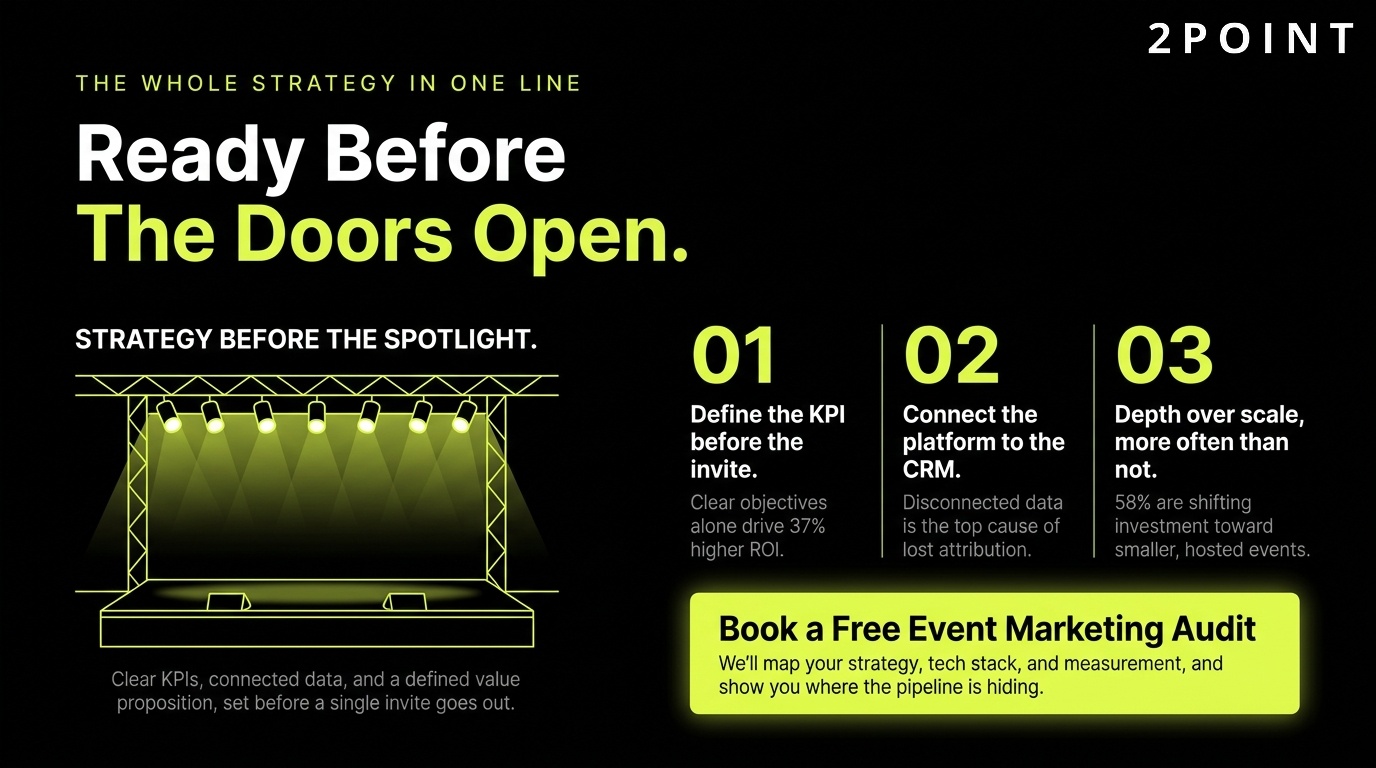
The core success factors for 2026 and beyond can be summarized clearly. Start every event with explicitly defined objectives and KPIs, because events with clear measurement frameworks deliver 37% higher ROI than those without. Invest in technology integration that connects your event platform to your CRM and marketing automation systems, because disconnected data is the primary cause of attribution failure. Prioritize quality of experience over scale of attendance, because immersive, personalized experiences create durable brand impressions that volume-driven events rarely achieve. Build community infrastructure that extends engagement beyond event day, because the relationships formed at events are the long-term asset, not the event itself. And manage budgets with disciplined attribution, because in 2026's resource-constrained environment, the event programs that survive and grow are those that can demonstrate their contribution to revenue in the language of finance and executive leadership.
The opportunity is significant for teams willing to approach event marketing as a discipline rather than a logistics exercise. Event marketing commands the highest budget allocation in marketing because it delivers outcomes that other channels cannot. The challenge is earning that allocation by delivering those outcomes consistently, measuring them credibly, and communicating them compellingly. That is the work of strategic event marketing, and the organizations that master it will have a meaningful competitive advantage in the markets they serve.
For brands looking to develop or elevate their event marketing programs, the expertise required spans strategy, creative, production, technology, and measurement. 2POINT works with organizations to build event marketing programs that connect strategy to execution and investment to demonstrable business outcomes, helping brands create experiences that move their audiences and advance their growth objectives.
Frequently Asked Questions About Event Marketing
What is event marketing and how does it differ from traditional advertising?
Event marketing is the strategic use of in-person, virtual, or hybrid events to promote brands, products, or services through direct experiential engagement rather than passive message delivery. Unlike traditional advertising, which reaches audiences who are doing something else, event marketing captures voluntary attention in an environment where participants have chosen to engage with the brand experience.
How much of a marketing budget should go to events?
Industry data shows that 24% of total marketing budgets now go to events, making it the highest single-channel allocation in marketing. For B2B specifically, approximately 17% of marketing budget is allocated to events. The right percentage for any individual organization depends on deal size, sales cycle length, and how central relationship-building is to the buying process.
What is the typical ROI for event marketing?
ROI varies significantly by event type. B2B field events typically deliver 200-400% ROI, trade shows return approximately $20.98 for every $1 spent, and 52% of business leaders rate trade shows as their highest-ROI marketing channel. Event-sourced leads convert to qualified opportunities at a 40% rate, and 72% of event marketers report that prospects who attend events close faster than those who do not.
What is the difference between in-person, virtual, and hybrid event marketing?
In-person events involve physical attendance and deliver the highest depth of engagement and relationship-building, with 82% of attendees preferring them when given a choice. Virtual events are conducted entirely online and offer broader geographic reach at lower cost but lower engagement depth. Hybrid events combine both formats simultaneously, allowing remote participation alongside in-person attendance, and are growing at a 17.65% CAGR through 2031.
How do you measure event marketing ROI effectively?
Effective event ROI measurement requires integrating your event platform with your CRM, tracking attendee behavior from registration through post-event pipeline activity, and using multi-touch attribution models that capture event influence at multiple points in the buyer journey. Setting specific, measurable KPIs before the event aligned to the event's primary objective (demand generation, pipeline acceleration, or brand awareness) is the essential starting point for credible ROI measurement.
What are the biggest challenges in event marketing today?
The three most persistent challenges are proving ROI to leadership (98% of event marketers report difficulty justifying spend), accurate attribution (86% cannot precisely attribute revenue to events), and rising costs (72% expect cost increases up to 20% in 2026). Secondary challenges include content personalization at scale, integrating technology stacks, and building attendee engagement in virtual and hybrid formats.
What is experiential marketing and how does it relate to event marketing?
Experiential marketing is the broader discipline of creating direct, memorable brand interactions through designed experiences, of which event marketing is the most prevalent form. Experiential marketing encompasses sporting event activations, festival sponsorships, pop-up experiences, product samplings, and community events in addition to traditional corporate and B2B events. Both disciplines prioritize active participant engagement over passive message reception.
In-person events vs. virtual events: which delivers better results?
In-person events consistently deliver stronger ROI, deeper relationship-building, and higher attendee satisfaction, with 78% of organizers rating them as their most impactful marketing channel. Virtual events deliver superior geographic reach and lower cost per attendee, making them more efficient for top-of-funnel awareness goals. The most effective event programs combine both formats strategically based on audience, objective, and available budget.
What event marketing trends are most important to follow in 2026?
The four most significant trends shaping event marketing in 2026 are AI integration across event workflows (95% of teams expect increased AI use), community building as an ongoing engagement strategy, the growth of micro-events and curated experiences for high-value audiences, and content co-creation models that shift attendees from passive consumption to active participation. Content personalization, cited by 40% of organizers as their top priority, is an overlapping theme across all four trends.
How should B2B companies approach their event marketing strategy differently than B2C brands?
B2B event marketing must account for longer sales cycles, multi-stakeholder buying decisions, and relationship quality as a primary competitive differentiator, which means prioritizing pipeline metrics, account-based targeting, and executive relationship programs over broad reach and brand impression metrics. B2B events should be designed to accelerate specific deals, support named account engagement, and create community among customer and prospect audiences, with ROI measured in pipeline influenced and revenue closed rather than impressions delivered.
How early should event marketing promotion begin before the event date?
For major in-person events, promotional campaigns should begin 12-16 weeks before the event date to allow SEO content to rank, early-bird registration incentives to drive initial momentum, and multi-channel sequences to run their full course. For virtual events and webinars, 4-6 weeks of promotion is typically sufficient. SEO-focused content supporting event discoverability should begin even earlier because organic search rankings take months to develop.
What event marketing technology is essential for a modern event program?
The essential technology foundation for modern event marketing includes a registration and attendee management platform, integration between that platform and your CRM or marketing automation system, an event mobile app for in-person events, and post-event analytics that connect behavioral data to business outcomes. AI-powered personalization tools, predictive attendee intelligence platforms, and account-level attribution tools represent the next tier of capability that leading event marketing teams are adopting in 2026.
