

 let’s connect


What Is Google Advertising and Why It Matters in 2026
Google advertising is the world’s most powerful digital advertising basics platform, connecting businesses with high-intent audiences at the exact moment they search, browse, watch, and discover. Here is what every business owner and marketer needs to know right now:
- Google advertising is a pay-per-click platform spanning Search, Display, YouTube, Shopping, and Discover.
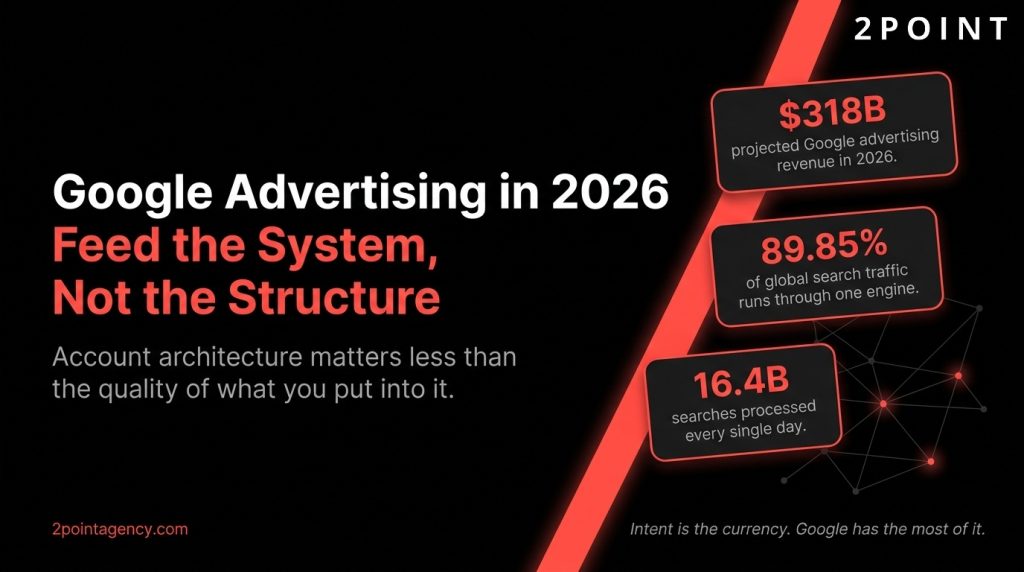
- Projected 2026 revenue for Google advertising is $318 billion, reflecting consistent double-digit growth.
- Google holds 89.85% of global search market share as of March 2026.
- The average conversion rate across Google Ads campaigns is 7.52%.
- Businesses earn an average of $2 for every $1 spent on Google Ads.
- The platform now prioritizes quality inputs: conversion data, creative assets, and audience signals over manual campaign structure.
- More than 7 million advertisers worldwide actively use Google advertising to reach customers.
- AI-first features including AI Max, Performance Max, and Demand Gen now define the competitive landscape.
- Any business seeking high-intent traffic, measurable ROI, and scalable reach should be advertising on Google in 2026.
The platform has undergone a fundamental transformation. In 2026, Google advertising is no longer about setting precise keywords and writing individual ads. It is about feeding an intelligent system the highest-quality signals possible and trusting it to find your best customers across every surface Google owns. Understanding how to work with that system, rather than against it, is the difference between campaigns that scale and campaigns that stagnate.
This guide covers everything: market performance data, the new AI Max campaign type, Performance Max strategy, creative automation, privacy compliance, and realistic performance benchmarks by industry. Whether you are launching your first Google Ads campaign or restructuring an enterprise account, the frameworks here apply directly to where the platform stands today.
Google Advertising’s Market Dominance and Financial Performance
Before diving into tactics, it is worth understanding the scale of the platform you are working with. Google advertising is not simply a marketing channel. It is the financial engine of one of the most valuable companies in human history, and the data behind its 2026 performance reveals both the opportunity and the competitive stakes for every advertiser.
Record-Breaking Revenue Growth Through 2026
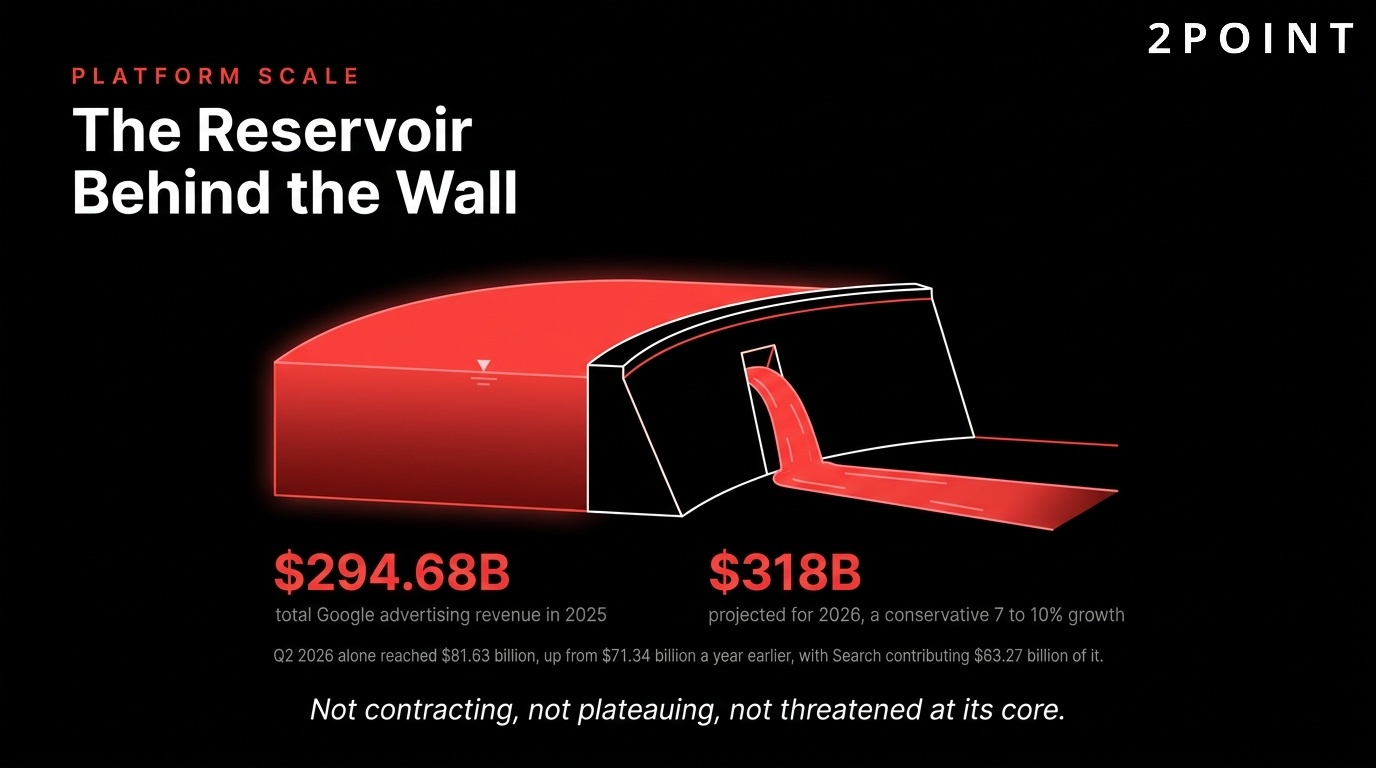
Google advertising revenue figures for 2026 are staggering. Q2 2026 revenue reached $81.63 billion, up from $71.34 billion in the same quarter the prior year. Within that total, Search and other advertising contributed $63.27 billion, confirming that keyword-driven intent capture remains the dominant revenue driver for Alphabet. The fourth quarter of 2025 produced $82.3 billion, a 14% year-over-year increase, capping an annual total of $294.68 billion for the full year 2025.
Looking forward, the $318 billion projection for 2026 reflects a 7 to 10% growth rate that analysts consider conservative given the acceleration of AI-driven ad formats. Alphabet crossed the $400 billion annual revenue threshold for the first time in 2025, a milestone that underscores how central advertising remains to its business model even as the company diversifies into cloud computing, hardware, and AI infrastructure.
What these numbers mean for advertisers is straightforward: the platform is not contracting, not plateauing, and not threatened at its core. Alphabet is simultaneously investing $175 to $185 billion in AI infrastructure in 2026, and a significant portion of that investment flows directly back into advertising product development. Every dollar of infrastructure spend on AI is, in part, a bet on making the ad platform smarter and more effective.
Search Market Share and Competitive Position
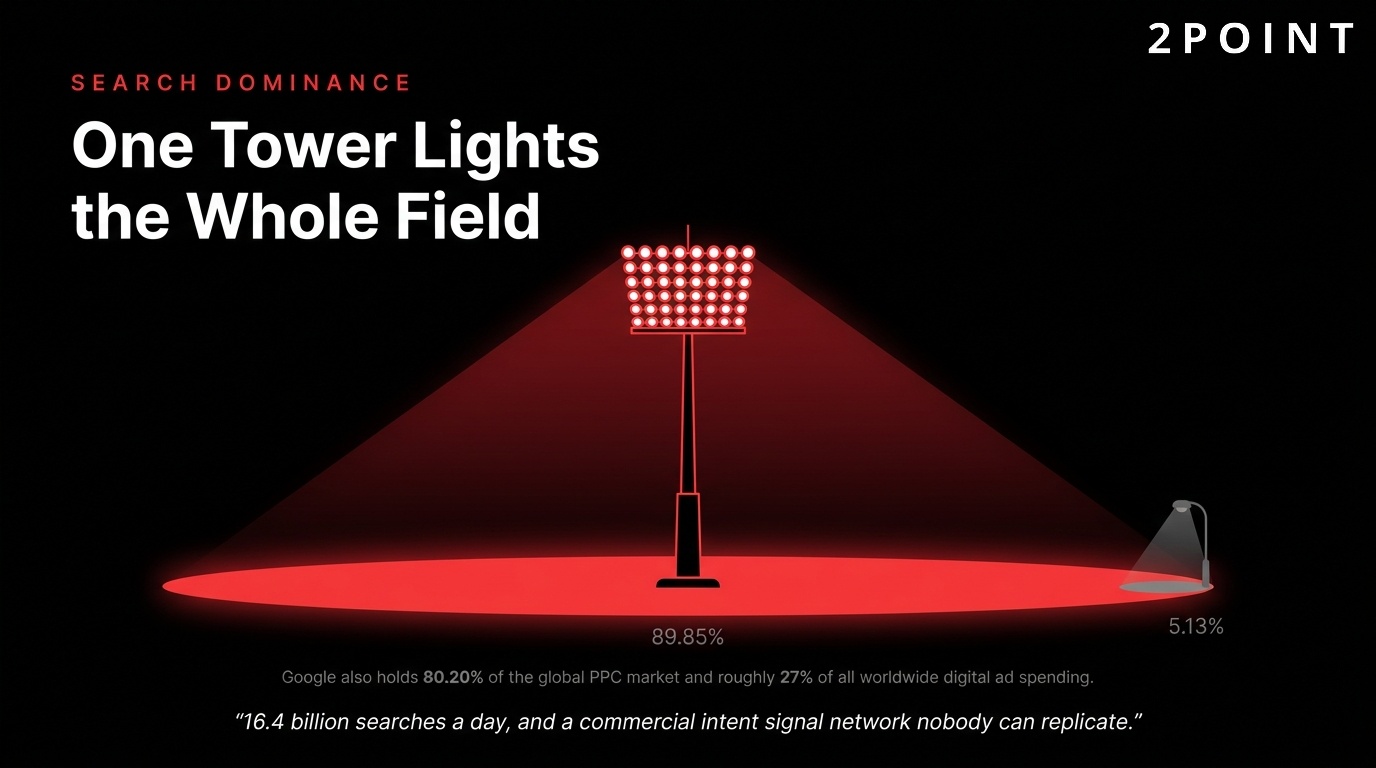
Google commands 89.85% of global search traffic as of March 2026, with Bing sitting in a distant second place at 5.13%. That gap is not narrowing in any meaningful way. In the worldwide digital advertising market, Google accounts for approximately 27% of all spending, and within the PPC advertising segment specifically, Google holds 80.20% of the global PPC market as of 2025.
The platform processes 16.4 billion daily searches, a volume that dwarfs every competitor and creates a commercial intent signal network that simply cannot be replicated elsewhere. Each of those searches represents a moment of expressed need, curiosity, or purchase intent, and Google advertising allows businesses to intercept those moments with precision that organic search alone cannot guarantee.
For context on what this means in practice: a business selling industrial HVAC systems in a mid-sized regional market can still reach thousands of high-intent searchers every month through Google advertising, in ways that social platforms or display networks cannot match because those platforms lack the explicit search signal. Intent is the currency of Google advertising, and the platform has more of it than anyone else.
The Meta Challenge and the Evolving Ad Landscape
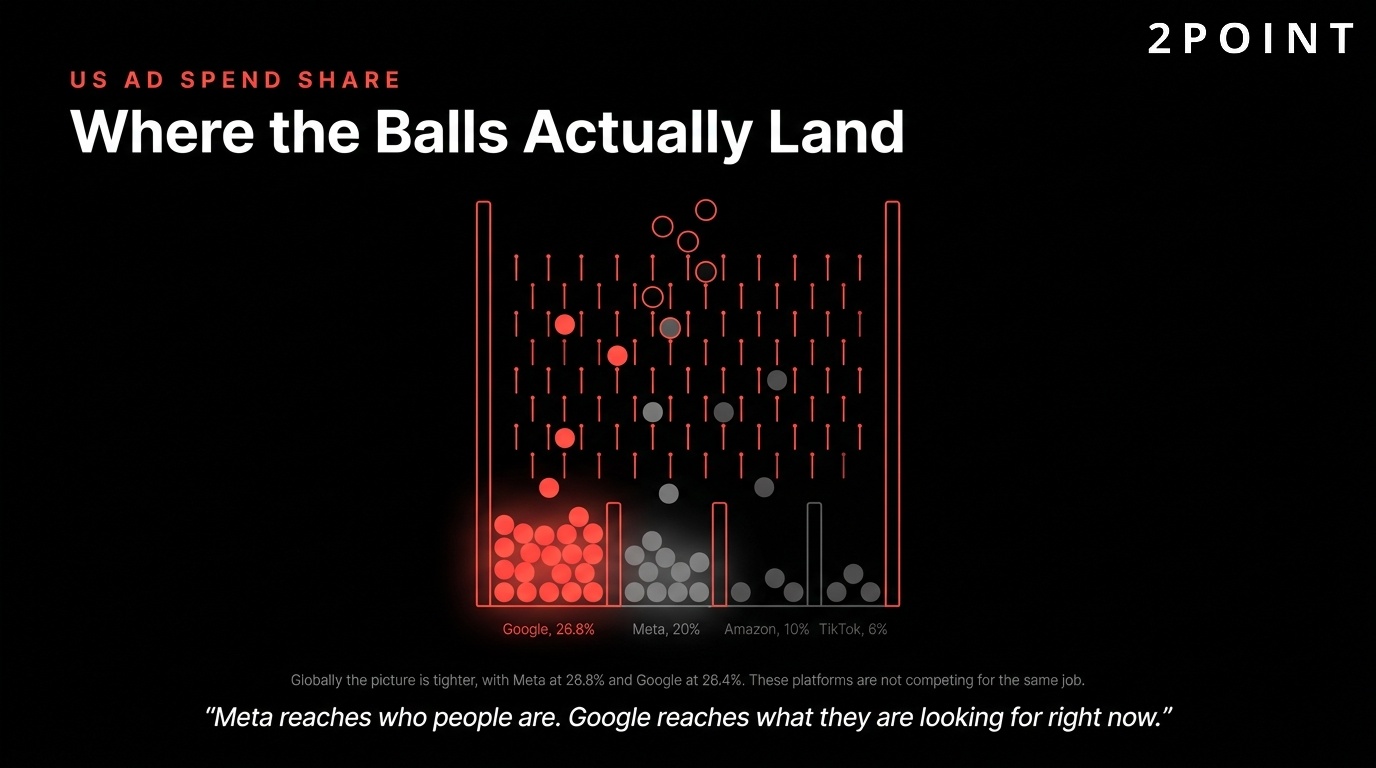
The competitive picture is not entirely one-sided. Meta was projected to overtake Google in worldwide ad spend share in 2025, with Meta at 26.8% versus Google at 26.4% globally. In the US market specifically, the breakdown tells a different story: Google holds 26.8%, Meta follows at 20%, Amazon claims approximately 10%, and TikTok captures around 6%.
This shift reflects a fundamental difference in the type of advertising each platform excels at. Meta’s strength is upper-funnel awareness and interest-based discovery, reaching audiences based on who they are and what they have engaged with. Google’s strength is high-intent capture, reaching audiences based on what they are actively searching for. These are not competing for the same job. The most sophisticated advertisers in 2026 use both platforms in coordination, with Google handling bottom-funnel conversion and Meta or other social platforms building awareness that feeds the Google search pipeline.
Google’s direct response to competitive pressure in the awareness space has been the Demand Gen campaign type, which places visually rich ads on YouTube, Discover, and Gmail surfaces, competing directly with social media’s discovery-based ad formats. Pair this with AI-powered creative tools, and Google is making a credible play for upper-funnel budgets it has not historically dominated.
Platform Scale and the Advertiser Base
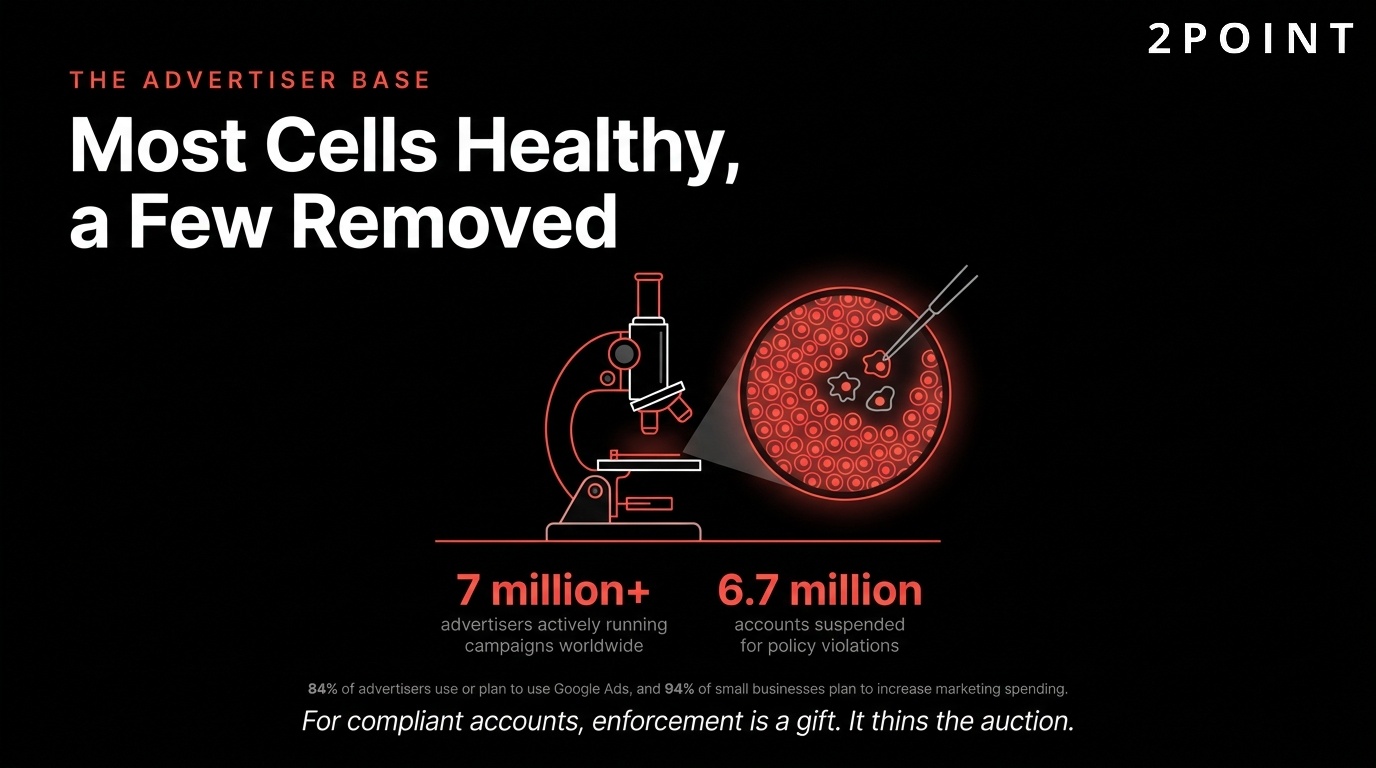
More than 7 million advertisers worldwide are actively running campaigns on Google, spanning every industry, geography, and budget size imaginable. 84% of advertisers either use or plan to use Google Ads, reflecting how embedded the platform has become in standard marketing practice. Among small businesses specifically, 94% plan to increase their marketing spending, with Google Ads representing one of the primary channels for that investment.
Platform quality is actively managed. Google suspended 6.7 million accounts for policy violations in recent years, a figure that reflects both the scale of the advertiser base and the company’s commitment to maintaining ad quality. For legitimate advertisers, this enforcement activity is a net positive: it reduces auction competition from fraudulent or low-quality actors, which contributes to better performance for compliant accounts.
AI Max and the Evolution of Search Campaigns
The most significant change to Google advertising in 2026 is the introduction of AI Max for Search campaigns. This is not a minor feature update. It represents a philosophical shift in how Google believes search advertising should work, moving decisively away from the advertiser-as-architect model toward an AI-as-optimizer model where human judgment provides direction and machine intelligence handles execution.
What AI Max Is and How It Changes Search Advertising
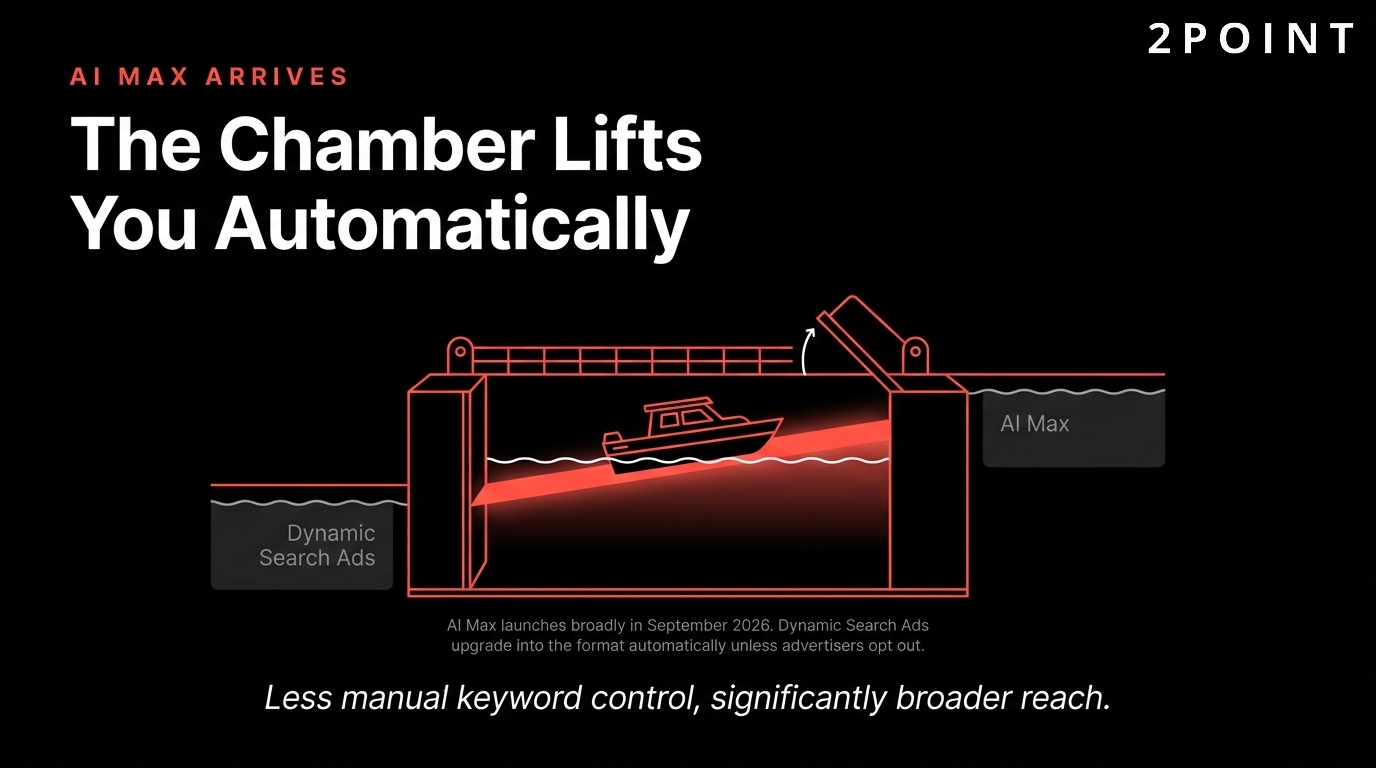
AI Max is part of what Google calls its “Power Pack,” a trio of campaign types that together cover the full customer journey: Demand Gen for awareness, Performance Max for cross-channel consideration, and AI Max for high-intent search capture. AI Max was announced at Google Marketing Live 2026 and is scheduled to launch broadly in September 2026, at which point Dynamic Search Ads will be automatically upgraded into the AI Max format unless advertisers opt out.
The core function of AI Max is AI-assisted matching combined with asset optimization and dynamic landing page selection. Where legacy search campaigns relied on advertisers selecting specific keywords, writing individual ads, and designating specific landing pages, AI Max uses signals from the user’s search query, their context, and available assets to construct the most relevant ad experience dynamically. This means less manual keyword control, but significantly broader reach and more responsive ad delivery.
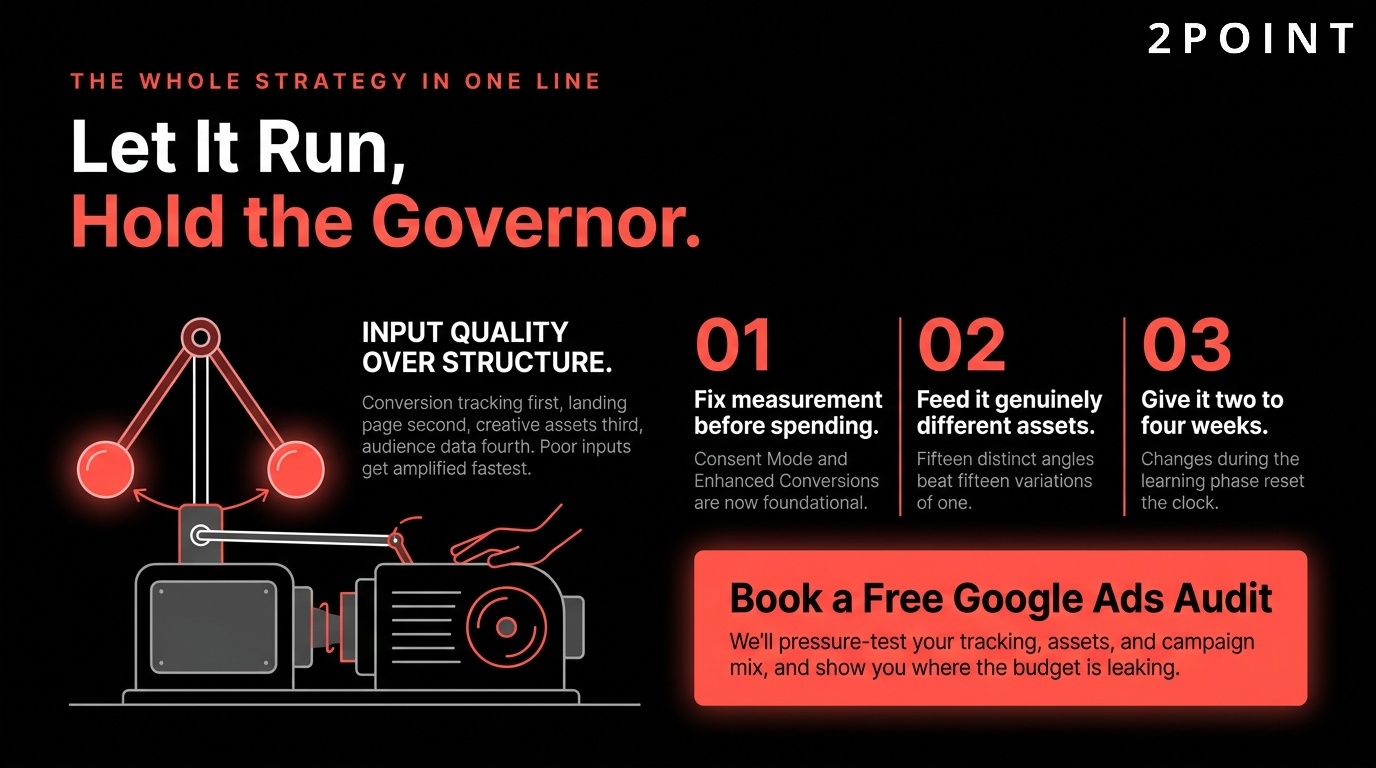
The philosophy shift is important to understand at a conceptual level. Google’s AI-first approach in 2026 prioritizes quality inputs over structural complexity. A well-organized campaign with poor creative assets and incomplete conversion tracking will underperform a simpler campaign that gives the AI clear objectives and diverse, high-quality raw material to work with. The architecture of the account matters less than the quality of what goes into it.
AI Max for Shopping Campaigns
Beyond search text ads, AI Max for Shopping campaigns is designed to reach shoppers “the moment discovery begins,” well before they have formulated a specific product search query. This means placing product ads across Search, the Shopping tab, YouTube, Discover, and Display simultaneously, with the AI determining which surface and which product from the advertiser’s feed is most likely to drive a conversion for each individual user.
Integration with Product Feeds and Google Merchant Center is central to how AI Max Shopping functions. The campaign pulls directly from the product catalog, using titles, descriptions, images, and pricing data as inputs for dynamic ad construction. Advertisers who have invested in high-quality product feed data, with accurate titles, rich descriptions, and professional imagery, will have a significant advantage over those with minimal feed information. The AI can only optimize what it has to work with.
Early performance indicators suggest that AI Max Shopping outperforms standard Shopping campaigns in reach and discovery-phase conversion, particularly for broad product categories where users are still forming their preferences. For advertisers with large catalogs, this creates an opportunity to surface relevant products to users who would never have searched using the specific keywords a human campaign manager might have selected.
Search Term Matching and Advertiser Control in AI Max
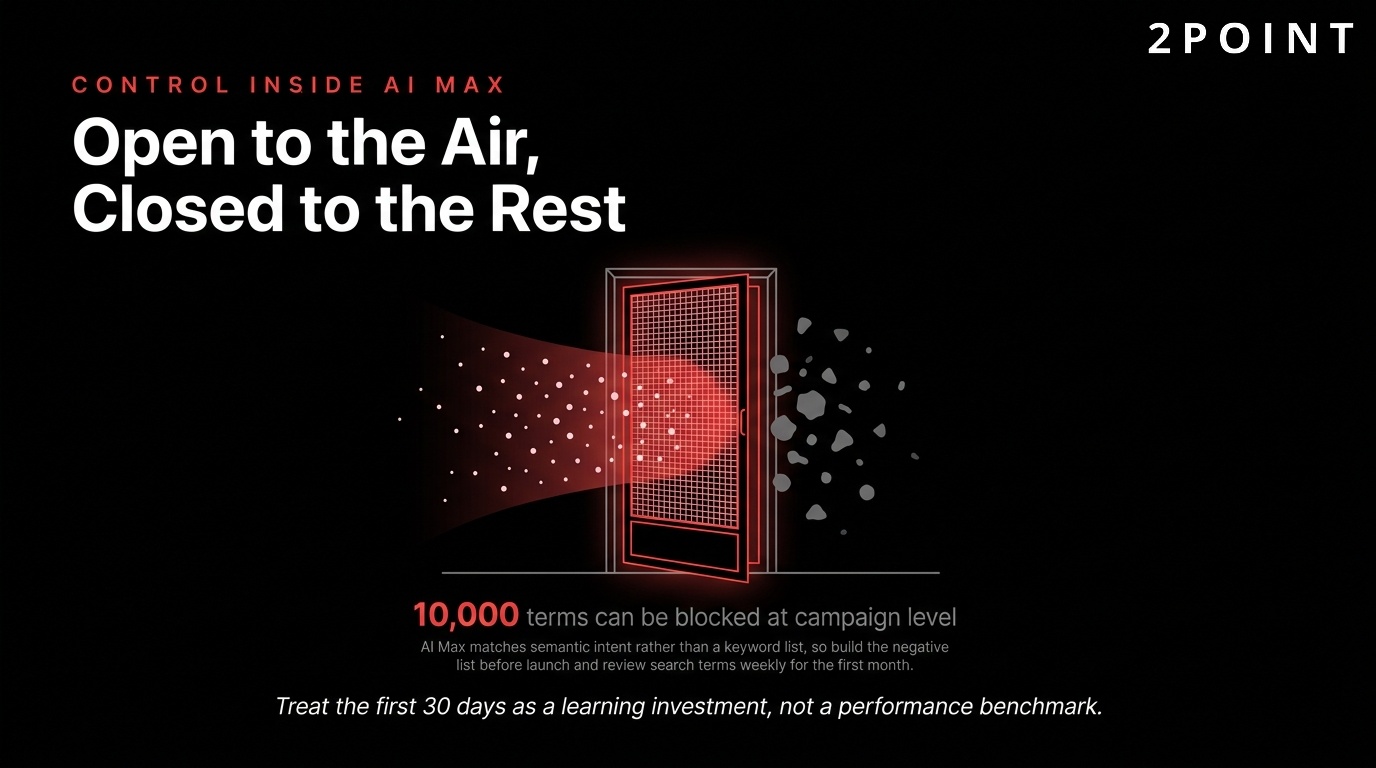
One of the most common concerns advertisers express about AI-first campaign types is the loss of granular control over which search queries trigger their ads. AI Max addresses this directly by providing campaign-level negative keyword functionality, allowing advertisers to block up to 10,000 terms from triggering their campaigns. This is a substantial increase in exclusion capacity compared to legacy campaign structures.
The matching in AI Max differs fundamentally from the exact, phrase, and broad match keyword types advertisers have used historically. Rather than matching against a predefined keyword list, AI Max evaluates the semantic intent behind a query and matches it against the full scope of the campaign’s assets and objectives. This produces broader reach, but also requires more active monitoring of the search terms report to identify and exclude irrelevant traffic patterns, particularly in the early weeks of a campaign.
The practical guidance for managing AI Max effectively is to approach brand safety proactively. Build a comprehensive negative keyword list before launch, drawing from search term data in existing campaigns. Monitor search terms reports weekly in the first month, adding exclusions for any categories of queries that produce impressions without conversions. Over time, as the AI learns from conversion data, query quality tends to improve significantly. Treating the first 30 days as a learning investment rather than a performance benchmark is essential for accurate evaluation.
Asset Optimization and Creative Requirements in AI Max
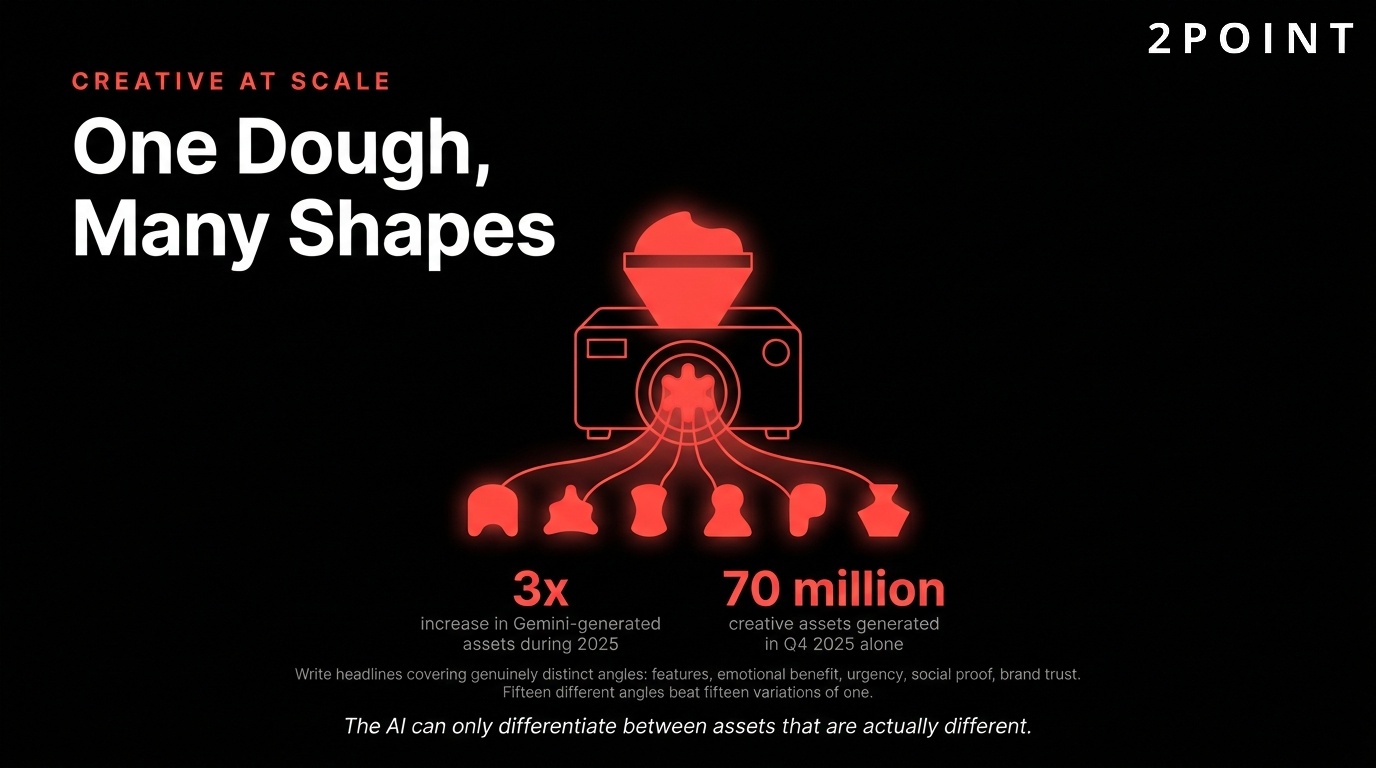
AI Max selects from available headlines, descriptions, and landing pages dynamically, combining them based on predicted performance for each individual query context. This means that every asset an advertiser provides is an input into a combinatorial system that tests thousands of combinations without requiring the advertiser to manually A/B test each one. The more diverse and high-quality the asset library, the more options the AI has to find optimal combinations.
The minimum asset requirements for AI Max campaigns are similar to those for Responsive Search Ads: multiple headlines and descriptions with varying angles, themes, and calls to action. However, the optimal approach goes further. Google’s data shows a 3x increase in Gemini-generated assets in 2025, with nearly 70 million creative assets generated via AI in Q4 2025 alone. Advertisers who leverage Gemini’s creative tools within Google Ads Asset Studio can generate diverse asset variants rapidly, giving the AI more material to work with from day one.
The practical guidance: write headlines that cover multiple distinct angles, including product features, emotional benefits, urgency, social proof, and brand trust separately. Avoid slight variations of the same message. A campaign with 15 genuinely different headline angles will always outperform one with 15 minor variations of a single theme, because the AI can actually differentiate between them and select the right angle for each context.
Performance Max Campaign Strategy and Updates in 2026
Performance Max has been the centerpiece of Google’s AI-driven campaign evolution since its full rollout, and in 2026 it continues to receive significant product investment. For advertisers who have not yet adopted Performance Max, understanding how it works and how to run it effectively is no longer optional. It is where Google is directing the platform’s development resources.
How Performance Max Works Across Google Properties
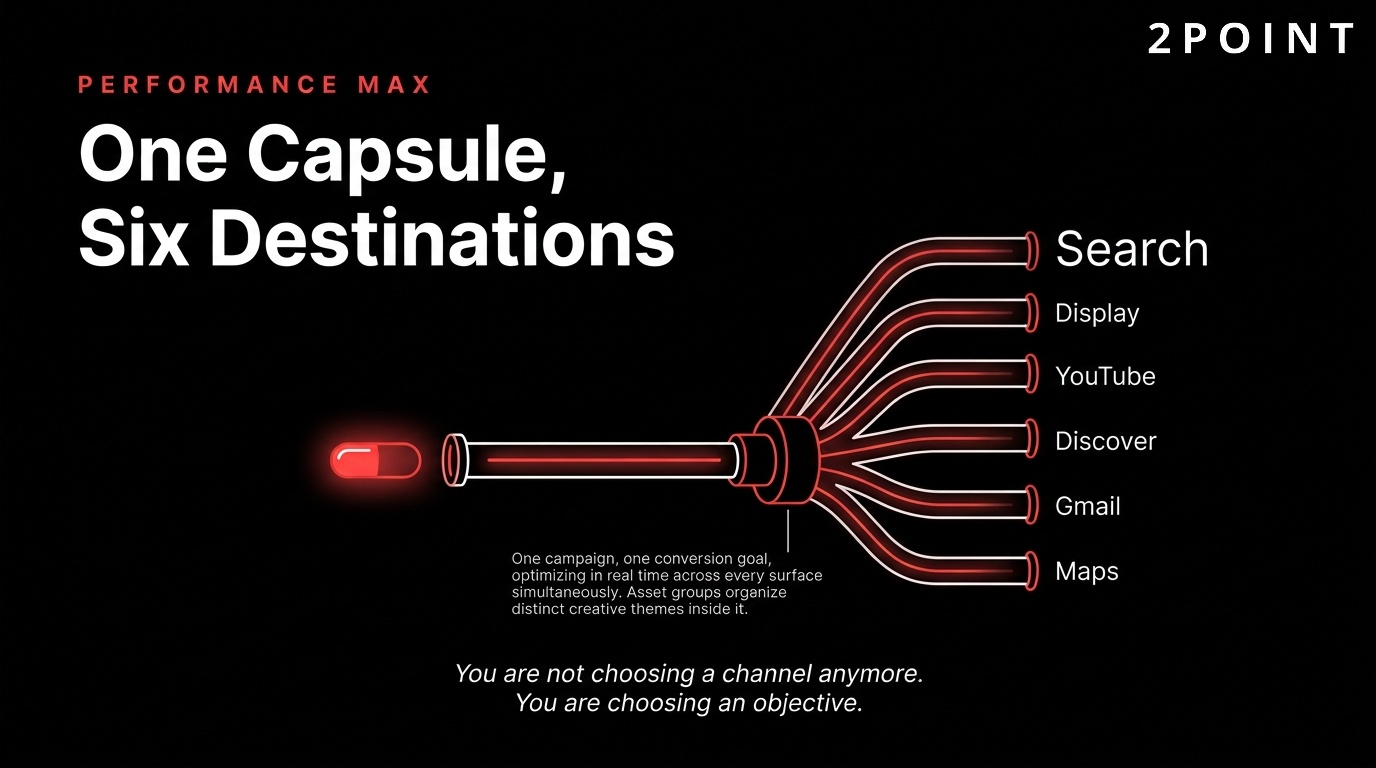
A single Performance Max campaign serves ads across Google Search, Display Network, YouTube, Discover, Gmail, and Google Maps simultaneously. The campaign optimizes in real time toward a defined conversion goal, whether that is maximizing total conversions, maximizing conversion value, or generating leads above a target cost per action. Performance Max uses asset groups to organize different creative themes within a single campaign, allowing advertisers to provide distinct messaging for different product lines or audience segments while maintaining the unified optimization structure.
Audience signals play a critical directional role. Advertisers can provide Google with signals about who their ideal customers are: customer lists, website visitor segments, interests, and demographics. These signals do not limit the campaign’s reach to only those audiences. They guide the AI’s initial exploration, helping it find high-performing user profiles faster. Without audience signals, Performance Max still works, but it takes longer and requires more spending before it can identify reliable patterns.
The question of when to use Performance Max versus traditional Search campaigns comes down to goals and data availability. Performance Max excels when advertisers have robust conversion tracking, diverse creative assets, and a goal of maximizing total conversion volume across channels. Traditional Search campaigns remain valuable when precise query control is essential, such as conquesting competitor brand terms or managing very specific branded keyword portfolios where exact match behavior matters.
2026 Performance Max Enhancements
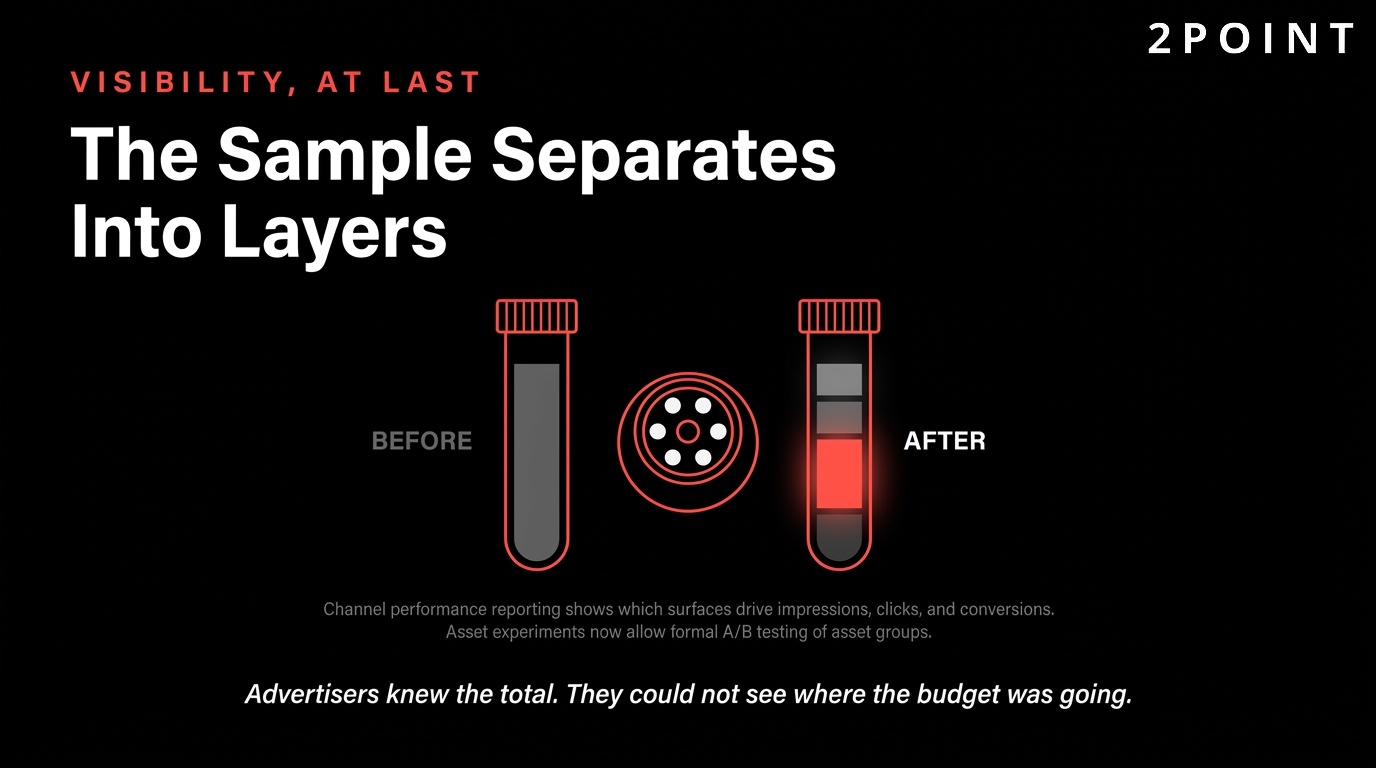
The updates announced at Google Marketing Live 2026 for Performance Max address the most persistent complaints from advertisers: lack of visibility and difficulty testing creative. Asset experiments are now available within Performance Max, allowing advertisers to formally A/B test asset groups against each other and receive statistically significant performance data. This closes a major gap that previously made it difficult to prove which creative approaches were driving results.
Channel performance reporting, currently in beta, provides visibility into which specific surfaces (Search, Display, YouTube, etc.) are driving impressions, clicks, and conversions within a Performance Max campaign. This was previously a significant black box: advertisers knew their total performance but could not see whether their budget was predominantly going to YouTube, Display, or Search. The new reporting gives planners the data they need to make informed decisions about supplementing Performance Max with channel-specific campaigns.
Additional 2026 enhancements include improved search terms insights, better placement-level data for Display and YouTube, and new conversion tracking integrations that allow offline conversion data to flow into Performance Max optimization more seamlessly. Optimization score recommendations are now specific to Performance Max, giving advertisers a clear checklist of actions that the system predicts will improve their results.
Asset Requirements and Creative Best Practices for Performance Max
A Performance Max campaign requires a minimum set of assets to run across all surfaces: headlines, descriptions, images in multiple aspect ratios, and logo files. However, meeting the minimum is rarely the path to strong performance. Google’s own data consistently shows that campaigns with fuller asset libraries, including video assets, perform significantly better than those relying on static images alone, primarily because video assets unlock YouTube placements that represent a substantial portion of available inventory.
For advertisers without existing video assets, Gemini-powered creative tools within Asset Studio can generate video ads from existing image assets and copy. While AI-generated video does not replace purpose-built video production for flagship brand campaigns, it provides a functional solution that unlocks YouTube inventory for advertisers who otherwise would be locked out of that placement. Even a simple 15-second AI-generated video showing a product with a voiceover call to action can meaningfully expand a Performance Max campaign’s reach.
Ad extensions including sitelinks, callouts, and structured snippets continue to matter within Performance Max. These provide additional surface area for messaging and improve ad relevance scores, which affects both Quality Score calculations and the AI’s ability to serve ads in competitive auctions. Treat these not as optional extras but as core components of a complete asset package. Understanding Google Ads bidding in conjunction with your asset quality level is essential, since the two work together to determine auction outcomes.
Audience Signals and Exclusions in Performance Max
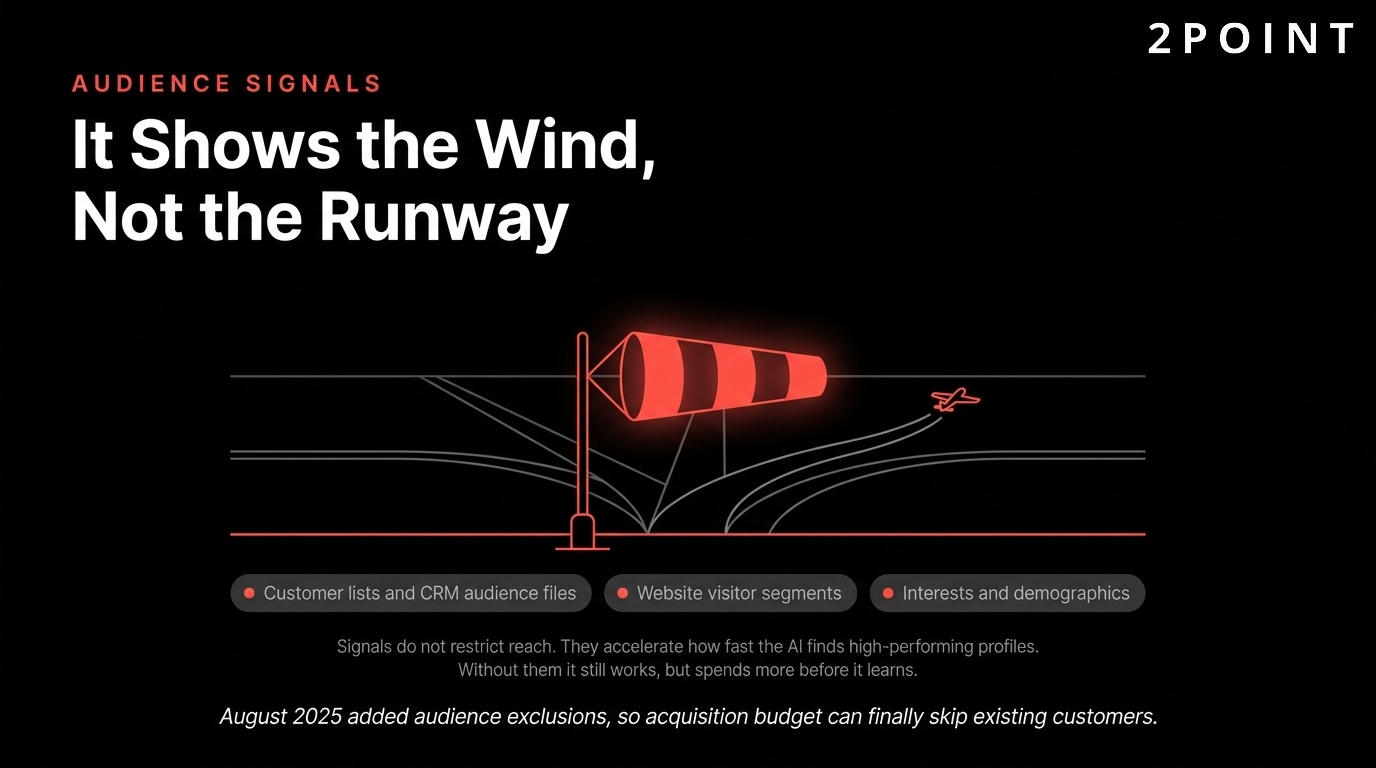
The August 2025 update that added audience exclusion capabilities to Performance Max was one of the most welcomed product changes in the platform’s history. Previously, advertisers could not prevent Performance Max from serving ads to their existing customers, making it difficult to use the campaign type for pure new customer acquisition. With audience exclusions now available, advertisers can upload customer lists and exclude those users from Performance Max targeting, ensuring that acquisition budget reaches genuinely new audiences rather than retargeting existing ones.
First-party data integration is increasingly central to Performance Max effectiveness. Customer lists, website visitor segments, and CRM-sourced audience files allow the AI to identify “lookalike” profiles among unexposed audiences, extending the reach of valuable first-party signals without compromising user privacy. In the post-cookie environment, this first-party data foundation is the most durable competitive advantage an advertiser can build. Businesses that have invested in CRM data collection, email list growth, and website analytics setup are materially better positioned to run effective Performance Max campaigns than those starting from scratch.
AI-Powered Creative Tools and Advertising Automation
The creative side of Google advertising has been transformed more dramatically in the past 18 months than in the previous decade combined. Gemini, Google’s AI model, is now embedded throughout the ads creation workflow, from generating headlines to producing video assets to reviewing policy compliance in real time. Understanding these tools is no longer a competitive advantage. It is table stakes for campaigns that can compete effectively in 2026.
Gemini Integration in Google Ads Asset Studio
Google’s Asset Studio now incorporates Veo 3 and Nano Banana tools for generating studio-quality creative directly within the ads platform. Veo 3 handles video generation, allowing advertisers to create product video ads from text prompts, reference images, and brand guidelines without requiring a video production team. Nano Banana handles image editing and background generation, enabling rapid creation of product photography variations that meet display advertising specifications across multiple formats.
The scale of adoption is striking. Gemini-generated assets in Google Ads increased 3x in 2025, with nearly 70 million creative assets generated in Q4 2025 alone. This suggests that the AI creative tools are not merely experimental features but are actively being used by millions of advertisers to produce real campaign material at scale. The advertiser who dismisses AI creative tools as low-quality is falling behind peers who are already using them to iterate 10 times faster than traditional production workflows allow.
Practical use cases include generating multiple image background variations for the same product photo (enabling ad customization for seasonal campaigns without reshooting), creating headline and description variants tuned to different audience segments, and producing 15-second video ads for YouTube from static product imagery. For small and medium businesses without dedicated creative departments, these capabilities represent a genuine leveling of the playing field.
Real-Time Policy Reviews in Google Ads
One of the most friction-reducing features in the 2026 Google Ads platform is real-time policy review during ad creation. Advertisers building Responsive Search Ads now receive instant policy feedback as they type, flagging potential violations before the ad is submitted. Review times that previously ranged from hours to several days for complex policy questions have been reduced to seconds for the most common compliance checks.
The practical impact for campaign managers is significant. A common source of lost impression share has historically been policy disapprovals that go unnoticed for days, draining budget from a campaign that is technically live but not serving ads due to disapproved creative. Real-time policy review eliminates this failure mode for the most common types of violations. Advertisers can now build compliant ads from the first attempt rather than discovering problems after launch. This accelerates campaign launch timelines, reduces the manual review cycle between creation and go-live, and frees campaign managers to spend time on strategy rather than compliance troubleshooting.
Creator Partnerships and the Open Call Feature
Google’s 2026 advertising platform introduced new tools connecting brands directly with YouTube creators, including the Open Call feature, which allows advertisers to post creative briefs and solicit content submissions from creators across the platform. This is a significant expansion of what was previously a manual, relationship-driven influencer marketing process into a structured, platform-native workflow.
The integration extends beyond sourcing partnerships. Creator-generated content can be used directly as ad creative within YouTube campaigns, Display campaigns, and Demand Gen campaigns, with performance tracking built in to measure how creator-generated ads perform against brand-produced equivalents. For brands that have historically struggled to produce authentic, engaging video content at scale, this opens a new supply chain for creative material that audiences respond to very differently than polished corporate video advertising.
The measurement framework for creator partnerships includes standard metrics like view rate, CTR, and conversion rate, but also brand lift metrics that capture changes in awareness, consideration, and purchase intent among exposed audiences. These metrics are particularly valuable for upper-funnel creator campaigns where the objective is building brand familiarity rather than driving immediate clicks.
Quality Over Quantity: What the AI Really Needs to Succeed
The shift to AI-driven campaign management has created a counterintuitive reality: account structure matters far less in 2026 than it did in 2020. The old wisdom of building tightly themed ad groups with exact match keywords and carefully segmented campaigns is largely obsolete for AI-optimized campaign types. What matters now is the quality and completeness of the inputs you provide.
The new hierarchy of inputs, in order of importance, looks like this: robust conversion tracking comes first, because without accurate conversion data the AI has no objective to optimize toward. Landing page quality comes second, because even a perfect ad cannot compensate for a landing page that fails to convert. Creative assets come third, because the AI needs diverse, high-quality options to find optimal combinations. Audience data comes fourth, because first-party signals dramatically accelerate the AI’s ability to identify high-value users.
The risk of this architecture is important to acknowledge: poor inputs get amplified faster. A flawed conversion tracking setup, a misleading landing page, or a single irrelevant creative theme can contaminate an AI Max or Performance Max campaign at scale before the problem is identified. This is why ongoing monitoring and a rigorous setup process are more critical than ever, even as the day-to-day management workload shifts away from keyword-level maintenance. If you want to optimize Google Ads campaigns effectively in 2026, the work happens upstream of the platform, in your analytics, your website, and your creative process.
The Power Pack Framework: Demand Gen, Performance Max, and AI Max Working Together

Understanding Google advertising in 2026 requires understanding how its three core AI-driven campaign types relate to each other and to the customer journey. Running any one of them in isolation leaves significant opportunity on the table. Running all three in coordination creates a compounding advantage that compounds reach, intent capture, and conversion efficiency simultaneously.
Understanding the Three-Campaign Customer Journey
Google’s Power Pack framework maps each campaign type to a distinct stage in the customer decision process. Demand Gen operates at the top of the funnel, reaching audiences on YouTube, Discover, and Gmail who are not yet actively searching but are likely to become interested. Performance Max spans the middle of the funnel, following users across multiple Google surfaces as they move from awareness into active consideration. AI Max captures the bottom of the funnel, intercepting users with strong commercial intent at the moment they are ready to act.
The three campaign types do not merely coexist. They reinforce each other. A user who sees a Demand Gen ad on YouTube becomes more likely to conduct a branded search that AI Max can capture. A user who clicks a Performance Max Display ad and visits a product page becomes part of the website visitor audience that fuels Performance Max’s lookalike modeling. The system as a whole produces results that exceed the sum of its individual parts when the campaign structure is set up to allow appropriate data sharing and audience continuity across the funnel.
Budget allocation across the Power Pack should reflect this funnel logic. For businesses with established brand awareness and high search demand, concentrating 60 to 70% of budget in AI Max with Performance Max supplementing cross-channel reach is a reasonable starting allocation. For businesses in new markets or launching new products where awareness needs to be built from scratch, weighting Demand Gen more heavily in the initial phase makes strategic sense before shifting budget toward capture-focused campaigns as awareness grows.
Demand Gen Campaign Strategy
Demand Gen campaigns place visually rich, discovery-oriented ads on surfaces where users are in a receptive, browsing mindset rather than an active search mindset. YouTube, Google Discover, and Gmail are the primary placements, and the creative requirements reflect the native content environment of each surface. On YouTube, this means video-first creative that earns attention rather than demanding it. On Discover, it means high-quality imagery paired with compelling headline copy that matches the editorial tone of surrounding content.
Demand Gen targets audiences rather than keywords, which is a fundamental departure from search advertising logic. Advertisers define who they want to reach based on interests, behaviors, life events, and demographic characteristics, and the AI finds users matching those profiles across eligible surfaces. This approach excels when the business objective is generating demand that does not yet exist as search volume, reaching users who would benefit from a product they are not yet actively searching for. Measuring Demand Gen requires looking beyond last-click attribution to view-through conversions, assisted conversion data, and brand lift metrics that capture its contribution to downstream search and direct traffic.
Coordinating Campaigns Without Overlap and Auction Conflicts
A common concern when running multiple campaign types simultaneously is the risk of internal competition: your own campaigns bidding against each other in the same auction and inflating your costs. Google’s systems are designed to prevent direct auction conflicts between campaigns from the same advertiser by giving priority to whichever campaign is most eligible for a given query or placement. However, managing the funnel cleanly still requires deliberate structural choices.
Setting distinct goals for each campaign type is the most important coordination principle. If Demand Gen is set to optimize for awareness metrics and Performance Max is set to optimize for conversions, the systems will naturally differentiate their bidding behavior based on these objectives. Using audience exclusions to segment funnel stages prevents Performance Max from retargeting users who came from Demand Gen and converting them to what looks like a new acquisition. Running a clear attribution model, whether data-driven, linear, or time-decay, helps each campaign type receive appropriate credit for its contribution to the overall conversion path.
When to Use Single vs. Multiple Campaign Types
Not every business needs to run all three Power Pack campaign types simultaneously, particularly when starting with Google advertising or operating with a constrained budget. A small business with a monthly budget under £500 is better served by starting with a single, well-structured AI Max or Performance Max campaign than by spreading limited budget across all three types and failing to give any of them enough data to optimize effectively.
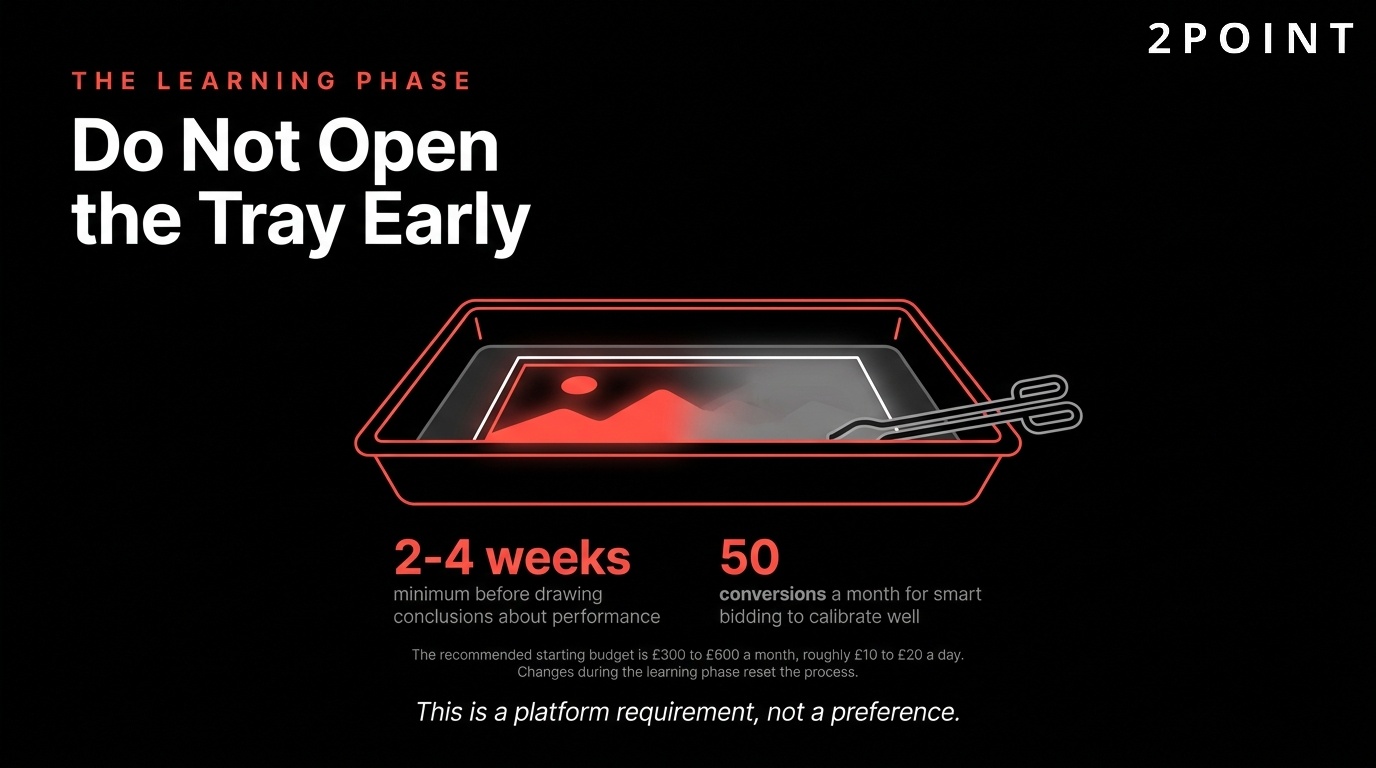
The general scaling guidance is to start with one campaign type, allow it to accumulate sufficient conversion data (typically 50 conversions per month minimum for smart bidding to function well), and then layer additional campaign types as budget grows and initial performance validates the channel. B2B businesses with long sales cycles should weight Demand Gen higher than e-commerce businesses because the path to purchase involves extensive research and multiple touchpoints before any commercial search occurs. Local service businesses benefit from tight geographic targeting within AI Max or Performance Max and may have limited need for Demand Gen’s broad awareness reach unless they are expanding into new markets. A well-constructed digital advertising strategy should determine which campaign type or combination suits your specific business goals before you commit significant budget to any configuration.
Performance Benchmarks and ROI Expectations by Industry
One of the most common questions marketers ask about Google advertising is straightforward: what results should I realistically expect? The honest answer is that performance varies significantly by industry, campaign structure, competitive landscape, and input quality. However, the benchmark data available for 2026 provides a useful baseline for setting expectations and identifying whether your campaigns are over- or underperforming relative to your peers.
Cross-Industry Conversion Rate Benchmarks
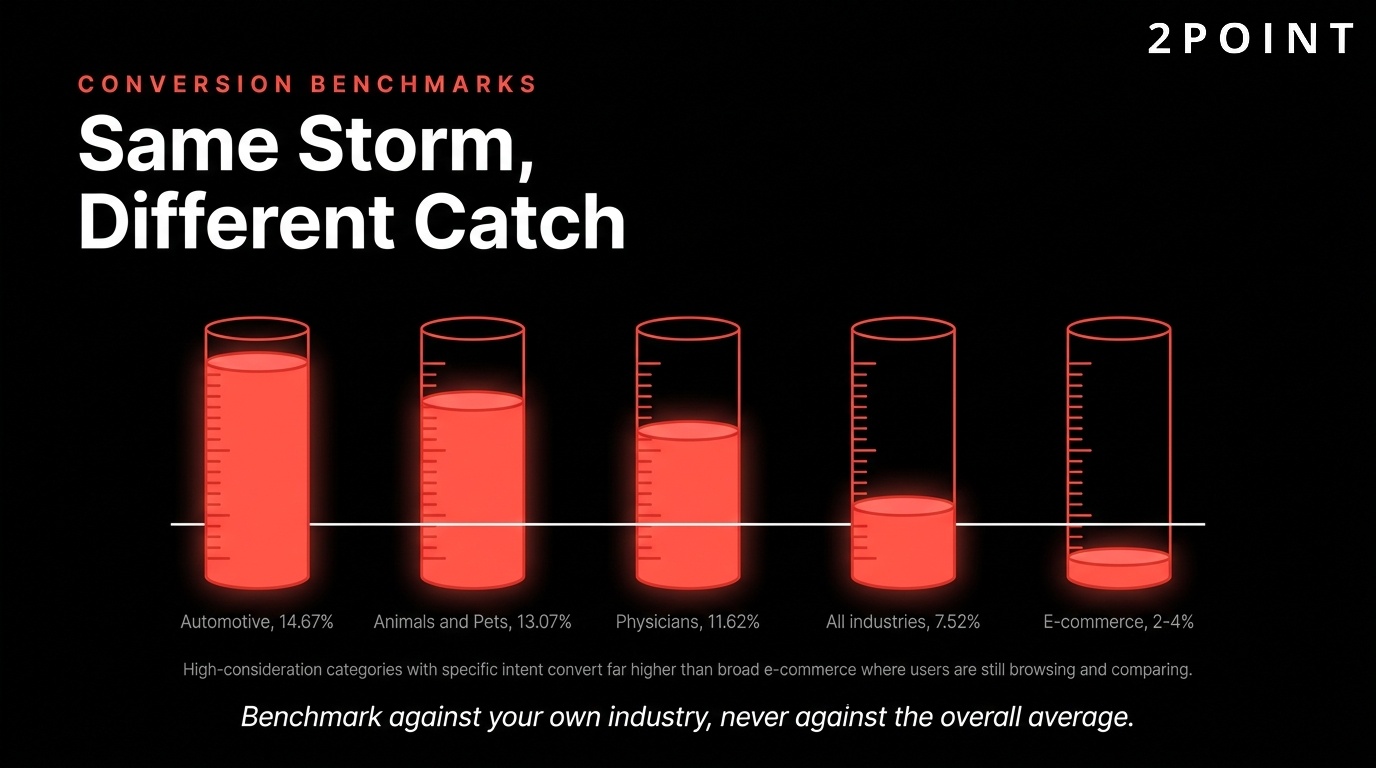
The average Google Ads conversion rate across all industries is 7.52%, but this average masks wide variation by sector. The highest-performing industries convert at dramatically higher rates than this average, while lower-performing sectors may operate well below it even with excellent campaign management. Understanding where your industry sits in this distribution is essential for setting realistic goals and making honest budget decisions.
| Industry | Average Conversion Rate | Performance Relative to Average |
|---|---|---|
| Automotive | 14.67% | 95% above average |
| Animals and Pets | 13.07% | 74% above average |
| Physicians and Surgeons | 11.62% | 55% above average |
| All Industries Average | 7.52% | Baseline |
| E-commerce (General) | 2-4% | 50-75% below average |
The key takeaway from conversion rate benchmarks is that high-consideration categories with clear, specific user intent (finding a vet, booking a medical appointment, locating a dealership) convert at far higher rates than broad e-commerce categories where users are still browsing and comparing options. Automotive outperforms most categories because automotive search queries are typically highly specific and represent users who are far along in the purchase process. Measuring your own campaign’s conversion rate against the right industry benchmark, not the overall average, is what produces actionable insight.
Cost Metrics: CPC, CPA, and Budget Planning
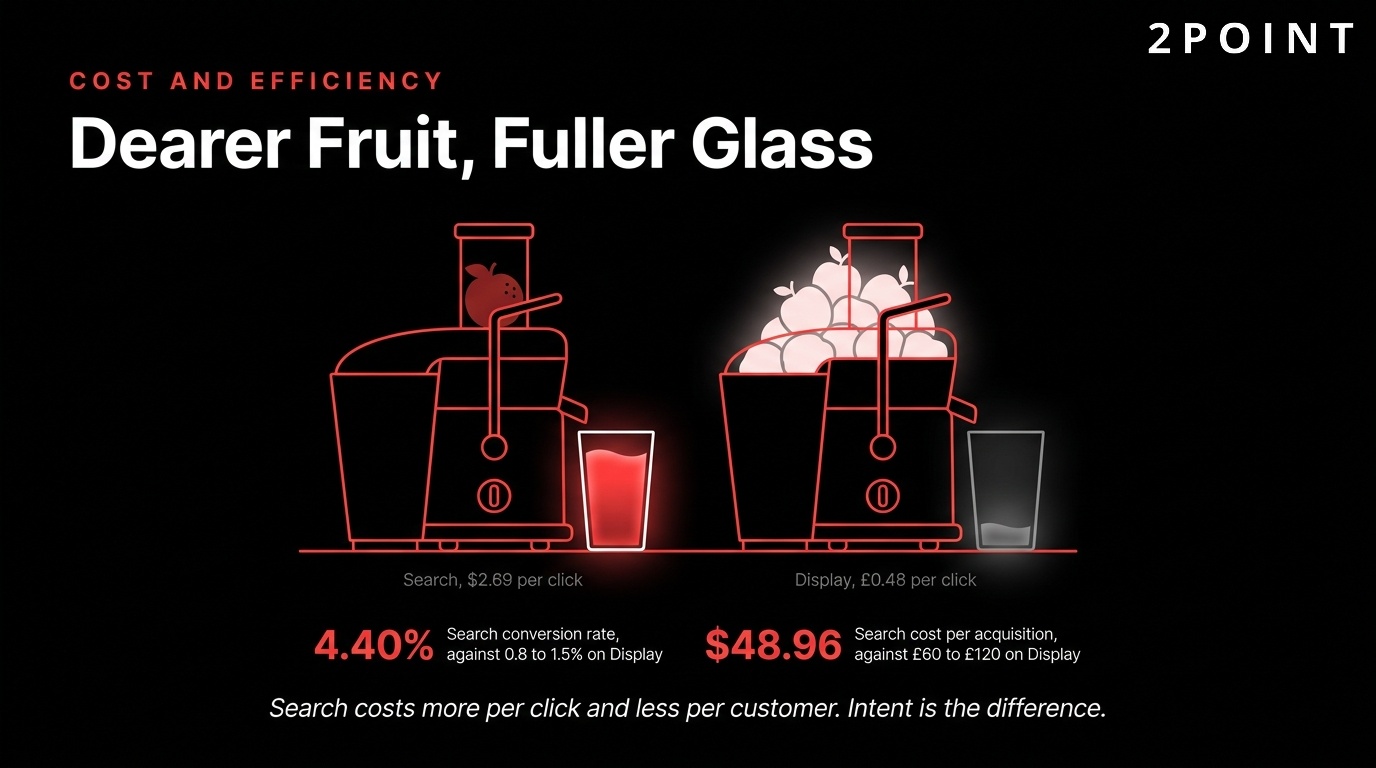
Average cost metrics for Google advertising in 2026 give marketers a practical framework for budget planning. Across Search campaigns, the 2026 averages are: CPC $2.69, CTR 3.17%, conversion rate 4.40%, and CPA $48.96. In UK markets, Search CPC averages £1.95 while Display CPC averages £0.48, reflecting the higher value of Search inventory relative to Display placements.
| Metric | Search Average (USD) | Search Average (GBP) | Display Average (GBP) |
|---|---|---|---|
| Cost Per Click (CPC) | $2.69 | £1.95 | £0.48 |
| Click-Through Rate (CTR) | 3.17% | 3.17% | 0.35-0.46% |
| Conversion Rate (CVR) | 4.40% | 4.40% | 0.8-1.5% |
| Cost Per Acquisition (CPA) | $48.96 | £35-45 | £60-120 |
The key takeaway from these cost benchmarks is that Search consistently delivers lower CPA than Display despite higher CPC, because the intent quality of search-triggered clicks is dramatically higher than the cold-audience clicks generated by Display placements.
For new campaigns, the recommended minimum budget for generating enough data to make meaningful optimization decisions is £300 to £600 per month (approximately £10 to £20 per day). Below this threshold, campaigns may spend weeks without accumulating enough conversion data for smart bidding algorithms to optimize effectively. The minimum 2 to 4 week testing period before drawing conclusions about campaign performance is a platform requirement, not a preference. Smart bidding strategies need conversion data to calibrate, and making changes during the learning phase resets this process. Understanding the full picture of PPC pricing before launching campaigns prevents costly misalignments between budget and expectations.
ROI and Revenue Impact
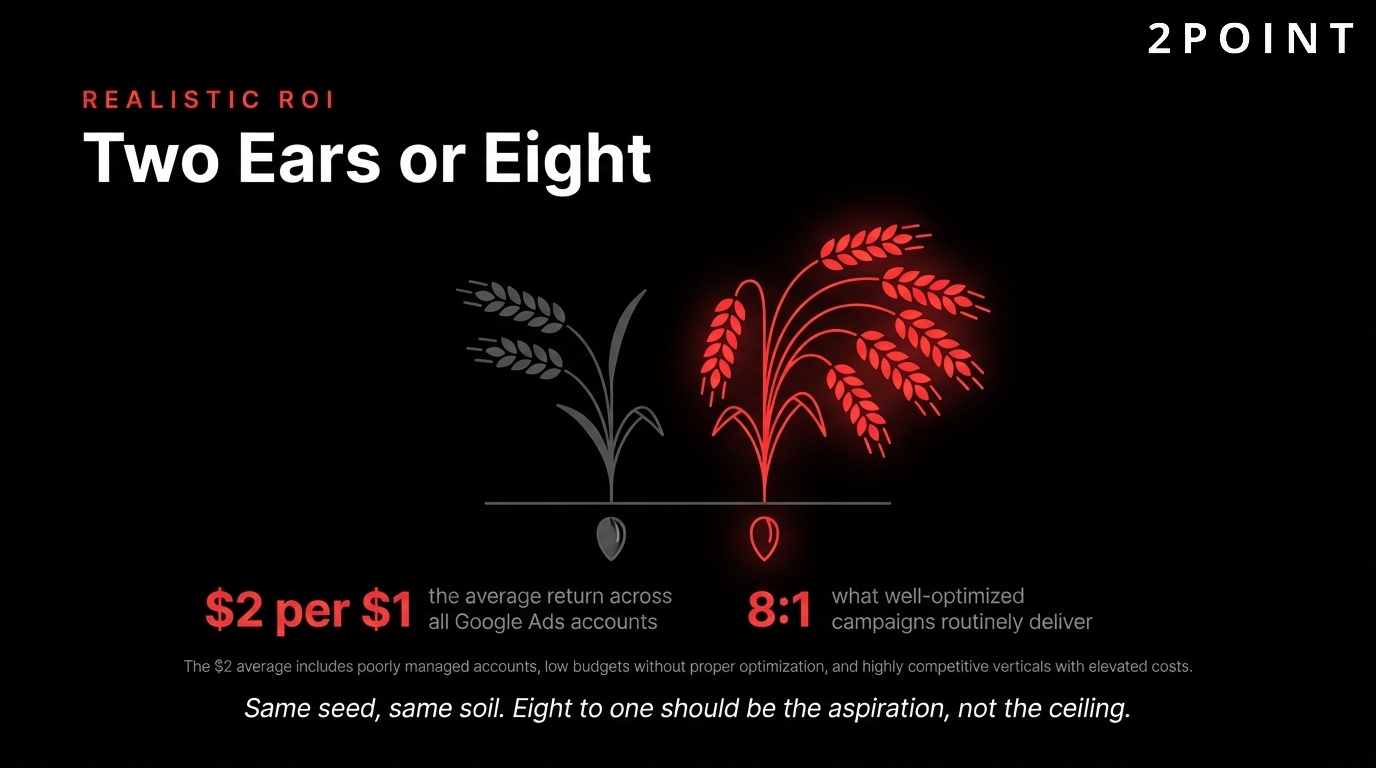
The headline ROI figure for Google advertising is the $2 average return per $1 spent, but this baseline tells only part of the story. Well-optimized campaigns routinely deliver 8:1 returns or higher, particularly in competitive categories where the lifetime value of a customer significantly exceeds the cost of acquisition. The $2 average includes poorly managed campaigns, low-budget accounts without proper optimization, and campaigns in highly competitive verticals where CPCs are elevated. For a business with experienced campaign management and strong input quality, 8:1 should be the aspiration, not the ceiling.
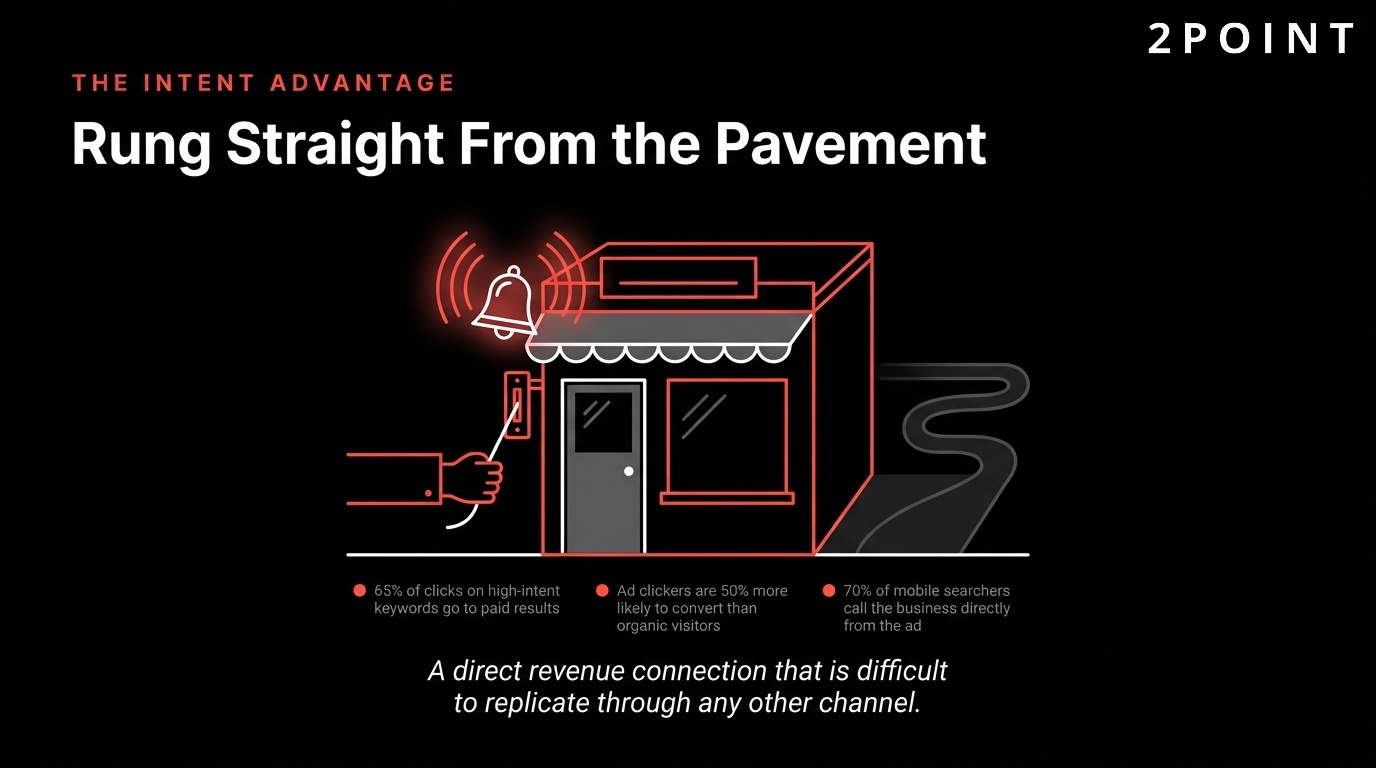
The intent advantage of search advertising over other digital channels is validated by the data. 65% of clicks on high-intent keywords go to paid results rather than organic, meaning that for commercial queries, ads capture the majority of the available traffic. Users who click on ads are 50% more likely to convert than organic visitors, reflecting the fact that clicking on an ad represents a stronger expression of purchase intent than clicking on an organic result. On mobile specifically, 70% of searchers call businesses directly from mobile ads, creating a direct revenue connection that is difficult to replicate through any other channel.
Click-Through Rates and Engagement Patterns
The average CTR for Google Search campaigns is 3.17%, but this figure varies considerably based on ad position, industry, query type, and the presence of ad extensions. Top 3 positions in the search results page generate significantly higher CTR than positions 4 through 8, and position 1 can deliver 2 to 4 times the CTR of position 3 for highly commercial queries. The investment in stronger Quality Scores, better ad relevance, and higher bids that earns top position typically pays for itself through improved CTR efficiency.
Ad extensions continue to meaningfully improve CTR by increasing the visual footprint of ads in search results and providing additional pathways for users to engage. Sitelinks allow users to navigate directly to specific pages, callouts highlight additional features and benefits, and structured snippets provide product or service category context. Campaigns with a complete extension set consistently outperform those relying on headline and description alone, and the implementation cost is minimal relative to the performance benefit. Understanding advertising effectiveness at this granular level allows marketers to make data-driven decisions about which extensions deserve more investment.
How Ads in AI Overviews Are Changing the Search Experience
The introduction of AI Overviews, Google’s AI-generated summary blocks at the top of search results, represents the most significant structural change to the search results page in over a decade. For advertisers, this evolution creates both challenges and new opportunities that require immediate strategic attention.
What AI Overviews Are and How They Reshape Search Results
AI Overviews are AI-generated summaries that appear at the top of certain search results pages, synthesizing information from multiple sources to provide direct answers to complex queries. Originally launched in mobile-only US markets, AI Overviews expanded to desktop and global markets in 2025, meaning that a significant and growing percentage of all search queries now display an AI Overview before any traditional organic results or paid search ads appear.
The user behavior implications are significant. When an AI Overview answers a question directly, a portion of users will read the summary and leave without clicking any further results, organic or paid. This zero-click search behavior has been a growing phenomenon for years, but AI Overviews dramatically accelerate it for information-seeking queries. The queries most likely to trigger AI Overviews tend to be exploratory and research-based rather than transactional, which means their impact on commercial intent traffic is somewhat moderated. However, the research phase of the purchase journey, where users are forming preferences and building awareness, is now significantly more likely to happen within Google’s AI-generated content rather than on publishers’ websites.
Conversational and visual search is also growing rapidly as Google integrates more multimodal AI capabilities into the search experience. Users are increasingly submitting queries as questions or spoken commands rather than keyword strings, and Google’s systems have adapted to understand and respond to intent behind these natural language queries rather than just pattern-matching against keywords. This shift validates the broader move in Google Ads toward intent-based matching over exact keyword matching.
Ad Placement Within AI Overview Results
Google has integrated paid placements within and around AI Overview results, creating new positioning opportunities for advertisers. Eligible ad positions include above AI Overviews, below them, and embedded within the AI-generated content itself, depending on the query type and the advertiser’s campaign eligibility. The selection process for which ads appear in AI Overview placements is based on the same fundamental Quality Score and bid logic that governs standard search placements, but with additional relevance requirements to ensure that ads in AI Overview contexts match the exploratory, question-based nature of the queries they appear alongside.
Creative considerations for AI Overview placements differ from traditional search ads. The user who triggers an AI Overview is typically in a research mindset rather than a purchase mindset, which means ad messaging that acknowledges the research context, offers helpful resources, or positions the brand as an authority is likely to resonate better than direct transaction-focused messaging. Providing specific, factual, useful information in ad copy rather than generic benefit statements tends to perform better in AI Overview adjacent placements because it mirrors the informational nature of the surrounding content.
Optimizing for Discovery-Phase Search Behavior
The expansion of AI Overviews reinforces a shift that has been underway in Google advertising for several years: the move from precise keyword targeting toward intent-based matching. Broad match keywords combined with smart bidding have consistently outperformed tighter match type strategies in AI-assisted search environments, because the AI can identify high-intent users even when their query does not contain the exact keyword phrase the advertiser targeted.
This means that an advertiser in the home renovation space does not need a keyword for every possible way a customer might describe a kitchen renovation project. A broad match keyword with strong audience signals and smart bidding can identify users asking conversational questions about kitchen renovations, comparing contractor reviews, looking at material costs, and researching timelines, all from a single keyword entry. The comprehensive ad copy covering multiple angles of the renovation journey, combined with a landing page that addresses the full range of early-stage questions, creates a better match for the exploratory intent that AI Overview queries typically represent.
Strategic Implications for SEO and Paid Search Integration
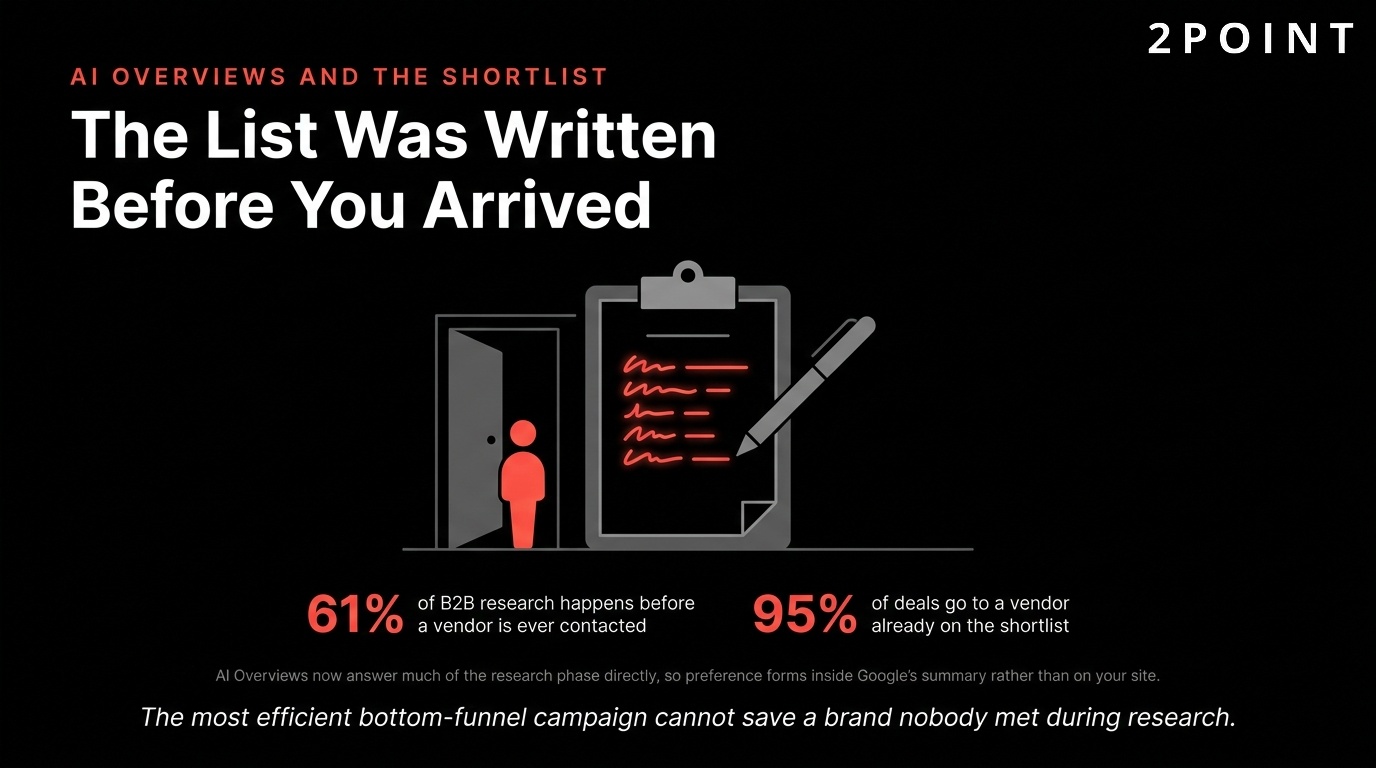
The rise of AI Overviews makes the coordination between paid search and organic search content strategy more important than it has ever been. Research consistently shows that 61% of B2B research happens before a vendor is ever contacted, and in 95% of deals, the winning vendor was already on the buyer’s shortlist before the sales process began. These statistics reveal a fundamental vulnerability for businesses that focus exclusively on bottom-funnel paid search while neglecting the research-phase visibility that determines whether they are considered at all.
Being absent from AI Overviews during the research phase of the customer journey means missing the moments when purchase preferences are being formed. A business can have the most efficient, high-converting bottom-funnel campaign imaginable, but if their brand is not encountered during the research phase, they will never appear on the shortlist that determines who gets evaluated in the first place. Coordinating paid search with content that earns AI Overview citations, building authority through comprehensive, well-structured informational content, and using Demand Gen campaigns to create brand familiarity before intent crystallizes into a search query is the integrated approach that produces sustainable competitive advantage. For businesses looking to improve their online advertising visibility, AI Overview optimization is now an essential component of that strategy.
Privacy, Measurement, and Conversion Tracking in Google Advertising
The measurement infrastructure that underpins effective Google advertising has undergone its most significant transformation in years, driven by privacy regulation, cookie deprecation, and Google’s own data standards evolution. In 2026, getting measurement right is not a technical detail. It is the prerequisite for everything else working correctly, because AI optimization systems are only as good as the conversion signals they receive.
Consent Mode and Enhanced Conversions: Now Essential, Not Optional
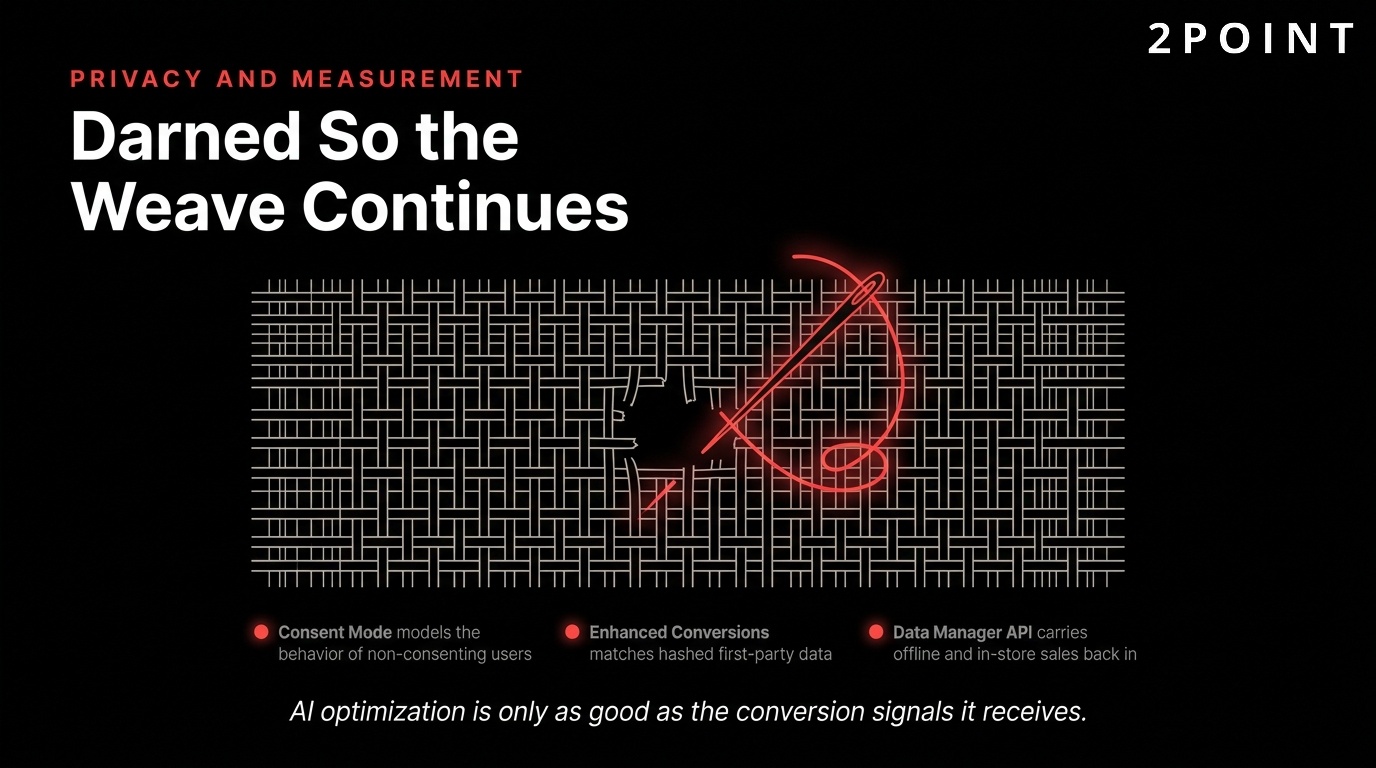
Google has made clear that Consent Mode and Enhanced Conversions are essential components of a properly configured Google Ads account in 2026, not optional additions for privacy-focused businesses. Consent Mode allows the ads measurement system to work within cookie consent frameworks by using modeled data to estimate the behavior of users who have not consented to tracking, filling the measurement gaps that cookie rejection creates without violating user consent preferences.
Enhanced Conversions extends conversion tracking accuracy by hashing first-party data (email addresses, phone numbers, and other identifiers provided by users during conversion events) and matching them against signed-in Google accounts. This approach improves conversion measurement coverage in browsers and environments where cookies are blocked or restricted, without requiring any new data collection from users beyond what they already provide voluntarily during a conversion. Implementation is available via Google Tag Manager or direct gtag.js integration, and the setup process, while technical, is well-documented and can be completed by any developer familiar with the Google Ads Tag ecosystem.
Compliance with GDPR in Europe, CCPA in California, and the growing patchwork of privacy regulations globally requires that Consent Mode be properly configured to respect user consent signals. Businesses that have not implemented Consent Mode risk both compliance exposure and measurement degradation, since Google’s systems can use modeled data only when the consent framework is correctly signaling user preferences. Working with a team experienced in measuring advertising effectiveness in a privacy-compliant way is increasingly important as these requirements become more complex.
Store Sales Conversions and Offline Tracking
For businesses with physical retail locations, the ability to connect online ad exposure to in-store purchases has historically been one of the most challenging measurement problems in digital advertising. Google’s Data Manager API now simplifies the process of uploading store sales conversions, providing a streamlined workflow that incorporates confidential matching and encryption to protect customer data while still enabling the attribution connection between digital campaigns and physical store revenue.
The offline conversion tracking capability allows businesses to understand the true full-funnel impact of their Google advertising investment, including the substantial portion of purchase value that begins online (with a search and ad click) but completes offline (with a visit to a physical store or a phone sale). Without this connection, businesses that measure only online conversions systematically undervalue their Google advertising ROI, making budget decisions based on incomplete data. Multi-touch attribution across digital and physical channels, enabled by the Data Manager API, provides a more accurate picture of which campaigns and campaign types are genuinely driving business outcomes. The expanded scope of measuring advertising effectiveness to include these offline signals is one of the most significant measurement advances of the past two years.
YouTube Channel Auto-Linking and Video Measurement
A deadline that many advertisers missed in mid-2026 was the June 10, 2026 implementation of automatic YouTube channel linking to Google Ads accounts, unless advertisers specifically opted out. This auto-linking brings organic YouTube video metrics directly into the Google Ads interface, allows advertisers to build remarketing audiences from video viewers, and enables conversion events including subscriptions, likes, and shares to be tracked as meaningful engagement signals.
For advertisers running YouTube campaigns, the benefits of channel linking are substantial. Organic video performance data provides creative intelligence about which content resonates with audiences, and this intelligence can directly inform paid YouTube ad production. Viewer audiences built from organic engagement are typically higher quality than cold audiences, producing better performance when used as signals in Performance Max or Demand Gen campaigns. Advertisers who had not previously managed organic YouTube channels now have a clear reason to invest in content creation: the resulting viewer audiences become a first-party data asset that feeds directly into paid campaign optimization.
API Changes and Developer Considerations
Several technical changes in 2026 affect how Google Ads data flows between platforms and how conversion tracking is implemented at a developer level. A May 2026 deadline was established for errors related to offline conversion imports using the legacy Google Ads API structure, requiring businesses to migrate to the Data Manager API for offline conversion uploads or risk data gaps in their conversion tracking. The migration process includes a developer token allowlisting process that requires approval from Google’s API access team, so businesses should begin this process well in advance of any hard deadlines.
Google Analytics event ingestion has also expanded in 2026 to include both web and app data streams within a unified reporting environment, allowing marketers to see the complete user journey across web visits and mobile app usage in a single attribution framework. For businesses with both web and app presences, this represents a significant simplification of their analytics infrastructure. The practical implication for marketing teams is ensuring that their technical partners understand these changes and have the platform knowledge to implement them correctly. What marketers need to communicate to development teams is straightforward: Consent Mode and Enhanced Conversions take priority, Data Manager API migration must be completed before any offline conversion deadlines, and YouTube channel linking should be confirmed rather than left to auto-configuration.
The Future of Google Advertising: Strategic Priorities for Success in 2026 and Beyond
The eight themes covered in this guide converge on a single strategic reality: Google advertising in 2026 rewards advertisers who understand how to collaborate with AI systems rather than those who resist or work around them. The platform is not the same tool it was in 2020, and the strategies that produced strong results five years ago are actively counterproductive today. The businesses that are winning on Google advertising right now are those that have made peace with this transition and organized their inputs, their measurement, and their creative processes around the new model.
Google’s continued dominance, reflected in $318 billion projected 2026 revenue and 89.85% global search share, confirms that the platform’s reach and intent quality remain unmatched despite intensifying competition from Meta, Amazon, and TikTok. The emergence of Meta as a near-peer in total ad spend share is not a threat to Google’s position in high-intent commercial search. It is a reminder that sophisticated advertisers need to operate across multiple channels and that a Google-only strategy may leave upper-funnel awareness gaps that competitors will fill.
The AI transformation of the platform, embodied in the Power Pack of Demand Gen, Performance Max, and AI Max, is the most consequential structural shift in Google advertising since the introduction of Quality Score. Success in this environment requires a different set of skills than success in the manual keyword-bidding era. The relevant skills now are: building robust conversion tracking frameworks, developing diverse and high-quality creative asset libraries, constructing accurate and comprehensive audience data sets, and understanding how to interpret AI-managed campaign results and intervene appropriately when systems need correction.
The rise of AI Overviews and conversational search behavior reinforces the need for an integrated approach to paid and organic search, particularly for B2B businesses where research phases are long and the shortlist is formed long before any sales contact occurs. Advertisers who invest exclusively in bottom-funnel conversion campaigns while neglecting research-phase visibility are building a strategy with a fundamental structural weakness.
Privacy compliance, centered on Consent Mode and Enhanced Conversions, is the non-negotiable foundation of all measurement in 2026. Without it, the conversion signals feeding AI optimization systems are incomplete, and incomplete signals produce suboptimal optimization. The businesses that treat privacy infrastructure as an investment in campaign performance, not just a compliance checkbox, will compound their advantages over time as their AI systems accumulate more accurate data.
The actionable priorities for any business running or planning to run Google advertising right now are clear. Audit your conversion tracking for accuracy and completeness. Implement Consent Mode and Enhanced Conversions if they are not already in place. Begin experimenting with AI Max and Performance Max using diverse, high-quality creative assets. Set realistic testing budgets with a minimum 2 to 4 week learning period before drawing conclusions. Coordinate your paid search strategy with content that can earn AI Overview visibility. Shift your focus from keyword-level control to input quality and conversion excellence.
Teams looking for experienced guidance in navigating this landscape can benefit from working with agencies that specialize in AI-driven Google advertising strategy. 2POINT brings the strategic framework and platform expertise to help businesses transition from legacy manual approaches to the AI-first model that defines competitive success in 2026, combining campaign management with the creative asset development, conversion tracking setup, and ongoing optimization that the platform now demands.
2026 represents a genuine inflection point in Google advertising. The opportunity for advertisers who embrace AI collaboration while maintaining strategic oversight is enormous: wider reach, better use of commercial intent signals, faster creative iteration, and more efficient scaling than was possible in the manual era. The window for competitors still operating on 2020-era strategies to catch up is narrowing. The advantage now belongs to those who adapt first, build better inputs, and let the AI do what it was designed to do.
Frequently Asked Questions About Google Advertising
What is Google advertising and how does it work?
Google advertising is a pay-per-click platform that lets businesses display ads across Google Search, Display Network, YouTube, Shopping, and Discover. Advertisers set budgets and bids, and Google’s AI matches ads to users based on search queries, intent signals, and audience characteristics. Advertisers pay only when users click on their ads, making it a performance-based channel with measurable ROI.
How much does Google advertising cost for a small business?
The recommended minimum budget for generating useful performance data is £300 to £600 per month (approximately £10 to £20 per day). The average cost per click across Search campaigns is $2.69 in US markets and £1.95 in UK markets. Actual costs vary by industry, competition level, and campaign quality, and budgets should be set based on target CPA goals and expected conversion rates.
What is the average ROI for Google Ads campaigns?
Businesses earn an average of $2 for every $1 spent on Google Ads, but well-optimized campaigns regularly achieve 8:1 returns or higher. ROI depends heavily on industry, conversion tracking accuracy, campaign management quality, and landing page performance. High-intent search advertising consistently delivers strong ROI because clicks represent active commercial interest rather than passive exposure.
What is AI Max for Search campaigns in Google Ads?
AI Max is Google’s newest AI-driven campaign type for search advertising, launching in September 2026. It uses AI-assisted query matching, dynamic asset selection, and automated landing page optimization to serve the most relevant ad for each individual search context. Dynamic Search Ads will be automatically upgraded to AI Max in September 2026 unless advertisers opt out.
What is the difference between Google Performance Max and traditional Search campaigns?
Performance Max runs a single campaign across all Google surfaces including Search, Display, YouTube, Gmail, Discover, and Maps, optimizing automatically toward a defined conversion goal. Traditional Search campaigns allow advertisers to specify exact keywords, write individual ads, and control placement at a granular level. Performance Max suits advertisers who prioritize total conversion volume across channels, while Search campaigns remain preferable when precise query control and brand safety require manual oversight.
How do AI Overviews affect Google advertising performance?
AI Overviews appear at the top of many search results pages as AI-generated summaries, changing the layout of the SERP and capturing some information-seeking clicks that previously went to organic or paid results. Google has integrated paid placements above, below, and within AI Overviews, giving advertisers new positions to bid for. The overall impact on transactional search traffic is moderate, but research-phase queries are significantly more likely to be answered within the AI Overview itself.
Is Google advertising better than Meta advertising for small businesses?
Google advertising excels at capturing high-intent traffic from users actively searching for a product or service, producing strong conversion rates because the search signal indicates purchase readiness. Meta advertising is stronger for upper-funnel awareness and reaching audiences who match a target customer profile before they begin searching. The optimal approach for most small businesses is to start with Google advertising for direct demand capture and add Meta advertising as budget grows to build awareness that feeds the Google search pipeline.
What conversion tracking setup is required for Google Ads in 2026?
Effective Google Ads measurement in 2026 requires at minimum: Google Tag or Google Tag Manager implementation, Consent Mode for privacy compliance, and Enhanced Conversions to recover measurement gaps caused by cookie restrictions. For businesses with physical locations, offline conversion tracking via the Data Manager API is also recommended to capture the full value of campaigns that drive in-store purchases. These are not optional add-ons but foundational requirements for AI optimization systems to function correctly.
What is the average conversion rate for Google Ads?
The average Google Ads conversion rate across all industries is 7.52%, but this varies significantly by sector. Automotive achieves 14.67%, Animals and Pets reach 13.07%, and Physicians and Surgeons convert at 11.62%, all well above average. E-commerce categories typically convert at 2 to 4%. Benchmarking against your specific industry rather than the overall average produces more useful performance targets.
How long does it take for Google Ads to work?
A minimum of 2 to 4 weeks is required before drawing meaningful conclusions about campaign performance, because smart bidding strategies need conversion data to exit the learning phase and begin optimizing effectively. Campaigns that accumulate fewer than 50 conversions per month may take longer to stabilize. Making significant changes during the learning phase resets the optimization clock and extends the timeline to reliable performance data.
What is the Google Ads Power Pack?
The Google Ads Power Pack is Google’s term for its three AI-driven campaign types used together to cover the full customer journey: Demand Gen for awareness on YouTube, Discover, and Gmail; Performance Max for cross-channel consideration and conversion across all Google surfaces; and AI Max for capturing high-intent search queries. Running all three in coordination produces results that exceed any single campaign type operating alone by compounding reach, intent capture, and conversion efficiency across the funnel.
Do I need a large budget to advertise on Google effectively?
A large budget is not required to start, but some minimum investment is necessary for the AI bidding systems to collect enough data to optimize. A budget of £300 to £600 per month is sufficient to generate meaningful performance data in most markets, and this can be scaled up as initial results validate the channel. The most important investment is not budget size but input quality: accurate conversion tracking, strong creative assets, and clear campaign objectives consistently outperform larger budgets with poor setup.