

 let’s connect



What is law firm marketing and why does it matter in 2026?
- Law firm marketing includes every strategy attorneys use to attract clients, build reputation, and grow revenue.
- Effective legal marketing is now essential for survival, not optional, with 418,181 law firms competing in the U.S.
- Over half of all legal queries now pass through AI-enhanced search experiences.
- Clients research extensively online before ever contacting an attorney.
- Firms without a strategic marketing system lose ground to competitors daily.
- The eight critical components covered here include SEO, AI search, content, reviews, PPC, social media, email, and lead generation.
- Each component works as part of a connected system, not as isolated tactics.
- Firms that implement this system predictably outperform those relying on referrals alone.
What Is the Current State of Law Firm Marketing and Why Are So Many Firms Falling Behind?

The legal industry has undergone a fundamental marketing transformation over the last five years, and the pace of change is accelerating in 2026. Competition for clients no longer happens primarily through reputation and referral networks. It happens across Google, AI-generated answer platforms, review sites, YouTube, and social media simultaneously. Firms that have not adapted to this new reality are not simply missing opportunities, they are actively losing clients to competitors who have.
Understanding where the market stands today is the first step toward building a strategy that works. The sections below break down the four core challenges firms face right now.
Why Most Law Firms Struggle With Their Marketing Efforts

The most persistent challenge in legal marketing is structural. Marketing is non-billable work, which means every hour spent on it competes directly with revenue-generating activities. This reality leads most attorneys to treat marketing as an afterthought, something to revisit when the caseload gets thin rather than a consistent, strategic priority.
Today's law firms must compete across multiple platforms and channels simultaneously, including Google Search, Google Maps, AI platforms, review directories, social media, and email. Each channel has its own rules, algorithms, and audience expectations. Managing all of these well requires either a dedicated internal team or a skilled external partner.
Law firms operate in one of the most aggressive digital landscapes of any industry, with search results more crowded and advertising costs rising year over year. The firms winning in this environment are not the ones spending the most, they are the ones spending most strategically. The gap between firms with a coherent marketing system and those relying on luck or sporadic effort continues to widen.
The Digital Foundation Crisis: Website and Online Presence

Every marketing strategy in 2026 begins and ends with a firm's website, yet the data reveals a troubling trend. In 2023, only 87% of law firms had a website, down from 94% in 2021 and 2022. This decline reflects a combination of smaller firms closing and others operating without any meaningful online presence, a position that is genuinely indefensible in today's market.
Only about one-third of law firms with websites maintain a blog, with adoption rates significantly higher at larger practices. This matters because blog content is one of the most cost-effective tools for capturing long-tail search traffic and answering client questions before a competitor does. Smaller firms that skip blogging entirely surrender a meaningful competitive advantage.
A well-designed website is the foundation for a strong SEO strategy and the central hub that all other marketing channels point toward. Paid ads, social media posts, and email campaigns all drive traffic somewhere, and that somewhere must be a website capable of converting visitors into consultation requests. Without a strong digital foundation, every other marketing effort underperforms.
How Client Behavior Has Permanently Changed the Legal Market

Legal consumers are more empowered, more informed, and more cautious than they have ever been. The process of selecting an attorney now mirrors how people purchase other significant services: through research, comparison, and social proof. Clients read reviews, compare practice area pages, watch attorney videos, and evaluate credentials long before they pick up the phone.
If a firm does not appear in search results or lacks persuasive digital assets, it is effectively invisible to the majority of prospective clients. Trust must be established within seconds through digital touchpoints that include compelling website copy, professional photography, video testimonials, and prominently displayed reviews. Multiple positive interactions across different channels are typically required before a prospect converts into a consultation.
This shift is not temporary. It reflects a generational change in how people evaluate professional services, and it will only deepen as younger, more digitally native clients enter the market for legal services over the next decade.
The Strategic Marketing Imperative: Why Treating Marketing as a System Changes Everything
Digital marketing for law firms is no longer just about lead generation. It functions as risk management, reputation building, and long-term business insurance. A firm that has built strong organic search visibility, a robust review profile, and a consistent content library has created resilience against market fluctuations that firms relying on referrals simply do not have.
Firms that treat marketing as a strategic system position themselves to win in any market, under any condition, rather than scrambling when referrals dry up or a key partner leaves. The difference between random tactics and a cohesive strategy is the difference between unpredictable revenue and predictable case flow. Firms that recognized the emerging 2026 trends early are already capturing market share while those waiting continue to fall behind.
How Does Law Firm SEO Generate the Highest Return on Marketing Investment?
Search engine optimization remains the single most powerful long-term marketing channel available to law firms. While paid advertising delivers immediate results and social media builds brand awareness, SEO creates compounding returns over time that no other channel replicates at the same scale. Understanding how it works, and what it actually takes to succeed, is foundational to any serious marketing strategy.
Why SEO Is the Highest-ROI Marketing Channel for Lawyers

SEO is one of the most effective client acquisition channels available for law firms across virtually all practice areas. Unlike paid advertising, which stops delivering the moment a campaign ends, organic search traffic continues generating leads as long as the content and technical infrastructure are maintained. This fundamental difference makes SEO a capital asset rather than a recurring expense.
Law firms regularly report 6 to 10 times return on investment within 12 to 18 months of implementing a disciplined SEO strategy. The reason for these returns is simple: organic search captures high-intent traffic from people who are actively searching for legal help right now, which means conversion rates are substantially higher than most other marketing channels.
For small and mid-size firms competing against well-funded practices, disciplined SEO execution is often the highest-ROI marketing investment available. SEO helps improve search rankings, builds domain authority, attracts qualified leads and clients, and helps firms stand out in saturated local markets. The benefits of investing in digital marketing compounds over time in ways that outperform almost any other channel.
Realistic SEO Timelines and What Law Firms Should Actually Expect

SEO typically takes between three and six months to produce a meaningful, measurable impact on search rankings and traffic. The timeline is influenced by several factors including the competitive intensity of the local market, the age and authority of the existing website, the depth of content already published, and the quality of technical SEO practices currently in place.
The most important mindset adjustment for firms new to SEO is to anticipate incremental success over time rather than an overnight transformation. Rankings improve gradually as new content is published, backlinks are earned, and technical issues are resolved. SEO builds lasting authority and generates organic traffic over the long term, with firms seeing compounding benefits as they develop both their content library and their backlink profile. Setting these expectations clearly with firm leadership from the start prevents premature abandonment of a strategy that is actually working.
Local SEO Fundamentals That Actually Move the Needle for Law Firms

For most law firms, especially those serving specific geographic regions, local SEO is the most directly revenue-generating component of any broader search strategy. Optimizing a Google Business Profile with location-specific keywords and maintaining consistent citations across online directories are among the most impactful starting points for local SEO.
A complete Google Business Profile should include accurate name, address, and phone number information, all practice areas listed as services, regular posts, and professional photos of staff and the physical practice location. Citations should be consistent across major legal directories including Avvo, FindLaw, Justia, Martindale-Hubbell, and local bar association listings. Any inconsistency in NAP data across directories signals confusion to Google and can suppress local rankings.
Building a steady flow of genuine client reviews is critical because Google's local algorithm prioritizes both the recency and volume of reviews. Firms should create a systematic process for requesting reviews from satisfied clients immediately after case resolution, while the experience is still fresh. This local SEO investment connects directly to local marketing strategies that help law firms dominate their specific geographic service areas.
Content Strategy and E-E-A-T: Building Legal Authority Google Recognizes
Improving SEO requires adding new content regularly, with the most effective firms publishing several times per month and maintaining strong core content on their primary practice area pages targeting the terms they most want to rank for. While attorneys do not strictly need a blog to rank, blogging dramatically accelerates results by enabling targeting of long-tail keywords, addressing common client questions directly, and establishing topical authority in specific practice areas.
Google's E-E-A-T framework, which evaluates Experience, Expertise, Authoritativeness, and Trustworthiness, directly affects how legal content is ranked. Law firms can demonstrate these qualities through showcasing attorney qualifications and credentials, displaying client reviews and case outcomes, earning industry accolades, and producing genuine thought leadership on complex legal topics. This approach to content marketing builds the kind of durable authority that withstands algorithm updates and generates consistent rankings over time.
How Are AI-Enhanced Search and Generative Engines Changing Legal Marketing in 2026?
The most significant structural shift in law firm marketing right now is not happening in paid advertising or social media. It is happening at the fundamental level of how people find legal information. AI-powered search experiences are displacing traditional search engine results pages, and firms that do not adapt will find their organic visibility eroding regardless of how well-optimized their websites are.
How AI Overviews Are Changing the Legal Search Landscape

By early 2026, over half of all legal-related search queries are expected to pass through AI-enhanced search experiences, a dramatic transformation that happened faster than most marketing professionals predicted. Google's AI Overviews now synthesize answers directly within search results, meaning users often receive a complete response without clicking through to any individual website.
The rise of ChatGPT and SearchGPT as default information sources for millions of users means fewer total searches are even reaching Google, and those that do reach traditional search engines are increasingly answered without generating a click. The traditional model of "rank on page one and get traffic" is being fundamentally disrupted, requiring law firms to think about visibility in entirely new ways.
Optimizing for ChatGPT, Perplexity, and the New AI Search Platforms

It is now critically important that law firms make strategic moves to establish visibility on AI platforms including ChatGPT, Perplexity, and emerging competitors, as this represents the most impactful legal marketing trend that leading firms are already implementing. Being cited or recommended by AI platforms requires a different approach than traditional SEO, one centered on being recognized as a credible, authoritative, frequently-cited source.
As traditional search transitions to synthesized answer engines, generic articles lose virtually all search engine value. To safeguard visibility in AI-driven search, firms must produce unique, depth-driven insights that cannot be replicated by surface-level AI content generation. Future-proofing a law firm's content strategy requires a fundamental shift from basic keyword targeting to real-world legal storytelling and demonstrable deep subject matter expertise. The firms that AI platforms cite as authoritative sources are those that publish original insights, reference real case outcomes, and produce content that genuinely advances a reader's understanding.
Using AI Tools Responsibly in Law Firm Marketing Operations

45% of legal professionals now use AI tools on a daily basis, with marketing applications among the most common use cases. These applications include drafting social media posts, creating initial blog content, developing business development plans, and generating first drafts of marketing copy. The efficiency gains are real and meaningful.
AI in legal marketing is no longer experimental; it has become foundational for competitive firms. The firms seeing the best results are those using AI with active oversight from experienced marketing professionals who can ensure accuracy, compliance with ethics rules, and strategic alignment. Without human review, AI-generated marketing content risks lacking factual accuracy, bar compliance, and the strategic perspective that converts prospects into clients. AI is a powerful efficiency tool; it is not a replacement for marketing strategy.
Voice Search Optimization for Legal Services
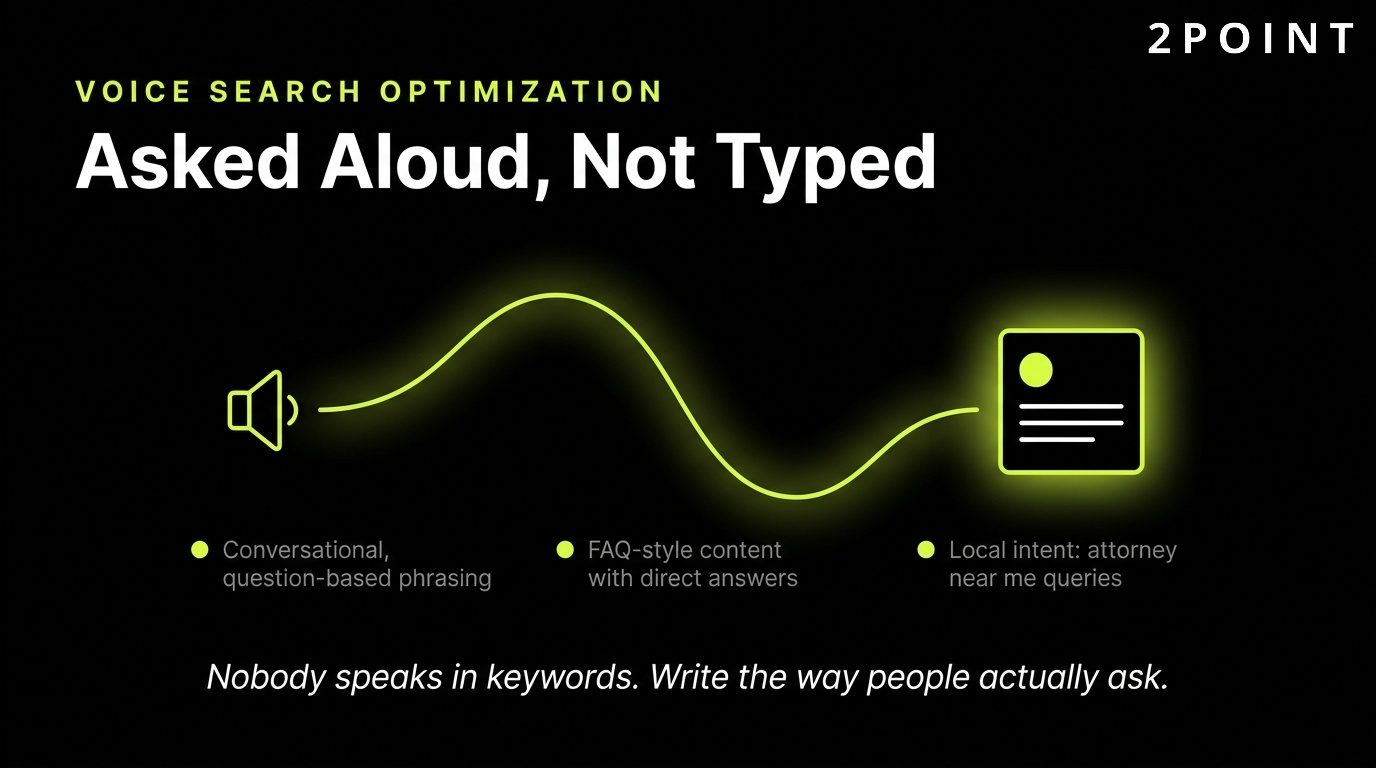
Voice search will continue gaining traction as a dominant search trend through 2026 and beyond, driven by improvements in both software capability and device integration across smartphones, smart speakers, and automotive systems. Advances in natural language processing have created an environment where more users comfortably rely on voice search for everyday informational needs, including finding local legal services.
Software programs have made major progress in accurately recognizing and parsing voice input, which means voice queries are now more precise and more actionable than they were even two years ago. Optimizing for voice search requires focusing on conversational, question-based queries, which aligns closely with FAQ-style content and concise, direct answers. Local intent queries such as "personal injury lawyer near me" and "divorce attorney in [city]" represent the highest-value voice search targets for most law firms.
What Content Marketing Strategies Actually Convert Legal Prospects Into Paying Clients?
Content marketing for law firms has matured well beyond basic blogging. In 2026, the firms generating consistent leads from content are those that approach it with the same rigor they apply to legal work: research-driven, audience-specific, and built around clearly defined outcomes. The following strategies reflect what is actually working right now.
The Shift From Informational Brochures to Educational Knowledge Hubs

The biggest law firm website trend for 2026 is the shift from treating a website as an informational brochure to positioning it as an educational knowledge hub that answers client questions comprehensively. This means clearer explanations of legal processes, stronger internal linking between related content, and sharp credibility signals that establish expertise at first glance.
Content marketing performance is undergoing a quiet but meaningful transformation in the legal space, driven by both algorithm changes and shifts in how prospective clients consume information. What earns visibility, trust, and engagement is becoming more nuanced, more human, and more data-driven than at any previous point. This evolution is pushing law firms toward a more intentional, editorial mindset, one that produces content with genuine depth rather than content designed primarily to satisfy keyword density requirements.
Creating Unique, Depth-Driven Legal Content That Stands Apart
Generic articles have lost virtually all search engine value as Google and AI platforms increasingly reward demonstrable expertise over keyword matching. Law firms must now produce unique, depth-driven insights that reflect real experience with specific legal issues. This requires a shift to real-world legal storytelling and demonstrated deep subject matter expertise, the kind that only comes from attorneys who have actually navigated the issues they are writing about.
The most effective content formats in 2026 include compelling case studies that walk through outcomes, informative infographics that simplify complex legal concepts, and short videos that are easily shared across social platforms. Each format serves a different function in the client journey: case studies build confidence, infographics expand reach, and videos accelerate trust. A well-rounded content marketing approach combines all three rather than relying on any single format.
Video Marketing for Law Firms: Building Trust at Scale

Videos have become one of the most popular and effective law firm marketing trends, and the reasons are straightforward: they communicate personality, build rapport, and establish human connection in ways that written content alone cannot match. For a profession where trust is the foundational purchasing criterion, video is uniquely powerful.
Video testimonials in particular play a vital role in helping prospects build trust within seconds, which is especially important given how quickly people make decisions about which firms to contact. Attorney introduction videos humanize the people behind the practice. Short educational videos addressing common legal questions demonstrate expertise while addressing the exact queries prospective clients are searching for. Process explanation videos reduce the anxiety around booking a consultation, a friction point that prevents many qualified prospects from taking the next step. The benefits of video marketing for law firms extend well beyond views and into measurable conversion improvements.
Practice Area-Specific Content Strategy: Why Niche Wins

By 2026, law firms running generic multi-practice campaigns are watching their cost-per-case climb while conversion rates decline. The market has become too sophisticated and too competitive for broad, undifferentiated messaging to work efficiently. The most successful firms are those marketing each practice area separately, capturing higher-intent traffic from prospects who are searching for exactly what those firms offer.
Boutique firms with 10 attorneys are routinely outranking much larger counterparts because their digital presence communicates deep expertise rather than general competence. The strategy is to market as if the firm has deep, niche expertise in each practice area it serves, with dedicated pages, targeted content, and specific client testimonials for each service. Law firm SEO trends for 2026 reflect a clear shift toward hyper-local targeting within specific practice niches, an approach that simultaneously improves search rankings and attracts more qualified, conversion-ready leads. Developing a personalized marketing approach for each practice area is what separates high-performing firms from those generating volume but not quality.
How Should Law Firms Build and Manage Their Online Reputation in 2026?
Online reputation management has become one of the most direct revenue drivers in legal marketing. Reviews influence search rankings, conversion rates, and client confidence simultaneously. Firms that treat reputation management as a systematic process rather than a passive hope consistently outperform those that leave it to chance.
Why Online Reviews Are Non-Negotiable for Legal Marketing Success
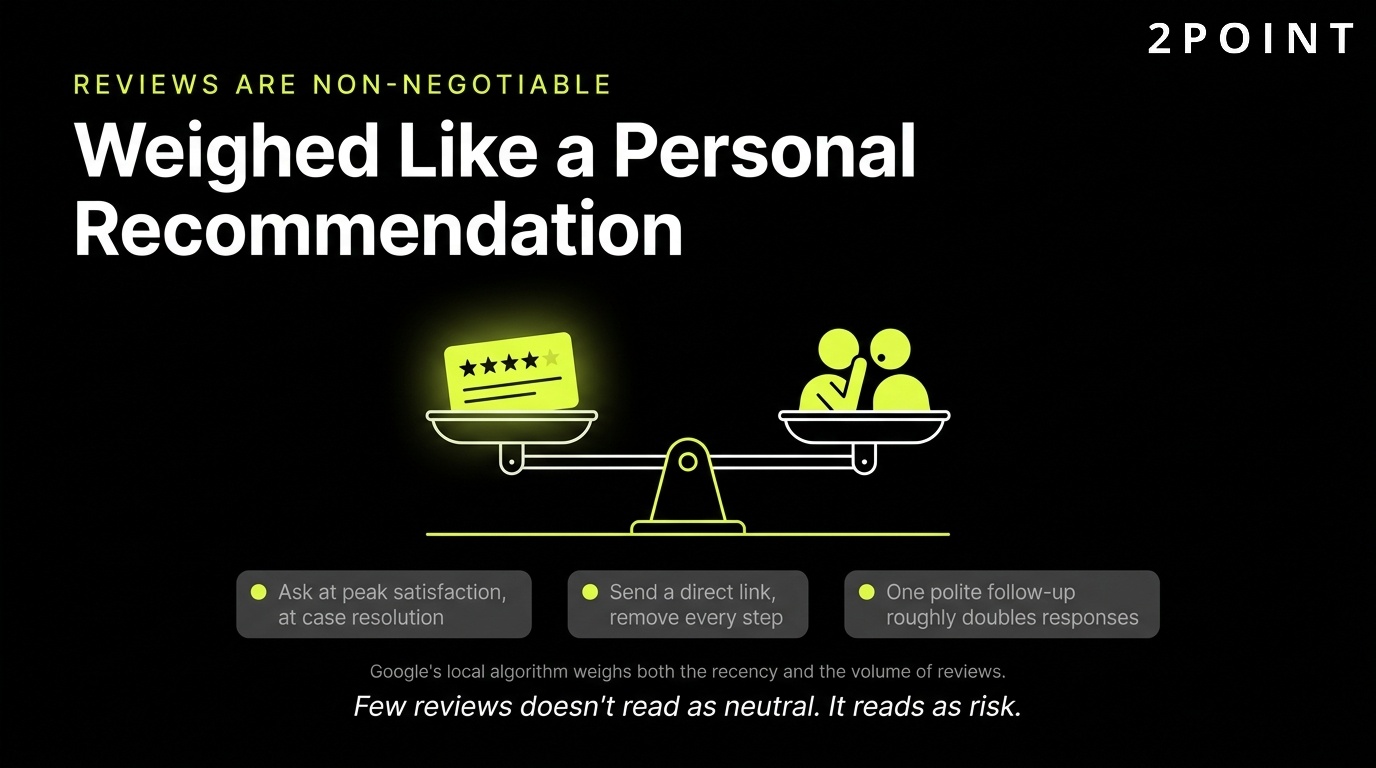
Prospective legal clients treat reviews with the same weight they give personal referrals. Before contacting any firm, a potential client will check Google reviews, Avvo ratings, and any other available feedback. A firm with dozens of recent five-star reviews communicates credibility instantly. A firm with few reviews or unaddressed negative feedback communicates risk, and risk is something legal clients are actively trying to avoid when choosing who will represent them.
Getting reviews must be an active, systematic process rather than something that happens organically. Firms that wait for clients to leave reviews on their own initiative collect a fraction of the reviews they could be generating. The most effective approach is to request reviews at the moment of peak client satisfaction, typically at case resolution or following a positive milestone, using a direct link to the Google review page that removes all friction from the process.
Strategies That Generate a Consistent Flow of Five-Star Reviews
The most reliable review generation systems share several common elements. First, they make the request easy by sending a direct link rather than asking clients to navigate to a review platform on their own. Second, they time the request strategically, reaching out when the client relationship is at its strongest. Third, they follow up politely if no review is received within a week, because one follow-up typically doubles response rates without creating friction.
Training all client-facing staff to mention the review request verbally during case conclusion conversations reinforces the digital follow-up. When a client hears the request in person and then receives a text or email with a direct link the same day, conversion rates improve substantially. Building this into the firm's standard client offboarding process ensures consistency regardless of which staff member handles the close.
Responding to Reviews: The Reputation Signal Most Firms Miss
How a firm responds to reviews, both positive and negative, is itself a reputation signal. Responding to positive reviews demonstrates that the firm values client feedback and is actively engaged with its community. Responding thoughtfully to negative reviews demonstrates professionalism, accountability, and the kind of client-centric values that attract new clients even from negative situations.
When responding to negative reviews, the priority is to acknowledge the concern without admitting fault or disclosing any client information, both of which can create bar compliance issues. A professional, empathetic response that invites the reviewer to contact the firm directly to resolve their concern communicates maturity and client focus. Prospective clients reading negative reviews pay as much attention to the firm's response as to the original complaint. Customer-centric marketing principles apply directly here: how a firm handles complaints publicly shapes how prospects perceive it before they ever make contact.
Reputation Management Beyond Google: Avvo, Martindale, and Legal Directories
Google reviews are the highest-priority platform for most law firms, but reputation management extends across the entire digital ecosystem where prospective clients conduct research. Avvo, Martindale-Hubbell, FindLaw, and Justia all function as research destinations for legal consumers, and a firm's profile quality on each platform directly influences whether a prospect moves forward or continues searching.
Each directory profile should be treated as a miniature marketing asset: complete with accurate information, comprehensive practice area descriptions, attorney credentials, awards, and as many peer endorsements and client reviews as the platform allows. Many attorneys neglect their directory profiles after initial setup, allowing them to go stale while competitors keep theirs current. Regular quarterly audits of all directory profiles ensure consistency and accuracy across the entire review ecosystem, which also supports local SEO through consistent NAP data.
What Are the Most Effective PPC and Paid Advertising Strategies for Law Firms?
Pay-per-click advertising gives law firms the ability to appear at the top of search results immediately, without waiting for SEO to produce organic rankings. For competitive practice areas and high-value case types, PPC is often a necessary complement to organic search strategies. Understanding how to run it efficiently is what separates profitable campaigns from expensive experiments.
Google Ads for Lawyers: How to Compete Without Wasting Budget
Legal keywords are among the most expensive in all of Google Ads. Terms like "personal injury lawyer," "DUI attorney," and "divorce lawyer" routinely command cost-per-click rates that would be unthinkable in most other industries. This reality makes targeting precision and landing page quality paramount: a campaign that converts at twice the rate effectively halves the cost per case acquisition.
The most effective Google Ads strategies for law firms focus narrowly on highest-value practice areas and geographic targets, use negative keyword lists aggressively to eliminate irrelevant clicks, and direct all traffic to dedicated landing pages rather than the homepage. A landing page built specifically for one practice area and one audience converts dramatically better than a general firm website. Every element, from headline to form to trust signals, should be designed with a single conversion goal in mind.
Google Local Services Ads: The Highest-Intent Legal Advertising Format
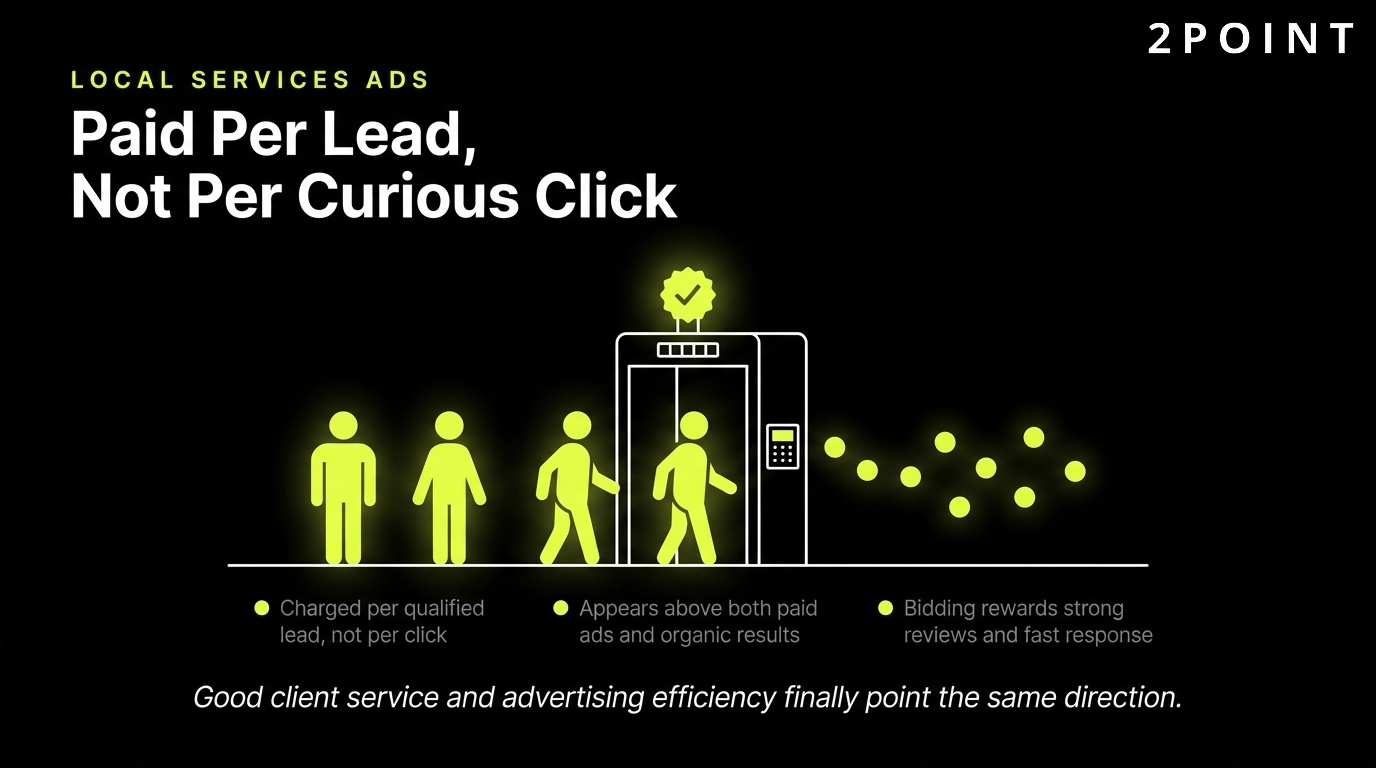
Google Local Services Ads (LSAs) represent one of the most cost-effective advertising formats available to law firms in 2026. Unlike traditional Google Ads that charge per click, LSAs charge per qualified lead, typically a phone call or message from a prospective client. The Google Screened badge that accompanies LSA listings also adds a layer of credibility that standard ads do not provide.
LSAs appear above both paid search ads and organic results for local queries, giving participating firms maximum visibility for high-intent searches. The bidding system rewards firms that receive strong reviews and respond quickly to leads, creating an alignment between good client service and advertising efficiency. For firms that have not yet implemented LSAs alongside their standard paid search campaigns, this represents a meaningful gap to close immediately.
Remarketing Campaigns: Converting the Prospects Who Did Not Contact You the First Time
Most visitors to a law firm's website leave without making contact, and the majority of them are still in the process of evaluating their options. Remarketing campaigns allow firms to stay visible to these prospects as they continue their research across other websites, social media platforms, and YouTube. Consistent visibility during the decision-making period significantly increases the probability of being the firm the prospect ultimately contacts.
Effective legal remarketing sequences use different ad creative for different visitor segments based on which pages they visited. Someone who read about family law services should see remarketing ads speaking specifically to family law, not a generic firm advertisement. This segmentation requires slightly more creative development upfront but dramatically improves relevance and conversion rates downstream. The multi-channel marketing approach that combines search, display, and social remarketing creates a surrounding presence that keeps the firm top-of-mind throughout the extended decision cycle typical of legal service selection.
Tracking and Attribution: Knowing Which Ads Actually Generate Cases
The single most common failure in law firm PPC is inadequate tracking. Many firms run campaigns, generate leads, and have no reliable system for connecting those leads to actual signed cases. Without this connection, it is impossible to know which keywords, campaigns, or ad variations are actually profitable versus simply generating volume.
Proper attribution for legal PPC requires call tracking at the keyword level, form submission tracking integrated with the firm's CRM, and a clear process for tagging leads with their source at intake. When this infrastructure is in place, the firm can calculate true cost-per-case by campaign and make data-driven budget allocation decisions. Setting clear marketing goals before launching any paid campaign ensures that the metrics being tracked are connected to real business outcomes rather than vanity metrics like click volume or impression share.
How Can Law Firms Use Social Media Marketing to Build Authority and Generate Leads?
Social media marketing for law firms has evolved significantly beyond simply having a Facebook page. In 2026, the firms generating meaningful business from social media are those using it strategically, with platform-specific content, consistent posting, and clear conversion pathways. Used correctly, social media builds brand authority, attracts referral sources, and generates direct client inquiries.
Choosing the Right Social Platforms for Your Practice Area
Not all social media platforms deliver equal value for all law firm types, and spreading effort thinly across every platform is less effective than executing well on the two or three that best match a firm's practice area and target client profile. Understanding where prospective clients and referral sources actually spend their time online is the foundation of any effective social strategy.
| Social Platform | Best Practice Areas | Primary Audience Reached | Content Format Priority |
|---|---|---|---|
| Business law, employment, M&A, IP | Business owners, executives, HR professionals | Articles, thought leadership posts, case commentary | |
| Family law, personal injury, immigration, criminal defense | General consumer demographics | Video testimonials, community posts, educational content | |
| Family law, estate planning, general brand awareness | Younger adults, 25-45 | Short video, infographics, behind-the-scenes content | |
| YouTube | All practice areas | High-intent information seekers | Educational Q&A videos, attorney profiles, process explanations |
| TikTok | Consumer-facing practices, personal injury, general awareness | Adults under 40 | Short educational clips, myth-busting, relatable legal content |
The platforms that generate the most consistent business value for law firms are those where the firm's target client base is most active and most receptive to professional service content.
Creating Content That Builds Legal Authority on Social Media
The most effective social content for law firms educates first and promotes second. Posts that answer common legal questions, explain recent law changes, address widespread misconceptions, or walk through what clients can expect from a legal process generate significantly more engagement than promotional posts about the firm itself. Authority is built through demonstrated knowledge, not through repeated announcements of services.
Consistency is the operational challenge most firms underestimate. A social media strategy that produces five posts in January and then goes quiet until April does more reputational harm than good, signaling inactivity to both algorithms and potential clients who visit the profile. Building a realistic content calendar with achievable posting frequencies, even if that means three times per week rather than daily, is far more effective than ambitious plans that collapse under the weight of a busy caseload. The full range of social media marketing benefits for law firms only materializes with consistent, strategic execution over time.
LinkedIn Strategy for Business and Corporate Law Firms
LinkedIn occupies a unique position in the legal marketing ecosystem because it reaches the exact audience most relevant to business-oriented law firms: executives, business owners, CFOs, HR directors, and other professionals who either need legal services or refer clients to attorneys. For firms practicing in areas like commercial litigation, mergers and acquisitions, employment law, or intellectual property, LinkedIn represents the highest-leverage social platform available.
The most effective LinkedIn strategies for law firms combine regular posting of substantive legal commentary with active engagement in relevant professional communities. Attorneys who comment thoughtfully on industry news, contribute original analysis on legal trends affecting their target clients, and maintain a complete, professionally photographed profile build genuine authority that translates into referrals and direct client inquiries. This functions as a form of B2B marketing where the relationship and trust-building dimension is just as important as any individual piece of content.
Social Media Advertising for Immediate Lead Generation
Organic social media builds authority gradually over months. Social media advertising delivers results immediately by putting a firm's message in front of precisely defined audience segments. Facebook and Instagram advertising in particular offer demographic and behavioral targeting capabilities that allow law firms to reach people who match the profile of their ideal client with remarkable precision.
For consumer-facing practices like personal injury, family law, and immigration, social advertising campaigns targeting specific life events, such as recent divorce filings, new business formations, or recent accidents, can generate high-quality leads at a cost-per-acquisition that competes favorably with Google Ads for less competitive practice areas. The key is combining precise targeting with compelling creative, clear value propositions, and frictionless lead capture forms built natively within the platform to maximize conversion rates. Understanding the investment required is also important, and social media marketing costs vary significantly by market, competition, and campaign objective.
How Does Email Marketing Help Law Firms Nurture Leads and Retain Clients?
Email marketing is one of the most underutilized channels in law firm marketing, which means it represents a significant opportunity for firms willing to use it strategically. While most legal professionals associate email with internal communication, a well-executed email marketing program nurtures prospective clients through long decision cycles, maintains relationships with past clients, and generates referrals from a warm audience that already trusts the firm.
Building an Email List That Actually Has Marketing Value
An email list of people who have voluntarily expressed interest in a law firm's services is one of the most valuable marketing assets a firm can own. Unlike social media followers, who can be reached only at the algorithm's discretion, an email list allows direct, unmediated communication with an engaged audience. Building that list requires intentional lead capture: newsletter signup forms on the website, content downloads like guides or checklists, webinar registrations, and consultation request forms that add contacts to a nurture sequence.
The quality of list contacts matters far more than quantity. A list of 500 past clients, active referral sources, and warm prospects who downloaded a legal guide is worth more than a purchased list of 50,000 cold contacts. Building the list organically through genuine value creation ensures high deliverability, strong open rates, and meaningful engagement with every campaign sent.
Email Sequences That Convert Prospects Who Are Not Yet Ready to Hire
Many legal matters have extended decision timelines. Someone researching divorce options may not contact an attorney for weeks or months. Someone exploring estate planning may think about it for years before acting. Email nurture sequences allow a firm to stay present and valuable throughout these extended windows, building familiarity and trust that makes the firm the obvious choice when the prospect finally acts.
Effective legal nurture sequences deliver genuine value at each touchpoint: a legal tip relevant to the prospect's situation, a relevant case study, an explanation of a recent law change, or an answer to a frequently asked question. Each email serves the prospect's interest first and the firm's marketing interest second. Over time, this consistent helpfulness creates the kind of relationship that generates consultation requests, referrals, and repeat business. The advantages of email marketing automation are especially significant for law firms with limited staff time for manual follow-up.
Past Client Email Campaigns: The Most Overlooked Revenue Source in Legal Marketing
Past clients represent a remarkably underutilized revenue source for most law firms. These individuals have already experienced the firm's service quality, trust the attorneys involved, and are the most likely source of repeat business, referrals, and testimonials. Yet most firms make no systematic effort to stay in contact with past clients after case resolution.
A quarterly email newsletter sent to past clients, former leads, and referral sources keeps the firm visible and top-of-mind without requiring significant time investment. The content should be genuinely useful: summaries of important legal developments in relevant practice areas, answers to common questions, reminders about related services the client may not have used, and occasional personal updates from the firm. This kind of consistent, low-pressure communication is what transforms a one-time client into a lifetime referral source who mentions the firm to friends and colleagues whenever legal needs arise.
What Are the Most Effective Law Firm Lead Generation Strategies for 2026?
Law firm lead generation in 2026 encompasses a broader ecosystem than most attorneys realize. Beyond organic search and paid advertising, there are multiple channels and tactics that generate qualified prospect inquiries. The most effective lead generation strategies connect multiple touchpoints into a coordinated system rather than relying on any single source.
Intake Optimization: Converting More of the Leads You Already Have

Before investing in generating more leads, law firms should examine how effectively they convert the leads they are already receiving. Research consistently shows that response speed is one of the most significant factors in legal lead conversion: a prospect who calls and reaches voicemail during business hours is highly likely to call the next firm on their list within minutes. In a high-competition environment, being the first to respond meaningfully is often the difference between signing the case and losing it to a competitor.
Intake optimization involves auditing the entire experience a prospect has from first contact through consultation booking. This includes testing response times across different contact channels, reviewing the scripts or frameworks used by intake staff, evaluating the consultation booking process for unnecessary friction, and measuring conversion rates at each stage of the funnel. Most firms that conduct this audit discover significant conversion leakage that can be closed without any additional marketing spend, effectively increasing the ROI of all existing marketing investment.
Referral Programs: Systematizing Your Most Trusted Lead Source
Attorney referrals and client referrals remain among the highest-conversion lead sources in legal marketing. A referred prospect arrives with a built-in level of trust and a higher likelihood of signing than a cold inbound lead from any digital channel. The challenge is that most referral programs in law firms are entirely passive: attorneys hope that satisfied clients and professional contacts will mention them when opportunities arise, but they do nothing to actively cultivate or systematize this process.
A structured referral program includes regular outreach to past clients inviting them to recommend the firm, a formal attorney referral network with clear communication about practice areas and case types the firm accepts, and a consistent follow-up system that thanks referring parties promptly and keeps them informed about referred clients within ethical boundaries. Treating referral generation as a marketing activity with defined processes and marketing goals reliably increases referral volume from sources that were already available but never fully activated.
Legal Directories and Lead Aggregators: What Actually Delivers ROI
Legal directories and lead generation platforms vary enormously in the quality and volume of leads they produce, and the investment required. Understanding which platforms deliver genuine value for specific practice areas and markets is essential before committing budget to directory advertising.
| Lead Source | Best For | Typical Cost Model | Lead Quality Level |
|---|---|---|---|
| Google Local Services Ads | All consumer practice areas | Pay per verified lead | High, active searchers |
| Avvo | Consumer-facing practices | Monthly subscription or pay per contact | Medium, varies by market |
| FindLaw | Personal injury, family, criminal | Monthly retainer | Medium, broad targeting |
| Martindale-Hubbell | Business law, higher-value cases | Monthly subscription | Medium to high, professional audience |
| Nolo | DIY-adjacent practice areas | Pay per lead | Variable, research-stage prospects |
| Justia | All practice areas, SEO benefit | Free to paid tiers | Lower direct leads, high citation value |
Google Local Services Ads consistently deliver the highest-intent leads for consumer-facing law firms, while traditional legal directories provide the most value as citation and credibility signals rather than primary lead sources.
How to Create a Law Firm Marketing Funnel That Converts Across Every Stage
A marketing funnel for a law firm maps the journey from first awareness through consultation booking and client signing. Most law firm marketing fails not because of poor traffic generation but because of gaps in the middle and bottom of the funnel where interested prospects fall away without converting. Addressing the entire funnel as a system produces dramatically better results than optimizing any individual touchpoint in isolation.
At the awareness stage, SEO, social media, and paid advertising bring prospects into the ecosystem. At the consideration stage, content marketing, video, and reviews build trust and differentiate the firm from competitors. At the decision stage, compelling practice area pages, easy consultation booking, and rapid response convert interest into action. At the retention and advocacy stage, exceptional service delivery, follow-up emails, and review requests transform clients into referral sources. Each stage feeds the next, and weakness at any point in the chain limits results everywhere downstream. The marketing mix that law firms deploy across this full funnel determines their overall acquisition efficiency and long-term growth trajectory.
How Much Should Law Firms Spend on Marketing and How Do You Measure What Works?
Marketing budget allocation is one of the most consistently mishandled aspects of law firm business development. Firms either spend too little to generate meaningful results, spread budget too thin across too many channels, or invest without any framework for measuring which activities are actually driving case acquisition. A disciplined approach to budget and measurement transforms marketing from a cost center into a predictable growth engine.
Law Firm Marketing Budget Benchmarks by Practice Size

Industry guidance on law firm marketing budgets typically ranges from 2% to 10% of gross revenue, with significant variation by practice area competitiveness, firm growth stage, and geographic market. Firms in highly competitive personal injury markets in major metropolitan areas often invest at or above the high end of this range, while established estate planning practices in smaller markets may achieve excellent results at lower investment levels.
| Firm Size by Revenue | Recommended Marketing Budget Range | Typical Budget Priority |
|---|---|---|
| Under $500K annually | 7-10% of revenue | Website, local SEO, Google Business Profile |
| $500K to $2M annually | 5-8% of revenue | SEO, PPC, content, review management |
| $2M to $10M annually | 4-7% of revenue | Multi-channel strategy, video, social advertising |
| Over $10M annually | 2-5% of revenue | Full-stack digital strategy, PR, events, brand |
Smaller firms typically need to invest a higher percentage of revenue because they are building foundational assets and market presence, while larger firms benefit from accumulated brand equity that makes each marketing dollar more efficient.
The Metrics That Actually Matter in Legal Marketing
The legal marketing metrics that drive business decisions are those directly connected to case acquisition, not those that measure digital activity for its own sake. Tracking website sessions or social media followers without connecting those metrics to consultation requests and signed cases creates the illusion of marketing performance without the substance.
The core metrics every law firm should track include cost per consultation, consultation to case conversion rate, cost per signed case by channel, lifetime client value by practice area, and referral source tracking. These metrics allow precise comparison of different marketing channels and campaigns on an apples-to-apples basis, revealing which investments are generating profitable growth and which are consuming budget without proportionate return. Firms using a managed marketing services approach benefit from having these measurement frameworks built in from the start rather than retrofitted after campaigns are already running.
In-House vs. Agency: How to Decide What's Right for Your Firm
The decision between managing marketing internally and engaging an external agency is one of the most consequential choices a firm makes in its growth strategy. Both approaches have merit, and the right answer depends on firm size, budget, growth ambitions, and the specific capabilities available internally.
In-house marketing staff provide deep familiarity with the firm's culture, attorneys, and cases, but rarely have the full range of specialized skills, including technical SEO, paid media management, video production, and content strategy, that a comprehensive marketing program requires. External agencies bring specialized expertise and dedicated resources but require effective communication and management to stay aligned with firm goals. The question of outsourcing marketing versus building in-house capability is worth evaluating carefully, with many firms finding that a hybrid model, agency partners for specialized channels with an internal coordinator managing relationships, delivers the best balance of expertise and alignment.
How Does Law Firm Branding Differentiate Your Practice in a Crowded Market?
Branding is the dimension of law firm marketing that most attorneys underestimate and most successful firms leverage to greatest effect. In a market where multiple qualified firms offer comparable legal services, the firm that prospects remember, trust, and feel connected to before they ever make contact has a decisive advantage. That connection is created through branding.
What Law Firm Branding Actually Means Beyond a Logo
Branding in the legal context encompasses far more than visual identity. It includes the firm's positioning statement, the specific type of client the firm serves best, the tone and language used across all communications, the values that guide client relationships, and the consistent impression the firm creates at every touchpoint from the website to the waiting room to attorney communications. A logo and color palette are branding elements, but they are outputs of brand strategy rather than the strategy itself.
The most powerful law firm brands are built on a clear and defensible differentiation: what this firm does differently, better, or more specifically than alternatives. That differentiation might be a particular niche practice focus, a distinctive client service approach, a specific geographic commitment, or a unique attorney background that creates genuine relevance for a target audience. Branding and marketing are distinct disciplines that reinforce each other when aligned correctly, with brand strategy defining what makes the firm worth choosing and marketing creating visibility for that choice.
Attorney Personal Brands: The Competitive Advantage of Visibility
Individual attorney personal brands are among the most underutilized assets in legal marketing. An attorney who is visible as a credible expert in a specific legal domain, through speaking engagements, published articles, media commentary, podcast appearances, and active LinkedIn presence, generates referrals and direct client inquiries that never touch the marketing funnel in any traditional sense. These relationships and reputation-driven opportunities represent some of the highest-quality business development outcomes available.
Building an attorney personal brand does not require becoming a media personality. It requires consistent, substantive contribution to the conversation in a specific area of law, over a sustained period. An attorney who publishes one genuinely insightful LinkedIn article per week for a year, engages authentically with their professional network, and speaks at two or three relevant industry events annually will build meaningful professional visibility. This form of thought leadership compounds over time in ways that directly support both the attorney's practice and the broader firm's marketing goals. Developing a complete picture of the firm's marketing mix should always account for the role individual attorney brands play in the overall strategy.
Building a Law Firm Marketing System That Grows Your Practice Year After Year
Every strategy covered in this guide, from technical SEO and AI search optimization to reputation management, content marketing, PPC, social media, email, and lead generation, is individually powerful. The firms that grow most consistently and predictably in 2026 are not those doing any single one of these things exceptionally well. They are the firms that connect all of these channels into a coherent, measurement-driven system where each component reinforces the others.
An effective law firm marketing system starts with a strong digital foundation, meaning a fast, professional website that converts visitors into consultation requests. It builds credibility through consistent content, authentic reviews, and visible attorney expertise. It generates demand through disciplined SEO and targeted paid advertising. It nurtures prospects through email and social media. And it measures every component against case acquisition outcomes, reinvesting in what works and correcting what does not.
The competitive landscape will not become easier. With over 418,181 law firms competing for client attention across an increasingly complex digital environment, the gap between firms with strategic marketing systems and those without will only continue to widen. The firms committing to this work now, building the foundation, creating the content, earning the reviews, and optimizing the entire funnel, are the ones who will look back in three years at dramatically different growth trajectories.
For firms that want to accelerate this process with expert guidance, 2POINT works with professional service organizations to build the kind of integrated marketing systems that generate consistent, measurable growth. The strategies outlined here are not theoretical, they are the building blocks of what separates the practices that grow from those that plateau.

Frequently Asked Questions About Law Firm Marketing
What is law firm marketing and what does it include?
Law firm marketing encompasses all strategies and activities attorneys use to attract new clients, build professional reputation, and grow their practice. It includes digital channels like SEO, paid advertising, social media, email, and content marketing, as well as traditional approaches like referral programs, networking, and directory listings.
How much should a law firm spend on marketing each year?
Most industry benchmarks suggest law firms should allocate between 2% and 10% of gross revenue to marketing, with smaller or newer firms typically investing toward the higher end of the range to build foundational visibility. The appropriate budget depends on practice area competitiveness, geographic market, and growth objectives.
How long does it take to see results from law firm SEO?
Law firm SEO typically takes between three and six months to produce meaningful improvements in search rankings and organic traffic. Timeline varies based on factors including market competition, website age, content depth, and the technical health of the site. Consistent investment over 12 to 18 months typically generates 6 to 10 times return on investment.
Do law firms need a blog to rank on Google?
A blog is not strictly required for law firm SEO, but it significantly accelerates ranking improvements by enabling targeting of long-tail keywords, addressing common client questions, and establishing topical authority. Even occasional blog posts or FAQ updates can meaningfully boost search visibility compared to a static website.
What is the most effective marketing channel for law firms in 2026?
SEO and Google Local Services Ads consistently deliver the highest returns for most law firms, with organic search capturing high-intent prospects and LSAs generating verified leads at a cost-per-acquisition that outperforms traditional Google Ads in many markets. The most effective approach combines multiple channels in an integrated strategy rather than relying on any single source.
How are AI and ChatGPT changing legal marketing?
AI-enhanced search platforms including ChatGPT and Perplexity are displacing traditional search engines for a growing share of legal queries, with over half of all legal searches expected to pass through AI-enhanced experiences by early 2026. Law firms must optimize for these platforms by producing unique, depth-driven content that demonstrates genuine subject matter expertise rather than generic keyword-focused articles.
Law firm SEO vs. PPC: which is better for generating cases?
SEO and PPC serve different functions and are most effective when used together. SEO builds compounding long-term authority and generates passive organic traffic, while PPC delivers immediate results for high-priority practice areas. Firms relying exclusively on PPC face rising costs and instant revenue loss when campaigns pause, while firms relying only on SEO miss immediate opportunities in high-competition markets.
How important are online reviews for law firm marketing?
Online reviews are critically important, influencing both Google search rankings and prospective client conversion decisions simultaneously. Google prioritizes review recency and volume in local search rankings, and prospective clients use reviews as a primary trust signal when evaluating which firm to contact. A systematic review generation process is essential for competitive law firm marketing.
What social media platform works best for law firm marketing?
The best platform depends on practice area. LinkedIn performs best for business law, employment, and IP practices targeting professional audiences. Facebook and Instagram work best for consumer-facing practices like personal injury, family law, and immigration. YouTube provides value across all practice areas through educational video content that also supports SEO.
Can a small law firm compete with large firms in digital marketing?
Yes, small and boutique law firms regularly outperform larger competitors in digital marketing by leveraging niche practice expertise, hyper-local targeting, and consistent content production that larger firms with bureaucratic marketing processes cannot match. Deep practice area focus and genuine thought leadership create competitive advantages that are not proportional to firm size or budget.
What is the difference between legal marketing and law firm branding?
Branding defines what a law firm stands for, how it is positioned relative to competitors, and the consistent impression it creates across all touchpoints. Marketing creates visibility for that brand and drives prospective clients to engage with it. Branding answers "why choose this firm," while marketing answers "how do prospects find and connect with this firm."
Should law firms use AI tools to create their marketing content?
AI tools can improve efficiency in content drafting, social media planning, and campaign development, but must be used with active human oversight to ensure accuracy, bar ethics compliance, and strategic alignment. Without professional review, AI-generated legal marketing content risks being factually incorrect or ethically non-compliant, which can create significant professional liability.
