

 let’s connect


What Is Marketing Automation? A Direct Answer
- Marketing automation is software that handles repetitive marketing tasks so teams can focus on strategy and creativity.
- It manages email campaigns, social media posting, lead nurturing, and customer segmentation automatically.
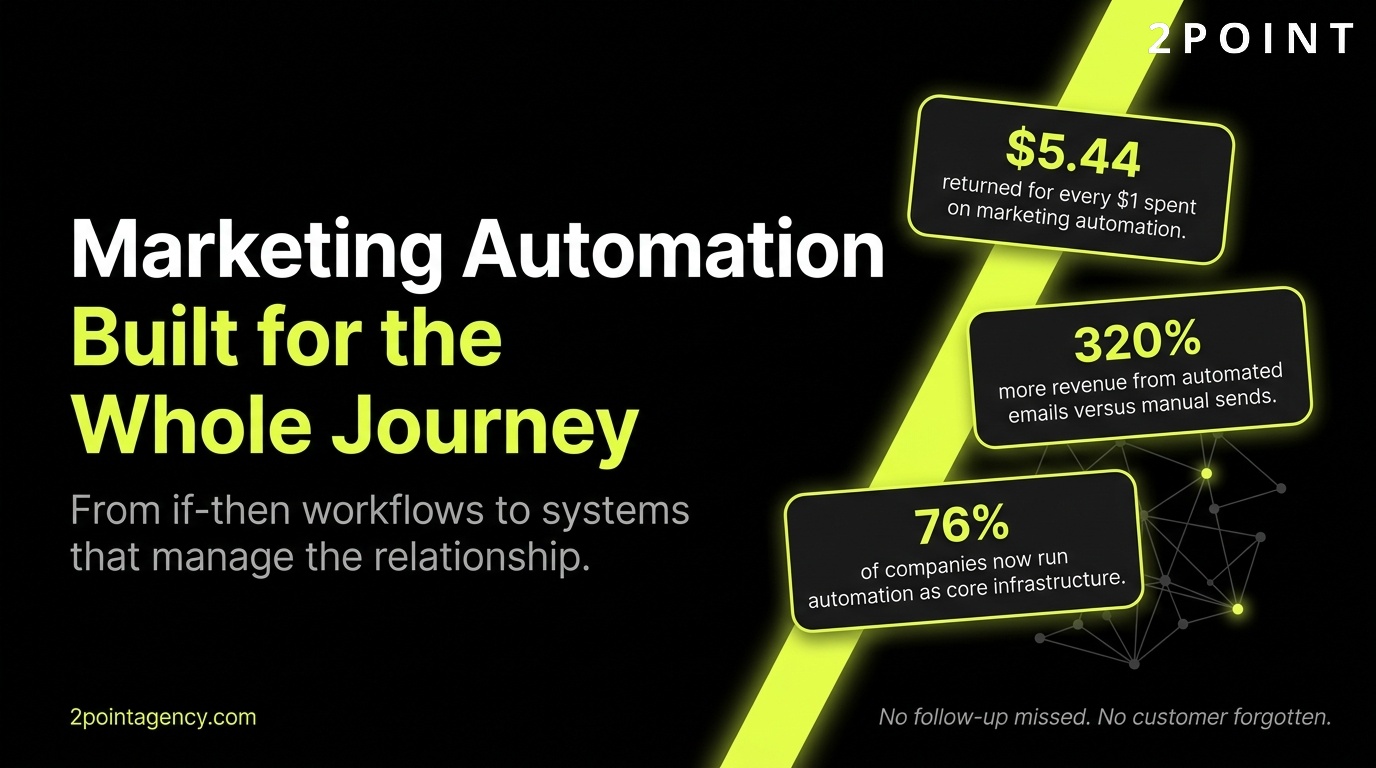
- The global market reached $8.08 billion in 2026, with a 9.3% compound annual growth rate.
- 76% of companies now use automation platforms as a core part of their marketing operations.
- Modern systems use AI to optimize campaigns, predict customer behavior, and make real-time decisions.
- Businesses see an average ROI of $5.44 for every dollar spent on marketing automation programs.
- Automated emails generate 320% more revenue than manually sent campaigns.
- Top platforms include HubSpot for all-in-one solutions, Klaviyo for eCommerce, and ActiveCampaign for small businesses.
- The technology has evolved from simple if-then workflows to intelligent systems managing entire customer journeys.
- Those journeys span email, SMS, social media, web channels, and in-app messaging simultaneously.
Marketing Automation Market Size, Growth, and Adoption in 2026
Current Market Valuation and Projections Through 2034
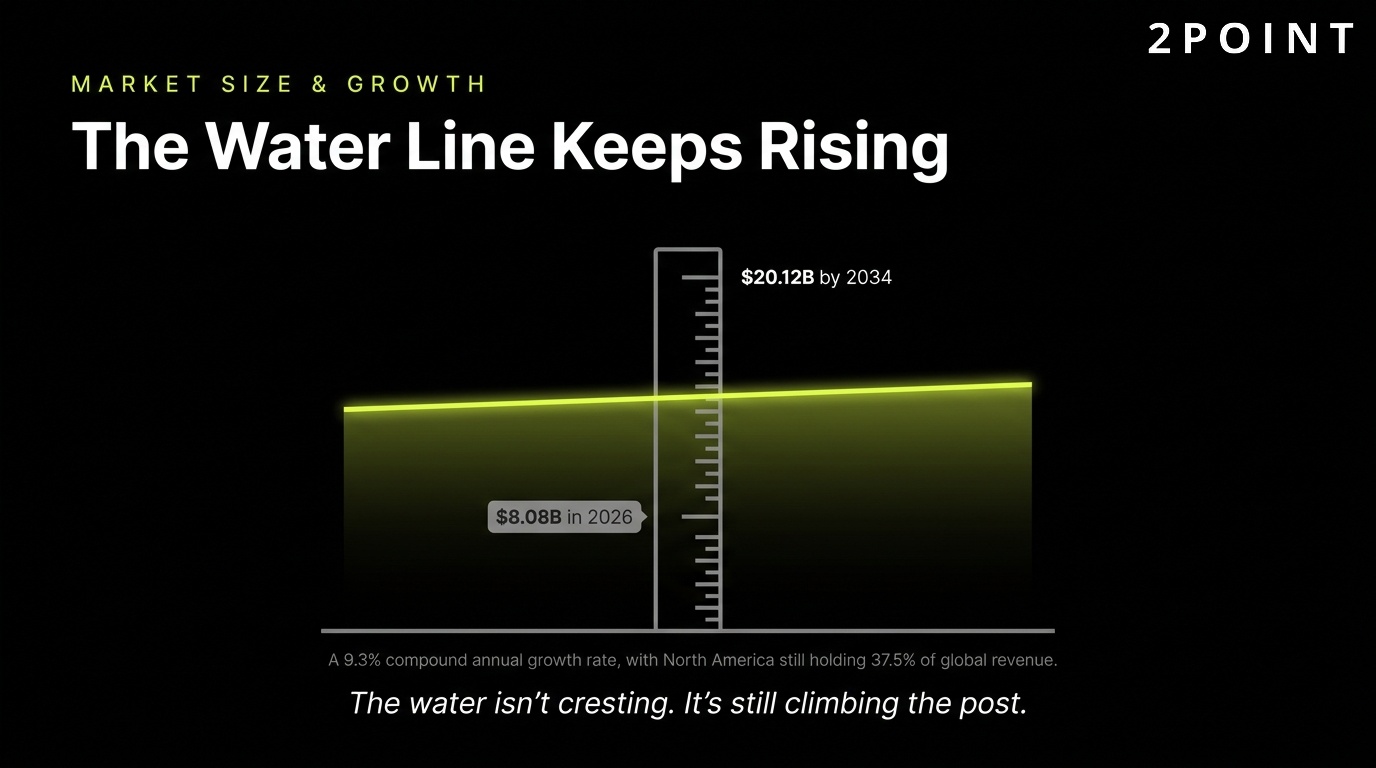
The marketing automation market entered 2026 at a valuation of $8.08 billion, up from $7.39 billion in 2025, representing a 9.3% compound annual growth rate. Analysts project the market will reach $8.70 billion in 2027 and continue climbing to $20.12 billion by 2034, driven by accelerating AI integration and expanding adoption among businesses that previously relied on manual marketing processes. Some broader market estimates, which include adjacent automation technologies, place the figure as high as $81 billion by 2030.
North America continues to dominate, commanding 37.5% of global marketing automation revenue in 2024, a share that is expected to hold steady even as Asia-Pacific adoption accelerates. The region's dominance reflects both the concentration of enterprise software buyers and the maturity of digital marketing infrastructure in the United States and Canada. European markets are also growing rapidly, particularly as GDPR compliance requirements have pushed companies toward more structured, documented marketing processes that automation platforms naturally support.
Three forces are driving this explosive growth. First, AI capabilities have transformed what automation platforms can actually do, turning them from scheduling tools into intelligent decision-making systems. Second, customer expectations for personalized, timely communication have risen to a point where manual marketing simply cannot keep pace. Third, competitive pressure has made automation a necessity rather than a luxury: companies that delay adoption face measurable disadvantages in engagement, conversion, and customer retention.
The trajectory is clear. Marketing automation is not a niche technology for sophisticated enterprises anymore. It is foundational infrastructure for any business that takes customer communication seriously, and the market data reflects that reality at every level of the business landscape.
Enterprise vs. Mid-Market vs. SMB Adoption Rates
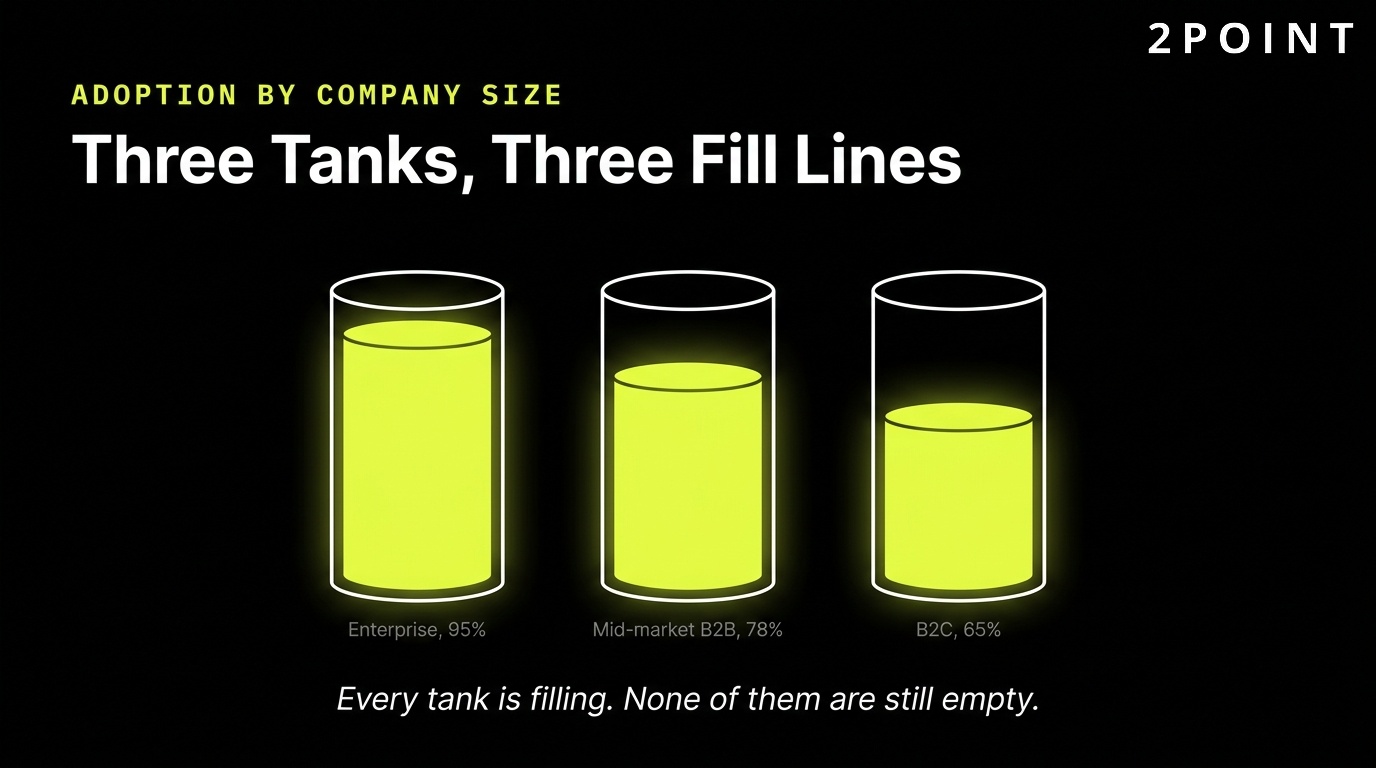
Adoption patterns vary significantly by company size, but the directional trend is universal: automation use is accelerating across all segments. Enterprise marketing teams report 95% adoption rates, making automation essentially standard practice at the largest companies. Mid-market B2B organizations follow at 78%, while B2C companies, many of them eCommerce retailers leveraging platforms like Klaviyo and Braze, sit at 65% adoption. Notably, only 12% of marketing teams with 50 or more employees operate without any form of automation, down from 27% in 2023, a dramatic shift in just three years.
Large enterprises controlled 62.5% of the marketing automation market share in 2024, reflecting their investment in comprehensive platforms like HubSpot, Marketo, and Salesforce Marketing Cloud. These organizations typically have dedicated marketing operations teams, complex multi-channel workflows, and integration requirements that demand robust, enterprise-grade solutions. Their investment anchors the market even as SMB adoption grows.
The SMB segment is the most interesting growth story. Small and mid-sized businesses have historically been underserved by automation platforms that were either too expensive or too complex for teams without dedicated technical resources. That gap has narrowed considerably as platforms like ActiveCampaign and Mailchimp have made automation accessible at price points that work for businesses with modest contact lists and limited budgets. The result is a democratization of capabilities that were once exclusive to large marketing departments.
The gap between companies that have adopted automation and those that have not is widening into a competitive chasm. Businesses still relying on manual processes are not just slower; they are structurally unable to deliver the personalized, timely experiences that customers now expect. The adoption statistics reflect not just technology preferences but competitive survival strategies.
Customer Journey Automation Statistics Worth Knowing
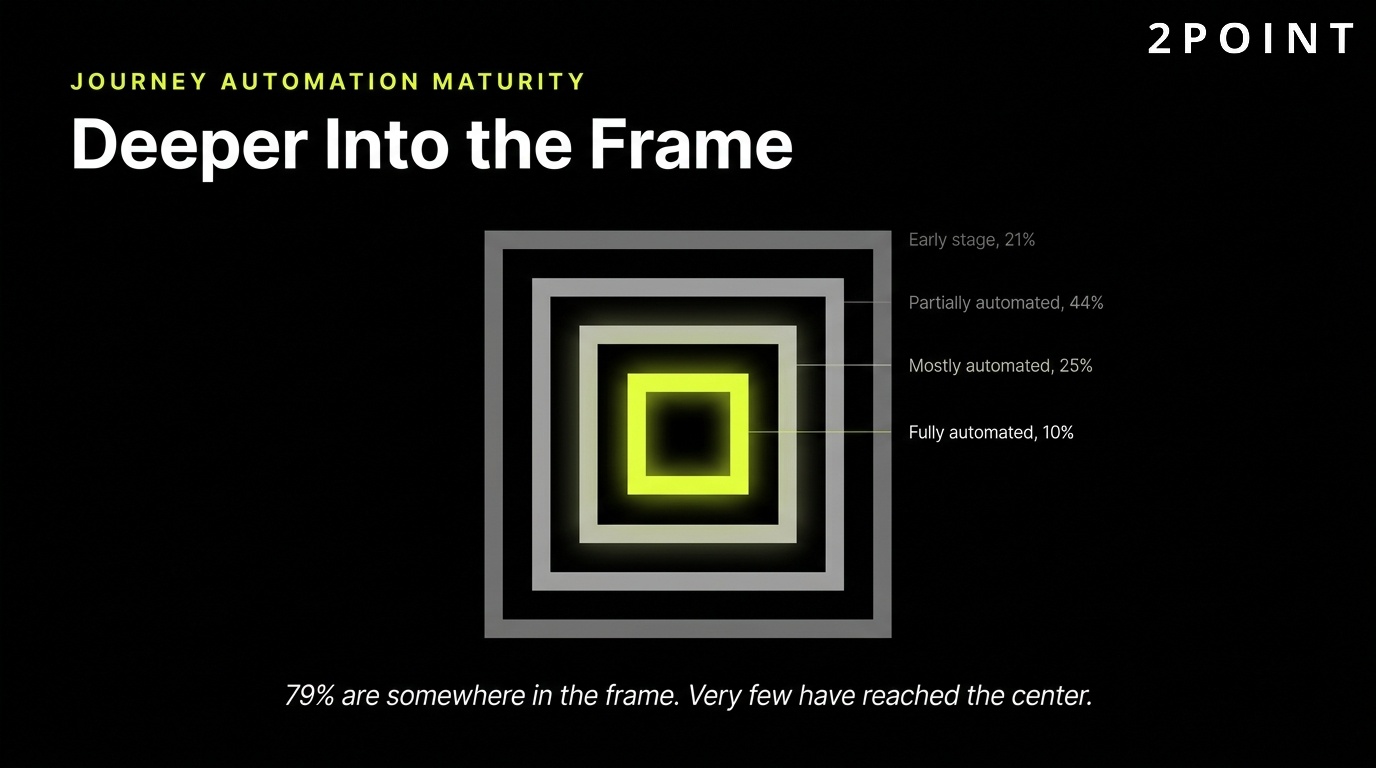
79% of marketers automate their customer journeys, either partially or fully, making journey automation one of the most widespread applications of the technology. The breakdown reveals where companies sit on the automation maturity curve: 10% have fully automated their customer journeys, 25% are mostly automated, and 44% have partially automated their most critical touchpoints. The remaining 21% are either in early stages of implementation or still managing journeys manually.
A separate set of data points reinforces the scale of AI integration within these journeys. 64% of marketers currently use automation and AI tools in their regular workflows, and 62% consider automation important to their overall marketing strategy. Forty-three percent specifically use automation to optimize their strategic approach rather than just execute tactical tasks, signaling a maturation in how teams think about the technology.
The most significant shift in the data is the evolution from task automation to full journey orchestration. Early adopters used automation to schedule emails and post to social media at optimal times. Modern implementations coordinate behavioral triggers, predictive content selection, channel switching, and real-time personalization across the entire customer lifecycle. That shift from automating individual tasks to orchestrating complete journeys represents a fundamentally different and more valuable application of the technology.
This maturation explains why companies investing in automation are seeing returns far beyond basic efficiency gains. When automation manages the entire customer journey intelligently, the compounding effect on conversion rates, retention, and lifetime value becomes substantial. Understanding how to build an effective marketing automation workflow is increasingly the difference between marginal improvements and transformational results.
Why Marketing Automation Became Non-Negotiable
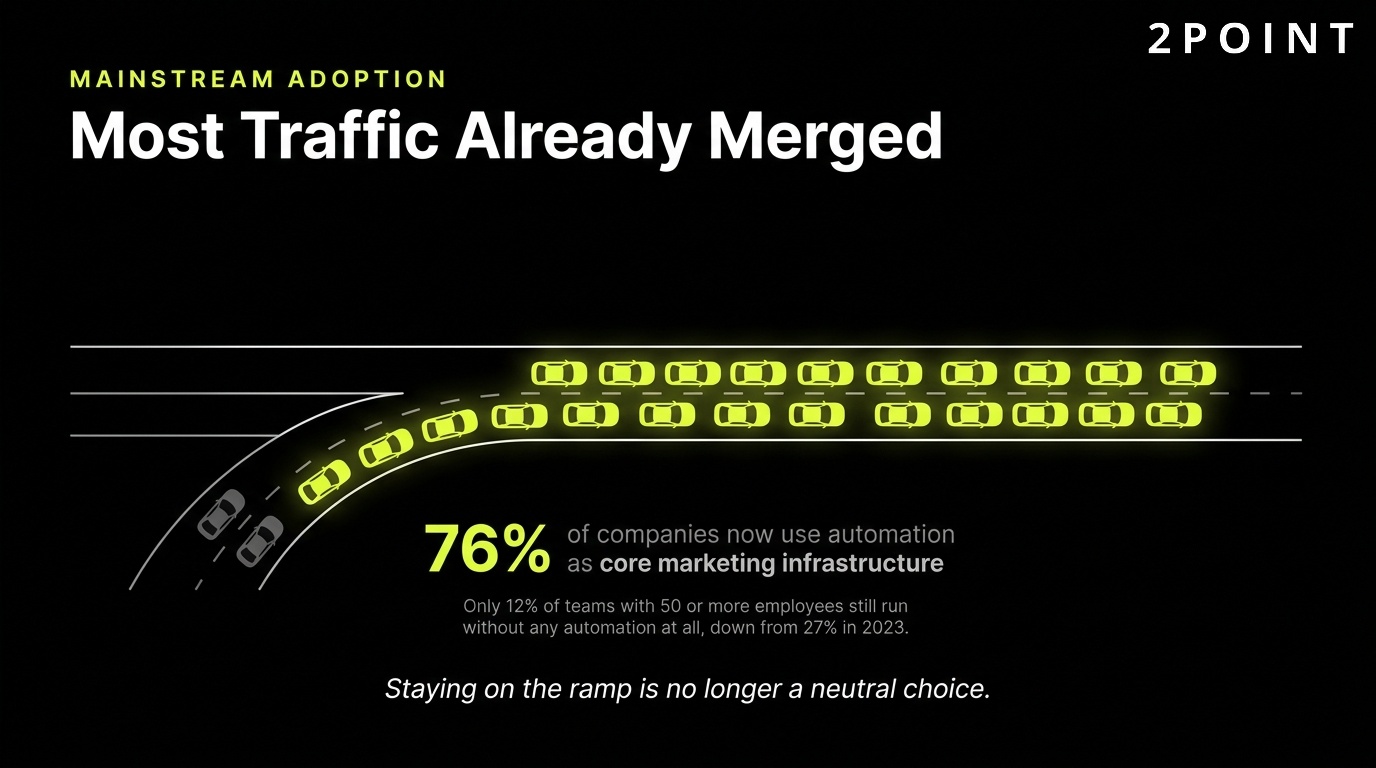
Marketing automation transitioned from competitive advantage to operational necessity somewhere around 2023, and by 2026 that transition is complete. The question for most businesses is no longer whether to adopt automation but how to implement it effectively. 76% of companies now use automation platforms, which means any business operating without one is increasingly the exception in its market, and that exception comes with measurable costs.
Customer expectations are the primary driver. Research consistently shows that 74% of consumers expect personalized experiences from brands, and they expect those experiences to be consistent across every touchpoint they use. Meeting that expectation manually, at scale, across email, SMS, web, and social channels simultaneously, is not feasible for any human team. Automation is not a shortcut to personalization; it is the only viable path to delivering it.
Rising marketing costs have added urgency to the adoption conversation. Ad spend efficiency has declined as platforms become more competitive and crowded. Labor costs for manual marketing operations continue to rise. The math increasingly favors investing in automation platforms that multiply the output of existing team members rather than hiring additional staff to execute repetitive tasks. Automated emails generate 320% more revenue than manual campaigns, making the ROI argument for adoption straightforward.
Companies that delayed automation adoption are now dealing with the consequences: lower engagement rates, weaker lead conversion, slower response times, and a growing gap between their customer experience and what competitors with mature automation programs are delivering. The window for treating automation as optional has closed.
Marketing Automation ROI and the Performance Metrics That Matter
Financial Returns: The $5.44 Per Dollar Benchmark
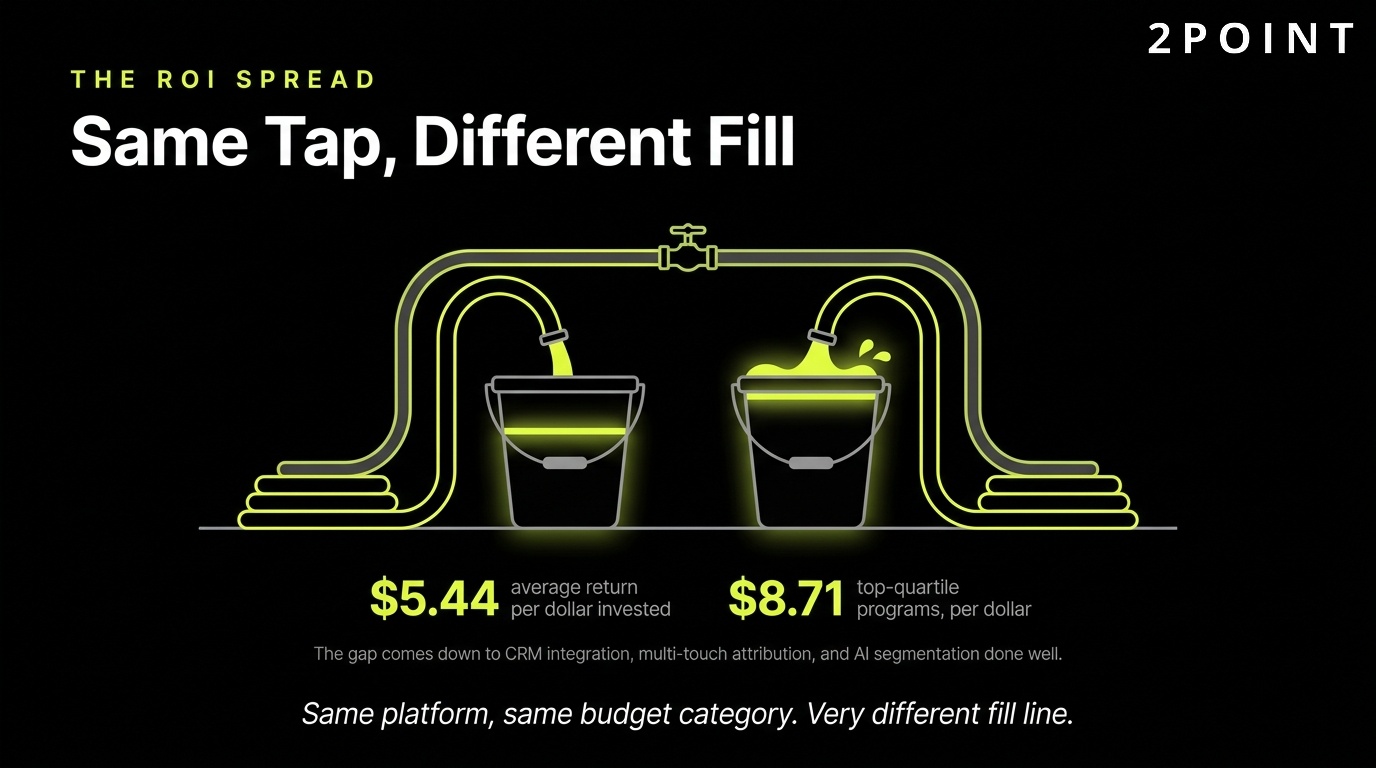
The headline number for marketing automation ROI is $5.44 returned for every dollar invested, averaged across all marketing automation programs. That average, while impressive, obscures a significant range of performance. Top-quartile programs achieve $8.71 per dollar, driven by tight CRM integration, multi-touch attribution models, and AI-powered segmentation that continuously improves targeting precision. Bottom-quartile programs return far less, often because implementation was rushed, data quality was poor, or the team lacked the skills to use the platform effectively.
76% of companies see positive ROI within their first year of implementing marketing automation, which is a compelling argument for early investment. Companies that invest heavily in automation see an average of 34% revenue growth over three years compared to their pre-automation baseline. These numbers include the full cost picture: platform subscription fees, content creation costs, integration development, and ongoing management time.
Understanding what separates average programs from top-quartile performers is the most actionable takeaway from the ROI data. High performers share several characteristics: they integrate their automation platform deeply with their CRM so customer data flows seamlessly; they use multi-touch attribution to understand which automated touchpoints actually drive conversions; and they invest in AI segmentation that goes beyond basic demographic grouping to behavioral and predictive signals. These are not advanced concepts reserved for large enterprises. They are best practices that any team can implement with the right platform and the right approach.
Having a clear marketing strategy before implementing automation is often the difference between achieving top-quartile returns and landing in the average range. Automation amplifies what already exists in your strategy. If the strategy is sound, automation makes it dramatically more effective. If the strategy is unclear, automation simply executes confusion more efficiently.
Conversion Rate and Lead Generation Impact
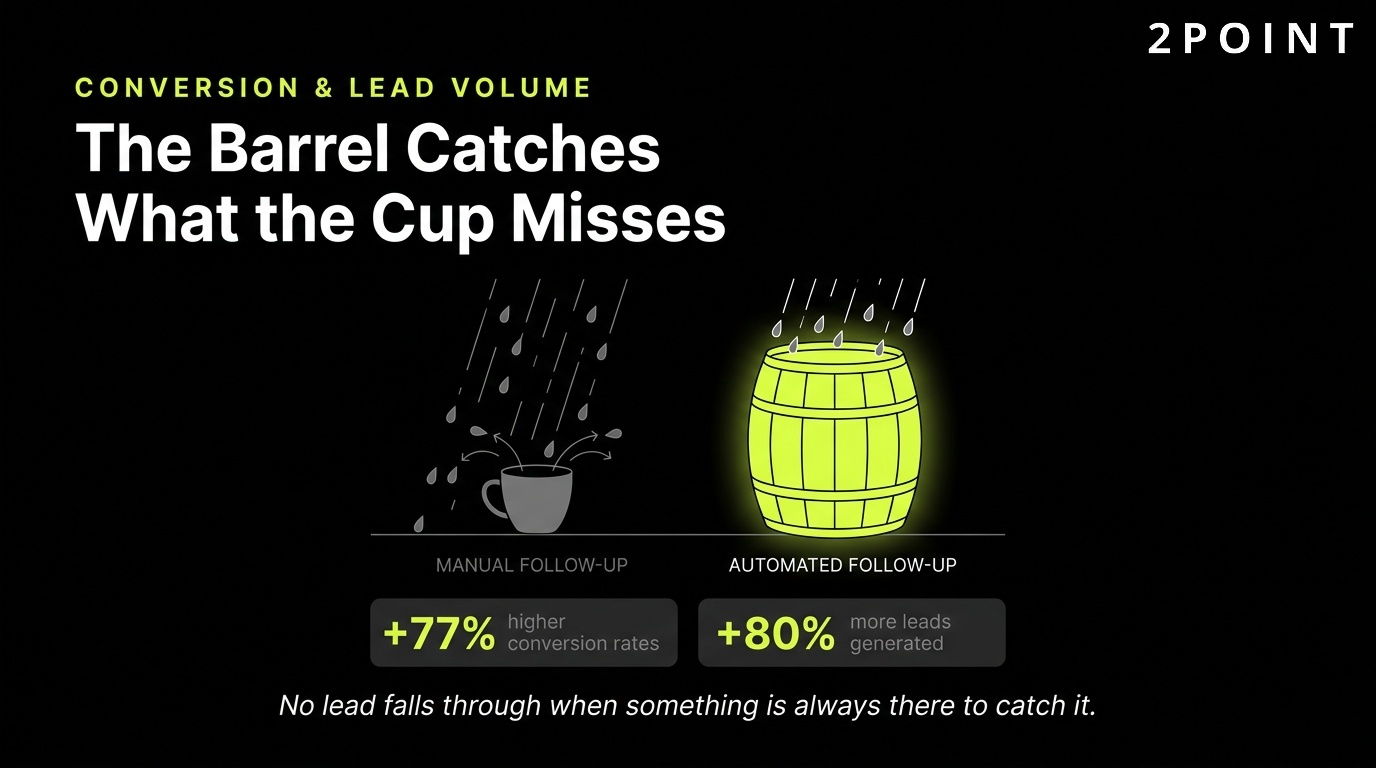
Automation delivers 77% higher conversion rates compared to manual marketing processes, and the reasons are structural rather than incidental. Automated systems respond to behavioral signals immediately, scoring leads based on actual engagement rather than assumptions, and triggering follow-up communications at precisely the moment when a prospect is most likely to convert. Human-managed processes cannot achieve that level of timing consistency at scale.
80% more leads are generated through automated processes compared to manual alternatives, a statistic that resonates particularly in B2B contexts. Manufacturing companies and B2B service providers report that 80% of their organizations see measurable increases in lead volume after implementing automation. The mechanism is straightforward: automation ensures no lead falls through the cracks, every inquiry receives timely follow-up, and nurturing sequences keep prospects engaged throughout extended sales cycles.
Businesses that implement lead nurturing automation specifically report a 10% or greater revenue boost within six to nine months, a timeline that reflects how quickly improved lead handling translates into closed business. The conversion improvement comes from three automation-specific advantages: speed of response, consistency of follow-up, and the ability to personalize communications based on individual behavior rather than segment assumptions. A lead who downloads a whitepaper on a specific topic receives follow-up content relevant to that topic, not a generic newsletter.
Achieving this level of conversion improvement requires understanding your target audiences deeply enough to build workflows that genuinely address their needs at each stage of the buyer journey. Automation without audience insight produces efficient irrelevance, and irrelevance does not convert.
Email Automation Performance Benchmarks
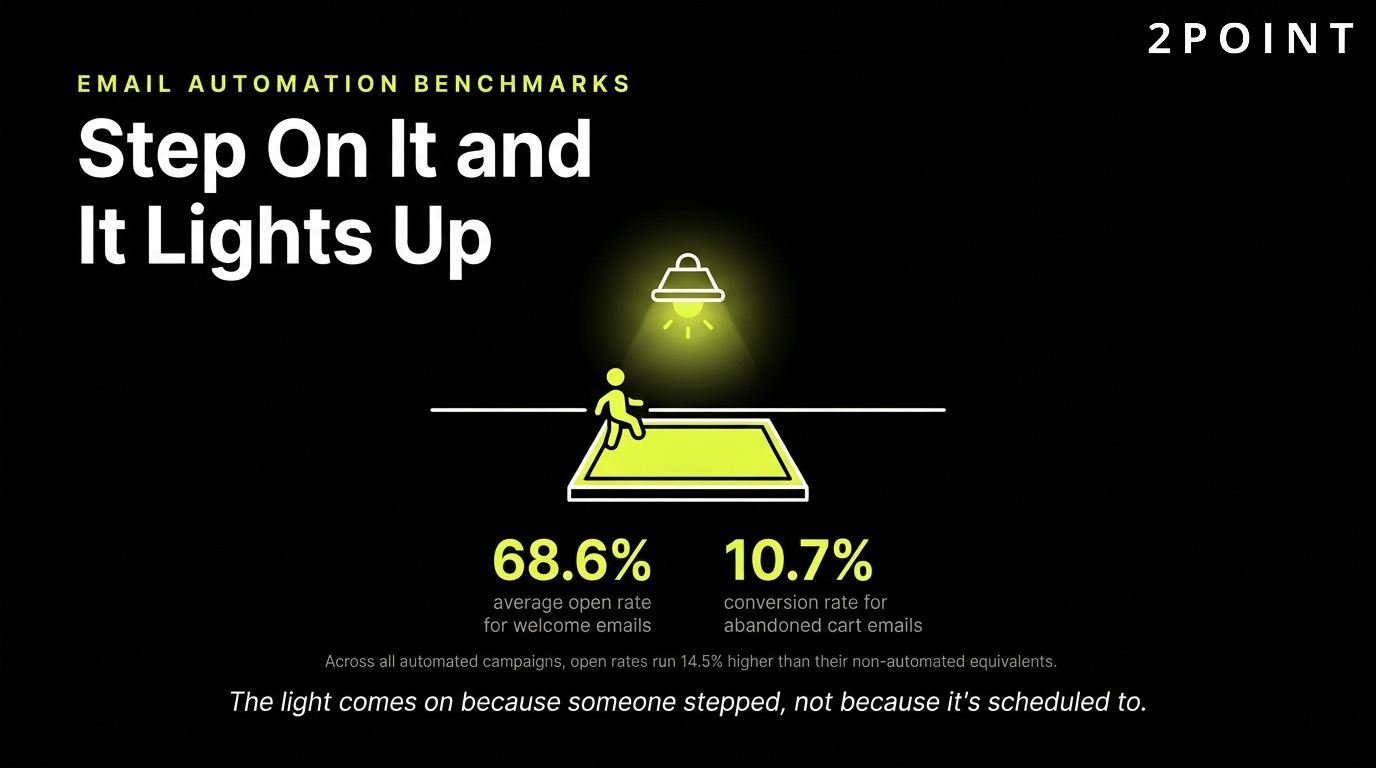
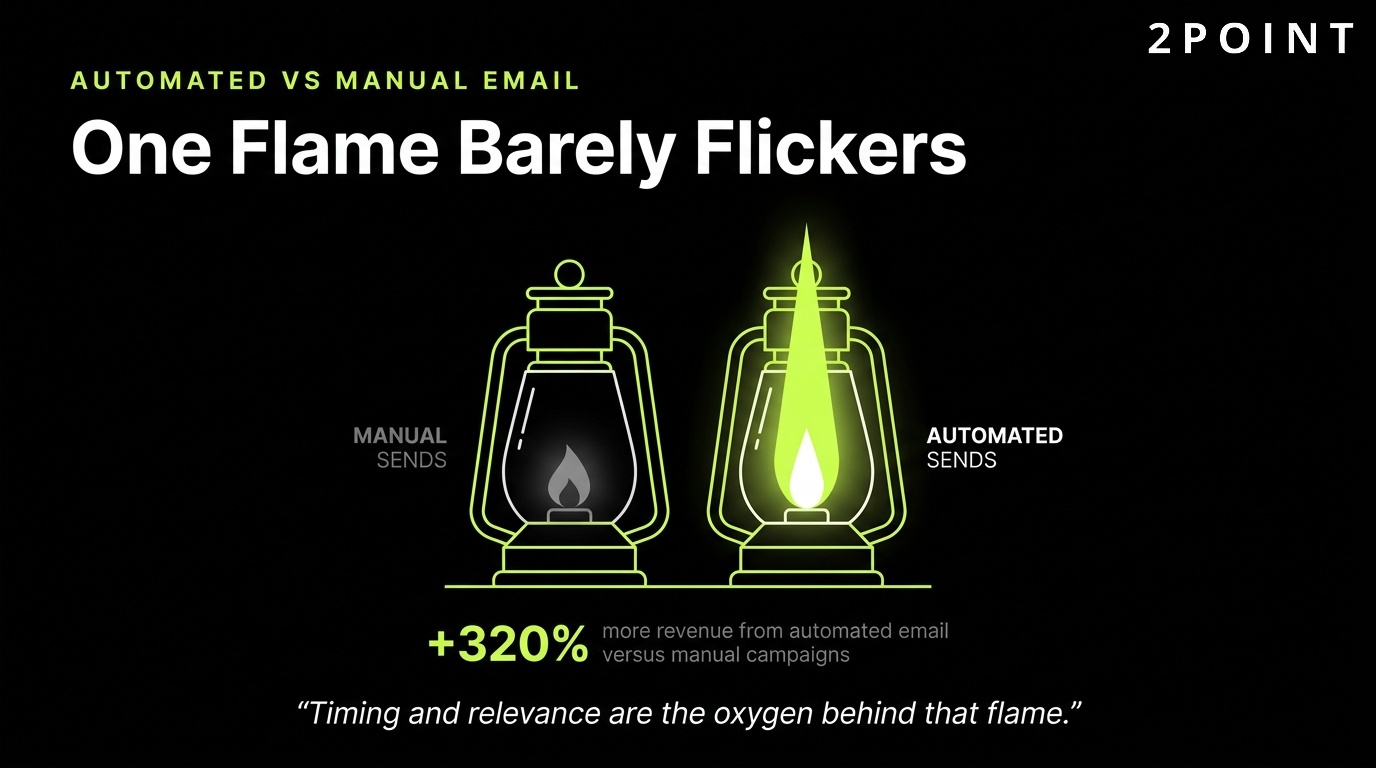
Email remains the highest-ROI channel in the marketing automation ecosystem, and the performance gap between automated and manual email is stark. Automated emails generate 320% more revenue than non-automated campaigns, a differential that reflects the compounding advantages of behavioral triggering, timing optimization, and relevance-based personalization that automation enables. These are not marginal improvements; they represent a fundamental difference in how email can perform when technology manages the variables humans cannot.
Specific automated email flows deliver particularly strong benchmarks. Welcome emails, typically the first message a new subscriber receives, achieve an average open rate of 68.6%, far above the industry average for standard email campaigns. Abandoned cart emails, which automatically follow up with shoppers who leave items in their cart without purchasing, convert at 10.7%, making them one of the highest-performing touchpoints in eCommerce automation. Across all automated campaigns, open rates run 14.5% higher than their non-automated equivalents.
The performance advantage stems from three factors that automation uniquely provides. First, timing: automated emails are sent based on individual behavior rather than arbitrary schedule, so they arrive when the recipient is most likely to engage. Second, relevance: triggered emails respond to specific actions, making the content immediately pertinent to what the recipient just did. Third, consistency: automated sequences never miss a follow-up, never skip a nurturing step, and never send to a suppressed contact because someone forgot to update a list.
For teams looking to maximize email marketing impact on driving sales, building behavioral trigger sequences around key customer actions, welcome, purchase, browse abandonment, re-engagement, is the highest-leverage starting point. These flows require upfront investment but deliver returns continuously without ongoing manual effort.
Engagement Metrics and Customer Experience Gains
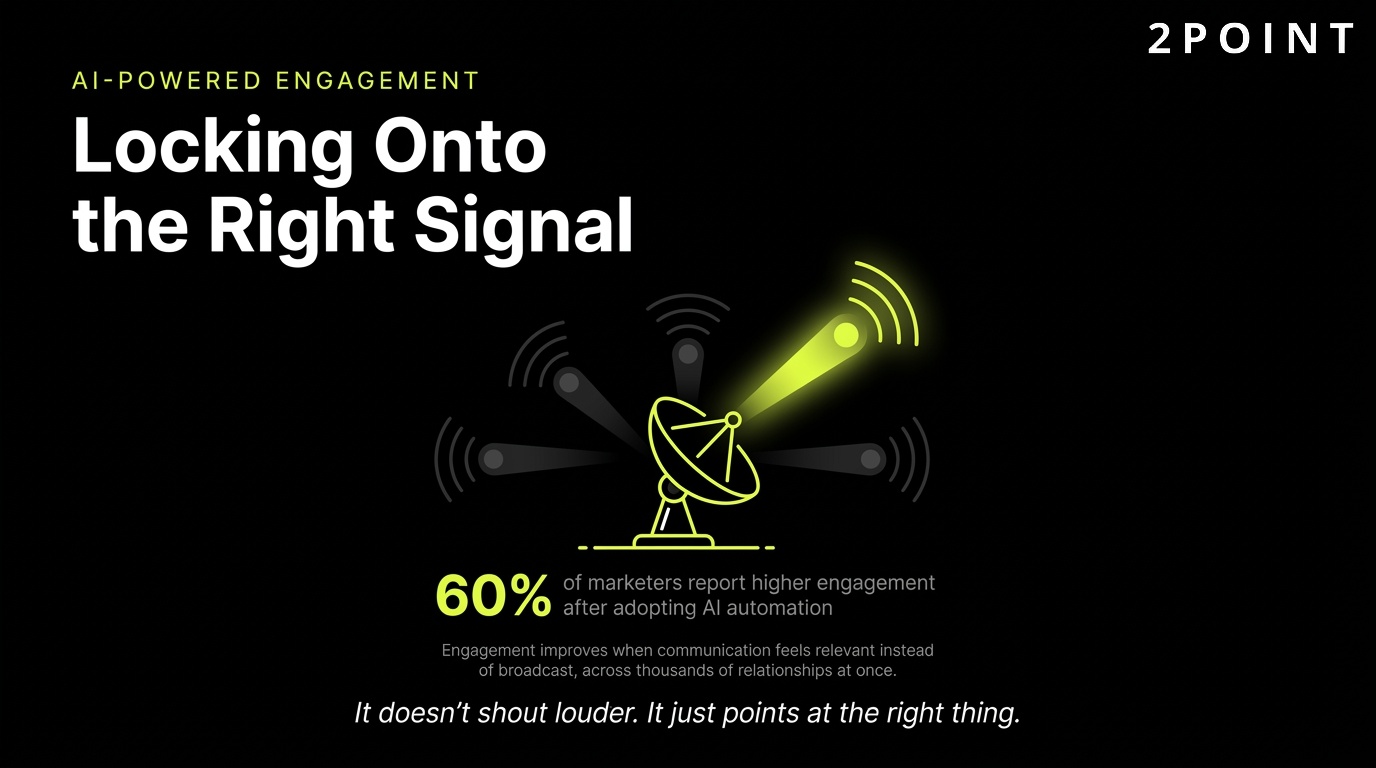
60% of marketers report higher engagement after adopting AI-powered marketing automation, and the mechanism behind that improvement is the ability to deliver the right message on the right channel at the right moment for each individual. Engagement quality improves when communications feel relevant rather than broadcast, and automation is the only technology that can maintain that relevance across thousands of simultaneous customer relationships.
The customer experience improvements extend beyond open rates and click-through rates. Automation enables consistency across channels, ensuring a customer who engages with a brand via email, then visits the website, then receives an SMS, encounters a coherent experience that reflects their relationship with the brand rather than disconnected campaigns. That consistency builds trust, reduces friction, and creates the kind of seamless experience that customers increasingly expect from brands they choose to engage with.
Understanding customer behavior in marketing is the foundation of effective engagement automation. Forty-seven percent of marketers specifically cite efficiency improvement as a primary driver of automation adoption, but efficiency and engagement are not competing priorities. When automation is properly implemented, the efficiency gains and the engagement improvements are the same thing: doing the right thing for each customer without manual effort for each interaction. The brands winning in 2026 have internalized this truth.
AI and Agentic Marketing Automation: The 2026 Paradigm Shift
From Rule-Based Systems to Autonomous Decision-Making
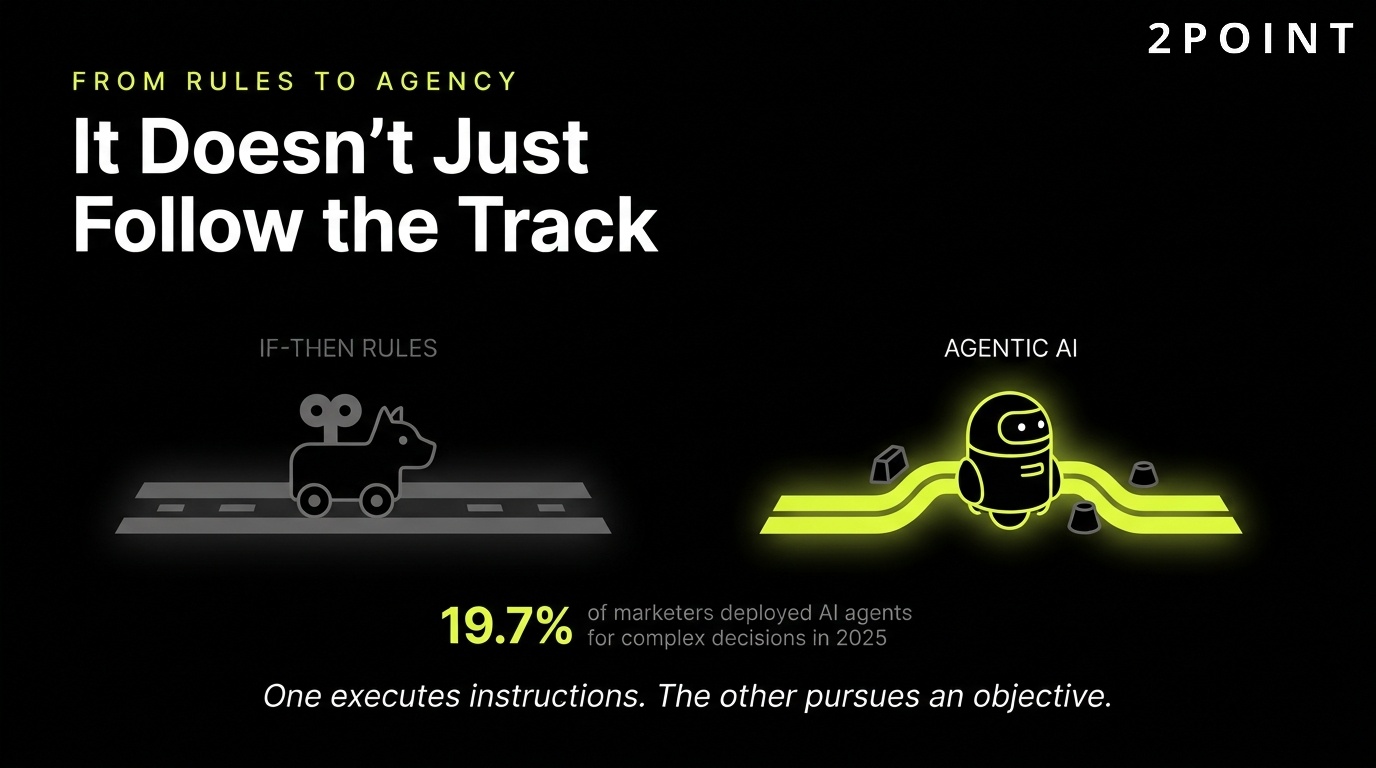
The marketing automation that most businesses implemented between 2015 and 2022 was fundamentally rule-based: if a contact does X, send email Y. Those if-then workflows were powerful for their time, but they had hard limits. Every possible customer scenario had to be anticipated and programmed. Exceptions fell through the cracks. Optimization required manual A/B testing and analysis. The systems executed instructions precisely but could not reason, adapt, or improve without human intervention.
That model has been overtaken by AI systems capable of autonomous decision-making. 92% of marketers now use AI tools in their workflows, and daily AI usage jumped from 37% in 2024 to 60% in 2025. Gartner projects that 80% of enterprises will be using generative AI by 2026, with marketing among the primary application areas. The shift is not incremental. AI has changed what automation can do at a fundamental level.
Agentic AI, systems that execute complex goals without constant human oversight, represents the frontier of this evolution. Rather than executing predefined rules, agentic systems can determine which channel to use for a given customer, when to escalate from automated to human interaction, how to adjust a campaign based on real-time performance signals, and what content will resonate with a specific individual based on behavioral patterns. 19.7% of marketers deployed AI agents for complex decision-making in 2025, and that number is accelerating rapidly.
The language of automation has shifted accordingly. Teams no longer talk about building workflows; they talk about training AI systems to understand customer intent and respond intelligently. The difference is not semantic. It reflects a genuinely different relationship between marketing teams and their technology, one where the platform is a collaborator rather than a tool.
What AI Actually Does in Modern Marketing Automation Platforms
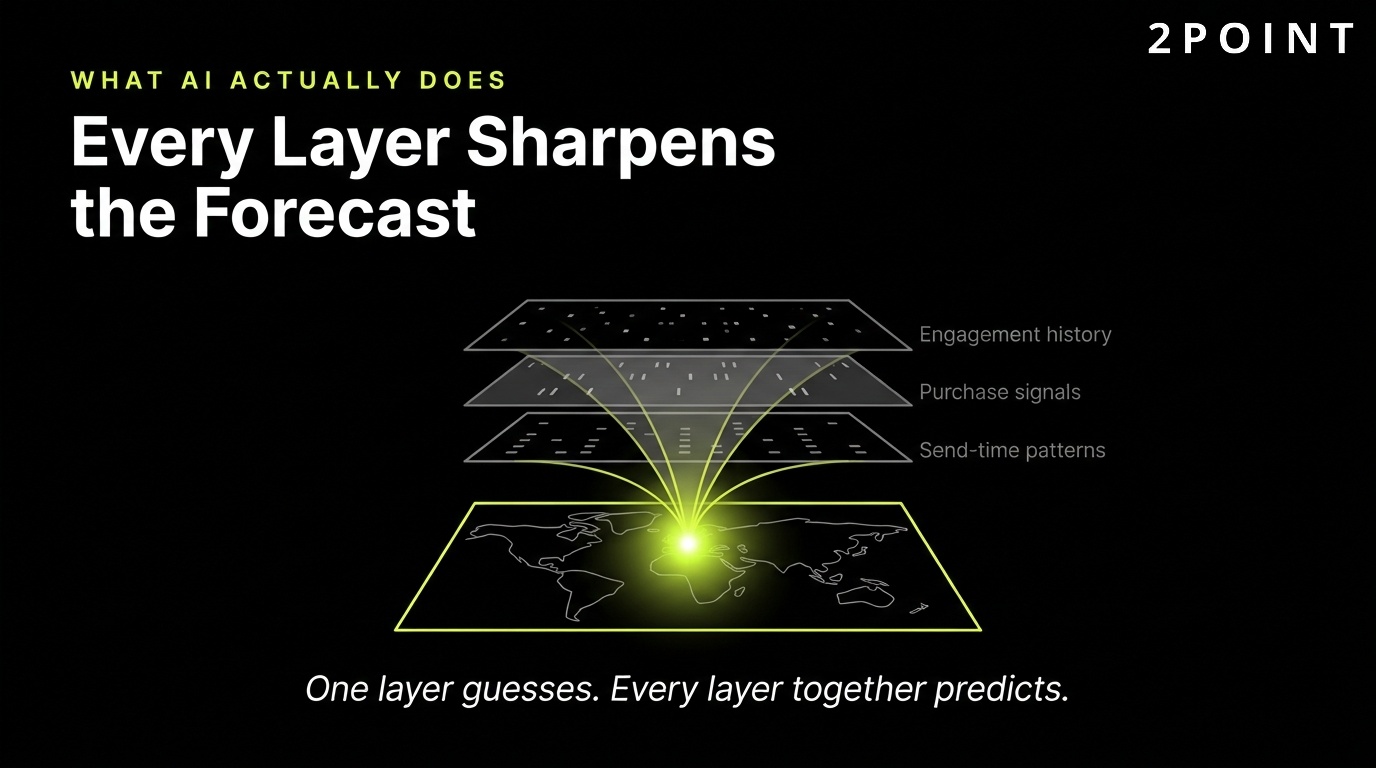
Understanding what AI does concretely inside modern marketing automation platforms helps cut through the hype. Predictive analytics is one of the most mature AI applications, enabling platforms to forecast customer behavior, including churn risk, purchase intent, and optimal engagement timing, based on historical patterns and real-time signals. A customer whose engagement frequency is declining triggers different automation responses than one who is actively browsing and clicking, even if their demographic profiles are identical.
Content optimization at scale is another area where AI delivers measurable value. Traditional A/B testing requires statistical significance to reach conclusions, which means waiting weeks or months for meaningful results on small list segments. AI-powered multivariate testing can identify winning content variations in hours, then dynamically serve the best-performing version to each individual based on their behavioral profile. The result is personalization that improves continuously rather than in discrete optimization cycles.
Send time optimization, once a manual exercise in analyzing open rate data by time of day, is now handled individually for each contact. AI systems track when each person opens emails, engages with content, and makes purchases, then schedules future communications to align with those patterns. This individual-level optimization is impossible at scale without AI, and it contributes meaningfully to the 14.5% higher open rates that automated campaigns consistently achieve.
Lead scoring, customer segmentation, and journey orchestration have all been transformed by AI pattern recognition. Where human-defined scoring models rely on assumptions about what behaviors indicate purchase intent, AI models identify patterns in actual conversion data and continuously refine scoring criteria. Micro-segments emerge that human analysts would never have identified, and journey paths adapt in real time based on how individual customers actually engage rather than how they were expected to. The combination of these capabilities is what drives top-quartile programs to their $8.71 ROI benchmark.
Agentic AI Deployment and Budget Trends in 2026
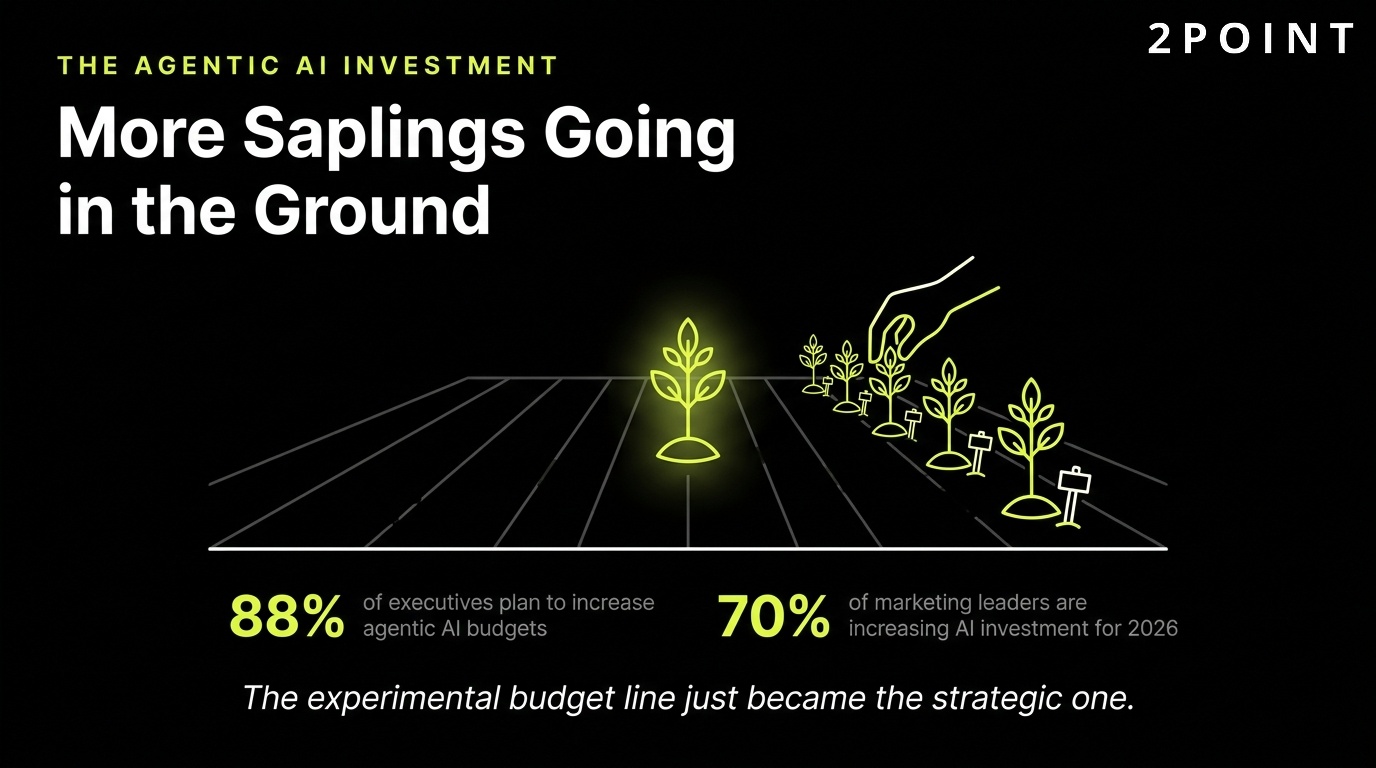
19.7% of marketers deployed AI agents for complex decision-making tasks in 2025, and the investment signals that number will grow substantially in 2026. 88% of senior executives planned to increase their AI budgets for agentic initiatives, and 70% of marketing leaders specifically indicated plans to increase AI investment in their 2026 planning cycles. The transition from experimental AI budgets to strategic planning is underway.
What are companies actually automating with AI agents? Campaign optimization is the most common application, with AI systems adjusting bid strategies, channel allocation, and content selection based on performance signals without requiring human approval for each decision. Content creation support is a close second, with AI generating first drafts, subject line variations, and social copy that human marketers then refine. Customer service integration, where AI agents handle initial inquiries and route complex issues to human representatives, is also a growing application area.
The skills gap is real and worth acknowledging. Deploying AI marketing agents effectively requires a different skill set than managing traditional automation workflows. Marketers in 2026 are increasingly expected to be fluent in AI systems, capable of training models with quality data, evaluating outputs critically, and identifying where AI judgment should be trusted versus where human oversight is essential. The platforms themselves are investing in making this transition easier through better interfaces and pre-built AI models, but the human skill development component cannot be automated away.
ROI expectations for AI investments are generally being met, which helps explain the budget growth. The $5.44 average return on marketing automation investment reflects programs that include AI components, and top-quartile programs achieving $8.71 per dollar are almost universally distinguished by the sophistication of their AI segmentation and personalization capabilities. The investment case for agentic AI is increasingly evidence-based rather than speculative.
Balancing Automation with the Human Touch in 2026
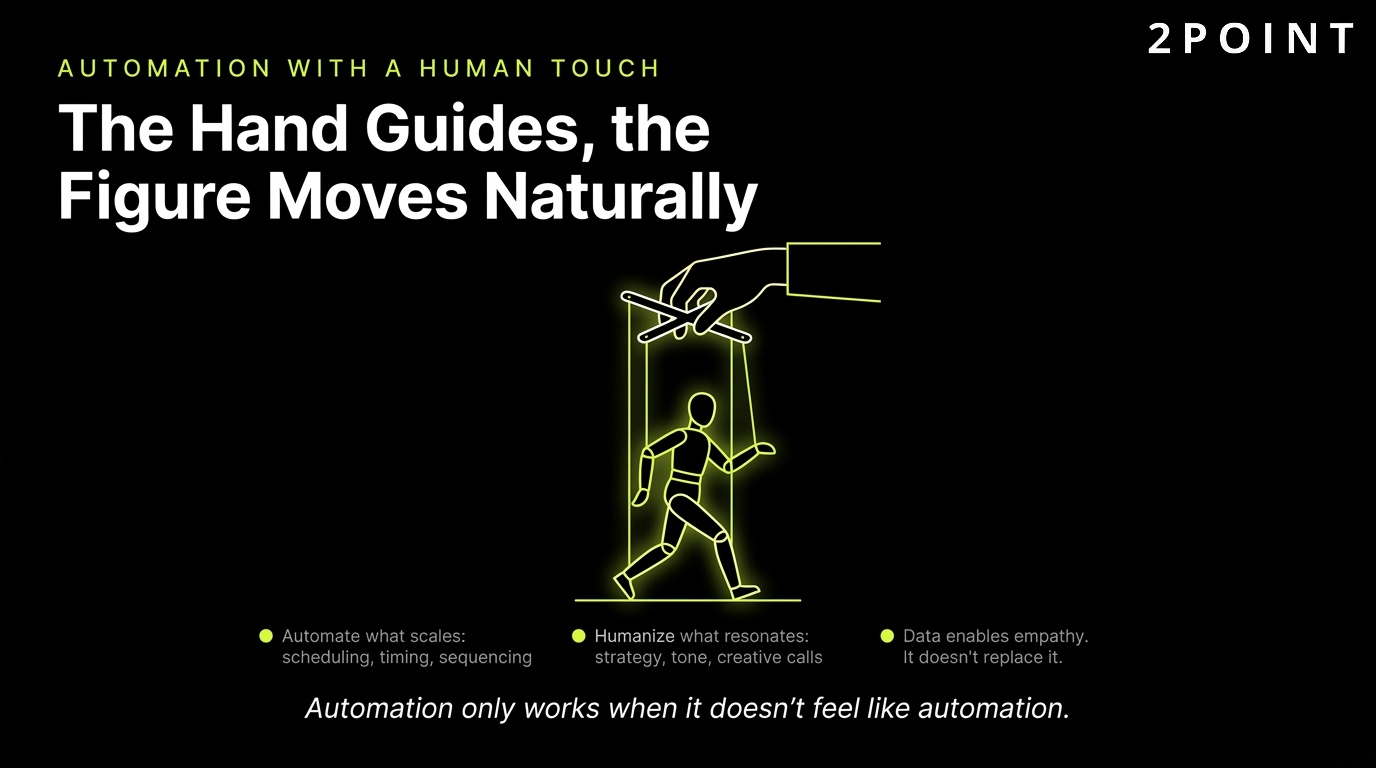
The most effective marketing automation programs in 2026 share a counterintuitive characteristic: they feel human. Automation only works when recipients do not experience it as automation. Generic triggered emails that arrive with robotic precision but feel impersonal can actually damage brand relationships, while well-crafted automated sequences that feel attentive and relevant build them. The technology is a means to a human end, not a substitute for human judgment.
There are domains where human capabilities still clearly outperform AI: strategic direction, creative conceptualization, empathetic customer service for complex situations, and navigating genuinely novel scenarios that fall outside any pattern the AI has been trained on. Successful teams in 2026 use AI as a copilot, handling the data processing, timing optimization, and scale challenges while humans focus on the creative and strategic decisions that require judgment and emotional intelligence.
Building trust through transparency in marketing communications is especially important in an age of pervasive automation. Customers are increasingly aware that much of the communication they receive is automated, and their tolerance for that reality is conditioned on the quality of the experience. Automation that feels attentive and relevant is welcomed. Automation that feels generic, poorly timed, or tone-deaf actively harms brand perception.
The 2026 best practice is straightforward in principle and demanding in execution: use data to enable genuine empathy at scale. Automation should make it possible to know enough about each customer to communicate with them in ways that feel individually considered, not to replace the consideration with technology. The brands achieving 60% higher engagement with AI-powered automation have understood this distinction and built their programs around it.
Hyper-Personalization and Zero-Party Data Strategy in Automated Marketing
Why Generic Messaging No Longer Works in 2026
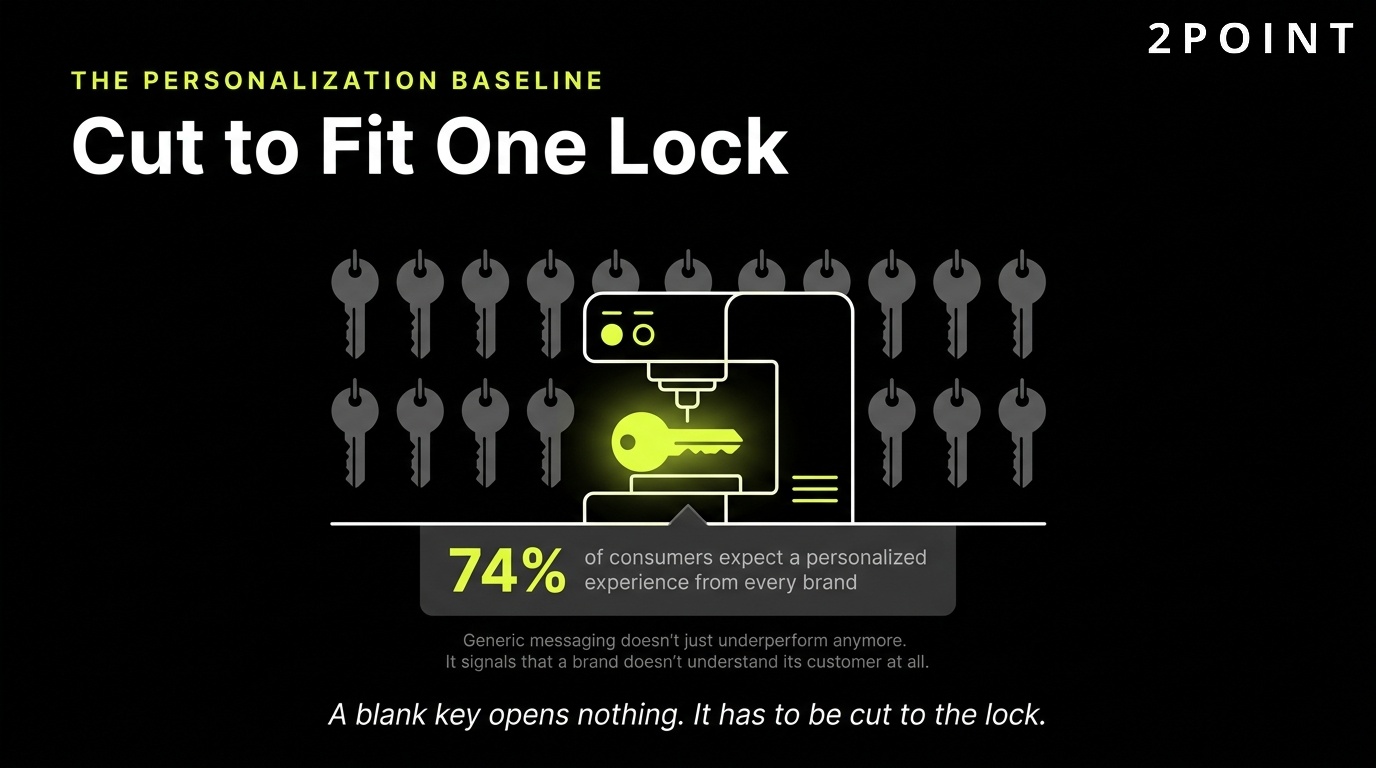
74% of consumers expect personalized experiences from brands in 2026, and that expectation is not aspirational; it is a baseline requirement for engagement. The era of broadcast marketing, sending the same message to everyone on a list and hoping some percentage finds it relevant, has produced diminishing returns for years. In 2026, generic messaging does not just underperform; it actively signals to customers that a brand does not understand them, which drives disengagement and brand switching.
The personalization gap between what consumers expect and what most brands actually deliver remains significant. Consumers expect communications that reflect their purchase history, browsing behavior, stated preferences, and current needs. Most brands, even those with automation platforms in place, are still delivering segment-level personalization at best: treating everyone who bought a particular category the same way, or everyone in a particular geography. That is better than nothing, but it falls far short of the individual-level relevance that customers now expect.
The cost of generic messaging is measurable. Lower engagement rates reduce deliverability scores, which means fewer emails reach the inbox over time, which compounds into progressively worse performance. Brand switching research consistently shows that irrelevant communication is among the top reasons consumers disengage from brands they previously chose. And in competitive markets, a competitor who communicates more relevantly will win the attention and loyalty that a generic brand loses.
Building a personalized marketing strategy that genuinely resonates requires more than automation technology. It requires a commitment to understanding customers as individuals and building systems that reflect that understanding in every communication. The 77% higher conversion rates and 320% revenue improvement from personalized automated emails are the returns on that commitment.
The Zero-Party Data Revolution Reshaping Personalization
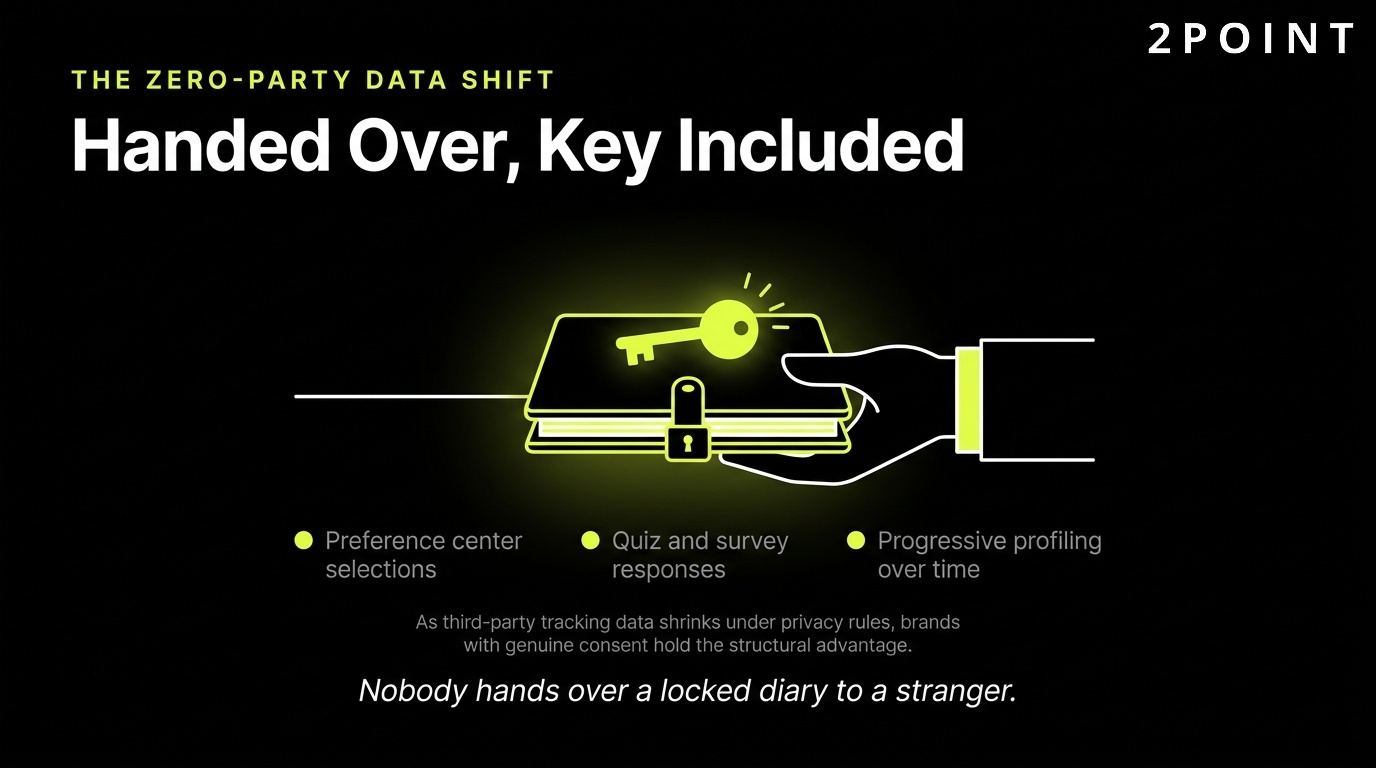
Zero-party data is information that customers intentionally and proactively share with a brand, as distinguished from first-party data (observed behavioral data), second-party data (shared between partners), and third-party data (purchased from data brokers). Examples include preference center selections, quiz responses, survey answers, and progressive profiling completions. The defining characteristic is consent and intention: the customer chose to share this information because they understood it would improve their experience.
Zero-party data has become the 2026 competitive advantage in personalization for two converging reasons. Privacy regulations across major markets have restricted the collection and use of third-party tracking data, reducing the data pool that marketers previously relied on for targeting. Simultaneously, ad costs on major platforms have risen as targeting precision declined, making owned data increasingly valuable relative to rented audience access. Brands that invested in building genuine customer relationships and collecting consensual preference data are now operating with a structural advantage their competitors cannot quickly replicate.
The practical implementation of zero-party data collection is more accessible than it sounds. Preference centers that ask new subscribers what content they want and how frequently they want to hear from a brand are a foundational starting point. Interactive quizzes that help customers find products suited to their needs, while simultaneously collecting preference data, perform well for eCommerce and product-heavy businesses. Progressive profiling, which gradually builds customer profiles through small data requests across multiple interactions rather than demanding everything at once, respects customer attention while steadily improving personalization capability.
The resulting personalization quality exceeds what third-party data ever delivered. A customer who told you they prefer email over SMS, that they are interested in a specific product category, and that they prefer to hear from you weekly is giving you the information you need to communicate with them in the way they want. That is the foundation for personalized marketing campaigns that genuinely resonate rather than just appear targeted.
Implementing Hyper-Personalization at Scale Through Automation
Hyper-personalization, delivering individually relevant experiences to thousands or millions of customers simultaneously, is only possible at scale through automation. The human effort required to craft individual communications for each customer would be infinite; the computational effort for a well-configured automation platform is trivial. Dynamic content blocks within email templates, which automatically swap content based on recipient attributes, are the most common implementation of this capability. A single email template can deliver hundreds of different versions of a message based on purchase history, geographic location, product preferences, and engagement behavior.
Behavioral triggers are the engine of real-time personalization. When a customer browses a specific product category, a trigger fires and initiates an automated sequence relevant to that behavior. When they make a purchase, a different sequence begins. When their engagement declines below a threshold, a re-engagement sequence activates. These triggers create the impression of a brand that is attentive and responsive because, functionally, it is: the automation is watching and responding to individual behavior in ways that no human team could sustain manually.
Predictive personalization goes further, using AI to anticipate what a customer will want before they express that need. Recommendation engines on eCommerce platforms have pioneered this capability, and marketing automation platforms are increasingly incorporating similar functionality. A customer who has bought a product that typically leads to a follow-on purchase receives proactive communication about that follow-on product before they go searching for it. This anticipatory personalization is among the highest-value applications of AI in the marketing automation stack.
Maintaining personalization consistency across channels is where many programs fall short. A customer should encounter the same level of individual relevance whether they open an email, receive an SMS, visit the website, or see a retargeting ad. That multi-channel consistency requires data integration across the entire marketing stack, with each channel drawing from the same customer profile and contributing its interactions back to it. The brands achieving 68.6% welcome email open rates and 60% higher engagement with AI automation have solved this integration challenge.
Privacy-First Personalization: Building Trust as a Competitive Moat
Personalization and privacy are not fundamentally in tension. The brands that have reconciled them most effectively have discovered that privacy-first personalization, where customers understand what data is collected and have meaningful control over it, produces better personalization outcomes than surveillance-based approaches ever did. Customers who trust a brand with their data share more of it and engage more openly with personalized communications. The privacy-first approach is not a constraint on personalization; it is an enabler of the deeper customer relationships that produce the best personalization results.
Transparency is the foundational element of privacy-first personalization. This means clearly communicating what data is collected, how it is used, and what value it provides to the customer. A preference center that says "tell us what you care about so we can stop sending you things that don't matter to you" frames data collection as a benefit for the customer, which it genuinely is. A privacy policy buried in the footer that most customers never read is not transparency; it is legal compliance theater.
Giving customers meaningful control over their data and communication preferences builds the kind of trust that translates into long-term loyalty. Customers who feel in control of their relationship with a brand are less likely to unsubscribe, more likely to engage with communications, and more likely to recommend the brand to others. Control is not just an ethical requirement; it is good business. The brands that treat their data governance as a customer experience feature rather than a compliance burden are building moats that competitors without those trust relationships cannot easily cross.
Value exchange is the practical mechanism of privacy-first personalization. Customers share data when they receive something valuable in return: more relevant recommendations, earlier access to products they care about, communications timed to their preferences. The exchange must be genuine and legible. If customers cannot see the benefit of sharing their preferences, they will not share them, and the personalization opportunity is lost. Designing value exchanges that are both compelling and honest is one of the most important creative challenges in modern marketing automation strategy.
Platform Selection: Choosing the Right Marketing Automation Software
Core Features Every Marketing Automation Platform Should Have
The feature set of marketing automation software varies enormously across the market, but several capabilities are non-negotiable regardless of company size or industry. CRM integration, whether native or through a robust API connection, is the most critical. Without centralized contact management that keeps customer data synchronized across marketing, sales, and service functions, automation workflows operate on incomplete information and deliver inconsistent experiences. The 16% of marketers who report trusting their data accuracy are almost universally operating with tight CRM integration.
Multi-channel workflow capabilities separate genuinely powerful platforms from glorified email schedulers. Modern customers move between email, SMS, web, social media, and in-app channels fluidly, and effective automation must follow them. Behavioral automation, triggering communications based on specific customer actions, is the mechanism that makes timing-relevant personalization possible. Analytics and reporting must go beyond vanity metrics to provide attribution data that connects automated touchpoints to actual revenue, enabling the ROI measurement that justifies platform investment.
Segmentation capabilities are often the most revealing feature to evaluate. Basic demographic segmentation is table stakes. Behavioral segmentation, grouping customers by what they actually do rather than who they are, delivers meaningfully better personalization. Predictive segmentation, using AI to identify patterns that predict future behavior, is the differentiator for top-performing programs. Platforms that offer only demographic segmentation will limit your personalization ceiling regardless of how well you implement everything else.
The integration ecosystem surrounding a platform matters as much as its native features. Your automation platform will need to connect with your eCommerce platform, CRM, customer service software, advertising platforms, and analytics tools. Platforms with limited integration options create data silos that undermine the unified customer view that effective automation requires. Evaluating integration depth, not just the number of integrations listed, is essential during platform selection.
Best Marketing Automation Platforms by Business Type and Use Case
Platform selection is most effective when grounded in specific business context rather than general capability comparisons. The following table organizes the leading platforms by the business types and use cases where they deliver the best outcomes.
| Business Type | Recommended Platform | Primary Strengths | Best For |
|---|---|---|---|
| Small Business (under 10K contacts) | ActiveCampaign | Visual automation builder, CRM, lead scoring, affordable pricing | Teams needing all-in-one functionality without enterprise complexity |
| eCommerce (B2C) | Klaviyo | Email and SMS integration, eCommerce data sync, loyalty building | Online retailers using Shopify, WooCommerce, or BigCommerce |
| Enterprise B2B | HubSpot Marketing Hub | Comprehensive platform, deep CRM integration, extensive reporting | Large teams needing scalable, fully integrated marketing and sales alignment |
| Enterprise B2B (Salesforce ecosystem) | Marketo Engage / Marketing Cloud Account Engagement | Advanced lead management, deep Salesforce integration, enterprise workflow complexity | Companies with existing Salesforce CRM investments |
| Omnichannel / Mobile-First | Braze / Iterable / MoEngage | Push notifications, in-app messaging, SMS, cross-channel orchestration | Consumer apps and high-frequency mobile engagement |
| Mid-Market Multi-Channel | HubSpot / ActiveCampaign | Balance of capability and cost, growing feature sets, strong support | Growing businesses scaling from SMB to enterprise operations |
The most important takeaway from this comparison is that no single platform wins across all contexts, and the right choice depends on your current stage, primary channel mix, existing tech stack, and team capabilities.
Enterprise adoption at 95% is concentrated heavily in HubSpot, Marketo, and Pardot because these platforms can handle the complexity and scale that large marketing organizations require. The 65% B2C adoption rate has been significantly driven by Klaviyo's success in making advanced email and SMS automation accessible to eCommerce businesses of all sizes. For teams evaluating email automation tools, understanding this landscape helps narrow the options to those genuinely suited to specific needs.
Evaluating Marketing Automation Platforms: What Actually Matters
The evaluation process for marketing automation platforms trips up many buyers because feature lists look impressive in demos but rarely reflect the actual day-to-day experience of using the platform. A more reliable evaluation framework focuses on several factors that feature comparisons typically obscure. First, how does the platform handle your specific data architecture? If your customer data is complex, with multiple systems contributing different attributes, a platform that struggles with custom data models will cause ongoing frustration regardless of how powerful its workflow engine is.
Agentic AI features are now baseline expectations on enterprise-tier platforms. AI personalization, autonomous send-time optimization, and increasingly, MCP server support for connecting AI agents to external tools, are features that enterprise buyers should evaluate as standard capabilities rather than premium differentiators. Platforms that have not invested in these capabilities are already behind, and the gap will widen.
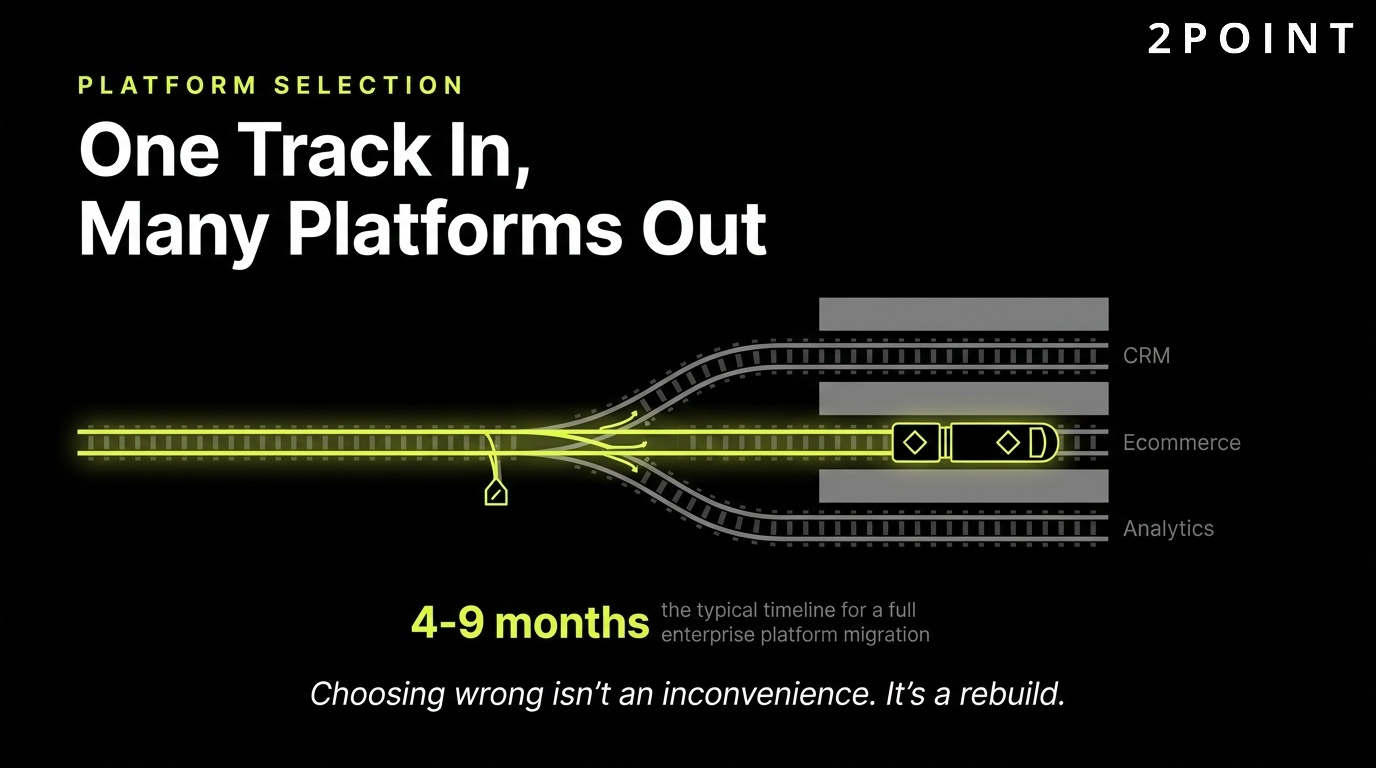
Switching costs deserve more weight than they typically receive in platform evaluations. Enterprise migrations take between four and nine months when you account for journey export, template rebuilding, deliverability warmup, and identity reconciliation across integrated systems. That timeline represents significant resource investment and operational risk. Choosing the wrong platform and subsequently migrating is not just an inconvenience; it is a material business disruption. Getting the initial selection right is worth the time and rigor required.
Testing with real use cases, not vendor-provided demos, is the most reliable way to evaluate a platform. Run your actual highest-priority workflows in a trial environment. Connect your real data sources. Attempt the integrations you will actually need. The experience of doing your real work in the platform will reveal limitations that no feature list or sales demonstration will disclose. Talking to current users in companies similar to yours adds a layer of reality that analyst reports and vendor marketing cannot provide.
Common Platform Selection Mistakes That Cost Time and Money
The most expensive platform selection mistake is choosing based on feature lists rather than actual needs. Vendors optimize demos to showcase their strengths and minimize their weaknesses. A thorough feature list comparison between platforms often reveals more parity than genuine differentiation, leaving buyers to choose based on price or brand recognition rather than fit. The result is frequently a platform that was technically capable of doing what was needed but never got configured to actually do it because implementation was harder than expected.
Underestimating implementation and switching costs is the second most common mistake, and the four-to-nine-month enterprise migration timeline makes it a costly one. Implementation costs include not just platform configuration but data migration, team training, integration development, and the opportunity cost of the team members consumed by the project. Buyers who budget only for the platform subscription frequently find themselves significantly over budget before the platform is generating any return.
Data quality requirements are systematically underestimated. Marketing automation is fundamentally a data-driven technology. The quality of the outputs, personalization accuracy, lead scoring reliability, attribution precision, is directly constrained by the quality of the input data. Only 16% of marketers report trusting their data accuracy, which means 84% are running automation programs on data they know is imperfect. Investing in data quality before platform implementation, rather than expecting the platform to solve data quality problems, consistently produces better outcomes.
Team skill level and training needs are often the last consideration when they should be among the first. The most capable platform in the market delivers no value if the team cannot operate it effectively. Honest assessment of current team capabilities, and the training investment required to close the gap, is essential to realistic ROI projections. Platforms with steeper learning curves may be the right long-term choice but require longer timelines to positive return.
Omnichannel Integration and Customer Journey Orchestration
What True Omnichannel Marketing Automation Looks Like
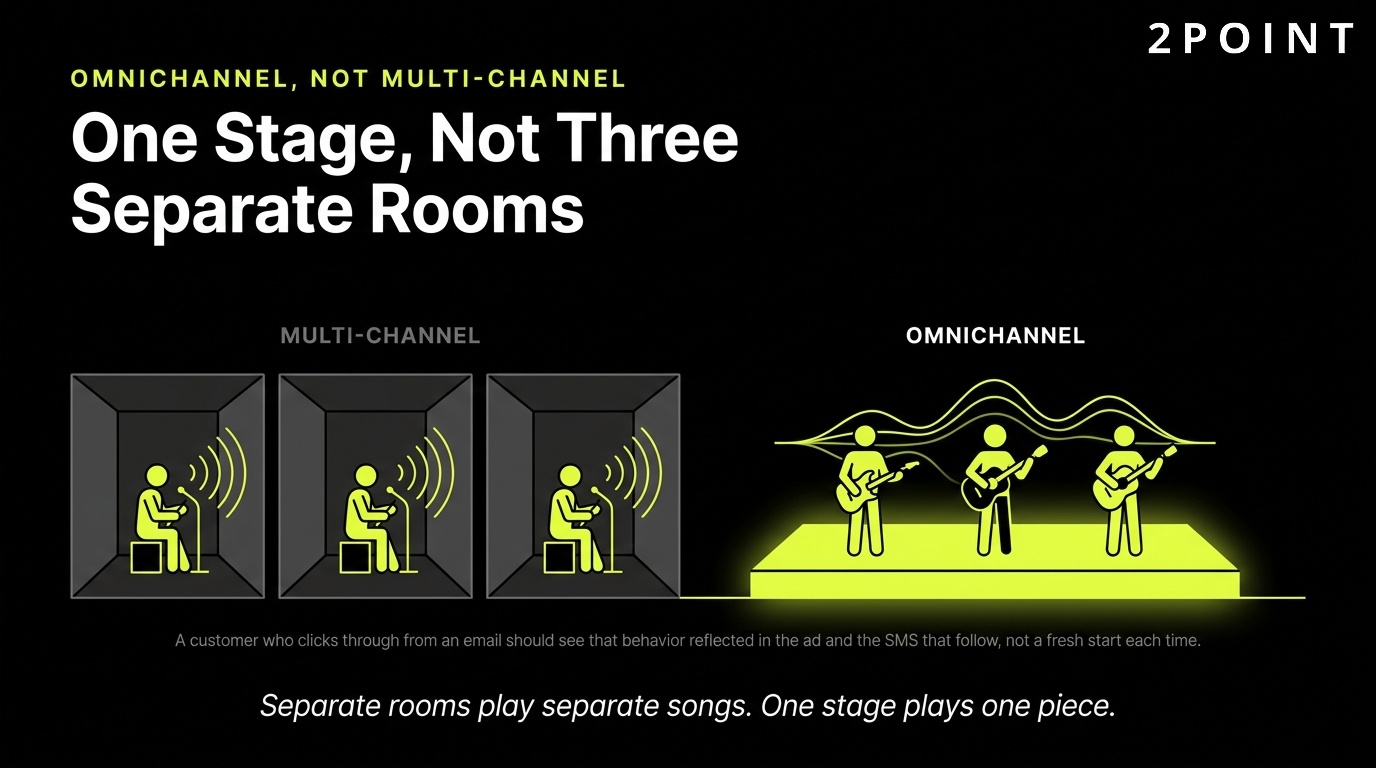
Omnichannel automation is frequently confused with multi-channel automation, and the distinction matters enormously for outcomes. Multi-channel marketing runs separate campaigns across different channels, each managed independently with its own logic, data, and performance tracking. A customer in a multi-channel environment might receive an email sequence on one thread, see a retargeting ad driven by different logic, and receive an SMS from yet another system, with no coordination between them. Omnichannel automation coordinates all of these channels into a single, coherent customer journey where each interaction informs the next.
True omnichannel automation means a customer who opens an email and clicks through to a product page has that behavior recognized across the entire system. The retargeting ad they subsequently see reflects what they clicked on. The SMS they receive is timed to their demonstrated engagement pattern rather than a bulk schedule. The next email they receive acknowledges where they are in the journey rather than starting over from the beginning. This coordination is what separates the cohesive marketing campaigns that win customer loyalty from the fragmented experiences that frustrate customers and waste marketing budget.
The channels that need coordination in 2026 extend well beyond email: SMS, push notifications, social media messaging, web personalization, in-app messaging, and retargeting ads all contribute to the customer journey. Each channel has different optimal use cases, different engagement contexts, and different audience expectations. Orchestrating them requires a platform that can serve as the central nervous system for all of these channels simultaneously, routing customers through the appropriate channel mix based on their behavior and preferences.
The performance advantages of true omnichannel coordination are substantial. The 77% higher conversion rates associated with automation are driven in significant part by the consistency and relevance that omnichannel coordination enables. The 60% higher engagement that AI-powered automation delivers reflects systems that can follow customers across their preferred channels and maintain contextual continuity across every interaction.
Email and SMS: The Power Combination for 2026 Automated Campaigns
Email and SMS have emerged as the most effective channel combination in marketing automation for a specific and logical reason: they serve complementary purposes with different urgency profiles. Email is the appropriate channel for longer-form content, nurturing sequences, product education, and communications where the recipient benefits from being able to read at their own pace. SMS is the appropriate channel for time-sensitive offers, appointment reminders, shipping updates, and any communication where immediacy matters more than depth.
The performance statistics for each channel reinforce this complementarity. Automated emails generate 320% more revenue than non-automated equivalents and deliver 68.6% open rates for welcome sequences. SMS achieves delivery rates of approximately 98% and open rates around 90%, making it the most reliable channel for critical communications. The combination of email's depth and SMS's immediacy, coordinated through automation so each channel is used for its optimal purpose, consistently outperforms either channel used in isolation.
Klaviyo's success in eCommerce has been largely built on exactly this email-plus-SMS integration, and its influence has shaped how the broader market thinks about channel coordination. An abandoned cart sequence might begin with an email that provides product details and reviews, follow with an SMS the next day that offers a time-limited discount, and conclude with a final email that either recaptures the sale or removes the contact from the sequence. Each step uses the channel appropriate to its purpose and timing.
Compliance considerations for SMS automation differ materially from email and warrant careful attention. SMS requires explicit opt-in consent in most major markets, and the requirements are more stringent than email. Building SMS subscriber lists through proper opt-in mechanisms, and maintaining clear opt-out procedures, is both a legal requirement and a deliverability best practice. Subscribers who genuinely opted in to SMS communication are far more likely to engage positively than those added without explicit consent.
Building Marketing Automation Workflows That Span Multiple Channels
Effective multi-channel marketing automation workflows follow a consistent design principle: the channel should be chosen based on the message and the moment, not on operational convenience. This principle sounds obvious but is frequently violated in practice. Sending an urgent time-sensitive offer via email, because the team has not yet built out SMS capabilities, is a common example of operational convenience overriding customer experience logic.
Designing omnichannel workflows begins with mapping the customer journey across all channels the customer actually uses, not just the channels the marketing team has historically managed. Customer journey mapping that includes mobile behavior, app usage, social media engagement, and offline touchpoints reveals channel preferences and transition patterns that email-only analysis misses. That map then becomes the blueprint for automation workflows that follow customers through their actual behavior patterns rather than forcing them into the brand's preferred communication path.
Channel suppression logic is a frequently overlooked component of omnichannel workflow design. When a customer converts through one channel, communications through other channels should update accordingly. A customer who purchases after receiving an SMS should be removed from the email sequence that was driving them toward the same conversion. Without suppression logic, automation systems over-communicate and send irrelevant messages to customers who have already taken the desired action, which damages the relationship and inflates unsubscribe rates.
Coordinating Social Media Marketing Within Automated Customer Journeys
Social media's role in marketing automation has evolved significantly as platforms have developed better API access and as programmatic advertising has matured. Social media marketing within an automated journey typically functions at two levels: organic content scheduling and paid social ad coordination. Organic scheduling is the more established application, with tools like Buffer and Hootsuite providing automation for content publishing. Paid social coordination is the more powerful integration, where custom audience lists built from automation platform data drive retargeting campaigns that align with where individual customers are in their journey.
A customer who received a welcome email sequence but has not yet purchased can be automatically added to a paid social audience that shows them brand awareness content designed to reinforce the email messaging. A customer who abandoned a cart can see retargeting ads featuring the exact products they left behind, coordinated with the automated email and SMS sequence that is already addressing the same abandonment. This cross-channel coordination dramatically improves the efficiency of paid social spend by ensuring ads reach audiences who are already in active automated journeys, rather than cold audiences who need to be brought to awareness before conversion can occur.
Marketing Automation Trends Shaping Strategy in 2026 and Beyond
The Five Most Impactful Marketing Automation Trends for 2026
The marketing automation trends that matter most in 2026 are not incremental improvements to existing capabilities. They represent structural shifts in how automation works and what it can do. Understanding these trends allows marketing teams to make investment decisions that will remain relevant for the next three to five years rather than optimizing for capabilities that are already becoming obsolete.
| Marketing Automation Trend | Current Adoption Rate | Primary Impact | Key Platforms Leading |
|---|---|---|---|
| Agentic AI Decision-Making | 19.7% deployed agents | Autonomous campaign optimization without manual oversight | HubSpot AI, Salesforce Einstein, Marketo AI |
| Zero-Party Data Collection | Growing rapidly post-cookie | Privacy-compliant personalization with explicit consent | Klaviyo, ActiveCampaign, HubSpot |
| Predictive Personalization | 60% reporting higher engagement | Anticipating customer needs before expressed | Klaviyo, Braze, MoEngage |
| Omnichannel Journey Orchestration | 79% automating customer journeys | Coordinated cross-channel experiences replacing siloed campaigns | Braze, Iterable, HubSpot |
| Content AI and Dynamic Creative | 92% using AI tools in workflows | Scale of content production and personalization | Adobe, HubSpot, Salesforce |
Each of these trends reinforces the others, with agentic AI providing the decision-making layer that makes predictive personalization and omnichannel orchestration possible at scale.
Predictive Analytics and the Future of Automated Campaign Optimization
Predictive analytics has moved from a premium add-on to a standard expectation in marketing automation platforms used by serious marketers. The capability to forecast which customers are most likely to purchase, which are at risk of churning, and which respond best to specific content types allows automation systems to prioritize resources and personalize experiences in ways that historical data alone cannot enable. Rather than reacting to customer behavior after it happens, predictive systems anticipate it and act preemptively.
Churn prediction is one of the highest-value applications. By identifying customers whose engagement patterns match historical churn signals before they actually disengage, automation systems can trigger re-engagement sequences while the customer relationship is still salvageable. The alternative, waiting until a customer has already churned and then attempting win-back campaigns, is both more expensive and less effective. The economics of customer retention consistently favor proactive predictive intervention over reactive recovery.
Purchase intent prediction enables more efficient resource allocation in lead nurturing and eCommerce scenarios. Rather than sending identical nurturing sequences to all prospects at the same pace, predictive scoring identifies which leads are approaching purchase decisions and triggers more intensive engagement with those contacts. The result is more efficient use of marketing automation capacity and higher conversion rates for the same volume of leads. This capability is a key driver of the conversion rate improvements and revenue growth that characterize top-performing automation programs.
Automated Marketing Campaigns and the Role of Content in 2026
Automated marketing campaigns in 2026 increasingly rely on AI to handle content creation and optimization tasks that previously required significant human time. AI writing assistants generate subject line variations, draft email body copy, and produce social media content that human marketers then edit and approve. This workflow does not eliminate creative judgment; it amplifies creative capacity by handling the drafting work and leaving human attention for the refinement and strategic decisions that genuinely require it.
Dynamic content within automated campaigns has become significantly more sophisticated. Rather than simply swapping a customer's name or location into a template, modern dynamic content systems assemble entirely different message structures based on recipient attributes. A customer with a long purchase history and high loyalty score might receive a completely different version of a promotional campaign than a new subscriber, with different offers, different tone, and different calls to action, all served from the same automated workflow through dynamic content logic.
The integration of content strategy with automation strategy is where many programs see the largest improvement opportunities. Content marketing assets, blog posts, case studies, videos, guides, feed into automated nurturing sequences as educational content that moves prospects through the buyer journey. When content strategy is designed with automation delivery in mind, and automation sequences are built around content assets that genuinely help customers, the combination produces consistently stronger results than either content or automation managed in isolation.
Marketing Automation ROI Trends: What Drives Returns in 2026
The $5.44 average return on marketing automation investment is meaningful context, but the more actionable question is what drives programs to the $8.71 top-quartile benchmark. The answer consistently involves the same set of factors: data quality, integration depth, personalization sophistication, and team capability. Programs that invest in all four areas deliver returns that justify continued investment and expansion. Programs that cut corners on any of the four typically find themselves in the average or below-average range.
Data quality has an outsized impact because every other element of automation performance depends on it. Segmentation accuracy, lead scoring reliability, personalization relevance, and attribution modeling all require clean, complete, and timely data. The 84% of marketers who do not fully trust their data accuracy are working with a fundamental constraint on their automation performance that platform upgrades or additional features cannot solve. Investment in data hygiene and governance consistently produces higher ROI than equivalent investment in additional platform capabilities.
Integration depth determines how much of the available customer signal actually reaches the automation system. A platform that receives email engagement data but does not see website behavior, purchase history, and customer service interactions is operating with an incomplete picture of each customer. The automation decisions it makes are correspondingly less accurate. Investing in the integration work required to bring all relevant customer data into the automation platform is foundational infrastructure for top-quartile performance.
Team capability is the factor most often underestimated in ROI discussions. The same platform in the hands of a skilled marketing operations team versus a team that uses only its most basic features can produce dramatically different returns. Investment in training, in hiring people with marketing automation expertise, and in dedicated time for workflow optimization and testing consistently produces measurable improvements in program performance. The technology can only do what the team configures it to do, and configuration quality determines outcomes more than platform selection in many cases.
Implementing Marketing Automation: A Step-by-Step Framework
Phase One: Strategy and Foundation Before You Touch the Platform
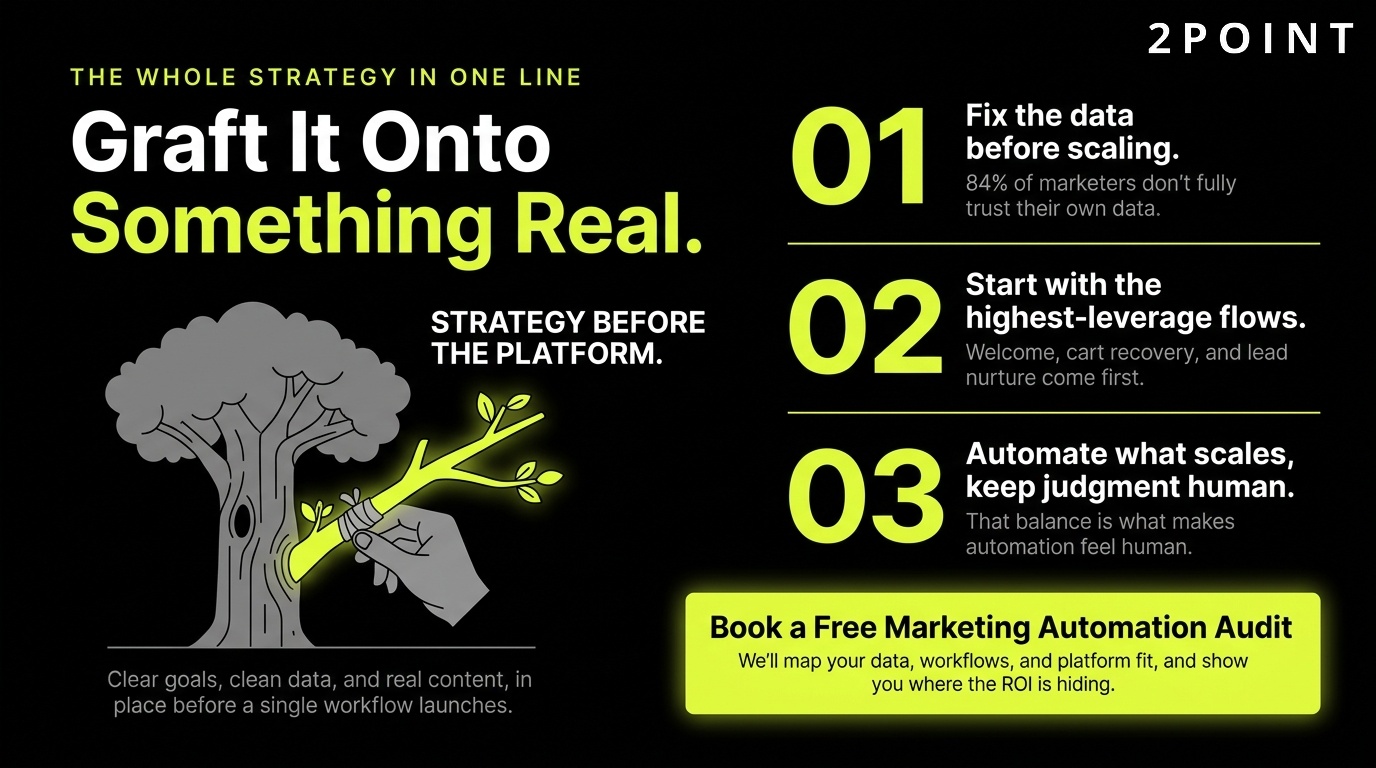
Marketing automation implementation most commonly fails not because of technical problems but because strategic clarity was insufficient before implementation began. The platforms are capable. The failure points are almost always definitional: unclear goals, incomplete audience understanding, absent content, or misaligned team expectations. Investing in strategy before configuration prevents the expensive rework that characterizes failed implementations.
The strategic foundation requires clear answers to four questions. First, what specific business outcomes is automation expected to drive? Revenue targets, conversion rate improvements, and time savings are legitimate goals; "being more automated" is not. Second, who are the customer segments that automation will serve, and what does each segment need at each stage of the journey? Third, what content assets exist to fuel automated sequences, and what gaps need to be filled before launch? Fourth, how will performance be measured, and who owns the ongoing optimization process?
Maintaining clear and consistent marketing messages across all automated touchpoints requires this strategic foundation. Without it, automated sequences frequently develop tonal inconsistencies and messaging contradictions as different team members build different workflows without coordinating their approach.
Phase Two: Data Audit and Infrastructure Preparation
Before any automation workflow goes live, the data it will use must be evaluated for quality and completeness. A data audit examines contact list health, including bounce rates, duplicate records, and incomplete profiles. It identifies what data fields are populated reliably versus inconsistently. It maps the data sources that need to integrate with the automation platform and evaluates the quality of data flowing from each source. The audit findings directly inform implementation decisions about what automation is possible immediately versus what requires data improvement first.
Infrastructure preparation includes setting up the technical integrations between the automation platform and the CRM, eCommerce platform, advertising accounts, and analytics tools. This is also the phase for establishing email deliverability infrastructure: authenticating sending domains with DKIM, SPF, and DMARC records, and planning the warmup process for new sending IP addresses. Deliverability is foundational to email automation performance and is often treated as an afterthought when it should be the first technical priority.
Phase Three: Building and Launching Core Automation Workflows
The first workflows to build should be the highest-impact, most universal sequences rather than complex edge-case scenarios. Welcome series for new subscribers, abandoned cart sequences for eCommerce, and lead nurturing sequences for B2B contacts are the highest-ROI starting points because they address the most common customer scenarios and deliver measurable returns quickly. These foundational workflows also generate performance data that informs the development of more sophisticated sequences.
- Build the welcome series first: this is the highest-open-rate automated sequence and sets the tone for the entire customer relationship.
- Configure behavioral triggers for your highest-value customer actions: purchases, cart abandonment, form completions, and specific page visits.
- Establish lead scoring criteria and configure the CRM integration to route scored leads to appropriate sales workflows.
- Build re-engagement sequences for contacts whose engagement has declined below defined thresholds.
- Create post-purchase sequences that nurture customer relationships, encourage reviews, and facilitate repeat purchases.
- Launch with proper tracking in place: UTM parameters, conversion event tracking, and attribution modeling configured before any sequence goes live.
Each workflow should be launched with A/B testing built in from the start. Testing subject lines, send times, content variations, and call-to-action placement within automated sequences produces continuous improvement that compounds over time. The brands achieving the highest email marketing performance metrics are almost universally running ongoing optimization programs rather than setting up workflows and leaving them unchanged.
Phase Four: Optimization, Scaling, and Advanced Capability Development
After core workflows are live and generating performance data, the optimization phase begins. This involves analyzing which sequences are performing above and below benchmarks, identifying the specific elements that drive performance differences, and making data-informed adjustments. Optimization is not a one-time exercise; it is an ongoing operational commitment that distinguishes top-performing programs from those that plateau after initial implementation.
Scaling automation capabilities means extending the channel coverage, increasing the sophistication of segmentation and personalization, and building more complex multi-path workflows that accommodate a wider range of customer behaviors. This progression should be driven by performance data from existing sequences rather than by platform capability exploration. Build what the data shows will improve customer outcomes, not what seems technically interesting.
Advanced capability development typically includes predictive lead scoring, multi-channel journey orchestration across email, SMS, and paid social, and progressive profiling systems that continuously enrich customer profiles through interaction data. These are not starting points for automation programs; they are the result of maturity developed through consistent execution and optimization of foundational workflows. The temptation to start with advanced capabilities before mastering the basics is a common mistake that leads to over-engineered, underperforming programs.
Measuring Marketing Automation Success: The Metrics That Matter
Primary Performance Indicators for Automated Marketing Campaigns
Measuring automation success requires a metrics framework that connects operational performance to business outcomes. Vanity metrics, open rates and click rates in isolation, reveal channel performance but not business impact. A rigorous measurement framework includes both engagement metrics and revenue attribution to tell the complete performance story.
| Metric Category | Key Performance Indicators | Benchmark Target | Why It Matters |
|---|---|---|---|
| Email Engagement | Open rate, click rate, unsubscribe rate | Open rate above 25%, unsubscribe below 0.2% | Signals content relevance and list health |
| Conversion Performance | Conversion rate by workflow, revenue per email | Automated sequences 77% above manual baseline | Connects automation activity to revenue outcomes |
| Lead Quality | Lead score distribution, sales acceptance rate | 80% or more leads accepted by sales | Measures whether automation delivers value to sales pipeline |
| Customer Retention | Repeat purchase rate, churn rate, re-engagement rate | Improving quarter over quarter | Automation impact on long-term customer value |
| Overall Program ROI | Revenue attributed to automation per dollar invested | $5.44 average, top quartile $8.71 | Justifies platform and team investment |
The most effective measurement programs track metrics at both the workflow level and the program level, enabling teams to identify which specific sequences drive disproportionate value and which underperform and need optimization.
Attribution Modeling for Automated Marketing Programs
Attribution is the most technically challenging aspect of measuring marketing automation ROI, and it is the area where most programs make consequential measurement errors. Single-touch attribution models, which assign full conversion credit to either the first or last touchpoint, systematically misrepresent the contribution of automated nurturing sequences that influence customers throughout multi-touch journeys. A customer who converts after an automated email sequence that followed them over several weeks should not have that conversion attributed entirely to the final email they received before purchasing.
Multi-touch attribution models distribute conversion credit across the touchpoints that influenced a conversion, providing a more accurate picture of which automated sequences and channels are actually driving business outcomes. Implementing multi-touch attribution requires platform capabilities that most marketing automation systems include at enterprise tiers, along with the integration infrastructure to track customer interactions across all relevant channels. The investment in proper attribution infrastructure is directly justified by the improved investment decisions it enables: knowing which workflows actually drive revenue makes optimization straightforward rather than speculative.
For teams using email marketing automation as their primary channel, tracking the revenue contribution of specific automated sequences provides the clearest picture of program ROI. Welcome series revenue, abandoned cart recovery value, post-purchase upsell performance, and re-engagement campaign revenue are all measurable at the workflow level when tracking is properly configured. These workflow-level metrics provide the granular data needed to optimize programs systematically rather than based on intuition.
Compliance, Ethics, and Responsible Marketing Automation Practices
Navigating GDPR, CAN-SPAM, and CASL in Automated Marketing Programs
Marketing automation programs operate within a complex regulatory landscape that varies by geography, channel, and the nature of the customer data being processed. GDPR in the European Union, CAN-SPAM in the United States, CASL in Canada, and equivalent regulations in Australia, Brazil, and other major markets all impose requirements that must be reflected in automation system design, not treated as compliance afterthoughts. Violations carry financial penalties that can dwarf the cost of building compliant systems from the outset.
GDPR imposes the most stringent requirements, including the need for lawful basis for processing personal data, clear consent mechanisms, the right to erasure, and data portability requirements. Marketing automation systems processing data from EU residents must be configured to respect these rights: unsubscribes must propagate immediately across all channels and systems, data retention policies must be enforced automatically, and consent records must be maintained in a way that can be produced on request. Platforms with strong GDPR compliance features make this operationally feasible; platforms without them create ongoing compliance risk.
CAN-SPAM compliance for email automation requires that every commercial email include a functioning unsubscribe mechanism that is honored within ten business days, accurate sender identification, and a physical mailing address. CASL is more demanding, requiring express or implied consent for commercial electronic messages and imposing stricter anti-spam requirements. SMS automation in the United States is governed primarily by TCPA, which requires explicit written consent for automated text messages and imposes significant per-message penalties for violations.
Building compliance into automation system design from the start, rather than retrofitting it after the fact, is consistently less expensive and more reliable. This means configuring suppression lists that automatically prevent communications to opted-out contacts, implementing consent tracking that records when and how each contact provided consent, and establishing data retention schedules that automatically purge data beyond the retention period. Compliance is not just a legal obligation; it is also a trust signal that informs how customers experience automated communications.
Ethical Automation Practices That Build Long-Term Customer Trust
Beyond regulatory compliance, ethical marketing automation involves a set of practices that reflect respect for customers as individuals rather than as data points to be optimized. The distinction between compliant automation and ethical automation is meaningful: a program can technically comply with all relevant regulations while still feeling manipulative, deceptive, or disrespectful. Ethical automation sets a higher bar that ultimately serves business interests because it builds the trust and loyalty that drive long-term customer value.
Frequency management is one of the most commonly neglected ethical dimensions of automation programs. Technically, there is often nothing preventing an automated system from sending daily emails to every contact on a list. Practically, this erodes trust, increases unsubscribes, and damages deliverability. Ethical programs include frequency caps that limit how many automated messages a customer can receive in a given period, with override logic for genuinely time-sensitive communications. Customers who feel respected in their inbox stay on lists longer and engage more positively.
Honest personalization means using customer data to serve customers better, not to exploit psychological vulnerabilities or create false urgency. Countdown timers that are genuinely tied to real deadlines are an honest personalization tool. Fake countdown timers that reset every time the page is loaded are manipulative. Dynamic pricing that reflects actual supply and demand is a legitimate business practice. Automation that shows false scarcity to pressure purchases is deceptive. Ethical automation programs apply the same standards to automated communications that they would apply to direct sales conversations.
Frequently Asked Questions About Marketing Automation
What is marketing automation and how does it work?
Marketing automation is software that automatically executes marketing tasks based on predefined rules, behavioral triggers, or AI-driven decisions. It connects customer data from your CRM, website, and other sources to deliver personalized emails, SMS messages, social media posts, and other communications without requiring manual action for each interaction.
How much does marketing automation software cost for a small business?
Marketing automation software for small businesses typically ranges from $15 to $500 per month depending on contact list size and feature requirements. Platforms like ActiveCampaign start under $50 per month for small lists, while more comprehensive platforms with advanced AI and multi-channel capabilities cost $200 to $800 per month for SMB tiers. Enterprise platforms from HubSpot, Marketo, and Salesforce run from $800 to $4,000 or more per month.
What is the average ROI for marketing automation?
Businesses see an average ROI of $5.44 for every dollar spent on marketing automation programs, with top-performing programs achieving $8.71 per dollar. 76% of companies report positive ROI within the first year of implementation. Companies heavily investing in automation see an average of 34% revenue growth over three years.
How long does it take to implement marketing automation?
Basic marketing automation workflows, welcome series, lead nurturing sequences, and abandoned cart emails, can be live within two to four weeks for most platforms. Full enterprise implementation with CRM integration, multi-channel coordination, and advanced AI capabilities typically takes three to six months. Enterprise migrations between platforms take four to nine months when accounting for data migration, template rebuilding, and deliverability warmup.
Is marketing automation only for large businesses?
Marketing automation is now accessible and cost-effective for businesses of all sizes, including solo operators and startups. Platforms like Mailchimp offer free tiers, and ActiveCampaign provides comprehensive automation for under $50 per month for small contact lists. The technology that was exclusive to enterprise budgets a decade ago is now available to any business with an email list and a defined customer journey.
What is the difference between marketing automation and email marketing?
Email marketing refers specifically to the channel of communicating with customers via email. Marketing automation is the broader category of technology that automates marketing tasks across multiple channels, including email, SMS, social media, paid ads, and web personalization. All email automation is a subset of marketing automation, but marketing automation encompasses far more than email.
Marketing automation vs. CRM: what is the difference?
A CRM (Customer Relationship Management) system stores and organizes customer data, tracks sales interactions, and manages the customer relationship record. Marketing automation software uses that data to execute personalized, triggered communications across marketing channels. The two systems work best when integrated, with CRM data fueling automation decisions and automation activity updating the CRM record with engagement data.
Can marketing automation replace my marketing team?
Marketing automation cannot replace a marketing team because it depends on human judgment for strategy, creative direction, content creation, and the ongoing optimization decisions that determine whether automation programs succeed. Automation amplifies what a team can accomplish by eliminating repetitive manual tasks, but the quality of strategy, content, and judgment inputs determines the quality of automated outputs. The most effective teams treat AI and automation as capability multipliers rather than team replacements.
What are the most common marketing automation mistakes businesses make?
The most common mistakes include implementing automation before having a clear strategy, choosing a platform based on feature lists rather than specific business needs, underestimating data quality requirements, over-automating to the point where communications feel robotic, and failing to build proper testing and optimization processes into program management. Neglecting deliverability infrastructure is also a frequent and costly oversight.
How does AI improve marketing automation in 2026?
AI improves marketing automation by enabling predictive analytics that forecast customer behavior, send-time optimization that schedules communications for when each individual is most likely to engage, dynamic content selection that personalizes messages beyond simple template swaps, and autonomous campaign optimization that adjusts performance variables without requiring human approval for each decision. AI also powers advanced lead scoring, customer segmentation, and churn prediction capabilities that rule-based systems cannot replicate.
What is zero-party data and why does it matter for marketing automation?
Zero-party data is information that customers intentionally and explicitly share with a brand, such as preferences selected in a preference center, quiz responses, or survey answers. It matters for marketing automation because it provides high-quality, consent-based personalization inputs that are not affected by privacy regulation changes targeting third-party tracking data. Brands that have built zero-party data collection systems are able to deliver better personalization with more customer trust than competitors relying on inferred or purchased data.
How do I know if my marketing automation program is performing well?
A well-performing marketing automation program delivers open rates above 25% for email sequences, conversion rates at least 60 to 77% above your pre-automation baseline, positive ROI within 12 months of implementation, and improving customer retention metrics. Comparing your program's performance against the benchmarks of $5.44 average ROI, 68.6% welcome email open rates, and 10.7% abandoned cart conversion rates provides context for evaluating where your program sits relative to industry standards.
Marketing automation has moved well beyond its origins as a scheduling and task-execution tool. In 2026, it represents the infrastructure through which customer relationships are built, maintained, and grown at scale. The data is consistent: businesses that implement automation thoughtfully, investing in strategy, data quality, integration depth, and team capability, see returns that justify the investment many times over. Those that treat automation as a shortcut to be implemented quickly and left on autopilot see marginal or negative returns.
The brands winning with marketing automation share a common orientation: they use technology to be more human with customers, not less. They use AI to understand individual needs better and respond to them more relevantly. They use automation to ensure no customer is forgotten, no follow-up is missed, and no opportunity to add value goes unexplored. That orientation, combined with the right platform, the right data infrastructure, and a team committed to ongoing optimization, is the formula for marketing automation that genuinely transforms business performance.
Teams looking to build or mature their automation programs often benefit from strategic guidance from specialists who have built and optimized automation systems across diverse business contexts. 2POINT works with businesses at every stage of the automation journey, from initial strategy and platform selection through advanced AI personalization and multi-channel orchestration, helping teams achieve the top-quartile returns that distinguish great automation programs from average ones.
