

 let’s connect


What Is a Marketing Funnel? (Quick Answer)
A marketing funnel is one of the most foundational concepts in modern business growth. Before diving into strategy, here is a direct, complete answer to what a marketing funnel is and why it matters right now:
- A marketing funnel is a strategic framework that maps the customer journey from first awareness to final purchase and beyond.
- Funnels visualize how prospects move through defined stages: Awareness, Consideration, Conversion, Loyalty, and Advocacy.
- The marketing funnel is also called a sales funnel, conversion funnel, or customer funnel depending on the context.
- In 2026, effective funnels integrate AI tools, first-party data, and cross-functional workflows across teams.
- Modern funnels are non-linear: buyers move fluidly between stages across multiple touchpoints and channels.
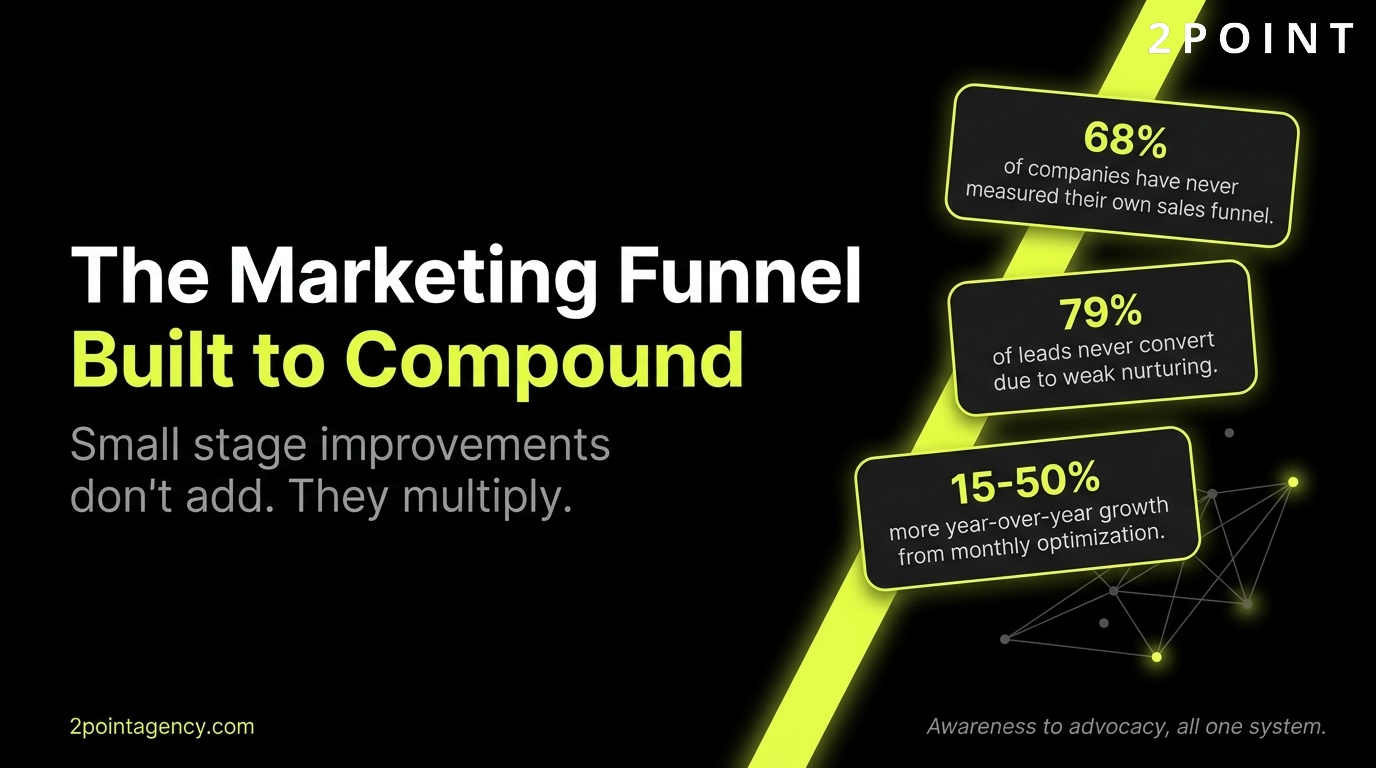
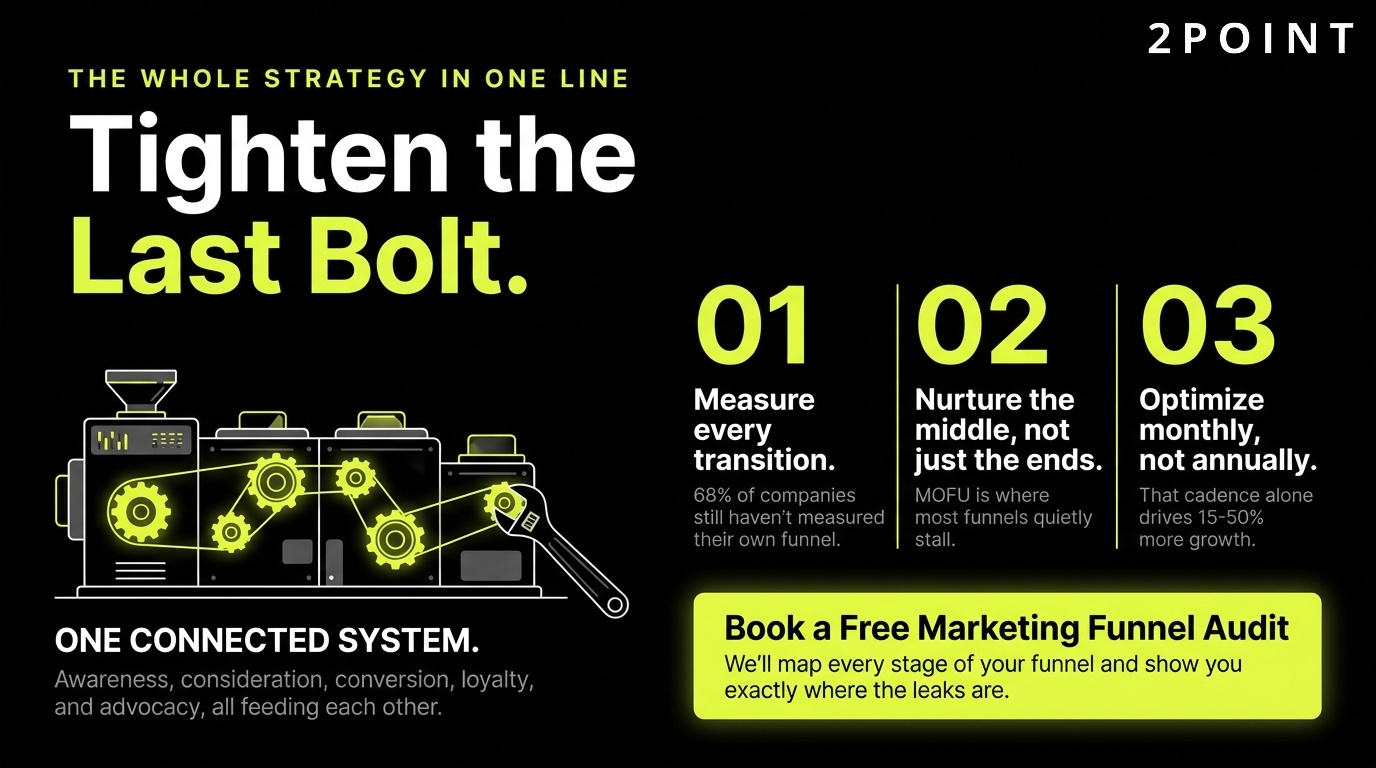
- 68% of companies have not identified or measured their sales funnel, leaving major revenue on the table.
- 79% of leads never convert to a sale due to lack of nurturing at the right funnel stage.
- Companies that optimize their funnels monthly grow 15 to 50% year over year compared to those that do not.
Now let's explore why marketing funnels remain essential in 2026 and how to build one that drives predictable, compounding growth for your business.
Why Marketing Funnels Still Matter in 2026
Every few years, someone declares that the marketing funnel is dead. Every few years, that prediction is wrong. The funnel has not disappeared. It has evolved into something more sophisticated, more data-driven, and more powerful than earlier versions. Understanding why funnels still matter is the starting point for any serious growth strategy in 2026.
The Evolution of the Marketing Funnel Framework
The marketing funnel framework has existed in some form for over a century, tracing its roots back to Elias St. Elmo Lewis's AIDA model from 1898. What has changed dramatically is not the fundamental logic of the funnel but how sophisticated marketers use it. The core insight, that buyers move through predictable psychological stages before committing to a purchase, remains as valid today as it was when it was first documented.
In 2026, the marketing funnel framework remains foundational for high-growth organizations. What has shifted is the technology layered on top of it. Real-time behavioral data, AI-driven segmentation, predictive lead scoring, and automated nurture workflows have transformed the funnel from a simple conceptual diagram into an active, dynamic growth engine. Modern funnels function as command centers for revenue operations, providing visibility into every stage of the buyer journey and enabling teams to act on insights in near real time.
The growth marketing funnel, a term that has gained significant traction in recent years, takes this evolution one step further. It applies a scientific, hypothesis-driven mindset to every stage of the funnel, treating marketing as a repeatable, scalable system rather than a series of isolated campaigns. Companies that optimize their funnels on a monthly basis grow between 15 and 50% year over year, a striking gap compared to organizations that leave their funnels unexamined. The funnel is not dead. It is simply being used at a much higher level of sophistication by the companies winning in their markets.
How Modern Buyer Behavior Shaped Today's Funnels
Today's buyers are fundamentally different from buyers of a decade ago. They arrive at sales conversations already educated, already skeptical, and already partway through a decision. The rise of AI-powered search, peer review platforms, short-form video, and social proof communities has shifted the balance of information from seller to buyer. This shift is permanent, and every marketing funnel built in 2026 must account for it.
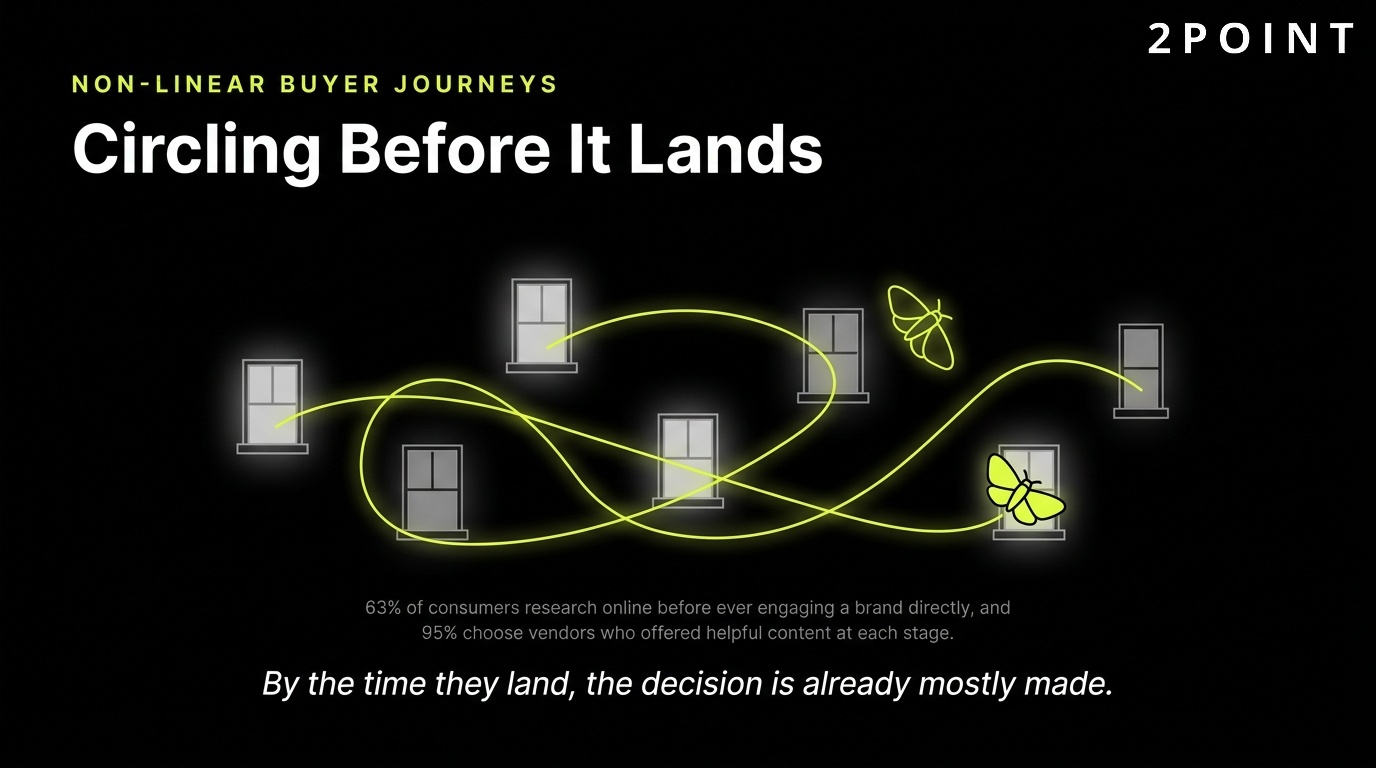
63% of consumers research online before engaging a vendor, meaning that by the time a prospect interacts with your brand directly, they have often already formed an initial impression. The implication is significant: brands that invest in creating useful, trust-building content at the top and middle of the funnel are shaping buyer decisions before a sales conversation ever begins. 95% of buyers choose vendors who provided helpful content at each stage of the decision journey, which underscores the compounding advantage of consistent funnel investment.
Modern buyers also move in non-linear patterns. A prospect might discover your brand through a YouTube video, engage with a blog post a week later, compare your product against competitors on a review site, and then convert after seeing a retargeting ad. The funnel stages, awareness, consideration, and conversion, remain identifiable, but the path between them is fluid and multi-channel. Understanding and designing for this behavior is what separates effective modern funnels from outdated, linear models. Understanding consumer behavior in digital marketing is therefore not optional. It is the foundation on which every funnel decision should be made.
The Full-Funnel Growth Approach vs. Siloed Campaigns
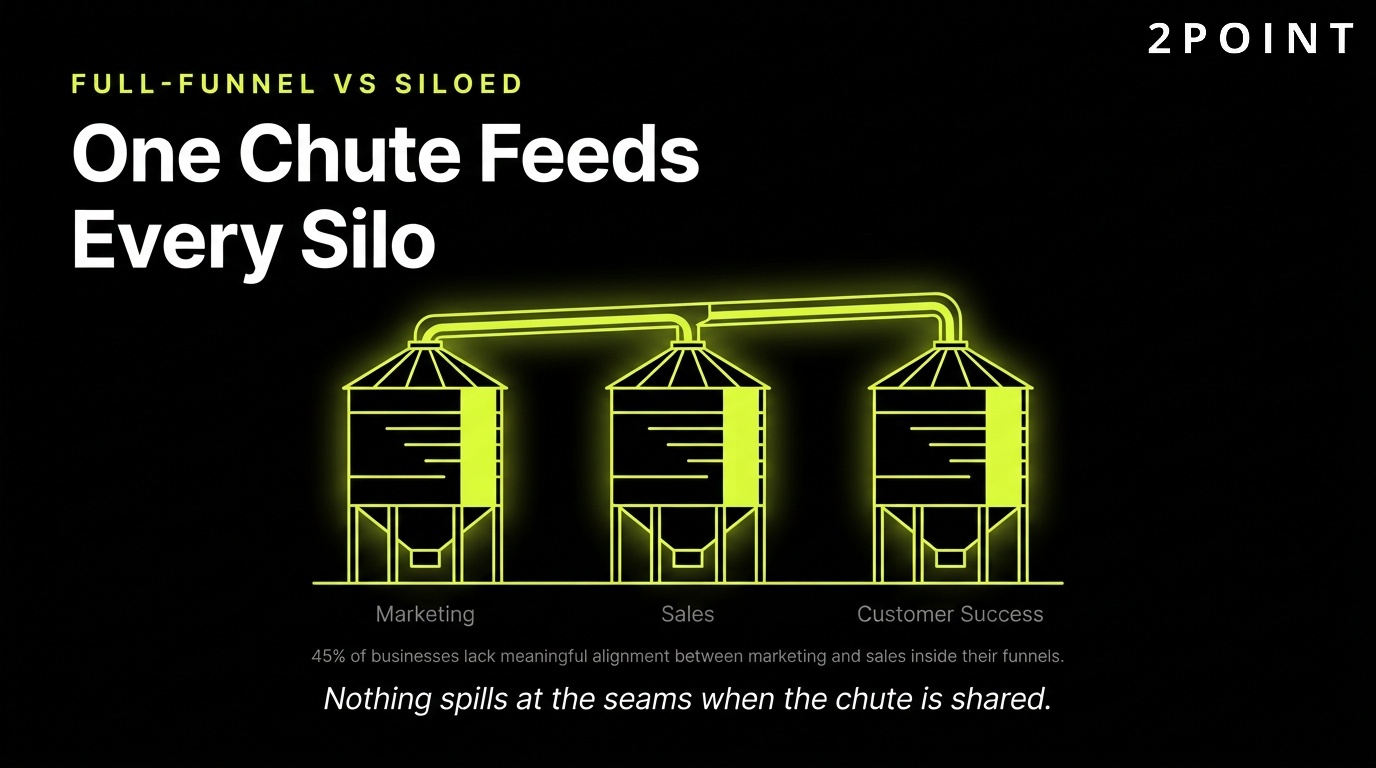
One of the most costly mistakes organizations make is running marketing as a collection of disconnected campaigns rather than as one unified growth system. In the traditional, siloed model, the marketing team generates leads, the sales team pursues them independently, and the customer success team operates in an entirely separate world. Each group optimizes for its own metrics, and the result is an inconsistent buyer experience with significant value leaking at every handoff point.
The full-funnel growth approach tears down these silos. Every channel, every team, and every piece of content is treated as part of one connected growth engine. A paid ad campaign at the awareness stage feeds a nurture sequence at the consideration stage. That nurture sequence hands off warm, well-qualified leads to a sales process designed to close efficiently. After the sale, a structured onboarding and retention program feeds the advocacy stage, which in turn generates referrals that reenter the funnel at awareness. 45% of businesses currently lack meaningful alignment between their marketing and sales functions within their funnels, which represents a major opportunity for organizations willing to invest in integration.
The results of full-funnel alignment are concrete. More efficient budget allocation, smarter data usage, stronger brand consistency, and compounding marketing value over time. Forward-thinking organizations in 2026 treat their marketing funnel not as a departmental tool but as a company-wide growth infrastructure. This perspective shift is what drives the difference between businesses that plateau and those that scale predictably. A well-executed marketing goals framework is essential for giving every funnel stage a clear performance target to work toward.
Understanding the Marketing Funnel Stages
While the overall funnel concept is intuitive, executing at each stage requires a precise understanding of what buyers need, what tactics are most effective, and which metrics signal healthy progression. The following breakdown covers each funnel stage with the specificity required to build a system that actually performs in 2026.
Top of Funnel (TOFU): Awareness Stage Strategies
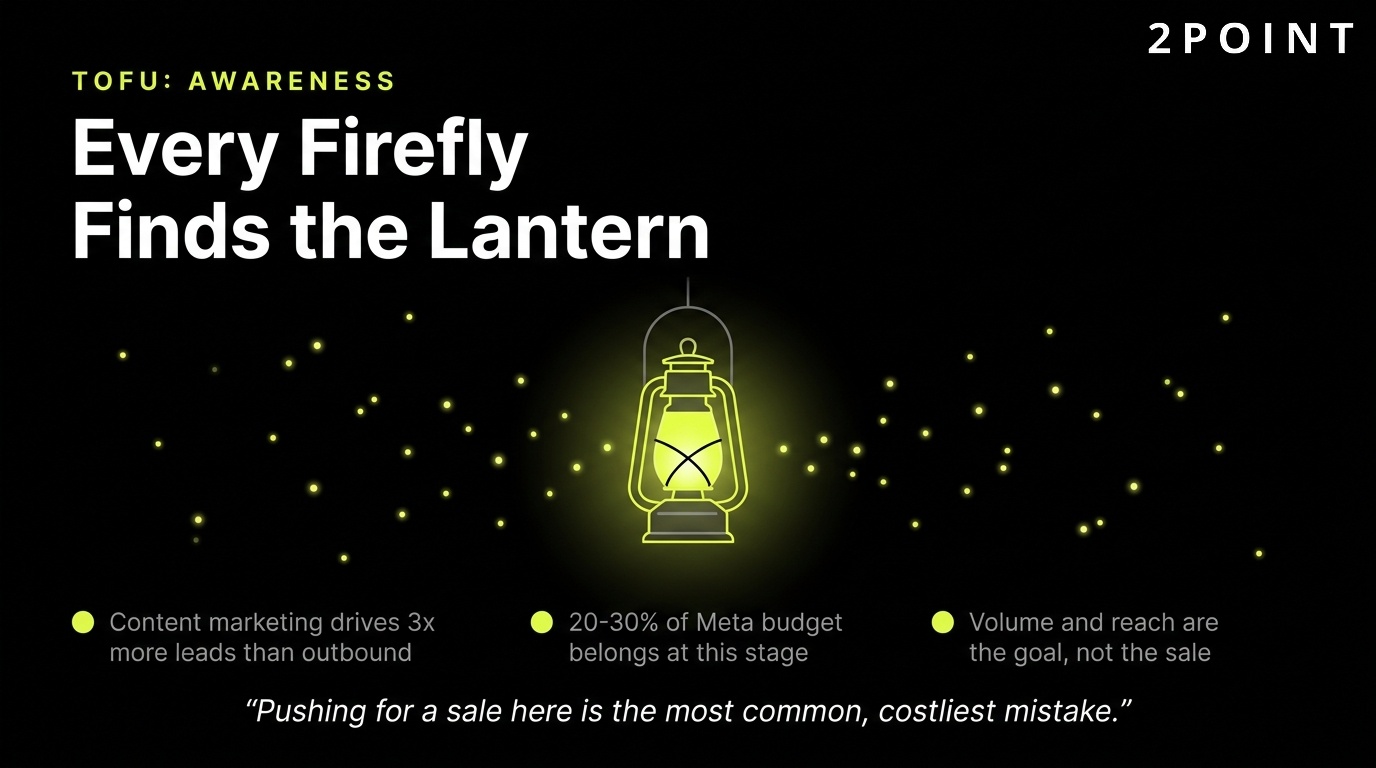
The top of the marketing funnel is where everything begins. TOFU strategies are designed to create awareness and capture attention, not to drive immediate sales. At this stage, your goal is to reach audiences who have never encountered your brand before and give them a compelling reason to pay attention. Pushing for a sale at TOFU is one of the most common and costly mistakes organizations make, because it skips the trust-building that converts browsers into buyers.
Effective TOFU tactics in 2026 include AI-driven content distribution, search engine optimized blog content, short-form video on platforms like Instagram Reels and TikTok, influencer partnerships, podcast appearances, organic social posts, and paid awareness campaigns. Content marketing drives three times more leads than outbound advertising, making it a foundational TOFU investment for any growth-oriented organization. For brands running paid social, allocating 20 to 30% of total Meta advertising budget to top-of-funnel campaigns is widely recommended, as it allows Meta's AI algorithm to identify efficient audiences rather than being constrained by overly narrow targeting parameters.
The key metrics to track at TOFU are website visits, unique visitors, impressions, social reach, and new email subscribers. These numbers tell you whether your awareness efforts are generating the volume of attention required to feed the rest of the funnel. A strong TOFU operation consistently feeds new, relevant prospects into the stages below it, creating the raw material that the rest of the funnel converts into revenue. Pairing TOFU content with a well-structured social media marketing plan ensures your awareness efforts are reaching the right audiences consistently.
Middle of Funnel (MOFU): Consideration and Interest
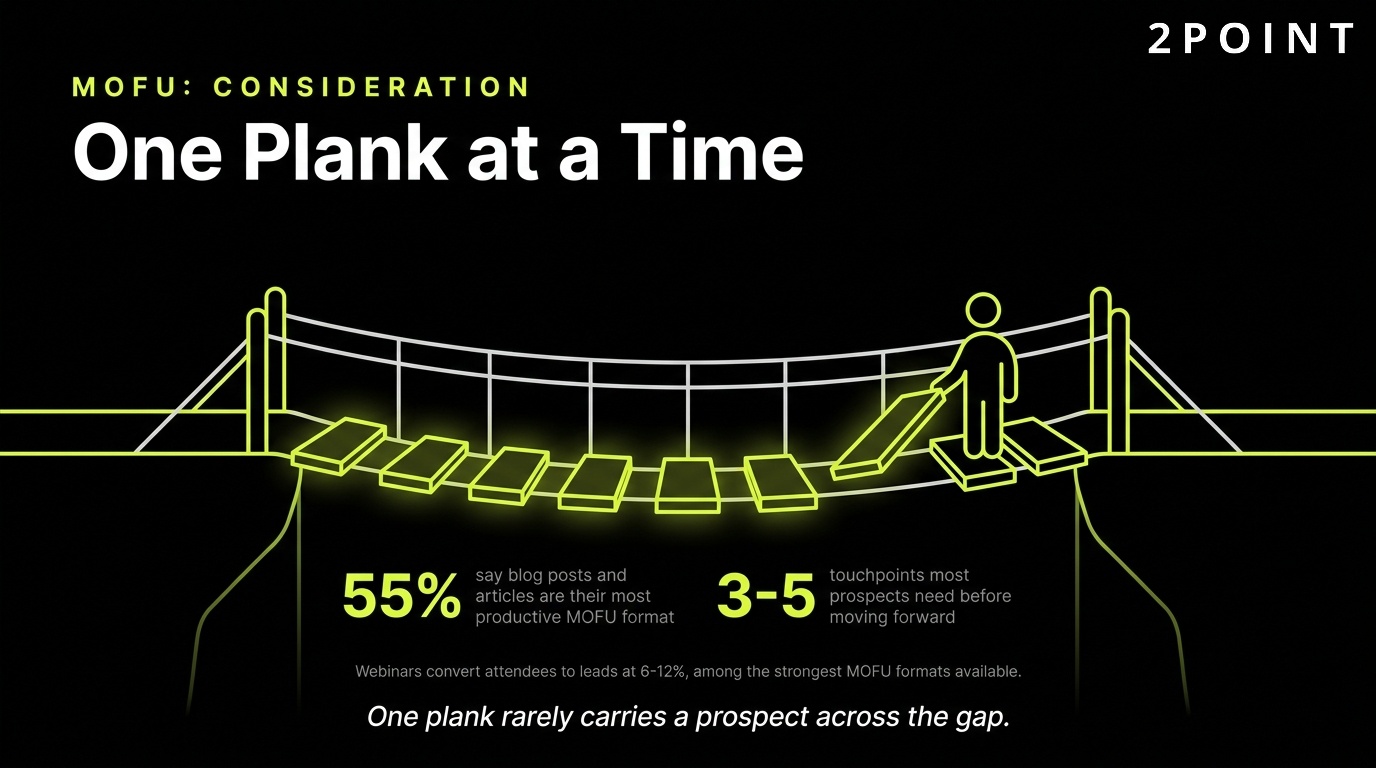
Once a prospect becomes aware of your brand, the middle of the funnel takes over. MOFU is focused on building trust, educating qualified leads, and nurturing the relationship until the prospect is ready to make a purchase decision. This stage is where most brands underinvest, and it is often where funnels stall. Prospects who reach MOFU have demonstrated interest but still need reasons to choose your solution over the alternatives they are actively evaluating.
The most effective MOFU tactics include targeted email sequences, webinars, in-depth guides, detailed case studies, comparison content, product overviews, and personalized retargeting campaigns. 55% of businesses report that articles and blog posts are the most productive format for moving prospects through the consideration stage. Webinars are particularly powerful, with attendee-to-lead conversion rates ranging from 6 to 12%. Critically, 40% of prospects require three to five touchpoints before advancing to the next funnel stage, which means a single piece of MOFU content is rarely sufficient.
The metrics that matter at MOFU are click-through rates, email open and reply rates, content download numbers, webinar attendance, time on page, and video watch time. These signals reveal the quality of engagement, not just the volume. High-engagement MOFU content tells you that prospects are genuinely evaluating your brand, while low engagement signals that your content is not connecting with their specific questions and concerns. Email marketing automation is one of the most efficient tools available for delivering consistent, personalized MOFU nurturing at scale without requiring manual effort from your team for every interaction.
Bottom of Funnel (BOFU): Conversion and Decision
The bottom of the funnel is where qualified leads become paying customers. At BOFU, prospects have moved through awareness and consideration, have identified your brand as a credible option, and are ready to make a purchase decision. What they need at this stage is not more education. They need final reassurance, a clear value proposition, social proof, and a frictionless path to conversion. Failing to provide these elements at BOFU means losing prospects who were already close to buying.
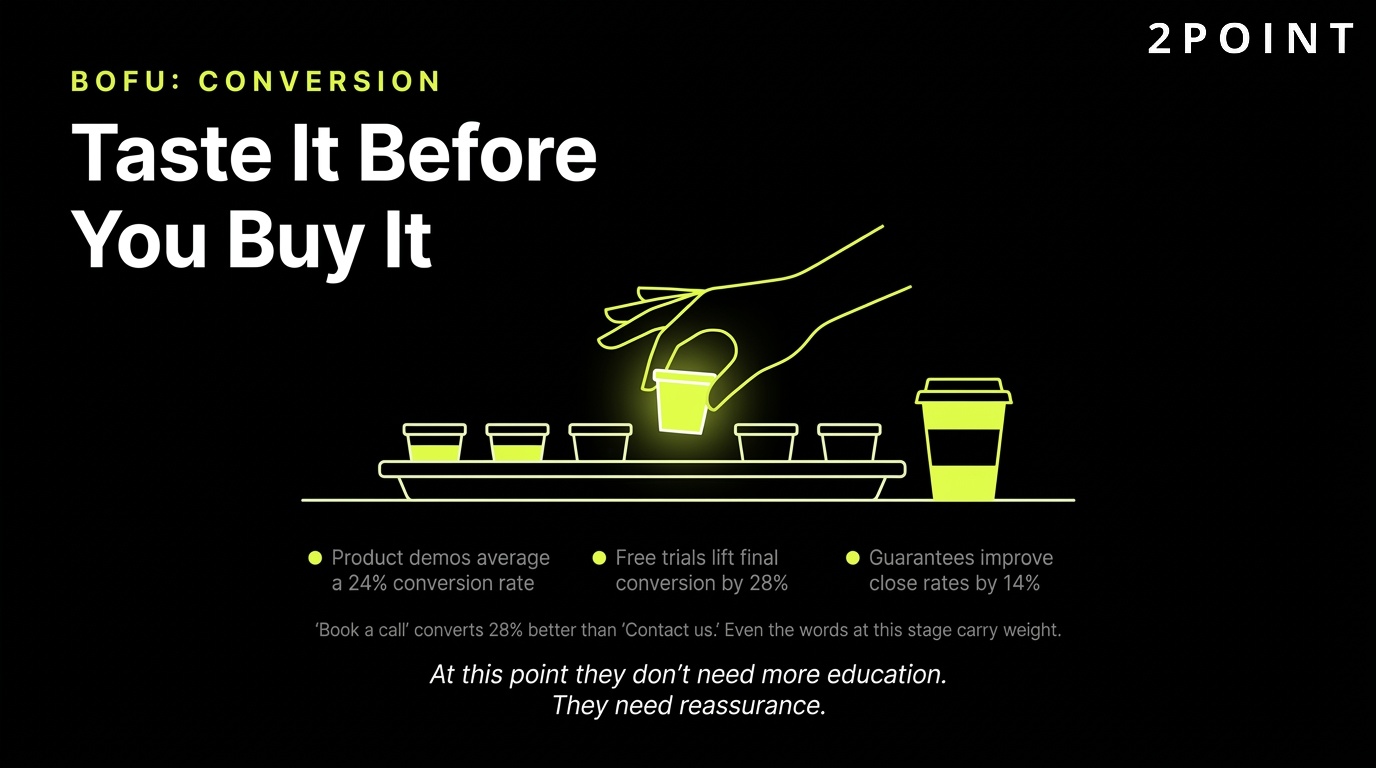
The most effective BOFU tactics include product demonstrations, free trials, customer testimonials, detailed case studies, risk-reversal guarantees, and well-crafted limited-time offers. The data on specific BOFU elements is compelling. Product demos average a 24% conversion rate to sale. Free trials increase final conversion rates by 28%. Money-back guarantees improve close rates by 14%. Even the language used in calls to action matters significantly: "Book a call" CTAs convert 28% better than "Contact us", a small change with a substantial impact on revenue.
Speed is one of the most underestimated BOFU variables. Following up with a high-intent lead within five minutes increases the odds of qualification by eight times compared to waiting even an hour. Most organizations wait hours or days, hemorrhaging conversion opportunities in the process. The metrics to track at BOFU include conversion rate, cost per acquisition, sales-qualified lead volume, and demo request completion rate. A well-optimized BOFU is often where the largest and fastest gains in funnel performance are found.
Post-Purchase: Loyalty and Advocacy Stages
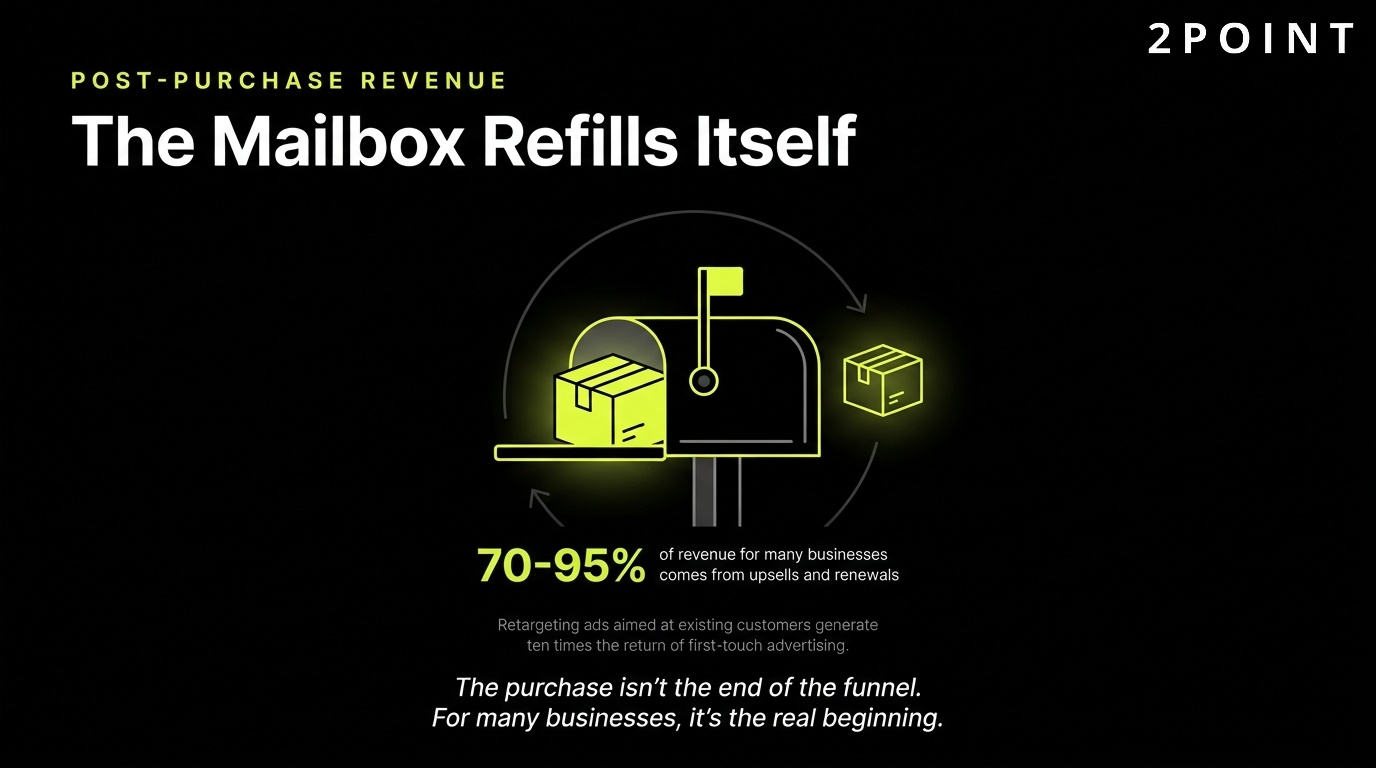
The purchase is not the end of the marketing funnel. For many businesses, especially those with subscription models or high lifetime value products, it is actually the beginning of the most important revenue cycle. The post-purchase stages, loyalty and advocacy, are chronically underinvested and represent one of the highest-return opportunities in any marketing program. 70 to 95% of revenue for many businesses comes from upsells and renewals rather than new customer acquisition, which reframes how strategically important the back end of the funnel truly is.
Loyalty stage tactics include structured onboarding sequences, personalized follow-up communications, exclusive content for existing customers, loyalty reward programs, and proactive customer success outreach. Advocacy stage tactics focus on turning satisfied customers into active promoters through referral programs, co-created content, case study features, and community participation. Retargeting ads designed for existing customers generate ten times the return compared to first-touch advertising, demonstrating that the back end of the funnel delivers exceptional ROI per dollar spent.
The metrics that define success at the loyalty and advocacy stages are customer lifetime value, retention rate, repeat purchase rate, referral rate, and net promoter score. These numbers reveal whether your post-purchase experience is creating fans or simply fulfilling transactions. Building a strong customer-centric marketing program around the loyalty and advocacy stages is one of the most sustainable competitive advantages a business can develop, because it creates compounding returns that new-customer acquisition simply cannot match.
Marketing Funnel Metrics That Actually Matter
A marketing funnel without measurement is just a theory. The organizations that consistently outperform their competitors are those that treat their funnel as a data system, tracking performance at every stage, identifying where value is leaking, and making targeted improvements based on evidence rather than intuition. The following framework gives you the specific metrics and tools needed to run a measurement-driven funnel operation.
Stage-to-Stage Conversion Rates and Benchmarks
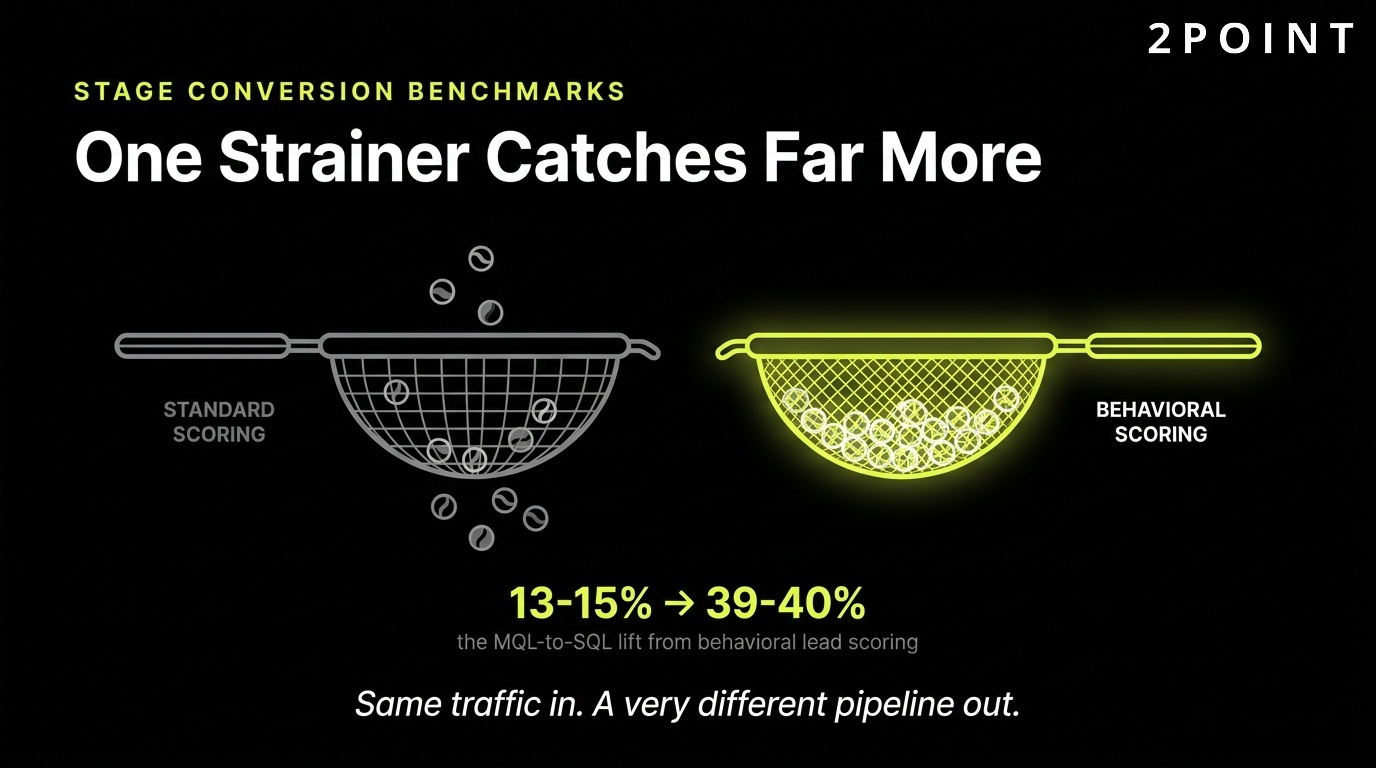
Stage-to-stage conversion rates are the most critical measurement in any funnel analysis. They tell you not just how many prospects enter your funnel but how effectively you are moving them from one stage to the next. Understanding where drop-off occurs is the diagnostic insight that drives every meaningful optimization decision. Without this data, funnel improvement is guesswork.
For most online businesses, a healthy overall funnel conversion rate falls between 3.1 and 5%. The biggest performance gap in B2B funnels specifically tends to occur at the marketing-qualified lead to sales-qualified lead transition, where the average organization converts at 13 to 15%, while organizations using behavioral lead scoring achieve rates of 39 to 40%. This single transition point can represent a doubling of sales pipeline with no increase in traffic. Separately, most funnels lose 70% of leads between the first interaction and email signup, making that early stage one of the highest-value optimization opportunities available.
The consistent finding across all these statistics is that 79% of leads never convert to a sale, not because they were bad leads but because they were not nurtured effectively. That number represents an enormous proportion of marketing investment that produces zero return. Measuring conversion rates at each transition point, first interaction to signup, signup to engagement, engagement to MQL, MQL to SQL, SQL to close, reveals exactly where the funnel is failing and where investment will have the greatest impact.
Essential Metrics by Funnel Stage
Different funnel stages require different measurement frameworks. The table below organizes the essential metrics by stage, providing a practical reference for building your funnel reporting dashboard.
| Funnel Stage | Primary Metrics to Track | What Each Metric Reveals |
|---|---|---|
| Awareness (TOFU) | Website visits, unique visitors, impressions, social reach, email list growth rate | Volume and quality of new audience being reached |
| Consideration (MOFU) | Click-through rates, content downloads, email engagement rate, video watch time, webinar attendance | Depth of engagement and interest quality |
| Conversion (BOFU) | Conversion rate, cost per acquisition (CPA), sales-qualified lead (SQL) volume, demo request rate | Revenue efficiency and sales readiness |
| Loyalty and Advocacy | Customer lifetime value (CLV), retention rate, repeat purchase rate, net promoter score (NPS), referral rate | Long-term revenue health and brand growth through existing customers |
| Advanced Diagnostics | Time in stage, activation depth, lead quality score, stage-to-stage conversion rate | Bottleneck identification and predictive pipeline health |
Tracking metrics at each funnel stage enables targeted optimization rather than broad, inefficient changes, making every improvement dollar work harder. 68% of companies have not identified or measured their sales funnel, which means that simply establishing this measurement framework immediately positions an organization ahead of the majority of its competitors.
Tools for Tracking Funnel Performance
The right technology stack makes funnel measurement practical and actionable. The following tools cover the full spectrum of funnel analytics needs, from broad website behavior to granular campaign performance and qualitative user insights.
- Google Analytics 4: The foundation for tracking overall website interactions, user flow, and funnel visualization across digital touchpoints.
- WPFunnels: Provides individual page-level metrics including traffic, bounce rate, conversion rate, and revenue attribution, particularly useful for WordPress-based funnels.
- HubSpot Marketing Hub: Comprehensive CRM-based funnel tracking that connects marketing activity to sales outcomes and customer lifetime value.
- Google Search Console: Tracks organic search performance and identifies content gaps at the awareness stage of the funnel.
- Ahrefs: Monitors keyword rankings, content performance, and organic visibility to inform TOFU and MOFU content strategy.
- Meta Ads Manager: Manages and measures TOFU, MOFU, and BOFU paid social campaigns with stage-specific performance data.
- Hotjar or Microsoft Clarity: Session replay and heatmap tools that reveal exactly where users get stuck, drop off, or lose interest on individual funnel pages.
- Funnelytics: Maps and analyzes entire funnel architecture, connecting touchpoints to revenue outcomes in a visual, easy-to-interpret format.
Layering qualitative tools like session replay alongside quantitative analytics platforms gives marketers both the numbers and the narrative behind user behavior, which is essential for diagnosing funnel friction accurately. Effective use of CRM tools in marketing is particularly important for connecting funnel data across teams and ensuring that insights from marketing are accessible to sales and customer success.
The Compounding Effect of Small Improvements
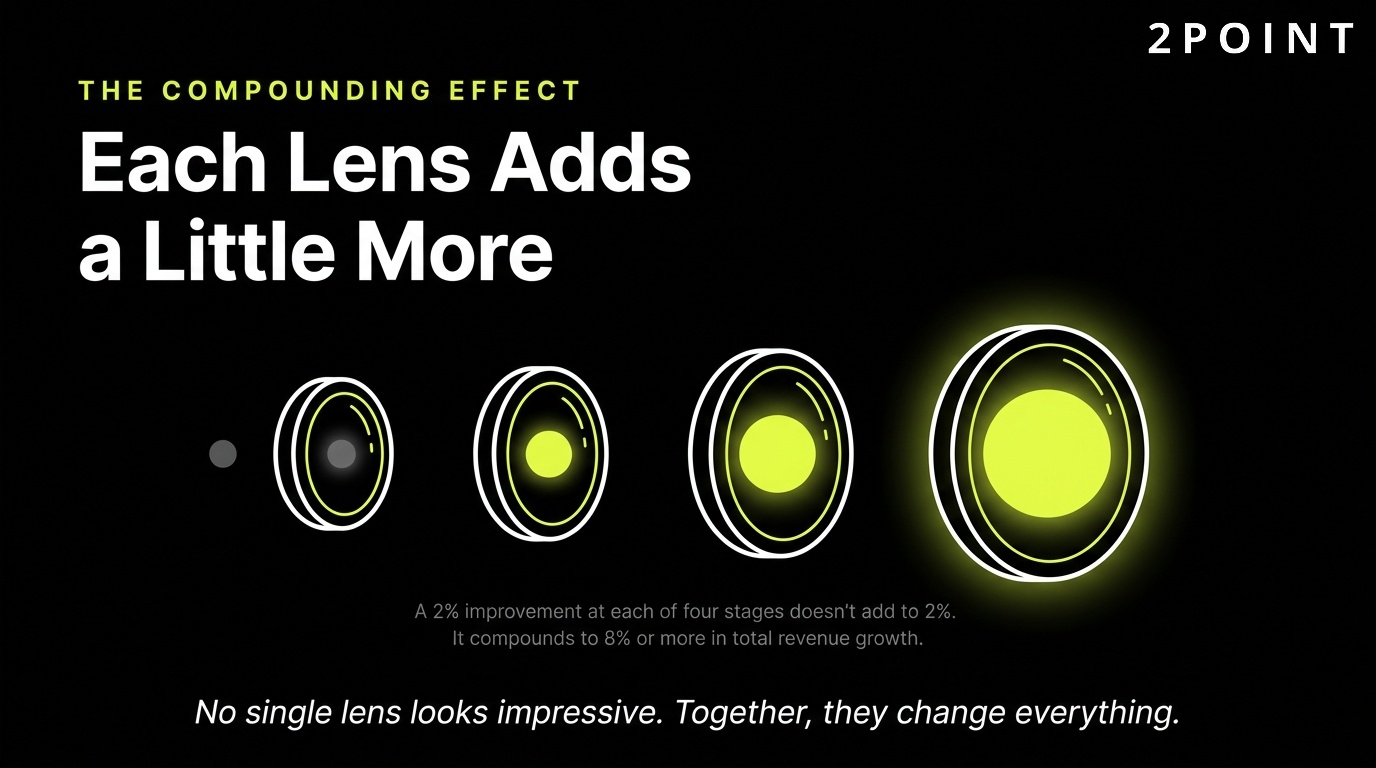
One of the most motivating realities of funnel optimization is that small, incremental improvements at each stage do not add together linearly. They compound. A 2% improvement at each of four funnel stages does not produce a 2% overall revenue increase. It produces a multiplicative gain that can translate to 8% or more in total revenue growth without adding a single new visitor to the top of the funnel. This compounding dynamic is why consistent, incremental funnel optimization is one of the highest-ROI activities in any marketing program.
Consider a practical example: if your funnel converts 1,000 visitors to 50 leads and 5 sales at baseline, improving each transition by just 10% yields a materially different outcome at the bottom line. Even minor optimizations such as improving page speed, tightening follow-up sequences, or refining CTA language can double or triple conversion rates at specific stages. When these improvements are stacked across multiple stages, the total impact far exceeds what any single campaign or channel investment could achieve.
The organizations that harness this compounding effect are those that treat optimization as an ongoing operational discipline rather than a periodic project. Monthly funnel optimization drives 15 to 50% year-over-year growth compared to organizations that only review their funnels quarterly or annually. The gap is not explained by effort alone. It is explained by the accumulated advantage of dozens of small, data-validated improvements that build on each other over time. Identifying a weak digital marketing strategy early and correcting it at the funnel level is always more efficient than attempting to compensate for structural inefficiencies with increased ad spend.
How to Build a High-Converting Marketing Funnel Step by Step
Understanding marketing funnel theory is valuable. Knowing exactly how to build one that performs in the real world is what creates results. The following four-step framework provides a practical, sequential guide to constructing a high-converting funnel from the ground up, regardless of your industry, business model, or current marketing maturity.
Step 1: Define Your Target Audience and Business Goals
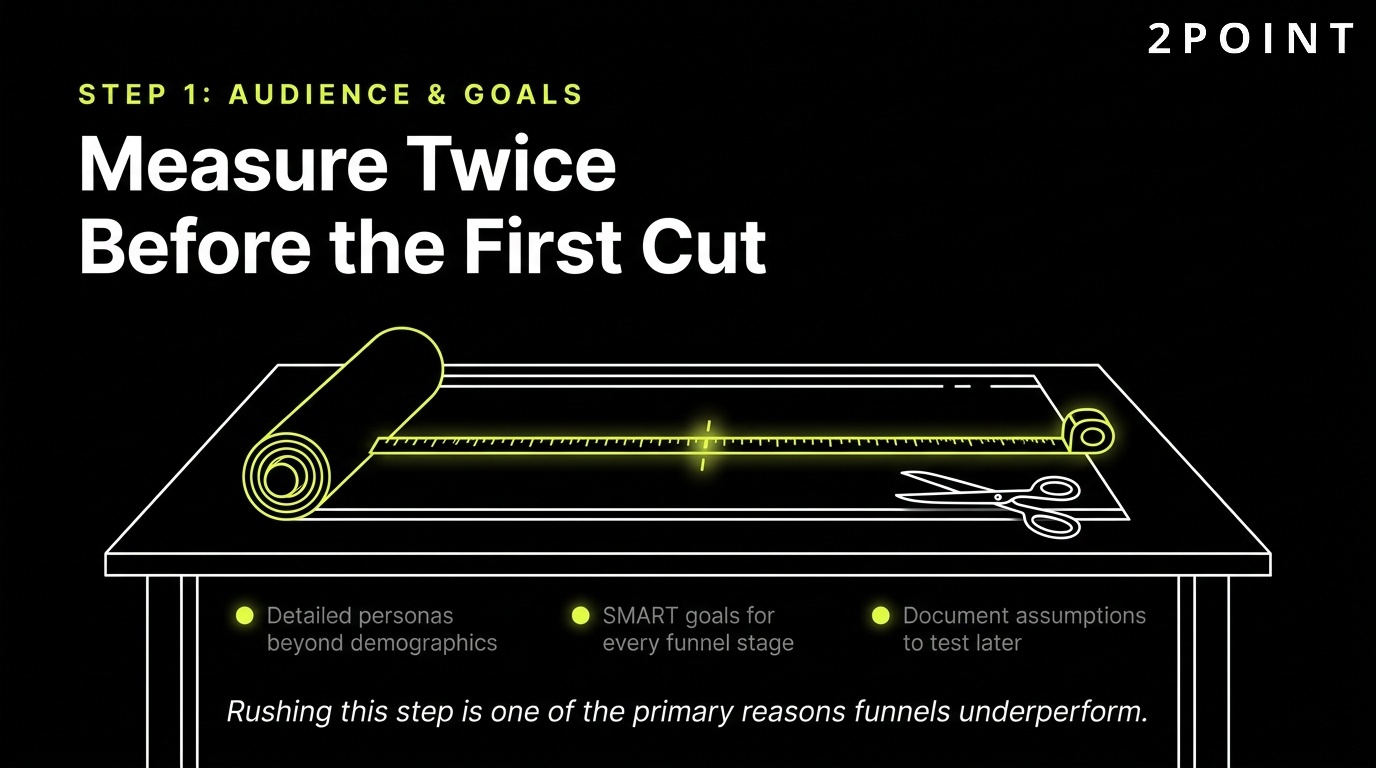
Every high-performing marketing funnel begins with clarity about two things: who you are serving and what success looks like for your business. Without this foundation, every subsequent decision, from content format to channel selection to messaging, will be made in a vacuum. Skipping or rushing this step is one of the primary reasons funnels underperform even when the tactics they deploy are technically sound.
Start by building detailed buyer personas that go well beyond basic demographics. Effective personas capture the specific pain points your ideal customers experience, the goals they are trying to achieve, the objections they have to solutions like yours, and the information sources they trust. Customer interviews are the most reliable source for this information. Supplementing interviews with analysis of your existing customer data, identifying behavioral patterns, purchase triggers, and retention drivers, gives you a three-dimensional view of the person you are building your funnel for.
Once your audience is defined, set SMART goals for each funnel stage. This means establishing specific conversion targets, for example targeting a 40% TOFU-to-MOFU transition rate and a 25% MOFU-to-BOFU transition rate, and aligning these stage-level goals with your overarching business objectives around revenue, market share, and customer acquisition. Document your assumptions explicitly, because you will need to test and refine them as real-world data accumulates. A well-defined personalized marketing strategy built around a precisely defined audience will consistently outperform a generic one aimed at everyone.
Step 2: Map the Customer Journey and Touchpoints
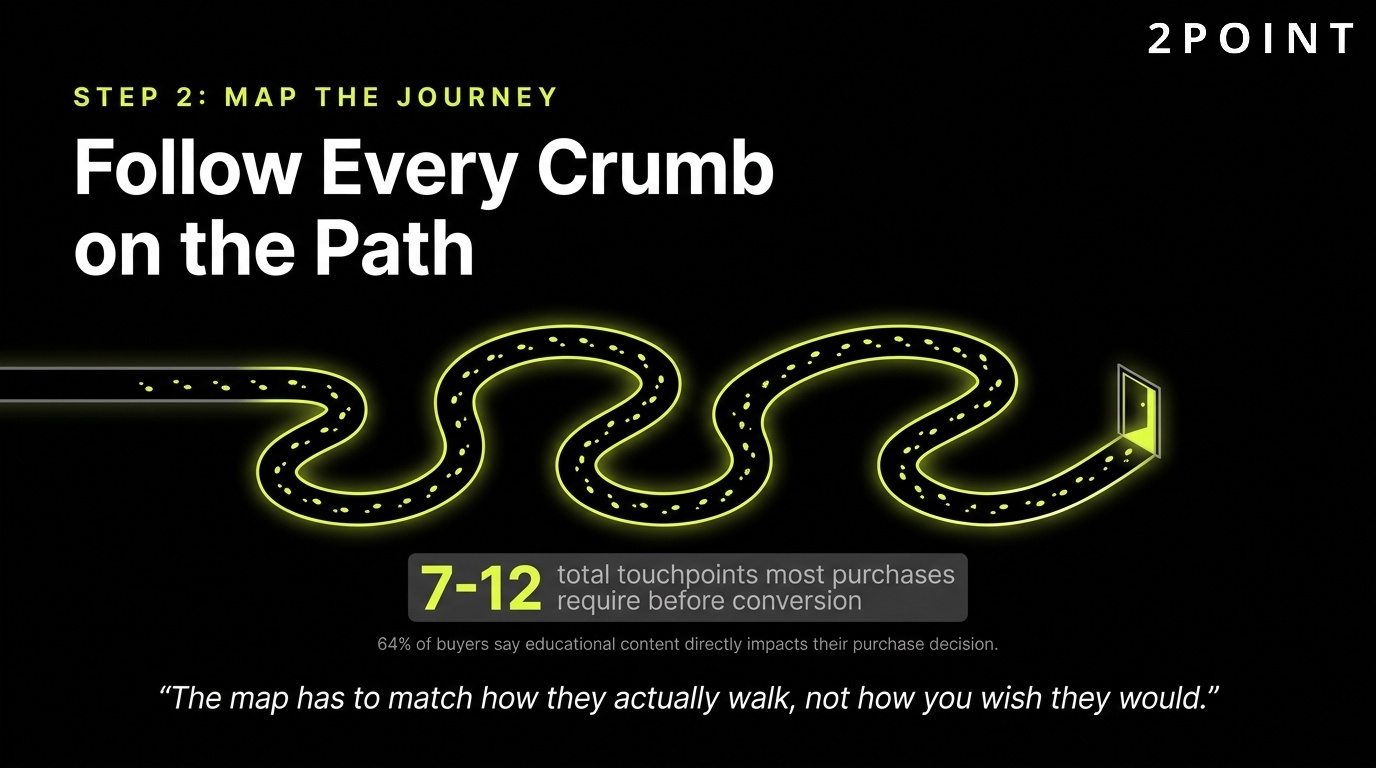
With your audience and goals defined, the next step is mapping every touchpoint where prospects interact with your brand throughout their buying journey. This exercise is frequently underestimated in its value. Most organizations know their primary acquisition channels but have a poor understanding of how prospects actually move through the full journey, which channels they encounter at different stages, and where the journey breaks down.
Effective journey mapping identifies every interaction point across four distinct stages: Awareness, Interest and Consideration, Decision and Conversion, and Loyalty and Advocacy. For each stage, document which channels are driving engagement, what content prospects are consuming, and where they are most frequently stalling or disengaging. Recognize from the outset that buyer journeys are rarely linear. A prospect might enter at MOFU through a Google search, move up to TOFU by sharing your content socially, return at BOFU weeks later through a retargeting ad, and then convert. Most purchases occur after seven to twelve total brand touchpoints, which means your funnel needs to be present and consistent across a significant number of interactions before expecting conversion.
The customer journey map also reveals where your current funnel is failing. Look for stages with disproportionately high drop-off rates, channels that attract high volumes of traffic but low engagement quality, and gaps between content you are producing and questions your prospects are actually asking. 64% of buyers say that educational content directly impacts their purchase decisions, which means that gaps in your content coverage at critical journey stages are directly costing you conversions. Use this map as the architectural blueprint for your funnel build.
Step 3: Create Stage-Specific Content and Offers
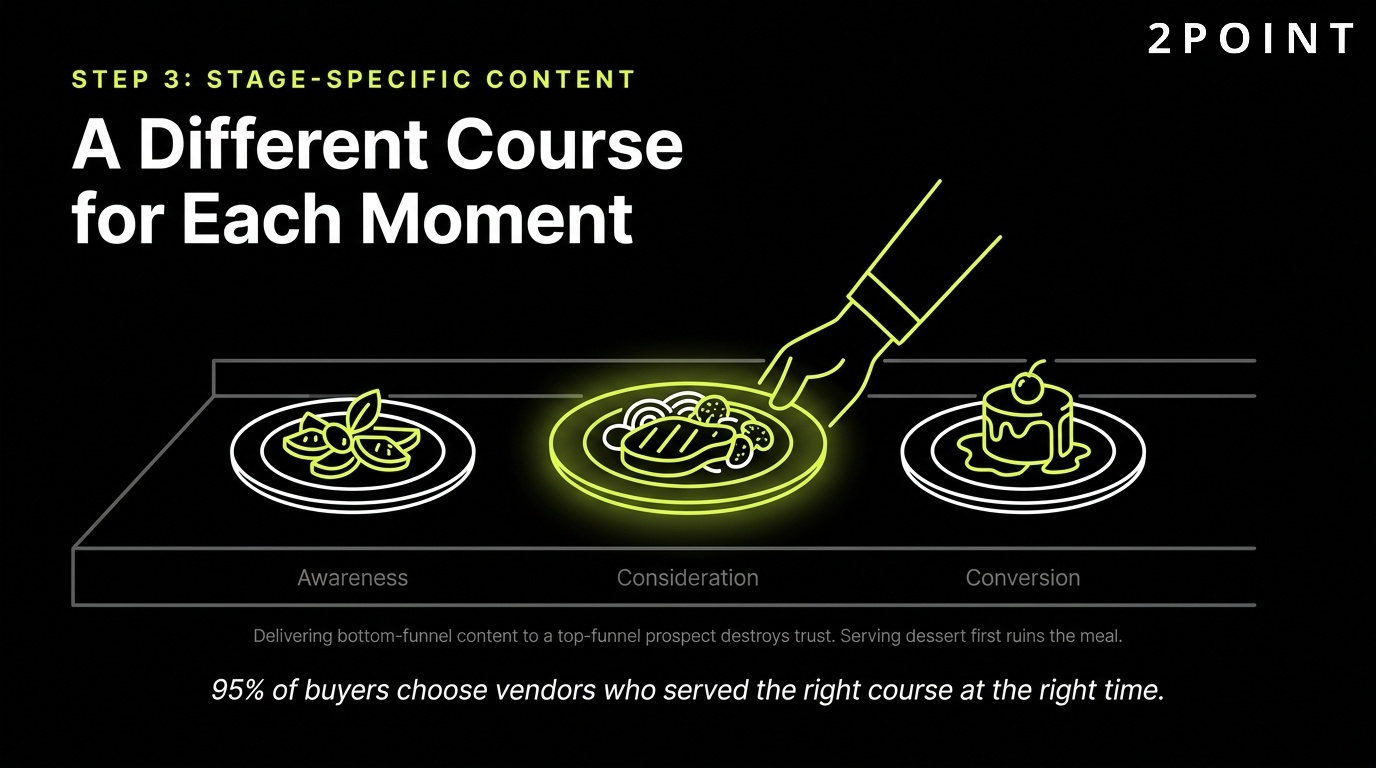
Funnel content is not a one-size-fits-all proposition. Each stage of the marketing funnel requires a different content type, a different message, and a different call to action because the buyer's psychological state and information needs are fundamentally different at each stage. Delivering bottom-of-funnel content to top-of-funnel prospects destroys trust and kills engagement. Delivering top-of-funnel educational content to conversion-ready prospects creates frustrating delays. Stage-specific content is what keeps prospects moving forward at the right pace.
The following table outlines the most effective content types and offers for each funnel stage, based on current performance data.
| Funnel Stage | Most Effective Content Types | Primary Goal of Content |
|---|---|---|
| Awareness (TOFU) | Blog posts, short-form video, social content, podcasts, SEO-optimized guides, infographics | Generate attention and attract new audiences to your brand |
| Consideration (MOFU) | Email sequences, webinars, in-depth case studies, comparison pages, downloadable guides, product overviews | Build trust, educate, and differentiate from competitors |
| Conversion (BOFU) | Product demos, free trials, testimonials, ROI calculators, limited-time offers, consultations | Eliminate objections and create a clear path to purchase |
| Loyalty | Onboarding sequences, how-to video content, exclusive resources, personalized check-ins | Maximize product adoption and customer satisfaction |
| Advocacy | Referral program assets, co-created content, community invitations, case study features | Turn satisfied customers into active brand promoters |
Stage-specific content alignment is the single most effective way to reduce drop-off at each funnel transition and accelerate the buyer's progression from awareness to conversion. 95% of buyers choose vendors who provided sufficient helpful content at each stage of their journey, and comparison pages specifically reduce funnel drop-off by 17%. Investing in high-quality content marketing across all stages of the funnel is one of the most reliable ways to build compounding organic growth over time.
Step 4: Implement Tracking, Automation, and Optimization Systems
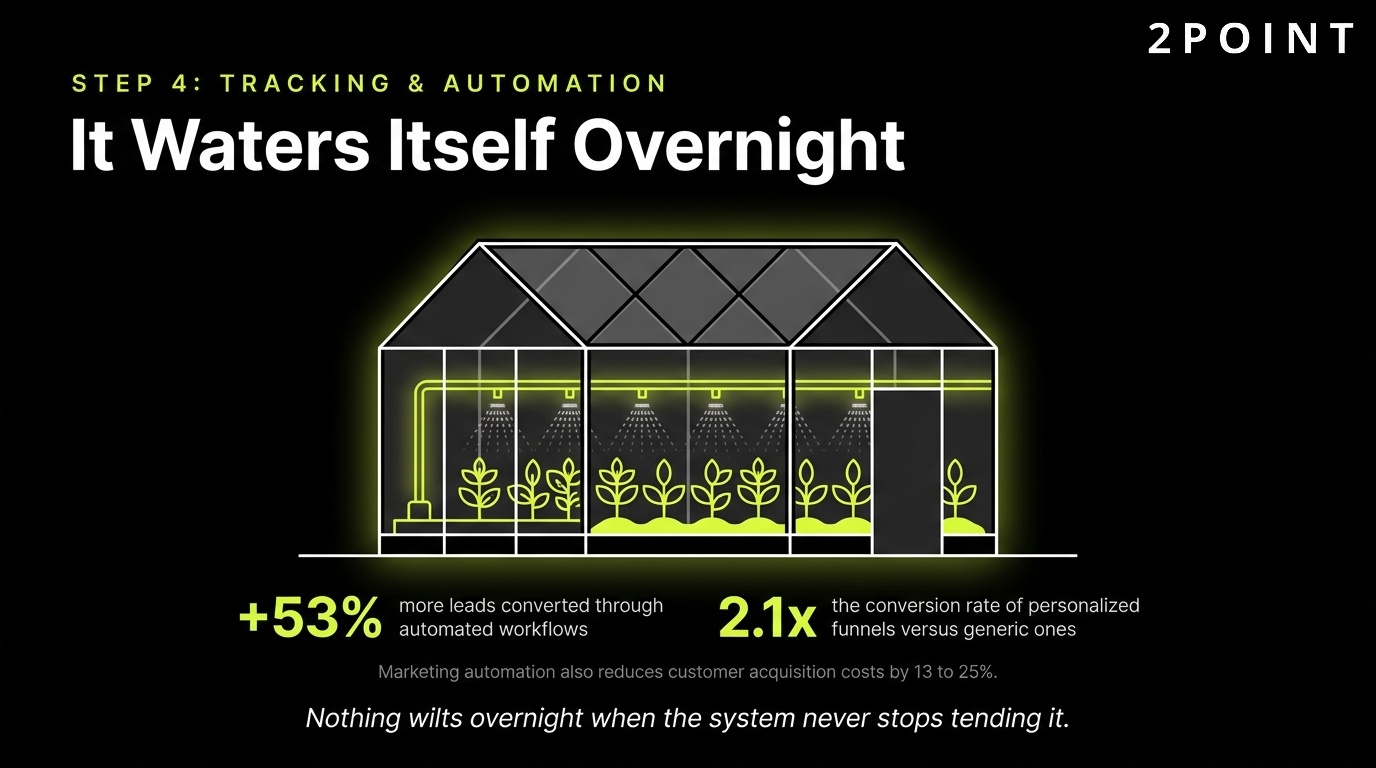
The fourth and final step in building your funnel is putting the operational infrastructure in place that allows it to run efficiently, improve continuously, and scale without requiring proportional increases in manual effort. This means implementing the right analytics tools, building automation workflows, establishing lead scoring systems, and creating the feedback loops that drive ongoing optimization.
Begin with tracking. Install GA4, connect your CRM, and establish stage-specific conversion events so you can measure performance at every transition point. Then build your lead scoring model. Behavioral signals, such as pages visited, content downloaded, emails opened, and demos requested, are significantly more predictive of purchase intent than demographic data alone. Organizations that implement behavioral lead scoring see MQL-to-SQL conversion rates improve from the 13 to 15% average to the 39 to 40% range, a transformative difference in pipeline quality.
Next, implement automated nurture workflows triggered by specific prospect actions. Businesses with automated funnel workflows convert 53% more leads than those relying on manual follow-up, and marketing automation reduces customer acquisition costs by 13 to 25%. Personalized funnels convert at 2.1 times the rate of generic, non-personalized versions, making personalization a core automation objective rather than an optional enhancement. Marketing automation workflows are the operating system of a high-performing modern funnel, and investing in them early pays compounding dividends as your funnel scales.
Marketing Funnel Optimization Strategies for 2026
Building a funnel is the first step. Optimizing it into a consistently high-performing growth system is an ongoing process that separates top-performing organizations from the rest. The following strategies represent the most effective approaches to funnel optimization available in 2026, combining proven conversion principles with modern AI-powered capabilities.
Funnel Analysis: Finding and Fixing Conversion Leaks
Conversion funnel analysis is the systematic process of reviewing each funnel stage to understand how prospects are moving through it and where they are dropping out. It is the diagnostic foundation on which every meaningful optimization decision rests. Without it, teams make expensive, time-consuming changes based on assumptions rather than evidence. With it, they identify the specific points in the buyer journey where intervention will have the greatest impact and fix them in order of priority.
The process starts with identifying high drop-off points between stages. These "leaks" represent prospects who showed enough interest to enter a stage but did not receive adequate value, reassurance, or guidance to advance to the next one. Common leak locations include the gap between first website visit and email list signup, where most funnels lose 70% of all leads, and the MQL-to-SQL transition, where funnels without behavioral scoring lose up to 85% of pipeline. BOFU leaks frequently occur at checkout pages, demo request forms, and the period immediately following an initial sales conversation.
Once leaks are identified, use session replay tools and heatmaps to understand the behavioral dynamics behind the drop-off. Often, the problem is a specific page element: a confusing form, a slow-loading section, an unclear value proposition, or a CTA that does not match the intent of the visitor. Prioritize fixes based on the combination of drop-off rate and the revenue value of that stage. A 5% improvement at a high-volume, high-value stage will always outperform a 20% improvement at a low-volume early stage. Fixing a weak digital marketing strategy at the structural level through funnel analysis is always more effective than attempting to patch it with increased advertising spend.
The Speed-of-Follow-Up Advantage in Funnel Conversion
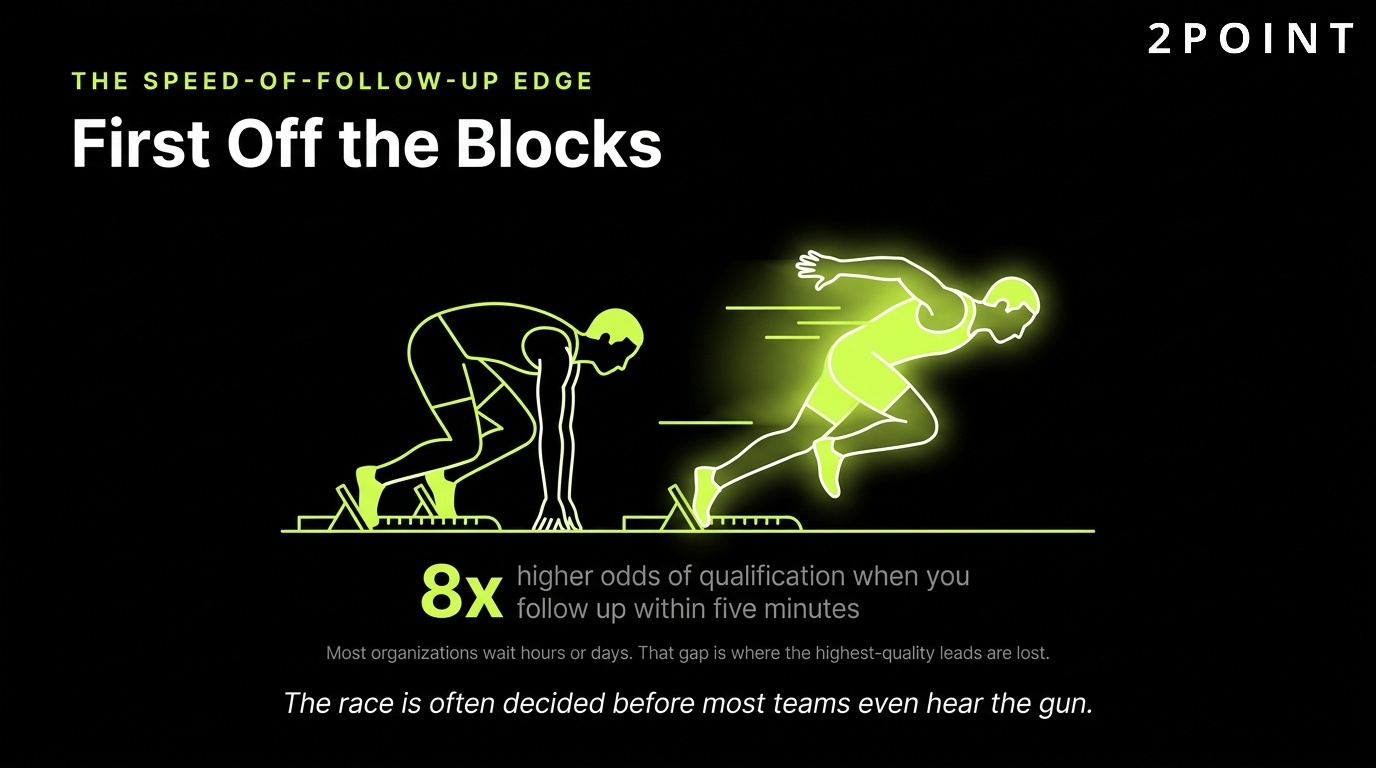
Among all the optimization levers available in a modern marketing funnel, speed of follow-up is consistently among the most impactful and most neglected. The data on this point is striking: following up with a high-intent lead within five minutes of their action increases the odds of qualification by eight times compared to waiting even an hour. Most organizations wait hours or days to follow up, which means they are losing the vast majority of their highest-quality conversion opportunities to competitors who are faster or to simple prospect disengagement.
Implementing speed-of-follow-up improvements requires both automation and process design. For leads who take high-intent actions such as requesting a demo, starting a free trial, or visiting a pricing page, automated instant responses, whether via email, SMS, or chatbot, should be the immediate first response. These automated touchpoints acknowledge the action, provide relevant information, and bridge the gap while a human follow-up is prepared. For the highest-value leads, human outreach within the five-minute window is the gold standard.
The persistence dimension of follow-up matters as much as speed. 40% of prospects require three to five touchpoints before advancing to the next funnel stage, and most purchases occur after seven to twelve total brand interactions. A single fast follow-up is not enough. The winning formula is speed combined with a structured multi-touch nurture sequence that provides consistent value at each contact without becoming intrusive. Pairing this approach with marketing automation workflows ensures that no lead falls through the cracks regardless of team capacity or time zones.
Personalization and AI-Powered Funnel Optimization
Personalization has moved from a nice-to-have feature to a measurable competitive requirement. Personalized funnels convert at 2.1 times the rate of generic, non-personalized versions, and AI tools now make sophisticated personalization achievable without the prohibitive manual effort it once required. In 2026, AI-powered personalization is the standard operating procedure for high-performing marketing funnels, not an advanced technique reserved for enterprise organizations.
The practical applications of AI in funnel personalization are broad and growing. Dynamic landing pages that adapt their content, offer, and CTA based on a visitor's traffic source, industry, or previous behavior deliver dramatically higher conversion rates than static pages. Personalized email sequences that respond to the specific content a prospect has consumed, rather than following a fixed schedule, maintain engagement by remaining contextually relevant. AI-driven product and content recommendations based on browsing behavior guide prospects toward the information and offers most likely to advance them in the funnel. AI tools reduce customer acquisition costs by up to 60% for organizations that implement them at scale, creating a sustainable structural advantage over competitors still relying on manual campaign management.
The foundation for effective AI personalization is first-party data. As privacy regulations tighten and third-party cookies become increasingly unreliable, organizations that have built robust first-party data assets, email lists, CRM records, behavioral event data, and direct customer relationships, are positioned to personalize more effectively and more compliantly than those dependent on external data sources. Building a robust first-party data strategy is not just a privacy compliance initiative. It is a direct investment in funnel performance. Combining this with a well-developed personalized marketing strategy creates a compounding advantage as your data asset grows over time.
A/B Testing and Continuous Funnel Experimentation
Continuous optimization through structured A/B testing is one of the most reliable ways to improve funnel performance over time. Unlike one-time redesigns or periodic overhauls, a culture of continuous experimentation ensures that your funnel is always improving, always incorporating new learnings, and always moving toward higher performance based on real-world evidence. The organizations that excel at this practice do not have extraordinary marketing talent. They have disciplined testing processes that accumulate small wins into large advantages.
The principles of effective A/B testing in a funnel context are straightforward. Test one variable at a time so that results can be clearly attributed to specific changes. Run tests until statistical significance is achieved, which typically requires at least 100 conversions per variant to produce reliable conclusions. Document every test rigorously, including the hypothesis, the result, the interpretation, and the decision made. Build testing into your regular operational workflow rather than treating it as a periodic initiative.
The highest-impact variables to test in most funnels include CTA language, headline framing, offer type (free trial versus demo versus consultation), form field count, social proof placement and format, landing page layout, and page load speed. Even seemingly minor changes can produce significant results. The 28% conversion improvement from changing "Contact us" to "Book a call" is a perfect example of how a single word change can materially impact revenue. The testing framework is straightforward: hypothesis, design variants, run the test, analyze the results, implement the winner, and repeat. Organizations that execute this cycle consistently across their funnel will see compounding improvements that are difficult for competitors to replicate quickly. This kind of systematic testing is a core element of what 2POINT helps clients implement when building and refining their full-funnel marketing systems.
Top Trends Shaping Marketing Funnels in 2026
The marketing funnel landscape is evolving rapidly. New technologies, shifting buyer behaviors, regulatory changes, and emerging channel dynamics are reshaping how funnels are built, managed, and optimized. The organizations that adapt to these trends early will build structural advantages. Those that ignore them will find their funnels delivering diminishing returns as the market moves on without them.
AI and Answer Engine Optimization in the Modern Marketing Funnel
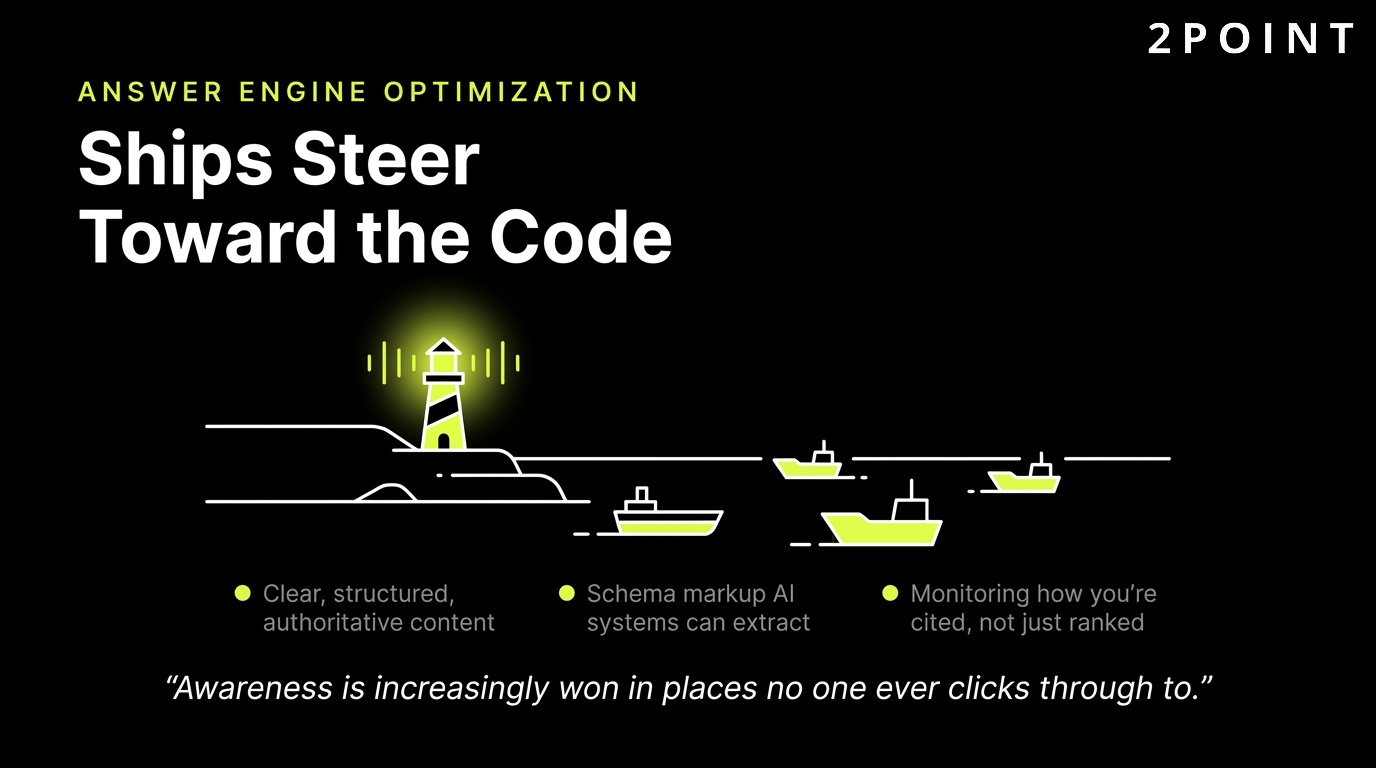
Answer Engine Optimization, or AEO, has emerged as one of the most significant shifts in funnel strategy for 2026. Buyers are increasingly beginning their research journeys not on Google but on AI platforms like ChatGPT, Gemini, and Perplexity. These tools synthesize answers from across the web, presenting information without requiring users to click through to source websites. For marketers, this means that a growing proportion of TOFU discovery is happening in environments where traditional SEO visibility does not apply.
AEO involves structuring and optimizing content so that it is consistently referenced and cited by AI systems when answering questions relevant to your brand's expertise. This means prioritizing clear, well-organized, authoritative content with explicit answers to common questions. It means using structured data and schema markup to help AI systems understand and extract your content. And it means monitoring brand mentions in AI-generated responses to understand how your organization is being represented in these new discovery environments. AI visibility and AEO are among the top priorities for B2B funnel marketers in 2026, making it a non-optional consideration for any organization building a modern awareness strategy.
The practical implication for funnel strategy is that TOFU investment must now include both traditional SEO and AEO as parallel tracks. Content that ranks well organically and is also cited by AI platforms creates maximum awareness coverage across the full spectrum of how buyers conduct research today. This dual approach is becoming the new baseline for competitive awareness-stage marketing, and organizations that build it early will compound their visibility advantages as AI-driven search continues to capture a larger share of the research journey. Understanding current video marketing trends is equally important, as video remains a dominant format for TOFU engagement across both traditional and AI-powered platforms.
First-Party Data and Privacy-First Marketing Funnel Strategy
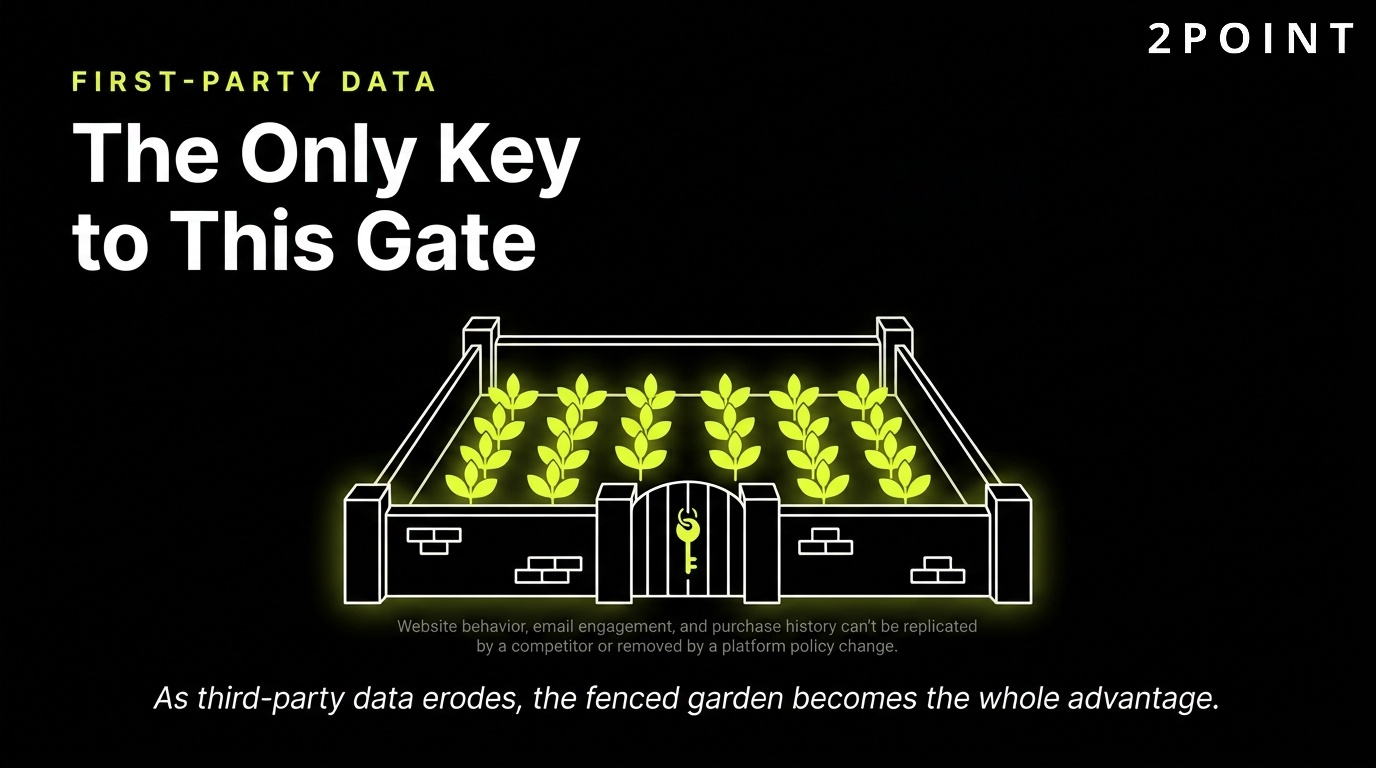
First-party data has become the single most important asset in modern marketing funnel management. As global privacy regulations tighten and third-party cookies lose reliability, the organizations with rich, consented, direct-relationship data are the ones with the deepest personalization capabilities and the strongest targeting precision. Building a first-party data strategy is no longer a future consideration. It is an immediate operational priority.
First-party data is information collected directly from your audience through their interactions with your owned channels, including website behavior tracked in your CRM, email engagement data, purchase history, product usage patterns, survey responses, and community participation. This data is accurate, relevant, privacy-compliant, and uniquely owned by your organization. It cannot be replicated by competitors or stripped away by platform policy changes. This gives it a durability that third-party data has never had.
In funnel terms, first-party data enables significantly more precise segmentation, more relevant content delivery, and more accurate lead scoring than any external data source can provide. A prospect's actual behavior on your website, the specific pages they visited, the content they downloaded, the emails they opened, tells you far more about their intent and stage than any demographic profile. Funnels built on first-party behavioral data consistently outperform those relying on broad audience targeting, and the gap will widen as privacy regulations continue to restrict third-party data usage. Organizations investing in digital marketing capabilities built around first-party data are positioning themselves for long-term competitive resilience. Coupling first-party data with robust inbound marketing strategies creates a sustainable pipeline of consented, engaged prospects who have actively chosen to enter your funnel.
How Video Marketing Is Reshaping Funnel Engagement
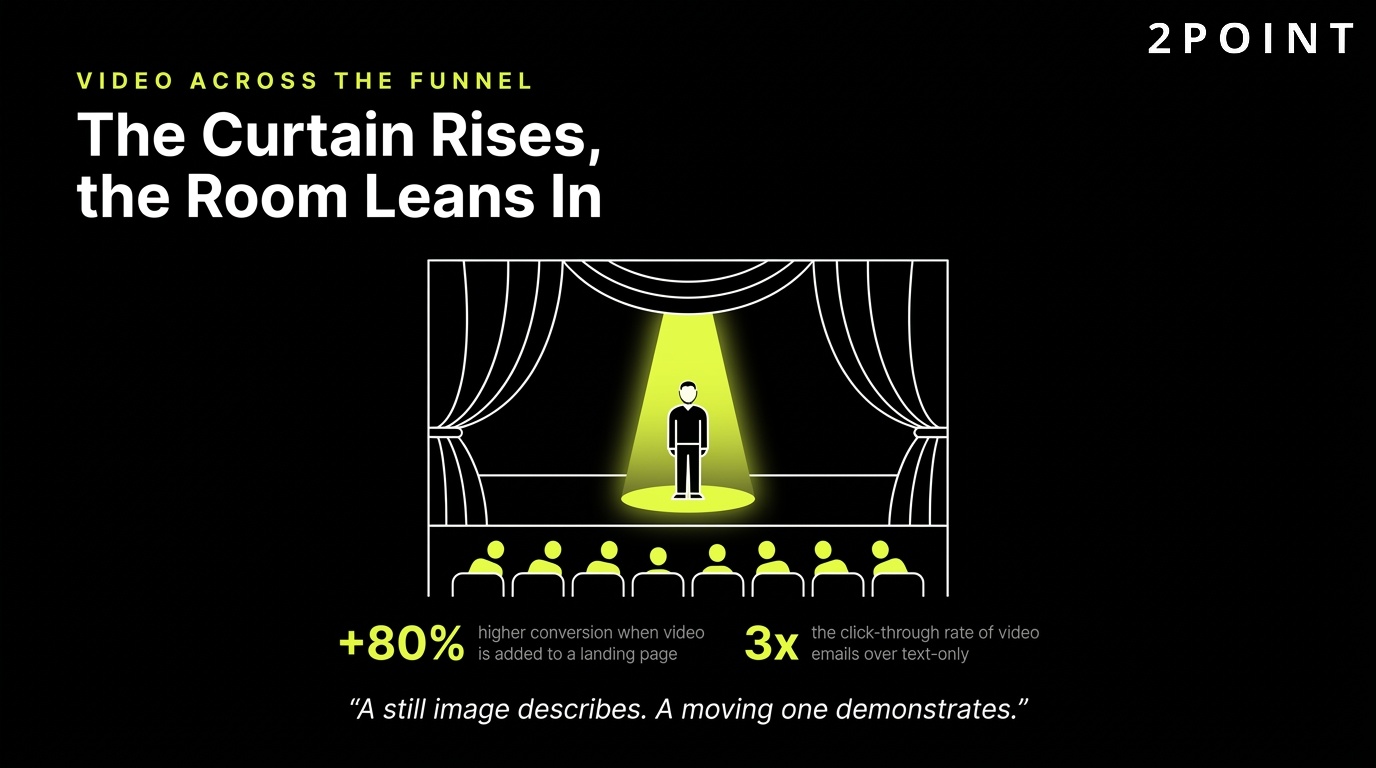
Video has established itself as the dominant content format across multiple funnel stages, and its influence is only expanding in 2026. At the awareness stage, short-form video on platforms like Instagram Reels, TikTok, and YouTube Shorts delivers brand reach at a scale and cost that text-based content rarely matches. At the consideration stage, longer-form video content including webinars, product walkthroughs, and founder story videos builds the trust and depth of understanding that moves prospects toward conversion decisions. At the conversion stage, video testimonials and case study presentations provide the social proof that closes deals.
The data on video in funnel contexts is compelling. Video on landing pages increases conversion rates by up to 80% in some studies. Video emails generate three times the click-through rates of text-only emails. Short-form video is the leading content format for generating initial brand awareness among audiences under 45, a demographic that represents a growing share of B2B purchase decision-makers. Video is not a single-stage tactic. It is a cross-funnel format that can serve every stage with the right production approach and messaging focus.
The key to effective video across the funnel is tailoring both format and content to the stage. TOFU videos should be short, immediately engaging, and awareness-focused, requiring no prior knowledge of your brand. MOFU videos can be longer, more educational, and more specific to your solution's capabilities and differentiation. BOFU videos should feature customer success stories, specific ROI outcomes, and clear calls to action. The organizations investing in social media marketing that includes a structured video content strategy across funnel stages are capturing engagement that purely text-based competitors are leaving on the table.
Full-Funnel Attribution and Cross-Channel Measurement
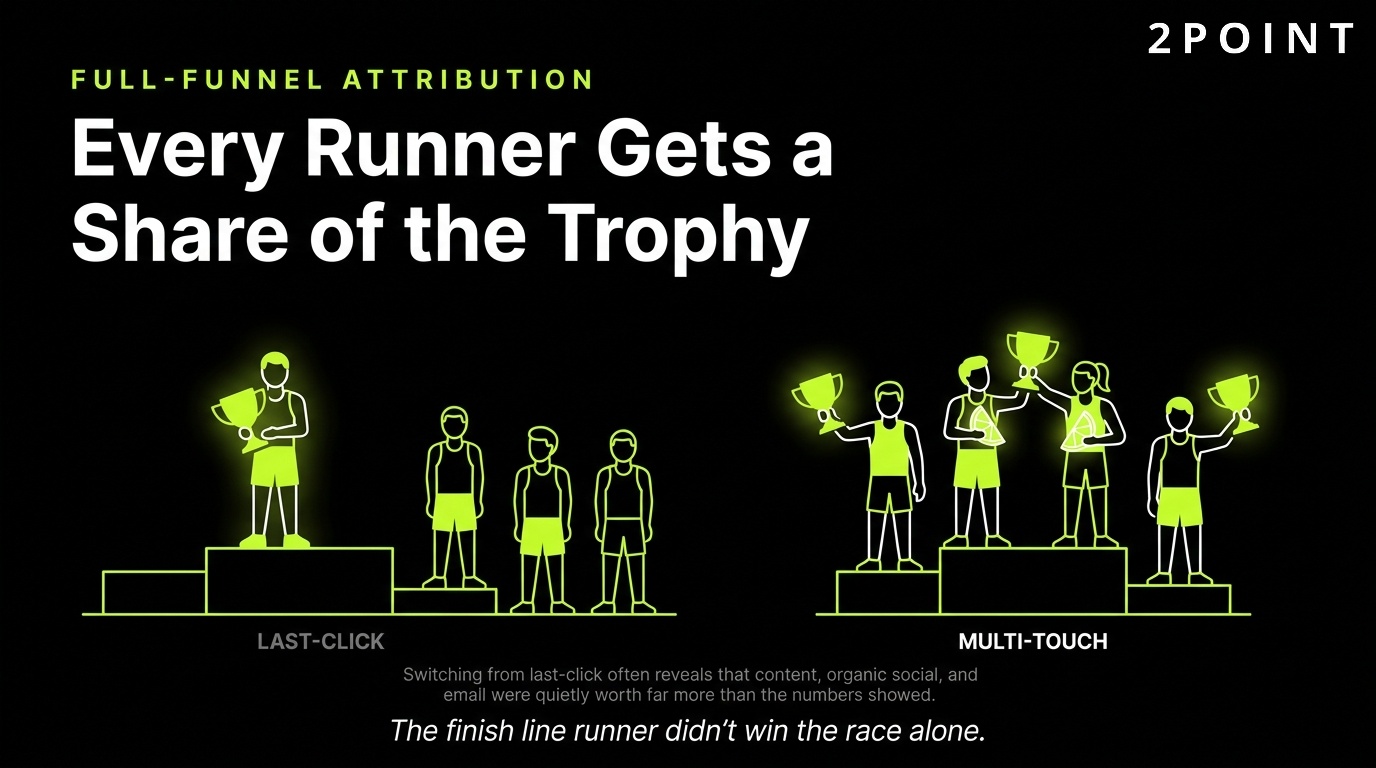
One of the persistent challenges in marketing funnel management is accurately attributing conversions to the specific touchpoints and channels that contributed to them. Traditional last-click attribution, which credits the final interaction before a conversion with 100% of the value, dramatically undervalues awareness and consideration-stage investments. This attribution distortion leads to systematic underfunding of the channels that build pipeline and systematic overfunding of the channels that happen to be present at the moment of conversion.
Full-funnel attribution models, including linear attribution, time-decay attribution, and data-driven attribution powered by machine learning, distribute credit across all touchpoints that contributed to a conversion. This creates a much more accurate picture of which funnel investments are generating real value and which are simply present at the end of journeys that other channels initiated. In practice, organizations that switch from last-click to multi-touch attribution models typically discover that their content marketing, organic social, and email programs are significantly more valuable than their last-click data suggested.
The practical implementation of full-funnel attribution requires connecting your analytics platforms, CRM, and advertising accounts through a unified data layer. Google Analytics 4's data-driven attribution model is a strong starting point, but for organizations with complex, multi-channel funnels, purpose-built attribution platforms that integrate data across all touchpoints provide more granular insights. Getting attribution right is not just a reporting exercise. It is a budget allocation discipline that directly determines whether your funnel investments are being distributed efficiently. A well-executed marketing mix strategy, informed by accurate attribution data, ensures that every channel in the funnel is funded appropriately based on its actual contribution to revenue.
Marketing Funnel vs. Sales Funnel: Understanding the Key Differences
The terms "marketing funnel" and "sales funnel" are used interchangeably in many contexts, but they describe distinct functions within the buyer journey. Understanding where each begins and ends, and how they connect, is essential for building aligned systems between marketing and sales teams.
| Dimension | Marketing Funnel | Sales Funnel |
|---|---|---|
| Primary owner | Marketing team | Sales team |
| Starting point | First brand awareness moment | First sales qualification conversation |
| Primary focus | Generating awareness, interest, and qualified leads | Converting qualified leads to closed deals |
| Key stages | Awareness, Consideration, Lead Generation | Qualification, Proposal, Negotiation, Close |
| Primary metrics | Reach, engagement, MQL volume, lead quality | SQL volume, conversion rate, deal size, close rate |
| Content role | Drives awareness and nurtures prospects to sales readiness | Supports objection handling and final decision-making |
| Post-purchase role | Manages loyalty and advocacy stages | Handles upsells, renewals, and account expansion |
The most effective organizations treat the marketing funnel and sales funnel as two interconnected systems within a single revenue architecture, with clear handoff criteria and shared data ensuring consistent performance across the full buyer journey. The distinction between B2B marketing and B2C funnels is also important here, as the sales funnel in B2B contexts tends to be longer, involve more decision-makers, and require more structured nurturing than in direct-to-consumer contexts.
Common Marketing Funnel Mistakes and How to Avoid Them
Even well-intentioned funnel strategies fail when specific structural and tactical mistakes are made. The following mistakes represent the most common and costly errors organizations make when building and managing their marketing funnels in 2026.
Neglecting the Middle of the Funnel
The MOFU stage is the most chronically underinvested part of the marketing funnel. Organizations tend to invest heavily in TOFU awareness campaigns to drive traffic and in BOFU tactics to close deals, but they neglect the consideration stage where prospects are actively evaluating their options and deciding whether to trust your brand. This creates a hollow funnel: lots of traffic entering at the top, very little making it to conversion because there is insufficient nurturing in the middle to maintain engagement and build the trust required for purchase decisions.
The fix is straightforward but requires sustained commitment. Build a robust MOFU content library that addresses the specific questions, objections, and evaluation criteria your prospects encounter during the consideration stage. Implement email nurture sequences that deliver this content progressively based on prospect behavior. Create comparison content that helps prospects understand how your solution differs from alternatives. MOFU investment consistently produces some of the highest ROI in the full funnel because it acts as a multiplier on both TOFU and BOFU performance.
Treating the Funnel as a Linear Path
Designing a funnel that assumes all prospects follow a rigid, sequential path from awareness to conversion is one of the most common architectural mistakes in modern funnel building. Real buyer journeys are non-linear. Prospects jump between stages, revisit earlier content after considering conversion, enter the funnel at different stages depending on how they discovered your brand, and exit and re-enter over extended time periods. A funnel that cannot accommodate this behavior will lose large numbers of prospects who simply do not fit the assumed linear model.
Building flexibility into your funnel means creating re-entry points for prospects who disengage and later return, designing content that serves multiple stages simultaneously, and avoiding hard-coded sequences that cannot adapt to prospect behavior. It also means investing in retargeting campaigns that can re-engage prospects who left the funnel at any stage, since these campaigns consistently deliver some of the highest conversion rates available in paid digital advertising. A funnel designed for real, non-linear buyer behavior will always outperform one designed for an idealized linear model that rarely occurs in practice.
Ignoring Post-Purchase Funnel Stages
Treating the conversion event as the end of the marketing funnel is a strategic error that leaves a substantial portion of potential revenue unrealized. For businesses with any meaningful customer lifetime value, the post-purchase stages of the funnel, loyalty and advocacy, represent the highest-return investment available. Existing customers require significantly less marketing investment to generate repeat revenue than new customer acquisition, and satisfied customers who become advocates generate referrals that reduce overall acquisition costs for the entire funnel.
The organizations that maximize total funnel revenue are those that invest in post-purchase experiences with the same intentionality they apply to the pre-purchase stages. This means structured onboarding programs, personalized retention communications, loyalty rewards that create genuine value, and advocacy programs that make it easy and rewarding for happy customers to refer others. With 70 to 95% of revenue coming from upsells and renewals in many business models, ignoring the back end of the funnel is not just a missed opportunity. It is a structural constraint on total revenue potential.
Building Without Measurement Systems
A marketing funnel built without proper measurement infrastructure is essentially being managed blindly. Without stage-to-stage conversion tracking, marketers have no reliable way to know where their funnel is performing well, where it is leaking, or whether any given optimization effort is producing results. The result is often a cycle of expensive, time-consuming changes that may or may not be addressing the actual bottlenecks in the funnel.
Implementing measurement systems before launching or scaling a funnel is not a technical nicety. It is a foundational operational requirement. This means setting up conversion events at every funnel stage transition, connecting your CRM to your analytics platforms, establishing baseline performance data against which improvements can be measured, and building reporting dashboards that give every relevant team member visibility into the numbers that matter for their work. With 68% of companies still not having identified or measured their sales funnel, implementing even basic measurement systems creates immediate competitive advantage. The marketing automation software required to support these measurement systems is more accessible and more affordable than ever, removing the technical barriers that once made this level of sophistication impractical for smaller organizations.
Marketing Funnel Examples Across Different Business Models
Understanding how the marketing funnel adapts across different business contexts helps teams apply the framework to their specific situation more effectively. The funnel's core stages remain consistent, but the tactics, content types, conversion mechanisms, and measurement priorities vary significantly based on business model, transaction value, and buyer complexity.
B2B SaaS Marketing Funnel Structure
B2B SaaS funnels are typically longer, involve multiple stakeholders, and require significantly more MOFU nurturing than consumer-focused funnels. The TOFU stage relies heavily on SEO-driven content marketing, LinkedIn advertising, and thought leadership to reach decision-makers and generate initial interest. The MOFU stage is where B2B SaaS funnels are most differentiated from other models: prospects evaluate multiple vendors over weeks or months, requiring a sustained nurture program that addresses evolving concerns, builds credibility, and consistently demonstrates product value.
Free trials and product demos are the primary BOFU conversion mechanisms in B2B SaaS, and both are highly effective when deployed correctly. The post-purchase stage in SaaS is arguably the most critical, since customer retention directly determines whether a subscription-based business is generating sustainable revenue or constantly fighting churn. Investment in customer success, onboarding programs, and proactive engagement is the difference between a SaaS funnel that generates predictable recurring revenue and one that requires constant high-cost new customer acquisition just to maintain flat revenue. Implementing CRM tools in marketing effectively is especially critical in B2B SaaS, where managing complex multi-stakeholder relationships over long sales cycles requires organized, systematic data management.
E-Commerce Marketing Funnel Structure
E-commerce funnels are typically shorter and more transactional than B2B funnels, but they require equal sophistication in their design and execution. The TOFU stage relies on a combination of paid social advertising, influencer partnerships, organic search, and content marketing to drive initial product discovery. The MOFU stage is compressed compared to B2B contexts, often consisting of just one or two touchpoints such as a product page visit, an abandoned cart sequence, or a retargeting ad.
BOFU optimization in e-commerce focuses on reducing friction at the checkout stage, since cart abandonment rates average between 65 and 80% depending on the industry. Social proof elements like product reviews, user-generated content, and trust signals are particularly impactful at BOFU in e-commerce contexts. Post-purchase, the e-commerce funnel focuses on driving repeat purchases, increasing average order value through cross-sell and upsell sequences, and generating the user-generated content and reviews that fuel future TOFU discovery. A well-designed mobile-friendly marketing experience is especially critical for e-commerce funnels, since a significant proportion of purchases occur on mobile devices where poor user experience directly destroys conversion rates.
Service Business Marketing Funnel Structure
Service businesses, including agencies, consultancies, professional services firms, and local service providers, operate funnels that blend B2B complexity with high levels of relationship-driven trust building. The TOFU stage typically combines local SEO, content marketing, social proof (Google reviews, testimonials), and referral generation to build initial awareness. Because service purchases are high-involvement and trust-intensive, MOFU nurturing is especially critical: prospects need substantial evidence of expertise and successful outcomes before they are willing to commit.
The primary BOFU mechanism for most service businesses is the consultation or discovery call, which serves simultaneously as a sales qualification step and as a final opportunity to demonstrate value before the prospect makes a commitment. The quality of this conversation, its preparation, structure, and follow-up, often determines more of the final conversion outcome than any earlier funnel stage. Post-purchase, service business funnels focus intensely on client experience, outcome delivery, and referral generation, since word-of-mouth and referral channels are the most cost-efficient and highest-conversion acquisition channels available to most service businesses. Organizations like 2POINT specialize in building and optimizing these types of service-business funnels, creating integrated systems that connect awareness through advocacy in a single coherent growth architecture.
Building a Sustainable Marketing Funnel for Long-Term Growth
A high-converting marketing funnel is not a static asset. It is a living system that requires ongoing investment, iteration, and adaptation to maintain its performance as markets evolve, buyer behaviors shift, and competitive dynamics change. The organizations that sustain funnel performance over years rather than months are those that build the operational disciplines required to keep their funnels current, well-measured, and continuously improving.
Sustainability in funnel management requires four core practices. First, regular performance reviews at the stage level, at minimum monthly, to catch degradation early and identify new optimization opportunities. Second, ongoing content investment that keeps the funnel's information assets current, relevant, and competitive against the evolving landscape of buyer needs and competitor offerings. Third, technology stack maintenance, ensuring that the tools supporting the funnel are properly integrated, correctly configured, and actually generating the insights required for decision-making. Fourth, cross-functional alignment, regularly bringing together the marketing, sales, and customer success teams to review funnel performance, share learnings, and coordinate on improvements that span multiple functions.
The funnels that generate compounding returns over time are those built on these disciplines. They are not necessarily the funnels with the most sophisticated technology or the largest budgets. They are the ones managed with the most consistent attention, the clearest performance standards, and the deepest commitment to continuous improvement. The framework described throughout this guide, from initial audience definition through stage-specific content to AI-powered optimization and first-party data strategy, provides the complete blueprint for building a funnel of exactly this kind.
Conclusion: Your Marketing Funnel Is Your Growth Engine
The marketing funnel is not a relic of simpler marketing times. It is the most comprehensive, adaptable, and proven framework available for understanding and influencing the buyer journey in 2026 and beyond. When built with precision, measured with discipline, and optimized with the combination of AI-powered tools and human strategic judgment, the funnel becomes the central engine of sustainable, predictable business growth.
The evidence is clear. Companies that define their funnel stages, align content to buyer needs at each stage, implement proper measurement, and optimize continuously grow at dramatically higher rates than those that do not. The statistics cited throughout this guide, from the 79% of leads lost to poor nurturing, to the 2.1x conversion advantage of personalized funnels, to the 15 to 50% year-over-year growth differential from monthly optimization, all point to the same conclusion: the marketing funnel is not optional. It is the operational foundation that everything else in your marketing program should be built around.
Whether you are building your first funnel, rebuilding a funnel that is underperforming, or optimizing a system that is already delivering results, the principles in this guide provide a clear, actionable path forward. Start with your audience. Map the journey. Create stage-specific content. Measure everything. Optimize relentlessly. The funnel rewards consistency and commitment with compounding returns that build over time into genuine, sustainable competitive advantage.
Frequently Asked Questions About Marketing Funnels
What is a marketing funnel in simple terms?
A marketing funnel is a framework that represents the stages a prospect moves through from first learning about a brand to becoming a paying customer and, ideally, a loyal advocate. The stages typically include Awareness, Consideration, Conversion, Loyalty, and Advocacy. It is called a funnel because the number of prospects decreases at each successive stage as those who are not a fit exit the process.
How many stages does a marketing funnel have?
Most marketing funnels include four to five stages: Awareness (TOFU), Consideration (MOFU), Conversion (BOFU), Loyalty, and Advocacy. Some simplified models compress this into three stages: top, middle, and bottom of funnel. The number of stages used in practice depends on the complexity of the buyer journey and the level of granularity required for measurement and optimization.
What is the difference between a marketing funnel and a sales funnel?
A marketing funnel covers the full buyer journey from initial awareness through lead generation and into post-purchase loyalty and advocacy. A sales funnel specifically covers the portion of the journey managed by the sales team, beginning at lead qualification and ending at deal close. The marketing funnel is broader in scope, and the sales funnel is a subset of it focused on the conversion stages.
Why do most leads fail to convert in a marketing funnel?
79% of leads never convert to a sale primarily due to inadequate nurturing at the consideration stage of the funnel. Prospects need multiple touchpoints, consistent relevant content, and timely follow-up to move through the evaluation process. Most funnels lose the majority of prospects between the first interaction and email signup, and many more are lost between consideration and conversion due to insufficient trust-building content and slow follow-up.
What is a good conversion rate for a marketing funnel?
A healthy overall marketing funnel conversion rate falls between 3.1 and 5% for most online businesses, though this varies significantly by industry, price point, and business model. High-performing funnels with strong personalization and behavioral lead scoring can achieve substantially higher rates at specific stage transitions. The most meaningful benchmark is improvement relative to your own baseline rather than comparison to broad industry averages.
How does marketing funnel optimization work?
Marketing funnel optimization involves systematically analyzing stage-to-stage conversion rates to identify where prospects are dropping out, then implementing targeted improvements at those leak points. Common optimization methods include A/B testing of CTAs and landing pages, improving follow-up speed, personalizing content based on behavioral data, and streamlining conversion paths to reduce friction. The process is continuous rather than one-time, with monthly optimization generating 15 to 50% greater year-over-year growth compared to infrequent reviews.
What is the role of content marketing in a marketing funnel?
Content marketing serves every stage of the marketing funnel by providing the information, education, and social proof that buyers need to advance toward a purchase decision. At TOFU, content drives awareness and initial engagement. At MOFU, it builds trust and differentiates the brand from competitors. At BOFU, it provides the final reassurance through case studies and testimonials. Content marketing generates three times more leads than outbound advertising while building long-term organic visibility that compounds over time.
How does AI affect marketing funnel strategy in 2026?
AI impacts marketing funnels at multiple levels in 2026, including content personalization, predictive lead scoring, automated nurture workflows, Answer Engine Optimization for AI-driven search platforms, and customer acquisition cost reduction of up to 60% at scale. AI enables personalized funnels that convert at 2.1 times the rate of generic versions and allows small teams to execute funnel complexity that previously required large marketing departments. First-party data is the essential fuel for effective AI personalization.
What is Answer Engine Optimization and how does it fit into the marketing funnel?
Answer Engine Optimization (AEO) is the practice of structuring content so that AI platforms like ChatGPT, Gemini, and Perplexity reference and cite it when answering user questions. In funnel terms, AEO affects the awareness stage, since a growing percentage of initial brand discovery now happens through AI-generated responses rather than traditional search results. Brands that optimize for AI visibility alongside traditional SEO capture a broader share of the discovery journeys that begin outside conventional search engines.
Is the marketing funnel relevant for small businesses?
Yes, the marketing funnel framework is highly relevant for small businesses and in many ways more impactful, because small businesses have fewer resources and benefit most from the efficiency gains that a well-structured funnel delivers. Even a simplified three-stage funnel with basic measurement and targeted content for each stage will outperform an unstructured approach. The marketing funnel provides small businesses with the same systematic growth discipline that large organizations use, scaled appropriately to their resources and customer journey complexity.
How does personalization improve marketing funnel performance?
Personalized marketing funnels convert at 2.1 times the rate of generic funnels by delivering content, offers, and messaging that are specifically relevant to each prospect's situation, behavior, and stage in the buyer journey. Personalization can be implemented through dynamic landing pages, behavior-triggered email sequences, AI-driven content recommendations, and segmented advertising audiences. First-party behavioral data is the most reliable foundation for effective personalization that is also privacy-compliant.
How long does it take to build a high-converting marketing funnel?
A basic, functional marketing funnel covering all primary stages can be built in four to eight weeks with focused effort, though a fully optimized, high-converting funnel typically takes three to six months of iterative testing and refinement. The initial build includes audience research, journey mapping, content creation, and tracking setup. Ongoing optimization, which drives the compounding performance improvements that make funnels increasingly valuable over time, is a continuous process that never fully ends.
