

 let’s connect


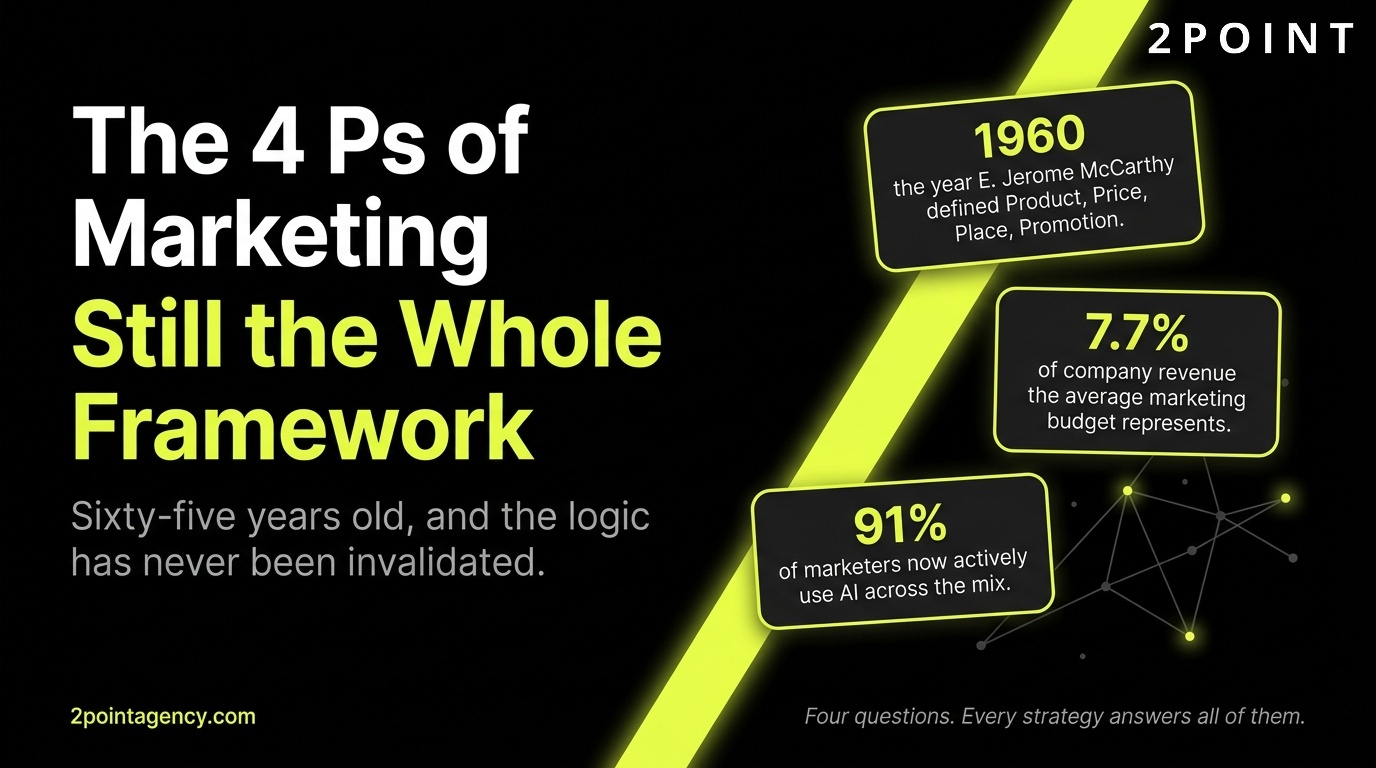
What Are the 4 Ps of Marketing? A Direct Answer
- Product is what you sell, including features, design, quality, and branding decisions.
- Price is what customers pay, shaped by costs, perceived value, and competitive positioning.
- Place covers every channel and touchpoint where customers discover, evaluate, and buy.
- Promotion includes advertising, content, social media, PR, and all communications that drive awareness.
- The framework was created by E. Jerome McCarthy in 1960 and remains the foundation of marketing strategy today.
- Together, these four elements form the marketing mix, a coordinated system for bringing products and services to market effectively.
- Marketing budgets average 7.7% of company revenue, making strategic optimization across all four Ps essential.
- The framework is over 60 years old and still taught in every business school worldwide because its core logic has never been invalidated.
The sections below give you a complete, practical understanding of each P, how they interconnect, and exactly how to apply them in a modern business environment where digital complexity and budget pressure collide.
Why the 4 Ps of Marketing Still Drive Business Strategy in 2026
Picture this: it is early 2026, and your marketing team is staring at a planning document that lists fourteen different digital channels, three proposed influencer partnerships, a new AI personalization tool, and a shrinking budget. Everyone has opinions. No one has a framework. The meeting ends with more confusion than clarity, and the quarter starts without a cohesive plan.
This scenario plays out in organizations of every size. The sheer volume of marketing tools, platforms, and tactics available today creates a paradox of choice that leads to fragmented execution and wasted spend. What separates high-performing marketing teams from those stuck in reactive mode is not access to better tools. It is a disciplined, structured approach to decision-making rooted in proven principles.
That is exactly what the 4 Ps of marketing provide. With global digital ad spend projected to reach $835.82 billion in 2026, the stakes for getting your marketing mix right have never been higher. At the same time, 91% of marketers now actively use AI and 92% of companies rely on AI-driven personalization for growth, meaning the executional landscape has shifted dramatically even as the foundational principles have stayed the same.
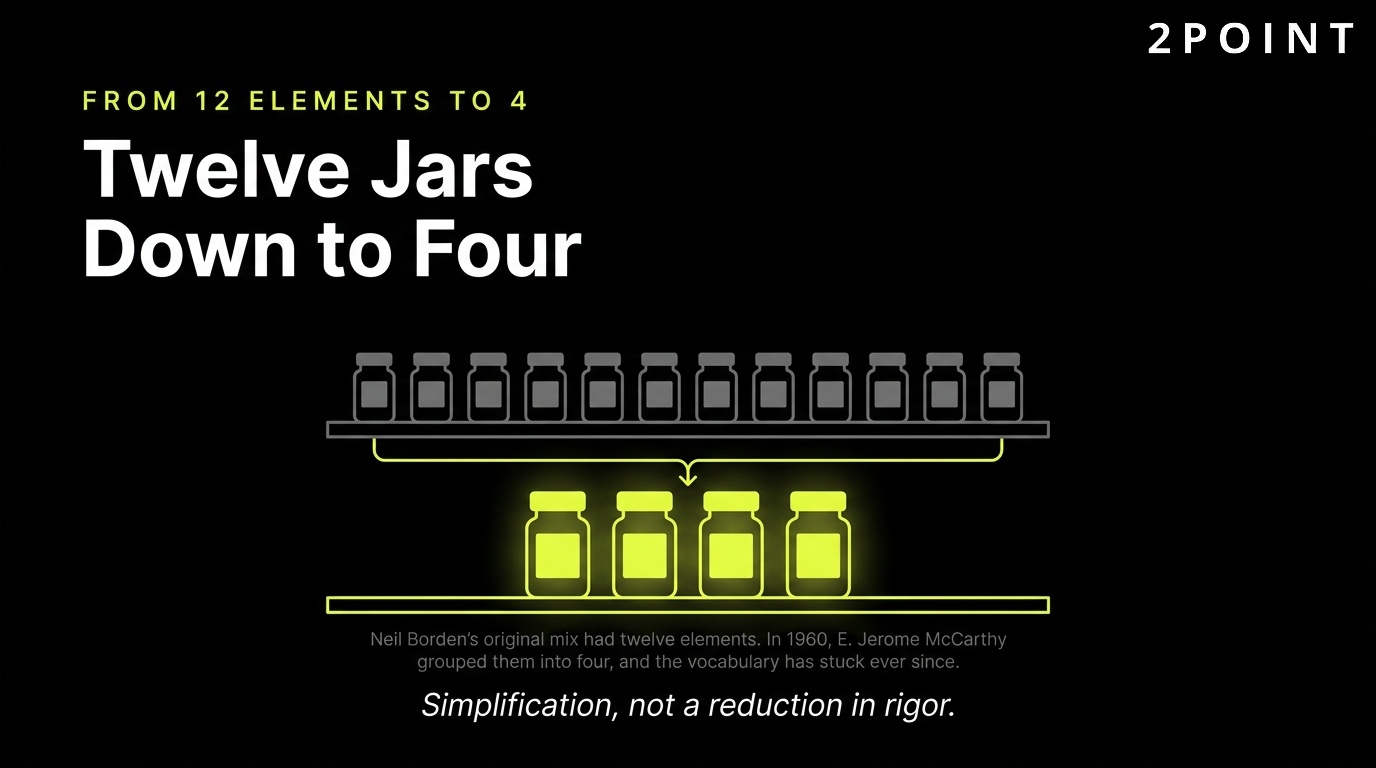
The history of the 4 Ps traces back further than most practitioners realize. In 1948, Harvard researcher James Culliton described marketers as "mixers of ingredients," a metaphor that would prove remarkably durable. Neil Borden picked up that metaphor in the 1950s and developed a 12-element framework covering product planning, pricing, branding, distribution channels, personal selling, advertising, promotions, packaging, display, servicing, physical handling, and fact-finding. It was comprehensive but unwieldy.
In 1960, marketing professor E. Jerome McCarthy distilled Borden's complex framework into four elegant categories in his book Basic Marketing: A Managerial Approach. Product, Price, Place, and Promotion. The simplification was not a reduction in rigor. It was a restructuring that made the framework immediately actionable for business leaders and students alike. Within a decade, the 4 Ps had spread through business education globally and had been adopted by marketing departments in companies of every industry and size.
More than six decades later, digital transformation has fundamentally changed how each P is executed, but not what each P means or why it matters. A product now might be a SaaS platform rather than a physical good. Price might shift by the second based on algorithmic demand sensing. Place encompasses social commerce platforms, mobile apps, and voice interfaces alongside physical retail. Promotion now includes hyper-personalized AI-driven campaigns reaching individuals rather than demographic segments. But the underlying logic, that every successful market offering requires a coherent strategy across all four dimensions, remains as valid as it was in 1960.
This guide gives you a deep, practical understanding of every dimension of the 4 Ps marketing framework. You will learn what each element means in 2026, how to integrate them into a cohesive marketing mix, how extended frameworks like the 7 Ps and 4 Cs relate, and exactly how to implement and optimize your own marketing mix strategy step by step.
Understanding the Marketing Mix Foundation
What Is the Marketing Mix?
The marketing mix is a coordinated, interconnected system of decisions that determines how a company brings its products or services to the market. It is not a checklist of independent tactics. It is a unified strategic framework where every element influences and reinforces the others. When executed with discipline, the marketing mix shapes customer perception, drives purchase decisions, builds brand loyalty, and generates sustainable revenue.
At its core, the marketing mix exists to answer four fundamental business questions. What are you offering? What will customers pay for it? Where will they access it? And how will they learn it exists and why they should care? The answers to these questions must be consistent with each other, aligned with customer expectations, and differentiated from competitive alternatives. When all four answers work in harmony, you have a marketing mix. When they contradict each other, you have customer confusion and lost sales.
Understanding consumer behavior is central to the marketing mix's purpose. Each element of the mix is designed to influence a specific dimension of how customers think, feel, and act. Product decisions shape what customers experience. Pricing decisions communicate value and establish accessibility. Distribution decisions determine friction or ease in the buying journey. Promotional decisions build awareness, preference, and urgency. A customer-centric approach, one that starts with deep understanding of what customers need and value, always produces a stronger mix than a product-centric approach that starts with what a company wants to sell.
The original Borden framework included 12 distinct elements before McCarthy consolidated them into 4 core categories. That consolidation made the framework more usable without sacrificing its analytical depth, since every one of Borden's original 12 elements still lives within one of McCarthy's four categories. Recognizing that heritage helps you understand why each P carries more strategic weight than its single-word label might suggest.
Historical Evolution: From Borden to McCarthy
The marketing mix did not emerge fully formed from a single insight. It evolved through decades of academic and practical development, and understanding that evolution helps clarify why the framework is structured the way it is.
James Culliton's 1948 description of the marketer as a "mixer of ingredients" was the conceptual seed. Culliton observed that marketing decisions did not happen in isolation. Successful marketers blended multiple variables together, just as a chef combines ingredients, to produce a result that no single ingredient could achieve alone. The metaphor was intuitive, and it stuck.
Neil Borden formalized the metaphor into an analytical framework in the 1950s. His 12-element marketing mix included product planning, pricing, branding, channels of distribution, personal selling, advertising, promotions, packaging, display, servicing, physical handling, and fact-finding and analysis. This comprehensive framework captured the full complexity of marketing decisions, but its length made it difficult to use as a quick strategic tool.
E. Jerome McCarthy's contribution in 1960 was the art of productive simplification. By grouping Borden's 12 elements into 4 categories, McCarthy created a framework that was both comprehensive and immediately memorable. Basic Marketing: A Managerial Approach became one of the most influential marketing textbooks ever published, and the 4 Ps became the standard vocabulary for marketing education and practice worldwide. Philip Kotler later popularized the framework further through his own prolific academic and consulting work, cementing the 4 Ps as the universal starting point for marketing strategy.
The timeline matters because it reveals something important: the 4 Ps did not become dominant by accident. They won out over more complex frameworks because they struck the right balance between completeness and usability. That same quality is why they remain the dominant framework in 2026, even as dozens of newer models have been proposed.
Why the 4 Ps Still Matter in 2026
Some frameworks age out. The 4 Ps have not, and the reason is structural. The four categories map onto four fundamental business realities that do not change regardless of technology: every market offering has some form of product, some form of price, some form of distribution, and some form of communication. As long as those realities exist, the 4 Ps remain relevant.
What has changed dramatically is execution. The channels through which promotion happens, the mechanisms through which prices are set and adjusted, the touchpoints that constitute "place," and the ways products are designed and iterated, all of these have been transformed by digital technology. But the strategic logic that connects them has not changed at all.
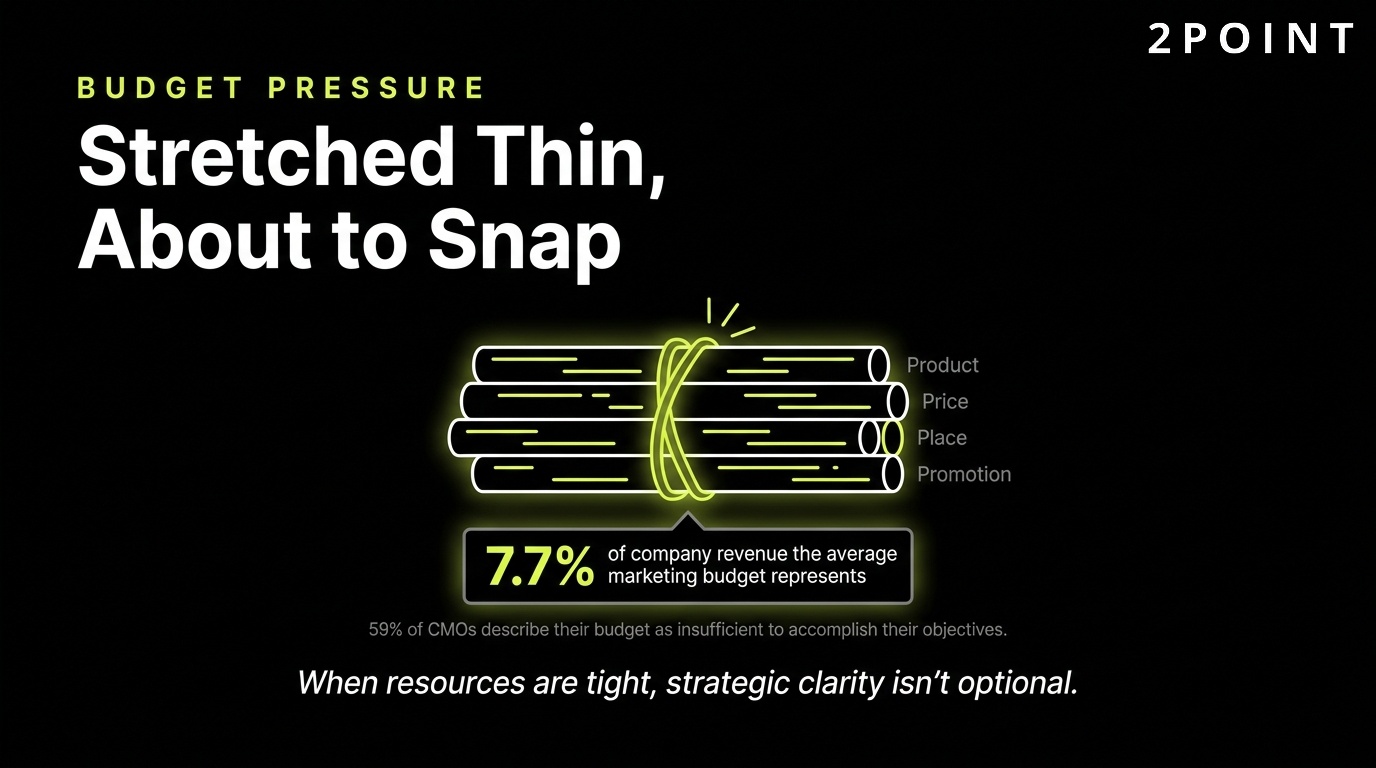
Budget pressure makes the framework even more valuable in 2026. Marketing budgets have flatlined at 7.7% of company revenue, and 59% of CMOs describe their budgets as insufficient to accomplish their objectives. When resources are constrained, strategic clarity is not optional. The 4 Ps framework forces teams to make explicit, deliberate choices about where to allocate effort and spend rather than spreading resources reactively across whatever channel is currently generating buzz.
Think of the 4 Ps as a control panel rather than a rigid plan. A skilled operator does not set the controls once and walk away. They monitor outputs, observe what the data reveals about customer response, and adjust individual dials while keeping the overall system in balance. That is exactly how modern marketing teams should use the framework: as a living, adaptive system rather than a static document.
The 4 Ps as an Interconnected System
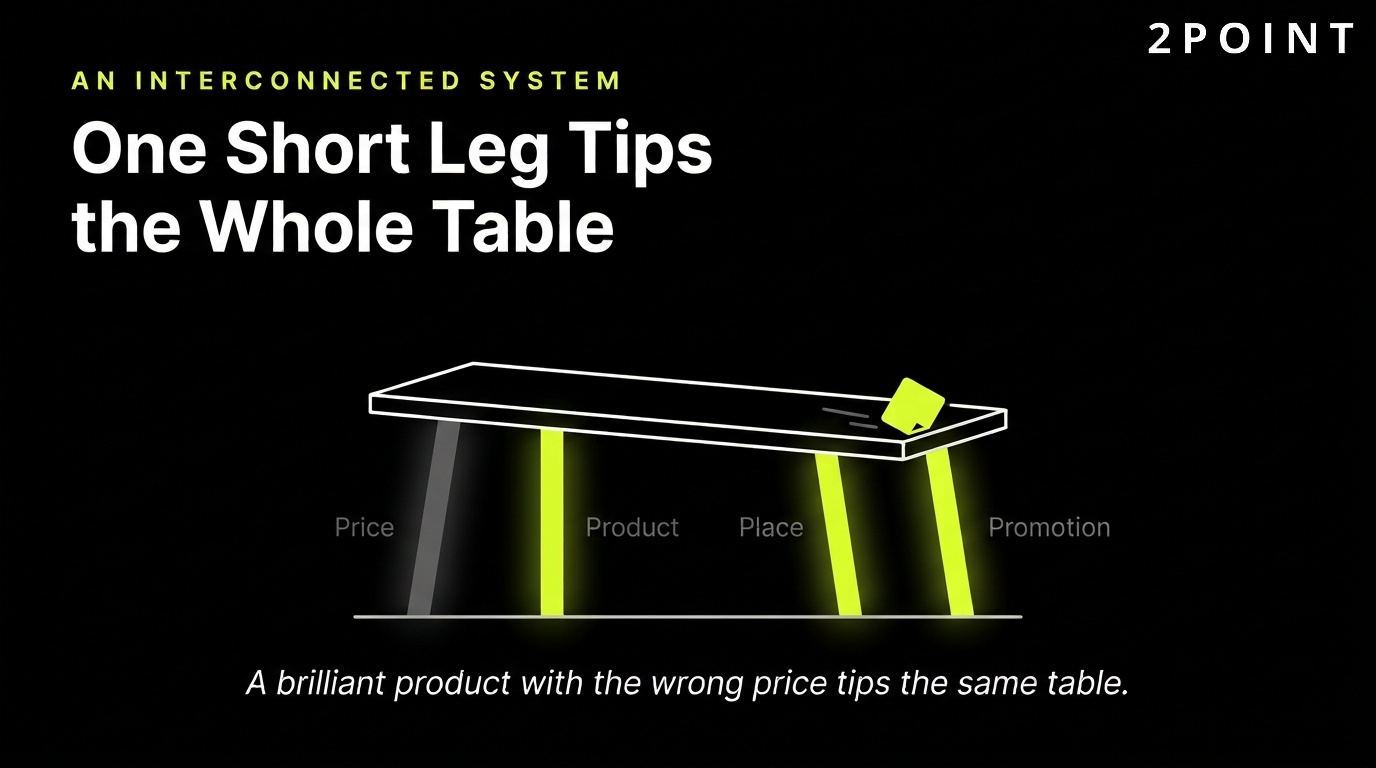
The most important thing to understand about the 4 Ps is that they are not independent. Changing one element changes the implications for all the others. Set a premium price without a product that justifies the premium, and customers feel deceived. Build a brilliant product but distribute it through channels your target customers do not use, and demand never develops. Run aggressive promotional campaigns for a product with fundamental design flaws, and you accelerate negative word of mouth. The mix must function as a system.
Brand equity grows through consistency across all four Ps. When customers repeatedly experience a product that matches what the promotion promised, available through channels that make access easy, at a price that reflects the stated value proposition, trust accumulates. That trust is the foundation of loyalty, repeat purchase, and advocacy. Conversely, misalignment across the Ps erodes trust even when individual elements are strong in isolation.
Consistency requirements are especially challenging in 2026's multi-channel environment. A customer might discover your product through a social media ad, research it on your website, see it demonstrated on YouTube, read reviews on a marketplace, and complete the purchase through a retail partner. Every one of those touchpoints is part of your Place and Promotion strategy. The message must be consistent, the product experience must match expectations, and the price must not create surprises. Achieving that consistency requires deliberate system thinking, not channel-by-channel tactical planning.
Customer behavior data is the mechanism through which you adjust the dials. Purchase patterns, abandonment rates, return reasons, review sentiment, and inquiry volume all provide signals about which elements of your mix are performing and which need adjustment. A data-driven approach to the marketing mix treats every customer interaction as a feedback signal and builds continuous improvement into the operating rhythm of the team.
Product: The Foundation of Your Marketing Mix Strategy
Defining Product in Modern Marketing
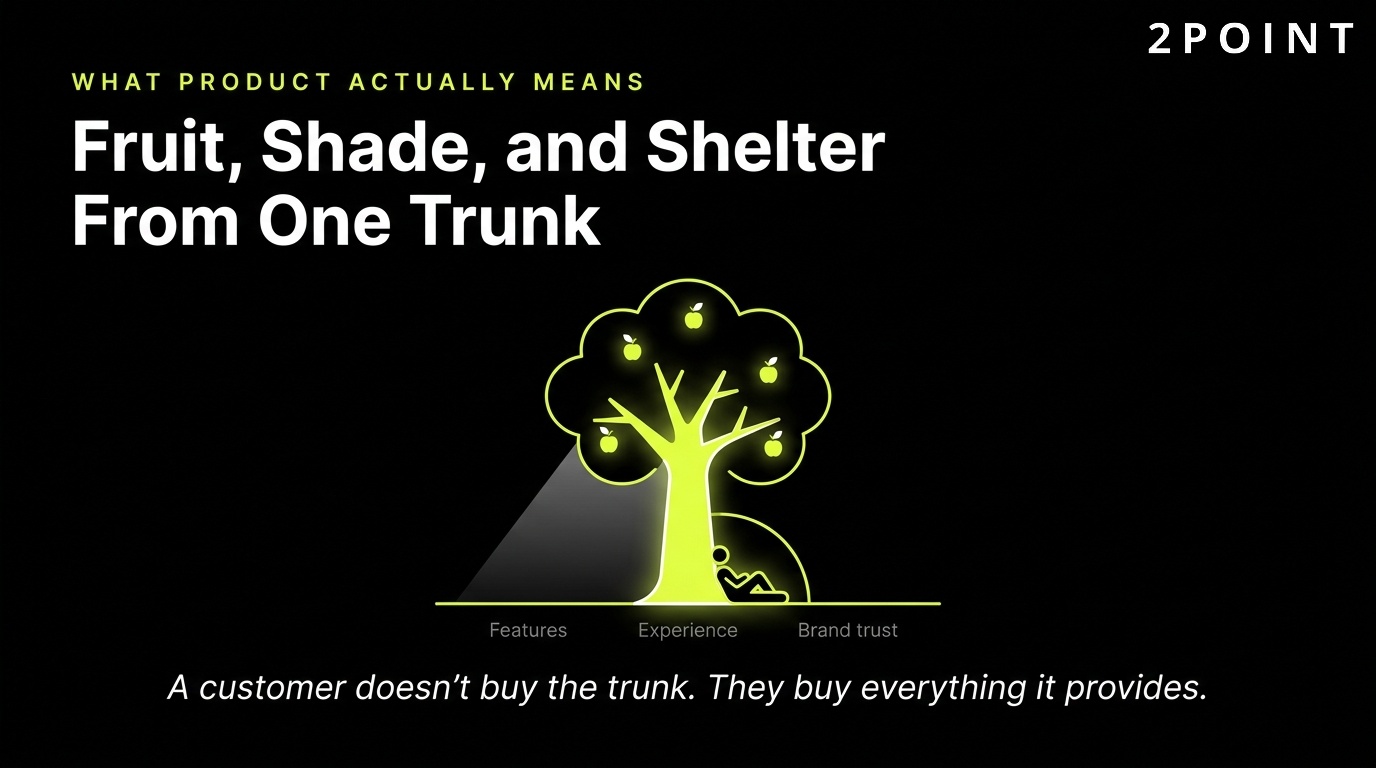
In the context of the 4 Ps, "product" encompasses far more than the physical object a customer takes home or the software they download. A product is the complete bundle of benefits, experiences, and associations that a customer receives when they make a purchase. It includes tangible attributes like features, materials, and design, and intangible attributes like brand reputation, customer service quality, and the emotional experience of ownership or use.
The core components of product strategy span product variety, quality, design, features, brand name, packaging, and associated services. Each of these decisions shapes what customers experience and how they perceive value. A product with excellent functionality but poor packaging communicates a different brand story than the same functionality presented with premium design. A strong brand name attached to a mediocre product creates a gap between expectation and experience that destroys loyalty.
Product decisions extend to assortment management: which variants, sizes, configurations, or tiers to offer. Offer too few, and you leave customer segments underserved. Offer too many, and you create decision paralysis and operational complexity that inflates cost without proportional revenue benefit. The right product assortment is determined by deep understanding of your customer segments and their distinct needs, not by instinct or competitive imitation.
For digital products, the product definition extends to platform appearance, user interface design, onboarding experience, and integration capabilities. A poorly designed onboarding flow is as damaging to product perception as a physical product with a defective component. In 2026, where software and services often represent the majority of a company's product portfolio, these digital experience dimensions are central to product strategy, not peripheral considerations.
Product Development Strategy
The most effective product development processes in 2026 are explicitly customer-centric. Rather than beginning with internal capabilities or technology, customer-centric product design begins with articulating the specific problem or need being solved, then works backward to determine what features, format, and experience best address that need. This approach consistently produces products with stronger market fit than capability-led development.
Co-creation with customers has moved from an innovation experiment to a mainstream development practice. Rapid prototyping and iterative development processes allow companies to involve real customers in shaping product direction before significant investment is committed. Beta programs, open feedback forums, user research sessions, and advisory boards all provide channels through which customer insight can directly influence product decisions. This reduces development risk and increases the probability of market success.
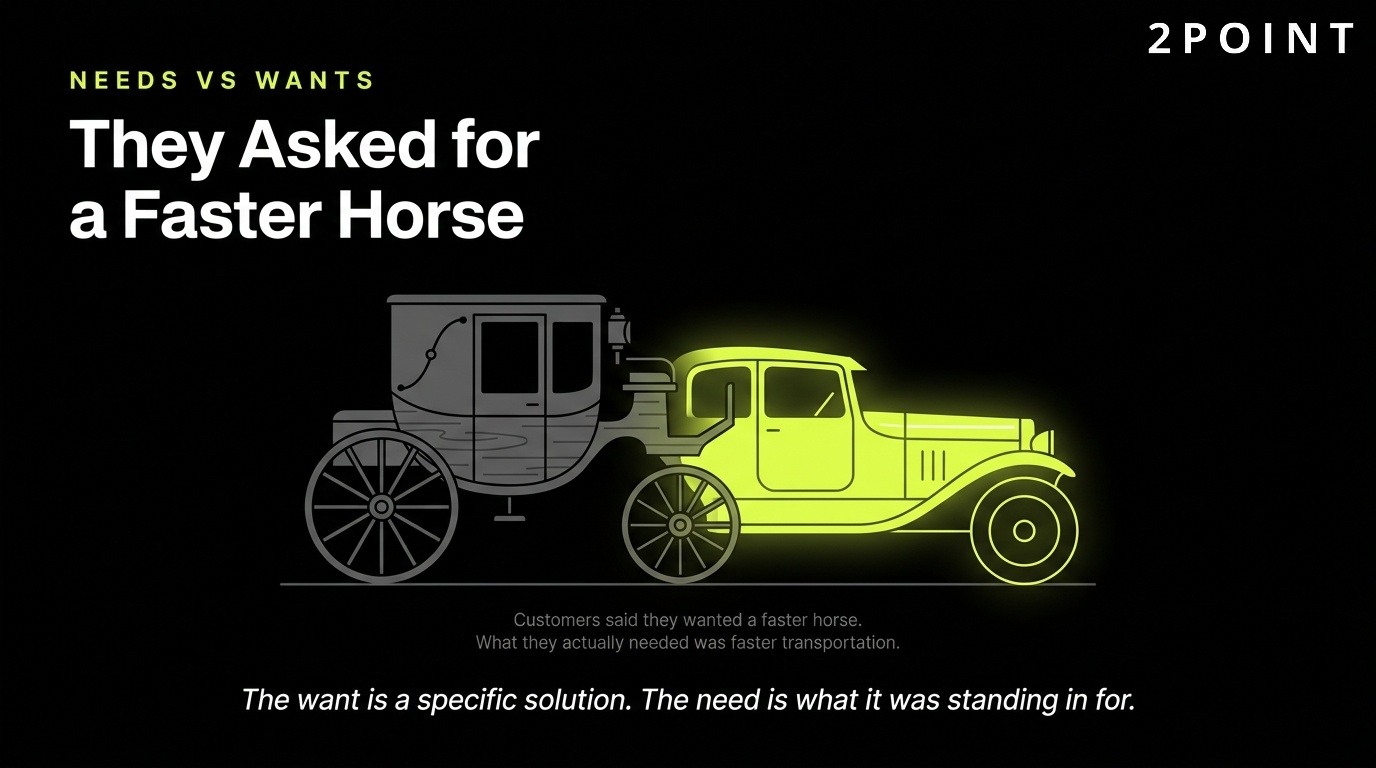
The distinction between meeting customer needs and meeting customer wants is strategically important. Customers often articulate wants that are specific solutions they have imagined, while the underlying needs are more fundamental and may be served by different solutions. Famously, Henry Ford noted that customers said they wanted faster horses when what they actually needed was faster transportation. Understanding the difference between stated wants and underlying needs gives product teams the insight to develop genuinely innovative solutions rather than incremental improvements on existing offerings.
For digital products specifically, the strategy must account for how the product appears and functions across multiple platform environments. A mobile app that delivers a poor experience on certain devices, or a web platform that loads slowly on lower-bandwidth connections, compromises the product regardless of how strong its core functionality is. In 2026, cross-platform consistency and performance are non-negotiable product quality standards.
Product Lifecycle and Portfolio Management
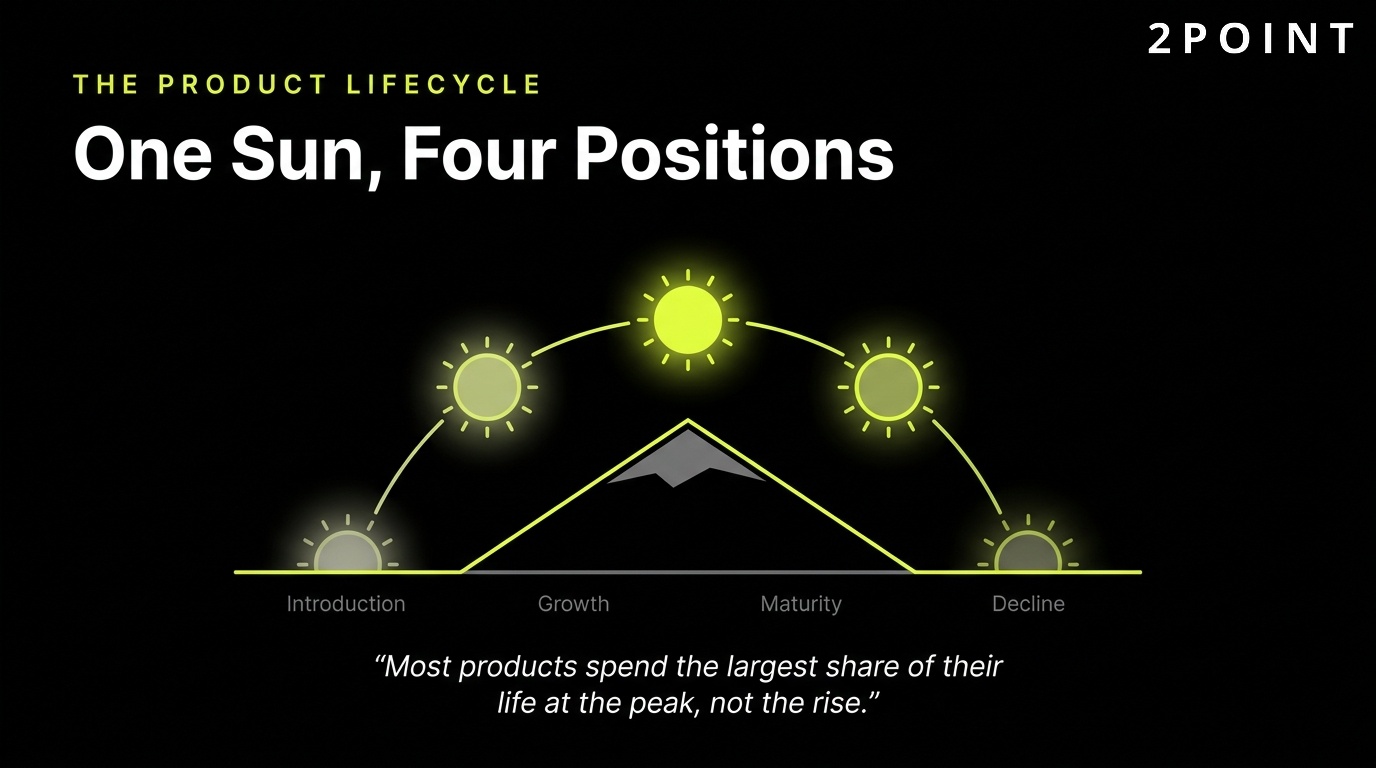
Every product moves through four stages during its commercial life: introduction, growth, maturity, and decline. Each stage requires a different marketing mix configuration. During introduction, investment in awareness-building promotion is high, distribution is often selective, and pricing may use either skimming or penetration strategies depending on the competitive context. During growth, the focus shifts to expanding distribution, defending market share, and managing increasing competitive pressure.
In the maturity stage, which is where most products spend the largest portion of their commercial lives, the strategic challenge shifts to sustaining relevance and profitability as growth slows. This often involves product line extensions, feature additions, packaging refreshes, or repositioning to reach new customer segments. Promotional emphasis shifts from awareness to loyalty and differentiation. During decline, the strategic decision is whether to invest in revitalization or manage the product's profitable exit from the portfolio.
Portfolio management requires a balanced view across these lifecycle stages. A portfolio composed entirely of mature or declining products lacks growth potential. A portfolio composed entirely of early-stage products carries high risk and uncertain cash flow. Healthy portfolios intentionally balance products across lifecycle stages, with established products funding the investment needed to develop and launch next-generation offerings.
The decision of when to retire a product is among the most difficult in portfolio management. Emotional attachment, historical investment, and internal advocacy for legacy products can make it difficult to make objective retirement decisions. Data-driven portfolio reviews, conducted on a regular cadence, help organizations make these decisions based on market performance and strategic fit rather than sentiment.
Product in the Digital Age
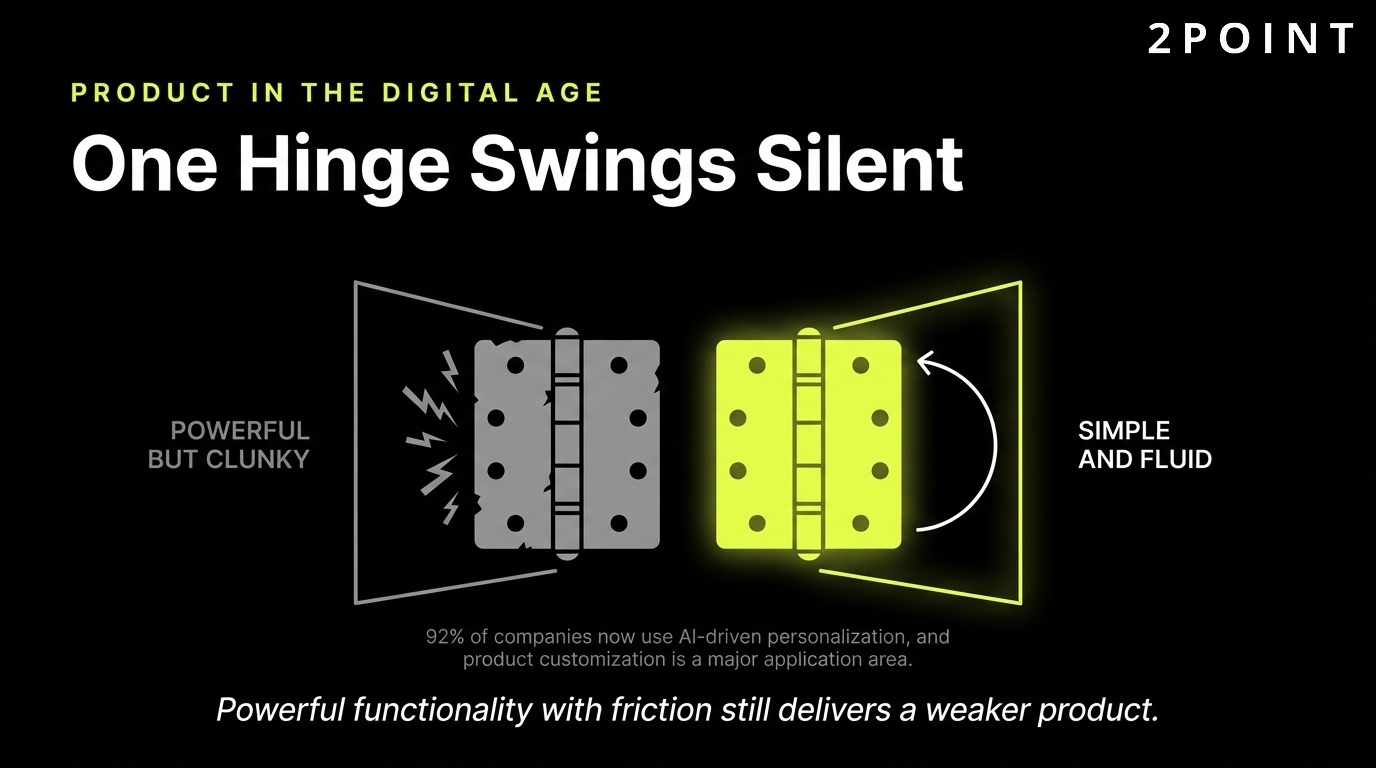
Digital transformation has expanded both what "product" means and what customers expect from it. User experience has become a product feature in its own right. Customers evaluate digital products not only on what they do, but on how intuitive, fast, and satisfying they are to use. A product that requires extensive effort to operate, even if its functionality is powerful, delivers a weaker overall product experience than a simpler alternative that removes friction from the user journey.
Service integration with physical products has become standard across many categories. Smart devices collect usage data and receive software updates. Physical goods come with digital warranty registration, troubleshooting apps, and connected community platforms. This integration blurs the traditional boundary between product and service, creating ongoing relationship opportunities that did not exist in the era of purely transactional product sales.
Customer feedback loops now operate at unprecedented speed and scale. Review platforms, social media, in-app feedback mechanisms, and support ticket analysis provide continuous, real-time signals about product performance and customer satisfaction. Organizations that build systematic processes for capturing and acting on this data create a compounding advantage: each improvement cycle produces a product that better meets customer needs, which drives better reviews, which attracts more customers, which generates more feedback for the next improvement cycle.
92% of companies now use AI-driven personalization for growth, and product customization is a major application area. Recommendation engines, adaptive interfaces, personalized feature sets, and usage-based product configurations all represent forms of AI-enhanced product personalization that strengthen the customer relationship and increase perceived value without proportionally increasing production cost.
Price: Strategic Value Communication in Your Marketing Mix
Understanding Pricing Strategy
Price is the only element of the 4 Ps that generates revenue rather than creating cost, which makes pricing decisions among the most consequential in the entire marketing mix. At its most basic, price is the amount a customer pays in exchange for the benefits a product provides. But effective pricing strategy goes far deeper than cost recovery. Price communicates value, signals positioning, influences purchase urgency, and shapes how customers perceive the brand.
The core components of pricing include list price, discounts, allowances, payment period terms, and credit availability. Each of these levers affects the effective price a customer pays and the attractiveness of the offering at that price point. A high list price with aggressive discounting communicates a fundamentally different brand story than a lower list price with no discounting, even when the final transaction price is identical. Discount strategy is therefore a brand strategy decision, not merely an arithmetic one.
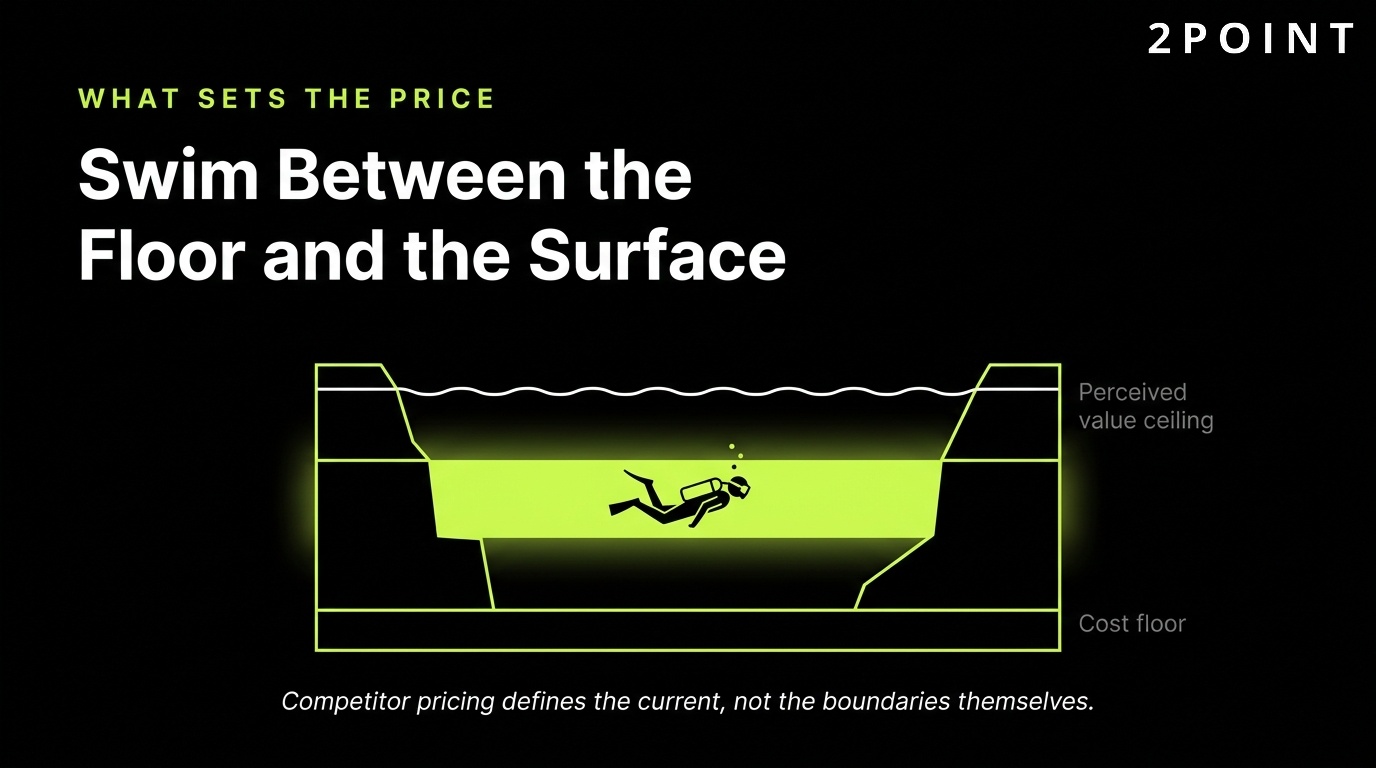
Effective pricing requires analysis of three primary inputs: the cost of production and delivery (which sets the floor), the perceived value to the customer (which sets the ceiling), and competitor pricing (which defines the competitive context). A price that falls between these boundaries may be technically viable but not strategically optimal. The goal is to price at a point that maximizes both revenue and customer perceived value, which often requires testing and iteration rather than calculation alone.
Psychological pricing considerations add another dimension. Price points like $99 rather than $100 leverage the way human cognition processes numbers. Tiered pricing creates anchoring effects where a premium tier makes a mid-tier option look like excellent value. Bundle pricing can increase total transaction size while making customers feel they are receiving more for their money. These psychological mechanisms are well-documented and consistently effective, and they should be incorporated into any serious pricing strategy. For a deeper look at pricing decisions in digital contexts, understanding how market positioning affects rate-setting is essential.
Modern Pricing Models and Approaches
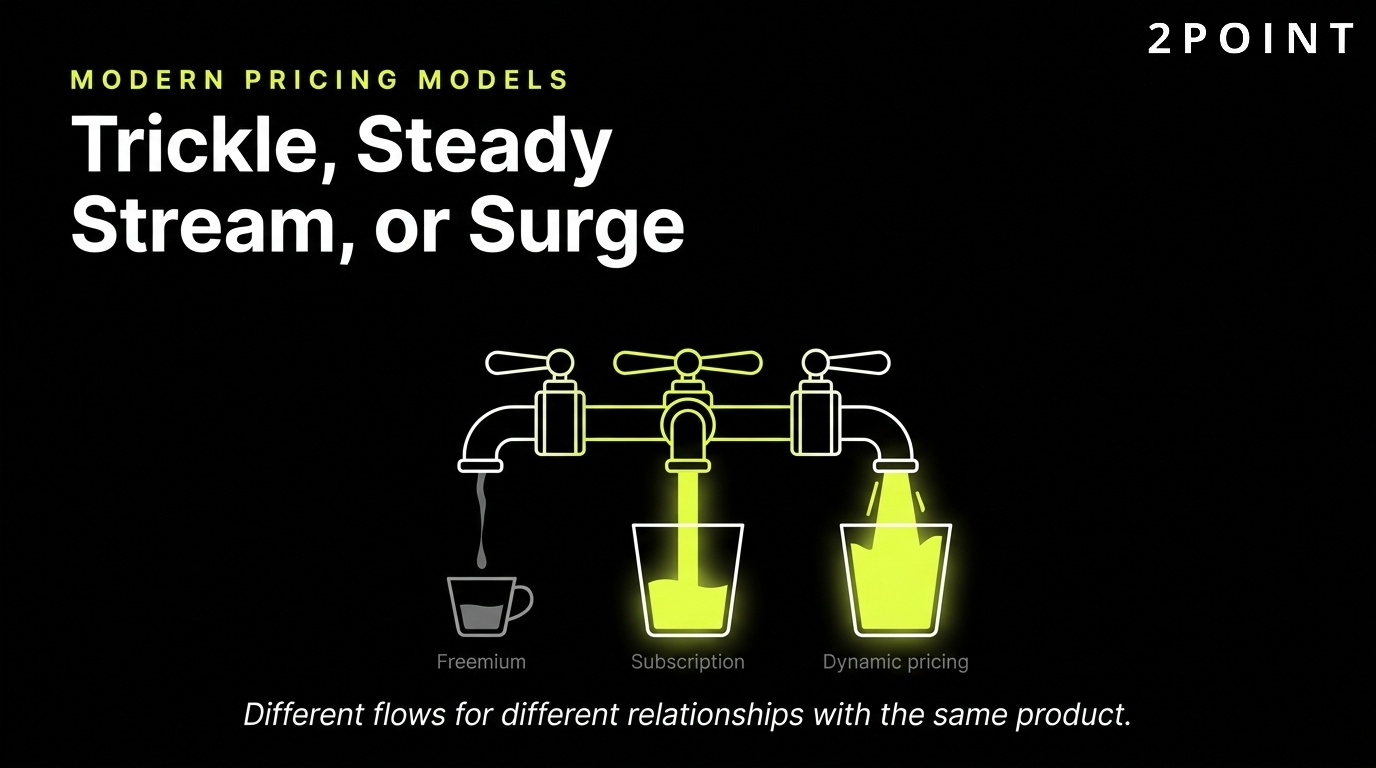
The range of viable pricing models has expanded dramatically with digital commerce. Where physical product businesses historically chose between a small number of pricing structures, digital and hybrid businesses now have access to a much wider toolkit. Selecting the right model is as important as setting the right price within that model.
Dynamic pricing allows prices to fluctuate in response to real-time demand, competitive activity, inventory levels, and customer characteristics. Algorithms now enable second-by-second dynamic pricing adjustments in industries from airlines and hotels to ride-sharing and e-commerce. While this maximizes revenue capture at a mathematical level, it carries reputational risks if customers perceive the pricing as arbitrary or exploitative, requiring careful implementation with appropriate customer communication.
Subscription pricing has transformed revenue models across software, media, physical goods (through subscription boxes), and professional services. The subscription model converts one-time transactions into recurring revenue streams, which improves revenue predictability, deepens the customer relationship, and creates ongoing opportunities to demonstrate value. The trade-off is the ongoing obligation to deliver consistent value that justifies the recurring charge, making retention strategy inseparable from subscription pricing strategy.
Freemium pricing, where a base product tier is offered free with premium features requiring paid upgrades, has become a dominant customer acquisition strategy in digital markets. The model reduces the risk barrier for new customers and builds a large user base from which paying subscribers are converted. Effective freemium strategy requires careful calibration of which features live in the free tier and which require payment, since offering too little for free fails to attract users, while offering too much eliminates the conversion incentive.
Digital price comparison is now trivially easy for consumers, which means competitive pricing transparency is a structural feature of digital markets. Customers can compare prices across dozens of competitors in seconds. This compression of competitive advantage through price alone is a strong argument for value-based pricing strategies that compete on differentiation rather than simply matching or undercutting competitor prices.
Pricing Psychology and Customer Perception
Price and perceived value are not the same thing, and managing the gap between them is one of the most powerful levers in marketing. A customer who believes a product is worth more than its price perceives themselves as getting a good deal, which creates positive purchase emotions and increases repurchase likelihood. A customer who believes a product is worth less than its price feels overcharged, which creates resentment and defection risk regardless of the product's actual quality.
Premium pricing strategy deliberately sets price above competitive alternatives to signal superior quality, status, or exclusivity. This approach works when the product and brand experience genuinely justify the premium and when the target customer segment values the signals that premium price communicates. The risk is that premium pricing requires ongoing investment in product quality and brand experience to maintain its justification. A price premium not supported by a genuine quality differential is rapidly exposed in an environment where customers can share experiences instantly.
Discount strategy carries its own brand risks that are often underestimated. Frequent, deep discounting trains customers to wait for promotions before purchasing, which erodes full-price revenue and signals that the list price is not the real price. It also anchors customer value perception at the discounted price, making it difficult to return to full-price pricing without customer resistance. Discount strategies should be used tactically and sparingly, with clear constraints on frequency and depth to protect brand equity.
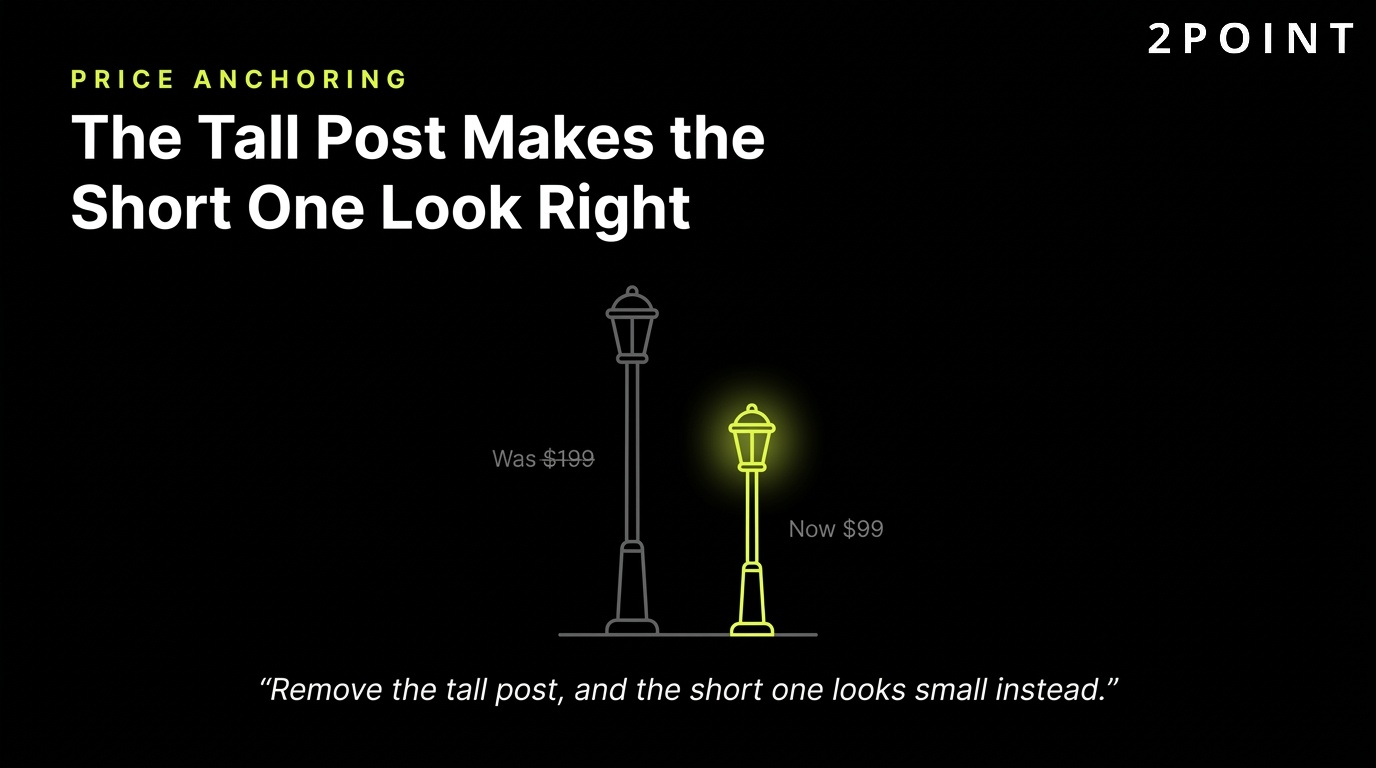
Price anchoring is a technique where a higher reference price (the anchor) is presented before or alongside the actual selling price, making the selling price appear more attractive by comparison. This is the mechanism behind "was $199, now $99" framing and behind multi-tier pricing presentations where a high-priced premium option makes mid-tier options feel like excellent value. Anchoring is a well-documented behavioral phenomenon that consistently influences purchase decisions when implemented authentically.
Pricing in Omnichannel Environments
Managing price consistently across multiple channels is one of the more operationally complex challenges in modern marketing mix management. Customers who encounter different prices for the same product in different channels feel deceived or confused, both of which damage trust and purchase intent. Price consistency is therefore both a customer experience priority and a brand integrity requirement.
At the same time, channel-specific pricing strategies can be legitimate and effective when implemented transparently. A lower price on a direct website channel versus a retail channel may reflect the cost savings of cutting out an intermediary, savings that can be passed to customers while still maintaining retailer margin requirements. Exclusive promotional pricing through specific channels, such as an email subscriber discount or a loyalty program rate, rewards specific customer behaviors without undermining overall price integrity.
Geographic pricing variations respond to real differences in market conditions, cost structures, purchasing power, and competitive landscapes across regions. A product priced for a North American market may require significant adjustment for Southeast Asian or Latin American markets to achieve accessibility without sacrificing brand positioning. Global pricing strategy requires a framework that balances consistency of brand positioning with responsiveness to local market realities.
Real-time price optimization based on demand sensing and competitive monitoring is increasingly accessible even to mid-market businesses, not just enterprise retailers. Tools that monitor competitor prices and adjust your own pricing within predefined guardrails allow you to remain competitive without constant manual intervention. The key discipline is setting those guardrails thoughtfully, defining the price floor below which you will not go regardless of competitive pressure, and the ceiling above which the price signal becomes more damaging than the revenue gain.
Place: Distribution Channels and the 4 Ps in the Digital Era
Redefining "Place" for 2026
Of the four Ps, "Place" has undergone the most dramatic transformation in the digital age. In its original conception, Place referred primarily to physical distribution: the retail stores, warehouses, wholesalers, and logistics networks through which physical goods moved from manufacturer to consumer. That conception still matters, but it now represents only a portion of what strategic placement decisions must address.
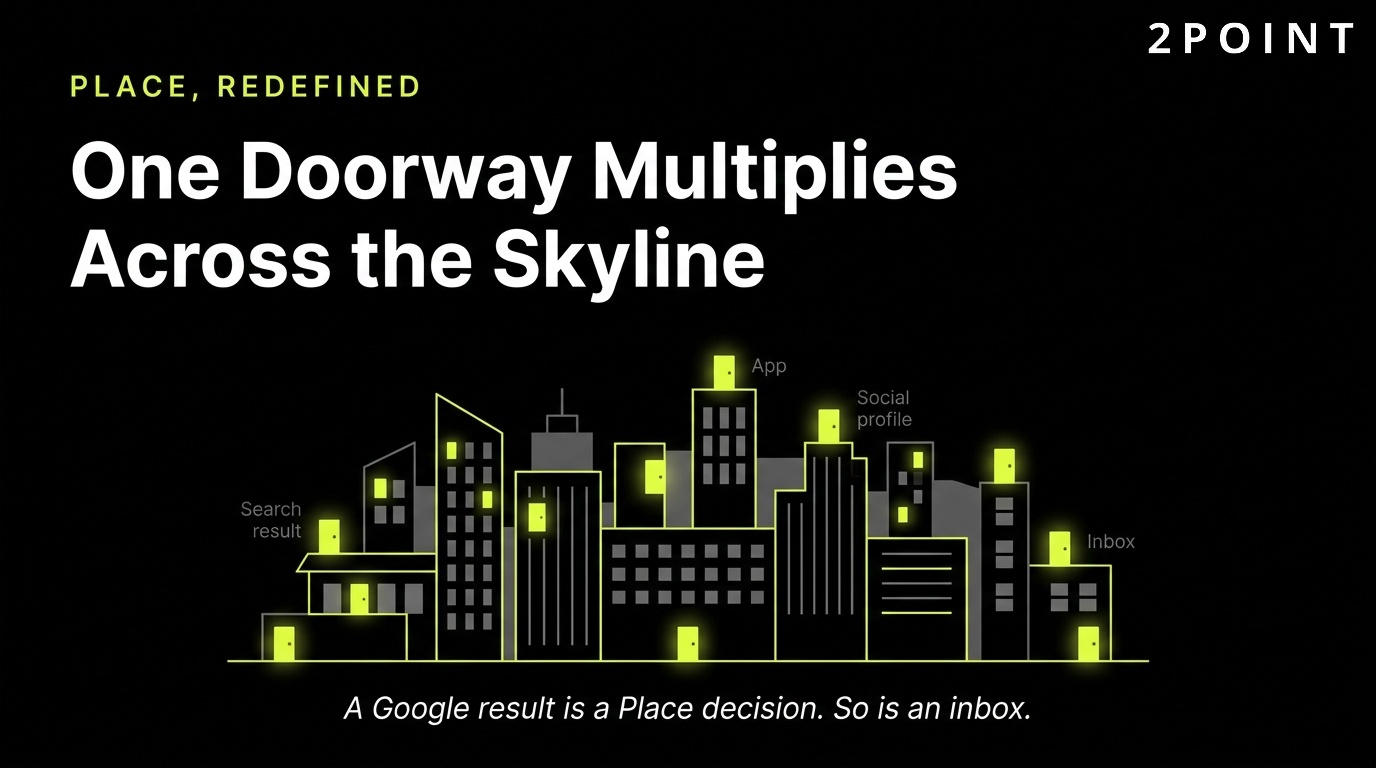
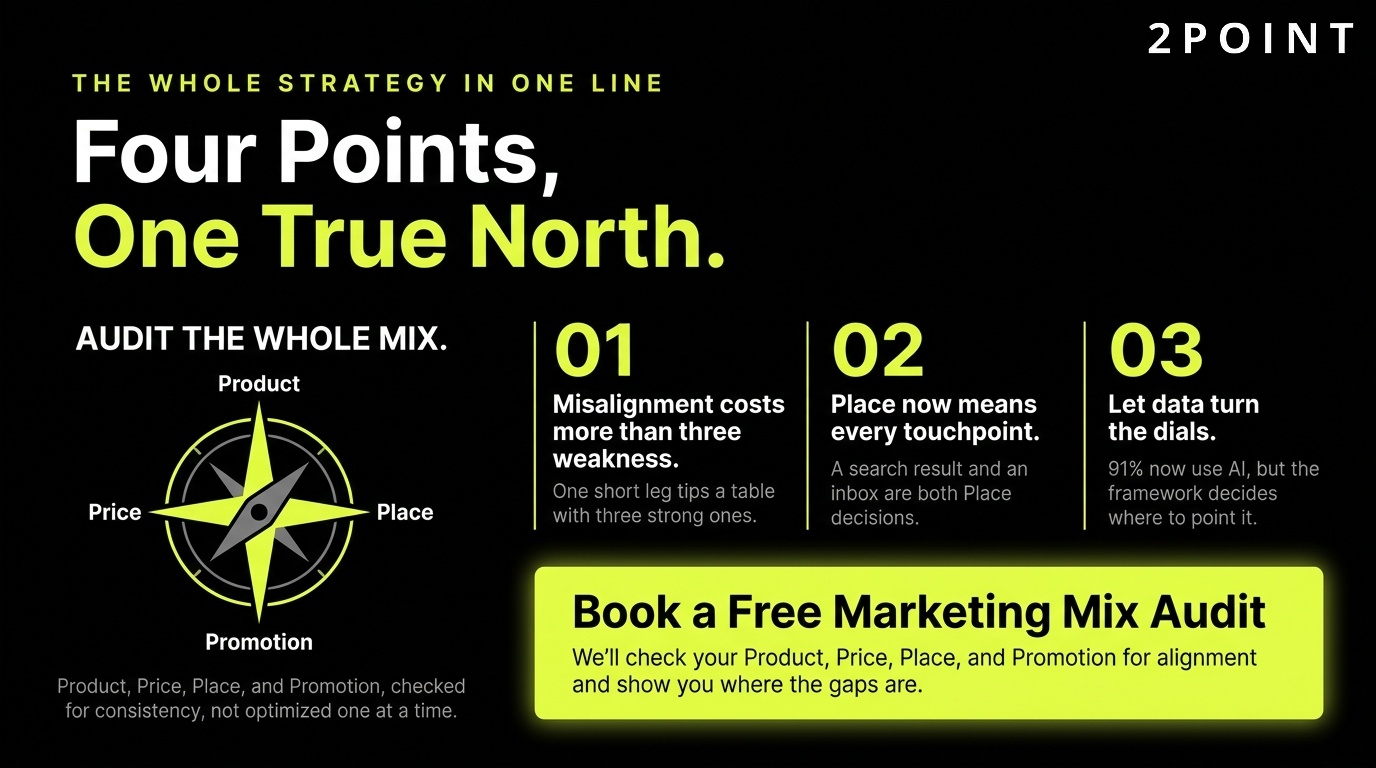
In 2026, Place encompasses every touchpoint where a customer discovers, evaluates, engages with, or purchases your product. A Google search result is a Place decision. A social media profile is a Place decision. An app store listing is a Place decision. An email inbox is a Place decision. Place now means every touchpoint across the customer journey, including emerging ones that did not exist even a few years ago.
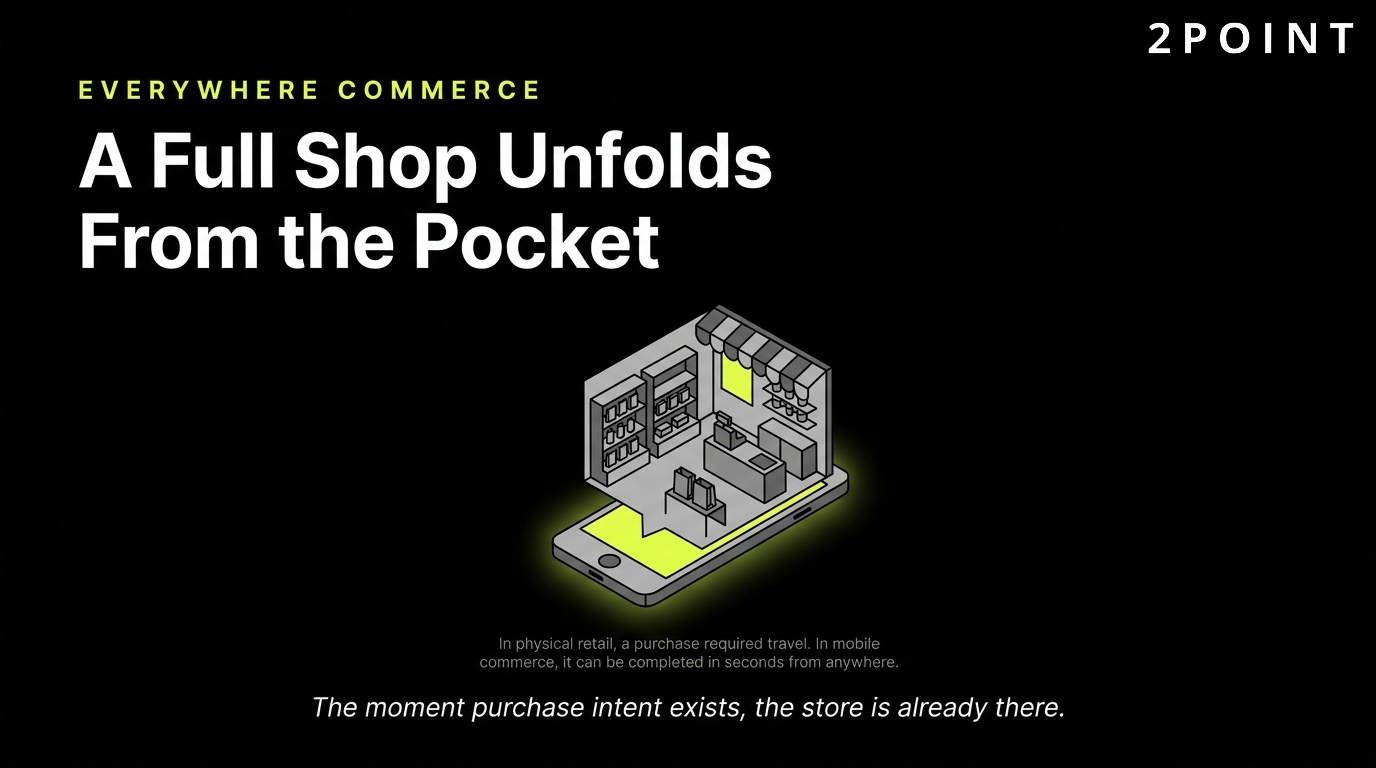
The "everywhere commerce" reality created by mobile apps and always-connected devices has transformed the instant purchase capability available to customers. In physical retail, a purchase required travel to a store. In desktop e-commerce, it required sitting at a computer. In mobile commerce, a purchase can be completed in seconds from anywhere, at any time, in any context. This compression of purchase friction has fundamentally changed what effective placement means: being present in the moments when purchase intent exists, regardless of where or when those moments occur.
Channel selection in 2026 must be driven by customer behavior data, not internal preference or historical habit. The right channel is the one where your target customers actually spend time, not the one your team is most familiar with or most comfortable managing. Starting with a rigorous analysis of where your customers discover, research, and buy products in your category is the only defensible basis for Place strategy decisions.
Traditional Versus Digital Distribution Channels
Physical distribution remains critically important for a vast range of product categories, and effective physical distribution strategy is as nuanced as ever. The core components of physical distribution include channel selection (which types of intermediaries to use), geographic coverage (which markets to serve and at what density), inventory management (how much stock to hold and where), transportation and logistics (how goods move from production to customer), and physical location quality (for retail or service-based businesses).
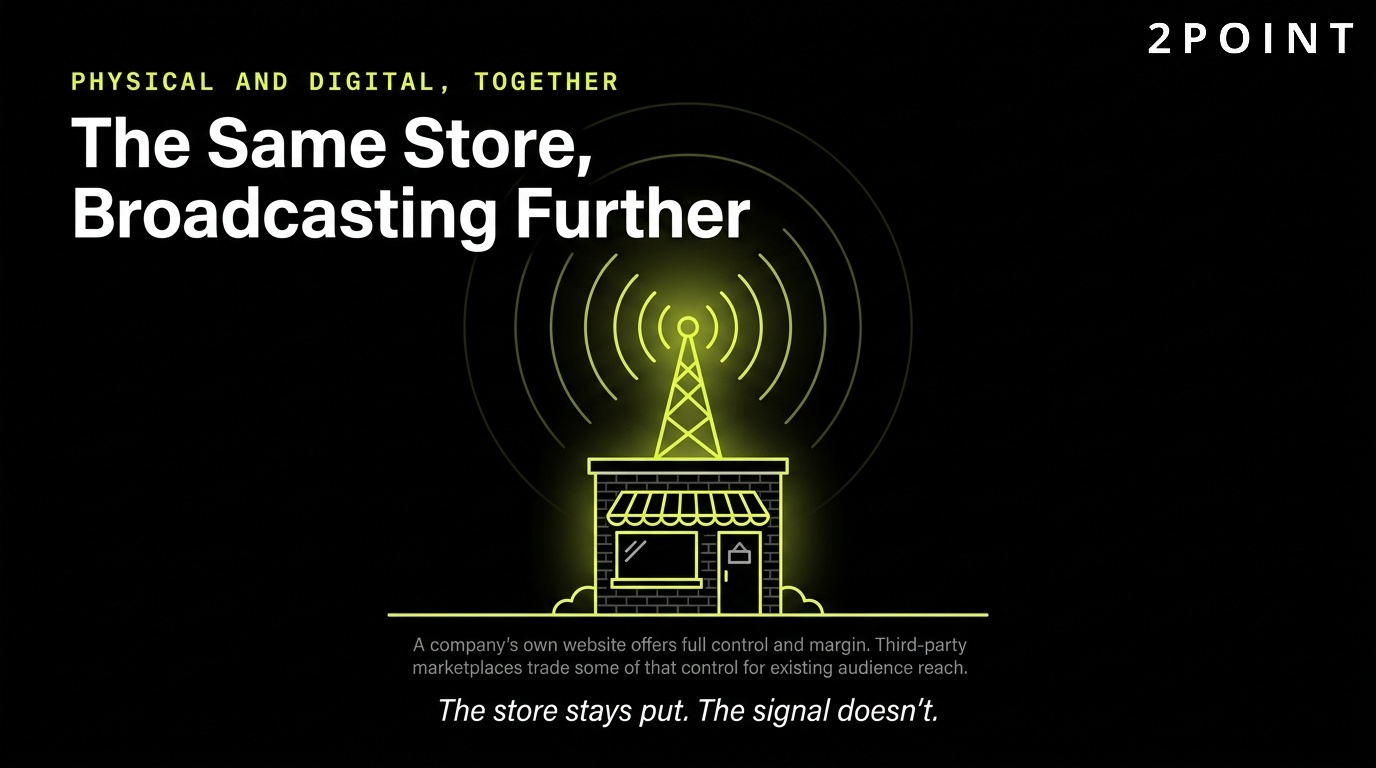
Digital distribution channels have added an entirely new layer of complexity and opportunity. A company's website is its owned digital distribution channel, offering maximum control over customer experience and margin retention at the cost of traffic acquisition. Third-party marketplaces like Amazon, Walmart.com, or category-specific platforms offer access to large existing audiences at the cost of margin sharing, reduced control over the customer experience, and competitive exposure.
| Distribution Channel Type | Key Advantages | Primary Challenges | Best Suited For |
|---|---|---|---|
| Physical Retail (own stores) | Full brand control, experiential selling | High fixed cost, limited geographic reach | Premium brands, high-touch categories |
| Physical Retail (wholesale/partner) | Broad geographic reach, lower cost | Reduced margin, limited brand control | Mass-market consumer goods |
| Direct Website (D2C) | Full margin, rich customer data, brand control | Traffic acquisition cost, logistics | Brands with strong identity and repeat purchase |
| Third-Party Marketplace | Existing audience, trust signals | Margin reduction, competitive visibility | New market entry, commodity categories |
| Social Commerce | Discovery-native, frictionless purchase | Platform dependency, algorithm changes | Visual products, impulse categories, younger demographics |
| Mobile App | Personalization, push notifications, loyalty | App store fees, development cost | High-frequency purchase categories, subscription models |
The key takeaway is that no single distribution channel is optimal for all products or all customer segments, and the most effective Place strategies in 2026 combine multiple channels in a deliberately coordinated system.
Social Commerce and Emerging Platforms
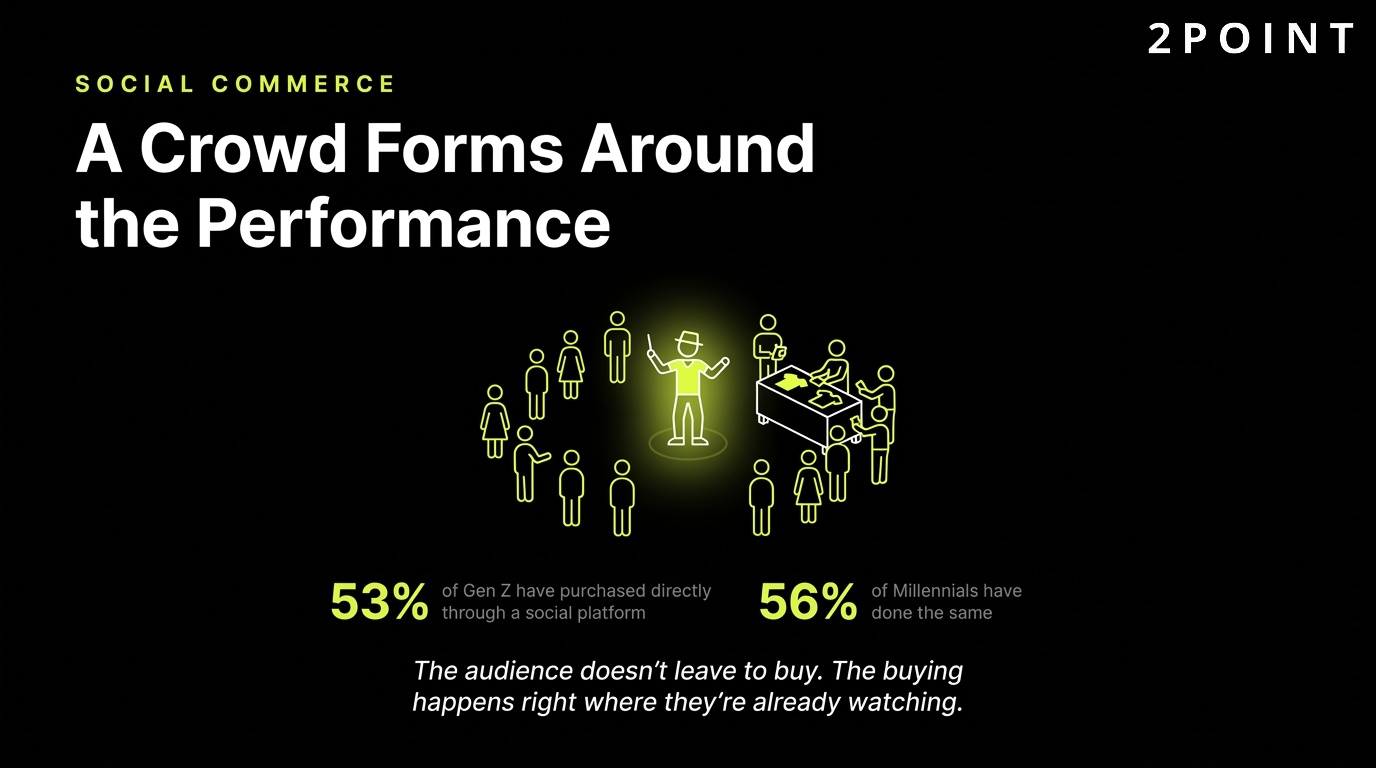
Social commerce has moved from an experimental feature to a major distribution category in its own right. Global social commerce now represents a $1.63 trillion market growing at a compound annual rate exceeding 30%. That growth trajectory reflects a fundamental shift in how customers, particularly younger ones, integrate shopping behavior into their social media usage.
53% of Gen Z consumers and 56% of Millennials have made a purchase directly through a social media platform recently. For brands targeting these demographics, social commerce is not an optional channel enhancement. It is a core distribution requirement. Platforms including Instagram Shopping, TikTok Shop, Pinterest Shopping, and YouTube Shopping all offer native purchase capabilities that allow customers to complete transactions without leaving the social environment where they discovered the product.
Platform-specific strategies matter because each social commerce environment has a different dominant content format, community norm, and algorithmic discovery mechanism. TikTok favors short-form video content with organic virality potential. Instagram is strong for aspirational lifestyle imagery with a well-developed influencer commerce ecosystem. Pinterest captures high-intent purchase research behavior through visual discovery. A social commerce strategy that treats all platforms identically will underperform one that optimizes content and product presentation for each platform's specific dynamics.
Emerging platforms and technologies create ongoing Place strategy decisions that require regular reassessment. Augmented reality shopping experiences, voice commerce through smart speakers, and live-stream shopping events represent distribution channel innovations that are growing rapidly and may become standard expectations in specific product categories within the coming years. A robust Place strategy in 2026 includes not just management of current channels but active monitoring of emerging touchpoints that may become significant for your target customers.
Omnichannel Distribution Strategy
The distinction between multi-channel and omnichannel distribution is not merely semantic. A multi-channel strategy means being present in multiple channels, each of which operates independently. An omnichannel strategy means delivering a seamless, continuous customer experience regardless of which channel or combination of channels a customer uses. The latter is significantly harder to achieve and significantly more valuable when done well.
Seamless omnichannel execution requires integration at three levels: technology (shared customer data and inventory systems), process (consistent operating procedures across channels), and culture (organizational alignment around the customer journey rather than channel-specific metrics). Most organizations find the technology integration the easiest of these three and the cultural alignment the hardest.
Click-and-collect and Buy Online, Pick Up In-Store (BOPIS) models represent a particularly successful form of omnichannel integration, one that combines the convenience of online ordering with the immediacy of local pickup. These models also create additional in-store visit opportunities that can drive incremental purchases. Real-time inventory visibility across all locations is the operational foundation that makes these models work, and investing in that infrastructure pays dividends across the entire distribution strategy.
Breaking down channel silos within organizations is as important as integrating their technology. When teams managing different channels optimize independently for their own channel metrics, they create customer experiences that feel disjointed. A customer who had a great experience through your app but then received inconsistent service in your physical store will not distinguish between the two channels in their overall brand assessment. Omnichannel experience quality is judged holistically, and organizational accountability must reflect that reality.
Promotion: Reaching Your Audience with the Right Marketing Mix
The Promotion Mix Components
Promotion is the element of the 4 Ps that most people instinctively think of as "marketing," but it is only one of four interdependent elements. At its core, promotion encompasses every communication a brand makes with its target audience, whether paid, earned, owned, or shared. The promotion mix includes advertising, personal selling, sales promotion, and public relations as its traditional pillars, with digital channels having added significant breadth and complexity to each.
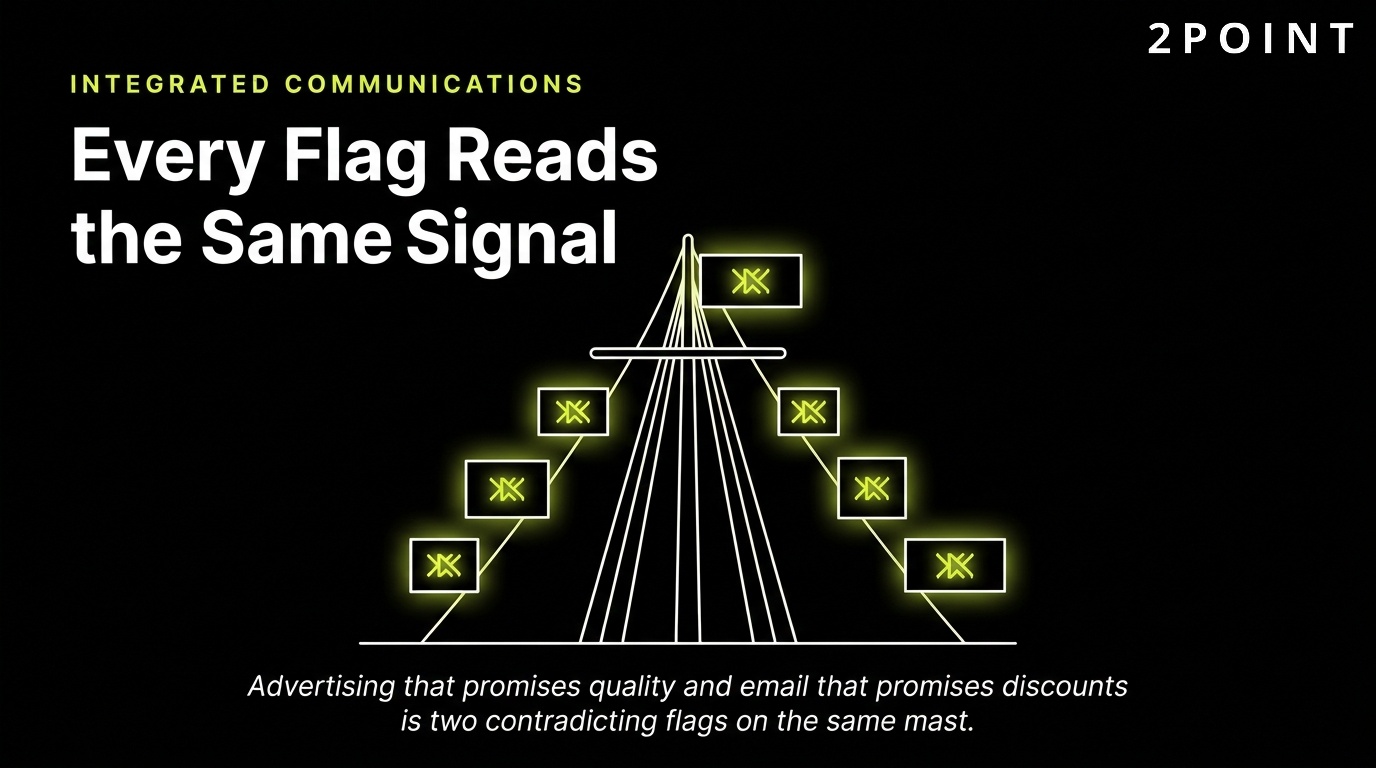
Integrated Marketing Communications (IMC) is the discipline of ensuring that all promotional activities communicate a consistent message across all channels and touchpoints. Without IMC discipline, a brand's advertising might communicate premium quality while its promotional emails communicate discount urgency, creating a contradictory brand signal that confuses customers and weakens both messages. IMC requires a unified messaging strategy, a shared brand voice, and coordination mechanisms across all teams and agencies involved in customer communications.
Traditional promotion tactics retain significant power and relevance in many contexts. Television and streaming video advertising reach massive audiences and remain particularly effective for brand awareness objectives in consumer categories. Radio and podcast advertising are experiencing a resurgence as audio consumption grows. Out-of-home advertising offers high-frequency exposure in specific geographic markets. Direct mail, once considered obsolete, has recovered effectiveness precisely because it is now so much less common than digital alternatives.
Selecting the right promotion mix for your specific audience, objectives, and budget requires disciplined analysis rather than trend-following. The most sophisticated promotional strategy is not necessarily the one that uses the most channels or the newest technologies. It is the one that deploys the right communications in the right channels at the right moments in the customer journey to move target customers toward purchase and loyalty. Understanding the differences between inbound and outbound marketing approaches is essential when building your promotion mix, as each serves different strategic purposes.
Digital Promotion Strategies
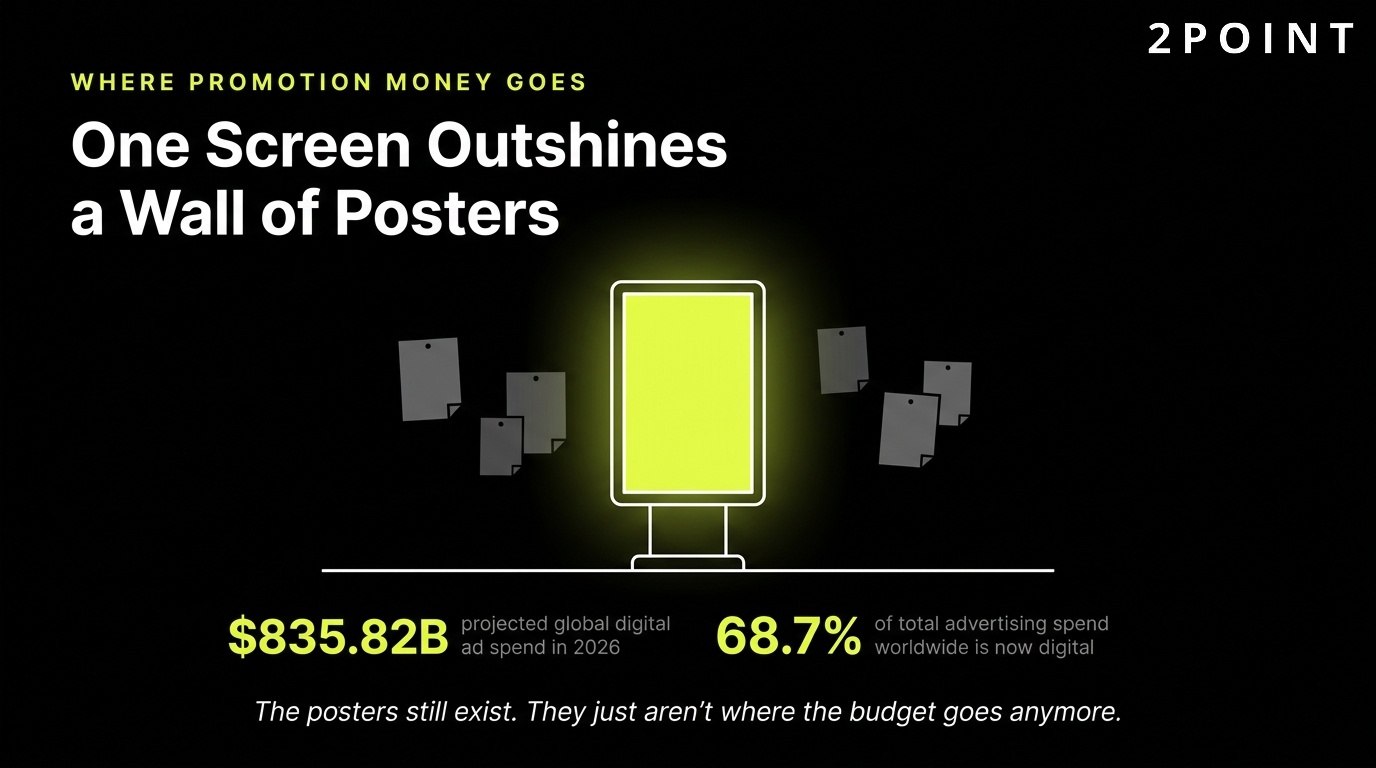
Digital channels now represent the dominant share of promotional investment for most organizations, and the numbers make the reason clear. Global digital advertising spend is projected at $835.82 billion in 2026, and digital now accounts for 68.7% of total advertising spend worldwide. Within digital, social media advertising alone represents a massive and growing channel: social media ad spend reached $317.3 billion globally in 2026, up from $247.3 billion in 2025.
Email marketing remains one of the highest-ROI digital promotion channels despite being among the oldest. Its directness, personalization capability, and measurability give it advantages that newer channels have not displaced. Modern email marketing, enhanced through email marketing automation, allows behavioral triggers, dynamic content, and sophisticated segmentation that deliver the right message to the right subscriber at the right moment in their relationship with the brand.
Content marketing builds long-term promotional value by creating useful, relevant content that attracts and retains audiences. Unlike advertising, which stops delivering when payment stops, quality content continues generating traffic, leads, and conversions long after its creation. Content marketing is particularly effective for B2B organizations and for consumer categories where purchase decisions involve significant research and comparison.
Social media marketing spans both organic community building and paid advertising, and the most effective social media strategies integrate both. Organic presence builds community, demonstrates brand personality, and creates the authentic content foundation that paid amplification then scales to larger audiences. Influencer partnerships have become a mainstream component of social promotion, with authenticity and audience fit now recognized as more important than raw reach metrics. Video marketing is particularly powerful within social promotion, given the dominant role of video content across virtually every platform.
Hyper-Personalization and AI-Driven Promotion
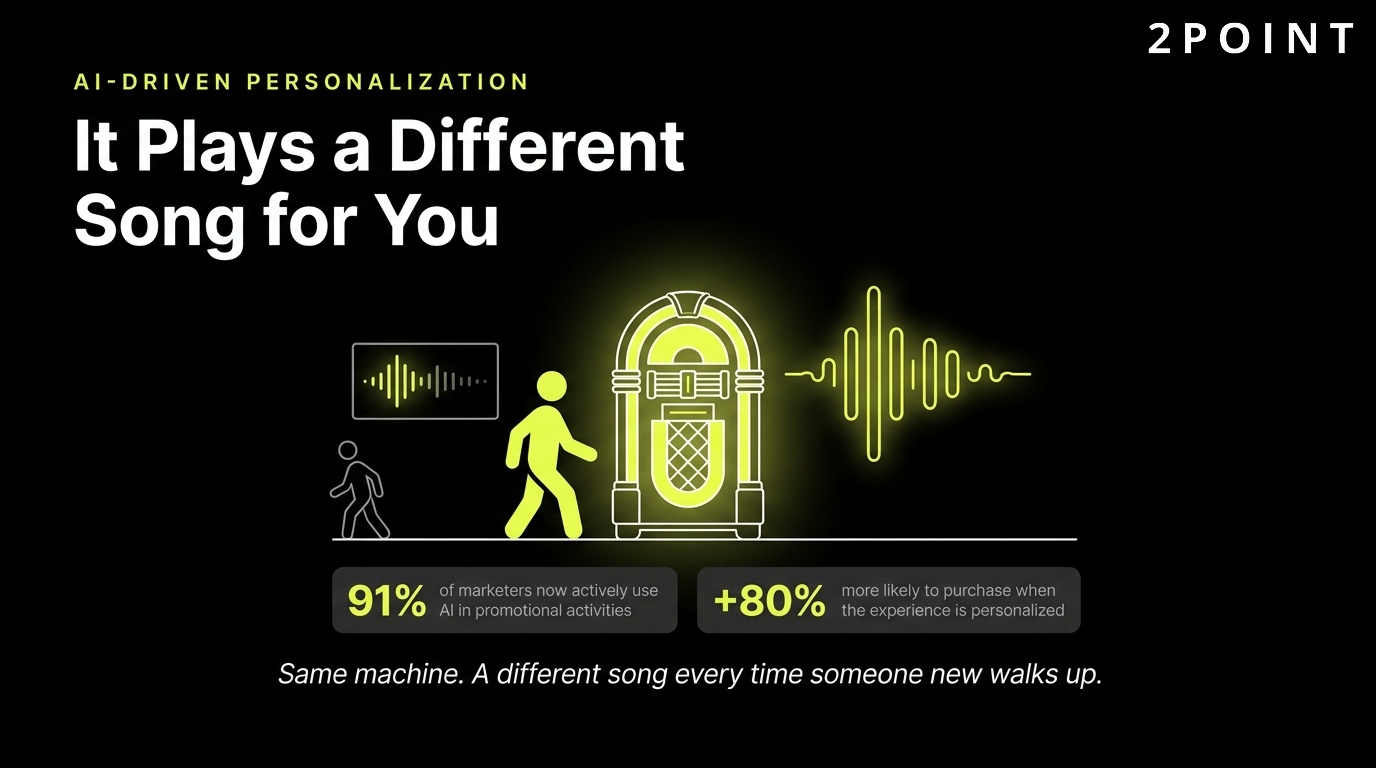
The promotional landscape has shifted from mass communication to individualized communication at scale, and AI technology is the primary driver of that shift. Where previous generations of marketing personalization involved addressing an email with a customer's name or segmenting audiences into broad demographic groups, 2026-era personalization operates at the individual level, tailoring content, timing, channel, creative, and offer to each customer's specific context, behavior, and preference history.
91% of marketers now actively use AI in their promotional activities, and the business case is compelling: 68% of businesses report increased content marketing ROI attributable to AI tools. Most significantly, consumers are 80% more likely to make a purchase when their experience is personalized to their individual context and preferences. These numbers explain why AI-driven personalization has moved from a competitive advantage to a baseline expectation in most categories.
Marketing automation workflows enable personalized promotional sequences that respond to customer behavior rather than calendar schedules. A customer who visits your pricing page but does not convert might receive a targeted case study email the following morning. A customer who abandons a cart might receive a reminder with a relevant testimonial. A loyal customer approaching their repurchase window might receive a loyalty reward offer. All of these sequences can run continuously without manual intervention, delivering personalized communication at a scale that would be impossible through manual execution.
Customer journey mapping and touchpoint optimization are the strategic disciplines that make AI-driven promotion coherent rather than just technically impressive. Mapping the specific stages a customer moves through from initial awareness to loyal advocacy, and identifying the promotional interventions most effective at each stage, provides the strategic framework within which AI tools operate most effectively. Without that framework, AI personalization optimizes tactically without strategic direction, often improving individual interaction metrics while failing to move customers through the journey efficiently.
Case Study: How Boxed Water's #BetterPlanet Campaign Demonstrates Promotion Excellence
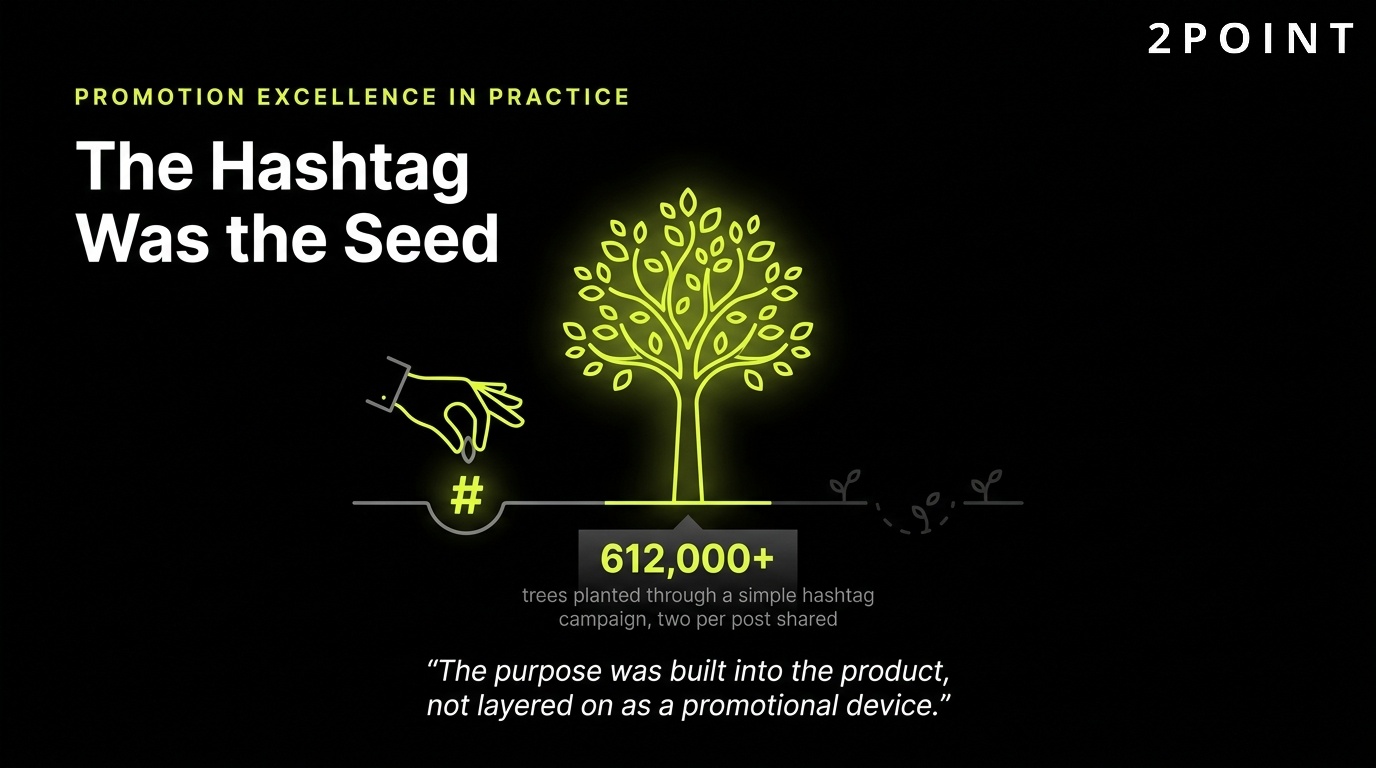
Boxed Water is Better, a sustainable packaging company, developed a promotional campaign that has become a widely studied example of purpose-driven marketing executed through user-generated content. The #BetterPlanet campaign invited social media users to share photos of themselves with Boxed Water products using the campaign hashtag, with the company committing to plant two trees for every post shared under the hashtag.
The campaign's design was elegant in its alignment across the marketing mix. The product itself, water in sustainable, plant-based packaging, was the physical embodiment of the environmental commitment the campaign communicated. The promotion asked customers to become co-creators and ambassadors, not passive recipients of advertising. The hashtag mechanism made participation frictionless and the contribution tangible: a specific, measurable outcome (two trees) resulted from a specific, easy action (a social post).
The #BetterPlanet campaign resulted in over 612,000 trees planted, a metric that simultaneously demonstrated the campaign's promotional reach and the brand's authentic commitment to its stated environmental values. That combination of scale and authenticity is precisely what drives the most durable promotional outcomes: customers who participate in a brand action that creates real-world impact become invested in the brand's success in a way that purely transactional customers never do.
The lessons for other businesses are clear. Authenticity in purpose-driven marketing requires that the purpose be genuinely embedded in the product and business model, not layered on as a promotional device. Customer empowerment through participation creates promotional content and brand advocacy that advertising spend alone cannot replicate. Measurable, specific commitments (two trees per post) are more credible and motivating than vague pledges. And campaigns that align all elements of the marketing mix, from product design through promotional mechanic, achieve outcomes that disconnected tactics cannot match. Building a personalized marketing strategy that resonates emotionally with your audience is at the heart of what made this campaign so effective.
Integrating the 4 Ps of Marketing into a Cohesive Strategy
System Thinking and Balance Across the Marketing Mix
The most common marketing mix failure mode is not weakness in a single P. It is misalignment between the Ps. A marketing team might invest heavily in developing a premium product, then undermine it with a pricing strategy that signals budget positioning, or distribute it through channels that contradict the brand's quality story, or promote it with messaging that attracts the wrong customer segment. Each individual decision might be internally defensible, but the combination creates a confused market offering that fails to deliver on any positioning.
Identifying imbalances in your current marketing mix requires stepping back from channel-level or tactic-level evaluation and assessing your mix as a complete system. The diagnostic question for each element is whether it reinforces or contradicts the customer promise implied by the other elements. If your product is genuinely premium, does your pricing position support that? Does your distribution channel quality match the expectation your promotional messaging creates? Does your promotional message accurately represent what the customer will experience when they receive the product?
The consequences of misalignment are concrete and measurable. High advertising investment driving traffic to a poor product experience produces high acquisition cost and high churn simultaneously, the worst possible combination. Excellent product quality sold through low-prestige channels prevents premium pricing and limits the addressable market. Strong brand positioning unsupported by consistent customer experience at every touchpoint creates a gap between expectation and reality that generates negative reviews and erodes the brand investment.
Achieving and maintaining harmony across the mix requires continuous adjustment based on performance data, not a one-time configuration exercise. Markets change. Customer expectations evolve. Competitive dynamics shift. The marketing mix that was optimal eighteen months ago may be suboptimal today. Building a regular cadence for marketing mix review, one that examines all four elements together rather than each in isolation, is a foundational practice of high-performing marketing organizations.
Data-Driven Marketing Mix Optimization
Customer behavior data is the primary input for marketing mix optimization decisions. Purchase patterns reveal which product variants, price points, channels, and promotional messages are driving conversion. Abandonment data reveals where friction or misalignment is causing customers to drop out of the journey. Return rates and reasons reveal gaps between promotional messaging and actual product experience. Support inquiry patterns reveal unmet needs or unclear communications that adjustments to product, promotion, or pricing could address.
Real-time feedback loops, enabled by digital analytics platforms, allow marketing teams to observe customer response to mix changes within hours or days rather than waiting for quarterly performance reports. This speed of feedback compresses the optimization cycle dramatically. A pricing adjustment can be tested, evaluated, and confirmed or reversed in days. A promotional message variant can be A/B tested across a live audience and the winner deployed within a week. This iterative, data-driven approach to mix optimization is a significant competitive advantage for organizations that build it into their operating rhythm.
Defining the right KPIs for each element of the mix is essential for meaningful measurement. Product metrics might include adoption rates, feature utilization, satisfaction scores, and return rates. Price metrics might include average transaction value, discount redemption rates, price sensitivity analysis results, and margin by segment. Place metrics might include channel acquisition cost, channel-specific conversion rates, and inventory turn by location. Promotion metrics might include reach, engagement, conversion rates, and cost per acquisition by channel.
A/B testing should be applied systematically across mix elements, not just to email subject lines and landing page headlines. Test pricing structures, channel emphasis, product bundle configurations, and promotional message strategies with the same rigor and scale you would apply to digital advertising creative. The learning generated from these tests builds institutional knowledge about what works for your specific customers in your specific market context, knowledge that is far more valuable than any general best practice.
Omnichannel Integration Across the Marketing Mix
Omnichannel integration is the operational manifestation of marketing mix systems thinking. When all four Ps are coordinated and consistent across all customer touchpoints, the result is an experience that feels coherent and trustworthy regardless of how or where a customer engages with the brand. That coherence is a significant competitive advantage in markets where fragmented experiences are the norm.
The technology requirements for omnichannel integration are substantial. A unified customer data platform that captures and connects customer interactions across all channels is the foundation. Without a shared data layer, different channels operate with incomplete pictures of the customer, making personalization impossible and creating jarring experience discontinuities. For example, a customer who has already purchased a product should not receive advertising for that same product. Achieving that level of coordination requires shared data.
Process integration is equally important. The experience a customer has when they contact support after a purchase through a social commerce channel should be as seamless and informed as the experience they would have had if they had purchased through the brand's own website. Achieving that parity requires standardized processes, shared training, and consistent service standards across every channel and team that touches the customer.
Channel silos are the organizational enemy of omnichannel integration. When teams are rewarded based on individual channel metrics rather than overall customer lifetime value, they have incentives to optimize for their channel at the expense of the overall experience. Restructuring incentives around customer-level outcomes, rather than channel-level metrics, is often the most important organizational change required to enable genuine omnichannel strategy.
Building a Customer-Centric Marketing Mix
The most strategically powerful shift in modern marketing mix thinking is the reorientation from product-out to customer-in. Rather than starting with a product and asking how to sell it, a customer-centric approach starts with a deep understanding of specific customer segments and asks what product, at what price, through what channels, communicated through what messages, would most effectively meet their needs and earn their business.
Customer research and persona development are the non-negotiable starting points for customer-centric mix design. Detailed personas that capture not just demographic characteristics but behavioral patterns, decision-making processes, information sources, purchase barriers, and success metrics give marketing teams a specific, human reference point for every mix decision. When evaluating a pricing strategy, the question is not "does this seem reasonable?" but rather "does this align with what our target persona values and can afford?"
Disciplined segmentation by need and behavior, rather than by demographic or firmographic characteristics alone, produces more actionable marketing mix decisions. Two customers with identical demographic profiles may have fundamentally different needs, buying journeys, and responses to promotional messages. Behavioral segmentation, identifying groups of customers who exhibit similar patterns of research, evaluation, and purchase, provides the basis for truly personalized mix strategies. Customer-centric marketing requires ongoing commitment to understanding how customer needs evolve across different lifecycle stages and relationship depths.
Continuous customer feedback integration keeps the marketing mix adaptive to changing customer expectations. Formal research (surveys, focus groups, customer interviews) provides structured insight. Informal channels (social listening, review monitoring, support ticket analysis) provide real-time, unfiltered signals about customer experience. The most effective marketing organizations maintain active listening systems across both formal and informal channels and build the insights into mix decisions on an ongoing basis.
Extended Frameworks: Beyond the Standard 4 Ps of Marketing
The 7 Ps Marketing Mix for Service Businesses
The 4 Ps were originally developed with physical product businesses primarily in mind. As service industries grew in economic significance and as product businesses increasingly competed on service dimensions, marketing theorists recognized that the original framework needed expansion. The 7 Ps model addresses this by adding People, Process, and Physical Evidence to the original four.
People refers to everyone who represents the brand in customer interactions: customer-facing staff, service delivery personnel, salespeople, and even other customers who are visible in the service environment. In service businesses, the people delivering the service are inseparable from the service itself. A restaurant with excellent food but poor service delivers a compromised product. A software company with powerful technology but poor customer success delivery creates customer churn regardless of feature quality. People strategy, including hiring, training, culture, and incentive design, is therefore a marketing strategy imperative in service businesses.
Process encompasses the systems and procedures through which service is delivered to customers. Efficient, reliable, transparent processes create customer confidence and reduce friction. Inconsistent or opaque processes create anxiety and reduce trust. Customer-facing process design, the steps a customer experiences from initial inquiry through service delivery and follow-up, is a direct determinant of customer satisfaction and retention in service categories.
Physical Evidence addresses the tangible elements that customers use to assess the quality of intangible services. For a hotel, physical evidence includes the lobby design, room quality, and brand materials. For a consulting firm, physical evidence includes office environment, presentation quality, and report design. For a digital service, physical evidence includes interface design, response time, and the quality of any physical deliverables. Physical evidence provides the cues customers use to form quality judgments when the service itself is difficult to evaluate before purchase.
The 4 Cs: A Customer-Focused Alternative to the 4 Ps
Robert Lauterborn proposed the 4 Cs framework in 1990 as a customer-centric reframing of the 4 Ps. Rather than describing the marketing mix from the seller's perspective, the 4 Cs describe it from the buyer's perspective. The reframe is not a replacement for the 4 Ps but a complementary lens that helps marketers stress-test their mix decisions against customer reality.
| 4 Ps (Seller Perspective) | 4 Cs (Buyer Perspective) | Strategic Shift |
|---|---|---|
| Product | Customer Solution | From "what we sell" to "what problem we solve" |
| Price | Customer Cost | From transaction price to total cost of ownership |
| Place | Convenience | From distribution logistics to purchase ease |
| Promotion | Communication | From one-way messaging to two-way dialogue |
The 4 Cs framework is most valuable as a diagnostic tool: after designing a marketing mix using the 4 Ps, applying the 4 Cs lens reveals whether the mix genuinely serves the customer or merely serves the organization's preferences and convenience.
Customer Solution thinking challenges marketers to articulate not what the product is but what problem it solves and what benefit it delivers. Customer Cost thinking expands the price consideration to include all costs a customer incurs: not just the transaction price but the time investment, switching cost, learning curve, and ongoing maintenance costs associated with a purchase. Convenience asks not whether the distribution system is efficient for the seller but whether it is easy for the customer. Communication replaces the one-way broadcast model of promotion with a two-way dialogue model that reflects how modern customers expect to engage with brands.
The New Digital 4 Ps: Process, People, Platform, and Performance
A newer framework specifically designed for digital marketing contexts proposes a reimagined set of 4 Ps: Process, People, Platform, and Performance. This framework does not replace the original 4 Ps but rather provides a complementary lens for addressing the specifically digital dimensions of modern marketing mix strategy.
In this digital framework, Process refers to the customer's digital journey: the specific sequence of digital touchpoints, interactions, and experiences through which a customer moves from initial awareness to purchase and beyond. Mapping and optimizing this digital process is equivalent to the distribution channel management in the original Place P, but specifically focused on the design of digital customer journeys.
People in the digital context refers to audience definition and personalization: the specific segments, personas, and individual customers whose needs, behaviors, and preferences shape digital strategy. This extends the original People P from the 7 Ps model into the digital personalization domain, emphasizing that effective digital marketing treats audiences as collections of individuals rather than undifferentiated masses.
Platform addresses the technology infrastructure through which digital marketing is delivered and managed: the CRM, marketing automation system, analytics platform, content management system, and data infrastructure that enable personalized, measurable, scalable digital marketing. Platform decisions have become strategic marketing decisions, not just technical IT decisions, because they determine what marketing capabilities are actually achievable.
Performance replaces the traditional measurement afterthought with a central strategic discipline: the continuous measurement, analysis, and optimization of digital marketing effectiveness. In a digital environment where almost every customer interaction can be tracked and measured, performance management is not just an accountability exercise but a real-time optimization capability that drives continuous improvement across all other elements of the mix.
Choosing the Right Marketing Framework for Your Business
With multiple marketing mix frameworks available, the question of which to use is a practical one that should be answered based on your specific business model, industry context, and strategic priorities. No single framework is universally superior; each has contexts where it provides more useful analytical value.
The original 4 Ps are the right starting point for virtually every business: they provide the foundational strategic structure that ensures all four dimensions of market offering strategy are explicitly addressed. If you are in a product-based business with relatively straightforward service components, the 4 Ps may be sufficient as your primary framework. For understanding the distinctions between B2B and B2C marketing contexts and how the mix differs between them, the 4 Ps provide the common language for comparison.
The 7 Ps are most valuable for service-intensive businesses where the quality of people, processes, and physical evidence directly determines service quality. Professional services firms, hospitality businesses, financial services organizations, and healthcare providers typically benefit significantly from the additional analytical structure the 7 Ps provide.
The 4 Cs work best as a diagnostic complement to the 4 Ps rather than a replacement, helping you stress-test whether your mix is genuinely customer-centric or is inadvertently optimized for internal convenience. Using both frameworks together produces the most complete strategic picture. The digital 4 Ps are most relevant for digitally native businesses or for traditional businesses undergoing significant digital transformation, where the specific challenges of digital customer journey design, technology platform selection, and performance measurement dominate the strategic agenda.
Implementing the 4 Ps of Marketing: A Step-by-Step Practical Guide
Step 1: Conduct Customer and Market Research
Every effective marketing mix strategy begins with rigorous research rather than assumption. Customer and market research provides the factual foundation on which every subsequent decision is built. Without it, the 4 Ps become an exercise in articulating preferences rather than a strategic response to market reality.
Customer segmentation is the starting point: dividing your total addressable market into distinct groups that share meaningful characteristics, needs, and behaviors. The most useful segmentation for marketing mix purposes is behavioral and needs-based rather than purely demographic. Who has the problem your product solves? How do they currently address that problem? What do they find frustrating about current solutions? What would make a new solution worth switching to? These questions, answered through qualitative research (customer interviews, focus groups) and validated through quantitative methods (surveys, usage data analysis), produce the customer insight that drives every P.
Competitive analysis across all four Ps reveals the strategic landscape you are operating in and identifies differentiation opportunities. Analyze not just competitor pricing but competitor product positioning, distribution strategies, and promotional approaches. Where are competitors concentrated? Where are they absent? Where are they vulnerable? A rigorous competitive analysis identifies the white space where your marketing mix can deliver distinctive value. For businesses concerned about identifying gaps, reviewing signs of a weak marketing strategy can reveal areas requiring immediate attention.
Market trend identification requires looking beyond current competitive dynamics to understand where customer needs, technology capabilities, and market conditions are heading. The marketing mix you design today will be deployed over the coming months and years. Building in awareness of directional trends, such as the continued growth of social commerce, the increasing expectation of personalization, or shifts in customer price sensitivity, ensures your mix is designed for the market you will be competing in, not just the market that exists today.
Step 2: Define Your Marketing Mix Strategy and Set Clear Goals
With research completed, the next step is translating customer and market insight into explicit strategic decisions for each P and connecting those decisions to measurable business objectives. This is where the 4 Ps framework does its most important analytical work: forcing explicit, documented choices rather than allowing strategy to emerge implicitly from tactical decisions. Setting clear marketing goals at this stage gives each element of your mix a performance target against which execution can be evaluated.
Setting objectives for each P means defining what success looks like in specific, measurable terms. For Product: what does a successful product experience look like, measured through satisfaction scores, feature adoption rates, or return rates? For Price: what revenue per unit, margin, or average transaction value indicates pricing effectiveness? For Place: what channel mix, conversion rates, and customer acquisition costs define distribution success? For Promotion: what reach, engagement, and conversion metrics indicate promotional effectiveness? These objectives become the KPIs that guide ongoing measurement and optimization.
Budget allocation across the mix is one of the most consequential strategy decisions. Most marketing budget frameworks allocate primarily to promotion, with relatively limited explicit budget for product development, distribution channel investment, or pricing research. This allocation often reflects organizational silos (the "marketing budget" funds promotion while "product" and "operations" budgets fund the other Ps) rather than a strategic assessment of where investment will generate the greatest return. A 4 Ps strategy review should examine resource allocation across all four elements, not just within the promotional budget.
Timeline and milestone planning converts the strategy into an executable roadmap. Which mix elements need to be established or adjusted first? What are the dependencies between elements? What are the key milestones that indicate the strategy is on track? A phased implementation plan that acknowledges the interdependencies between mix elements is more realistic and more manageable than one that treats all changes as simultaneous and independent.
Step 3: Execute and Coordinate Across Channels
Strategy without coordinated execution produces no market results. The execution phase is where the marketing mix strategy connects to the customer through every channel and touchpoint, and where the quality of internal coordination determines whether the customer experiences a coherent brand or a collection of unconnected communications.
Cross-functional team coordination is the organizational imperative of integrated marketing execution. Product, pricing, distribution, and promotional decisions involve teams across the organization: product development, finance, operations, sales, and marketing all have roles to play. Without explicit coordination mechanisms, these teams will make decisions that are locally rational but collectively incoherent. Shared planning processes, regular cross-functional review meetings, and clearly designated owners for integration decisions are the structural mechanisms that enable coordination.
Message consistency across channels requires a documented messaging framework that all teams and agencies use as their creative brief foundation. The messaging framework defines the brand's core value proposition, the specific benefits it offers to target customer segments, the tone and voice appropriate to the brand, and the specific claims and proof points that support the positioning. Every promotional execution, regardless of channel or format, should be traceable back to this framework.
Technology platform utilization enables the scale and personalization that modern execution requires. Marketing automation tools, CRM systems, analytics platforms, content management systems, and paid advertising platforms all play roles in efficient, coordinated execution. Marketing automation in particular allows personalized, triggered communications to reach customers at the right moments in their journey without requiring manual intervention at each touchpoint. Internal communication and training ensure that everyone involved in customer-facing execution understands the strategy, the messaging framework, and their specific role in delivering a consistent brand experience.
Step 4: Measure, Analyze, and Optimize Your Marketing Mix
The fourth step is not a final destination but the beginning of a continuous improvement cycle. Measurement reveals what the market is telling you about the effectiveness of your mix decisions. Analysis converts those signals into actionable insight. Optimization translates that insight into mix adjustments that improve performance. And then measurement begins again.
Analytics tools and dashboards should be configured to report on the KPIs defined in Step 2, organized by the P they measure rather than by channel. This P-centric reporting structure makes it easier to diagnose which element of the mix is driving performance or causing problems, rather than attributing results to channels when the real cause may be product, pricing, or messaging issues.
Performance review cadence should be aligned with the speed of your market and the pace of mix changes. A fast-moving e-commerce business might review promotional performance weekly and pricing performance monthly, with product and distribution reviews quarterly. A B2B enterprise software business might operate on longer cycles given longer sales cycles and slower market dynamics. The key is that reviews are regular, scheduled, and attended by the decision-makers who have authority to act on findings.
Identifying optimization opportunities requires looking for patterns rather than reacting to individual data points. A single high-performing campaign does not prove your promotional strategy is optimal. A sustained pattern of superior performance in specific channels, audience segments, or message types indicates a genuine strategic insight worth doubling down on. Similarly, consistent underperformance in specific areas signals a mix element that requires strategic reconsideration rather than tactical adjustment. Digital marketing tools make it easier than ever to identify these patterns quickly and act on them with precision.
The 4 Ps of Marketing: Building Your Competitive Advantage for 2026 and Beyond
After more than seven decades, the 4 Ps of marketing remain the most widely used strategic framework in business education and practice. Not because marketers lack imagination or resist new ideas, but because the framework describes something that is genuinely and durably true: every market offering requires coherent decisions about what it is, what it costs, where it is available, and how customers learn about it. That logic does not expire.
What has transformed, profoundly and permanently, is how each P is executed. The product dimension now includes digital experience as a core quality attribute. The price dimension now includes algorithmic dynamic adjustment as a standard tool. The place dimension now encompasses a global, always-on, multi-channel touchpoint ecosystem. The promotion dimension now deploys AI-driven personalization at individual scale across dozens of channels simultaneously. These executional transformations have made the framework more powerful and more complex to execute well, not less relevant.
Budget pressure makes strategic framework discipline more critical than ever. When 59% of CMOs describe their budgets as insufficient, the ability to allocate limited resources to the highest-impact mix decisions separates organizations that grow efficiently from those that chase tactics and generate noise without results. The 4 Ps framework provides the analytical structure for making those allocation decisions based on strategic logic rather than trend-following or internal politics.
The extended frameworks, the 7 Ps, the 4 Cs, and the digital 4 Ps, add useful analytical dimensions without replacing the core framework. They are best understood as lenses that help you examine your mix from different angles: the service quality angle, the customer perspective angle, and the digital execution angle. Using them in combination with the original 4 Ps produces the most complete strategic picture.
Your immediate next step should be an honest audit of your current marketing mix. Do your four Ps tell a consistent story? Does your product deliver what your promotion promises? Does your pricing reflect your product's genuine value proposition? Are your distribution channels matched to where your target customers actually spend time? Do your promotional activities reach the right people with the right message at the right moments? If any of these questions reveals a gap or misalignment, you have found your optimization priority.
Start that audit with customer research, not with internal discussion. What customers actually experience and value is the only valid reference point for evaluating your mix's effectiveness. Their behavior, their feedback, and their choices reveal the truth about your current mix's performance more accurately than any internal assessment can.
Looking forward, AI and emerging technologies will continue transforming how each P is executed, at what speed, at what level of personalization, and at what scale. Core principles will remain stable. The organizations that build competitive advantage will be those that master both dimensions: strategic framework discipline through the 4 Ps, and executional excellence through the best available technologies and data capabilities.
Teams like those at 2POINT work with brands every day to translate marketing mix strategy into coordinated, measurable digital execution across all four Ps. The framework is the foundation. Disciplined execution and continuous optimization are where the competitive advantage is actually built.
Frequently Asked Questions About the 4 Ps of Marketing
What are the 4 Ps of marketing in simple terms?
The 4 Ps of marketing are Product (what you sell), Price (what customers pay), Place (where and how customers buy), and Promotion (how you communicate with customers). Together, these four elements form the marketing mix framework used to bring products and services to market effectively. The framework was created by E. Jerome McCarthy in 1960 and remains the foundational structure for marketing strategy worldwide.
Who invented the 4 Ps of marketing?
E. Jerome McCarthy introduced the 4 Ps framework in his 1960 textbook Basic Marketing: A Managerial Approach. McCarthy simplified Neil Borden's earlier 12-element marketing mix framework into four core categories. Philip Kotler later popularized the framework through his extensive academic and consulting work, making it the global standard for marketing strategy education and practice.
Why are the 4 Ps of marketing still relevant today?
The 4 Ps remain relevant because every market offering, regardless of industry or technology context, requires decisions about what it is, what it costs, where customers access it, and how they learn about it. Digital transformation has changed how each P is executed but has not changed the underlying logic. The framework's simplicity and completeness make it a durable tool for strategic decision-making even as individual tactics evolve rapidly.
What is the most important P in the marketing mix?
No single P is universally the most important, because the four elements function as an interdependent system where misalignment in any one area undermines the others. That said, Product is often considered the foundation because every other decision depends on what the product actually is and what value it delivers. A strong product with a poorly aligned price, place, or promotion strategy will underperform, but a weak product cannot be saved by excellence in the other three Ps.
What is the difference between the 4 Ps and the 7 Ps of marketing?
The 7 Ps framework extends the original 4 Ps by adding People, Process, and Physical Evidence. These three additional elements address dimensions that are particularly important in service businesses, where the people delivering the service, the processes through which it is delivered, and the tangible cues that signal quality are central to customer experience. The 7 Ps are typically used by service-intensive businesses, while the 4 Ps serve as the universal starting framework for all business types.
What is the difference between the 4 Ps and the 4 Cs of marketing?
The 4 Ps describe the marketing mix from the seller's perspective (Product, Price, Place, Promotion), while the 4 Cs reframe the same decisions from the buyer's perspective (Customer Solution, Customer Cost, Convenience, Communication). The 4 Cs are not a replacement for the 4 Ps but a complementary analytical lens that helps marketers evaluate whether their mix genuinely serves customer needs rather than internal organizational preferences. Using both frameworks together produces a more complete strategic picture.
How do you apply the 4 Ps of marketing to a digital business?
For digital businesses, Product includes the digital product experience, interface quality, and platform performance. Price encompasses digital pricing models including subscriptions, freemium tiers, and dynamic pricing. Place includes the website, app, marketplace listings, and social commerce channels where customers discover and purchase. Promotion encompasses digital advertising, content marketing, email marketing, social media, and influencer partnerships. The principles are identical to traditional application, but every execution mechanism is digital.
Can the 4 Ps of marketing be applied to B2B businesses?
Yes, the 4 Ps apply fully to B2B businesses, though the specific strategies within each P differ from B2C applications. B2B products often involve customization and complex feature sets. B2B pricing typically involves negotiation, volume discounts, and contract terms. B2B place strategies emphasize direct sales, partner channels, and professional networks. B2B promotion relies more heavily on content marketing, thought leadership, trade events, and personal selling than mass media advertising. The framework is universal across business models.
How often should a business review its marketing mix?
Most businesses should conduct a comprehensive marketing mix review at least quarterly, with more frequent tactical reviews of specific elements like promotional performance (weekly or monthly) and pricing (monthly). Major strategic reviews should occur annually or when significant market changes occur, such as a major competitive entry, a shift in customer behavior, or a significant change in business objectives. The marketing mix should be treated as a living strategy, not a static document.
What happens when the 4 Ps of marketing are misaligned?
Misalignment between the four Ps creates customer confusion, wasted marketing investment, and missed revenue opportunities. For example, a premium product priced below its quality level signals low confidence in the product's value. A product with strong promotional investment distributed through channels that target customers do not use generates awareness without conversion. Each misalignment has specific, measurable negative consequences for customer experience and business performance.
How does pricing strategy affect the rest of the marketing mix?
Pricing affects all other Ps because it communicates the brand's value positioning to customers. A premium price point requires a product experience that justifies it, distribution channels that match the quality signal, and promotional messaging that supports the premium positioning. A budget price point implies different product feature tradeoffs, broader and more accessible distribution, and promotion focused on value and affordability. Every pricing decision ripples through the entire marketing mix.
What tools help businesses optimize their marketing mix strategy?
Marketing mix optimization draws on analytics platforms (Google Analytics, Adobe Analytics), CRM systems (Salesforce, HubSpot), marketing automation tools, A/B testing platforms, social listening tools, and competitive intelligence software. Customer research tools including survey platforms and user testing software provide the qualitative and quantitative customer insight that guides mix decisions. AI-powered tools are increasingly used to analyze large data sets and identify optimization opportunities across all four Ps simultaneously.
