

 let’s connect


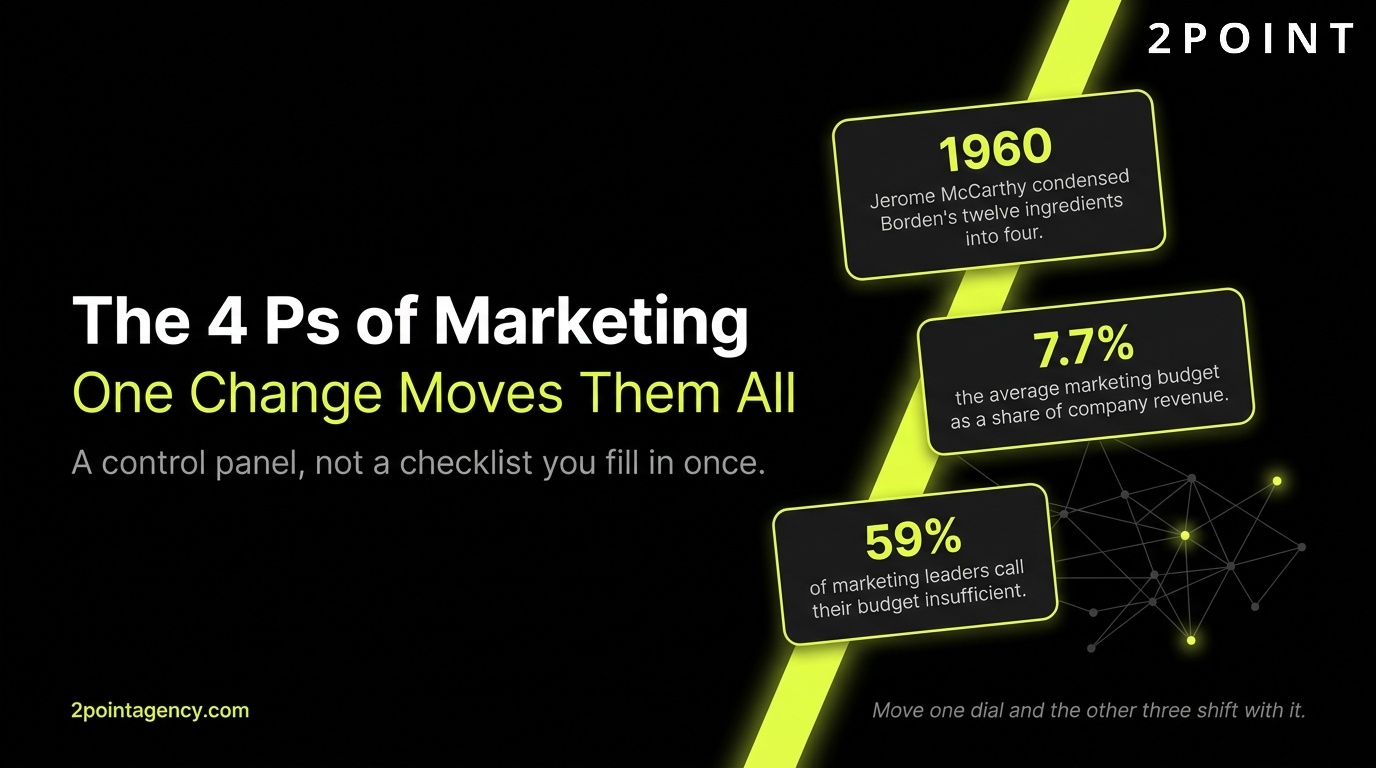
What Are the 4 Ps of Marketing? A Direct Answer
- The 4 Ps of marketing are Product, Price, Place, and Promotion.
- Jerome McCarthy introduced the 4 Ps framework in 1960 as a practical model for marketers.
- Each P represents a distinct strategic decision that shapes how a business reaches customers.
- Product defines what you sell, including features, design, and the value it delivers.
- Price determines revenue and communicates perceived value to your target market.
- Place covers how and where customers access your product or service.
- Promotion encompasses every method you use to communicate your offering to potential buyers.
- The 4 Ps work as an integrated system, not as independent checkboxes.
- Marketers in 2026 use the framework as a dynamic control panel, adjusting each element based on real-time data.
- The model applies equally to B2B, B2C, digital products, and physical goods.
Why the 4 Ps of Marketing Still Define Strategic Success in 2026
Every business faces the same fundamental challenge: how do you coordinate dozens of marketing decisions, across teams, channels, and timelines, without losing focus on what actually moves customers to buy? Pricing strategies influence channel selection. Channel decisions shape promotional tactics. And all of it circles back to whether the product delivers on its promise. Without a structured framework, these decisions become reactive, disconnected, and expensive to fix after the fact.
The 4 Ps of marketing exist precisely to solve that coordination problem. The concept of a "marketing mix" first appeared in the 1950s through Harvard professor Neil Borden, who described marketing as a recipe with multiple ingredients that could be mixed in different proportions. Jerome McCarthy then sharpened that concept into the four-category framework we recognize today, published in his 1960 textbook "Basic Marketing: A Managerial Approach." Philip Kotler later popularized the 4 Ps through his influential marketing textbooks, cementing the model's place in business education and practice for decades.
What makes this framework remarkable is its durability. Despite seismic shifts in technology, consumer behavior, and media landscapes, the 4 Ps have not become obsolete. They have evolved. Research into the marketing mix in the digital age confirms that the core categories remain structurally sound, even as the tactics within each P have multiplied dramatically. A "Place" decision that once meant selecting a retail shelf now includes app store optimization, e-commerce platform selection, and direct-to-consumer delivery logistics. The container has held while the contents have expanded.
In 2026, the 4 Ps matter more than ever because marketing budgets are under pressure, attention is fragmented across more channels than any previous era, and customers have higher expectations for relevance and convenience. Businesses that treat the 4 Ps as a living decision-making system, rather than a one-time planning exercise, consistently outperform those that treat marketing as a series of disconnected campaigns. This guide will walk you through each P in depth, explain how they interact, explore the customer-centric evolution of the model, and give you practical tools to apply the framework regardless of your industry or budget. By the end, you will have a clear, actionable understanding of how to build a marketing mix that actually delivers results.
Understanding the Marketing Mix Foundation
The Origins and Evolution of the 4 Ps Framework
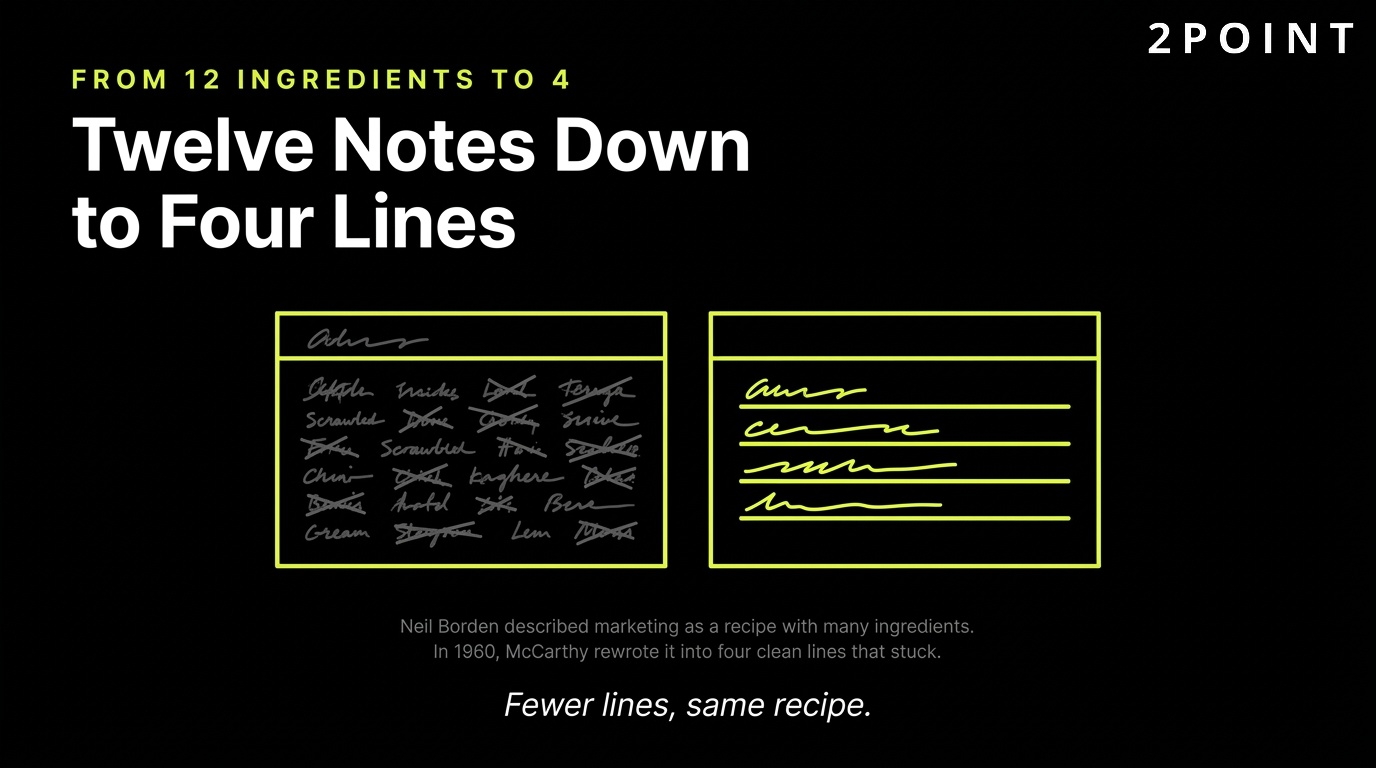
The story of the 4 Ps begins with Neil Borden's 1950s work at Harvard Business School, where he identified twelve ingredients that marketers blend to influence buyer behavior. His original "marketing mix" was comprehensive but unwieldy, more of a checklist than an actionable framework. Jerome McCarthy condensed Borden's twelve elements into four categories in 1960, creating the Product, Price, Place, Promotion model that would become the most widely taught marketing framework in history.
McCarthy's genius was in the simplification. By grouping related decisions under four memorable headers, he gave marketing managers a practical mental model they could apply across industries, budgets, and business types. The framework spread rapidly through business schools and corporate training programs throughout the 1960s and 1970s. Philip Kotler's endorsement and elaboration of the 4 Ps in his landmark textbooks solidified their status as the foundational vocabulary of marketing strategy.
Over the following six decades, marketers proposed numerous extensions to the original model. The 7 Ps added People, Process, and Physical Evidence, particularly relevant for service businesses. The 4 Cs reframed the model from a customer perspective. The 4 Es pushed even further toward experiential and emotional considerations. Yet despite these variations and expansions, the original 4 Ps remained the bedrock framework that practitioners returned to again and again, precisely because of its structural clarity and universal applicability.
The framework's evolution reflects a broader maturation in marketing thought: moving from product-centric to customer-centric thinking, from mass communication to personalized engagement, and from intuition-based decisions to data-driven optimization. Understanding this history is not just academic. It helps you recognize which version of the framework fits your current business context and how to adapt the model without losing its analytical power.
Why the Marketing Mix Still Matters in 2026
Some frameworks become relics. The 4 Ps have not. In 2026, their relevance is arguably stronger than at any previous point, precisely because the explosion of marketing channels and tactics has made structured decision-making more essential, not less. The 4 Ps provide a structured way to think about marketing decisions at a time when marketers face an overwhelming array of tools, platforms, and approaches. Without a unifying framework, it is easy to chase tactics without strategy.
The persistence of the 4 Ps is also supported by empirical evidence. Research on the evolving marketing mix in the digital age demonstrates that the framework's core categories continue to predict purchase intention when properly applied in digital contexts. The study found that digital adaptation of each P, particularly in how products are presented and how promotion is personalized, significantly affects buyer behavior, validating the framework's continued utility.
Modern marketing analytics have actually made the 4 Ps more powerful by enabling precise measurement of each element's contribution to outcomes. Marketing mix modeling in 2026 allows businesses to quantify how changes in pricing, distribution channel investment, and promotional spend contribute to revenue, turning the qualitative framework into a quantitative optimization tool. This integration of classical structure with modern data capabilities is what keeps the 4 Ps relevant and actionable for businesses of all sizes.
The key shift is treating the 4 Ps as a control panel rather than a static plan. A control panel is designed to be adjusted in real time based on what the instruments tell you. A static plan is written once and consulted rarely. The businesses winning in 2026 are treating their marketing mix as the former.
How the 4 Ps Work Together as a System
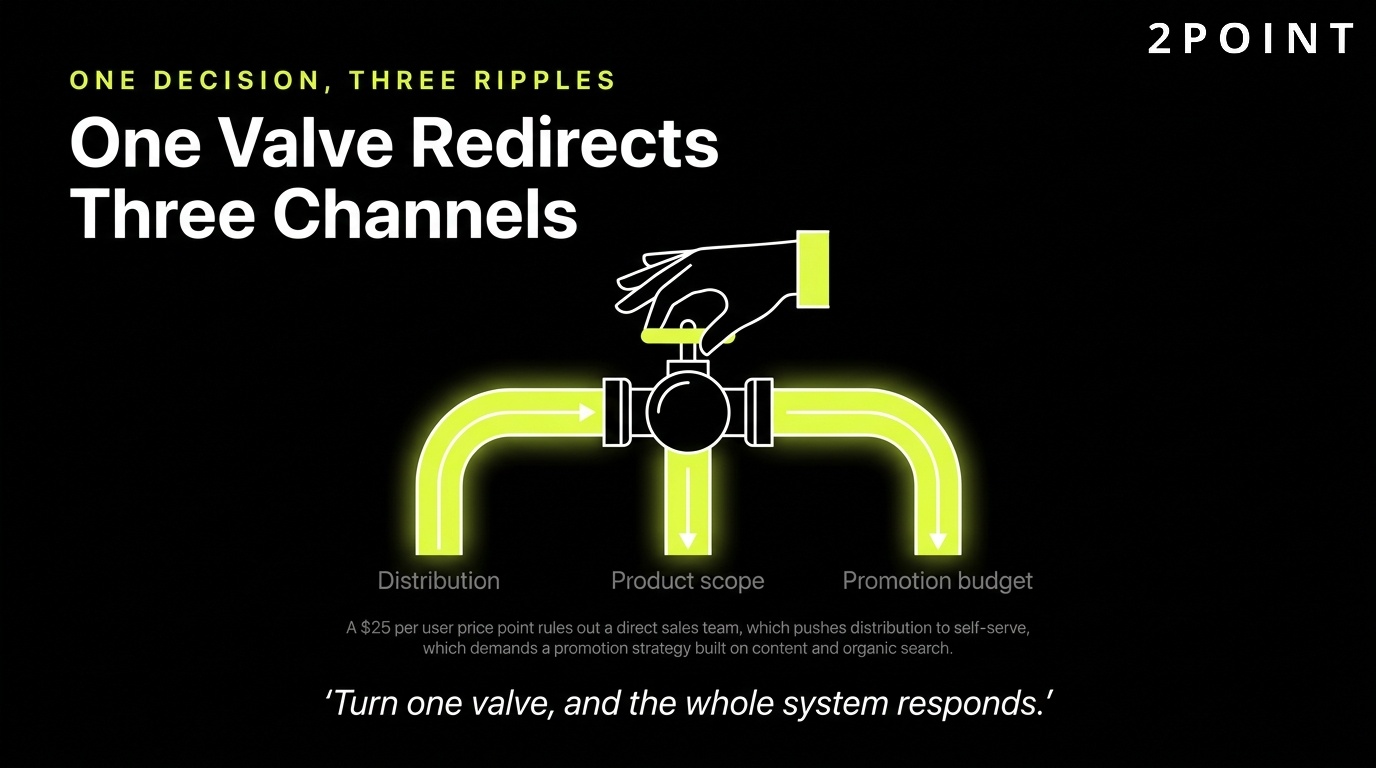
One of the most important and frequently overlooked aspects of the 4 Ps framework is that each element profoundly influences the others. They do not operate in independent silos. The 4 Ps are interdependent variables where a decision in one area creates ripple effects across the entire mix. Recognizing these interdependencies is what separates sophisticated marketers from those who treat each P as a standalone decision.
Consider a practical example: a developer tool company that decides to position its product at $25 per user per month. That pricing decision immediately shapes distribution strategy, because at that price point, the economics of a direct sales team do not work. The company must rely on self-serve digital distribution, which in turn demands that the promotional strategy heavily invest in content marketing and organic search to drive trial. The product itself may need to be simplified to enable that self-serve model. One change in any of the four variables triggers reconsideration of all the others, and that is by design.
The risks of disconnected execution are significant. A company that builds a premium product but prices it like a commodity confuses the market and undermines its own value proposition. A business that invests heavily in promotion but distributes through channels that create friction for buyers wastes its advertising investment. A service that prices aggressively to penetrate the market but then lacks the distribution infrastructure to fulfill orders at scale destroys customer trust at the moment of conversion. Cohesion across the 4 Ps is not just a best practice. It is a competitive advantage that compounds over time as each element reinforces the others.
When all four elements align around a clear target customer and a consistent value proposition, the marketing mix creates a self-reinforcing system where every touchpoint tells the same story, builds the same expectations, and delivers the same experience. That consistency is what transforms marketing from an expense into an investment.
Common Misconceptions About the Marketing Mix
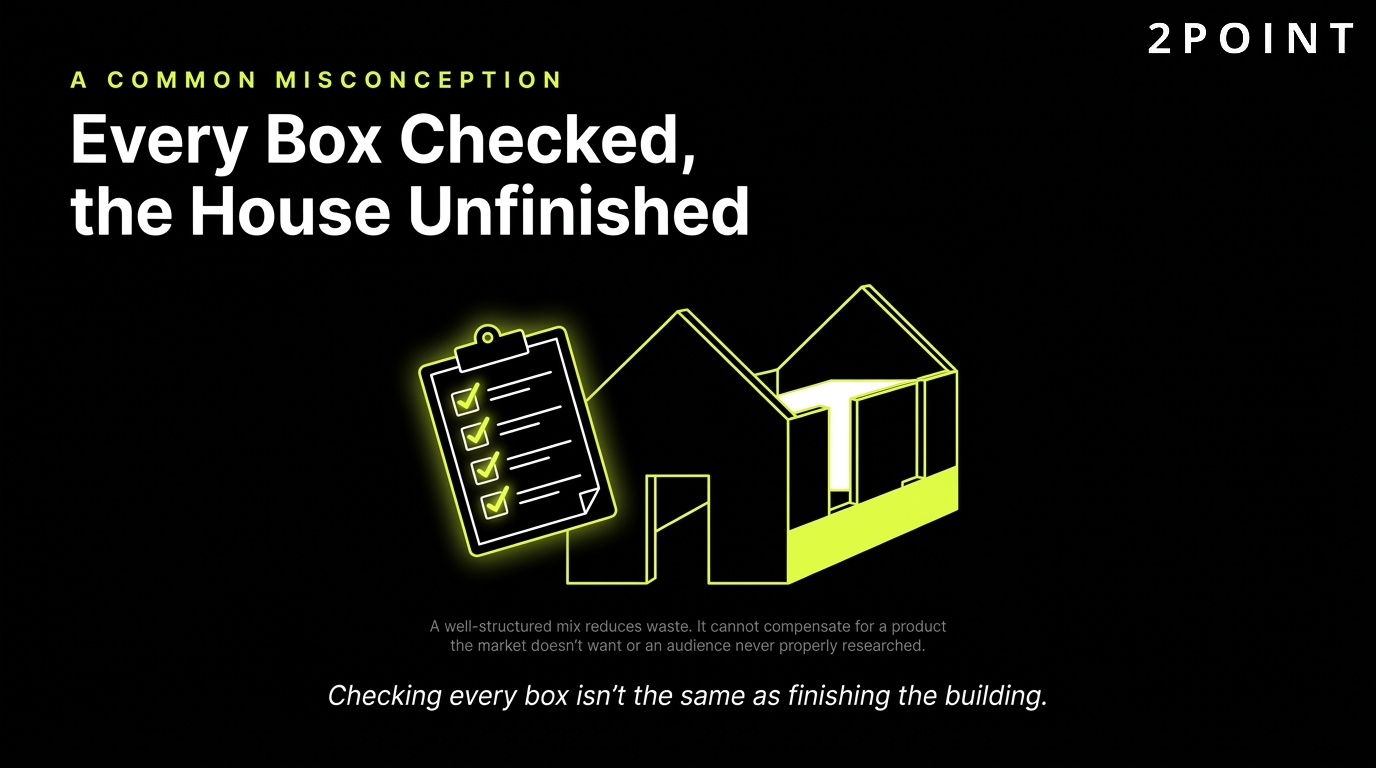
A common misconception about the marketing mix is that it functions as a checklist: fill in the boxes, and your marketing strategy is complete. This misunderstanding leads organizations to treat the 4 Ps as a one-time planning exercise rather than an ongoing strategic discipline. The reality is that the mix requires continuous monitoring, testing, and adjustment as market conditions, customer expectations, and competitive dynamics evolve.
Another persistent misconception is that the 4 Ps are primarily a B2C tool, useful for selling consumer goods but less relevant for business-to-business companies or service providers. This is incorrect. The framework applies equally across business models. A B2B software company makes deliberate decisions about product features, pricing structures, distribution channels, and communication strategies, all of which map directly onto the 4 Ps. Service businesses use the extended 7 Ps model, which builds on the original four rather than replacing them.
Many marketers also believe that executing the 4 Ps framework guarantees marketing success. It does not. What it does is reduce waste by forcing alignment and deliberate decision-making. A well-structured marketing mix reduces the likelihood of expensive misalignments, but it cannot compensate for a product the market does not want or a target audience that has not been properly researched. The framework is a tool for organizing decisions, not a substitute for customer insight.
Perhaps the most consequential misconception is that the 4 Ps are product-outward by nature, starting with what you have and then figuring out how to sell it. Effective application of the framework actually begins with customer research and works backward to inform each P. When businesses start with the customer's needs, behaviors, and preferences, every element of the mix can be designed to resonate rather than simply to exist.
Product: Building What Customers Actually Want
Defining Product Beyond Physical Features
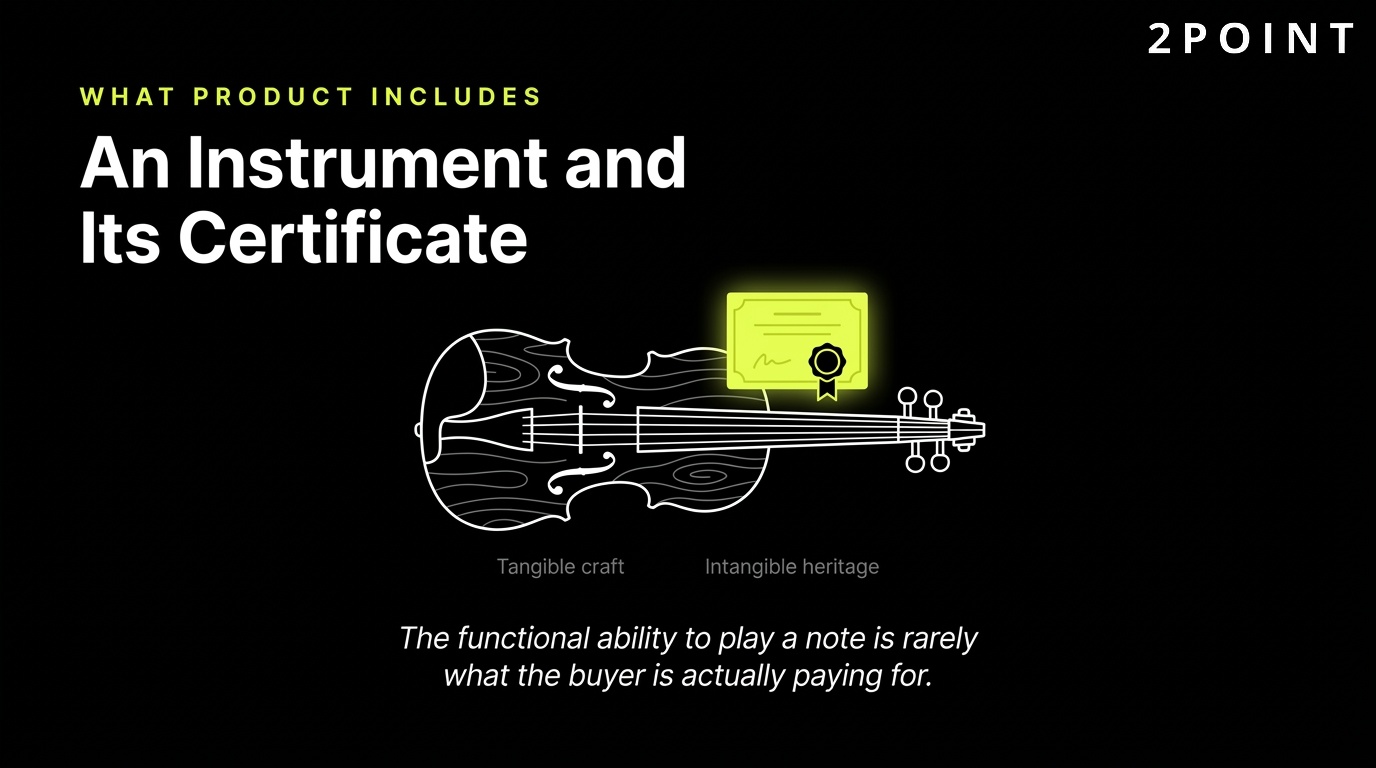
In the context of the 4 Ps of marketing, "product" encompasses far more than the physical object or software application a company sells. A product includes the tangible and intangible elements that deliver value to a buyer, from the core functionality to the packaging, the brand name, the warranty, the customer service experience, and the emotional associations that the offering creates. Every element of what a customer receives, perceives, and remembers about your offering is part of the product in this broader sense.
Tangible product elements include physical design, materials, dimensions, colors, packaging, and the functional performance of the item itself. Intangible elements include quality standards, brand reputation, after-sales support, and the status or identity signals the product conveys to the user. For a luxury watch, the intangible elements of craftsmanship heritage and social signaling are arguably more valuable to the buyer than the functional ability to tell time. For a B2B software platform, the intangibles of reliability, responsive support, and a trusted brand matter enormously in enterprise purchasing decisions.
Product lifecycle management is another critical dimension of the product P. Every offering passes through introduction, growth, maturity, and decline phases, and the appropriate marketing mix varies significantly at each stage. During the introduction phase, promotional investment is typically highest because the market needs to be educated. During maturity, price competition intensifies and differentiation becomes the primary lever. Understanding where your product sits in its lifecycle informs every other element of the marketing mix.
Quality standards and differentiation decisions made at the product level cascade through the entire mix. A product positioned as premium must be priced, distributed, and promoted in ways that reinforce that positioning. Any inconsistency between the actual product quality and the signals sent by price, distribution channel, or advertising creates cognitive dissonance for buyers and erodes trust.
Product Strategy in the Digital Age
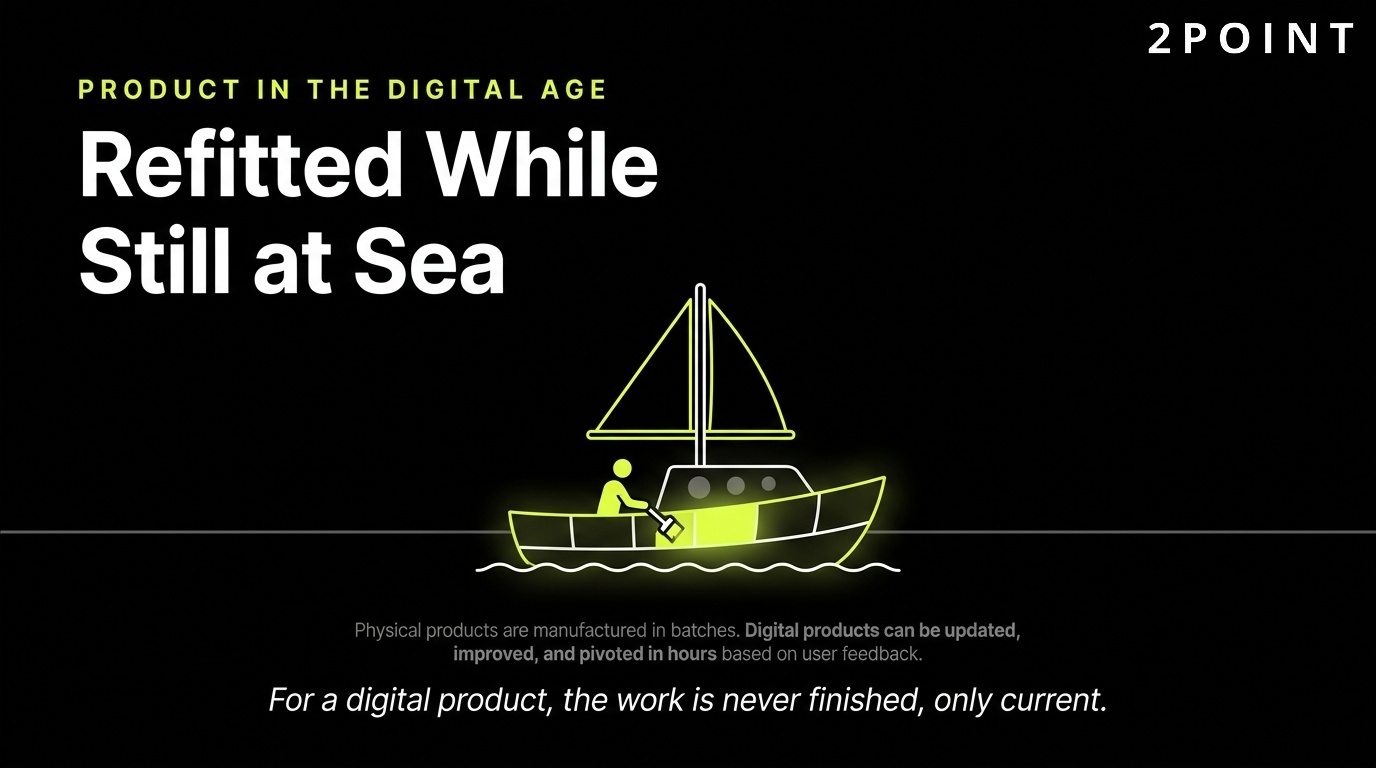
Digital transformation has fundamentally changed what "product" means for many businesses. The dawn of the digital age has profoundly evolved the marketing mix, and nowhere is this more apparent than in the product dimension. Software products, digital services, subscription platforms, and hybrid offerings that combine physical goods with digital experiences have expanded the definition of product well beyond its original parameters. A modern "product" might be a mobile app, a streaming subscription, a SaaS platform, or a physical product paired with a companion app and a community forum.
One of the most significant changes is the shift from one-time product launches to continuous product evolution. Physical products are manufactured in batches and released at defined intervals. Digital products can be updated, improved, and pivoted in days or even hours based on user feedback. This continuous evolution model means that product strategy in digital businesses is never truly finished, it is an ongoing loop of release, measure, learn, and improve. For marketers, this means the product P requires constant attention and close alignment with product development teams.
Customer feedback loops have become a core component of digital product strategy. User behavior data, in-app analytics, support ticket themes, Net Promoter Scores, and direct user interviews all feed into product decisions in ways that were impossible before digital tools made this data collection trivial. The most successful digital product teams treat every customer interaction as a signal about product-market fit, using that signal to guide their next iteration. This customer-feedback-to-product-improvement cycle is what drives product-led growth models, where the product itself becomes the primary driver of acquisition, retention, and expansion revenue.
For marketers, the implication is clear: product strategy cannot be delegated entirely to a product team. Marketing's role is to ensure that the customer insight gathered through promotional channels, CRM data, and market research flows back into product development. When marketing and product teams operate in silos, companies miss the opportunity to close this feedback loop effectively.
Differentiation and Competitive Positioning
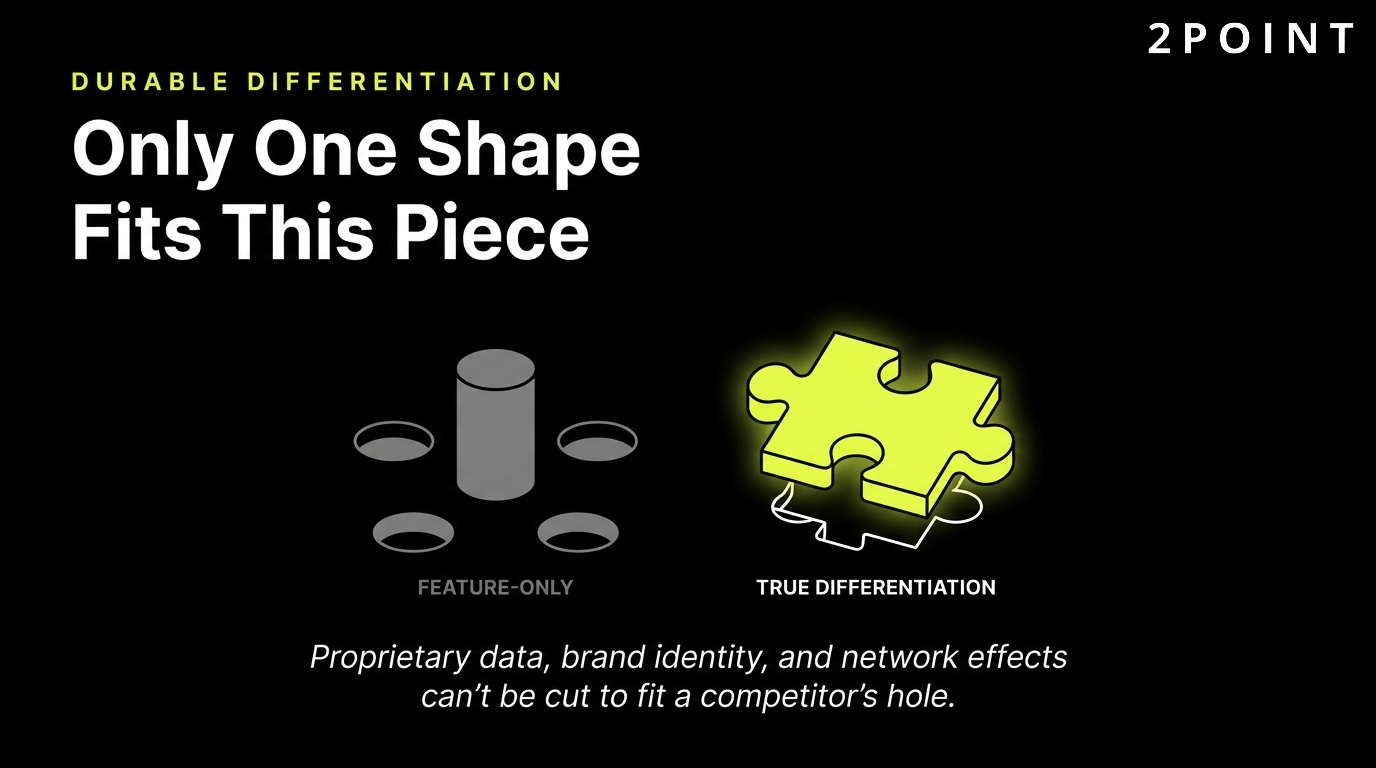
Differentiation is the answer to the question every buyer asks: why should I choose this product over the alternatives? Your product strategy must clearly communicate what sets your offering apart from every other option in the market, not just in terms of features, but in terms of the specific value it creates for a specific customer. Effective differentiation is always defined relative to alternatives and always grounded in something customers actually care about.
The most durable forms of differentiation are not easily replicated. Unique technology, proprietary data, a strong brand identity, a network effect that grows more valuable as more users join, or a design philosophy that resonates deeply with a specific community are all forms of differentiation that are difficult for competitors to copy quickly. Feature-only differentiation is the most fragile because features can be cloned. A clear value proposition that goes beyond features to address customer outcomes, emotional needs, or identity is significantly more defensible.
Value proposition clarity is a product strategy prerequisite, not a marketing afterthought. If the product team cannot clearly articulate what problem the product solves, for whom, and why it solves it better than alternatives, no amount of promotional investment will create sustained customer acquisition. The marketing team can amplify a clear value proposition with great efficiency. It cannot manufacture clarity where none exists at the product level.
Real-world examples of effective differentiation illustrate how different approaches can succeed in the same market. Apple's iPhone does not compete primarily on specifications. It competes on ecosystem integration, design quality, and brand identity. A regional accounting software company might differentiate on local tax law expertise and responsive human support. Both approaches are valid. What matters is that the differentiation is meaningful to the target customer and consistently reflected across all four Ps.
Product Variety and Portfolio Management
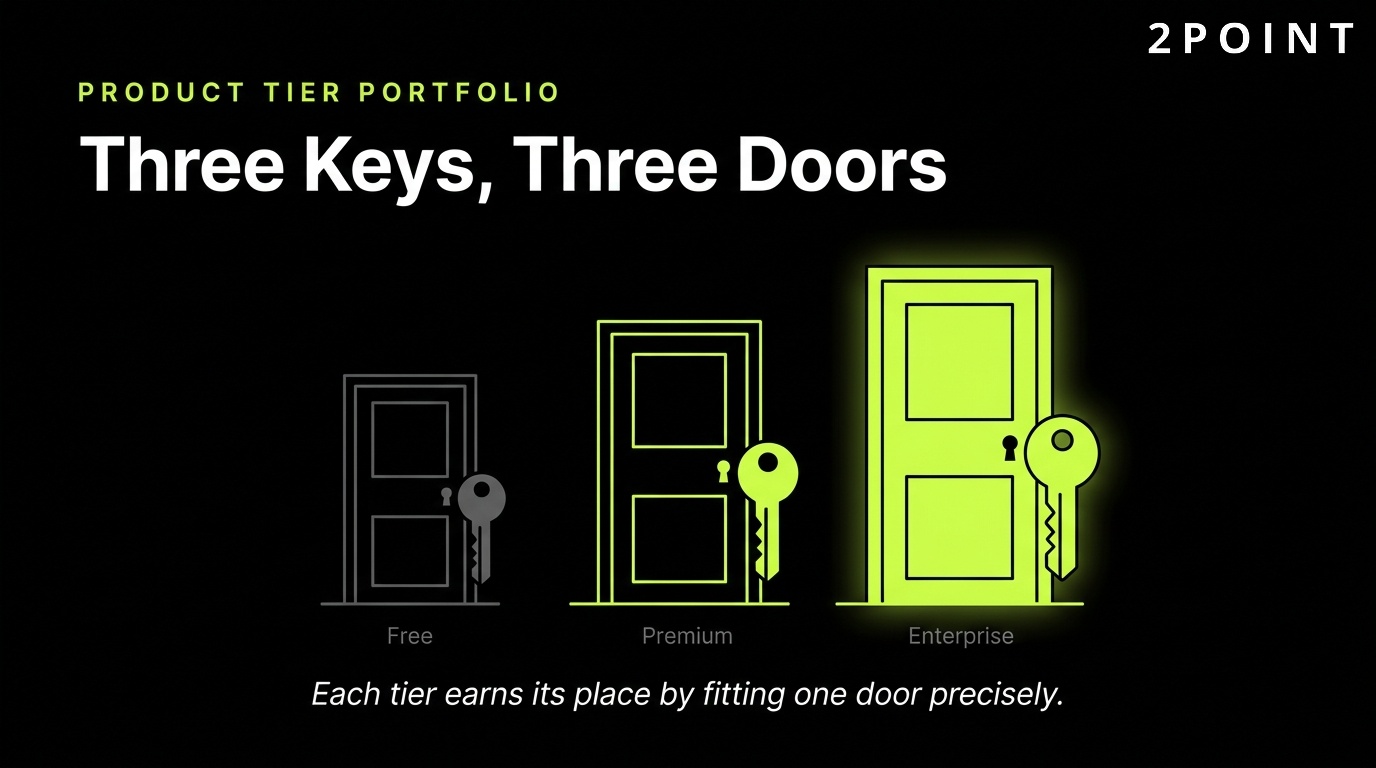
Managing multiple products or product tiers introduces complexity that, when handled well, can dramatically expand market reach and revenue. Product variety decisions involve determining which customer segments to serve, what price points to cover, and how to structure offerings so that each tier serves a distinct purpose without cannibalizing the others. A poorly designed product portfolio creates internal confusion and market confusion simultaneously.
The free-premium-enterprise model has become standard in digital products. A free tier demonstrates value and removes the purchase barrier, driving top-of-funnel volume. A premium tier converts engaged free users who need additional capability. An enterprise tier serves large organizations with compliance, security, and customization requirements that justify a significantly higher price. Each tier must deliver clear value at its price point while also creating natural upgrade paths that encourage customers to move up as their needs grow.
The fundamental tension in portfolio management is between breadth and focus. More products reach more customers but dilute brand identity, strain operations, and complicate sales conversations. Fewer products are easier to market, support, and improve, but they may leave revenue on the table or cede ground to competitors who serve adjacent needs. The right answer depends on your resources, competitive position, and customer diversity. What matters is that every product in your portfolio earns its place by serving a distinct customer need that your organization is genuinely well-positioned to fulfill.
Price: Finding the Right Value Exchange
Pricing as Revenue Source and Market Signal
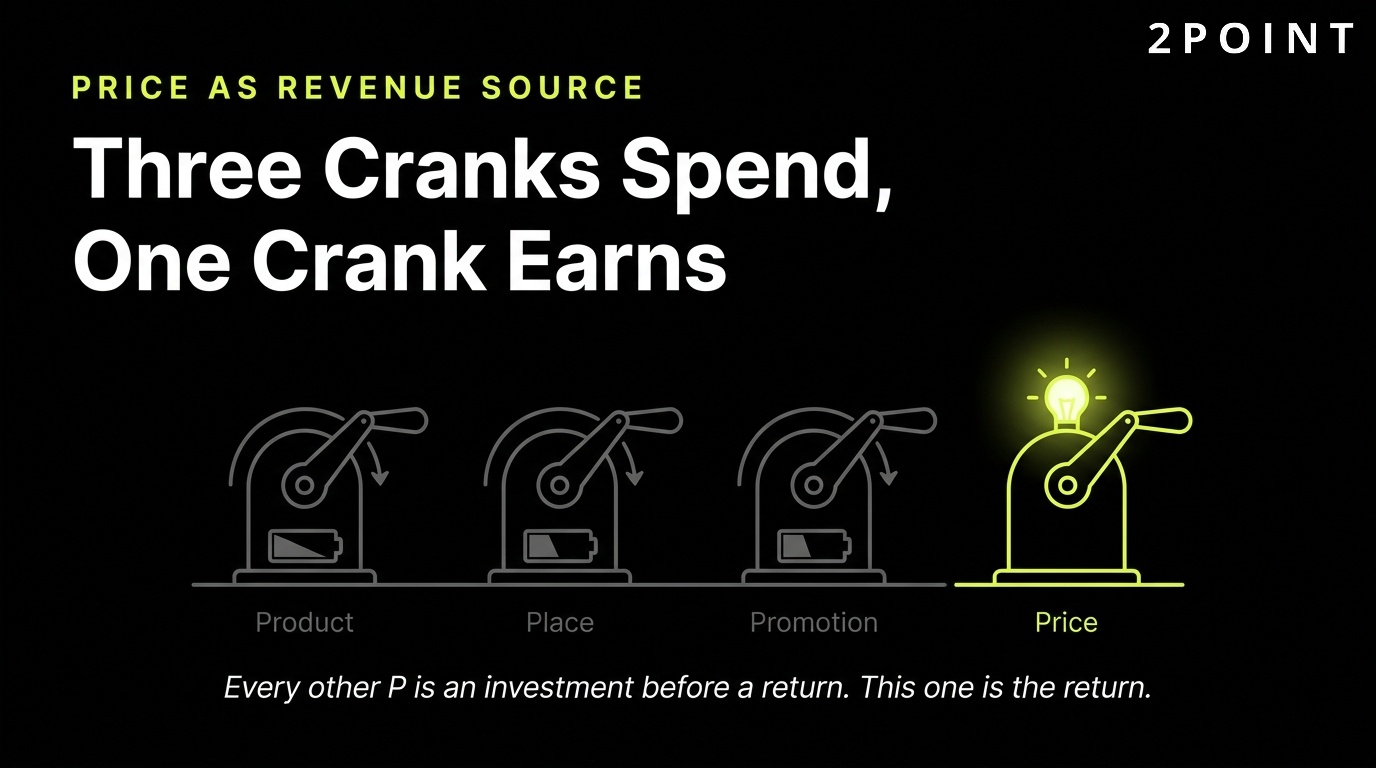
Price occupies a unique position among the 4 Ps because it is the only element that generates revenue rather than incurring costs. Every other P, product development, distribution infrastructure, promotional spend, requires investment before generating return. Price is the direct mechanism through which marketing strategy translates into business revenue. This makes pricing decisions among the highest-leverage choices a marketing leader can make, small changes in price can dramatically impact both volume and margin.
Beyond its role as a revenue mechanism, price functions as a powerful market signal. The price you set communicates your product's perceived value before a single customer experiences it. A high price signals quality, exclusivity, and premium positioning. A low price signals accessibility, but risks communicating that the product is undifferentiated or of lower quality. Neither signal is inherently right or wrong. What matters is that your price signal is consistent with every other element of your marketing mix and accurately reflects the actual value your product delivers.
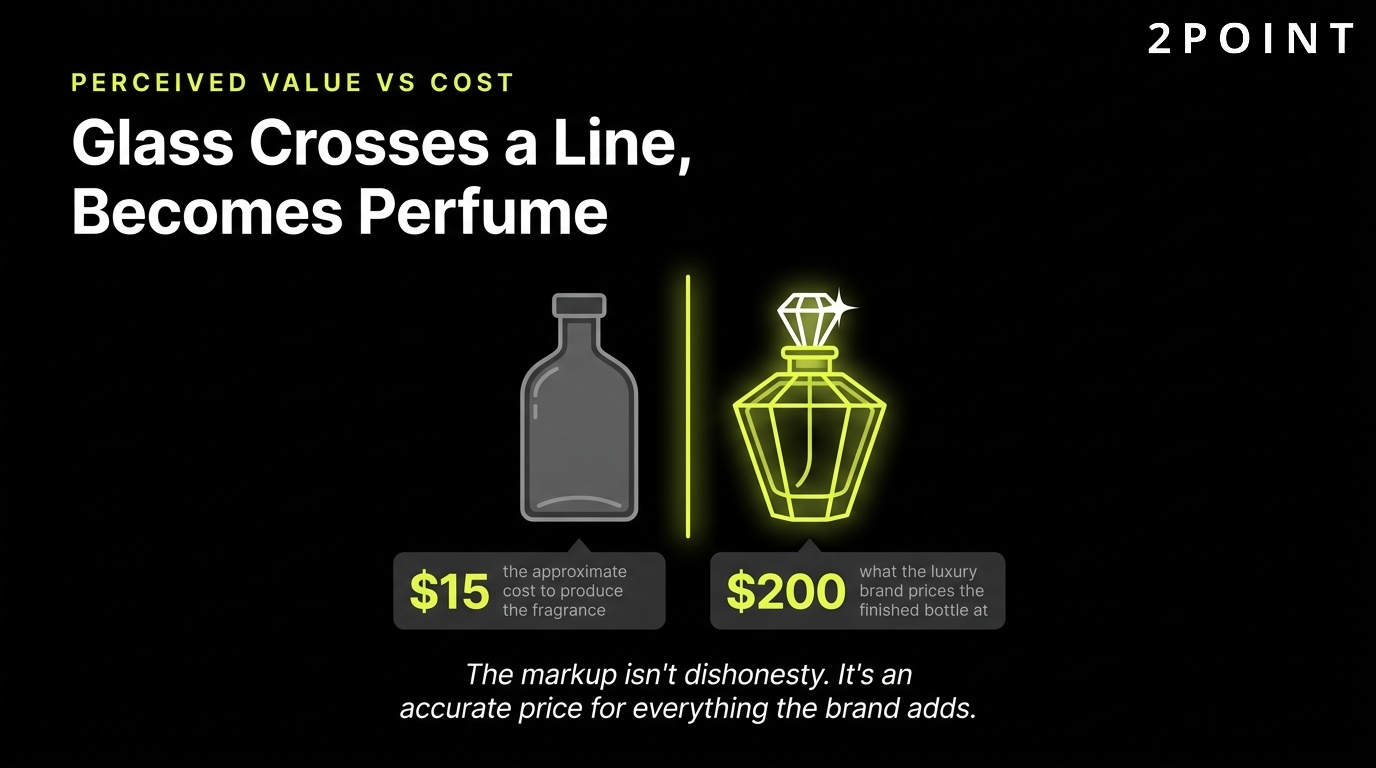
Perceived value and actual cost are rarely the same number, and sophisticated pricing strategy exploits this gap deliberately. The cost to produce a bottle of perfume might be $15. A luxury brand prices it at $200 because the perceived value of the fragrance, the brand heritage, the packaging, and the status it confers is worth $200 to the target buyer. The markup is not dishonesty. It is an accurate reflection of the total value the customer receives. Understanding the gap between your production cost and your customer's perceived value is the foundation of effective pricing strategy.
Psychological pricing factors add another layer of complexity. Prices ending in .99 are perceived as meaningfully lower than rounded numbers by many buyers. Offering a $499 option alongside an $899 option makes the $499 seem like a rational middle choice, even if your real goal was always to sell the $499 tier. Anchoring, framing, and price laddering are all legitimate tools for shaping how customers perceive the value they are receiving relative to the price they are paying.
Pricing Strategies and Models
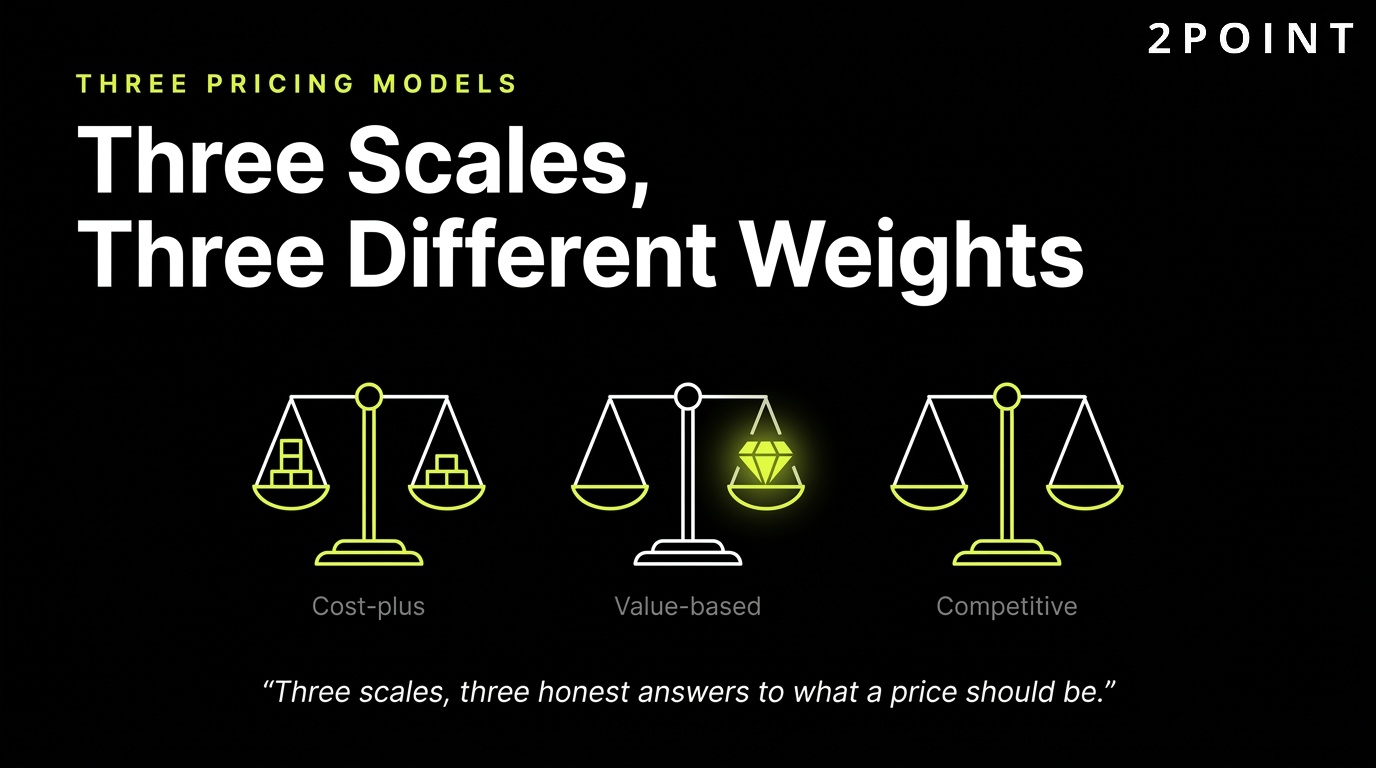
The choice of pricing strategy should reflect your business objectives, competitive position, cost structure, and customer value perception. No single approach works for every business or every situation. Common pricing strategies include cost-plus pricing, which adds a markup to production costs; value-based pricing, which prices based on the perceived value to the customer rather than the cost of production; and competitive pricing, which sets price relative to what comparable alternatives charge in the market.
Cost-plus pricing is the simplest model and the most dangerous for long-term profitability. It guarantees margin on each unit sold but completely ignores what the market will actually pay. Value-based pricing is the most powerful model but requires deep customer research to implement accurately. You must know, with real data, what your customers believe your product is worth relative to alternatives. Competitive pricing works well when your product is genuinely comparable to alternatives, but it commoditizes your offering and makes differentiation harder to communicate.
Digital products have introduced pricing models that did not exist in the era of physical goods. Subscription pricing converts what was once a one-time purchase into recurring revenue, improving business predictability while giving customers lower upfront barriers to entry. Freemium models offer a free tier to drive adoption and then monetize through premium features or usage volume. Dynamic pricing adjusts prices in real time based on demand, inventory, user behavior, or competitive positioning. Each of these models has genuine advantages and genuine risks that must be weighed against your specific product and market context.
The key principle across all pricing strategies is that price must align with the total marketing mix. A premium product distributed through discount channels at a discounted price creates market confusion that erodes brand equity over time. Price is not a standalone variable. It is a statement about the value you believe your product delivers, and that statement must be consistent across every other element of how your product is presented to the world.
Price Positioning Within Your Market
Where you position your price within the market landscape is a strategic choice with consequences that extend far beyond the revenue line. Premium pricing positions your offering as the superior choice for customers who prioritize quality, capability, or status over cost. Budget pricing maximizes volume by making your offering accessible to the broadest possible market. Mid-market pricing attempts to balance accessibility with quality perception, often the most competitive space because you face pressure from both above and below.
Reference pricing and price anchoring are powerful tactical tools within any price positioning strategy. When you present a $25 per user per month option alongside a $75 per user per month enterprise option, the presence of the higher-priced anchor makes the $25 tier feel like a compelling value. Anchoring shapes buyer perception without changing the actual price. Retail stores have used this technique for decades by displaying "original" prices next to sale prices. Digital businesses use it through pricing page design, feature comparison tables, and the strategic inclusion of higher-priced tiers they may expect few customers to purchase.
Pricing affects brand perception in ways that compound over time. A brand that consistently discounts trains its customers to wait for sales, devaluing the product in their minds. A brand that holds its price firmly communicates confidence in its value proposition. When you do discount, how you frame the discount matters enormously. A "limited availability" offer feels different from a "permanent markdown," even if the end price is identical. Your pricing behavior over time becomes part of your brand story, and that story is very difficult to revise once established in the market.
For businesses implementing a personalized marketing strategy, price positioning decisions must consider the different willingness-to-pay that exists across customer segments. Enterprise buyers often have larger budgets and longer sales cycles, justifying higher prices paired with more intensive sales support. Small businesses and individual users prioritize low upfront cost and self-serve simplicity. Serving both segments often requires genuinely different pricing tiers rather than a single price that tries to satisfy everyone and satisfies no one perfectly.
Discounts, Payment Terms, and Price Optimization
Discounts are a double-edged instrument in the pricing toolkit. Used strategically, they can accelerate trial, reward loyalty, clear inventory, or incentivize annual commitments over monthly ones. Used poorly, discounts train customers to never pay full price and create a race to the bottom that permanently compresses margins. The difference lies in whether the discount serves a specific strategic purpose with a clear end condition, or whether it becomes a reflexive response to any sales friction.
Payment terms and credit conditions are pricing levers that many businesses overlook. Offering annual billing at a 20% discount compared to monthly billing is not technically a price cut. It is a payment structure that improves your cash flow while giving the customer a genuine financial incentive to commit. For B2B businesses, extending net-30 or net-60 payment terms can remove a significant barrier for cash-constrained buyers without reducing your stated price. Payment flexibility is a form of price accessibility that can expand your market without compromising your pricing position.
A/B testing pricing changes is standard practice for digital businesses that have enough traffic to generate statistically significant results. By showing different prices to different visitor segments and measuring conversion rates, average order values, and downstream retention, you can build empirical evidence for pricing decisions rather than relying on intuition or competitor benchmarking alone. The goal of price optimization is to find the point where the product delivers maximum customer value while generating maximum business profitability. Those two objectives are more often aligned than in conflict when your product genuinely solves an important customer problem.
Place: Getting Your Product to Customers
Distribution Channels in 2026
Place, or distribution, is the often underestimated P. Businesses that invest heavily in product development and promotional spend frequently underinvest in distribution strategy, then discover that the most compelling product and the most effective advertising cannot compensate for a buying process that creates friction. Place refers to how and where customers can access, purchase, and receive your product, encompassing the entire distribution network from your organization to the end buyer.
Distribution channels in 2026 span a wider range than at any previous point in marketing history. Direct channels include your own website, mobile app, physical stores, and sales team. Indirect channels include third-party retailers, online marketplaces, resellers, distributors, and affiliate partners. Digital distribution has fundamentally changed the economics of reaching customers, eliminating many of the physical constraints that once made geographic expansion expensive and slow. A software company based in Miami can distribute its product to users in Tokyo, Berlin, and São Paulo without a physical presence in any of those markets.
The digital age has transformed distribution from a logistics problem into a customer experience design problem. In physical retail, distribution was primarily about getting goods onto shelves before customers arrived. In digital markets, distribution is about reducing the number of steps between a customer's intent to buy and their ability to use the product. Self-serve platforms, instant digital delivery, and product-led growth models have raised customer expectations for frictionless access to the point where any unnecessary step in the buying process creates measurable drop-off.
Geographic and demographic considerations still matter profoundly in distribution strategy, even for digital products. Regulatory environments differ by country, payment preferences vary by region, and the platforms through which customers discover and access products differ significantly across demographics. A distribution strategy designed primarily for the US market may need substantial adaptation for Southeast Asian markets, where mobile-first purchasing through super-apps is the dominant behavior rather than desktop e-commerce.
Channel Selection and Strategy
Channel selection is one of the highest-stakes decisions in your marketing mix because it is difficult to change quickly and it shapes every downstream customer interaction. The primary criterion for channel selection is matching your distribution approach to your target customer's buying behavior. Where do they go when they need what you offer? What does their research and purchase journey look like? What level of support do they need to make a confident buying decision? Your channel strategy should answer these questions first and then work backward to operational feasibility.
The decision between multi-channel and omnichannel approaches is particularly relevant in 2026. Multi-channel means being present across several channels, but each operates independently with potentially inconsistent experiences. Omnichannel means creating a seamless experience that carries customer context, preferences, and history across every touchpoint. Multi-channel marketing delivers reach. Omnichannel delivers experience. Most businesses should prioritize experience in their highest-volume channels over presence in the maximum number of channels, because a mediocre experience in ten channels is less effective than an excellent experience in three.
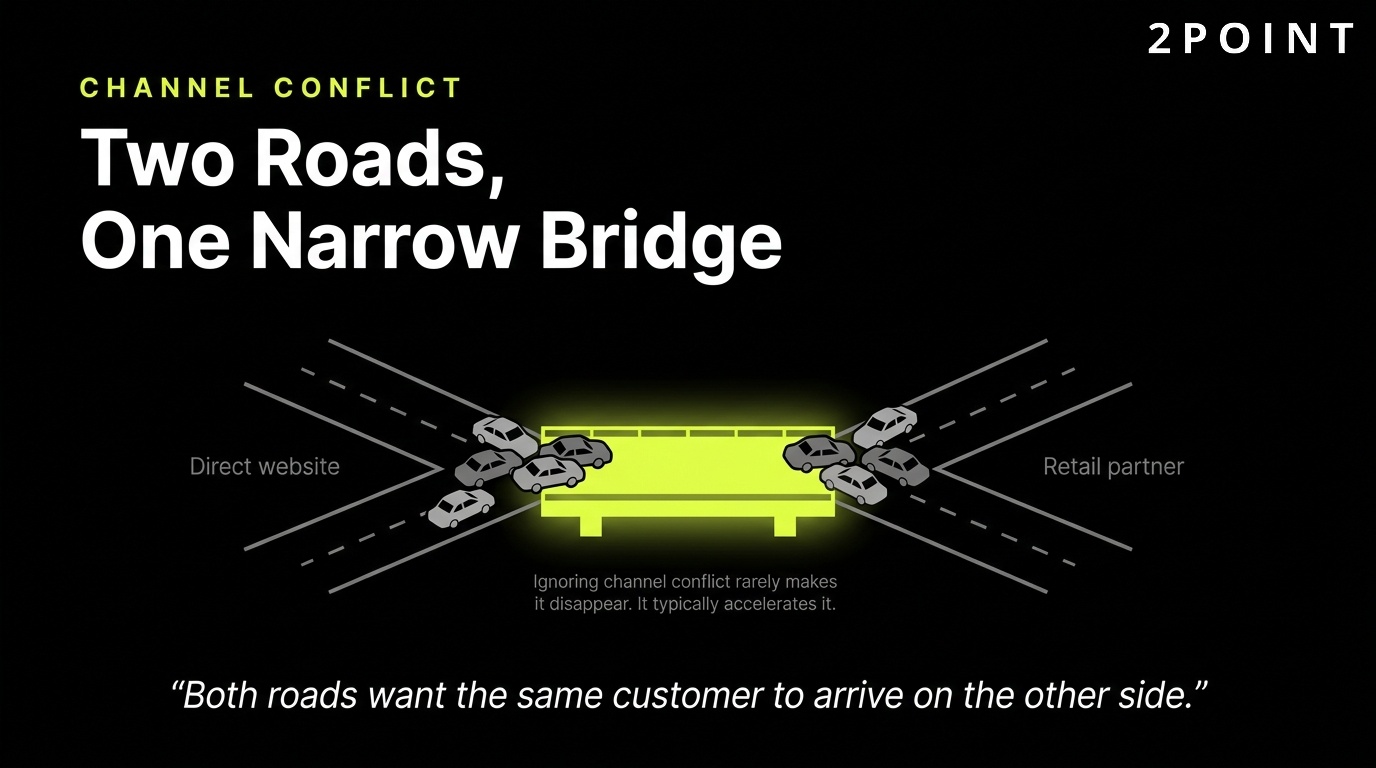
Channel conflict arises when you distribute through multiple channels that compete with each other for the same customer. A manufacturer that sells directly through its website while also selling through retail partners risks alienating those partners if the direct channel offers lower prices. Managing channel conflict requires clear policies, pricing consistency across channels, and honest communication with channel partners about your distribution strategy. Ignoring channel conflict rarely makes it disappear. It typically accelerates it.
Cost and control trade-offs are fundamental to channel strategy. Direct channels give you complete control over pricing, messaging, customer data, and the buying experience, but they require you to build and fund the infrastructure. Indirect channels provide leverage and reach through existing partner infrastructure, but you cede control over how your product is presented, priced, and supported at the point of sale. Most mature businesses use a combination of both, managing the balance based on strategic priorities rather than default convenience.
Logistics, Inventory, and Fulfillment
The operational backbone of the Place P is logistics: ensuring that the product is available when and where customers want to buy it. For physical products, this encompasses warehousing, inventory management, transportation, and last-mile delivery. Effective logistics management ensures product availability without creating the carrying costs and write-off risks associated with excess inventory. Stockouts and delivery delays create customer dissatisfaction that promotional investment cannot repair after the fact.
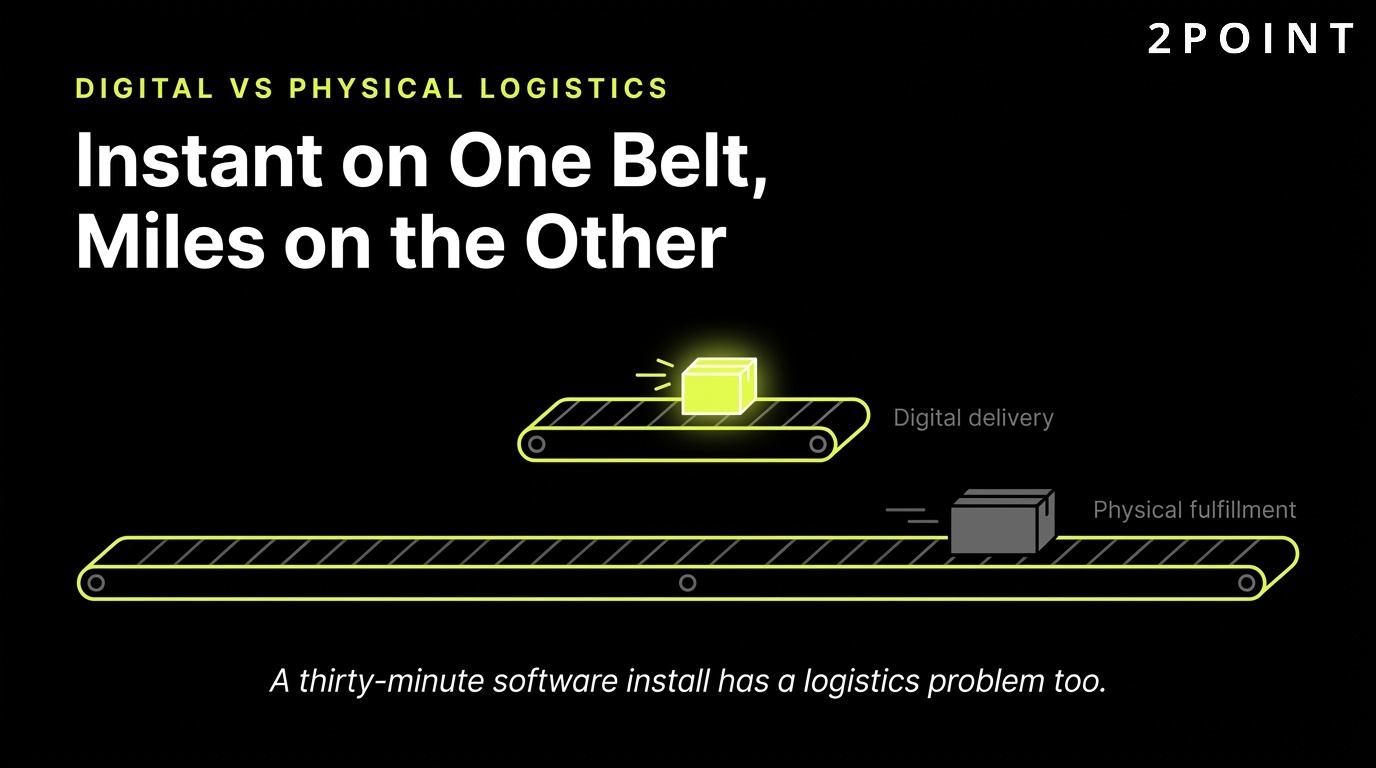
For digital products, logistics takes the form of platform reliability, delivery speed, and onboarding experience. A software product that takes thirty minutes to install and configure before delivering any value has a logistics problem as real as a physical retailer who cannot get inventory on shelves before demand peaks. Digital delivery and instant access have become table stakes for most digital product categories, with customers expecting to go from purchase decision to productive use in minutes rather than days.
Customer expectations for speed and convenience continue to increase year over year, driven by the standard set by the largest e-commerce and digital platforms. Amazon's same-day delivery in major markets has reset consumer expectations for physical goods. Stripe's instant payment processing and API documentation have reset B2B developer expectations for how quickly they should be able to integrate a payment product. Meeting these expectations requires genuine investment in fulfillment infrastructure, not just in the promotional campaigns that promise them.
Location Strategy for Physical and Digital Presence
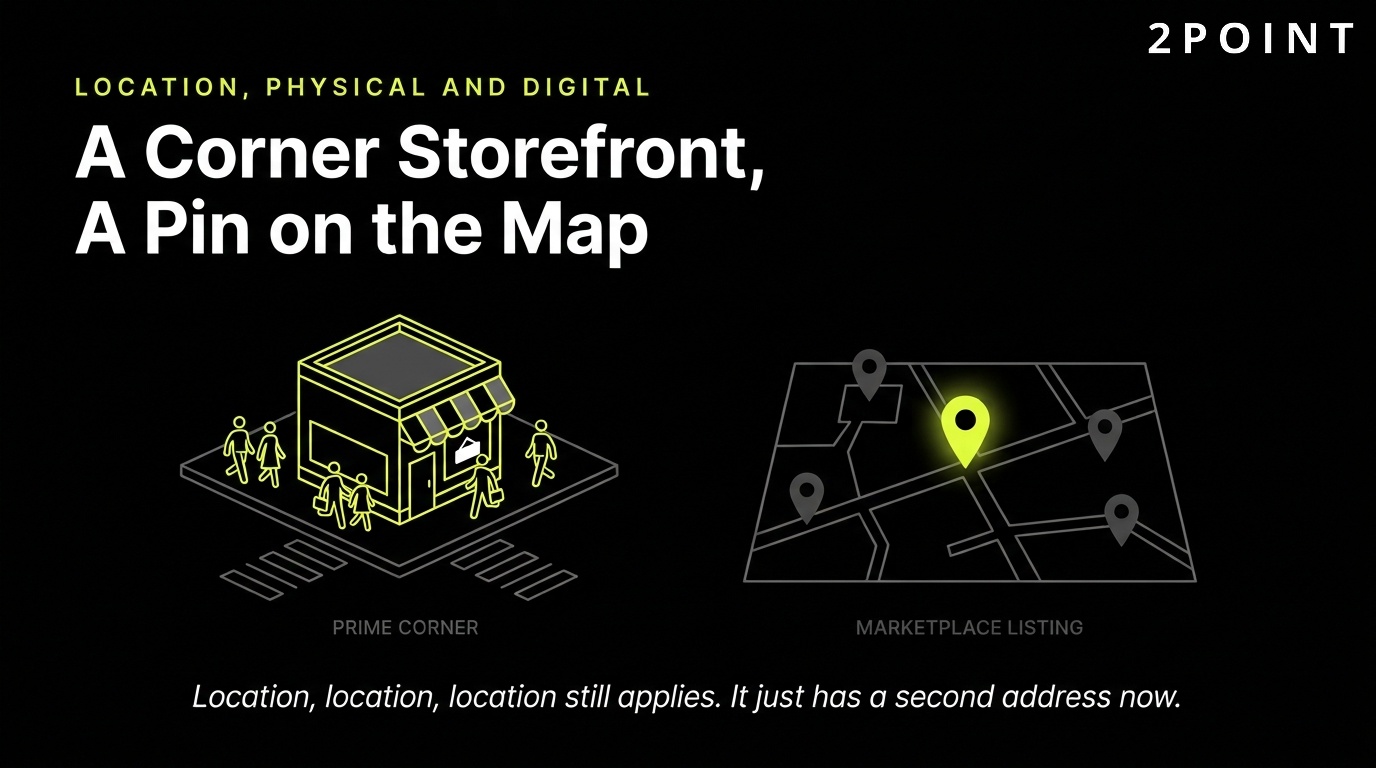
For businesses with physical locations, site selection is a distribution decision with permanent consequences. The classic retail wisdom that the three most important factors are "location, location, location" reflects a genuine truth: the right physical location provides built-in foot traffic, competitive isolation, and a customer convenience advantage that advertising can only partially compensate for. Physical location strategy considers demographics, traffic patterns, competitor proximity, cost, and lease terms, among many other factors specific to the retail category and target customer.
For digital businesses, the equivalent of physical location is presence in the marketplaces and platforms where customers discover and evaluate solutions. Being listed in the G2 software marketplace, the Salesforce AppExchange, Apple's App Store, or the AWS Marketplace is a location decision with real strategic implications. The marketplaces you choose to participate in shape which customers discover you and through what context. Presence in a marketplace that your target customer trusts provides a credibility signal that your own website cannot always generate for first-time buyers.
Your website itself is a primary distribution point for most businesses in 2026, often the first and most important location at which customers encounter your brand, evaluate your offering, and make a purchase decision. Website design, loading speed, mobile optimization, and checkout experience are all distribution decisions that directly affect conversion rates. Treating the website as primarily a marketing asset rather than a distribution asset leads to underinvestment in the transactional and functional elements that determine whether a visitor becomes a customer. Convenience is a competitive advantage, and your website is often your most important source of it.
Promotion: Communicating Your Value
The Promotional Mix in the Digital Age
Promotion is the most visible of the 4 Ps and frequently the one that receives the most budget and attention, sometimes at the expense of the other three. In its fullest sense, promotion encompasses every method by which you communicate the existence, value, and availability of your product to potential and existing customers. The traditional promotional mix includes advertising, public relations, personal selling, and sales promotions. Each serves a distinct role in moving buyers through awareness, consideration, purchase, and loyalty stages.
The digital age has added a substantial catalogue of promotional tools to this traditional list. Content marketing, search engine optimization, social media, email marketing, influencer partnerships, podcast advertising, and programmatic display advertising all sit within the promotion P. The challenge is not a shortage of promotional options. It is the discipline to select the channels and tactics that most efficiently reach your specific target audience at the right stage of their buying journey, rather than spreading resources thinly across every available channel.
Integration of offline and online promotional tactics has become a strategic priority as customer journeys increasingly cross between physical and digital touchpoints. A customer might discover a brand through a podcast advertisement, research it through organic search, read reviews on a third-party platform, watch a product demonstration video, and ultimately convert through a retargeted display ad. Integrated promotional strategies that maintain consistent messaging across all of these touchpoints are significantly more effective than siloed campaigns that treat each channel as an independent initiative.
The shift toward personalization and precise targeting has transformed promotional effectiveness. Social media platforms and programmatic advertising networks can deliver your message specifically to the buyers most likely to convert, based on demographic, behavioral, and contextual signals that were simply unavailable to mass media advertisers in previous decades. This precision demands more sophisticated creative and message strategy, because the same generic advertisement that might have been acceptable in a mass media context becomes obviously irrelevant when served to a highly targeted audience that expects relevance.
Content Marketing and Organic Promotion
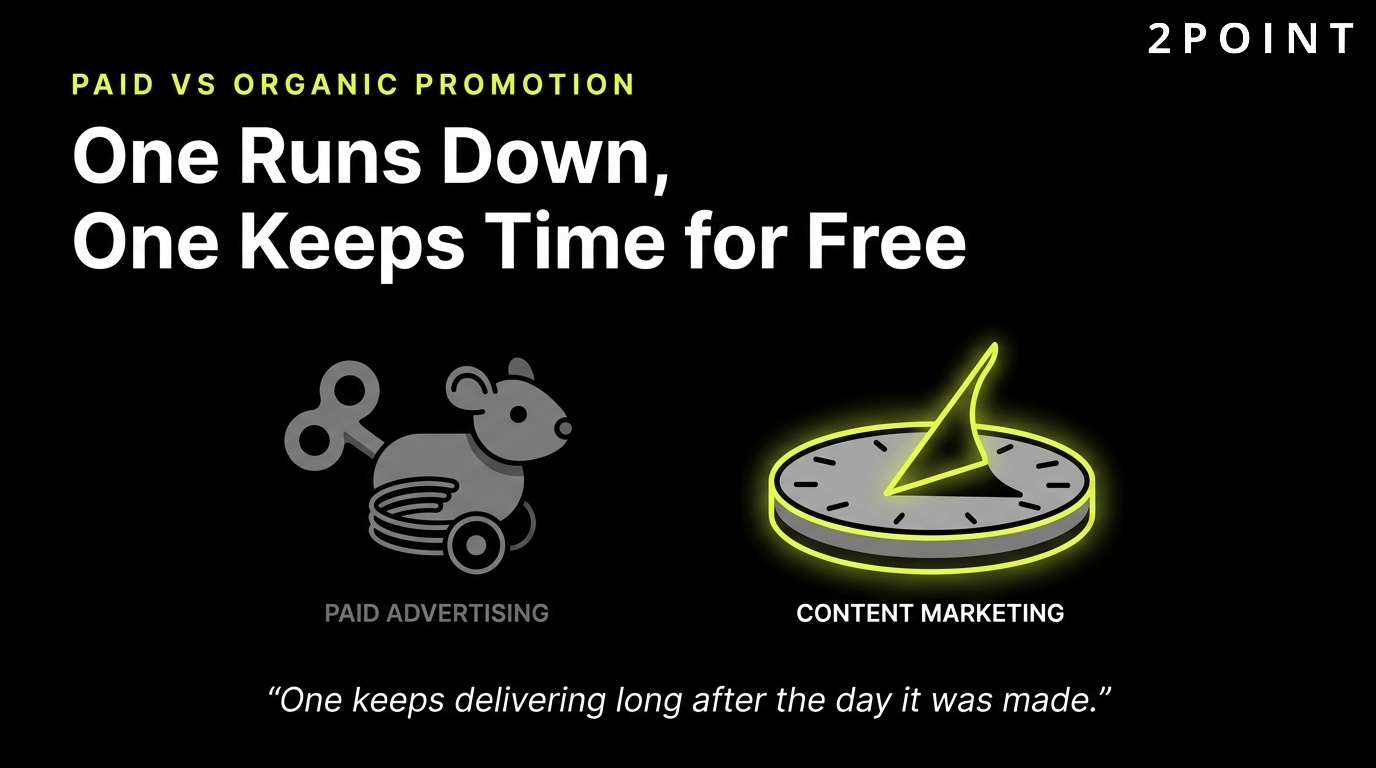
Content marketing has become one of the most durable and cost-effective components of the promotional mix for businesses that invest in it consistently. Unlike paid advertising, which stops delivering the moment you stop paying, high-quality content assets, comprehensive guides, educational videos, research reports, and well-optimized landing pages, continue generating organic traffic and customer discovery for months or years after publication. Inbound content strategy targets customer pain points at the precise moment they are searching for solutions, creating promotional relevance at the highest possible point of buyer intent.
Search engine optimization is the mechanism that makes content marketing scalable. Content marketing built around the specific questions, problems, and vocabulary of your target customers earns organic search visibility that pays compounding dividends over time. A developer tools company that publishes thorough technical guides answering the exact questions their target users type into Google builds a promotional channel that reaches buyers at maximum intent without a cost-per-click attached to each visit. This is why content strategy must be grounded in keyword research and customer journey mapping, not in what the marketing team finds interesting to write about.
The distinction between educational content and sales messaging is critical for long-term promotional effectiveness. Buyers in 2026 have highly refined filters for self-interested promotional content. They engage with content that genuinely teaches them something, helps them solve a real problem, or enables them to evaluate their options more accurately. Content that primarily serves the company's interest rather than the reader's interest is quickly identified as promotional and discounted accordingly. The most effective content marketing treats the customer's question as the starting point and the company's expertise as the answer, not the other way around.
For businesses using inbound marketing as their primary growth engine, content quality, depth, and search visibility are the core metrics that drive promotional performance. An investment in a single genuinely comprehensive guide on a high-intent topic can outperform months of paid advertising at a fraction of the total cost, particularly for businesses targeting informed buyers who conduct substantial research before making purchasing decisions.
Social Media and Community-Driven Promotion
Social media has fundamentally altered the promotional landscape by giving brands direct access to ongoing conversations with their target audiences. Platform selection for social media promotion should be driven entirely by where your target customers are most active and most receptive to engagement, not by which platforms are most familiar to your marketing team or most popular in general. LinkedIn serves B2B professionals effectively. Instagram and TikTok reach consumer audiences through visual and video content. X (formerly Twitter) remains important for technology, media, and public affairs communities.
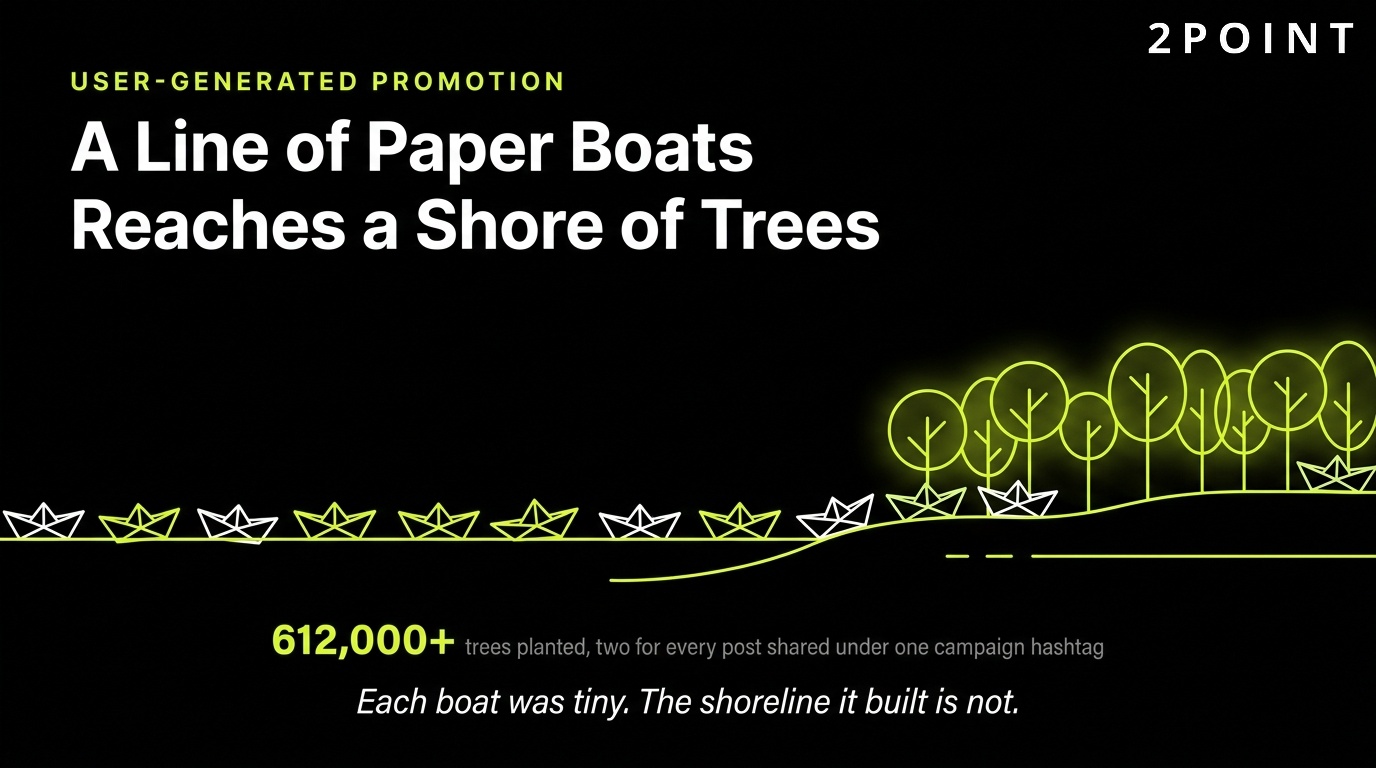
User-generated content campaigns represent one of the highest-leverage uses of social media as a promotional channel. When customers create and share content about your product, they provide social proof, reach new audiences through their own networks, and generate promotional material at a cost far below what professional production would require. The Boxed Water "Better Planet" campaign is a compelling example: by encouraging customers to share photos with the campaign hashtag, Boxed Water planted over 612,000 trees while generating substantial organic brand visibility through customer-created content. The campaign aligned promotional strategy with brand values in a way that customers found genuinely worth participating in.
Building two-way communication with customers through social media is a promotional advantage that traditional advertising channels cannot replicate. When a brand responds thoughtfully to customer questions, engages with industry conversations, or acknowledges and addresses customer concerns publicly, it builds credibility and trust at scale. Community-driven promotion is inherently more credible than brand-originated advertising because it carries the social proof of peer endorsement. Building a community around your brand's mission and values is a long-term promotional investment that creates compounding returns in customer loyalty and organic advocacy.
For businesses developing a social media marketing plan, the most effective starting point is a clear definition of which customer segments you are targeting, what content they find genuinely valuable, and what action you want them to take as a result of their engagement with your brand on social platforms.
Data-Driven Targeting and Personalization
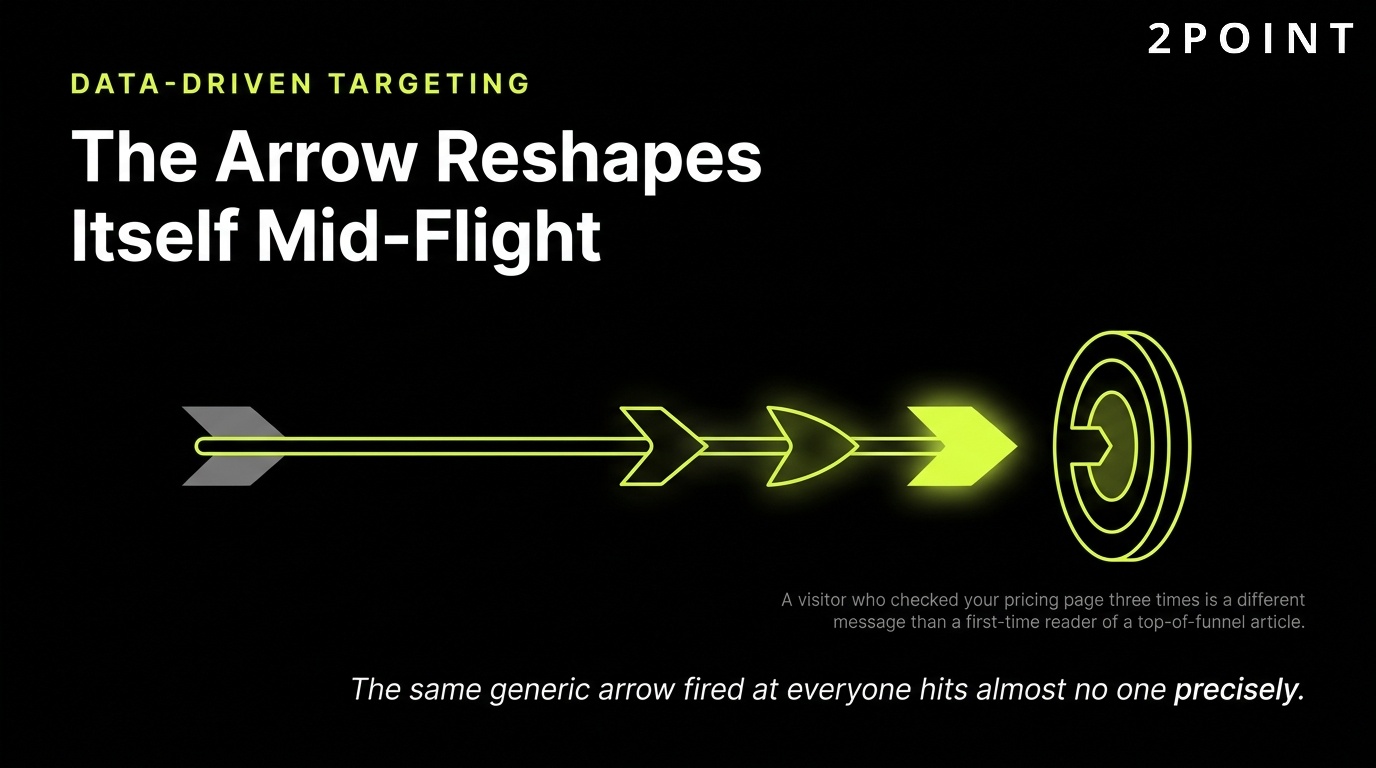
The most significant promotional advantage that digital marketing provides over traditional approaches is the ability to use behavioral and demographic data to deliver the right message to the right person at the right moment. Digital analytics allow marketers to understand customer behavior at a granularity that was technically impossible before the internet era. Page visits, content consumption patterns, email open rates, ad click-through rates, search queries, purchase history, and hundreds of other behavioral signals can be combined to create detailed profiles of customer intent and readiness to buy.
Segment-specific messaging uses this data to serve different communications to different buyer profiles based on their stage in the buying journey, their specific use case, or their demographic characteristics. A buyer who has visited your pricing page three times in the past week is significantly closer to a purchase decision than a first-time visitor reading a top-of-funnel educational article. Serving both the same generic brand awareness message wastes the opportunity to move the high-intent buyer toward conversion. Personalized promotional messages that reflect the buyer's demonstrated interest and stage consistently outperform generic messages in conversion rate, customer acquisition cost, and lifetime value.
Facebook and Instagram's targeting capabilities exemplify the precision available to modern marketers. You can target users based on job title, employer, education, interests, behaviors, life events, income range, and remarketing audiences built from your own website or app visitors. When combined with well-designed creative that speaks directly to the specific audience segment receiving it, these platforms allow even small businesses to compete effectively for customer attention against much larger competitors.
Measuring promotional effectiveness is the final and essential step in data-driven promotion. Without measurement, optimization is guesswork. Key metrics vary by promotional tactic: cost per click for paid search, engagement rate for social media, email open and click-through rates for email marketing, and organic traffic and conversion rate for content marketing. Tying all of these channel metrics to downstream business outcomes, revenue, customer acquisition cost, and lifetime value, is what enables genuine promotional mix optimization rather than simply reporting on activity. Using CRM tools effectively is essential for connecting promotional activities to customer outcomes across the full journey.
From 4 Ps to 4 Cs: The Customer-Centric Evolution of the Marketing Mix
Why the Customer Perspective Matters
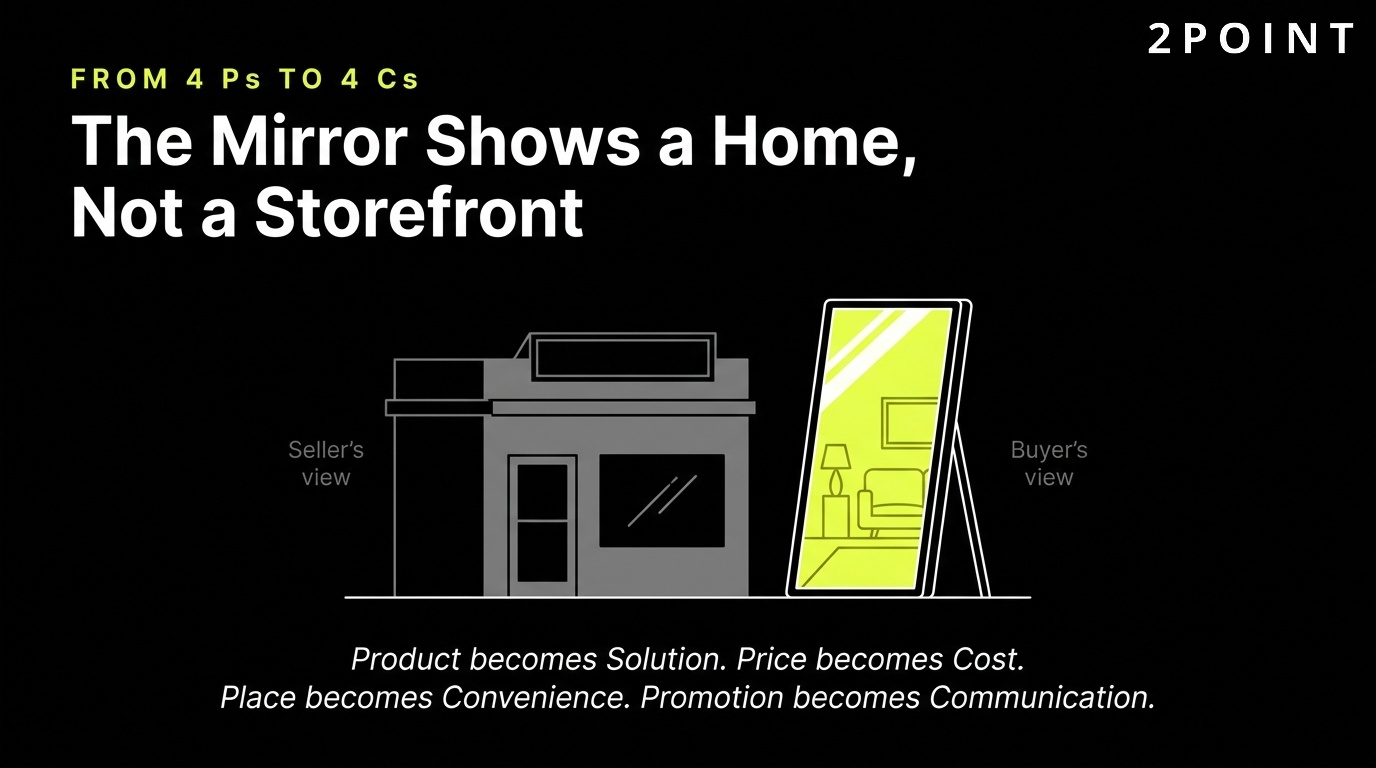
The 4 Ps framework was conceived primarily from the marketer's and seller's perspective: here is our product, here is our price, here is where we sell it, and here is how we promote it. While this perspective has proven remarkably useful, it carries an inherent limitation. It starts with the seller's assets and capabilities rather than with the customer's needs, preferences, and purchase context. As customer power has grown through the internet, increased competition, and greater access to information, the seller-centric framing of the 4 Ps has needed a counterbalancing customer-centric lens.
The 4 Cs model, developed by Robert Lauterborn in 1990, provides that counterbalancing perspective. The 4 Cs reframe each of the 4 Ps from the customer's point of view: Product becomes Customer Solution, Price becomes Customer Cost, Place becomes Convenience, and Promotion becomes Communication. This reframing does not invalidate the 4 Ps. It complements and enriches them by ensuring that every seller-side decision is evaluated through the lens of customer impact and customer value.
The shift toward customer-centric marketing reflects a structural change in market power that has accelerated dramatically through digital transformation. Customers in 2026 can research alternatives, read independent reviews, compare prices across vendors, and switch providers with unprecedented ease. This means that marketing strategies built purely on pushing seller-defined value propositions to passive buyers are increasingly ineffective. The businesses that thrive are those that genuinely understand and respond to customer needs rather than simply communicating their own strengths. Applying a customer-centric marketing lens to the 4 Ps framework makes it significantly more effective in this environment.
The 4 Cs do not replace the 4 Ps. They reframe them. A business still needs to make decisions about its product, pricing, distribution, and promotional strategy. The 4 Cs simply demand that each of those decisions be made with genuine customer insight rather than internal assumptions. The two frameworks used together create a complete picture: the seller's operational reality validated against the customer's actual needs and preferences.
Customer Solution vs. Product
The shift from "product" to "customer solution" in the 4 Cs framework represents a fundamental reorientation of marketing strategy. When you think "product," you tend to think about features, specifications, and capabilities. When you think "customer solution," you think about the specific problem the customer is trying to solve, the job they are trying to get done, and the outcome they are trying to achieve. Selling solutions means understanding customer jobs-to-be-done deeply enough that your product features are designed and communicated in terms of the outcomes they enable rather than the technical capabilities they represent.
The customer solution perspective transforms how you develop and position your product. Rather than starting with "what can we build?" the question becomes "what does the customer need to accomplish, and how can we make that as easy as possible?" This reframing often reveals product opportunities that a purely feature-focused approach misses entirely, as well as feature investments that customers do not actually value despite their technical sophistication. The practical application is straightforward: every product feature and every marketing claim should be translatable into a specific customer outcome. If you cannot articulate what problem a feature solves for a real customer in a real situation, it has questionable strategic value.
Customer Cost vs. Price
Customer Cost in the 4 Cs framework encompasses far more than the monetary price listed on your website or pricing page. Total customer cost includes time, effort, psychological burden, and opportunity costs associated with finding, evaluating, purchasing, learning to use, and eventually replacing or disposing of a product. A product priced at $50 with a complex purchasing process and a steep learning curve may represent a higher total customer cost than a competitor priced at $75 with a smooth buying experience and intuitive onboarding.
Convenience is, at its core, a cost reduction strategy. Every step you remove from the buying process, every form field you eliminate, every approval gate you bypass, every implementation complexity you absorb on the customer's behalf, reduces the total cost of ownership for the buyer even if the monetary price remains unchanged. Making the buying experience frictionless is a competitive advantage that does not require you to cut your price. It requires you to invest in understanding where your customers experience friction and systematically eliminating it. In 2026, companies that treat customer effort reduction as a strategic priority consistently achieve higher conversion rates, lower churn, and stronger customer satisfaction scores.
Convenience and Communication
The reframing of "Place" as "Convenience" in the 4 Cs model shifts the question from "where can we distribute our product?" to "how can we make it as easy as possible for customers to get what they need?" Convenience encompasses ease of purchase, ease of access, ease of use, and ease of getting support when needed. It is not just about physical or digital location. It is about the entire experiential dimension of accessing your offering. A product available everywhere but difficult to purchase from any of those locations scores low on convenience despite high distribution presence.
The shift from "Promotion" to "Communication" represents an even more fundamental reorientation. Promotion, in its original sense, is a one-way broadcast: the seller communicates its value proposition to buyers. Communication implies a two-way dialogue where the seller is genuinely listening to buyers, responding to their questions, incorporating their feedback, and building a relationship rather than simply delivering a message. Building two-way communication channels with customers is now a baseline expectation rather than a differentiator. Customers expect to be able to reach brands through multiple channels, receive timely responses, and feel heard. The businesses that invest in genuine communication infrastructure, not just broadcast infrastructure, consistently outperform on customer loyalty and lifetime value metrics.
The integration of Convenience and Communication with modern customer expectations is reshaping what "good marketing" looks like. Using marketing automation allows businesses to deliver highly personalized, timely communications at scale while maintaining the convenience of instant response. When applied thoughtfully, automation enhances rather than replaces genuine communication, ensuring that customers receive relevant information at the right moment in their journey without requiring manual intervention for every interaction.
Applying the 4 Ps to Your Marketing Strategy
Starting With Customer Research, Not Product
The most common and most costly error in applying the 4 Ps framework is starting with the product and working outward, rather than starting with the customer and working inward. A customer-inward approach begins with deep research into who your target customers are, what they need, how they currently solve the problem your product addresses, what they wish were different about existing solutions, and how they make purchasing decisions. Only with this foundation in place can you make genuinely informed decisions about product features, pricing, distribution channels, and promotional messaging.
Building real buyer personas, not demographic approximations, but detailed profiles grounded in actual customer interviews, behavioral data, and observed purchase patterns, is the foundation of effective 4 Ps strategy. Understanding customer behavior before setting your marketing mix dramatically reduces the risk of expensive misalignments between what you are offering and what your target market actually wants. A single afternoon of customer interviews will surface more actionable insight than weeks of internal assumptions-based planning.
Avoiding assumptions is particularly critical for businesses that have been operating for several years and believe they already understand their customers well. Markets change, customer preferences evolve, new alternatives emerge, and the competitive landscape shifts. The customer who chose you three years ago may have significantly different expectations and alternatives available to them today. Periodic revalidation of your customer understanding through fresh research, not just analysis of existing customer data, is essential for keeping your 4 Ps strategy current and effective. The businesses that fall into complacency about customer understanding are the ones that get disrupted.
Creating an Integrated Marketing Mix Strategy
Integration is the principle that transforms the 4 Ps from four separate decisions into a single, coherent marketing strategy. An integrated marketing mix strategy ensures that every element of your marketing tells the same story about your brand, creates the same expectations in your customers' minds, and delivers on those expectations at every touchpoint. Inconsistency between the Ps creates market confusion and undermines the credibility of each individual element.
The practical test of integration is simple: take any two Ps and ask whether they are telling the same story. Does your price reflect the quality level that your product actually delivers? Does your distribution channel reinforce the positioning communicated in your advertising? Does your promotional messaging accurately represent the purchase and ownership experience your customers actually have? When the answer to any of these questions is "not quite," you have an integration gap that is costing you conversion rate, customer satisfaction, and brand equity. Ensuring consistency across all marketing mix elements requires deliberate coordination across teams that are often organized and managed separately in larger organizations.
Position within target markets is the organizing principle that makes integration possible. When every team member understands the specific customer segment you are targeting, the specific value proposition you are delivering to that segment, and the specific position you are claiming relative to alternatives in the market, each P decision becomes clearer and easier to align. The marketing mix is not a general-purpose strategy. It is a specific strategy for a specific customer in a specific competitive context. The tighter that specificity, the more powerful the integration.
Using the 4 Ps as a Dynamic Control Panel
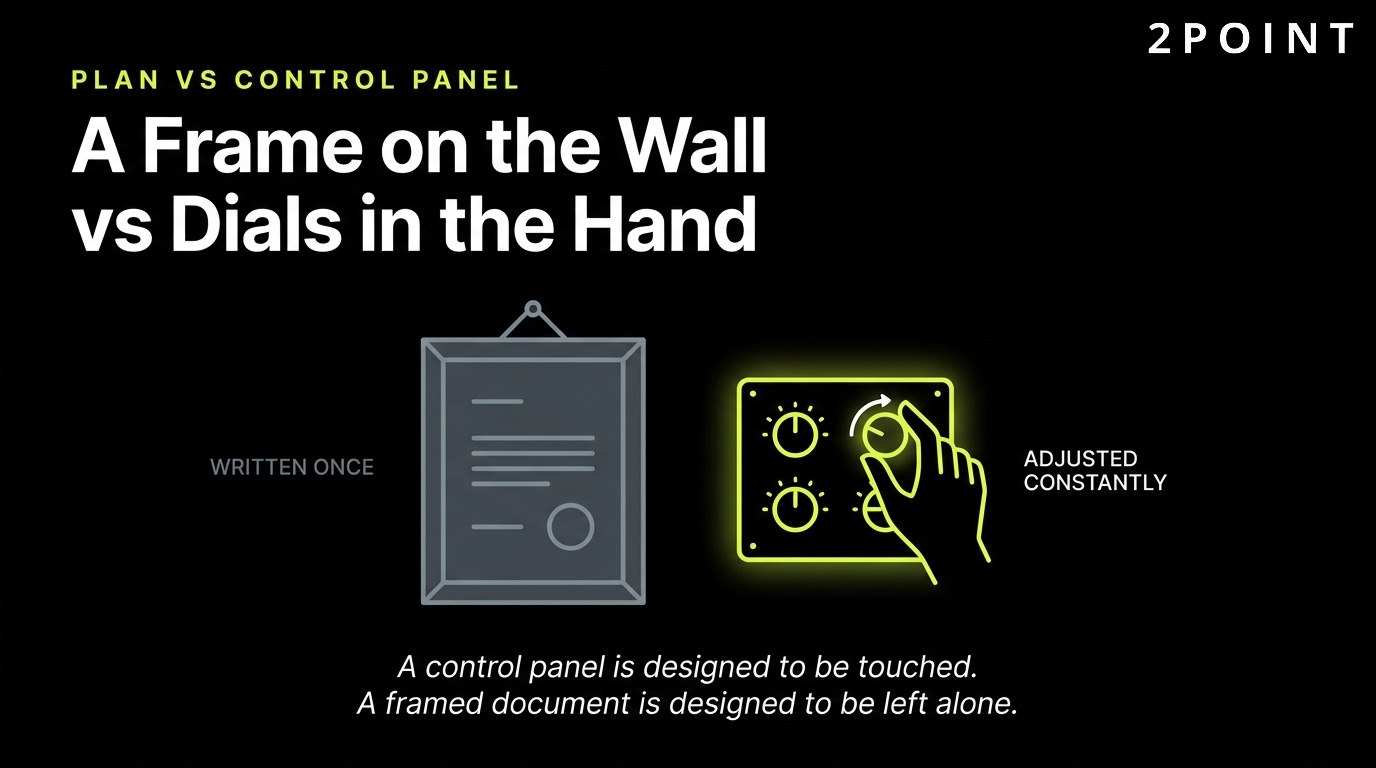
The most valuable shift in perspective for any marketer applying the 4 Ps framework is from treating it as a plan to treating it as a control panel. A plan is written once, approved, and executed. A control panel is monitored continuously, interpreted in real time, and adjusted based on what the instruments tell you about current conditions. Real-time adjustments based on market feedback are what separate businesses that consistently grow from those that launch strong and then plateau.
Customer behavior signals are your primary instruments. Purchase rates tell you whether your offer is resonating at the moment of decision. Cart abandonment rates tell you where friction exists in the buying process. Return rates tell you whether the product is delivering on its promise. Churn rates tell you whether the long-term value proposition holds up after the initial purchase excitement fades. Each of these signals maps to specific Ps: abandonment often points to friction in Place or Price, churn often points to Product gaps, and low initial conversion may indicate a Promotion or Price misalignment. Continuous optimization of the marketing mix requires building the measurement infrastructure to capture these signals consistently and the organizational discipline to act on them promptly.
Responding to market changes requires both speed and strategic judgment. Not every signal demands a strategic response. Some are noise. Others are genuine leading indicators of significant market shifts. The judgment to distinguish between the two comes from deep familiarity with your customers, your competitive context, and the historical patterns in your own data. What the control panel metaphor captures is the active, engaged posture that effective marketing leaders bring to mix management: always watching, always learning, and always willing to adjust when the data calls for it.
Universal Application Across Industries
One of the most valuable properties of the 4 Ps framework is its genuine universality. The 4 Ps apply equally to B2B and B2C businesses, to service companies and product manufacturers, to solopreneurs and enterprise organizations, to technology startups and traditional retail businesses. The specific tactics and decisions within each P vary enormously across these contexts, but the structural framework remains constant and consistently useful.
A solo consulting practice making decisions about service packages (Product), day rates (Price), how to reach clients (Place), and how to communicate expertise (Promotion) is applying the 4 Ps framework whether or not they frame it in those terms. A global consumer goods company conducting a comprehensive market strategy review is doing the same thing at exponentially greater scale and complexity. The core principles remain constant even as the implementation details vary by industry, business size, and competitive context. For local businesses in particular, applying the 4 Ps with discipline and customer focus can create a powerful competitive advantage against larger competitors who execute the framework less thoughtfully.
Industry-specific adaptations of the 4 Ps are common and useful. Service businesses often add the People, Process, and Physical Evidence Ps to address the distinctive characteristics of service delivery. Technology companies increasingly incorporate a fifth P for Partnerships, reflecting the critical role that ecosystem relationships play in distribution and product integration strategies. These adaptations do not replace the original framework. They extend it to capture dimensions of value creation and delivery that are particularly important in specific industry contexts while retaining the original four as the foundational structure.
Budget Realities and Resource Allocation for the 4 Ps in 2026
The Marketing Budget Landscape
Marketing budget discussions in 2026 are shaped by a persistent structural tension between the scope of what is possible and the constraints of what is funded. According to Gartner's 2025 CMO Spend Survey, marketing budgets average approximately 7.7% of company revenue, and a significant majority of marketing leaders report that their budgets are insufficient to execute their full strategic agenda. Fifty-nine percent of marketing leaders describe their budgets as inadequate, meaning that resource prioritization is not an occasional challenge but a permanent condition of marketing management.
This budget reality has important implications for how you approach the 4 Ps framework. When resources are constrained, you cannot invest deeply in every element of the mix simultaneously. You must make deliberate trade-off decisions about where investment will generate the greatest return given your current business stage, competitive position, and customer acquisition dynamics. The 4 Ps framework is invaluable in this context because it forces explicit prioritization rather than allowing budgets to be allocated by default to whichever P has the loudest internal advocates or the most immediately measurable results.
Earning more from the same spend requires a combination of better measurement, smarter allocation, and continuous optimization. The businesses that consistently outperform on marketing efficiency are those that invest in understanding what is actually working, cut spending on what is not, and reinvest the savings into their highest-return activities. This sounds straightforward but requires overcoming significant organizational inertia, because stopping something that has always been done is psychologically difficult even when the data clearly supports the decision.
Allocating Budget Across the 4 Ps
There is no universally correct answer to the question of which P deserves the most investment. The right allocation depends entirely on your business stage, your product's market readiness, your competitive position, and your primary growth objective at any given point. Early-stage businesses typically need to invest heavily in product development and market education, prioritizing the Product and Promotion Ps to establish product-market fit and initial customer acquisition. Growth-stage businesses often need to invest in distribution infrastructure to scale beyond their initial customer base, shifting emphasis toward the Place P.
A common trap is the tendency to allocate disproportionately to Promotion while underinvesting in the other three Ps. Promotional spend is highly visible and creates easily measurable short-term activity metrics, making it attractive to organizations that feel pressure to demonstrate marketing results quickly. But promotional effectiveness is fundamentally constrained by the strength of the other three Ps. The best advertising in the world cannot compensate for a product that underdelivers, a price that misaligns with perceived value, or a distribution process that creates buyer friction. Testing and learning with constrained resources means running small experiments across the mix rather than committing large budgets to a single P before you have validated that investment's effectiveness.
A structured approach to budget allocation begins with an honest assessment of where your current marketing mix is weakest. If your product is strong, your price is competitive, and you have an efficient distribution process, then incremental promotional investment is likely your highest-return opportunity. If your conversion rates are low despite healthy traffic, the bottleneck may be in pricing or the purchase experience rather than promotional reach. The 4 Ps framework is most valuable as a budget allocation tool when each element is evaluated independently against objective performance metrics, not just relative to its current budget share.
Marketing Mix Modeling and ROI Measurement
Marketing mix modeling (MMM) is the quantitative practice of using statistical analysis to understand how each element of the marketing mix contributes to business outcomes. Originally developed by consumer goods companies in the 1970s and 1980s, MMM has become significantly more accessible and actionable as data collection, processing power, and analytical tools have improved. In 2026, marketing mix modeling is a core tool for strategic marketers who need to make resource allocation decisions based on empirical evidence rather than intuition.
Attribution across multiple touchpoints is one of the most challenging problems in modern marketing measurement. A customer who converts after seeing a display ad, reading a blog post, watching a product video, and clicking a search ad has interacted with multiple promotional elements across multiple channels before making a purchase decision. Giving full credit to only the last touchpoint, as last-click attribution models do, dramatically understates the contribution of upper-funnel promotional activities and leads to systematic underinvestment in brand building and content marketing. Multi-touch attribution models attempt to distribute credit more accurately across all touchpoints, enabling more informed promotional mix decisions.
Adjusting the marketing mix based on measured performance is the practical output of effective marketing analytics. When MMM reveals that your paid social investment is generating a significantly lower return than your organic search investment, the appropriate response is to shift budget accordingly until the returns equilibrate or until you have exhausted the efficient capacity of the higher-return channel. This kind of disciplined, data-driven reallocation is what separates marketing organizations that improve their efficiency year over year from those that repeat the same allocation patterns regardless of changing performance data. Using your digital marketing strategy assessment as a starting point for MMM analysis provides a structured foundation for these allocation conversations.
When to Shift Resources Between the Ps
Recognizing the signals that indicate a need to shift investment between the Ps is a practical skill that comes from regular, structured review of your marketing mix performance. Pricing signals that suggest attention is needed include high traffic with low conversion, frequent objections to price in sales conversations, higher-than-expected churn immediately after a first payment, or a significant gap between your price and the price point at which competitors are winning the business you lose. These signals suggest that the Price P deserves investment in the form of customer research, competitive analysis, and potentially A/B testing of alternative pricing structures.
When distribution becomes the bottleneck, the symptoms typically include strong demand signals, healthy conversion rates for customers who complete the purchase, but significant drop-off or abandonment at specific points in the fulfillment or access process. This pattern suggests that your promotional investment is working but your Place infrastructure is not keeping pace with the demand it is generating. Promotional efficiency vs. reach trade-offs become particularly acute when budgets are constrained. Choosing channels that reach a smaller but more precisely targeted audience at lower cost per acquisition often outperforms broad-reach campaigns that generate high volume but low-quality leads.
Product-market fit challenges are the most fundamental signals for resource reallocation. When retention rates are low, customer satisfaction scores are disappointing, and the most common reason for churn is that the product "didn't do what I expected," additional promotional investment will not solve the problem. Investment needs to shift toward the Product P: deeper customer research, product iteration, and potentially a more fundamental rethinking of the value proposition. For businesses developing a strong marketing goals process, connecting those goals explicitly to each P helps ensure that resource allocation decisions are driven by strategy rather than departmental habit.
A Complete Framework Summary: The 4 Ps at a Glance
| The P | Core Question | Key Decisions | Common Mistakes | 2026 Priority |
|---|---|---|---|---|
| Product | What are we selling and what value does it deliver? | Features, design, quality, lifecycle, differentiation, portfolio | Feature-first thinking, ignoring intangibles, no lifecycle management | Continuous iteration, customer feedback loops, product-led growth |
| Price | What price reflects our value and serves our strategy? | Pricing model, positioning, discounts, payment terms, testing | Cost-plus default, reflexive discounting, ignoring perceived value | Value-based pricing, dynamic optimization, segment-specific tiers |
| Place | How do customers access and receive our product? | Channel mix, direct vs. indirect, logistics, digital presence, convenience | Underinvesting in distribution, ignoring channel conflict, friction in buying | Omnichannel experience, self-serve infrastructure, marketplace presence |
| Promotion | How do we communicate our value to target customers? | Channel selection, messaging, content, targeting, measurement | Broadcast-only approach, disconnected channels, measuring activity not outcomes | Personalization, content marketing, data-driven attribution, community building |
The 4 Ps are most effective when each element reinforces the others within a single, customer-grounded strategy rather than operating as independent departmental decisions.
The 4 Ps vs. the 4 Cs: A Comparative Overview
| 4 Ps Element (Seller Perspective) | 4 Cs Equivalent (Customer Perspective) | Strategic Shift |
|---|---|---|
| Product | Customer Solution | From "what we make" to "what the customer needs to accomplish" |
| Price | Customer Cost | From monetary price to total cost of ownership including time and effort |
| Place | Convenience | From "where we distribute" to "how easy we make it to buy and use" |
| Promotion | Communication | From one-way broadcast to two-way dialogue and relationship building |
Using the 4 Ps and 4 Cs together ensures that every seller-side decision is validated against the customer's actual experience and priorities.
Pricing Strategy Comparison for Common Business Models
| Pricing Strategy | Best Suited For | Primary Advantage | Primary Risk |
|---|---|---|---|
| Cost-Plus Pricing | Manufacturing, commodity products | Guaranteed margin on each unit | Ignores customer willingness to pay and competitive context |
| Value-Based Pricing | Professional services, SaaS, premium goods | Maximizes revenue per customer based on actual value delivered | Requires deep customer research to implement accurately |
| Competitive Pricing | Commoditized markets, price-sensitive segments | Easy market benchmarking, reduces price objections | Commoditizes your offering, limits differentiation |
| Freemium Pricing | Digital products, SaaS, mobile apps | Low barrier to trial drives high top-of-funnel volume | Conversion to paid requires careful product and pricing design |
| Dynamic Pricing | E-commerce, hospitality, digital advertising | Optimizes revenue based on real-time demand signals | Can feel inconsistent or unfair to price-sensitive buyers |
The most effective pricing strategy is the one that accurately reflects your product's value to your specific target customer while supporting your positioning and margin objectives.
Building a Complete Digital Marketing Presence Using the 4 Ps
How Digital Marketing Transforms Each P
The emergence of digital marketing has not replaced the 4 Ps. It has expanded the toolkit within each P while dramatically increasing the speed at which feedback, measurement, and optimization can occur. Every P has been changed in fundamental ways by digital capabilities, and understanding these changes is essential for building a marketing mix that performs effectively in a digital-first environment.
In the Product P, digital enables continuous iteration based on real-time user behavior data, something physically impossible with traditional product manufacturing. In the Price P, digital enables dynamic pricing, A/B testing, and personalized pricing offers that adjust based on buyer behavior in ways that static retail pricing cannot. In the Place P, digital channels eliminate geographic constraints and dramatically reduce the cost of distributing intangible products globally. In the Promotion P, digital platforms enable precise targeting, real-time performance measurement, and personalized messaging at scale that was economically out of reach for most businesses before programmatic advertising made it accessible.
The social media marketing component of the digital promotional mix deserves special attention because it uniquely enables community-building and two-way communication at scale. A brand that uses social platforms effectively is not just broadcasting promotional messages. It is creating ongoing dialogue with its customer community, gathering real-time feedback, building brand advocates, and developing relationships that reduce customer acquisition costs through word-of-mouth referral. This community dimension of promotion was not possible at scale before social platforms made it structurally simple.
Integrating Mobile Marketing Into the 4 Ps
Mobile has become the dominant computing platform for most customer interactions with brands, making mobile marketing a non-negotiable consideration across all four Ps. In the Product P, mobile-first design is a baseline requirement for digital products because the majority of users will interact with your product on a smartphone. In the Price P, mobile payment infrastructure, including Apple Pay, Google Pay, and regional mobile payment platforms, removes friction from the purchase process and improves conversion rates by reducing the steps required to complete a transaction.
In the Place P, mobile distribution through app stores represents a distinct channel with its own discovery, review, and acquisition dynamics. App Store Optimization (ASO) is the mobile equivalent of SEO, requiring the same kind of keyword research, competitive analysis, and ongoing optimization to maintain visibility in an increasingly crowded marketplace. In the Promotion P, mobile-specific formats, including in-app advertising, push notifications, SMS marketing, and mobile video, reach customers during the moments when they are most actively engaged with their devices and therefore most receptive to relevant messages.
The Role of Brand Awareness in the 4 Ps
Building brand awareness is a promotional objective that influences every other P in the marketing mix. When customers recognize and trust your brand, your pricing power increases because familiar brands command a premium over unfamiliar alternatives. Your distribution effectiveness improves because channel partners and marketplace algorithms favor established brands. Your product launches succeed more quickly because an existing audience is primed to evaluate and adopt new offerings from brands they already trust.
Brand awareness investments typically have longer payback periods than direct response advertising, which creates a tension in organizations that prioritize short-term measurable results. The businesses that build the strongest long-term competitive positions are those that invest consistently in brand awareness even when the direct revenue attribution is difficult to prove, because the compounding returns of brand equity accumulate over years and create a moat against competitive disruption. Branding is not the same as marketing, but the two are deeply interdependent, and a strong brand is one of the most valuable assets that a well-executed 4 Ps strategy can build over time.
For businesses using affiliate marketing as part of their promotional mix, brand awareness is particularly critical because affiliates are more willing to promote, and more effective at promoting, brands that their own audiences already recognize and trust. An affiliate program built on top of a strong brand foundation generates meaningfully higher commission-to-revenue ratios than one that asks affiliates to introduce an unknown brand to skeptical audiences.
Conclusion: The 4 Ps as Your Enduring Marketing Foundation
The 4 Ps of marketing have survived more than six decades of technological revolution, behavioral shifts, and business model innovation for a simple reason: they capture a set of decisions that every business must make, regardless of industry, size, or era. Every organization that sells something must decide what that something is, what it costs, how customers access it, and how they hear about it. The 4 Ps provide a durable, actionable framework for making those decisions deliberately rather than by default.
The most important insight for any practitioner applying the 4 Ps in 2026 is that the framework is not static. The 4 Ps function best as a dynamic control panel that is monitored continuously and adjusted based on real customer signals, competitive dynamics, and performance data. The businesses that treat the marketing mix as a living strategic instrument, not a document completed during annual planning, consistently outperform those that execute their initial mix without regular review and recalibration.
Customer centricity enhances rather than replaces the 4 Ps framework. Research confirms that applying a customer perspective to each P significantly improves the framework's ability to predict purchase intention and drive business results. Starting every marketing mix decision with deep customer research, rather than internal assumptions, is the single most reliable way to ensure that your product, pricing, distribution, and promotional investments generate real returns.
Integration is the multiplier. Individual excellence in any single P is less valuable than coherent alignment across all four. A premium product that is priced cheaply, distributed through commodity channels, and promoted with generic messaging wastes every advantage the product itself creates. A modest product supported by smart pricing, convenient distribution, and precisely targeted promotion can outperform significantly better products that suffer from mix inconsistency. When all four Ps tell the same story about who you are, who you serve, and what you uniquely offer, the marketing mix becomes a self-reinforcing competitive advantage that compounds over time.
The practical recommendation is straightforward: conduct a structured audit of your current marketing mix before your next planning cycle. Evaluate each P independently against objective performance metrics and customer feedback. Identify where the gaps and inconsistencies are. Then prioritize the investments that will close the most consequential gaps rather than simply increasing spending in the areas that are already performing adequately. This kind of disciplined, evidence-based approach to the 4 Ps is what separates marketing that builds lasting business value from marketing that simply generates activity.
At 2POINT, helping businesses build coherent, customer-grounded marketing strategies is central to what we do. Whether you are launching a new product, entering a new market, or optimizing an existing mix that is not delivering the results you need, the 4 Ps framework provides the structural foundation for every strategic decision that follows. Start with your customer, align your mix, measure relentlessly, and adjust continuously. That is the enduring competitive formula that the 4 Ps have always represented, and it remains as actionable and as relevant in 2026 as it was when Jerome McCarthy first articulated it more than six decades ago.
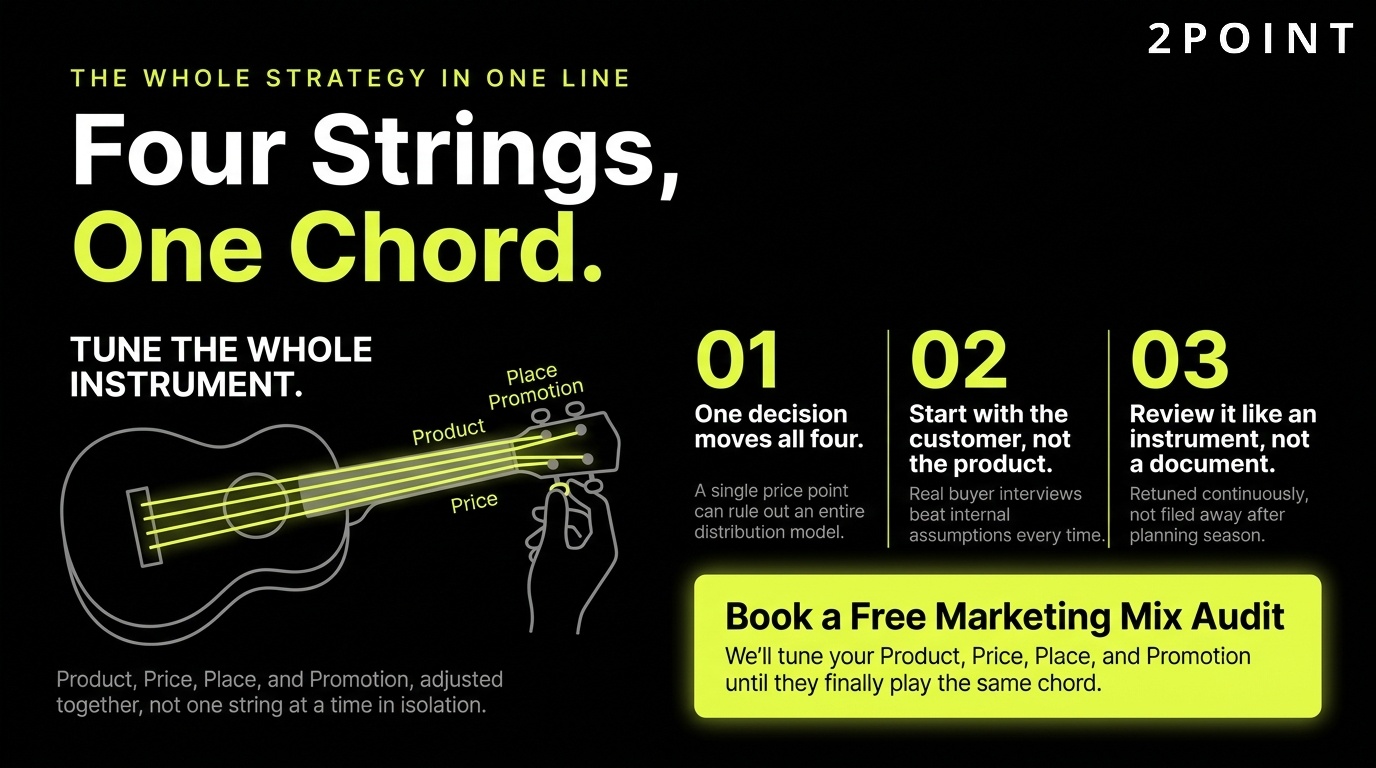
Frequently Asked Questions About the 4 Ps of Marketing
What exactly are the 4 Ps of marketing?
The 4 Ps of marketing are Product, Price, Place, and Promotion. Together, they form a strategic framework that guides every major marketing decision a business makes, from what to sell and how to price it, to where to distribute it and how to communicate its value to customers.
Who created the 4 Ps of marketing and when?
Jerome McCarthy introduced the 4 Ps framework in his 1960 textbook "Basic Marketing: A Managerial Approach," drawing on Neil Borden's earlier concept of the "marketing mix." Philip Kotler later expanded and popularized the framework through his highly influential marketing textbooks throughout the 1960s and 1970s.
Are the 4 Ps of marketing still relevant in 2026?
Yes, the 4 Ps remain highly relevant in 2026. Research confirms that the framework continues to predict purchase intention when properly applied in digital contexts. The specific tactics within each P have evolved significantly, but the four strategic categories still capture every major marketing decision a business must make.
What is the difference between the 4 Ps and the 4 Cs of marketing?
The 4 Ps (Product, Price, Place, Promotion) represent the seller's perspective, while the 4 Cs (Customer Solution, Customer Cost, Convenience, Communication) represent the buyer's perspective. The 4 Cs do not replace the 4 Ps. They reframe each element to ensure that seller-side decisions are grounded in genuine customer insight and experience.
How do the 4 Ps work together as a system?
Each of the 4 Ps influences the others in significant ways. A pricing decision shapes which distribution channels are economically viable, which in turn affects what promotional investment is required. A product feature set shapes what price the market will accept. When all four Ps are aligned around a clear target customer and consistent value proposition, the mix creates a self-reinforcing competitive advantage.
Can the 4 Ps apply to service businesses and B2B companies?
Yes, the 4 Ps framework applies to service businesses, B2B companies, digital product companies, and non-profit organizations, not just consumer goods manufacturers. Service businesses often use the extended 7 Ps model, which adds People, Process, and Physical Evidence to the original four, but the core framework remains the foundation.
What is the most important of the 4 Ps?
No single P is universally most important. The relative priority depends on your business stage, competitive position, and primary growth challenge. Early-stage businesses often need to focus on Product and Promotion to establish product-market fit. Growth-stage businesses frequently need to invest in Place infrastructure. The framework is most powerful when all four Ps receive appropriate attention relative to your specific strategic situation.
How does pricing strategy fit within the 4 Ps of marketing?
Price is the only one of the 4 Ps that generates revenue rather than incurring costs, making pricing decisions among the highest-leverage choices in the marketing mix. Effective pricing reflects the customer's perceived value, communicates market positioning, and aligns with the product quality, distribution channels, and promotional messaging of the overall mix.
What is a marketing mix model and how does it relate to the 4 Ps?
A marketing mix model (also called marketing mix modeling) is a statistical approach to measuring how each element of the marketing mix contributes to business outcomes like revenue and customer acquisition. It is a quantitative tool that uses the 4 Ps framework as its structural foundation, enabling data-driven decisions about resource allocation across Product, Price, Place, and Promotion investments.
How do I start applying the 4 Ps to my marketing strategy?
Begin with customer research rather than product decisions, building genuine buyer personas grounded in interviews and behavioral data. Then map each P to specific decisions about what you offer, how you price it, where customers access it, and how you communicate its value. Evaluate the consistency and alignment across all four Ps, and establish measurement systems that let you optimize each element based on real performance data.
What is the biggest mistake businesses make with the 4 Ps?
The most common and costly mistake is treating the 4 Ps as a one-time planning checklist rather than a dynamic management framework. Businesses that complete a 4 Ps analysis during annual planning and then execute without ongoing review miss the opportunity to adjust based on customer feedback, competitive changes, and performance signals throughout the year.
How does the 4 Ps framework differ from a full marketing strategy?
The 4 Ps framework is a structural tool for organizing marketing mix decisions, not a complete marketing strategy on its own. A full marketing strategy also includes market segmentation, target audience definition, competitive positioning, marketing goals, budget allocation, and performance measurement. The 4 Ps provide the operational structure that gives a broader strategy its practical execution form.
