

 let’s connect


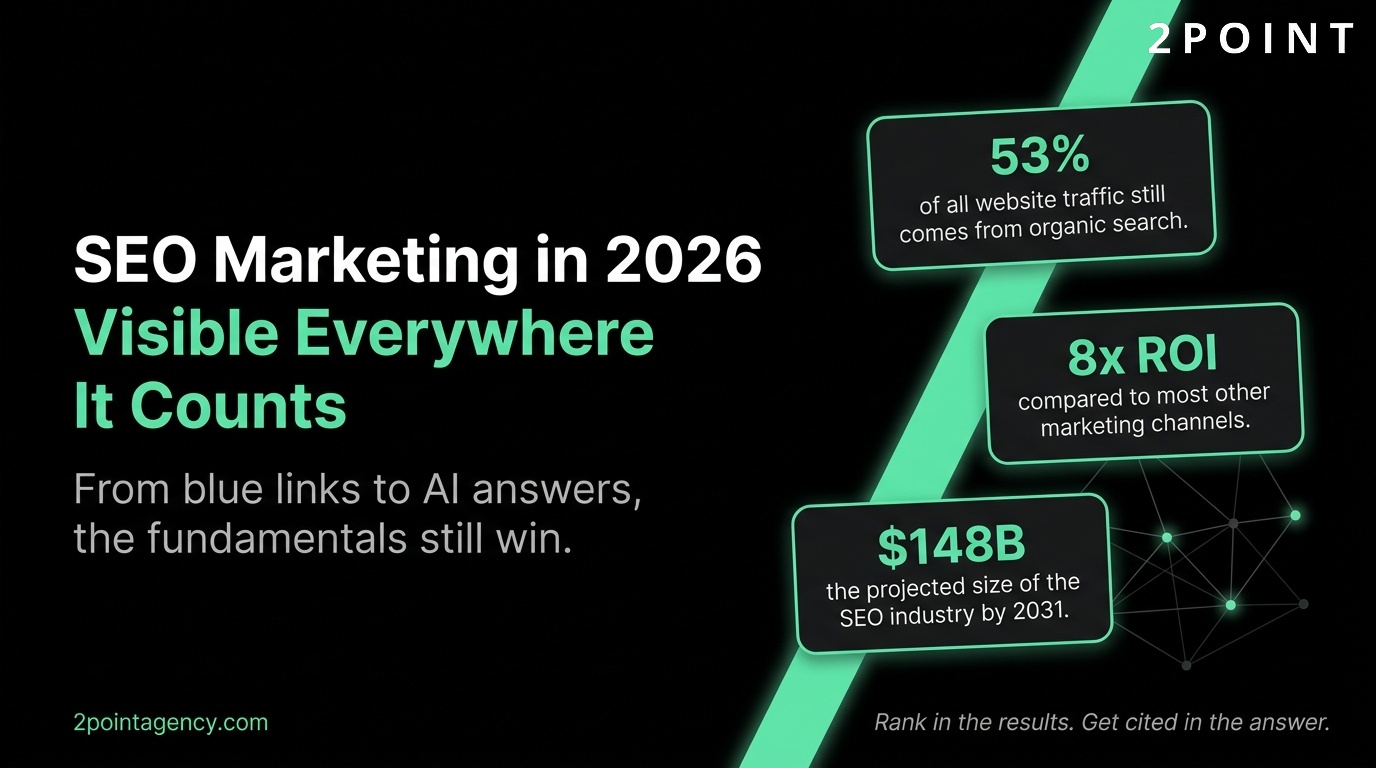
- SEO marketing optimizes digital content and websites to increase visibility in search engines and AI-powered platforms.
- Organic search drives 53% of all website traffic, making it the dominant digital discovery channel.
- SEO delivers approximately 8x ROI compared to most other marketing channels.
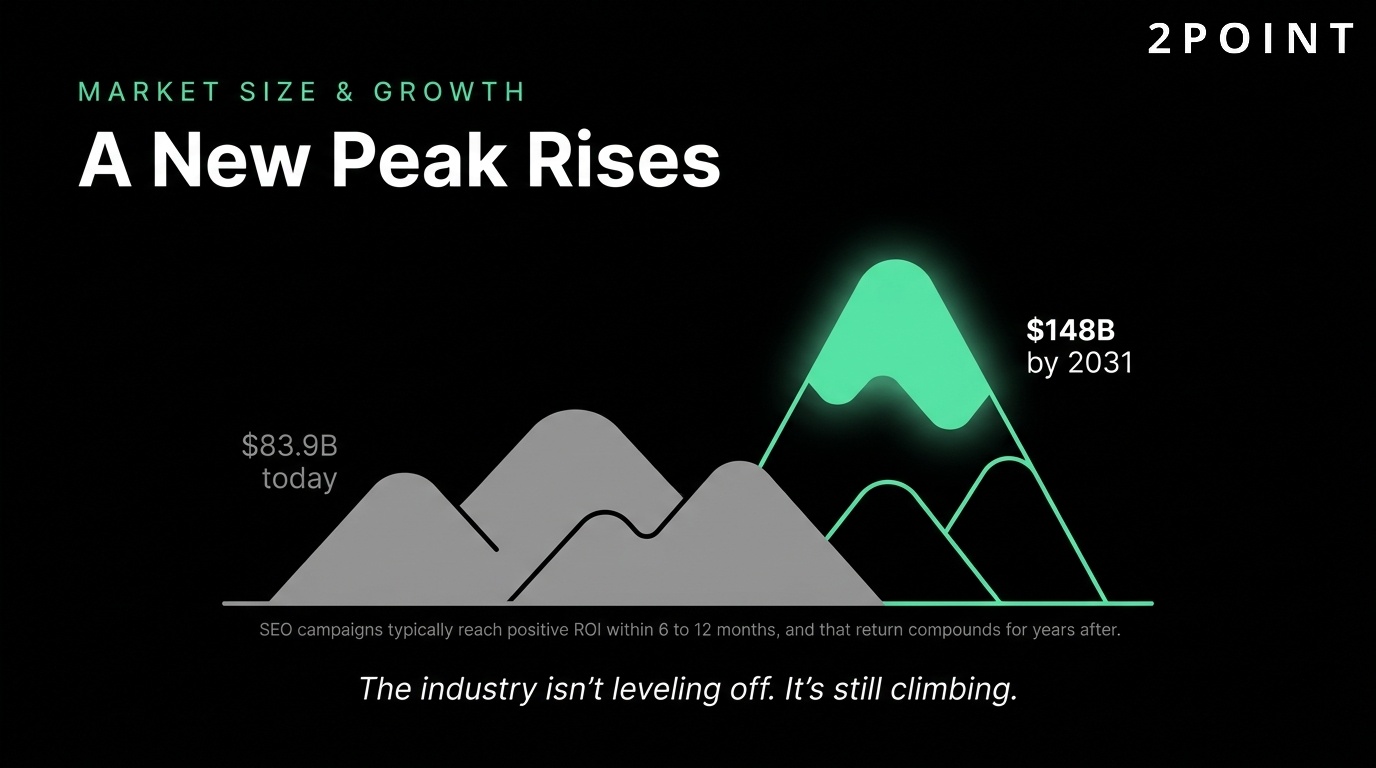
- The global SEO industry is valued at $83.9 billion and projected to reach $148 billion by 2031.
- In 2026, SEO marketing includes optimization for Google AI Overviews, ChatGPT citations, and multi-platform discovery.
- Traditional fundamentals such as keyword research, technical health, and backlinks still matter significantly.
- Success now requires visibility across search engines AND AI answer engines simultaneously.
- Brands that ignore AI-era optimization risk losing influence even when they rank on page one.
SEO marketing has never been more important or more complex. The practice has expanded far beyond placing keywords on a webpage. Today it encompasses technical architecture, content authority, brand reputation, AI citation optimization, and multi-platform visibility. This guide breaks down exactly what SEO marketing means in 2026, what changed, what stayed the same, and how to build a strategy that performs across every channel where your audience discovers information.
Why SEO Marketing Still Matters in the AI Era
Every year, a new wave of commentary declares SEO dead. Every year, the data proves otherwise. The channel has evolved substantially, particularly with the rise of AI-generated search results, but the underlying logic remains intact: people search for information, and the brands that appear at the right moment with the right answer win attention, trust, and revenue. The question is no longer whether SEO marketing works. The question is how to do it well in a landscape that looks very different from even two years ago.
The Numbers Behind SEO's Enduring Value
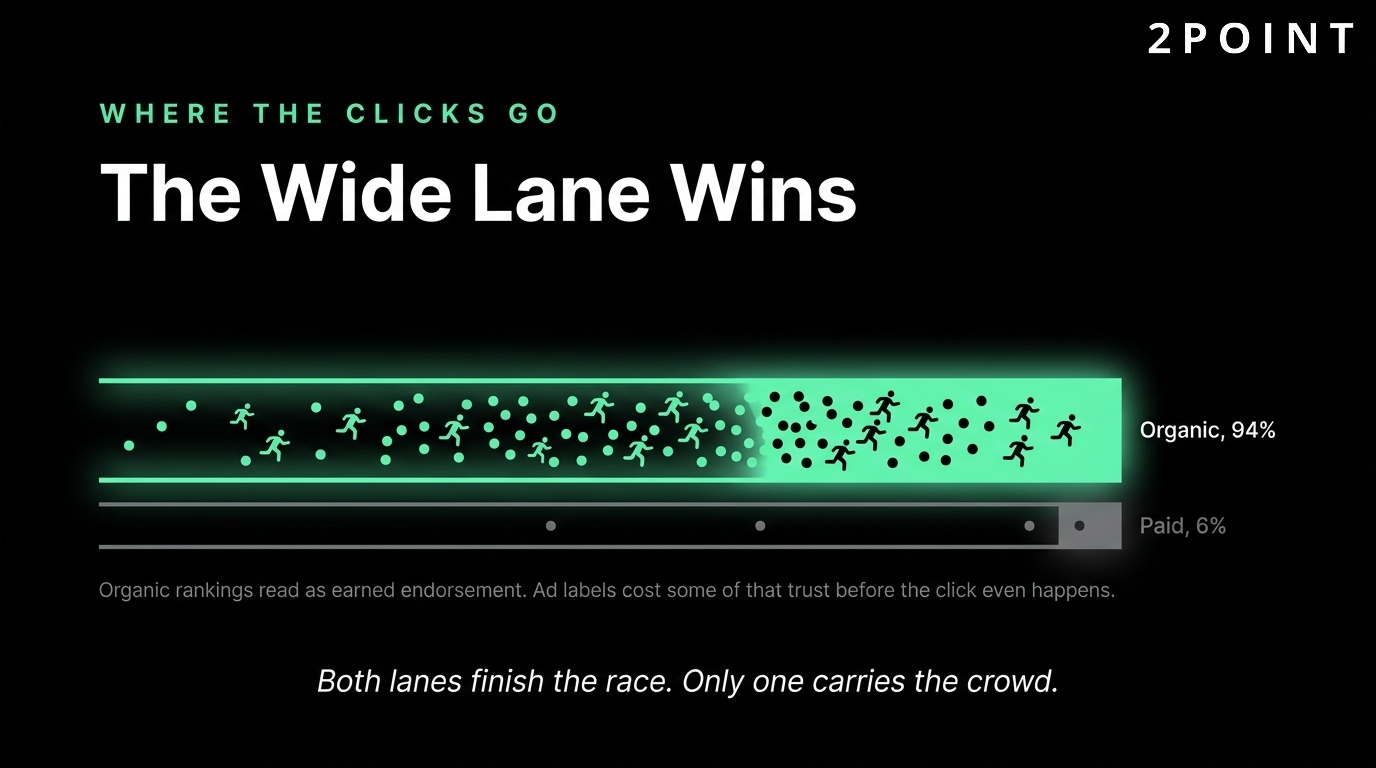
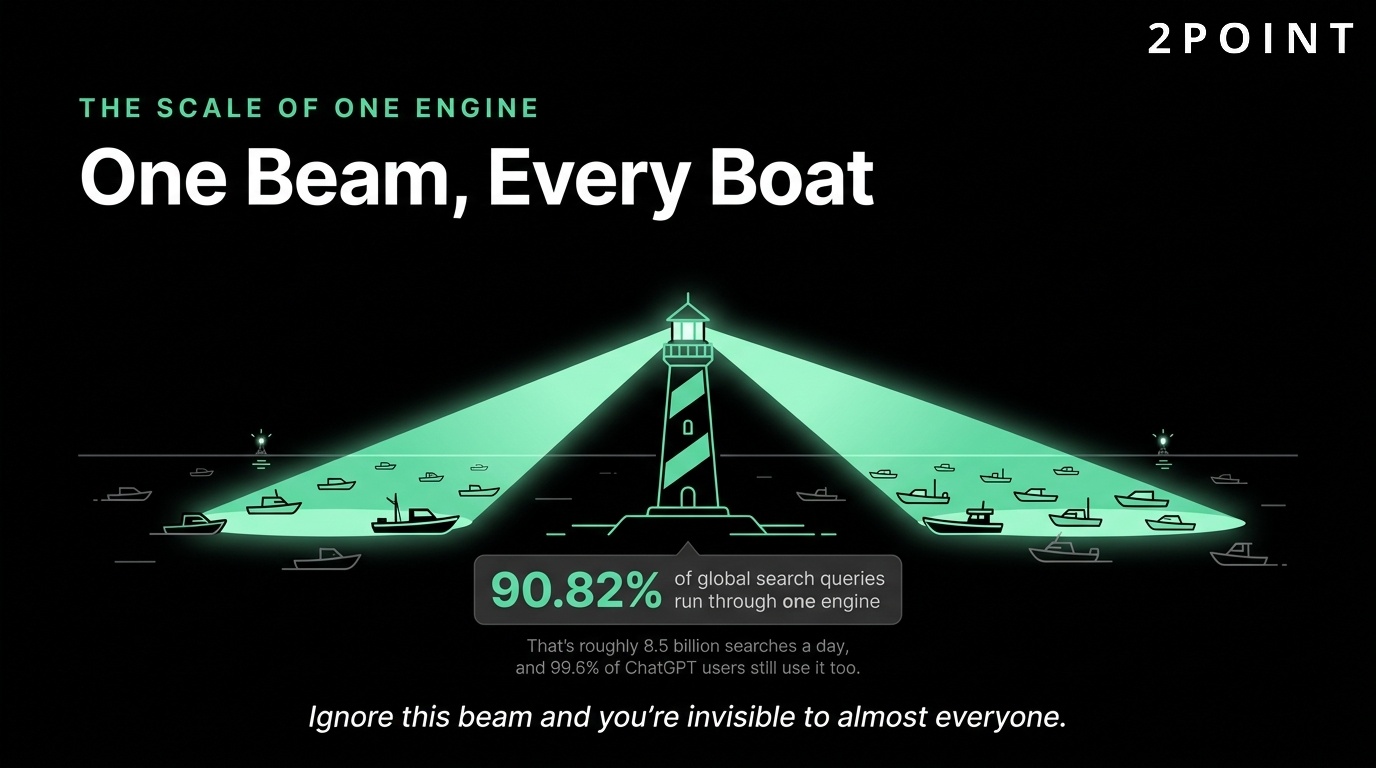
Google handles 90.82% of global search queries, processing roughly 8.5 billion searches every single day. That staggering volume means even a fraction of organic visibility translates into enormous traffic opportunity. And while paid advertising competes for attention, 94% of clicks still go to organic search results, meaning the investment in organic rankings pays dividends that paid clicks simply cannot replicate at scale.
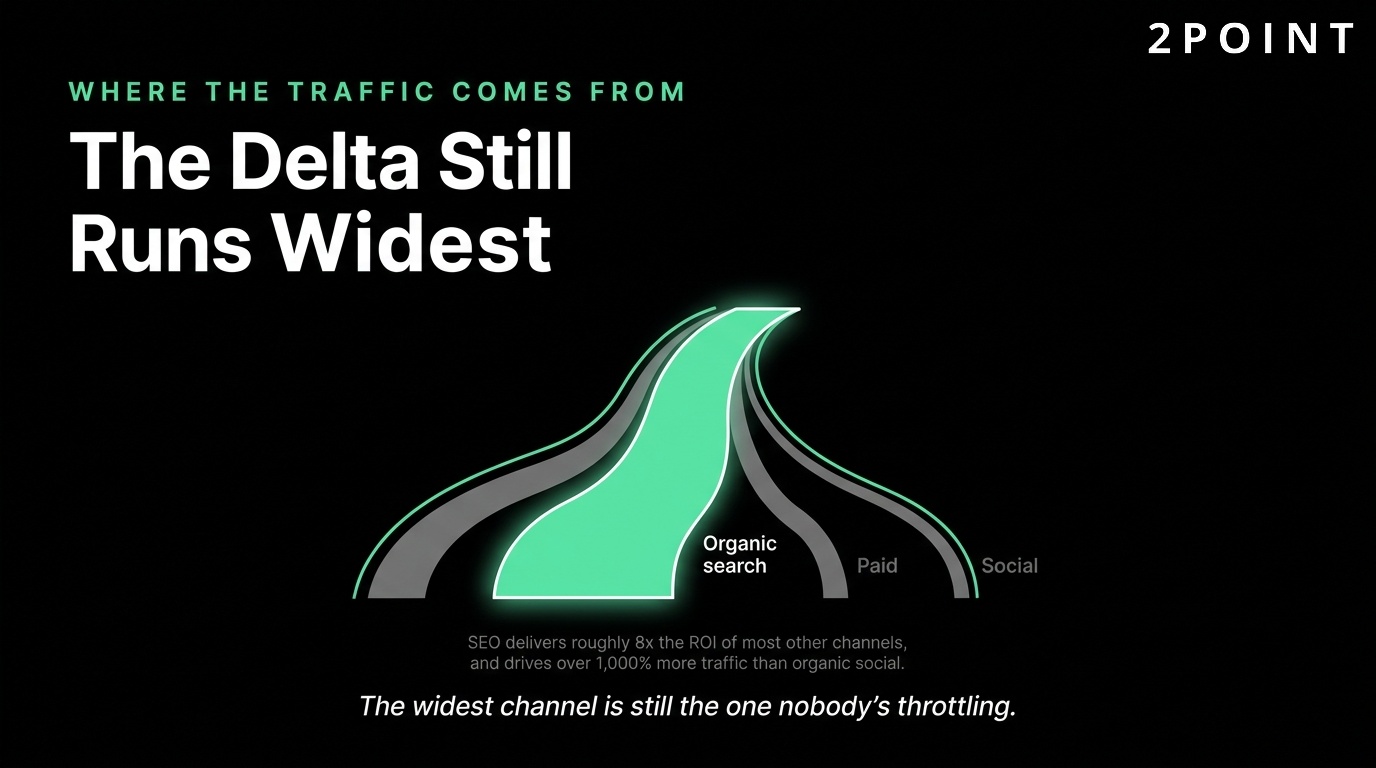
The traffic advantage is equally dramatic when compared to social media. SEO drives more than 1,000% more traffic than organic social media, a gap that has grown as social platforms throttle organic reach to push brands toward paid promotion. For marketers trying to build sustainable audience growth without unlimited advertising budgets, that differential is decisive.
The return on investment case is compelling as well. SEO campaigns typically achieve positive ROI within six to twelve months, and in 2026, websites, blogs, and SEO programs represent the top ROI-generating channel cited by marketers. Businesses recognize this, with companies allocating 10 to 20 percent of digital marketing budgets to SEO as a core growth lever rather than a supplementary tactic.
These numbers tell a consistent story: despite every disruption, search engine optimization remains the highest-performing digital channel for sustainable, compounding growth. The fundamentals that drove results five years ago still apply. What has changed is the sophistication required to execute them well.
What Changed: From Traffic Generation to Visibility Everywhere
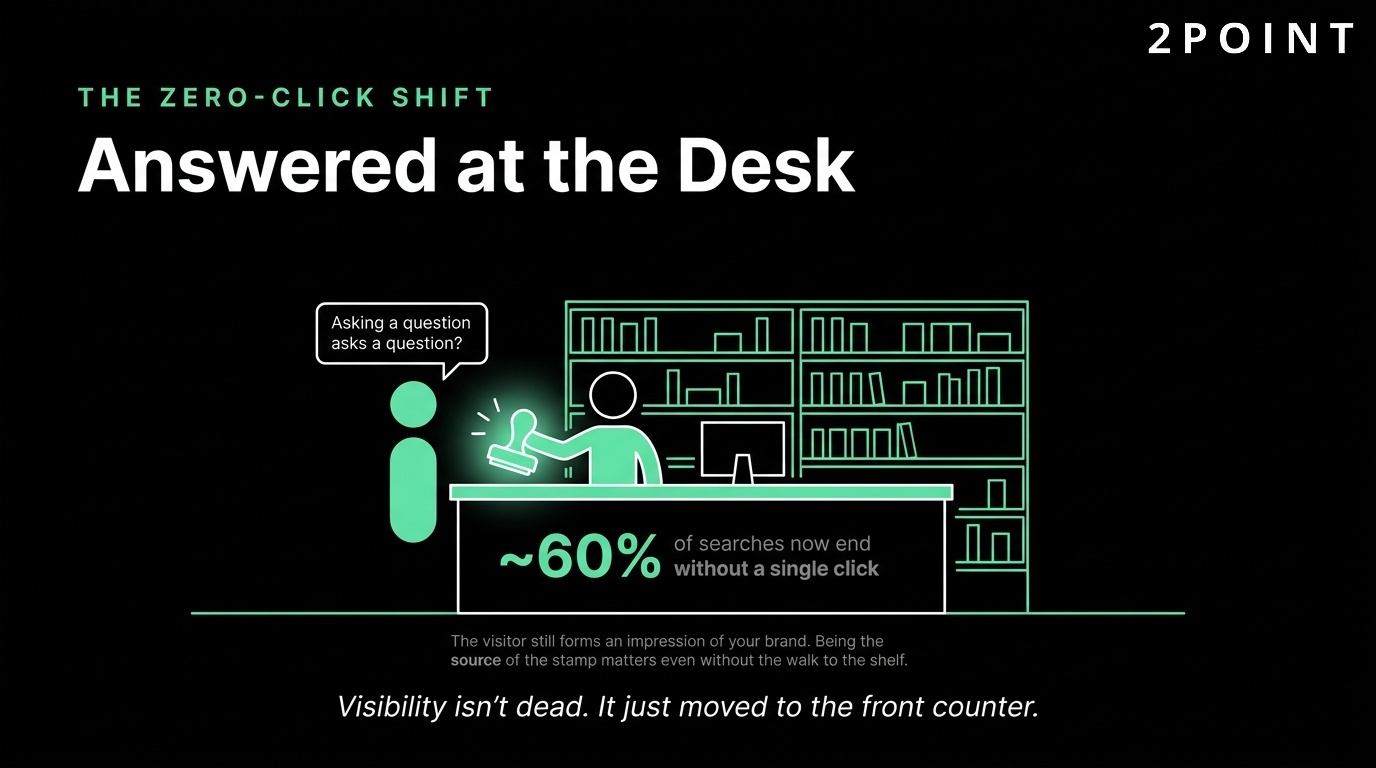
The arrival of AI-generated search features did not replace search behavior. It reshaped what happens after a user types a query. Approximately 60% of searches now end without a click because AI Overviews, featured snippets, and knowledge panels deliver the answer directly on the results page. That is a meaningful behavioral shift, but it does not reduce the strategic importance of appearing in those results. If anything, it raises the stakes.
AI Overviews appear on roughly 16% of queries, and when they do, they reduce clicks to the top-ranking organic page by approximately 58%. But this does not mean those queries have lost value. It means the definition of visibility has expanded. Being cited inside an AI Overview carries brand authority that influences purchasing decisions, even without generating a direct click. Notably, 99.6% of ChatGPT users still use Google, confirming that search and AI tools coexist rather than compete.
The clearest signal of this shift is the convergence of search and content strategy. Search and content are no longer separate disciplines, and organizations that treat them as independent silos are leaving significant performance on the table. A well-structured SEO strategy in 2026 integrates content planning, technical optimization, and AI visibility into a single unified program.
The Shift to Intent Quality Over Traffic Volume
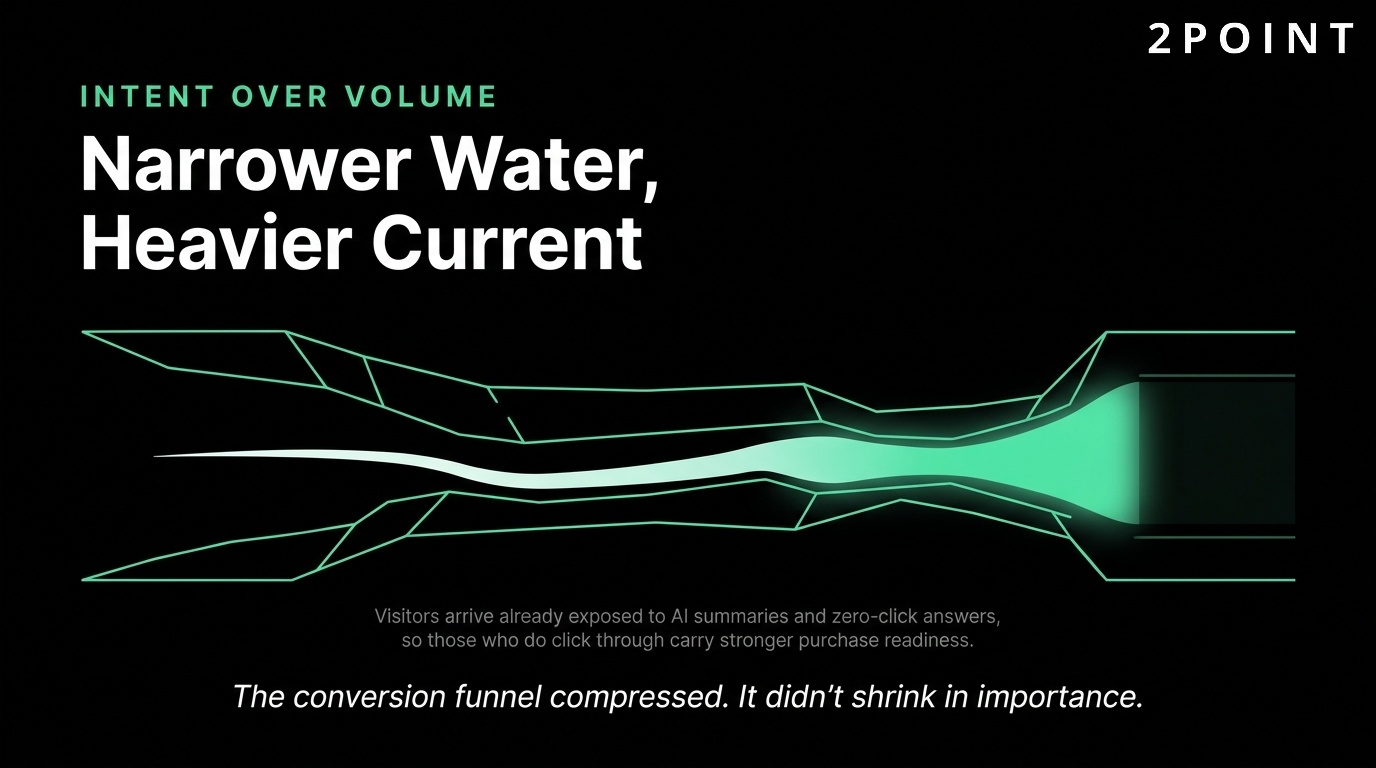
One of the most important strategic recalibrations in modern SEO marketing involves letting go of raw traffic as the primary success metric. Fewer clicks now come from search, but the visitors who do click through are further along in their decision-making process. They have already been exposed to information through AI summaries and zero-click answers, which means when they arrive on your site, they often arrive with higher intent and stronger purchase readiness.
Traditional traffic metrics no longer tell the full story of SEO performance. Users are discovering brands and forming purchasing decisions without ever clicking through to a website. This compresses the conversion funnel and changes how SEO impact should be measured. A brand that earns consistent mentions in AI answers and featured snippets is influencing buyer decisions at scale, even when Google Analytics shows flat organic traffic numbers.
The practical implication is that conversion optimization has become inseparable from SEO strategy. When fewer visitors arrive but each one carries higher intent, the quality of the landing experience matters enormously. Pages that convert well become more valuable per visitor, and optimizing for conversion becomes integral to SEO success as the funnel compresses. Smart SEO marketing focuses on reaching decision-makers at critical moments, not simply maximizing visitor counts.
Budget Reality: What Companies Actually Spend
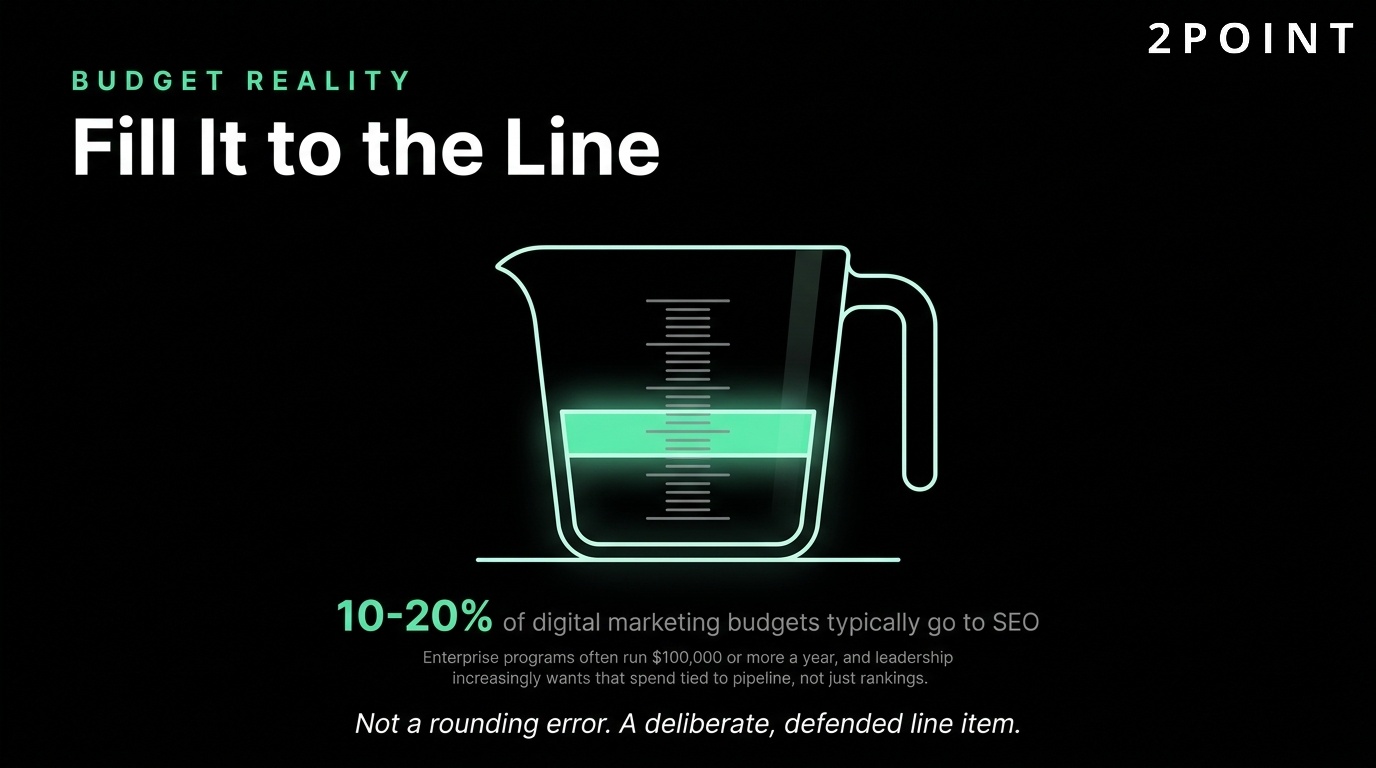
Budget allocation reveals what organizations truly prioritize, and the SEO investment picture in 2026 reflects genuine strategic commitment. Enterprise organizations routinely spend $100,000 or more annually on SEO programs, spanning content production, technical development, link acquisition, and analytics infrastructure. Mid-market companies typically invest at lower absolute levels but commit meaningful proportions of their digital marketing budgets to organic search.
The scrutiny applied to those budgets has intensified. Leadership is demanding clearer answers on how content contributes to pipeline and revenue, not just impressions and rankings. This is driving a healthy evolution in how SEO teams report results and structure their programs. The marketers who survive budget reviews are those who can draw a credible line from organic search activity to business outcomes.
That measurement challenge creates an opportunity for well-organized SEO programs to demonstrate disproportionate value. When content generates qualified leads, reduces customer acquisition costs, and builds brand authority that supports sales cycles, those outcomes can be quantified and defended. The investment remains significant, but the justification has shifted from "we need to rank" to "here is what ranking actually generates for the business."
The AI Revolution in SEO Marketing: What Actually Changed
Artificial intelligence has not disrupted SEO marketing so much as it has expanded it. The channels where brands must earn visibility have multiplied. The standards for content quality have risen. The measurement frameworks require updating. But the core mission of search engine optimization, helping the right people find you when they need you, remains completely intact. What has changed is the terrain on which that mission plays out.
Understanding Generative Engine Optimization (GEO)
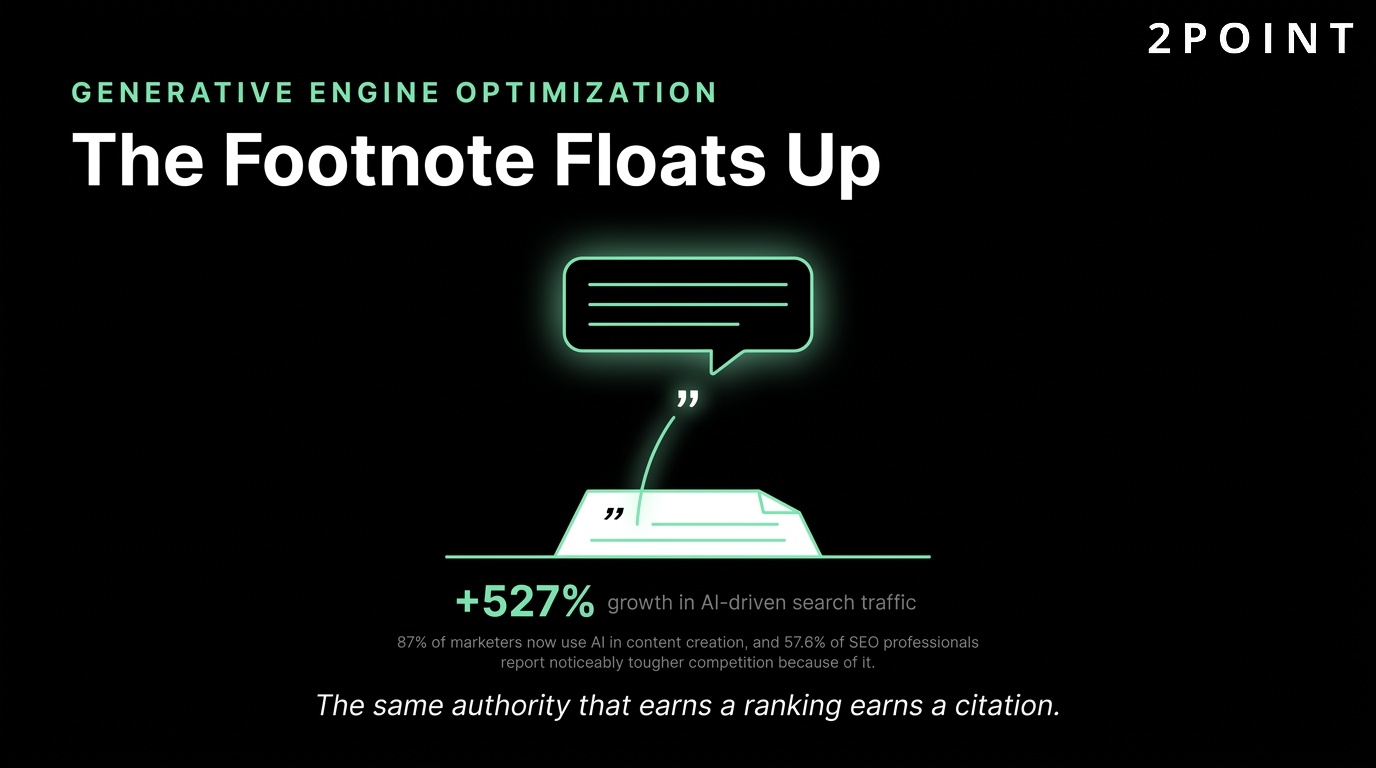
A new discipline has emerged within the broader SEO marketing landscape: generative engine optimization, commonly called GEO. The central question GEO addresses is straightforward. When ChatGPT, Google Gemini, Perplexity, or Microsoft Copilot answers a question about your industry, your product category, or a problem you solve, does your brand appear in the response? GEO focuses on building credible, well-structured, authoritatively cited content that AI systems draw from when generating their answers.
The growth of AI-driven search is real and accelerating. AI search traffic has grown by 527% over recent periods, and 87% of marketers now use AI to create or assist in creating content. The competitive implications are significant: AI-generated content accounts for 17.3% of content appearing in Google's top 20 results, and 57.6% of SEO professionals report a significant increase in competition directly attributable to AI content production.
GEO is not a replacement for traditional SEO. It is an extension of it. The same principles of authority, relevance, and trustworthiness that drive Google rankings also determine which sources AI systems prefer to cite. Brands that invest in authoritative, well-structured content are building assets that work across both traditional search results and AI-generated answers simultaneously. This dual-channel return makes content investment more valuable than ever.
How AI Overviews Changed Search Behavior
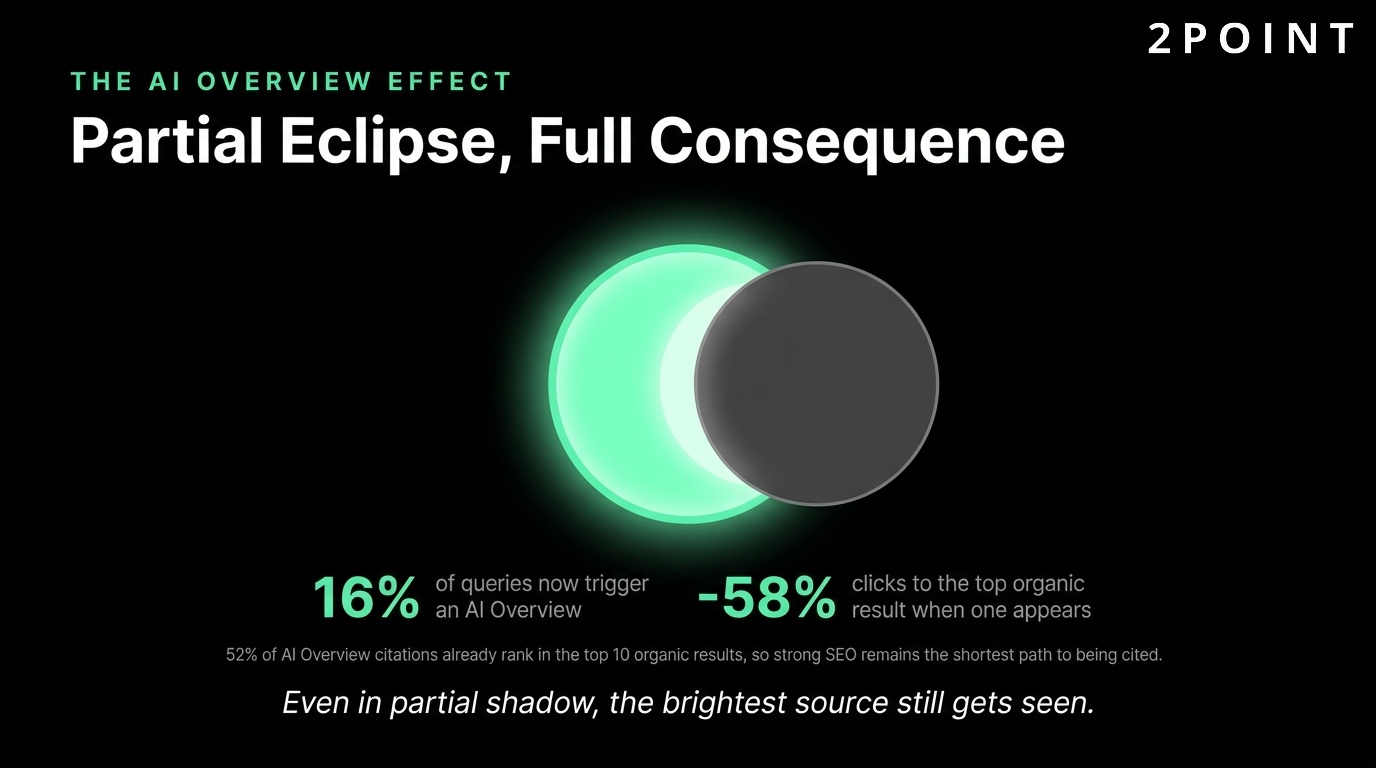
Google's AI Overviews represent the most visible change to the search results page in the platform's history. These AI-generated summaries appear at the top of results for an estimated 16% of queries, and their presence measurably changes what users do next. When an AI Overview appears, clicks to the top-ranking organic page drop by approximately 58%. For high-volume informational queries, that represents a substantial shift in traffic distribution.
The broader zero-click pattern extends beyond AI Overviews. 61.5% of desktop searches and 34.4% of mobile searches result in no click at all, as users receive sufficient answers directly from the results page. This is not a new phenomenon, but AI has accelerated it dramatically. The strategic response is not to lament lost clicks but to ensure your brand earns the citation inside the AI-generated answer.
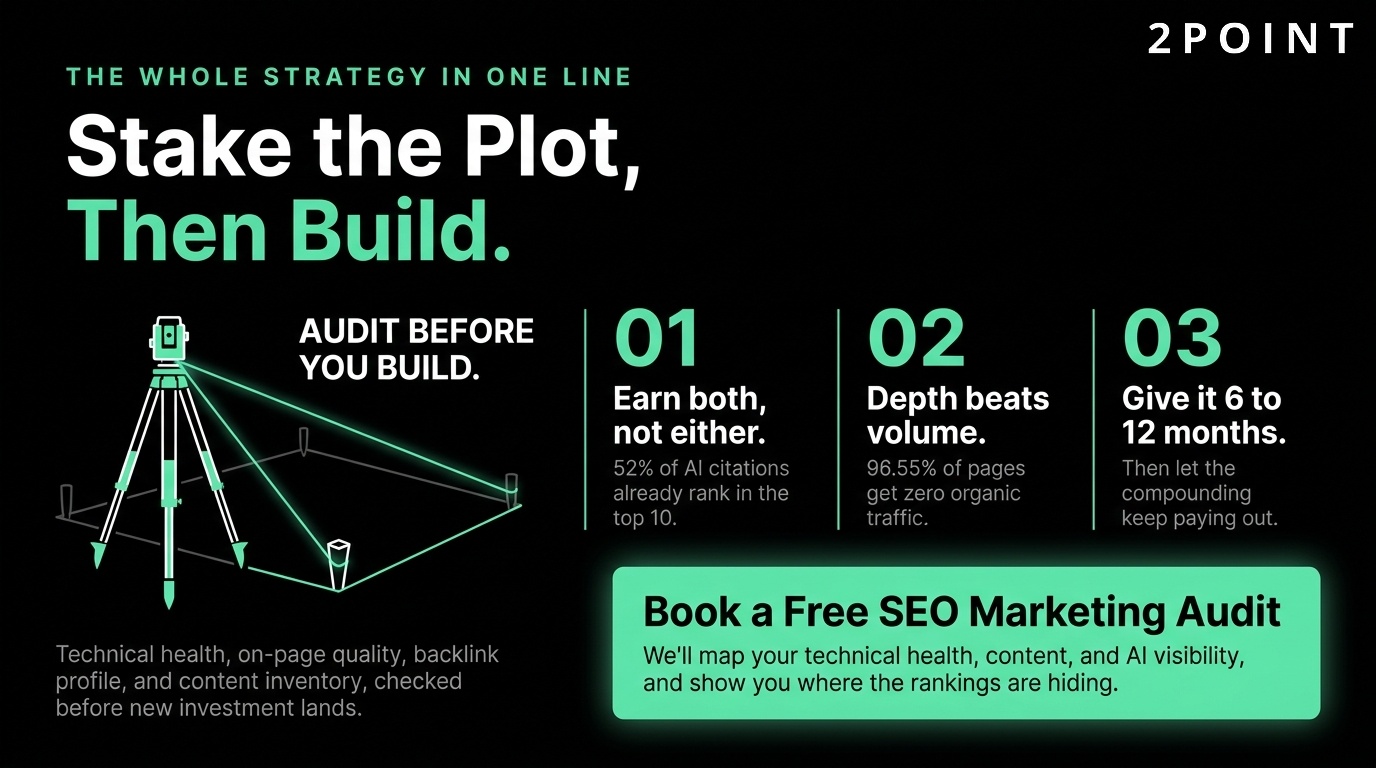
The encouraging data point for SEO marketers is this: 52% of the sources cited in AI Overviews already rank in the top 10 organic results. Traditional SEO excellence remains the primary path to AI citation. Earning strong rankings through quality content, authoritative backlinks, and technical optimization also positions brands to be cited in the AI summaries that appear above those rankings. The two goals reinforce each other rather than competing.
AI Integration Best Practices for SEO Marketing
The question facing every content team in 2026 is not whether to use AI in their SEO workflow but how to use it wisely. The answer that consistently produces strong results involves treating AI as a force multiplier for human expertise rather than a substitute for it. AI performs well for gap analysis, topic clustering, outline generation, and editing, tasks that benefit from speed and pattern recognition. Fully automated content production without human oversight tends to produce generic output that struggles to rank and fails to build trust.
The practical workflow that works looks like this: use AI to accelerate research, identify structural gaps, and generate first drafts of supporting sections. Then bring human judgment to bear on claims, examples, positioning, and the trust factors that differentiate genuine expertise from assembled information. Every piece of content should pass through a quality assurance checklist covering factual verification, primary-source citations, author expertise signals, and a clear answer to the question "what is new or better here compared to what already exists?"
The content that earns rankings and AI citations in 2026 is content that could not have been produced by AI alone: content reflecting real experience, proprietary data, genuine client insights, and perspectives shaped by years of practice. AI helps produce that content faster and more efficiently. It does not replace the underlying expertise that makes the content worth citing.
Multi-Platform Search: Beyond Google SEO
The search landscape has fragmented across a diverse ecosystem of discovery platforms. Buyers today discover brands through ChatGPT, YouTube, LinkedIn, Reddit, podcasts, forums, and niche community platforms, and AI systems reference content from all of these sources when generating responses. This means SEO marketing can no longer focus exclusively on Google rankings without ceding significant discovery opportunity to competitors who show up everywhere their audience looks.
The community platform dimension deserves particular attention. ChatGPT's official subreddit alone generates 480,000 organic visits monthly, and Reddit content appears with increasing frequency in Google results following expanded licensing agreements. User-generated content on community platforms has become a strong trust indicator that influences both human discovery and AI source selection.
The strategic response is what practitioners call a "search everywhere" approach: earning visibility simultaneously across classic organic rankings, AI answer citations, video results, community platform discussions, and podcast content. This approach requires measurement tools capable of tracking brand appearance inside AI platforms, not just traditional Google Search Console data. For marketers building integrated digital marketing programs, this multi-platform SEO mindset is the connective tissue that makes everything work together.
E-E-A-T: The New Foundation of SEO Content Strategy
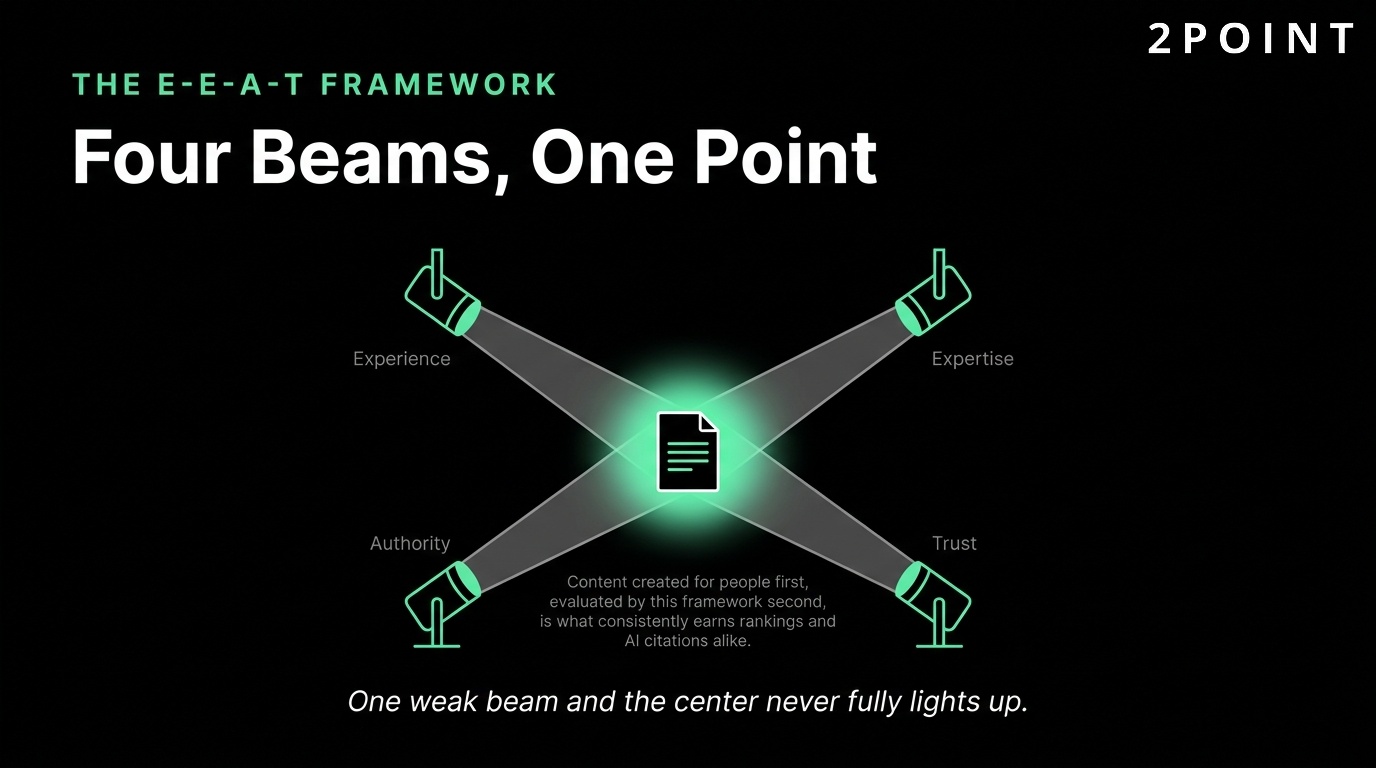
Google's E-E-A-T framework has been part of its quality rater guidelines for years, but its practical importance has intensified dramatically as AI-generated content has flooded the web. The framework provides a principled answer to a simple question: in a world where anyone can generate unlimited content instantly, what actually makes content trustworthy and valuable? The answer is the same thing it has always been: real expertise demonstrated through real evidence.
What E-E-A-T Actually Means (and Why It Matters More Than Ever)
E-E-A-T stands for Experience, Expertise, Authoritativeness, and Trustworthiness. The first E, Experience, was added relatively recently and reflects a crucial insight: firsthand experience with a topic produces demonstrably better content than assembled research. A travel guide written by someone who spent three weeks in the destination reads differently from one assembled by an AI pulling from existing sources. That difference is detectable, and it represents the most important ranking factor trend for 2026.
What consistently ranks in 2026 is content showing real experience, verified expertise, and genuine trustworthiness, built on original research, case studies, and practitioner insights. This is not incidental. Google has explicitly stated its preference for content created for people first, algorithms second, and E-E-A-T is the framework it uses to evaluate whether content meets that standard. The brands that invest in building genuine authority are the ones whose content earns enduring rankings.
The competitive dimension of E-E-A-T is equally important. In a landscape where competitors can produce high volumes of generic AI content, demonstrated expertise becomes the primary differentiator. E-E-A-T signals separate brand-building content from commodity output, and they are precisely the signals that AI systems prioritize when selecting sources to cite. The emphasis on showing real people behind a site, through reviews, author credentials, and verifiable proof, creates trust that algorithmic content simply cannot manufacture.
Implementing E-E-A-T Signals on Your Site
Understanding E-E-A-T conceptually is straightforward. Implementing it practically requires deliberate, page-level work. The most effective approach involves adding proof blocks to key pages: clear attribution of who wrote the content and why they are qualified, how the content was reviewed or fact-checked, what sources were used, and what the author's direct experience with the topic involves. These signals are visible to both human readers and search engine crawlers.
Social proof amplification is equally important. Building credibility through interviews, third-party reviews, and credible external mentions creates the kind of external validation that Google weighs heavily in authority assessment. Author bios should include real credentials, professional headshots, and links to other published work. Editorial review processes and fact-checking standards should be documented and visible, particularly on content covering health, finance, legal, or safety topics where Google applies heightened scrutiny.
The content itself should feature primary source citations, original data, documented case studies, and customer results with specific metrics where possible. These elements serve multiple functions: they strengthen E-E-A-T signals, they provide citation-worthy assets that other sites and AI systems reference, and they give human readers compelling evidence that the information is reliable. Every page on a site should be evaluable by a skeptical reader asking "why should I trust this?"
Creating Citation-Worthy Content That AI References
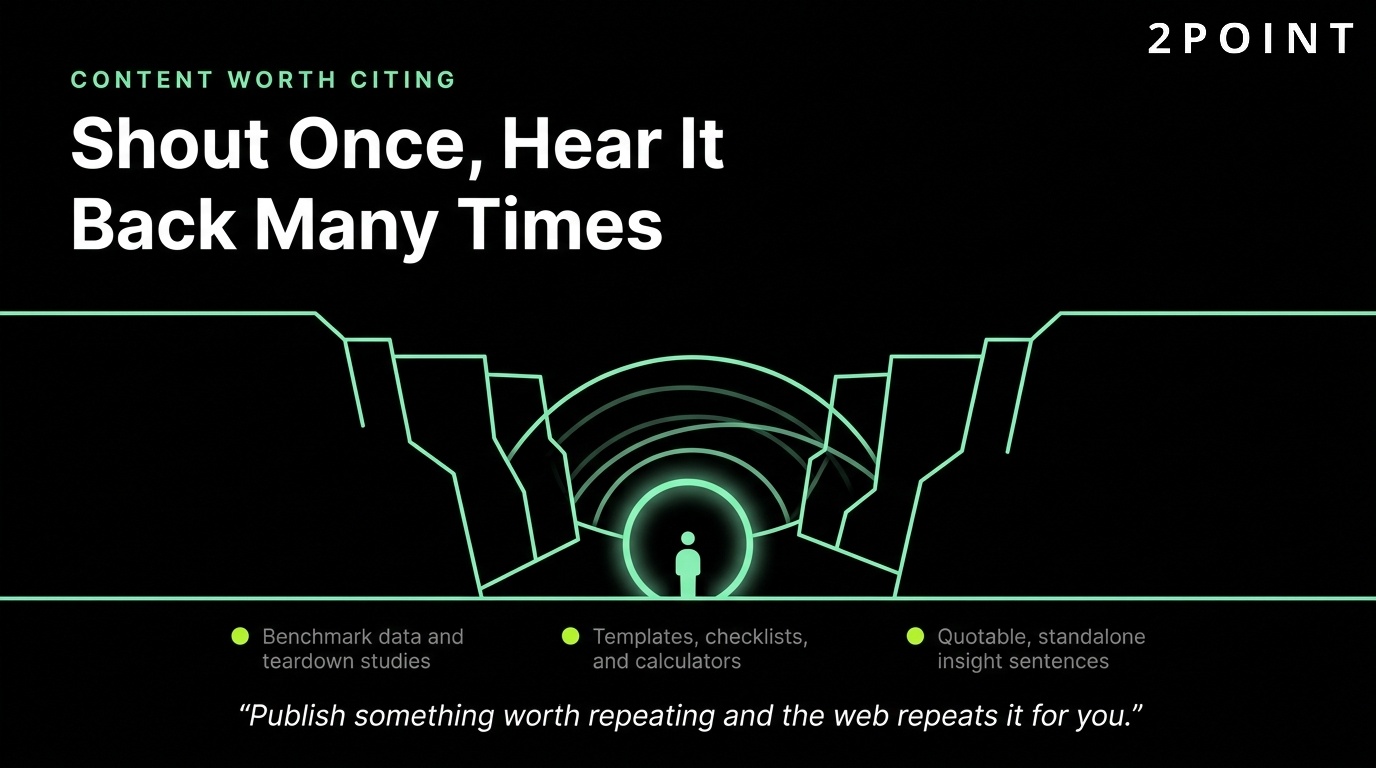
The highest-leverage investment in SEO marketing in 2026 is creating content that others want to cite. This category of content earns backlinks naturally, appears in AI-generated answers, and generates branded mentions across platforms without requiring ongoing promotional effort. The most citable content formats include benchmark data, teardown studies, original research, templates, checklists, and simple calculators that provide genuine utility unavailable elsewhere.
Third-party validation amplifies citability significantly. Earning mentions through podcasts, strategic partnerships, and digital PR campaigns creates the kind of authoritative external references that both Google and AI systems interpret as quality signals. When a respected industry podcast cites your research, when a trade publication references your benchmark report, and when practitioners quote your framework in their own writing, your content has achieved genuine authority status.
Structure matters as much as substance when it comes to citability. Content must be able to rank, answer, and be cited simultaneously. This means including clear data points with explicit attribution, quotable insights presented in standalone sentences, and research findings organized so they can be extracted and referenced easily. Content that requires reading the entire piece to extract a useful insight is much less likely to earn citations than content that surfaces its most valuable information efficiently.
Brand Reputation as an SEO Signal
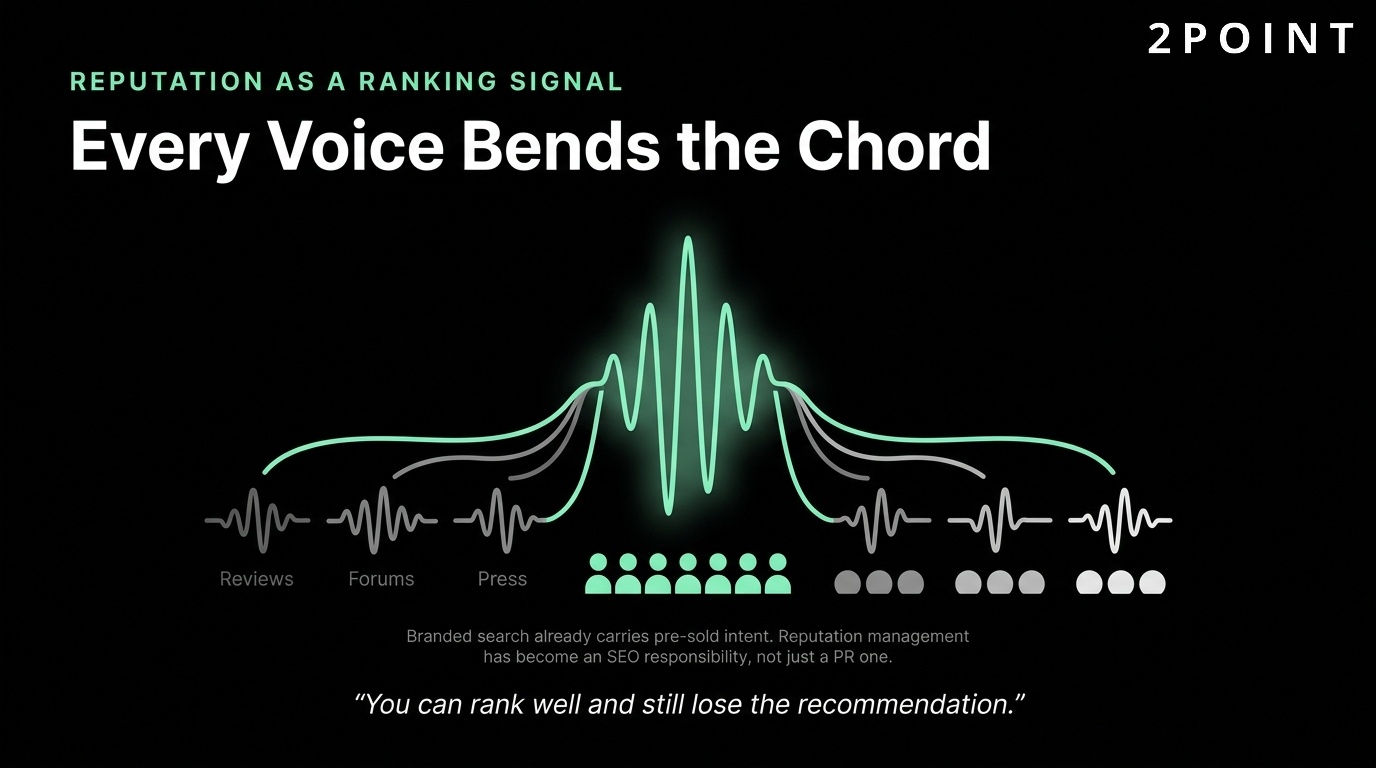
One of the most significant shifts in SEO marketing involves the elevation of brand reputation to a genuine ranking and citation factor. AI systems now aggregate everything the internet says about a brand and use that sentiment as a recommendation signal. Reviews, forum discussions, social media commentary, press coverage, and user-generated content all feed into the brand picture that AI systems draw when deciding whether to recommend or cite a business. This makes reputation management an SEO responsibility, not just a PR one.
Branded search carries significant intent, trust, and conversion potential that far exceeds generic keyword traffic. When a user searches specifically for your brand name, they are already pre-sold to some degree. Building the kind of brand recognition that generates branded search volume is therefore an SEO strategy as much as a marketing one, and growing branded search demand has shifted from a marketing byproduct to a deliberate strategic initiative.
The risk of ignoring brand reputation in SEO planning is concrete. A brand can rank well for valuable terms in traditional search results while simultaneously losing influence because AI systems cite competitors more frequently based on stronger overall reputation signals. Monitoring brand mentions, responding to reviews, earning positive press coverage, and maintaining active presence in community discussions are all now legitimate SEO activities with measurable impact on AI visibility and organic authority. To integrate branding with SEO effectively, reputation and search strategy must be planned together from the start.
SEO Best Practices That Still Work in 2026
The fundamentals of search engine optimization have proven more durable than most people expected. While the tactical landscape has evolved substantially, the underlying practices that drove results five years ago remain essential today. Keyword research, on-page optimization, technical excellence, and link acquisition still form the backbone of any effective SEO program. What has changed is the sophistication with which these practices must be applied.
Keyword Research and Intent Mapping
Keyword research remains the cornerstone of effective SEO marketing. Thorough keyword research identifies the high-impact terms that attract the right audience and informs every content decision that follows. The approach has evolved significantly from the early days of density optimization, however. Modern SEO has moved decisively away from keyword stuffing and toward user intent alignment, treating every search query as a signal about what someone actually needs rather than simply a string of words to match.
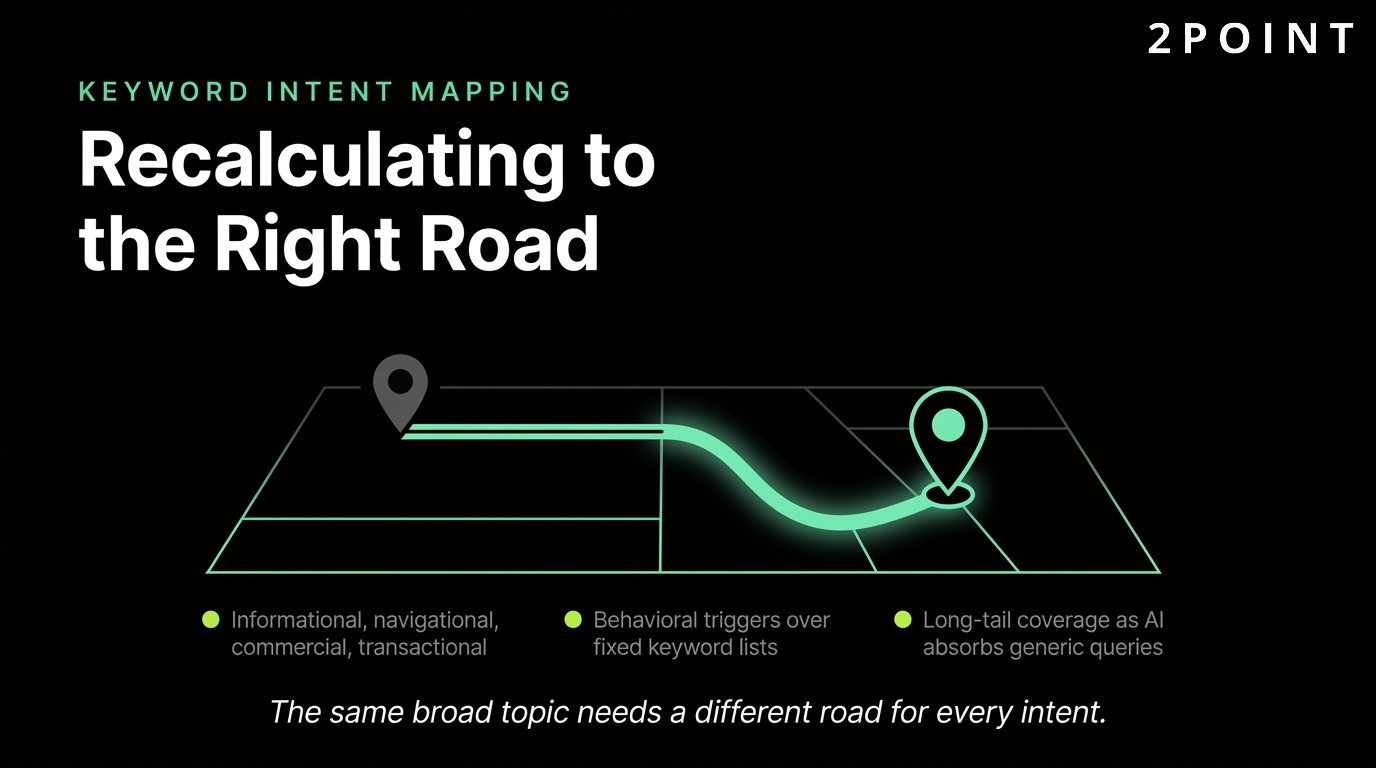
AI-generated content prioritizes personalization, context, and relevance in ways that reward intent-focused keyword strategies. Understanding whether a query reflects informational, navigational, commercial, or transactional intent determines not just which keywords to target but what kind of content to create, how to structure it, and what call to action serves the reader best. A search for "how does SEO work" requires a completely different content approach than "hire SEO agency," even though both relate to the same broad topic.
Practically speaking, include the main keyword at least once near the top of the page, integrate natural variations throughout the body content, and answer common questions about the topic and include relevant definitions. Long-tail keyword coverage has become increasingly valuable as AI handles generic informational queries and users turn to search for more specific, nuanced needs. Brands that map their keyword strategy to detailed buyer intent across the full funnel consistently outperform those chasing high-volume head terms alone.
On-Page Optimization Fundamentals
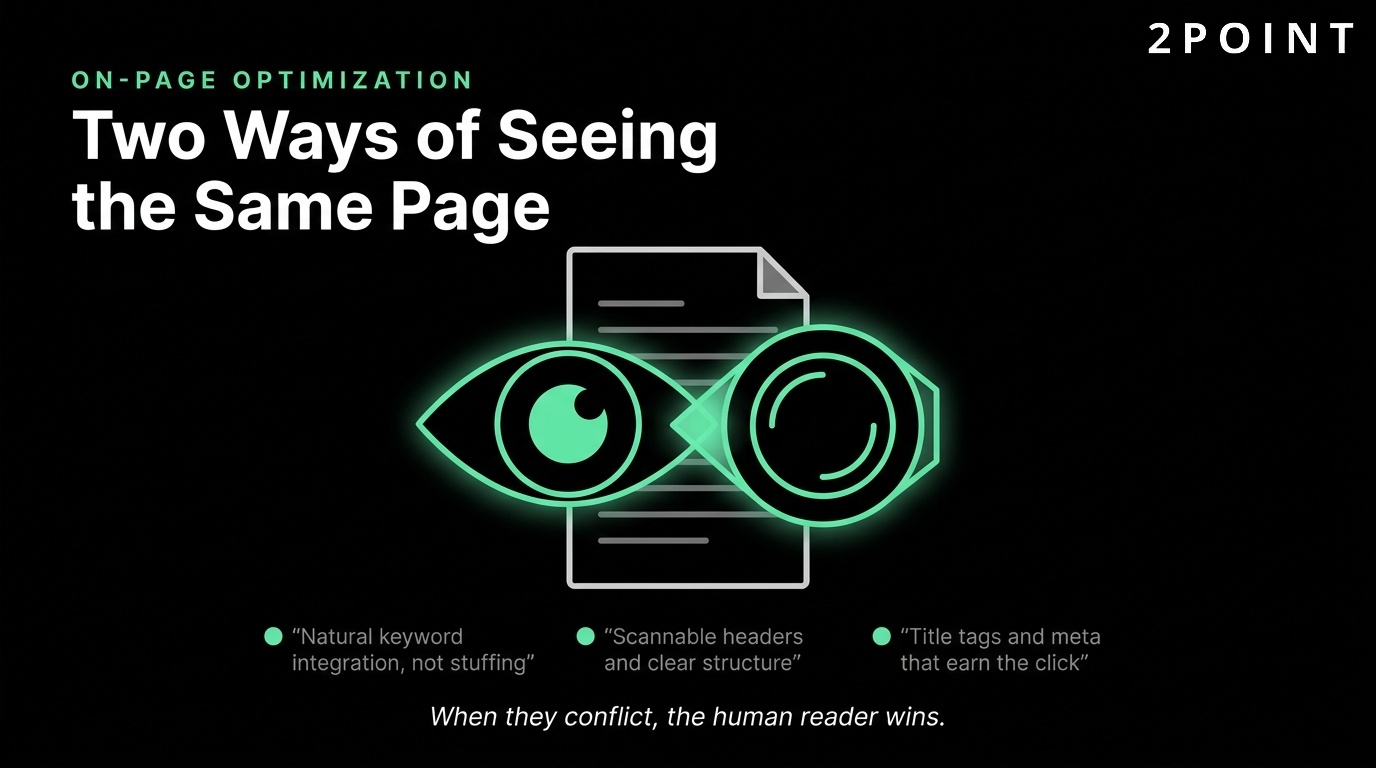
On-page optimization serves two masters simultaneously, and the most effective SEO content satisfies both without compromise. Technical elements satisfy algorithmic requirements for indexing and ranking, while substantive content provides genuine value to the target audience. When these two priorities conflict, user value should win, because search engines have become increasingly sophisticated at detecting content designed primarily for algorithms rather than people.
Title tags and meta descriptions still carry significant weight, both for ranking signals and for the click-through rates that influence how Google evaluates page quality. Headers should organize content logically, include natural keyword variations, and make the document scannable for readers who skim before committing to a full read. Image alt text, internal links, and URL structure contribute meaningful cumulative signals that compound over time across a large site.
Keyword integration must feel natural and contextual rather than forced, because search engines now match queries based on how humans naturally communicate. Pages that read smoothly and address user needs comprehensively consistently outrank pages that stuff keywords into awkward sentences. The practical test is simple: read the content aloud. If it sounds unnatural, revise it. Modern SEO rewards content that reads smoothly and addresses user needs comprehensively.
Technical SEO and Site Performance
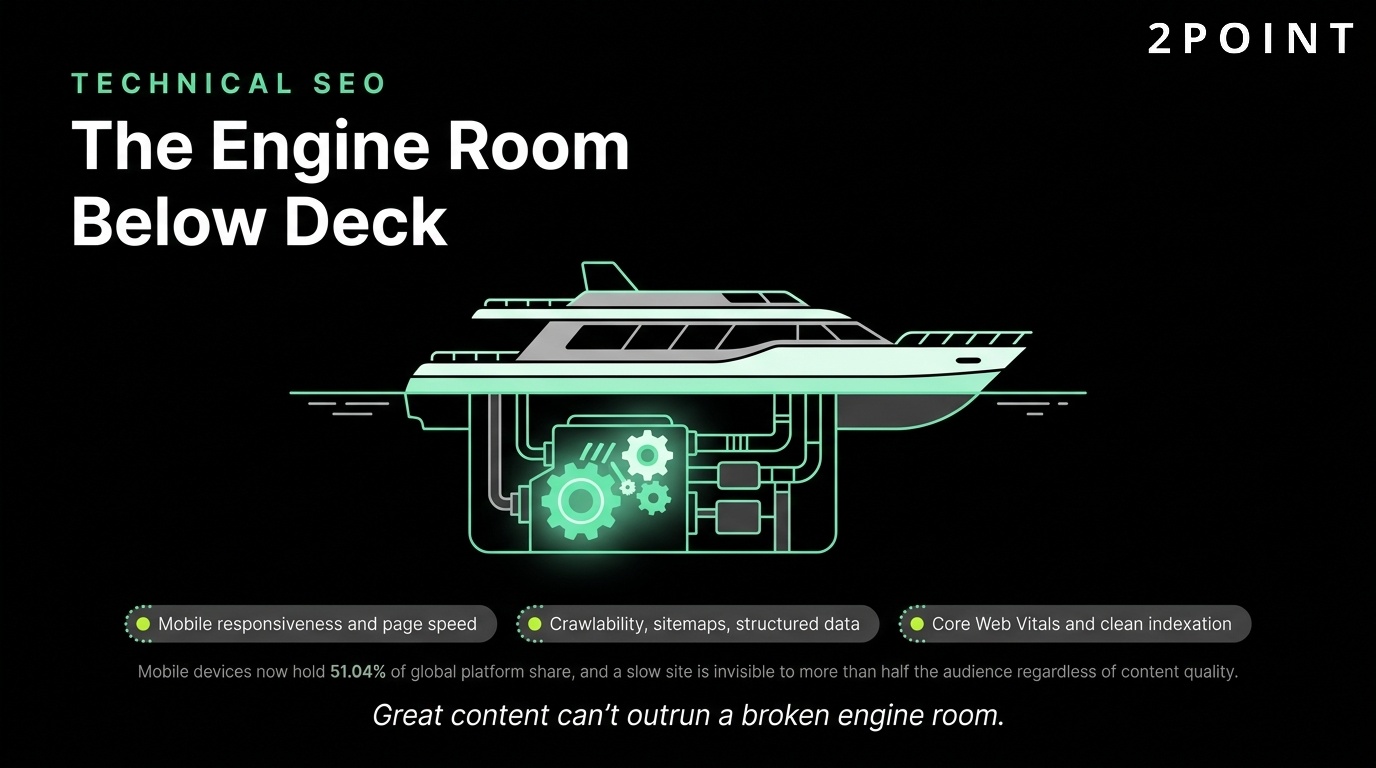
Technical SEO represents the infrastructure layer on which all other optimization efforts depend. Even extraordinary content fails to rank if it cannot be properly crawled, indexed, and evaluated by search engines. Strong performance is driven by the combination of on-page content quality and technical SEO excellence, and neglecting either dimension limits the ceiling of what organic search can achieve.
Content optimization includes mobile responsiveness, page speed, and structured data implementation as table-stakes requirements. Mobile performance is particularly critical: mobile devices account for 51.04% of global platform market share as of mid-2026, and 51% of smartphone users report discovering a new company or product while searching on their mobile device. A site that performs poorly on mobile is effectively invisible to more than half the potential audience. Building an SEO-friendly website that loads quickly on all devices is a prerequisite for competitive rankings.
Core Web Vitals, crawl budget optimization, XML sitemaps, canonical tag management, and HTTPS implementation are all components of technical SEO that require ongoing attention rather than one-time setup. Structured data markup, in particular, creates additional opportunities for rich results, featured snippets, and AI citations that go beyond standard blue-link rankings. The combination of technical foundations and high content quality produces maximum search visibility.
Link Building and Domain Authority
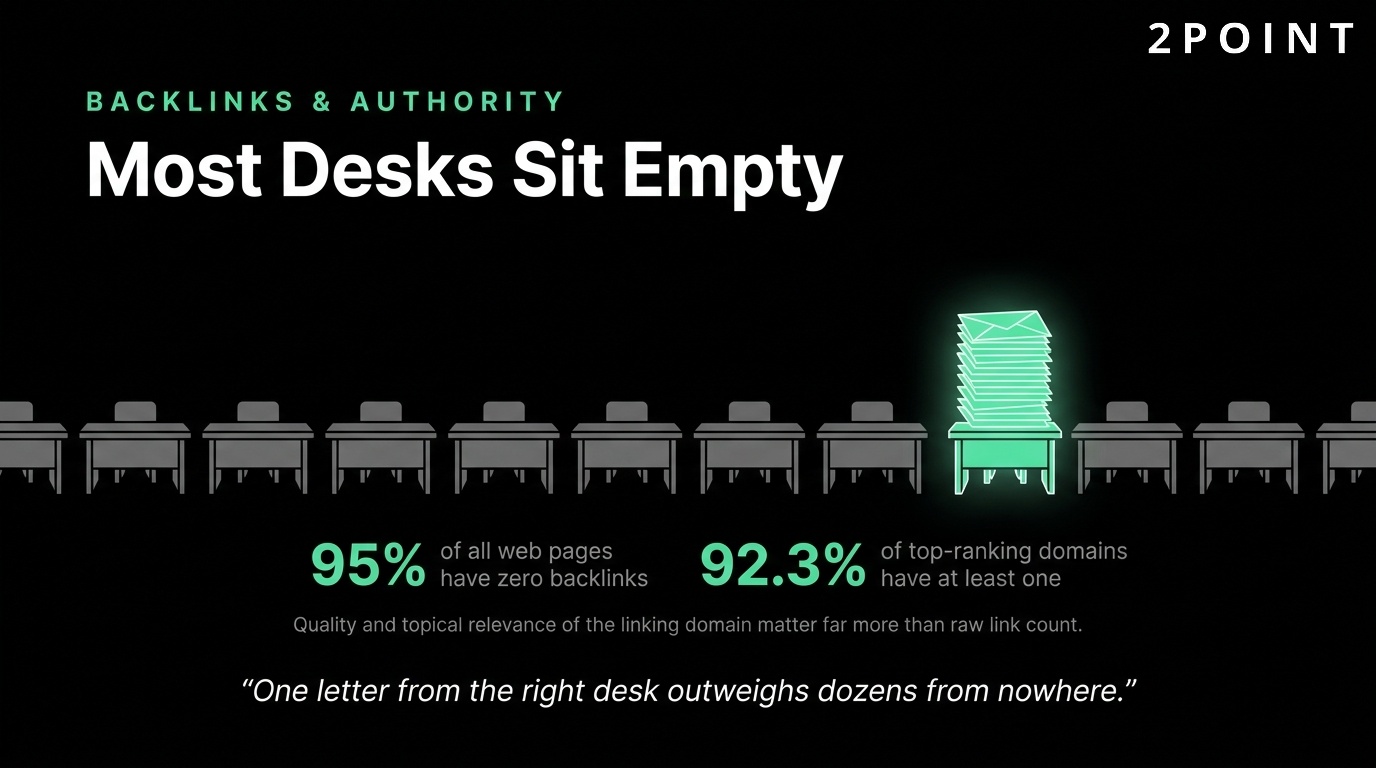
Backlinks remain one of the most powerful ranking signals in Google's algorithm, and the data confirms their importance clearly. Pages with more backlinks consistently earn more organic traffic from Google, while 95% of all web pages have zero backlinks. That gap creates enormous competitive opportunity for brands willing to invest in earning links. Among top-ranking domains, 92.3% have at least one backlink, confirming that link acquisition is not optional for competitive rankings.
The approach to link building has evolved from the manipulative tactics that characterized early SEO toward genuinely earning links through valuable content. Digital PR campaigns, original research publications, expert commentary in trade publications, podcast appearances, and strategic partnerships all generate high-quality backlinks that improve domain authority while also building brand reputation. This convergence of link building and brand building is one of the clearest examples of how SEO strategy and broader marketing strategy have become inseparable.
Building a robust backlink profile is a core SEO best practice that compounds over time. Quality and relevance of linking domains matter significantly more than raw quantity. A single link from a high-authority, topically relevant publication outweighs dozens of links from generic directories. The most sustainable link building strategy is also the most effective: create content so genuinely useful and original that other publishers reference it naturally.
| SEO Best Practice | Current Importance Level | Key 2026 Consideration | Primary Impact |
|---|---|---|---|
| Keyword Research and Intent Mapping | Essential | Focus on intent alignment, not density | Content relevance and targeting |
| On-Page Optimization | Essential | Balance algorithmic and human readability | Rankings and click-through rates |
| Technical SEO | Essential | Mobile-first performance is baseline | Crawlability and indexation |
| Link Building | High | Quality and relevance outweigh quantity | Domain authority and rankings |
| E-E-A-T Signals | High and Rising | Differentiates from AI-generated content | Trust, authority, and AI citations |
| Structured Data Markup | High | Enables rich results and AI citations | SERP feature eligibility |
The most effective SEO programs treat these practices as a unified system rather than independent tactics, because each element reinforces the others when implemented together.
Content Marketing and SEO: The Inseparable Strategy
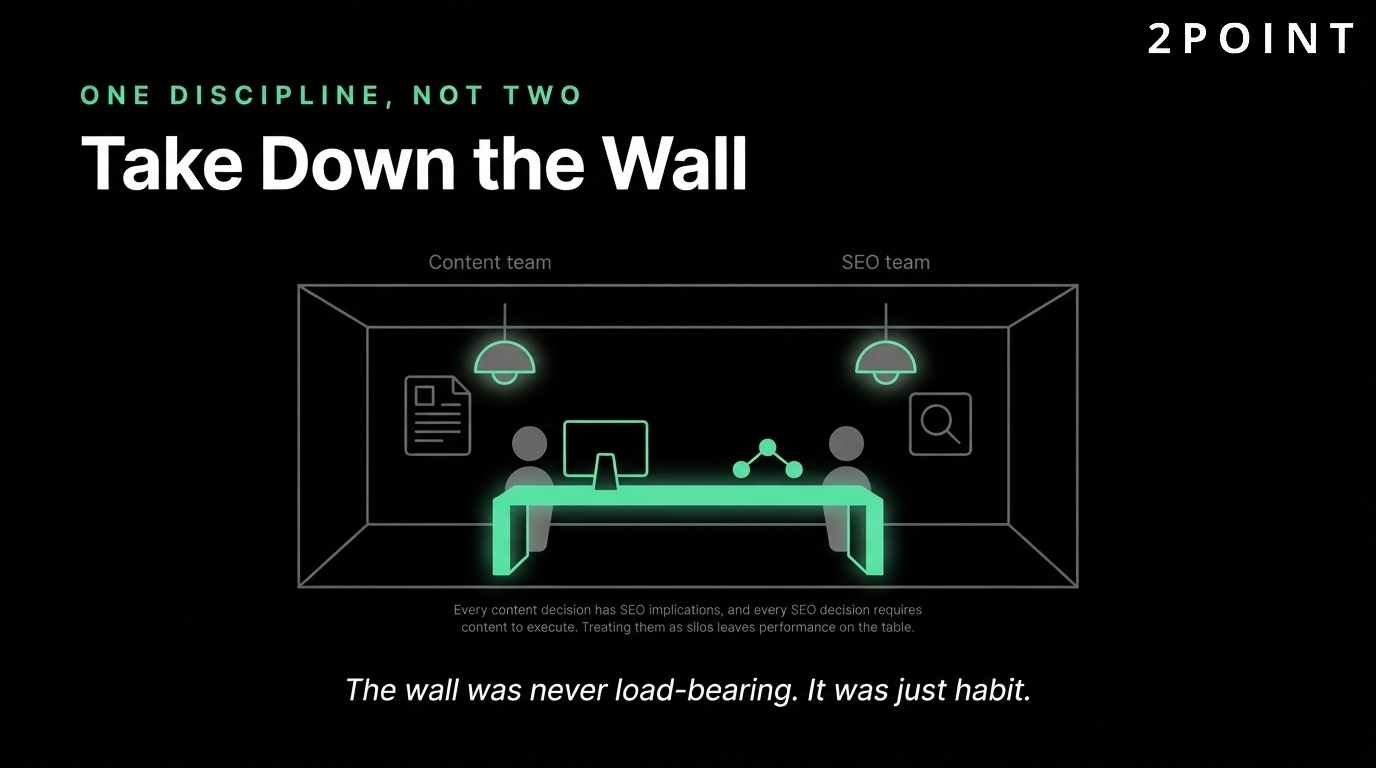
Content marketing and SEO marketing have merged into a single strategic discipline. There is no longer a meaningful distinction between "content strategy" and "SEO strategy" for organizations serious about organic growth. Every content decision has SEO implications, and every SEO decision requires content to execute. The brands that have internalized this integration consistently outperform those treating them as separate departments with separate budgets and separate success metrics.
Why Content Quality Beats Content Volume
The most sobering statistic in SEO marketing is also the most clarifying: 96.55% of all web pages receive zero organic search traffic from Google. The vast majority of content published on the internet is effectively invisible. This is not primarily a distribution or promotion problem. It is a quality and relevance problem. Pages that receive meaningful organic traffic earn it because they genuinely answer a real question better than competing pages. Everything else is noise.
The practical implication for content strategy is clear: depth and focus outperform breadth and volume. A site that thoroughly covers eight topics with exceptional content consistently outranks a site that superficially addresses sixty-four topics. The algorithmic reason is straightforward: Google measures user satisfaction signals including dwell time, bounce rate, and pogo-sticking back to results, and thin content that fails to fully address user intent performs poorly on all these measures.
What separates ranking content is original research, real case studies, and practitioner insights that go beyond what can be assembled from existing sources. Answering common questions comprehensively and providing definitions where relevant satisfies both user intent and algorithmic quality signals. Content investment should be concentrated in pieces that are genuinely the best available resource on their topic, rather than spread across numerous adequate-but-unremarkable pages.
Dual-Purpose Content: Serving Readers and Search Engines
Content optimization must satisfy technical requirements while also providing genuine value to the humans who encounter it. This dual-purpose mandate shapes every element of well-executed content: keyword integration that flows naturally rather than intruding on readability, structure that is both scannable for quick-reading humans and clearly organized for algorithmic crawlers, and meta elements that both describe the content accurately and entice clicks.
Internal linking deserves particular attention as a dual-purpose content element. For users, internal links provide navigation pathways to related information that deepens engagement with a site. For search engines, they distribute link equity across pages, establish topical relationships between content clusters, and help crawlers discover and index new content efficiently. A thoughtful internal linking strategy connecting related content across a site amplifies the value of every individual piece while improving overall domain authority. For example, connecting a guide on SEO metrics to related pieces on strategy and analytics creates a content cluster that signals topical authority to search engines.
Rich media integration strengthens content performance across both dimensions. Images with proper alt text, videos with optimized titles and descriptions, and infographics with supporting text all contribute to better user experience and additional indexation opportunities. The goal is content that does not feel optimized because it has been so thoughtfully constructed that the optimization is invisible. The best indicator of success is that a page satisfies the reader completely without the reader thinking about SEO at all.
Video SEO and Visual Content Strategy
Video has become a non-negotiable component of comprehensive SEO marketing strategy. The adoption numbers are striking: 91% of businesses now use video as a marketing tool, and 93% of video marketers describe video as an important part of their overall strategy. The persuasive power of video is equally compelling: 85% of people report being convinced to purchase a product or service after watching a brand's video. These are not marginal effects.
AI has entered video production as well. 63% of video marketers used AI video tools to help create or edit marketing videos in the most recent survey period, reflecting the same force-multiplier dynamic seen in written content. The production barrier to video has dropped significantly, which means quality and strategic positioning now differentiate video content more than production budget alone. For guidance on creating videos that support both marketing and search goals, SEO for marketing videos requires a distinct optimization approach from written content.
Video SEO specifically involves optimizing titles, descriptions, and tags for YouTube search, ensuring transcripts and captions exist for both accessibility and keyword indexation, creating compelling thumbnails that improve click-through rates, and structuring playlists and channel organization to support topical authority. YouTube is the second-largest search engine in the world, and video content that ranks there also frequently appears in Google's universal search results, creating dual-channel visibility from a single content investment.
Measuring Content Performance Beyond Traffic
The measurement frameworks that worked for SEO marketing five years ago are no longer sufficient. Traditional traffic metrics no longer tell the full story of content performance in an era of zero-click searches, AI citations, and multi-platform discovery. The most important measurement shift of 2026 is the movement away from using SEO metrics alone to evaluate search performance. Organic sessions and keyword rankings remain useful, but they are incomplete without business-outcome data layered on top.
Leadership is demanding clear answers on how content contributes to pipeline and revenue, not just impressions and traffic. This pressure is healthy. It drives SEO teams to connect their work to lead generation, customer acquisition cost reduction, and sales cycle influence rather than reporting on metrics that business leaders cannot act on. Brands that can demonstrate how organic content drives revenue conversations earn sustained investment. Brands that can only show traffic charts face constant budget pressure.
New metrics deserve prominent places in SEO reporting dashboards: AI citation frequency, branded search volume growth, brand mention velocity across external sources, content assist attribution in multi-touch conversion paths, and lead quality scores correlated to organic traffic sources. Measurement tools showing brand appearance inside AI platforms are becoming essential infrastructure. Robust SEO analytics that connect organic performance to business outcomes are no longer optional for programs seeking sustained organizational support.
Local and Mobile SEO Marketing
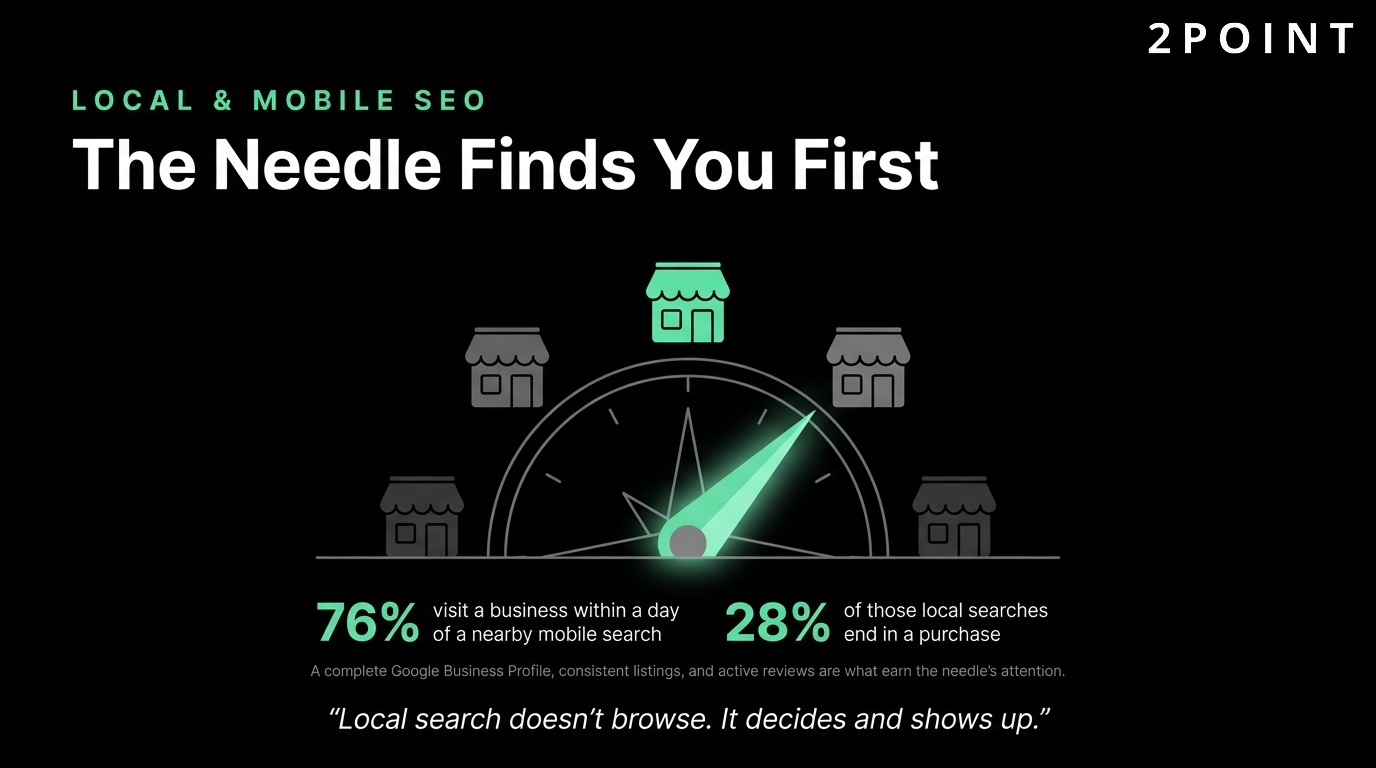
For businesses with physical locations, service areas, or audiences concentrated in specific geographic markets, local and mobile SEO represents the highest-ROI application of search optimization available. The search behaviors that drive in-store visits, phone calls, and appointment bookings are intensely local, and the businesses that optimize for these behaviors earn disproportionate returns compared to their investment. The opportunity is substantial and still undercaptured by many businesses.
Mobile-First Optimization Requirements
Mobile is not a secondary consideration in SEO planning. It is the primary context in which most users encounter search results. Mobile devices account for 51.04% of global platform market share as of mid-2026, and 51% of smartphone users report discovering a new company or product while searching on their phone. Google's mobile-first indexing means the mobile version of a site is the version Google primarily evaluates for ranking purposes, making mobile performance a direct ranking factor rather than a user experience consideration alone.
Mobile responsiveness is now table stakes. Brands competing for visibility need sites that load quickly on cellular connections, display correctly on varied screen sizes, and offer touch-friendly navigation that works without a mouse. Page speed is particularly critical on mobile devices, where users have less patience for slow loads and are often on less reliable connections than desktop users. Core Web Vitals scores, which Google uses as ranking signals, reflect mobile performance directly.
Mobile search results also feature distinct SERP elements that require specific optimization. Local map packs, quick answer boxes, click-to-call features, and location-based results all appear more prominently on mobile than desktop. Optimizing for these features requires different approaches than optimizing for standard blue-link rankings, including Google Business Profile optimization, schema markup for local business information, and content structured for quick answer extraction.
Local SEO Statistics and Strategy
The conversion rates associated with local search are remarkable. 76% of people who search on their smartphones for something nearby visit a relevant business within one day, and 28% of those local searches result in a purchase. No other digital marketing channel comes close to those conversion timelines. When a user searches "dentist near me" or "best coffee shop downtown," they are expressing immediate purchase intent, and the business that appears in local results captures that intent directly. Understanding the local SEO factors that drive visibility for small businesses is essential for competing in geographic markets.
Google Business Profile optimization is the foundation of local SEO performance. A complete, accurate, and actively managed profile with current hours, photos, services, and regular posts significantly outperforms a neglected or incomplete listing. Reviews are particularly powerful: their quantity, recency, rating, and keyword content all influence both local pack rankings and the decisions of prospective customers who encounter the listing. Actively soliciting and responding to reviews is one of the highest-ROI local SEO activities available.
Citation consistency, meaning consistent Name, Address, and Phone number information across all online directories and listings, remains a foundational local ranking signal. Local content strategy should include location-specific landing pages for businesses serving multiple areas, blog content addressing local topics and community events, and local link building through partnerships with area businesses, chambers of commerce, and community organizations. These efforts build the local authority signals that determine which businesses appear when nearby customers search.
Voice Search and Conversational Queries
83% of global consumers use Google or YouTube every day, and an increasing proportion of those interactions happen through voice interfaces, smart speakers, and conversational AI assistants. Voice searches are behaviorally distinct from typed queries: they tend to be longer, more conversational, and more frequently phrased as questions. "What is the best Italian restaurant near me that is open right now?" is a typical voice query. Optimizing for this pattern requires different content approaches than optimizing for typed keywords.
Search engines now match queries based on how humans naturally communicate, which means content that uses natural, conversational language performs better for voice search than keyword-dense copy. Featured snippets are especially important for voice results because voice assistants typically read the featured snippet aloud as the answer to a query. Earning featured snippet positions for question-based queries gives a brand the equivalent of being the only answer provided, rather than one of ten links to choose from.
Structured data markup provides additional opportunities for voice optimization by helping search engines and voice assistants understand the specific information within a page, including business hours, product prices, event dates, and FAQ answers. FAQ sections with conversational question phrasing and direct answers are particularly well-suited to voice query patterns and frequently earn featured snippet placement. Optimizing for the question formats that target customers ask naturally creates the content that voice interfaces are built to deliver.
The Local and Mobile SEO Opportunity Summary
| Local SEO Factor | Strategic Priority | Key Action | Measurable Outcome |
|---|---|---|---|
| Google Business Profile | Critical | Complete all fields and post regularly | Local pack visibility and calls |
| Reviews and Ratings | Critical | Solicit and respond to all reviews | Rankings and conversion rate |
| Citation Consistency (NAP) | High | Audit and correct all directory listings | Local authority signals |
| Local Content | High | Create location-specific pages and posts | Geographic keyword rankings |
| Mobile Page Speed | High | Optimize Core Web Vitals for mobile | Rankings and bounce rate |
| Structured Data Markup | Medium to High | Implement local business schema | Rich result eligibility |
Businesses that address all six local SEO factors consistently outperform competitors who focus on only one or two, because the local ranking algorithm rewards comprehensive optimization across multiple signal types simultaneously.
SEO Strategy vs. PPC: Choosing the Right Investment Mix
One of the most common strategic decisions marketers face is how to allocate budget between organic search investment and paid search advertising. The two channels are complementary rather than competing, but they serve different objectives and operate on different timelines. Understanding the distinct characteristics of each helps organizations build investment strategies that use both channels appropriately rather than treating it as an either/or choice. A thorough SEO vs PPC analysis reveals significant differences in cost structure, timeline, and long-term value.
The Fundamental Differences Between SEO and Paid Search
| Comparison Factor | SEO Marketing | Pay-Per-Click (PPC) Advertising |
|---|---|---|
| Cost Structure | Time and resource investment upfront, compounding returns over time | Ongoing cost per click, stops generating traffic when budget is paused |
| Timeline to Results | Typically 6 to 12 months for significant impact | Can generate traffic within hours of campaign launch |
| Long-Term Value | Rankings and authority compound over time | No residual value when campaigns are turned off |
| Click-Through Rate | Organic results receive 94% of all clicks | Paid results receive approximately 6% of clicks |
| Trust and Credibility | Organic rankings perceived as earned endorsement | Ad labels reduce trust for some user segments |
| Targeting Precision | Intent-based through keyword optimization | Precise demographic, behavioral, and keyword targeting |
| Scalability | Scales through content and authority building | Scales immediately with budget increase |
| ROI Timeline | Highest long-term ROI, 6 to 12 month payback period | Immediate but often diminishing returns at scale |
Most competitive digital marketing programs use both channels strategically, applying PPC for immediate traffic to high-value pages and time-sensitive promotions while building SEO authority for sustainable long-term organic performance.
When to Prioritize SEO Investment
SEO marketing is the superior investment for organizations building sustainable, long-term digital presence. The compounding nature of organic authority means that every piece of quality content, every earned backlink, and every technical improvement adds value that persists and accumulates. A well-executed SEO program built over two to three years creates a competitive moat that competitors cannot easily or quickly replicate, because authority signals take time to earn regardless of budget.
SEO also becomes increasingly cost-effective over time as a brand's organic presence matures. The marginal cost of maintaining top rankings decreases as domain authority builds, while the marginal cost of maintaining paid search visibility increases as competition for keywords intensifies. Organizations that invested in SEO three years ago are harvesting traffic today at costs that would be impossible to replicate through paid channels at equivalent scale.
For new products and market entries, a clear marketing strategy should include both immediate PPC for demand capture and longer-term SEO investment for sustainable visibility. The two channels work best when integrated in this way, with PPC data informing keyword priorities for SEO content, and SEO rankings reducing the reliance on paid traffic as organic authority develops.
Combining SEO and Paid Search Effectively
The most effective approach for most businesses involves using paid search to complement and accelerate SEO strategy rather than treating them as alternatives. PPC campaigns generate immediate keyword performance data that informs SEO content priorities. High-performing paid keywords with strong conversion rates are strong candidates for organic ranking investment because the commercial intent is proven.
Remarketing campaigns targeting users who found the site through organic search extend the relationship beyond the initial visit, creating additional conversion opportunities from the audience that organic content attracted. This integration means that SEO-generated traffic produces more revenue per visitor than organic clicks alone, improving the attributable ROI of the organic investment. Choosing the right digital marketing platform that supports both SEO tracking and paid search management in a unified view makes this integration significantly more effective.
How to Build an SEO Marketing Strategy That Performs
Strategy without execution is aspiration. Execution without strategy is activity. Effective SEO marketing requires both: a clear strategic framework that defines priorities and allocates resources appropriately, combined with disciplined execution that produces the content, technical work, and link building that actually drives organic performance. The following framework reflects how high-performing SEO programs are structured in 2026.
Conducting an SEO Audit Before You Build
Every effective SEO strategy begins with an honest assessment of where the site currently stands. A comprehensive marketing audit covering organic performance identifies existing strengths to protect, weaknesses to address, and opportunities to capture. The audit should cover four areas: technical health (crawlability, indexation, site speed, mobile performance), on-page optimization (keyword usage, content quality, meta elements), backlink profile (quantity, quality, relevance of existing links), and content inventory (which pages rank, which receive traffic, which convert).
The technical audit reveals the foundational issues that prevent strong content from performing. Crawl errors, duplicate content, slow load times, and mobile rendering problems all suppress rankings regardless of content quality. These issues should be prioritized and resolved before significant content investment because they limit the ceiling of what any amount of great content can achieve on an unhealthy technical foundation.
The content audit identifies the quick wins available in the existing content library. Pages ranking on page two or three for commercially valuable keywords often require relatively modest improvements to move to page one. Identifying these near-miss opportunities and prioritizing their optimization typically delivers faster ROI than creating entirely new content targeting competitive keywords from scratch. Using market research insights to validate keyword priorities during the audit process ensures that optimization effort focuses on the terms that actually drive business value.
Setting Realistic SEO Goals and Timelines
One of the most common sources of SEO program failure is misaligned expectations about timeline and magnitude of results. SEO operates on a fundamentally different timeline than paid advertising. Campaigns that expect significant organic ranking improvements within thirty days will consistently be disappointed. The realistic expectation for meaningful impact from a new SEO program is six to twelve months, with compounding improvements continuing for years afterward as domain authority builds.
Goal setting should work backward from business outcomes rather than forward from SEO activity. Instead of targeting a specific ranking position, set goals for organic-sourced leads, organic-influenced revenue, or branded search volume growth. These business metrics connect SEO performance to organizational priorities and create clearer accountability for program investment. They also survive the inevitable ranking fluctuations that occur as Google updates its algorithm, because they measure what SEO ultimately produces rather than how it produces it.
Milestone-based tracking helps communicate progress to stakeholders during the period before organic traffic results materialize. Reporting on technical issues resolved, content published, backlinks earned, and target keyword position improvements provides evidence of program momentum before the compounding effects of those efforts appear in traffic and revenue data. This communication prevents premature program cancellation during the investment phase before returns arrive.
Building a Sustainable Content Engine
Sustainable SEO performance requires a consistent and disciplined approach to content production. The most effective content programs treat SEO content as a long-term asset portfolio rather than a campaign deliverable. Each piece of content should be conceived as an asset that will generate value for years, not something produced to meet a monthly quota and then forgotten.
Topic cluster organization has replaced the keyword-by-keyword approach that characterized earlier SEO content planning. A topic cluster centers on a comprehensive pillar page addressing a broad topic in depth, supported by cluster content pages that address specific subtopics in detail and link back to the pillar. This architecture signals topical authority to search engines while creating a navigational structure that serves readers exploring a topic in depth. Brands that build robust topic clusters consistently outrank competitors with equivalent or greater individual page quality but less organized site architecture.
Content governance matters as much as content production. An updated, accurate content library performs better than one littered with outdated posts that have lost relevance or contain incorrect information. Establish regular review cycles for high-traffic and high-value content, update statistics and examples when they age out, and redirect or consolidate thin pages that dilute overall site authority. Working with a specialist digital marketing agency that understands content governance and SEO together can accelerate this work significantly for teams without dedicated in-house expertise.
Connecting SEO to the Full Customer Journey
SEO marketing creates visibility at multiple stages of the customer journey, not just at the initial discovery moment. Top-of-funnel content attracts awareness from users researching broad topics. Middle-of-funnel content captures users comparing options and evaluating specific solutions. Bottom-of-funnel content serves users ready to make decisions, with product pages, case studies, and pricing information that support conversion. Each content type requires different keyword strategies, different content formats, and different calls to action.
Integrating SEO with customer lifecycle marketing creates an always-on visibility program that meets customers wherever they are in their relationship with the brand. SEO can support new customer acquisition at the awareness stage, product education during consideration, loyalty building through helpful post-purchase content, and re-engagement for customers who have lapsed. This full-lifecycle approach maximizes the return on SEO investment by ensuring the organic channel contributes to revenue at every customer relationship stage, not just initial acquisition.
Measuring customer engagement signals from organic traffic helps optimize content strategy over time. Customer engagement metrics including time on page, scroll depth, return visit rates, and content sharing provide signals about which content genuinely serves audience needs versus which content earns clicks but fails to deliver value. These engagement patterns inform future content investment decisions and help SEO programs continuously improve their quality and relevance.
SEO Marketing Trends That Will Define the Next Two Years
Understanding where SEO marketing is heading prepares organizations to build programs that perform not just today but through the changes coming in the near future. The trends shaping the discipline through 2028 represent both challenges and opportunities, and the brands that adapt proactively will widen their competitive advantages while those that wait will find the gap increasingly difficult to close.
AI-First Content Quality Standards Rising
The arrival of AI content generation tools has flooded the web with mediocre content, paradoxically making truly excellent content more valuable than ever. Google and other search platforms are continuously improving their ability to detect and devalue generic, AI-assembled content that fails to provide genuine insight. The bar for what constitutes "good enough" organic content has risen sharply and will continue rising as platforms get better at identifying authentic expertise versus assembled information.
Brands that invest in original research, genuine practitioner expertise, and content that reflects real experience will build durable competitive advantages as this quality threshold continues to rise. The investment required to produce genuinely excellent content is higher than producing adequate content, but the return is also higher and more durable. Content built on real expertise earns consistent rankings, AI citations, and reader trust that commodity content simply cannot match regardless of production volume.
Search Everywhere Optimization Becoming Standard
The fragmentation of discovery across multiple platforms will continue to accelerate. YouTube, Reddit, LinkedIn, TikTok, podcasts, and AI chat interfaces all represent channels where target audiences discover information and form brand perceptions. SEO strategies that focus exclusively on Google search results will progressively miss larger proportions of their target audience as discovery behavior continues to diversify.
The brands that build "search everywhere" programs, creating content designed for multiple discovery contexts simultaneously, will compound their visibility advantages over time. A piece of original research published as a long-form article can be repurposed into a podcast discussion, a YouTube explainer, a LinkedIn post series, and a Reddit AMA. Each format reaches audiences through their preferred discovery channel, and AI systems aggregate all of these touchpoints when assessing a brand's authority and relevance. Exploring social media marketing as a complement to traditional SEO and influencer marketing as a brand visibility amplifier both contribute to a broader search presence strategy.
Measurement Sophistication as a Competitive Differentiator
Organizations with superior measurement capabilities will make better SEO investment decisions, allocate budgets more effectively, and demonstrate program value more convincingly than competitors relying on outdated metrics frameworks. The SEO programs that thrive in the next two years will track AI citation frequency, branded search growth, content assist attribution in multi-touch revenue models, and customer acquisition cost trends correlated to organic channel investment.
Building this measurement infrastructure requires investment in tooling, analytics configuration, and reporting discipline. But it also creates a significant organizational advantage: when SEO programs can demonstrate clear revenue contribution, they earn sustained budget support and executive attention. The competitive moat built by organizations that combine strong organic performance with strong measurement sophistication is one of the most durable in digital marketing. Understanding and tracking the right SEO metrics and KPIs is the foundation of that measurement sophistication.
Conclusion: Building SEO Marketing That Lasts
SEO marketing in 2026 is more complex, more competitive, and more important than at any previous point in its history. The channel has expanded from a tactical practice of keyword placement and link acquisition into a strategic discipline encompassing content quality, brand reputation, AI citation optimization, technical excellence, and multi-platform visibility. The brands that understand this expanded scope and invest accordingly are building digital assets that compound in value year after year.
The fundamentals have not changed. Search engines reward genuine expertise, clear communication, and content that truly serves user needs. What has changed is the standard of what "genuine expertise" means, the number of platforms where that expertise must be demonstrated, and the sophistication required to measure and prove its business impact. The organizations that meet those higher standards will dominate organic search visibility for years to come.
For businesses ready to build a serious SEO marketing program, the starting point is clarity about goals, honest assessment of current standing, and commitment to the long-term investment that sustainable organic growth requires. Whether building that capability in-house or partnering with specialists, the decisions made in the next twelve months will determine organic search performance for the next three to five years. 2POINT works with growth-focused organizations to build SEO marketing programs that integrate content strategy, technical excellence, and AI-era optimization into programs that deliver measurable business outcomes, not just traffic reports.
Frequently Asked Questions About SEO Marketing
What is SEO marketing and how does it work?
SEO marketing is the practice of optimizing digital content, website structure, and online authority to increase visibility in search engine results and AI-powered platforms. It works by aligning a website's content, technical performance, and external authority signals with the factors that search engines use to rank results, so that the right audiences find the brand when searching for relevant information or solutions.
How long does it take for SEO marketing to show results?
Most SEO programs show meaningful ranking improvements and traffic growth within six to twelve months of consistent investment. The exact timeline depends on the site's current authority, the competitiveness of target keywords, and the volume of quality content and links being built. Results compound over time, meaning programs that have been running for two to three years typically generate significantly stronger returns than newer programs.
What is the difference between SEO and SEM?
SEO, or search engine optimization, focuses on earning organic (unpaid) visibility in search results through content quality, technical optimization, and authority building. SEM, or search engine marketing, typically refers to paid search advertising (PPC), where brands pay for each click from search results. Both serve the same goal of search visibility but operate on different cost structures and timelines, with SEO delivering compounding long-term value and SEM providing immediate but temporary traffic.
Is SEO marketing still effective with AI changing search?
Yes. Organic search still drives 53% of all website traffic, and 99.6% of ChatGPT users continue to use Google regularly. AI has changed how search results look and how visibility is measured, but the underlying strategy of earning authority through excellent content remains the primary path to both traditional rankings and AI citations. Brands that adapt their SEO strategy to include AI optimization alongside traditional search are best positioned for the current landscape.
How much should a business spend on SEO marketing?
Businesses typically allocate 10 to 20 percent of their digital marketing budgets to SEO, with enterprise organizations often investing $100,000 or more annually. The appropriate investment level depends on market competitiveness, growth goals, and current organic performance. SEO investment should be evaluated against the long-term ROI of organic traffic rather than compared directly to short-term paid advertising costs.
What is E-E-A-T and why does it matter for SEO?
E-E-A-T stands for Experience, Expertise, Authoritativeness, and Trustworthiness. It is the framework Google uses to evaluate content quality and reliability, particularly important for topics involving health, finance, legal, or safety information. Demonstrating strong E-E-A-T signals through author credentials, original research, primary sources, and editorial standards directly improves rankings and increases the likelihood of being cited by AI-generated search results.
What is the difference between SEO marketing and content marketing?
SEO marketing and content marketing have converged into a single strategic discipline in 2026. Content marketing creates valuable material to attract and engage audiences, while SEO ensures that content is discoverable through search engines and AI platforms. Neither works optimally without the other: content without SEO is invisible, and SEO without quality content cannot earn or sustain rankings.
How does local SEO differ from general SEO marketing?
Local SEO focuses on earning visibility for geographically specific searches, typically "near me" or location-qualified queries, through Google Business Profile optimization, local citations, reviews management, and location-specific content. General SEO targets audiences regardless of location through broader keyword and content strategies. Businesses with physical locations or defined service areas should prioritize local SEO because the conversion rates from nearby searches are exceptionally high.
What is Generative Engine Optimization (GEO) and how is it different from SEO?
Generative Engine Optimization is the practice of optimizing content to be cited by AI platforms like ChatGPT, Google Gemini, and Perplexity when they generate answers to user queries. It differs from traditional SEO in that it focuses on being referenced within AI-generated responses rather than ranked in traditional blue-link results. The practices that support GEO, including authority building, clear data points, and well-structured content, largely overlap with strong traditional SEO, making investment in one channel reinforce the other.
Can small businesses compete in SEO marketing against larger competitors?
Yes, particularly through local SEO and niche topic authority. Small businesses can achieve competitive rankings in their geographic market and specific areas of expertise without matching the overall domain authority of large competitors. Focusing on long-tail keywords with clear intent, building strong local signals, and developing genuine expertise in a defined niche allows smaller sites to outrank larger generic competitors for the specific queries that matter most to their target customers.
What SEO metrics should businesses track to measure success?
Effective SEO measurement in 2026 goes beyond traditional traffic and ranking reports. Important metrics include organic-sourced leads and revenue, branded search volume growth, keyword ranking positions for target terms, backlink acquisition rate, Core Web Vitals scores, local pack visibility, and increasingly, AI citation frequency and brand mention volume. Connecting these metrics to business outcomes like customer acquisition cost and pipeline contribution is what demonstrates true SEO program value to organizational leadership.
Should I do SEO myself or hire a professional?
Basic SEO practices such as on-page optimization, Google Business Profile management, and content publishing can be handled in-house with proper education and tools. Competitive SEO programs targeting high-value keywords, requiring technical development work, or operating in complex multi-platform environments typically benefit from professional expertise that shortens the learning curve and avoids costly mistakes. Many organizations use a hybrid approach, managing content production in-house while partnering with specialists for technical SEO and strategic program development.
