

 let’s connect


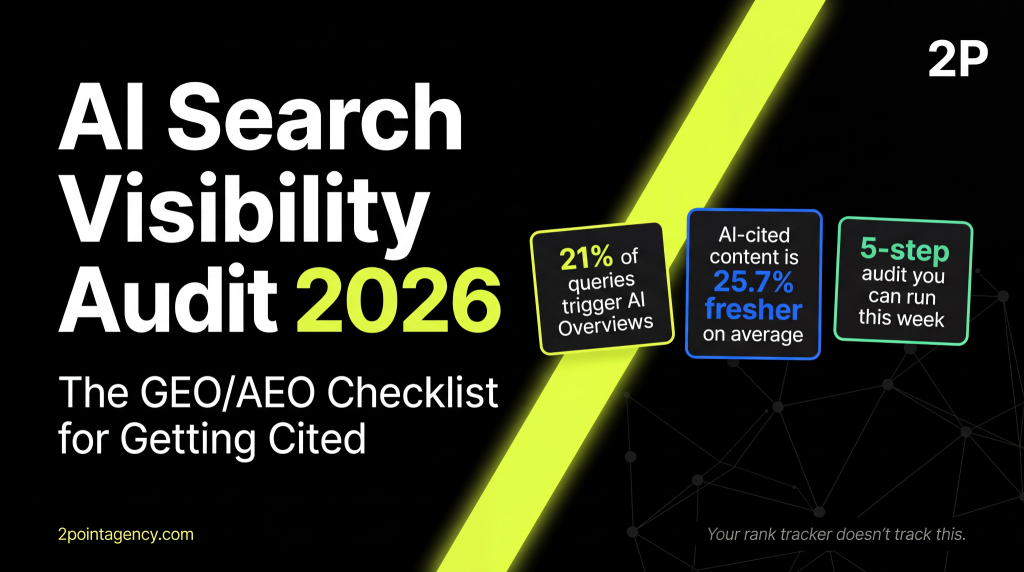
Your rank tracker tells you where you stand in Google. It does not tell you whether Perplexity cites your brand when someone asks which CRM is best for early-stage startups.
That blind spot is the problem. AI Overviews, ChatGPT, and Gemini now sit above traditional results for a growing share of buyer research. Ahrefs analyzed 146 million SERPs and found AI Overviews trigger on roughly 21% of queries.
If you cannot tell whether your content appears on those surfaces, you are flying blind.
Running an AI search visibility audit is how you close that gap. What follows is the AI search optimization checklist 2POINT runs before every client engagement begins.
Key Takeaways
- An AI search visibility audit measures whether your brand appears inside ChatGPT, Perplexity, Gemini, and Google AI Overviews, not just the traditional top ten. This is the foundation of any LLM visibility audit worth running.
- GEO and AEO overlap heavily with SEO but shift the focus from keyword-matched pages to citation-worthy answers. Understanding both is the starting point for how to appear in AI overviews consistently.
- The AEO audit checklist runs in five steps: baseline citation share, content structure, technical foundation, E-E-A-T signals, and ongoing monitoring.
- Named tools make this practical. Profound, Peec AI, Otterly, and Athena HQ handle citation tracking. Screaming Frog and schema validators cover the technical layer.
- The GEO audit checklist works best as a quarterly ritual. Brands that run it regularly catch content decay and competitor citation gains before they turn into lost pipeline.
- Running the audit in-house works for lean teams. Scaling it across large catalogs or multi-market brands usually justifies agency support.
What AI Search Visibility Actually Means
The New Search Surface in 2026
AI search visibility is whether your brand, content, or product appears as a cited source inside generative answer engines when someone asks a question related to your category.
It is not the same as ranking in Google. It is its own discipline now.
The four surfaces that matter most in 2026 are Google AI Overviews, ChatGPT search, Perplexity, and Gemini. Each pulls from different sources and rewards different signals, which is why a snapshot across all four gives you the clearest picture of your actual search visibility.
The optimization target has also shifted. A classic SERP ranks ten pages and lets you pick.
A generative engine synthesizes a response and cites only the sources it trusts. Your job moves from ranking on page one to becoming one of those cited sources, and that changes how you write, structure content, and measure wins.
Pew Research found that 34% of US adults have used ChatGPT, roughly double the 2023 figure, with a growing share treating it as a first-touch research destination before they open Google. An LLM visibility audit tells you whether your brand shows up where those users actually are.
GEO vs AEO vs SEO Explained
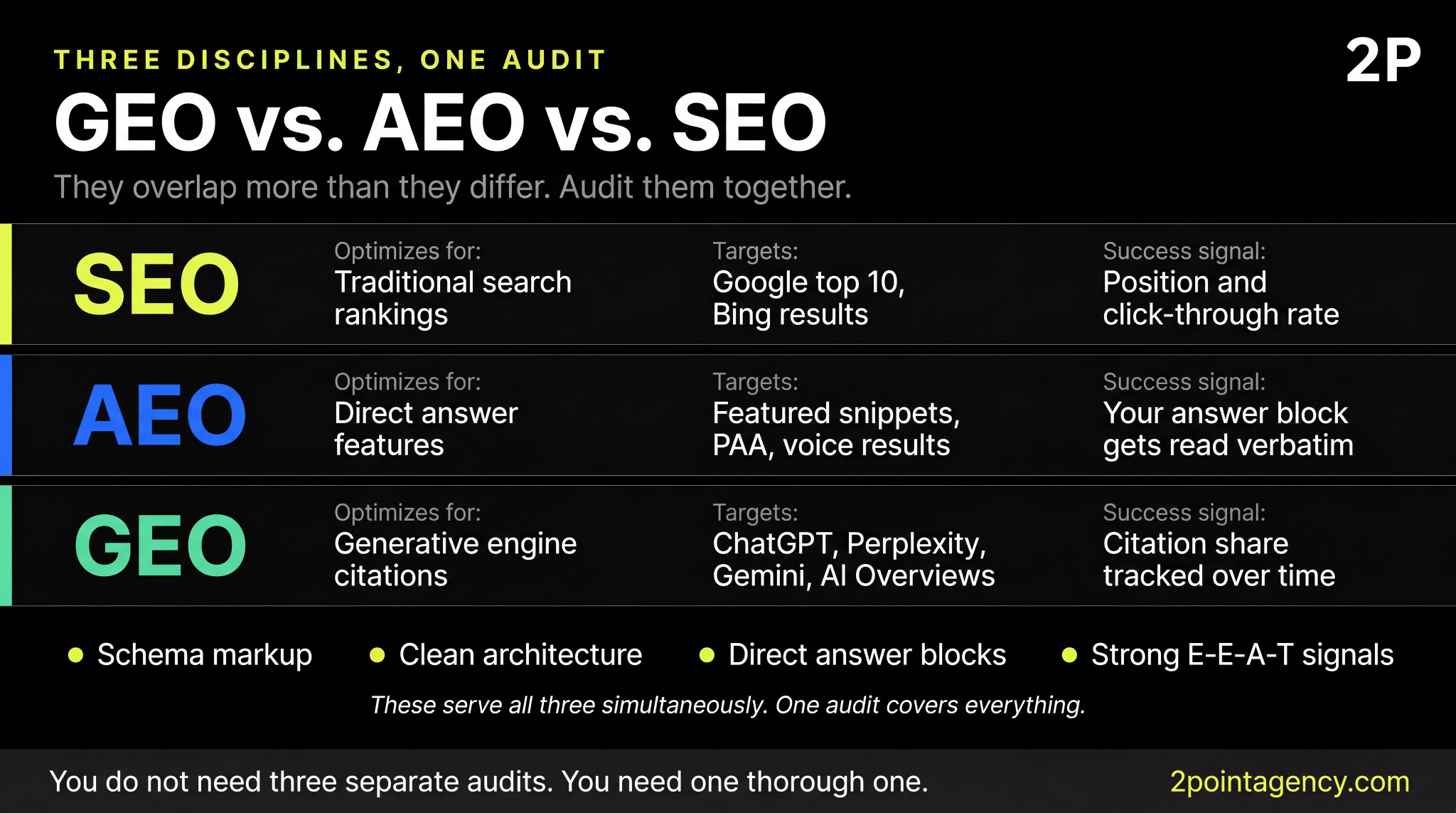
The three acronyms get thrown around together, so breaking them apart is the fastest way to understand what you are actually auditing.
- SEO: Optimizes pages to rank in traditional search results. Your success signal is position and click-through rate.
- AEO (Answer Engine Optimization): Structures content to get picked up in featured snippets, People Also Ask boxes, and voice assistants. Your success signal is whether your answer block gets read verbatim.
- GEO (Generative Engine Optimization): Optimizes content so ChatGPT, Perplexity, and Google AI Overviews cite it inside synthesized answers. Your success signal is citation share across a defined query set tracked over time.
The practical takeaway for your generative engine optimization audit is that all three share the same foundations.
Schema markup, clean site architecture, declarative answer blocks, and strong E-E-A-T signals serve all three simultaneously. Your GEO audit checklist does not need to be a separate workstream from your existing SEO process.
Why Most Sites Are Invisible to AI Search (and Do Not Know It)
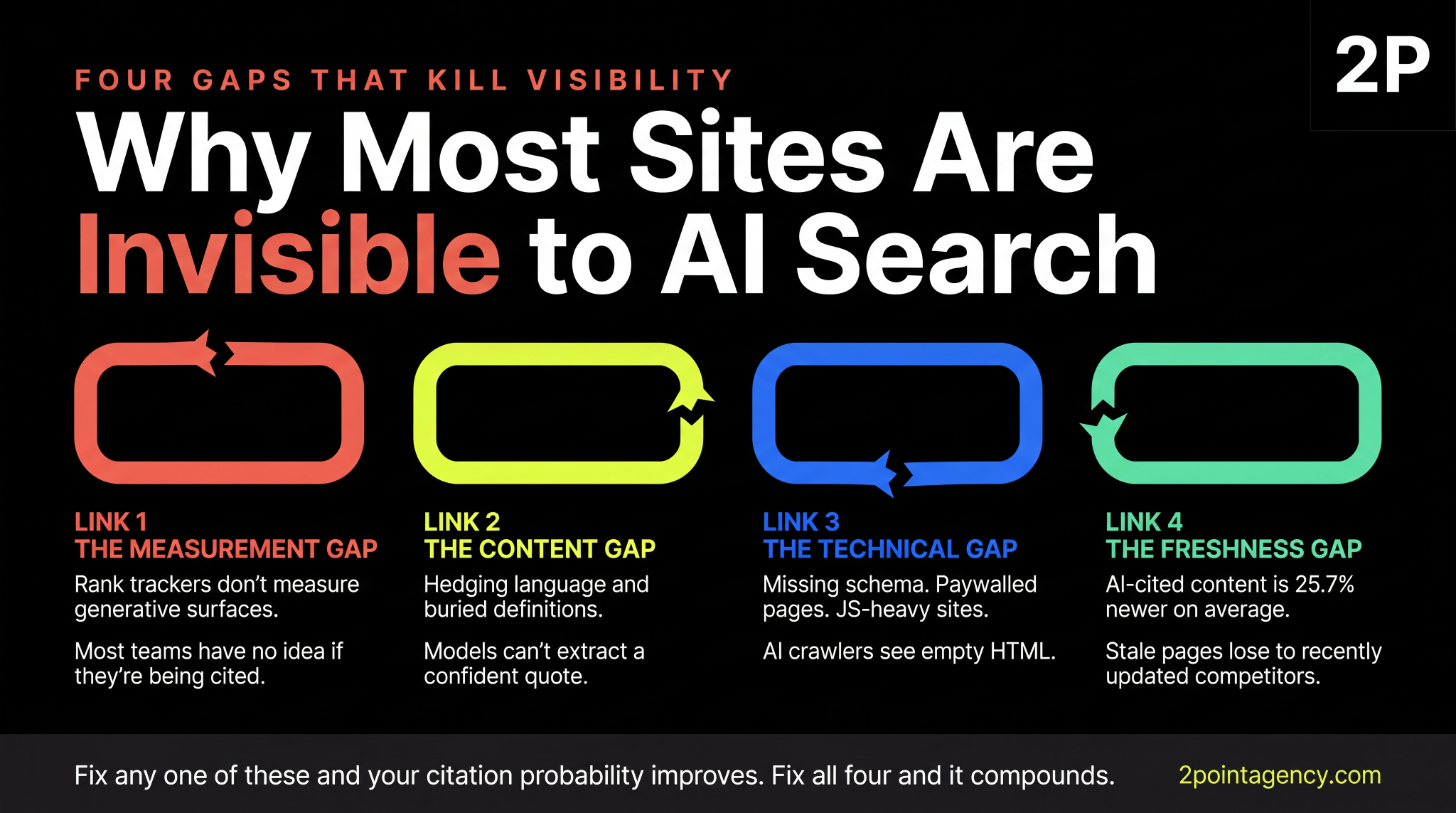
Most brands cannot answer, “Are we showing up in ChatGPT?” because their rank trackers were never built to measure it. Traditional tools watch your keyword position and alert you when it drops.
None of them tracks whether you got cited inside a synthesized answer. That gap leaves teams relying on whoever remembered to manually ask an AI a brand query last week.
The content gap compounds the problem. LLMs prefer declarative answers with clean sourcing and short entity definitions near the top of the page. If your content is packed with hedging language and buried definitions, models cannot extract a confident quote, and confident quotes are what earn citations.
Technical gaps finish the job. Missing schema markup, paywalled content, and JavaScript-heavy pages that serve empty HTML to bots make your site invisible to AI crawlers.
Freshness matters too. Ahrefs' analysis of 17 million AI citations found that AI-cited content is 25.7% fresher on average than traditionally ranked content. Stale pages lose citations to competitors that have been recently updated, even when the older content is more accurate.
The AI Search Visibility Audit Checklist (5 Steps)
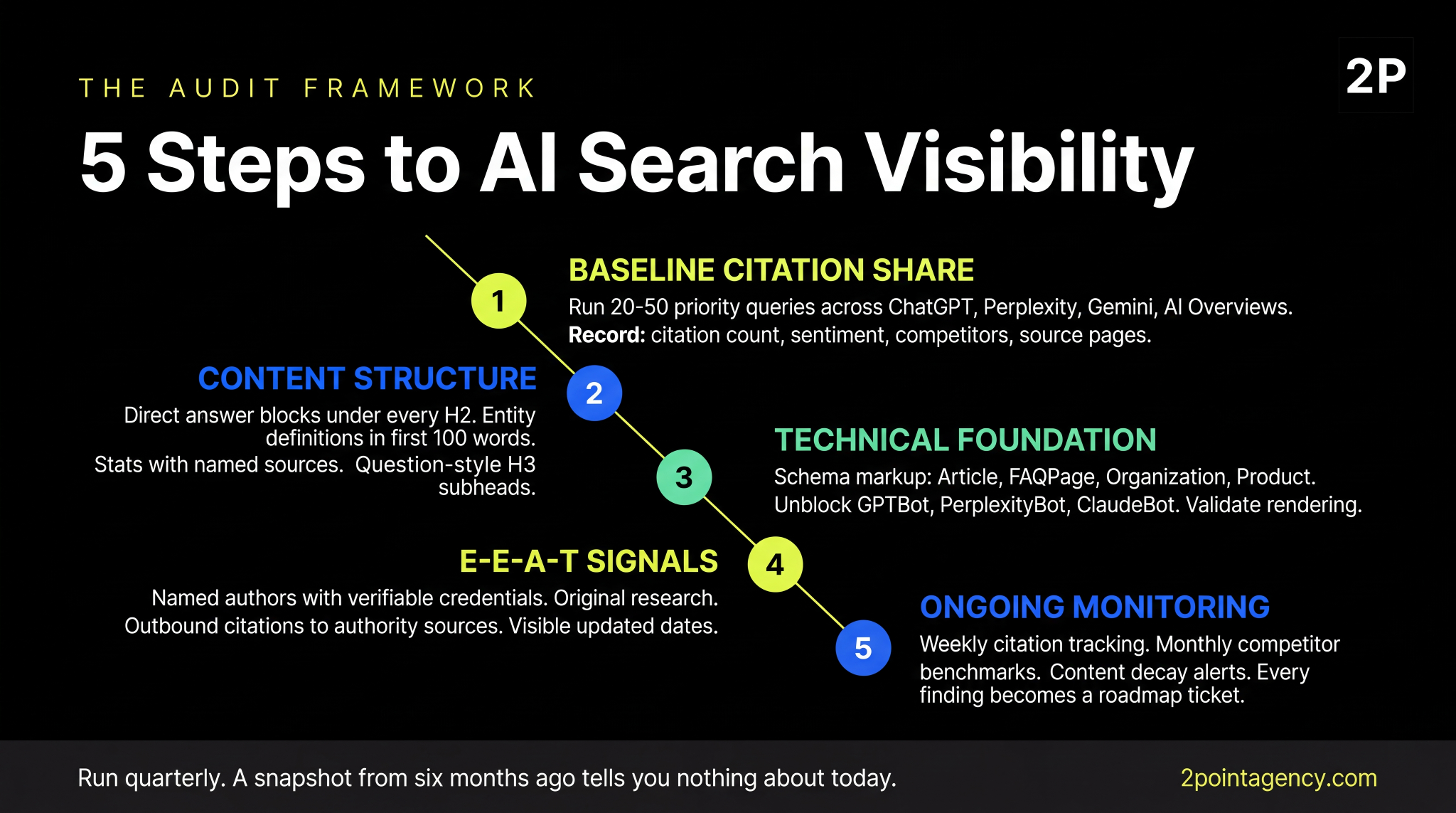
This is the section you can screenshot and hand to your team as a standalone playbook. Each step has a defined scope, named tools, and a deliverable you can compare against next quarter.
Step 1: Baseline Your Current Citation Share
Before you optimize anything, you need a clear picture of where you stand.
Build a list of 20 to 50 priority queries covering your brand terms, main category terms, and the commercial intent queries you care about most. Run each one through Google AI Overviews, ChatGPT, Perplexity, and Gemini, recording:
- Whether your brand appears and how it is described
- Which page gets cited on your behalf
- Which competitors share the surface with you
For scale, purpose-built citation tracking tools automate this entirely. Profound, Peec AI, Otterly, and Athena HQ all run query sets on a schedule and return citation share dashboards over time.
Your goal at the end of this step is to create a baseline scorecard that shows citation count, sentiment, competitor mentions, and the source pages cited. These tools fit naturally alongside your existing SEO integrations rather than adding another disconnected dashboard.
Step 2: Audit Your Content Structure for LLM Readability
Once you know your citation baseline, the content structure pass is where most teams find the quickest wins because the fixes are editorial rather than technical.
Every major H2 on a commercial page should open with two to three sentences that directly answers the heading’s question. Models extract citations from direct answers, not from paragraphs that warm up before making a point.
Entity definitions matter equally. Clear definitions of your product and category in the first 100 words give models something concrete to cite.
Your AI search optimization checklist for this step: named sources, specific numbers, and question-style H3 subheads all increase citation eligibility. Start with a clean on-page content audit of your top 20 pages.
Step 3: Audit Your Technical Foundation
Strong content with a broken technical layer cannot earn citations because AI crawlers never see it cleanly. Work through these checks in order:
- Schema markup: Audit for Article, FAQPage, Organization, and Product schema using Schema.org as your reference. Validate every priority page with Google's Rich Results Test.
- Crawlability: GPTBot, PerplexityBot, and ClaudeBot all need unblocked access. Check your robots.txt directly. Many sites accidentally block AI crawlers during routine security updates.
- Rendering: JavaScript-heavy pages often serve empty HTML to bots that do not execute scripts. Run a server-side fetch on your priority pages to confirm bots see your actual content.
- Canonical tags: Clean canonicals help models deduplicate content across URLs. Messy ones suppress citation frequency.
Google's structured data documentation is your GEO audit checklist for mapping markup types to specific search surfaces.
Step 4: Audit Your E-E-A-T Signals
E-E-A-T signals serve both traditional rankings and generative citations, meaning every hour invested here pays off across both surfaces simultaneously.
Start with author bios. Named authors with verifiable credentials and linked professional profiles are the baseline. Anonymous author pages tell models nothing and leave trust signals on the table. Pair each bio with first-hand experience markers like proprietary data or original research that only you could have produced.
Outbound citations matter more than most teams realize. Linking to peer-reviewed research and trade publications signals that your content sits within a broader web of evidence.
As Search Engine Land's E-E-A-T analysis confirms, how to rank in ChatGPT consistently comes down to citation practices, entity relationships, and verifiable authority signals working together.
Step 5: Set Up Ongoing Monitoring
The fifth step turns a one-off audit into a compounding advantage. You need a cadence, a scorecard, and a feedback loop that feeds findings directly into your content roadmap.
Three monitoring habits worth building immediately:
- Weekly citation tracking on your top priority queries to catch sudden drops before they become cumulative losses
- Monthly competitor benchmarks across the same query set to measure whether you are gaining or losing share
- Content decay alerts flag any source that disappears from citations for two consecutive weeks
The feedback loop is what most teams skip. Every finding needs a roadmap ticket with an owner, a deadline, and a success metric. Pair this with a proper rank-tracking stack, and your team can view one unified report rather than five separate tabs.
The Tools You Need to Run This Audit
You do not need a huge budget to run a credible first audit, but you do need the right tools broken out by function:
- Citation tracking: Profound, Peec AI, Otterly, and Athena HQ all automate query monitoring across ChatGPT, Perplexity, Gemini, and Google AI Overviews. Most offer free trials.
- Technical SEO: Screaming Frog or Sitebulb for crawl audits, plus Google Search Console for coverage issues and structured data validation.
- Schema validation: Google's Rich Results Test for real-time checks and Schema.org for vocabulary accuracy.
- Analytics: GA4 with AI referral segments capturing chatgpt.com, perplexity.ai, and gemini.google.com so you can track downstream conversions.
Ahrefs' analysis of 146 million SERPs confirms AI Overviews now trigger on 21% of all keywords. You are not buying dashboards for vanity. You are buying visibility into where your prospects are already making decisions.
Your LLM optimization strategy determines how well each tool pays off.
Common AI Search Audit Mistakes to Avoid
Even teams that run this audit diligently hit the same pitfalls. A strong generative engine optimization audit avoids all of these:
- Auditing once and never re-running: Citation share shifts weekly. A snapshot from six months ago tells you nothing about today.
- Trusting a single LLM snapshot: Run the same queries across several days and sessions. One-off results mislead more often than you would expect.
- Confusing mentions with citations: A brand mention without a linked source is not a citation. Your tracking tool should treat the two separately.
- Ignoring Perplexity: It has the clearest citation transparency of any major engine and often drives disproportionate referral traffic relative to its query share.
- Blocking GPTBot without understanding the tradeoff: Some bot blocks also kill live citation potential. Know exactly which bot does what before touching your robots.txt.
Each of these is fixable once you know to look for it.
How to Report AI Search Wins to Leadership
Winning the audit is one thing. Explaining it to a CFO who has never heard of Profound is another. The key is translating citation share into the language the leadership already speaks.
When your brand gets cited in ChatGPT for category queries, branded search volume typically rises over the following four to eight weeks. Users discover you through the LLM, then verify your identity with Google before buying. That sequence is measurable and connects your AI search work directly to the funnel leadership already tracks.
Keep your executive dashboard to three metrics:
- Citation share across your priority query set
- AI referral sessions from chatgpt.com, perplexity.ai, and gemini.google.com in GA4
- Branded search volume trend from Google Search Console
These three metrics tell a complete, defensible story. When the budget conversation comes up, real SEO ROI gives you the framing to make the case.
In-House vs Agency: Who Should Run This Audit?
The honest answer depends entirely on your situation. But most brands hit the agency threshold faster than they expect.
| Factor | In-House | Agency |
| Content volume | Under 500 pages | 500+ pages |
| Markets | Single market | Two or more |
| Audit cadence | Quarterly | Monthly or faster |
| LLM experience | 12+ months in-house | Under 12 months |
| Executive reporting | Internal only | Cross-brand benchmarking |
| Query set management | Single region | Multi-region coordination |
In-house works when you have a lean team with strong SEO fundamentals and one person tracking LLM developments seriously. As complexity grows, though, large content libraries, multi-market query sets, and quarterly executive reporting quickly exceed what an in-house team can sustain without dedicated headcount.
2POINT offers a free first-pass AI search visibility audit for brands that want an outside read before committing. Our SEO team runs the full five-step audit, and AIOBot helps optimize your content for AI Overview visibility at scale.
The 2026 Outlook for AI Search Visibility
Generative search share is still expanding, and the data confirms the direction.
Gartner projected traditional search volume would drop 25% by 2026 as AI chatbots and virtual agents replaced routine queries that once went to Google. That shift is now playing out in real time, and it is the context in which your 2026 audit strategy should be built.
Audit cadence needs to shift from annual to quarterly. Citation share volatility is too high to measure once a year and still capture the movements that matter.
The wild card is agentic browsing. Tools like Claude for Chrome let AI agents navigate the web on behalf of users, reshaping what visibility even means. An agent does not scroll a SERP. It reads a few sources and delivers an answer. Your citation trust today is your visibility advantage tomorrow.
Start Your AI Search Visibility Audit This Week
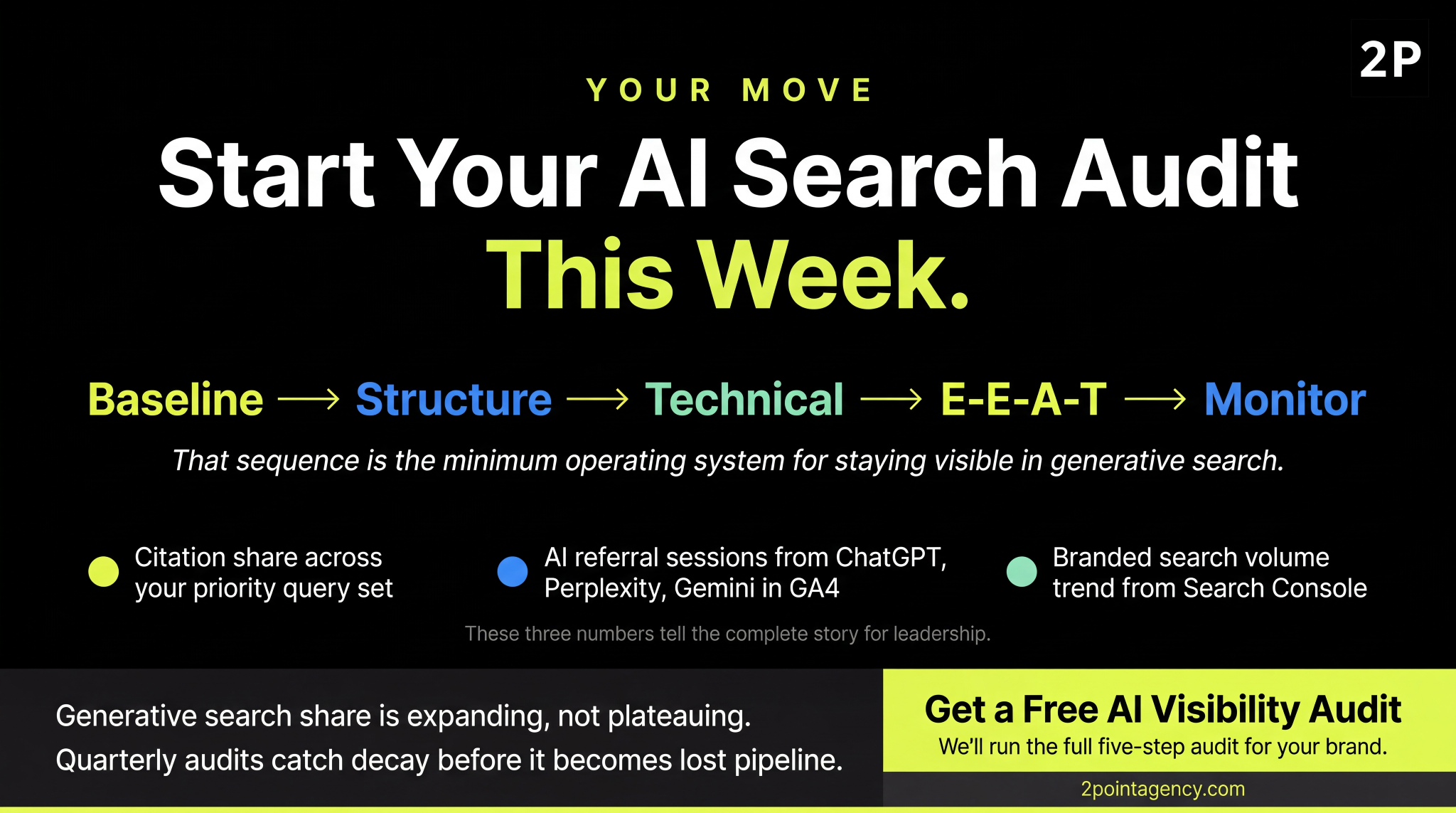
You now have the full five-step framework. Baseline your citation share, audit your content structure, fix your technical foundation, strengthen your E-E-A-T signals, and set up quarterly monitoring.
That sequence is the minimum operating system for any brand that wants to stay visible in generative search.
2POINT's SEO team runs this audit for brands that want an outside read, and AIOBot helps optimize your content for AI Overview visibility at scale.
FAQs About AI Search Visibility Audits
What is an AI search visibility audit?
An AI search visibility audit assesses whether your brand is cited in ChatGPT, Perplexity, Gemini, and Google AI Overviews. It checks citation share, content structure, technical foundation, and authority signals, giving you a baseline scorecard to improve against each quarter as generative search keeps evolving.
How do I check if my site shows up in ChatGPT?
Knowing how to rank in ChatGPT starts with running brand and category queries through ChatGPT search and recording whether your pages get cited. Scale with tools like Profound, Peec AI, Otterly, or Athena HQ, which automate checks across all four major AI surfaces on a repeatable schedule.
What is the difference between GEO and AEO?
Your AEO audit checklist focuses on featured snippets and voice results. Your GEO audit checklist focuses on getting cited inside ChatGPT, Perplexity, and AI Overviews. Both overlap with SEO, and running a generative engine optimization audit that covers all three simultaneously saves significant time without duplicating work.
How often should I run an AI search audit?
Quarterly is the right cadence for most brands. Your AI search optimization checklist covers more ground than a weekly citation check but catches content decay faster than an annual review. A full five-step audit every ninety days spots competitor citation gains before they compound into lost pipeline.
Should I block GPTBot from crawling my site?
Blocking GPTBot protects your content from training use but may reduce your chances of being cited in live ChatGPT answers. The tradeoff depends on your content strategy. Most publishers who want citation share leave GPTBot unblocked and address training concerns through other signals instead.