let’s connect


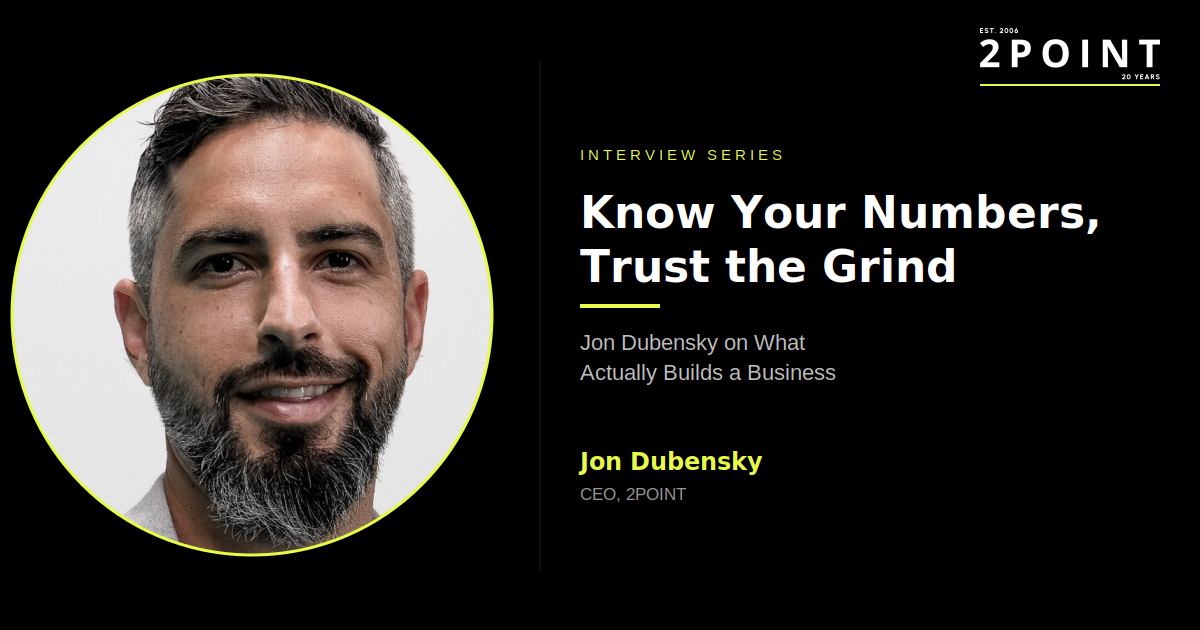
Jon Dubensky has built 2POINT from the ground up, and along the way he has developed a set of convictions about business, leadership, and marketing that cut against a lot of the noise.
In a recent interview, the CEO sat down to share his unfiltered perspective on what separates businesses that last from those that stall, and why most founders are looking in the wrong places for the answers.
Content Cannot Be an Afterthought
When asked what businesses consistently get wrong, Jon does not hesitate: organic content. Not the concept of it, but the commitment required to do it well. His observation is that too many businesses assume content can be handed off entirely, treated as a background task, or managed with minimal time investment, and then wonder why it produces nothing.
“There’s no tool that can really help a company that’s not doing it fully, or not being consistent about it,” he says. “You really need someone hands-on with your approach.” His point is not that AI or automation have no role, but that high-quality organic content, the kind that actually generates engagement, requires dedicated human attention. Whether that is an internal team member or an external partner, the work cannot simply be delegated and forgotten.
He also notes that this challenge runs especially deep for entrepreneurs and CEOs. Their minds are wired for the immediate and the reactive, what is happening right now, not what they want to be saying 90 days from now. Building a content calendar and sticking to it goes against the grain of how most founders naturally operate. Recognising that tension, Jon argues, is the first step to doing something about it.
Vanity Metrics Are a Distraction. Bottom Line Is the Only Honest Measure

On the question of which metrics businesses celebrate that they probably should not, Jon is direct. While he stops short of dismissing supporting metrics entirely, marketing funnels can reveal patterns and signal where effort is being wasted, he is firm that the only numbers that truly matter are sales, form submissions, and phone calls.
“You can’t always be looking at just long-term metrics and being excited about that, because there might not be a business at the end of the day if all of the metrics are showing up but the actual deals aren’t working,” he explains. The disconnect he sees most often is between graphs that look impressive and revenue that is not moving. Pretty dashboards can mask a business that is quietly struggling.
His remedy is to trace the full journey from lead to closed deal, understanding not just what converted, but why. What keyword drove that enquiry? Why did that lead not close? Most businesses, he observes, stop at what they can easily see and never take the few extra steps that would tell them what is actually happening at the revenue level.
A Healthy Business Starts with One Simple Truth
When asked what a healthy business looks like from the inside, Jon strips it back to basics. More money coming in than going out. Not loan money, not VC funding, but actual revenue paying for the team and the operation. Everything else, he argues, is secondary to that.
“If you’re at a negative then you’re always going to be stressed. You’re never going to be able to do your best work,” he says. This grounding take is one many business owners can relate to. For Jon, financial awareness is not just a CFO’s concern, it is the foundation of every smart decision a CEO makes. Knowing your numbers, specifically the monthly revenue required to cover costs and pay your team, keeps decisions rational rather than reactive.
What Actually Kills Businesses
Jon has a clear answer when asked what kills more businesses than people admit: the wrong people. Not bad strategy, not poor marketing, not an unfavorable market. The absence of quality people who can own their roles and operate without constant supervision.
“As a business owner, you’re less motivated when you don’t have quality people around you, because you can only be so self-motivated. And you can’t scale without having people that you can trust on your team.” This belief shapes how seriously he takes the hiring process, and how cautious he has become about what interviews can and cannot tell you.
On hiring, Jon has arrived at a position that may surprise people: he no longer believes much of what candidates say in interviews. References, credentials, salary history, stated work ethic, all of it he treats with scepticism, not out of cynicism, but out of experience. The real assessment, he argues, happens over 90 to 180 days on the job. Response times, consistency, quality of output, and whether a person continues to improve without being told to. These are the signals that actually distinguish long-term contributors from short-term passengers.
The Hiring Mistake Smart Founders Keep Making

There is one hiring pattern Jon sees repeatedly in founders he respects: the search for a game changer. A single hire who will come in and transform the trajectory of the business. He is sceptical of the instinct, even when he understands where it comes from.
The problem, in his view, is that the impulse often comes from anxiety rather than strategy. Founders get distracted by the volume of opportunity around them, or unsettled by the pace at which others appear to be growing, and look for a hire to solve the discomfort. “Anxiety causes rash decisions,” he says plainly. “And thinking someone can come in and move the needle to a crazy degree, those are signs that you probably just need to get more involved in the day-to-day of your own brand.”
On “Falling Behind”, and Why Slow Growth Is a Feature, Not a Flaw
For founders who feel like they are two years behind where they should be, Jon offers a perspective shaped by both personal experience and the reality of running a business in the social media age. The constant visibility of other people’s apparent success, younger founders, faster growth, higher income, creates a distorted sense of what is normal and what is possible.
“The slow grind is always more stable than super fast growth,” he says. His advice is simple in principle even if it is hard to execute: know your numbers, stick to your goals, maintain a market position you believe in, and keep improving every day. The businesses that fail, in his observation, are not usually the ones with weak strategies. They are the ones where the founder quit when things got hard, and things, he notes, are always hard at some level regardless of how successful you become.
There is one thing outside of work that Jon credits as making him a sharper business leader: reading. Physical books, not devices. His reasoning is practical; screens are distractions, and the ability to focus on something that builds you without the pull of notifications is increasingly rare and valuable. Pair that with a clear sense of obligation to family, and a commitment to maintaining your health, and what emerges, in his words, is a trifecta that unlocks a different level of potential.
It is a grounded philosophy from someone who has built a business by doing the unglamorous work well, and who remains willing to say so out loud.