


 let’s connect


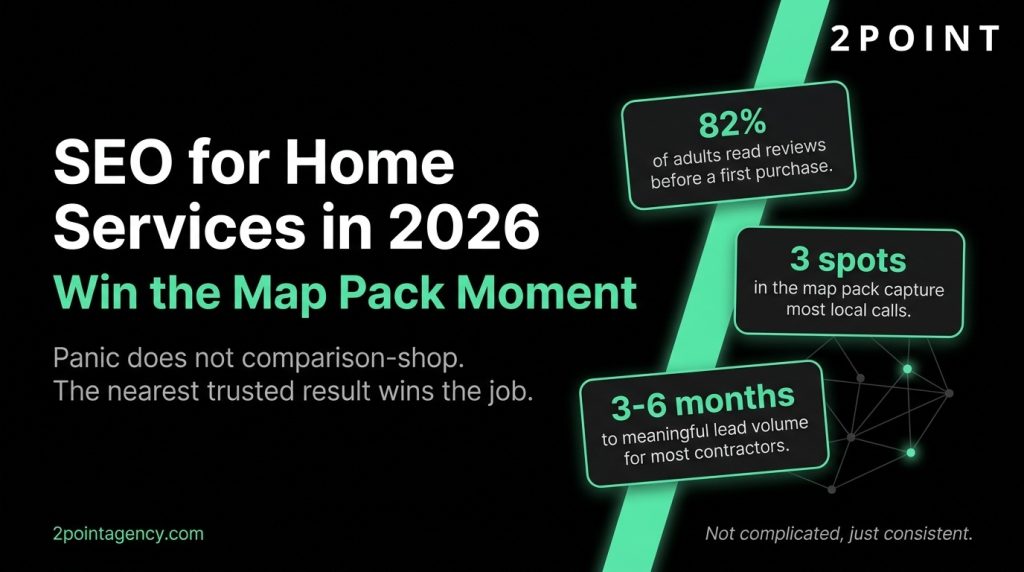
It is 7 pm on a Sunday when a homeowner hears water running behind a wall. They type "emergency plumber near me" and call the first business in the map pack, often before the results finish loading.
It is 7 pm on a Sunday when a homeowner hears water running behind a wall. They type "emergency plumber near me" and call the first business in the map pack, often before the results finish loading.
That sixty-second window is the whole game, because panic does not comparison-shop. The nearest trusted result wins the job, and often the customer has been behind it for years. Winning that moment is exactly what SEO for contractors is built to do.
At 2POINT, our SEO services for contractors turn nearby searches into booked jobs. If you run a plumbing, HVAC, roofing, electrical, or painting company, this is for you.
What Is Home Services SEO?
Home services SEO is the practice of optimizing a contractor's Google Business Profile, website, and reviews so the business appears in the local map pack, organic results, and AI answers when nearby homeowners search for a service.
The goal is narrow and practical. You show up for high-intent "service plus near me" searches, then convert that visibility into phone calls and quote requests.
That tight focus is what separates SEO for contractors from generic marketing.
Why SEO Is the Best Lead Channel for Home Service Businesses
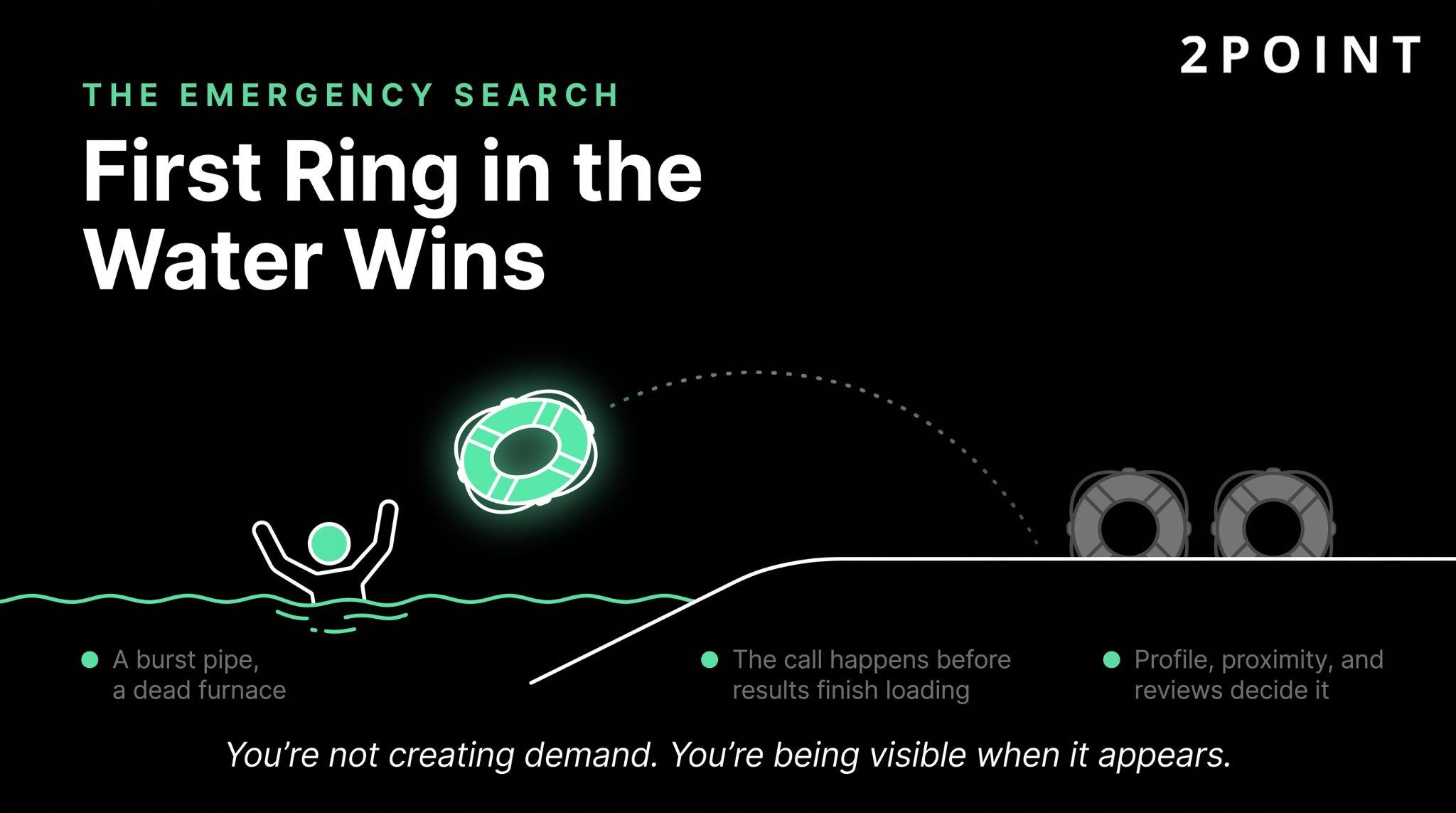
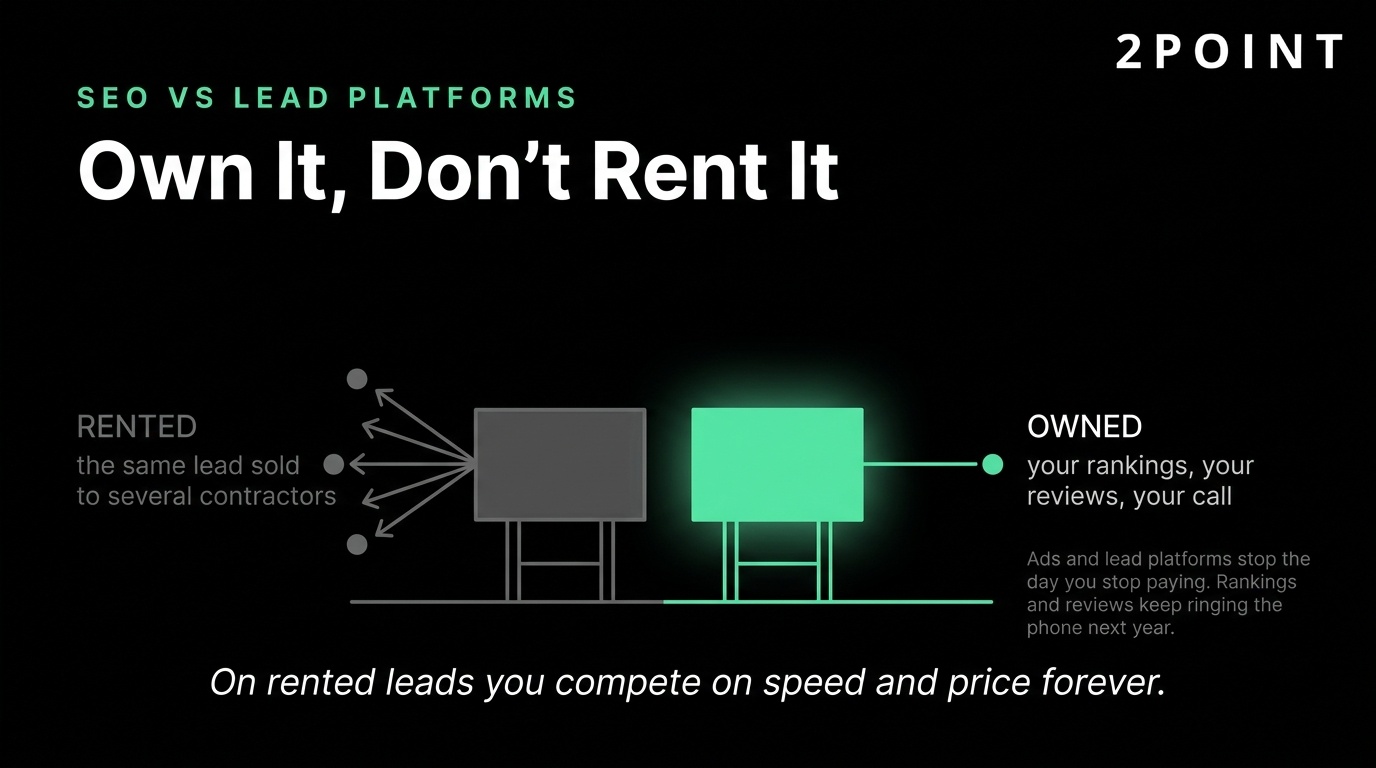
Search wins for the trades because it reaches homeowners at the exact moment they need you, not weeks before or after. And unlike paid leads, it keeps working after you stop paying. The rankings and reviews you build this year keep ringing the phone next year.
Reviews do much of the closing before you ever pick up. According to Pew Research Center, 82% of US adults at least sometimes read online reviews before a first-time purchase, and hiring a contractor is exactly that kind of considered choice.
So your Google reputation is often the first thing a homeowner checks. Strong contractor SEO simply makes sure that when they look, they find you.
Homeowners Search at the Exact Moment of Need
A burst pipe, a dead furnace, or a leaking roof creates an urgency few purchases match. The homeowner already has the problem, so these searches convert fast. That flips your job on its head.
You are not creating demand; you are being visible when it appears.
You Own the Leads Instead of Renting Them
Pay-per-lead platforms like Angi and Thumbtack sell the same lead to several contractors at once, so you compete on speed and price the second it lands. The rankings and reviews you build work differently. They are yours, and they keep sending calls with no per-lead fee attached.
It Compounds While Ads Stop the Day You Stop Paying
Google Ads switches off the instant your budget runs dry, and the leads stop with them. SEO runs the opposite way. A strong profile, a ranking page, and a steady flow of reviews keep pulling work month after month.
That compounding is why local SEO for contractors pays back over time rather than all at once.
The Map Pack Is the Most Valuable Real Estate in Local Search
Finally, look where the calls actually come from. Three businesses sit in the map pack above the regular results, and that block captures most local phone calls. Ranking there depends on your profile, proximity, and reviews, making it the single highest-return move a home service business can make.
How Homeowners Find a Contractor in 2026 (the Search Journey)
The path from problem to booked job now runs through four moments, and each one rewards a different tactic. Miss a stage, and you lose leads to whoever covers it. So map one move to each moment, including the newer step where an AI assistant writes the shortlist.
That full-journey coverage is the backbone of SEO for home service contractors.
Stage 1: the Emergency, Near-Me Search
This is the map pack moment. Someone types "water heater repair near me" and picks from the three businesses Google shows, weighted heavily by your Google Business Profile, your reviews, and how close you sit to the searcher. Nothing else in this journey converts faster. Win here, and the phone rings within minutes, not days.
Stage 2: the Research Search (Service Plus City)
Planned work runs differently. For a roof replacement or a repipe, homeowners search "roof replacement in [city]" and compare several options over days or weeks before calling anyone.
Dedicated service and location pages are what rank and get read at this stage, so each major service you offer deserves its own page targeting its own search.
Stage 3: the Trust Check
Before any call, the trust check happens. Homeowners scan your reviews, real job photos, and licensing, usually in under a minute.
This is where a complete profile quietly closes the deal or loses it, because genuine before-and-after photos and a steady review flow say what no ad copy can. Thin profiles lose jobs they never knew about.
Stage 4: the AI Answer
Increasingly, the journey starts somewhere new. Homeowners ask ChatGPT or Gemini for the best [trade] in [city] and get a ready-made shortlist back.
To make that list, you need to be citable, which is the job of answer engine optimization. Treat it as a new front door, because it is opening faster than most contractors realize.
The Four Pillars of Home Service SEO

Everything that moves the needle sits under four pillars. Your Google Business Profile, your website, your reviews, and your local authority.
Each covers a different stage of the journey you just mapped, and together they span the map pack, organic results, and the trust check in a single system. Build all four, since a gap in one quietly caps the other three.
Pillar 1: Your Google Business Profile
For a home service business, the profile outranks the website because it powers the map pack where emergency calls occur.
Google's own tips for ranking locally confirm that complete, accurate profiles are what its systems match to searches. So complete every field, keep hours up to date, and treat the profile as a living page rather than a one-time setup.
Categories and Services
Start with one accurate primary category, such as Plumber or HVAC Contractor, then add every service you offer as its own service item. Specificity is the point here, since precise categories help Google match you to precise searches, including the long-tail emergencies your competitors miss.
Service-Area Setup for Businesses Without a Storefront
If customers never visit your location, set the profile up as a service-area business. Hide the street address, then define the cities or zip codes you genuinely cover. Keep those areas honest, because padding them with regions you rarely serve can hurt your visibility and confuse Google about where you belong.
Photos of Real Jobs and Weekly Posts
Before-and-after photos of real jobs beat stock images for trust and engagement every time. Add a short weekly post on top, even a quick job update, and the profile reads as active. That activity signals a real, working business, which is exactly what Google wants to show a homeowner in a hurry.
Pillar 2: Your Website, Service, and Location Pages
Next comes your website, where research-stage searches and AI engines find the details a profile cannot hold. A profile wins the emergency, but the website wins the planned, higher-ticket job. Thin, one-page sites rarely rank for service-plus-city queries, so structure carries this pillar, and three page types do the work.
One Page Per Service
Give repair, installation, replacement, and maintenance each a page of its own. One page trying to rank for everything ranks for nothing, while a focused page can own its search and speak to exactly what the homeowner needs. It also hands AI engines a clean page to cite for that specific job.
City and Neighborhood Pages That Are Genuinely Local
Location pages earn their rankings with real local substance.
Neighborhoods served, recent local projects, permit notes, and area-specific advice all prove you actually work there. Boilerplate with the city name swapped in is a doorway page, and Google discounts it, so write each one as if a local will read it. Because one will.
Fast, Mobile, Click-to-Call, and Quote Forms
Most home service searches happen on a phone, often in a hurry. So remove every step between the visitor and the call. A click-to-call button, a short quote form, and a fast-loading page turn that visitor into a lead before they bounce back to the map pack and dial your competitor instead.
Pillar 3: Reviews and Reputation
Reviews pull double duty. They influence your map-pack ranking on one side and the homeowner's decision on the other, a combination no other pillar matches.
That dual weight is why reviews deserve a real system rather than an occasional ask when you happen to remember. Two habits carry the whole thing.
Build a Review-Request System
Ask every satisfied customer at the end of the job, while the finished work is right in front of them, and make leaving a review one tap easy with a saved link or QR code. Recency and a steady flow beat a big burst followed by silence, since Google reads the rhythm as much as the total.
Respond to Every Review
Reply to every review, good and bad, calmly and by name.
Owner responses serve as both a ranking and a trust signal, and the replies to bad reviews matter most. Future customers read them to see how you handle a problem, which tells them more than any five-star rave.
Pillar 4: Local Authority and Links
Finally, authority tells Google you are an established local business rather than a name it just met. For a contractor, it comes from consistency and community presence far more than from fancy link building, which puts this pillar well within reach of a small team with no SEO budget.
Consistent NAP and Local Citations
Keep your name, address, and phone number identical everywhere they appear, then claim the key directories for your trade and area.
Mismatched listings quietly drag down rankings, which is exactly why consistent listings across directories matter more than most owners realize. Audit them quarterly and fix drift early.
Local Links
Links from suppliers, trade associations, and the community groups you sponsor carry real local weight.
A sponsored Little League team or a supplier's where-to-buy page tells Google you are embedded in the area, and either is worth more to a contractor than a dozen generic directory links bought in bulk.
Technical SEO Basics Most Contractors Skip
You do not need to be a developer, but a few technical basics decide whether Google can rank your site at all.
Think of them as the plumbing behind your own marketing. Invisible when they work, costly when they fail. These three are the ones contractors most often skip, and fixing them removes the ceiling on everything else you build.
Core Web Vitals and Mobile Speed
Because home service searches skew mobile, a slow site loses jobs before the phone ever rings.
According to Google's own page experience documentation, its ranking systems reward pages that offer a good experience, with Core Web Vitals, secure HTTPS, and content that displays well on phones, all part of that assessment.
So compress your images, test on a real phone, and cut whatever makes the page crawl.
Crawlability, Indexation, and a Clean Sitemap
Next, make sure Google can actually reach your pages.
If your service pages cannot be crawled and indexed, they cannot rank, no matter how good they are. Submit an XML sitemap, check Search Console for accidental noindex tags, and keep key content out of JavaScript that search engines struggle to read. In Search Console, 10 minutes usually surface all three.
Schema Markup (LocalBusiness, Service, FAQ)
Finally, label what your business is in a language that machines can read clearly. Structured data spells out your services, service area, and location, so add LocalBusiness or HomeAndConstructionBusiness markup, plus Service and FAQ types where they match the visible page.
Done right, it qualifies you for rich results and provides the details AI engines cite. Validate before you publish.
Keyword Strategy: Services Times Locations Times Intent
The fastest way to build a keyword plan for the trades is a simple grid. Take every service you offer, cross it with every area you serve, then sort the results by intent.
That grid becomes your page plan, your content calendar, and your priority list in one move, and it keeps SEO services for contractors focused on terms that actually convert rather than vanity phrases.
Build the Service-and-City Grid
Start with the grid itself. List your services down one axis and your cities or zip codes across the other, and every cell, like AC repair in [city], is a page you could build. You will not build them all, and you should not. Rank the cells by job value and search intent, then work from the top down.
Capture Emergency and Seasonal Demand
Then layer timing on top. Add emergency and same-day pages for urgent work, since those searches carry the highest intent you can capture.
Seasonal demand deserves the same treatment: air conditioning in summer, heating in winter. Best of all, that demand is predictable, so build and index those pages before the season hits, not during it.
Favor Low-Competition Long-Tail Terms
Finally, aim where you can win. A specific service-plus-city phrase converts better and ranks easier than any broad head term, because the searcher already knows what they need. You do not have to beat national brands for plumbers.
You need to own a tankless water heater installation in your city, and that fight is winnable this quarter.
Optimize for AI Search (AEO and GEO)
Homeowners increasingly get their shortlist from an AI assistant, so your content has to be easy for those engines to lift and cite. Here is the encouraging part.
The work overlaps almost entirely with the local SEO you are already building, which means you are not starting a second program. You are pointing the first one at a new surface.
Write Answer-First Blocks AI Engines Can Lift
Lead your pages and FAQs with a direct, self-contained answer.
The test is simple. If a block can stand alone as the reply to a question, an AI engine can quote it without rewriting. Then label those blocks with the Schema.org vocabulary, LocalBusiness for who you are, FAQ for what you answer, and machines parse them correctly instead of guessing.
Stay Crawlable and Citable
None of it counts if the engines cannot reach you. Three quick checks keep you visible.
- Allow GPTBot in robots.txt to let ChatGPT access your content.
- Allow Google-Extended, which does the same for Gemini.
- Keep your schema clean and validated, ready for AI Overviews to cite.
Blocking those crawlers quietly removes you from the AI answers homeowners are starting to trust, and you will never see the leads it costs you.
SEO by Trade (Go Deeper for Your Trade)
The four pillars apply to every trade, but the details shift with the work. Treat this guide as the hub, and each trade below gets its own deeper playbook that links back here.
Find yours, then start with the specifics that decide jobs in your corner of the market.
HVAC Companies
Seasonal swings rule HVAC search. Summer AC and winter heating demand arrive on schedule, so build those pages well before each season, then let maintenance plans and emergency terms carry the months in between.
Roofing Companies
Roofing is high-ticket and trust-heavy, which changes what converts. Storm-response pages, visible warranties, and strong job photos carry extra weight, because a homeowner spending five figures checks everything twice before calling.
Electricians
Panel upgrades, EV chargers, and safety work drive electrician searches, and each deserves its own page. Above all, make your licensing impossible to miss, since cautious homeowners actively look for it before they trust anyone near their wiring.
Painting Companies
Painting sells visually. Before-and-after galleries do much of the persuading, so keep them fresh and organized by room and style, and split interior from exterior into separate service pages that each own their season.
Plumbers
Plumbing splits into two different games. Emergencies reward fast, near-me pages built for a phone call in a panic, while planned installs like repipes and tankless systems reward detailed service pages that earn a considered quote request. Build for both, since the same homeowner needs each at different times.
How Long Does Contractor SEO Take, and What Does It Cost?
Contractor SEO is a build, not a switch, so set honest expectations on timeline and budget before you start. Neither number is fixed, and your market decides where you land, but both follow patterns you can plan around.
Timeline
Most contractors see meaningful lead volume in roughly three to six months, with real authority in a competitive market taking 12 to 18 months.
The order of results is predictable, though. Profile and review work can lift map-pack visibility within weeks, while new service pages take months to rank, which is exactly why you start with the profile.
Cost Ranges and What Drives Them
Plan for a monthly investment rather than a one-time fee, since the work is ongoing.
Be skeptical of any flat price you see published, because quoted ranges vary wildly and rarely describe the same scope of work. What actually moves your number is threefold.
How competitive your market is, how many services and areas you cover, and how much your site needs fixing. Judge any quote by what the work includes and the reporting behind it, not the sticker.
Red Flags: Contractor SEO Traps to Avoid
A few common traps waste your money, and the worst can get your listings penalized. Check for these before you sign anything.
- Pay-per-lead lock-in, which resells your lead to competitors and keeps the customer relationship for the platform, not you.
- Fake or incentivized reviews, which break Google and FTC rules and put your profile one audit away from suspension.
- Doorway city pages that swap the town name into identical boilerplate, a pattern Google recognizes and discounts.
- Ranking guarantees are a myth, since Google itself warns that no one can promise a number-one position.
Any one of these in a sales pitch tells you what the rest of the engagement will look like. Keep looking.
When the Map Pack Loads, Will You Be in It?
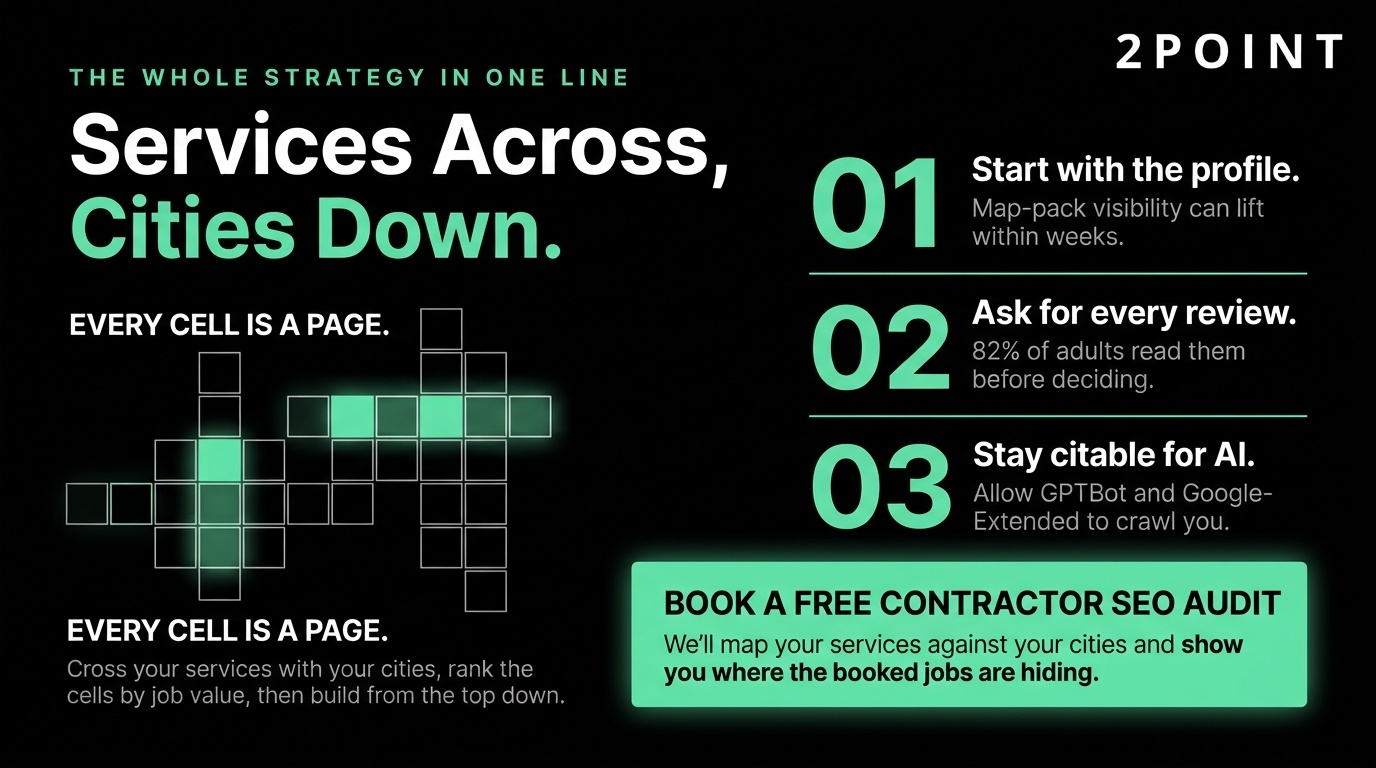
If you do only one thing this week, claim and complete your Google Business Profile and start asking every happy customer for a review. That single lever drives more calls for a home service business than anything else, and it is free. Build the four pillars on top, and the jobs compound.
When you want a hand, our managed SEO plugs into the multi-channel marketing that keeps your schedule full. Good SEO for home service contractors is not complicated, just consistent.
FAQs
How long does SEO take for a contractor?
Most contractors see meaningful lead volume in three to six months, with competitive markets taking twelve to eighteen months to build real authority.
Profile and review work moves fastest, often lifting map-pack visibility within weeks, while new service pages take longer to rank. Treat contractor SEO as an ongoing routine, and results compound quarterly.
Is SEO better than buying leads from Angi or Thumbtack?
They serve different needs, and many contractors run both early on.
Lead platforms deliver immediately, but resell the same lead to competitors, so you fight on speed and price forever. Building local SEO for contractors takes longer, yet the leads are exclusively yours, and the cost per lead drops as rankings and reviews compound.
Do I need a website if I have a Google Business Profile?
Yes. A Google Business Profile can win emergency, near-me calls on its own, but a website is what ranks for research searches and gives AI engines details to cite. In SEO for home service contractors, the profile is your map-pack storefront, and the website is the showroom behind it. You want both.
How do service-area businesses rank without a storefront?
Service-area businesses rank by configuring the profile correctly and building genuine local signals. Hide the street address, define only the cities you truly serve, then back it with real location pages, consistent listings, and reviews that name your neighborhoods.
Proximity still matters, so you rank strongest near your base and compete outward from there.
How much does home services SEO cost?
Plan for a monthly investment rather than a one-time fee, since the work is ongoing. Ignore flat prices published online, because your real number depends on competition, your service and area count, and how much your site needs fixing.
Well-run SEO services for contractors pay for themselves once a few higher-ticket jobs land.