let’s connect


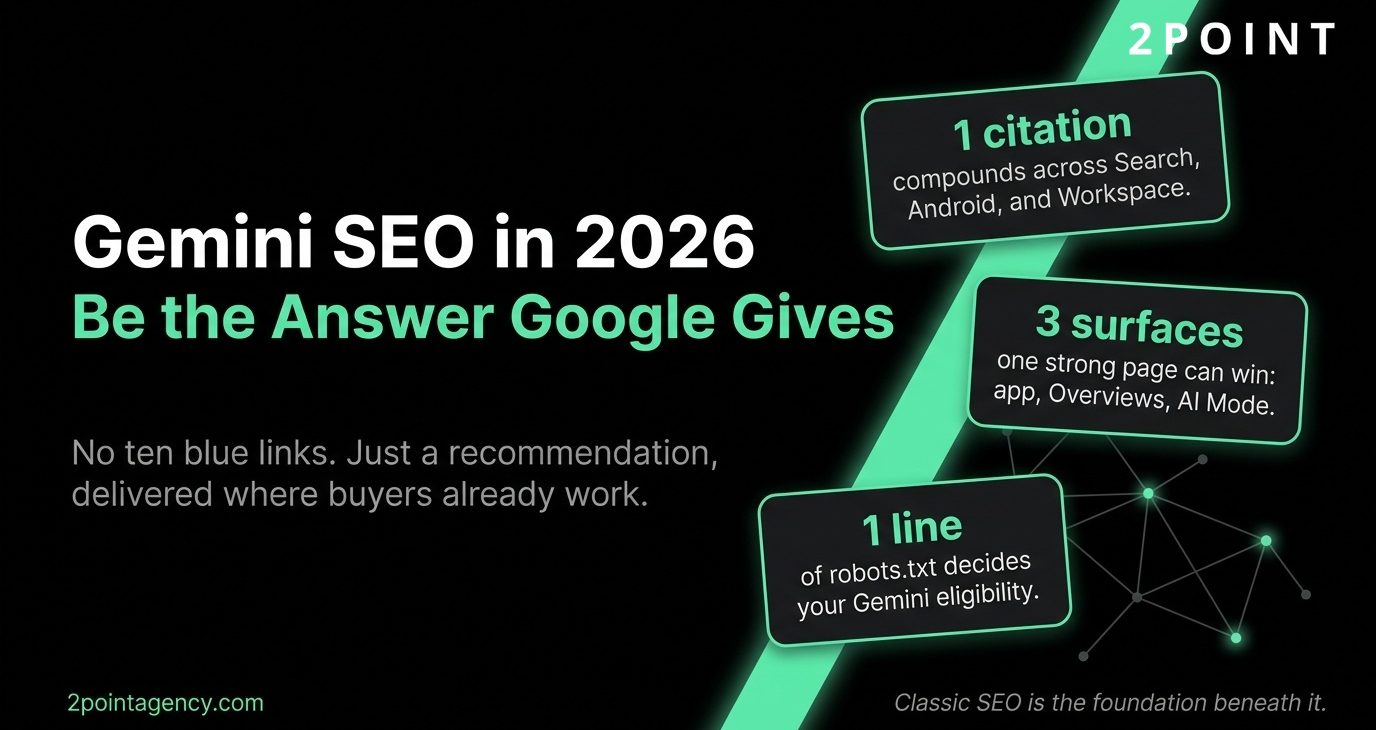
A shopper asks Gemini for the best option for their need and gets one synthesized answer, right inside the app they already use for email, docs, and their Android phone. No ten blue links. No ten open tabs. Just a recommendation with a few sources attached.
That placement is the whole opportunity. Because Gemini is woven through Google’s products, a citation reaches the buyer mid-workflow, where they are closest to acting. Earning it is what Gemini SEO is built to do.
At 2POINT, we help brands get cited in the AI tools their customers now trust. If you lead SEO or content, Gemini’s SEO is built for you.
What Is Gemini SEO?
Gemini SEO is the practice of optimizing your content, entity, and authority so Google Gemini cites or recommends your brand in its answers. Because Gemini grounds its responses in Google’s index, strong classic SEO is the foundation beneath it.
The goal shifts, though. You are earning the citation and the recommendation, not just a ranking position. So the work builds on the SEO you already do rather than replacing it, and your real rivals are whichever pages Gemini currently pulls for your buyers’ questions.
Gemini the App Versus AI Overviews Versus AI Mode
Let me clear the confusion up front, since the names blur together.
This guide targets the Gemini chat product, the standalone assistant you open to ask a question directly. The other two are related Google surfaces that share much of the same grounding, so your work carries across all three.
| Surface | Where it appears | What you optimize for |
| Gemini app | Standalone assistant, in Workspace and on Android | Being cited or recommended in the chat answer |
| AI Overviews | Above the classic search results | Being a linked source in the summary |
| AI Mode | Google’s conversational search tab | Being cited across a multi-step search |
The signals overlap heavily, so a single strong, well-structured page can earn you visibility across all three. If your focus is on the results page, pair this with earning citations in AI Overviews.
Why Gemini Matters for Your Brand
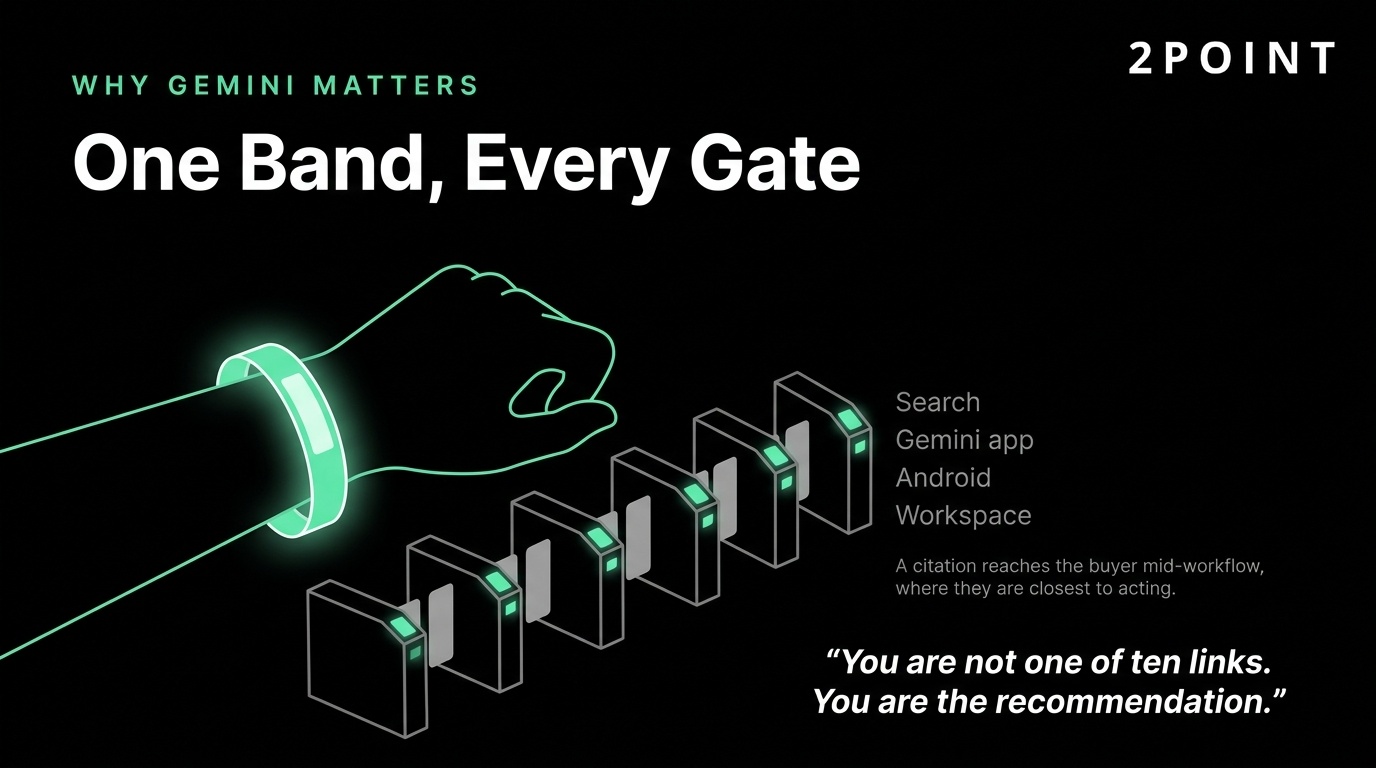
Gemini reaches people across Google Search, the Gemini app, Android, and Workspace tools like Gmail and Docs.
That spread changes the math, because a single citation can compound across products your customers already open every day. This is why Gemini SEO deserves a deliberate strategy rather than an afterthought.
When your brand becomes the answer Gemini gives, you are not one of ten links competing for a click. You are the recommendation, delivered at the exact moment someone decides.
How Gemini Finds and Cites Sources
Gemini does not invent its recommendations. It grounds answers in Google’s index, resolves the entities involved, and leans toward content that shows expertise and freshness. Those four mechanics are where you can actually intervene, so the rest of this section walks through each one and the move it hands you.
It Grounds Answers in Google’s Core Index
Start with the foundation. Gemini uses retrieval-augmented generation, pulling real pages from Google’s index to build a grounded answer.
According to Google’s optimization guide for AI features, those features rely on its core Search systems, and a page must be indexed and eligible to appear with a snippet before it can be used. In plain terms, Gemini will not cite a page it cannot crawl, render, or trust.
So classic Google visibility is the prerequisite, not a bonus.
Google-Extended: the Crawler That Controls Access
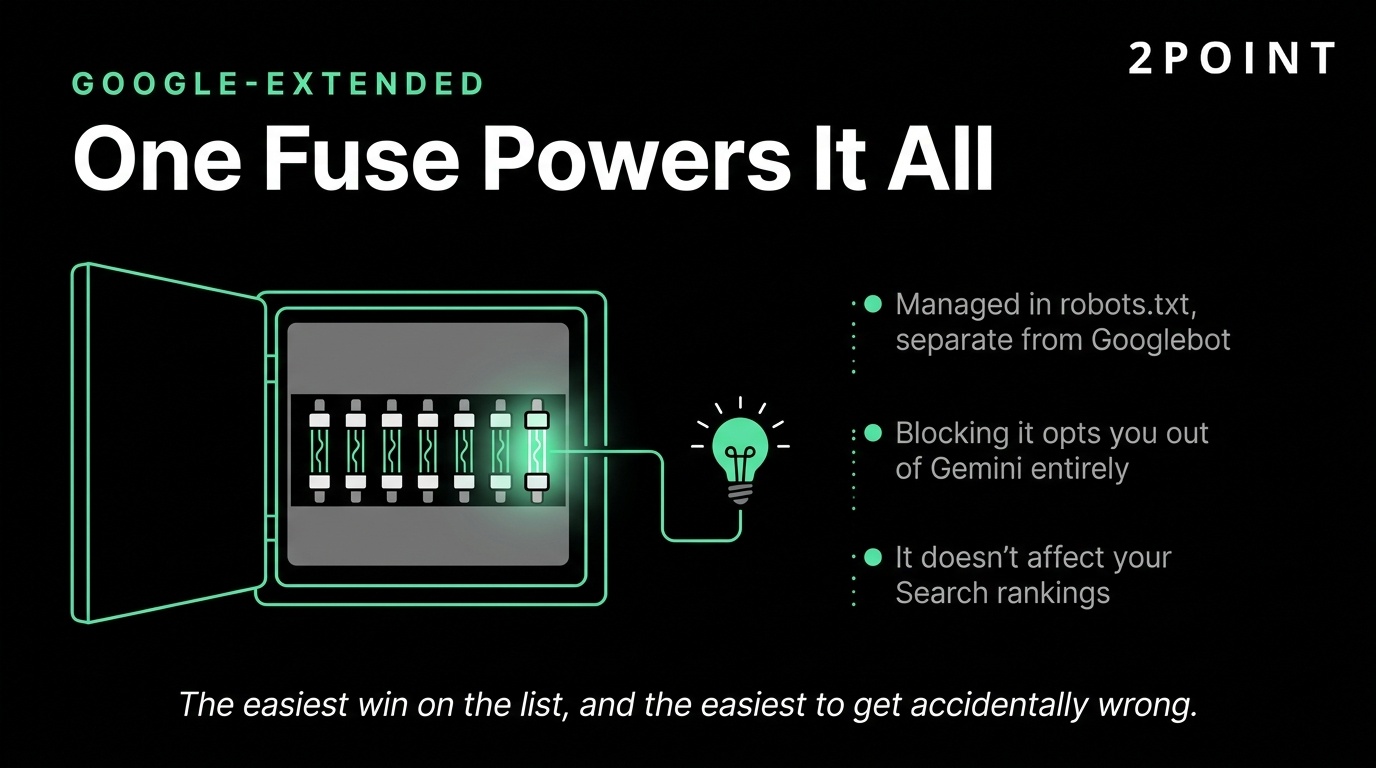
Google uses a separate control token, Google-Extended, to decide whether your content can be used for Gemini grounding and training, independent of Googlebot. You manage it in your robots.txt file.
Google’s common crawlers documentation states that blocking Google-Extended opts your content out of Gemini, though it does not affect your Google Search inclusion or ranking.
So check this one setting before anything else, since a stray disallow here quietly erases you from Gemini.
It Leans on the Knowledge Graph to Resolve Entities
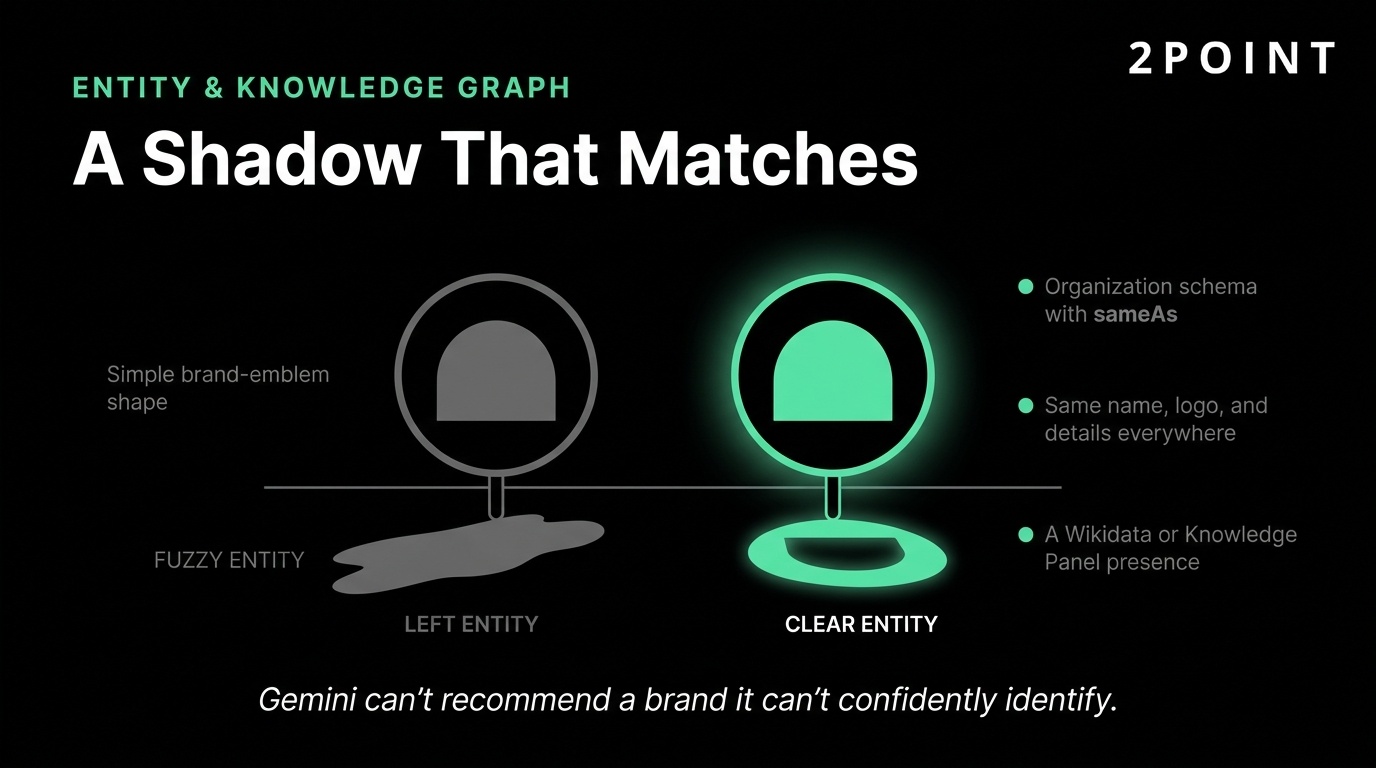
Before Gemini can recommend you, it has to know who you are.
A brand with a clear, consistent entity, the same name, logo, and details everywhere, plus a presence in Google’s Knowledge Graph, is far easier to cite than a fuzzy one the model cannot pin down.
So tighten your entity signals, your Organization schema, your consistent NAP, and your Knowledge Panel, and you become an easy, safe brand for Gemini to name.
It Favors E-E-A-T and Fresh, Verifiable Content
Finally, Gemini leans toward content it can trust, which you signal in concrete ways.
- Visible dates and a genuine last-updated stamp.
- Named authors with real, checkable credentials.
- Links out to primary sources and original data.
Content that demonstrates real experience and stays current is exactly what Google’s systems are built to surface, and that trust flows straight through to Gemini.
How to Optimize for Gemini, Step by Step
Here is the playbook, your Gemini SEO checklist. Each step pairs a one-line reason with a concrete action, so you can work through how to optimize for Gemini in order, without chasing hacks that do not last.
Step 1: Win Classic Google Rankings First
Because Gemini grounds its answers on Google, ranking in the top results is the single biggest lever you have. That is why SEO for Gemini starts with classic SEO, not AI tricks. So fix crawlability, earn authority, and rank the pages you want cited before you touch anything AI-specific.
Step 2: Strengthen Your Entity in the Knowledge Graph
The clearer your entity, the more confidently Gemini can recommend you. Give Google unambiguous, consistent signals about who you are, and two moves do most of the work.
Organization Schema and sameAs.
Add Organization schema with a sameAs array linking your official profiles, so Google resolves your brand to a single, confident entity. It is one of the highest-value moves for entity clarity, since sameAs is exactly how you tie your site to your Wikipedia, Wikidata, and social identities.
Wikipedia, Wikidata, and social identities.
A Wikidata or Wikipedia Presence and Consistent Brand Data. Where it is warranted, a Wikidata or Wikipedia entry reinforces that entity, and consistent name, logo, and details across the web keep the picture clean. Inconsistency is what makes a brand hard for the model to pin down and cite.
Step 3: Structure Content for Extraction
Gemini lifts self-contained answers, so write blocks it can quote without rewriting.
Answer Capsules, Question Headings, Tables, and FAQs.
Lead each section with a short, direct answer, use question-style headings, and format comparisons as tables and steps. The test is simple. If a section can stand alone as the answer to a question, you have structured it correctly.
Step 4: Prove E-E-A-T
Google promotes experience, expertise, authoritativeness, and trust, so Gemini cites brands that show it. Signal yours in concrete ways.
Named Authors, Credentials, and Primary-Source Citations.
- Real, credentialed authors on your content, never anonymous posts.
- Visible bios and author pages that prove the expertise.
- Citations to primary sources behind every meaningful claim.
Together these separate a citable page from a generic one.
Step 5: Add Schema Markup
Clean HTML plus structured data helps Google understand and reuse your content.
Mark up your pages with the Schema.org vocabulary, using Article, FAQ, Product, and Organization types, so engines parse and cite your details accurately rather than guessing.
Step 6: Keep Content Fresh
Freshness is baked into how Gemini retrieves, since grounding is built to pull current information. So stale pages quietly lose ground to updated ones.
Update Core Content on a Schedule.
Refresh your important pages on a regular cadence, updating stats, dates, and examples as they change. Well-maintained content tends to win over pages that have not moved in years, and the update signals you are still the current answer.
Step 7: Earn Brand Mentions Across the Web
Links, mentions, and citations across credible sources reinforce your presence, and your odds of being cited climb with them. In-depth, well-sourced content that goes beyond common knowledge earns far more of these than thin, commodity pages, so depth is the real link-building strategy here.
Step 8: Allow Google-Extended
Finally, confirm your robots.txt does not block Google-Extended, since that one line decides whether you are eligible for Gemini at all. It is the easiest win on this list, and the easiest thing to get accidentally wrong, so check it before you celebrate any of the work above.
Gemini Versus the Other AI Engines (Where It Fits)
Gemini is one of several AI answer engines, and knowing how it differs tells you where to spend first. The short version is this. Gemini leans hardest on Google’s index and Knowledge Graph, so your classic Google strength matters more here than anywhere else.
Gemini Versus Google AI Overviews
Gemini and AI Overviews share Google’s grounding but surface in different places, one in the assistant, one on the results page.
Google’s documentation on AI features confirms both may use the same query fan-out technique, issuing several related searches to build a response. That shared machinery is why optimizing for one tends to lift the other, so you rarely work them separately.
Gemini Versus ChatGPT and Perplexity
The retrieval sources are where these engines split.
- Gemini binds tightest to Google’s index and entity graph.
- ChatGPT runs its own pipeline and leans on Bing for live results.
- Perplexity retrieves in near real time across a broad web index.
Different plumbing, but the same page usually wins across all three, since extractability, freshness, and authority travel well. For the citation-first contrast, Perplexity rewards those signals in a similar spirit.
How to Measure Gemini Visibility
You measure Gemini by whether you are cited or recommended, not by rankings alone.
There is no console for it yet, so progress shows up through a mix of manual checks and referral tracking, and you want both running together.
Run Manual Prompt Checks in the Gemini App
Pick your priority questions and run them in the Gemini app on a set schedule, logging whether you are cited, recommended, or absent, and which competitors get named instead.
This manual baseline is the most reliable signal available today, largely because Search Console does not report the Gemini app at all. Keep the log in one sheet so the month-over-month trend, not any single check, is what guides you.
Track Referrals and Use AI-Visibility Tools
Then watch for gemini.google.com referrals in GA4 under session source, and build them a custom channel so those visits never disappear into generic referral traffic.
Volume is still small for most brands, so treat the trend as the signal rather than the raw number.
To track citations at scale across engines, pair it with a prompt monitor, and the trackers worth shortlisting run from lean monitors to enterprise platforms.
Common Mistakes That Keep You Out of Gemini
A handful of avoidable errors keep brands out of Gemini’s answers, and most cost nothing to fix once you spot them. Check these before you invest anywhere else.
- Blocking Google-Extended in robots.txt, which Google’s common crawlers documentation confirms opts you out of Gemini grounding entirely, the single most damaging line on this list.
- Weak or missing entity signals, which leave Google unable to confidently identify your brand and therefore reluctant to recommend it.
- Thin, commodity content that adds nothing beyond common knowledge, giving the model no reason to cite you over the page it already trusts.
- No schema, which leaves your pages harder to parse and reuse, so your details get guessed at rather than lifted cleanly.
- Stale pages untouched for years, quietly losing ground to fresher sources every time Gemini retrieves.
Will Google’s AI Name You When It Matters?
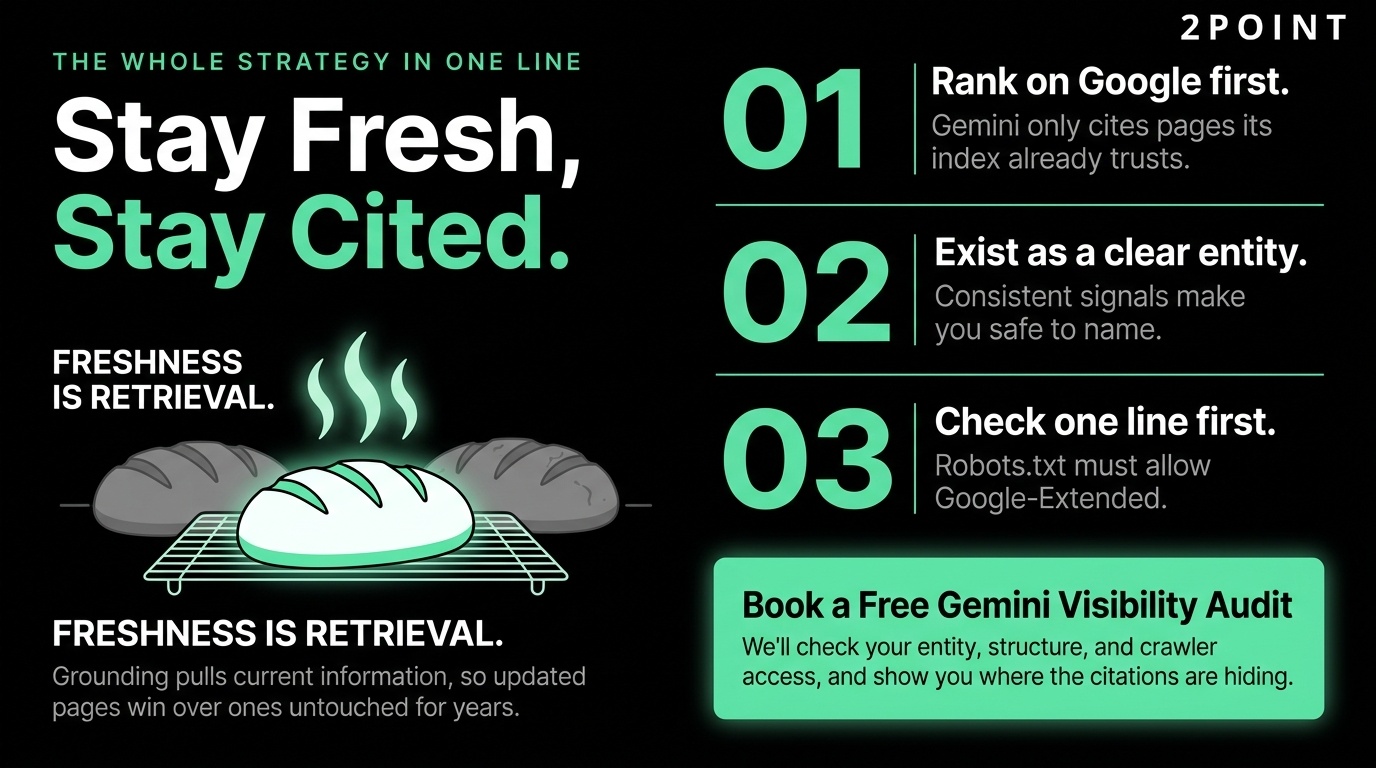
The formula is not complicated. Rank in Google, exist as a clear entity, keep your content fresh and well-structured, and Gemini will cite you. Because Gemini reaches across Search, its app, Android, and Workspace, that citation compounds into visibility few channels can match.
So confirm Google-Extended is allowed, tighten your entity signals, and lead pages with answers worth quoting. Gemini SEO is one layer of the wider work across every AI engine, which our multi-channel marketing team runs end to end.
FAQs
What is Gemini SEO?
Gemini SEO is the practice of optimizing your content, entity, and authority so Google Gemini cites or recommends your brand. Because Gemini grounds its answers in Google’s index, strong classic SEO is the foundation.
The goal shifts from winning a ranking to earning a citation inside the answer itself.
Is Gemini SEO different from Google AI Overviews?
They are related but surface differently. Gemini is the standalone chat assistant, while AI Overviews appear on the search results page.
Both are grounded in Google’s index and share techniques like query fan-out, so the work overlaps almost entirely. Build citable, well-structured content, and you qualify for both at once.
Does Gemini use Google’s search rankings?
Yes, more directly than most AI engines. Gemini grounds answers in Google’s index, and a page generally must be indexed and eligible to show with a snippet before it can be cited. So your Google visibility is the prerequisite, which is exactly why SEO for Gemini starts with classic fundamentals.
What is Google-Extended and should I allow it?
Google-Extended is a crawler token that controls whether your content feeds Gemini’s grounding and training, managed in robots.txt independently of Googlebot.
Block it and you opt out of Gemini entirely. For most brands wanting visibility, allowing it is the right call, so check your robots.txt, since blocking it accidentally is common.
How do I get my brand cited by Gemini?
Rank well on Google first, since Gemini grounds there, then make your brand easy to identify and quote. Strengthen your entity, structure answer-first blocks, prove expertise, keep pages fresh, and confirm robots.txt allows Google-Extended.
Getting cited by Gemini rewards the clearest, most trusted, most current answer available.