let’s connect


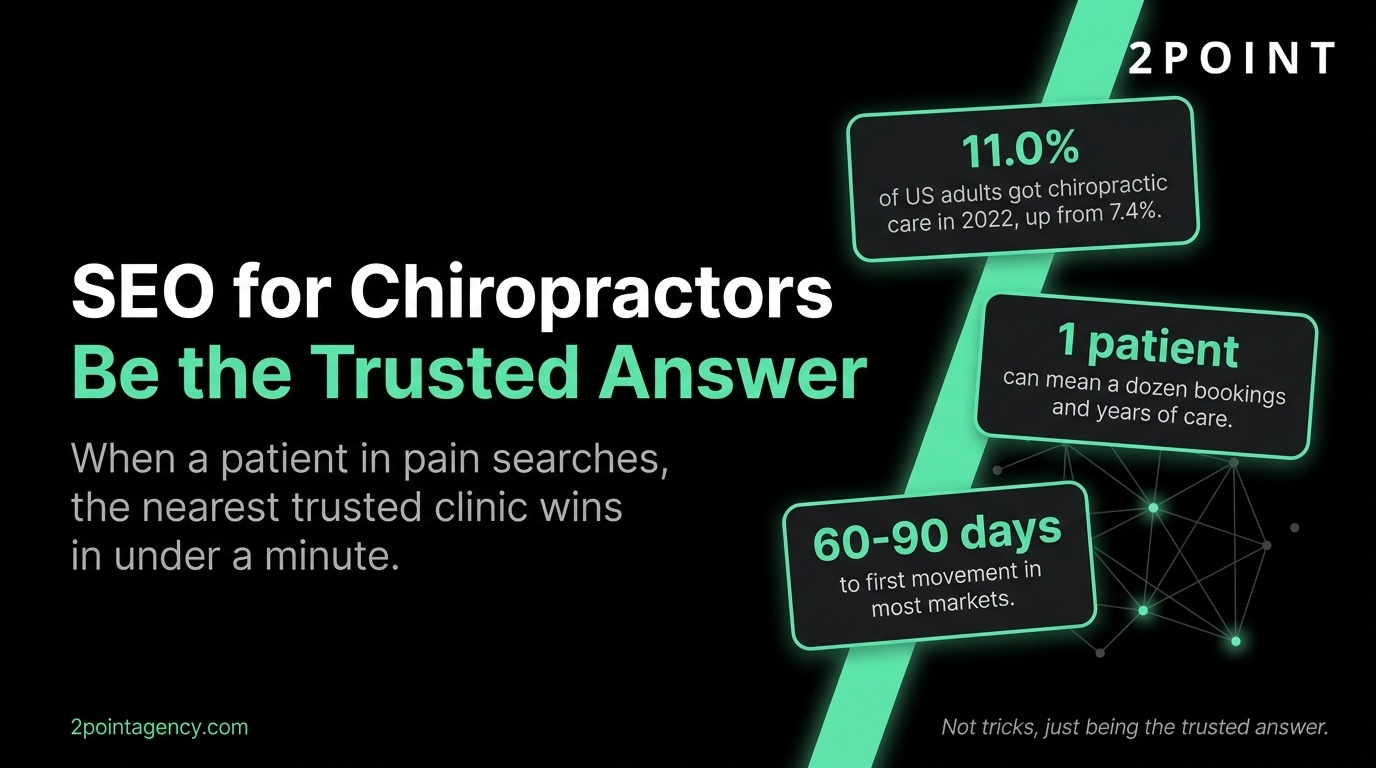
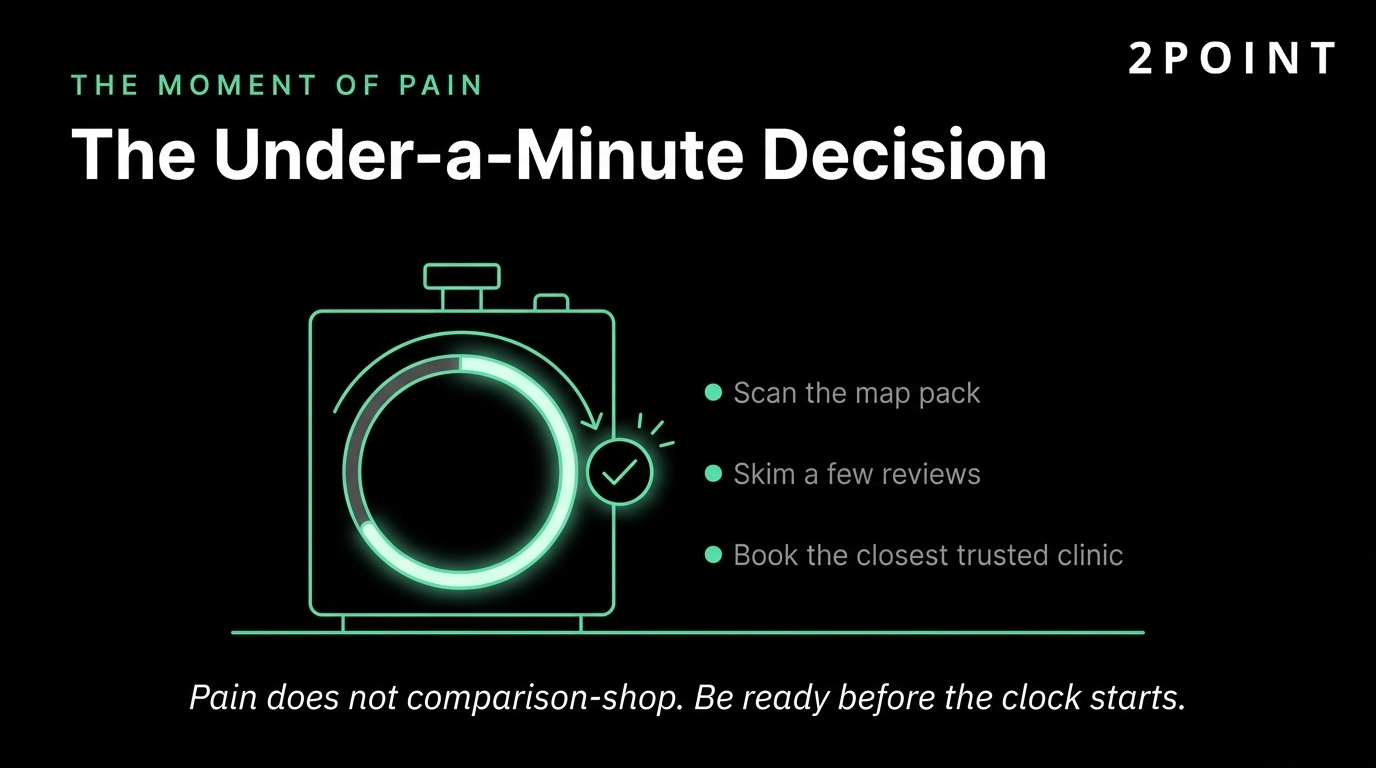
A new patient wakes with lower-back pain, reaches for their phone, and types “chiropractor near me.” They scan the map pack, skim a few reviews, and book the clinic that looks close, trusted, and open. The whole decision takes under a minute.
Pain does not comparison-shop, and that is the real stakes. The nearest trusted result wins the patient, and in chiropractic, that first visit often becomes a course of care. Winning that minute is what SEO for chiropractors delivers.
At 2POINT, our SEO services for chiropractors get clinics found by patients already searching. If you run a practice, this is for you.
What Is Chiropractic SEO?
Chiropractic SEO is the practice of optimizing a clinic’s Google Business Profile, website, and reviews so it appears in local map results, organic listings, and AI answers when nearby patients search for a chiropractor or a specific condition.
It has two halves that work together. Local SEO wins the map pack, while on-site SEO builds the content and service pages that rank and earn trust. Good SEO for chiropractors connects both.
Why SEO Matters for a Chiropractic Practice
Chiropractic demand is real and growing.
According to the National Center for Complementary and Integrative Health, 11.0% of US adults received chiropractic care in 2022, up from 7.4% in 2002, based on national survey data. That is a market-wide expansion over two decades.
Nearly all those patients start their search online, which creates a simple split. The clinics that show up and look trustworthy capture the rising demand, while the rest stay invisible to it.
Patients’ Search at the Moment of Pain
Condition searches like “sciatica relief” or “back pain chiropractor” are the highest-intent queries you can win, because the patient wants relief now, not next month.
They are not browsing, they are ready to book. That urgency is exactly why chiropractor SEO aimed at those moments converts so well, and why your condition pages deserve priority over generic ones. Build those first.
Steady New Patients Without Paying Per Click
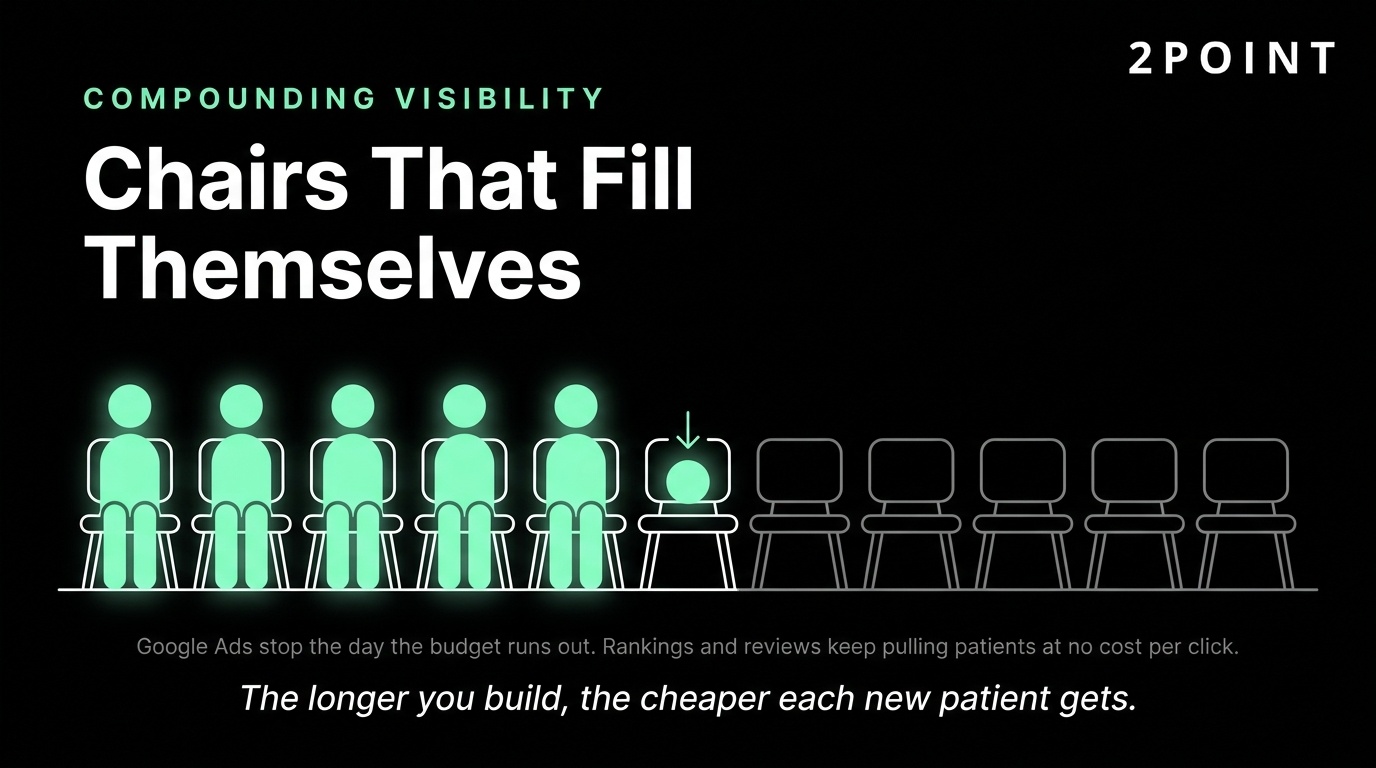
Google Ads stop delivering the day the budget runs out, and the leads stop with them. Rankings and reviews work differently.
They keep pulling in patients month after month at no cost per click, which is how local SEO for chiropractors compounds into a steady stream of new patients rather than a bill you keep feeding. The longer you build, the cheaper each patient gets.
Reviews Build Trust Before the First Visit
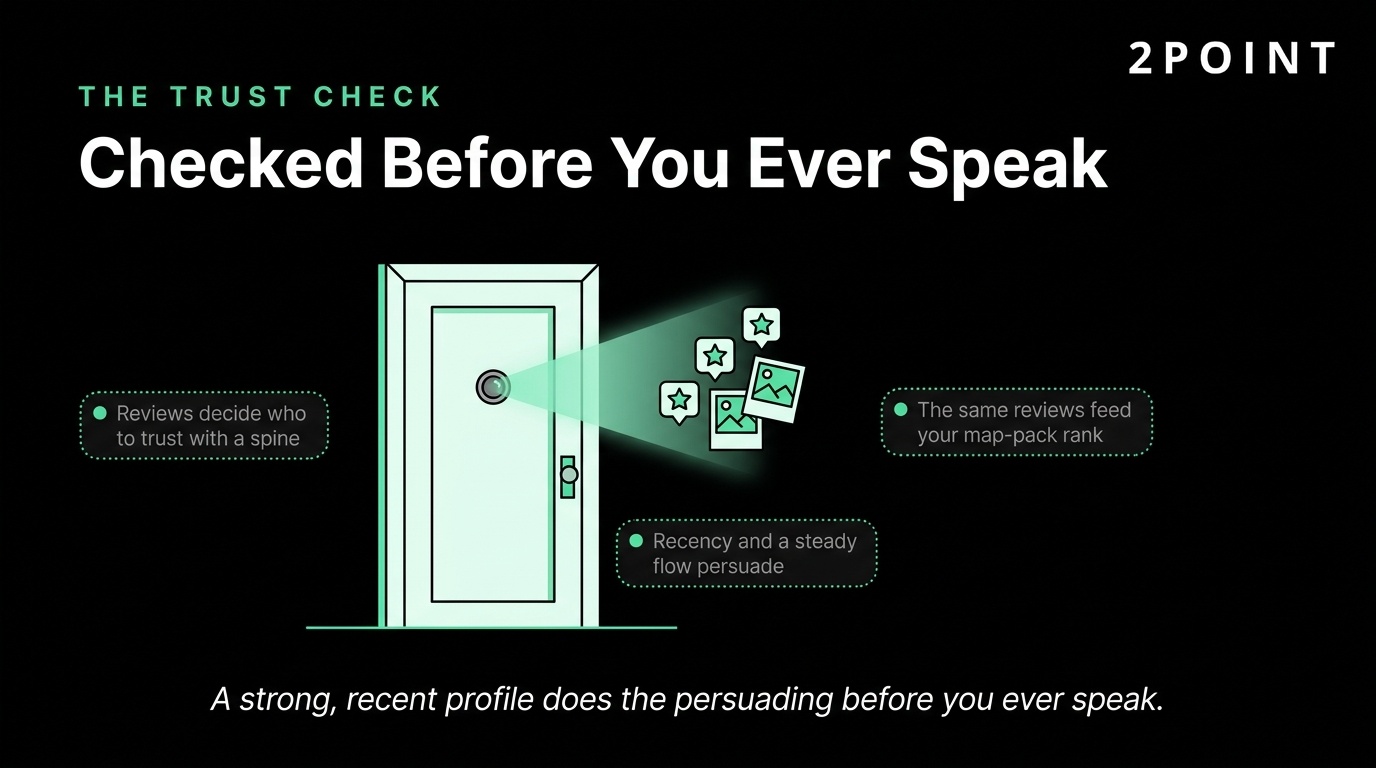
Before anyone calls, the trust check happens.
Patients read reviews to decide who to trust with their spine, and a strong, recent profile does much of the persuading before you ever speak to them. Better still, reviews pull double duty.
- They convince a nervous patient that others have found relief with you.
- They feed the map-pack ranking that made you visible in the first place.
The Recurring-Care Model Rewards Long-Term Visibility
Finally, the economics reward you twice. Chiropractic care is usually a course of visits rather than a single appointment, so one new patient can mean a dozen bookings and sometimes years of care.
That multiplies the value of every ranking win, because the lifetime value of each new-patient call is high. Few local businesses get that much return on a single search.
The Three Places Patients Find a Chiropractor (and How Each Ranks)
Patients discover clinics in three distinct places, and each one weighs different signals.
That split matters more than most owners realize, because effort aimed at the wrong surface simply does not move the one where your patients actually look. Learn which is which, and you know where your next hour of marketing work should go first.
The Google Maps Local Pack
Start with the map pack, the three-clinic block at the top of local results, and the highest-value real estate in search. Three signals drive it.
- Your Google Business Profile is complete and active.
- Proximity, meaning how close you sit to the searcher.
- Reviews, their rating, recency, and steady flow.
You control two of the three, which is exactly why the game plan starts here. Win this block and the phone rings.
Local Organic Results
Below the map sit the classic blue links, and a different engine decides them.
Here, your website does the work. Condition and service pages, technical health, and the authority you have earned determine whether you rank for research-stage searches like sciatica treatment options.
This surface converts slower than the map pack, but it catches patients earlier and feeds them forward.
AI Answers (ChatGPT, Gemini, Perplexity)
Increasingly, a third surface matters. More patients now ask ChatGPT, Gemini, or Perplexity for a recommendation and act on the shortlist they receive. The engines behave differently, too.
Perplexity tends to surface individual practitioners, while ChatGPT often leans toward business entities. So build clear identity signals at both levels, the clinic and the doctor, and you stay citable whichever engine your next patient happens to ask.
The Chiropractic SEO Game Plan, Step by Step
This is the core of the work. Each step below leads with why it matters and the first action to take, so you can start today without an SEO background. Work them in order, because the early steps deliver the fastest wins, and every later step builds on the foundation they lay.
Step 1: Optimize Your Google Business Profile
Your profile powers the map pack, which makes it the highest-return fix for most clinics. According to Google’s own Business Profile guidelines, complete and accurate profiles are what its systems match to local searches. Claim it, complete every field, and treat it as a living page rather than a one-time setup.
Categories, Services, Photos, and Posts
Set Chiropractor as your primary category, then add each service as its own item so Google can match you to specific searches. Upload real photos of your clinic and team rather than stock, and keep the profile active with occasional posts. Freshness signals a working practice, and patients notice it too.
Reviews
Reviews rank among the strongest local-pack signals, and three things drive their weight. Recency, the conditions patients mention, and your owner’s responses. So ask every satisfied patient, reply to each review by name, and keep the flow steady rather than one big push followed by silence.
Step 2: Fix the Technical Foundations
Next, the plumbing. Technical basics decide whether Google can rank you at all, and you do not need to be a developer to get them right. Two areas cover most of what goes wrong for clinic sites, and both are checkable in an afternoon.
Mobile Speed and Core Web Vitals
Most patients search on a phone, often in pain and in a hurry, so a slow, clunky mobile site costs you bookings directly. Compress your images, remove any unnecessary assets, and test on a real device. Speed feeds rankings and conversions simultaneously.
Crawlability and Schema (Chiropractic, LocalBusiness, FAQ)
Then make sure Google can reach and read you. Check that your pages crawl and index cleanly, and add structured data from the Schema.org vocabulary. Chiropractic or LocalBusiness markup for who you are, plus FAQ for what you answer, helps engines show your details as rich results.
Step 3: Target Long-Tail, Condition-Plus-Location Keywords
With the foundation set, aim your content. Specific terms convert better and rank easier than broad ones, so build your plan around the conditions you treat crossed with the areas you serve. That grid becomes your page list, and it keeps every hour of content work pointed at searches that book appointments.
Examples
Terms like “neck pain chiropractor in [city],” “sciatica,” “sports injury,” and “prenatal chiropractor” carry lower competition and higher conversion than the broad “chiropractor” head term. Each one can anchor its own page, and each reaches a patient who already knows what they need.
Step 4: Build Condition and Service Pages
Now give every major thing you treat a home. One page cannot rank for everything, and a patient searching for sciatica relief wants a page about sciatica, not a menu that mentions it once.
One Page Per Condition or Service
Give back pain, sciatica, prenatal care, and sports injury each a dedicated page with genuinely useful details on symptoms, treatment, and what to expect. Focused pages rank better and read better, because both Google and the patient can tell exactly what each one is about.
Location Pages for Multi-Clinic Practices
If you run more than one location, build a real page for each, with its own staff, hours, directions, and local details. Thin duplicates with the city name swapped in read as doorway pages, and Google discounts them, so write each one as if a local patient will judge it.
Step 5: Prove E-E-A-T (Chiropractic Is YMYL)
Chiropractic is health content, so Google holds it to the higher Your Money or Your Life bar. Four signals carry most of the weight.
- Named doctor-of-chiropractic authors on your clinical content.
- Visible credentials and licensing, easy to find.
- Accurate claims backed by credible sources.
- An About the Team page with real people and real photos.
Together, they show the experience and trust that people-first content standards reward.
Step 6: Earn Reviews the Compliant Way
Ask every satisfied patient for a review, and make it one tap easy with a saved link or QR code. Never buy or incentivize them, though. Your state board and the FTC both govern testimonials, and a fake or paid review risks both a Google suspension and a compliance issue. The steady, honest ask wins on both fronts.
Step 7: Build Local Citations and Links
Keep your name, address, and phone number identical across health and local directories, then claim the key ones for your area.
Mismatched listings quietly drag rankings down, which is why consistent citations across directories deserve a quarterly audit. From there, community links, a sponsored team, a local health fair, a practitioner association, and the local authority no directory can.
Step 8: Optimize for AI Search
Finally, make yourself citable. Lead your pages and FAQs with clear, answer-first blocks and keep the structure clean, so ChatGPT, Gemini, and AI Overviews can lift and credit you.
That is the job of answer engine optimization, and the good news for a clinic is that it overlaps almost entirely with the local SEO you just built.
What Makes Chiropractic SEO Different
Chiropractic SEO follows rules that generic local SEO does not, mostly because it involves health content and regulated advertising.
That combination raises the bar twice. Google judges your pages harder, and your profession polices your marketing. Handle both well, and you protect the practice while you grow it.
YMYL and Health-Claim Caution
Start with the health-claim bar. Avoid unsupported medical claims and frame outcomes carefully, tying anything you say about what care can do to a credible source.
According to Google’s people-first content guidance, demonstrating real expertise and trust matters most on topics that affect health, which is exactly where your pages live. Overpromising is a double risk, since it can cost you rankings and invite a compliance problem in the same stroke.
Review and Testimonial Rules
Testimonials and results claims are regulated, and the profession’s own standard is explicit.
The American Chiropractic Association’s Code of Ethics states that advertising, including social media, must be truthful and accurate, and must never be misleading, deceptive, or fraudulent.
The same code warns against creating false or unjustified expectations of treatment results.
Layer your state chiropractic board and FTC testimonial rules on top, and the safe path is simple. Real reviews, honestly asked for, never bought.
Insurance and Cash-Practice Keywords
Finally, do not overlook the practical searches.
Terms like “chiropractor that takes [plan]” and cash-plan phrases capture patients who have already decided to book and only need the payment question answered.
Build pages that answer those questions directly, with plans accepted, cash pricing, and packages laid out plainly. Few clinics do, which makes these some of the easiest high-intent wins on the board.
Your First 90 Days: a Phased Plan
You do not need to do everything at once. This phased plan front-loads the free, high-impact work, then builds toward the authority that takes longer to earn. Ninety days is enough to change what a patient sees when they search, without overwhelming a busy front desk.
Days 1 to 30: Foundation
Start with the moves that pay off fastest.
- Claim and complete your Google Business Profile, every field.
- Fix your name, address, and phone everywhere they appear.
- Set up a simple review-request routine at checkout.
This is the fastest path to map-pack visibility, and it costs nothing but attention.
Days 31 to 60: Content
With the foundation set, turn to what ranks.
- Build your top condition and service pages first.
- Add Chiropractic, LocalBusiness, and FAQ schema that matches the visible text.
- Clean up mobile speed, since patients search in pain and in a hurry.
This is where organic rankings start to take shape, usually just as your review flow becomes visible.
Days 61 to 90: Authority
Finally, build the trust that protects everything above.
- Earn a few genuine local links, a sponsorship or a community health event.
- Add FAQ blocks to your key pages so AI engines can lift them.
- Read your data, then double down on the pages and terms already gaining traction.
Momentum compounds from here, so keep the routine going past day ninety.
How Long Does Chiropractic SEO Take, and What Does It Cost?
Set honest expectations before you start, because chiropractic SEO is a build rather than a quick switch. Neither the timeline nor the budget is fixed, but both follow patterns you can plan around, and knowing them keeps you from quitting right before the results arrive.
Timeline
Expect the first movement in roughly 60 to 90 days in less competitive markets, and 6 to 12 months in crowded metros. The order of results is the predictable part.
Profile and review work can lift map-pack visibility within weeks, while new condition pages take months to rank, which is exactly why the game plan starts with the profile.
Cost Ranges and What Drives Them
Plan for a monthly retainer rather than a one-time fee, since the work is ongoing.
Treat any flat price you see published with skepticism, because quoted ranges vary wildly and rarely describe the same scope. What actually moves your number is threefold. How competitive your local market is, how many services and locations you run, and how much your site needs fixing.
Judge a quote by what the work includes and the reporting behind it, not the sticker, and expect the math to favor you once a few new patients with recurring care plans arrive.
Red Flags to Avoid
A few practices waste your money, and the worst put your license and listings at risk. Check for these before you sign anything.
- Fake or gated reviews, which break Google, state board, and FTC rules, and leave your profile one audit away from suspension.
- Keyword-stuffed city pages that swap the town name into identical boilerplate, a doorway pattern Google recognizes and discounts.
- Unsupported health claims that promise cures or guaranteed outcomes are both an SEO risk and a compliance problem.
- Ranking guarantees are a myth, since Google itself warns that no one can promise a number-one position.
Any one of these in a sales pitch tells you how the rest of the engagement will go. Keep looking.
When a Patient in Pain Searches, Will They Find You?
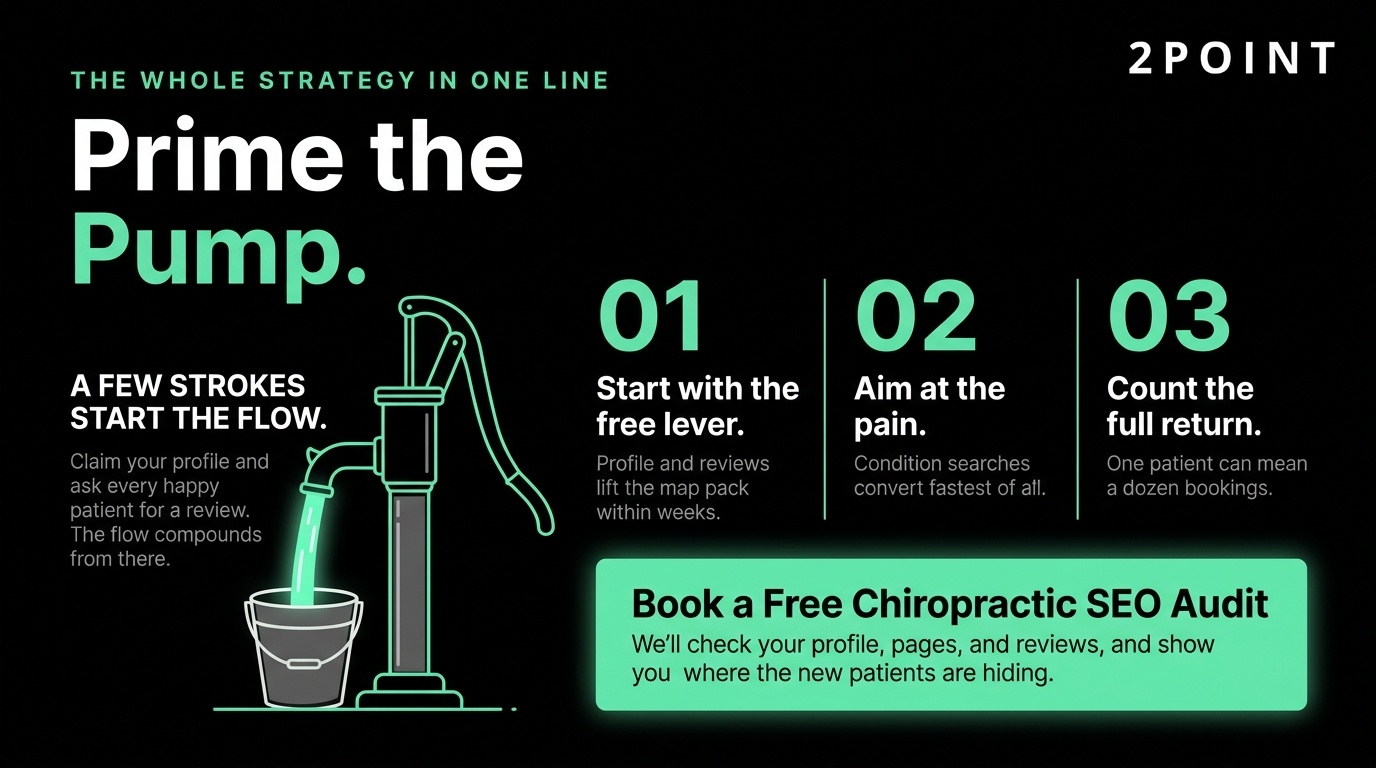
If you do one thing this week, claim and complete your Google Business Profile and start asking every happy patient for a review. That single lever brings in more new patients than anything else, and it costs nothing. Build the game plan on top, and bookings compound.
When you want a hand, our managed SEO plugs into the multi-channel marketing that keeps your schedule full. Strong SEO services for chiropractors are not tricks, just being the trusted answer.
FAQs
How long does it take for chiropractic SEO to bring in new patients?
Most clinics see first movement in 60 to 90 days in less competitive markets and in 6 to 12 months in crowded metros.
Profile and review work moves fastest, often lifting map-pack visibility within weeks, while new condition pages take longer. Treat SEO for chiropractors as an ongoing routine, and results compound quarterly.
Is SEO or Google Ads better for a chiropractic clinic?
They serve different needs, and many clinics run both early on. Google Ads deliver instant bookings but stop the moment you pause spending, while rankings compound at no cost per click.
Build local SEO for chiropractors underneath the ads, then lean less on paid as your map-pack visibility grows.
How many reviews do I need to rank in the map pack?
There is no magic number. Recency, rating, and a steady flow matter more than any total, though competitive metros can take a hundred or more to lead the map pack. Reviews are among the strongest chiropractor SEO signals, so ask every satisfied patient for a review at checkout and never buy or incentivize them.
What keywords should a chiropractor target?
Focus on condition-plus-location long-tail terms, since they convert best and rank easier than broad head terms. Think “sciatica chiropractor in [city],” “prenatal chiropractor,” and insurance phrases like “chiropractor that takes [plan].” Give each major condition its own page.
That grid is the backbone of chiropractor SEO services that actually book patients.
How much does chiropractic SEO cost?
Plan for a monthly retainer rather than a one-time fee, since the work is ongoing. Ignore flat prices published online, because your number depends on local competition, your service count, and how much your site needs fixing.
Well-run SEO services for chiropractors typically pay for themselves once a few recurring-care patients book.