


 let’s connect


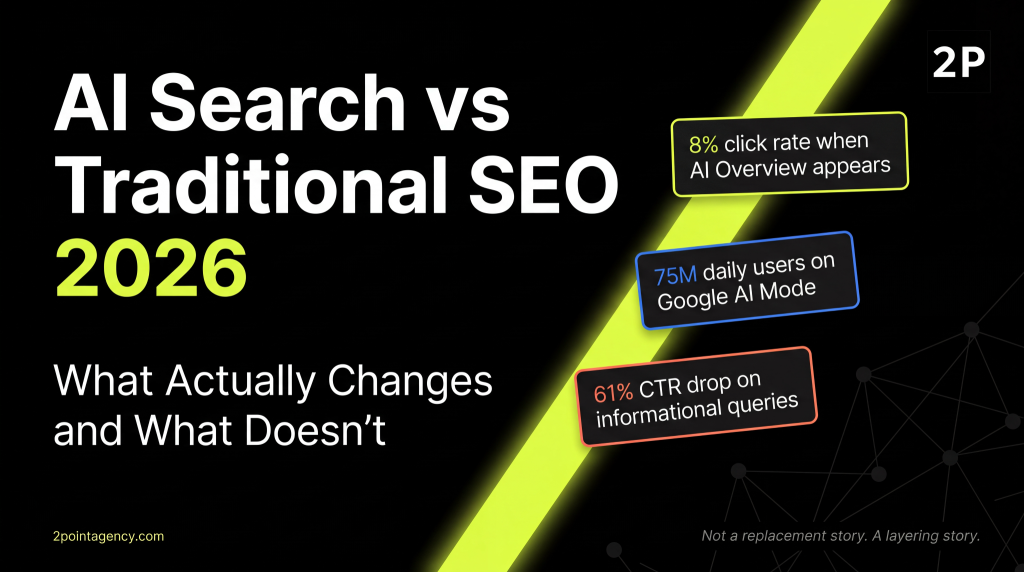
Every LinkedIn post says SEO is dying. Every SEO publication says nothing has changed. Neither is telling you the whole truth.
The honest take on AI search vs traditional SEO is that it is not a replacement story. It is a layering story. The channels you already invested in still work. What has changed is the playbook underneath them, and how AI search optimization now determines who gets cited and who gets skipped entirely.
The brands winning in 2026 understood which parts of SEO got harder, which got easier, and which stayed the same. 2POINT built this guide to show you exactly where each line falls.
Key Takeaways
- AI SEO vs traditional SEO is a layering story, not a replacement one. Your existing foundation still matters, and the new optimization layer sits directly on top of it.
- The future of SEO 2026 is measurable. AI Overviews now appear on a growing share of SERPs and cut organic click-through rates roughly in half when they trigger.
- Five SEO components shifted in specific ways: keyword research, content strategy, technical SEO, link building, and measurement. Each one changed shape without disappearing entirely.
- What's changing in SEO is the surface area and reward structure, not the fundamentals. E-E-A-T, entities, schema, and intent still win across both traditional and AI search surfaces.
- A six-step Monday-morning playbook gets you adapted without blowing up your existing program.
The Three Myths Killing Your 2026 SEO Strategy
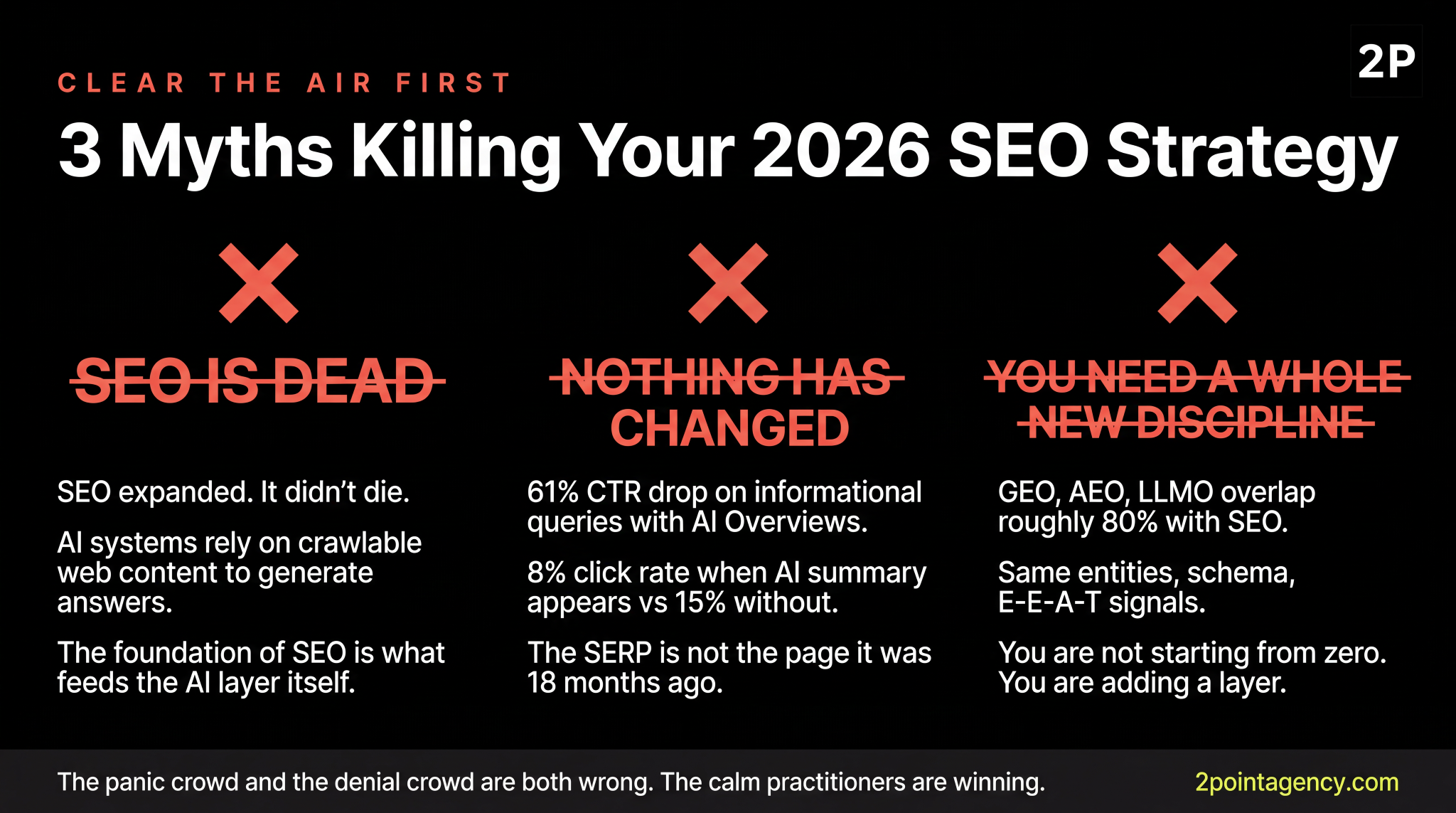
Before we get into what actually shifted, we need to clear the air. Three myths are quietly tanking 2026 SEO budgets, and you will likely hear all three before the end of this quarter.
Myth 1: "SEO Is Dead"
Is SEO dead in 2026? The panic is loud, and the answer is no.
Google still processes billions of queries a day, and organic search still drives the majority of measurable traffic for most mid-market brands.
That said, the data is real and worth knowing. Pew Research Center tracked 900 US adults and found that users clicked a traditional result just 8% of the time when an AI Overview appeared, compared to 15% when it did not. That is a real drop across an enormous denominator.
What actually died: the lazy version of SEO. Thin blog posts, keyword-stuffing pages, and volume-over-quality content strategies are what the algorithm is punishing.
The brands getting hit are the ones that treated content like inventory instead of evidence.
Myth 2: "Nothing Has Really Changed"
The opposite camp is equally dangerous. Veterans SEO who have watched five “Google is dying” cycles assume this is the sixth. It is not.
The data makes that clear. Search Engine Land reported a 61% drop in organic CTR on informational queries where AI Overviews appeared, based on Seer Interactive’s analysis of 25 million impressions across 42 organizations.
That is not noise. That is a structural shift in how your searchers behave.
When leadership tells you nothing has changed, show them the CTR data. The SERP is not the page it was eighteen months ago.
Myth 3: "AI Search Is a Brand New Discipline"
GEO vs SEO has become a cottage industry. Every new acronym, GEO, AEO, and LLMO, promises that the old rules are obsolete and you need a new specialist immediately. You do not.
AI SEO vs. traditional SEO has roughly an 80% overlap. The entities, schema, E-E-A-T signals, and content quality principles that earned your rankings in 2024 are the exact signals large language models use to decide who gets cited today.
What changed is the surface area and the format of the answer. The fundamentals stayed the same. Understanding that distinction is what separates teams that adapt cleanly from those that rebuild from scratch unnecessarily.
What Actually Changes: The 5 SEO Components in 2026
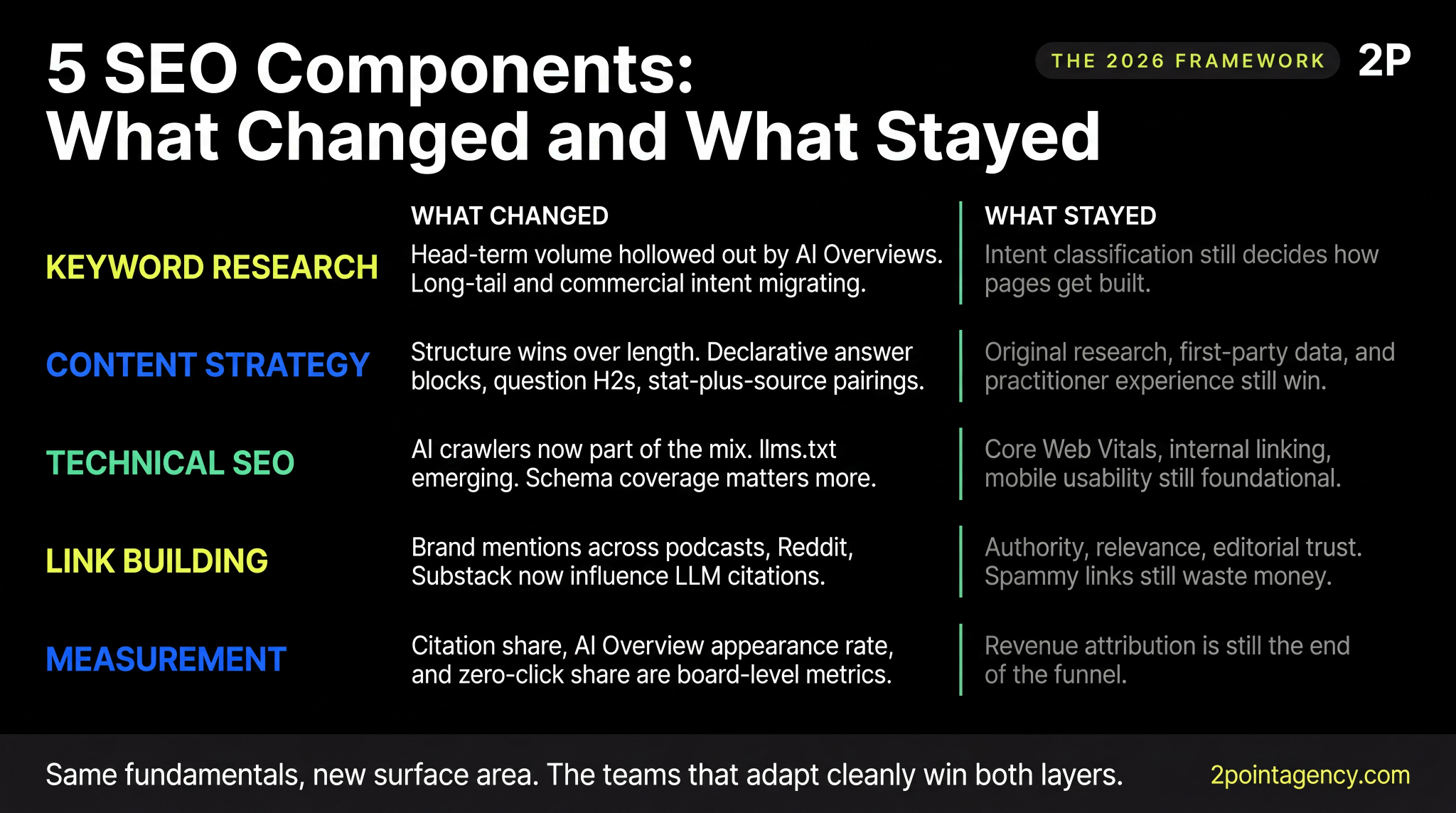
Here is the framework worth knowing. Every SEO program has five components, and how AI search is changing SEO varies across them. The breakdown below covers what changed, what stayed, and what your team does on Monday morning.
Keyword Research
What changes: head-term volume is getting hollowed out. When someone types "what is schema markup," and an AI Overview answers in 80 words, that query stops sending clicks.
Long-tail and commercial-intent keywords still convert, and that is where remaining volume is quietly migrating.
What stays: intent classification stays the same. Informational, navigational, commercial, and transactional buckets still decide how your page should be built.
Do this Monday: Start by auditing your top 50 keywords based on current AI Overview coverage. Any keyword with an AIO above the fold is either one you win the citation on or one you reallocate the effort to.
Ahrefs analyzed 146 million SERPs and found AI Overviews fire most aggressively on informational, seven-plus-word queries. That tells you exactly where to prune and where to double down.
Content Strategy
What changes: length is no longer the flex. What wins now is structure. Declarative answer blocks in the first 100 words, question-based H3S that match real searches, and stat-plus-source pairings are what AI models cite consistently.
What stays: What stays is original research, first-party data, and practitioner experience. E-E-A-T is not a checklist anymore. It is the entire game.
Do this Monday: Start Monday by rewriting the first 100 words of your top three performing pages into a direct, quotable answer to the primary query. That single edit is the highest-leverage change most in-house teams can make this year. Your AI search visibility directly depends on getting this right.
Technical SEO
What changes: Crawlability for AI bots. GPTBot, PerplexityBot, ClaudeBot, and Google's AI Mode crawlers all interpret robots.txt differently. Your llms.txt file is also becoming increasingly important for how generative search vs SEO bots read your site structure.
What stays: Core Web Vitals, internal linking, schema markup, and mobile usability. The fundamentals still win.
Do this Monday: Confirm AI crawlers are not blocked in your robots.txt unless you actively want them blocked. Then audit your schema coverage. Your SEO integration stack needs to feed clean data to Search Console and your AI visibility tracker. If the plumbing is dirty, nothing else matters.
Link Building
What changes: The pool of what counts as a citation expanded. A mention in a podcast transcript, a Reddit thread, a Substack newsletter, or a YouTube caption can now influence what an LLM says about your brand.
Traditional backlinks still drive Google rankings. Brand mentions across the open web now drive AI citations.
What stays: Authority, relevance, and editorial trust. Spammy links are still spammy. Cheap backlinks are still a waste of money.
Do this Monday: Pull every unlinked brand mention from the last 12 months and decide whether each one deserves outreach, a reclaim, or a note in your visibility tracker. Understanding which mention types move the needle for generative citations is where most teams find the fastest wins.
Measurement and Reporting
What changes: The KPI stack. Impressions and clicks in Search Console now tell you less than half the story. Brand mentions in AI answers, share of voice inside AI Overviews, and zero-click share have become board-level metrics.
What stays: Revenue attribution. The end of the funnel is still the end of the funnel.
Do this Monday: Add two new columns to your monthly SEO report: AI Overview appearance rate for your top 100 keywords, and LLM brand mention count. If your current stack cannot pull those numbers, your SEO tracking setup in 2026 needs tools with built-in AI visibility features.
The Real Stakes: What the Data Actually Says
Search Engine Journal confirmed Google's AI Mode reached 75 million daily active users by late 2025, less than a year after launch.
A Semrush analysis of 10 million keywords found AI Overviews appearing in 13-20% of SERPs, with saturation highest for informational queries. Pew Research found users click a traditional result just 8% of the time when an AI summary appears, roughly half the 15% baseline without one.
Those numbers sound brutal. And they are, for brands only optimizing for the old game.
The brands appearing in AI Overviews as citations and quoted sources are capturing a meaningful share of the clicks that still occur. You are not choosing between AI search optimization and traditional SEO. You are choosing between showing up in both places or showing up in neither.
Your Monday-Morning Playbook: 6 Steps to Adapt Without Blowing Up Your Program
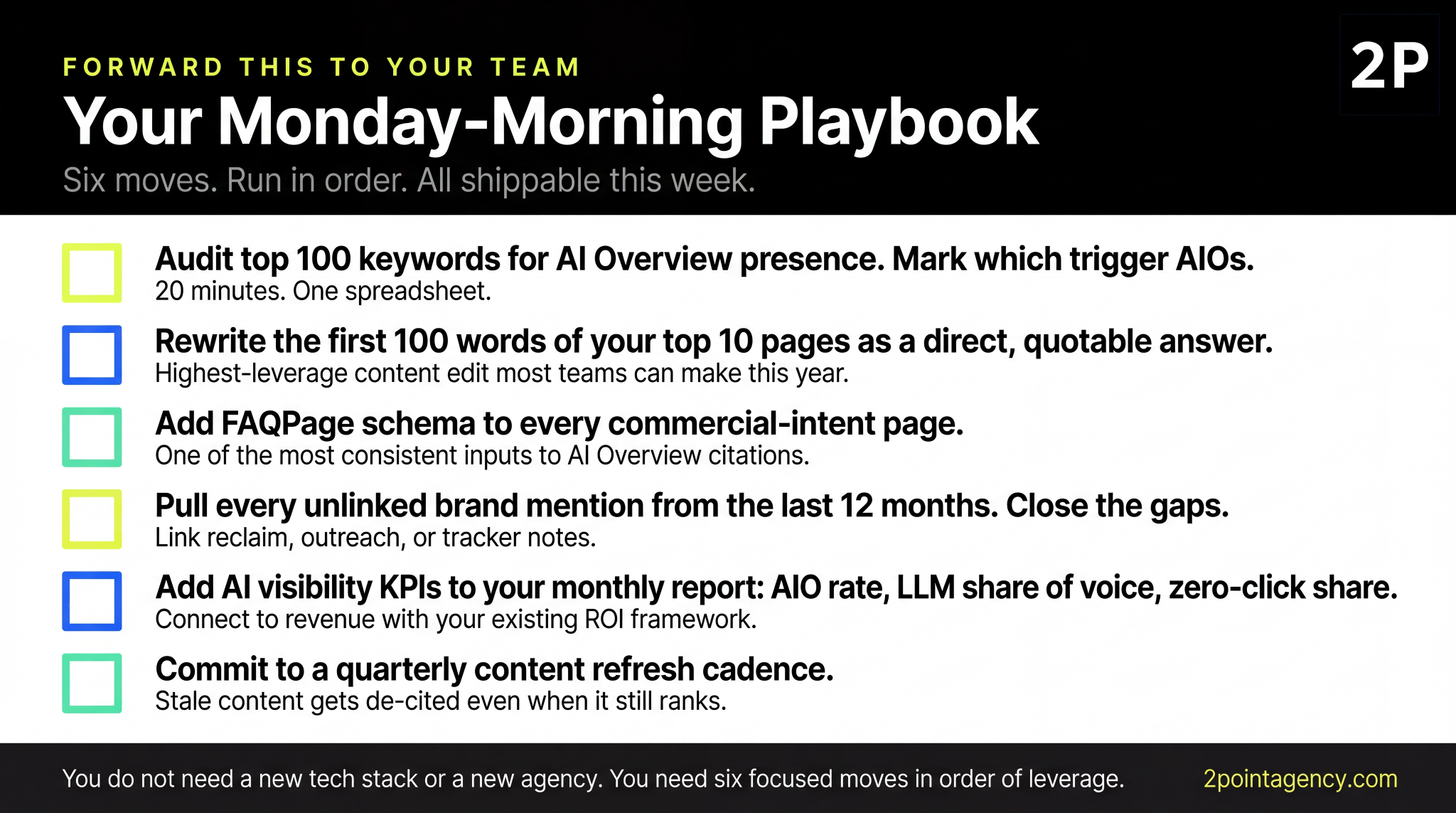
You do not need a new tech stack or a new agency to adapt. You need six focused moves, run in order of leverage:
- Audit your top 100 keywords for AI Overview presence. Mark, which ones trigger AIOs and which do not? That single sheet tells you where to fight and where to pivot.
- Rewrite the first 100 words of your top 10 organic pages as a direct, quotable answer. Declarative, entity-rich, citation-shaped.
- Add the FAQPage schema to every commercial-intent page. It is one of the most consistent inputs to AI Overview citations.
- Pull every brand mention from the last 12 months and close the gaps. Link reclaim, outreach, or tracker notes.
- Add AI visibility KPIs to your monthly board report: AI Overview appearance rate, share of voice in LLM answers, and zero-click share. Your SEO ROI framework gives you the language to connect those metrics to revenue in leadership conversations.
- Commit to a quarterly refresh cadence. Stale content gets de-cited even when it still ranks.
Is Your SEO Program Ready for Both Layers?
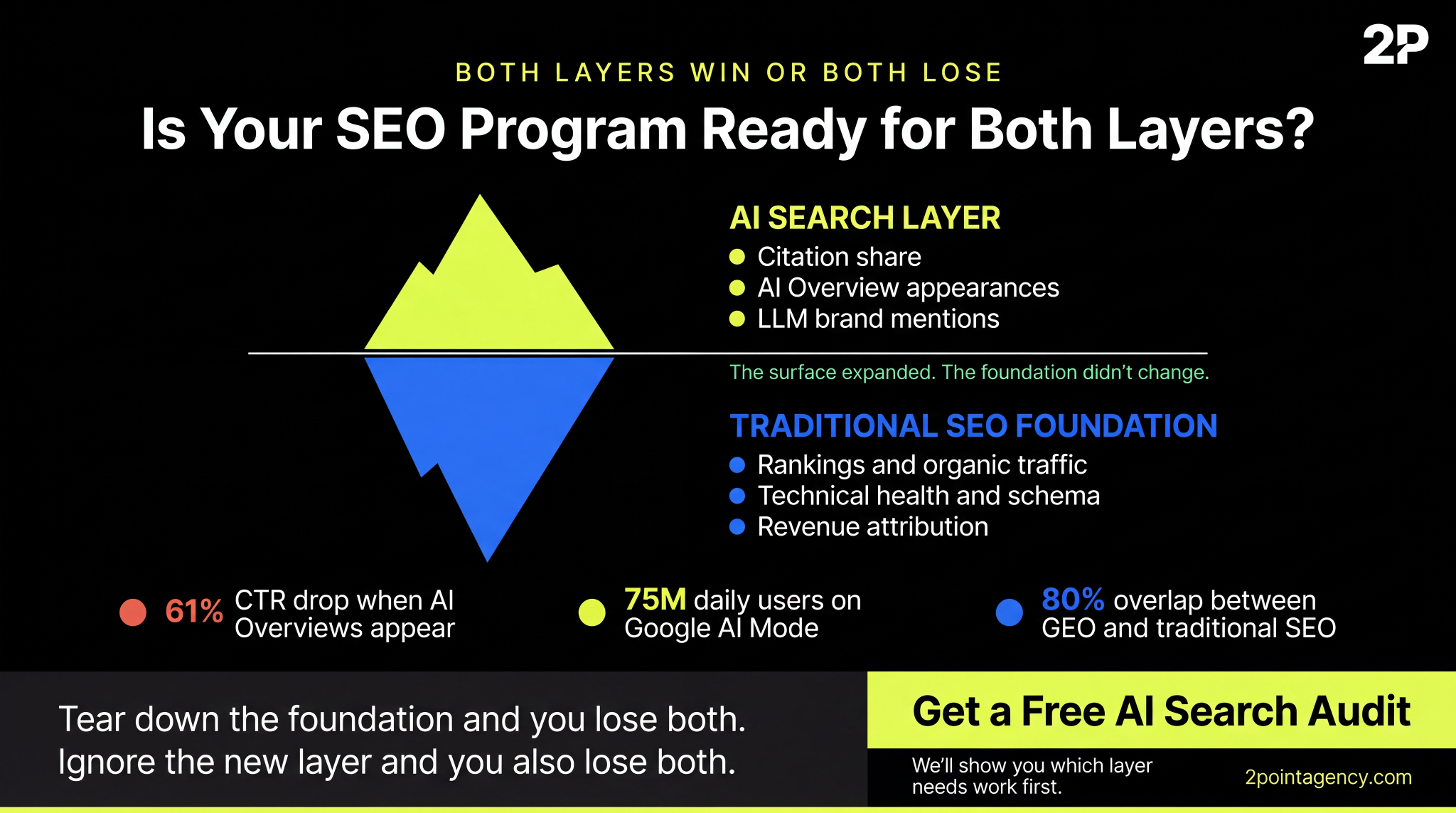
AI search vs traditional SEO is the wrong framing. The right one: traditional SEO built the foundation, and AI search is the new layer sitting on top. Tear down the foundation, and you lose both. Ignore the new layer, and you also lose both.
Get the foundation clean, rewrite your top pages for citation, and add the measurement layer.
2POINT's SEO team helps mid-market brands navigate exactly this transition, and AIOBot handles the AI visibility layer that most programs are still missing.
FAQs About AI Search Vs Traditional SEO
Is SEO dead in 2026?
No. The answer is that it has layered, not died. Google still drives the majority of measurable organic traffic for mid-market brands. AI Overviews and AI Mode now sit above the blue links, but your foundation still matters. What changed is what gets rewarded on top of it.
What is the biggest difference between AI search vs traditional SEO?
AI search vs traditional SEO still runs on the same E-E-A-T, entity, and schema signals. The difference is surface area. AI answers compress results into a summary. You win by being cited inside the summary and ranked underneath, not by choosing one over the other.
Do I need a separate GEO team for AI search optimization?
No. GEO vs SEO has a roughly 80% overlap. A good SEO team that understands entity optimization, schema, and declarative content can run AI search optimization without hiring new specialists. Same fundamentals, new surface area. Most mid-market brands do not need a separate team.
How is AI search changing SEO keyword research?
How AI search is changing SEO keyword research is straightforward: head-term informational volume is being absorbed into AI Overviews, and clicks are shrinking. Long-tail, commercial, and transactional keywords still convert. Audit your top 50 keywords against current AIO coverage to decide where to fight and where to pivot.
What is generative search vs SEO in practical terms?
Generative search vs SEO is the difference between being summarized and being ranked. Generative search produces a synthesized answer built from multiple sources. Traditional SEO returns a list of pages. You optimize for both by writing declarative answer blocks early and keeping classic on-page signals strong underneath.
What's changing in SEO measurement for 2026?
What's changing in SEO measurement is the KPI mix. Clicks and impressions now tell half the story. Brand mentions in AI answers, AI Overview appearance rate, and zero-click share have all become board-level metrics alongside the traditional revenue attribution numbers your leadership already tracks.
What does the future of SEO 2026 look like for mid-market brands?
The future of SEO 2026 for mid-market brands is layered visibility. Keep your foundational SEO work, add AI Overview citation optimization on top, and expand your measurement stack. Brands that commit to both quietly take share from competitors who either panicked or ignored the shift entirely.