

 let’s connect


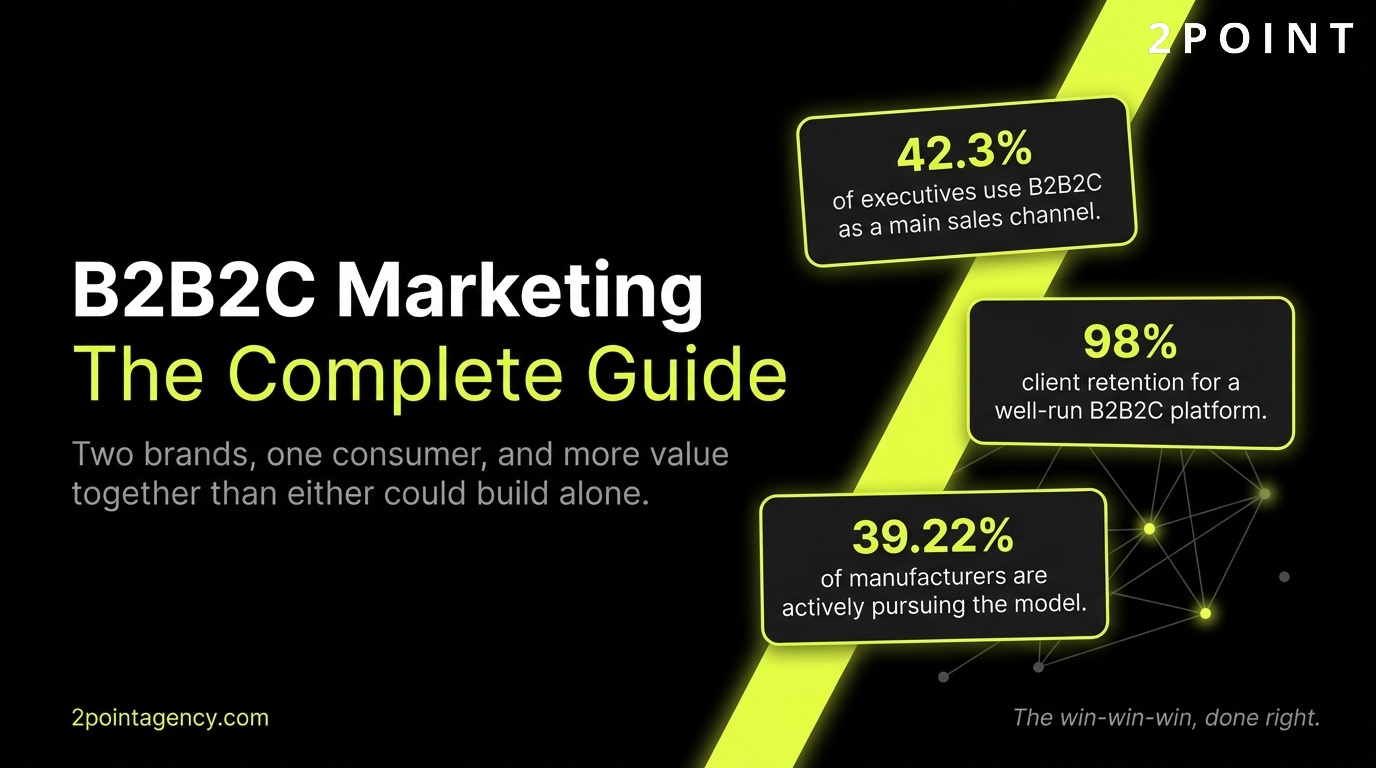
- B2B2C marketing is a hybrid model where one company partners with another business to jointly reach and serve end consumers.
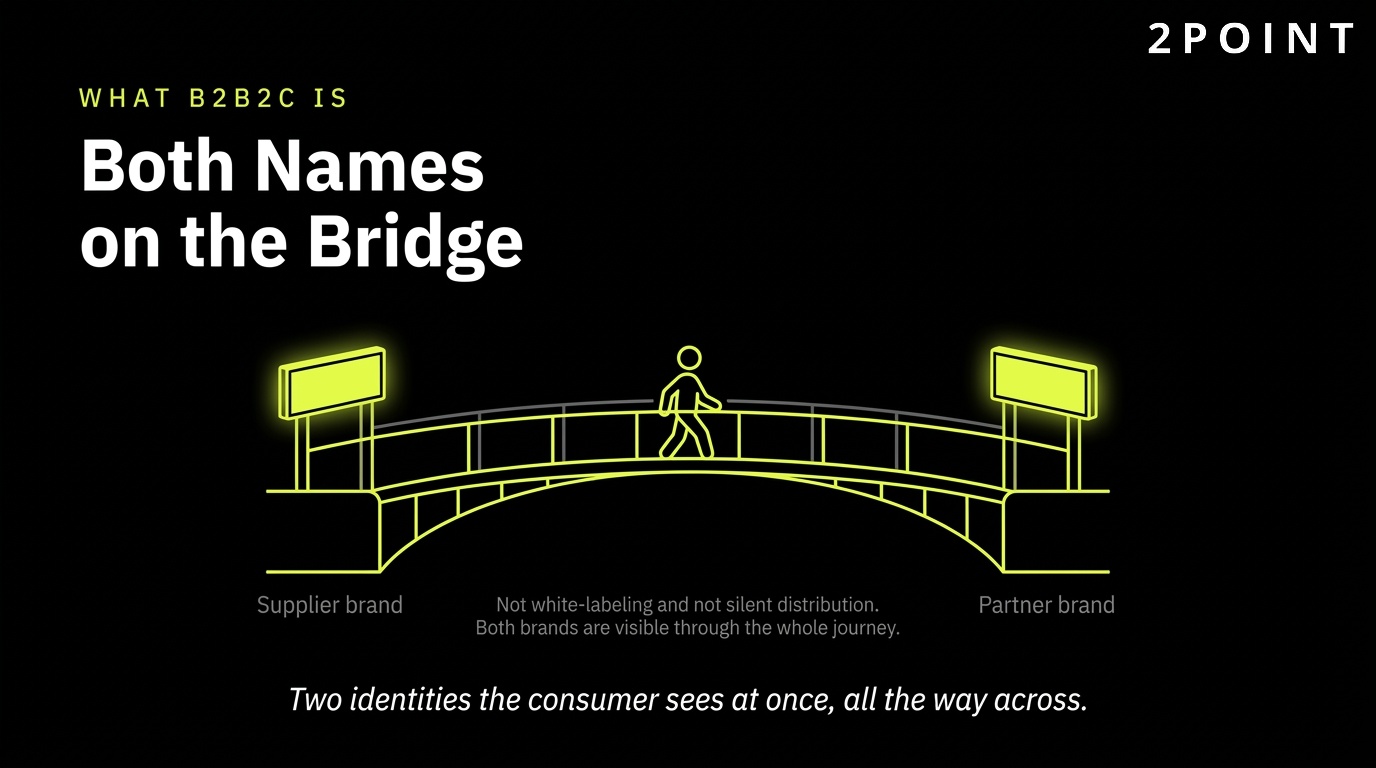
- Both brands remain visible throughout the customer journey, separating this model from white-labeling or silent distribution.
- The model combines the market reach of B2B relationships with the consumer engagement depth of B2C marketing.
- Companies benefit from shared infrastructure, reduced customer acquisition costs, and access to established customer bases.
- Common B2B2C examples include Amazon Marketplace, Instacart, Apple App Store, Affirm, and employer-sponsored health platforms like Maven Clinic.
- Success depends on selecting the right partners, aligning brand standards, and actively managing both business and consumer relationships.
- According to Adobe, B2B2C is distinct because the originating supplier retains brand identity through the intermediary partner all the way to the consumer.
The business-to-business-to-consumer model is reshaping how companies grow, compete, and serve customers in an increasingly connected economy. Whether you are a manufacturer looking to scale distribution, a technology platform seeking to embed your services inside a larger product, or a startup trying to access millions of consumers without building direct infrastructure from scratch, the B2B2C marketing approach offers a compelling path forward. This guide covers everything you need to know: how the model works, where it thrives, how it compares to traditional B2B and B2C approaches, and how to build a strategy that delivers real results.
Understanding the B2B2C Business Model and What Makes It Unique
What Makes B2B2C Different from Traditional Marketing Models
The B2B2C model sits in a distinct position in the commercial landscape, and understanding exactly how it differs from both traditional B2B and B2C arrangements is the foundation for everything else in this guide. In a conventional B2B relationship, a supplier sells to a business customer, and that business customer decides how, if, and when to present that product or service to their own customers. The originating supplier rarely has any direct visibility to the end consumer, and the end consumer often has no awareness of or relationship with the original supplier.
In a traditional B2C model, one company owns and manages the complete relationship with the consumer. They control marketing, sales, fulfillment, customer service, and every touchpoint. There is no intermediary with a competing or complementary brand identity in the mix.
The B2B2C model breaks this binary. Adobe describes B2B2C as an arrangement where a supplier maintains brand identity through the partner, ensuring that end consumers are aware of and engaged with both brands simultaneously. This is not white-labeling, where the original brand is hidden. It is not a channel partnership where the original company steps back entirely. It is a genuinely collaborative arrangement where both companies are visible, and the consumer interacts with both brand identities throughout their journey.
Research from VirtoCommerce highlights that 42.3% of industry executives now use B2B2C as a main sales channel, making it the second most common model behind direct-to-consumer at 48.7%. That figure alone signals how central this approach has become to modern commercial strategy.
The Three Core Types of B2B2C Models
Not all B2B2C arrangements look the same. The model manifests in at least three distinct structural types, each with its own dynamics, economic relationships, and marketing implications. Understanding which type applies to your situation shapes every strategic decision that follows.
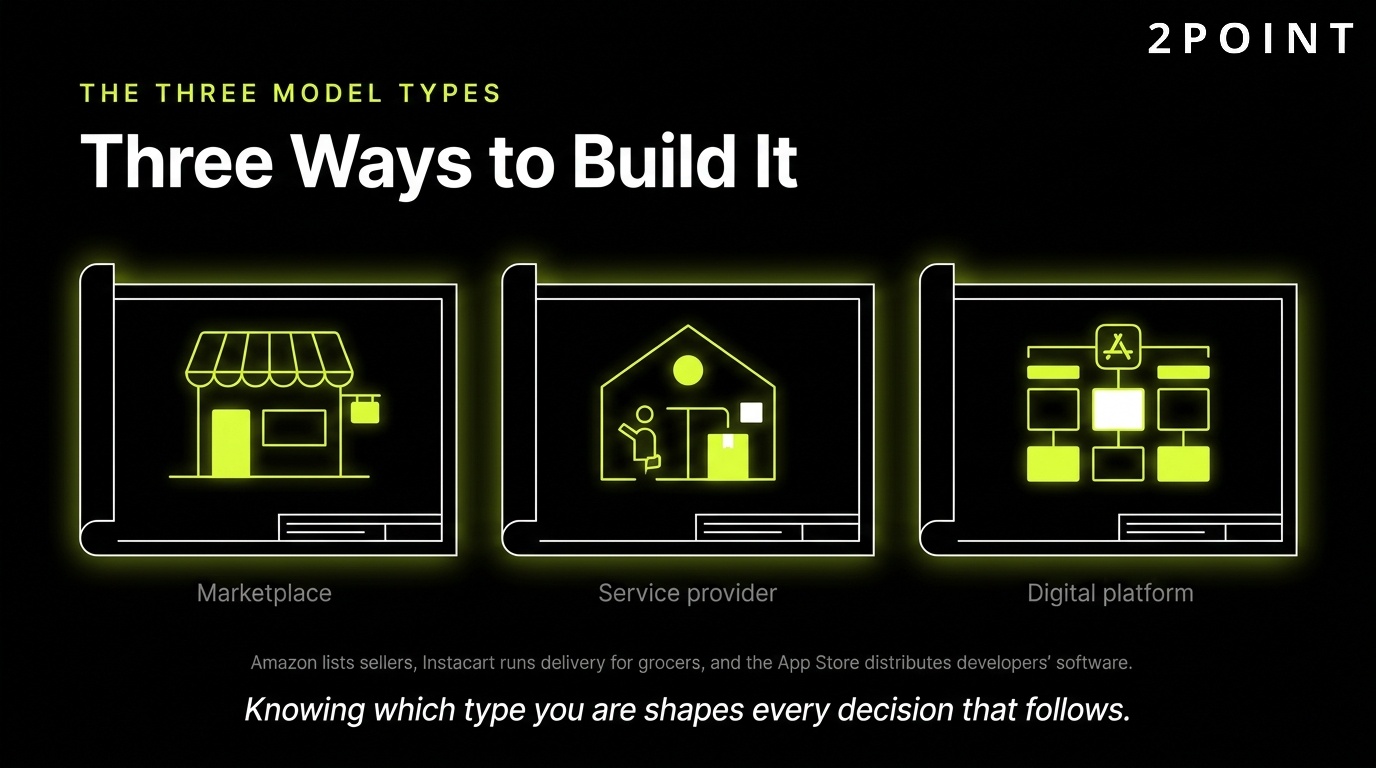
Marketplace models are the most widely recognized. Amazon is the defining example. Thousands of businesses sell their products through Amazon's platform. Amazon handles logistics, payments, customer service, and the digital storefront experience. The selling business retains its brand identity on the product listing, in the packaging, and in customer communications, but the consumer interacts with both the seller's brand and the Amazon brand throughout the experience. The intermediary (Amazon) provides infrastructure and access; the business partner provides product.
Service provider models involve one business delivering operational services on behalf of another business to serve that business's existing customers. Instacart is the clearest illustration. A grocery chain that lacks digital ordering and delivery infrastructure partners with Instacart, which handles the technology platform and last-mile logistics. The grocery store's brand remains front and center, but Instacart's brand is also present throughout the consumer-facing experience. Both brands are visible; both add distinct value.
Digital platform models encompass software and application ecosystems. The Apple App Store and Google Play Store allow third-party developers to distribute their software to consumers through the platform. The developer retains full brand identity within the app experience, but Apple or Google controls the discovery, payment processing, and security framework. Intuit's analysis of B2B2C notes that digital platform models have become particularly powerful as software-as-a-service companies seek scalable distribution without building their own acquisition channels from scratch.
How B2B2C Creates Value for All Three Parties
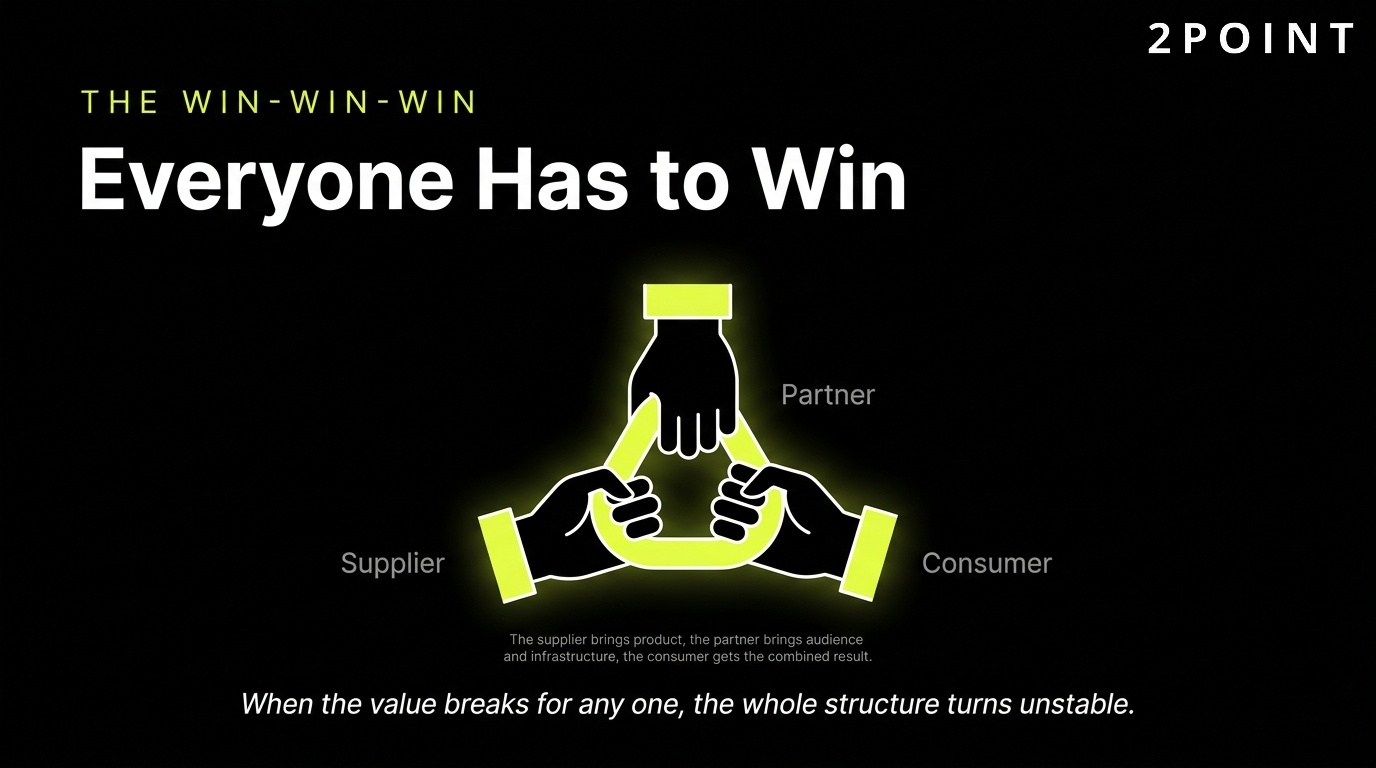
One of the most important concepts in the B2B2C model is that it must deliver genuine value to all three parties, not just two. When the value proposition breaks down for any one of the three, the entire structure becomes unstable. Manufacturers or original suppliers gain access to established customer bases that would take years and significant capital to build independently. Instead of investing in direct-to-consumer marketing, fulfillment infrastructure, and customer service operations, they plug into a partner's existing ecosystem and immediately access a large, engaged audience.
Intermediary businesses gain the ability to expand their product and service portfolio without developing those capabilities internally. A grocery chain that partners with a ready-meal service can offer customers more value without building a food production operation. A financial services company that partners with a fintech can offer modern payment options without building technology from scratch. The intermediary's offering becomes richer, which improves customer retention and increases revenue per customer.
Consumers benefit from greater variety, more seamless experiences, and services that neither the manufacturer nor the intermediary could have delivered alone. NetSuite's research on B2B2C emphasizes that the model generates this win-win-win through the alignment of complementary capabilities, where each party contributes what it does best and the consumer receives the combined result.
When B2B2C Works Best (and When It Does Not)
The B2B2C model is not the right answer for every company or every situation. Knowing when it is the appropriate choice, and when it is not, is as important as understanding how it works. The model performs best in situations where a company wants to reach consumers but prefers not to own the full operational complexity of the consumer relationship. Andreessen Horowitz's analysis of B2B2C business models cites lending as a classic example: a lender might partner with a retailer to offer financing at the point of sale. The lender does not want to handle collections conversations directly with consumers, so it benefits from a structure where the retail partner maintains the primary relationship while the lender provides the financing product invisibly at scale.
Delivery logistics, regulatory compliance, and technical implementation are other scenarios where B2B2C structures make strong strategic sense. When a company's core competency is product development or financial services, not last-mile delivery or IT implementation, partnering with specialists who handle those functions allows each party to focus on its strengths.
The model is less appropriate when your competitive differentiation depends entirely on owning the direct consumer relationship and gathering proprietary first-party data that cannot be shared. It is also problematic when margins are already thin, because profit sharing with a partner can make the unit economics unworkable. If your product requires highly customized consumer experiences that a standardized platform cannot support, B2B2C may create more friction than it solves. According to Intuit, careful evaluation of the partnership value exchange before committing to a B2B2C structure is essential for long-term viability.
Real-World B2B2C Marketing Examples That Illustrate the Model
Digital Marketplaces: Amazon and App Stores
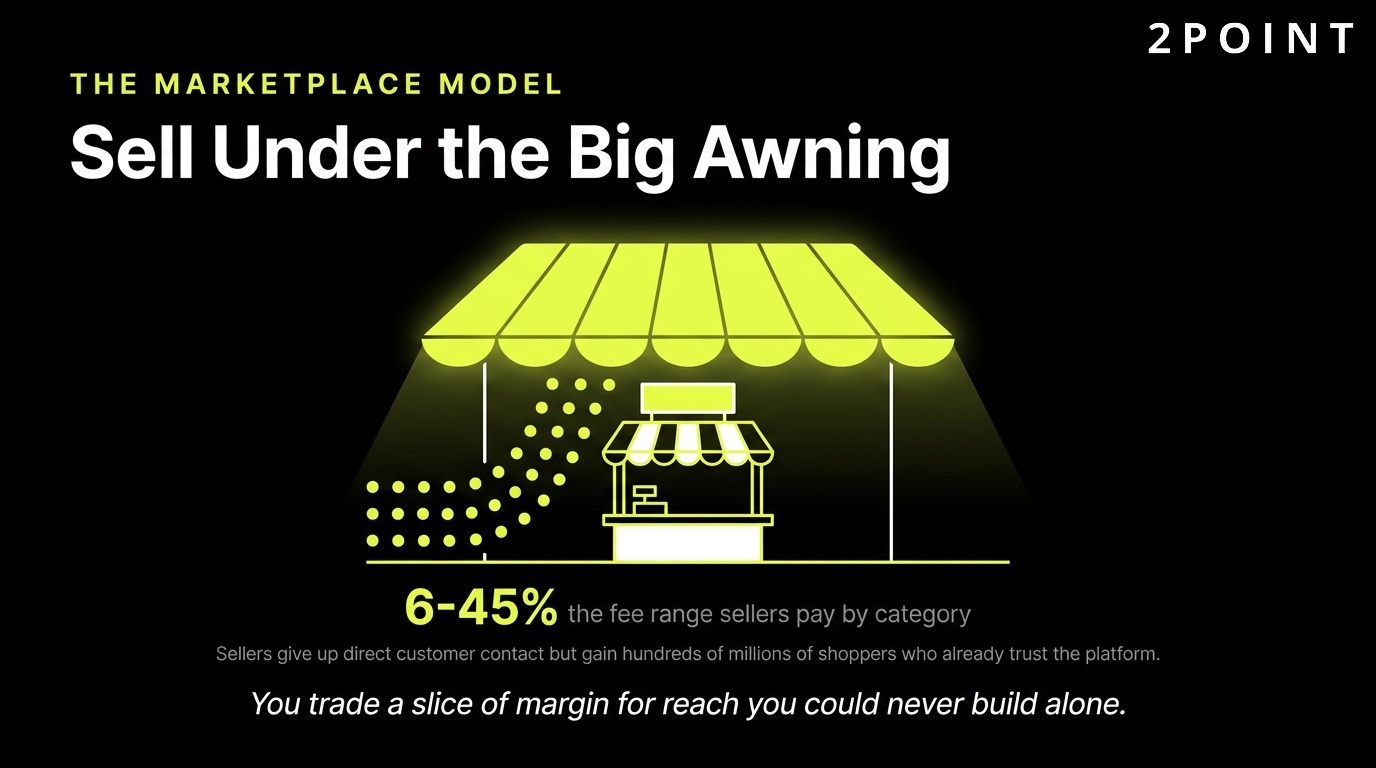
Amazon's marketplace is arguably the most studied B2B2C example in commerce today, and for good reason. Millions of businesses, from global brands to small independent sellers, use Amazon as their primary or supplementary distribution channel. Amazon provides the logistics network, the payments infrastructure, the customer service framework, and, most critically, the traffic. Sellers contribute the products, the pricing, and their brand identity. The consumer's experience includes both the seller's brand on the product and packaging, and Amazon's brand on the platform, checkout, and delivery experience.
The economic tradeoff is significant but often worth it for sellers. Sellers on Amazon sacrifice direct access to customer contact information and pay fees that can range from 6% to 45% of sale price depending on the category, plus fulfillment costs if using Fulfilled by Amazon. What they gain is immediate access to hundreds of millions of active shoppers who already trust the platform. For businesses that would otherwise spend years and millions of dollars building that level of consumer trust and reach independently, the tradeoff is frequently compelling.
App store models operate similarly. Intuit's B2B2C analysis highlights that digital platform operators typically charge commission rates of up to 30% on purchases plus annual registration fees. Developers pay this premium for access to the platform's built-in credibility, discovery tools, and consumer trust. The developer's brand and product identity remain intact within the app experience, while the platform handles billing, security, and the initial discovery moment.
Food and Delivery Services: Instacart and Uber Eats
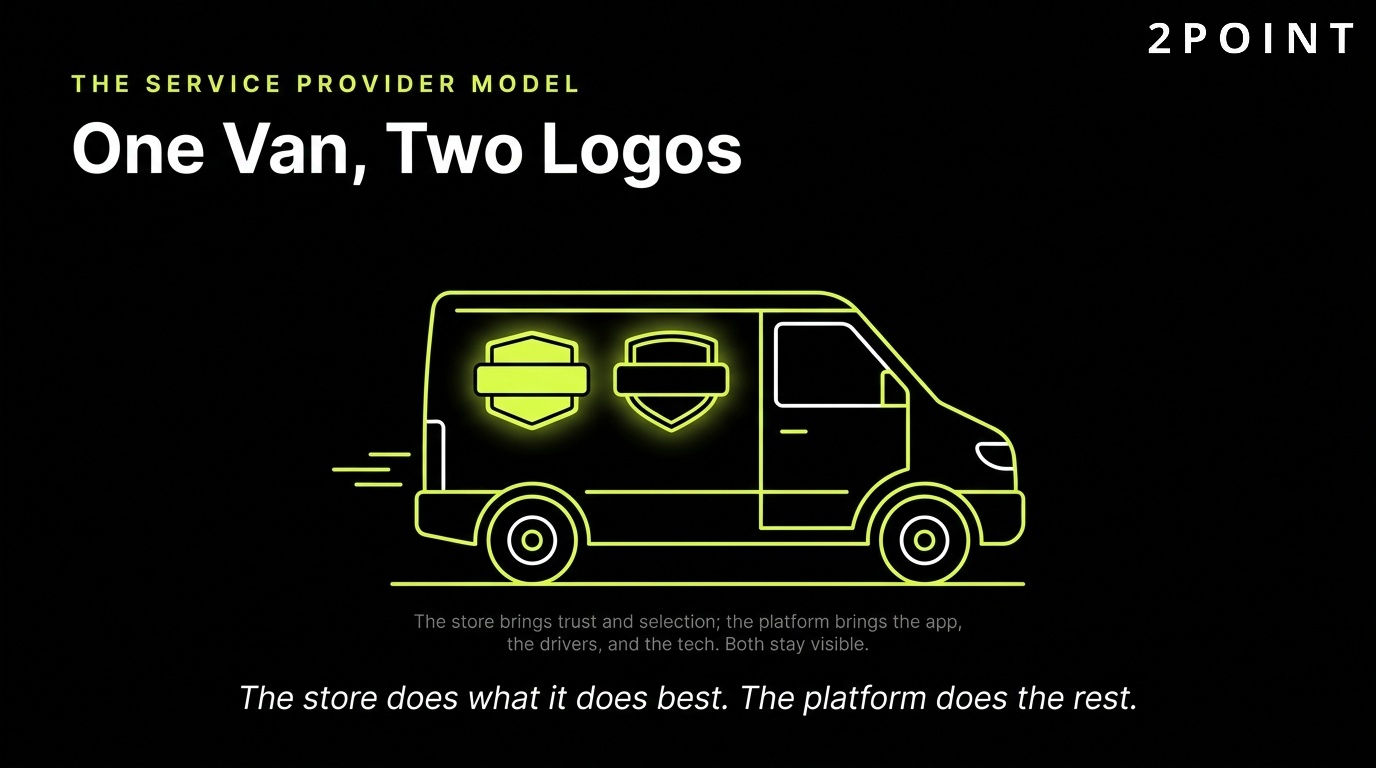
Food delivery and grocery delivery platforms represent some of the most consumer-visible B2B2C examples in the modern economy. Instacart's model is built on a fundamental insight: traditional grocery chains have deep consumer trust, extensive product selection, and established local brand loyalty, but they often lack the technology infrastructure, digital marketing expertise, and last-mile delivery logistics needed to serve consumers in a digital-first world. Rather than building those capabilities, they partner with Instacart, which provides the digital ordering platform, the delivery network, and the consumer-facing app experience.
Throughout the Instacart experience, both brands are visible. The consumer searches "Kroger on Instacart" or selects their preferred grocery partner within the app. They see the grocery store's products, pricing, and brand identity, while Instacart handles the technical and logistical dimensions of the transaction. Liferay's research on B2B2C customer experience emphasizes that this arrangement allows grocery stores to rapidly acquire a digital presence and serve online customers without the capital investment of building proprietary delivery technology.
Uber Eats operates on a structurally identical principle for restaurants. A restaurant's brand, menu, photography, and pricing are all presented within the Uber Eats platform, while Uber Eats handles the technology, driver network, payment processing, and customer communications. The restaurant gets digital distribution and delivery; Uber Eats gets a diverse, attractive product catalog that draws consumers to the platform.
Financial Services: Buy Now, Pay Later Platforms
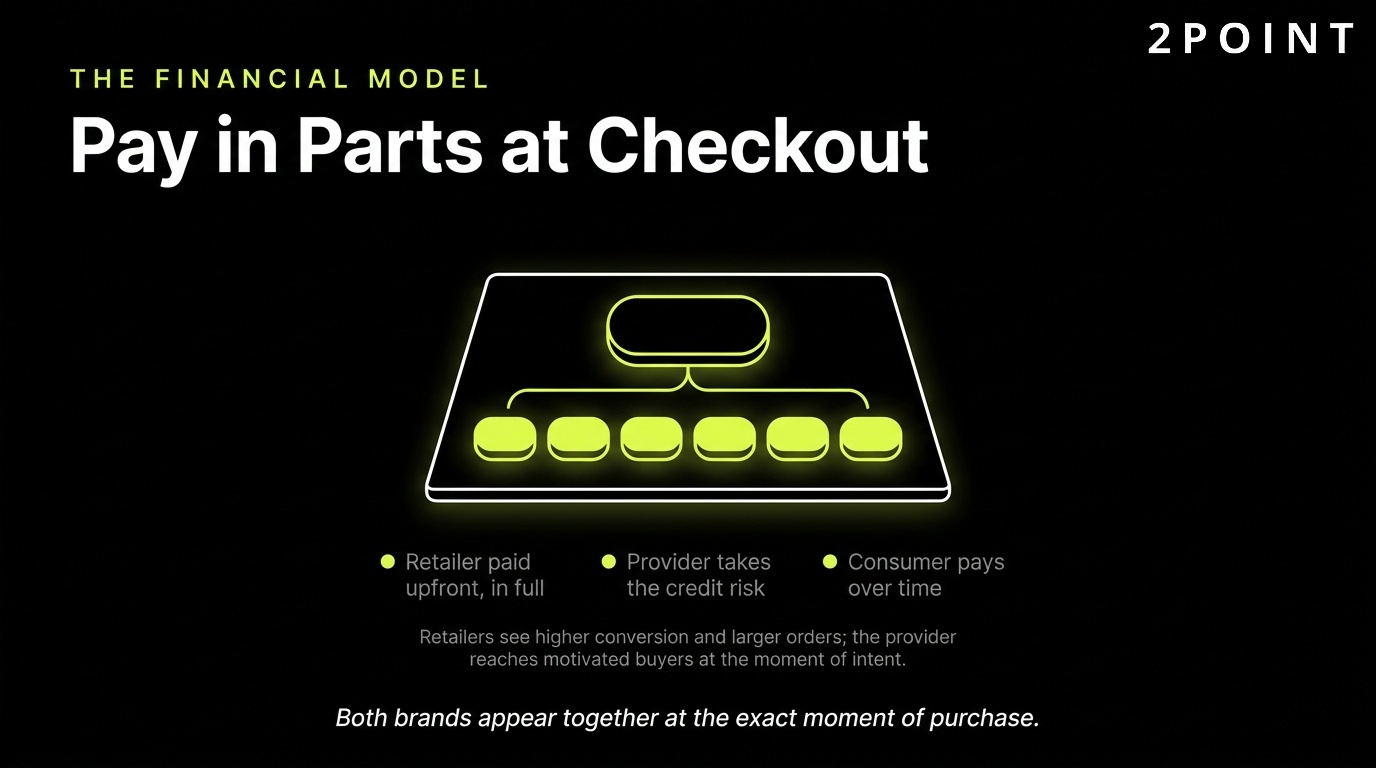
The explosive growth of buy now, pay later (BNPL) financing is one of the most commercially significant B2B2C success stories of the past decade. Platforms like Affirm, Klarna, and Katapult partner with retailers to offer flexible payment options directly at the point of purchase. Adobe's B2B2C ecommerce analysis notes that this model is a textbook example of the financial services B2B2C structure: the BNPL provider pays the retailer upfront in full, takes on the credit risk, and then collects installment payments from the consumer over time.
For the retail partner, the benefit is clear: higher conversion rates, larger average order values, and immediate payment without waiting for the consumer to pay over time. For the consumer, the benefit is payment flexibility that makes larger purchases accessible. For the BNPL provider, the benefit is a scalable distribution model that places their financing product in front of motivated buyers at the exact moment of purchase intent. Both brands are visible at the point of sale: the retailer's brand on the product and shopping experience, the BNPL brand on the payment selection screen. Andreessen Horowitz's B2B2C framework identifies BNPL as a prime example of a supplier using the B2B2C structure to achieve distribution scale without a direct consumer acquisition strategy.
Healthcare Technology: Maven Clinic's Employer-Sponsored Model
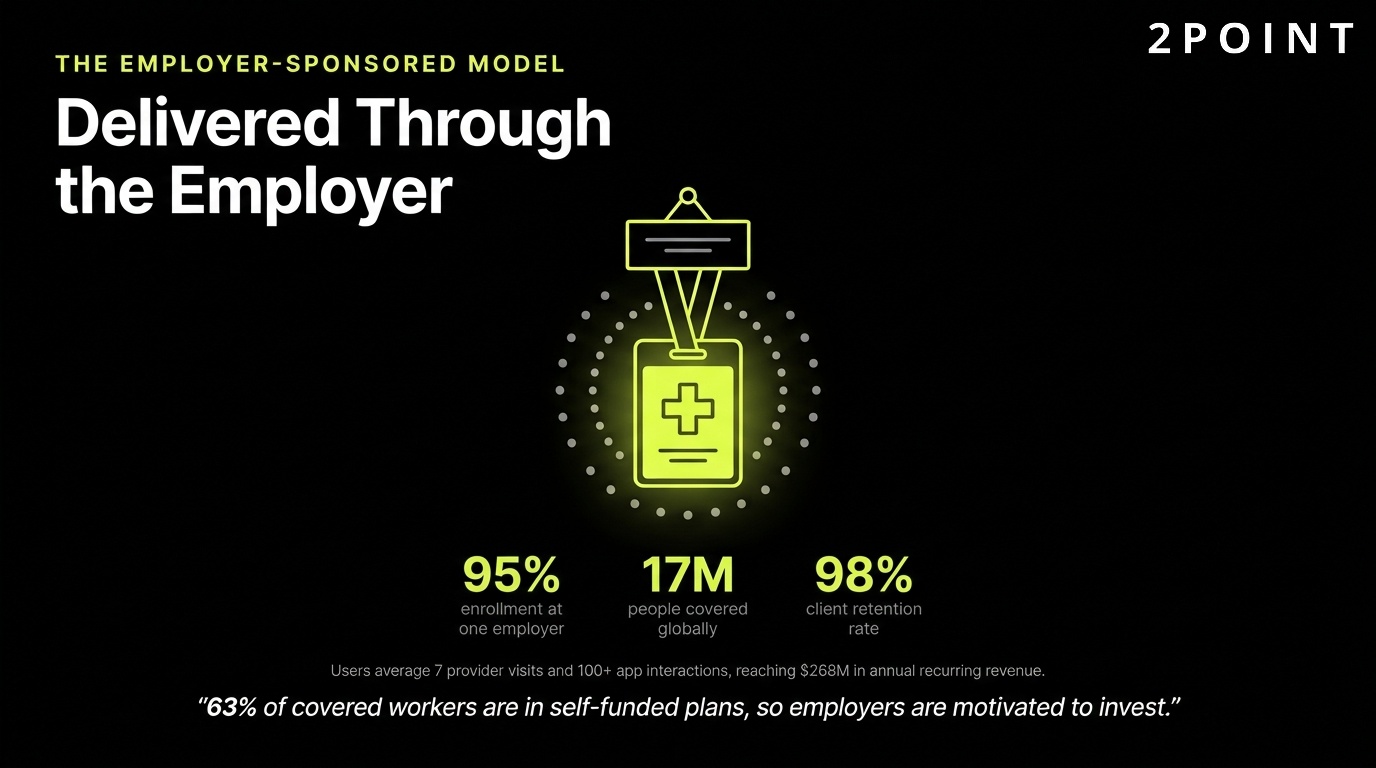
Perhaps the most compelling modern B2B2C case study in terms of engagement metrics and business outcomes is Maven Clinic, a digital health platform that provides women's and family health services. Maven does not sell directly to individual consumers. Instead, it partners with employers who offer Maven as an employee benefit, embedded within the broader benefits package. The employer is the B2B partner; the employee and their family are the end consumers. Both the employer's HR brand and Maven's brand are visible and active throughout the employee experience.
The results are striking. HTD Health's analysis of healthtech B2B2C models reports that Maven achieved 95% enrollment at Snap Inc., with users averaging seven provider visits and over 100 app interactions. Maven now covers 17 million people globally, has reached $268 million in annual recurring revenue, and maintains a 98% client retention rate. These numbers demonstrate the extraordinary power of a well-executed B2B2C model when the intermediary (the employer) actively promotes the service and the end consumer (the employee) finds genuine value in the product.
The broader healthcare context underscores why this model has become so important in healthtech. According to HTD Health, 63% of covered workers in the United States are in self-funded employer health plans as of 2024, which means employers are directly motivated to invest in preventive and supportive health services that reduce overall claims costs. This creates a massive, motivated market for digital health companies willing to distribute through the employer B2B2C channel. The employer's financial incentive aligns perfectly with the health platform's growth objectives, creating one of the most durable structural alignments in the entire B2B2C landscape.
B2B2C vs B2B vs B2C Marketing Strategies: Key Differences Explained
B2B Marketing Characteristics and Strategies
Traditional business-to-business marketing operates under a distinct set of conditions that shape every strategic and tactical decision. The fundamental dynamic is that you are selling to organizations, not individuals, which means the buying process involves multiple stakeholders with different priorities, different information needs, and different roles in the approval chain.
B2B transactions typically involve larger quantities and higher prices per transaction than B2C. The relationship between buyer and seller is usually ongoing and long-term, which means that retention and relationship quality are primary concerns. The purchase decision is rarely emotional or impulsive; it is evaluated on rational criteria including ROI, risk, operational fit, and total cost of ownership.
The buying committee dimension has grown significantly more complex over recent years. LinkedIn's B2B marketing research documents that buying committees have expanded from 5 to 16 members on average, and Improvado's B2B marketing trends report notes that 74% of buyers experience internal conflict during the purchase process. B2B marketing must therefore address multiple personas, multiple objections, and multiple approval stages simultaneously. Content strategies, sales enablement, and account-based marketing all reflect this multi-stakeholder reality. Understanding how to target your audience across these different decision-making layers is one of the most critical skills in B2B marketing.
B2C Marketing Characteristics and Strategies
Business-to-consumer marketing operates at the opposite end of the decision-making spectrum. The buyer is a single individual making a personal choice, often in a short timeframe, frequently with emotional or social factors playing a significant role. B2C marketing prioritizes speed of conversion, emotional resonance, visual appeal, and brand trust at scale.
Sales cycles in B2C are dramatically shorter than in B2B. A consumer might discover a product on social media and complete a purchase within minutes. There is no approval committee, no procurement process, and no contract negotiation. This creates both an opportunity (faster conversion when the message lands) and a challenge (winning attention in a saturated, fast-moving environment).
Personalization has become the defining competitive battleground in B2C marketing. Improvado's B2C marketing trends analysis for 2026 finds that 48.57% of B2C marketers cite personalization at scale as their top priority. Consumers expect marketing communications, product recommendations, and brand experiences that reflect their individual preferences and behaviors. Personalized marketing at scale requires sophisticated data infrastructure, automation, and increasingly, AI-driven content and recommendation systems. The brands that get this right earn loyalty that B2B relationships often achieve through contractual obligation rather than genuine preference.
B2B2C's Hybrid Marketing Approach
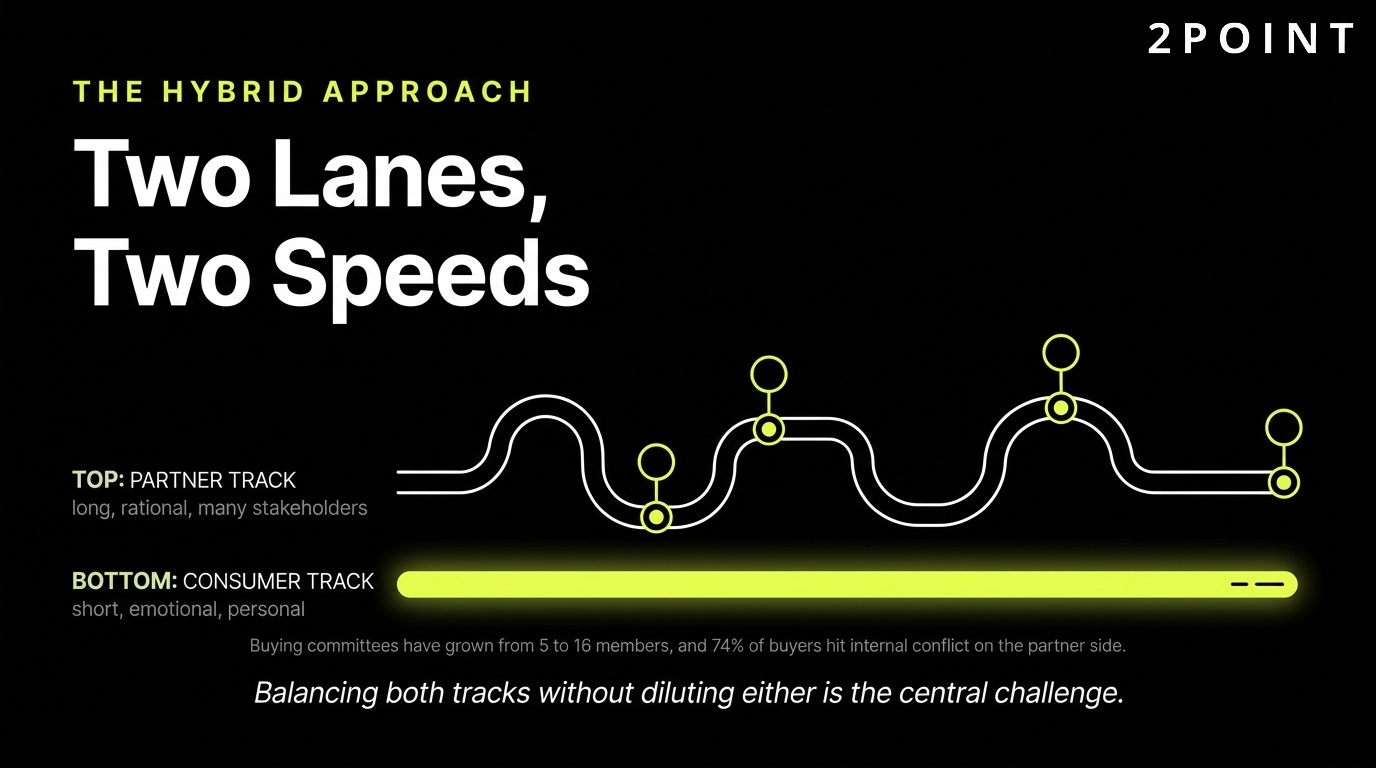
The B2B2C model requires a genuinely hybrid marketing approach that runs two distinct but coordinated strategies simultaneously. The first layer of marketing targets business partners, the intermediaries who will distribute your product or service to end consumers. This layer operates with all the characteristics of B2B marketing: relationship building, ROI-focused messaging, multi-stakeholder communication, and longer sales cycles. You must convince a business decision-maker that your product or service will create value for their organization and their customers.
The second layer of marketing targets end consumers, either directly or through co-branded campaigns with the partner. This layer operates with B2C dynamics: emotional resonance, personalization, short-form content, and experience-focused messaging. The challenge is that in many B2B2C structures, the originating supplier does not have direct access to the consumer, so their consumer-facing marketing must work through or alongside the partner's existing channels.
GritGlobal's analysis of B2B2C strategy identifies the primary goal of B2B2C marketing as retaining business partners who distribute to consumers, with a secondary goal of building brand awareness and preference among end consumers through co-branded initiatives. Both goals must be pursued simultaneously, but they require fundamentally different messaging, channels, and success metrics. Balancing these two marketing tracks without diluting either one is the central strategic challenge of B2B2C marketing execution. Social media in marketing plays a different role in each track, requiring separate strategic frameworks for partner-facing and consumer-facing efforts.
Shared Customer Relationship Management in B2B2C
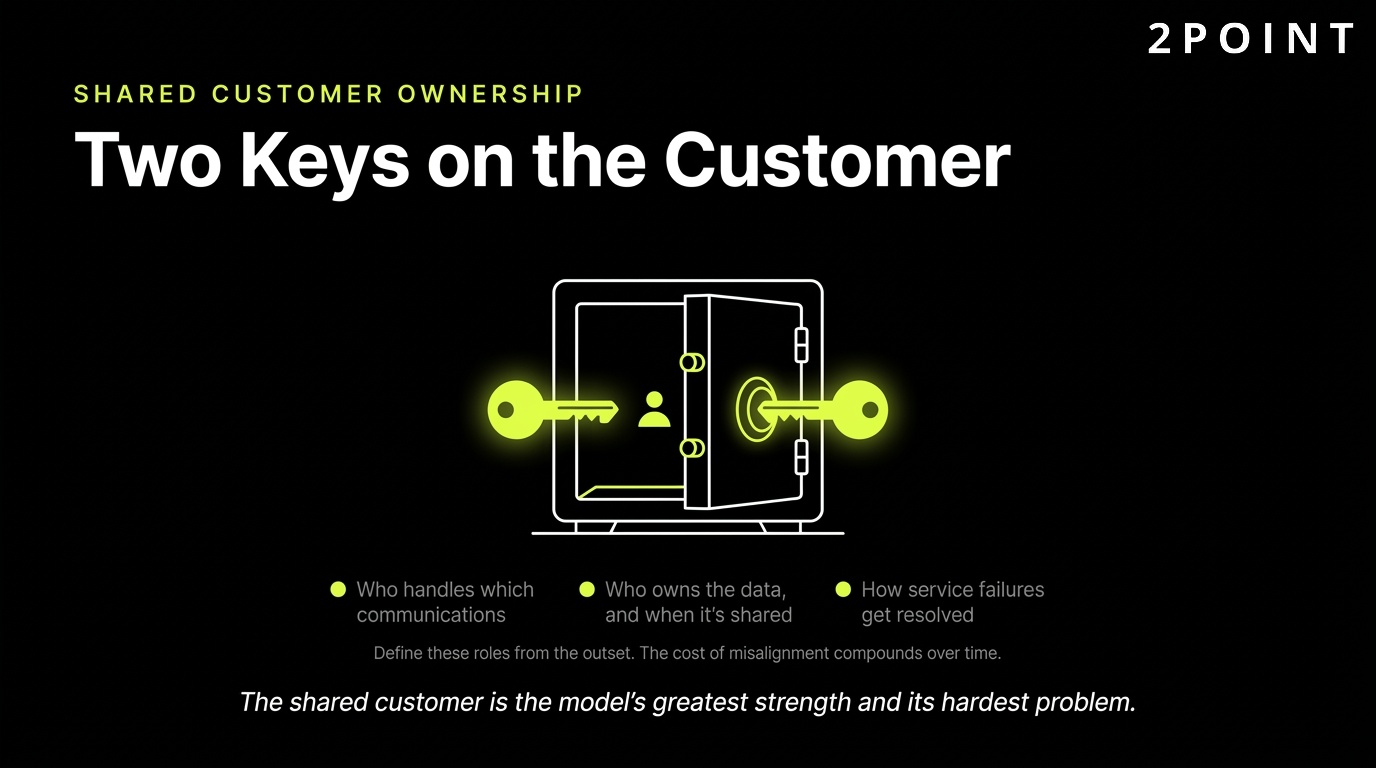
One of the most operationally complex aspects of the B2B2C model is the concept of shared customer ownership. In a traditional B2B or B2C model, one company owns the customer relationship completely. They hold the data, control the communications, manage the service experience, and bear full responsibility for customer satisfaction. In a B2B2C model, two companies share this responsibility, and navigating that shared ownership requires deliberate coordination and clear contractual frameworks.
According to Intuit's B2B2C research, the most successful B2B2C arrangements establish clear role definitions from the outset: which company handles which customer communications, who owns customer data and under what conditions it can be shared, how service failures are attributed and resolved, and how brand standards are maintained across both companies' touchpoints. NetSuite's B2B2C research reinforces that the shared customer relationship is both the greatest strength of the model (two companies creating more value together than either could alone) and its most persistent operational challenge. Invest in alignment structures early, because the cost of misalignment compounds over time.
The following table illustrates how the three models compare across key marketing and operational dimensions.
| Marketing Dimension | B2B Marketing | B2C Marketing | B2B2C Marketing |
|---|---|---|---|
| Primary buyer | Business decision-maker | Individual consumer | Business partner + end consumer |
| Sales cycle length | Long (weeks to months) | Short (minutes to days) | Dual: long for partners, short for consumers |
| Decision-making style | Rational, committee-based | Emotional, individual | Both simultaneously |
| Brand visibility | Supplier brand visible to business only | One brand visible to consumer | Both brands visible to consumer |
| Customer ownership | Seller owns the relationship | Brand owns the relationship | Shared between two companies |
| Marketing focus | ROI, risk reduction, efficiency | Emotion, personalization, experience | Partnership value + consumer engagement |
| Retention driver | Contract and switching costs | Brand loyalty and preference | Partner contracts + consumer experience quality |
The key takeaway from this comparison is that B2B2C marketing requires the strategic sophistication of B2B relationship management combined with the consumer engagement creativity of B2C, making it inherently more complex but also more powerful when executed well.
Strategic Benefits of B2B2C Marketing That Drive Business Growth
Accelerated Market Expansion and Scale Through Partnership

One of the most compelling reasons companies pursue the B2B2C model is the speed at which it enables market expansion. Building a direct-to-consumer audience from zero requires years of investment in brand building, content creation, paid acquisition, and community development. A startup manufacturer who wants to reach one million consumers directly faces a multi-year, multi-million-dollar challenge. The same company, through a well-chosen B2B2C partnership, might access that same audience within months by plugging into an intermediary's existing customer base.
This acceleration dynamic is not limited to startups. Even established companies use B2B2C structures to enter new geographic markets, serve new demographic segments, or launch new product categories without the overhead of building a fresh direct consumer channel. The partner brings the audience; the manufacturer brings the product. NetSuite's B2B2C analysis emphasizes that this speed-to-market advantage is one of the primary reasons manufacturers across categories are actively pursuing the model. Understanding the broader digital marketing growth landscape helps contextualize why this acceleration matters so much in today's competitive environment.
Reduced Customer Acquisition Costs Through Partner Channels
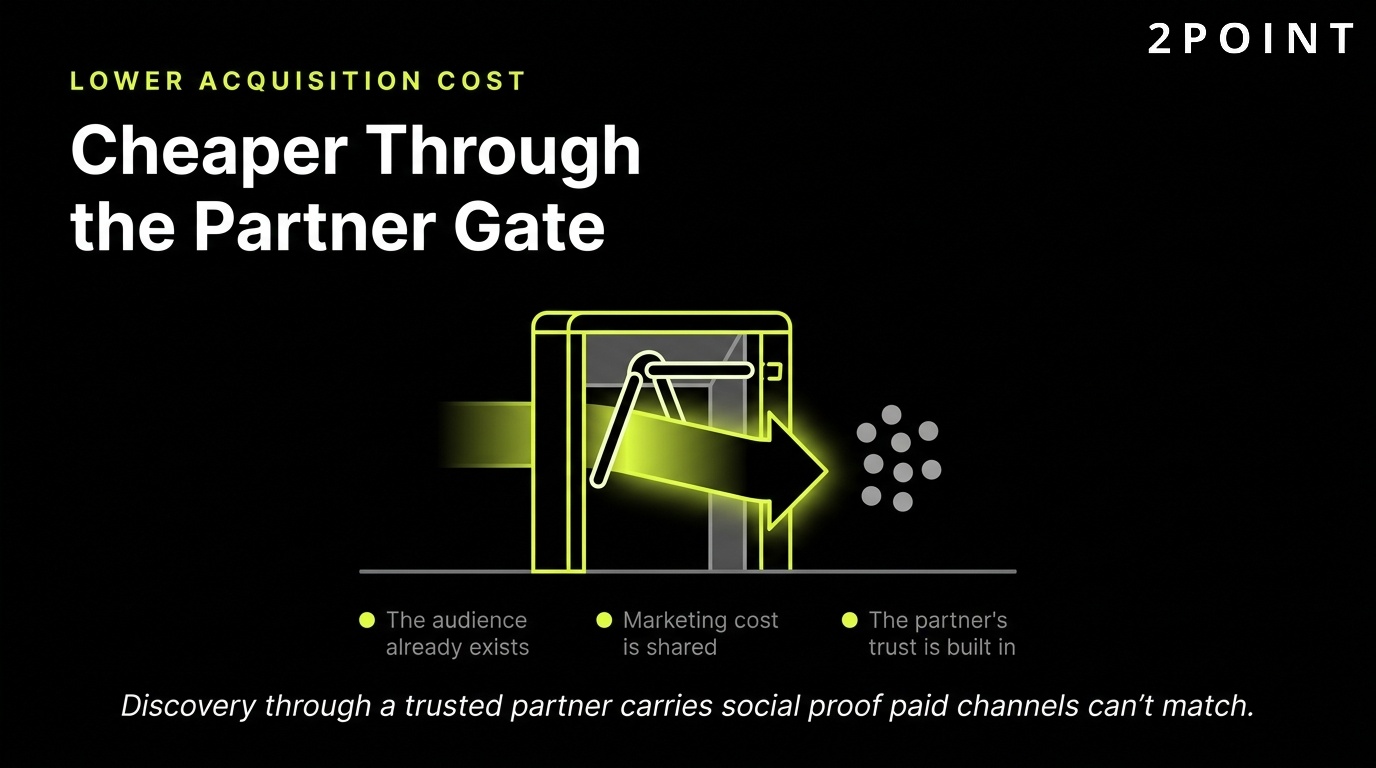
Customer acquisition cost is one of the most scrutinized metrics in any marketing operation, and the B2B2C model offers a structural advantage in keeping it under control. When you acquire customers through a partner's existing traffic and customer base rather than through paid media, content marketing, or direct sales outreach, the per-customer acquisition cost is typically significantly lower than direct acquisition would be.
This cost advantage works on multiple levels. First, the partner's audience already exists, so you are not paying to build it. Second, marketing expenses are shared between partners, spreading the investment across two organizations. Third, the partner's existing trust with their customers reduces the credibility barrier that typically adds cost to direct consumer acquisition. Liferay's B2B2C customer experience research notes that discovery through a trusted partner channel carries built-in social proof that paid acquisition channels simply cannot replicate at the same cost efficiency. Lowering acquisition costs while maintaining conversion quality is a durable competitive advantage, and B2B2C partnerships deliver this through structural design rather than tactical optimization.
Cost Efficiency Through Shared Infrastructure Investment
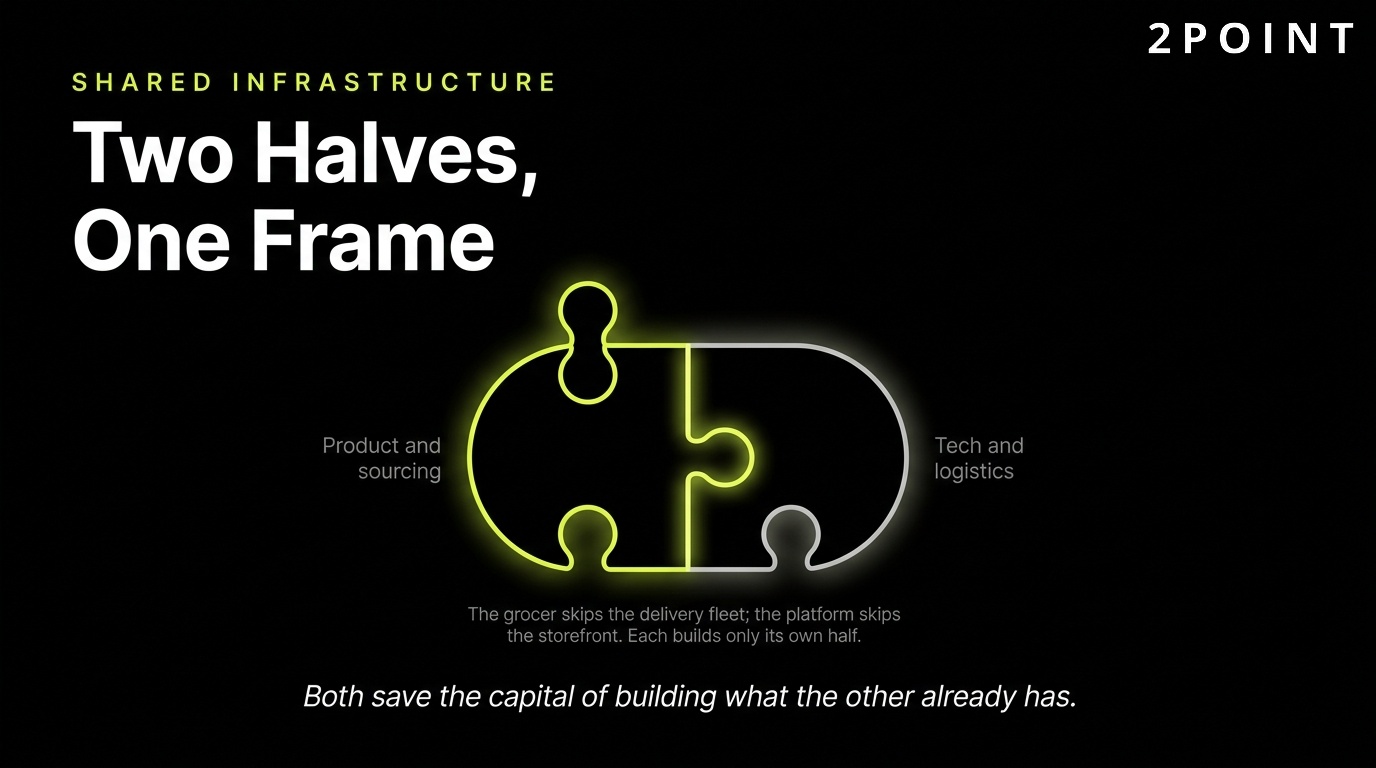
The operational cost advantages of B2B2C extend well beyond customer acquisition. When partners contribute complementary infrastructure, both companies save the capital and operational expense of building those capabilities independently. A software company that distributes through a marketplace does not need to build a consumer-facing payment processing system. A food brand that sells through a delivery platform does not need to operate a delivery fleet. A healthcare company that distributes through employers does not need to build an enterprise HR integration team from scratch.
These infrastructure savings translate directly to lower operating costs and faster paths to profitability. Mecalux's B2B2C business model analysis identifies shared infrastructure as one of the most underappreciated benefits of the model, particularly for companies in capital-intensive categories like logistics, healthcare, and financial services. The grocery store does not need to invest in delivery truck fleets or driver networks when Instacart provides that infrastructure. The grocery store focuses on what it does best: sourcing, merchandising, and serving local communities. Instacart focuses on what it does best: technology and logistics. Both save money; both serve consumers better.
Network Effects and Competitive Moats Built Through B2B2C Channels
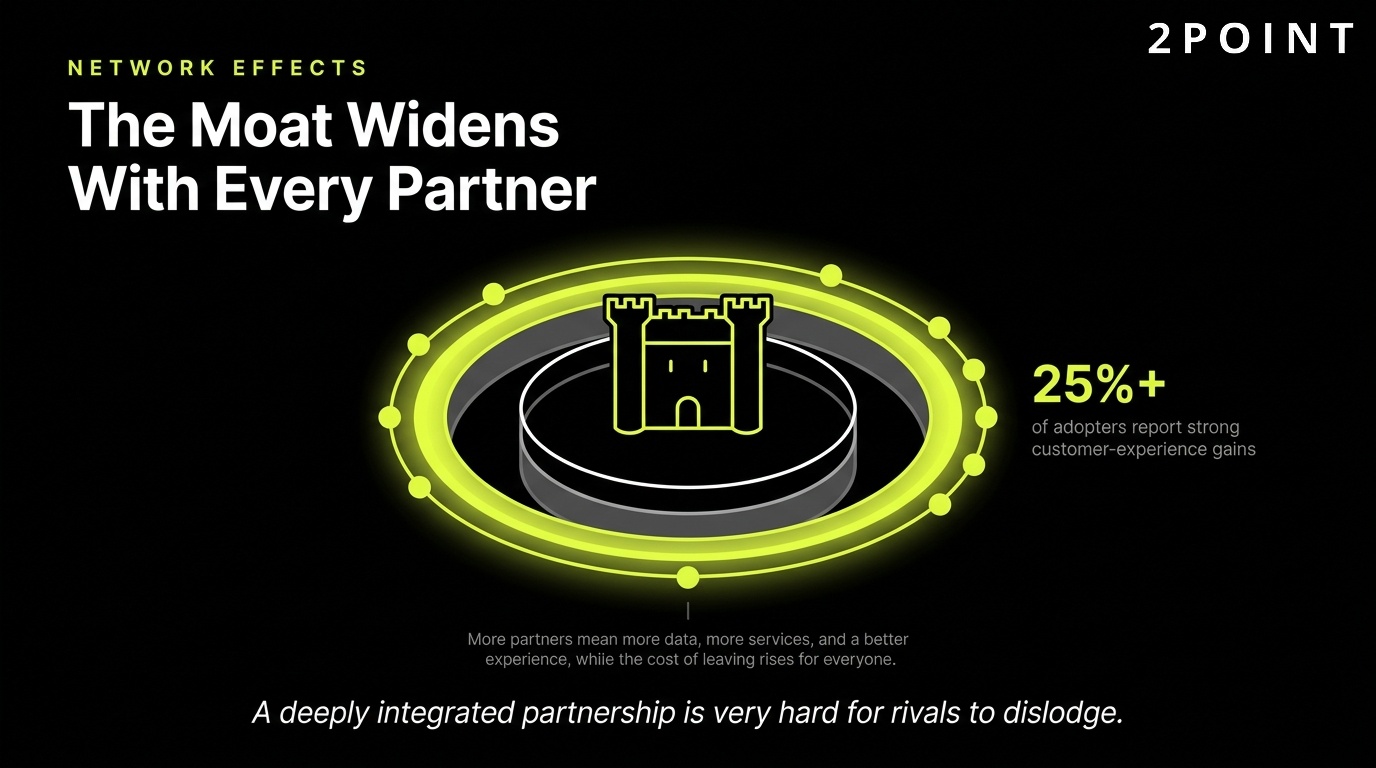
Andreessen Horowitz's research on B2B2C business models highlights a strategic benefit that goes beyond the immediate cost and scale advantages: the network effects that proprietary B2B2C channels generate over time. As more partners join a platform or as a partnership deepens, the channel becomes more valuable to all participants. More consumer data flows through the system. More products and services become available. The consumer experience improves. And the cost of leaving the partnership increases for both parties.
This compounding dynamic creates genuine competitive moats that are difficult for competitors to replicate. Maven Clinic's 98% client retention rate is not just a testament to product quality; it reflects the deep integration of Maven's services into employer benefits systems, HR workflows, and employee habits. Dislodging that kind of embedded partnership requires competitors to offer dramatically superior value and absorb the switching costs that employers would incur, a high bar that protects Maven's market position. According to VirtoCommerce's B2B2C research, 39.22% of manufacturers are actively pursuing the B2B2C model, and more than 25% report significant satisfaction improvements in their customer experience strategy after adopting it, suggesting that the moat-building benefits are widely recognized across industries.
B2B2C Marketing Challenges and How to Overcome Them Effectively
Brand Control and Customer Experience Risks in B2B2C Structures
The structural advantage of reaching consumers through a partner's existing infrastructure comes with a significant and often underestimated risk: you do not fully control the experience that consumer has with your brand. When a partner handles customer service, fulfillment, or the primary consumer touchpoint, any failure on the partner's part reflects on your brand as well as theirs. A restaurant that receives negative reviews because a delivery driver arrived late, left food in poor condition, or was rude to a customer has suffered brand damage from a failure that was entirely outside their operational control.
This risk is not a reason to avoid B2B2C, but it is a reason to structure partnerships with explicit brand protection mechanisms. Clear brand guidelines that define how your product, service, and brand identity are presented in every consumer-facing touchpoint are essential. Service-level agreements that establish minimum standards for customer experience quality give you contractual recourse when partner performance falls short. Regular joint reviews of consumer feedback, complaints, and satisfaction metrics keep both parties accountable. GritGlobal's B2B2C analysis recommends treating brand protection in partnership agreements with the same rigor you would apply to intellectual property protection in any commercial contract. Maintaining clarity in communications across both organizations is a foundational requirement for keeping brand standards consistent.
The Partner Promotion Problem and How to Solve It
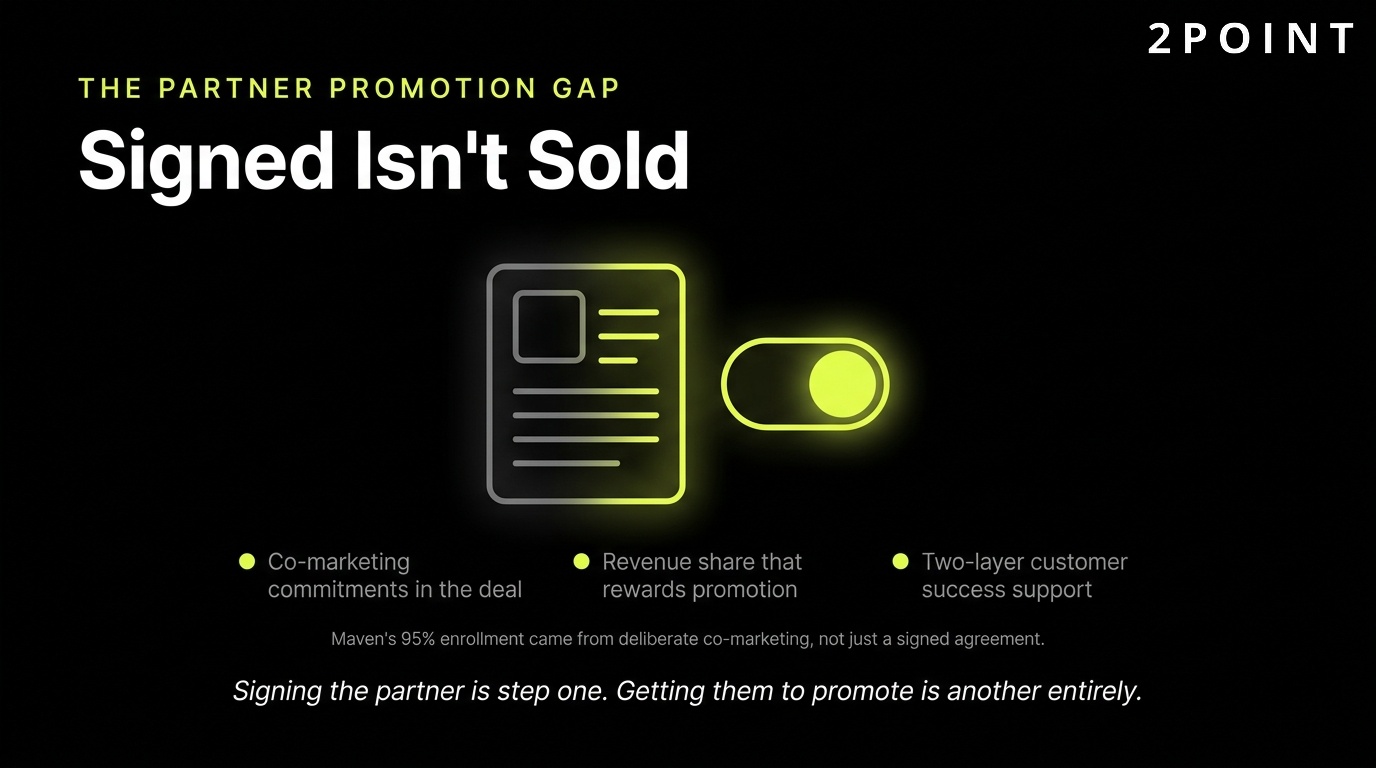
One of the most frequently overlooked failure modes in B2B2C marketing is the partner promotion gap: the situation where Business A signs a partnership agreement and then fails to actively promote your product or service to their end customers. This is not necessarily bad faith. Partners have full businesses to run, their own priorities competing for attention, and limited bandwidth for promoting every product or service in their ecosystem. The result is that your product sits quietly in their catalog, technically available but functionally invisible to end consumers.
Andreessen Horowitz's framework is particularly direct about this challenge, noting that signing the partner is step one, and getting them to actively promote your product is an entirely separate and equally critical challenge. Maven Clinic's 95% employee enrollment at Snap is not simply a function of having a partnership agreement with Snap. It reflects deliberate co-marketing efforts, employee communications campaigns, manager training, and benefit promotion strategies that Maven and Snap executed together.
The solution requires building active promotion into the partnership structure from the beginning. Co-marketing commitments, minimum promotion activities, revenue share structures that reward active promotion, and usage tracking that demonstrates the relationship between partner promotion effort and end-consumer engagement all create aligned incentives. You also need two layers of customer success management: one team dedicated to ensuring the partner organization is satisfied and actively engaged, and another focused on ensuring end consumers are achieving value from the product. Both layers must succeed for the partnership to generate its full potential.
Profit Margin Pressure and Revenue Sharing Trade-offs
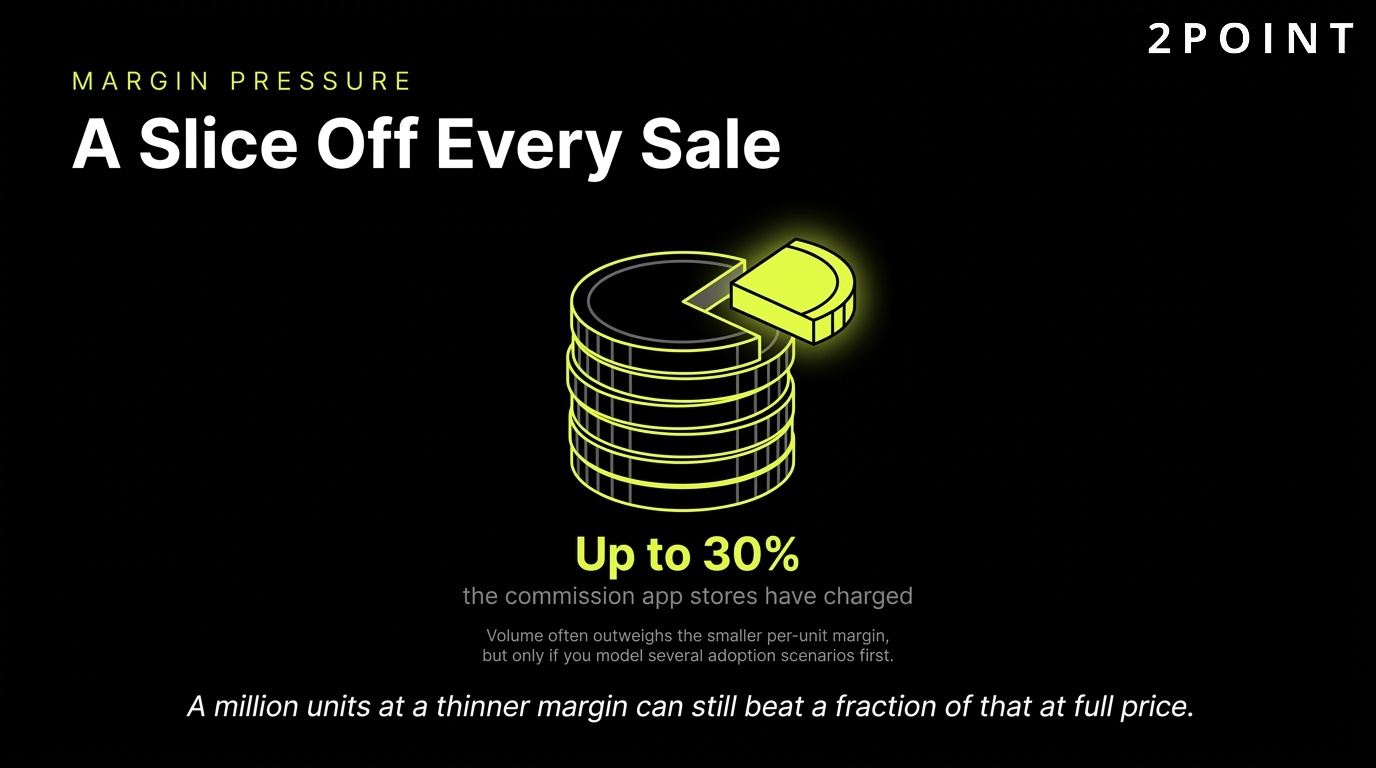
B2B2C partnerships always involve sharing economics with the intermediary, and the impact on profit margins requires careful modeling before committing to any partnership structure. Platform commissions can be substantial: app stores have historically charged up to 30% on purchases. Delivery platforms take meaningful percentages of each order value. Marketplace fees, payment processing charges, and platform subscription costs all reduce the margin that the original supplier retains from each consumer transaction.
For many B2B2C structures, the volume that partnership access enables more than compensates for the reduced per-unit margin. Selling one million units at a 15% lower margin through a partner channel can still generate more total profit than selling 200,000 units at full margin through a direct channel, particularly when you account for the lower customer acquisition and infrastructure costs in the partner model. But this math requires explicit financial modeling before the partnership is signed. GritGlobal's B2B2C guidance recommends modeling several volume scenarios before committing, ensuring that the partnership remains financially viable even at lower-than-projected adoption rates. Good data-driven decision making during the partnership evaluation phase prevents costly structural misalignments from becoming embedded in long-term agreements.
Complex Data Sharing and Customer Ownership Challenges
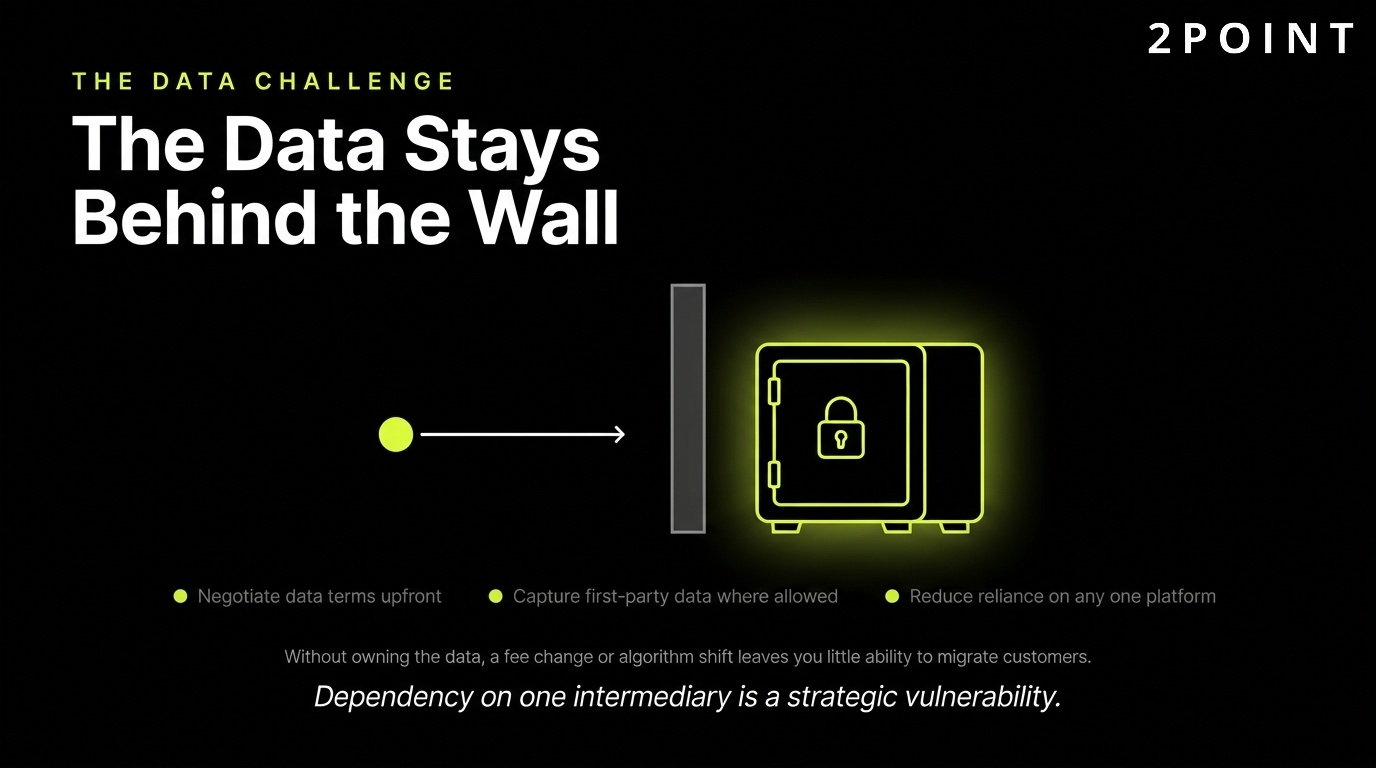
Data access is one of the most practically challenging dimensions of B2B2C partnerships. Many intermediary platforms restrict the originating supplier's access to customer contact information, purchase history, and behavioral data. Amazon, for example, does not provide sellers with buyer email addresses or contact details. This restriction prevents sellers from building independent customer relationships outside the platform, making them dependent on Amazon for continued access to those consumers.
This dependency creates strategic vulnerability. If the platform changes its fee structure, modifies its algorithms, or decides to compete directly with your product category (all of which Amazon has done), you have limited ability to migrate your customer base to an alternative channel because you do not own the customer data. NetSuite's B2B2C analysis recommends negotiating data access terms explicitly and upfront in partnership agreements, before any leverage is created. Building first-party data strategies that capture customer information through warranty registrations, product apps, loyalty programs, or direct consumer communications, where platform rules permit, helps reduce dependency on any single intermediary. The ability to analyze user behavior from the data you do own becomes especially valuable when partner-supplied data is limited or restricted.
Building a Successful B2B2C Marketing Strategy Step by Step
Selecting the Right B2B2C Partners for Your Business
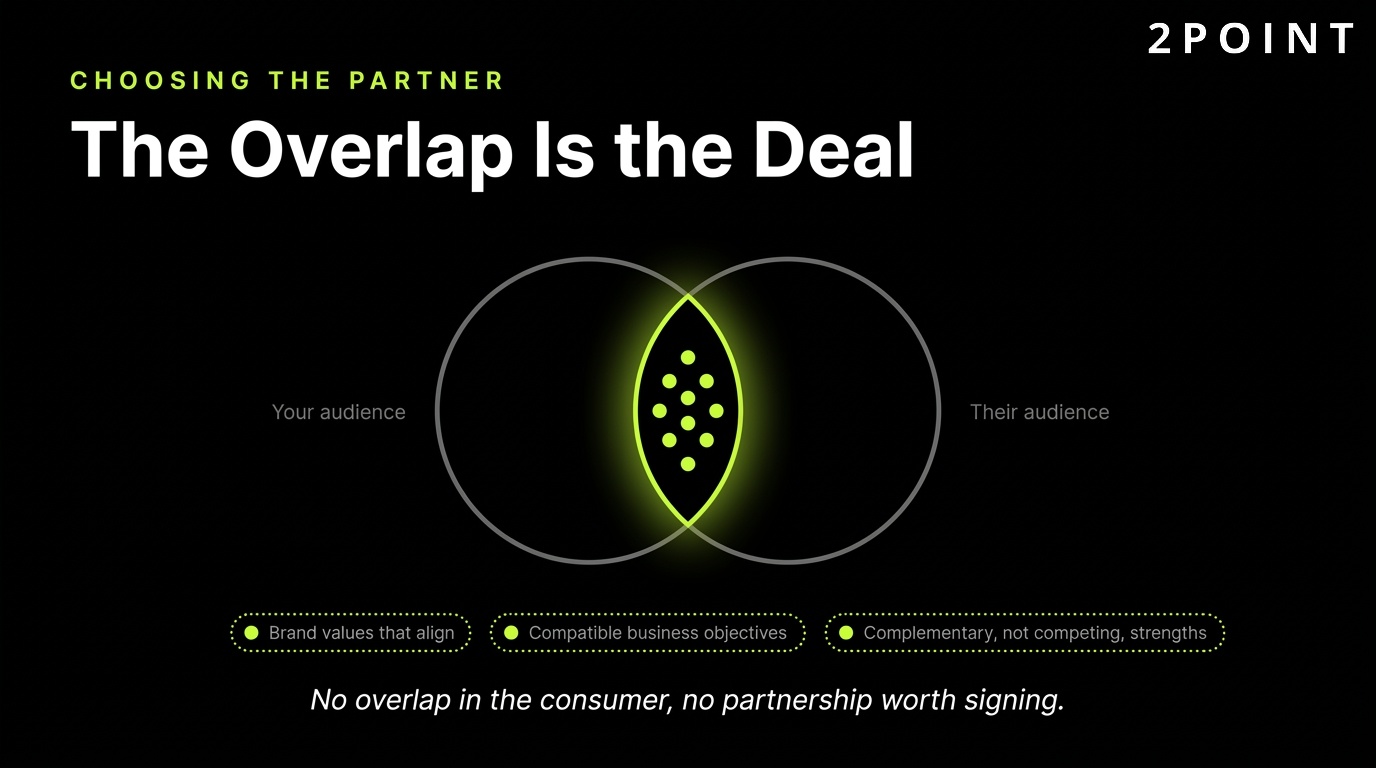
Partner selection is the single most consequential decision in a B2B2C marketing strategy. The wrong partner can damage your brand, undermine your financial model, and waste years of relationship-building effort. The right partner can accelerate your growth by years and generate a competitive advantage that compounds over time. Approaching this decision with a structured evaluation framework significantly improves your odds of success.
The most fundamental requirement is audience alignment. Both companies must be serving the same end consumer, or at minimum, overlapping consumer segments with compatible needs. If your product serves one demographic and your potential partner's customer base skews heavily toward a different demographic, the partnership will underperform regardless of how well the commercial terms are structured. Intuit's B2B2C guidance recommends evaluating four dimensions in every potential partner: brand values alignment, target audience overlap, business objective compatibility, and complementary (not competitive) capability profiles.
Beyond the audience match, assess the partner's operational capacity to support the partnership. Do they have the customer-facing infrastructure to effectively present and support your product? Do they have the marketing capabilities to actively promote it to their audience? Do they have the data systems to share the performance information you need to manage the partnership effectively? Pherrus's B2B2C comparison analysis notes that partnerships where one party significantly outpaces the other in operational sophistication tend to create frustration and underperformance on both sides. Aim for partners whose capabilities genuinely complement yours rather than simply filling a gap you hope they can handle.
Avoiding Competitive Threats and Partner Relationship Risks
The history of B2B2C partnerships includes cautionary tales of relationships that deteriorated because one partner created a perceived or actual competitive threat to the other. Andreessen Horowitz's B2B2C framework is direct about this risk: never signal to a partner that you intend to eventually acquire their customers and then shift those customers to a competitor of theirs. Never use data you gain through a partnership to build products or tools for that partner's direct competitors. And in the early stages of a B2B2C relationship, focus on optimizing outcomes for your existing clients rather than pushing aggressively to expand into adjacent territories that might alarm the partner.
Customer ownership complexity is a particularly sensitive area. When a consumer acquired through a B2B2C partnership later becomes a direct customer of the originating supplier (for example, when an Amazon seller gets a customer to sign up for their own website), the intermediary may view this as a violation of the partnership's spirit even if it is not explicitly prohibited. Navigating these tensions requires clarity about the rules of engagement, documented in the partnership agreement, and judgment about when to act on opportunities that might create partner friction. Protecting the partnership relationship is often worth more in long-term value than the short-term gain from any individual competitive move.
Implementing Co-Branding and Joint Marketing Campaigns
Co-branding is one of the most powerful consumer-facing tactics available in a B2B2C model, and it is frequently underutilized. When two brands collaborate on marketing that presents both their identities together, the consumer receives a signal that both brands endorse the partnership and stand behind the combined value they are delivering. This endorsement effect can significantly increase consumer trust and adoption rates compared to either brand marketing the partnership unilaterally.
Effective co-branding in a B2B2C context requires clear agreement on how each brand is represented, which brand leads in which context, and what the consistent message about the partnership's value to consumers will be. GritGlobal's co-branding guidance recommends developing a joint brand narrative that honestly and compellingly articulates why the partnership makes the consumer's life better, rather than simply announcing that two companies have a commercial relationship. Emotional storytelling is particularly effective in co-branding contexts because it helps consumers understand the partnership's meaning in human terms rather than commercial ones. Joint campaigns across email, social media, and in-store or in-app environments that both partners amplify through their respective channels multiply the reach of every marketing investment both companies make.
Measuring B2B2C Marketing Performance Across Both Relationship Layers
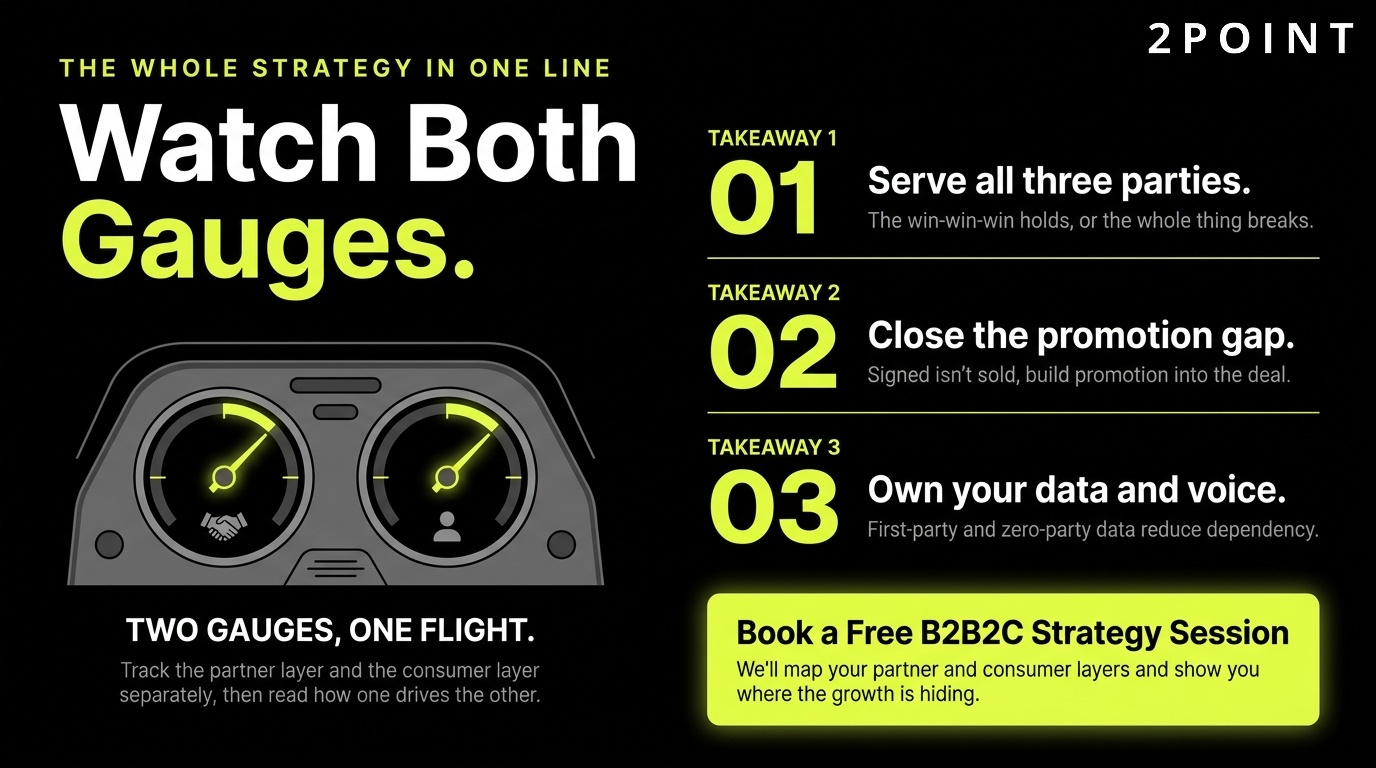
Measurement in a B2B2C model is inherently more complex than in a single-entity marketing operation because you are tracking performance across two distinct relationship layers simultaneously. Collapsing this complexity into a single set of metrics will give you misleading information about where the partnership is performing well and where it is breaking down.
The partner layer metrics should track: partner acquisition rate (how many qualified business partners are joining the program), partner promotion activity (how actively partners are presenting your product to their customers), partner satisfaction scores, and partner renewal and retention rates. These metrics tell you whether the business side of the partnership is healthy. According to Andreessen Horowitz, revenue attribution across the partnership, including which partners drive the most end-consumer value, is a critical metric for prioritizing partner success investment.
The consumer layer metrics should track: end-user adoption and engagement rates, consumer satisfaction and Net Promoter Score, repeat usage and retention, and lifetime value attributable to partner-acquired customers. Maven Clinic's reporting on seven provider visits per user and 100-plus app interactions per user demonstrates exactly the kind of end-consumer engagement metrics that validate the partnership's value at the consumer layer. HTD Health's healthtech B2B2C analysis confirms that tracking both layers independently and then analyzing the relationship between them, specifically how partner promotion activity correlates with consumer engagement quality, provides the most actionable intelligence for optimizing B2B2C marketing performance. Ensuring you are consistently tracking conversions at both the partner acquisition stage and the end-consumer adoption stage is essential for a complete performance picture.
B2B2C Marketing Technology Stack: Tools and Platforms That Power the Model
Marketing Automation for Dual Audiences in B2B2C
Managing two distinct audience relationships simultaneously, business partners and end consumers, places significant demands on marketing automation infrastructure. The workflows, messaging cadences, content types, and success metrics for each audience are so different that attempting to manage both through a single, undifferentiated automation system typically results in poor performance for both.
A well-designed B2B2C marketing automation architecture maintains separate workflows for partner communications and consumer engagement. The partner workflow handles onboarding new business partners, delivering partner training materials, communicating program updates and performance reports, and triggering re-engagement sequences when partner activity drops below expected levels. The consumer workflow handles personalized product recommendations, usage encouragement communications, re-engagement for lapsed users, and satisfaction check-ins. GritGlobal's analysis highlights that platforms like Atom8's B2B automation capabilities specifically address the need for partner portal automation, automated lead assignment based on territory or product fit, and quote and pricing management systems that simplify the complex B2B side of a B2B2C operation. A well-structured content marketing plan ensures that each automation workflow is fed with relevant, audience-appropriate content rather than generic messages that fail to serve either the partner or consumer relationship.
Customer Data Platforms and Unified Data Management for B2B2C
Customer data management in a B2B2C model is complicated by the fact that consumer data flows through multiple touchpoints owned or operated by different companies. A consumer might first encounter your brand through a partner's platform, engage with your product through that partner's interface, and then interact with your brand directly through a product app, warranty registration, or loyalty program. Connecting these touchpoints into a coherent customer profile requires a customer data platform (CDP) designed to ingest, clean, and unify data from multiple sources.
The data quality challenge is acute in B2B marketing contexts more broadly. eMarketer's 2026 B2B marketing research reports that 53% of B2B marketers say more than 10% of leads are disqualified due to poor data quality, a problem that is compounded in B2B2C environments where data enters the system through partner intermediaries who may use different data standards, field definitions, or collection methods. Additionally, AdRoll's 2026 B2B marketing predictions note that 91% of B2B marketers now use intent data for account prioritization, a capability that depends entirely on having clean, unified, and well-structured customer data underlying the intent signals. In a B2B2C model, this means investing in data governance frameworks that define how partner-supplied data is validated, enriched, and integrated into your unified customer view.
Personalization Engines for Consumer-Facing Touchpoints
Personalization at scale is the defining consumer marketing challenge of 2026, and B2B2C models face a specific variation of this challenge: you need to personalize the consumer experience even when you do not control all the touchpoints that consumer experiences. Where you do control touchpoints (your product interface, your communications, your app), personalization engines that leverage behavioral data to predict intent and deliver relevant experiences are essential.
The most advanced B2B2C personalization systems use AI-driven engines that move beyond simple segmentation to real-time, individual-level predictions. Improvado's B2C marketing trends research identifies AI agents that predict consumer intent before users explicitly express it as one of the most powerful emerging personalization capabilities. Zero-party data collection, where consumers voluntarily share preferences through structured formats like preference centers, product quizzes, and loyalty profile builders, provides the highest-quality personalization input because it is explicitly consented and highly accurate. In B2B2C contexts where partner platforms restrict behavioral data access, zero-party data collection through your own consumer touchpoints becomes particularly valuable as a personalization foundation. This directly supports the broader goal of analyzing user behavior in ways that are both effective and privacy-compliant.
Supply Chain and Inventory Management Systems for B2B2C Operations
The operational infrastructure that supports a B2B2C model must enable real-time coordination between multiple parties across inventory, order management, fulfillment, and customer communications. When a consumer places an order through a partner platform for a product managed by the originating supplier, every step from inventory availability check to order confirmation to shipping notification to delivery tracking must flow seamlessly across company boundaries.
Mecalux's B2B2C operational analysis emphasizes that real-time inventory visibility is a foundational requirement that many B2B2C partnerships underinvest in during the initial setup phase. When inventory data is not synchronized in real time, consumers encounter stockout errors, overselling, and order cancellations that damage both brands. The technology investment required to achieve genuine real-time inventory coordination across company systems is significant, but the consumer experience damage from failing to make that investment is greater. Automated order tracking that presents consistent status information to consumers regardless of which company's systems are actually processing the order is the consumer-facing manifestation of this backend coordination capability.
B2B2C Marketing Trends Shaping the Model in 2026 and Beyond
AI-Driven Autonomous Marketing Systems in B2B2C Contexts
Artificial intelligence has moved from a supporting tool in marketing to an increasingly autonomous actor, and this shift has profound implications for how B2B2C marketing operations are structured and staffed. Improvado's 2026 B2B marketing trends research reports that 96% of marketers now use AI tools regularly, with 45% citing efficiency as the primary benefit. But the more significant shift is qualitative: AI systems are moving beyond answering questions and surfacing insights to actively executing marketing decisions without continuous human instruction.
In a B2B2C context, this autonomous execution capability is particularly valuable because of the operational complexity involved in managing two relationship layers simultaneously. AI systems can monitor partner engagement signals and trigger re-engagement workflows when a partner's promotion activity drops. They can analyze consumer behavioral data across partner touchpoints and adjust personalization models in real time. They can optimize content distribution across both partner-facing and consumer-facing channels based on continuous performance feedback. The evolution from marketers querying dashboards to AI systems researching, planning, and executing marketing actions represents a fundamental change in how B2B2C organizations will staff and structure their marketing functions over the next several years.
Zero-Party Data and Privacy-First Marketing in the Post-Cookie Era
The full deprecation of third-party cookies across major browsers, a transition that has been completed as of 2026, has forced every B2B and B2C marketer to rethink their data strategies. For B2B2C marketers, the implications are particularly significant because so much consumer behavioral data in these models has historically flowed through partner platforms rather than being collected directly. When third-party tracking capabilities erode, the data advantage that intermediary platforms provided also diminishes.
Zero-party data, information that consumers intentionally and voluntarily share with brands, has emerged as the highest-quality alternative to third-party behavioral tracking. Improvado's B2C marketing trends analysis identifies preference centers, product configuration quizzes, loyalty program profiles, and progressive profiling sequences as the most effective zero-party data collection mechanisms. This data comes with explicit consumer consent and reflects stated preferences rather than inferred behaviors, making it both more accurate and more defensible from a regulatory standpoint. For B2B2C brands, building zero-party data collection into every consumer touchpoint they control, whether that is a product registration flow, an app onboarding sequence, or a loyalty rewards program, is a strategic imperative that becomes more valuable every year as privacy regulations tighten and third-party data quality declines. This aligns closely with the shift toward community engagement strategies that build direct relationships with consumers rather than depending on intermediary platforms to mediate all interactions.
Answer Engine Optimization for B2B2C Brand Visibility
Search behavior is undergoing a structural shift as consumers increasingly receive information through AI-generated summaries, recommendation engines, and conversational interfaces rather than traditional search results pages. For B2B2C brands, this shift creates a new visibility challenge: your brand and your partner's brand must both appear accurately and authoritatively in AI-generated responses and recommendation outputs, not just in traditional organic search results.
eMarketer's 2026 B2B marketing research notes that 39% of B2B marketers struggle with maintaining voice and quality as content output increases, a challenge that is directly relevant to answer engine optimization because AI recommendation systems favor content that is authoritative, consistent, and clearly structured. In a B2B2C partnership, both companies must ensure that their public-facing content about the partnership, the product, and the consumer value proposition is consistent, accurate, and formatted in ways that AI systems can extract and present reliably. Misalignment between the two brands' public-facing information creates confusion in AI-generated summaries and reduces the likelihood that either brand appears prominently in recommendation results. The effort to integrate SEO and content marketing across both partner brands is becoming increasingly important as answer engine optimization replaces traditional SEO as the primary driver of discovery.
Omnichannel Experience Expectations in B2B2C Customer Journeys
Consumer expectations for seamless, consistent experiences across every touchpoint they encounter have risen to a level where inconsistency is no longer an irritation but a deal-breaker. In a B2B2C model where the consumer journey spans touchpoints owned by two different companies, meeting these omnichannel expectations requires a level of coordination and shared commitment to experience quality that many partnerships do not adequately plan for.
Consumers do not distinguish between which company is responsible for which part of their experience. If the partner's platform has a confusing checkout flow, the consumer's frustration attaches to the overall experience, including the originating supplier's brand. If the originating supplier's product experience is difficult to navigate, the partner's credibility also suffers. Both companies must be invested in the quality of every touchpoint, not just the ones they control directly. Shopify's B2B2C guide recommends regular joint review sessions where both partners examine the complete consumer journey from first discovery to ongoing usage, identifying friction points and assigning clear remediation responsibility for each one.
Email marketing remains one of the most powerful and cost-effective channels for maintaining consistent omnichannel engagement across B2B2C partnerships. The Geisheker Group's B2B marketing guide reports that email delivers an average return of $36 for every $1 spent, outperforming social media, paid search, and display advertising on a pure ROI basis. In a B2B2C model where the consumer has explicitly opted in to communications from both brands, coordinated email programs that reinforce the partnership's value and guide consumers through their journey with both brands represent one of the highest-return communication investments available. Tracking how well these programs perform and continuously refining them based on engagement data requires both the analytical rigor of measuring success and the creative discipline of authentic storytelling that keeps consumer interest alive across multiple communication touchpoints.
The following table summarizes the key 2026 B2B2C marketing trends and their strategic implications for businesses operating or considering this model.
| 2026 Marketing Trend | Impact on B2B2C Strategy | Recommended Response |
|---|---|---|
| AI-driven autonomous marketing (96% of marketers use AI tools) | Automates dual-audience management and partner engagement monitoring | Invest in AI-powered marketing automation with separate partner and consumer workflows |
| Third-party cookie deprecation (fully complete in 2026) | Reduces partner-supplied behavioral data; increases data gap risk | Build zero-party data collection into every owned consumer touchpoint |
| Answer engine optimization replacing traditional SEO | Both partner brands must appear accurately in AI-generated results | Coordinate public-facing content standards across both companies |
| Omnichannel experience expectations | Consumers judge both brands on any single touchpoint failure | Conduct joint customer journey audits and assign clear ownership for each touchpoint |
| Personalization at scale (top priority for 48.57% of B2C marketers) | Consumer-facing touchpoints must deliver individualized experiences | Deploy AI personalization engines on all owned consumer interfaces |
| Intent data adoption (91% of B2B marketers use it for account prioritization) | Partner acquisition and management becomes more targeted and efficient | Integrate intent data into partner prospecting and re-engagement workflows |
The key takeaway is that B2B2C marketers in 2026 must simultaneously address partner relationship management with B2B-grade sophistication and consumer experience delivery with B2C-grade personalization, all while navigating a rapidly shifting data privacy and AI landscape.
The Community and Localization Dimensions of B2B2C Marketing
Why Community-Driven Marketing Matters in B2B2C Partnerships
Community building has emerged as one of the most durable competitive advantages available to brands operating in the B2B2C model. When end consumers develop a sense of belonging or shared identity around a product or service that reaches them through a partner channel, they become advocates who reduce the cost of acquiring new consumers, increase retention rates, and provide authentic social proof that no paid marketing can replicate. In a B2B2C structure, community can be built around either brand, or more powerfully, around the partnership itself.
Community-driven marketing in B2B2C contexts often takes the form of user groups, forums, events, or content programs that bring together consumers who share a common experience with the partnership's product or service. For employer-sponsored health platforms like Maven Clinic, community might manifest as peer support networks among employees who are navigating the same health challenges. For a grocery delivery partnership, it might take the form of recipe communities or local food culture content that both brands contribute to. The community creates an additional layer of consumer value that strengthens both brands' positions and deepens the partner relationship simultaneously.
Localized Marketing Strategies Within B2B2C Models
Many B2B2C partnerships operate across geographic markets with meaningfully different consumer preferences, regulatory environments, and competitive landscapes. A national grocery chain partnering with a delivery platform serves communities with very different needs from urban centers to rural towns. A global healthtech company partnering with multinational employers must navigate workplace cultures and benefit norms that vary enormously across countries. The B2B2C model's strength, leveraging a partner's existing local relationships and credibility, also creates an obligation to serve local contexts authentically rather than imposing a single standardized approach.
Localized marketing within B2B2C structures benefits from the partner's existing local knowledge and relationships, which the originating supplier can leverage to adapt product positioning, promotional messaging, and service delivery to local consumer expectations. A grocery partner who has served a community for decades understands what products resonate with that community, what communication styles build trust, and what price points reflect local purchasing power. Formalizing the process of incorporating that local knowledge into the joint marketing strategy strengthens both the partner relationship and the consumer experience in ways that generic, centralized marketing simply cannot achieve. The digital marketing impact of these localized approaches can be substantial, particularly in smaller markets where personalized, community-aware marketing stands out dramatically against generic national campaigns.
Conclusion: B2B2C Marketing as a Foundational Model for Modern Commerce
The business-to-business-to-consumer model is not an emerging trend on the periphery of commercial strategy. It is a foundational structure that already underlies some of the largest and most successful companies in the world, and its adoption is accelerating across industries. Understanding B2B2C marketing deeply, including how it works, where it creates value, where it introduces risk, and how to execute it with discipline, is an increasingly essential capability for any business leader, marketer, or strategist working in the modern economy.
The model's core insight is elegantly simple: two companies serving the same consumer together can create more value than either could create independently. The manufacturer brings the product. The intermediary brings the infrastructure, the audience, and the trusted relationship. The consumer receives a combined offering that neither partner could have delivered alone. When this alignment is genuine and the execution is thoughtful, all three parties benefit substantially.
The strategic value for manufacturers and suppliers is clear: access to established audiences at a fraction of the cost of direct acquisition, shared operational infrastructure that eliminates the need to build delivery, fulfillment, or customer service capabilities from scratch, and network effects that compound over time into genuine competitive moats. With 39.22% of manufacturers actively pursuing the B2B2C model and more than 25% reporting strong satisfaction improvements in their customer experience strategy after adoption, the evidence that this model generates real business results is substantial.
For intermediary businesses, the B2B2C model offers the ability to expand product and service portfolios rapidly, generating more value per existing customer and improving retention without the capital risk of organic capability development. For consumers, it delivers richer, more integrated experiences that reflect the combined strengths of two organizations working toward a common goal.
The challenges are real and deserve honest attention. Brand control becomes a shared responsibility rather than a sovereign one, requiring explicit standards and contractual protections. The partner promotion gap, where signing an agreement does not guarantee active promotion, requires built-in incentive structures and dedicated two-layer customer success management. Profit sharing reduces per-unit margins and demands careful financial modeling before commitments are made. Data ownership and access must be negotiated explicitly to protect your long-term independence from any single intermediary platform.
Technology is making B2B2C models more manageable and more scalable. AI-driven marketing automation can simultaneously manage partner relationship workflows and consumer personalization programs. Customer data platforms can unify the fragmented data environment that multi-partner models create. Personalization engines can deliver individualized consumer experiences even when the originating supplier does not control every touchpoint. And the shift toward zero-party data collection provides a privacy-compliant foundation for consumer intelligence that does not depend on third-party tracking infrastructure that is now effectively obsolete.
Looking forward, B2B2C structures will become more rather than less prevalent as digital transformation continues to blur the boundaries between companies, as consumers demand seamless experiences that require multiple companies to coordinate, and as businesses seek capital-efficient growth models that leverage partnership ecosystems rather than requiring fully vertical integration. The companies that master B2B2C partnership marketing now will have structural advantages that are difficult for competitors to replicate quickly.
The first step is an honest evaluation of whether your business, in its current form and strategic trajectory, is positioned to capture B2B2C opportunities. Who are the natural partners in your ecosystem with audiences you want to reach? What complementary capabilities could a partner contribute that would make your offering significantly more valuable to consumers? What would you contribute to a partner that makes their offering more compelling to their existing customers? And what does the financial model look like when the partnership operates at realistic adoption rates?
If you are navigating these questions and want strategic guidance on building a B2B2C marketing approach that is structured for real-world success, 2POINT works with organizations at every stage of this journey, from partnership strategy development to co-branding execution to performance measurement frameworks that give you visibility into both layers of your B2B2C relationships.
Frequently Asked Questions About B2B2C Marketing
What does B2B2C mean in marketing?
B2B2C stands for business-to-business-to-consumer, a marketing and commercial model where one company partners with another business to jointly reach and serve end consumers. Both the originating supplier and the intermediary business maintain visible brand identities throughout the consumer's experience, distinguishing B2B2C from white-labeling or silent distribution arrangements.
How is B2B2C different from B2B and B2C marketing?
In B2B marketing, one company sells to another business, and the originating company has no direct relationship with end consumers. In B2C marketing, one company owns the complete consumer relationship from acquisition through service. B2B2C combines both: two companies collaborate to serve the same consumer, both brands remain visible, and customer ownership is shared between the two organizations.
What are the best examples of B2B2C marketing in practice?
The most widely recognized B2B2C examples include Amazon Marketplace (where sellers reach consumers through Amazon's infrastructure), Instacart (connecting grocery stores with online shoppers), Uber Eats (delivering restaurant orders through a third-party platform), buy now pay later providers like Affirm (offering financing through retail partners), and employer-sponsored digital health platforms like Maven Clinic.
What are the main benefits of adopting a B2B2C marketing model?
The primary benefits of B2B2C marketing include accelerated market expansion through partner audiences, reduced customer acquisition costs compared to direct channels, operational cost savings through shared infrastructure, and compounding network effects that create competitive moats over time. The model allows companies to scale consumer reach without building the full infrastructure of a direct-to-consumer operation.
What are the biggest challenges of B2B2C marketing?
The most significant B2B2C challenges include loss of direct brand control over consumer touchpoints, the partner promotion gap where business partners fail to actively promote your product to their customers, profit margin pressure from revenue sharing and platform commissions, and limited access to consumer data when intermediary platforms restrict data sharing. Each challenge can be mitigated through careful partnership agreement terms and active partner management.
Is B2B2C the same as a channel partnership or reseller agreement?
No. In a traditional channel partnership or reseller agreement, the originating supplier's brand is often invisible to the end consumer, and the reseller presents the product as their own or under a private label. In B2B2C, the originating supplier's brand identity is explicitly maintained throughout the consumer experience, and both brands are visible and recognizable to the end consumer at every stage of their journey.
How do you measure success in a B2B2C marketing strategy?
Measuring B2B2C marketing performance requires tracking two distinct relationship layers simultaneously. The partner layer metrics include partner acquisition rate, partner promotion activity levels, partner satisfaction scores, and renewal rates. The consumer layer metrics include end-user adoption and engagement rates, consumer satisfaction scores, repeat usage rates, and lifetime value of partner-acquired customers.
What technology does a B2B2C marketing operation need?
A B2B2C marketing technology stack typically requires marketing automation platforms with separate workflows for partner communications and consumer engagement, a customer data platform to unify data across multiple partner touchpoints, AI-driven personalization engines for consumer-facing experiences, and supply chain or inventory management systems that enable real-time coordination between partner companies.
How does B2B2C marketing handle customer data and privacy?
Data governance in B2B2C is complex because consumer data flows through multiple company systems and platforms. Many intermediary platforms restrict originating suppliers' access to consumer contact and behavioral data, making it essential to negotiate data access terms explicitly in the partnership agreement. Building zero-party data collection through owned consumer touchpoints, including preference centers, app profiles, and loyalty programs, provides a privacy-compliant data foundation that reduces dependency on intermediary-supplied data.
Can small businesses use B2B2C marketing effectively, or is it only for large companies?
B2B2C models are accessible and often particularly valuable for small businesses that lack the capital to build direct-to-consumer infrastructure from scratch. A small manufacturer can reach millions of consumers through an Amazon Marketplace presence. A local food producer can access digital customers through a delivery platform partnership. The key requirement is not company size but rather having a product or service that genuinely creates value for the partner's existing customers.
How do you avoid the partner promotion gap in B2B2C marketing?
Avoiding the partner promotion gap requires building active promotion commitments into the partnership agreement from the beginning, including minimum co-marketing activities, revenue share structures that reward active promotion, and regular performance reviews tied to end-consumer engagement data. Dedicated partner success management that treats the partner's employees and communications teams as an extension of your own marketing function significantly improves promotion consistency and effectiveness.
What is the future outlook for B2B2C marketing in the next five years?
B2B2C marketing is expected to grow in both prevalence and strategic importance as digital transformation accelerates, consumers demand seamless omnichannel experiences that require multi-company coordination, and businesses seek capital-efficient growth models. AI-driven automation, zero-party data strategies, and answer engine optimization will become core capabilities for B2B2C marketers, while the companies that build deep, well-structured partnership ecosystems now will enjoy compounding competitive advantages as these trends intensify.
