


 let’s connect


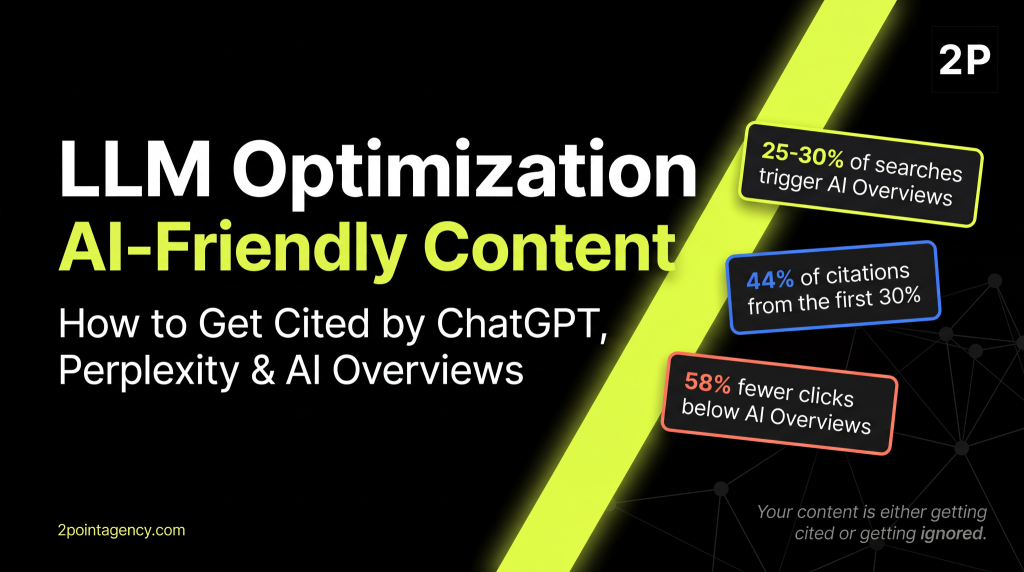
Millions of people are getting answers without ever clicking a link. They ask ChatGPT, Perplexity, or Google a question and walk away with a response that cites three sources. Yours is not one of them.
That is the LLM optimization problem. Large language models do not reward rankings alone.
They reward content structured to be extracted, summarized, and cited as a direct answer. Most brands are not building for that yet.
Knowing how to get cited by AI is now a real competitive advantage. 2POINT helps clients build AI-friendly content that earns citations across every major AI platform. This is the playbook.
Key Takeaways
- AI Overviews now appear in over 25% of Google searches, and AI referral traffic grew 357% year-over-year in 2025. LLMO is no longer optional for brands that rely on organic search.
- LLMs cite sources based on structure, authority, and freshness. To optimize content for LLMs, write self-contained, direct-answer sections that make sense without surrounding context. Unstructured long-form paragraphs get skipped.
- Structure and verifiable data are your two highest-leverage citation signals. Content with clear formatting, named sources, and specific statistics consistently outperforms generic prose across every major AI platform.
- 44.2% of all LLM citations come from the first 30% of an article. Front-load your strongest, most citable material and avoid burying your best points deep in the page.
- Generative engine optimization, LLMO, and AEO overlap heavily. The tactics are the same: clear structure, verifiable data, schema markup, and regular content updates.
Why Does LLM Optimization Matter for SEO in 2026?
AI systems are rapidly becoming the primary way people discover content online.
When a user asks a question and gets an AI-generated summary, the sources the AI pulls from get the traffic. Everything below that summary competes for what is left.
The scale of this shift is measurable. Ahrefs’ analysis of 300,000 keywords found that AI Overviews now correlate with a 58% lower click-through rate for the top-ranking page. Ranking on page one no longer guarantees the traffic it once did.
The opportunity, though, is just as real. AI-referred visitors arrive pre-qualified because the model has already matched their intent to your content. That pre-filtering makes the traffic you do receive significantly more valuable.
Your visibility in AI-powered search compounds over time as models learn to trust your content.
How Do LLMs Rank and Choose Sources?
How LLMs decide which sources to cite bears little resemblance to traditional search ranking.
Instead of keywords and backlinks, they evaluate structure, authority, and freshness. Understanding that process is the foundation of every LLM SEO strategy you build.
The "Skimming Homework" Model
Think of an LLM as a student skimming before an exam. It does not read your entire website.
It looks for clear headings that signal the topic, well-organized passages that lift cleanly into a summary, and trust signals that reduce its risk of citing something inaccurate. Google Search Central's guidance on helpful content confirms that the same qualities that make content useful for people make it useful for AI: real authorship, cited sources, and updated facts.
Here is what that skimming model looks for in practice:
| Signal | What Models Look For | Your Action |
| Authoritative | Real bylines, cited sources, updated dates | Add author bios, cite primary sources, and include dates |
| Structured | Skimmable blocks that extract cleanly | Use 2-3 sentence overviews after H2S, clear headings, and short FAQ blocks |
| Context-rich | Entities, related concepts, relationships | Define terms, link related pages, and add schema markup |
Where Citations Actually Come From
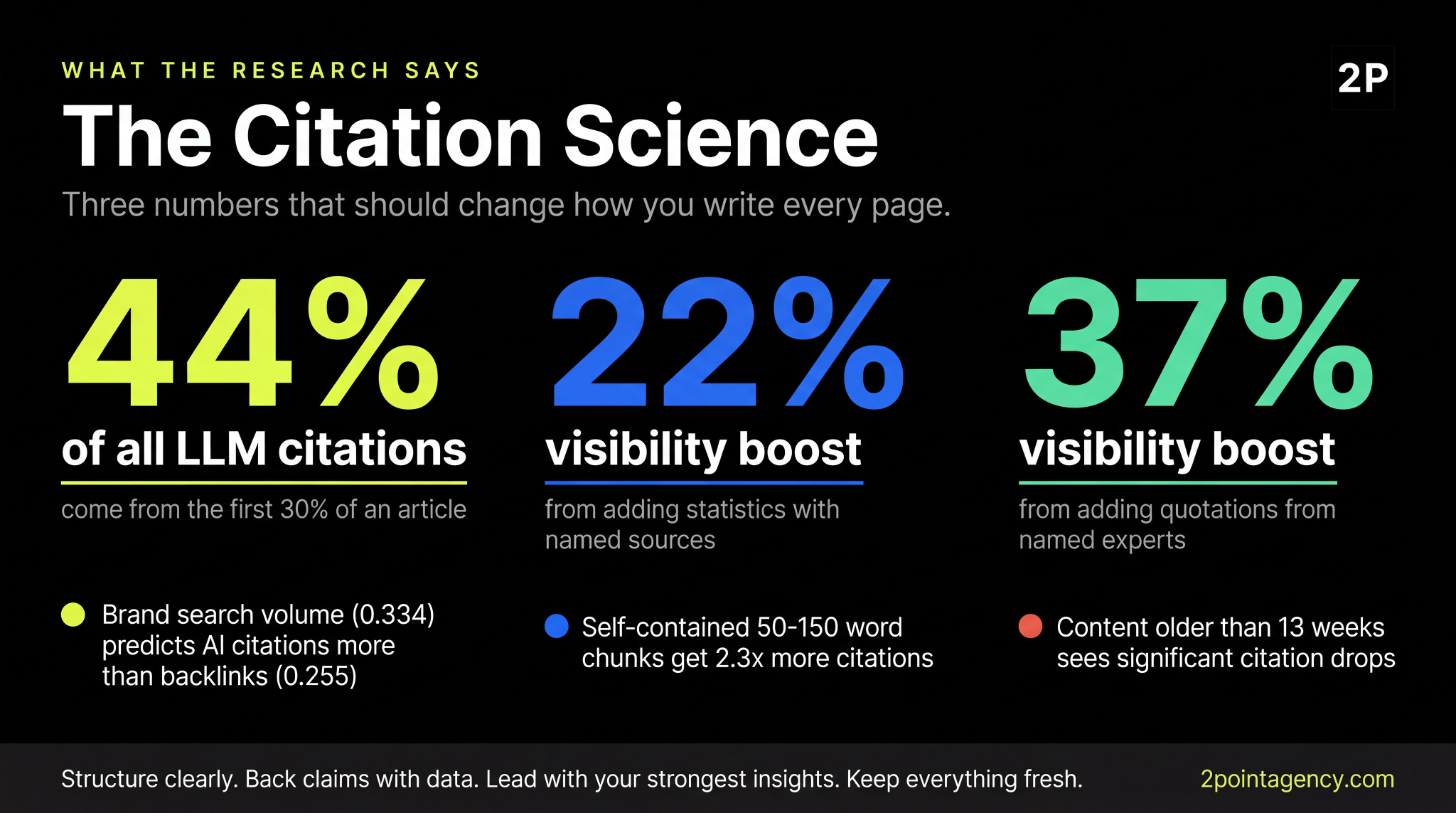
Kevin Indig's analysis of 1.2 million ChatGPT responses found that 44.2% of all LLM citations come from the first 30% of an article. Your introduction does the heavy lifting for AI visibility.
Bury your best content below the fold, and models may never find it.
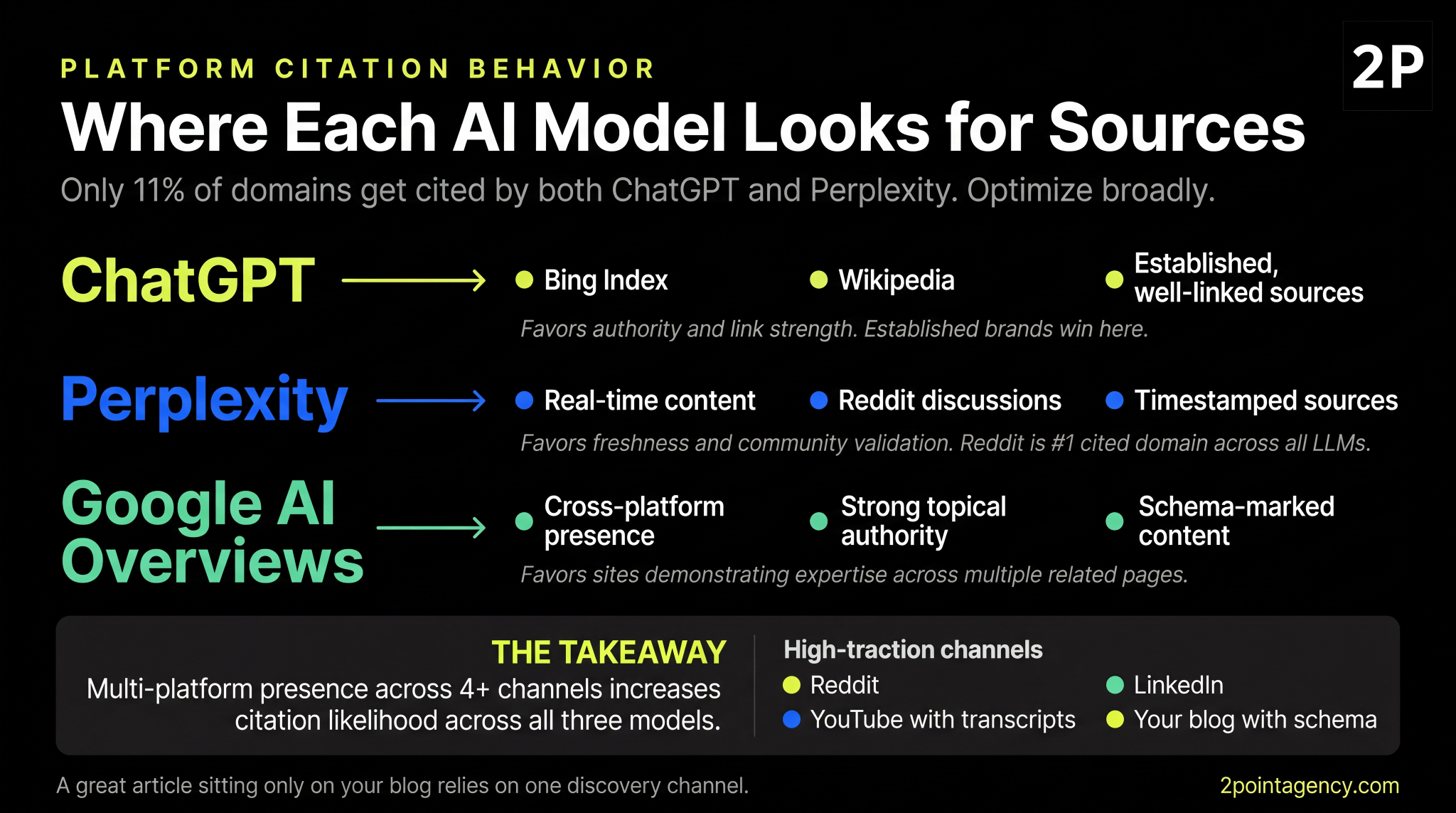
Platform behavior varies, too. ChatGPT draws heavily from Wikipedia, Perplexity favors real-time Reddit discussions, and Google AI Overviews look for cross-platform authority. Semrush's analysis of 230,000+ prompts found that only 11% of domains get cited by both ChatGPT and Perplexity simultaneously.
That makes optimizing for one model a partial strategy at best. Your content needs to satisfy the shared requirements across all platforms: clear structure, cited data, visible authorship, and freshness signals.
LLMO vs GEO vs AEO: What's the Difference?
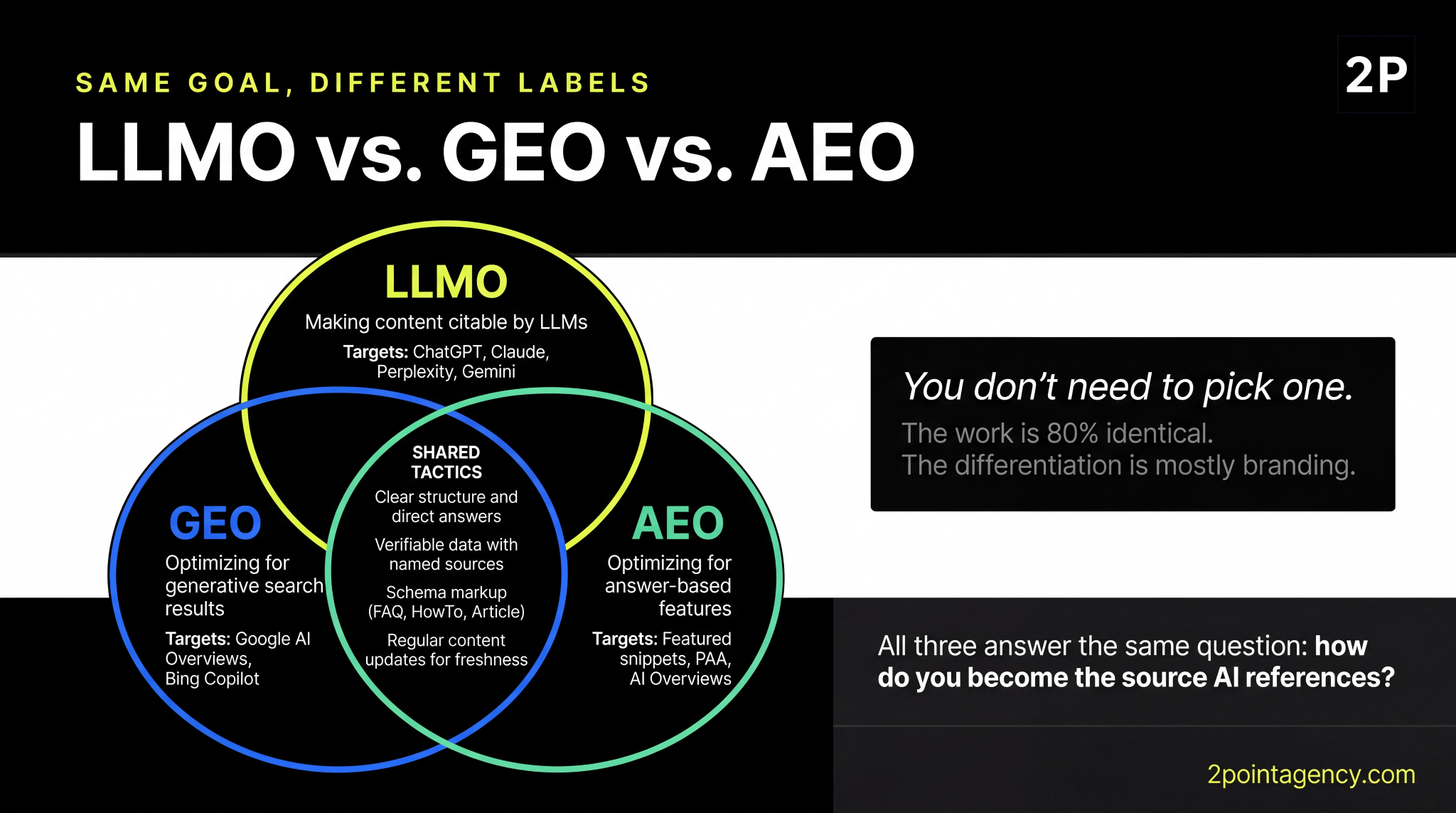
Three acronyms dominate conversations about AI search optimization, and they overlap enough to cause real confusion. LLMO, GEO, and AEO all describe strategies for making your content visible to AI systems.
Understanding where they differ helps you prioritize the right tactics for your goals. Here is how they compare:
| Aspect | LLMO | GEO | AEO |
| Focus | Making content citable by LLMs | Optimizing for generative search results | Optimizing for answer-based search features |
| Targets | ChatGPT, Claude, Perplexity, Gemini | Google AI Overviews, Bing Copilot | Featured snippets, PAA, AI Overviews |
| Key tactics | Structure, entity clarity, citations, and freshness | Statistics, quotations, source authority | FAQ schema, direct answer formatting |
| Origin | Industry practitioners (2024-2025) | Academic research (KDD '24 GEO study) | SEO community (evolved from snippet optimization) |
You do not need to pick one. The underlying tactics are largely the same: structure your content so AI can parse it, back up your claims with verifiable data, include schema markup, and keep everything up to date.
If you see a competitor positioning themselves as "GEO experts" while another touts "AEO services," understand that the work is 80% identical. The differentiation is mostly branding.
What matters is whether you are doing the work: structuring for AI extraction, proving your authority with data, and staying current.
What Is LLM Optimization? (And How Is It Different from Traditional SEO?)
LLM optimization is the practice of structuring your content so AI systems can understand it, trust it, and cite it when generating answers. It differs from traditional SEO in one fundamental way: traditional SEO optimizes for ranking position, while LLM optimization optimizes for citation likelihood.
Two concepts drive this distinction:
- Semantic SEO: Writing to the whole idea and its obvious follow-up questions. If your page covers LLM optimization, AI systems expect related concepts like schema markup, topical authority, and content freshness to appear naturally. Leave those gaps, and the model treats your content as incomplete.
- Entity-based SEO: Naming real things and connecting them clearly. Mentioning ChatGPT, Google AI Overviews, and Perplexity by name anchors your content to entities the model already recognizes. That specificity builds trust in ways generic language cannot match.
A 2024 study published at ACM SIGKDD found that generative engine optimization techniques can boost content visibility in AI responses by up to 40%. Adding statistics and authoritative quotations were among the most effective individual tactics.
The practical takeaway for you: content that reads like a neutral, well-sourced reference earns more AI citations than content that reads like a sales pitch.
What Makes LLMs Actually Cite Your Content?
The research on how to get cited by AI has matured considerably since 2024. Multiple studies now converge on specific, measurable signals that drive citation behavior.
These are the signals your content needs to hit, and they form the foundation of any effective LLM optimization strategy.
The Signals That Drive Citations
Brand search volume is the strongest predictor of AI citations, with a 0.334 correlation, according to The Digital Bloom's 2025 AI Visibility Report. That is higher than backlinks at 0.255.
For your AI visibility strategy, brand recognition now matters more than traditional link building.
Beyond brand signals, multi-platform presence across four or more channels increases citation likelihood. When your insights appear on your blog, YouTube, LinkedIn, and in relevant Reddit threads, AI models see consistent messaging from multiple independent sources. That redundancy validates your authority across the web.
Structure and transparency matter just as much. Real authorship, visible publication dates, and cited sources reduce the perceived risk for AI models when deciding whether to reference your content. Anonymous pages with no date attached are the fastest way to get passed over, regardless of how accurate your information is.
Content Formatting That Earns Citations
Formatting directly affects how often AI systems cite your content.
Surfer SEO's AI Citation Report found that AI Overview-cited articles cover 62% more facts than non-cited ones. Verifiable, specific data points give AI models something concrete to extract and attribute.
Positioning plays an equally important role. AI models read like journalists, grabbing the key facts from the top of your content first. Your introduction and opening sections carry the most citation weight, so front-load your strongest, most specific claims rather than building toward them.
Structure reinforces both. These formats get parsed faster and more accurately than dense prose:
- Question-based H2 headings followed by 40 to 60-word direct answer paragraphs.
- Comparison tables with specific, labeled data points.
- Numbered lists for step-by-step processes.
- Bullet points for scannable takeaways and feature breakdowns.
Platform-Specific Citation Behavior
Different AI models source content differently. Building your strategy around a single platform leaves visibility on the table.
- ChatGPT relies on Bing's index and draws heavily from Wikipedia. Well-linked, established sources with clear authority signals perform best.
- Perplexity emphasizes real-time content. Reddit discussions, recently published posts, and timestamped sources rank higher in its citation preferences.
- Google AI Overviews reward cross-platform presence and strong topical authority. Sites that demonstrate expertise across multiple related pages earn more citations.
The LLM Seeding Strategy
LLM seeding is the practice of publishing content in the formats and locations where AI models are most likely to discover and cite it. Your blog is one channel. The ecosystem you build around it is what compounds your citation surface area.
The channels with the highest traction for AI citation right now:
- Reddit: Authentic, experience-based answers in relevant subreddits
- YouTube: With full transcripts and captions
- LinkedIn: Professional thought leadership that AI models treat as authority signals
- Your blog: With proper schema markup
The most powerful version of this strategy is creating original data points that nobody else can replicate. When an LLM finds a unique statistic or firsthand case study, it returns to that source repeatedly.
Repurposing your content across these channels multiplies each original insight across every AI model that looks at it.
How to Find Content Gaps for LLM Optimization
A content gap audit identifies where your content falls short compared to what AI systems need to cite you. Run through these five steps for any industry or content type:
- Step 1: Define the job and entity. Write the core task your audience needs to accomplish in one sentence. List the obvious sub-tasks and name the main entity clearly.
- Step 2: Run competitor coverage. Find terms your competitors rank for that you do not. Pay special attention to question-based queries since those are what AI systems answer most frequently.
- Step 3: Read the SERP like a programmer. Check which competitors appear in AI Overviews for your target queries. FAQ blocks, comparison tables, and step-by-step lists get cited more often than narrative paragraphs. Layer this AI-specific lens on top of your on-page SEO audit findings.
- Step 4: List missing content types. For each gap, identify whether the missing piece is an FAQ block, a tutorial, a checklist, or a template. AI models cite the format that best answers the query.
- Step 5: Map the cluster. One pillar page answers the main task. Supporting pages tackle each sub-task. Interlink them all so AI systems recognize your site as a comprehensive authority on the topic.
The "Be the Source" Playbook: How to Get Picked by AI
Making your content the definitive source for AI systems requires three things from you: matching your format to the query, aligning your structure with the model's extraction preferences, and aligning your authority with the model's trust thresholds.
When to Use Video, Blog, or Interactive Formats
A useful test: read a ChatGPT or Perplexity answer on your topic and ask yourself what is missing.
Use that answer to choose your format:
- Informational queries: Blog posts with FAQ schema earn the most citations. If nuance matters, pair the post with an FAQ block.
- How-to queries: Video with transcripts and HowTo schema captures both traditional and AI-powered results.
- Comparison queries: Structured tables outperform narrative paragraphs because they provide AI models with a clear data structure for extracting information.
AI citation is the distribution mechanism. Your content still has to deliver real value when someone clicks through.
Best-Practice Templates for AI-Friendly Content
| Element | Blog Post | Video Tutorial | Any Format |
| Opening | 40 to 60-word summary answering the core query | Promise the result in the first sentence of your description | State the answer before the explanation |
| Structure | Question-based H2 headings for each section | Timestamps for each step and a full transcript | One primary goal per page |
| Data | At least one statistic with a named source and year per major section | Descriptive titles with both the task and the tool names | Use recent examples (2024 to 2026) |
| Format | Short FAQ covering the obvious follow-up questions | Keep the runtime between 60 and 180 seconds for single-task videos | Consistent entity names throughout |
| Schema | Article and FAQPage schema | VideoObject schema | Canonical links and descriptive alt text |
| Trust Signals | Visible updated date and author bio | One-paragraph recap below the player | Mobile-fast loading |
| Links | Internal links that mirror the user's likely next question | Internal links that mirror the user’s likely next question |
The llms.txt Standard
Create an llms.txt file at your site root. This Markdown file lists your most important pages with brief descriptions, serving as a sitemap specifically for AI crawlers.
It helps ChatGPT, Claude, and Perplexity discover and prioritize your canonical content.
The format is simple: place a Markdown file at yoursite.com/llms.txt with a title, a brief site description, and your most important URLs, each with a one-line summary. Early adopters report improved citation rates.
Implementation takes under an hour, and getting yours in place now gives you a head start before this becomes standard practice.
Core LLM Optimization Strategies (Step-by-Step)
These six strategies cover the tactical steps of generative engine optimization, making your content AI-friendly across every major platform.
Each one addresses a specific signal that AI models evaluate when deciding whether to cite you.
1. Use Structured Headings and Lists
AI reads your page structure before it processes your actual content. Clear headings and lists give the model a map of what your page covers and where each piece of information lives.
Use proper hierarchy: H1 for your main topic, H2 for key subtopics, H3 for details. Keep your paragraphs short and self-contained. Each section should answer its heading question completely without requiring surrounding context to make sense.
2. Optimize for Entities and Context
Keywords place your content on the map. Entities tell AI exactly where it sits on that map.
Writing about LLM optimization, name the specific models (ChatGPT, Gemini, Perplexity, Claude), the schema types (FAQPage, HowTo, Article), and the tools practitioners actually use.
That specificity anchors your content to nodes in the AI's knowledge graph.
Co-occurrence reinforces this further. Related entities appearing naturally across your page signal depth to AI models. Building content ecosystems across related topics creates exactly the kind of entity-rich network AI recognizes as authoritative.
3. Add FAQ Sections and Short Summaries
Short summaries of 40 to 60 words placed directly after each H2 heading are the blocks AI systems extract when generating answers. FAQ sections serve the same purpose at the page level.
Pages with FAQPage schema are 3.2x more likely to appear in AI Overviews. Pull your questions from Google Search Console, customer support tickets, and People Also Ask boxes.
Those are the exact phrases your audience types into AI systems, too.
4. Use Schema and Internal Linking
Schema markup helps AI understand your page's purpose and content type. Each schema type serves a distinct role:
- The article schema confirms authorship and publication dates, giving AI a trust signal it can verify
- HowTo schema maps step-by-step processes into a format AI can extract directly
- The FAQ schema allows your answers to surface inside AI-generated results
Schema is a clarity signal, not a ranking signal. It removes ambiguity, allowing AI models to parse your content accurately. Thin or generic content gets ignored regardless.
Internal linking reinforces this by showing AI that your site covers related subtopics in depth. Glossary hubs built for semantic breadth signal to AI that your site is a comprehensive resource worth citing.
5. Keep Content Fresh and Data-Backed
Freshness is one of the most underestimated factors in AI citation. Research on content freshness in AI search found that 50% of AI-cited content is less than 13 weeks old.
Your citation probability starts declining noticeably after that window closes.
The same principle applies to refreshing older content. HubSpot found that updating older blog posts can increase organic search views by up to 106%. That freshness signal now carries equal weight in AI citation.
Build quarterly content reviews into your workflow. Knowing which posts need updating versus which to leave alone saves you from wasting effort on pages that are already performing well.
6. Distribute Content Where LLMs Look
Your blog is your home base. The AI citation ecosystem, though, extends well past it.
Reddit carries disproportionate weight in AI citations. Authentic answers written from genuine experience get cited because AI models value community-validated expertise.
YouTube transcripts are fully indexed, so every video you publish with captions becomes a citable text source. LinkedIn articles, similarly, build the professional authority models recognize when evaluating your brand.
Together, publishing across four or more channels creates redundant authority signals that AI models cross-reference. That redundancy is what makes your expertise discoverable regardless of which model a user queries.
Distribution, however, does not mean copying and pasting the same content everywhere. Syndicating content without risk of duplication means adapting each piece to the platform's native format and culture.
How to Measure LLM Optimization Success
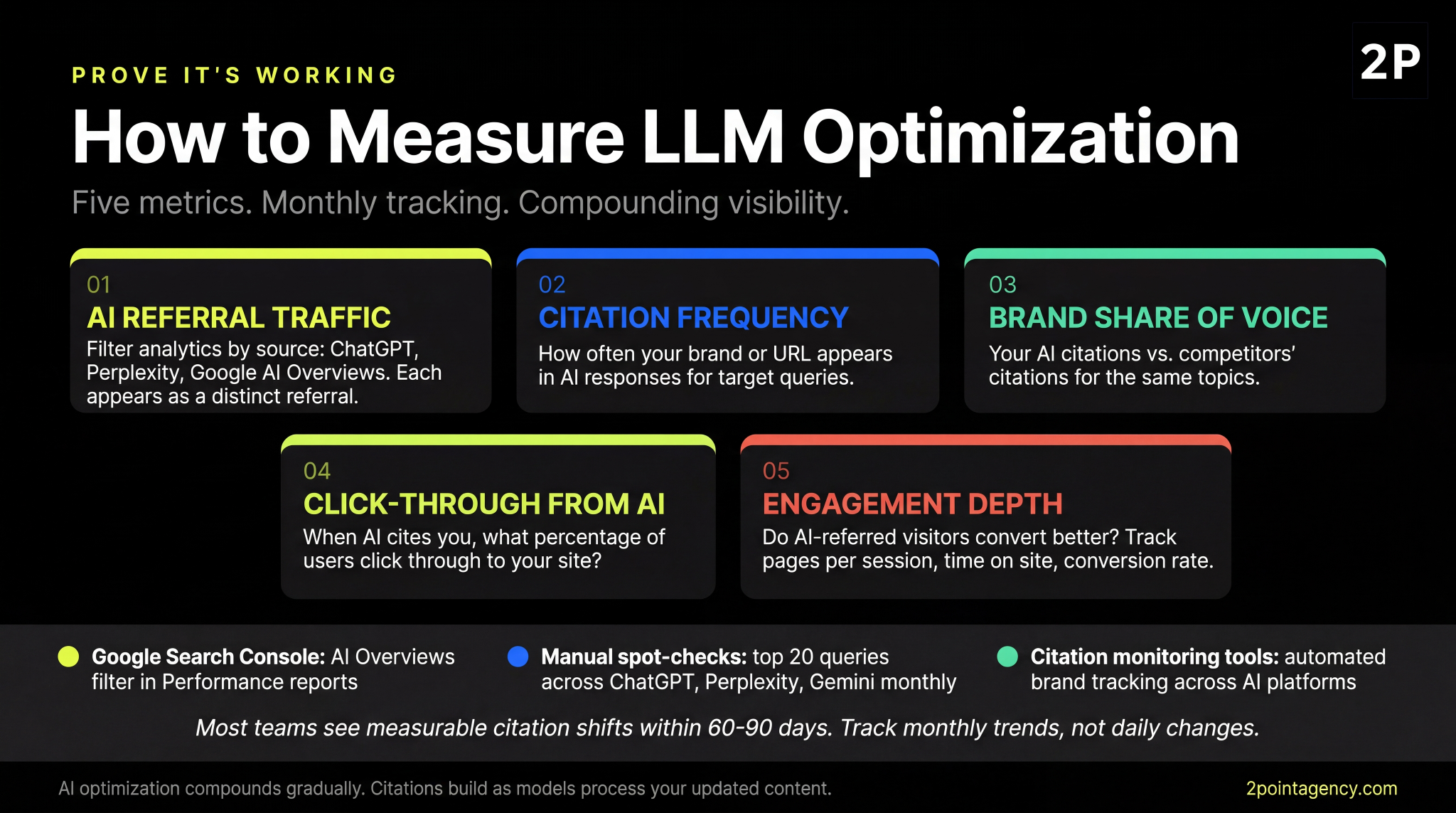
AI search optimization only earns its budget if you can prove it is working. The good news is that the measurement tools have caught up. You now have practical ways to track your AI visibility alongside traditional SEO metrics.
Metrics That Matter
Track these five metrics to measure your AI visibility progress:
- AI referral traffic: Filter your analytics by source. ChatGPT, Perplexity, and Google AI Overviews each appear as distinct referral sources.
- Citation frequency: How often does your brand or URL appear in AI-generated responses for your target queries?
- Brand mention share of voice: Your AI citations compared to your competitors' citations for the same topics.
- Click-through from AI panels: When AI cites you, what percentage of users actually click through to your site?
- Engagement depth: Do AI-referred visitors behave differently from organic visitors? Track pages per session, time on site, and conversion rate.
Tools for Tracking
The AI search optimization landscape evolves quickly, so focus on categories rather than specific products.
AI citation monitoring tools track brand mentions across ChatGPT, Perplexity, and Gemini. Google Search Console now includes an AI Overviews filter in its Performance reports, showing you exactly which queries surface your content in AI summaries.
Manual spot-checks still add value alongside those tools. Search your top queries in ChatGPT, Perplexity, and Gemini once a month and document which sources get cited.
For a practical setup, create a spreadsheet with your top 20 target queries. Run each one through all three platforms monthly, recording whether your brand appeared, which URL was cited, and your position in the response.
Setting Realistic Expectations
AI optimization compounds gradually. Citations build as models process your updated content across crawl cycles, so track month-over-month trends rather than expecting daily changes.
Most teams see measurable shifts in citation frequency within 60 to 90 days. Early wins typically come from:
- Adding direct answer paragraphs to existing pages
- Implementing the FAQ schema on high-traffic content
- Refreshing outdated statistics with current, sourced data
Deeper gains from authority building and multi-platform seeding take longer.
Expect three to six months before citation rates shift noticeably. Focus on citation quality as well as quantity throughout, because an AI that accurately represents your brand is worth more than one that misrepresents you.
Common LLM Optimization Mistakes
These are the patterns that consistently hinder AI visibility.
- Treating LLMO as separate from SEO. The foundations are identical: structure, authority, freshness, and user value. Approaching them as separate workstreams means duplicating effort and missing the compounding benefits.
- Optimizing for one model only. Only 11% of domains get cited by both ChatGPT and Perplexity. Build for overlap, not a single platform.
- Ignoring the first 30%. Over 44% of citations come from introductions and early sections. Lead with your strongest material.
- Stuffing schema without substance. Schema helps AI parse your content, but it cannot compensate for thin or generic writing. Perfect markup on mediocre content still gets ignored.
- Neglecting freshness. Half of AI-cited content is less than 13 weeks old. Content you published in 2024 and never updated is already losing citation eligibility.
- Publishing without a distribution plan. AI models validate content through cross-platform presence. A great article sitting only on your blog relies entirely on one discovery channel.
How 2POINT Helps You Rank in AI-Driven Search
We start with an AI visibility audit to check whether your key pages appear when someone asks ChatGPT, Perplexity, or Google AI Overviews about your industry.
That baseline tells us exactly where you stand.
From that foundation, we restructure your content to meet citation eligibility requirements. Direct answer formatting, schema implementation, entity optimization, and internal linking that signals topical depth to AI models.
We then build a measurement framework to track AI citations alongside your traditional rankings.
You see which content gets cited, by which models, and for which queries. Ready to see where your content stands? Our SEO team will show you the opportunities, and AIOBot handles the ongoing optimization so your team stays focused on strategy.
Is Your Content Getting Cited or Getting Ignored?
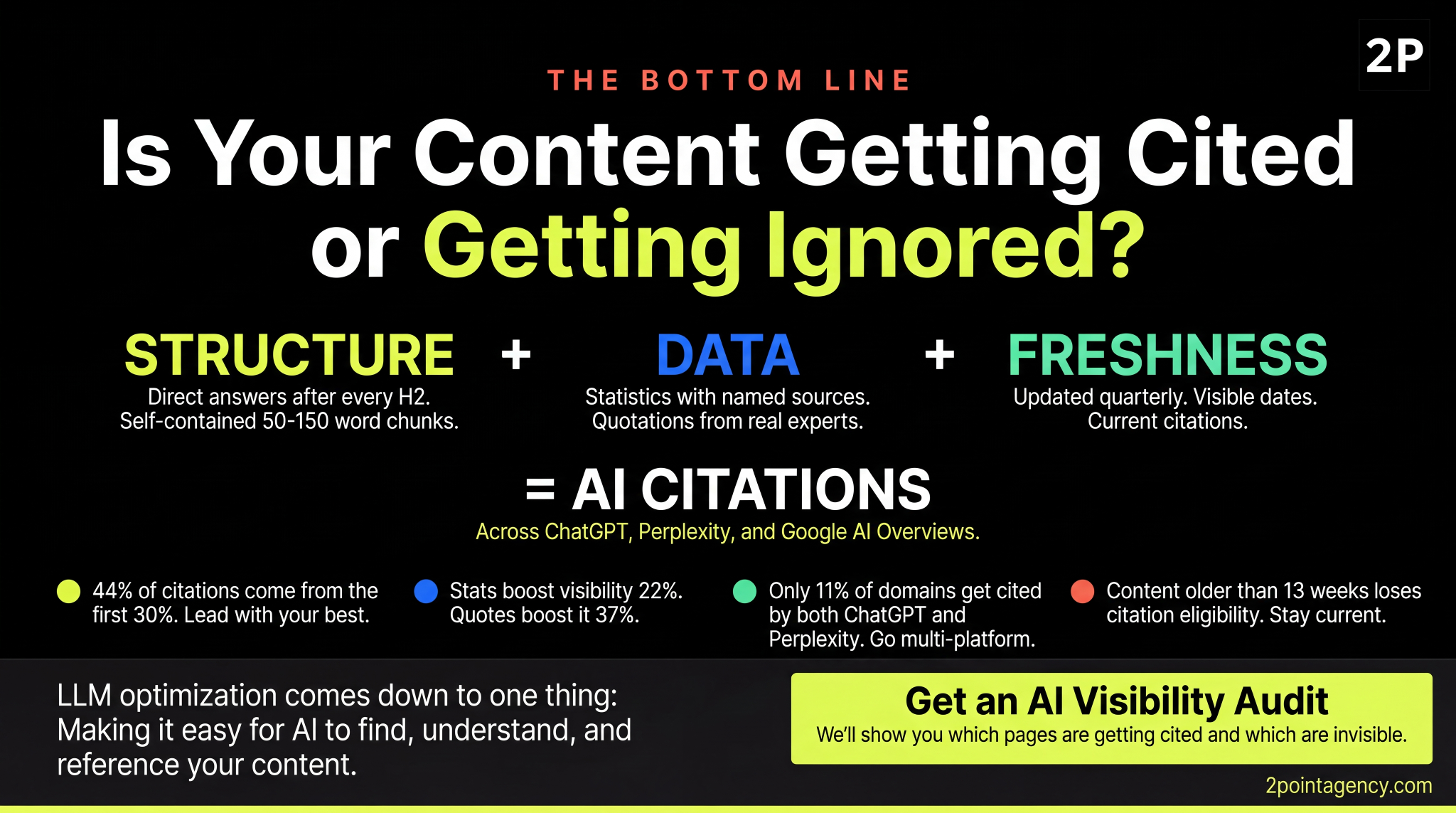
LLM optimization comes down to one thing: making it easy for AI models to find, understand, and reference your content.
Structure it clearly. Back every claim with verifiable data. Lead with your strongest insights. Keep everything fresh.
The research on what drives citations is solid and getting more specific every quarter. The tools exist. What separates brands that show up in AI answers from those that don't is simply whether they act on it.
2POINT's SEO team builds LLM optimization strategies that put your brand in front of the right audiences, and AIOBot keeps your content optimized as AI search evolves.
FAQs About LLM Optimization
What is LLM optimization in SEO?
LLM optimization is the practice of structuring content so AI systems like ChatGPT, Perplexity, and Google AI Overviews can understand, trust, and cite it.
Unlike traditional SEO, which targets ranking position, LLM optimization targets citation probability.
The core tactics for optimizing content for LLMs include direct-answer formatting, schema markup, named-source citations, and regular content updates.
How is LLMO different from traditional SEO?
LLMO differs from traditional SEO in what it optimizes for. Traditional SEO targets your ranking position on a search results page.
LLM optimization targets citation likelihood, meaning how often AI models reference your content when generating answers. Both share the same foundations, but LLMO places greater emphasis on structure, entity clarity, and content freshness.
How do I know if AI is citing my content?
To find out whether AI is citing your content, check the AI Overviews filter in Google Search Console's Performance report. Run monthly spot-checks by searching your target queries in ChatGPT, Perplexity, and Gemini, then document which URLs appear.
Citation monitoring tools can automate this tracking across multiple platforms simultaneously.
Does LLM optimization replace traditional SEO?
LLM optimization does not replace traditional SEO. It extends it.
Strong traditional SEO foundations, including page speed, quality backlinks, and topical authority, directly support AI citation likelihood. The most effective approach treats both as complementary strategies.
When executed together, they reinforce each other across both traditional search and AI-generated answers.
What is the fastest way to improve AI visibility?
The fastest way to optimize content for LLMs is to make three targeted changes to existing pages: add 40-60-word direct-answer summaries after each H2 heading, include at least one statistic with a named source per major section, and implement the FAQPage schema.
All three can be applied in a single editing pass without publishing new content.