let’s connect


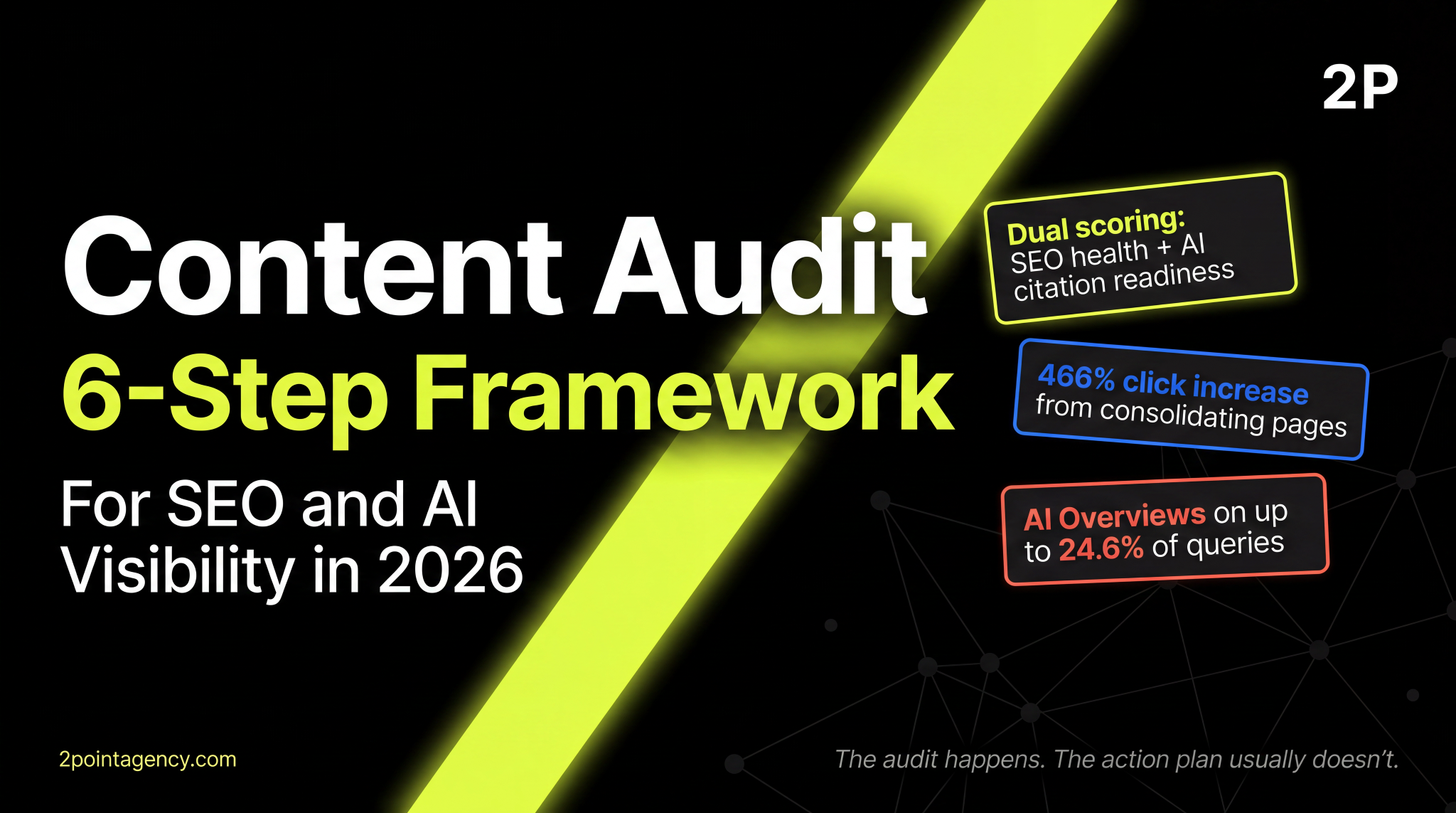
Most teams have hundreds of published pages and no clear picture of which ones are actually working. Traffic slides quietly for months before anyone investigates, and when they do, the content audit that follows usually ends at a spreadsheet nobody revisits.
The audit happens. The action plan does not.
The problem is not effort. Most content audit processes stop at inventory and miss two things: a scoring system that prioritizes action, and an AI content audit layer that captures visibility in AI Overviews, Gemini, and ChatGPT.
2POINT built this six-step framework to address both gaps simultaneously.
Key Takeaways
- A content audit is a prioritized action plan, not an inventory exercise. Every URL needs a clear verdict: protect, upgrade, investigate, merge, or delete.
- The dual scoring system, combining the SEO Health Score and AI Citation Readiness Score, is what separates a useful SEO content audit from a vanity exercise. Most frameworks on the SERP only cover half the picture.
- Pages losing 20% or more of organic traffic year over year are silently dragging your site’s authority down. Most teams do not catch it until the damage compounds.
- Keyword cannibalization appears in almost every website content audit. Multiple pages competing for the same query split the authority and hand the ranking to a competitor.
- Google’s March 2026 core update rewarded relevant, satisfying content. If you have not audited since, your data is outdated.
- Your Monday-morning move: export your full URL list from Search Console, apply the dual scoring system, and build your content audit template into a priority matrix you can act on immediately.
What Is a Content Audit (and Why Most Audits Fail)
A content audit is a systematic review of every published page on your website.
You evaluate each piece on performance, relevance, quality, and strategic fit, and aim for a clear verdict for every URL: keep it, update it, merge it, or delete it.
Most teams treat the audit like a data pull. Export URLs, check traffic numbers, flag a few thin pages, move on. That is an inventory, not an audit. An inventory tells you what exists. A website content audit tells you what to do about it.
The difference is a scoring system. Every page needs a measurable SEO health score and an AI citation readiness score that together produce a prioritized action plan, not another forgotten spreadsheet.
Run one after any major Google core update. The March 2026 update reshuffled rankings across industries in just 12 days. Also run one when organic traffic drops for two consecutive months, before a site migration, or quarterly if your site has 100 or more pages.
How to Do a Content Audit in 6 Steps
A proper content audit process follows a structured sequence. Each step below builds toward the dual-score prioritization matrix that turns your data into decisions you can actually act on.
Step 1: Build Your Content Inventory
Start with a full crawl. Use Screaming Frog for sites with fewer than 500 URLs, Sitebulb for visual reports, or pull directly from your XML sitemap. Every indexable URL needs to be in one place before you can score anything.
Next, pull performance data from two sources:
- Google Search Console: impressions, clicks, CTR, and average position per URL
- GA4: sessions, engaged sessions, and conversions
Then tag each URL by type: pillar page, blog post, landing page, glossary entry, or resource page. Your technical SEO setup determines whether the crawl data feeding this inventory is clean and complete.
The end product is a single spreadsheet containing every URL, its type, and its baseline performance data.
Step 2: Score Each Page for SEO Health
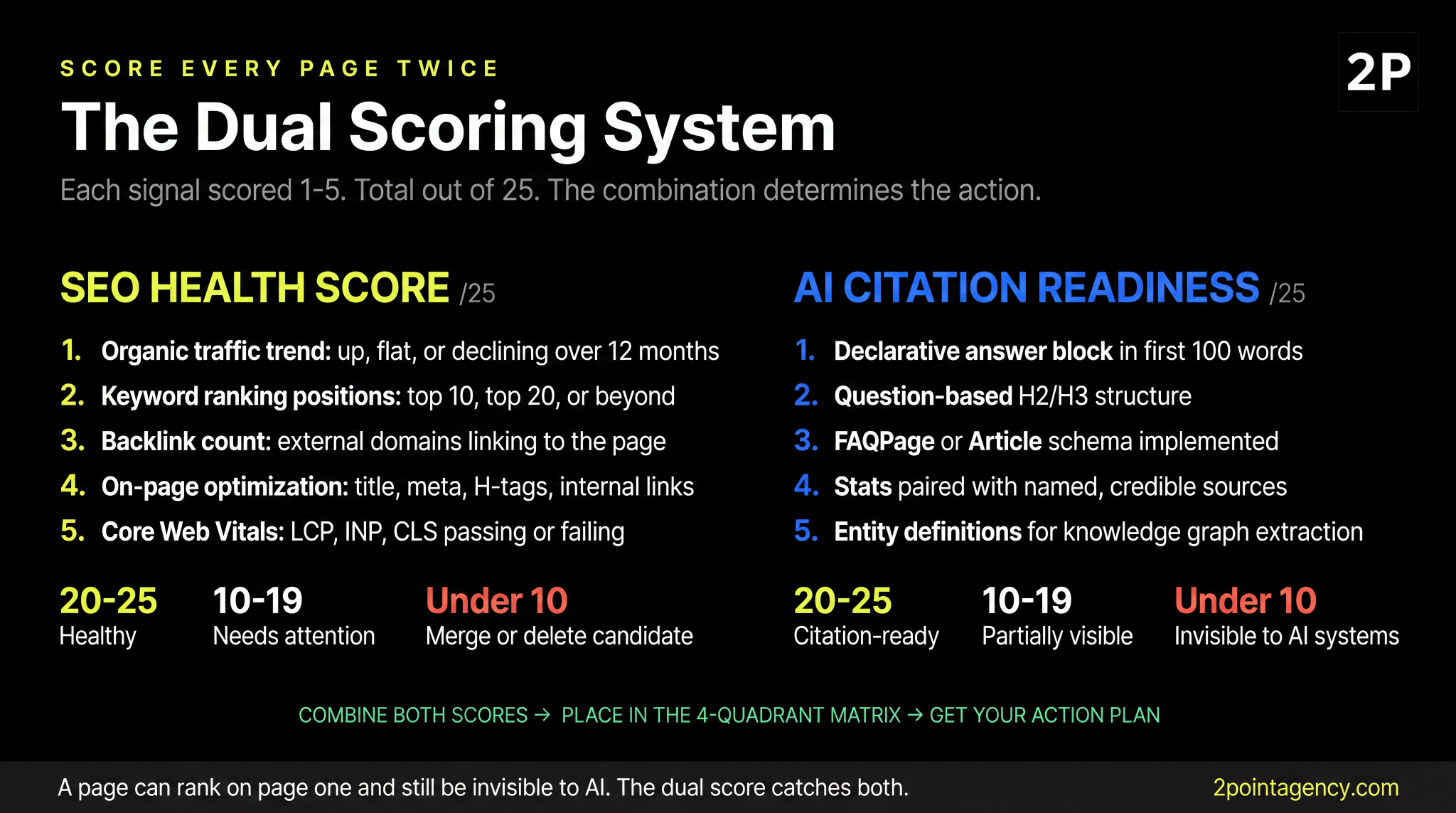
With your inventory built, the next step is assigning an SEO Health Score to every page. Each page gets scored across five signals:
- Organic traffic trend: up, flat, or declining over the past 12 months.
- Keyword ranking positions: primary keyword in top 10, top 20, or beyond.
- Backlink count: external domains linking to the page.
- On-page optimization: title tag, meta description, H-tag structure, internal links.
- Core Web Vitals: LCP, INP, and CLS passing or failing.
Score each signal on a 1 to 5 scale for a total out of 25. Pages with a score of 20 or higher are healthy. The 10-19 range needs attention. Anything under 10 is a candidate for merging or deletion.
Flag any page that lost 20% or more of its organic traffic year-over-year. That is your content decay signal, and it triggers an automatic review regardless of total score.
Step 3: Check for Keyword Cannibalization
Pull the top three ranking URLs for each of your target keywords from Search Console.
If multiple pages from your site appear for the same keyword, you have cannibalization, and it shows up in almost every SEO content audit.
The fix is straightforward. Pick the strongest page for each cannibalized keyword as your canonical winner. Then merge the weaker pages into it. Backlinko found that consolidating competing pages via 301 redirects led to a 466% increase in organic clicks, as the winning page absorbed the combined authority and climbed in the rankings.
Finally, cross-reference this step with your AI search visibility data. Pages cannibalizing each other in organic results often create the same confusion in AI citations.
Step 4: Score Each Page for AI Citation Readiness (The Layer Nobody Else Checks)
Most audit guides stop at traffic, rankings, and backlinks. That approach missed a critical layer. Semrush’s analysis of over 10 million keywords found AI Overviews appeared on up to 24.6% of queries at peak, expanding into commercial and transactional searches.
Your content can rank on page one and still be invisible to AI systems if it is not structured for citation. The AI Citation Readiness Score evaluates five signals:
- Declarative answer block in the first 100 words: Does the page provide a quotable answer immediately?
- Question-based H2/H3 structure: Are subheadings framed as questions AI models can extract?
- FAQPage or Article schema: Is structured data implemented correctly?
- Stat-plus-source pairings: Does the page pair data points with named, credible sources?
- Entity definitions: Does the page define key terms clearly for knowledge graph extraction?
Score each signal 1-5, total out of 25. Pages scoring 20+ are citation-ready. Pages with fewer than 10 pages are invisible to AI systems, even if they rank well organically. That gap is the blind spot this content audit checklist is designed to close.
Your LLM optimization foundation determines which side of that line your content falls on.
Step 5: Build the 4-Quadrant Priority Matrix
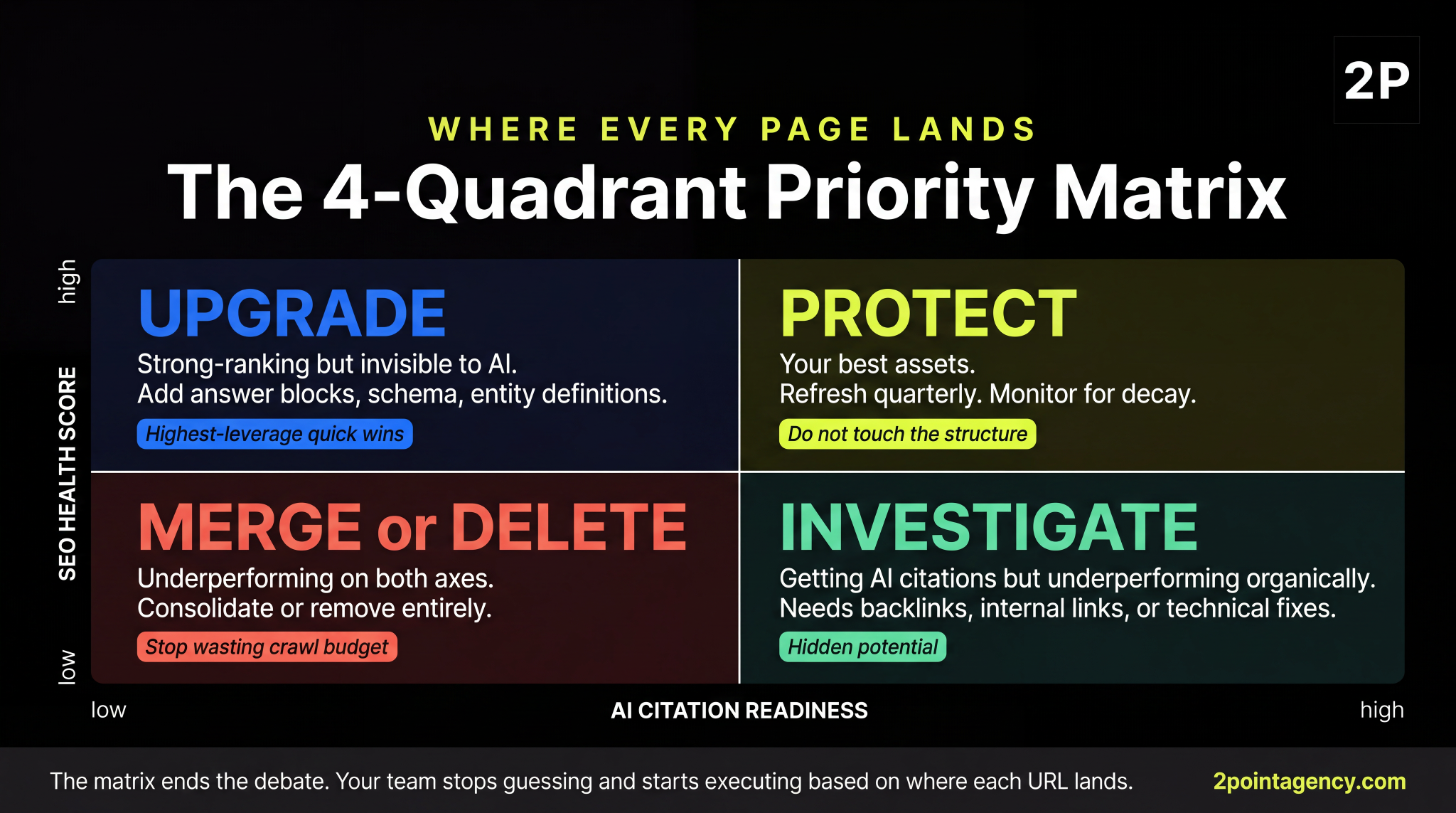
With both scores in hand, combine them into a 2×2 matrix. This is what turns your data into a clear action plan every team member can act on immediately.
- Quadrant 1: High SEO + High AI — PROTECT: Your best assets. Refresh quarterly, monitor for decay, and avoid structural changes.
- Quadrant 2: High SEO + Low AI — UPGRADE: Strong-ranking pages invisible to AI. Add declarative blocks, schema, and entity definitions. These are your highest-leverage quick wins.
- Quadrant 3: Low SEO + High AI — INVESTIGATE: Getting AI citations but underperforming organically. Likely needs backlink support, internal linking, or technical fixes.
- Quadrant 4: Low SEO + Low AI — MERGE or DELETE: Underperforming on both axes. Consolidate into a stronger page or remove entirely.
The matrix ends the debate. Your team stops guessing and starts executing based on where each URL lands.
Step 6: Execute the Action Plan
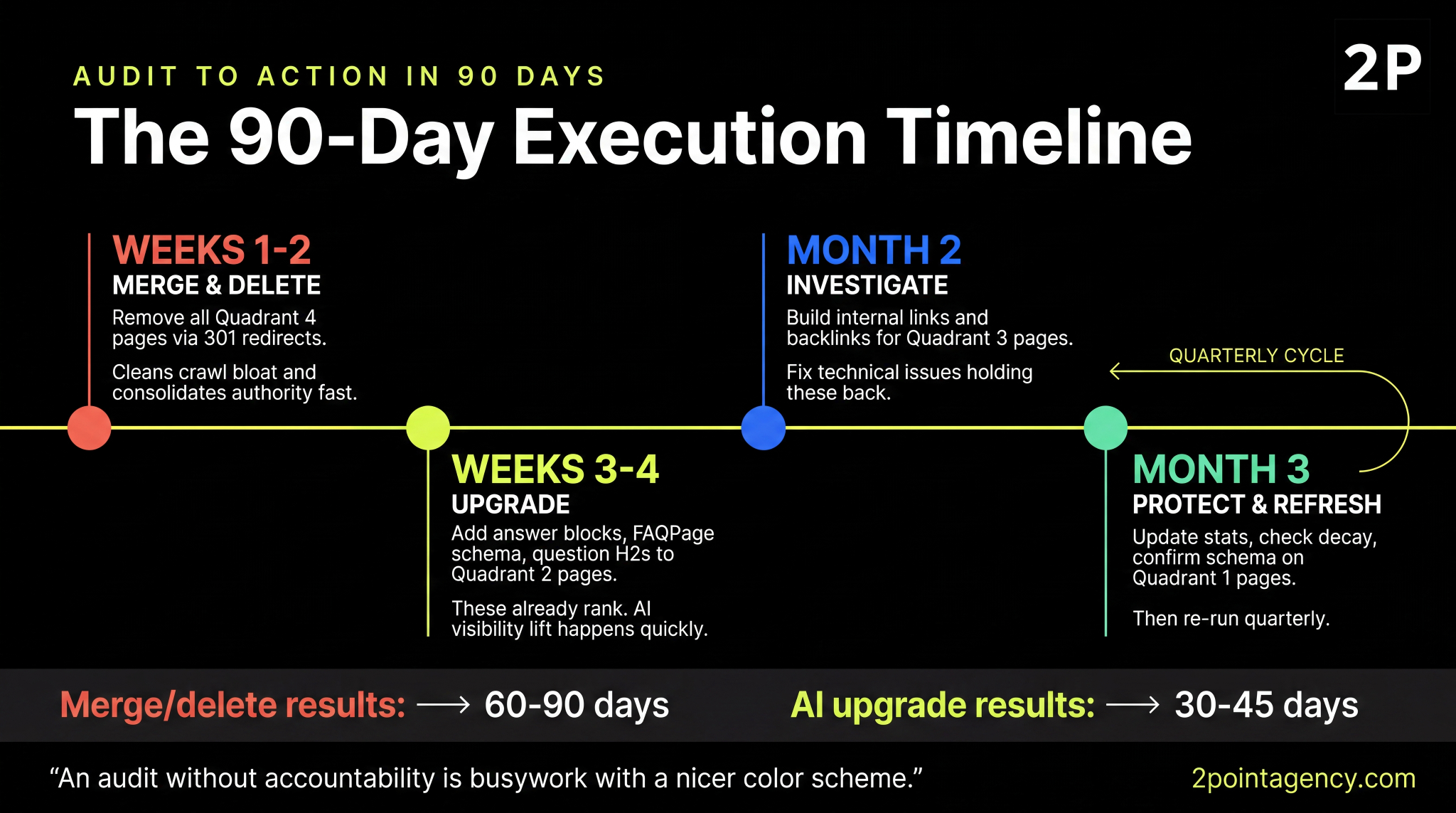
The audit deliverable is a 90-day execution plan, not a spreadsheet. Here is the timeline that works:
- Weeks 1 to 2: Merge or delete all Quadrant 4 pages using 301 redirects. This cleans crawl bloat and consolidates authority fast.
- Weeks 3 to 4: Upgrade all Quadrant 2 pages. Add declarative answer blocks, FAQPage schema, question-based H2s, and entity definitions. These pages already rank, so the AI visibility lift happens quickly.
- Month 2: Investigate Quadrant 3 pages. Build internal links, pursue backlink outreach, and fix technical issues.
- Month 3: Refresh all Quadrant 1 pages. Update statistics, check for content decay, and confirm the schema is up to date.
- Ongoing: Re-run your full website content audit quarterly. The dual scoring system speeds up repeat audits because the rubric is already built.
Assign every action to a specific owner with a deadline. An audit without accountability is busywork with a nicer color scheme.
Content Audit Tools: What You Actually Need
You do not need an enterprise platform to run a thorough content audit. The right stack covers five functions:
- Crawling: Screaming Frog (free under 500 URLs) or Sitebulb for visual reports
- Performance data: Google Search Console and GA4, both free and both essential
- Keyword and backlink data: Semrush or Ahrefs for position tracking and backlink profiles
- AI citation tracking: Profound, Peec AI, Otterly, or Athena HQ to measure whether your pages appear in AI Overviews and LLM responses
- Spreadsheet: Google Sheets or Notion. The scoring system matters more than the tool housing it.
The one decision worth thinking through is where AI search and traditional SEO overlap in your stack, since that determines which citation tools earn a permanent slot in your workflow.
What Happens After Your Content Audit: Measuring the Impact
Track these metrics by quadrant after executing your action plan:
- Organic traffic change: broken down by quadrant so you can see which actions moved the needle
- AI citation share change: Are Quadrant 2 upgrades translating into AI Overview appearances?
- Keyword cannibalization reduction: did the winning pages climb after resolving competing pairs?
- Index ratio: after merging and deleting, is Google crawling what you actually want it to crawl?
Timelines matter as much as the metrics themselves. Merge-and-delete actions typically show organic improvements within 60 to 90 days. Upgrade actions often produce AI citation lifts faster, within 30 to 45 days, because structural changes are immediately visible to AI crawlers.
Once you have those results, connect them to your broader content marketing strategy, so your SEO content audit findings feed future planning rather than sitting in an isolated spreadsheet.
Content Audit Mistakes That Waste Your Time
Five mistakes consistently derail content audits, and every one traces back to the same root cause: auditing without a system. Here is what to watch for before you start.
Auditing Without a Scoring System
Opening a spreadsheet and eyeballing which pages look weak is not an audit. Without a repeatable rubric, every decision becomes subjective, and nothing gets resolved. The fix is the dual scoring system.
Every page gets an SEO Health Score and an AI Citation Readiness Score, and the rubric carries forward to your next cycle.
Ignoring AI Visibility Entirely
Most online content audit templates stop at traditional SEO signals and cover only half the picture.
A page can rank on page one and still be invisible to AI Overviews and ChatGPT. If your audit does not score for AI citation readiness, it is already outdated.
Treating Every Page the Same
A Quadrant 1 page needs a light refresh every quarter. A Quadrant 4 page needs to be merged or deleted. Without the priority matrix, your team spends hours on pages that should have been removed weeks ago. The matrix prevents that entirely.
Running the Audit but Never Acting on It
The scores are filled in. The matrix is built. The document sits in a shared drive while everyone moves on. Tie every finding to a specific action, owner, and deadline. Your content audit process should produce a 90-day calendar, not a filing cabinet contribution.
Auditing Once and Forgetting About It
Content decays. Rankings shift. Algorithm updates rewrite the rules. Run a light audit quarterly on your top 20% of pages and a full audit annually. The dual scoring system makes repeat audits faster because your rubric and content audit template already carry over.
In-House vs Agency: Who Should Run Your Content Audit?
The right choice depends on your site size, internal expertise, and what leadership expects as a deliverable.
| Factor | In-House | Agency |
| Page count | Under 100 pages | 100+ pages |
| GA4 and Search Console expertise | Strong in-house | Limited or stretched |
| AI citation scoring experience | Solid and current | Little or none |
| Deliverable expected | Internal working doc | Polished priority report |
| Timeline flexibility | 2 to 3 focused weeks | Competing priorities |
| Dual scoring system | Built and maintained | No existing rubric |
Even teams that check the in-house boxes often find that competing priorities derail the execution. An agency brings the rubric, the tools, and dedicated time that most in-house teams simply cannot provide.
2POINT runs content audits using the dual scoring framework for mid-market brands that need both the SEO and AI citation layers built, scored, and actioned in the same engagement.
Is Your Content Library an Asset or a Liability?
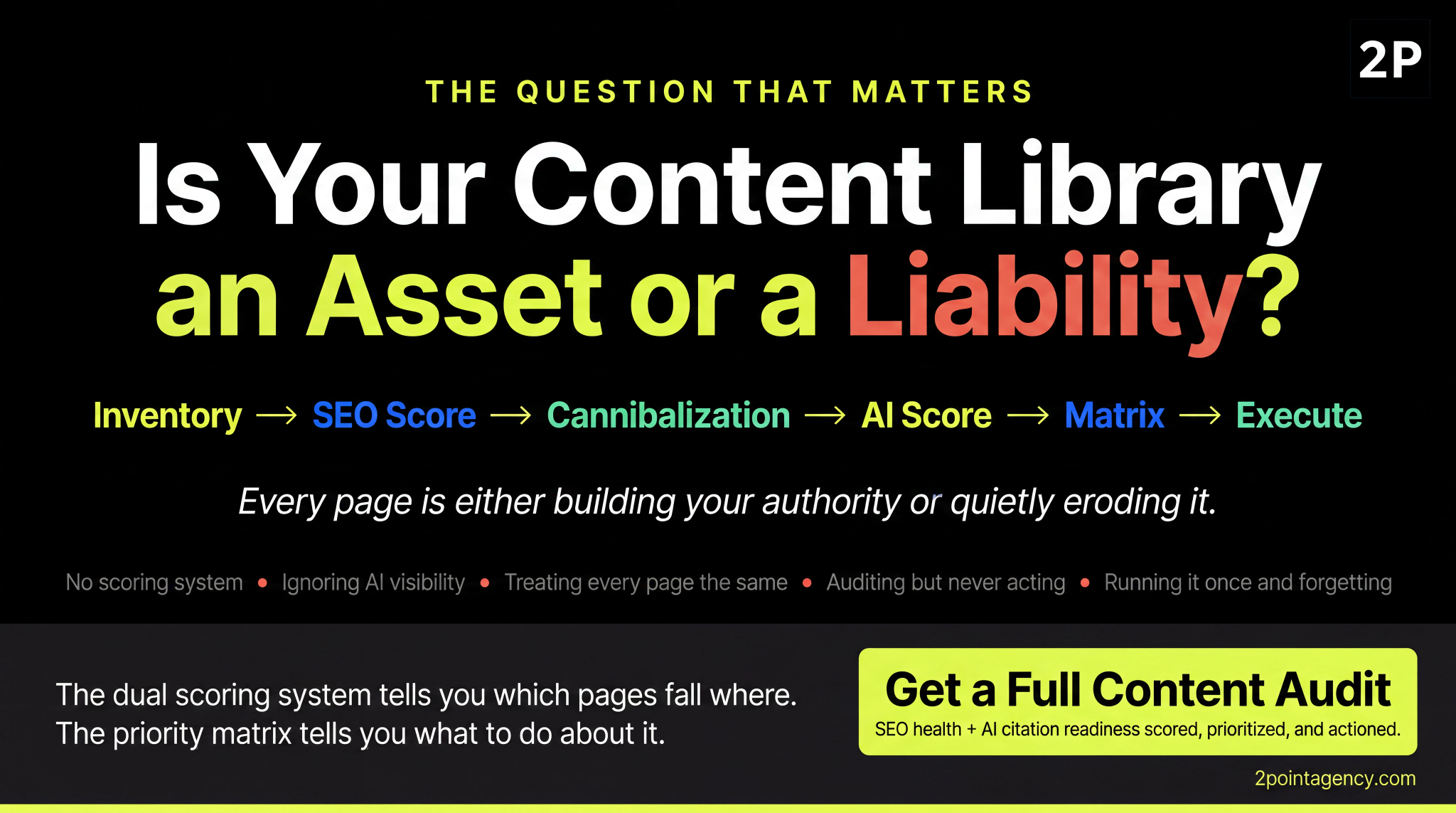
Every page you have published is either building your authority or quietly eroding it. The dual scoring system shows which pages fall where and provides a prioritized action plan.
2POINT’s SEO team and multi-channel marketing support help mid-market brands audit, prioritize, and execute without the scope becoming overwhelming.
FAQs About Content Audits
How often should you do a content audit?
Run a full content audit annually with lighter quarterly reviews on your top-performing pages. Sites with 200 or more URLs benefit from quarterly scoring because content decay and algorithm updates shift performance faster than annual reviews can keep up with.
What tools do you need for a content audit?
A website content audit requires Screaming Frog for crawling, Google Search Console and GA4 for performance data, and Semrush or Ahrefs for keyword tracking. For the AI content audit layer, tools like Profound or Otterly track AI Overview appearances.
How long does a content audit take?
A site with 100 to 200 pages typically takes two to three weeks using this content audit process. Larger sites with 500 or more URLs take four to six weeks, especially when scoring for both SEO health and AI citation readiness.
What should you do with underperforming content?
Your content audit checklist should assign one of four verdicts: protect, upgrade, merge, or delete. Pages with some value get merged into stronger pieces via 301 redirects. Thin pages with no backlinks get removed. The priority matrix tells you exactly which action each URL needs.
Does a content audit help with AI search visibility?
Yes. The content audit for SEO and AI visibility scores each page for citation readiness across declarative answer blocks, schema, and entity definitions. Pages scoring low are invisible to AI Overviews, even if they rank organically. Fixing those gaps expands your visibility beyond traditional search.
What is keyword cannibalization, and how does an audit fix it?
Keyword cannibalization happens when multiple pages target the same primary keyword. A SEO content audit identifies these conflicts through Search Console data so you can pick a canonical winner and redirect competing pages to consolidate ranking authority.
Should you delete old blog posts during a content audit?
Deletion makes sense when a page has zero traffic, no backlinks, and content that cannot be refreshed. Your content audit template should include a clear threshold for when deletion beats updating, based on dual scores rather than gut feel.