FOLLOW US

Last update: Jan 9, 2026 Reading time: 11 Minutes
Backlinks seem simple until you try to deliberately replicate results.
One strong link lands, rankings shift, and a pattern starts to show. The link helped because it fit the context, was on a page that already mattered, and pointed to something worth citing. Without that fit, outreach turns into noise, and the wins stay random.
Today, 2POINT Agency breaks down how to get backlinks for your website with 9 quality-first methods you can run consistently. It also shows how to vet sponsored opportunities and “easy link” offers, so your visibility stays legitimate and your link profile stays clean.
A high-quality backlink feels earned because it helps the reader immediately.
It sits in real content and points to a page that clearly strengthens the explanation. Links placed mainly to influence rankings stop acting like citations entirely.
Google’s spam policies label that link spam, so editorial intent becomes the real filter, even among the top ranking factors.
Use this checklist before chasing any link:
Link building gets easier once targets are clear. Pick 3–6 pages that deserve links, mixing money pages with supporting content that builds trust and context.
| Page type | Link intent | What to choose | Track these fields |
| Money page (service/product/category) | Authority lift. | High-converting page that needs stronger credibility signals | Target URL, prospect URL, status, live link, anchor, type, date |
| Supporting guide | Topical depth. | Best explainer that answers a key sub-question in your niche | Target URL, prospect URL, status, live link, anchor, type, date |
| Linkable asset (template/checklist/tool) | Product discovery support. | Resource people can cite and reuse without extra explanation | Target URL, prospect URL, status, live link, anchor, type, date |
| Proof page (case study/about/process) | Brand credibility. | A page that reduces doubt and supports decision-making | Target URL, prospect URL, status, live link, anchor, type, date |
Practical, repeatable tactics show how to get backlinks for your website through assets, outreach, and relationships.
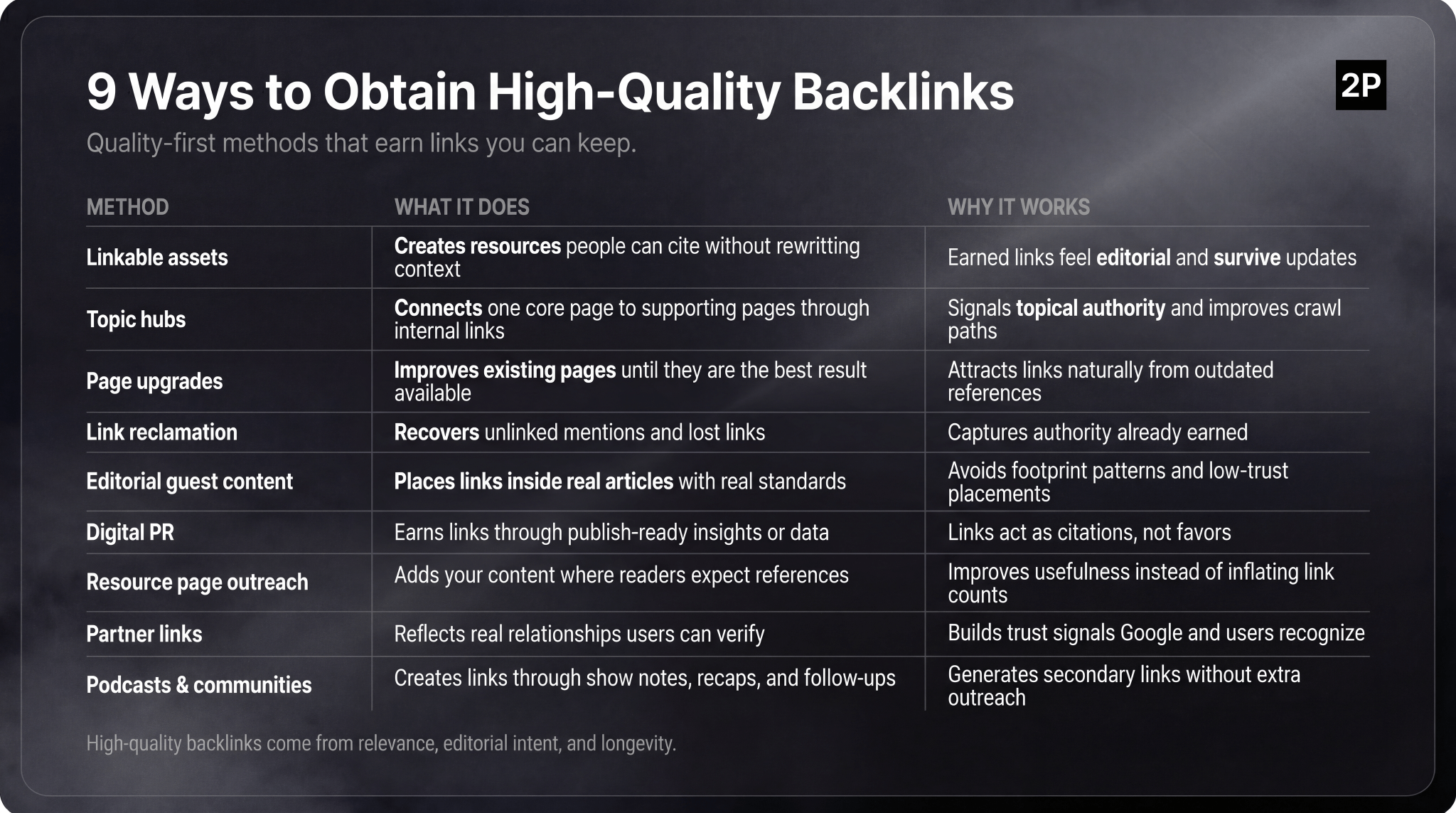
If an asset saves time, it earns citations and reduces friction for editors. Solve a specific problem so the link feels obvious.
Linkable assets win when they answer a question in a reusable format, so writers can cite them without re-explaining basics. That behavior aligns with research on information foraging and search, where users weigh value against effort and lean on SEO conversion basics when they need a dependable reference point.
Build assets that are easy to cite:
Quality checkpoint: Stays useful for 12+ months with minimal updates.
A single post can rank, yet it often leaves gaps that readers notice. A mini hub closes those gaps by making your topic feel more mapped out, not scattered.
Build one pillar page that answers the core question, and add 3-5 support pages that address the decisions and objections around it. Connect them with deliberate internal links so readers and Googlebot can follow the logic cleanly, since Google highlights link architecture as a key factor in discovery and indexing.
Quality checkpoint: the hub feels complete, not padded.
Some of the best links show up after you make a page obviously better. Start by tightening the intro, adding missing steps, and swapping vague claims for clear examples.
Put the most useful block above the fold, since Google has highlighted page layout issues when too much gets pushed down. Reach out to sites linking to older resources and show them the upgrade. That makes your outreach feel helpful, not needy, and keeps your updates aligned with AI-friendly content patterns.
Quality checkpoint: upgrades are obvious in 10 seconds.
Reclaim beats prospecting because the intent already exists. Someone referenced your brand, your work, or your resource, so the conversation is warmer before you even reach out.
Start by collecting the easy wins you can fix in minutes, especially when brand reputation signals are already in play.
That way, new outreach builds on a cleaner foundation rather than patching holes later.
Quality checkpoint: reclaim work comes before new outreach.
Guest contributions work when you treat them like real publishing, not a link drop. Start by matching the publication’s voice, audience, and standards, because editors can spot a forced pitch in a heartbeat.
Bring a clear angle that fits their readers, such as a framework, teardown, or specific example that adds something new. Keep the link as a supporting citation, not the main event, and avoid patterns that look manufactured across multiple sites.
Google’s spam policies call out manipulative link behavior designed to influence rankings, which is why restraint and relevance matter.
Quality checkpoint: avoid networks and repeated anchor patterns.
Digital PR earns coverage when the angle is publish-ready and specific. Writers are already juggling deadlines, so a vague “thought leadership” pitch rarely lands.
A tighter approach is to bring something usable that supports a story their audience already cares about. That could be a ranked list with clear criteria, a brief industry snapshot, an expert comment tied to a timely question, or a small data pull that makes the claim easier to prove.
Once the pitch matches the writer’s beat and format, the link reads like a normal citation rather than a favor. Google flags links created mainly to manipulate rankings, so value has to lead.
Resource pages earn links when they are curated for readers, not stitched together for SEO.
You are not asking to “add a link,” you are offering a better reference that fits what the page already promises.
Look for lists that are clearly maintained, topical, and easy to navigate. Google notes it uses links to find new pages and as a relevance signal, which is why clean, crawlable placements matter.
Partner links carry weight when they reflect a relationship that a customer could verify in seconds. That is the difference between credibility and decoration.
Think suppliers, integrations, distributors, memberships, certifications, associations, and community partnerships. When the relationship is real, the link becomes a helpful reference that explains what the partnership enables, not a random badge on a page.
A logo wall tends to look performative because it lacks context. Add the missing details, what the partner does, who benefits, and how someone uses it, and the page reads like proof.

Podcasts, webinars, and communities can earn links in a way that feels natural because the link is part of the record. A good appearance leaves a trail: show notes, speaker pages, event recaps, and follow-up resources people reference later.
The real upside is the second wave. When the audience overlaps with your buyers, someone shares your resource, another person cites it, and the link footprint grows without extra outreach.
Generic marketing groups rarely create that effect, so prioritize rooms where your ideal customer already shows up with real questions.
Quality checkpoint: audience overlap beats audience size.
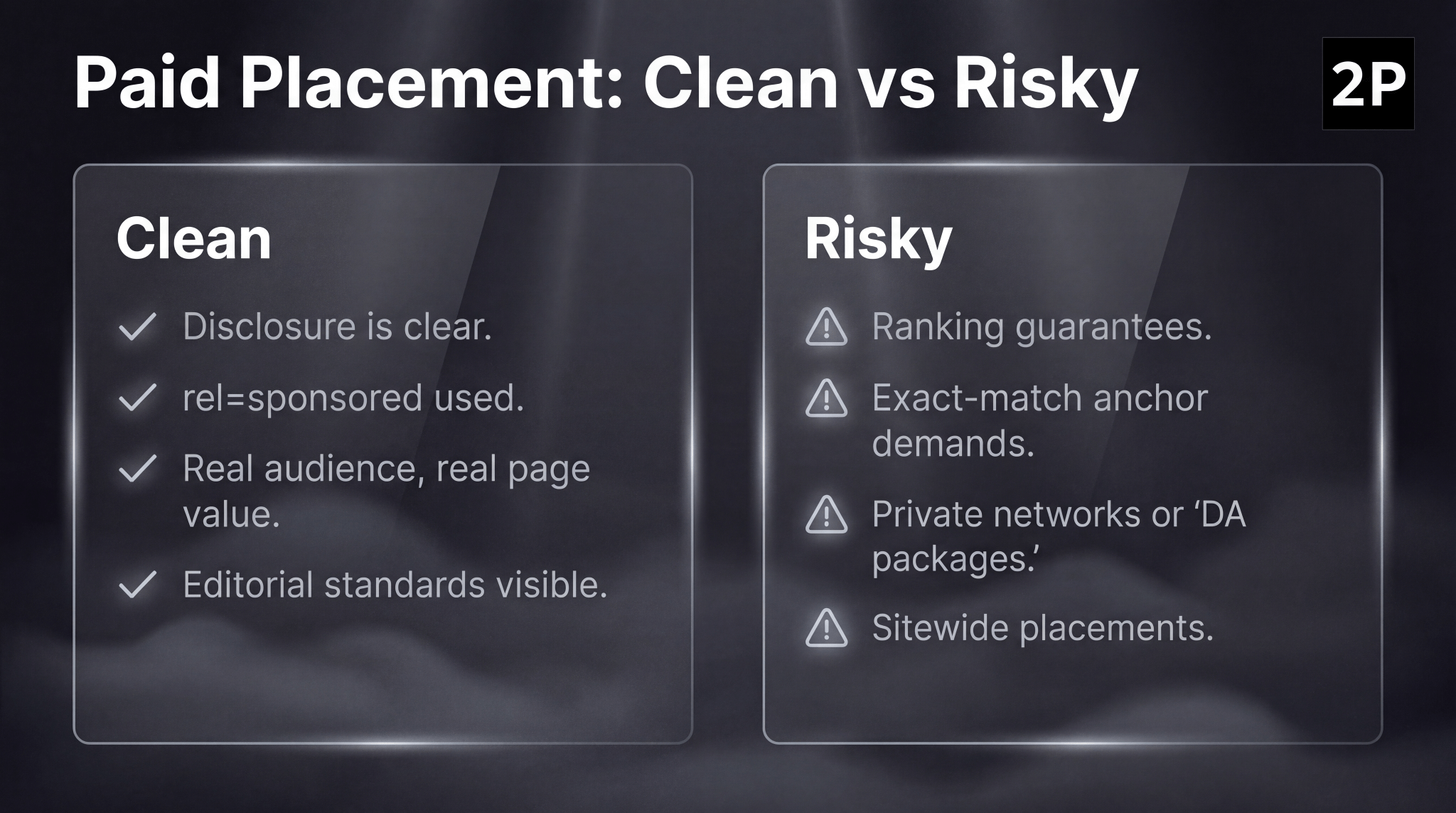
The line is clear: paying for links to manipulate rankings violates Google’s spam policies. Google lists “buying or selling links for ranking purposes” as link spam, including exchanging money for posts containing links.
That does not kill paid exposure. It changes how it should be handled.
If money changes hands, use proper link attributes. Google explains that using rel=”sponsored” (and nofollow as appropriate) qualifies a link as paid.
Vendor screening list that protects you:
Consistency beats intensity because link building punishes random bursts. A simple scorecard keeps decisions calm, comparable, and repeatable, so you spend time on links that can actually move the needle without adding risk.
Google also describes ranking as driven by many factors and signals, so the goal is a steady portfolio of strong opportunities, not one lucky placement.
Use this weekly scorecard and score fast, even in 60 seconds per prospect:
In practice, keep a short weekly quota: score 20, pursue the top 5, ignore anything flagged. That rhythm builds momentum without compromising quality.
Backlink tracking gets messy when it turns into a running link count. A cleaner approach is to treat links like assets tied to real outcomes, because that forces the right questions.
Pay attention to what changed each week, not just what exists.
When a link appears, note where it sits on the page and what it supports, since placement and context often explain its impact. Pair that with a quick check on indexing and keyword movement for the target URL, so you can spot links that land but never translate into visibility.
During site updates, review redirects and canonicals early, because that is where strong links quietly disappear.

Pick two or three tactics your team can sustain, even during busy weeks. Run the quality checkpoint, score opportunities, and keep a single tracker that links targets to outcomes.
That cadence is how wins compound without burning out your team. If the process feels scattered, tighten it into a repeatable workflow with clear targets, outreach angles, and maintenance rules.
2POINT can help build that system, plug it into your broader SEO services plan, and keep quality high without chasing shortcuts.
No fixed number. It depends on the SERP and competitors. Some local terms move with a few strong links, while competitive queries need sustained, relevant editorial links plus strong on-page quality.
A quality backlink fits the topic and helps readers. It sits in real content, on an indexed page, with natural anchor text. Referral traffic and editorial standards matter more than raw link counts.
Often weeks, sometimes longer. Google has to crawl and index the linking page, connect signals, and re-evaluate rankings. Effects show faster when links stack, and the target page stays stable.
Buying quality backlinks for rankings is risky. Paid placements can be fine for exposure when disclosed properly, but guarantees are a red flag. If you want to know how to get backlinks for your website, focus on earned editorial links and durable assets.

Traditional PR and SEO no longer live in separate rooms. Your audience discovers and decides in public: search, social, newsletters, podcasts, and niche communities. Your site can claim credibility, yet trust grows faster when other voices echo it.
Your SEO tech stack keeps growing, but the story your data tells still feels messy. GA4 shows sessions and events. Search Console shows queries and impressions. Your CRM shows leads, but not always the path that created them.
DIY SEO can work. It can also quietly drain months if you are fixing the wrong things, chasing the wrong keywords, or guessing at technical changes that affect revenue. Before you commit to a path, you need a way to judge what is realistic for your team, what is risky, and what is simply not worth doing alone.

 let’s connect



