

 let’s connect


What Is Multi-Channel Marketing? A Direct Answer
- Multi-channel marketing means reaching customers across multiple platforms simultaneously, including email, social media, SMS, paid search, and web.
- It differs from omnichannel marketing because each channel can operate independently rather than requiring full integration.
- Businesses using three or more channels see a 287% higher purchase rate than those using a single channel.
- The approach works best when your target customers actively engage across more than one digital or physical touchpoint.
- 73% of consumers use multiple channels during the purchase journey, making single-channel strategies statistically insufficient.
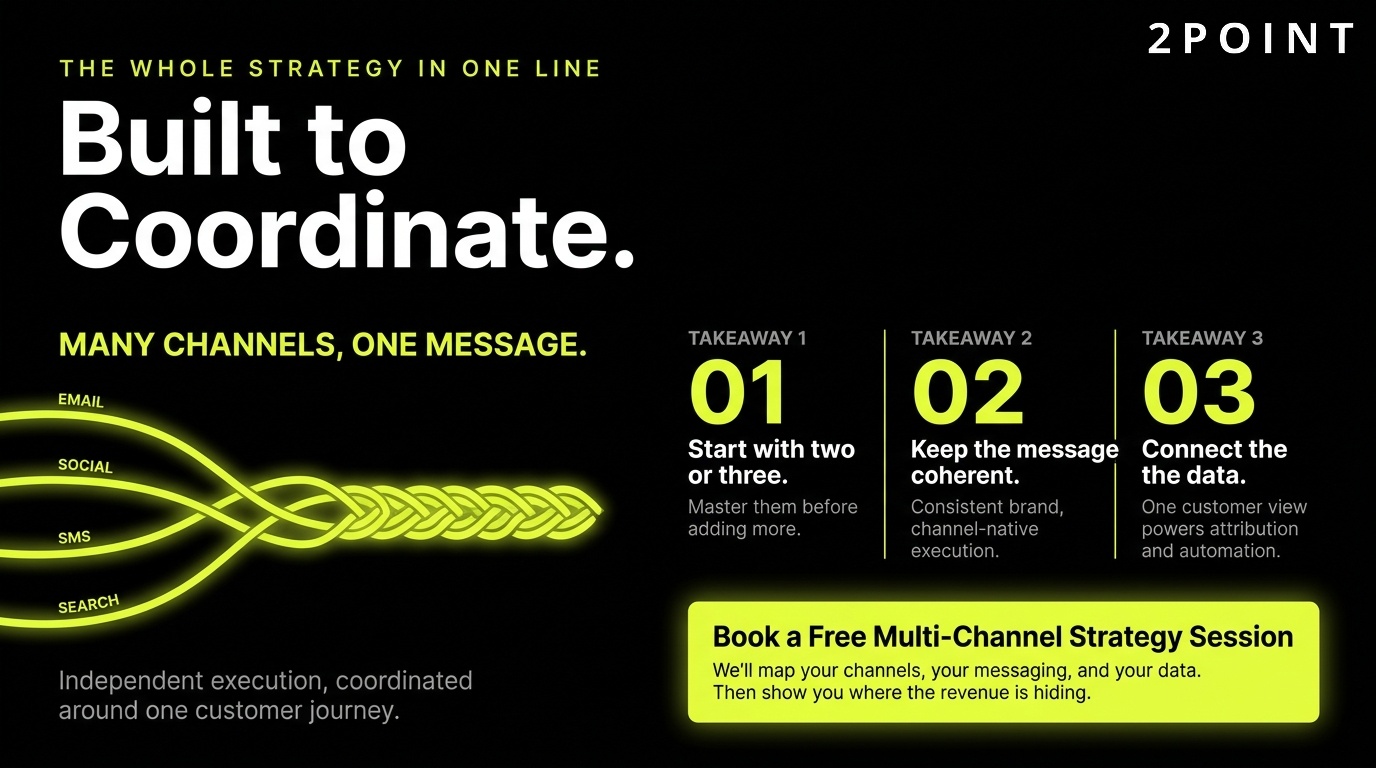
- Start by identifying two to three core channels where your audience is most active, then build outward with a consistent message.
- Success depends on coordinated messaging, shared data, and clear performance metrics for each channel.
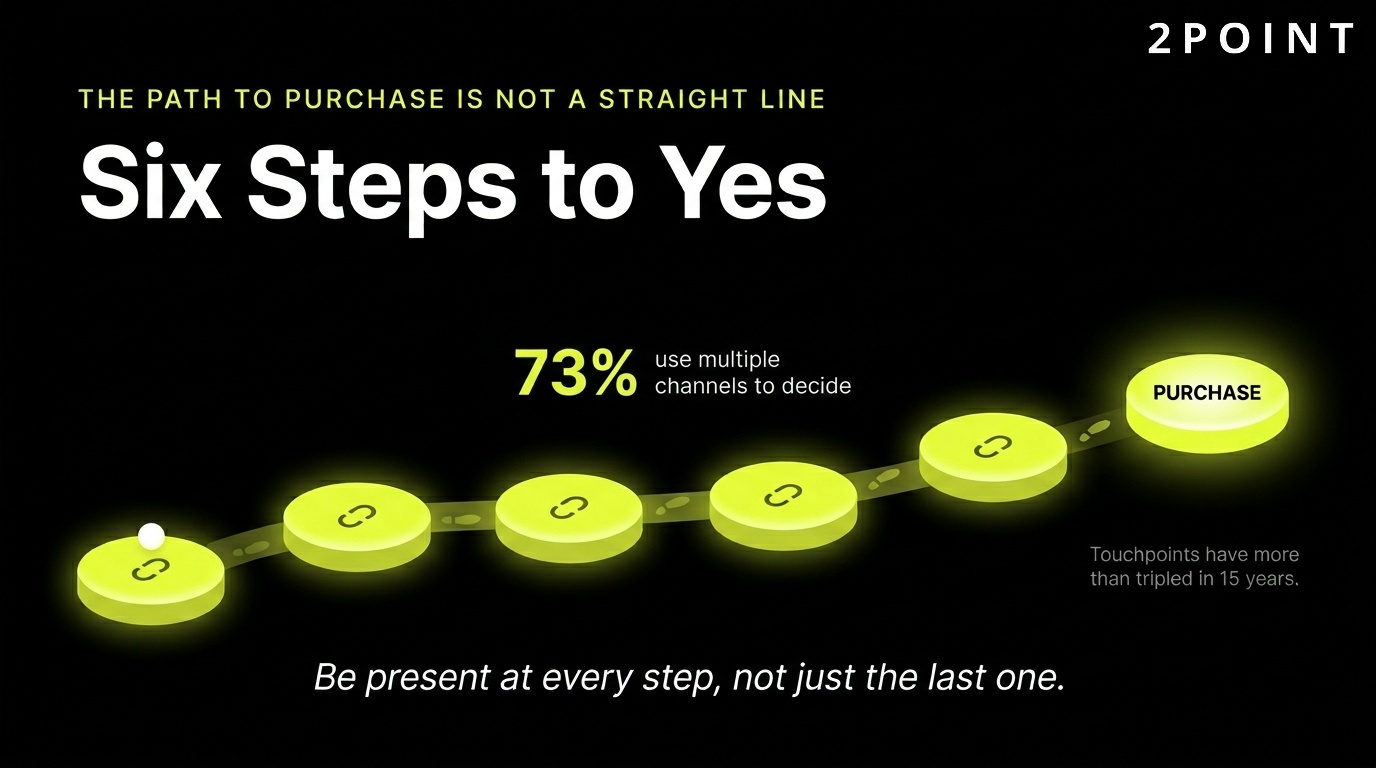
Multi-channel marketing is no longer a growth tactic reserved for enterprise brands with eight-figure budgets. It has become the baseline expectation for any business that wants to stay visible, relevant, and competitive in 2026. Consumers today interact with brands across an average of six touchpoints before making a purchase decision, and that number has more than tripled in the past fifteen years. The businesses that understand this shift and build strategies around it are capturing market share from those that have not yet adapted.
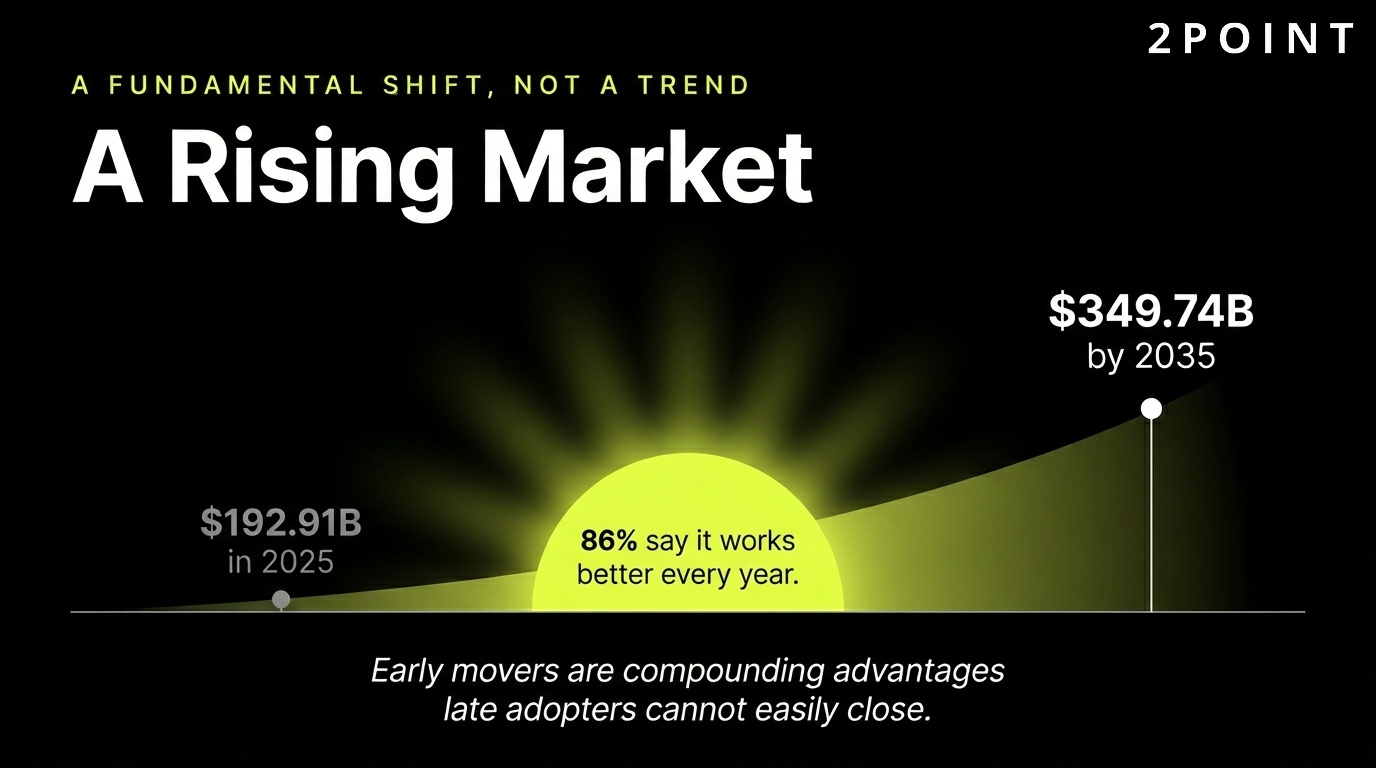
The global multi-channel marketing industry is now valued at $192.91 billion in 2025 and is projected to reach $349.74 billion by 2035. That growth reflects a fundamental change in how brands must communicate, not a passing trend. Meanwhile, 86% of marketers report that multi-channel strategies are becoming more effective year over year, which means early movers are compounding advantages that will be expensive for late adopters to close.
This guide covers everything you need to build a high-performing multi-channel marketing strategy in 2026, regardless of your current budget or team size. You will learn how to define your channel mix, create consistent messaging, measure attribution across touchpoints, automate execution, and optimize performance over time. Whether you are starting with a two-channel foundation or expanding an existing program to full orchestration, the frameworks here apply at every stage of growth.
The sections ahead address eight core areas: the strategic definition and ROI case for multi-channel marketing, how the modern customer journey actually unfolds, channel selection and prioritization, strategy-building frameworks, marketing automation and AI, measurement and attribution, common implementation challenges, and real-world patterns that are working in 2026. By the end, you will have a clear, actionable picture of where to start and how to scale.
Understanding Multi-Channel Marketing in 2026
Core Definition and Strategic Framework
Multi-channel marketing is the practice of coordinating customer interactions across multiple independent channels, each with its own targeting, creative, and performance tracking, while maintaining a coherent brand message. The emphasis is on presence and reach: your brand appears where your customers are, using formats native to each platform, without requiring every channel to share live data with every other channel in real time.
The strategic purpose is straightforward. Customers do not follow a linear path from awareness to purchase. They discover brands on social media, research on search engines, compare on review platforms, and convert through email or a direct website visit. A business that is only present on one of those surfaces misses every interaction that happens elsewhere. Multi-channel marketing closes those gaps.
The framework involves three layers: separate channel campaigns optimized for each platform's audience and format, separate metrics tracking performance on each channel individually, and coordinated messaging ensuring that the core value proposition remains consistent even as the creative execution adapts. This structure is achievable for businesses of almost any size. The key distinction is that channel independence is a feature, not a limitation. You do not need a fully unified technology stack to start. You need clear goals, a defined audience, and two to three channels where that audience is most active.
Where multi-channel marketing works best: businesses with audiences that demonstrably use more than one platform during their research process, products or services with purchase cycles longer than a single session, and brands that have enough content capacity to maintain meaningful presence across their chosen channels. Where it struggles: when teams are stretched too thin across too many platforms without sufficient resources to execute any of them well. The engagement rate for multi-channel campaigns is 18.96% compared to 5.4% for single-channel, but only when each channel receives adequate investment and attention.
Multi-Channel vs. Cross-Channel vs. Omnichannel: What the Difference Actually Means
These three terms are frequently used interchangeably, but they describe meaningfully different approaches. Understanding the distinctions helps you choose the right model for your current resources and business maturity.
| Marketing Approach | Channel Relationship | Data Integration Level | Customer Experience | Best Fit |
|---|---|---|---|---|
| Multi-Channel Marketing | Independent channels, coordinated messaging | Separate metrics, shared brand guidelines | Consistent brand, channel-native execution | Growth-stage businesses, limited tech stack |
| Cross-Channel Marketing | Connected planning, shared insights | Shared audience segments, coordinated timing | Sequenced interactions across channels | Mid-market businesses with CRM infrastructure |
| Omnichannel Marketing | Fully integrated, online-offline bridge | Unified customer view, real-time sync | Seamless continuation across every touchpoint | Enterprise businesses with mature tech stack |
The key takeaway: multi-channel is where most businesses start, cross-channel is where coordinated data sharing begins, and omnichannel is the mature destination where a fully unified customer view drives every interaction in real time.
It is worth noting that 91% of consumers are omnichannel shoppers, meaning they expect some degree of continuity as they move between surfaces. This does not mean every business must achieve full omnichannel integration immediately. It means the direction of travel matters, and even a well-executed multi-channel strategy should be designed with integration in mind so that the transition to cross-channel or omnichannel is not a full rebuild.
Why Multi-Channel Marketing Has Become Non-Negotiable
The shift from single-channel to multi-channel is not a marketing preference. It is a behavioral reality driven by how consumers now move through their days. Fifteen years ago, the average consumer required around two touchpoints before making a purchase. Today that number has grown to six or more, and the platforms that carry those touchpoints span social feeds, search engines, email inboxes, review sites, streaming platforms, and physical retail environments, often within a single research session.
Platform algorithm changes have made single-channel dependency increasingly risky. Organic reach on Facebook dropped by more than 60% between 2012 and 2022. Google search results pages have shifted toward paid and AI-generated results, reducing organic click-through rates for many query types. Any business that built its entire customer acquisition model on a single platform has experienced how quickly that investment can be devalued by an algorithm update or platform policy change.
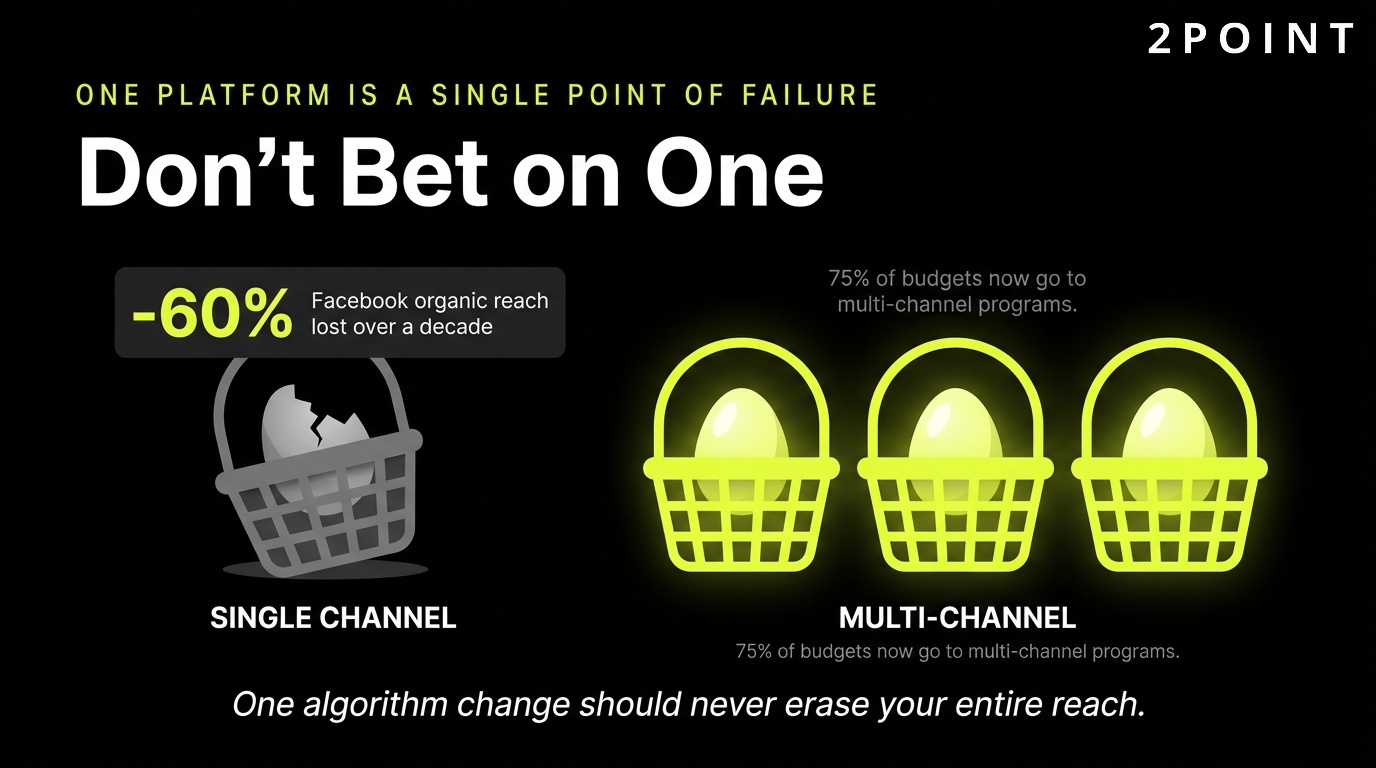
Risk mitigation is one of the strongest arguments for multi-channel marketing that does not get enough attention. Diversifying across channels means no single platform change can eliminate your reach entirely. 75% of marketing budgets are now allocated to multichannel programs, which reflects how seriously the broader market has taken this reality. And with 90% of consumers switching devices during the purchase journey, a brand that only shows up on one device type or in one context is invisible for most of the buying process.
The ROI Case: What the Numbers Actually Show
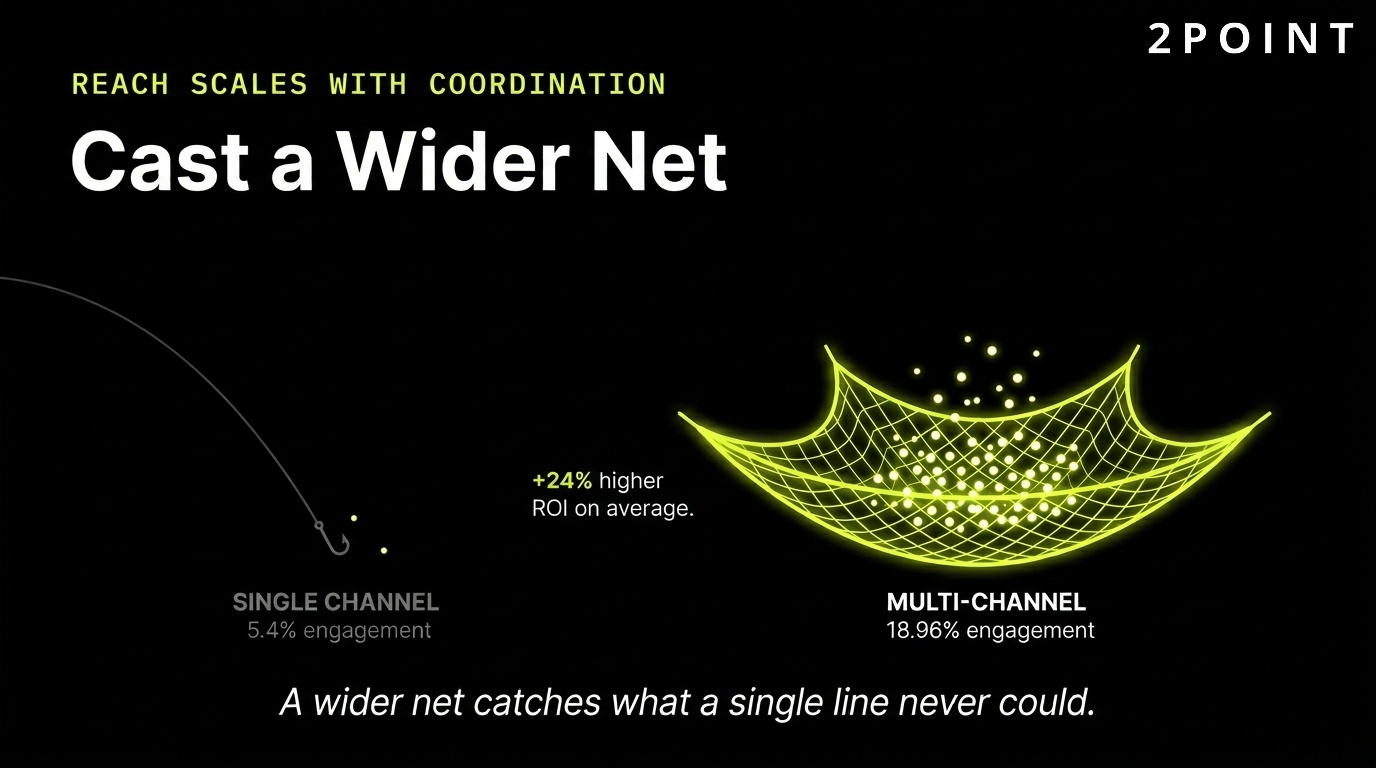
The performance data for multi-channel marketing is compelling, but it is also more nuanced than most summaries suggest. The headline number is well-established: businesses using three or more channels see a 287% higher purchase rate than single-channel businesses, and that figure rises to 412% for businesses using five or more channels. Organizations that adopt multi-channel approaches also report a 24% higher ROI on average compared to single-channel counterparts.

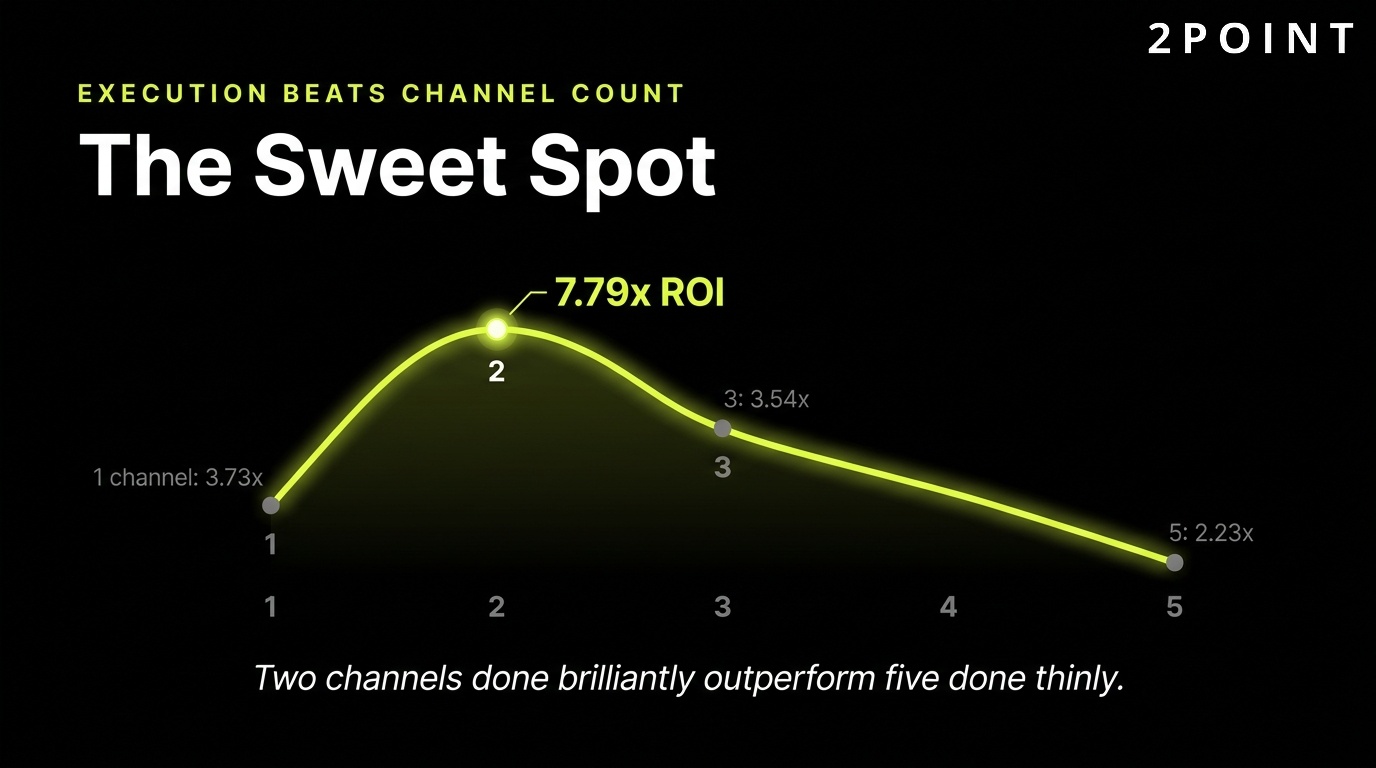
However, the relationship between channel count and ROI is not strictly linear. Data from Metadata's campaign analysis reveals an interesting curve: one channel delivered 3.73x ROI, two channels peaked at 7.79x, three channels dropped to 3.54x, four channels recovered to 4.86x, and five channels fell to 2.23x. This pattern suggests that the quality and integration of channel execution matters more than simply adding channels. Two well-executed channels consistently outperform five poorly resourced ones.
Email marketing continues to anchor the ROI case with a $36 return for every $1 spent, making it the most cost-efficient channel in most marketing stacks. When used in combination with SMS, paid social, and retargeting, email becomes even more powerful as a conversion mechanism for audiences already warmed through earlier touchpoints. The multi-channel advantage is not about presence everywhere. It is about engineering the right sequence of interactions that moves a specific customer segment from awareness to purchase with the least friction possible.
How the Customer Journey Unfolds Across Multiple Channels
How Modern Buyers Actually Research and Purchase
The modern purchase journey is rarely a straight line. A typical B2C buyer interacts with a brand across an average of 11 touchpoints before making a purchase, and those touchpoints are spread across multiple devices, platforms, and time windows. B2B buyers consume an average of 13 pieces of content during their research process, with roughly eight coming from the vendor and five from independent third-party sources. This means your brand message must appear not only on your own properties but also in the places where your prospects seek objective information.
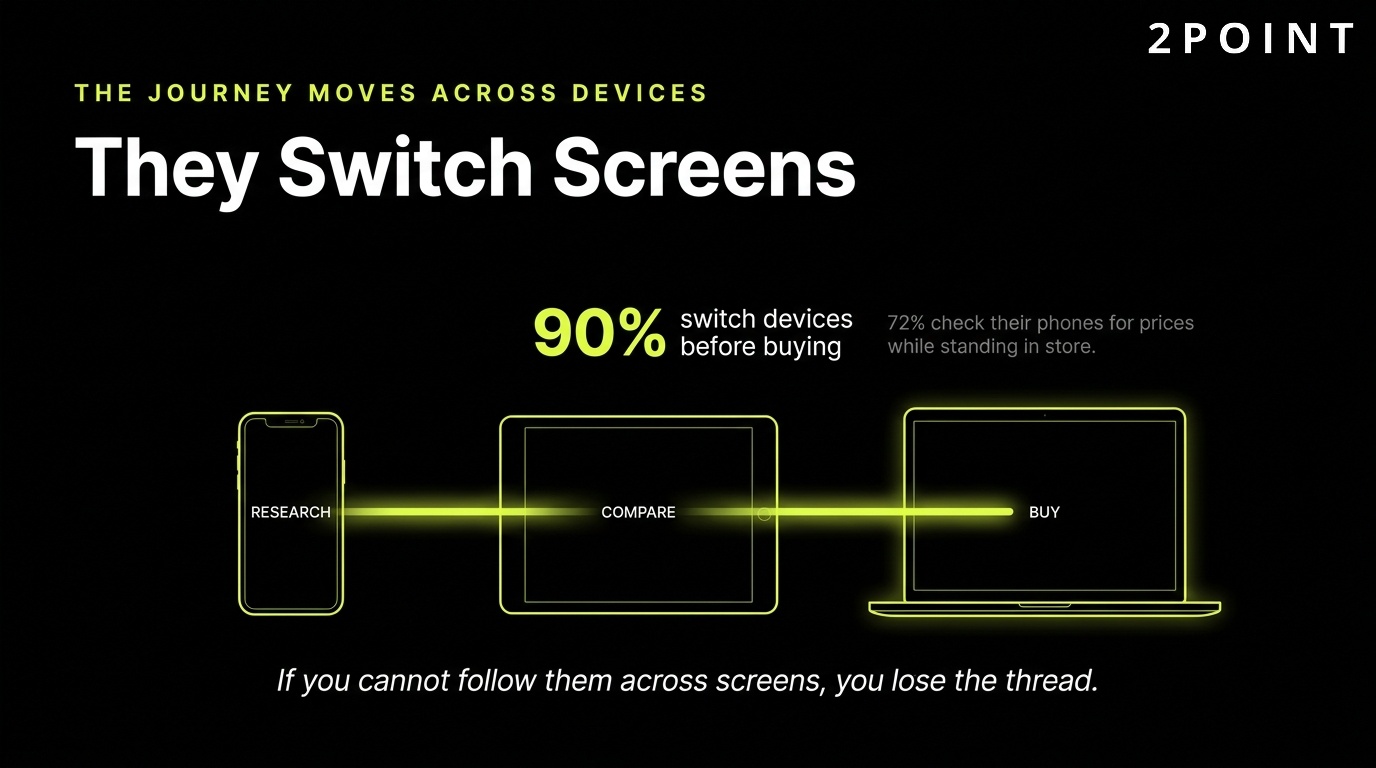
Device-switching behavior is particularly important for channel strategy. 90% of consumers switch between devices during the purchase journey, starting research on a smartphone and completing a transaction on a desktop, or vice versa. Any tracking, attribution, or retargeting system that cannot connect behavior across devices is missing a significant portion of the customer path. Meanwhile, 77% of B2B buyers now conduct independent research before ever engaging with a sales representative, which means content marketing, SEO, and review platforms have become pre-sales infrastructure rather than optional extras.
Physical retail remains part of this multi-channel picture. 72% of in-store shoppers use their smartphones to look up price comparisons and product reviews while standing in the store. This behavior blurs the boundary between digital and physical channels and makes mobile optimization a requirement for businesses with any retail presence. The implication for strategy is clear: your digital presence must be strong enough to win the "last look" comparison that happens at the moment of decision, even when that decision occurs in a physical location.
Channel Preferences by Customer Segment
Channel preferences vary significantly by generation, purchase context, and industry vertical. Younger consumers skew heavily toward short-form video and social commerce for discovery, while older demographics show stronger preference for email and search as primary research channels. B2B buyers prioritize LinkedIn, industry publications, webinars, and email newsletters, while B2C consumers in lifestyle categories are more likely to discover brands through Instagram, TikTok, and influencer content.
Understanding these preferences is not optional. 72% of consumers say they prefer interacting with brands through multiple channels, but the specific channels they prefer are audience-specific. A strategy built on channel preferences drawn from industry averages rather than your actual customer data is likely to misallocate budget. The most reliable approach is to combine behavioral analytics from your existing customer base with direct preference research, including surveys and preference centers that allow customers to self-select the channels and frequencies they want.
Geographic and cultural sensitivity in marketing also affects channel selection. WhatsApp dominates messaging in many international markets where SMS is less prevalent. WeChat is essential in China. Line is critical in Japan, Thailand, and Taiwan. Platform assumptions that work in North American markets often do not translate internationally, and businesses with any cross-border customer base need to account for regional platform preferences in their channel mix. Research from Twilio shows that 80% of business leaders say consumers spend 38% more when they receive a personalized experience, and channel relevance is a core component of that personalization.
The Cost of Poor Multi-Channel Experience
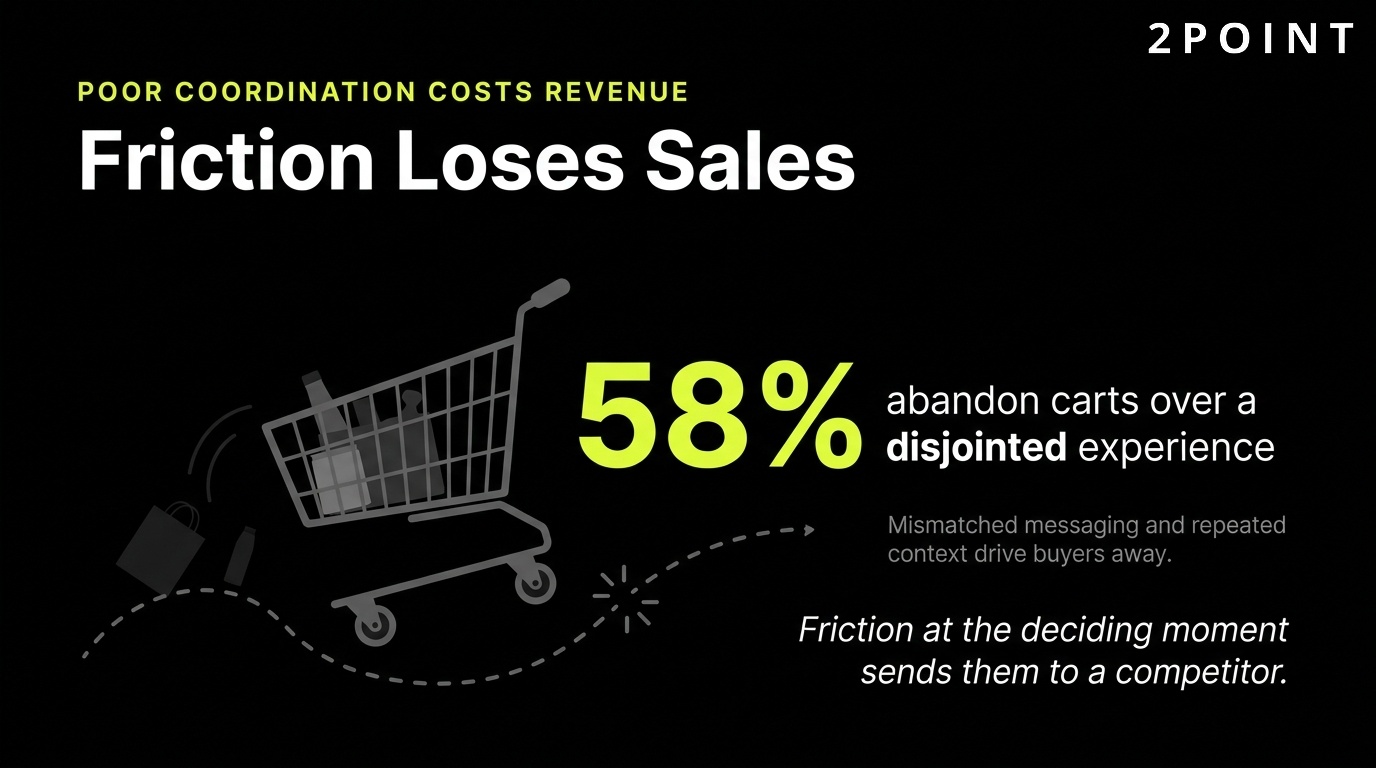
The performance upside of multi-channel marketing is well documented, but the downside risk of executing it poorly is equally significant and less frequently discussed. 58% of consumers abandon shopping carts because of a poor multi-channel experience. This includes disconnected messaging between channels, inconsistent pricing information, and friction created when a customer has to repeat context they already provided in a different channel.
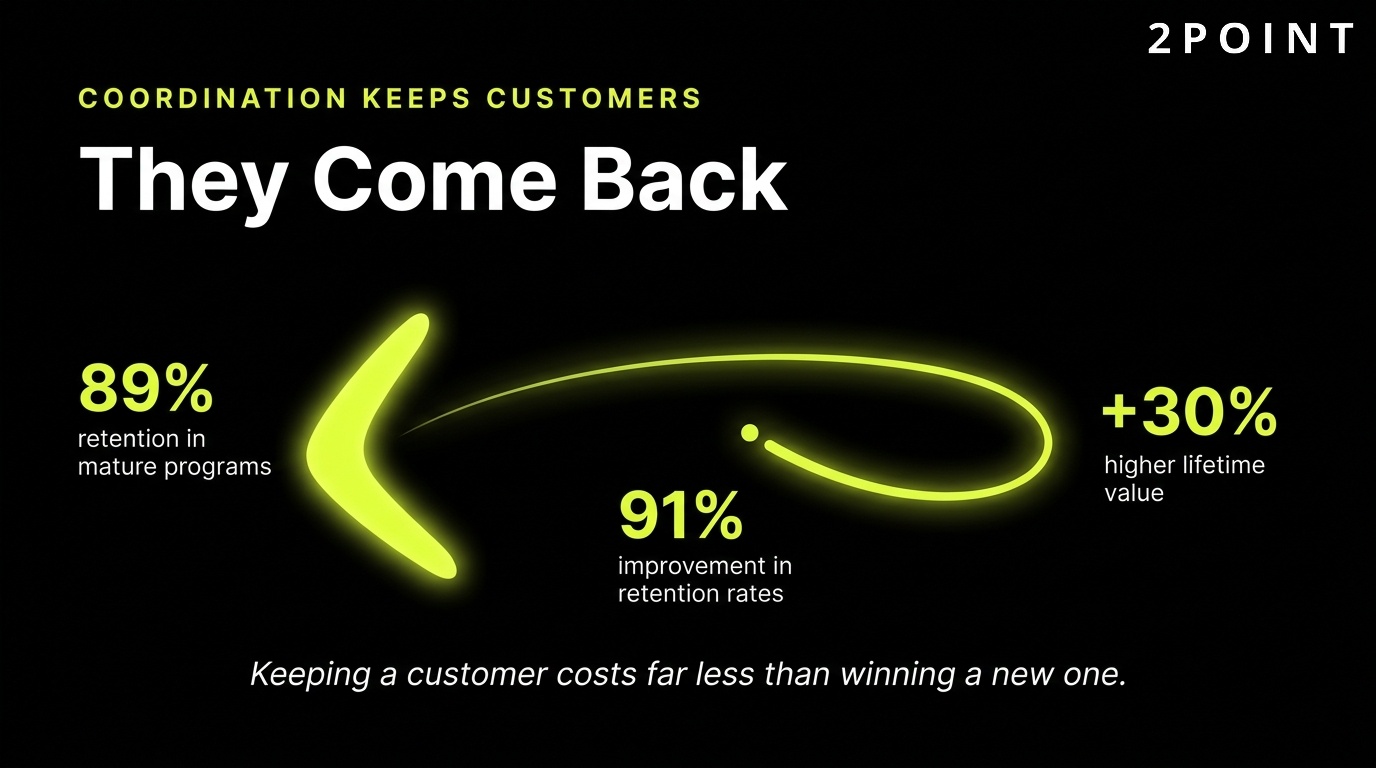
Customer retention is one of the most concrete areas where multi-channel execution quality shows up in business outcomes. Companies with strong multi-channel strategies report a 91% improvement in customer retention rates, and businesses with mature multi-channel programs achieve an average 89% customer retention rate versus significantly lower rates for single-channel businesses. When you consider the cost of acquiring a new customer versus retaining an existing one, this retention differential has compounding financial implications over a multi-year period.
The competitive switching risk is also real. Customers who encounter poor coordination between your channels, for example, receiving an email promotion for a product that your website shows as sold out, or getting a sales call about an offer they already declined on a previous channel, will often choose to research alternatives rather than work through your process friction. The threshold for channel-switching behavior is lower than most businesses assume, particularly in categories with strong competition and low switching costs.
Mapping Channels to Customer Journey Stages
Effective multi-channel strategy assigns specific channels to specific stages of the customer journey rather than using every channel for every purpose. This stage-based approach ensures that messaging is contextually appropriate for where a customer actually is in their decision process.
| Journey Stage | Customer Mindset | Best-Fit Marketing Channels | Content Type |
|---|---|---|---|
| Awareness | Problem recognition, browsing | Social media, display advertising, SEO content, influencer marketing | Educational blog posts, short-form video, social ads |
| Consideration | Evaluating options, comparing | Email, retargeting ads, webinars, review platforms | Case studies, comparison guides, email sequences, demos |
| Decision | Ready to buy, needs reassurance | Sales calls, live chat, SMS offers, landing pages | Testimonials, pricing pages, limited-time offers |
| Retention and Loyalty | Post-purchase, seeking value | Email, SMS, in-app messaging, loyalty programs | Onboarding content, upsell sequences, community access |
The key takeaway: assigning channels intentionally to journey stages eliminates wasted spend on high-cost conversion-focused channels for audiences still in early awareness, and prevents brand discovery channels from being burdened with transactional messaging that repels early-stage prospects.
With 81% of consumers researching online before making an in-store purchase, the awareness and consideration stages require particularly strong digital presence. A brand that only activates paid channels at the decision stage is paying premium prices to intercept customers who already formed preferences during the research phase without any brand exposure from your side.
Strategic Channel Selection: Which Marketing Platforms Actually Matter
The Channel Concentration Framework
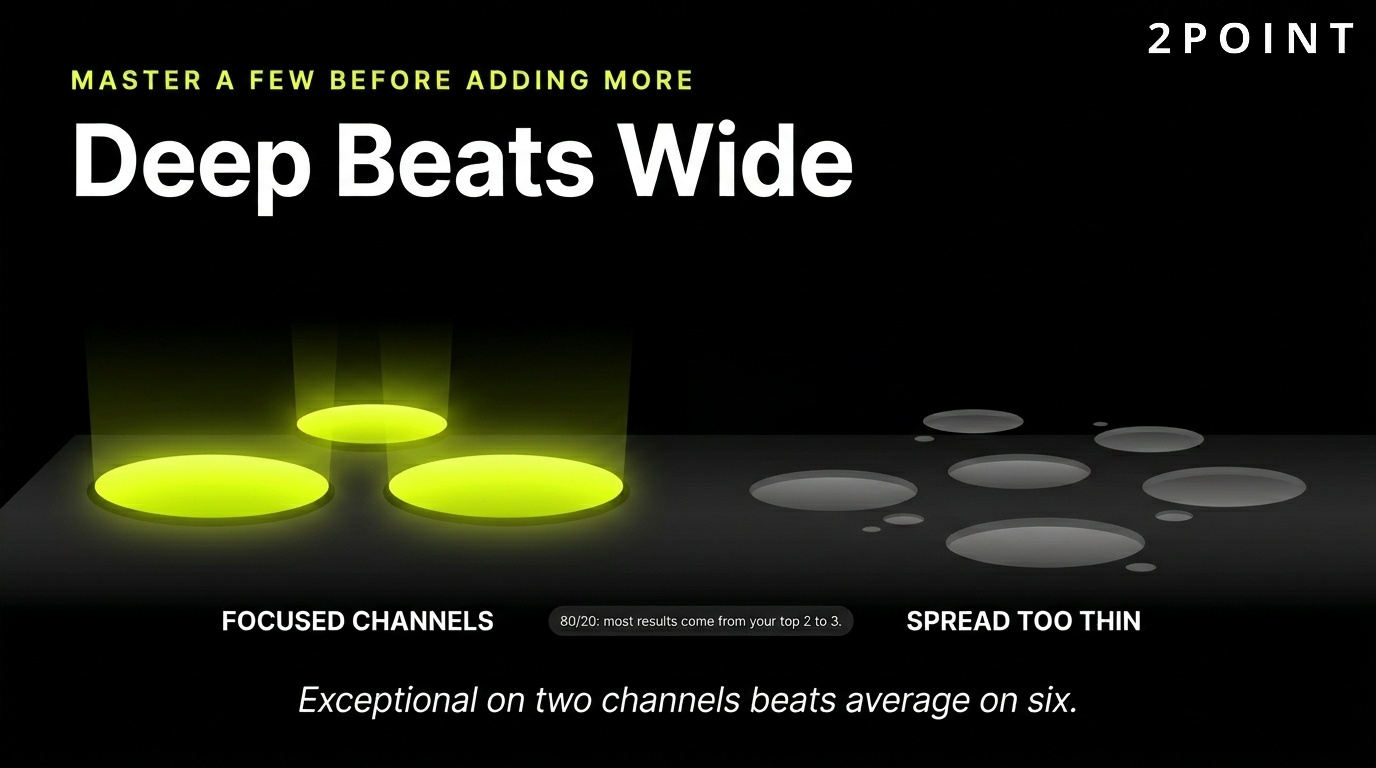
Before adding a new marketing channel, apply a simple concentration test: if 60% or more of your target audience is demonstrably active on a platform, it qualifies as a priority channel. Below that threshold, the audience is too diluted to justify the content production, campaign management, and measurement overhead that a credible presence requires. This test alone eliminates most "shiny object" channel additions before they drain resources from channels that are actually working.
Content velocity is the second filter. Maintaining a meaningful presence on any social platform requires a minimum of three to five posts per week to stay algorithmically visible. Email programs need consistent cadence to avoid list decay. Paid channels require ongoing creative refresh to avoid ad fatigue. Before adding a channel, the honest question is not "could we benefit from being there?" but rather "do we have the content production capacity to maintain credible presence here over at least six months?"
For businesses operating under $50,000 per month in marketing budget, the strongest guidance is to start with two to three core channels and achieve genuine depth before expanding. The general budget framework breaks down as follows: $10,000 per month supports two to three core channels such as email plus one paid channel; $50,000 per month can support adding a Scale quadrant channel if customer acquisition cost payback is under twelve months; $100,000 per month enables full multi-channel orchestration. Exceeding these thresholds without the corresponding infrastructure and team capacity produces diminishing returns and scattered execution.
The 80/20 rule applies directly to channel management. Eighty percent of your results will typically come from your top two or three channels. The remaining twenty percent of budget can test new channels in limited pilots, but those pilots should have defined success criteria and sunset dates to prevent under-performing experiments from accumulating into a permanent drag on overall performance. When to expand: when your core channels have stable performance, clear attribution, and optimization has reached a point of marginal returns. When to deepen: almost always, before expansion.
Email Marketing: The Consistent Revenue Driver in Any Multi-Channel Mix
Email marketing remains the most consistently high-performing channel in the multi-channel toolkit, and its dominance is not nostalgia. 82.4% of B2C marketers use email marketing, and 73.5% rate it as their most effective channel. This is a channel that has survived the rise of social media, messaging apps, and short-form video while continuing to outperform them on conversion metrics for most business categories.
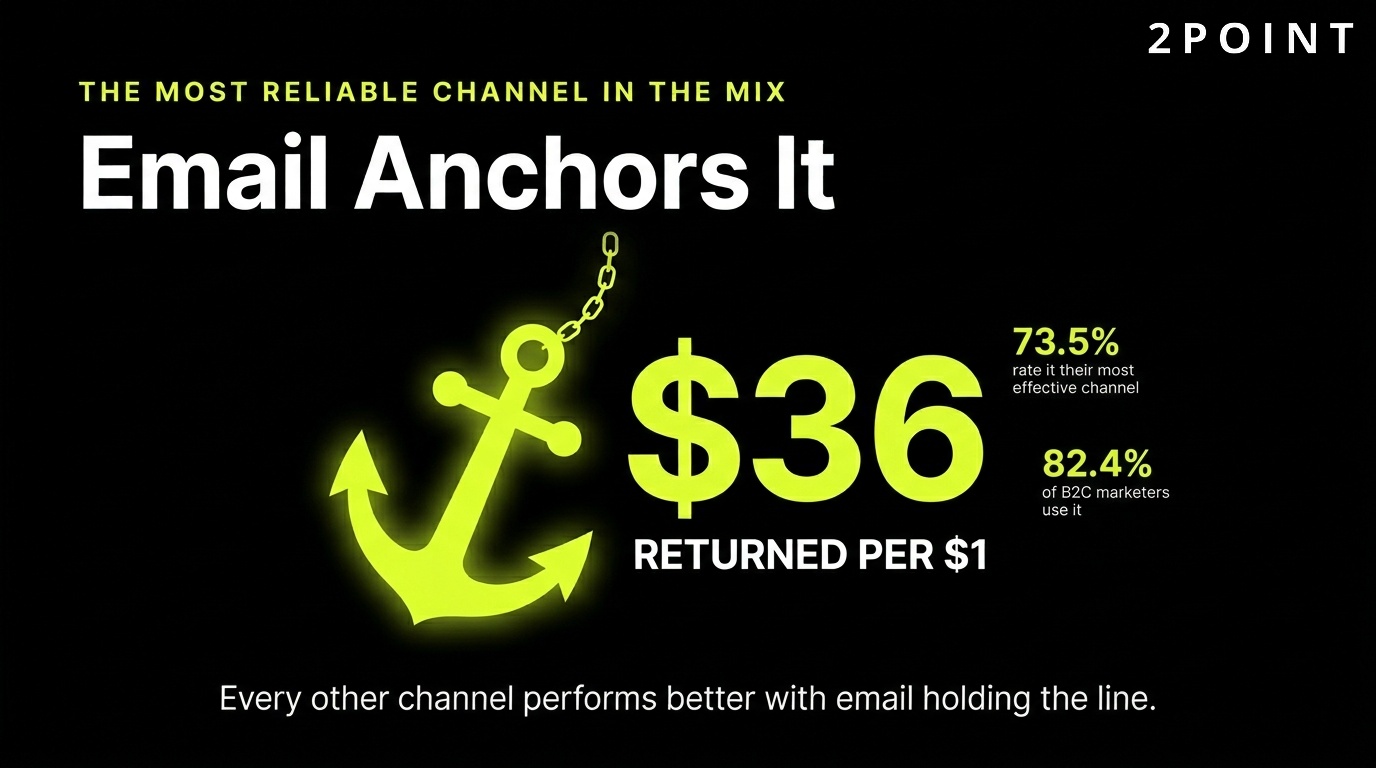
The ROI case is decisive. Email delivers a $36 return for every $1 invested, making it the highest-ROI channel in digital marketing by a significant margin. For B2B specifically, 83% of marketers rank email as their top channel for prospect engagement, and 95% of consumers say they want to receive emails from brands they like. The audience permission model that email operates on means that every subscriber has already signaled some level of interest, which creates a fundamentally higher-quality audience than most paid channels can achieve.
Building an effective email marketing campaign within a multi-channel context means treating email as a conversion and nurture channel rather than a broadcast mechanism. Segmentation based on behavior across other channels, personalized subject lines and content blocks, automated sequences triggered by specific actions, and coordinated timing with SMS or retargeting campaigns all contribute to email performance that exceeds the channel's already strong baseline. Learning how to optimize email marketing for higher open rates and engagement is one of the highest-leverage investments any multi-channel marketer can make.
SMS and Mobile Channels: The High-Engagement Option
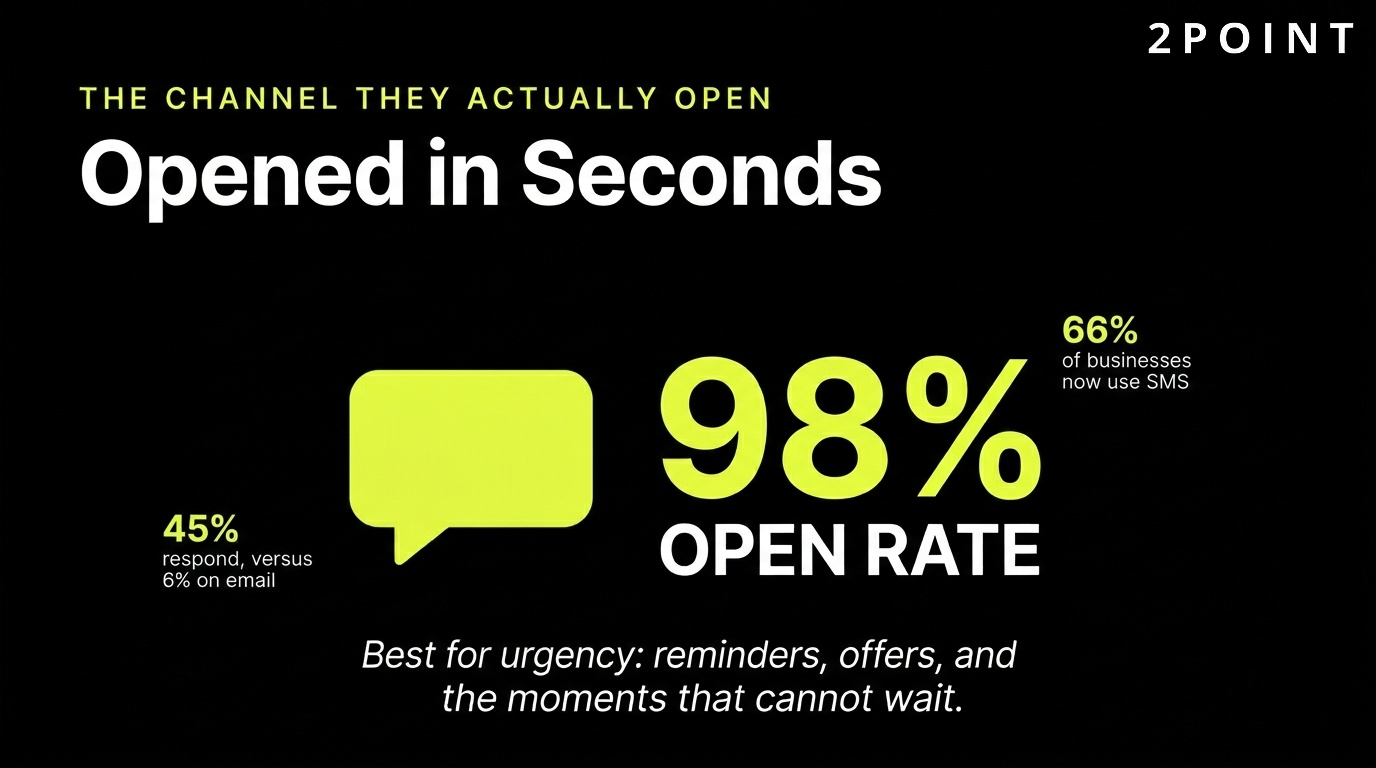
SMS is the channel that consistently surprises marketers who have not used it recently. The performance metrics are exceptional: SMS achieves a 98% open rate and a 45% response rate, compared to email's typical 6% response rate. These numbers reflect the fact that SMS arrives in a genuinely personal space with very little competing content, and the brevity of the format makes immediate engagement frictionless.
Adoption is accelerating. 66% of businesses now use SMS marketing in 2025, representing a 55% increase over four years. Mobile push notifications have similarly strong adoption, with 74.3% of businesses using them and a 7.8% click-through rate. WhatsApp has seen dramatic growth as a business communication channel, with usage rates rising from 13.5% to 34.8% among businesses in recent years, driven by international audiences and younger demographics who treat it as a primary communication platform.
The appropriate use cases for SMS in a multi-channel strategy are specific: time-sensitive promotional offers, appointment and delivery reminders, two-factor authentication and transactional messages, and urgent updates that require near-immediate attention. SMS is not well-suited for long-form educational content or top-of-funnel awareness building. Its strength is in the late consideration and decision stages, where a well-timed message with a clear call to action can close the conversion gap. When paired with email, SMS and email create a powerful two-channel combination where email builds context and SMS delivers urgency.
Social Media and Social Commerce Integration
Social media's role in multi-channel marketing has evolved beyond awareness and engagement into a complete purchase channel. Social commerce in the US is projected to surpass $100 billion in 2026 and reach $137 billion by 2028, driven by TikTok Shop, Instagram Shopping, and Facebook Shops enabling full purchase flows without leaving the platform. This shift means social media is no longer just a top-of-funnel channel that needs to be paired with a separate conversion mechanism. For many product categories, it is the entire purchase funnel compressed into a single surface.
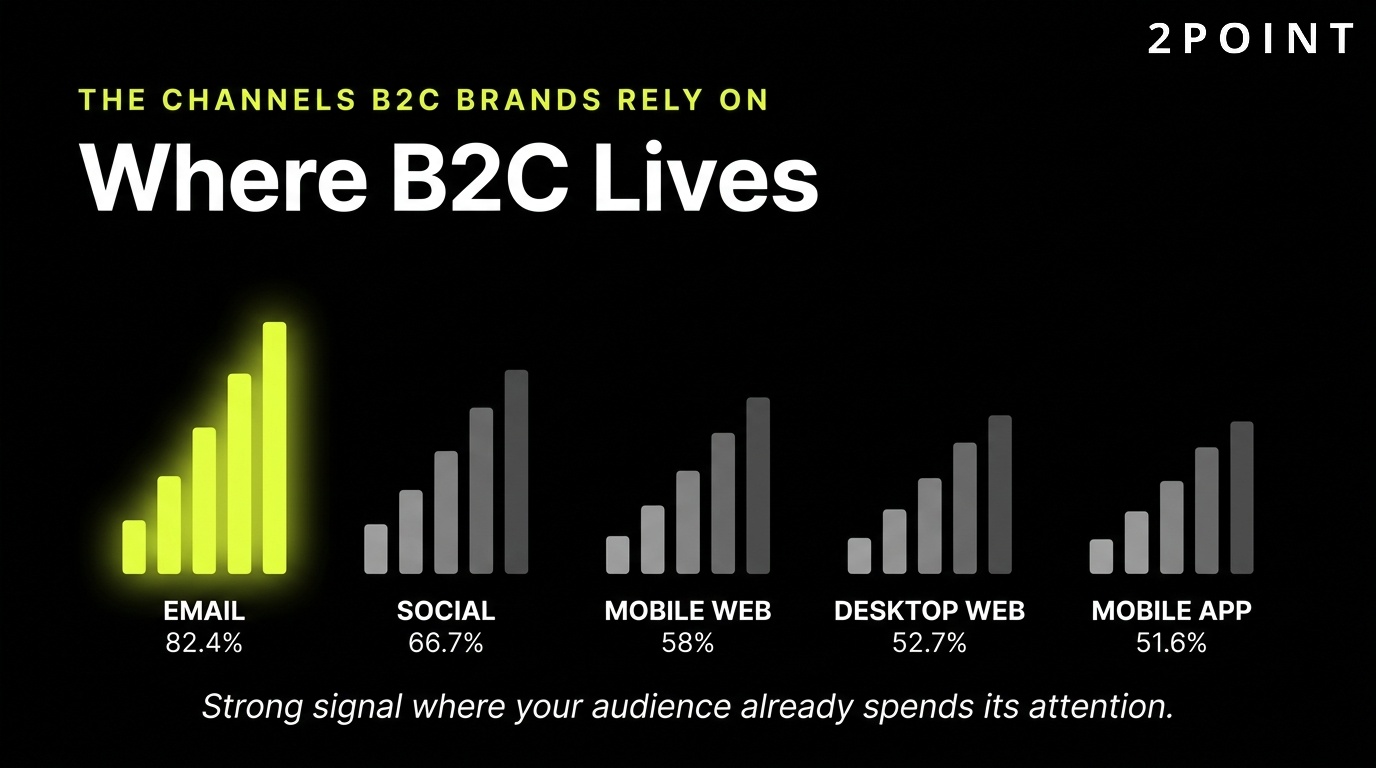
Platform strategy within social media must be channel-specific. LinkedIn drives B2B lead generation and professional credibility. Instagram and TikTok dominate B2C discovery for lifestyle, fashion, beauty, food, and consumer electronics. Pinterest captures high purchase-intent browsing for home, fashion, and craft categories. Cross-posting identical content across platforms is not a strategy. It is a symptom of under-resourced execution. Platform-native content, formatted and framed for each platform's specific audience behavior and algorithm, consistently outperforms repurposed content from other channels. The channel mix for B2C businesses shows email at 82.4%, social at 66.7%, mobile web at 58%, desktop web at 52.7%, and mobile app at 51.6%, with desktop push notifications at 11.8% representing the lowest adoption rate.
Integrating influencer marketing into your social media channel adds third-party credibility that branded content cannot replicate. Influencer-driven content performs particularly well for awareness and consideration stages, where the parasocial trust between a creator and their audience transfers some degree of credibility to the recommended brand. For a deeper look at how to use this effectively, the brand visibility strategies connected to influencer partnerships are worth exploring as part of your social channel planning.
Emerging Channels: Voice, AR, and Geofencing
Voice commerce, augmented reality, and geofencing represent the next generation of marketing channels, but their current role in most multi-channel strategies is supplemental rather than foundational. 26% of smart speaker owners have made a purchase through voice, and 40% use their devices for consumer-related activities such as product research and brand discovery. For businesses in categories where voice queries are common, optimizing for voice search and building voice-activated experiences is worth early investment.
AR is gaining traction in retail and product categories where visualization matters, including furniture, eyewear, cosmetics, and automotive. Geofencing enables location-based targeting that bridges digital and physical, sending offers or messages when a customer enters a defined geographic area such as near a store, at a competitor's location, or at an event venue. These channels make most sense once your core two to three channels are performing well and you have clear attribution infrastructure in place. Adding emerging channels before your foundation is optimized creates measurement complexity without proportional returns.
Building a Multi-Channel Marketing Strategy That Actually Works
Customer Research and Ideal Customer Profile Definition
Every effective multi-channel marketing strategy begins with a precise understanding of who you are trying to reach and how those people actually behave. Ideal Customer Profile (ICP) definition is not a branding exercise. It is a channel selection tool. When you know that 68% of your best customers are active on LinkedIn and check email twice daily but rarely engage on Instagram, your channel prioritization becomes straightforward rather than speculative.
Behavioral research must go beyond demographics. Understanding customer demographics provides a starting point, but psychographic and behavioral data tell you why and how they make decisions. Where do they research? What content formats do they consume? At what times of day are they most active on which platforms? What triggers their purchase decisions? These questions, answered with real data from your existing customer base and supplemented by market research, produce a channel strategy grounded in evidence rather than assumption.
Segmentation within your ICP is equally important. A single ideal customer profile rarely reflects the full diversity of your customer base. Behavioral segmentation separates customers by how they interact with your brand. Purchase-history segmentation separates high-value from at-risk customers. Stage-based segmentation separates new prospects from repeat buyers from lapsed customers. Each segment may respond best to a different channel mix and messaging approach, and documenting these differences in your CRM or customer data platform creates the infrastructure for personalized multi-channel campaigns at scale.
The Consistent Messaging Framework for Multi-Channel Campaigns
One of the most common execution failures in multi-channel marketing is brand inconsistency across channels. When a brand's LinkedIn presence feels corporate and serious, its Instagram presence feels playful and casual, and its email feels transactional and impersonal, customers experience a fragmented brand personality that undermines trust. 58% of marketers report struggling to align messaging across channels, making this a widespread rather than exceptional challenge.
The solution is the "variation within coherence" principle. Your core positioning, value proposition, and brand voice must remain stable across every channel. What adapts is the format, length, tone register, and content type that are native to each platform. A brand that positions itself as a trusted expert in business efficiency will express that positioning through long-form LinkedIn articles, concise how-to Instagram Reels, detailed email case studies, and brief SMS tips during a campaign. The voice is consistent. The execution is platform-native.
Practical tools for maintaining message consistency include a centralized brand guidelines document that explicitly addresses channel-specific adaptation rules, a shared content calendar that aligns campaign timing across channels, and a messaging hierarchy that identifies which claims and proof points are mandatory in every piece of content versus optional depending on format. Transparency in marketing communications is also an important consistency element: the claims you make on one channel must align with what customers find when they move to another channel to verify them, or the resulting credibility gap will cost you conversions at exactly the moment when the customer was ready to decide.
Budget Allocation by Business Stage in a Multi-Channel Strategy
Budget allocation in multi-channel marketing should be tied to business stage and channel maturity rather than arbitrary percentages. The framework that produces the most consistent results divides channels into four categories: Core (channels that are consistently profitable and well-understood), Scale (channels ready for increased investment based on positive but not yet maximized returns), Test (channels in limited pilots with defined success criteria), and Pause (channels that have underperformed against benchmarks for two or more consecutive review cycles).
At the $10,000 per month level, the entire budget should focus on two to three Core channels. Email marketing combined with one paid channel, such as paid search or paid social depending on audience behavior, is the most capital-efficient starting point. At $50,000 per month, adding a Scale channel is appropriate if your Core channels have a customer acquisition cost payback period under twelve months. At $100,000 or above, full multi-channel orchestration including retargeting, SMS, content marketing, and experimentation with emerging channels becomes viable without overextending team capacity.
The 80/20 budget rule applies here: allocate 80% of budget to channels with proven positive returns, and use the remaining 20% for testing and expansion. 65% of businesses plan to increase their multi-channel marketing budgets in the coming year, and with 75% of marketing budgets now directed to multichannel programs, the competitive baseline is rising. Businesses that delay building their multi-channel foundation will face higher customer acquisition costs as their competitors become more efficient at engaging the same audiences across multiple surfaces.
Integration and Technology Infrastructure for Multi-Channel Execution
Technology infrastructure is where many multi-channel strategies stall. The unified data layer, the single source of truth that connects customer behavior across every channel, is the technical foundation that separates genuinely coordinated multi-channel marketing from simultaneous single-channel campaigns running in parallel. Without it, you cannot accurately attribute conversions, personalize experiences based on cross-channel behavior, or automate sequences that respond to what a customer does on one channel with a message on another.
CRM and Customer Data Platform (CDP) selection is the most consequential infrastructure decision in multi-channel marketing. A CRM manages relationships and pipeline. A CDP unifies behavioral data from every channel into a single customer profile in real time. For businesses with complex multi-channel programs, a CDP enables the kind of audience segmentation and behavioral triggering that dramatically improves campaign relevance and conversion rates. The selection criteria should include: native integrations with your active channels, real-time data synchronization capability, audience segmentation flexibility, and a clean API ecosystem for connecting tools that do not have native integrations.
Marketing automation platforms sit above the data layer and execute campaigns across channels based on behavioral triggers and predefined sequences. The platform must be capable of cross-channel workflow building, meaning a single automation can send an email, wait for a behavior signal, then trigger an SMS or retargeting ad based on what the customer did or did not do. Data analytics for marketing must be built into this infrastructure from day one, because campaigns without measurement infrastructure cannot be optimized and their ROI cannot be proven. Unified commerce integration, connecting your marketing channels to your e-commerce, inventory, and customer service systems, represents the most mature version of this infrastructure and enables the seamless customer experience that drives the retention and lifetime value benefits associated with multi-channel excellence.
Marketing Automation and AI: Scaling Multi-Channel Execution
Why Automation Is Non-Negotiable in Multi-Channel Programs
Manual execution of multi-channel marketing at any meaningful scale is not a sustainable operating model. The volume of decisions involved in coordinating messaging, timing, audience segmentation, and personalization across four or more channels simultaneously exceeds what any human team can manage accurately in real time. Marketing automation is not a nice-to-have feature. It is the operational infrastructure that makes multi-channel marketing possible at scale.

The performance data for automation is clear. Businesses using marketing automation generate 80% more leads and achieve 77% higher conversion rates than those managing campaigns manually. These numbers reflect both the volume advantage of automation, reaching more prospects with less labor, and the relevance advantage, delivering more timely and contextually appropriate messages based on behavioral triggers that manual processes cannot monitor continuously.
Automation also creates consistency. A manually managed email sequence depends on team availability and human decision-making at every step. An automated sequence fires at the right time, with the right message, for every customer who meets the trigger criteria, regardless of whether it is a Tuesday morning or a Saturday night. This consistency across a multi-channel program ensures that no customer falls through the gaps because a team member was busy with a different task. The consistency benefit compounds over time as your automation sequences mature and accumulate optimization data.
AI-Powered Campaign Orchestration in Multi-Channel Marketing
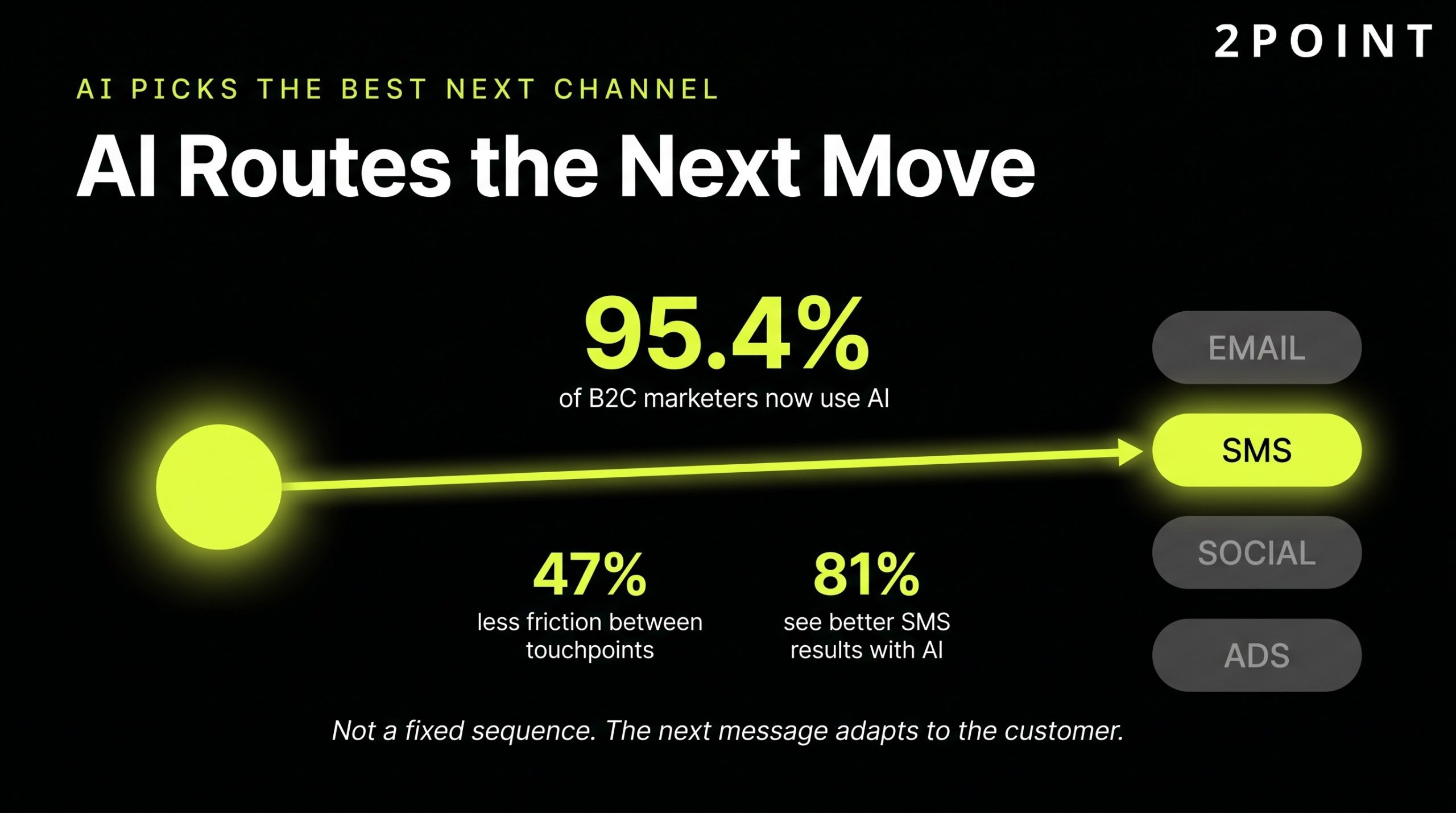
Artificial intelligence has moved from a marketing buzzword to a practical infrastructure component in the span of a few years. 95.4% of B2C marketers are now using AI in their marketing programs in 2025, up from 77.2% in 2024. This near-universal adoption reflects how quickly AI tools have become accessible and how demonstrably they improve campaign performance when deployed correctly.
In multi-channel marketing, AI applies in several specific ways. Predictive lead scoring analyzes behavioral signals across channels to identify which prospects are most likely to convert, allowing sales and marketing to prioritize their most valuable contacts. Real-time bid adjustment in paid advertising optimizes spend allocation across channels based on conversion probability signals. Behavioral trigger automation uses machine learning to identify patterns in customer behavior that predict specific actions, then fires relevant messages at the optimal moment. And cross-channel orchestration AI can dynamically adjust which channel and message a customer receives next based on their full behavioral history, rather than following a static predefined sequence.
The friction-reduction benefit is measurable. AI-powered orchestration has been shown to reduce friction between touchpoints by 47%, which translates directly to higher completion rates through the purchase funnel. SMS performance specifically improves significantly with AI optimization, with 81% of businesses reporting improved SMS results when using AI tools for send-time optimization and content personalization. The practical implication is that businesses willing to invest in AI-powered marketing automation can achieve a level of relevance and timing precision that was previously available only to enterprise companies with large data science teams.
Personalization Across Channels: The Competitive Differentiator
Personalization is where multi-channel marketing transforms from a presence strategy into a relationship strategy. A brand that reaches you on three channels with generic broadcast messaging has not created a multi-channel experience. It has created three separate interruptions. A brand that uses behavioral data from each channel interaction to inform more relevant messaging on subsequent touchpoints is building a genuine relationship that accumulates trust and reduces purchase friction over time.
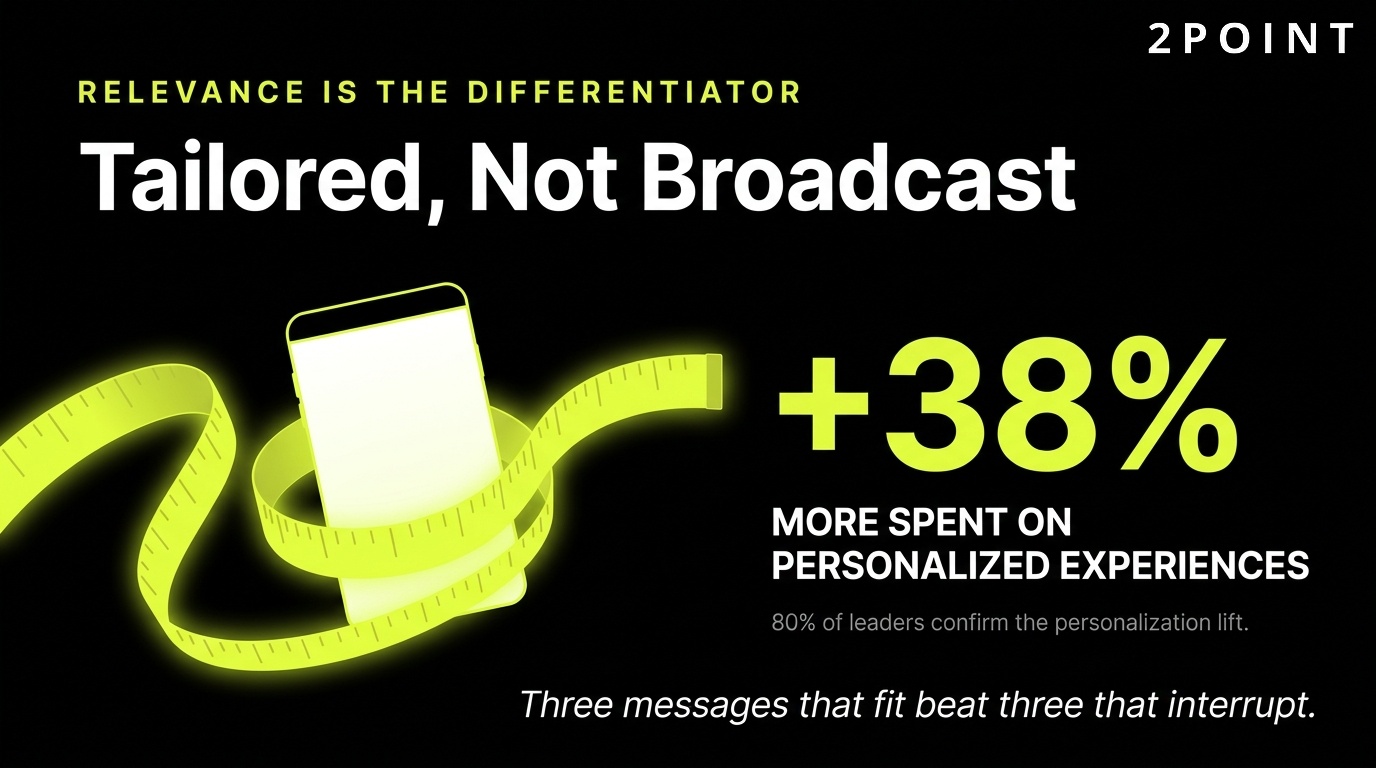
The business case for personalization is well established. 80% of business leaders report that consumers spend 38% more when they receive personalized experiences, and channel-level relevance is a core component of that personalization. Dynamic content adaptation, showing different email content blocks to different segments based on their browsing behavior, purchase history, or channel interactions, is one of the most accessible forms of personalization and consistently outperforms static content on both engagement and conversion metrics.
Preference center management gives customers agency over their channel experience while generating valuable first-party data. Customers who can select which channels they prefer, at what frequency, and for which content types are more likely to remain engaged over time and less likely to unsubscribe or opt out. This preference data, stored in your CRM and used to guide automation rules, reduces churn in your owned channel audiences and improves the signal quality of your behavioral data. Behavioral triggers and send-time optimization ensure that messages arrive when individual customers are most likely to engage, based on their personal usage patterns rather than assumed audience averages. For deeper guidance on building effective audience engagement through personalized approaches, the strategies connecting behavioral data to campaign design are particularly valuable for multi-channel programs.
Automation Platform Selection Criteria for Multi-Channel Programs
Choosing the wrong automation platform for a multi-channel program is an expensive mistake that becomes more costly as your program matures and migration becomes more disruptive. The selection criteria must be evaluated against your specific channel mix, team technical capacity, and growth trajectory rather than general popularity rankings.
Non-negotiable features for a multi-channel automation platform include: a cross-channel workflow builder that can orchestrate email, SMS, push, and ad retargeting in a single automation canvas; unified analytics that report performance across channels in a single view; native CRM integration or a robust API for connecting your customer data; audience segmentation that can filter by behavioral signals from multiple channels; and A/B testing capability at the automation level, not just individual email level. Scalability is the second priority. The platform that serves a 5,000-contact list well may become expensive or technically limited at 100,000 contacts. Understanding the pricing model and technical architecture at your projected scale prevents expensive mid-growth platform migrations.
Ease of use versus sophistication is a genuine tradeoff. More sophisticated platforms with greater personalization and orchestration capability typically require more technical expertise to implement and maintain. For teams without dedicated marketing operations resources, a more accessible platform that the team will actually use consistently will outperform a more sophisticated platform that sits partially configured. A realistic implementation timeline should be included in any platform evaluation: most enterprise-level marketing automation platforms require three to six months to fully configure, integrate, and train teams before delivering their projected performance benefits. Plan for this runway in your business case and budget allocation.
Measurement, Attribution, and Optimization in Multi-Channel Marketing
Essential KPIs for Measuring Multi-Channel Marketing Success
Measurement in multi-channel marketing requires a layered KPI framework that captures performance at the channel level, the campaign level, and the business outcome level simultaneously. Channel-level metrics without business outcome metrics tell you what is happening but not why it matters. Business outcome metrics without channel-level attribution tell you results but not which actions to replicate.
| KPI Category | Specific Metric | What It Measures | Optimization Signal |
|---|---|---|---|
| Engagement | Engagement rate by channel | Audience responsiveness to content | Below 1% warrants creative or audience review |
| Traffic and Click Quality | Channel-specific CTR | Message-to-action effectiveness | Declining CTR indicates creative fatigue or audience mismatch |
| Conversion | Conversion rate across touchpoints | Journey completion efficiency | Stage-specific drop-offs identify friction points |
| Acquisition Cost | Cost per acquisition (CPA) by channel | Channel-level capital efficiency | CPA above CAC payback threshold triggers reallocation |
| Customer Value | Customer lifetime value (CLV) | Long-term revenue potential by segment | Multi-channel customers show 30% higher CLV |
| Reach | Unique reach across channels | Audience coverage and overlap | High overlap suggests channel redundancy |
| Return | Return on marketing investment (ROMI) | Overall marketing program financial performance | Below 3:1 triggers budget reallocation review |
The key takeaway: multi-channel customers generate 30% higher lifetime value, purchase 250% more frequently, and spend three to four times more than single-channel customers, making CLV the most important long-term KPI for justifying multi-channel investment to business leadership.
For guidance on selecting the right metrics and building a complete measurement system, exploring how to effectively measure marketing campaign success provides a practical framework for tying channel-level performance to revenue outcomes.
The Attribution Challenge and How to Solve It
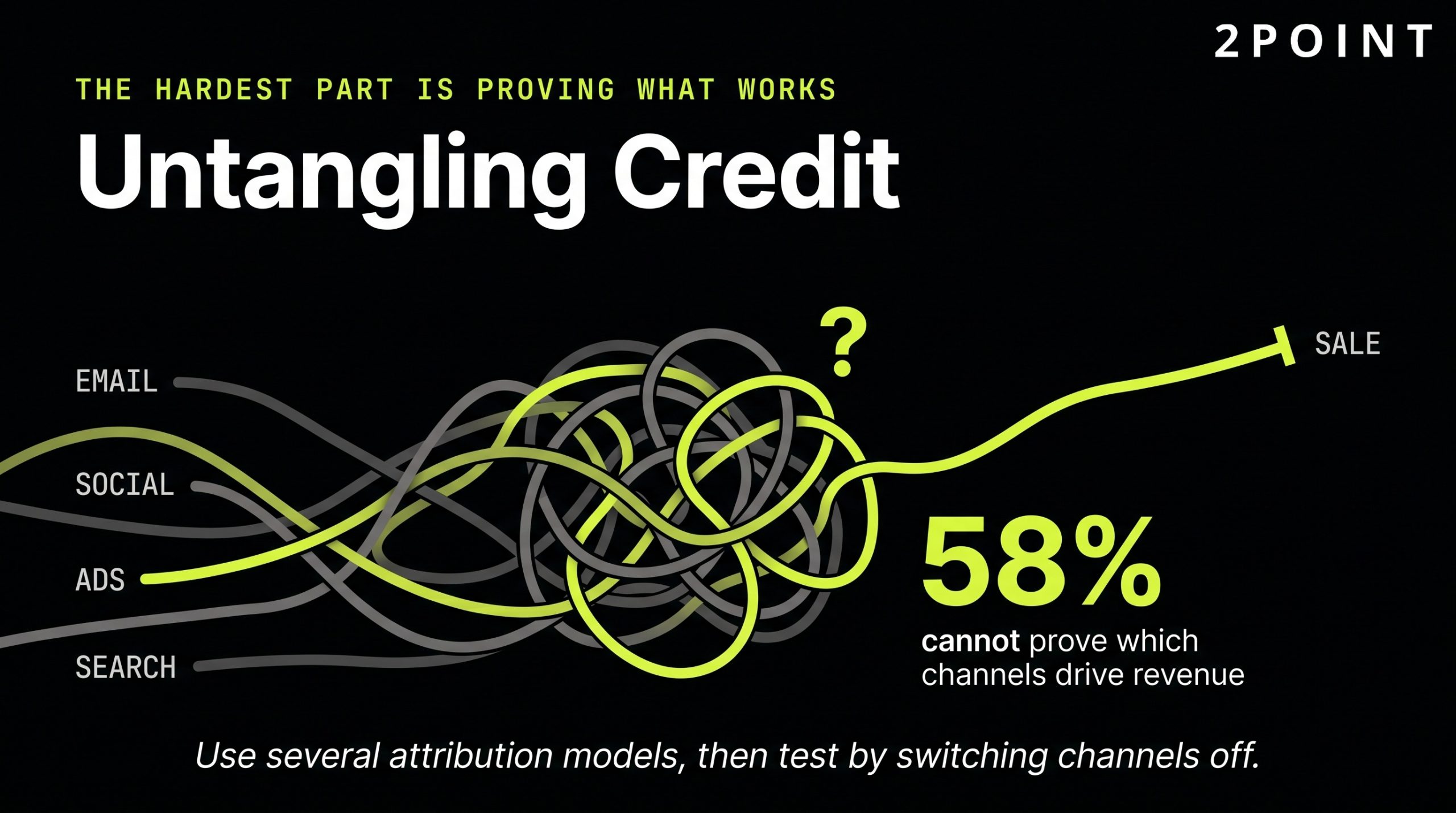
Multi-channel attribution is genuinely difficult, and the marketers who treat it as a solved problem are typically underestimating its complexity. 58% of marketers say they cannot prove which channels are actually driving revenue, which means the majority of multi-channel budget allocation decisions are being made on incomplete information. Understanding attribution models and their respective limitations is essential for interpreting your data correctly and avoiding systematic misallocation.
| Attribution Model | Credit Distribution | Best Use Case | Key Limitation |
|---|---|---|---|
| First-Touch | 100% to first interaction | Measuring awareness channel effectiveness | Ignores all nurturing and conversion-stage channels |
| Last-Touch | 100% to final interaction | Identifying conversion-stage triggers | Ignores all awareness and consideration channels |
| Linear | Equal credit to all touchpoints | Balanced view across long journeys | Does not reflect that some touchpoints matter more |
| Time-Decay | More credit to recent touchpoints | Short sales cycles with multiple touches | Undervalues awareness channels |
| Data-Driven | Machine learning assigns credit based on actual conversion patterns | High-volume programs with enough data | Requires significant conversion volume to be statistically valid |
The key takeaway: no single attribution model is universally correct, and using multiple models simultaneously with Google Analytics 4's data-driven attribution as a reference point provides the most complete picture of how your channels interact to drive conversions.
The practical solution for most businesses is a three-layer measurement approach. Use channel-level analytics for channel-specific optimization decisions. Use a unified attribution model in a CDP or dedicated attribution platform for cross-channel budget allocation decisions. And supplement both with incrementality testing, running controlled experiments where specific channels are turned off for defined periods to measure their actual contribution to overall revenue, rather than relying entirely on correlation-based attribution. Using analytics for optimizing digital marketing decisions across channels requires building this infrastructure deliberately, not as an afterthought once campaigns are already running.
Building a Single Source of Truth for Multi-Channel Data
A single source of truth in multi-channel marketing means that every team member working on any channel refers to the same dataset for performance information, customer profiles, and attribution data. Without this, different teams develop different narratives about which channels are performing based on their own platform-native analytics, creating budget allocation conflicts and undermining the integrated view that makes multi-channel strategy coherent.
The architecture for a single source of truth involves three components. First, data normalization across channels: converting channel-specific metrics into common definitions so that a "conversion" means the same thing whether it originated in email, paid social, or organic search. Second, real-time data synchronization: ensuring that customer behavior on one channel updates their profile and segment membership across all channels without a delay that would cause them to receive irrelevant messaging. Third, a consolidated reporting dashboard that pulls from the normalized data layer rather than from individual platform analytics, eliminating the discrepancies that arise from different attribution windows and conversion counting methodologies.
Data governance and quality control are maintenance requirements, not one-time setup tasks. As your channel mix evolves and new data sources are added, maintaining the integrity of your unified data layer requires regular audits, defined data ownership responsibilities, and clear processes for handling data quality issues when they arise. The investment in actionable data in marketing pays compound returns over time, as each campaign cycle adds to the behavioral dataset that makes future targeting and personalization more precise.
Continuous Optimization Framework for Multi-Channel Programs
Multi-channel marketing optimization is not a project with a completion date. It is an ongoing operational cycle that produces compounding returns when executed consistently. The most effective programs treat optimization as a regular rhythm rather than a reactive response to underperformance. The continuous optimization framework has four stages, repeating on a cycle aligned to your campaign cadence.
Stage one is structured A/B testing across channels. Every channel should have at least one active test at any given time, covering creative elements, audience segments, offer structures, or timing variables. Test one variable at a time with clearly defined success criteria and sufficient statistical significance before declaring a winner. Stage two is channel performance benchmarking against your own historical data and available industry benchmarks. Benchmarks provide context: a 2% email CTR means something very different in a B2B SaaS context versus a B2C retail context.
Stage three is budget reallocation based on defined triggers. Establish rules in advance for when budget shifts between channels. For example, if a channel's CPA exceeds your target by more than 20% for two consecutive months, budget reduces by a defined percentage until performance recovers. This prevents emotional budget decisions and ensures reallocation is systematic. Stage four is quarterly strategic reviews that assess channel mix, ICP accuracy, competitive context, and technology infrastructure against your current business objectives. Quarterly reviews are the mechanism for making larger strategic adjustments, such as adding a new channel, retiring a channel that has not performed, or revisiting your strategic marketing decisions based on accumulated data.
Common Multi-Channel Marketing Challenges and How to Overcome Them
Integration and Technology Complexity
Technology integration is consistently cited as the primary challenge in multi-channel marketing implementation. Legacy systems that predate modern API infrastructure, data silos created by department-specific tools that do not communicate with each other, and platform compatibility issues between best-in-class point solutions all create friction that prevents the unified data layer from functioning as designed. The result is manual workarounds, data inconsistencies, and attribution gaps that undermine confidence in the entire program.
The phased implementation approach is the most practical solution for businesses dealing with legacy infrastructure. Rather than attempting a full-stack replacement, identify the highest-priority integration, typically CRM-to-email-platform, and execute it completely before adding the next integration. Middleware platforms such as Zapier, Make, or dedicated iPaaS solutions can bridge gaps between tools that lack native integrations, enabling data flow without requiring custom development. The build-versus-buy decision for integration infrastructure should lean strongly toward buying established solutions unless your requirements are genuinely unique, as custom integration development creates ongoing maintenance obligations that consume engineering resources indefinitely.
Resource and Skill Constraints in Multi-Channel Programs
The resource reality for most businesses implementing multi-channel marketing is that team bandwidth is the binding constraint, not budget. Adding a new channel is straightforward in principle. Maintaining it at a quality level sufficient to build audience trust and drive performance requires ongoing creative production, campaign management, analytics review, and optimization. When these tasks are distributed across an already fully loaded team, quality degrades across all channels simultaneously.
The prioritization framework for resource-constrained teams starts with a clear channel maturity assessment. Rank your active channels by current performance, strategic importance, and your team's actual execution quality. Double down on the top two performing channels before adding new ones. Identify the specific skill gaps limiting your performance on those channels, and make targeted investments in either training or fractional hiring to address them. Automation is the most powerful force multiplier available to resource-constrained marketing teams: a well-configured automation program can replace dozens of manual tasks that are currently consuming team bandwidth, freeing capacity for the higher-leverage work of strategy, creative, and optimization.
The agency versus in-house decision is context-dependent. In-house teams build institutional knowledge and brand familiarity over time, which improves efficiency and quality as that knowledge accumulates. Agency partnerships provide access to specialized skills and channel expertise without the fixed cost of full-time employment, which is valuable when building capacity in a new channel or during high-demand periods. Many high-performing multi-channel programs use a hybrid model: in-house team for strategy, brand management, and channel coordination, with agency partners providing execution capacity and specialized skills on specific channels.
Message Coordination Without Losing Brand Consistency
The practical challenge of maintaining consistent brand messaging across a multi-channel program is primarily an operational problem rather than a creative one. 58% of marketers identify message alignment across channels as a significant challenge, and the root cause is typically the absence of coordinated workflow infrastructure rather than disagreement about brand positioning.
Cross-functional alignment is the foundation. Every team member producing content for any channel should work from the same briefing document, messaging hierarchy, and campaign calendar. A shared content calendar that shows all planned touchpoints across channels simultaneously enables teams to see where their work fits in the broader sequence and identify conflicts or redundancies before they are published. Creative asset management systems ensure that the same approved brand assets, logos, product images, and core visual elements are accessible to every channel manager, preventing off-brand creative from appearing on secondary channels due to a lack of access to current approved assets.
Approval workflow design is where message consistency is either protected or lost. Streamlined approval processes that include a consistency review checkpoint, confirming that new content aligns with the current campaign messaging across other channels, catch alignment issues before publication. Brand guidelines should be explicit enough to provide clear direction on channel-specific adaptation while flexible enough that they do not require every piece of content to go through a lengthy approval chain. The goal is a framework that empowers channel managers to make good independent decisions within defined parameters, not a bureaucratic bottleneck that slows execution to the point where the brand loses its relevance in fast-moving channels like social media.
Avoiding Channel Expansion Too Quickly
The "shiny object syndrome" in multi-channel marketing describes the pattern of adding new channels in response to industry buzz or competitor activity before existing channels are performing at their potential. This pattern is extremely common and consistently produces the same outcome: mediocre performance across many channels rather than excellent performance on the channels that actually matter for your audience.
The depth-versus-breadth decision framework starts with a channel maturity assessment. For each active channel, answer these questions: Is this channel consistently hitting its performance benchmarks? Is the audience segment we are reaching through this channel actually converting? Is our content quality on this channel at a level we would consider competitive with the best brands in our category? If any answer is no, the priority is to fix that, not add another channel.
An expansion readiness checklist prevents premature scaling. Before adding any new channel, confirm that you have a defined audience segment that is demonstrably active on the new channel, content production capacity to maintain credible presence for a minimum of six months, a measurement infrastructure that can track the new channel's performance independently and in relation to your existing channels, and a named team member with responsibility for managing and optimizing the new channel. The two to three channel mastery approach for businesses in the growth stage is not a limitation. It is a competitive advantage: exceptional execution on two channels consistently outperforms average execution on six, and the accumulated optimization data from focused channels creates proprietary advantages that are genuinely difficult for competitors to replicate.
Multi-Channel Marketing in Practice: Real-World Patterns That Work in 2026
HubSpot's Content-Driven Multi-Channel Engine
HubSpot's multi-channel marketing model is one of the most studied and most instructive examples of how content-first strategy creates compounding returns across channels. HubSpot drives over seven million monthly blog visitors, with 60 to 70% of that traffic coming from organic search, and converts 10 to 15% of those visitors into sales-qualified leads through email nurture sequences over a six to twelve month cycle. The posts that generated leads in 2020 continue to generate leads in 2026, which means the content investment has returned value for six consecutive years without additional spend.
The multi-channel mechanics are layered. Organic search drives top-of-funnel awareness through long-form educational content optimized for specific buyer questions. Email captures interested visitors and guides them through a structured nurture sequence. Social media amplifies content reach and drives community engagement that reinforces brand credibility. Paid advertising retargets high-intent visitors with conversion-focused messages after they have consumed educational content. Each channel plays a specific role in the overall journey, and the channels reinforce each other's effectiveness rather than competing for the same audience behavior.
The SMB adaptation of this model does not require seven million monthly visitors to be viable. The compounding logic applies at any scale. An SMB that produces two high-quality, keyword-optimized articles per month and builds an email nurture sequence of eight to ten messages will begin to see the same content compounding effect within twelve to eighteen months. The patient, quality-over-quantity discipline that characterizes HubSpot's approach is both the hardest part to execute and the most significant competitive advantage it creates. Most businesses abandon content programs before the compounding returns become visible. Those that persist capture audiences their competitors cede.
Nike's Integrated Physical-Digital Multi-Channel Experience
Nike's multi-channel strategy is the benchmark example of how physical and digital channels can reinforce each other when coordinated around a unified customer identity. The SNKRS app creates exclusive product drops that generate social media buzz, which drives email sign-ups, which further develops the owned audience for future drops. In-store events are promoted through email and in-app notifications, while in-app promotions drive store visit behavior, creating a continuous cycle between digital engagement and physical retail that deepens customer loyalty on both surfaces.
The influencer and social media integration is not incidental to this model. It is a planned channel that bridges the gap between product launches and mass awareness. Athlete partnerships create credible cultural moments that organic branded content cannot replicate. These moments generate user-generated content that extends the campaign reach far beyond Nike's owned channels. The key lesson is not that every brand needs SNKRS-level exclusivity to execute this model. It is that the principle of coordinating channel-specific experiences around a unified customer journey, where each channel adds something distinct rather than repeating the same message, creates the kind of multi-channel engagement that drives the retention and lifetime value benefits the data promises.
Small Business Multi-Channel Success Patterns
Small businesses achieving strong results from multi-channel marketing in 2026 share a consistent set of structural choices. The foundation is almost always email combined with one social channel where their specific audience is demonstrably active. SMS is added for time-sensitive promotions and appointment-based businesses once the email foundation is producing consistent returns. Retargeting ads extend the reach of content assets to audiences who engaged but did not convert, recovering a portion of the visitors that email cannot reach because they have not yet opted in.
Review platforms play a crucial and often underutilized role in small business multi-channel strategy. Google Business Profile reviews, Yelp, Trustpilot, or industry-specific review platforms function as a passive channel that influences purchase decisions during the consideration stage without requiring ongoing content production investment. Actively generating and responding to customer reviews for marketing purposes creates a trust signal that other channels amplify. Local SEO integrated with Google Business Profile provides visibility to in-market customers at the moment of highest purchase intent, often at a fraction of the cost of paid advertising for local search terms.
The resource allocation reality for small businesses is that the multi-channel mix must be designed around execution consistency rather than theoretical channel coverage. A small business that produces one excellent email newsletter per week and maintains an active, engaging presence on one social platform will consistently outperform one that attempts to maintain simultaneous presence on five channels with insufficient resources to execute any of them well. Building a cohesive marketing strategy that matches channel selection to available resources is the single most important strategic decision for small business marketers approaching multi-channel execution for the first time. Leveraging word-of-mouth marketing tactics alongside digital channels also accelerates growth disproportionately at this stage, as referral traffic from satisfied customers is among the highest-converting acquisition sources available.
B2B Multi-Channel Orchestration Patterns
B2B multi-channel marketing operates on fundamentally different timing and relationship dynamics than B2C. Sales cycles measured in months rather than days require a channel strategy that sustains relevance and trust across a much longer engagement window. The core channel combination for most B2B organizations is LinkedIn for audience development and thought leadership, email for nurture and direct outreach, and content marketing for search-driven awareness and sales enablement. These three channels address the full B2B consideration journey when coordinated correctly.
Webinars serve a particularly valuable function in B2B multi-channel programs as conversion mechanisms at the consideration-to-decision stage transition. A prospect who has consumed several pieces of content and opted into email communication is ready for a higher-intimacy interaction. A well-executed webinar with strong Q&A demonstrates expertise in a format that creates genuine relationship depth. The webinar registration itself is a behavioral signal that can trigger a personalized follow-up sequence combining email and LinkedIn touchpoints, coordinated around the specific topic the prospect raised interest in by registering.
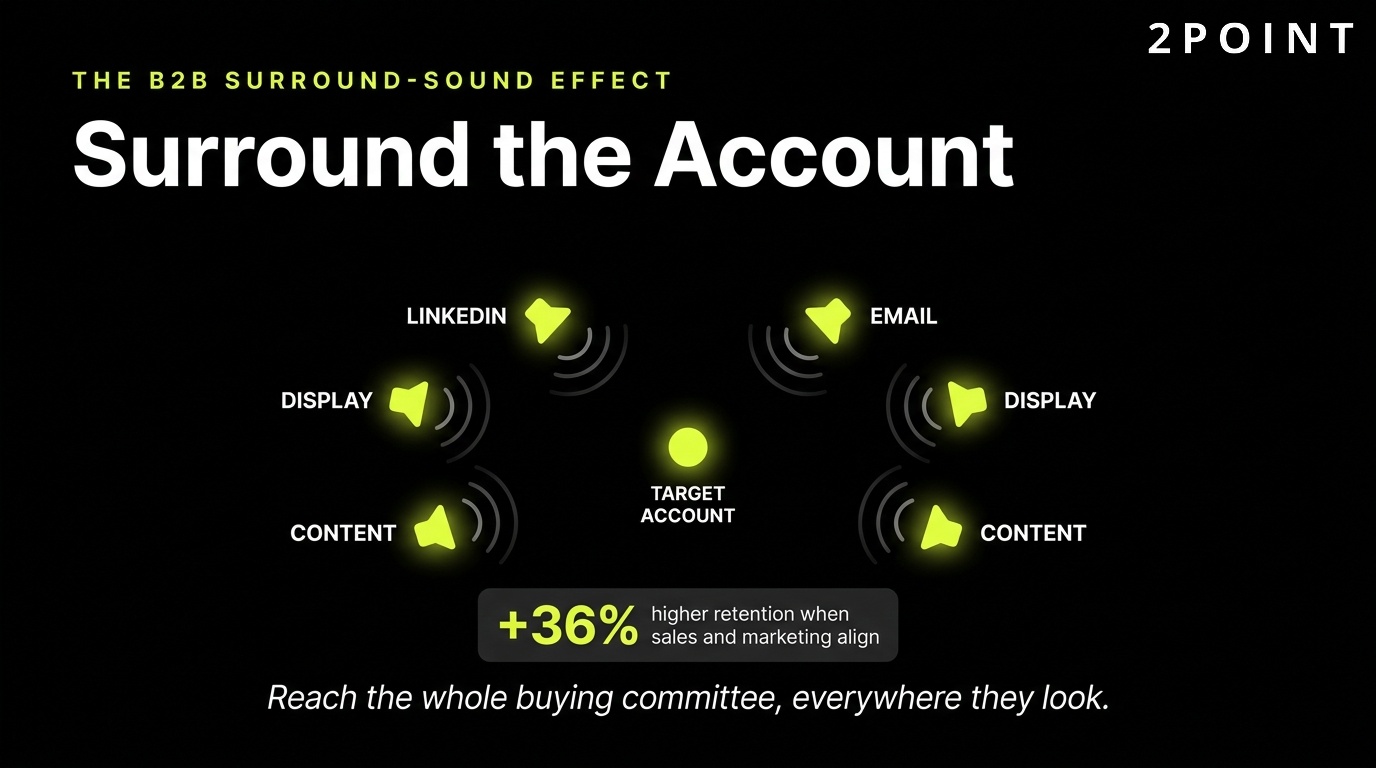
Account-based marketing (ABM) is the most sophisticated B2B application of multi-channel orchestration. ABM uses a defined list of target accounts and coordinates personalized outreach across every available channel simultaneously, creating a surround-sound effect where key decision-makers at target accounts encounter relevant brand messaging on LinkedIn, in their inbox, through paid display, and in content their colleagues share. B2B organizations with aligned sales and marketing in a coordinated multi-channel program show 36% higher customer retention rates than those with disconnected sales and marketing motion. The metrics that matter most in B2B multi-channel programs are sales-qualified lead generation rate, pipeline velocity, and deal close rate by channel combination, all of which require the unified attribution infrastructure described in the measurement section to track accurately.
Building Your Multi-Channel Marketing Program: The Path Forward
Multi-channel marketing in 2026 is not one of several approaches a business can choose between. It is the strategic baseline for any organization that wants to reach, engage, and retain customers in an environment where buyers consume information across an average of six touchpoints, switch devices constantly during their research, and expect consistent brand experiences wherever they encounter your brand.
The evidence for multi-channel investment is overwhelming. Three-channel programs produce 287% higher purchase rates. Multi-channel customers spend three to four times more than single-channel customers. Organizations with mature multi-channel programs achieve 89% customer retention rates. And the gap between businesses with integrated multi-channel infrastructure and those without is widening every year as the first movers compound their data, optimization, and audience development advantages.
The practical path forward is sequential rather than simultaneous. Start with your two or three highest-priority channels based on where your actual customers are most active. Build genuine depth on those channels before expanding to others. Invest in the technology infrastructure that creates a unified customer data layer, because without it, your multi-channel program will always be multiple single-channel programs running in parallel rather than a coordinated system that learns and improves. Implement marketing automation to scale execution while maintaining personalization quality. And build a measurement framework that connects channel-level performance to business outcomes so that every budget decision is grounded in evidence.
As you assess your current marketing program against these frameworks, aligning marketing strategies to your specific business objectives is the essential first step. The channel mix, budget allocation, and technology choices that are right for a B2B SaaS company in a twelve-month enterprise sales cycle look very different from those that serve a B2C e-commerce brand with a forty-eight-hour average purchase cycle. The principles in this guide apply universally. The specific implementation must be adapted to your audience, your resources, and your growth stage. Exploring the full range of digital marketing best practices available in 2026 is a strong next step toward building your strategy on current, validated frameworks.
The businesses that build strong multi-channel foundations now will be in an increasingly dominant market position over the next decade as the $192 billion industry grows toward $350 billion and the competitive stakes for audience attention continue to rise. At 2POINT, helping businesses translate these strategic frameworks into practical, revenue-generating programs is exactly the kind of work that produces the compounding advantages that matter most over time.
Frequently Asked Questions About Multi-Channel Marketing
What exactly is multi-channel marketing and how does it differ from single-channel marketing?
Multi-channel marketing is the practice of reaching customers across multiple platforms simultaneously, including email, social media, SMS, search, and more, using coordinated messaging. Single-channel marketing limits all communication to one platform, which restricts reach to only the fraction of your audience that is active on that specific channel and misses every touchpoint that occurs elsewhere in the purchase journey.
Is multi-channel marketing the same as omnichannel marketing?
No. Multi-channel marketing uses multiple independent channels with coordinated messaging but separate metrics and operations. Omnichannel marketing fully integrates those channels through a unified customer data system, enabling real-time personalization and seamless experience continuity as customers move between platforms. Most businesses start with multi-channel and mature toward omnichannel as their technology infrastructure develops.
How many channels should a small business start with for multi-channel marketing?
Small businesses should start with two to three channels where their target audience is most demonstrably active. Email combined with one social channel is the most common and capital-efficient starting point. Expanding to additional channels before achieving strong, consistent performance on core channels typically produces mediocre results across all channels rather than excellent results on the most important ones.
What is the ROI of multi-channel marketing compared to single-channel?
Businesses using three or more channels see a 287% higher purchase rate than single-channel businesses, and those using five or more channels see a 412% increase. Multi-channel customers also spend three to four times more and generate 30% higher lifetime value. Organizations adopting multi-channel approaches report 24% higher ROI on average, though the actual return depends heavily on execution quality and channel selection.
What are the most effective channels in a multi-channel marketing strategy?
Email marketing is consistently the highest-ROI channel, delivering $36 for every $1 spent, and 73.5% of marketers rate it their most effective channel. SMS offers the highest engagement rates at 98% open rates. Social media is essential for discovery and social commerce. The most effective combination depends on your audience's specific platform preferences and your business category.
How do you measure attribution in multi-channel marketing?
Attribution in multi-channel marketing requires selecting a model that fits your purchase cycle: first-touch for measuring awareness channel effectiveness, last-touch for conversion triggers, linear for equal credit distribution, time-decay for short sales cycles, or data-driven for high-volume programs. Most businesses benefit from using multiple models simultaneously and supplementing them with incrementality testing to measure each channel's true contribution to revenue.
What technology do you need to run a multi-channel marketing program?
A functional multi-channel program requires a CRM for customer relationship management, an email marketing platform, and analytics tools at minimum. As programs mature, adding a marketing automation platform for cross-channel workflow orchestration and a Customer Data Platform (CDP) for unified behavioral data creates the infrastructure needed for personalization and accurate attribution. The exact stack depends on your channel mix and budget.
Multi-channel marketing vs. cross-channel marketing: which should I use?
Multi-channel marketing uses independent channels with coordinated messaging and separate metrics. Cross-channel marketing connects those channels through shared data and coordinated timing, enabling sequential customer journeys that span multiple platforms. Choose multi-channel when you are building your initial channel presence and lack the technology infrastructure for full data integration. Move toward cross-channel as your CRM and automation infrastructure matures.
How does marketing automation help multi-channel marketing programs?
Marketing automation enables consistent, personalized execution across channels at a scale that manual processes cannot match. Businesses using automation generate 80% more leads and achieve 77% higher conversion rates. In multi-channel programs specifically, automation ensures that customer behavior on one channel can trigger relevant responses on another channel without manual monitoring, creating the coordinated experience that multi-channel customers expect.
What is the biggest challenge in implementing multi-channel marketing?
Technology integration is consistently cited as the primary challenge, followed by message alignment across channels and resource constraints. The most common failure mode is attempting to maintain active presence across too many channels without sufficient team capacity or technology infrastructure, which produces mediocre execution everywhere rather than strong performance on priority channels.
How does personalization work in a multi-channel marketing context?
Personalization in multi-channel marketing uses behavioral data collected across all channels to deliver more relevant messages on each subsequent touchpoint. This includes dynamic email content based on website browsing history, retargeting ads showing products a customer viewed, and SMS offers triggered by a customer's purchase history. Customers who receive personalized experiences spend 38% more on average, making cross-channel personalization one of the highest-leverage investments in any multi-channel program.
How long does it take to see results from a multi-channel marketing strategy?
Results vary by channel combination, industry, and execution quality. Email and paid channels can produce measurable results within four to eight weeks of proper campaign launch. Content-driven channels such as organic search and social media typically require three to six months before significant organic reach develops. Full multi-channel attribution clarity, where you can confidently measure each channel's contribution to revenue, typically takes six to twelve months of consistent execution and data accumulation.
