let’s connect


Your buyers are comparing you to competitors right now. They are building shortlists, evaluating alternatives, and forming opinions.
Most of it is happening inside ChatGPT, Perplexity, and Gemini, not on your website.
The AI search B2B buyer journey has shifted in ways most marketing teams have not yet caught up to. Strong organic rankings no longer guarantee visibility where decisions actually form.
A solid B2B AI search strategy starts with understanding which stage of the buying journey each AI surface influences and what your brand needs to say at each one. 2POINT built this framework to close that gap.
Key Takeaways
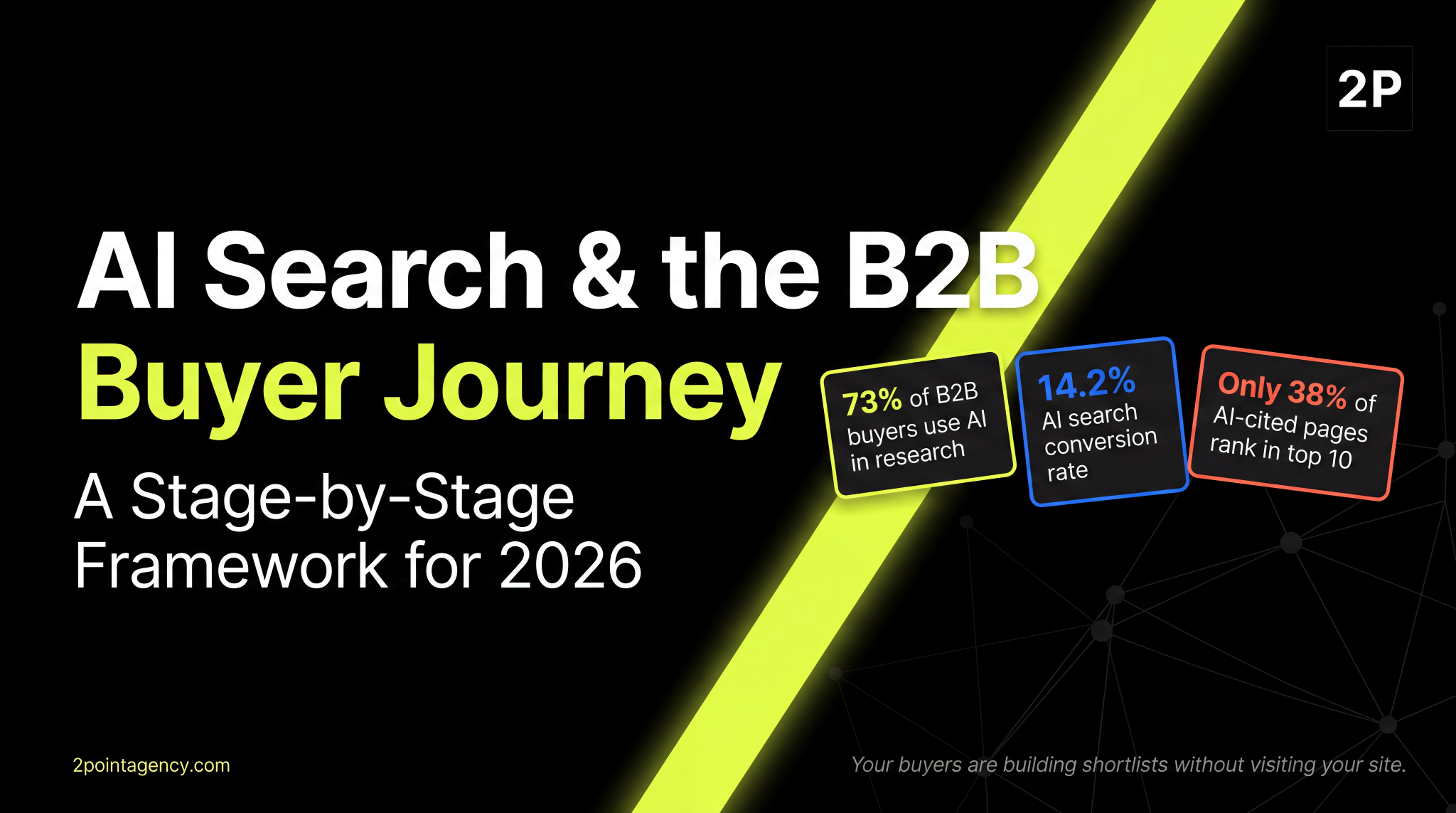
- 73% of B2B buyers use AI tools in purchase research, and 37% consult AI before Google. The AI search B2B buyer journey now starts in ChatGPT and Perplexity, not just traditional search.
- AI search traffic converts at 14.2% compared to Google organic’s 2.8%. AI in B2B marketing is the highest-converting discovery channel most teams are currently ignoring.
- How AI is changing B2B buying is measurable. The average B2B buying cycle compressed from 11.3 to 10.1 months in a single year as AI tools deliver synthesized comparisons instantly.
- Traditional SEO rankings do not predict AI citations. Only 38% of pages cited in AI Overviews also rank in the top 10 for the same query. Different surfaces, different optimization signals.
- Your Monday-morning move: audit your brand’s presence in ChatGPT, Perplexity, and Google AI Overviews for your top 10 buyer-intent keywords. Invisible brands are handing citations to competitors.
How B2B Buyers Actually Research in 2026
The B2B buyer journey is multi-stage, and in 2026, AI search has reshaped every stage of it.
Here’s why. A typical Google search runs 3-4 words. A ChatGPT prompt averages 60. That gap tells you everything. Buyers now ask detailed, specific questions and get vendor comparisons in a single response, bypassing the traditional research process altogether.
The shift is measurable, too. Averi’s analysis of 680 million AI citations found that 73% of B2B buyers now use AI in their purchase research. And according to Forrester’s 2026 Buyer Insights, 61% of the B2B buyer journey 2026 ends before a buyer ever contacts a vendor.
What that means for you is straightforward: AI in B2B marketing is already shaping your pipeline before you’re even in the room. That’s why understanding how AI search differs from traditional SEO is where the process of closing that gap begins.
The 4-Stage AI-Influenced B2B Buyer Journey
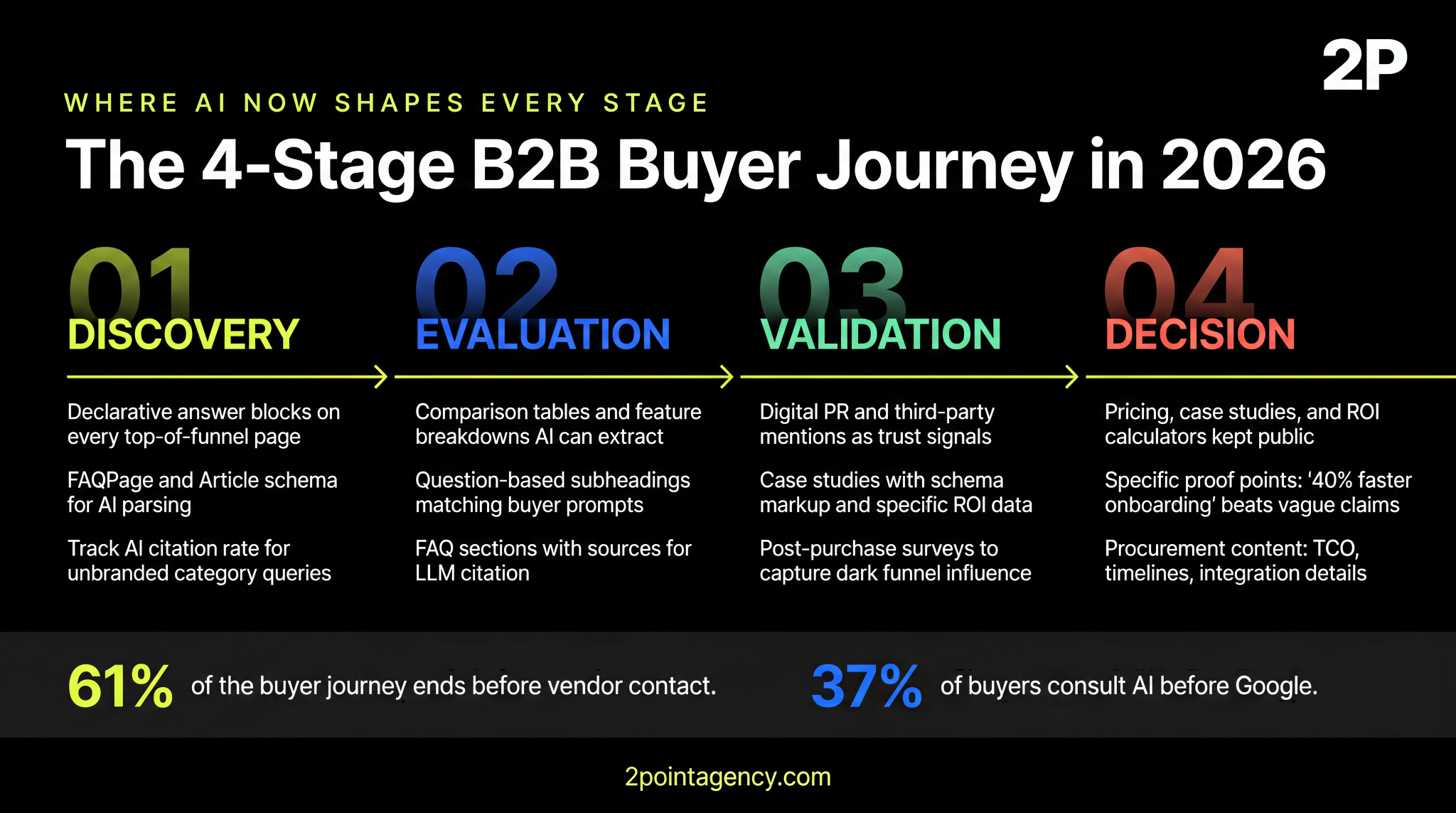
Understanding the AI search B2B buyer journey at a surface level is not enough.
What you need is a stage-by-stage breakdown of exactly what changes at each phase and what your B2B content strategy AI needs to do about it. That is what this framework gives you.
Stage 1: Discovery (AI Does the Googling for Your Buyer)
Discovery is where the AI search B2B buyer journey diverges most from what you know.
Your buyer used to search “best CRM for mid-market SaaS” and click through results. Now they open ChatGPT or Perplexity, type a 60-word prompt, and get a shortlist with vendor names and pricing, without visiting a single page.
And the numbers show exactly what that costs you. AI Overviews now appear in 87.6% of search results, pushing organic links down, and Gartner projects organic search will drop over 50% by 2028.
Your content needs to work differently here:
- Build declarative answer blocks at the top of every top-of-funnel page so AI can extract and cite you.
- Add the FAQPage and Article schema so AI platforms can parse your content accurately.
- Track your AI citation rate for unbranded category queries. If buyers are searching your category without your brand name, you need to know if you’re showing up.
Stage 2: Evaluation (AI Compresses Weeks of Research into Minutes)
The evaluation stage used to take weeks. Buyers attended demos, read comparisons, and built documents before settling on a shortlist. AI buyer research has changed that.
Today, 47% of consumers say AI directly influences which brands they trust. The evaluation window is shrinking, and if your content isn’t structured for extraction, you simply won’t appear.
- Comparison-ready content, with feature tables and use-case breakdowns, that AI can pull into comparisons.
- Question-based subheadings: “How does [product] handle compliance?” beats “Our Features” every time.
- FAQ sections with sources to support your LLM optimization and get cited during evaluation.
Stage 3: Validation (Buyers Cross-Check AI Answers with Trusted Sources)
AI doesn’t eliminate the trust layer of the B2B buyer journey. It reshapes it.
62% of frequent AI users always or very often fact-check what they find, going back to reviews, peers, and industry sources before deciding. You influenced the decision, but your analytics show zero touchpoints.
So what do you do?
- Digital PR and third-party mentions are the credibility signals AI weighs when deciding what to cite.
- Extractable case studies and ROI data with schema markup connect your brand to AI trust signals.
- Post-purchase surveys capture digital PR influence that analytics never show.
Stage 4: Decision (AI Agents Are Entering the Negotiation)
The decision stage is getting automated. Forrester predicts 1 in 5 B2B sellers will face AI-powered buyer agents in 2026. Procurement teams are already using AI to compare pricing, evaluate contracts, and generate counteroffers.
That means your positioning has to be clear, structured, and accessible before the agent even arrives. Three things to get right:
- Keep pricing pages, case studies, and ROI calculators public. AI agents can’t extract what’s gated.
- Structure proof points with specific data: “Reduced onboarding time by 40%” beats vague efficiency claims every time.
- Build procurement-specific content covering total cost of ownership, timelines, and integration requirements.
Why Traditional SEO Is Not Enough for AI Search B2B Visibility
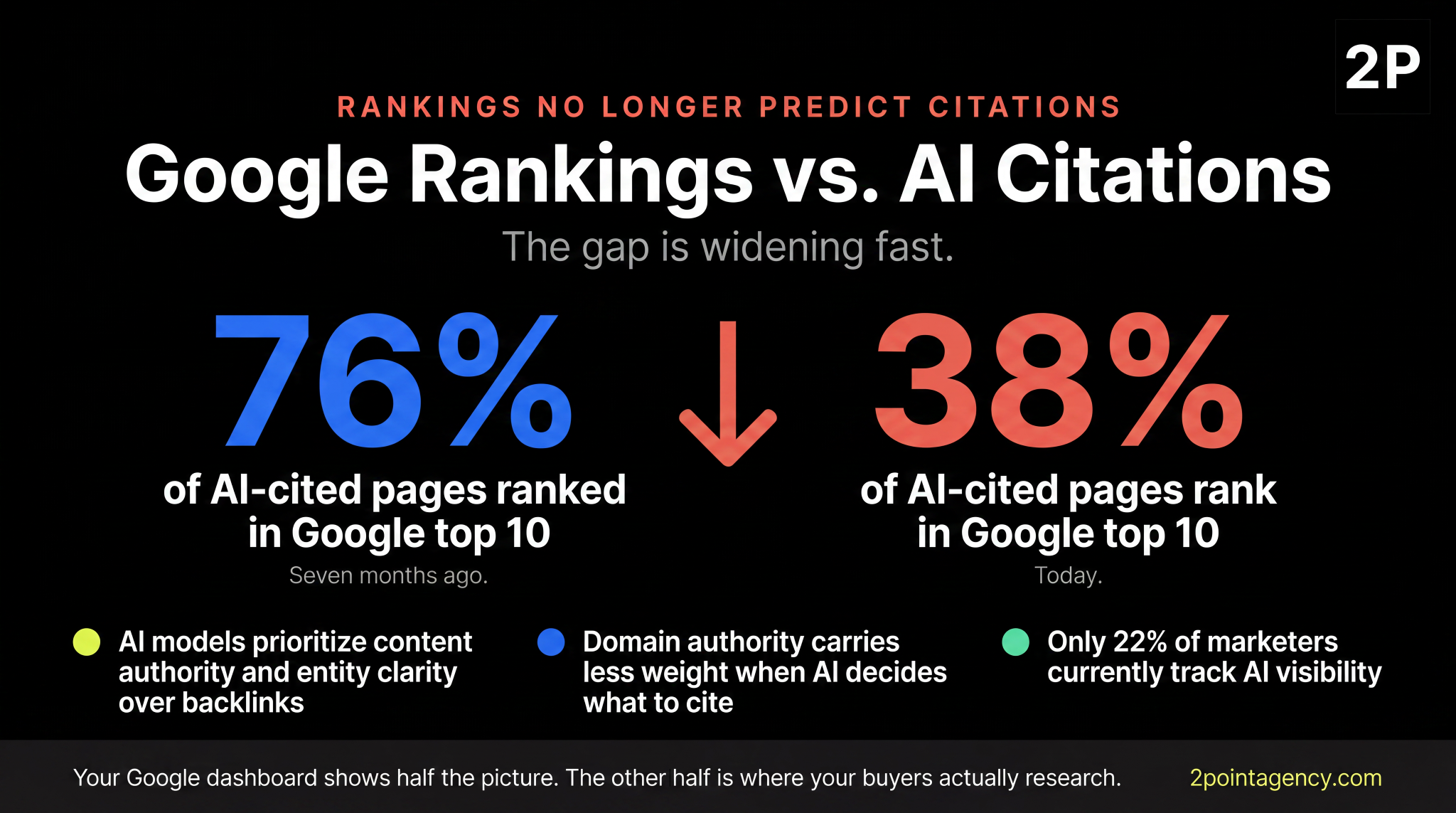
Your Google rankings no longer tell the full story.
Ahrefs analyzed 863,000 keywords and found that only 38% of pages cited in AI Overviews also rank in Google’s top 10 for the same query. Seven months before, that figure was 76%. The gap between rankings and AI citations is widening fast.
That’s because AI models prioritize content authority, entity clarity, and structured data over backlinks. Domain authority still matters for Google, but it carries less weight when AI decides what to cite in a buyer’s research conversation.
Only 22% of marketers track AI visibility B2B, and fewer than 26% plan to build content for AI citations. So running an AI search visibility audit first gives you a clear picture of where you stand across ChatGPT, Perplexity, and Google AI Overviews.
How to Build an AI-Visible B2B Content Strategy
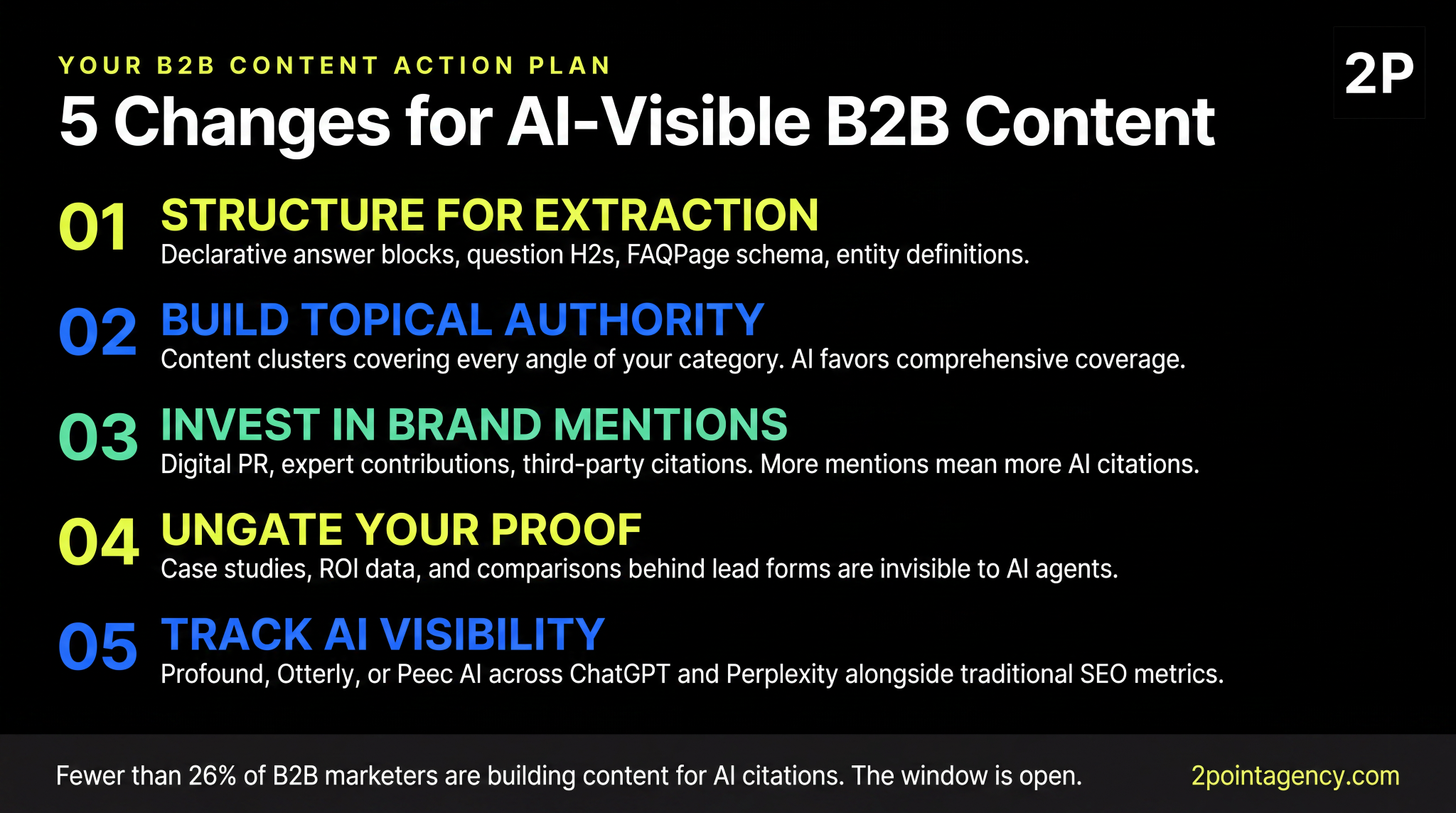
Five changes directly address the AI search B2B buyer journey stages above.
- Structure content for extraction with declarative answer blocks, question-based H2s, FAQPage schema, and entity definitions.
- Build topical authority through content clusters. AI favors comprehensive coverage, and your content strategy framework should reflect that.
- Invest in brand mentions via digital PR, third-party citations, and expert contributions to industry publications.
- Ungate your proof. Case studies, ROI data, and comparisons behind lead forms are invisible to AI agents.
- Track AI visibility alongside SEO with tools like Profound, Otterly, or Peec AI across ChatGPT and Perplexity.
Measuring AI Search Impact on Your B2B Pipeline
Your current SEO dashboard misses AI search B2B performance. Demand Gen Report is clear: AI search summaries now give buyers condensed answers without reading your long-form content, so publishing volume no longer guarantees visibility.
Track these instead:
- AI citation rate (branded and unbranded) for your target queries
- AI referral traffic from chatgpt.com, perplexity.ai, and AI Overviews in GA4
- AI-influenced conversions via UTM tagging and attribution
- Dark funnel attribution via post-purchase surveys
- Buying cycle length: AI-influenced deals vs. organic-only
Your technical SEO foundation is step one.
Content Mistakes That Kill B2B AI Visibility
Four mistakes are costing you B2B AI visibility right now.
- Gating your best content. AI can’t cite what it can’t access, and that gated case study blocks more than you think.
- Writing for keywords instead of topics. Search Engine Journal reports that Google’s top 10 is now a weaker AI citation indicator than a year ago. Topic coverage across multiple angles matters more than any single top-10 position.
- Ignoring brand mentions. AI weighs how often credible third-party sources reference your brand. More mentions mean more citations.
- Not tracking AI visibility at all. You can’t improve what you don’t measure.
In-House vs Agency: Who Should Build Your B2B AI Search Strategy?
| In-House | Agency | |
| Content Structure | Your team already produces structured content with schema markup | You have 100+ pages that need structural optimization for AI citation |
| Tooling | Someone on the team has experience with AI citation tracking tools | Nobody has experience with generative search B2B platforms yet |
| Ownership | One person can own AI visibility as a channel alongside SEO | Leadership needs measurable AI visibility benchmarks alongside traditional SEO reporting |
| Speed to results | Slower ramp-up as the team builds new skills alongside the existing workload | Faster execution with frameworks and tracking already in place |
| Risk | Trial and error costs you visibility while competitors get cited | Proven playbook reduces the gap between where you are and where buyers find you |
In-house works if you already have the structure, tooling, and bandwidth.
Most B2B teams don’t, and that’s not a knock. AI search B2B visibility requires a different skill set than traditional SEO, and building it from scratch takes time you may not have.
If your buyers are already researching AI platforms but your B2B content strategy’s AI visibility is zero, that’s the gap 2POINT closes, using the 4-stage buyer journey framework and dual-channel measurement to get you visible where it counts.
Are Your Buyers Finding You in AI Search, or Finding Your Competitors?
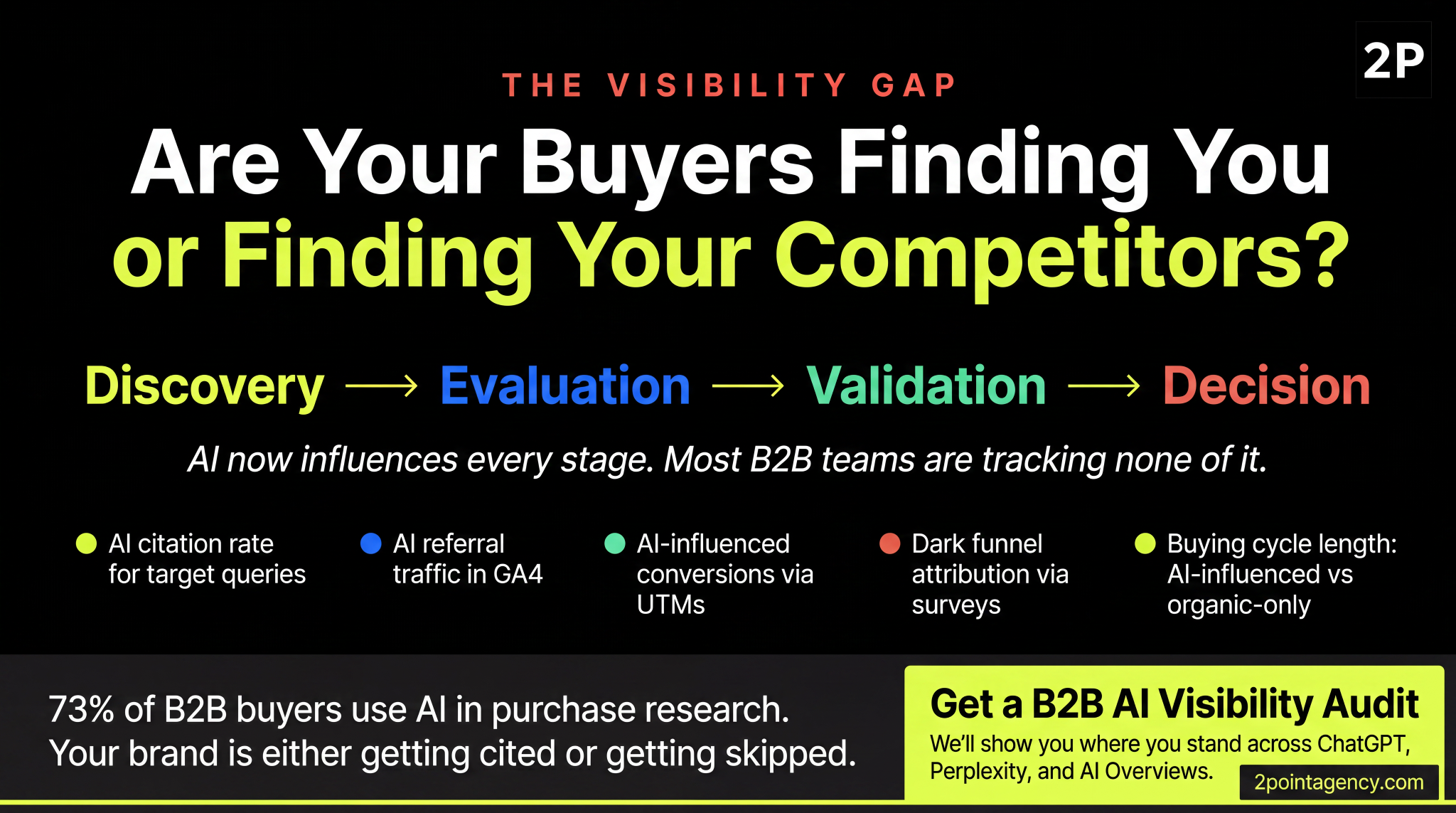
The AI search B2B buyer journey has reshaped every stage: discovery, evaluation, and decision-making. Most teams aren’t tracking any of it, and fewer than 26% are building content for AI citations.
That window won’t stay open.
2POINT helps B2B brands close that gap through AI-focused SEO and multi-channel strategies built for where buyers actually search now.
FAQs About AI Search and B2B Buyer Journeys
How are B2B buyers using AI search tools in 2026?
B2B buyers use ChatGPT, Perplexity, and Gemini to research vendors, compare features, and build shortlists before visiting any website. 73% now use AI in their purchase research, asking detailed prompts that return synthesized comparisons, making traditional Google-only discovery increasingly incomplete.
What percentage of B2B buyers use AI before Google?
37% of B2B buyers now start purchase research in AI tools before Google. The B2B buyer journey in 2026 increasingly begins on platforms like ChatGPT and Perplexity, making AI visibility B2B a critical channel that most marketing teams still overlook.
Does ranking on Google mean you’ll appear in AI search results?
No. An Ahrefs study of 863,000 keywords found only 38% of pages cited in AI Overviews also rank in Google’s top 10. AI models prioritize entity clarity, content structure, and topical authority, so your B2B AI search strategy needs to address both channels independently.
How does AI search change B2B content strategy?
AI search rewards structured, extractable content over keyword-optimized pages. Your B2B content strategy AI approach should include declarative answer blocks, question-based subheadings, FAQPage schema, and stat-plus-source pairings so AI models can parse and cite your content during buyer research.
What tools track AI search visibility for B2B brands?
Profound, Peec AI, Otterly, and Athena HQ track AI citation rates across ChatGPT, Perplexity, and Google AI Overviews. Pair these with GA4 for AI referral traffic and with post-purchase surveys for dark-funnel attribution. Tracking AI in B2B marketing requires a dedicated measurement stack.
How long does it take to see results from AI search optimization?
Structural changes such as declarative blocks, schema markup, and entity definitions typically yield AI citation improvements within 30-60 days. Building topical authority and brand mentions for a full AI-powered buyer journey strategy takes 3-6 months, though citation-tracking tools provide faster feedback on what’s working.
Should B2B brands ungate content for AI visibility?
Yes. AI systems cannot cite content behind lead forms or login walls. Ungating case studies, comparison pages, and ROI data makes them accessible during AI buyer research. The tradeoff favors AI visibility B2B: broad AI-influenced impressions consistently outweigh the limited reach of gated lead capture.