


 let’s connect


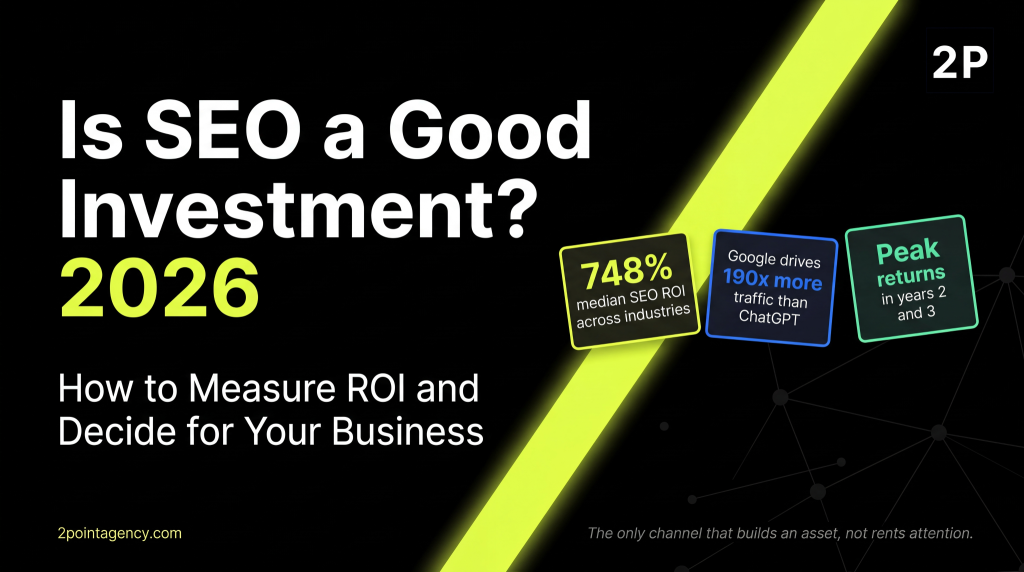
Most businesses investing in SEO can’t answer one question: Is it actually working?
The problem is not the investment itself. SEO ROI is measurable, but only if you know where to look and what to connect. Traffic going up means nothing if revenue stays flat.
Knowing how to measure SEO ROI changes that conversation entirely. It turns a cost line into a business case. And for brands serious about growth, 2POINT treats it as the starting point, not an afterthought.
So, is SEO a good investment? Let's find out.
Key Takeaways
- SEO return on investment delivers a median 748% across industries, but results vary widely by vertical and execution quality.
- The formula is simple: (SEO revenue minus SEO costs) divided by SEO costs, multiplied by 100. Run it quarterly, including your full costs, not just your agency retainer.
- Industry benchmarks range from 317% for eCommerce to 1,389% for real estate. Know where your vertical sits before setting expectations.
- SEO investment takes 6 to 12 months to turn positive and peaks in years two and three. Track impressions, average position, and non-branded clicks while revenue catches up.
- If you are asking whether SEO is worth the money, consider this: Google still drives 190 times more traffic than ChatGPT. The channel is evolving, not disappearing.
What Is SEO ROI and Why Does It Matter?
SEO ROI measures the revenue your business earns from organic search relative to what you spend to achieve it. The formula is straightforward: SEO revenue minus SEO costs, divided by SEO costs, multiplied by 100. A positive result means organic search earns more than it costs you.
To put that in context, First Page Sage 2026 SEO statistics show that the median ROI across industries is 748%. That is $7.48 returned for every dollar invested.
Figma is a useful example of what that looks like at scale. With over 12 million organic visits per month, their traffic is worth an estimated $49 million in equivalent ad spend, without paying for a single click.
That compounding effect is what separates SEO from every other channel. Paid ads stop delivering the moment your budget runs out. A well-built organic presence keeps working long after the initial investment stops, and your CFO will notice the difference.
Is SEO a Good Investment? What the Data Says in 2026
Yes, and the evidence goes well past a single ROI statistic. The market trajectory alone tells a clear story.
Mordor Intelligence projects the global SEO market will grow from $72.3 billion in 2025 to $106 billion by 2030, at a CAGR of nearly 8%. That level of sustained investment across industries does not occur around a declining channel.
Backlinko's Google search data estimates daily searches at 8.5 billion in 2026.
Your customers are in that stream every single day. The question is not whether SEO reaches them. It is whether your content is there when they look.
The ROI data further reinforces the point. WordStream's SEO statistics show that a well-executed SEO campaign can deliver a 748% ROI. Paid campaigns deliver results on a linear curve. SEO compounds. The authority and content you build today keep generating returns long after the initial investment stops.
SEO ROI by Industry: What to Expect in Your Vertical
SEO ROI varies significantly depending on your industry, and knowing where your vertical sits matters before you set benchmarks or judge your own performance.
The variation comes down to three core drivers: average transaction value, customer lifetime value, and sales cycle length. Industries where a single conversion is worth $5,000 or more naturally produce higher ROI from the same organic traffic than industries where the average order is $35.
High-value verticals like real estate and financial services consistently top the ROI rankings, while eCommerce sits at the lower end. Here is how the numbers break down:
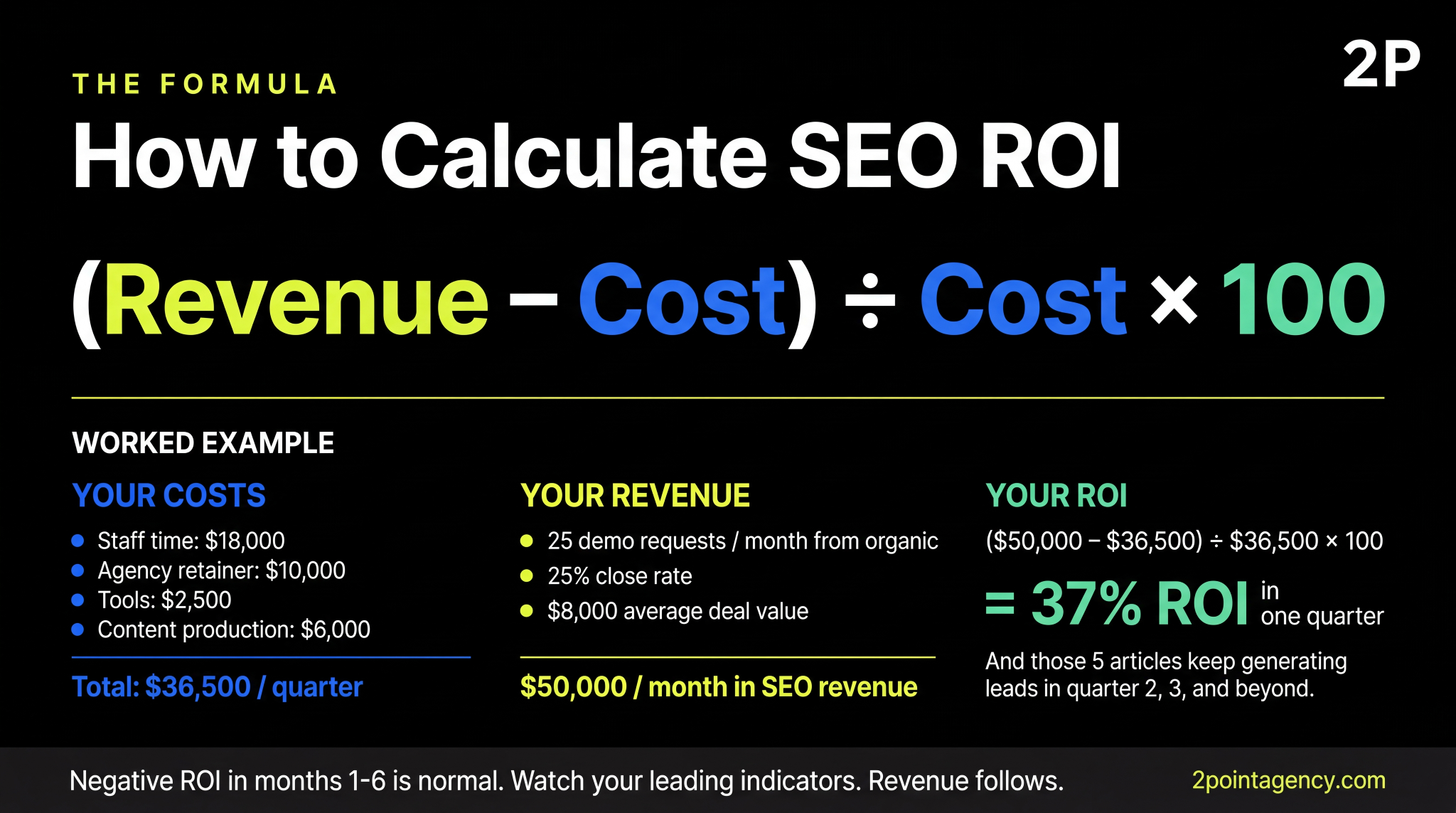
| Industry | Median ROI | Break-Even Period | Key Driver |
| Real Estate | 1,389% | 10 months | High transaction value per deal |
| Medical Devices | 1,183% | 13 months | Long sales cycle, high LTV |
| Financial Services | 1,031% | 11 months | High-value leads, 7.3x better than PPC conversion |
| Higher Education | 994% | 13 months | High LTV, research-heavy search journey |
| SaaS / B2B Tech | 702% | 9 months | Content-driven acquisition model |
| Legal Services | 526% | 10 months | Extremely high CPCs make organic valuable |
| eCommerce | 317% | 9 months | Volume-driven with thinner margins |
A few things worth noting about this table. These are medians; half of the businesses in each vertical perform above these numbers, and half below.
Execution quality, competitive landscape, and domain maturity all shift where you land.
If your industry is not listed, apply this logic. High customer lifetime value combined with high Google Ads cost-per-click signals strong SEO ROI potential. Organic clicks are free. Every one you earn replaces an expensive paid click and typically converts better too.
When SEO Might Not Be the Right Investment
An honest answer to whether SEO is worth the money has to include the scenarios where it is not your best bet.
SEO is a weaker fit when your buyers do not search.
Enterprise procurement, referral-driven industries, and niche B2B categories where decisions are made through RFPs often have low search volume. If your addressable audience generates 50 searches per month for your category, execution quality will not save you.
Urgent timelines are another mismatch. If your business needs revenue within three to six months, paid search and outbound move faster.
The smartest move in any of these situations is a multi-channel approach that uses each channel where it performs best. SEO handles long-term demand capture. Paid handles urgency. They compound each other when used together.
How to Calculate SEO ROI Step by Step
Knowing whether your SEO investment is working requires more than a gut feeling.
You need a formula, real numbers, and the discipline to track them consistently. This four-step process gives you a defensible, repeatable framework for measuring exactly what your SEO is returning.
Step 1: Calculate Your True SEO Investment
The most common mistake in calculating SEO ROI is underestimating the actual cost. Your agency retainer is one line item. The full cost includes staff time, freelance writers, tool subscriptions, and content production.
Here is a realistic quarterly breakdown:
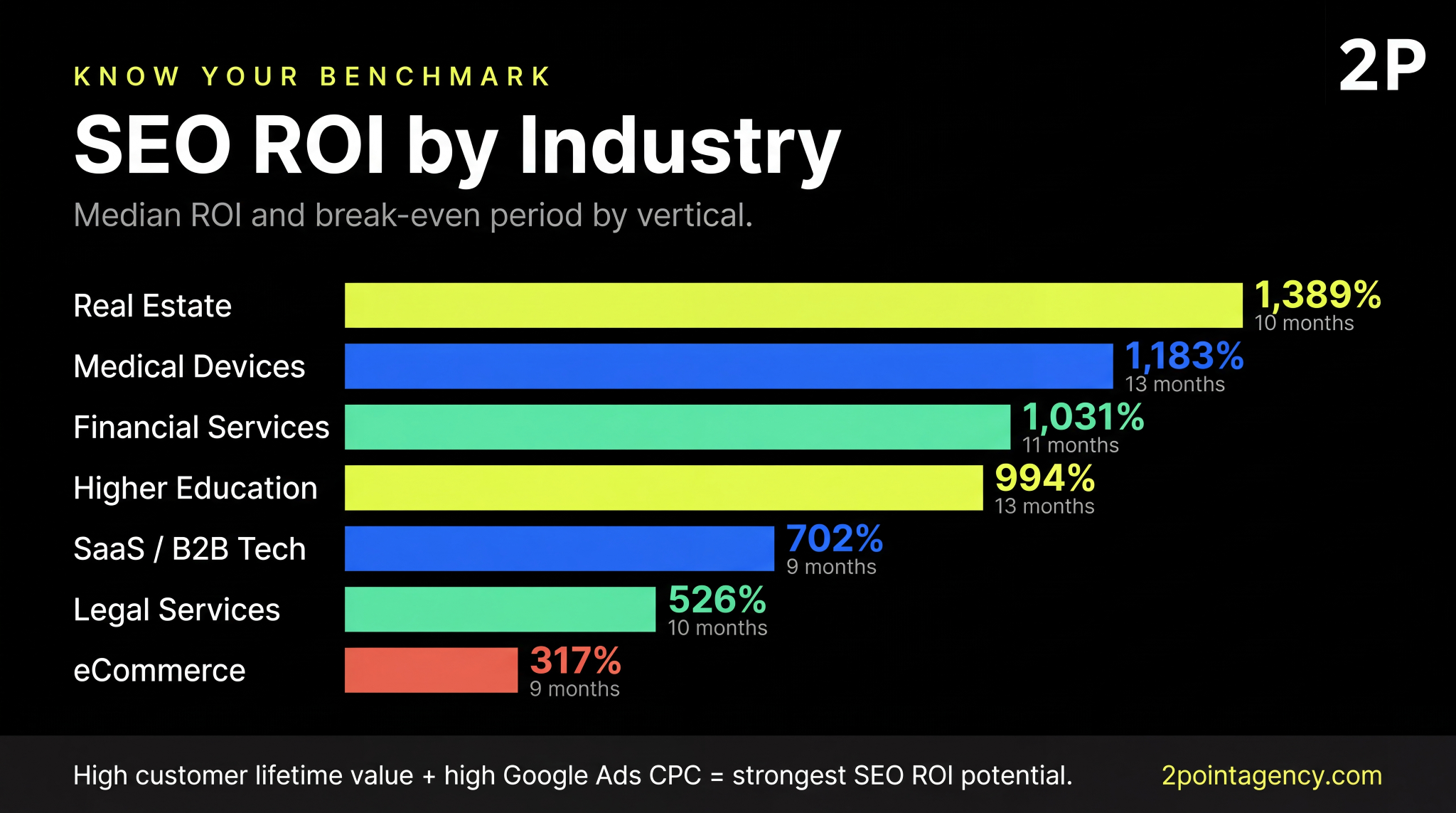
- Staff time allocated to SEO: $18,000
- Agency retainer: $10,000
- Tools (Semrush, Screaming Frog, schema plugins): $2,500
- Content production (5 articles, graphics, video): $6,000
- Total quarterly investment: $36,500
As Investopedia's ROI methodology confirms, ROI calculations only produce meaningful results when you compare net profit against total investment. Missing half your costs inflates your apparent returns and leads to poor budget decisions.
Step 2: Measure Revenue From Organic Search
Revenue attribution is where the formula gets real.
In Google Analytics 4, set up conversion events for every action that leads to money: form submissions, demo requests, trial signups, and eCommerce transactions. Filter these by the organic search channel to isolate what SEO is actually producing for you.
For B2B, the math works like this. Say organic search drives 25 demo requests per month. Your sales team closes 25% of demos. The average deal is worth $8,000.
That's 25 × 0.25 × $8,000 = $50,000 per month in SEO-attributed revenue.
For eCommerce, pull your organic channel revenue directly from GA4, including repeat purchases from customers who originally arrived through organic search.
Step 3: Apply the Formula and Interpret Results
The formula is straightforward:
(SEO Revenue minus SEO Costs) divided by SEO Costs, multiplied by 100 = SEO ROI.
Using the numbers from our example: ($50,000 minus $36,500) divided by $36,500, multiplied by 100 equals 37% ROI in a single quarter.
That number looks modest, but compounding changes everything. Those five articles continue to generate traffic after 90 days. By quarter three, the same content is producing leads while new pages keep piling on.
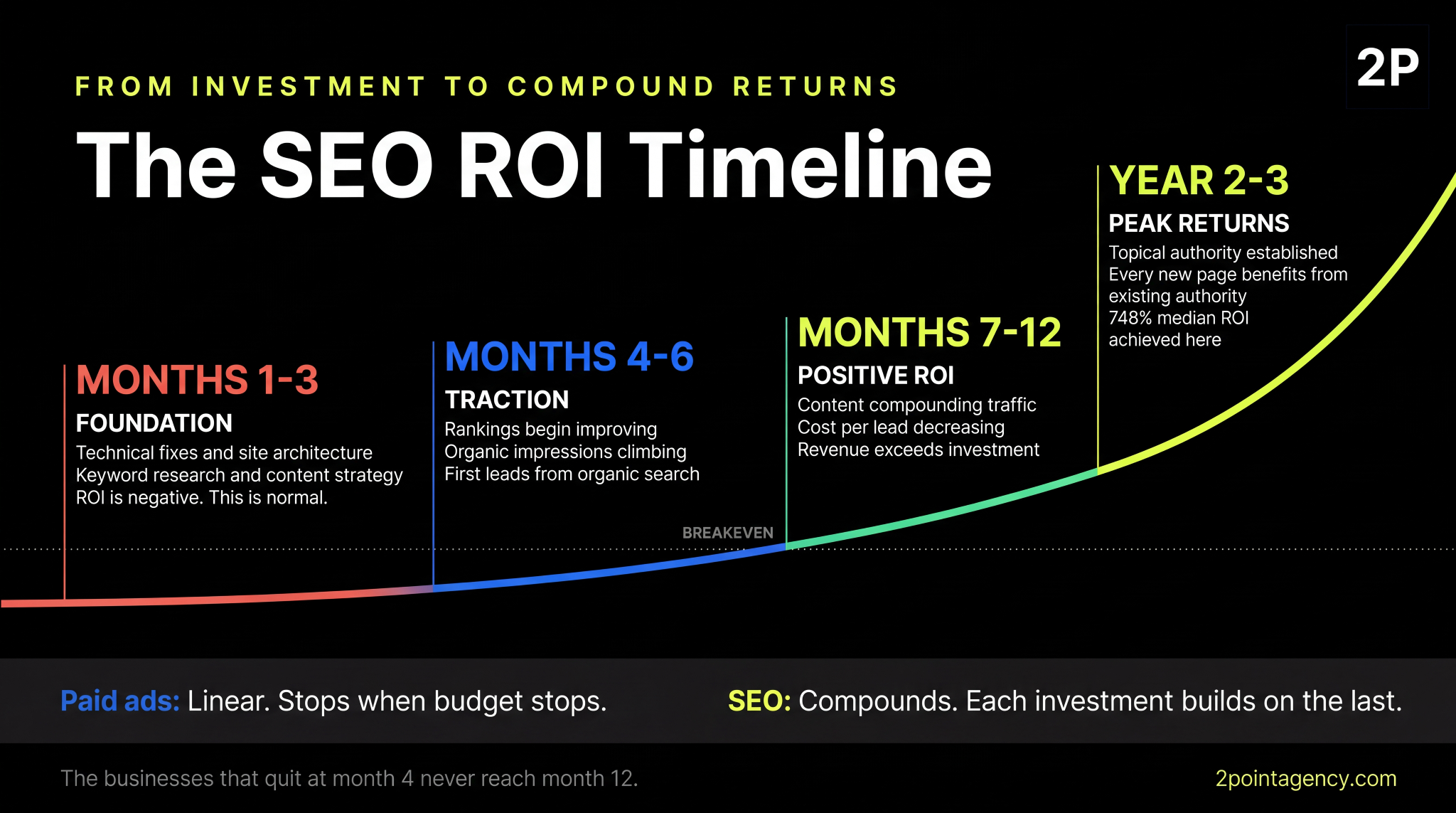
Negative ROI in the first three to six months is normal. Watch your leading indicators instead: impressions, indexed pages, and non-branded clicks climbing means revenue is coming.
Step 4: Forecast Future SEO ROI
Forecasting transforms SEO from a faith-based exercise into a strategic investment decision.
The practical formula: monthly search volume multiplied by your expected click-through rate for a target position equals projected monthly traffic. Multiply that by your conversion rate and average deal value to get projected revenue.
Search Engine Land's SEO projection framework recommends modeling three scenarios:
- Conservative: Position 5 to 8, capturing 3 to 5% CTR
- Moderate: Position 3 to 5, capturing 6 to 10% CTR
- Aggressive: Position 1 to 2, capturing 15 to 25% CTR
This gives you something concrete to bring into a budget meeting, not just a case for SEO, but a projection your stakeholders can actually evaluate.
The KPIs That Actually Predict SEO ROI
Most SEO reporting conflates activity with progress. Your monthly deck shows keyword rankings, traffic graphs, and backlink counts, but none of it answers the question your leadership team actually cares about: is this making money? Splitting your metrics into leading and lagging indicators solves that problem directly.
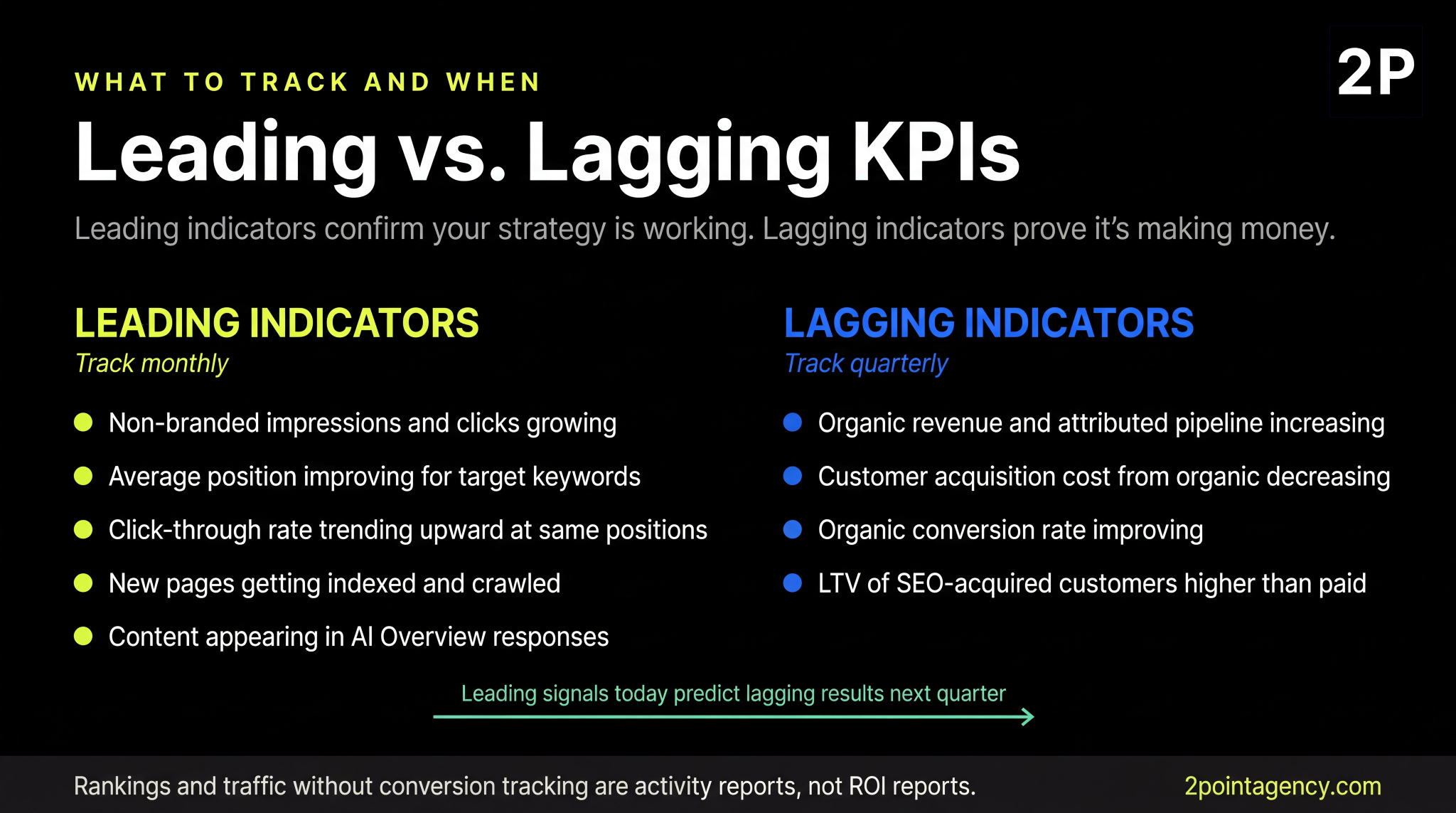
Leading Indicators (Track Monthly)
Leading indicators confirm your strategy is working before revenue shows up. Track these monthly:
- Non-branded impressions and clicks: Growth here means Google is showing your content to new audiences, not just people who already know your brand.
- Average position for target keywords: Moving from position 18 to position 9 proves traction, even before traffic meaningfully increases.
- Click-through rate trends: Improving CTR at the same position signals your titles and meta descriptions are resonating with your audience.
- Indexed pages and crawl health: If Google is not indexing your new content, nothing else matters.
- AI Overview appearances: Track how often your content appears in Google's AI-generated responses. Understanding how AI Overviews select sources is an increasingly important part of your visibility strategy.
Lagging Indicators (Track Quarterly)
Lagging indicators are the revenue metrics that justify your continued investment. Track these quarterly:
- Organic revenue and attributed pipeline: The number that matters most. Pull it from GA4 with proper conversion tracking in place.
- Customer acquisition cost from organic: Total SEO investment divided by customers acquired through organic. This number should decrease over time as SEO compounds.
- Organic conversion rate: The percentage of your organic visitors who take a revenue-generating action.
- Customer lifetime value of SEO-acquired customers: In many industries, organic customers have higher LTV because they found you through research rather than a discount ad.
How to Present SEO ROI to Stakeholders
Your CEO does not want to hear about keyword rankings. They want to know what organic search contributes to the business.
Start with revenue contribution and cost-per-acquisition trends.
Show how your organic CPA compares to paid acquisition costs for the same keywords. The ad value equivalent, what your current organic traffic would cost to buy through Google Ads, tends to produce a visible reaction in budget meetings.
Then close with a 12-month projection across three scenarios. Stakeholders think in financial terms, so give them a financial model.
Factors That Influence Your SEO ROI
The 748% median ROI is an aggregate. Your actual return depends on variables specific to your business, your market, and the execution of your strategy.
Understanding those variables is what lets you move your number in the right direction.
Competition and Keyword Difficulty
The keywords you target determine your difficulty curve and your timeline to returns.
A term like "Ozempic" carries a six-figure monthly volume, with keyword difficulty scores above 70, and is dominated by WebMD, Mayo Clinic, and pharmaceutical manufacturers. Competing for that as a regional health clinic is a losing proposition.
Your opportunity sits in the long tail. "How to get Ozempic for weight loss in California" conveys a sharper intent, lower difficulty, and a visitor who is closer to converting. Building content ecosystems around related queries is how you win without burning budget on keywords you will never rank for.
Quality vs. Cost of Execution
Cheap SEO and strong SEO produce fundamentally different outcomes, and the difference shows up directly in your ROI. Cheap SEO means thin articles, irrelevant backlinks, and no technical optimization.
The result is stagnation, or worse, penalties that take months to recover from.
Strong SEO means original research, expert input, technical audits, and a content strategy built around your ideal customer. You are investing in an asset, so treat it as you would any serious business investment.
Time Horizon and Compounding Returns
SEO takes 6 to 12 months to deliver positive ROI, with peak returns typically arriving in years 2 and 3.
Early months focus on technical fixes, crawl health, and site architecture. The middle phase builds topical authority across your core subject areas. Revenue follows once those foundations take hold.
The compounding effect is what separates SEO from every other channel.
A post you publish in month three can still generate leads in year three. Each investment builds on the last, which is why your SEO ROI accelerates over time rather than staying flat.
Team Expertise and ICP Alignment
Even the best keyword list will produce mediocre results if your content does not speak to the people who actually buy from you. ICP-driven content, built around real customer language and decision criteria, beats keyword-stuffed content every time.
Achieving that requires a full stack: a strategist who understands your market, writers who translate expertise into readable content, and analysts who close the loop between data and strategy.
It also starts with long-tail keyword research that maps search behavior directly to buyer intent.
AI Search and the Zero-Click Reality
AI is reshaping search, but the data tells a more nuanced story than the headlines suggest.
Ahrefs' analysis of 300,000 keywords found that AI Overviews now correlate with a 58% lower click-through rate for top-ranking pages. That is a real impact you need to plan around.
The broader context matters, though. Ahrefs' traffic research shows Google still drives 190 times more traffic to websites than ChatGPT. The strategic response is not to abandon SEO. It is to structure your content for AI extraction so you appear inside the AI Overview itself.
Optimizing for LLM citations and traditional SEO are now the same investment.
SEO ROI vs. PPC ROI: How They Compare
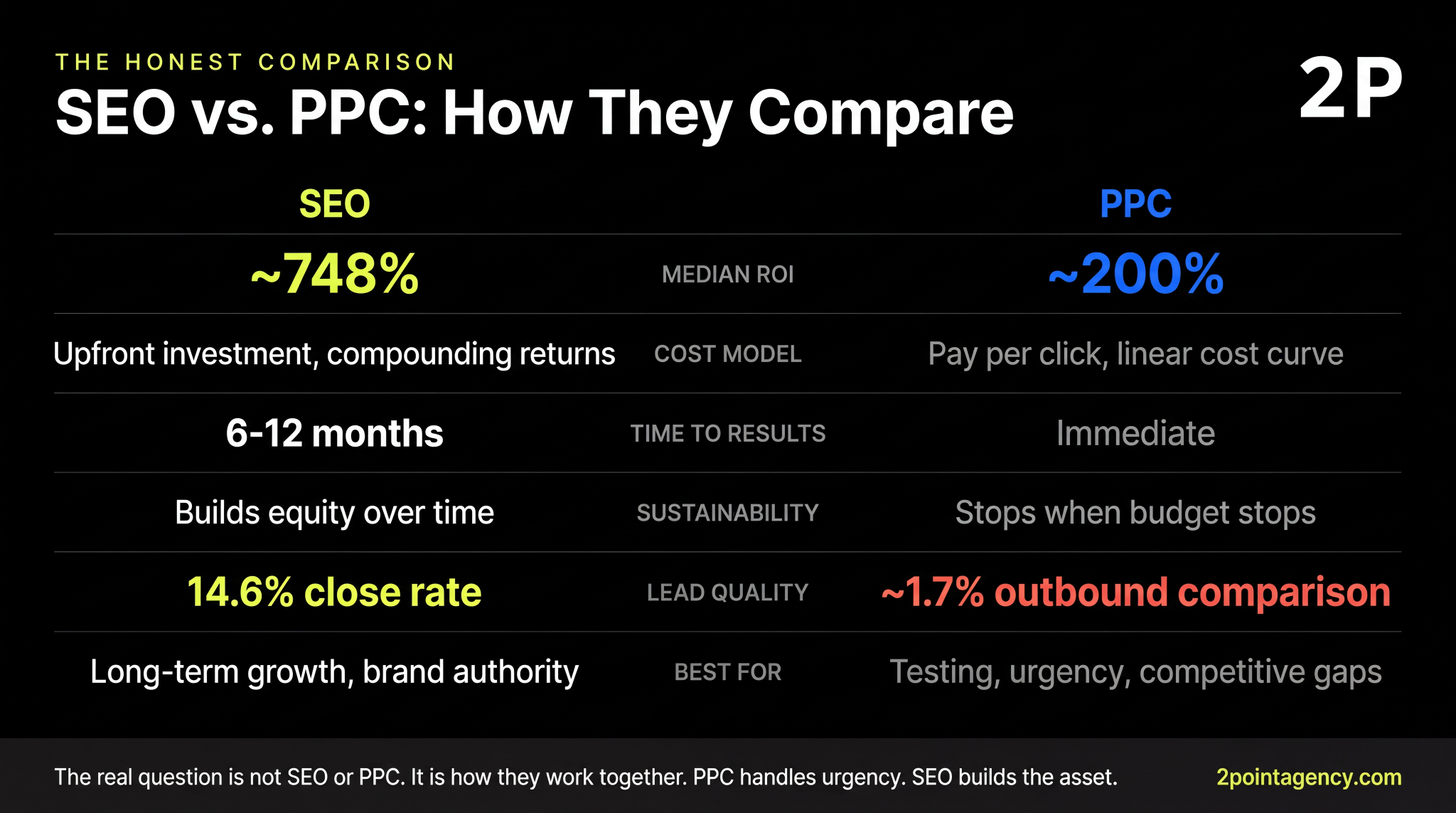
Both channels work. The difference is how long they last and what they cost you over time.
SEO delivers a median ROI of approximately 748%, compared to PPC's 200%. Organic leads also arrive pre-qualified, having already researched your solution before clicking. That intent advantage is why SEO consistently produces lower customer acquisition costs over a full 12-month period.
PPC, on the other hand, is faster and more controllable. You can launch today and generate traffic by tomorrow. The trade-off is that your results stop when your budget does. Here is how the two channels compare across key dimensions:
| Factor | SEO | PPC |
| Median ROI | ~748% | ~200% |
| Cost model | Upfront investment, compounding returns | Pay per click, linear cost curve |
| Time to results | 6-12 months | Immediate |
| Sustainability | Builds equity over time | Stops when the budget stops |
| Lead quality | 14.6% close rate | ~1.7% outbound comparison |
| Best for | Long-term growth, brand authority | Testing, urgency, competitive gaps |
The comparison isn't really SEO versus PPC, though. It's about how they work together.
PPC data reveals which keywords convert before you invest months of SEO effort targeting them. Organic traffic reduces your blended cost-per-acquisition over time, freeing paid budget to focus on competitive gaps, new product launches, and time-sensitive campaigns.
The businesses that see the strongest total marketing ROI use both channels in a coordinated strategy. PPC handles what needs to happen right now. SEO builds an asset that keeps paying back for years.
Case Studies: Real SEO ROI From 2POINT Clients
Talking about SEO ROI in the abstract is easy. Showing it in real client work is what separates theory from proof. These three case studies represent different industries, different challenges, and different paths to returns you can actually learn from.
Rayne Water: Search Recovery in an AI Era
Rayne Water came to 2POINT with a problem that is becoming increasingly common: a multi-location business watching consistent month-over-month declines in search visibility, organic traffic, and keyword rankings as AI-powered search features reshaped how customers found water treatment solutions.
The strategy combined three integrated initiatives: NAP standardization across all markets to restore local search authority, content restructuring specifically designed to capture AI Overview features, and targeted social advertising to generate immediate qualified lead flow.
The result: organic traffic grew by 63%, and tracked keywords increased by 30%. See the full strategy in the Rayne Water case study.
Mavwicks: From TikTok-Dependent to Multi-Channel Revenue
Mavwicks had a problem that feels good on the surface but hides real risk. The brand was TikTok's number one home goods brand, driving strong sales through a single platform.
But TikTok's algorithm is unpredictable. One month, you are trending. Next, your reach craters.
2POINT restructured its entire approach around multi-channel revenue so growth would not depend on any single platform's algorithm. The result: 6.5x overall ROAS and a revenue base diversified across channels. See the full breakdown in the Mavwicks case study.
Dady'O: Unified Brand and ROI Framework
Dady'O makes excellent mezcal. But when they came to 2POINT, their marketing was fragmented across uncoordinated efforts, lacked a unified brand story, and had almost no digital presence.
You cannot calculate SEO ROI when you have no infrastructure to track conversions in the first place.
The foundational work involved building a consistent brand identity, a new web presence, audience personas, and performance benchmarks that connected digital spend to actual distributor sales.
The takeaway for you is simple. If you cannot measure ROI, building the measurement framework is your most impactful first investment. Everything else depends on it. Read the full Dady'O brand transformation.
How to Improve Your SEO ROI
Getting positive SEO ROI is one thing. Improving it quarter over quarter is what turns organic search into a genuine competitive advantage for your business. These four areas produce the biggest impact on your returns.
Invest in Research and Expertise
Build your ideal customer profiles from real sources: sales call recordings, support tickets, and customer interviews. The language your customers use to describe their problems is the language your content should target.
From there, validate that language with data. Google Search Console reveals the queries already driving impressions. Tools like Semrush show you where the opportunity gaps are.
Focus on long-tail queries with sharp intent and manageable competition.
That is where your best SEO ROI comes from, and it starts with long-tail keyword research mapped to buyer intent.
Create Content That Earns Citations and Trust
Open every piece with a clear promise and deliver a direct answer within the first 100 words. Include proprietary data, client snapshots, and narratives tied to specific numbers rather than vague claims.
Back every assertion with a credible source, whether that is a government report, a peer-reviewed study, or a named industry survey.
Structure matters just as much as substance. Self-contained paragraphs, an FAQ schema, and question-based headings align with how both people and AI models search, making your content easier to extract and cite.
Older pages that once performed well deserve attention, too. Refreshing existing content can recover lost rankings and generate new returns from pages that have already built domain authority.
Strengthen Technical and Multi-Channel Foundations
Core Web Vitals remain both a ranking factor and a user experience signal.
LCP under 2.5 seconds, responsive INP, and stable CLS are the thresholds you need to hit. Run a full on-page SEO audit across your site to catch crawl errors, broken links, missing schema, and speed issues before they drag down your ROI.
Your highest-performing SEO content should also fuel other channels. Turn a blog post that generates 50 demo requests into a YouTube walkthrough, a LinkedIn carousel, or an email sequence.
Every channel reinforces the others, and repurposing your best content is one of the highest-leverage moves you can make.
Measure Results and Reinvest
The ROI loop is simple in concept and powerful in practice.
| What to Track | Examples | Where to Check | How to Use It |
| Discovery | Impressions, keyword positions | Google Search Console | Identify rising topics, optimize titles, and metas |
| Engagement | Bounce rate, time on page, pages per session | GA4 | Find underperforming content, improve UX |
| Conversion | Form fills, demos, and purchases from organic | GA4 Events | Tie the organic to revenue, calculate CPA |
| Revenue | Deal value, LTV, ROAS | CRM + GA4 | Build executive-ready ROI reports |
Track how people find you, how they interact with your content, and where money lands. Identify the pages and keywords driving the most revenue. Reinvest in what works. Reduce spend on what doesn't.
That feedback loop is what takes your SEO return on investment from good to exceptional, and it's how you prove quarter over quarter that SEO is worth it.
Common SEO ROI Mistakes That Cost You Money
Knowing the formula is not enough if common mistakes are quietly undermining your results.
These are the six errors we see most often from businesses that come to 2POINT after struggling with SEO.
- Measuring too early. Judging ROI at month three, when results take 6 to 12 months, means abandoning a winning strategy before it pays off.
- Counting only agency fees as cost. Ignoring staff time, content production, and tool subscriptions inflates your apparent ROI and creates unrealistic expectations.
- Ignoring attribution. Organic search often assists conversions credited to other channels. Without multi-touch attribution, you are systematically undercounting what SEO actually produces for you.
- Chasing vanity metrics. Rankings and traffic without conversion tracking are activity reports, not ROI reports.
- Cheap execution. Thin content and spammy backlinks do not just fail. They damage your domain authority and trigger penalties that take months to recover from.
- Optimizing for one channel only. Siloing SEO from paid, email, and social makes accurate ROI attribution nearly impossible.
How 2POINT Drives SEO ROI for Growing Brands
2POINT approaches SEO as a revenue channel, not a checkbox.
Every engagement starts with an audit that maps your organic performance, the competitive landscape, and the gaps between where you are and where the opportunity lies.
The process includes an AI visibility audit checking your brand's presence in ChatGPT, Perplexity, and Google AI Overviews, alongside traditional rankings. Content gets restructured for both conversion and citation eligibility, with schema and internal linking built to distribute authority where it matters most.
Everything ties back to revenue you can report on. Ready to see what that looks like for your business? Explore 2POINT's SEO services or let AIOBot handle your AI visibility optimization.
So, Is SEO Worth the Money for Your Business?
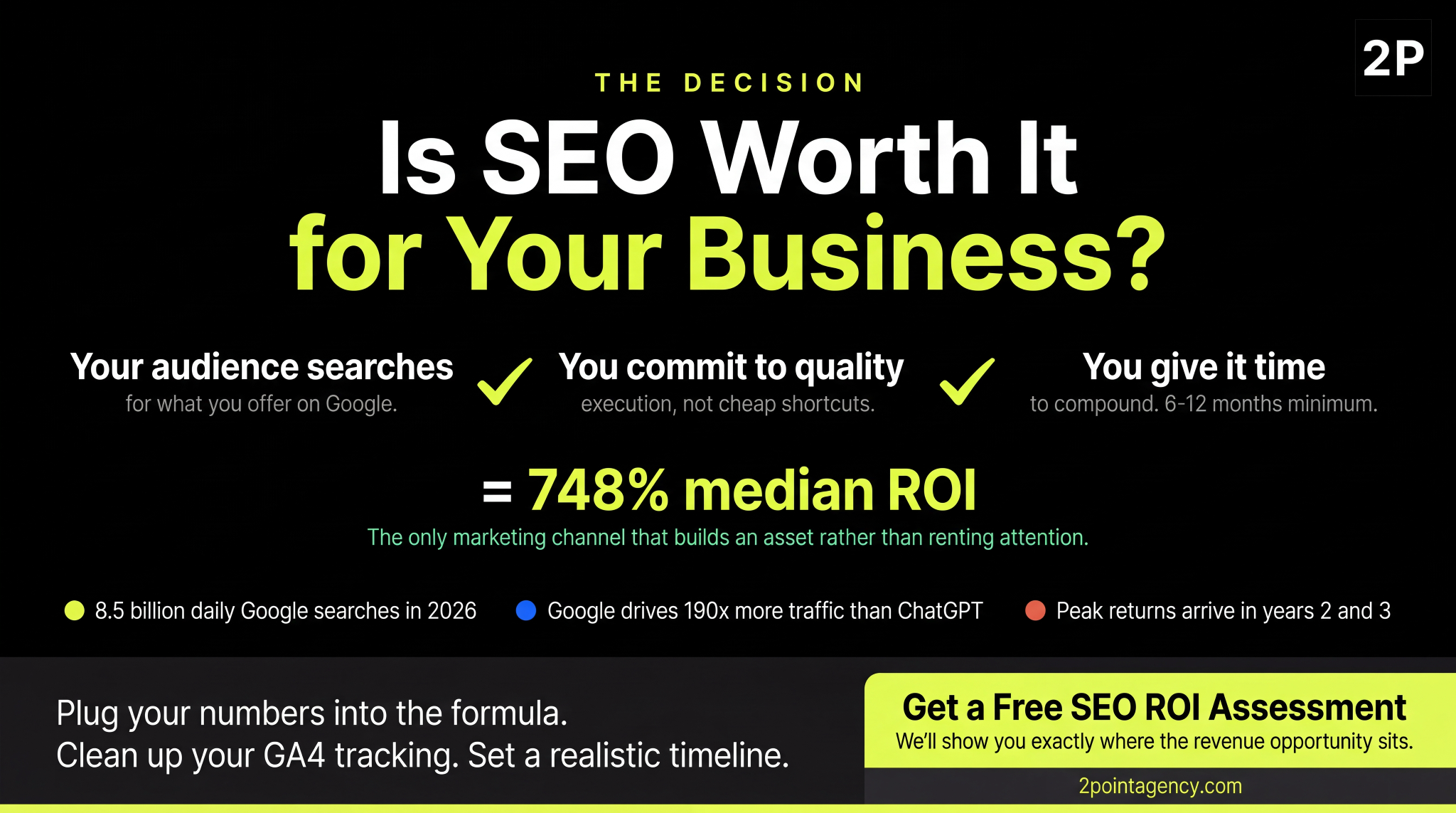
So, is SEO worth it? Yes, when three conditions are true: your audience searches for what you offer, you are committed to quality execution, and you are willing to give the strategy time to compound.
The data support it. A median 748% SEO return on investment, and the only marketing channel that builds an asset rather than renting attention. But those numbers are not automatic. They require the right strategy, the right execution, and patience.
Your move: plug your numbers into the formula. Clean up your GA4 conversion tracking. Set a realistic time horizon based on your industry benchmarks.
2POINT's SEO team builds strategies around measurable revenue outcomes, and AIOBot keeps your content optimized as AI search evolves.
FAQs About SEO ROI
What is a good SEO ROI?
The median SEO return on investment across industries in 2026 is 748%.
Results vary widely by vertical, from 317% in eCommerce to 1,389% in real estate. Any positive ROI means organic search is earning more than you spend on it, but benchmarking against your specific industry gives you a more accurate target to work toward.
How do you calculate SEO ROI?
Knowing how to measure SEO ROI starts with this formula: SEO revenue minus SEO costs, divided by SEO costs, multiplied by 100. The step most businesses miss is including all costs. Staff time, agency fees, tools, content production, and technical development should all factor in, not just your monthly retainer.
How long does SEO take to show ROI?
Most businesses see positive returns within 6 to 12 months, with peak SEO return on investment arriving in years two and three. Track impressions, keyword positions, and non-branded clicks monthly as your leading indicators.
Revenue follows once your technical foundations and content authority reach a tipping point.
Is SEO still worth it with AI search?
Is SEO worth the money now that AI is reshaping search? Yes. Google still drives 190 times more website traffic than ChatGPT, and AI Overviews appear in roughly 25% of queries.
The brands earning AI citations are the same ones doing strong SEO, so your investment works across both surfaces simultaneously.
How much should I spend on SEO?
Most businesses invest $2,000 to $10,000 per month on their SEO investment.
Your right budget depends on industry competition, your current domain authority, and your revenue goals. Is SEO a good investment at that price? For businesses with search demand and a long-term view, the compounding returns consistently make it worth the money.