

 let’s connect


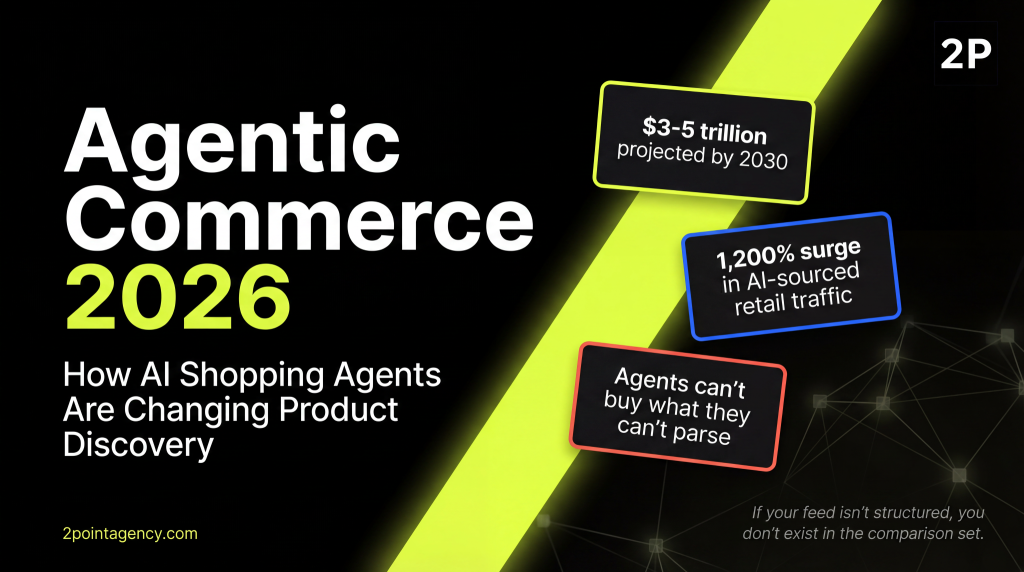
Your Google rankings are holding. Your conversion rate is solid. But your organic traffic is quietly declining month over month, and your attribution data isn't giving you a clear answer.
The reason is increasingly simple. AI shopping agents are now fielding product queries, comparing attributes, and returning recommendations before your customer opens a browser tab. If your product feed isn't structured for them to read, you're invisible at the moment the decision is made.
That's the gap agentic commerce created in 2026. At 2POINT, we help mid-market brands close it with agentic commerce optimization built for how AI agents actually discover and rank products.
Key Takeaways
- Agentic commerce is delegated shopping. AI agents research, compare, and complete purchases on behalf of consumers. 45% of shoppers already use AI in their buying journey, and McKinsey projects $3-5 trillion in global agentic commerce by 2030.
- Two protocols currently define AI product discovery. Google's UCP powers checkout across AI Mode, Gemini, and Google Shopping. OpenAI's ACP powers ChatGPT shopping with Stripe handling payments. Brands need visibility on both to stay competitive.
- AI agents cannot buy what they cannot parse. 42% of customers already abandon purchases due to insufficient product information. For AI-driven product discovery, every missing attribute is a product that doesn't exist in the comparison set.
- Structured product data is the new competitive moat. AI agents select products based on structured product data AI systems can read: schema accuracy, real-time pricing, review signals, and policy transparency. Traditional SEO rankings don't predict agent selection.
- Quick audit: Check whether OAI-SearchBot and Googlebot can crawl your product pages. If your robots.txt blocks either one, your products are currently invisible to ChatGPT shopping and Google AI Mode.
What Is Agentic Commerce (and Why It Matters in 2026)
Agentic commerce is delegated shopping.
You set the intent, and an AI shopping agent researches products, compares options across stores, and completes the purchase without you touching a single page.
What makes this significant is the scale behind it. McKinsey projects $3-5 trillion in global agentic commerce by 2030. Building on that, Morgan Stanley estimates the US figure alone at up to $385 billion, representing 10-20% of total US e-commerce spend.
For brands selling products online, the practical implication is direct. AI agents don't browse.
They parse structured data, evaluate attributes, and select products programmatically. If your product feed isn't built for that, you won't appear in the comparison set at all.
How AI Shopping Agents Discover and Select Products
AI-driven product discovery doesn't work like Google search. An agent takes your customer's query, extracts specific attributes such as price range, features, and constraints, and then searches connected catalogs for matches.
Adobe Analytics tracked a 1,200% surge in AI-sourced retail traffic to US websites. That channel is yours to capture or miss. What decides it is data completeness.
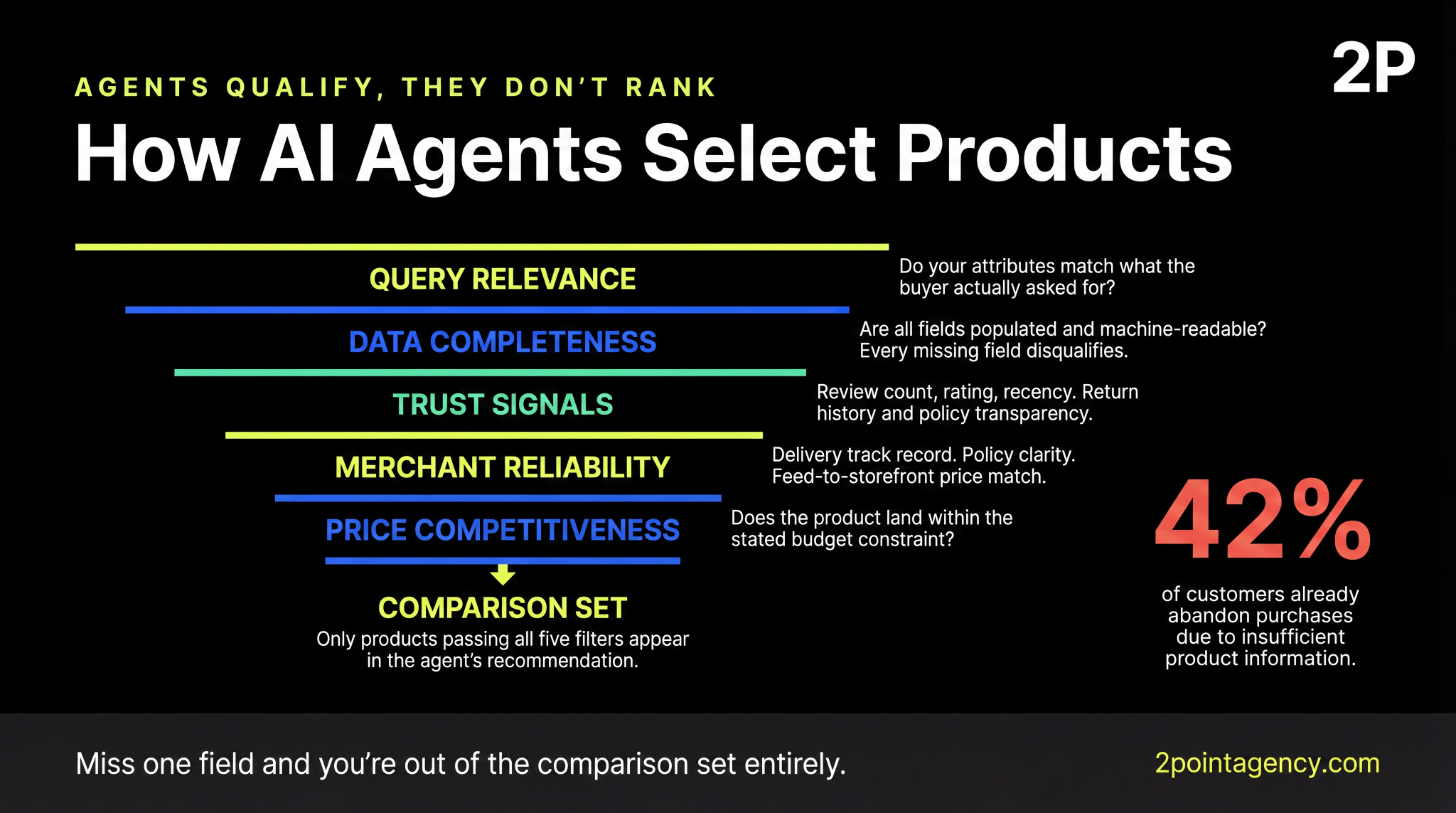
Agents qualify products, they don't rank them:
- Query relevance: Do your attributes match what the buyer actually asked for?
- Data completeness: Are all fields populated and machine-readable?
- Trust signals: review count, rating, and return history
- Merchant reliability: delivery track record and policy clarity
- Price competitiveness: Does your product land within the stated budget?
Miss one field and you're out of the comparison set entirely. The same machine-readable content principles that underpin agentic commerce SEO also determine this.
UCP vs ACP: The Two Protocols Defining Agentic Commerce
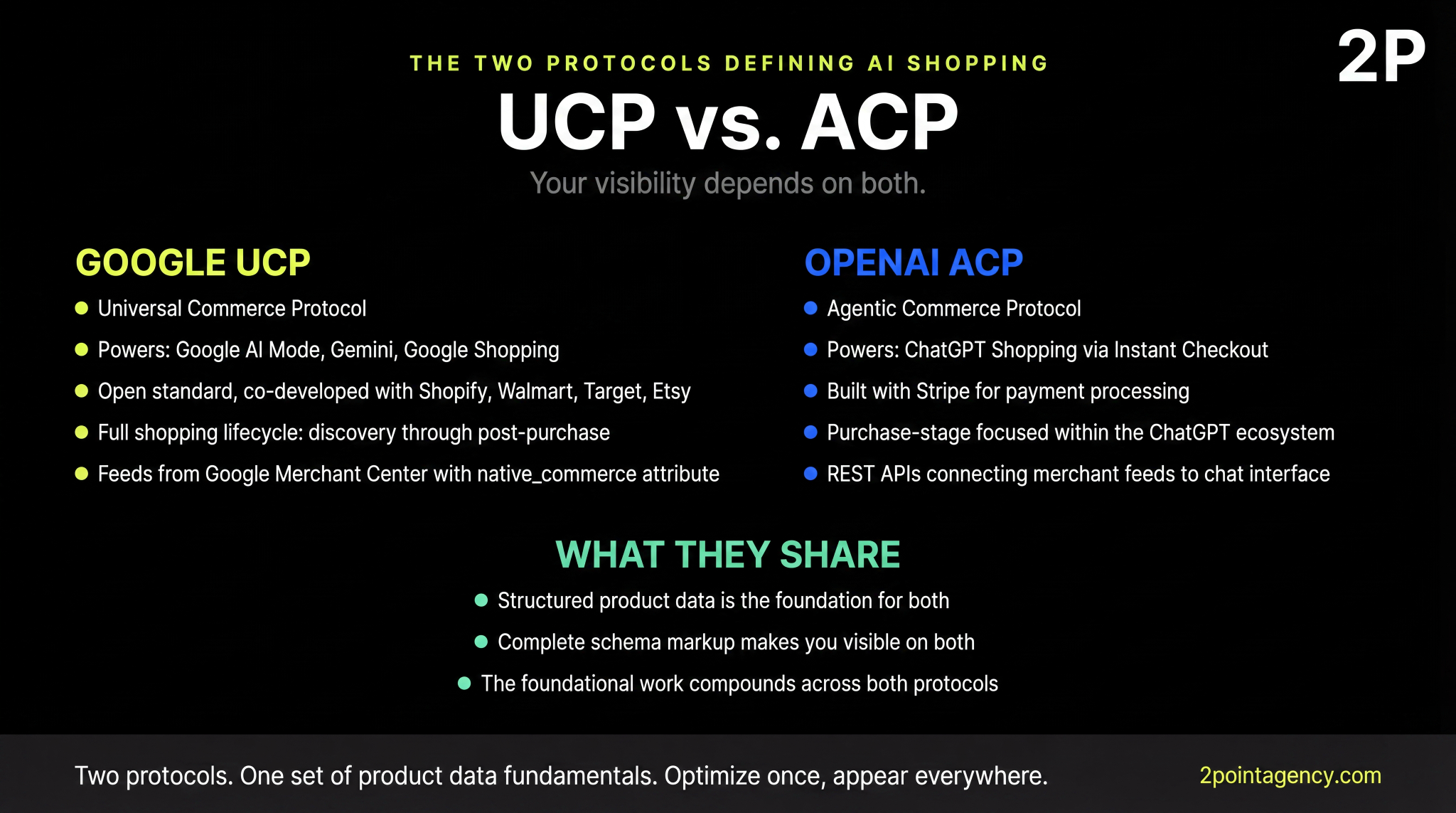
Two protocols now define AI shopping 2026 commerce, and your visibility depends on both.
Google's Universal Commerce Protocol (UCP) launched at NRF in January 2026.
Announced by Sundar Pichai, it's an open standard for executing transactions across Google AI Mode, Gemini, and Google Shopping. Co-developed with Shopify, Walmart, Target, Etsy, and Wayfair, UCP covers the full shopping lifecycle from discovery to post-purchase.
OpenAI's Agentic Commerce Protocol (ACP), built with Stripe, powers ChatGPT shopping through Instant Checkout. It focuses on purchase-stage transactions within the ChatGPT ecosystem using REST APIs.
The two protocols coexist. Structured product data, complete schema markup, and clean Merchant Center feeds make you visible on both. The foundational work compounds across both protocols, just as it does across your AI and traditional search channels.
The 5-Layer Agentic Commerce Optimization Framework
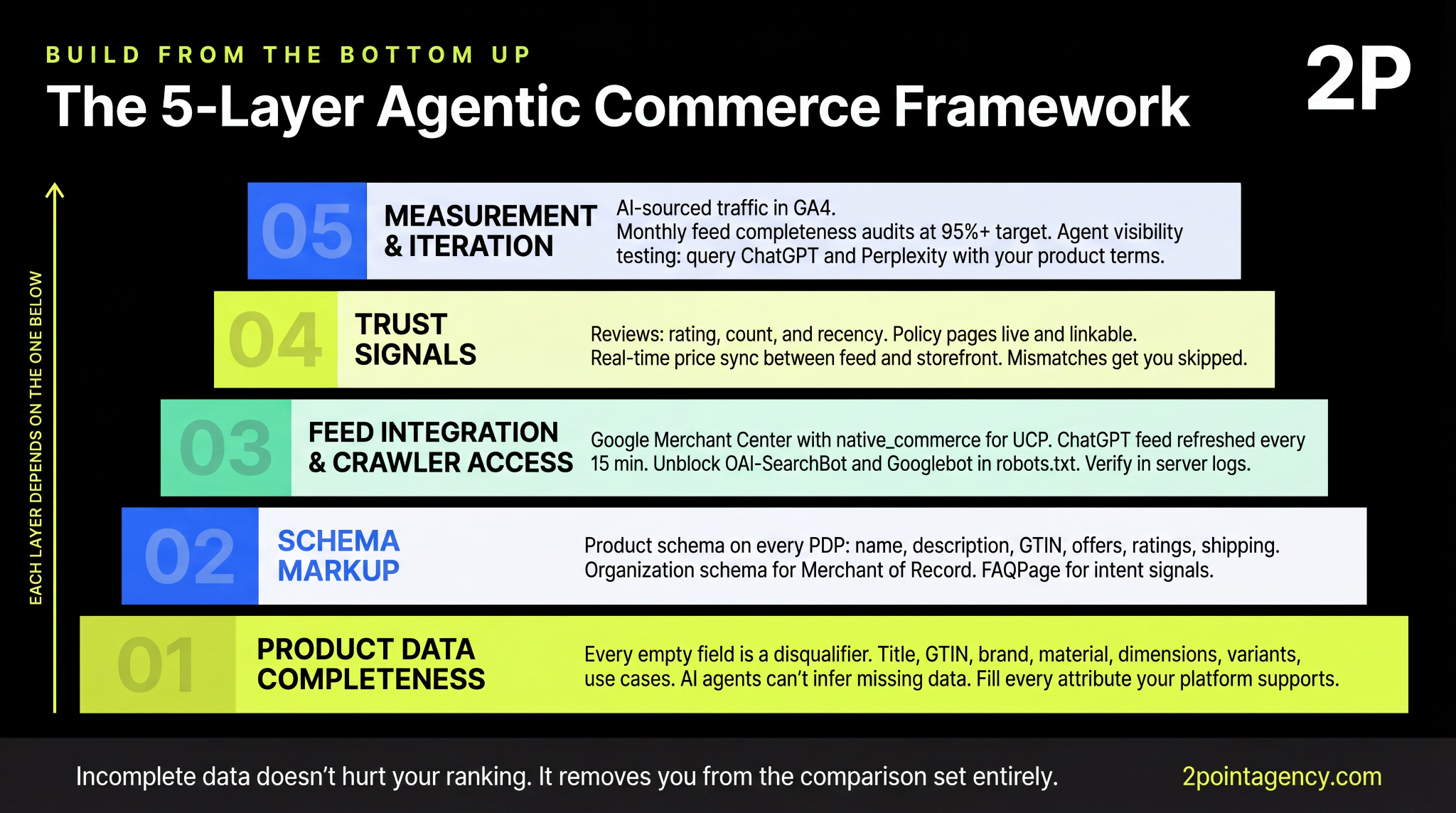
Your product data is either readable by AI agents, or it isn't. This agentic commerce SEO framework tells you exactly where to fix that, covering every layer an AI agent evaluates before your product enters a comparison set.
Layer 1: Product Data Completeness
Product data completeness is where AI-driven product discovery starts. And it’s where most brands lose before they begin.
Every empty field is a disqualifier. AI agents can't infer missing data. Title, description, GTIN, brand, material, dimensions, weight, size variants, color, compatibility, use cases. Fill every attribute your platform supports.
Your descriptions matter just as much. "Lightweight trail running shoe with 8mm drop and Vibram outsole for rocky terrain" gives an agent five extractable attributes. "Great shoe for runners" gives zero.
Incomplete data doesn't hurt your ranking. It removes you from the comparison set entirely.
Layer 2: Schema Markup and Structured Data
Schema markup is the foundation of how to optimize for AI agents. Without it, even complete product data can go unread.
Start with schema.org/Product on every product page: name, description, GTIN, brand, offers, aggregateRating, and shippingDetails. Add the Organization schema to confirm the Merchant of Record status.
As Search Engine Journal notes, missing or incorrect structured data makes your products invisible to agent-mediated discovery.
FAQPage schema matters too. Agents parse question-answer pairs as intent signals. Your technical SEO foundation now extends to agent platforms, not just Google crawlers.
Layer 3: Feed Integration and Crawler Access
Schema gets you readable. Feed integration gets you discoverable. Both matter, and this layer connects the two.
Here's what to cover:
- Google Merchant Center: Keep your product feed complete, accurate, and refreshed frequently. UCP pulls directly from the Merchant Center for AI product discovery. Activate the native_commerce attribute for UCP eligibility.
- ChatGPT product feed: Supports TSV, CSV, XML, or JSON formats, refreshed as often as every 15 minutes. Include review counts, return rates, and popularity scores where possible.
- Crawler access: Check your robots.txt to allow OAI-SearchBot and Googlebot. If either is blocked, your products don't exist on that platform. This is the most common reason brands are invisible in ChatGPT shopping results.
Layer 4: Trust Signals and Social Proof
AI agents don't trust your brand; they verify it. Every selection decision runs through quantifiable signals, and yours need to hold up.
Here's what agents evaluate:
- Reviews: Average rating, total count, and recency all factor in. Manage reviews as a discovery tactic, not just a conversion one.
- Policy pages: Return, shipping, warranty, and support pages must be live and linkable. Missing or gated policies reduce your trust score in agent selection.
- Pricing accuracy: Agents cross-reference your storefront price against your feed. A mismatch results in your product being skipped or flagged. Real-time price sync is non-negotiable for AI shopping 2026.
Layer 5: Measurement and Iteration
The framework only compounds if you measure it. Here's what to track for agentic commerce optimization:
- AI-sourced traffic in GA4: Monitor referrals from chatgpt.com, perplexity.ai, Google AI Mode, and Copilot. Segment these separately from organic and paid to measure real conversion differences.
- Feed completeness score: Audit monthly. Aim for 95%+ field completion across all products. Every missing attribute shrinks your AI-driven product discovery surface.
- Agent visibility testing: Query ChatGPT and Perplexity with your target product terms. If competitors appear and you don't, your data layer has gaps.
Extending your AI search visibility audit from content pages to product pages closes those blind spots fast.
Agentic Commerce Case Studies and Early Results
Early agentic commerce results are in:
- Shopify Agentic Storefronts: AI-driven orders grew 15x in 2025, with products now discoverable across ChatGPT, Google AI Mode, and Copilot.
- Microsoft Copilot Checkout: With shopping intent present, agentic checkout journeys are 194% more likely to result in a purchase.
- Google UCP: Live across AI Mode, Gemini, and Google Shopping. Wayfair and Etsy confirmed at launch.
The conversion advantage is structural. AI commerce buyers arrive through AI-driven product discovery, having already compared options. The decision is made before the click.
In-House vs Agency: Who Should Build Your Agentic Commerce Strategy?
Most brands managing 500+ SKUs don't have the bandwidth to optimize product data, implement schema at scale, and track AI visibility across platforms simultaneously. Here's where each approach realistically fits:
| In-House | Agency | |
| Catalog size | Under 500 SKUs with relatively complete data | 500+ SKUs needing structured data optimization at scale |
| Schema experience | Team has hands-on Product schema implementation experience | No one has implemented schema markup across a large catalog |
| Feed management | Already managing Google Merchant Center feeds actively | Feeds exist, but are incomplete or rarely audited |
| Channel scope | TikTok-focused optimization is enough for now | Need agentic commerce, traditional SEO, and AI search working together |
| AI visibility | Products already appearing in ChatGPT and Google AI Mode | Invisible in AI platforms for key category queries |
The reality is that most mid-market brands fall into the agency column across most of these.
Schema at scale, feed optimization, and AI visibility tracking across ChatGPT, Google AI Mode, and Copilot aren't tasks that get done alongside existing responsibilities.
2POINT builds AI-ready product strategies covering agentic commerce optimization, Google SEO, and AI search visibility. If your products aren't showing up in ChatGPT shopping and Google AI Mode for your category queries, your competitors are capturing that revenue right now.
Are your products showing up when AI agents shop for your category?
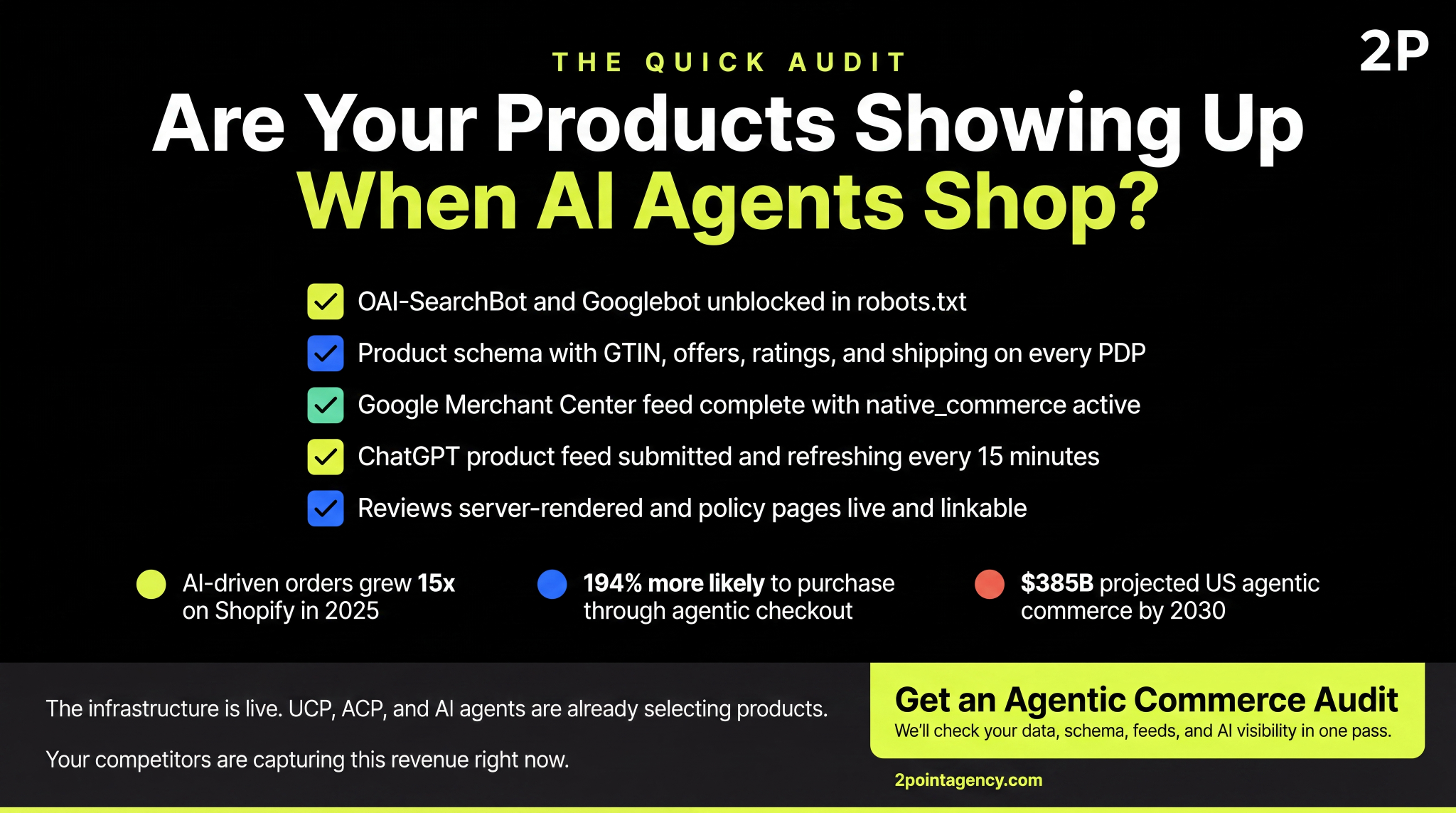
The infrastructure is live. UCP, ACP, and AI shopping agents are already selecting products and routing purchases.
The 5-layer framework tells you exactly where to start. 2POINT handles agentic commerce optimization across product data, schema, and AI visibility. If you need it connected across channels, that's multi-channel.
FAQs About Agentic Commerce
What is agentic commerce?
Agentic commerce is a shopping model where AI shopping agents autonomously research, compare, and purchase products on your behalf. You set the intent; the agent handles AI product discovery through checkout. McKinsey projects this market will reach $3-5 trillion globally by 2030.
How do AI shopping agents discover products?
AI shopping agents parse schema markup, merchant feeds, and crawled product pages. They match products based on data completeness, pricing accuracy, and trust signals. Products with incomplete structured product data never enter the agent's comparison set.
What is the difference between UCP and ACP?
Google's Universal Commerce Protocol supports multiple AI platforms with broader merchant control. OpenAI's Agentic Commerce Protocol powers ChatGPT shopping through Stripe. UCP is broader in scope; ACP is simpler to implement. Agentic commerce optimization for both protocols overlaps significantly.
Do I need to optimize for ChatGPT shopping?
Yes. ChatGPT shopping is already driving measurable revenue. Shopify reports AI-driven orders grew 15x in 2025. Ensuring OAI-SearchBot can crawl your pages and your structured product data that AI systems can read is the minimum for AI shopping 2026 visibility.
How does agentic commerce affect traditional SEO?
Agentic commerce SEO reinforces traditional SEO rather than replacing it. Schema markup and content quality that AI agents evaluate also improve Google rankings. Brands investing in agentic commerce optimization see compounding returns across both channels.
What product data do AI agents need?
AI agents need complete attributes, including title, description, GTIN, brand, dimensions, variants, pricing, availability, and return policies. Every missing field narrows the scope of structured product data that AI agents can evaluate. Aim for 95%+ attribute completeness across your catalog.
How do I measure agentic commerce performance?
Track AI-sourced traffic in GA4 by monitoring referrals from chatgpt.com, perplexity.ai, Google AI Mode, and Copilot. Run monthly feed audits and test how to optimize for AI agents by regularly querying ChatGPT with your target product searches.






