


 let’s connect


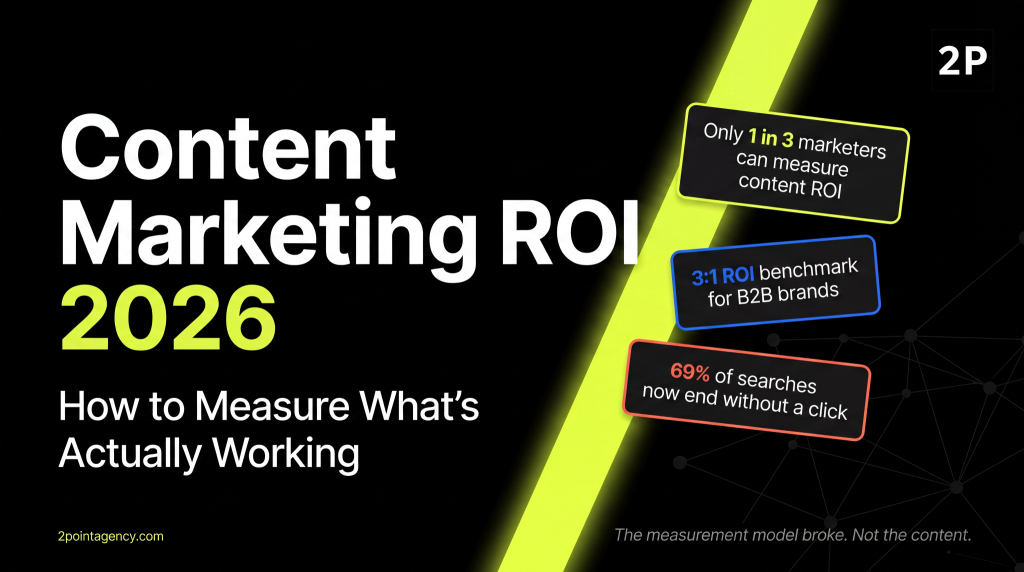
Content is your most published asset and your least provable one. Every quarter, the same meeting happens: traffic is up, leads are flat, and nobody can draw a straight line from the blog to the revenue.
The measurement model is what breaks down, not the content itself.
Most teams calculate content marketing ROI with a model built for 2019. AI Overviews and zero-click searches have since broken the attribution chain, and the gap between investment and provable return keeps widening.
At 2POINT, we rebuilt the content marketing ROI formula to include AI content marketing metrics that most teams are not tracking yet.
Key Takeaways
- Only one-third of marketers can accurately measure content marketing ROI, yet most are increasing content budgets in 2026. The gap between investment and measurement is the biggest risk in content right now.
- The basic ROI formula accounts for revenue and costs. It misses pipeline influence, brand lift, and the entire AI visibility layer. Content ROI measurement requires all three tiers to tell the full story.
- A 3-tier framework covers the complete picture: Tier 1 Foundation Metrics, Tier 2 content marketing attribution and pipeline metrics, and Tier 3 AI visibility metrics, including citation share and branded search lift.
- Content ROI compounds over 6 to 18 months. Measuring on quarterly windows almost always makes content look like a losing investment, which is why content marketing reporting cadence matters as much as the metrics themselves.
- Proving content marketing value to leadership starts Monday: add citation share and branded search lift to your next monthly report alongside traditional sessions and conversions.
What Is Content Marketing ROI (and Why Most Teams Get It Wrong)
Content marketing ROI is the measurable return your content program generates relative to its total costs. It sounds simple. In practice, content generates value across five streams, and the standard formula captures only one.
Those five streams are:
- Direct revenue attribution: conversions from buyers who clicked through content.
- Pipeline influence: deals where the buyer consumed content before converting, even if the content was not the last touch.
- Organic traffic value: the equivalent paid search cost of your content's organic visits.
- AI citation value: estimated impression value when your brand gets cited in AI Overviews, ChatGPT, or Perplexity.
- Brand lift: increase in branded search volume driven by content exposure across channels.
If your content marketing reporting covers only the first stream, your program looks worse than it actually is. Content Marketing Institute found that just 12% of B2B content teams exceeded their goals in 2026, and measurement blinds spots are a primary reason.
Proving content marketing value requires tracking all five streams, not just the one that fits neatly into a last-click report.
The Content Marketing ROI Formula (and What It Misses)
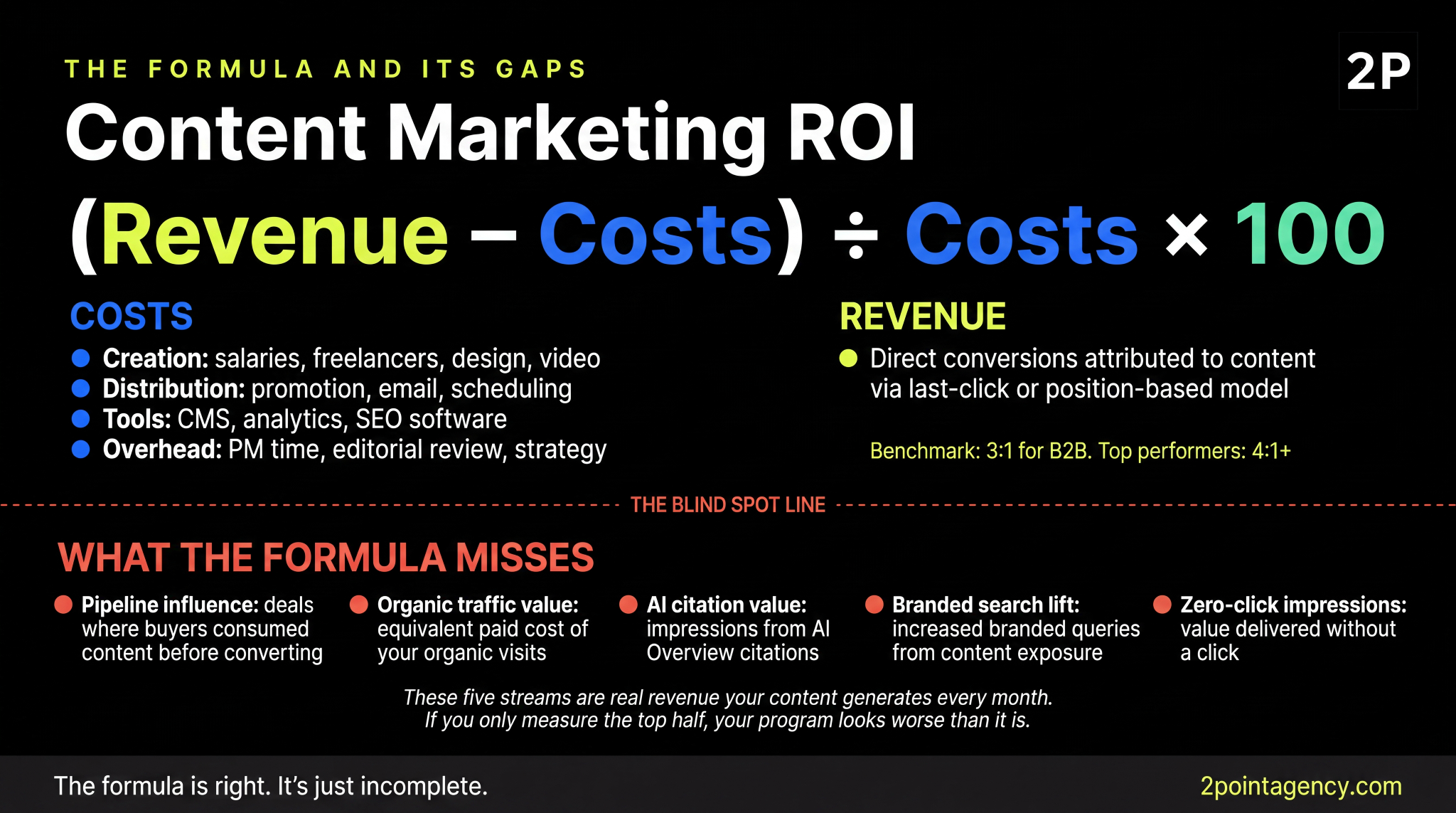
The formula itself is straightforward.
ROI = [(Revenue Attributed to Content − Total Content Costs) ÷ Total Content Costs] × 100
What to include in your cost inputs:
- Creation: salaries, freelancers, design, video production
- Distribution: paid promotion, email platform fees, social scheduling tools
- Tools: CMS, analytics platforms, SEO software, AI writing tools
- Overhead: project management time, editorial review, strategy hours
A solid benchmark sits around 3:1 for B2B brands, with top performers reaching 4:1 or higher. The problem is that the formula has a structural blind spot. It has no input for AI citations, zero-click impressions, branded search lift, or long-tail organic traffic value.
Those are real value streams your content generates every month.
Your SEO tracking setup needs to feed clean cost and revenue data into this formula. Messy inputs produce meaningless outputs regardless of which model you run.
The 3-Tier Content Marketing ROI Framework
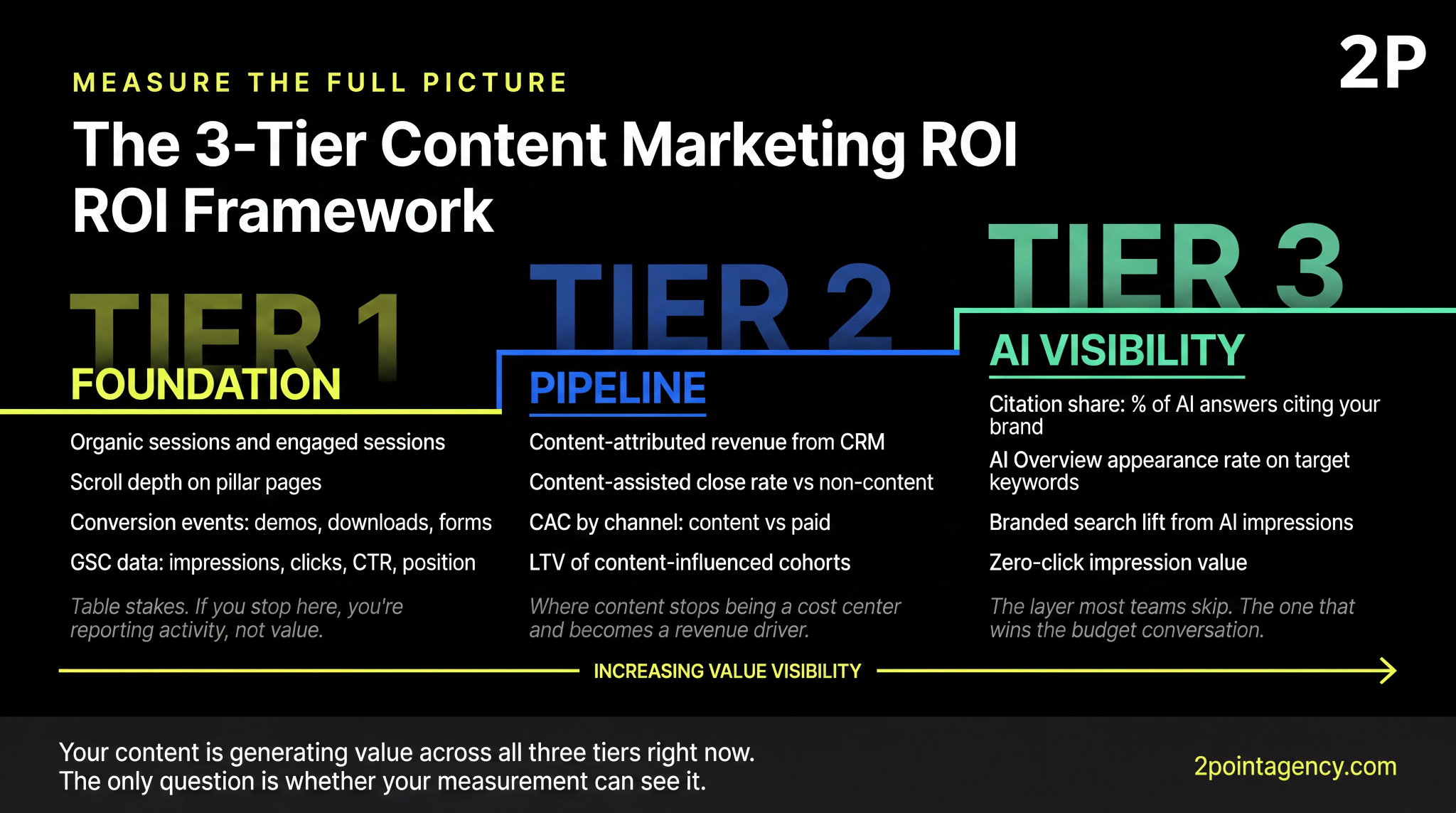
Most content measurement advice gives you a flat list of metrics. A list tells you what to track.
A framework tells you where you stand, what to fix first, and where your program is actually generating value.
The 3-tier framework below is built around that distinction. Work through it in order and your content marketing attribution story becomes something leadership can actually act on.
Tier 1: Foundation Metrics (What Every Team Should Track)
Tier 1 covers the metrics every team already has access to or can set up in GA4 this afternoon. They tell you whether your content is reaching people and holding their attention.
- Organic sessions and engaged sessions.
- Pages per session and average engagement time.
- Scroll depth on pillar pages.
- Conversion events: demo requests, lead magnet downloads, contact form submissions.
- Google Search Console data: impressions, clicks, CTR, and average position.
Tier 1 is table stakes. If your monthly report stops here, you are telling leadership a story about activity, not about value. Your AI search visibility gaps appear in this data first, and fixing them is what unlocks the deeper value that Tier 2 and Tier 3 quantify.
Tier 2: Pipeline Metrics (What Proves Revenue Impact)
Tier 2 is where content stops being a cost center and becomes a revenue driver.
These are the content marketing KPIs 2026 demands: the ones that connect your content directly to closed deals and give your CFO a number worth defending.
- Content-attributed revenue: deals where the buyer engaged with at least one content asset before converting.
- Content-assisted conversion rate: the close rate of content-influenced leads versus non-influenced leads.
- CAC by channel: content acquisition cost compared to paid channels.
- LTV segmentation: content-influenced cohorts versus non-content cohorts.
- Attribution model: position-based (40/20/40) gives the best accuracy-to-effort ratio for most mid-market teams.
The infrastructure is non-negotiable. You need GA4 with configured conversion events, a CRM with contact time visibility, and disciplined UTM parameters on every link. Your SEO integration stack connects analytics and CRM into one view.
Without it, content marketing attribution breaks the moment data lives in separate tools.
Tier 3: AI Visibility Metrics (What Nobody Else Is Measuring Yet)
Tier 3 is the measurement layer most content teams skip entirely. That is exactly why it matters. Gartner's survey of 174 senior marketing leaders found that budget constraints are the top challenge for 63% of CMOs in 2026.
The teams winning that budget conversation are the ones tracking AI content marketing metrics that their competitors have not yet measured.
Four metrics define Tier 3:
- Citation share: percentage of AI answers in your category where your brand is cited.
- AI Overview appearance rate: how often your content surfaces in Google's AI Overviews.
- Branded search lift: month-over-month branded query volume change driven by AI impressions.
- Zero-click impression value: estimated value of impressions on no-click queries.
A study by Pew Research Center found that users click a traditional result just 8% of the time when an AI summary appears, which means the impressions your content generates in those summaries carry real value even without a click.
Your content is already generating citations and zero-click impressions daily. If you are not tracking them, you are underreporting your program's value. Making your content citation-ready is what actually moves Tier 3 metrics.
Attribution Models: Giving Content the Credit It Deserves
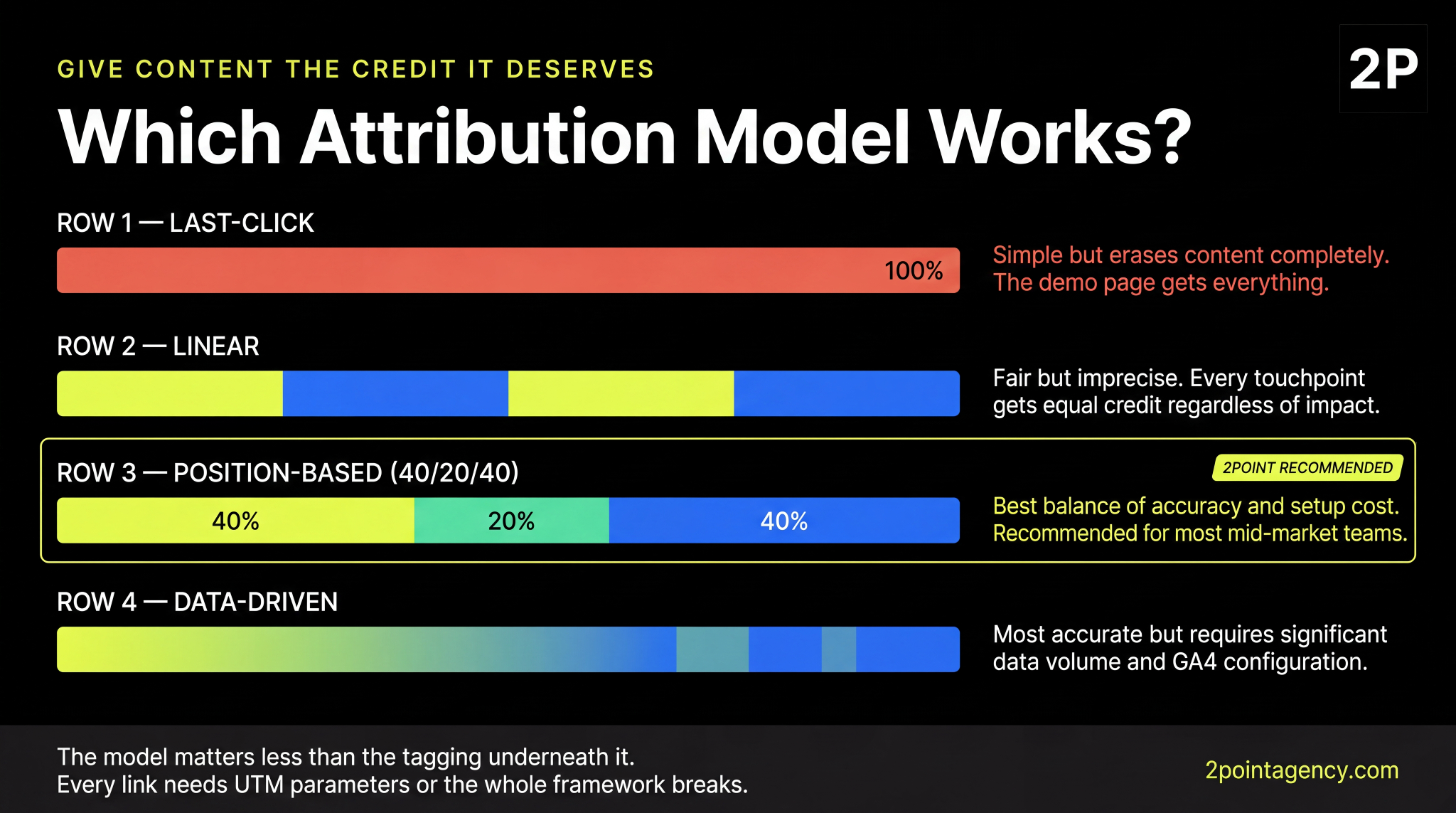
Content marketing attribution is where most teams hit a wall. The default setup is last-click, which gives the demo page 100% of the conversion credit while the blog post that educated the buyer three weeks earlier gets nothing. That is not a measurement. That is erasure.
Four models worth understanding:
- Last-click: simple, but gives content zero credit on most journeys.
- Linear: splits credit equally across all touchpoints. Fair but imprecise.
- Position-based (40/20/40): 40% to first touch, 40% to last touch, 20% distributed across everything in between. The best balance of accuracy and setup cost for most mid-market teams.
- Data-driven: most accurate, but requires significant data volume and GA4 configuration.
The model matters less than the tagging underneath it. Every link your team publishes needs UTM parameters, or the entire attribution framework breaks, regardless of which model you run.
The Real Cost of Not Measuring Content Marketing ROI
The data tells a consistent story. Similarweb confirmed that zero-click searches grew from 56% to 69% in the year after AI Overviews launched, and Search Engine Land found that organic CTR on informational queries dropped by 61% where AI Overviews appear.
Together, those two numbers explain exactly why your sessions chart is shrinking while your content continues to generate value.
That value shows up as AI citations, featured snippet placements, and People Also Ask entries that your current report never captures. If your measurement only tracks clicks, you are missing the channel where your content is working hardest.
Budget risk follows. Content is the easiest line item to cut, yet the hardest to defend.
The teams that added Tier 3 stopped having that conversation because the zero-click SEO playbook shows content working harder than the sessions chart ever will.
What Good Content ROI Measurement Actually Looks Like
Here is how each tier changes the conversation with leadership.
The Team That Only Measured Tier 1
Scenario: A mid-market content team reports organic sessions and pageviews monthly. Leadership sees flat traffic and questions whether content is worth the investment.
The fix: Added Tier 2 pipeline metrics. Discovered content-influenced deals closed at a significantly higher rate than non-content deals. The content marketing reporting story shifted from "traffic is flat" to "content-touched revenue is our highest-converting channel." Leadership approved a budget increase.
The Team That Added Tier 3
Scenario: A SaaS content team saw organic CTR declining 15% quarter-over-quarter, even as rankings held. The sessions-only report showed a decline.
The fix: Added citation share tracking and branded search lift. Discovered the brand was being cited in AI Overviews on a meaningful share of target keywords. Branded search volume was climbing month over month, attributable to the AI impression halo effect. Leadership shifted from "cut the blog" to "double the pillar pages."
That progression is available to every mid-market content team that builds the right reporting infrastructure. Your content is probably already doing this work. The only question is whether your measurement can see it.
Your Monday-Morning Content ROI Playbook
You do not need a new tech stack, a new agency, or a new job title to start measuring content marketing ROI properly. You need six focused moves, in order of leverage:
- Run the basic ROI formula on last quarter's output: Get the baseline number, even if it looks ugly. You need a starting point before you can improve anything.
- Audit your GA4 conversion events: Confirm that demo requests, lead magnet downloads, and contact form submissions are actually firing. Broken events mean broken data.
- Connect your CRM to GA4 via UTM parameters: This lets you trace content touchpoints to closed revenue. Without it, Tier 2 stays theoretical.
- Set up position-based attribution in GA4: One focused afternoon is all it takes.
- Add three Tier 3 KPIs to your monthly report: Citation share, AI Overview appearance rate, and branded search lift. Your AI search strategy is what determines how fast those numbers move.
- Build one dashboard with all three tiers visible: Bring it to your next leadership meeting instead of a sessions chart.
Run these in sequence and your full-stack content marketing reporting system is live inside three weeks.
Does Your Content Report Tell the Full Story?
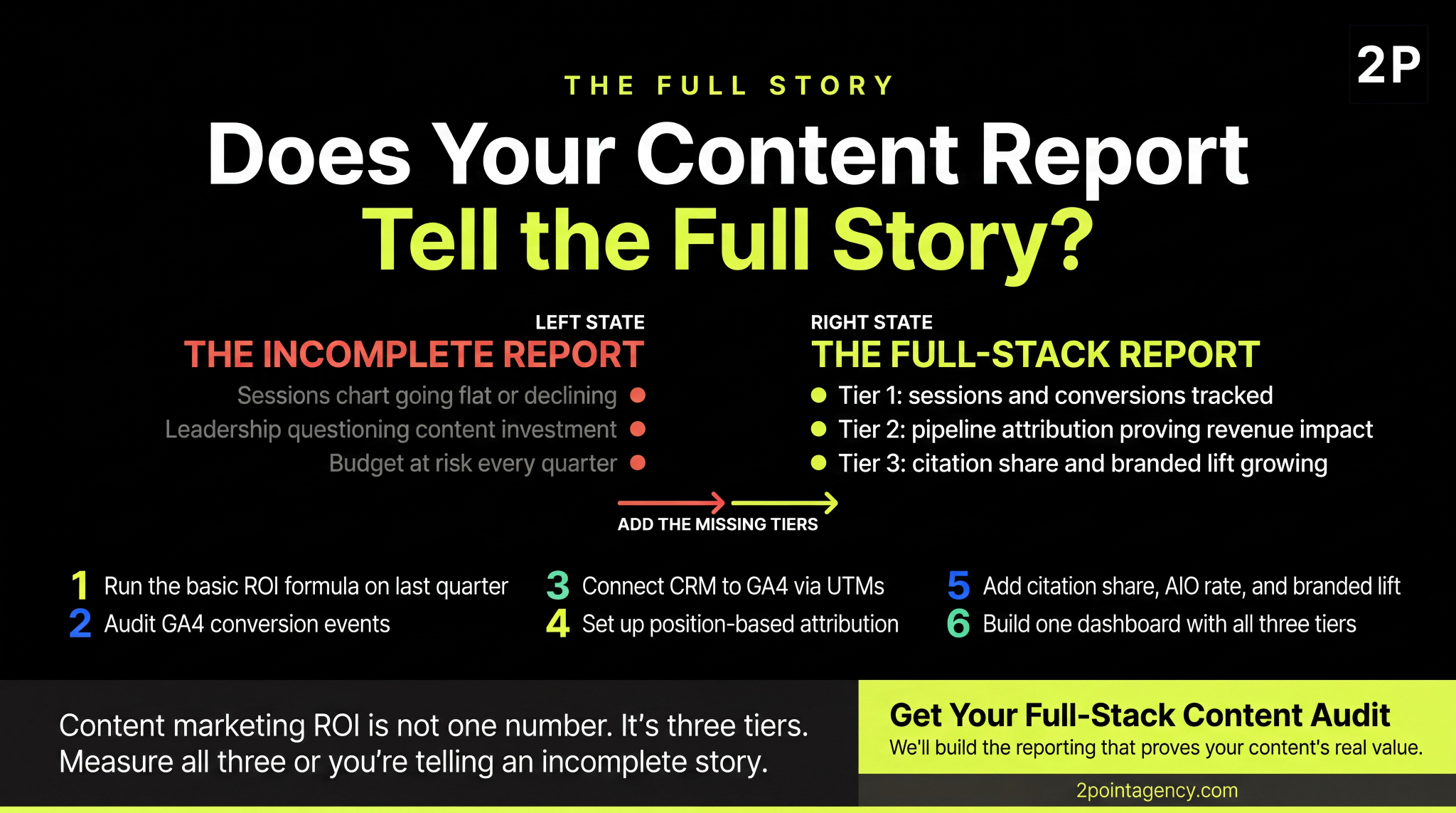
Content marketing ROI is not one number. It is three tiers.
Measure all three, or you are telling leadership an incomplete story, and incomplete stories lose budgets. Proving content marketing value starts with better measurement, not more content. Your program is generating more than your current reports show.
2POINT's SEO team and multi-channel marketing support help mid-market brands build the full reporting stack and bring the right story to leadership.
FAQs About Content Marketing ROI
What is a good content marketing ROI benchmark?
A good content marketing ROI benchmark sits around 3:1 for B2B companies. Top performers reach 4:1 or higher. Accurate content ROI measurement should include pipeline influence and AI visibility metrics alongside direct revenue attribution, not just last-click conversions.
How do you measure content marketing ROI?
You measure content marketing ROI using the formula: revenue attributed to content minus total costs, divided by total costs, multiplied by 100. Accurate content marketing reporting adds pipeline attribution and AI visibility metrics to direct revenue, capturing the full picture.
What is the content marketing ROI formula?
The content marketing ROI formula is: [(Revenue Attributed to Content − Total Content Costs) ÷ Total Content Costs] × 100. Include all creation, distribution, tool, and overhead costs. Add pipeline and AI metrics alongside it to avoid underreporting the value your content generates every month.
What content marketing metrics should you track in 2026?
The essential content marketing KPIs 2026 span three tiers: foundation metrics (organic sessions, conversions), pipeline metrics (content marketing attribution, CAC, LTV), and AI visibility metrics (citation share, AI Overview appearance rate, branded search lift).
Together, they make proving the value of content marketing straightforward in any leadership meeting.
Why is content marketing ROI so hard to measure?
Content marketing attribution is inherently complex because content influences buyers across multiple touchpoints over weeks or months. Last-click models erase content's contribution, and the AI visibility layer adds value streams that most teams lack the tools to track, making content ROI measurement feel harder than it should.
How long does content marketing take to show ROI?
Content typically delivers meaningful ROI over 6 to 18 months because it compounds over time. Measuring on 90-day windows almost always makes content look like a bad investment. Strong content marketing KPIs 2026 should reflect the full compound timeline when presented to leadership.
Should content marketing ROI include AI citation metrics?
Yes. AI content marketing metrics like citation share, AI Overview appearance rate, and branded search lift represent the real value your content generates daily. Most teams are not tracking these yet, which means adding them gives you an immediate measurement advantage and a more complete ROI picture for leadership.