

 let’s connect


Your click-through rate is dropping. Your rankings are holding. Your CMO wants answers, and you are running out of ways to explain why the chart is red when the work is solid.
That is the zero-click SEO problem.
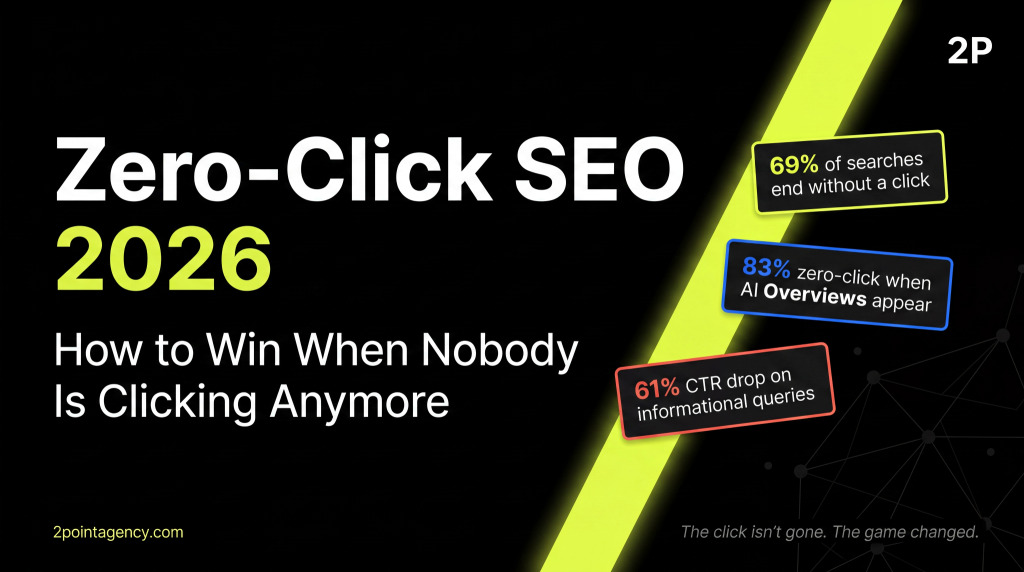
Zero-click searches grew from 56% to 69% after Google AI Overviews launched. That shift reset what winning in search means. You are no longer competing for clicks. You are competing for the impression that shapes the branded query that comes later.
The brands that won in 2026 built a zero-click search strategy before their CMOs started asking. At 2POINT, this is the exact shift we help mid-market brands navigate.
Key Takeaways
- Zero-click searches account for 69% of all Google searches. Searches with AI Overviews end without a click 83% of the time. Your metrics need to reflect that reality.
- Winning in search has shifted from earning the click to earning the impression and the citation. AI Overview optimization, and SERP feature optimization are now core top-of-funnel strategies.
- Modern zero-click content strategy is built on four pillars: Visibility, Extraction, Authority, and Owned Audience. Each one compounds the others.
- Featured snippet optimization, People Also Ask boxes, and AI Overview citations are the new ranking positions. If you are not cited, you are invisible before the page loads.
- Brands winning in 2026 measure citation share, zero-click search results ownership, and branded search lift alongside traditional session data.
- The immediate action: re-architect your top pages for AI extraction and add citation KPIs to your monthly report.
What Is Zero-Click SEO (and Why It's Now the Default)
Zero-click SEO is the practice of optimizing for visibility, citations, and value delivery within the SERP itself, rather than relying on a click-through to your site.
You are still building authority. You are still driving business outcomes. What changed is that a significant share of that value now gets delivered before anyone reaches your page.
None of this happened overnight. Featured snippets started it in 2014, knowledge panels expanded it, and AI Overviews made it structural. Pew Research Center found that users click a traditional result just 8% of the time when an AI summary appears, compared to 15% on clean SERPs. Roughly half your clicks are structurally removed.
Zero-click searches are not a bug. They are the new default, and the brands winning in 2026 stopped fighting them and started optimizing for them instead.
Three Myths That Are Killing Zero-Click SEO Strategies
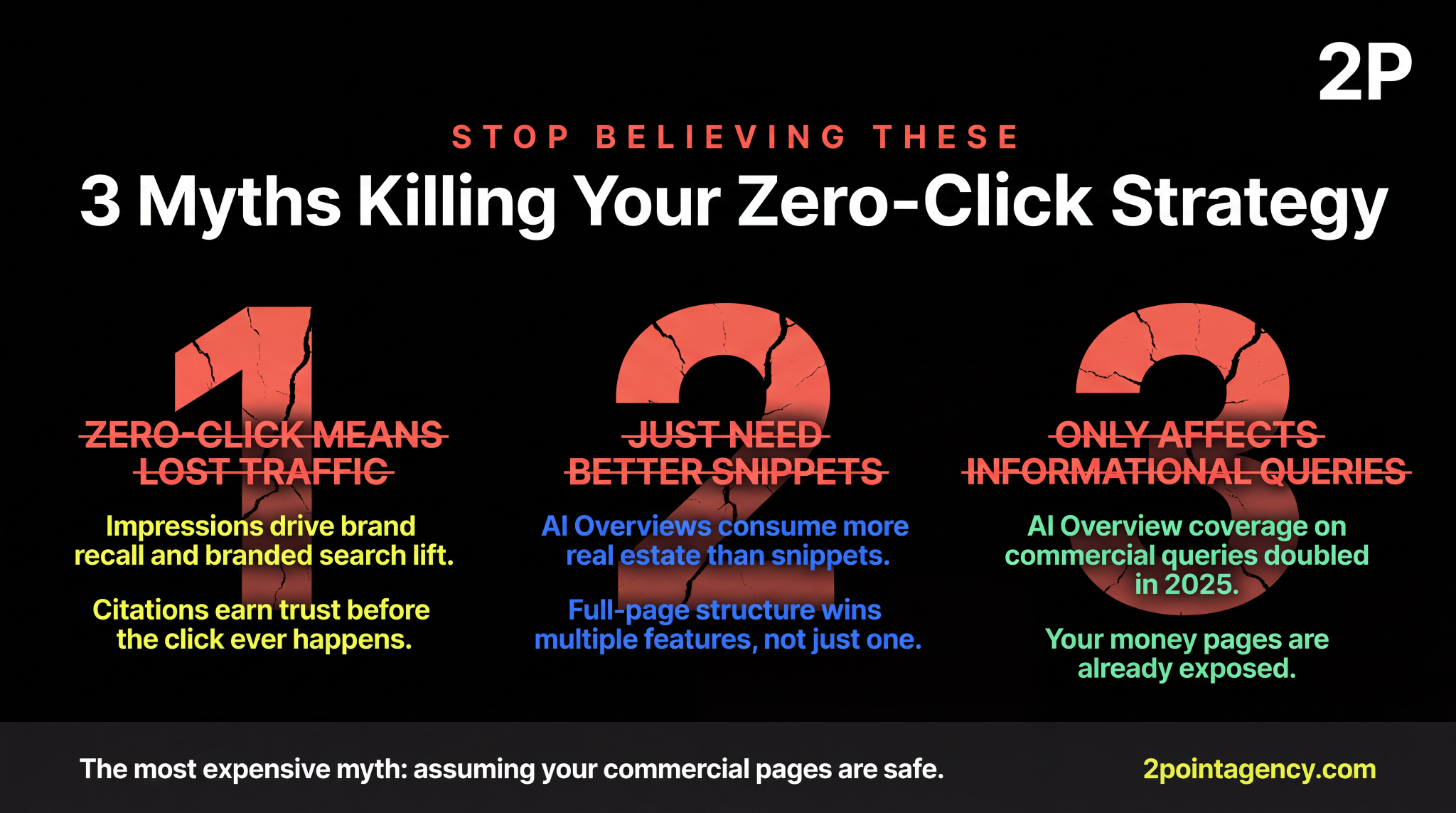
Before we get to the framework, three myths keep showing up in LinkedIn posts and agency decks. Believe any of them, and you will burn your 2026 budget in the wrong place.
Myth 1: Zero-Click Means Lost Traffic
Clicks are not the only form of value search delivers, and treating them that way has been the core mistake of the last two years.
When your brand shows up inside an AI Overview citation, you earn an impression that shapes trust, memory, and downstream intent. Brands consistently cited in AI answers see measurable lifts in branded search volume, even when zero-click searches produce no direct visit.
That branded lift is traffic you were going to earn anyway, arriving earlier in the funnel and at no additional cost to you.
Myth 2: You Just Need Better Featured Snippets
Featured snippet optimization is table stakes at this point, not a complete zero-click strategy.
AI Overviews and People Also Ask now consume more SERP real estate than classic snippets, and they follow different extraction rules. Writing one tight paragraph per query stopped being enough in 2024.
What actually works is broader SERP feature optimization: structuring your entire page for extraction across multiple surfaces, not just targeting a single answer box. One format wins one placement. Full-page structure wins several.
Myth 3: Zero-Click Only Affects Informational Queries
This myth is the most expensive one to believe.
Most teams protect their informational pages and leave their commercial pages untouched, assuming that AI Overviews target only top-of-funnel content. Semrush's analysis of 10 million keywords found that AI Overview coverage on commercial queries climbed from 8.15% to 18.57% over 2025.
That means your money pages are already exposed. If your zero-click SEO strategy stops at informational content, you are optimizing half the funnel and leaving the more valuable half unprotected.
The 4-Pillar Framework for Winning Zero-Click SEO
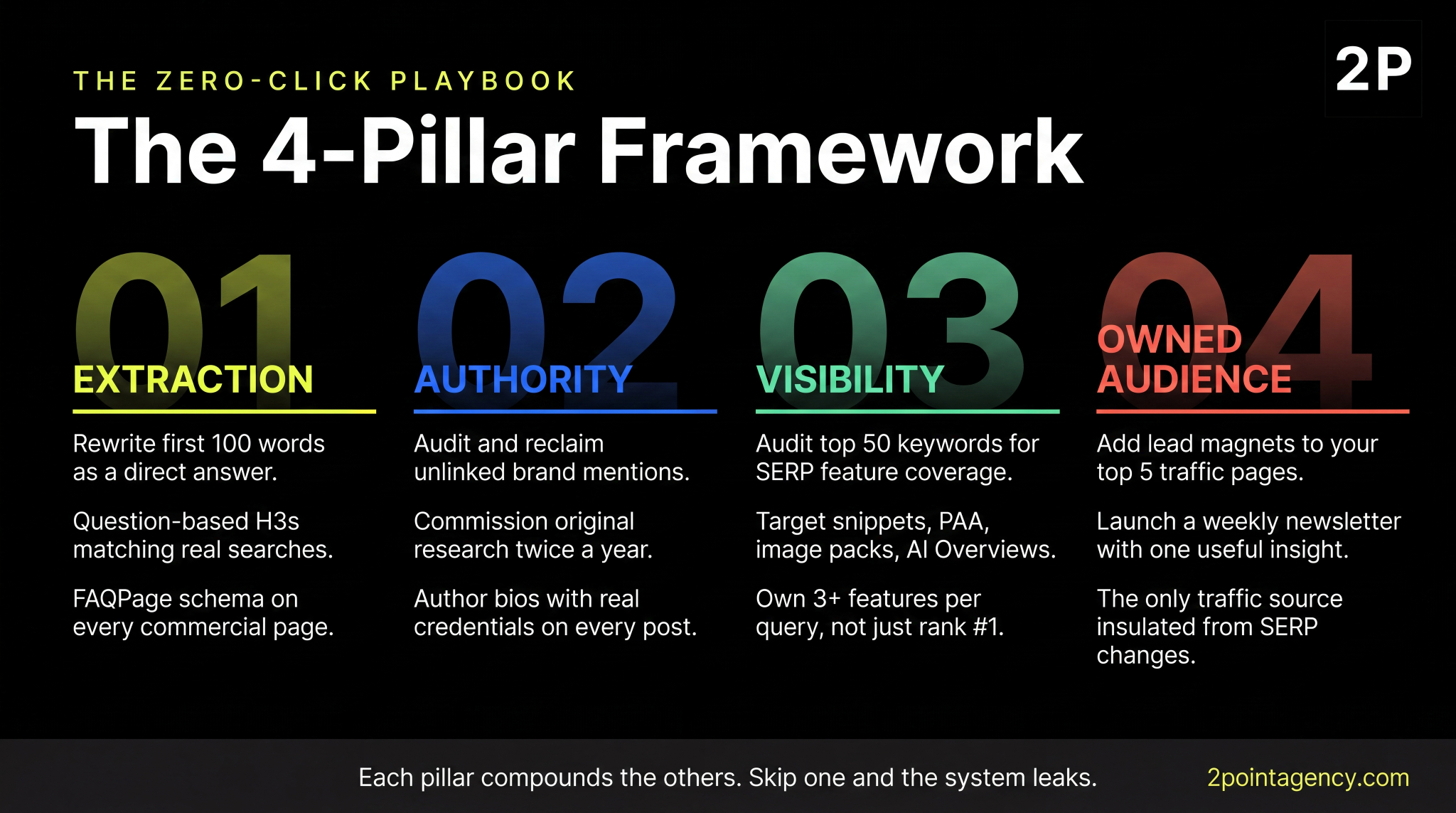
Four pillars define what winning looks like when clicks are no longer the primary metric.
Each one is a lever your team can pull this month, and together they cover every surface where your brand can earn visibility without a click.
Pillar 1: Visibility (Show Up in More Places)
Visibility is about expanding your SERP surface area beyond the number one blue link. A page that owns an AI Overview citation, a featured snippet, and a People Also Ask box on a single query outperforms a page that ranks first with nothing else attached.
SERP feature optimization starts with an audit.
Pull your top 50 keywords, mark which features appear on each query, and flag which ones you own versus which are available to capture. Your AI search visibility determines how much surface area you currently hold. That spreadsheet tells you where to spend the next 90 days.
Common feature wins worth chasing:
- Featured snippets on definition-style queries.
- People Also Ask entries on sub-questions your content already answers.
- Image pack placements on visual-intent queries.
- Video results on how-to queries.
- AI Overview citations on informational queries.
Pillar 2: Extraction (Make Your Content Citation-Ready)
Extraction is where most SEO teams leave the biggest gains on the table. Your content can be brilliant and comprehensive, but if an AI system cannot cleanly lift an answer from it, you do not get cited. A shallower competitor page does.
The fix is structural, not creative. Four moves make your content citation-ready:
- Rewrite your top 10 pages so the first 100 words answer the primary query directly
- Use question-based H3s that mirror People Also Ask phrasing exactly
- Add FAQPage schema to every commercial page
- Pair every stat with a named source in the same sentence
This structure has always been what featured snippet optimization rewards. So do AI Overviews, and they reward it even more aggressively. Your LLM optimization foundation is what determines how often you get pulled into the answer rather than buried underneath it.
Pillar 3: Authority (Earn the Citation)
When two sources could answer the same query, AI systems consistently pick the one with stronger entity authority. That means E-E-A-T signals, brand mention frequency across the open web, author credibility, and editorial trust from neutral sources all feed directly into your citation source.
Three moves that actually build authority:
- Audit every unlinked brand mention from the last 12 months and decide whether to pursue a reclaim or outreach
- Commission original research at least twice a year. LLMs favor primary sources over secondary ones
- Add author bios with real credentials and topical expertise statements on every post
Your SEO integration stack needs to connect brand mentions, backlinks, and citation share into a single view so you can track them together.
Pillar 4: Owned Audience (Bypass the SERP Entirely)
Owned channels are the only traffic source fully insulated from SERP changes.
Your email list, your newsletter, your community, your push notification subscribers. Every one of those audiences stays the same size tomorrow, regardless of what Google ships next week.
This does not mean abandoning SEO. It means treating SEO as a top-of-funnel acquisition engine that feeds owned audiences downstream. Add a lead magnet to your top five highest-traffic pages. Launch a weekly newsletter with one genuinely useful insight.
Understanding how organic search and owned audience growth connect is what separates brands that compound their visibility from those that start over every algorithm cycle.
The Real Stakes: What the Zero-Click Data Actually Says
The zero-click data is consistent across methodologies, and that consistency is the tell that this is structural.
Search Engine Land reports a 61% drop in organic CTR on informational queries where AI Overviews appear. Similarweb's tracking shows that zero-click searches accounted for roughly 69% of all Google sessions, up from 56% before AI Overviews launched. Pew Research tracked actual browser behavior across 68,879 searches and found click rates cut roughly in half on AI-summary SERPs.
Add to that: Google's AI Mode reached 75 million daily active users in early 2026. Every user who shifts to AI Mode is a user you can only reach through citation, not through ranking.
The brands winning right now treat this as a format change, not a traffic loss. They are measuring different things and optimizing for different outcomes. The ones falling behind are still staring at a session's chart, wondering where everybody went.
New Metrics for a Zero-Click World
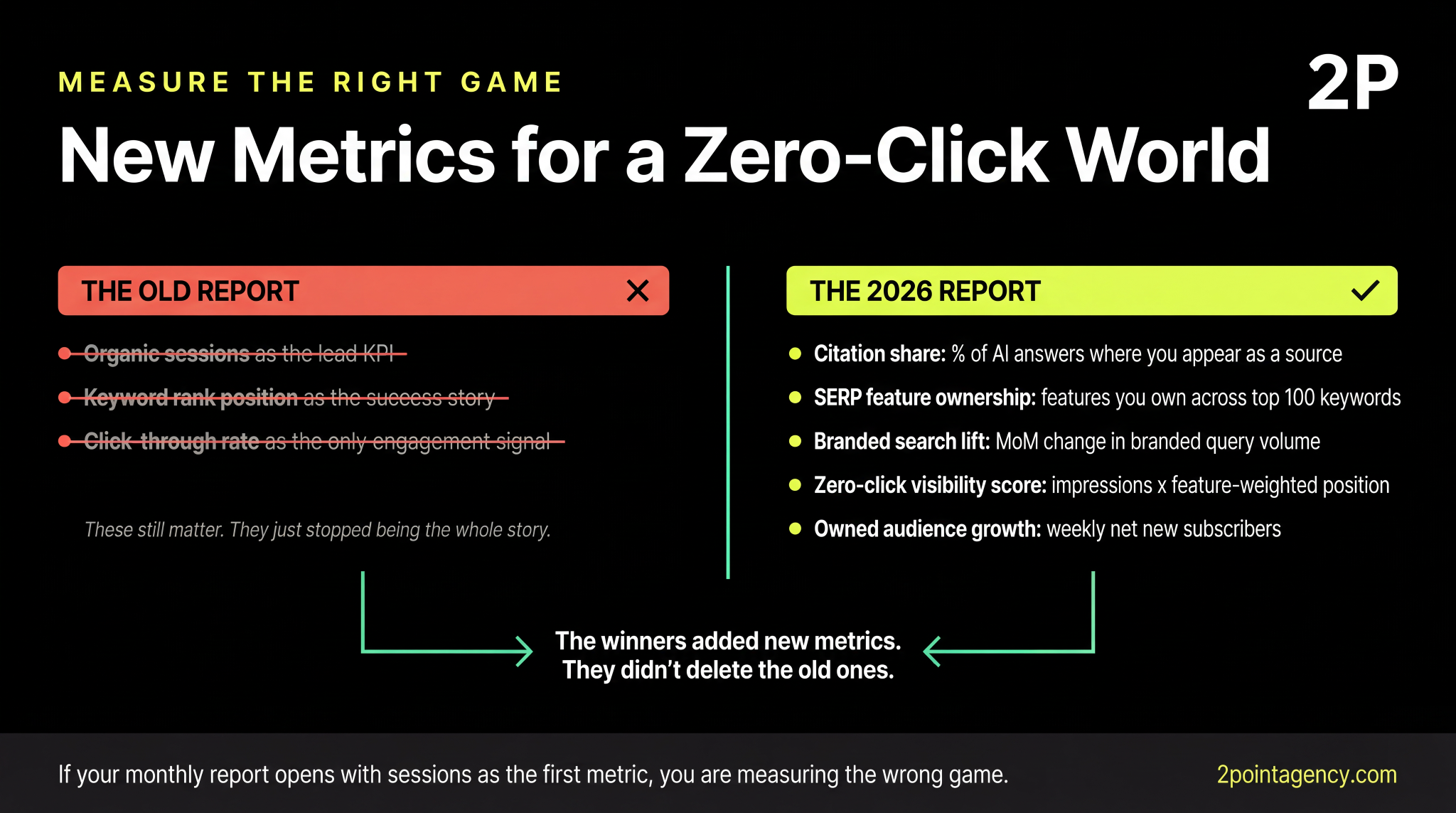
If your monthly SEO report still opens with organic sessions as the first metric, you are measuring the wrong game.
Zero-click content strategy demands new KPIs. Here are the five that actually reflect where visibility lives in 2026:
- Citation share: the percentage of AI answers in your category where your brand appears as a source
- SERP feature ownership: the count of features you own across your top 100 keywords
- Branded search lift: month-over-month change in branded query volume
- Zero-click visibility score: impressions multiplied by feature-weighted position
- Owned audience growth: weekly net new subscribers, not session volume
If your current stack cannot pull those numbers, your SEO tracking setup needs tools with built-in AI visibility and citation tracking.
What Winning Zero-Click SEO Actually Looks Like
You don't need a case study to picture how this plays out. Here is how each pillar translates into real outcomes when a mid-market brand commits to the framework.
The Extraction Play
A brand rewrites the first 100 words of its top 20 pillar pages as declarative answer blocks, adds FAQPage schema, and restructures every H2 as a question.
Within 60 to 90 days, AI Overviews start pulling answers directly from those pages. Sessions stay flat, but citation share climbs, branded search volume rises, and pipeline grows from a source the team was not tracking before.
The Owned Audience Play
A brand adds lead magnets to its top 10 organic pages and launches a weekly newsletter with one genuinely useful insight per edition.
Over the course of six months, the subscriber base generates direct traffic independent of any SERP changes. When Google ships its next update, the team watches rather than panics.
The Reporting Play
A brand replaces its sessions-and-clicks report with a dashboard built around citation share, SERP feature ownership, and branded search lift. Leadership stops asking why traffic is flat and starts asking how to earn more citations.
The budget conversation changes because the story finally matches the work.
Your Monday-Morning Zero-Click Playbook
You do not need a new tech stack or a new agency to start winning zero-click traffic. You need six focused moves, in order of leverage:
- Audit your top 50 keywords for SERP feature coverage: Mark which features you own and which are available. That becomes your 90-day target list.
- Rewrite the first 100 words of your top 10 organic pages: Make them declarative, quotable, 40 to 60-word answer blocks. This is the highest-leverage hour of work you will do this month.
- Add FAQPage schema to every commercial-intent page: It is one of the most consistent inputs to AI Overview citations.
- Pull every brand mention from the last 12 months: Reclaim unlinked mentions, pitch follow-up coverage, or log them in your visibility tracker.
- Add three new KPIs to your monthly report: Citation share, SERP feature ownership, and branded search lift. Reframe the conversation before leadership does it for you.
- Ship one lead magnet on your highest-traffic page: Start building the owned audience that insulates you from the next SERP change.
Run these in order, and your zero-click SEO program will be live in two weeks.
Are You Measuring the Right Things Yet?
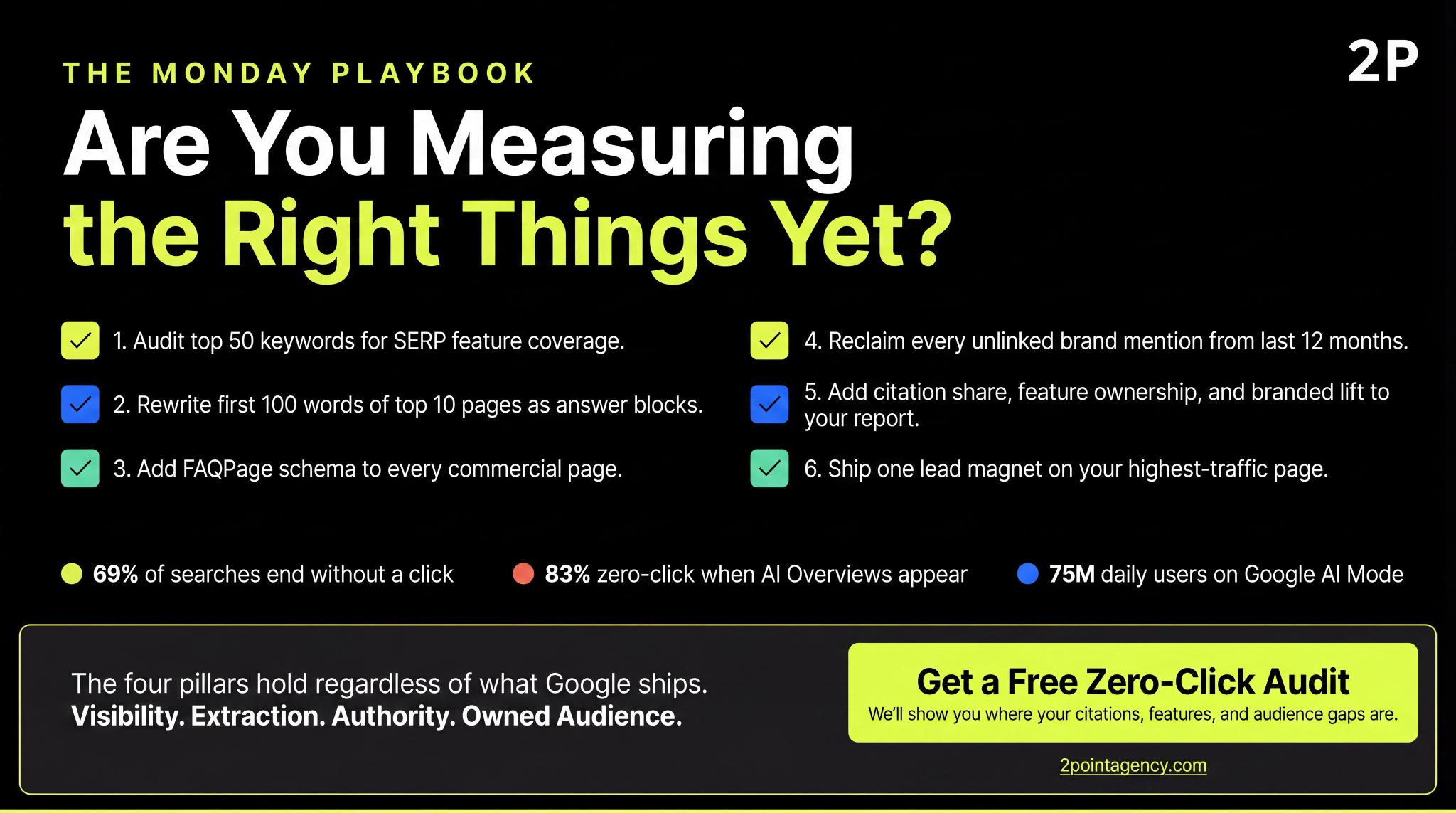
The four pillars hold regardless of what Google ships next. Visibility, Extraction, Authority, and Owned Audience together build a program that compounds rather than collapses.
2POINT's SEO team helps mid-market brands rebuild reporting and ship citation-ready content fast. AIOBot scales that further by producing AI-optimized articles at volume, helping your brand rank across more surfaces simultaneously.
FAQs
What is zero-click SEO in 2026?
Zero-click SEO is the practice of earning visibility, citations, and brand value inside the SERP itself rather than relying on a click. In 2026, most Google searches end without one, making zero-click SEO the default playbook for any modern search program.
How much of Google search is now zero-click?
Zero-click search statistics 2026 show searches ending without a click now represent the majority of all Google sessions, and the rate climbs even higher on SERPs where an AI Overview appears. The trend is structural and accelerating every quarter.
Is zero-click SEO killing organic traffic?
No. Zero-click searches are reshaping what organic success looks like, not eliminating it. Clicks are down on informational queries, but brands with a solid zero-click search strategy are capturing impression value and branded search lift instead of chasing lost clicks.
How do you measure success in a zero-click world?
Measure with KPIs that match the new game. Citation share, SERP feature optimization scores, branded search lift, and zero-click search results ownership matter more than raw session counts. Add owned audience growth, and you have a reporting layer leadership can actually act on.
What is the difference between zero-click SEO and AI Overview optimization?
AI Overview optimization is a subset of zero-click content strategy. Zero-click SEO covers every SERP feature. AI Overview optimization focuses specifically on earning citations in Google's generative answers, the fastest-growing slice of the zero-click opportunity.
Can you still get clicks from featured snippets?
Yes. Featured snippet optimization still drives clicks, especially when the snippet does not fully answer the query. Snippets also feed AI Overview citations, and People Also Ask entries, so the authority and visibility gains compound even when direct click rates are lower.
What is the fastest way to start winning zero-click traffic?
Knowing how to win zero-click traffic starts with three moves: rewrite your top 10 pages as 40 to 60-word answer blocks, add FAQPage schema to every commercial page, and audit your top 50 keywords for SERP feature coverage.