

 let’s connect


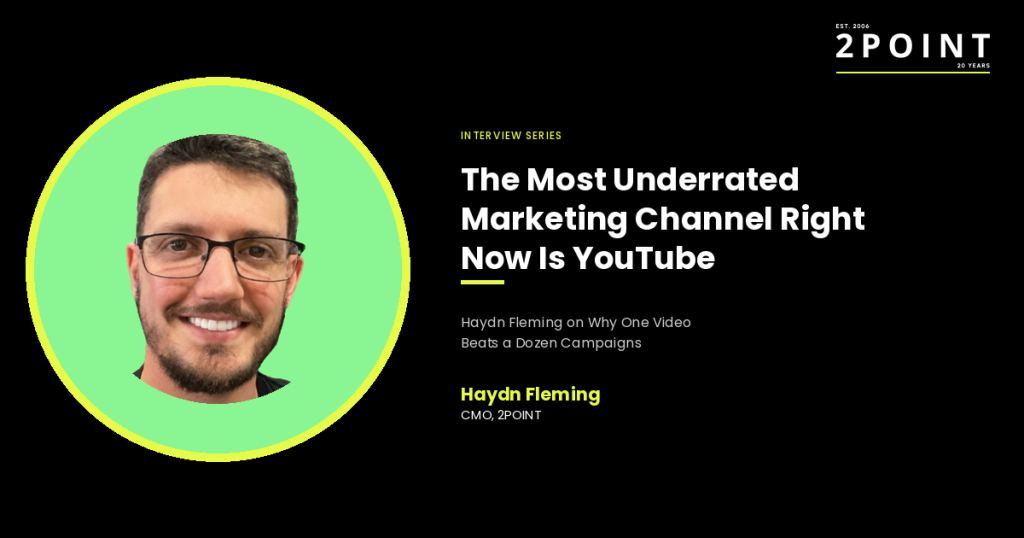
As CMO of 2POINT, he has spent years stress-testing ideas across channels, clients, and categories. In the process, he’s developed views that cut against the prevailing wisdom.
Haydn Fleming thinks about marketing in systems.
As CMO of 2POINT, he has spent years stress-testing ideas across channels, clients, and categories. In the process, he’s developed views that cut against the prevailing wisdom.
When asked what channel most businesses are not taking seriously enough, Haydn does not hesitate. Avoiding a hot take about a new platform or an algorithm hack, his answer is a return to one of the oldest formats on the internet, treated properly: YouTube.
Not Reach. Leverage.
It would be easy to assume Haydn's pick comes down to audience size or watch-time metrics. It does not. Haydn’s case for YouTube has almost nothing to do with the platform itself and everything to do with what producing a genuinely good long-form video forces a marketing team to do.
Put together a real script and think through what you are filming for that video, and a well-formed blog article is already sitting inside it. Keep going, and a newsletter is in there too.
That is the core of the argument: a single YouTube video, made well, is not one asset. It is the raw material for many.
The Repurposing Chain, Step by Step
Walk through what actually happens once the camera stops rolling, and the logic becomes concrete rather than theoretical.
A 10-to-15-minute video, scripted properly, becomes a bank of short-form clips ready for Instagram, TikTok, LinkedIn, and Facebook, each one already built around a moment that worked in the long-form cut.
The same script, because it had to hold together as a coherent piece of writing in the first place, becomes the backbone of a blog article with comparatively little extra effort. That article, in turn, becomes the basis for a newsletter send, since the argument, structure, and key lines have already been worked out. Nothing about any of these downstream pieces requires a new idea. Each one is a different packaging of the same thinking.
That is the distinction Haydn draws between YouTube and almost every other channel businesses default to first. A campaign built around static graphics or short-form clips alone tends to stay static graphics or short-form clips. It rarely generates a blog post or a newsletter as a byproduct, because none of the groundwork, the script, the structure, the argument, was ever built. Long-form video is one of the few formats that forces that groundwork to exist, and once it exists, it can be reused almost indefinitely.
Long-Form Video Is the Hard Mode That Makes Everything Else Easy
Haydn's reasoning goes a layer deeper than repurposing math.
Long-form YouTube, in his view, is the combination of nearly every soft skill content marketing requires, on-camera presence, scripting, storytelling, pacing, editing judgement, used together at once. Once a team can do that well, almost everything downstream becomes comparatively simple.
Making a static social post with captions is less work once the video already exists. Cutting a 60-second clip is less work once a 15-minute video has already been shot and edited. Writing a blog post that actually ranks is less work once the script has already forced the thinking to happen. Recording a strong podcast episode on the topic is less work, too, for the same reason.
Get that right, and a company tends to get good at nearly everything else, because the hardest version of the skill has already been practiced.
What Content Marketing Actually Rewards: Volume, Iteration, Consistency
Ask most teams what is holding their content back and the answer is rarely a lack of ideas. It is a lack of output. Haydn's view is blunt on this point: so much of what makes content marketing succeed or fail is simply volume, iteration, and consistency, how much a team can put out, on schedule, without running dry.
This is where the YouTube-first approach compounds. One well-produced long-form video does not require a new topic to become dozens of pieces of content. It can be sliced, restructured, and reformatted into fifty, even a hundred, distinct assets without the team ever having to come up with something new to say. The idea stays the same. Only the format changes.
For a marketing department under pressure to fill a calendar every week, that is not a minor efficiency gain. It is the difference between constantly scrambling for the next idea and mining a single well-made asset for months.
AI Has Made the Repurposing Step Faster, Not Just Possible
The repurposing argument is not new. What has changed, in Haydn's view, is how quickly it can now happen. Editing tools built around AI have collapsed a task that used to take a full week down to an afternoon or less.
That matters most for the teams with the least slack, the one or two-person marketing departments trying to run social, email, design, and reporting all at once. For those teams, the bottleneck was the time it took to turn one good recording into everything else it could become. As that editing step keeps getting faster, the gap between businesses that publish one long-form video and businesses that publish one long-form video plus fifty supporting assets gets easier to close, even for a lean team with no dedicated video department.
Why He Calls It the Highest-ROI Channel
Put those two arguments together, the skill-stacking effect and the repurposing math, and Haydn's conclusion follows naturally: YouTube is likely the single biggest ROI channel available to most businesses right now.
Part of that is simply the platform itself. It has real reach, strong engagement, and it remains a genuinely good medium for building an audience over time. But that is not what makes the case unusual. What makes it unusual is everything the channel enables elsewhere. A blog post that would otherwise require a separate research and writing process is largely already done. A quarter's worth of social clips is sitting inside a single shoot. A newsletter angle is already scripted before anyone opens a blank document.
Those downstream effects are not linear, they are closer to exponential.
Every additional platform a team wants to be present on, Instagram, LinkedIn, TikTok, a blog, an email list, becomes a repurposing exercise rather than a fresh production effort. The marginal cost of showing up everywhere else drops sharply once the long-form video already exists.
This is also why Haydn frames YouTube as an investment rather than a campaign. A paid social push stops producing value the moment the budget runs out. A well-made long-form video keeps generating clips, blog traffic, and search visibility long after the day it was published, and it keeps functioning as raw material for new formats the team has not even thought to build yet.
The Practical Case for Starting Here
None of this requires an hour-long production or a studio budget. Haydn is specific that the format does not need to be elaborate: ten minutes plus is enough to unlock the effect. What matters is that the video is made well enough, scripted with real thought, filmed and edited with care, that it can carry the weight of everything built on top of it.
For businesses trying to decide where to invest limited marketing time and budget, that is the practical takeaway. Rather than treating YouTube, blogging, social clips, and newsletters as five separate workstreams competing for the same hours, Haydn's approach treats them as one workstream with five outputs. Get the first one right, and the rest largely follows.
It also reframes the usual objection to video, that it is expensive, slow, and requires a production team most businesses do not have. Haydn's answer is not that video is cheap or effortless. It is that the effort spent on one long-form video replaces the effort that would otherwise be spent separately on a blog post, a set of social clips, and a newsletter. Measured against any single one of those channels alone, a video looks like more work. Measured against all of them combined, it is the shortcut.
It is a characteristically direct case from someone who thinks in systems and is not particularly interested in overcomplicating a straightforward idea: make one good long-form video, and let it do the work of an entire content calendar.
Haydn Fleming is the CMO of 2POINT.