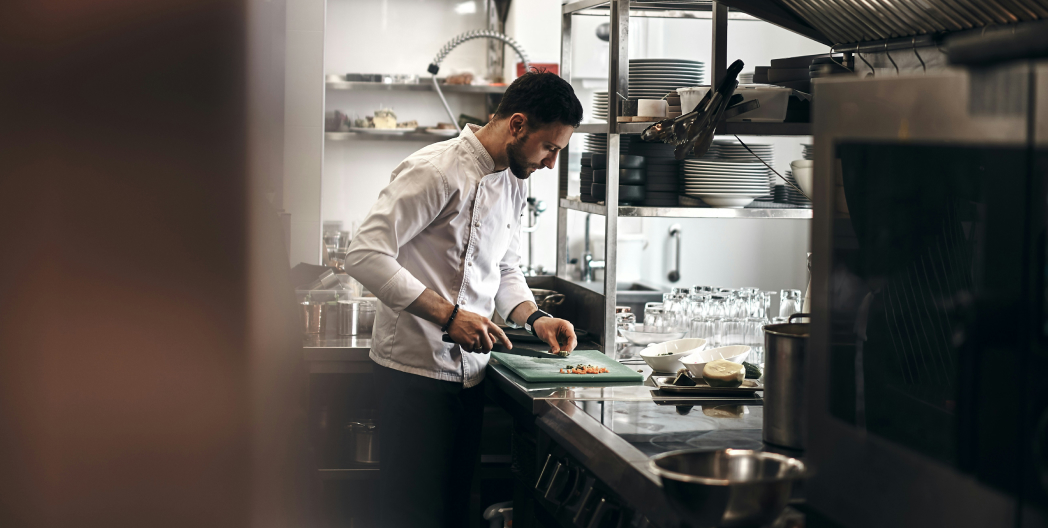

Discovery is table stakes. We build the full program: social presence that drives trial, local search that keeps you top-of-mind, and retention that turns first visits into regulars.
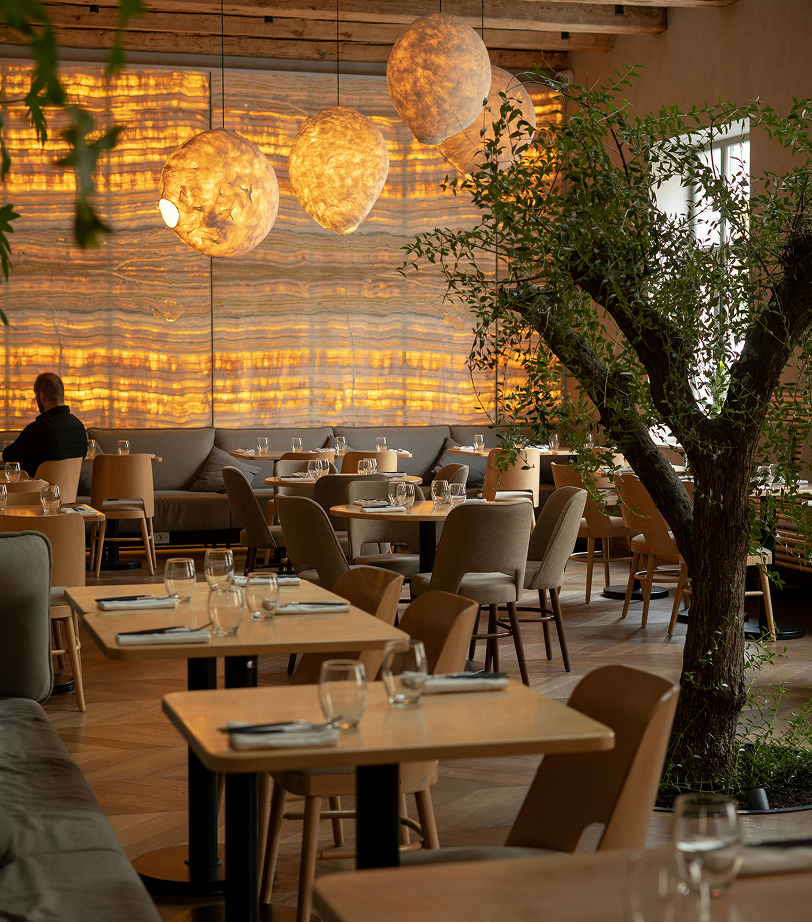

Food service discovery happens online before a single guest walks through the door. Operators who show up well on search, social, and maps fill seats. Those who don't hand that traffic to whoever does.
Return visits drive 80% of revenue for most food service businesses. First-visit acquisition matters, but the retention layer is where the economics actually work.
Paid social for new guest acquisition, local SEO for consistent walk-in traffic, and email and SMS that bring the guests you've already won back again and again.
A strategy call. We look at your current visibility, guest data, and marketing spend and tell you what we'd fix first before you commit to anything.
Three patterns that drain budget without driving covers or orders.
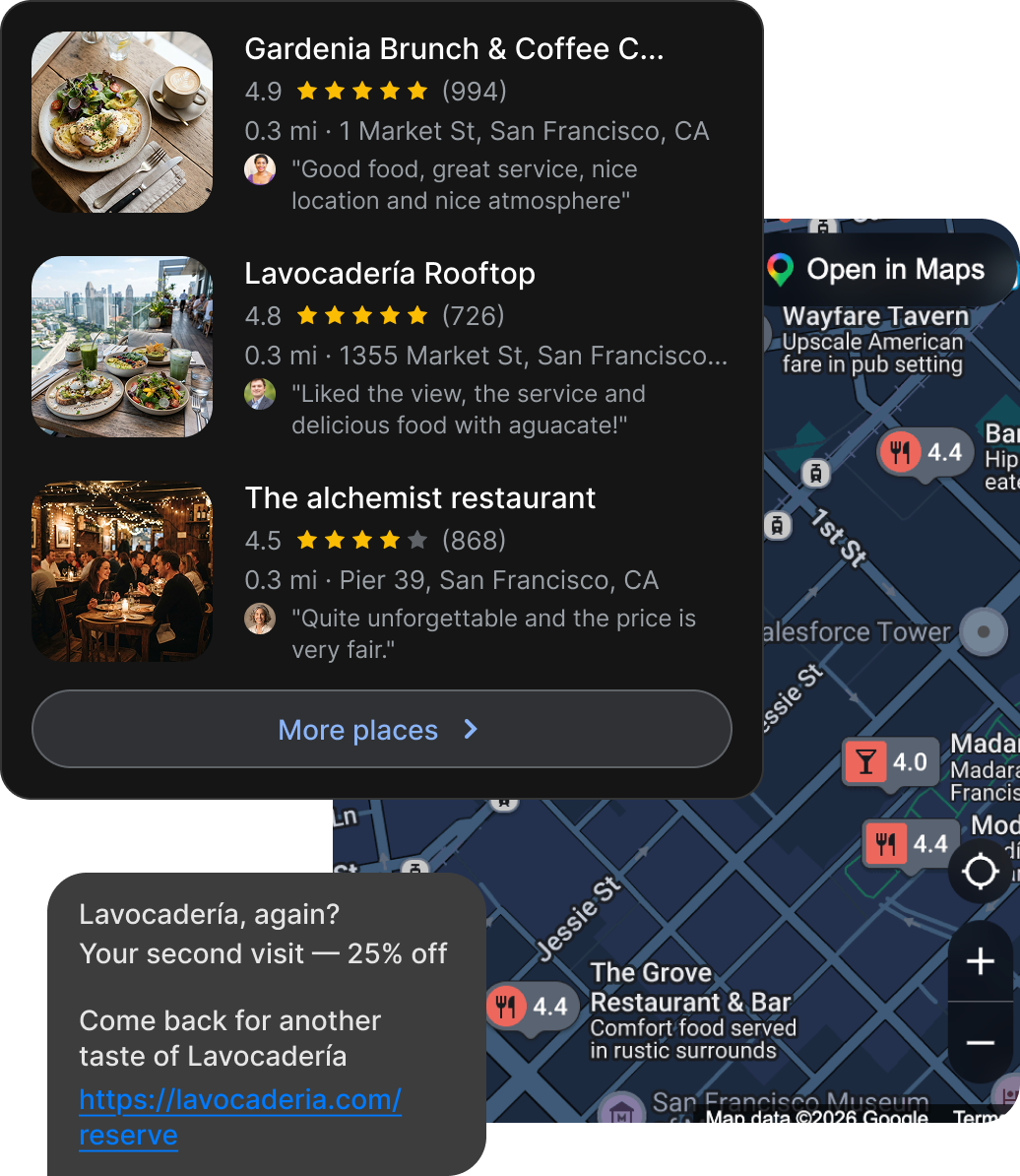
Without email or SMS, a first-time guest is a one-time cost with no follow-up. The economics of food service only work when you get repeat visits out of the guests you've already acquired. Most operators have the guests, but no system to bring them back.
Over 80% of restaurant searches happen on mobile, immediately before a dining decision. If you're not in the top three map results for your category and neighborhood, those searches end with a competitor getting the table.
Organic social builds awareness at a slow pace. Without paid social layered on top, a great Instagram account rarely converts into measurable new-guest volume. Most food operators post consistently and see no direct correlation to covers.
We build acquisition, local presence, and retention as one connected program. Each channel feeds the others. Budget follows what's actually producing visits, not what looks good on a dashboard.
% of food service clients actively running each channel with 2POINT
A multi-location fast-casual operator had strong in-person traffic but no digital acquisition program and a 21% return guest rate with no retention system in place. We launched Meta Ads targeting local dining audiences, built out their Google Business Profile and local SEO, and introduced an SMS loyalty program with automated retention flows. By Q4, covers were up 62% year-over-year, return guest rate climbed to 38%, and cost per new guest dropped from $14 to $6.40.
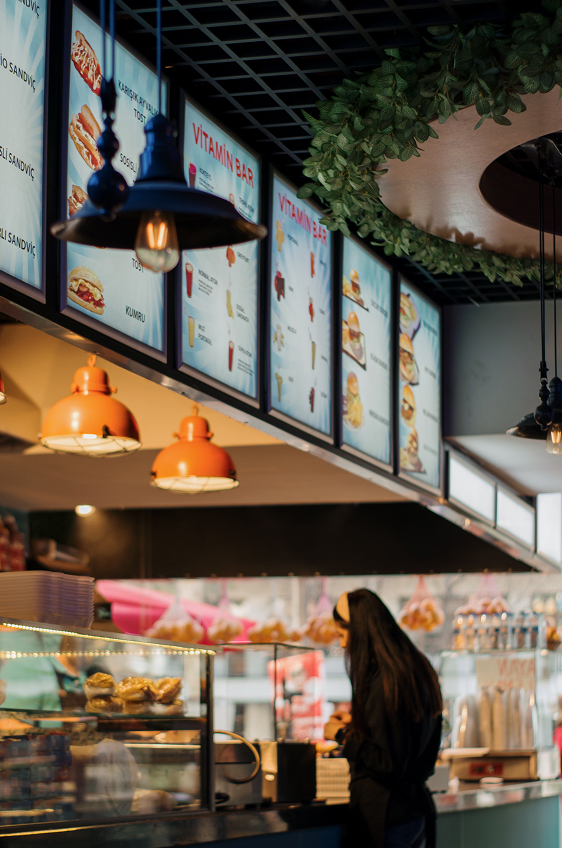
The format shapes the channel mix and creative approach. The goal is the same across all of them: more covers, more orders, more guests coming back.
Local SEO and Meta Ads drive the volume, with retention keeping it.
Reputation, Google visibility, and social presence drive the reservation.
SEO, paid search, and owned channels reduce the platform fee drag on every order.
Paid social for event promotion, local SEO for the late-night decision, and loyalty for the regulars who carry the weekly baseline.
We build within brand guidelines and target the guest radius that actually converts for each location.
We separate what works per concept while driving cross-concept traffic from shared footfall.
Email, SMS, and Meta Ads drive both customer acquisition and churn prevention.
Paid search for event-specific intent, SEO for discovery, and a CRM-backed follow-up process for the corporate account cycle.
Cover growth year-over-year for a multi-location fast-casual operator after launching paid social, local SEO, and SMS retention together
Return guest rate improvement for an operator with no existing retention program, achieved through SMS loyalty and automated email flows alone
Cost per new guest after the channel mix and creative strategy were rebuilt. Five years is our average client relationship, because the program keeps paying off.
Four stages, from baseline to a program generating new patients every month.
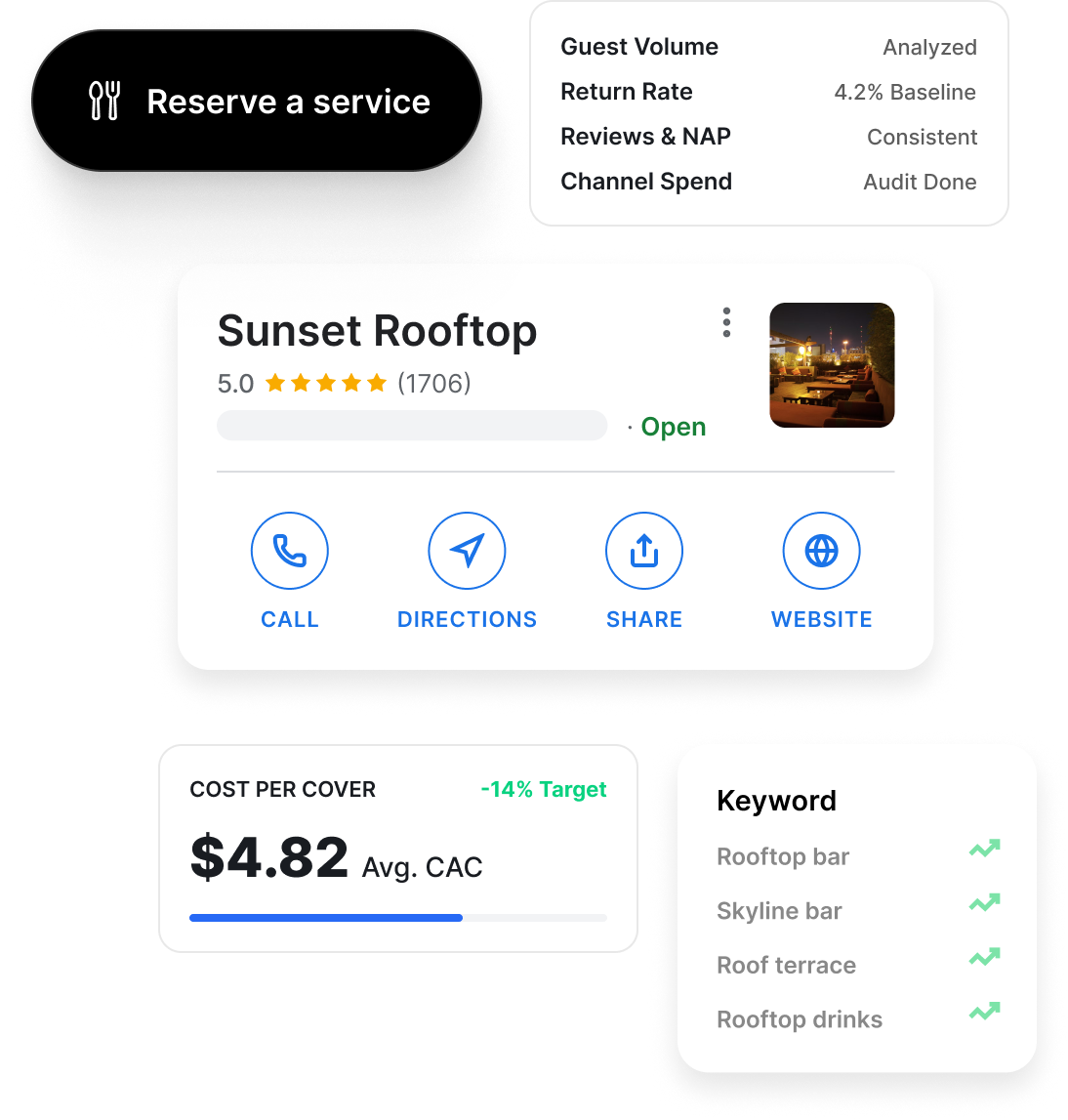
We start with your current guest volume, return rate, online reputation, and any existing marketing spend. That baseline determines where the biggest gaps are before we build anything new.
We map which channels to run, in what sequence, and what each is accountable to. Paid social, local SEO, and retention each have a defined role and a clear metric before anything goes live.
Every channel goes live with conversion tracking tied to actual visits or orders. We measure cost per new guest and return visit rate from the start, not just reach and engagement.
Creative rotates when performance drops. Budget shifts to what's producing guests. Retention sequences update based on what's actually bringing people back.
Straight answers before the call.
Reach has dropped sharply on both platforms without paid amplification, and organic posting rarely builds the volume a growing business needs. Posting without paid social layered on top rarely translates into measurable new-guest volume. We use organic content as the creative foundation and paid media as the distribution engine that actually drives covers.
Ad spend for a single location typically starts at $1,500 to $2,500 per month to generate real new-guest volume. We can run the math for your guest target and market on the strategy call so you have a real number, not a benchmark guess.
We set up tracking tied to reservation clicks, online orders, or call conversions depending on how your business takes bookings. We also work with operators to track offer redemptions and promo codes that tie digital spend to physical visits.
Yes. Multi-location programs run with shared creative and localized targeting so each location gets geographic coverage without competing with its neighbors. Budget allocation by location is part of the strategy discussion up front.
Yes. We build programs around online order volume just as readily as dine-in covers. The channels differ slightly, but the same logic applies: acquisition, local visibility, and retention are the three levers regardless of format.
Paid social typically shows new-guest volume within the first two to four weeks. Local SEO improvements show visible movement in 60 to 90 days. Email and SMS retention programs produce return visits within the first broadcast. Most operators see a measurable lift in covers within the first month.

“Great customer service! They are very patient even when needing to make a change back and forth getting to exactly the right look.”
“Excellent creative work.”
“Everyone at 2POINT is wonderful to work with.”
“The entire service was very professional, efficient and friendly.”
“I have worked with 2POINT at two different startup companies and they did a fantastic job with both web-design and managed all of our marketing initiatives. ”
“We’ve been with 2POINT for about a year and a half now, and couldn’t be happier.”
“Simply the best.”
“I’m really happy that I have asked this company to work on my marketing needs. They did a great job so far and I will definitely work with them again!”
“The team was amazing! Their communication and final delivery of my animated logo was top notch. I highly suggest 2POINT.”
“The 2POINT team I worked with was professional, prompt, and eager to meet our specific needs. I can highly recommend them. They definitely delivered! ”
“Excellent communication, and product we were very happy with the work they did for us.”
“We have worked with their team for almost a decade and hope to continue partnering with them.”
“Everybody on the team was very engaged, communicative and creative throughout the entire process.”
“The attention they give to my business has helped it grow. I really appreciate them!”
“Love working with 2POINT Digital Marketing Agency! ”
“2POINT is amazing! I get compliments on our website all the time!”
“I would definitely work with these guys again, they were able to take my visions and bring it to light. Extremely excited to use my animations on all my projects.”
“The design they came up with is absolutely stunning, and I've already received numerous compliments on the site's clean, modern look.”
“Great group of people, always willing to listen and work together to collaborate on the best ideas for our company!”
“Working with 2POINT on our custom animations was just delightful!”
Tell us your format, current marketing spend, and what's not working. We'll come prepared with a read on your competitive position and what we'd build first.






 let’s connect