
Word-of-mouth built your practice. We build the digital infrastructure that keeps it full, without depending on referrals or a single platform to deliver every new patient.







Health and wellness practices grow on referrals until they stop growing on referrals. Word-of-mouth is real, but it's not scalable or controllable. Practices that want to grow need a pipeline they can actually turn up.
Trust is the entire purchase in healthcare. Practices with strong reviews, high Google visibility, and a clear online presence win patients before the first call. Most practices underinvest here by a wide margin.
Paid search for immediate new patients, local SEO for sustainable baseline volume, and reputation management that does the selling before your front desk even picks up.
A strategy call. We look at your current visibility, review profile, and patient acquisition cost and tell you Bexactly what we'd fix first.
Three patterns that cap growth before marketing ever has a chance to work.
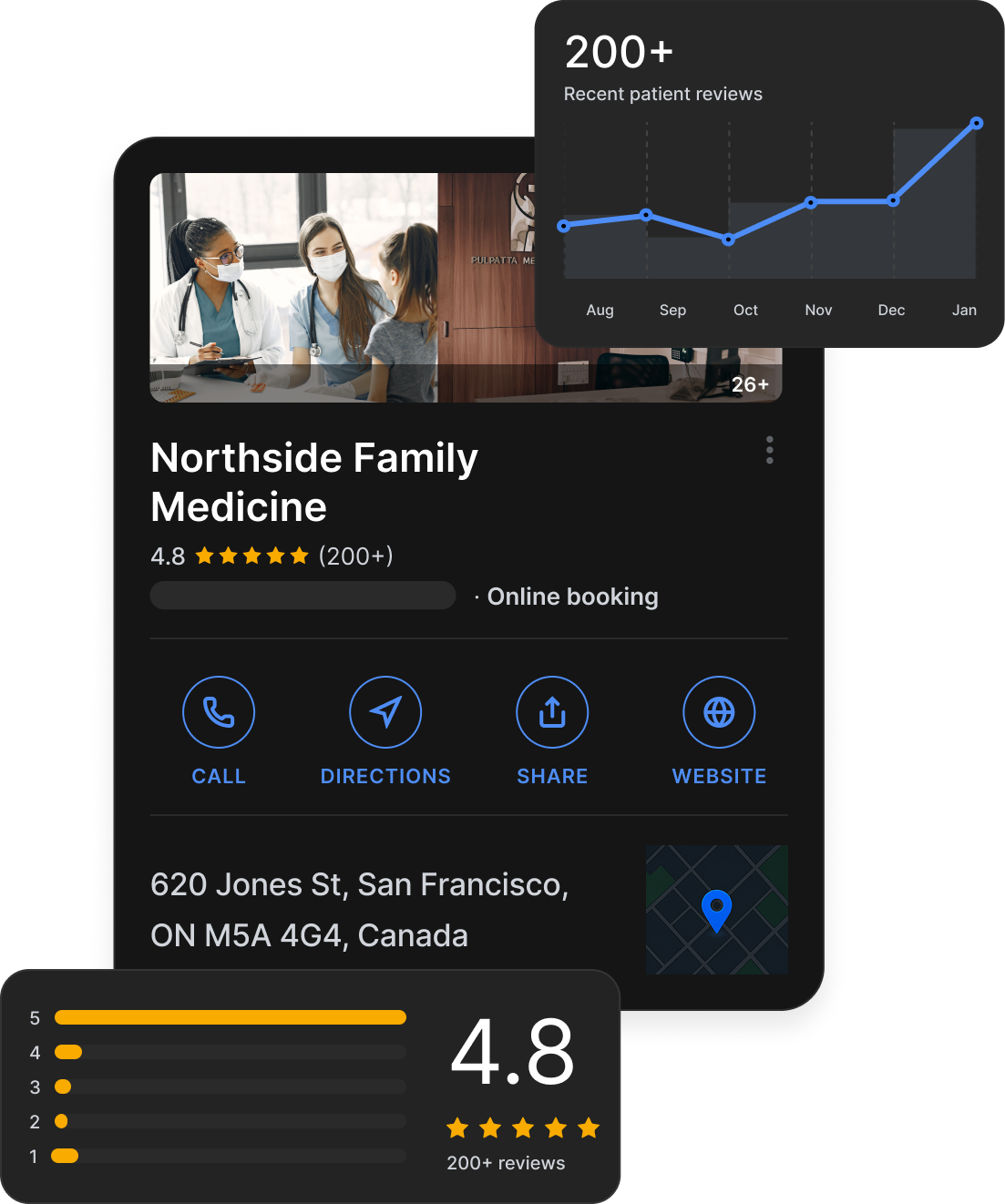
Reviews are the first thing a new patient checks. A practice with 40 reviews at 4.6 stars consistently loses to a competitor with 200 reviews at 4.8, regardless of the actual quality of care. Review volume and recency are the visible proxy for trust, and most practices never build a system to collect them.
A growing share of health and wellness bookings happen outside business hours. Practices without online scheduling lose those patients immediately, before staff ever gets a chance to speak to them. The competition is one click away at 9pm.
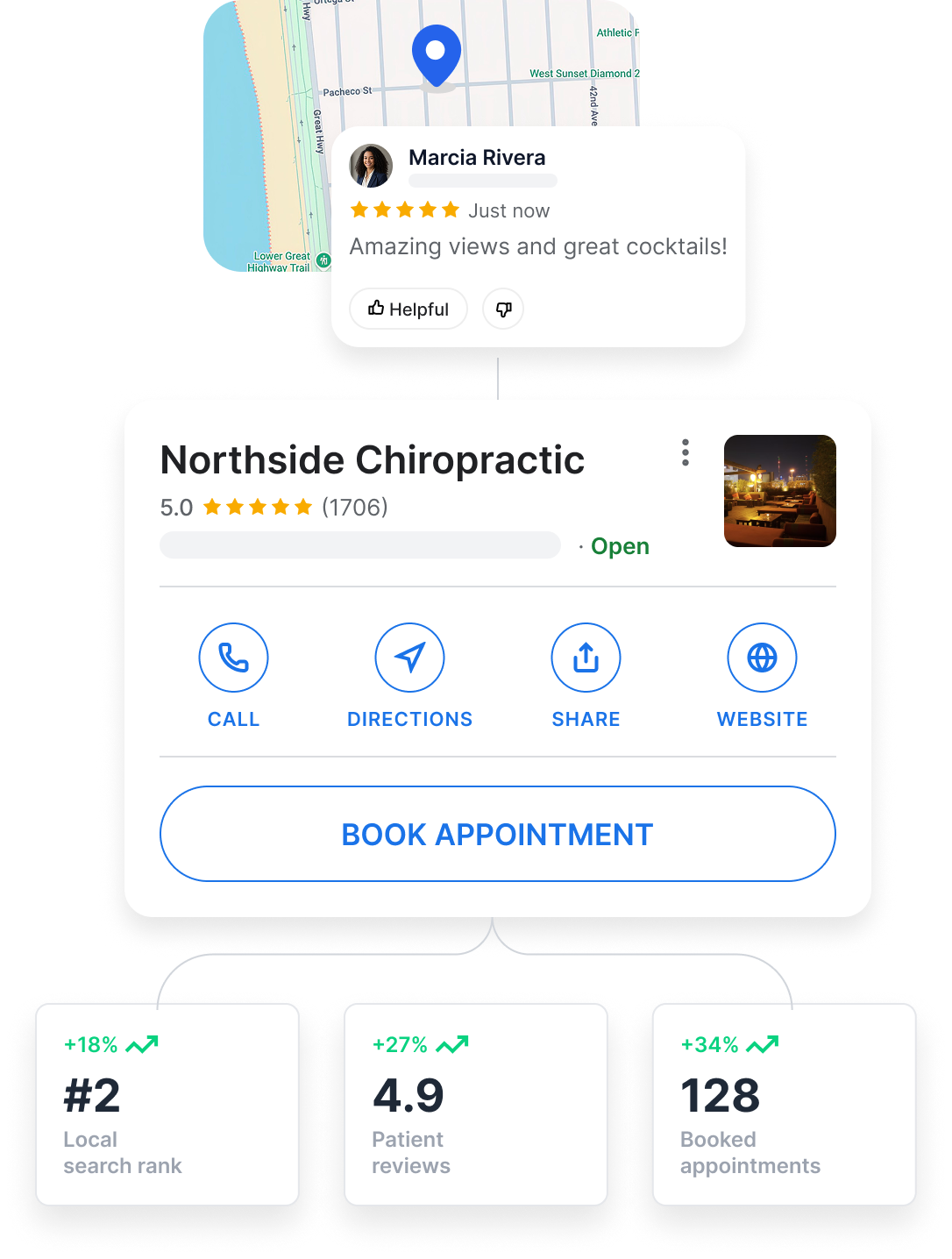
When someone searches for your service in your area, they click one of the top three map results. If your practice isn't there, the search ends without you. Most practices have never optimized their Google Business Profile or built the local SEO presence to compete for those positions.
We build three programs at once: the paid channel that generates patients immediately, the local presence that produces them for free over time, and the reputation that converts both.
% of health and wellness clients actively running each channel with 2POINT
A specialty wellness practice came to us growing entirely on word-of-mouth with no paid search, a weak Google Business Profile, and fewer than 30 online reviews. We launched Google Ads targeting service-specific local searches, rebuilt their Google Business Profile, and introduced a review collection system. By month six, cost per new patient dropped below $90 and the review count had grown to over 200 with a 4.9 average.

The service area shapes the keyword strategy and intake design. The underlying logic stays the same: search visibility, review credibility, and conversion that turns interest into bookings.
Meta and Google Ads plus review volume drive patient acquisition for treatment-specific searches.
Patients search with high intent, and showing up at the top of those results is the entire acquisition strategy.
Local SEO and review credibility build the volume that supplements the referral pipeline.
Platform selection and targeting require care, and we build programs that generate leads without crossing ethical lines.
Reviews and map pack visibility are the primary drivers.
Premium positioning, targeted search, and content built for the concierge model attract the right patients.
Map pack rank, review volume, and paid search working together determine which practice gets the new patient call.
Content and organic SEO build the trust that paid search then converts.
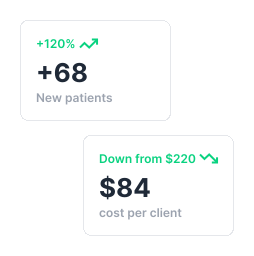
Three results from a specialty wellness practice in the first six months after launching paid search and local SEO together.
New patient growth achieved for a specialty wellness practice in the first six months after launching paid search and local SEO together
Cost per new patient for a practice that previously had no digital channel, achieved within six months through targeted Google Ads and local SEO
Online review count growth in six months through a structured review collection system built alongside the paid program, driving map pack visibility from the start.
Four stages, from baseline to a program generating new patients every month.
We start with your Google Business Profile, review profile, current site traffic, and how patients are finding you. That baseline tells us where the biggest gaps are before we touch anything.
We design the paid, local, and reputation programs together before launching any of them. Each channel feeds the others, and the sequence matters. We document what each is accountable to before touching a budget.
Conversion tracking is set to appointment requests or online bookings from day one. We measure cost per new patient, not cost per click or impressions.
Keyword lists, bidding, and creative update every month based on what's producing patients. Review velocity and local rank are monitored alongside paid performance.
Straight answers before the call.
Referrals work, and we don't build programs designed to replace them. The question is whether you can control the volume. When a practice is short two or three patients from optimal capacity, digital fills that gap on demand in a way referrals can't. It also protects you if a referral source slows down.
Google Ads typically generates appointment requests within the first two to four weeks once campaigns are live. Local SEO improvements compound over 60 to 90 days. Most practices see a measurable increase in new patient contacts within the first month of a properly structured program.
Yes. Cash-pay practices often have an easier time with paid search because cost is a direct business metric rather than an insurance reimbursement variable. We adjust the messaging and targeting strategy to position the practice clearly for patients who are choosing out of pocket.
That depends on your market, service type, and budget. We give specific projections based on actual auction data for your keywords and geography, not generic benchmarks. The strategy call is where that conversation happens, before any commitment.
Yes, though the cost to compete at the top is higher in dense markets. Competitive markets also have higher patient volume available, which usually makes the economics work well at a higher ad spend. We run the numbers for your specific market on the strategy call.
Medical practices, med spas, dental, physical therapy, chiropractic, mental health, functional medicine, concierge primary care, wellness centers, and more. The keyword strategy and intake design differ by practice type. We adapt the program to fit the way patients search for your specific service.

“Great customer service! They are very patient even when needing to make a change back and forth getting to exactly the right look.”
“Excellent creative work.”
“Everyone at 2POINT is wonderful to work with.”
“The entire service was very professional, efficient and friendly.”
“I have worked with 2POINT at two different startup companies and they did a fantastic job with both web-design and managed all of our marketing initiatives. ”
“We’ve been with 2POINT for about a year and a half now, and couldn’t be happier.”
“Simply the best.”
“I’m really happy that I have asked this company to work on my marketing needs. They did a great job so far and I will definitely work with them again!”
“The team was amazing! Their communication and final delivery of my animated logo was top notch. I highly suggest 2POINT.”
“The 2POINT team I worked with was professional, prompt, and eager to meet our specific needs. I can highly recommend them. They definitely delivered! ”
“Excellent communication, and product we were very happy with the work they did for us.”
“We have worked with their team for almost a decade and hope to continue partnering with them.”
“Everybody on the team was very engaged, communicative and creative throughout the entire process.”
“The attention they give to my business has helped it grow. I really appreciate them!”
“Love working with 2POINT Digital Marketing Agency! ”
“2POINT is amazing! I get compliments on our website all the time!”
“I would definitely work with these guys again, they were able to take my visions and bring it to light. Extremely excited to use my animations on all my projects.”
“The design they came up with is absolutely stunning, and I've already received numerous compliments on the site's clean, modern look.”
“Great group of people, always willing to listen and work together to collaborate on the best ideas for our company!”
“Working with 2POINT on our custom animations was just delightful!”
Tell us your practice type, how you currently get new patients, and what's not working. We'll come to the call with a read on your competitive position and what we'd build first.







 let’s connect