


 let’s connect


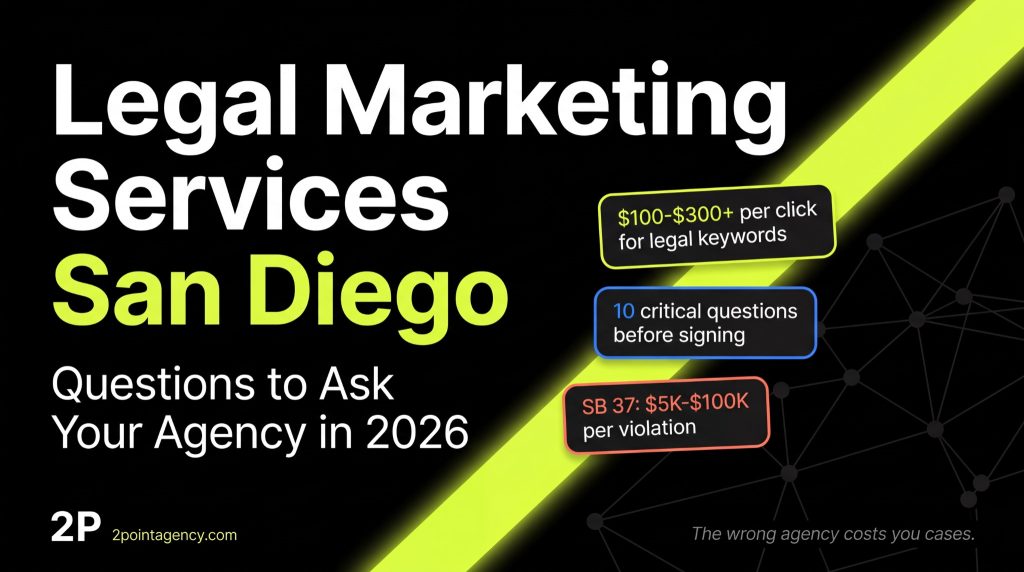
A single click in San Diego's legal market can cost $200 or more.
With every practice area saturated by firms fighting for the same clients, choosing the wrong agency wastes budget and costs you cases.
Legal marketing services in San Diego demand specialized knowledge. Bar advertising compliance, practice area targeting, intake optimization, and keyword landscapes where margins are razor thin require experience that generalist agencies rarely have.
This guide covers the questions to ask before hiring, what San Diego legal marketing services should deliver, and how to spot red flags early. At 2POINT, we build marketing programs for law firms competing in this exact market.
Key Takeaways
- San Diego legal marketing services require specialized knowledge of bar advertising rules, practice area targeting, and competitive keyword landscapes.
- The most important question: does the San Diego law firm marketing agency have direct experience marketing law firms, not just general businesses?
- Core services include local SEO, Google Ads, website design, content marketing, review management, and intake tracking.
- San Diego law firms typically invest $3,000 to $10,000 per month depending on practice area competition.
- A strong legal marketing agency in San Diego measures results in signed cases and consultations booked, not just traffic.
Why Legal Marketing Is Different From General Marketing
Bar Advertising Compliance
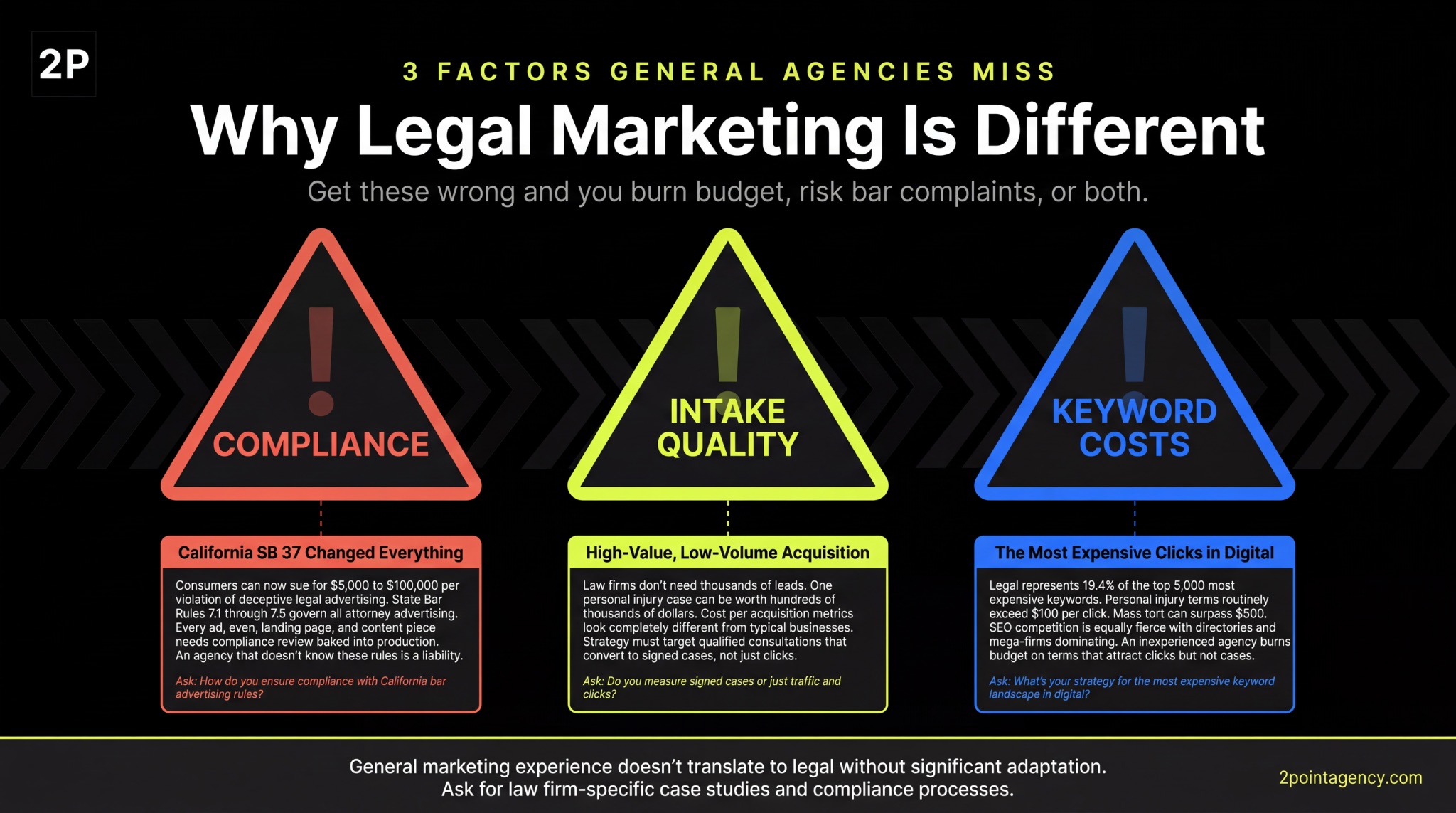
Before you evaluate any agency's SEO or ad strategy, you need to know they understand compliance. California's SB 37, signed into law in October 2025, reshaped attorney marketing rules that every San Diego firm needs to take seriously.
As detailed in Walker Advertising's analysis of SB 37, consumers can now file complaints and pursue civil lawsuits with statutory damages of $5,000 to $100,000 per violation for deceptive legal advertising.
That changes the stakes considerably. An agency unfamiliar with California State Bar Rules 7.1 through 7.5 can create ads, content, or website copy that puts your firm at risk of bar complaints or civil liability.
Compliance awareness has to be woven into every piece of content, every ad, and every landing page from the start, not treated as an afterthought.
High-Value, Low-Volume Client Acquisition
With compliance covered, the next thing to evaluate is how your agency thinks about lead quality. Law firms don’t need thousands of leads.
You need a steady stream of qualified consultations that convert to signed cases.
Consider the math. A single personal injury case can be worth hundreds of thousands of dollars, which means your cost per acquisition looks completely different from a typical e-commerce or SaaS business.
San Diego legal marketing services should be built around intake quality and case value, not just traffic volume. If your agency is optimizing for clicks instead of consultations, they're solving the wrong problem.
Competitive Keyword Landscape
Understanding compliance is essential, but you also need to grasp how expensive this market really is. Legal keywords are among the costliest in Google Ads.
According to FraudBlocker's analysis of the most expensive keywords in 2026, the legal industry represents 19.4% of the top 5,000 most expensive search terms, with personal injury keywords routinely eAxceeding $100 per click and some mass tort terms surpassing $500.
Organic competition in San Diego is equally fierce, with large firms and legal directories holding top positions. An agency without direct legal marketing experience will burn through your budget fast, bidding on the wrong terms and targeting keywords that attract clicks but not cases.
Core Legal Marketing Services San Diego Firms Need
Local SEO for Law Firms
With keyword costs this high, organic visibility becomes even more valuable. Here's what your agency should be executing:
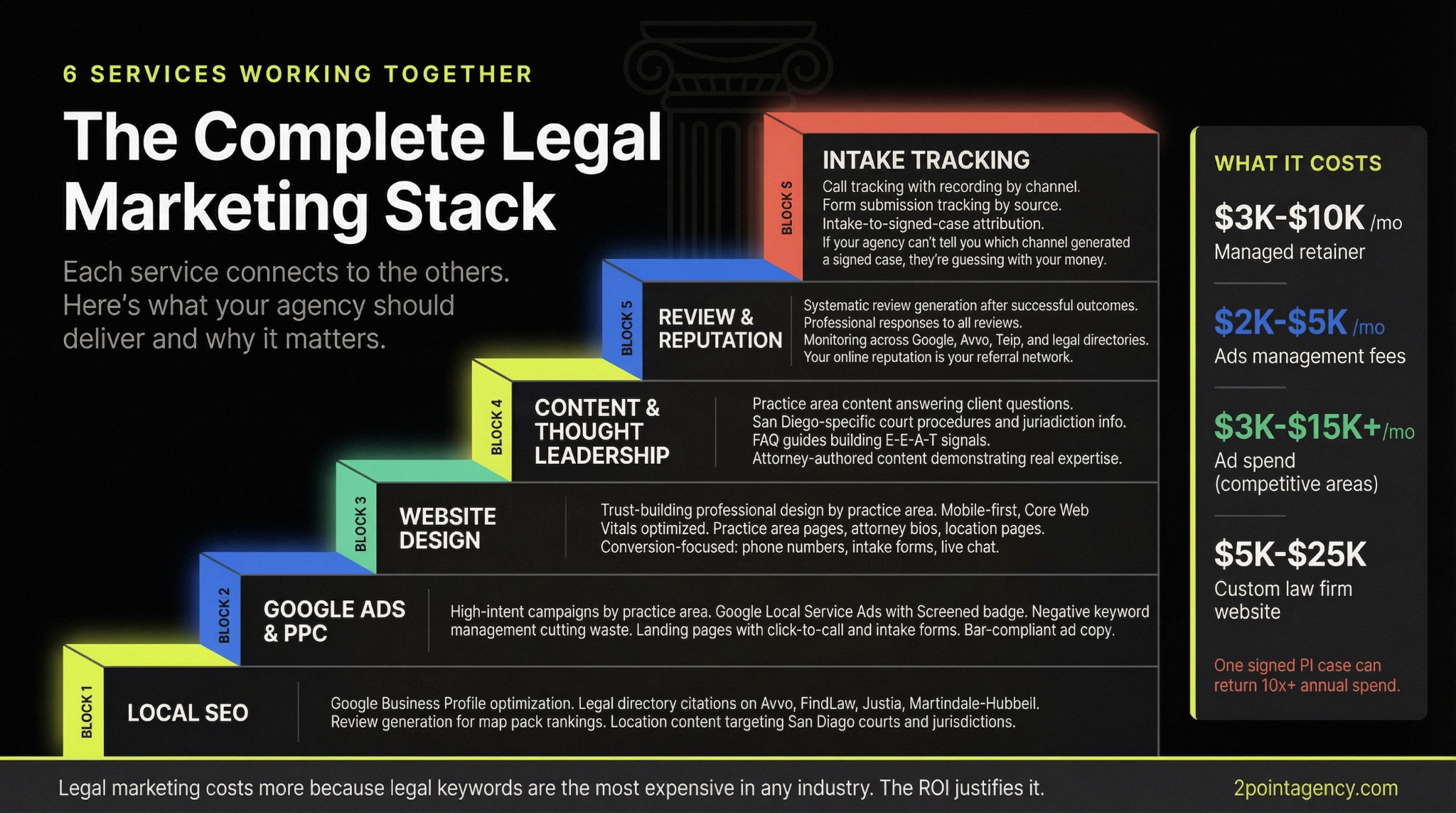
- Google Business Profile optimization with accurate practice area categories and service areas.
- Citation building on legal directories like Avvo, FindLaw, Justia, and Martindale-Hubbell.
- Review generation to build social proof and improve map pack rankings.
- Location-specific content targeting San Diego neighborhoods, courts, and jurisdictions.
Local SEO for law firms works differently than standard local SEO because map pack results are dominated by directories. Understanding how local SEO differs from enterprise and eCommerce helps you set realistic expectations.
Google Ads and PPC for Law Firms
Organic rankings take time to build, so paid search fills the gap while your SEO gains traction.
However, with legal CPCs among the highest of any industry, your campaigns need to be precise. Every dollar you spend should target high-intent keywords by practice area, with tight negative keyword management filtering out non-converting searches.
Your agency should be delivering:
- Google Local Service Ads with the Google Screened badge for qualified firms.
- Careful bid management and ad copy that complies with bar advertising rules.
- Landing pages with clear calls to action, click-to-call, and intake forms.
The same PPC advertising strategies that drive qualified leads in other industries apply here, but with tighter compliance requirements and far higher stakes per click.
Website Design for Law Firms
Your ads and SEO drive traffic, but your website is where that traffic either converts or bounces. It's the digital front door of your firm, and it needs to build trust immediately.
That means professional design that reflects your brand and practice areas, with mobile-first, fast-loading pages optimized for Core Web Vitals.
Beyond aesthetics, your site should include dedicated practice area pages, attorney bios, and location pages. Prominent phone numbers, intake forms, and live chat integration need to make contacting your firm completely frictionless.
Sites built with engaging animations and conversion-focused design consistently outperform static templates when it comes to building credibility and turning visitors into consultations.
Content Marketing and Thought Leadership
A well-designed website gives visitors a reason to stay.
But content is what gives them a reason to find you in the first place. Practice area pages that answer common client questions help you target informational keywords while building the E-E-A-T signals Google rewards.
To stand out locally, focus on San Diego-specific legal topics, court procedures, and jurisdiction-specific information that position your firm as the go-to authority.
Attorney-authored content carries the most weight because it demonstrates real legal expertise, which is exactly the kind of experience signal that a strong content marketing strategy depends on to drive visibility and build trust before a prospect ever picks up the phone.
Review Management and Reputation
Content builds your authority online, but reviews are what seal the decision. Most prospective clients read them before ever calling your office.
Your agency should implement systematic review generation after successful outcomes, professional responses to every review including negative ones, and monitoring across Google, Avvo, Yelp, and legal directories.
This matters because reviews directly influence your map pack rankings and how prospects evaluate your firm. In 2026, your online reputation is effectively your referral network.
Intake Tracking and Attribution
Reviews build trust, but you also need to know exactly which marketing efforts are driving real cases. That requires call tracking with recording, form submission tracking tied to source and campaign, and intake-to-signed-case attribution that connects your spend to actual revenue.
This is non-negotiable. If your legal marketing agency in San Diego can't tell you which channel generated a signed case, they're guessing with your money.
10 Questions to Ask Before Hiring a Legal Marketing Agency
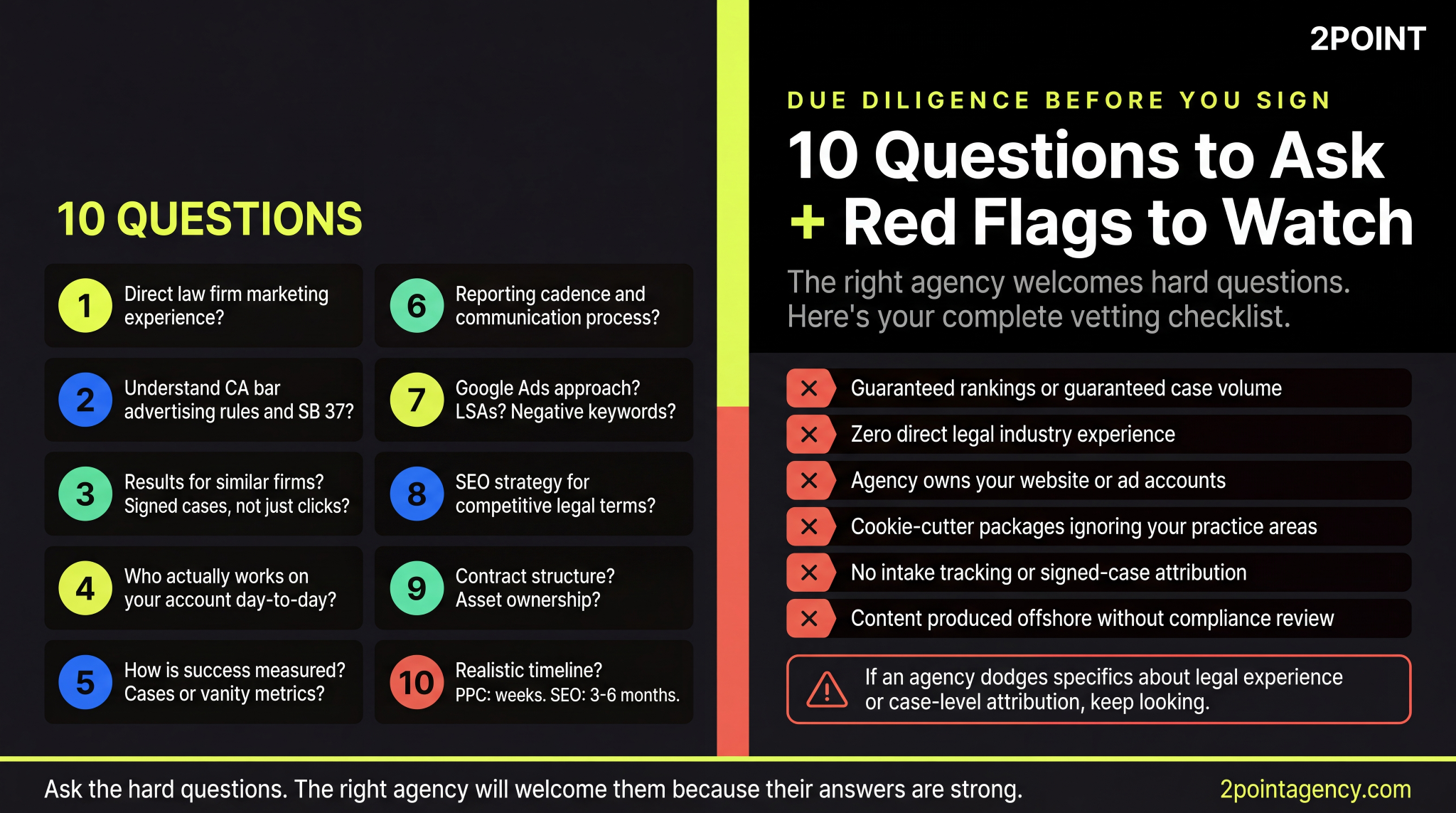
Do You Have Direct Experience Marketing Law Firms?
Ask for specific law firm clients they've worked with, ideally in your practice area.
General marketing experience doesn't translate to the legal vertical. When vetting San Diego legal marketing services providers, direct law firm experience is what separates credible partners from agencies guessing with your budget.
Do You Understand Bar Advertising Rules?
Beyond experience, you need to know how they handle compliance. Ask how they ensure every ad, content piece, and landing page aligns with California State Bar Rules 7.1 through 7.5 and SB 37. A credible agency will reference specific rules and have a review process built into production.
What Results Have You Delivered for Similar Firms?
Compliance knowledge is important, but results prove capability. Ask for anonymized case studies showing signed cases, consultations booked, and cost per intake. Agencies that can only show you impressions and clicks don't understand law firm marketing in San Diego.
Who Will Actually Work on My Account?
Strong results on paper mean nothing if the wrong people execute your campaigns. Ask who the day-to-day team members are and whether work stays in-house or gets outsourced. Strong sales teams don't guarantee strong execution, so push past the pitch.
How Do You Measure Success?
The answer should tie directly to business outcomes: signed cases, consultations, cost per acquisition, and organic visibility. Be skeptical of any agency measuring success only by rankings or traffic without connecting it to your intake pipeline.
What Is Your Reporting and Communication Process?
Expect monthly reporting at minimum with a dedicated account manager. Ask what reports include and how often you'll meet to review performance. If the answer is vague, that's a red flag.
How Do You Handle Google Ads for Legal?
Ask about bid management, negative keywords, ad copy compliance, and whether they have experience with Google Local Service Ads and the Google Screened badge. Legal PPC requires precision that general ad managers rarely have.
What Is Your SEO Strategy for Competitive Legal Keywords?
Ask how they plan to compete for terms like "San Diego personal injury lawyer" when large firms and directories hold the top spots. Look for answers involving long-tail targeting, topical authority through content clusters, and technical SEO foundations.
What Is the Contract Structure?
Ask about contract length, cancellation terms, and asset ownership. You should own your website, Google Ads account, and all content produced. Walk away from any agency that holds your digital assets hostage.
How Long Before I See Results?
A credible agency will tell you PPC generates leads within weeks while SEO takes 3 to 6 months for traction. Be cautious of anyone promising page-one rankings within 30 days or guaranteed case volume.
What Legal Marketing Should Cost in San Diego
Typical Pricing Ranges
Knowing the right questions helps you evaluate agencies, but you also need to know what San Diego legal marketing services typically cost:
- Monthly retainers: $3,000 to $10,000 depending on practice area competition and scope.
- Google Ads: $2,000 to $5,000 in management fees plus $3,000 to $15,000+ in monthly ad spend.
- Website design: $5,000 to $25,000 for a custom law firm site.
Why Legal Marketing Costs More
Those prices may seem steep compared to other industries, but there's a reason.
Legal keywords are the most expensive in Google Ads, content requires compliance review, and the competitive landscape demands higher quality strategy. San Diego legal marketing services reflect those realities.
The ROI justifies it though: one signed personal injury case can return 10x your annual marketing spend.
Red Flags When Evaluating Legal Marketing Agencies
Knowing what to pay is one thing. Knowing what to avoid is equally important. If you spot any of these during your evaluation of a San Diego law firm marketing agency, walk away:
- Guaranteed rankings or case volume with no caveats.
- Zero legal industry experience.
- They own your website or ad accounts instead of you.
- Cookie-cutter packages ignoring your practice areas.
- No intake or signed-case tracking.
- Content produced offshore without compliance review.
How 2POINT Serves San Diego Law Firms
At 2POINT, we build marketing programs for law firms competing in San Diego's demanding legal market. Every engagement starts with a comprehensive audit covering your digital presence, competitive landscape, and intake funnel before we recommend anything.
From there, custom strategies are built around your specific practice areas, target client profiles, and local market realities. Our San Diego legal marketing services span local SEO, Google Ads, website design, content marketing, and intake attribution, all under one coordinated team with dedicated account management.
The full-service approach we take ensures every channel reinforces the others, so your marketing compounds instead of operating in silos.
Explore our marketing services to see how we structure engagements for San Diego law firms.
Is Your Agency Asking the Right Questions About Your Firm?

San Diego legal marketing services require a partner who understands compliance, high-value intake funnels, and competitive keyword realities.
The agency you choose directly impacts the cases your firm signs.
Ask the hard questions before committing. If an agency dodges specifics about legal experience or case-level attribution, keep looking. Get in touch with 2POINT and we'll show you what a legal marketing partner should look like.
FAQs About Legal Marketing Services
What are legal marketing services?
Legal marketing services are specialized digital marketing programs built for law firms. They include SEO, PPC, web design, content, and intake tracking, all tailored to bar compliance and the high-value client acquisition that San Diego legal marketing services demand.
How much should a San Diego law firm spend on marketing?
Law firm marketing in San Diego typically runs $3,000 to $10,000 monthly for managed services. Competitive practice areas require additional Google Ads spend of $3,000 to $15,000 per month depending on your keyword landscape.
How long does it take for law firm SEO to work?
Law firm SEO in San Diego typically shows initial traction within three to six months. Competitive practice area keywords may take longer to crack. PPC delivers leads within weeks while your organic visibility builds alongside it.
What is the most effective marketing channel for law firms?
Google Ads drives immediate leads while SEO builds long-term visibility. The most effective legal marketing services in San Diego combine both so paid covers short-term gaps while organic compounds over time into your strongest channel.
Should I hire a legal-specific marketing agency or a general agency?
Always choose a San Diego law firm marketing agency with direct legal experience. Bar compliance, high-value intake funnels, and competitive keyword costs require specialized knowledge that general agencies rarely have when entering the legal vertical.
How do I measure ROI on legal marketing?
Track signed cases and consultations from each channel using call tracking and intake attribution. A strong attorney marketing partner in San Diego ties every dollar you spend to measurable business outcomes, not vanity metrics like impressions.