let’s connect


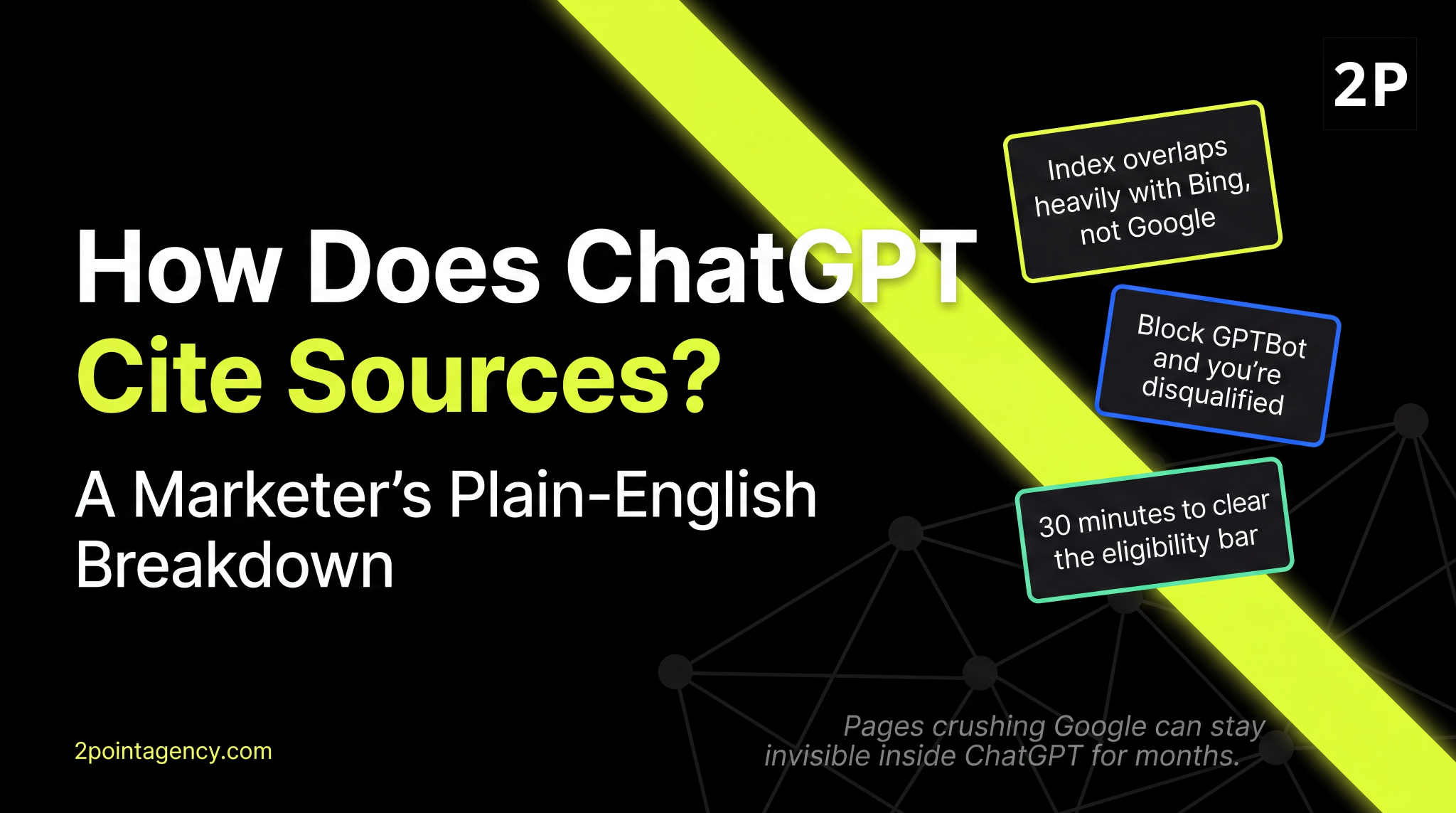
Most marketers assume ChatGPT cites sources the way Google ranks them. It doesn’t. The mechanics are different enough that pages crushing it on Google can stay completely invisible inside ChatGPT for months.
So how does ChatGPT cite sources? In short, it pulls candidate pages from its search index, ranks them by authority, structure, freshness, and topical match, then summarizes the strongest ones with inline citations linking back to the original source.
2POINT helps brands consistently earn ChatGPT citations. This is the marketer-friendly breakdown behind that work, not a code-level walkthrough.
TL;DR / Direct Answer
ChatGPT cites sources by retrieving relevant pages from its search index, ranking them by authority, topical match, freshness, and structure, then summarizing the top sources with inline citations in the response.
You see this most clearly in ChatGPT search (browse mode), where each response shows numbered references linking back to the source URLs. So for your team, citation eligibility is now a measurable layer of organic visibility, not a vanity metric.
How ChatGPT Cites Sources in 4 Stages
Stage 1: Query Understanding
First, ChatGPT parses your user’s question and decides whether to answer from base-model knowledge, search the web for current sources, or do both. Conversational queries with a clear time component (anything mentioning 2026, “right now,” or recent events) almost always trigger search.
So, for how ChatGPT picks sources, the trigger condition matters as much as the query itself.
Background or definitional queries often run on the base model alone, which means your visibility there depends entirely on training cycles, not real-time retrieval.
Stage 2: Retrieval from the Index
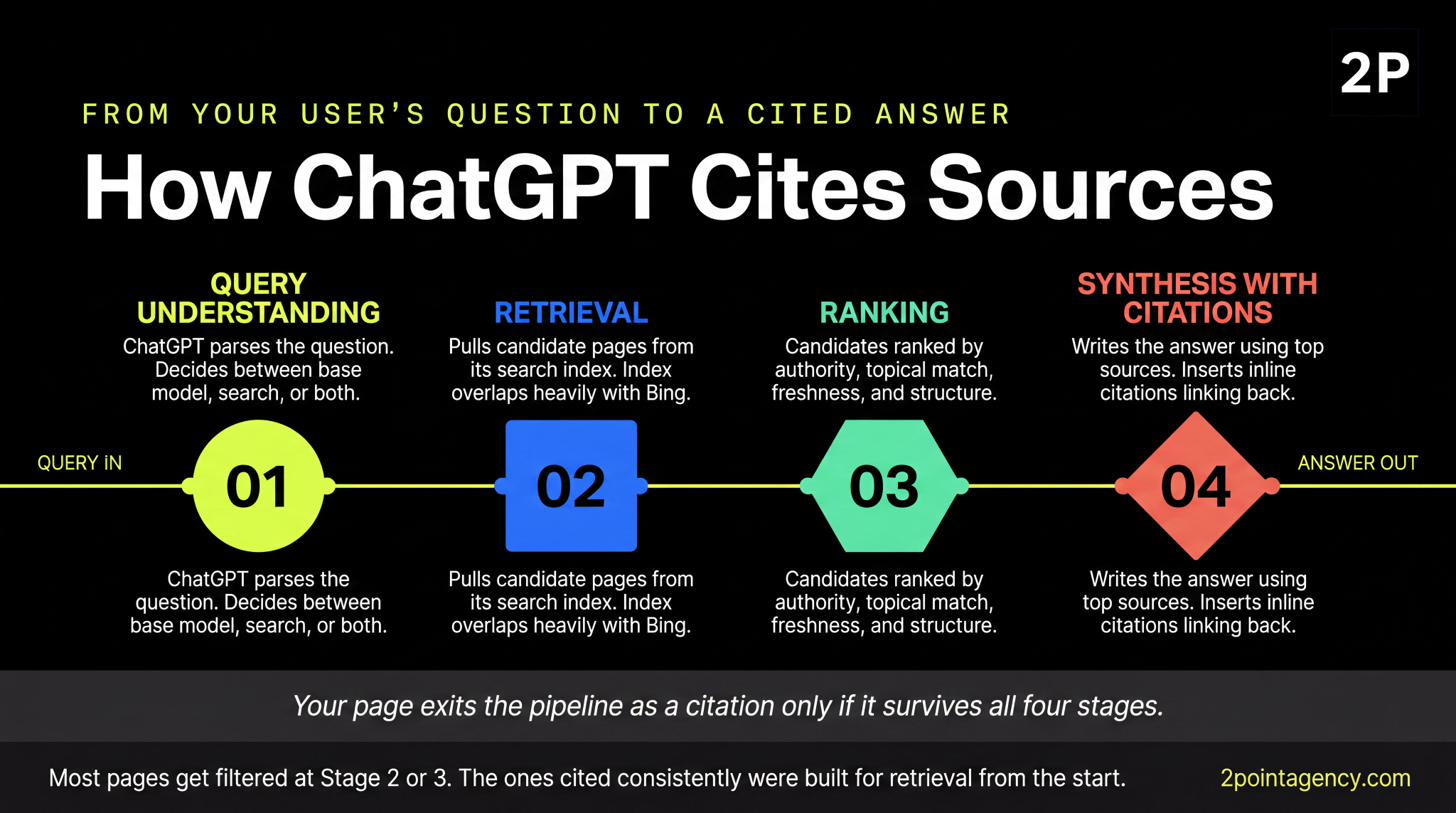
Once the search is invoked, ChatGPT pulls candidate pages from its search index.
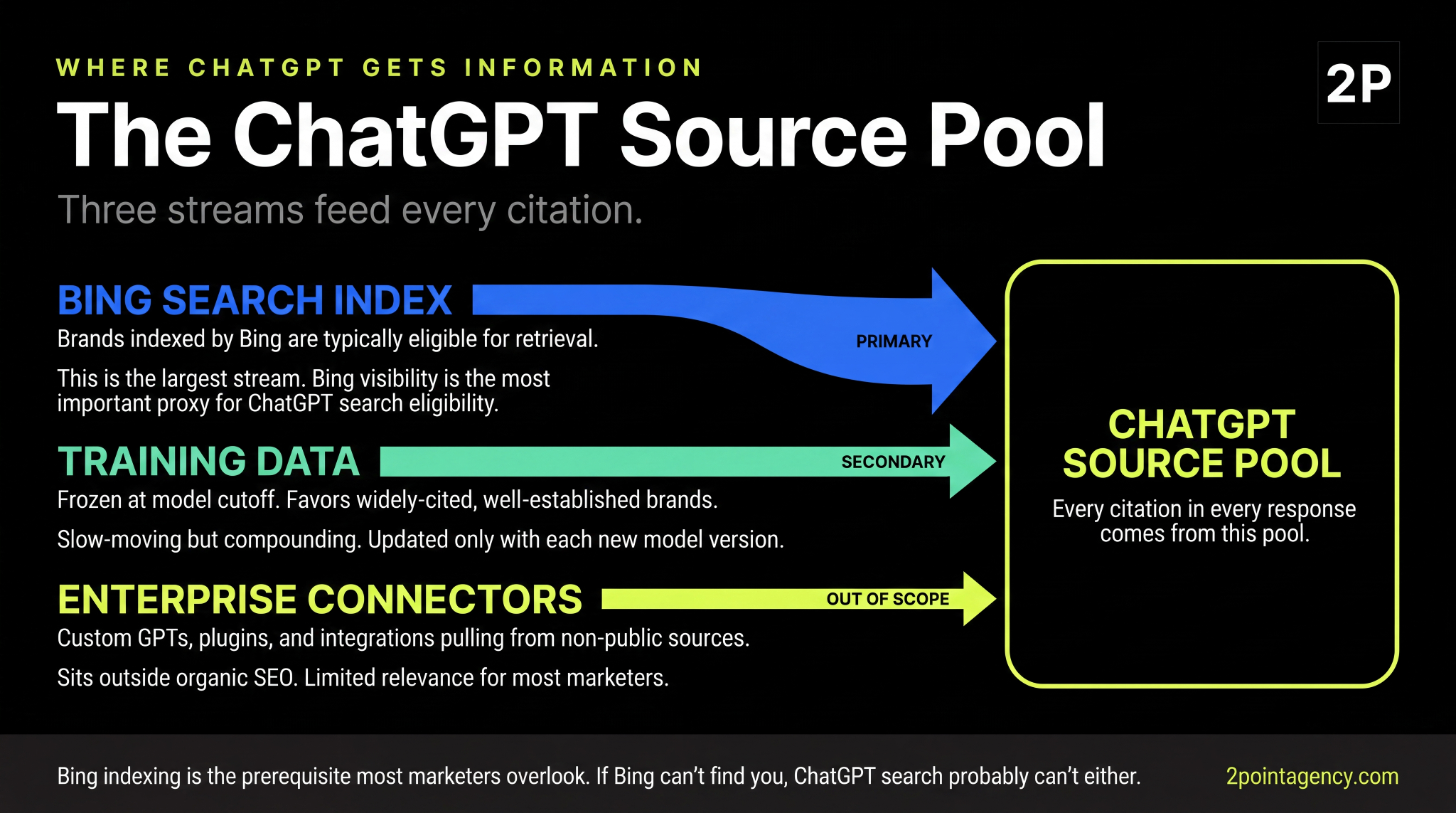
The index is broader than just live web crawling and overlaps significantly with Bing’s, so brands indexed by Bing tend to be eligible for retrieval.
That makes Bing indexing the prerequisite most marketers overlook. Where ChatGPT gets information for any given query depends heavily on how cleanly your pages sit inside that source pool.
Stage 3: Ranking the Candidates
Next, candidate pages are ranked by signals such as authority, topical match, freshness, structure, and machine accessibility. Pages with strong on-page structure and credible authorship rank higher in the ChatGPT source ranking.
Pages without those signals stay in the candidate pool but rarely make it into the response.
So this is where most of the visible ChatGPT source selection outcome gets decided. If your page isn’t built for retrieval, ranking is where it loses out on citations.
Stage 4: Synthesis with Citations
Finally, ChatGPT writes the answer using the top sources and inserts inline citations linking back to those pages.
According to OpenAI’s announcement, responses now include links to sources like news articles and blog posts, so users can dig deeper if they want. That synthesis step is where your ChatGPT search citations actually become visible to your audience.
Get cited here, and you’ve earned the impression even when there’s no click.
The Two ChatGPT Modes That Matter for Citations
Base Model Mode
In base model mode, ChatGPT responds solely from training data, which is constrained by a fixed knowledge cutoff. Citations are uncommon here, and any brand mentions usually reflect how widely a name appeared during training.
So you influence base-model output through long-term entity work, consistent third-party mentions, and authoritative coverage that gets indexed before each model refresh.
The slow-moving nature of this surface is exactly why it compounds.
Search / Browse Mode
In search and browse mode, ChatGPT fetches and synthesizes live or recently indexed sources, with explicit, clickable citations.
This is the mode that matters most for SEO, since every ChatGPT browse mode citations opportunity is a chance to be seen, clicked, or referenced downstream.
So tracking these citations gives you a far cleaner read on visibility than tracking base-model mentions alone. Search runs by default for most logged-in users, though free-tier behavior shifts as OpenAI adjusts its rollout.
The 5 Things ChatGPT Looks For When Citing
So, how do you actually get picked? How ChatGPT picks sources comes down to five signals working together. None of them stands alone, but every one is fixable. Treat the list below as the checklist any senior SEO would run, layered with ChatGPT source selection rules on top.
1. Authority and Trust
Start with authority. Established brand domains, citations from high-trust publications, and recognized author entities all push your pages to the top of the candidate pool.
So sites with weak entity footprints rarely earn chatgpt search citations, even when the content itself is strong. ChatGPT inherits trust from sources its training data already references, which means borrowed authority compounds faster than self-claimed expertise.
2. Topical Match
Next, specificity wins. Pages that directly answer your user’s question outperform pages that merely contain the keyword.
That’s why a focused page on “best CRM for 50-person SaaS teams” usually beats a generic CRM overview for the matching prompt. ChatGPT favors precision over breadth, since narrow pages give the model a cleaner answer to pull from.
3. Structure
Then comes format. Clear H2 and H3 hierarchy, TL;DR blocks, FAQ schema, and definition sentences let ChatGPT lift answers cleanly from your page. Otherwise, pages without those structural cues force the model to summarize on the fly. Which usually means it picks a cleaner page from a competitor instead.
4. Freshness
Freshness comes next. Recent date stamps and “Last Updated” signals matter for time-sensitive queries, especially in fast-moving categories where buyers expect current data.
That’s how stale pages with outdated stats lose ground every quarter. Refresh your numbers and dates, and you stay eligible. Skip that maintenance, and competitors with newer pages quietly take your spot.
5. Machine Accessibility
Last comes the technical layer. GPTBot must be allowed in robots.txt, schema markup must be present, and an llms.txt file at the root of your domain helps the model find your priority assets.
Block GPTBot, and you’re ineligible for ChatGPT citations entirely. The setup takes about 30 minutes once your hub pages are mapped, which makes machine accessibility the cheapest signal to fix on this list.
Where ChatGPT Pulls Sources From
Where ChatGPT gets information depends on which surface the query is triggered on. ChatGPT’s search index overlaps heavily with Bing’s, so brands indexed by Bing are typically eligible for retrieval.
But ChatGPT also pulls from two other pools you should know:
- Training-time data: Favors widely cited, well-established brands baked into the model during training cycles.
- Enterprise connectors: Custom GPTs, plugins, and integrations pull from non-public sources, which sit outside organic SEO.
So newer brands typically compete by using ChatGPT search citations first, since they haven’t had time to build a base model memory.
How Citations Appear in ChatGPT Responses
Inline Numbered Citations
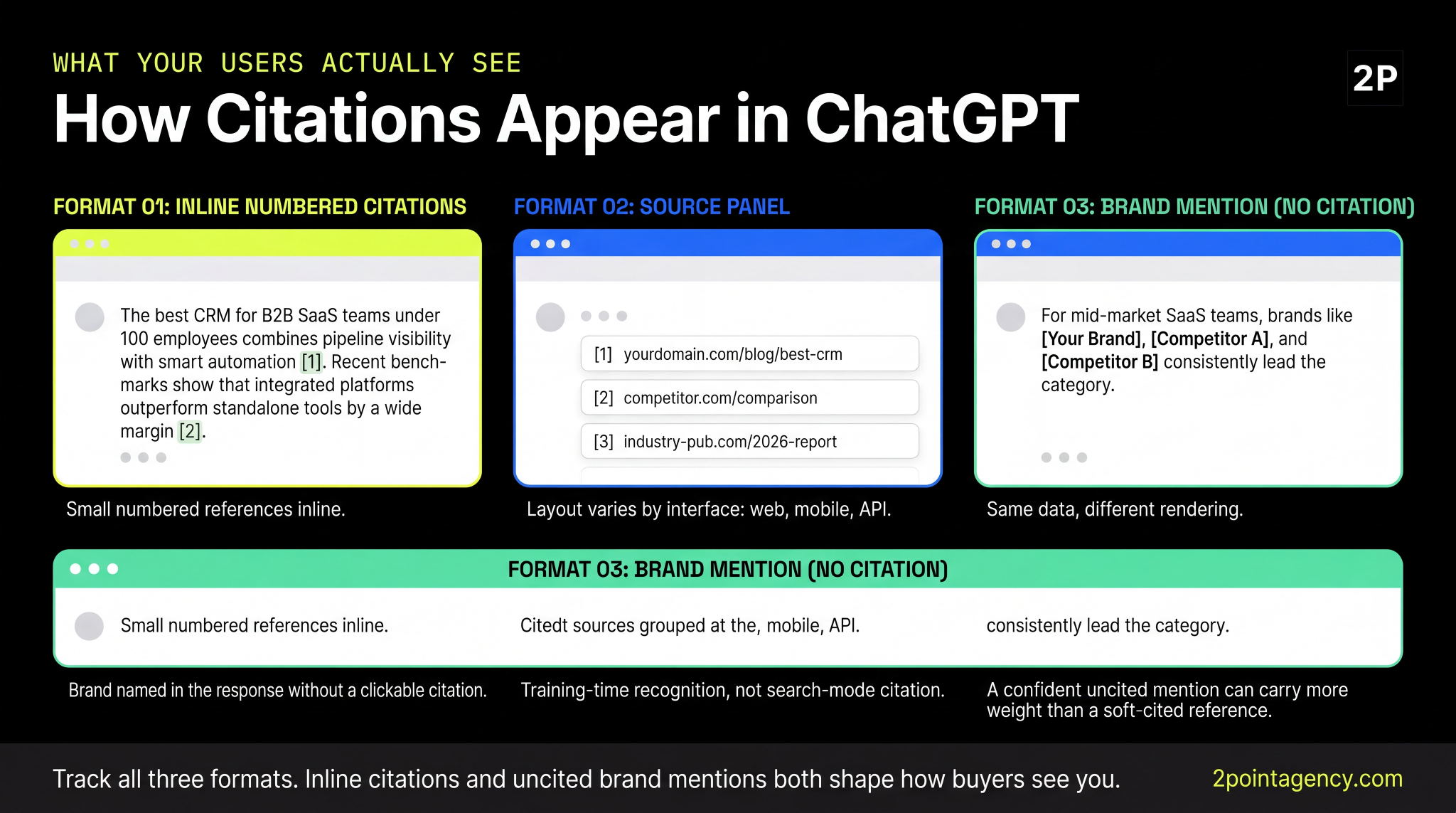
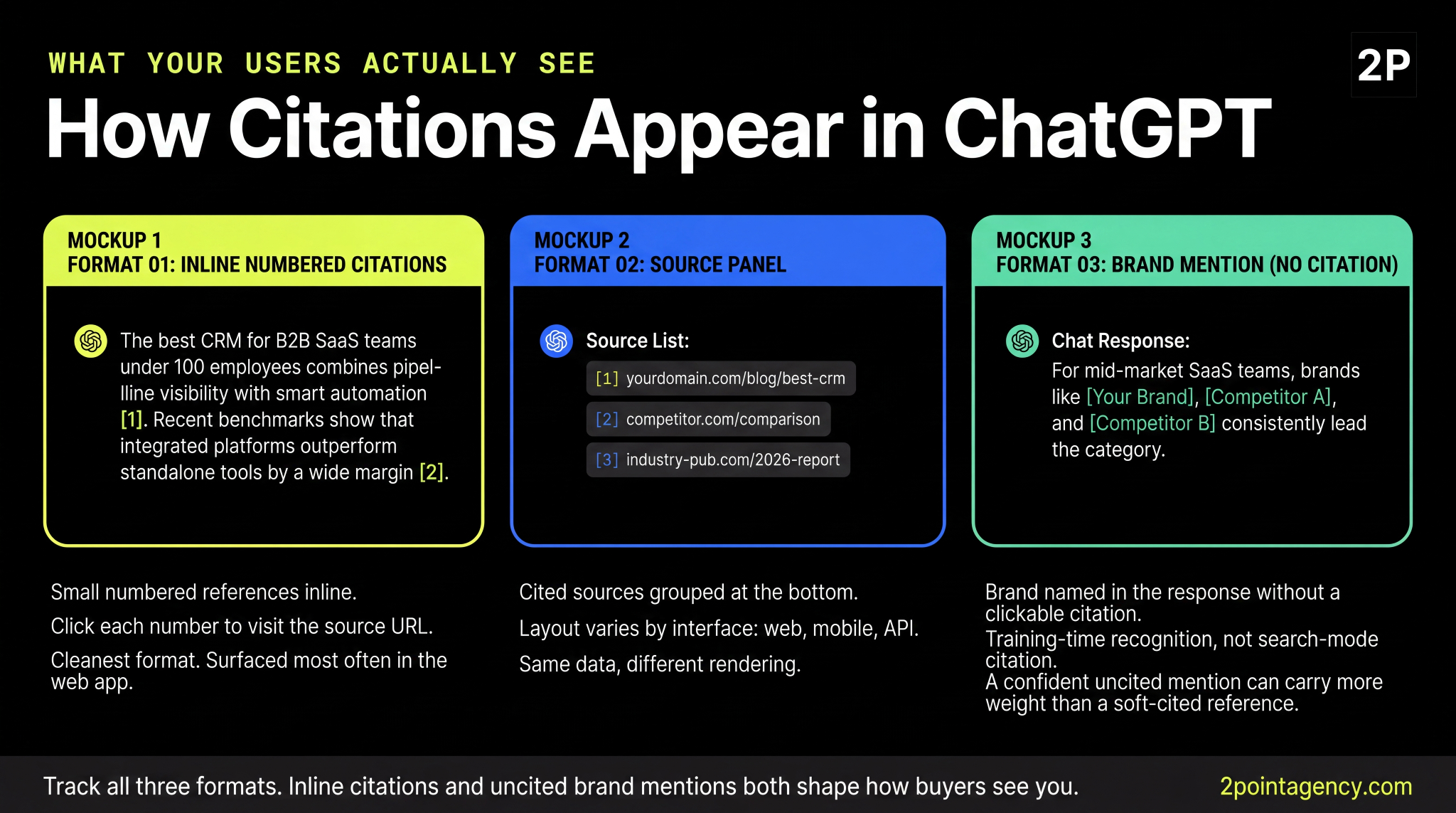
These are the citations you’ll see most often. Small numbered references appear inline (for example, [1], [2]) and link directly to the source URL.
The web app surfaces these the cleanest, since the numbered format gives readers a one-click path to verify the claim. Track these as your primary citation signal in any browse-mode audit.
Citation Cards / Source Lists
The second format is the source panel. ChatGPT sometimes groups cited sources into cards or a list that sits below the response, and the layout varies depending on whether you’re on web, mobile, or pulling responses through the API.
Underneath, though, the data is identical across all three. Only the rendering changes, so don’t read too much into one format showing more sources than another.
Brand Mentions Without Citations
The third surface is the trickiest. ChatGPT sometimes names your brand without citing it.
When that happens, you’re seeing training-time recognition rather than search-mode citation.
That’s a different signal entirely. The model is pulling your name from training data, which usually means widespread coverage long before the query landed.
A confident, uncited mention can actually carry more weight than a soft-cited reference.
Why Some Sites Get Cited More Than Others
Citation frequency comes down to four signals working in combination. Once you understand how ChatGPT picks sources, the editorial decisions stop feeling abstract:
- Authority dominates: Strong domain trust signals get cited across virtually every query, and the gap compounds quarterly.
- Structure compounds: TL;DR blocks, FAQ schema, and definition sentences let the model lift your text cleanly.
- Topical depth wins niches: Pillar-and-cluster coverage earns ChatGPT citations for long-tail queries even with lower authority.
- Recency matters: “Last Updated” signals push fresh pages above older competitors.
So ChatGPT source ranking rewards combinations, not single signals.
How to Make Your Site Citation-Eligible (4-Step Quickstart)
Four moves you can ship in your next sprint to clear the citation eligibility bar:
- Step 1: Confirm GPTBot is allowed in robots.txt. A block-by-default rule disqualifies you from every ChatGPT search citations opportunity, so this is non-negotiable.
- Step 2: Add TL;DR blocks and FAQ schema to your top 5 commercial pages. Aim for 40 to 60 words in each TL;DR, since that range matches what ChatGPT actually lifts as standalone answers.
- Step 3: Add Article, Person, and Organization schema across your editorial pages. Validate with the Schema Markup Validator before publishing, so a CMS quirk doesn’t quietly break your markup.
- Step 4: Publish llms.txt at your domain root. Curate it down to your most authoritative pages, which gives the model a clean map of what you want surfaced.
The four moves above clear the eligibility bar. Beyond that, sustained citation growth comes from deeper ChatGPT SEO work on entity strength and earned media, while broader LLM SEO layers add Gemini and Perplexity as separate but related citation surfaces.
Common Misconceptions About ChatGPT Citations
Misconception 1: ChatGPT Just Uses Wikipedia
Wikipedia gets cited heavily, which makes it easy to assume it’s the whole index. It isn’t.
ChatGPT pulls from a broad source pool that includes industry sites, publishers, niche newsletters, and developer documentation.
So treating Wikipedia as the only target leaves most of your earned-media value on the table, especially in B2B niches where the citation pool skews toward specialized publications that most marketers underweight.
Misconception 2: If I’m Not in Google, I’m Not in ChatGPT
This one trips up most SEO teams. ChatGPT’s search index overlaps more with Bing than with Google, so Bing visibility is a stronger proxy for ChatGPT search eligibility than Google rank alone.
That changes the work. Bing is back to being a first-class signal worth checking before you assume your Google ranking covers the AI surfaces, too.
Misconception 3: Citations Convert to Traffic 1:1
Many citations don’t drive an immediate click. That doesn’t mean they’re worthless.
A buyer who sees you cited in a ChatGPT answer carries that recall into a later Google search or a direct visit, which compounds brand exposure, even when your traffic dashboard stays flat.
So track citation share alongside traffic, since one without the other gives you half the picture.
ChatGPT vs Other AI Tools: Citation Differences
Citation behavior varies by platform, and the differences matter when you’re sequencing your optimization work.
| Platform | Source Pool | Citation Threshold | Behavior |
| Perplexity | Broadest of the four | Lowest threshold | Heavy inline citations, multiple sources per answer by default |
| Google AI Overviews | Google’s organic search | Tied to existing rankings | Favors pages already ranking in traditional SERPs |
| Gemini | Google search-integrated | Similar to AI Overviews | Tighter consumer focus, citation behavior overlaps with AI Overviews |
| ChatGPT | Search index plus training data | Mid-range, more selective than Perplexity | More curated than Perplexity, broader than AI Overviews |
Optimizing across all four isn’t usually a separate program. The ChatGPT source selection signals that earn you citations here also lift your visibility on Perplexity and Google AI Overviews, so the work compounds across surfaces rather than competing for budget.
Mini Glossary of Related Terms
A few terms worth knowing as you sharpen your ChatGPT source ranking work:
- GPTBot: OpenAI’s web crawler, which you control through your robots.txt file.
- RAG (Retrieval-Augmented Generation): The retrieve-then-summarize pattern ChatGPT uses to ground answers in real sources.
- Browse mode: ChatGPT’s search-enabled mode that fetches live sources at query time, where most of your ChatGPT browse mode citations show up.
- Citation card: The displayed source reference is inside or after a ChatGPT response.
- Source pool: The full set of pages ChatGPT can retrieve, primarily its search index and training data.
So bookmark these. They appear in most ChatGPT citation conversations, and knowing the difference saves time when teams use them interchangeably.
Bringing It All Together
So how does ChatGPT cite sources? It retrieves, ranks, and synthesizes the strongest pages from its search index, then surfaces those sources with inline citations. Citation eligibility comes down to structure, authority, machine accessibility, and topical depth.
None of these levers is exotic. They’re the same fundamentals that have rewarded good content for years, just applied to a new surface.
The deeper ChatGPT SEO framework goes step by step through entity work, schema, and earned media that compound your citation rate over time. Or, if you’d rather have a team run that work for you, our SEO audit maps your gaps end-to-end and ships the fixes in your next sprint.
FAQs
Does ChatGPT cite every source it uses?
No. In search mode, citations appear inline so you can verify the answer. In base-model mode, citations are uncommon since the response comes from training memory.
Brands also get mentioned without explicit citations. So track both surfaces, since uncited mentions and ChatGPT citations both shape how buyers see you.
How often does ChatGPT update its source index?
Search-mode retrieval is near real-time because ChatGPT pulls fresh pages each time a search is triggered. Training data updates with each model version on a months-long cadence.
So new content can appear in ChatGPT browse mode SEO results within days, while base-model recognition waits for the next model refresh and for earned media within it.
Why was my site cited and then later not?
ChatGPT search ranking factors shift constantly.
Competitor updates, your own structural changes, declining freshness signals, or shifts in domain authority can push you in or out of the cited set. So treat citation tracking as a rolling metric. Spot-check your top 20 prompts monthly and pair the data with your changelog.
Can I tell ChatGPT to cite me?
No. There’s no opt-in switch or paid placement. You earn citations through authority, structure, schema, freshness, and GPTBot SEO access, plus references in trusted publications.
The work is editorial and technical, not transactional.
Brands that force placements through over-optimization usually see worse results than brands focused on real ChatGPT search ranking factors.
Where can I see all the sources ChatGPT used in a response?
Cited sources show inline as numbered references and in a source panel after the response on web and desktop.
Mobile and API responses render the same data differently, sometimes collapsing the source list. So if the panel isn’t obvious, hover over each citation number to surface the URL.