FOLLOW US

Last update: Jan 8, 2026 Reading time: 15 Minutes
DIY SEO can work. It can also quietly drain months if you are fixing the wrong things, chasing the wrong keywords, or guessing at technical changes that affect revenue. Before you commit to a path, you need a way to judge what is realistic for your team, what is risky, and what is simply not worth doing alone.
You can keep full control, yet progress still demands consistency and smart prioritization. That’s where many teams stall. The workload expands, technical details stack up, and competition punishes scattered effort.
If you’re searching for how to DIY SEO, you likely want a decision that fits your reality.
This guide gives you a scorecard, clear pros and cons, and an agency vetting checklist. For structured help, 2POINT Agency is a strong reference point.
Most “DIY vs agency” advice stops at “it depends.” This scorecard gives you a practical default based on capacity, complexity, and risk, so you choose a path you can actually sustain and set realistic SEO ROI expectations.
Score each line 0 to 2. Be honest. This is not a personality test; it’s a workload test.
| Criteria | 0 points | 1 point | 2 points |
| Weekly time available | Under 2 hours | 2-4 hours | 5+ hours |
| Comfort making site edits | Not comfortable | Some comfort | Comfortable |
| Site size and complexity | Large or complex | Medium | Small and simple |
| Competitive pressure | High | Medium | Low |
| Risk tolerance | Low | Medium | High |
| Need for speed | High urgency | Moderate | Low urgency |
0 to 4: DIY fundamentals: Keep scope small. Focus on a handful of pages and repeat the same improvements until it feels routine.
5 to 8: Hybrid: Handle brand-led work in-house. Outsource high-risk tasks like deep technical audits, migrations, or advanced troubleshooting.
9 to 12: Agency or specialist support
You’re likely dealing with urgency, complexity, or tough competition. Help prevents wasted effort and keeps priorities tight.
Use this score as your default. If you land on a borderline number, let “risk tolerance” and “need for speed” break the tie.
This is your quick mental map. It helps you choose based on what actually changes the SEO experience: consistency, decision speed, and risk.
| Category | DIY | Hybrid | Pro |
| Time demand | High, because you research, plan, execute, and QA | Medium, you keep brand-led work and delegate specialist tasks | Low internally, you focus on direction, approvals, and context |
| Cost type | Low cash, high time, and opportunity cost | Medium cash, manageable time cost | Higher cash, lower time cost, and fewer detours |
| Control | Highest, but you carry all decisions and follow-through | High, you steer priorities and voice, while specialists handle risk | High at the goal level, plus a team runs execution and QA |
| Execution speed | Fast for simple edits, slow when complexity shows up | Steady, because complex work doesn’t stall the whole plan | Steadiest, clearer process and fewer reversals |
| Quality risk | Highest, especially in technical areas and prioritization | Balanced, risk-heavy work is specialist-led | Lowest with a strong provider and defined standards |
| Mistake cost | Highest, because small errors can affect many pages | Lower, because risky changes get reviewed and tested | Lowest, because QA and process reduce the blast radius |
| Best fit | Only if the site is simple and the stakes are low | Best default for many teams that want control without carrying risk | Best when competition is tough, timelines matter, or the site is complex |
| What you still own | Learning curve, tools, priorities, and consistency | Brand voice, approvals, priorities, internal knowledge | Approvals, access, business context, and keeping goals clear |
Are SEO agencies worth it? They can be, and the decision gets clearer when you look at complexity, risk, and consistency. If your site feels simple and your time is steady, DIY or hybrid can work. When the stakes rise, support often saves you painful detours.
Common triggers that push you toward hiring help:
Even if you plan to hire help, it’s useful to know what DIY does well. These benefits also show what you should keep in-house, so an agency can execute faster without diluting your voice.
You know what matters this quarter, what product lines need attention, and what pages convert when traffic lands. That clarity is a real advantage, because SEO is rarely instant, and the wrong priorities can waste weeks of effort before you notice the drift.
Google also notes that some improvements can show quickly, yet broader effects can take months, so picking the right work early protects your momentum.
Works best when you can review priorities weekly and treat the agency as execution plus QA, not a replacement for direction.
You already have the raw material agencies cannot invent: the words customers use on calls, in reviews, and in objections. When you feed that language into page headings, FAQs, and examples, pages feel obvious, and readers do not have to translate jargon before they trust you.
Plain wording also improves understanding in real-world testing, which is a useful reminder that clarity is not a “nice to have,” it is performance.
Works best when you can share real phrases, common objections, and what “good leads” sound like, so the agency can map that language to search intent.
Speed is not only about publishing quickly. It is also about reducing rework.
When you can approve changes in a tight loop, you help an agency move without stalls, and you avoid the painful cycle where edits sit for weeks, priorities shift, and the same work gets reopened.
Search Console guidance also points out that you do not need to check the data daily, but you should review it around key changes to confirm stability. That matches how good agency work runs: planned edits, clean QA, and a quick review cadence so problems show up early.
Works best when you set a simple review rhythm, log major edits, and give quick feedback on the pages tied to revenue and leads.
Consistency is a quiet trust builder.
When pages speak in one voice, visitors can click around without hitting contradictions, vague claims, or that outsourced tone that makes everything feel generic.
Visual polish and presentation cues shape credibility quickly, and Stanford’s web credibility research shows how often people judge credibility based on design, appearance, and related signals. That makes voice consistency and page structure worth guarding, even when an agency writes the drafts.
Works best when you keep final approval over messaging and give the agency a short voice guide, along with examples of pages that “feel right.”
Doing SEO yourself can work, yet the friction is real. These four cons show where people lose momentum, and where professional support saves you time, stress, and avoidable mistakes.
SEO doesn’t fail because you “lack discipline.” It fails because it gets squeezed between everything else, so you keep reloading context, making tiny edits, and walking away mid-thought. That switching tax is expensive.
Keep your efforts contained with one protected block each week and a strict finish line:
Early progress can feel quiet, and that silence tempts you into random tweaks.
You change several things, forget what changed, and still can’t tell what mattered, so confidence starts wobbling.
Feedback timing matters for learning. Peer-reviewed research on delayed feedback shows that when signals arrive later, accuracy can drop in tasks that require integrating information, which is exactly how SEO can feel when results lag behind edits.
Contain it with a simple tracking habit:
Technical SEO seems harmless until a small change affects your whole site. A template edit can rewrite headings across the site. A robots.txt setting can block key pages. One wrong canonical can point Google at the wrong version, so your strongest page quietly loses its seat.
Redirects create the same kind of ripple. A single bad rule can cause a loop, a chain, or send people to an irrelevant page, and you may not notice until traffic or leads dip.
Contain it by shrinking the blast radius.
You test changes on a small page set, you confirm indexing, canonicals, and redirects, and you only scale after checks pass. You also keep template backups, run a short pre-publish checklist, and log what changed and why, so fixes stay fast if something looks off.
When you’re working on your own site, busywork disguises itself as progress.
You can spend an hour polishing a paragraph, swapping a few keywords, or testing a shiny plugin, and still leave the real blockers untouched. Usually, the issue is intent. The page doesn’t answer the query cleanly, key sections are missing, and internal links don’t guide people to the right next step, even when the ranking factors look fine on paper.
Use a simple decision filter you can apply in seconds. Start by stating the page’s job in one sentence. After that, run three checks:
If one is not, park it and move.

Use this four-step loop to stay informed, set a clear direction, and review agency work without living in the weeds.
Choose one goal that matters right now, so your SEO effort has a clear job. Maybe you want more calls on a core service page, or better-qualified traffic landing on a product category.
Keep the scope tight with one page set, around 3 to 6 pages. That focus makes your brief sharper, and it helps a provider move faster with fewer back-and-forth edits.
Before you touch content, confirm Google can crawl and index the pages you care about.
If access is blocked or signals are messy, even great improvements stay invisible, and you end up solving the wrong problem.
Use Search Console to check indexing, coverage, canonicals, and blocked resources, using Google’s SEO Starter Guide and basic mobile optimization checks as the baseline. If you see warnings you can’t explain in plain language within a minute, hand that piece to a specialist and keep your attention on priorities.
Look at what the page promises in the title and intro, and compare it to what the query actually needs.
When the promise and the answer align, you reduce bounces and give search engines a clear signal.
Tighten titles, headings, sections, and FAQs so the page answers the main question early. Add internal links that guide the reader to the right next step, and use your customer language to keep the copy human while an agency applies standards at scale.
Publish your updates and treat them like a test you can learn from. Existing pages already have history, so improvements show up faster than brand-new URLs that still need to earn trust and visibility.
Keep a simple change log with dates, pages, and what you adjusted.
That way, when Search Console trends move, you can tie movement to specific edits instead of guessing. This loop keeps you focused and turns SEO into a steady habit rather than a burst of effort.
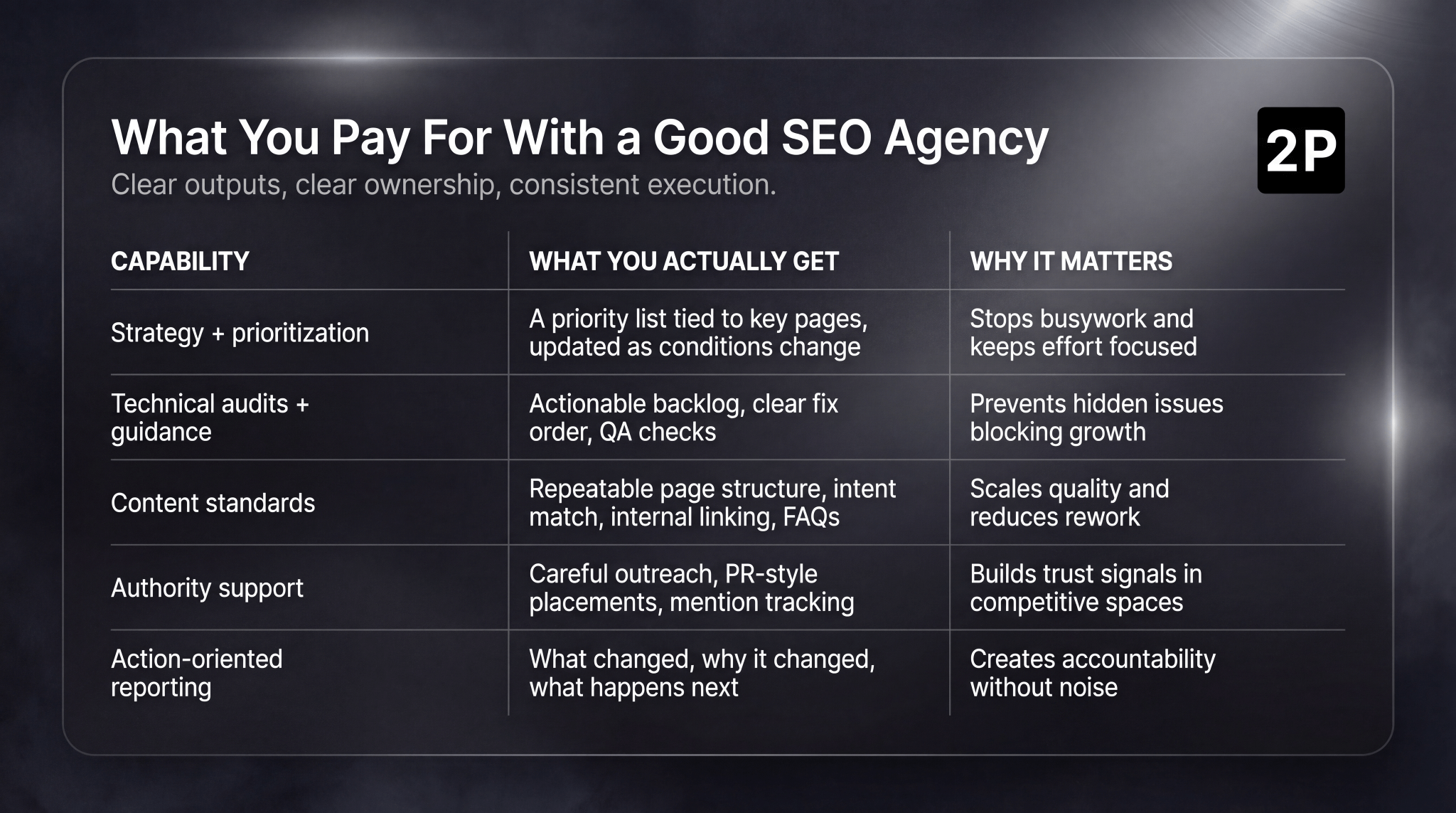
A good agency isn’t a magic button. You’re paying for a structured team that keeps execution consistent and removes blind spots.
| What you pay for | What it looks like in practice | Why it matters |
| Strategy and prioritization | A clear priority list, tied to your key pages and goals, updated as conditions change | Keeps you out of the “busy work” trap and focuses effort on what moves the site forward |
| Technical audits and implementation guidance | A practical audit that turns into a backlog, with clear fixes, owners, and order of operations | Prevents hidden technical issues from undermining content and rankings |
| Content planning plus on-page execution standards | Repeatable standards for titles, headings, page structure, internal links, and FAQs | Creates consistency across pages, improves intent match, and makes updates easier to scale |
| Authority-building support | Thoughtful outreach, PR-style placements, partnership opportunities, and mention tracking | Helps competitive pages earn trust signals without relying on shortcuts |
| Transparent, action-oriented reporting | A summary of what changed, why it changed, what happened, and what happens next | Helps competitive pages earn trust signals without relying on shortcuts |
Good deliverables feel concrete, repeatable, and easy to verify, because you can see the work, not just hear about it.
Use this list during calls to compare agencies on substance, not buzzwords.
Hybrid works because it splits SEO along a clean line: keep the work that needs your voice and context, and outsource the work where mistakes cost more. You stay in control of priorities and messaging, while a specialist handles the technical depth and risk.

If you stopped doing SEO on your own, you would have more time to run the business, and your SEO work would become more consistent.
You would still set direction, yet you would not have to carry every decision, every fix, and every round of updates on your own. That shift matters most when competition is tight or your site has technical risk.
Use your scorecard and tables to choose the level of help that fits.
For many teams, hybrid is the cleanest move: you keep the brand voice, approvals, and page priorities, while a specialist handles audits, technical fixes, and higher-stakes work.
If you want support that stays structured and practical, 2POINT Agency can help you map priorities, tighten execution, and keep deliverables clear without the fluff.
A few hours a week can still move the needle if you pick one outcome and keep the scope tight, like improving 3 to 6 key pages. Update what already gets impressions, improve headings and internal links, and log edits so you can repeat what works.
Learn the basics of indexing and how to match intent on a page. Build a simple checklist for titles, headings, FAQs, and internal links. Keep a change log to spot patterns.
If your site is competitive or technical, or if you can’t maintain weekly momentum, support can be worth it. It’s a strong fit when they show clear deliverables, you retain access, and their prioritization method is easy to follow.
Keep anything that needs your voice and business context in-house: offers, positioning, approvals, and final edits. Own internal linking and page updates to keep changes accurate. Outsource high-risk technical work, such as migrations, structured data, and complex fixes.

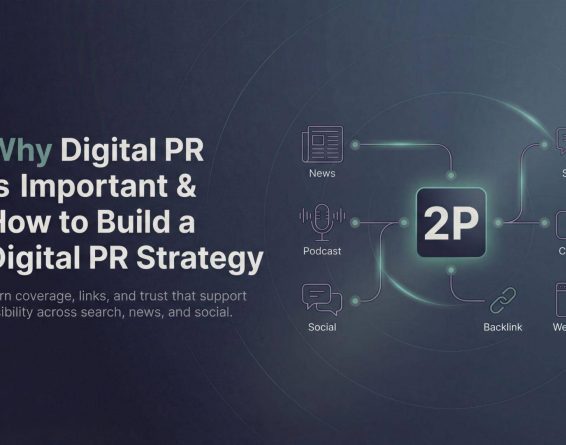
Traditional PR and SEO no longer live in separate rooms. Your audience discovers and decides in public: search, social, newsletters, podcasts, and niche communities. Your site can claim credibility, yet trust grows faster when other voices echo it.
Your SEO tech stack keeps growing, but the story your data tells still feels messy. GA4 shows sessions and events. Search Console shows queries and impressions. Your CRM shows leads, but not always the path that created them.
Backlinks seem simple until you try to deliberately replicate results. One strong link lands, rankings shift, and a pattern starts to show. The link helped because it fit the context, was on a page that already mattered, and pointed to something worth citing.

 let’s connect