

 let’s connect


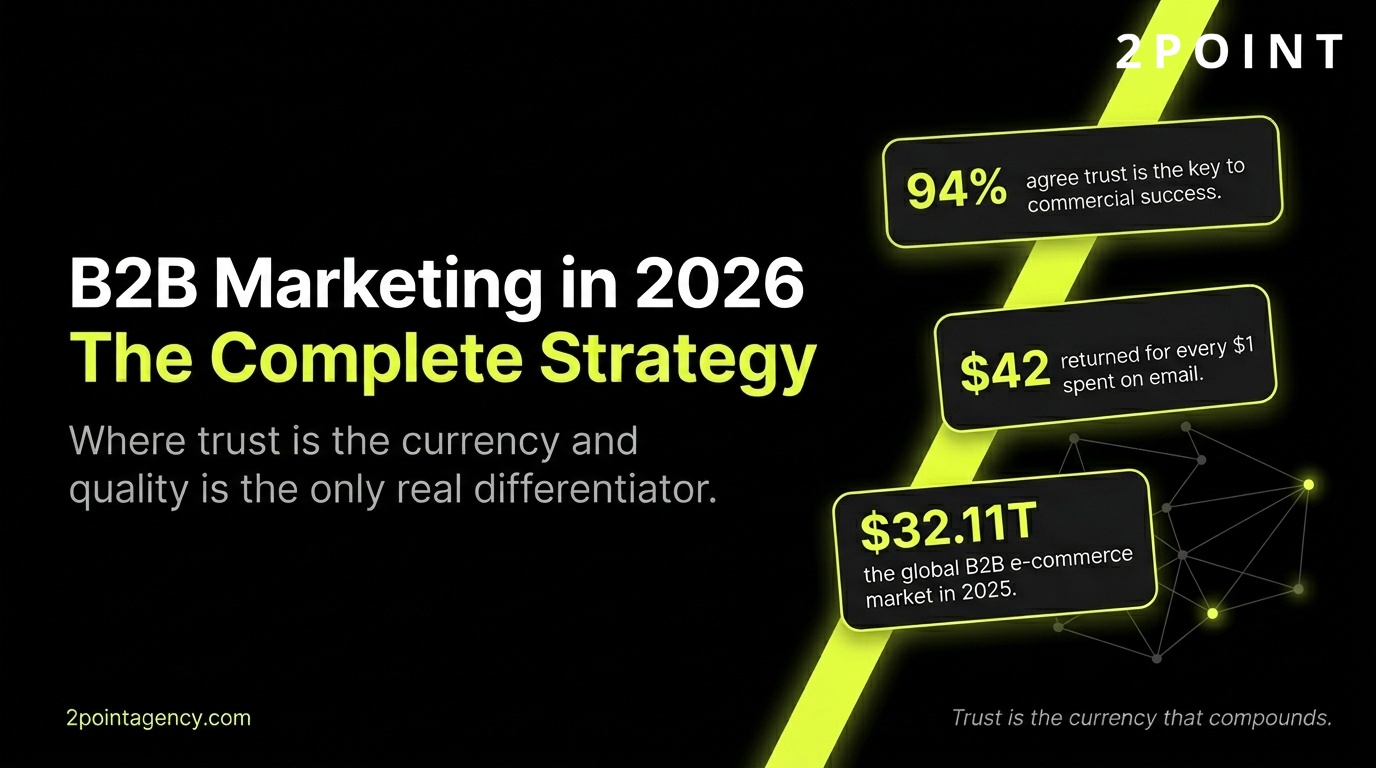
B2B marketing has entered one of its most demanding and most exciting eras. AI tools are reshaping execution, buyer expectations have shifted to consumer-grade experiences, and trust has become the single most valuable currency in any business relationship. The organizations winning right now are the ones that understand these dynamics and build strategies around them deliberately, not reactively.
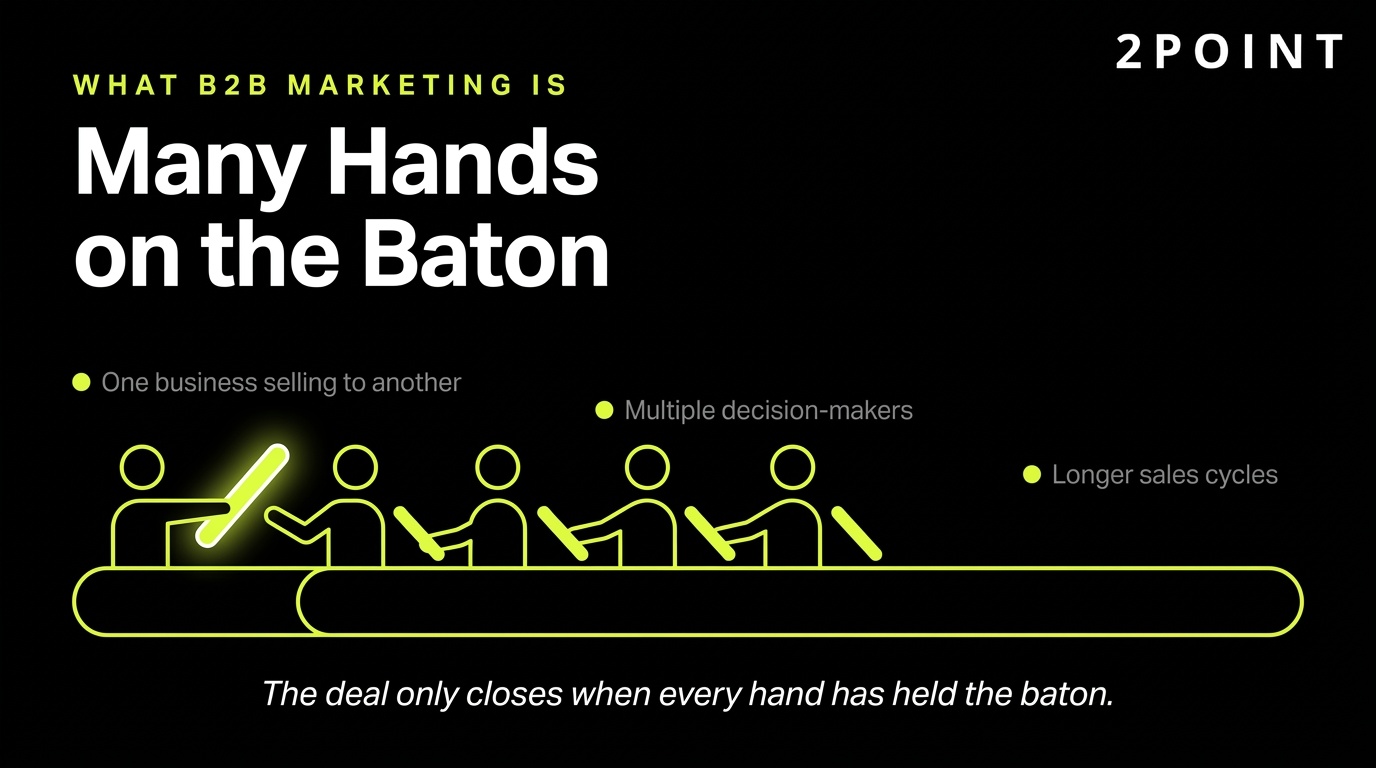
- B2B marketing is the practice of promoting products or services from one business to another, involving longer sales cycles and multiple decision-makers.
- 94% of B2B marketers agree that trust is the single most important factor in commercial success.
- 91% of B2B marketers currently use content marketing as a core part of their strategy.
- Email marketing delivers $42 in return for every $1 spent, making it the highest-ROI channel available.
- The global B2B ecommerce market reached $32.11 trillion in 2025, signaling massive digital opportunity.
- Modern B2B buyers complete most of their research before ever contacting a vendor, requiring a content-first strategy.
- AI tools accelerate execution but create content saturation, making quality and authenticity primary differentiators.
- The most effective B2B marketing strategies combine data-driven targeting, trust-building content, and multi-channel distribution.
How the AI Revolution Is Reshaping B2B Marketing Strategy
Artificial intelligence has moved from an experimental curiosity to an operational necessity inside B2B marketing teams. The shift happened faster than most predicted. What began as a productivity experiment in 2023 and 2024 has become standard infrastructure, touching everything from content ideation to campaign reporting to customer segmentation. The question is no longer whether to use AI but how to use it well enough to stay ahead of competitors who are using it too.
The opportunity is real and measurable. So is the risk. As AI-generated content floods every channel, buyers are developing finely tuned filters for what feels generic versus what feels genuinely useful. Winning B2B marketers in 2026 are the ones who use AI to accelerate execution while protecting the human insight, strategic depth, and creative clarity that actually drives decisions.
How B2B Marketers Are Actually Using AI in 2026
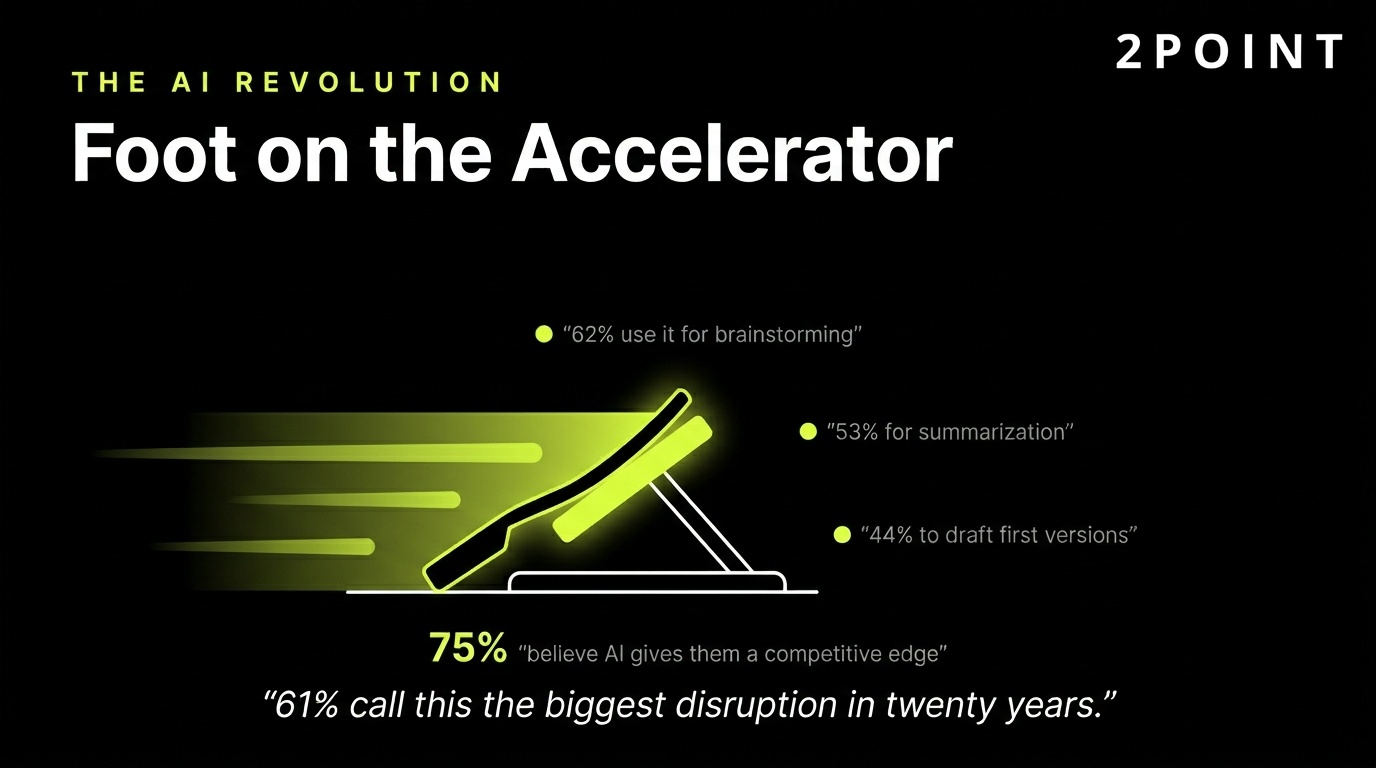
The practical applications of AI inside marketing teams have become surprisingly specific. 62% of B2B marketers use AI for brainstorming, 53% use it for content summarization, and 44% use it to draft initial content versions. These are not vanity activities. They represent real time savings that allow teams to focus higher-order energy on strategy, relationship development, and quality control.
The competitive advantage argument is persuasive. 75% of B2B marketers believe AI gives them a measurable competitive edge, and the tools creating that edge are now household names inside marketing departments. ChatGPT, HubSpot's AI suite, and Microsoft Copilot are among the most widely used AI marketing tools across the industry. Teams that have not yet integrated at least one of these into their workflows are already operating at a disadvantage in terms of output volume and speed.
The broader stakes are significant. 61% of B2B marketing professionals believe the industry is experiencing the biggest disruption it has seen in 20 years, driven primarily by AI. That is not hyperbole. It reflects a genuine inflection point where the fundamental mechanics of how marketing content gets created, distributed, and consumed are being rewritten simultaneously.
The Content Decentralization Problem Facing B2B Teams
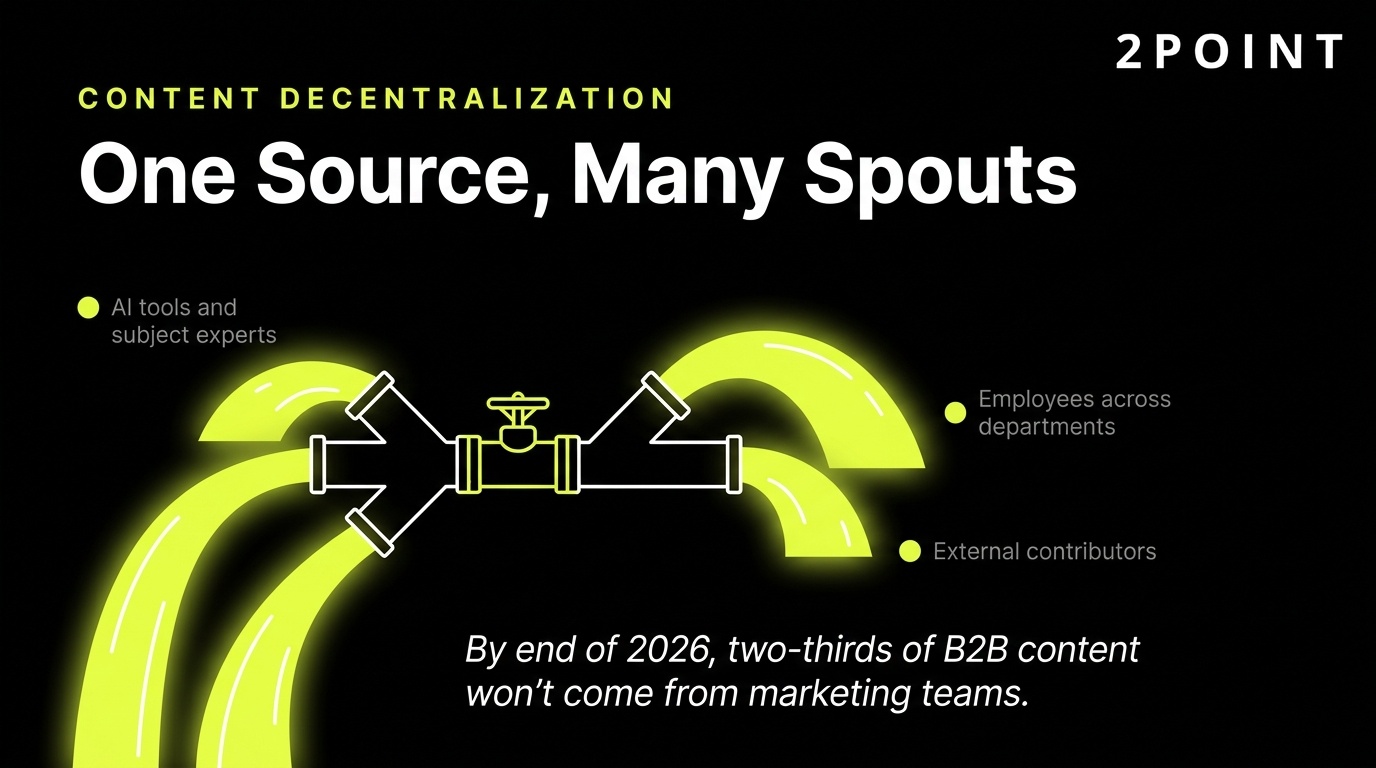
Forrester's predictions for 2026 include a striking structural shift: two-thirds of B2B content will not come from traditional marketing content teams by the end of 2026. Instead, it will come from AI tools, subject matter experts, employees across departments, and external contributors. That decentralization creates enormous scale, but it also creates serious governance challenges that most organizations are not yet equipped to handle.
When anyone with a prompt and an AI tool can produce a blog post, a LinkedIn article, or a whitepaper in twenty minutes, the question of brand consistency becomes urgent. More content is now generated by AI than by humans across the B2B landscape, and the downstream effects on brand voice, customer experience, and message integrity are still unfolding. Organizations that treat this as a publishing-speed advantage without building the corresponding quality infrastructure are creating significant long-term brand risk.
The solution is not to restrict content creation but to build decision frameworks that work at scale. This means establishing clear brand guidelines accessible to every contributor, creating review workflows that do not create bottlenecks, and training non-marketing employees on the standards that protect customer experience. Agility in marketing matters enormously here: the teams that move quickly with guardrails in place will out-create and out-quality teams that either move slowly or move fast with no governance at all.
Why AI-Generated Content Is Failing to Convert
Volume without quality is not a strategy. The uncomfortable truth emerging from B2B marketing data in 2025 and 2026 is that most AI-generated content is performing exactly as buyers have come to expect: it is average. Consumers are increasingly tuning out AI-generated and brand-generated content in favor of content they perceive as human-created and genuinely expert. That preference is not sentimental. It is functional. Human-created content tends to carry specific experience, genuine perspective, and earned credibility that AI tools cannot reliably replicate.
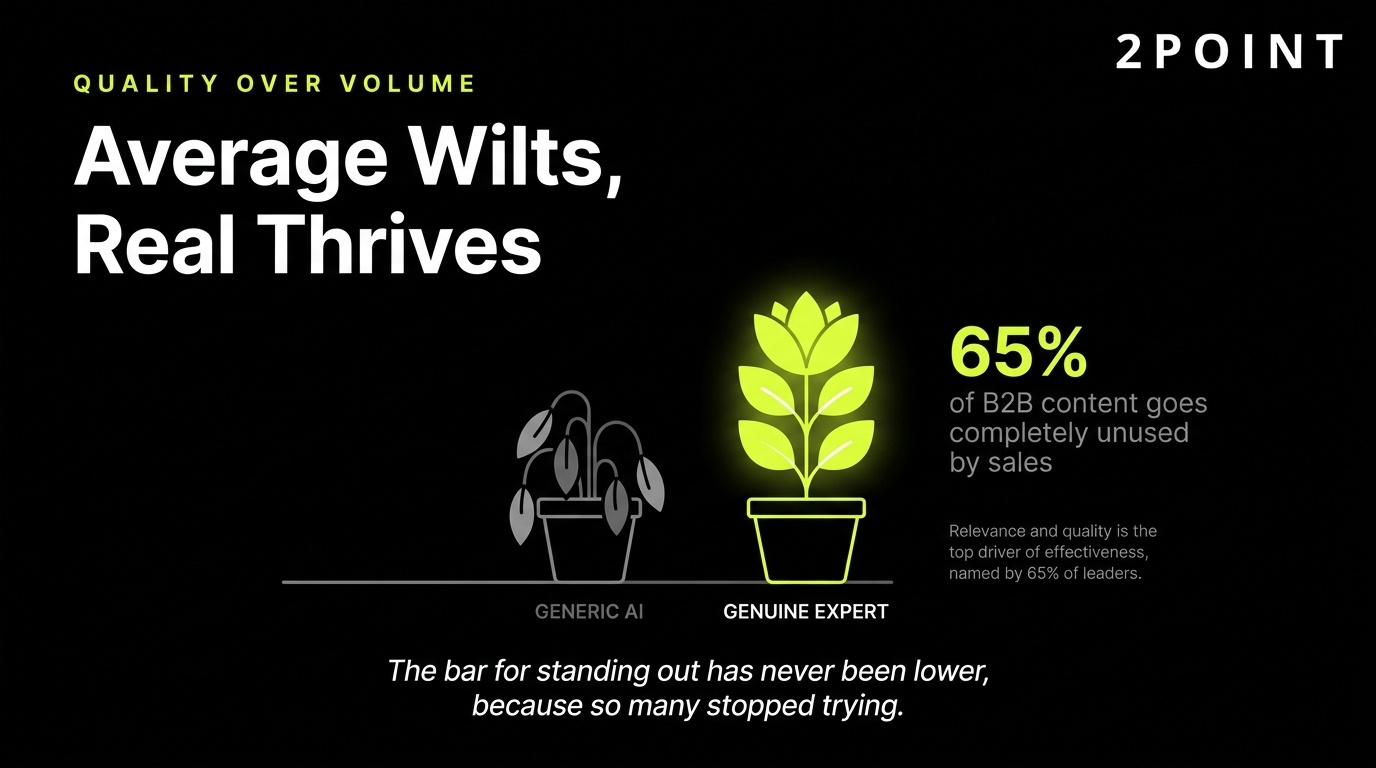
The waste problem compounds the challenge. 65% of B2B content produced goes completely unused by sales teams, which means a significant portion of marketing's output is not converting to pipeline regardless of how it was created. The root cause is usually strategic misalignment: content built without a clear buyer stage, persona, or conversion goal in mind tends to sit on a resource page and never move a deal forward.
Content relevance and quality is the top driver of content effectiveness, cited by 65% of B2B marketing leaders. The opportunity embedded in this data is clear. When most competitors are producing average-quality AI content at scale, organizations willing to invest in genuine quality, specific insight, and real human perspective can stand out dramatically. The bar for differentiation through content quality has never been lower, precisely because so many organizations have stopped trying.
Building Your AI Implementation Framework for B2B Marketing
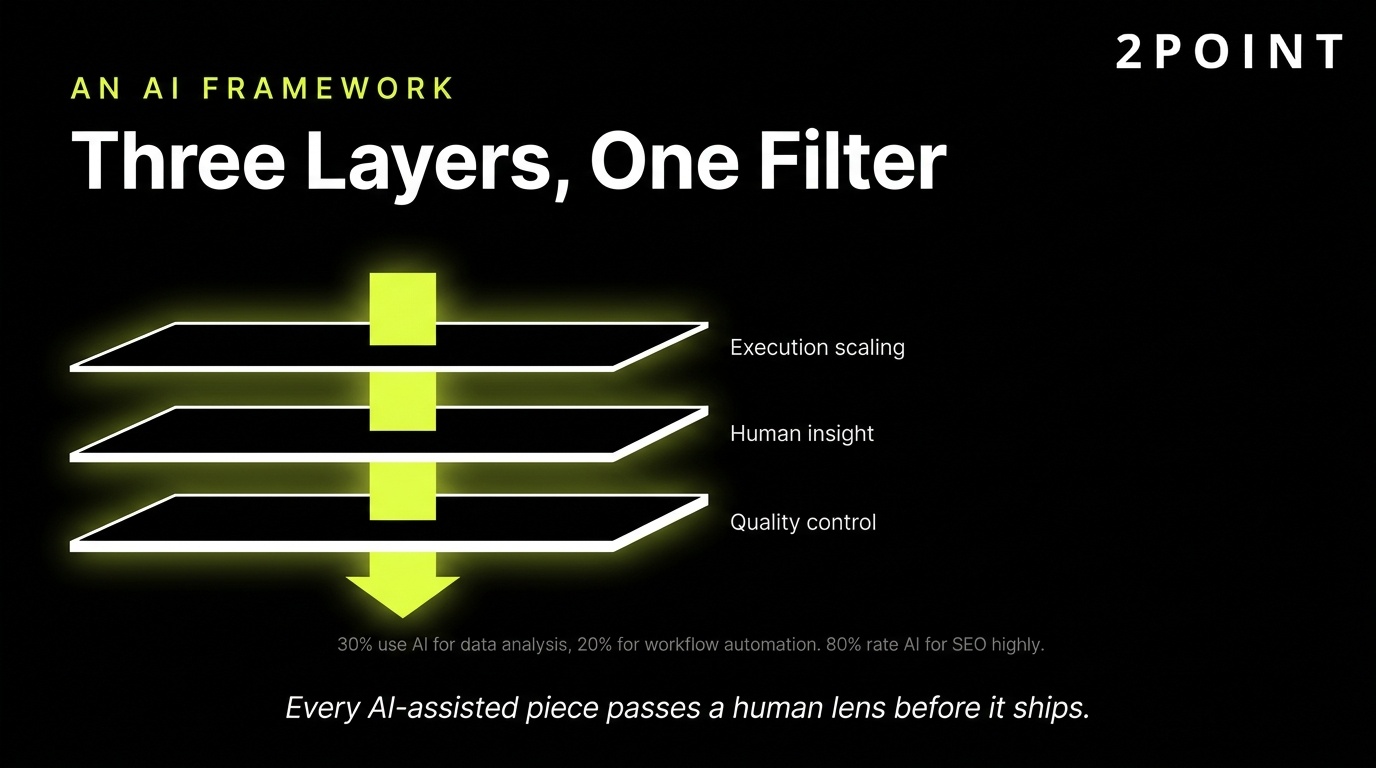
The most effective approach to AI in B2B marketing is not maximalist adoption or cautious avoidance. It is a three-layer framework that matches AI capabilities to appropriate tasks while preserving human judgment where it matters most. Layer one is AI for execution scaling: using tools for research, drafting, formatting, distribution scheduling, and data summarization. Layer two is human insight for strategy and connection: ensuring that positioning decisions, relationship-sensitive communications, and brand-defining content carry genuine human perspective. Layer three is measurement for quality control: tracking not just volume and reach but engagement depth, conversion rate, and sales team utilization.
The specific applications showing the strongest return right now include data analysis, workflow automation, and SEO optimization. 30% of B2B marketing teams leverage AI specifically for data analysis, while 20% use it for workflow automation. These applications deliver clean efficiency gains without the quality risks associated with pure content generation. 80% of B2B marketers rate the importance of AI-optimized content for SEO at 6 or higher on a 10-point scale, reflecting how deeply AI has become embedded in search visibility strategy.
The implementation framework should also include explicit review checkpoints. Every piece of AI-assisted content should pass through a human lens before publication, not for word count adjustment but for genuine strategic review: Does this reflect something a competitor could not easily replicate? Does it carry a specific point of view? Does it serve a buyer's actual decision-making need? These questions, asked consistently, are what separate AI-augmented teams from AI-dependent ones.
Trust-Based B2B Marketing: The Foundation Every Strategy Needs
Trust is not a soft metric in B2B marketing. It is a commercial driver with measurable impact on pipeline velocity, close rates, and customer lifetime value. In an environment where AI has made content creation cheaper and faster for everyone, the organizations that build genuine, durable trust with buyers are the ones that create sustainable competitive advantages. Trust cannot be generated at scale through automation alone. It requires consistent, authentic demonstration of expertise, integrity, and relevance over time.
The Trust Economy in B2B Decision-Making
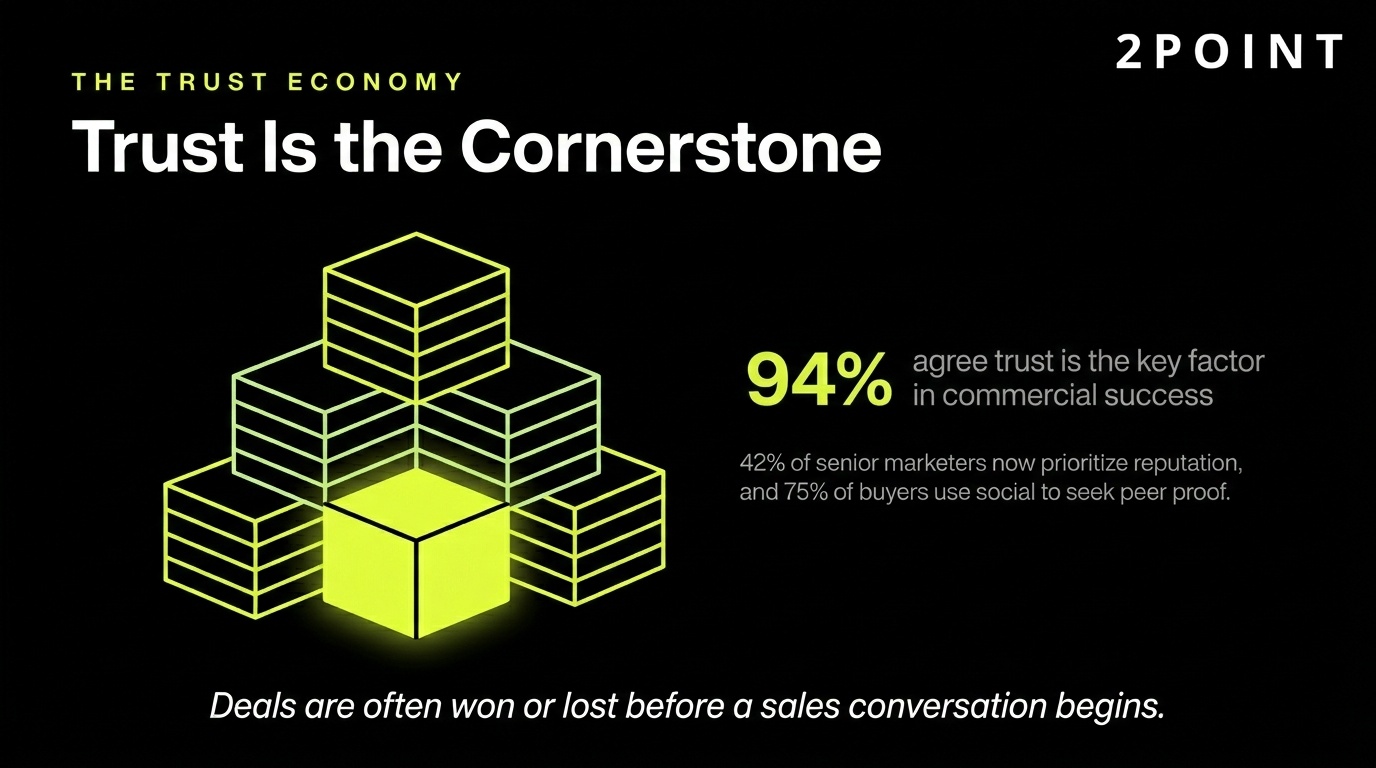
The data on trust's role in B2B success is unambiguous. 94% of B2B marketers agree that trust is the key factor in commercial success, a consensus that spans industries, company sizes, and geographies. This is not a new finding, but its intensity has sharpened as AI content saturation has made authentic credibility rarer and more valuable.
Senior marketers are responding to this reality with deliberate investment in brand reputation. 42% of senior B2B marketers now prioritize brand awareness and reputation among decision-makers as a primary objective, recognizing that deals are often won or lost before a sales conversation ever begins. The buyer who already knows and trusts your brand enters the conversation differently than the buyer who has never heard of you, and that difference shows up in close rates and deal velocity.
Social proof is reshaping how that trust gets established. 75% of B2B buyers use social media during the buying process, not to engage with brand content but to seek peer perspectives, analyst opinions, and real-world experiences from people they trust more than vendors. Understanding this behavior means repositioning your marketing from broadcasting to facilitation: creating the conditions for trusted third parties to speak on your behalf. Platforms like social media have become critical trust infrastructure, not just distribution channels.
The Rise of Influencer and Analyst Relations in B2B Marketing
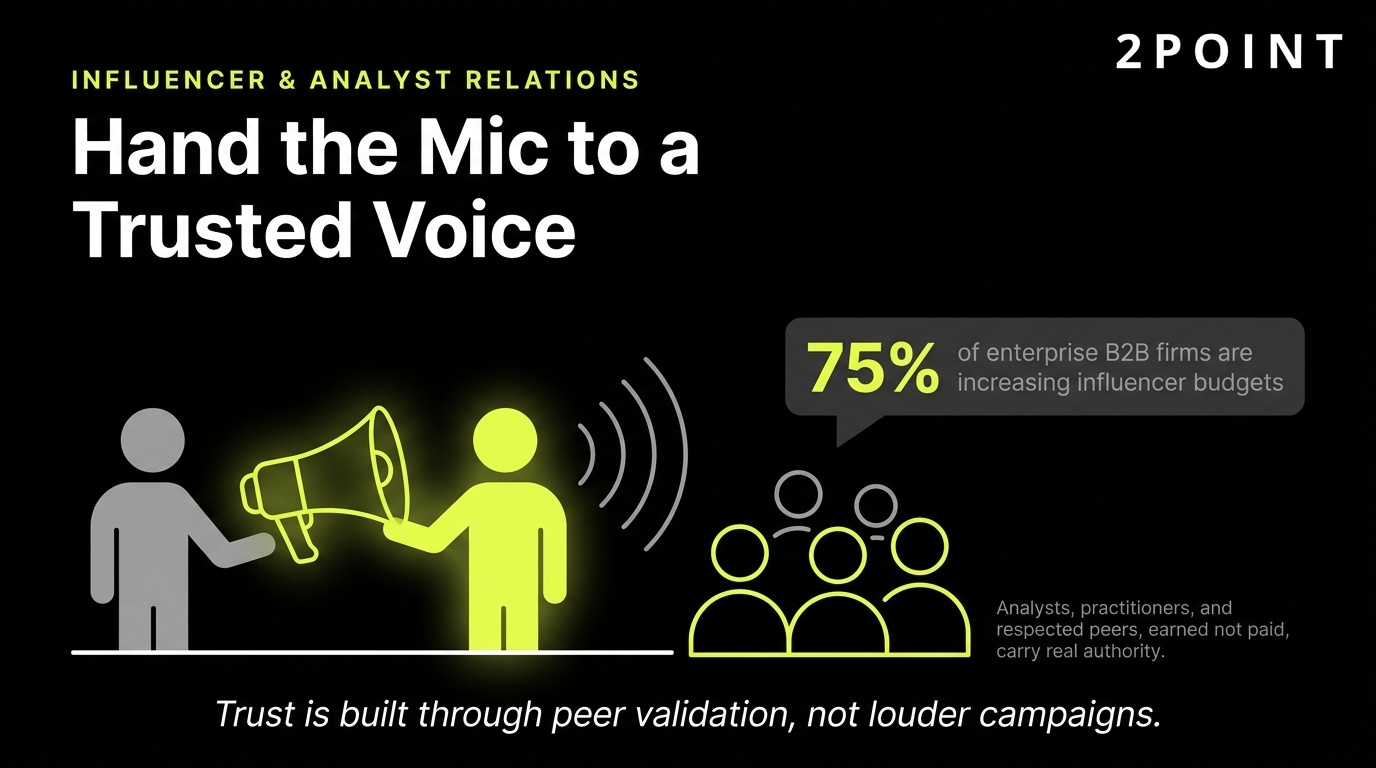
The fastest-growing trust-building investment in enterprise B2B is influencer and analyst relations. 75% of enterprise B2B companies are increasing their influencer relations budgets in 2026, a signal that the industry has accepted what buyers already knew: external validators carry more weight than vendor claims. This is not the influencer marketing of consumer brands. B2B influencer marketing is about aligning with analysts, subject matter experts, industry practitioners, and respected peers whose endorsement carries genuine authority in specific buying contexts.
The strategic logic is straightforward. When a well-regarded analyst mentions your platform in a market overview, or when a respected practitioner shares a genuine success story from working with your team, that signal reaches buyers in a way that a paid ad or branded whitepaper cannot. Trust in B2B is no longer built through campaigns but through peer validation and third-party credibility. This shifts the strategic investment from content creation alone to relationship building with the voices buyers already listen to.
For organizations new to this approach, the entry point is identifying which analysts, thought leaders, and practitioners your specific buyers follow and trust. Once those voices are identified, the goal is to create genuine relationships, provide them with useful information, and earn authentic coverage rather than paid placement. The distinction between earned and paid credibility is not lost on sophisticated B2B buyers. Leveraging influencer marketing effectively in B2B contexts requires patience and authenticity rather than transactional thinking.
Case Studies as Trust-Building Assets in B2B Marketing
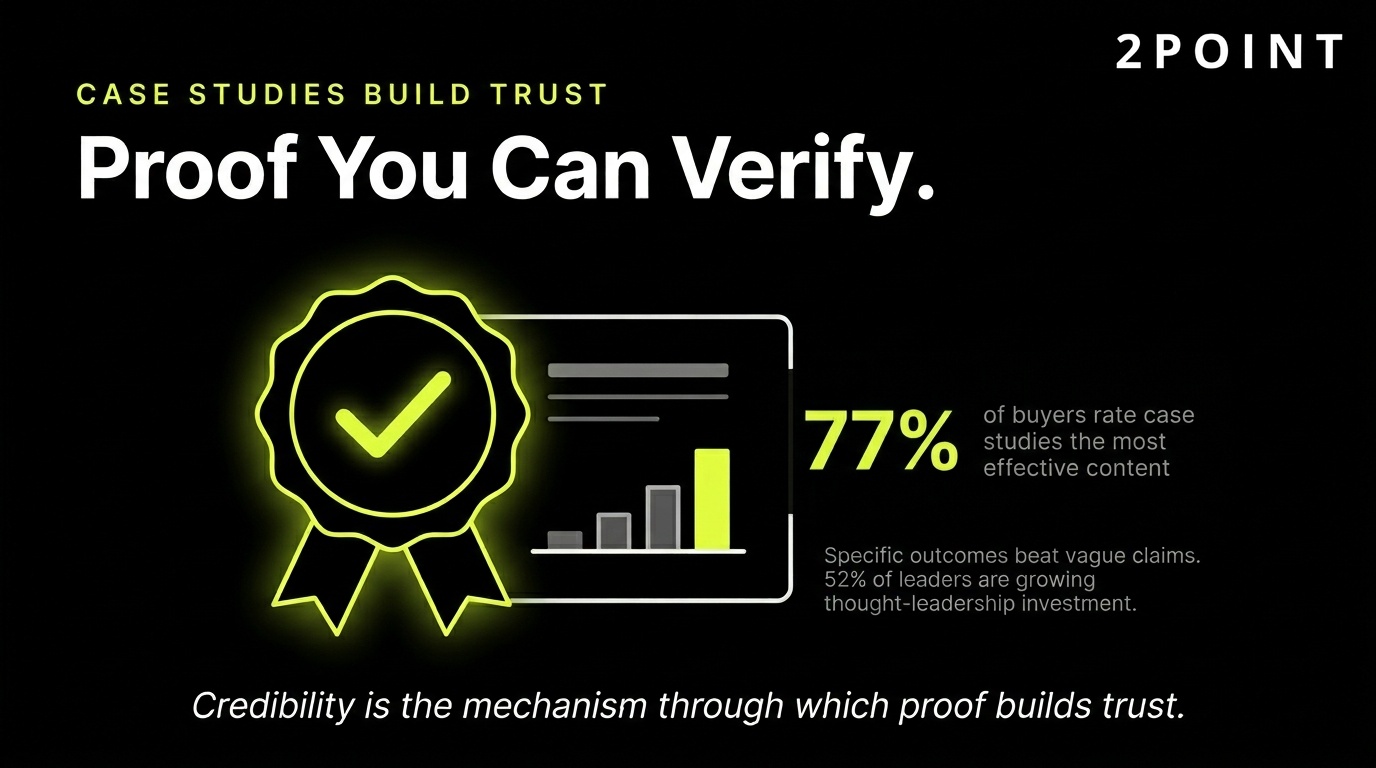
Among all content types available to B2B marketers, case studies remain the most effective at building the specific kind of trust that accelerates purchase decisions. 77% of B2B buyers rate case studies as the most effective content type in their research process, because a well-constructed case study does something no other format can: it provides peer-level social proof with specific, verifiable outcomes.
The framework for a compelling B2B case study goes beyond before-and-after storytelling. The most effective case studies identify a specific, relatable challenge, describe the decision-making process with enough honesty to feel authentic, and present outcomes with enough specificity to be credible. Vague statements about "improved efficiency" convert less well than precise claims like "reduced onboarding time by 40% within 90 days." The difference is credibility, and credibility is the mechanism through which case studies build trust. Customer testimonials embedded within case studies further amplify their persuasive power.
Investment in thought leadership content more broadly is also increasing, which signals that the industry understands the trust-building value of expert positioning. 52% of B2B marketing leaders plan to increase their investment in thought leadership content over the next year. 83% of organizations that invest in content marketing report achieving brand awareness goals, validating that sustained content investment builds the market presence that makes trust-building possible at scale.
Authenticity and Human-Centered B2B Content Strategy
A counter-trend is emerging against AI content saturation, and it is creating a genuine competitive opportunity. Human-centered content is uncommon for the first time in modern marketing history, which means organizations that commit to producing it are operating in a less crowded space than they might expect. This is not nostalgia for pre-AI marketing. It is a strategic recognition that authenticity, specificity, and genuine human perspective are now scarce resources in a market flooded with synthetic sameness.
Human-centered content strategy does not mean avoiding AI tools. It means using them in service of human insight rather than as a replacement for it. The practical difference shows up in how content gets originated: starting from a genuine expert perspective, a real customer conversation, or a specific market observation rather than from a prompt designed to produce high-volume output. Growth in B2B marketing is now driven by distinctiveness, trust, and relevance, and all three of those qualities require human authorship at the strategic level even when AI assists at the execution level.
The behavior consequence of inauthenticity is also worth naming directly. 73% of B2B buyers actively avoid suppliers who send irrelevant or overly generic outreach. That figure is not just a cautionary note about email sequences. It is a signal about what happens when marketing loses its human attunement to buyer context and needs. Personalized marketing built on genuine understanding of buyer circumstances performs dramatically better than personalization that is merely variable substitution in an AI template.
Understanding the Modern B2B Buyer Journey in 2026
The B2B buyer journey has been fundamentally restructured by digital access, AI research tools, and rising expectations. Buyers are more informed, more independent, and more selective than at any point in the history of business-to-business commerce. Understanding this restructured journey is not optional for effective B2B marketing. It is the prerequisite for building a strategy that reaches buyers where they actually are rather than where they were five years ago.
The Digital-First Research Revolution in B2B Buying
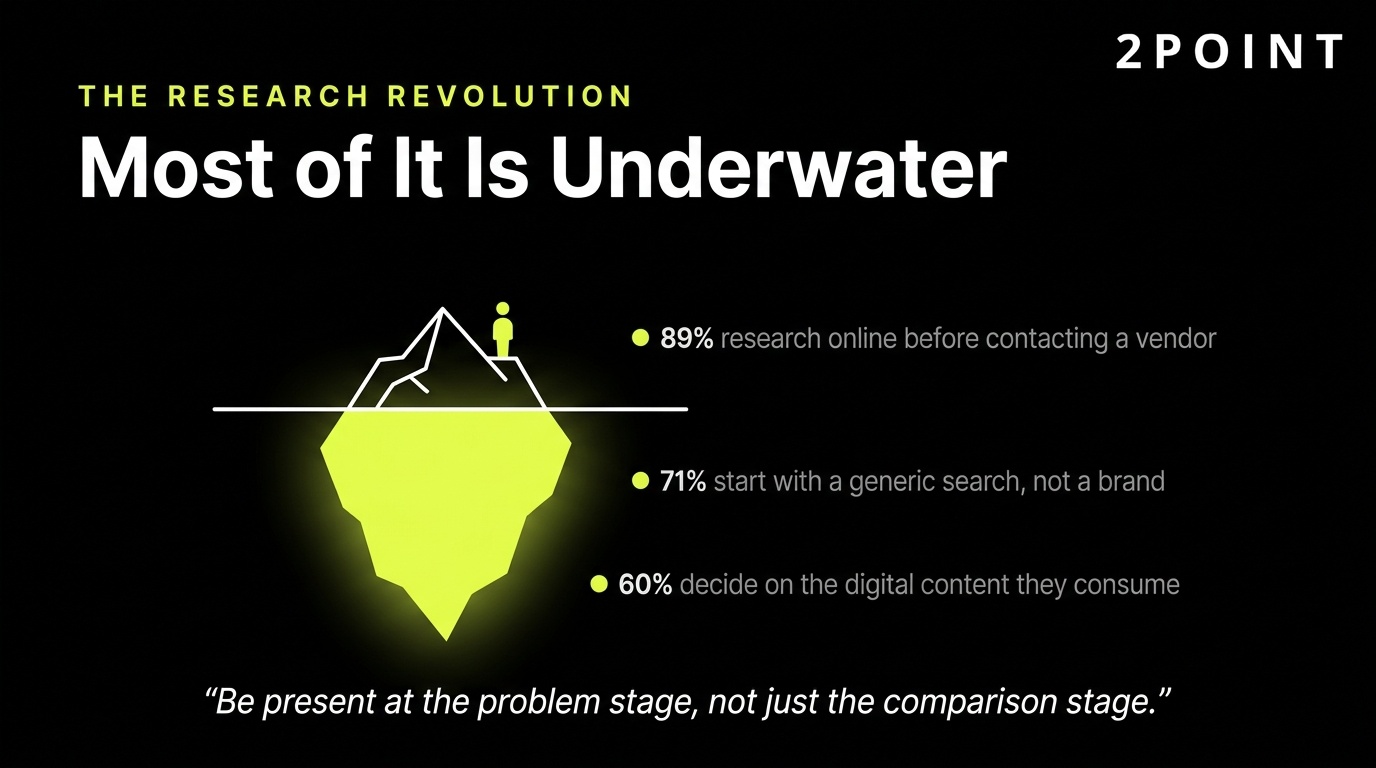
Modern B2B buyers conduct an extraordinary amount of independent research before they ever reach out to a vendor. 89% of B2B buyers research products online before making a purchase, and the way they begin that research tells an important strategic story. 71% of B2B buyers begin their research with a generic search query rather than a branded one, which means they are exploring categories and problems rather than already looking for your solution specifically.
This behavior has massive implications for customer journeys and content strategy. If buyers are starting with generic queries, your content strategy needs to be present at the problem-definition stage, not just at the solution-comparison stage. Organizations that only produce content about their products and features are missing the majority of the buyer journey. Those that also produce content addressing the problems, challenges, and questions that precede product consideration will be present at the beginning of the research process and therefore earn trust earlier.
60% of B2B buyers report making final purchasing decisions based on digital content they consumed during research. That statistic positions digital content not as a top-of-funnel awareness tool but as a bottom-of-funnel conversion driver. The content a buyer reads during their independent research period is shaping the deal before sales ever gets involved. Mapping your content to every stage of that research process, with appropriate depth and specificity at each stage, is one of the most high-leverage investments a B2B marketing team can make.
Sales Cycle Compression and Buying Committee Changes
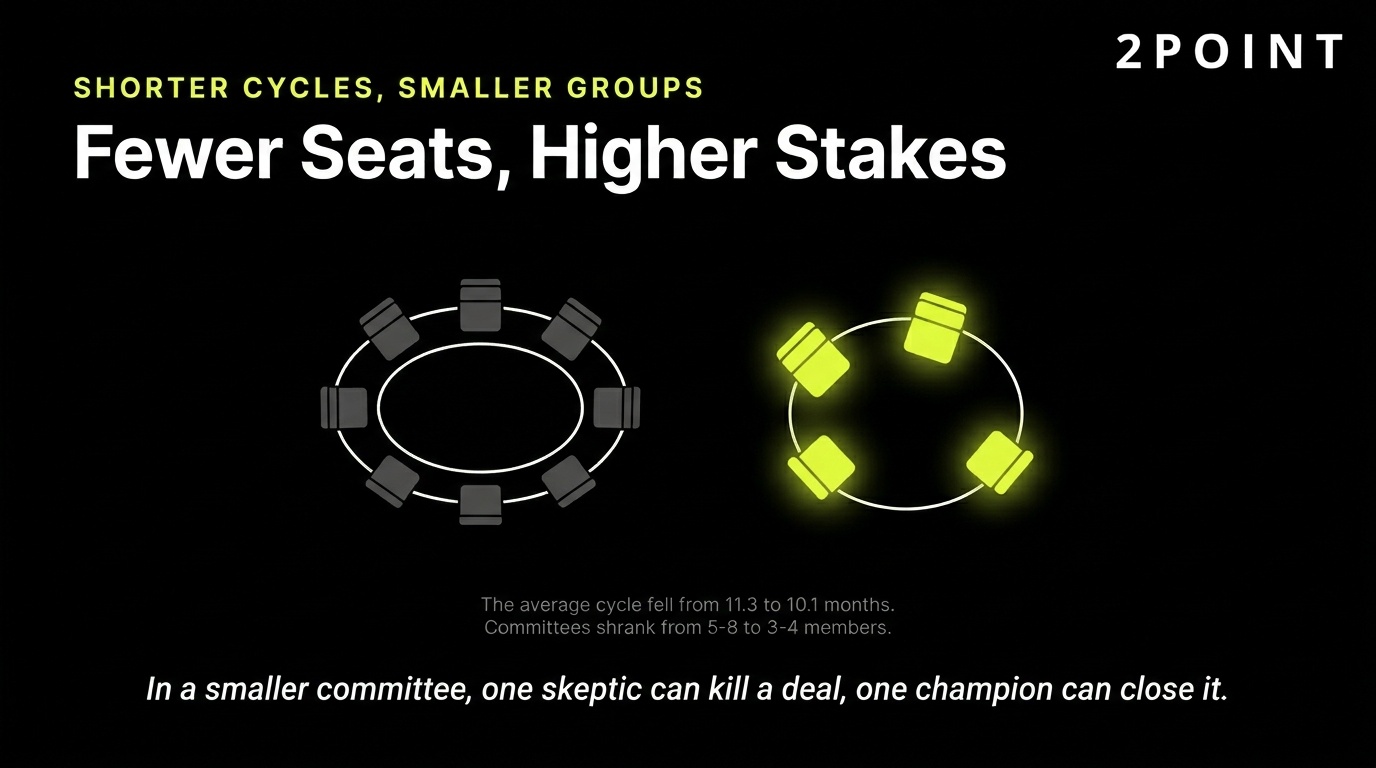
Two structural changes in B2B buying behavior are reshaping how deals get made and how marketing must support them. First, the average B2B sales cycle is compressing. The average B2B sales cycle dropped from 11.3 months in 2024 to 10.1 months in 2025, a compression driven by better-informed buyers, more accessible digital tools, and organizational pressure to make decisions faster. Shorter cycles mean less time to build relationships through traditional engagement, placing greater weight on the content and reputation buyers encounter before they ever engage.
Second, buying committees are shrinking. B2B buying groups for software decisions are contracting from 5 to 8 members to 3 to 4 members, particularly in the software and technology categories. This might seem like a simplification, but it actually increases the stakes for each individual stakeholder's opinion. In a smaller committee, one skeptic can kill a deal more easily, and one champion can close it more quickly. The implication for marketing is that stakeholder-specific content and messaging become even more critical: each of three or four decision-makers needs to feel addressed directly rather than as part of a generic audience.
The combination of shorter cycles and smaller committees rewards organizations that have already built trust and visibility before the formal evaluation begins. Smaller, faster-moving committees mean each individual stakeholder carries substantially more influence in the final decision. Account-based marketing approaches that address specific roles and concerns, rather than broadcast messaging designed for general audiences, perform better in this environment.
Consumer-Grade Expectations in B2B Marketing Experiences
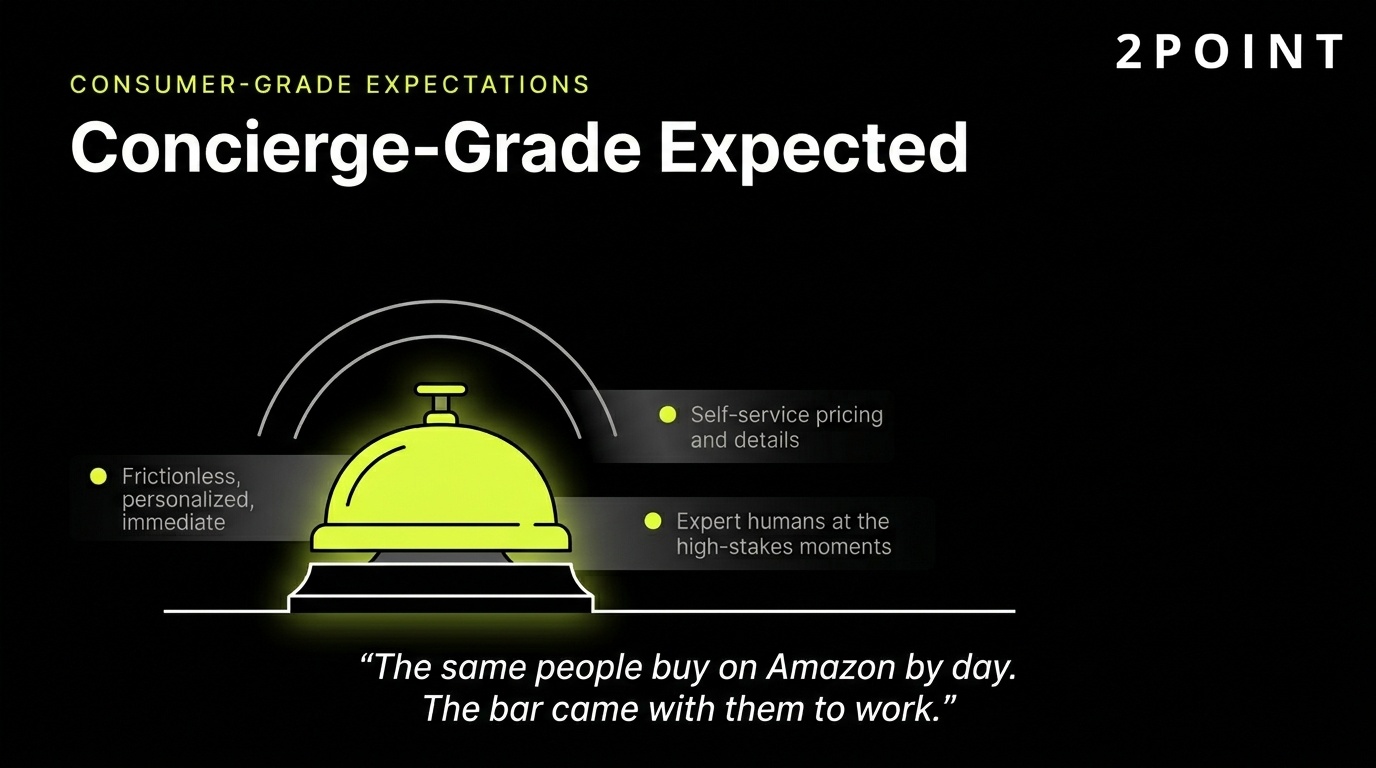
The people making B2B purchasing decisions are the same people who use Amazon, Netflix, and Uber in their personal lives. They have been conditioned by consumer technology to expect frictionless, personalized, immediate experiences. Those expectations do not disappear when they arrive at work. B2B buyers now expect consumer-grade digital experiences at every touchpoint, including your website, your sales process, your onboarding, and your customer support.
This expectation shift creates both a challenge and an opportunity. The challenge is that the bar for a good B2B digital experience has risen significantly, and organizations with outdated websites, friction-heavy sales processes, or inconsistent brand experiences are losing deals to competitors who have invested in experience quality. The opportunity is that many B2B organizations have not yet made this investment, creating meaningful differentiation for those who do.
Self-service is a growing demand. Buyers want to access pricing information, product details, and comparison data on their own terms rather than through a discovery call. Self-service capabilities are increasingly expected in B2B buying, but sales teams remain indispensable for addressing complex technical questions, security concerns, and quality assurance discussions. The winning model combines generous digital self-service with expert human support at the moments of highest-stakes decision-making.
Answer Engine Optimization for the New B2B Search Landscape
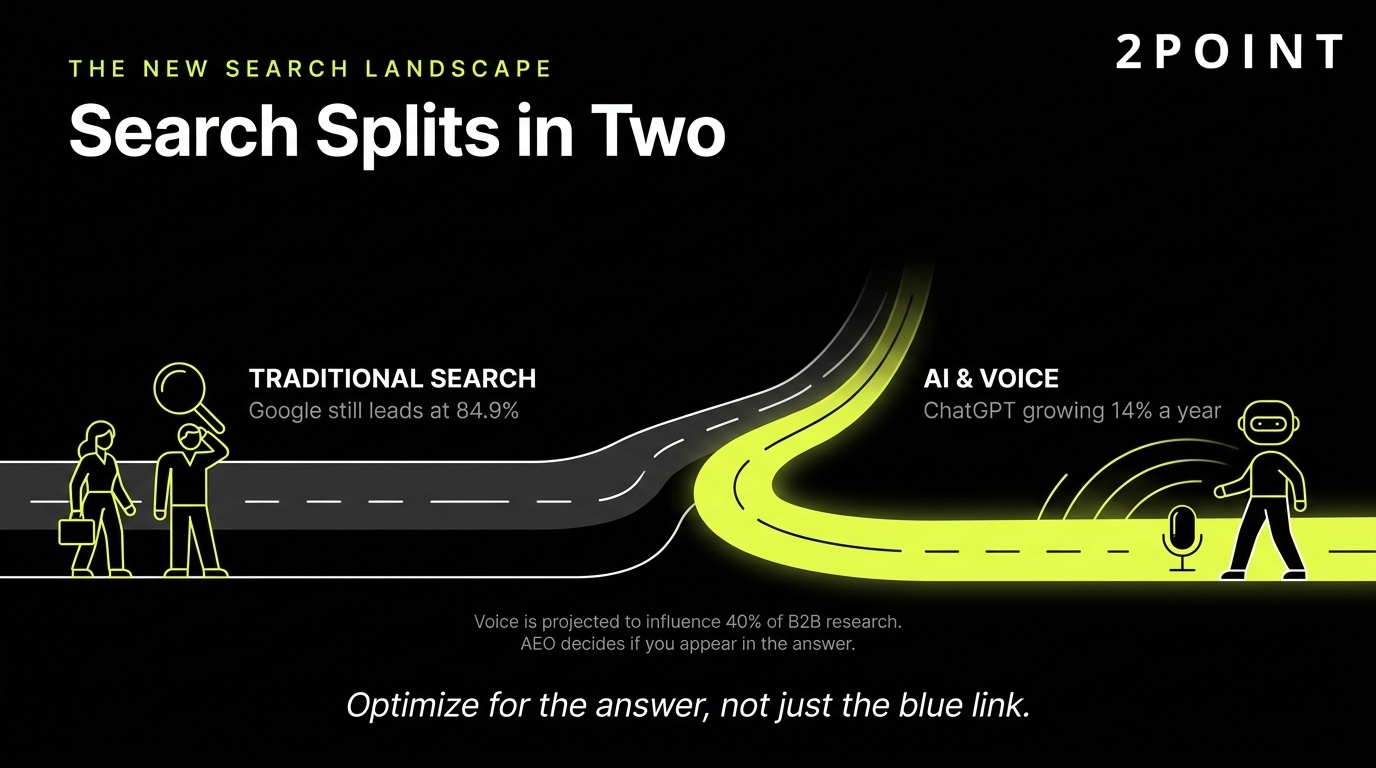
The search landscape has diversified in ways that require B2B marketers to expand their visibility strategy beyond traditional SEO. Google still dominates, but the ecosystem is expanding rapidly. Google holds 84.9% of B2B search market share, followed by Bing at 3.7% and ChatGPT at 3.2%. That ChatGPT figure is small in absolute terms, but its trajectory matters: ChatGPT is the fastest-growing search platform at 14% annual growth rate, meaning its share will compound quickly. B2B buyers are beginning to use AI chat interfaces for research in ways that bypass traditional search entirely.
Voice search adds another dimension. Voice search is projected to influence 40% of B2B research by 2026, driven by the normalization of voice interfaces in both consumer and professional contexts. Voice queries tend to be more conversational and question-based than typed queries, which has direct implications for content structure and keyword strategy. Voice search optimization is no longer a future consideration; it is a present-day requirement for comprehensive search visibility.
Answer Engine Optimization (AEO) is the practice of structuring content to be selected by AI systems and featured snippet algorithms rather than just ranked in traditional blue-link results. Google featured snippets appear in approximately 40% of search results, representing significant organic visibility for well-structured content. The AEO framework for B2B content includes: answering specific questions directly and early in the content, using structured formats like tables and numbered lists, building semantic authority around core topic clusters, and establishing entity recognition through consistent citation and cross-reference. When B2B buyers ask an AI assistant about the best solutions in your category, AEO is what determines whether your brand appears in the answer.
B2B Content Marketing Strategies That Actually Convert
Content marketing is the engine of B2B demand generation, trust building, and pipeline development. It is also the area where most B2B organizations experience the widest gap between investment and return. Understanding what separates high-performing content strategies from average ones requires looking at both the data on what works and the structural decisions that make execution effective over time. A well-designed content marketing strategy is not a blog calendar. It is an integrated system for creating, distributing, and optimizing content that serves buyer decision-making at every stage.
Content Marketing Performance and ROI in B2B
The adoption rate for content marketing among B2B organizations is near-universal. 91% of B2B marketers use content marketing as part of their overall strategy, which makes it one of the most widely practiced disciplines in the field. The performance outcomes justify that adoption: 83% of B2B organizations achieve brand awareness goals through content marketing, 77% build credibility and trust, and 74% see demand and lead generation growth.
72% of B2B marketers report increased engagement and lead volume as a direct result of content marketing investment. These are not marginal gains. They represent material pipeline impact from content that is doing its job. The challenge, as noted earlier, is that 65% of B2B content produced goes completely unused by sales teams, creating a structural inefficiency that undermines overall ROI.
The drivers of high-performing content are worth understanding precisely. Relevance and quality is the top factor at 65%, followed by skills and capabilities at 53%, and alignment between sales and marketing at 45%. These three drivers point to a common root cause for underperforming content: it gets created in isolation from both buyer needs and sales reality. The fix is not more content. It is better content built through closer collaboration between marketing, sales, and actual customers. Understanding your target audience with genuine depth is the prerequisite for producing content that earns those engagement and conversion metrics.
Video Marketing Investment and Impact on B2B Demand
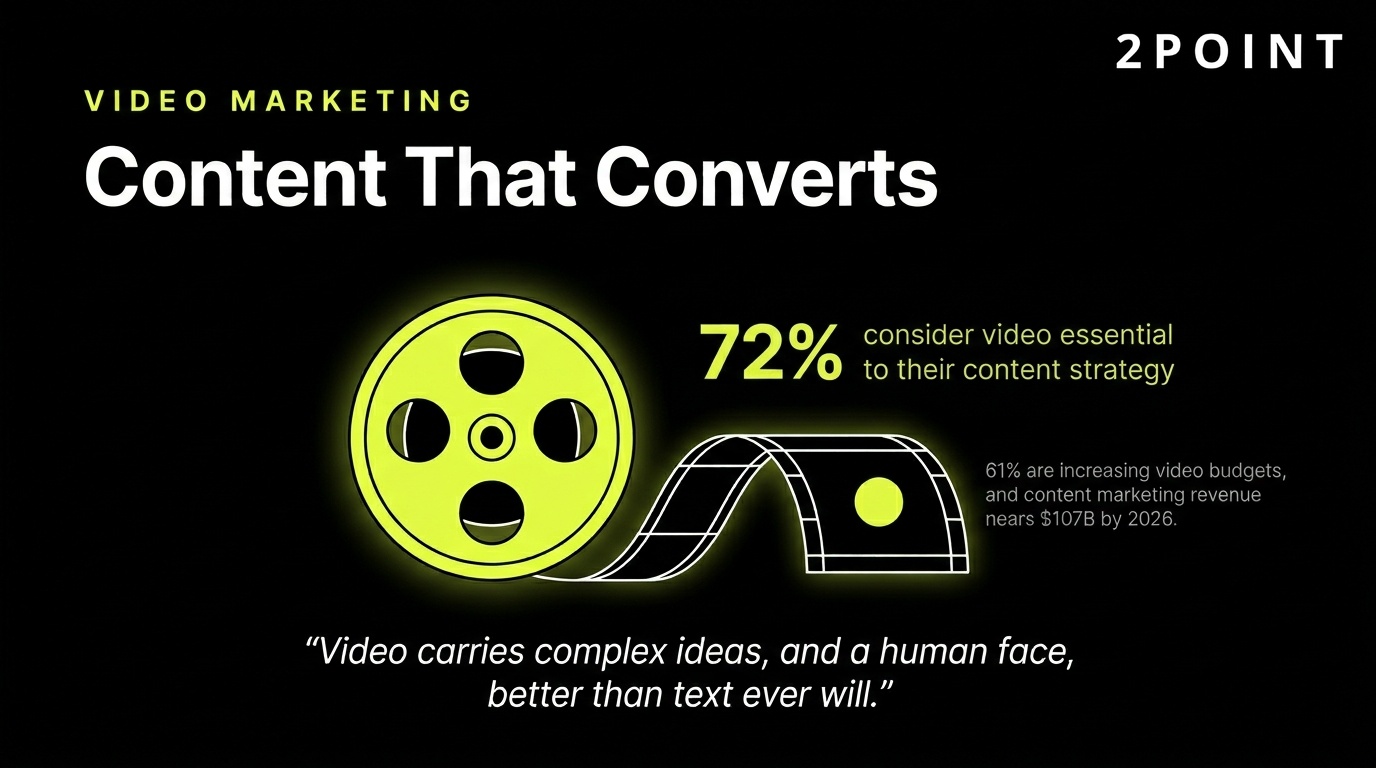
Video has crossed from "emerging channel" to "established essential" in B2B content strategy. 72% of B2B marketers consider video essential to their content strategy, and the investment data reflects that conviction. 61% of B2B marketing teams are actively increasing their video budgets in 2025, and 69% are currently investing in video as a content format.
The financial scale of video's role in content marketing is substantial. Content marketing revenue is projected to reach $107 billion by 2026, with video representing a disproportionately large and growing share of that total. The reasons are strategic as well as economic. Video communicates complex information more efficiently than text, builds personal connection between presenter and viewer, and performs significantly better in social media algorithms than static content formats.
A practical B2B video strategy includes four primary content types. Educational content addresses the problems and challenges your buyers face, positioning your organization as a knowledgeable guide before any product conversation begins. Customer success stories in video format carry the social proof of case studies with the personal credibility of a face and voice. Product demonstrations reduce the friction of evaluation by letting buyers understand the actual experience before a demo call. Thought leadership interviews with executives, practitioners, or subject matter experts build the authority and trust that accelerates decisions at the final stages of the buying process. Each format serves a different stage of the buyer journey, and a complete video strategy deploys all four in an integrated way.
The Blog-to-Lead Pipeline in B2B Marketing
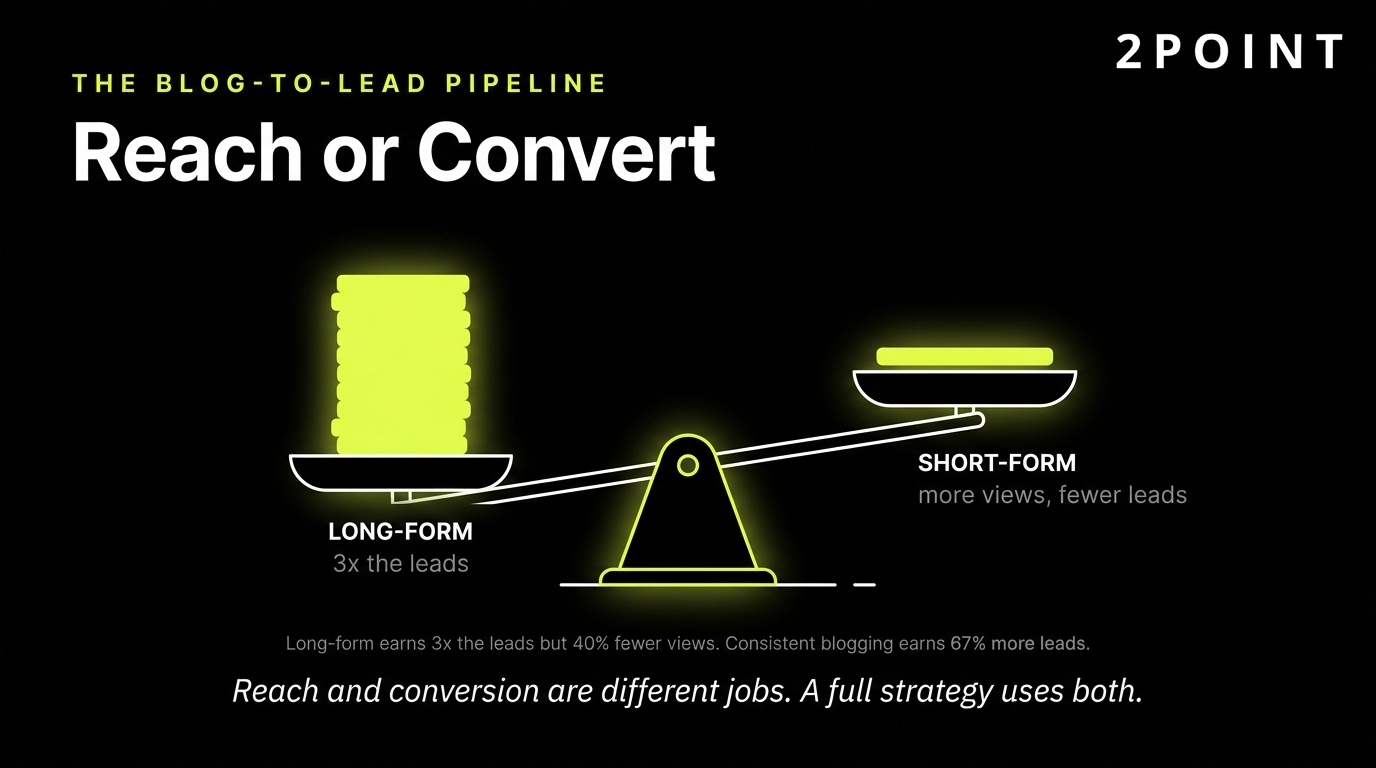
Blogging remains one of the most consistent lead generation mechanisms available to B2B marketers, but only when done with strategic discipline rather than volume-for-volume's-sake. Companies that blog consistently generate 67% more leads than those that do not, which is a compelling enough return to justify the investment even for organizations with limited content resources.
The quality-versus-quantity tradeoff in B2B blogging is worth understanding carefully. Long-form content of 2,000 words or more generates 3x the leads of shorter content, but receives 40% fewer views. This counterintuitive finding reveals an important insight about B2B content performance: reach and conversion are different objectives, and they often require different content formats. Short-form content reaches more people. Long-form content converts the people who find it at a dramatically higher rate. A complete blogging strategy uses both, matching format to stage: shorter content for awareness and discovery, longer content for evaluation and decision.
The blogging framework that converts well in B2B includes strategic topic selection based on buyer search behavior, thorough SEO optimization for both traditional and answer engine visibility, deliberate internal linking to guide buyers deeper into your content ecosystem, and clear conversion pathways that match the buyer's stage. A blog post addressing a top-of-funnel problem should offer a relevant middle-of-funnel resource. A bottom-of-funnel comparison post should make it easy to request a conversation. The pipeline only flows if each piece of content connects to the next step. Using analytics for marketing optimization helps identify which blog topics and formats are actually driving pipeline rather than just traffic.
Experiential and Event Marketing ROI in B2B
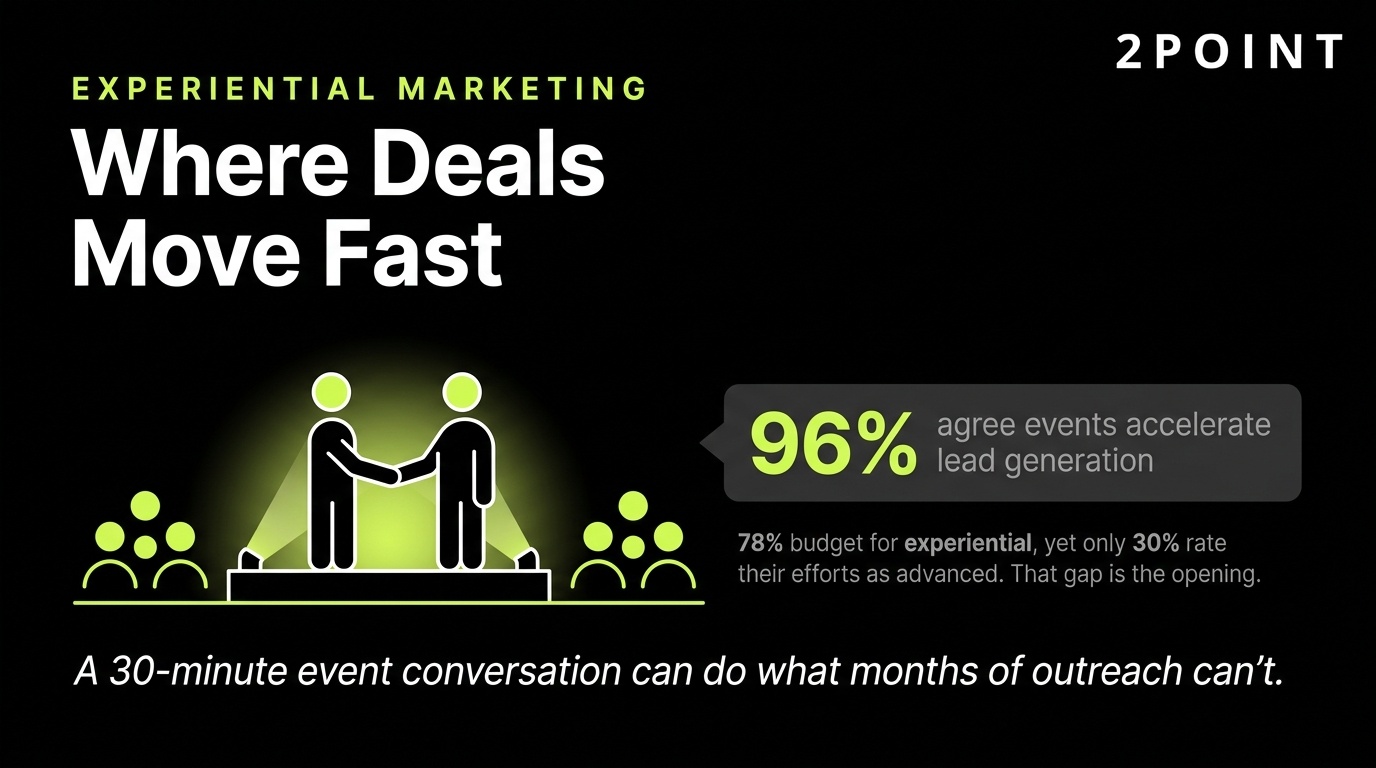
Despite the dominance of digital channels in B2B marketing investment, in-person and experiential marketing retains a unique and difficult-to-replicate strategic value. 78% of B2B organizations allocate budget to experiential marketing, recognizing that real-time, in-person moments create the kind of relationship depth that digital channels struggle to match. Conferences, executive dinners, user conferences, and field events remain central to relationship-building in high-value B2B categories.
The gap in execution quality, however, is significant. Only 30% of B2B organizations rate their experiential marketing efforts as established, advanced, or leading, with the remaining 70% still in exploratory or developing stages. This gap is actually an opportunity. Because most organizations are not executing events well, those that do stand out immediately. The differentiation advantage in experiential marketing is higher now than it has been in years, precisely because the field has underinvested in execution quality.
The pipeline case for events is strong regardless of maturity level. 96% of B2B marketers agree that events accelerate lead generation, which makes them one of the most universally validated channels in the arsenal. The specific mechanism is the combination of concentrated attention, face-to-face relationship development, and shared context that events create. A conversation at a well-designed event often accomplishes in 30 minutes what email sequences and LinkedIn outreach take months to produce. Investing in event quality, from the experience design to the follow-up strategy, is one of the highest-leverage uses of B2B marketing budget for organizations focused on enterprise relationships and complex sales.
B2B Marketing Channel Strategy and Budget Allocation
Channel selection and budget allocation decisions determine whether a strong B2B marketing strategy reaches its intended audience or remains an unrealized potential. The landscape of available channels has never been wider, which makes prioritization more important than ever. Data on channel ROI, adoption rates, and budget trends gives organizations a principled basis for making these decisions rather than relying on convention or guesswork. The right channel mix depends on your specific audience, product complexity, and sales motion, but the data points below provide strong starting points.
Email Marketing: The Highest-ROI Channel in B2B
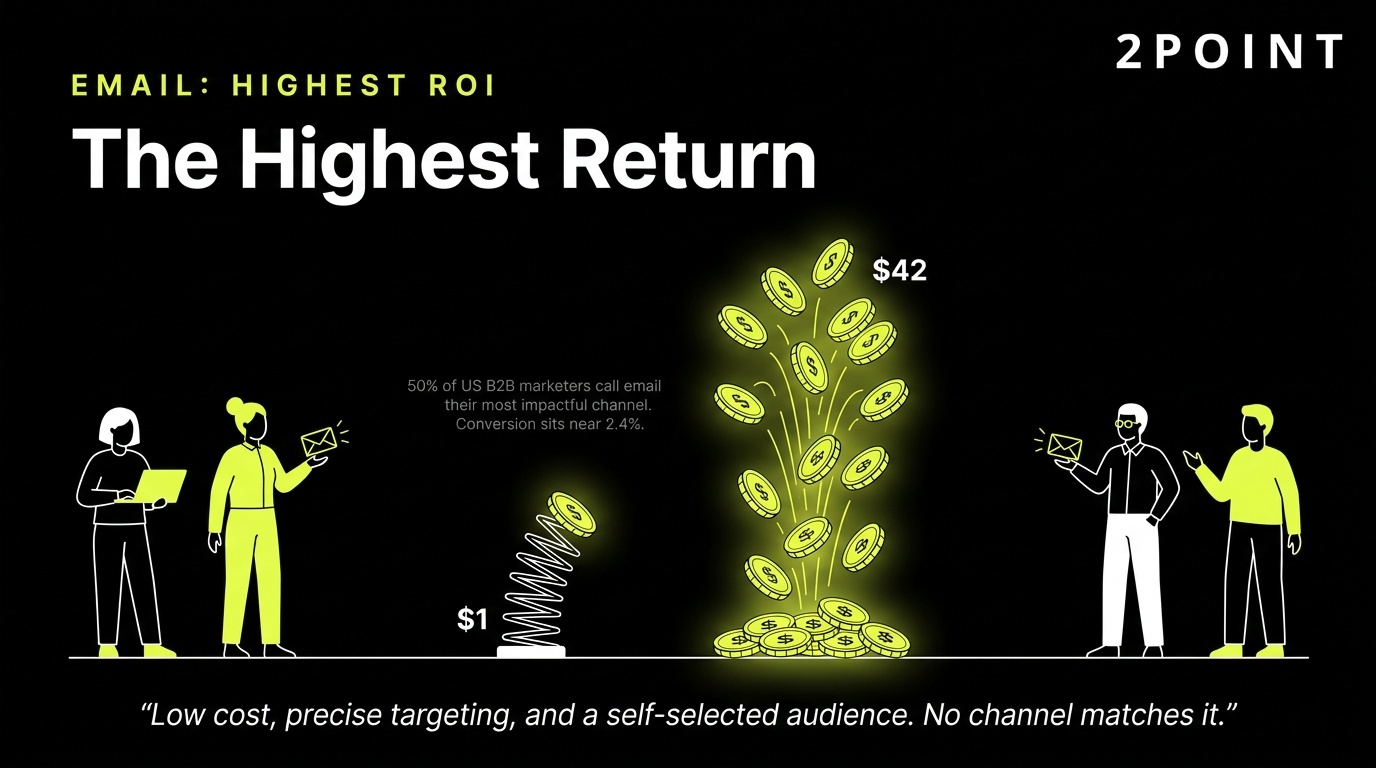
Among all B2B marketing channels, email delivers the most consistently high return on investment by a significant margin. Email marketing generates $42 in return for every $1 spent, a ratio that no other B2B channel matches at scale. This extraordinary ROI reflects email's combination of low cost, high targeting precision, and direct access to a self-selected audience. Subscribers have already indicated interest, which means the conversion environment is fundamentally different from interruptive advertising.
The scale and trajectory of email marketing investment confirms its importance. B2B email marketing revenue is projected to reach $13.69 billion in 2025, up from $7.5 billion in 2020, a trajectory that reflects sustained confidence in the channel's effectiveness. 50% of US B2B marketers consider email the most impactful component of their multichannel marketing strategy, which aligns with the ROI data and validates continued investment priority.
The B2B email conversion rate is approximately 2.4%, slightly below the B2C average of 2.8%, which reflects the longer and more complex B2B decision process rather than any fundamental weakness in the channel. The email marketing strategy framework that drives top performance in B2B includes four components. Segmentation ensures that different buyer types and stages receive content appropriate to their context. Personalization goes beyond variable substitution to reflect genuine understanding of the recipient's role, industry, and challenges. Automation sequences nurture contacts through the buyer journey without requiring manual intervention for every touchpoint. Testing discipline, applied systematically to subject lines, content formats, send times, and calls to action, continuously improves performance over time.
LinkedIn and Social Media Lead Generation for B2B
LinkedIn has established clear dominance as the B2B social media platform, and the data supporting that position is extensive. 85% of B2B marketers view LinkedIn as the most effective social media channel for their marketing objectives, and 62% report that LinkedIn generates leads at twice the rate of other social platforms. These figures reflect LinkedIn's unique combination of professional context, decision-maker audience, and targeting capabilities that simply do not exist elsewhere in social media.
The platform's adoption for specific B2B functions is nearly universal. 89% of B2B marketers use LinkedIn specifically for lead generation, and 62% report that it produces effective results. 42% of marketers actively use LinkedIn today, representing an 11% increase from 2024, confirming that adoption is still growing despite the platform's maturity. The combination of organic content, thought leadership publishing, sponsored content, and targeted advertising makes LinkedIn a genuinely multi-format B2B channel.
Beyond LinkedIn, the social media landscape for B2B is evolving. 87% of B2B marketers use social media platforms to share and distribute content, and 84% use paid social advertising as part of their channel mix. YouTube is gaining significant traction as a B2B research platform, particularly for product demonstrations and technical education. Instagram and TikTok are finding B2B audiences in specific verticals where visual content and short-form video align with buyer behavior. The key is not to be everywhere but to be present with relevant content where your specific buyers are actually active. Using social media marketing metrics to track which platforms drive genuine pipeline, rather than just vanity engagement, is the discipline that keeps channel investment productive.
B2B Marketing Budget Allocation and Investment Priorities
B2B organizations invest a smaller percentage of total revenue in marketing than their B2C counterparts, and the gap is significant. B2B organizations spend an average of 8.7% of total budget on marketing, compared to 14.3% for B2C product companies and 10.8% for B2C services companies. This structural difference reflects the longer sales cycles and relationship-intensive nature of B2B commerce, where individual deals carry larger revenue per customer and the cost of a lost relationship is proportionally higher.
The trend line is optimistic for those seeking to build the case for marketing investment. 83% of B2B marketing leaders expect their budgets to increase over the next 12 months, reflecting confidence in marketing's contribution to pipeline. Average B2B marketing budget growth is running at 8.9% overall, with nearly 12% specifically flowing into digital channels, confirming that digital is where incremental investment is being directed.
The pressure dynamic is real, however. 32% of B2B marketing teams experienced budget decreases in 2025, creating a two-speed market where well-resourced teams are pulling ahead while constrained teams struggle to maintain visibility. For teams operating under budget pressure, the channel ROI data above provides a principled basis for prioritization. Email, LinkedIn, and SEO-driven content consistently deliver the highest returns relative to investment, making them the defensible core around which other channels can be added as resources allow. Using data analytics to demonstrate channel-specific ROI to budget decision-makers is increasingly the mechanism through which marketing leaders protect and grow their investment.
Where Top B2B Marketing Performers Invest in 2026
The investment priorities of high-performing B2B marketing organizations reveal a clear strategic pattern: they concentrate spending where trust, reach, and conversion intersect. 61% of top performers are increasing video content investment, 52% are adding to thought leadership content, 40% are growing paid advertising spend, and 40% are deploying AI specifically for content optimization. These four priorities cluster around the same underlying logic: reach buyers where they are already consuming information, earn their trust through valuable content, and use technology to do it more efficiently.
The balance between lead generation and brand building is notable. 36% of top B2B marketing performers are investing in lead generation capabilities while 30% are investing in brand building, reflecting the industry's increasing recognition that long-term commercial results require both short-term pipeline development and sustained brand equity. Organizations that invest only in lead generation eventually exhaust market attention; those that only invest in brand eventually lose commercial momentum. The portfolio allocation matters.
Digital advertising investment at the market level confirms the channel's scale. B2B digital advertising spending is expected to reach $19.22 billion, reflecting the enormous collective bet on digital channels as the primary medium for B2B demand generation. For individual organizations building their investment framework, the decision should be informed by channel-specific ROI data, audience concentration in specific platforms, and the sales motion that needs to be supported. A transactional B2B product with a short sales cycle may prioritize paid search and email; a complex enterprise solution may weight more heavily toward thought leadership, events, and account-based advertising.
Building a Data-Driven B2B Marketing Operation
Strategy without measurement is speculation. The organizations that consistently outperform in B2B marketing are not necessarily those with the biggest budgets or the most creative campaigns. They are the ones that have built measurement systems rigorous enough to know what is working, disciplined enough to act on that knowledge, and sophisticated enough to connect marketing activity to revenue outcomes. Building a data-driven B2B marketing operation is an ongoing process rather than a one-time system implementation.
Essential B2B Marketing Metrics and Benchmarks
The measurement framework for a high-performing B2B marketing operation covers several interconnected metric categories. The most important B2B marketing benchmarks include cost per lead (CPL), conversion rate, customer acquisition cost (CAC), pipeline velocity, and return on advertising spend (ROAS). High-performing organizations also track click-through rate (CTR) and marketing qualified lead (MQL) volume as leading indicators of campaign effectiveness before pipeline impact is measurable.
| B2B Marketing Metric | What It Measures | Strategic Importance |
|---|---|---|
| Cost Per Lead (CPL) | Efficiency of lead acquisition spending | Identifies most cost-effective channels |
| Conversion Rate | Percentage of leads becoming opportunities or customers | Reveals quality of targeting and messaging |
| Customer Acquisition Cost (CAC) | Total investment required to acquire one customer | Informs pricing, retention, and growth sustainability |
| Pipeline Velocity | Speed at which leads move through the funnel | Identifies bottlenecks in the buying process |
| Return on Ad Spend (ROAS) | Revenue generated per dollar of advertising | Guides paid channel investment decisions |
| Marketing Qualified Leads (MQLs) | Volume of leads meeting predefined quality criteria | Leading indicator of future pipeline contribution |
| Click-Through Rate (CTR) | Engagement rate on content and ads | Signals relevance of messaging to target audience |
Tracking these seven metrics together provides a complete view of marketing efficiency, quality, and commercial impact rather than isolated performance signals.
Conversion rate benchmarks for B2B vary significantly by channel and vertical. The average B2B e-commerce conversion rate sits under 2%, with substantial variation by product category, price point, and buying complexity. The encouraging finding is that improving conversion has become structurally more accessible: 56% of B2B marketers say it is easier to improve conversion rates today than it was a decade ago, primarily because of better analytics tools, more sophisticated testing capabilities, and richer behavioral data. The constraint today is less about tooling and more about organizational commitment to continuous optimization.
Overcoming Data and Measurement Challenges in B2B Marketing
Even organizations with strong analytics tools often struggle to make data-driven decisions confidently. The most common barrier is not a lack of data but a lack of connected, trustworthy data. Scattered or missing data is identified as the primary barrier to confident marketing decision-making in B2B organizations, creating situations where teams have abundant metrics but cannot connect them to business outcomes.
The downstream consequences of measurement gaps show up in buyer experience and pipeline quality. 73% of B2B buyers actively avoid suppliers who send irrelevant outreach, a behavior that reflects the real cost of poor data: when marketers do not know enough about their audience's context, needs, and stage, they default to generic messaging that repels rather than attracts. 69% of B2B buyers report experiencing inconsistencies between a vendor's website messaging and what their salespeople actually say, a specific data failure that creates trust erosion at the moment of highest commercial sensitivity.
The measurement gaps that most directly affect pipeline performance are concentrated in nurture and personalization. 59% of B2B marketing leaders identify underperforming lead nurture sequences as a significant problem, and 52% point to data-driven personalization as the key capability needed to close the gap. These two findings together point to the same solution: better data infrastructure that enables more relevant, more timely, more stage-appropriate communication with buyers throughout their research and evaluation process. Analyzing customer journeys with precision is what makes personalized nurture sequences possible rather than aspirational.
Analytics and Continuous Optimization Framework for B2B
Measurement is only valuable if it drives action. The analytics framework that actually improves B2B marketing performance is built on a continuous cycle: measure, analyze, test, implement, and measure again. Monitoring results closely and adapting strategies based on audience engagement is the only reliable way to confirm that a B2B content strategy is working rather than simply being executed.
The practical optimization process for B2B marketing includes several specific disciplines. Experimenting with different content types, formats, and lengths reveals which combinations resonate most strongly with specific audience segments. Testing different promotion strategies, from organic social to paid amplification to email nurture, identifies the distribution mix that delivers the best reach-to-conversion ratio. Tracking which distribution channels yield the highest-quality leads, not just the most leads, is critical for resource allocation. A channel that generates 10 highly qualified leads consistently outperforms one that generates 100 unqualified ones.
The optimization cadence matters as much as the metrics themselves. Monthly reviews of campaign performance, quarterly reviews of channel strategy, and annual reviews of overall marketing strategy create a structured rhythm for continuous improvement without generating paralysis from over-analysis. Organizations that review performance too infrequently miss opportunities to optimize campaigns while they are running. Those that review too frequently often make reactive decisions based on statistical noise rather than genuine signal. Finding the right cadence for your team's scale and pace of activity is itself a strategic decision worth deliberate attention.
Channel ROI Comparison and Resource Allocation in B2B Marketing
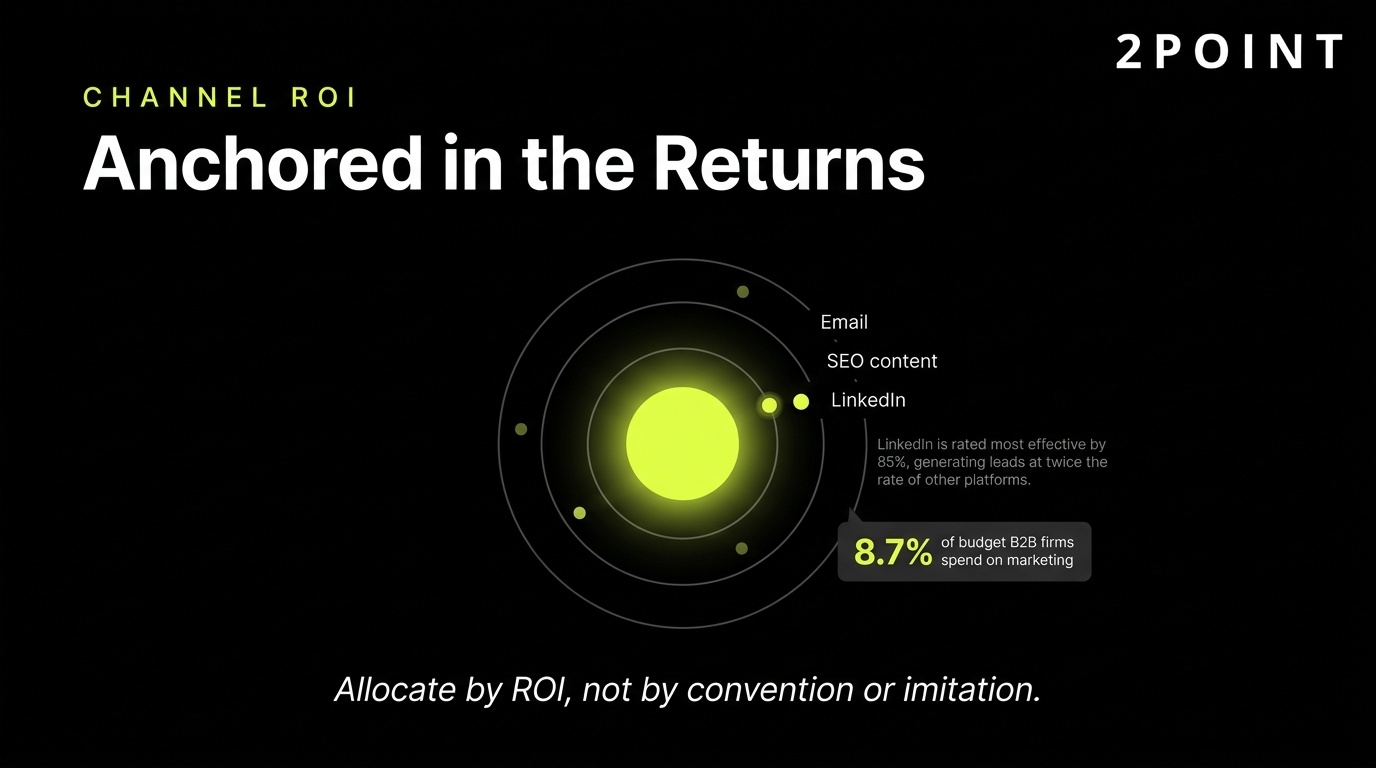
When resources are finite, which they always are, channel ROI data is the most important input to allocation decisions. The highest-return channels for B2B marketing in 2024 and 2025 have shown a consistent ranking that should inform investment priorities. The top three ROI channels for B2B are website and blog with SEO, paid social media advertising, and social shopping tools. This ranking reflects the primacy of organic search visibility, the targeting precision of paid social, and the growing importance of social commerce even in B2B contexts.
| B2B Marketing Channel | Primary Strength | ROI Rank | Key Consideration |
|---|---|---|---|
| Website, Blog, and SEO | Long-term organic visibility and trust | 1st | Compounding returns over time |
| Paid Social Media | Precise targeting of decision-makers | 2nd | Requires active budget management |
| Email Marketing | Highest absolute ROI at $42 per $1 spent | Top overall | List quality determines performance |
| LinkedIn Advertising | Professional audience, 2x lead rate | High | Higher CPL than other platforms |
| Events and Experiential | Relationship depth and pipeline acceleration | Variable | High cost per touch, high conversion |
| Video Content | Engagement and conversion across funnel stages | Rising | Production investment required |
Email and SEO-driven content consistently deliver the highest returns relative to investment, making them the essential core of any B2B marketing channel strategy regardless of total budget level.
SEO remains highly effective for B2B even as buyer research increasingly begins in AI chat interfaces. Search engine optimization continues to deliver strong results for B2B organizations despite the growing role of AI-powered search tools, because the content quality and authority signals that drive SEO performance also improve visibility in AI-generated answers. 41% of B2B marketing leaders are actively exploring updates to their SEO strategy to account for changes in how buyers search, which signals that the discipline is evolving rather than declining. The organizations that update their SEO approach to incorporate AEO principles alongside traditional ranking factors will have visibility across both traditional and AI-powered search simultaneously.
Content Strategy Framework for B2B Marketing Success
A B2B content strategy built on guesswork, gut instinct, or competitive imitation rarely outperforms one built on systematic research, clear objectives, and rigorous measurement. The framework described here is designed to be comprehensive without being bureaucratic, providing enough structure to drive consistent quality while remaining flexible enough to respond to market feedback and buyer behavior changes.
Six Essential Components of a High-Performing B2B Content Strategy
High-performing B2B content strategies share six foundational components that, when all are in place, create the conditions for sustained content performance across channels and over time. These six components are: precise audience definition, competitive landscape analysis, clearly defined objectives, measurement frameworks, customer journey mapping, and relationship-building mechanisms. Organizations that skip any of these components typically produce content that performs well in one dimension but fails in another, such as content that gets traffic but does not convert, or content that converts but runs out of topics quickly because the audience was defined too narrowly.
Before building new content strategy, a thorough audit of existing content is an indispensable starting point. A thorough content audit reveals high-potential assets that can be updated and promoted more aggressively, outdated content that is diluting domain authority, and gaps in the buyer journey where no content currently exists. Without this audit, organizations risk duplicating effort, missing quick wins, and building new strategy on top of a content foundation that is undermining rather than supporting their goals.
The resource challenge is real and common. Adapting marketing strategies based on research requires both the discipline to gather and analyze data and the organizational flexibility to act on what the data reveals. 45% of B2B organizations lack a scalable content production model, and 54% cite resource constraints as a primary barrier to content strategy execution. These constraints are best addressed through prioritization and repurposing rather than simply increasing headcount: identifying the highest-impact content types and topics, producing them with genuine quality, and then systematically repurposing each asset across multiple formats and channels.
B2B Lead Generation: Building a Systematic Pipeline Development Process
B2B lead generation is the conversion mechanism that connects content marketing investment to commercial outcomes. It is not a separate function from content strategy. It is the natural outcome of a content strategy that is deliberately designed with buyer progression in mind rather than just audience building. Value propositions that are clear, specific, and differentiated are the foundation on which effective lead generation is built.
The most effective B2B lead generation approaches in 2026 combine inbound content with targeted outbound, use gated assets strategically at the evaluation stage, and align nurture sequences to the actual stage and behavior of each lead rather than to a calendar-based drip. The distinction between volume lead generation and quality lead generation is critical: generating 500 leads who are poorly matched to your solution is less valuable than generating 50 who are genuinely evaluating your category. Competitor marketing strategies can provide useful intelligence for identifying positioning gaps where your organization can own a specific buyer problem more credibly than alternatives.
Account-based marketing (ABM) has become the dominant lead generation philosophy for enterprise B2B, because it aligns the entire go-to-market motion, from content creation to advertising to sales outreach, around a defined list of high-priority accounts. ABM produces fewer leads but significantly higher conversion rates, because every touchpoint is designed around the specific context of a specific account rather than generic audience assumptions. The infrastructure required for effective ABM includes good account data, cross-functional alignment between marketing and sales, and the flexibility to customize content and messaging at the account level without losing efficiency. Customer reviews and reference customers from similar industries or verticals are particularly powerful ABM assets because they speak directly to the concerns of targeted accounts.
B2B Marketing Automation: Scaling Without Losing Personalization
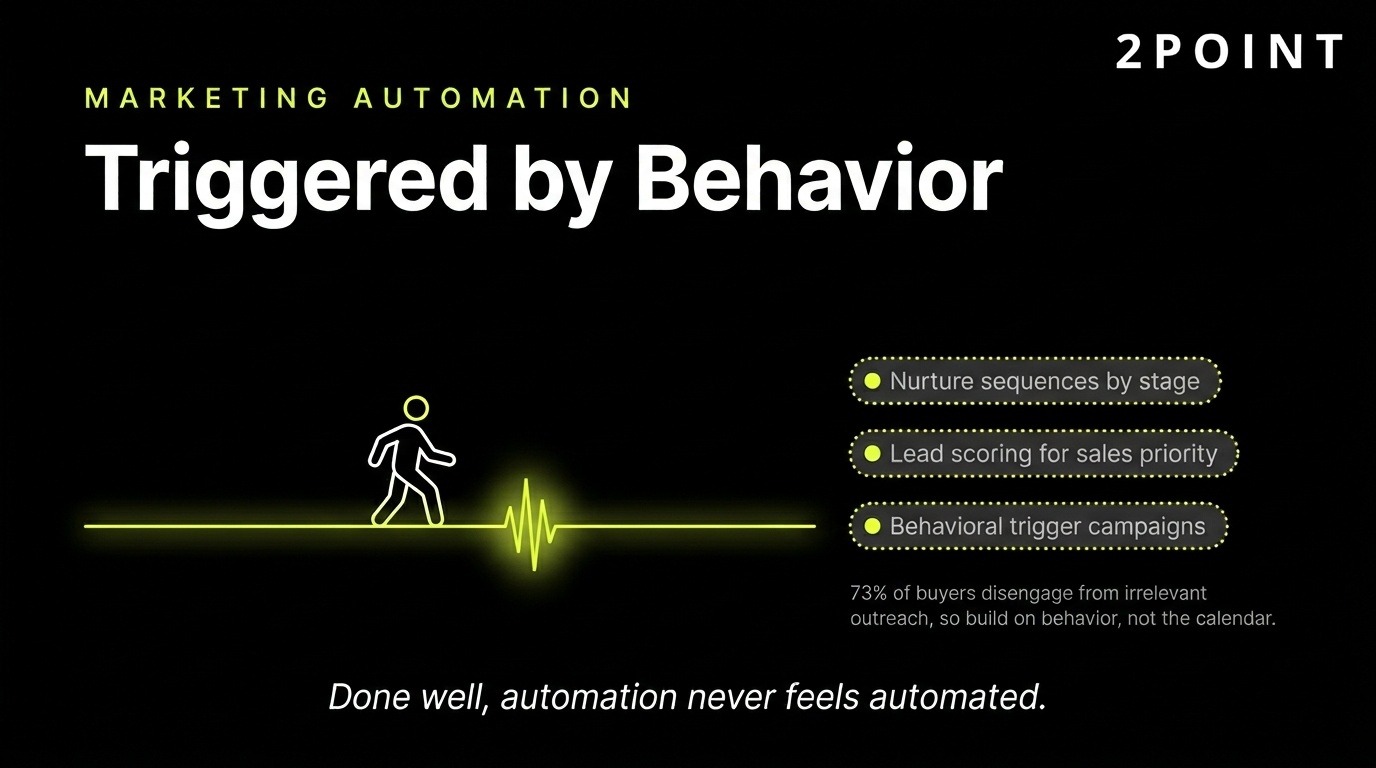
Marketing automation is the infrastructure layer that enables B2B organizations to maintain consistent, personalized communication with large numbers of leads and customers without requiring manual intervention at every touchpoint. When implemented well, automation does not feel automated to the recipient. It feels timely, relevant, and responsive because it is triggered by behavior rather than scheduled by calendar.
The core use cases for B2B marketing automation include lead nurture sequences that guide buyers through the research and evaluation stages, lead scoring systems that help sales teams prioritize their attention on the highest-intent prospects, behavioral trigger campaigns that respond to specific actions like downloading a resource or visiting a pricing page, and renewal and expansion communications for existing customers. Each of these applications delivers a different kind of value, but all share the same underlying principle: using data about buyer behavior to send more relevant communication at more appropriate moments than manual processes could achieve.
The risk with automation is the same as with AI content generation: speed and scale at the cost of relevance. Automated nurture sequences that do not adapt to buyer behavior quickly become irrelevant, and irrelevant outreach is the thing that 73% of B2B buyers say causes them to disengage from a supplier entirely. The solution is to build automation sequences around behavioral logic rather than time-based logic, and to create explicit off-ramps for contacts who are no longer engaging so that they are not continued into sequences that damage the relationship. Content marketing integrated with automation performs best when the content being delivered at each stage is genuinely stage-appropriate rather than generically educational.
B2B Digital Marketing Trends Shaping the Next Phase
The B2B digital marketing landscape is not static, and organizations that optimize for today's best practices without monitoring emerging trends risk being caught off-guard by shifts that reshape buyer behavior and competitive dynamics. The trends with the highest strategic impact for B2B marketing over the next 12 to 24 months cluster around five themes: AI integration, trust architecture, buyer self-service, search diversification, and experience personalization at scale.
AI integration will continue to accelerate across every function of B2B marketing, from content creation and optimization to lead scoring and campaign management. The organizations that will extract the most value from this acceleration are those that have built the quality control and governance frameworks discussed earlier, because they can move faster without sacrificing the brand integrity that trust requires. The arms race in AI-generated content volume will intensify, which paradoxically increases the value of human-authored, expert-level content for those willing to invest in it.
Buyer self-service capabilities will become a standard expectation rather than a differentiator, requiring B2B organizations to invest in digital infrastructure that enables buyers to understand, evaluate, and even trial solutions without requiring a sales touchpoint. This shift does not eliminate sales; it repositions sales toward the high-stakes moments where human judgment, context, and relationship management genuinely add value. The B2B organizations that understand this repositioning and build their go-to-market accordingly will create more efficient revenue models and better buyer experiences simultaneously. Organizations like 2POINT that work at the intersection of strategy and execution can help businesses navigate this kind of structural go-to-market transformation with both the analytical rigor and the creative capability the moment requires.
The convergence of user-generated content, peer review platforms, and community-based buying signals is also reshaping how B2B brands earn visibility and credibility. As buyers increasingly rely on community knowledge and peer networks rather than vendor-produced content for their research, the brands that have invested in genuine customer communities and have cultivated a base of enthusiastic advocates will have structural advantages that paid advertising cannot replicate. Building that community takes time, but the competitive moat it creates is durable in a way that campaign-driven visibility is not.
B2B vs B2C Marketing: Understanding the Critical Differences
While B2B marketing and B2C marketing share foundational principles of audience understanding, value communication, and channel strategy, the differences between them are significant enough to require distinct approaches, metrics, and organizational structures. Conflating the two leads to B2B strategies that mimic consumer marketing instincts without accounting for the structural realities of business purchasing.
| Marketing Dimension | B2B Marketing | B2C Marketing |
|---|---|---|
| Decision-Makers | Multiple stakeholders (3 to 8 people) | Typically one individual |
| Sales Cycle Length | Weeks to months (average 10.1 months) | Minutes to days |
| Purchase Value | High, often six to seven figures | Lower, often tens to hundreds of dollars |
| Buying Motivation | ROI, efficiency, risk reduction | Emotion, identity, convenience |
| Content Strategy | Education, thought leadership, case studies | Entertainment, aspiration, lifestyle |
| Top ROI Channel | Website, SEO, email | Email, paid social, content marketing |
| Marketing Budget as Percentage | 8.7% of revenue | 10.8% to 14.3% of revenue |
| Primary Trust Signal | Peer validation, analyst credibility | Brand perception, social proof |
The most important structural difference between B2B and B2C marketing is the multi-stakeholder decision process in B2B, which requires content and messaging strategies that address multiple roles, concerns, and objections simultaneously rather than a single buyer's singular motivation.
The emotional dimension of B2B buying is often underestimated. While B2B decisions are framed in rational terms, including ROI, risk, and efficiency, the people making those decisions are still humans with careers, reputations, and organizational dynamics to navigate. Fear of making a wrong choice, desire to appear competent to peers and supervisors, and the political dynamics of advocating for a specific vendor inside an organization all influence B2B purchasing decisions in ways that purely rational analysis does not capture. B2B marketing that acknowledges and addresses these human dimensions while supporting the rational case outperforms marketing that treats buyers as purely logical actors.
Conclusion: Building a B2B Marketing Strategy That Compounds Over Time
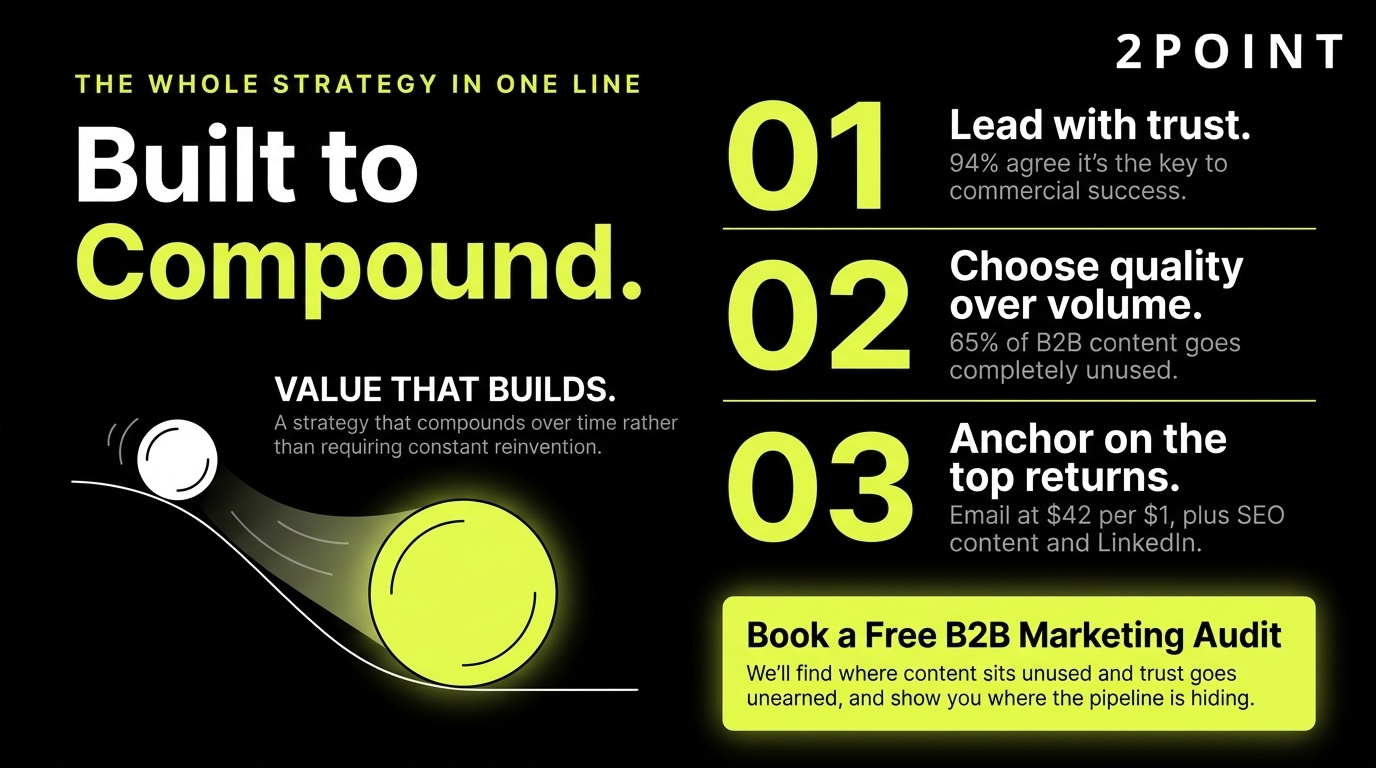
B2B marketing in 2026 rewards the organizations that approach it with both strategic rigor and genuine human understanding. The data reviewed throughout this guide points consistently toward a set of principles that define high-performing B2B marketing operations: trust as the foundation, quality over volume in content, buyer-centric journey mapping, multi-channel distribution built around ROI data, and continuous measurement-driven optimization.
The AI revolution is real and accelerating, but it is not the dominant variable. The organizations using AI to amplify human insight and strategic depth are outperforming those using it as a replacement for genuine expertise. As content volume continues to increase across every channel, the scarcity that matters most is authentic perspective and genuine usefulness, and those qualities remain fundamentally human in origin even when assisted by powerful tools.
The buyer journey has restructured around digital self-service, peer validation, and consumer-grade experience expectations. Meeting buyers in this new landscape means being present with relevant, trustworthy content earlier in the research process, enabling self-service without abandoning the human connection that closes complex deals, and building the brand reputation that makes your organization recognizable and credible before the formal evaluation begins.
The channel and budget data is clear: email, SEO-driven content, and LinkedIn anchor most high-performing B2B marketing programs, while video investment is accelerating and events retain irreplaceable relationship-building value. Allocating resources according to channel ROI rather than convention or competitive imitation is what separates efficient marketing investment from spending that produces volume without commercial return.
For organizations looking to build or rebuild their B2B marketing capability with all of these factors in mind, the best starting point is honest assessment: Where does your current strategy underserve buyers? Where is your content investment producing unused assets instead of pipeline? Where is trust being assumed rather than earned? Answering these questions with data and candor is the foundation of a B2B marketing strategy that compounds in value over time rather than requiring constant reinvention. 2POINT exists to help businesses tackle exactly these questions with the strategic depth and executional precision that 2026's competitive environment demands.
Frequently Asked Questions About B2B Marketing
What is B2B marketing and how does it differ from consumer marketing?
B2B marketing is the practice of promoting products or services from one business to another, involving longer sales cycles, multiple decision-makers, and purchases driven by ROI and efficiency rather than emotion. Unlike consumer marketing, which typically targets an individual's personal desires, B2B marketing must address the concerns of entire buying committees ranging from end users to executives to procurement teams.
What are the most effective B2B marketing channels in 2026?
The highest-ROI B2B marketing channels are email (delivering $42 per $1 spent), SEO-driven website and blog content, and LinkedIn advertising. Video content and thought leadership are the fastest-growing investment areas, while in-person events continue to deliver strong pipeline acceleration for relationship-intensive sales motions.
How long is the average B2B sales cycle?
The average B2B sales cycle in 2025 is approximately 10.1 months, down from 11.3 months in 2024, driven by better-informed buyers and smaller decision-making committees. However, cycle length varies significantly by product complexity, deal size, and industry vertical.
Does AI help or hurt B2B marketing performance?
AI improves efficiency when used for brainstorming, data analysis, and workflow automation, but it creates risk when used as a replacement for genuine human expertise and perspective. 75% of B2B marketers say AI gives them a competitive advantage, but 65% of AI-generated content goes unused by sales teams, revealing a quality gap that organizations must actively manage.
What is the most important factor in B2B marketing success?
Trust is the single most important factor, with 94% of B2B marketers agreeing on its centrality to commercial success. Trust is built through consistent delivery of relevant, expert content, authentic peer validation, and demonstrated understanding of buyer challenges rather than through campaign-driven brand messaging.
How is B2B content marketing different from B2C content marketing?
B2B content marketing prioritizes education, thought leadership, case studies, and technical depth because B2B buyers need to justify purchases to committees and manage organizational risk. B2C content marketing more commonly relies on emotional storytelling, lifestyle aspiration, and entertainment to drive individual consumer decisions.
What percentage of B2B buyers research online before contacting a vendor?
89% of B2B buyers research products online before making a purchase, and 71% begin with a generic search query rather than a branded one. This means B2B content strategy must address the problem-definition and category-education stages of the buyer journey, not just product comparison and evaluation.
How should B2B marketing budgets be allocated across channels?
B2B marketing budgets should anchor on the highest-ROI channels first: email, SEO-driven content, and LinkedIn advertising. Incremental budget should be directed toward video content, thought leadership, and events based on your specific sales motion and audience concentration. Track channel-specific pipeline contribution rather than vanity metrics to make allocation decisions based on actual commercial return.
What is B2B marketing automation and when should it be used?
B2B marketing automation uses software to send relevant communications triggered by buyer behavior rather than scheduled by calendar, enabling consistent engagement with large numbers of leads without manual effort. It works best for lead nurture sequences, lead scoring, behavioral trigger campaigns, and renewal communications, but requires behavioral logic and quality content to avoid becoming irrelevant to buyers.
How do B2B marketers build trust with prospects who have never heard of their brand?
Building trust with unknown prospects requires a combination of high-quality educational content that addresses real problems, third-party validation from analysts and peer networks, customer case studies with specific and verifiable outcomes, and consistent presence across the channels where target buyers already spend time. Influencer and analyst relations are increasingly important trust-building mechanisms because external validators carry more credibility than vendor-produced content.
What B2B marketing trends matter most in 2026?
The five most impactful B2B marketing trends in 2026 are: AI-driven content at scale creating both opportunity and quality risk, trust and authenticity becoming primary competitive differentiators, buyer self-service expectations reshaping the sales and marketing motion, search diversification across AI tools and voice interfaces requiring AEO alongside SEO, and video content becoming a non-negotiable component of demand generation strategy.
Is LinkedIn still worth investing in for B2B lead generation?
Yes. 85% of B2B marketers consider LinkedIn the most effective social platform, and 62% report that it generates leads at twice the rate of other channels. LinkedIn adoption among B2B marketers has grown 11% year-over-year, and its combination of professional audience targeting, organic thought leadership publishing, and paid advertising capabilities makes it the highest-priority social platform for most B2B organizations.
