

 let’s connect


What Is Home Service Marketing?
Home service marketing refers to the strategies, channels, and tactics that businesses in trades and residential services use to attract, convert, and retain customers. It covers companies in HVAC, plumbing, electrical, roofing, landscaping, pest control, cleaning, and dozens of related fields. Before diving into the full guide, here is a direct answer to what home service marketing actually involves and why it matters right now:
- Home service marketing targets homeowners who need urgent or scheduled residential services.
- It differs from standard B2C marketing because decisions are urgency-driven, locally focused, and heavily trust-dependent.
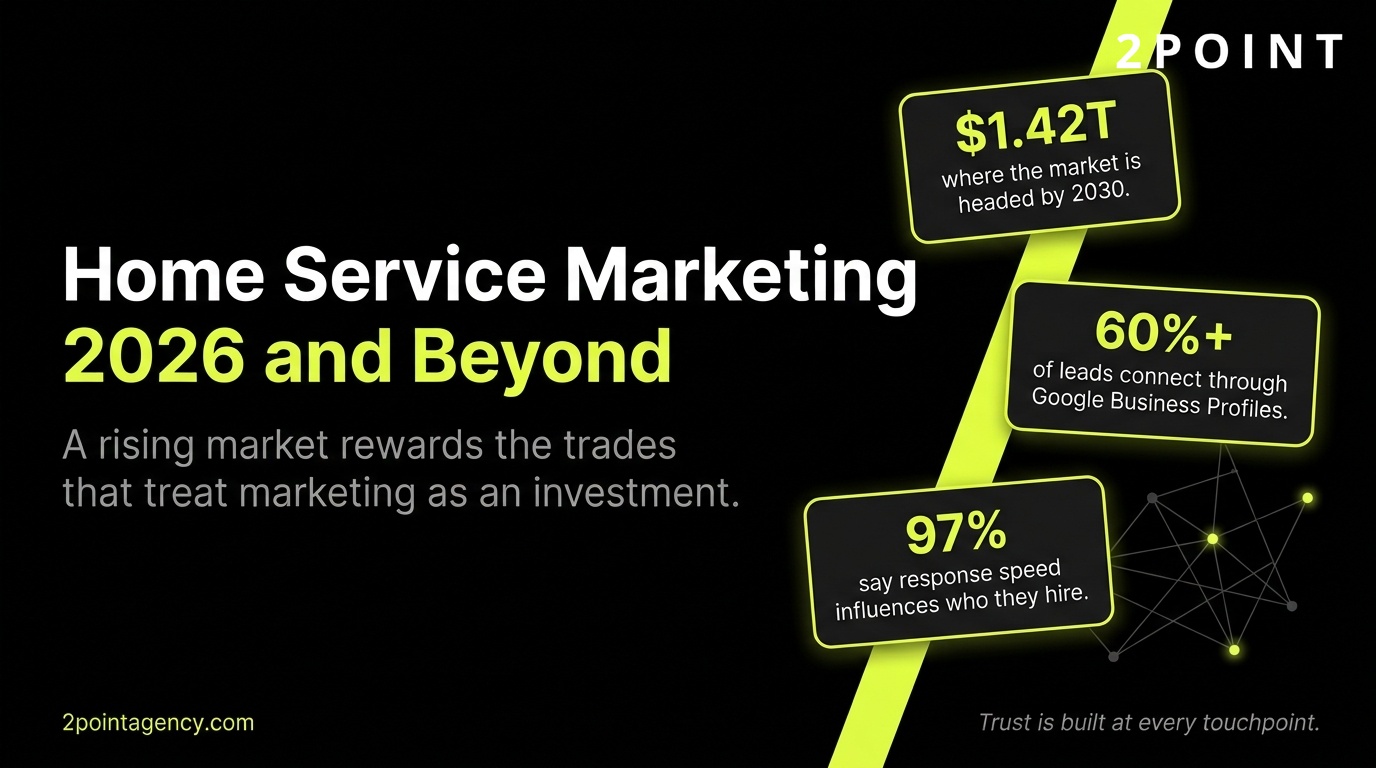
- The home services industry was valued at $870 billion in 2025 and is projected to reach $1.42 trillion by 2030.
- Effective home service marketing requires a digital-first approach centered on local search visibility.
- Google Business Profiles, local SEO, and paid search ads drive the majority of inbound leads.
- Online reviews and response speed influence hiring decisions more than price in most service categories.
- AI tools and automation are now active components in top-performing home service marketing programs.
- The businesses that treat marketing as an investment rather than an expense capture the largest market share.
The Home Services Marketing Landscape in 2026
The home services industry is entering one of the most consequential periods in its history. Market consolidation, digital acceleration, and dramatic shifts in consumer behavior are simultaneously reshaping how local service businesses must compete. For HVAC contractors, plumbers, electricians, roofers, and every other trade professional operating today, the rules of winning customers have fundamentally changed.
Understanding the current landscape is not optional background reading. It is the strategic foundation that determines which marketing investments make sense, where competition is most fierce, and which opportunities remain wide open for businesses willing to move decisively. The macro trends visible in 2026 will define competitive positioning through the remainder of the decade, making this a uniquely important moment to get your marketing strategy right.
Two forces are pressing on home service businesses from opposite directions. From above, private equity consolidators with sophisticated marketing operations are acquiring local companies and raising competitive standards across every market they enter. From the consumer side, homeowners have become dramatically more digitally sophisticated, with expectations shaped by the seamless experiences they have in retail and hospitality. Meeting in the middle requires a professional, integrated marketing approach that most small operators have never had to develop before.
Market Size and Growth Projections Through the Decade
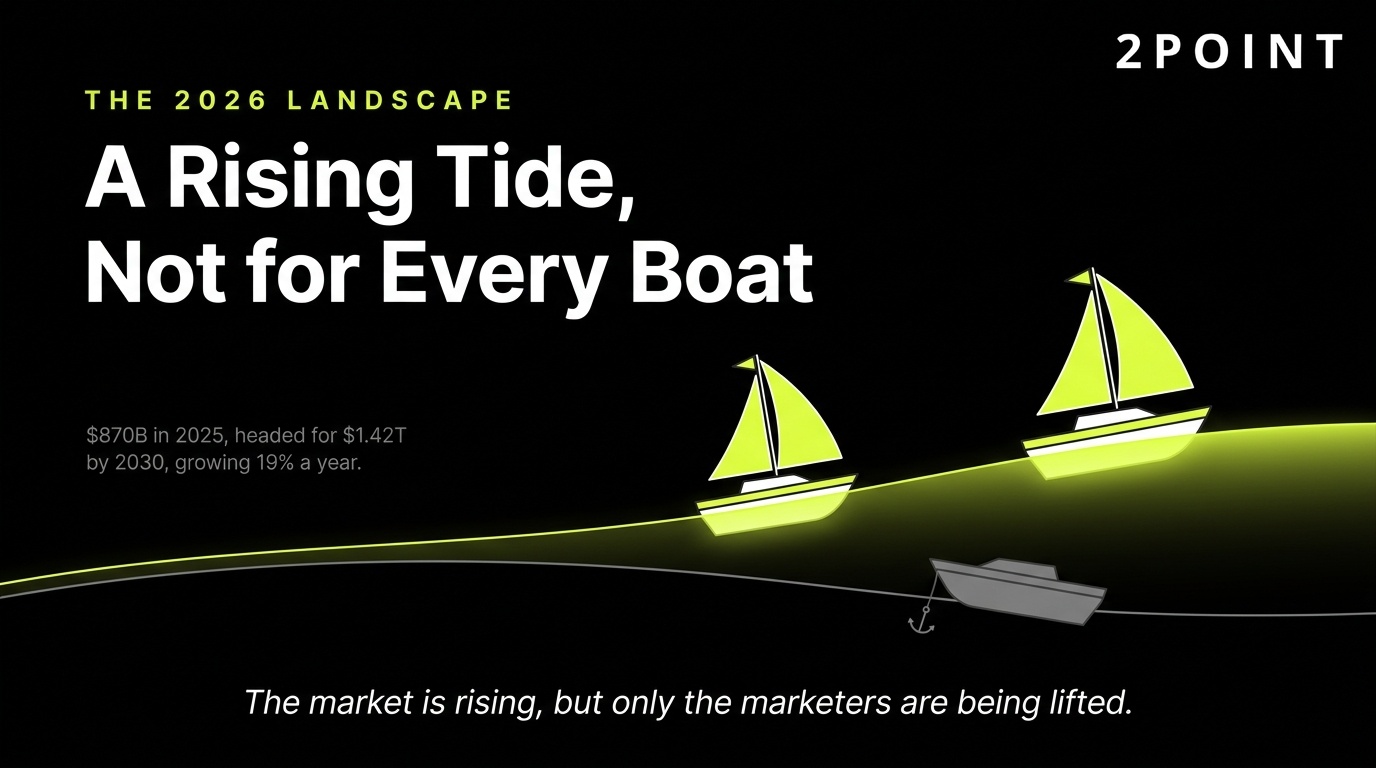
The numbers define the opportunity. The home services market reached approximately $870 billion in 2025 and is on a trajectory to reach $1.42 trillion by 2030, representing one of the most robust growth curves in any service sector of the American economy. This is not speculative optimism. It is driven by structural factors including aging housing stock, rising complexity in home systems, and the continued preference among homeowners to hire professionals rather than tackle repairs themselves.
The industry has seen a 19% annual growth rate through 2026, with specific subsectors outperforming even that impressive average. HVAC services, driven by climate volatility and aging equipment, represent one of the highest-growth categories. Plumbing, electrical modernization for EV charging infrastructure, and smart home integration services are also accelerating faster than the overall market average. For marketing-savvy businesses positioned to capture their share of this growth, the opportunity is extraordinary.
Importantly, this growth is not evenly distributed. Businesses that invest in professional marketing infrastructure are capturing disproportionate market share while under-marketers lose ground even in a rising tide. The market is growing, but it is simultaneously concentrating among operators who treat marketing strategies as a core business competency rather than an afterthought. That dynamic makes the strategic choices you make in 2026 more consequential than at any previous point in the industry's history.
The Competitive Reality: Private Equity and Industry Consolidation
Private equity investment in the home services sector has accelerated dramatically, with PE-backed consolidators systematically acquiring regional and local trades businesses across the country. These are not passive investments. The acquiring companies bring sophisticated digital marketing programs, centralized call centers, CRM platforms, and performance marketing expertise that most independent operators simply cannot match with existing resources.
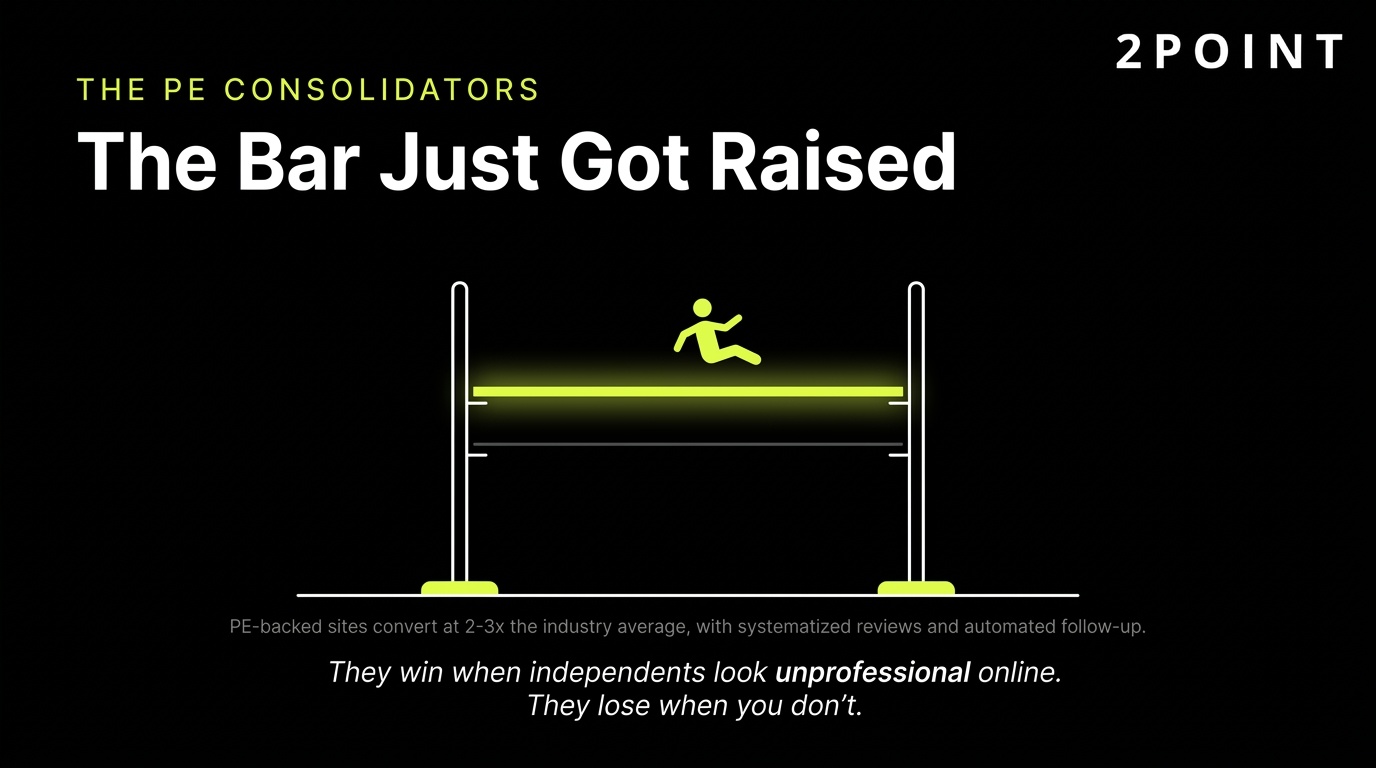
When a PE-backed competitor enters your market, the dynamic changes immediately. Their Google Business Profiles are meticulously optimized. Their websites convert at two to three times the industry average. Their follow-up sequences run automatically, reaching every lead multiple times across multiple channels. Their review generation is systematized, producing a steady stream of five-star ratings that push their listings to the top of local search results. For an independent plumber or HVAC contractor relying on word of mouth and a basic website, competing against this is genuinely difficult without a significant upgrade in marketing sophistication.
The silver lining for independent operators is authenticity and local roots. Homeowners frequently prefer local businesses when the quality of their digital presence signals trustworthiness and competence. The PE consolidators win when independent operators look unprofessional online. They lose when independent operators present themselves with equal professionalism while also delivering the genuine personal service that large roll-up operations struggle to replicate at scale. The competitive imperative is clear: professionalize your marketing or cede market share to operators who have.
Consumer Behavior Shifts Driving Marketing Evolution
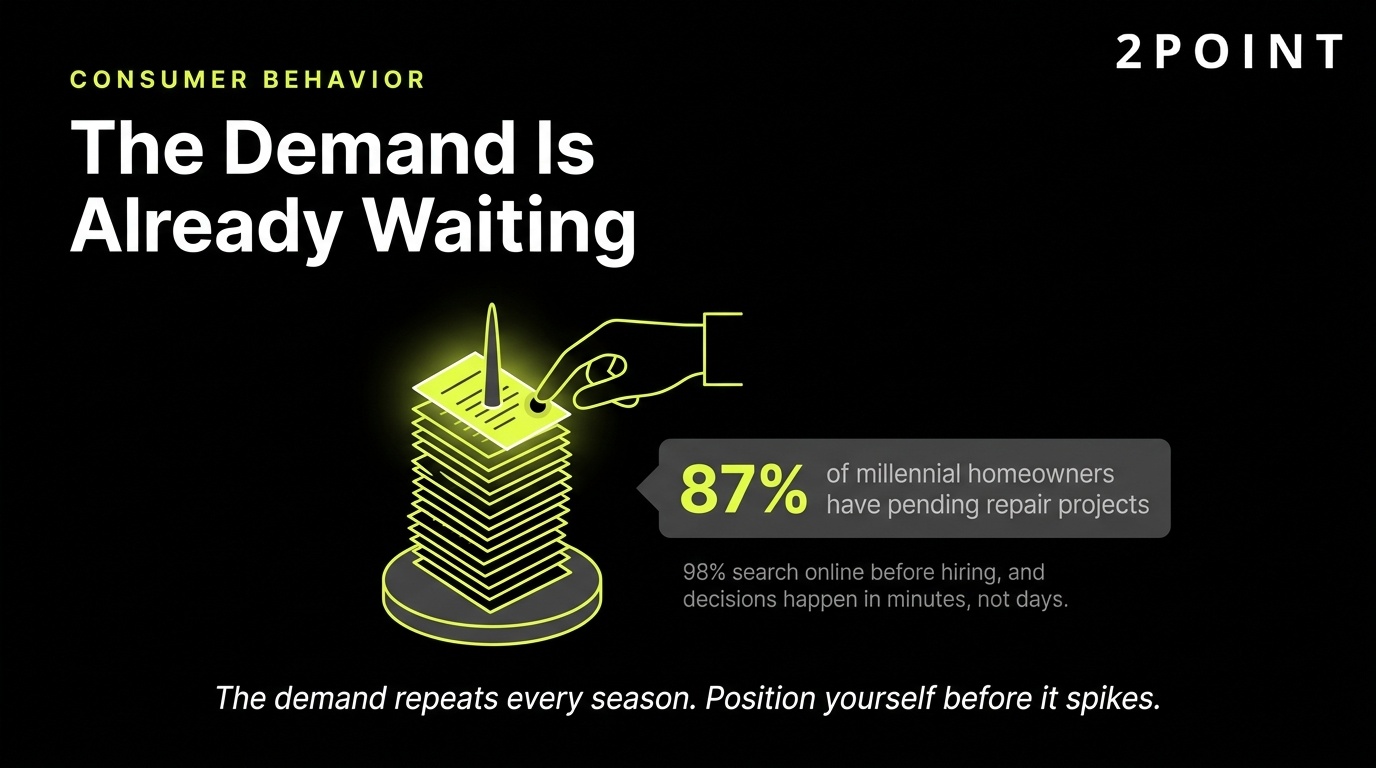
Ninety-eight percent of consumers now search online before hiring a home service provider, a figure that effectively makes digital presence a prerequisite for being considered at all. This is not a trend toward digital research. It is essentially universal behavior among homeowners who need any kind of service work. If your business is not findable online with a compelling, trustworthy presence, you are invisible to nearly every potential customer before they have even begun comparing options.
Decision timelines have also compressed dramatically. When a pipe bursts or an air conditioner fails on a 95-degree afternoon, homeowners are not conducting multi-day research projects. They are making decisions in minutes based on who appears first in local search results, who has the most and best reviews, and whose website makes it easiest to call or book. According to industry research, 87% of millennial homeowners currently have pending repair projects, representing a vast pool of demand that is actively looking for trustworthy providers at any given moment.
This deferred maintenance reality creates predictable, recurring demand that well-positioned home service businesses can capture systematically. The consumer who searches for an HVAC tune-up in spring, a furnace inspection in fall, or a gutter cleaning after the first big rainstorm is following patterns that repeat year after year. Marketing programs that anticipate these seasonal demand cycles and position businesses to appear exactly when that demand spikes are capturing leads at far lower cost than programs that react to demand rather than anticipating it. Aligning your marketing calendar with consumer behavior patterns is one of the highest-leverage actions available to any home service business in 2026.
Local SEO for Home Services: The Foundation of Every Marketing Strategy
Local SEO for home services is not one channel among many. It is the foundational infrastructure upon which every other marketing investment either succeeds or fails. When a homeowner searches for "plumber near me" or "HVAC repair in [city]," the businesses that appear in the top three local results receive the overwhelming majority of clicks, calls, and bookings. Everything else in your marketing strategy is competing for the fraction of attention that local search leaders leave on the table.
Seventy-six percent of people who search for a local service call or visit the business within 24 hours. That extraordinary conversion speed means local search visibility translates to revenue faster than almost any other marketing channel. A strong local SEO position is not just about website traffic. It is a direct driver of same-day phone calls, booked appointments, and jobs completed.
The local SEO ecosystem for home services in 2026 operates across several interconnected layers: Google Business Profile optimization, service area page development on your website, review generation and reputation management, and hyper-local targeting strategies that signal relevance to specific neighborhoods and communities. Neglecting any one of these layers weakens the entire structure. Building all of them deliberately creates a compounding competitive advantage that grows stronger over time.
Google Business Profile Optimization: Your Most Important Digital Asset
Your Google Business Profile is, without question, the single highest-priority digital asset for any home service provider. More than 60% of home service leads connect directly to Google Business Profiles, and a single suspension or penalty can devastate revenue overnight. This is not a set-it-and-forget-it asset. It requires ongoing attention, consistent updates, and strategic optimization to perform at the level that drives meaningful lead volume.
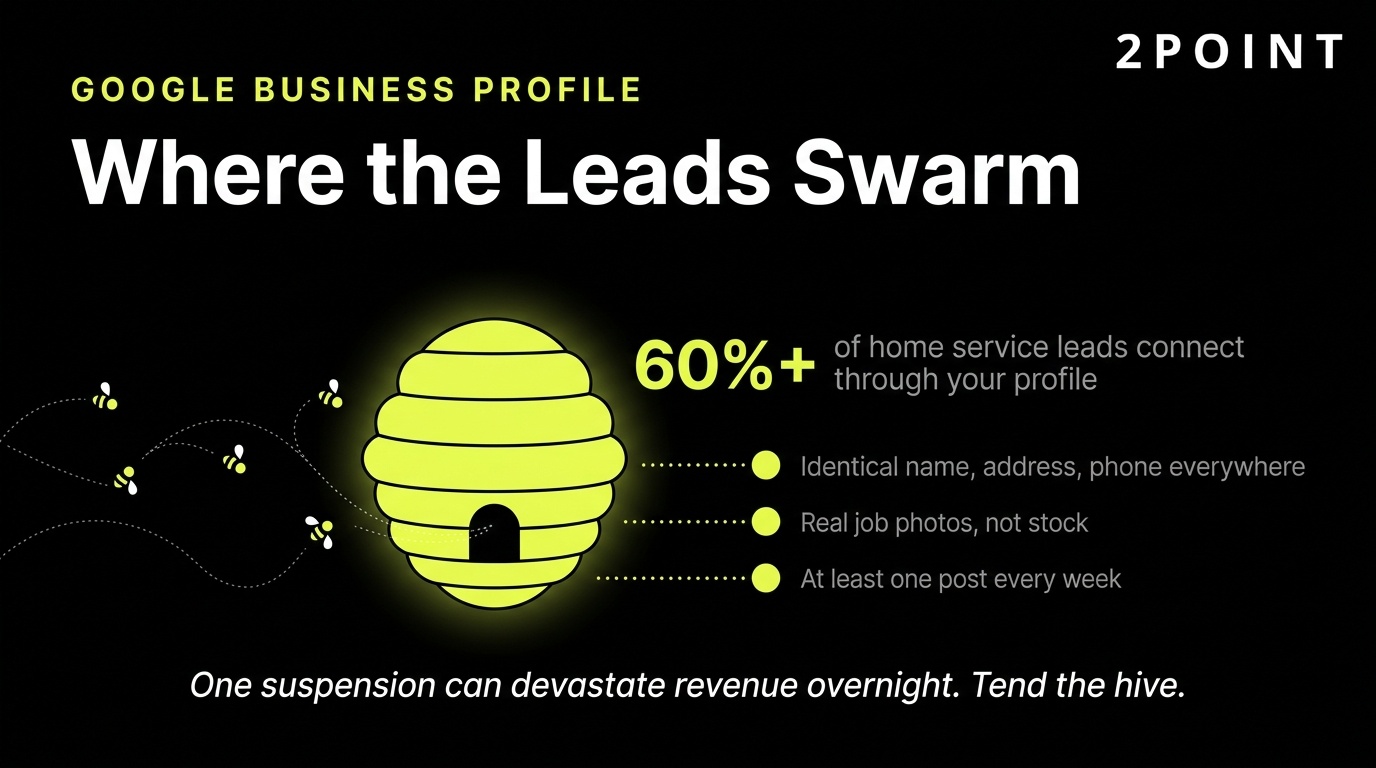
The essential optimization elements begin with NAP consistency: your business Name, Address, and Phone number must be identical across every online mention, from your GBP to your website to every directory listing on the internet. Discrepancies confuse both Google's algorithm and potential customers, suppressing your ranking and eroding trust. Beyond NAP, your primary and secondary category selections, business attributes (emergency service available, license number displayed, etc.), and service areas all communicate relevance signals that Google uses to determine when to show your listing.
Photography strategy matters more than most business owners realize. Profiles with photos receive significantly higher click-through rates than those without. The winning approach combines exterior and interior business photos, technician team photos in uniform, and most importantly, real photos of completed work that demonstrate quality and professionalism. Stock images underperform genuine job photos in every metric. Google Posts also play an active role. Publishing at minimum one post per week, featuring seasonal promotions, tips, and completed projects, signals to Google that your profile is actively managed and relevant, which correlates with higher local ranking positions.
Building a Service Area Pages Strategy That Ranks
Service area pages are dedicated website pages optimized for specific cities, neighborhoods, and zip codes within your operating area. A well-executed service area page strategy can dramatically expand your local search footprint beyond your primary business location, allowing you to rank for searches happening in every community you serve rather than just the city where your office is located.
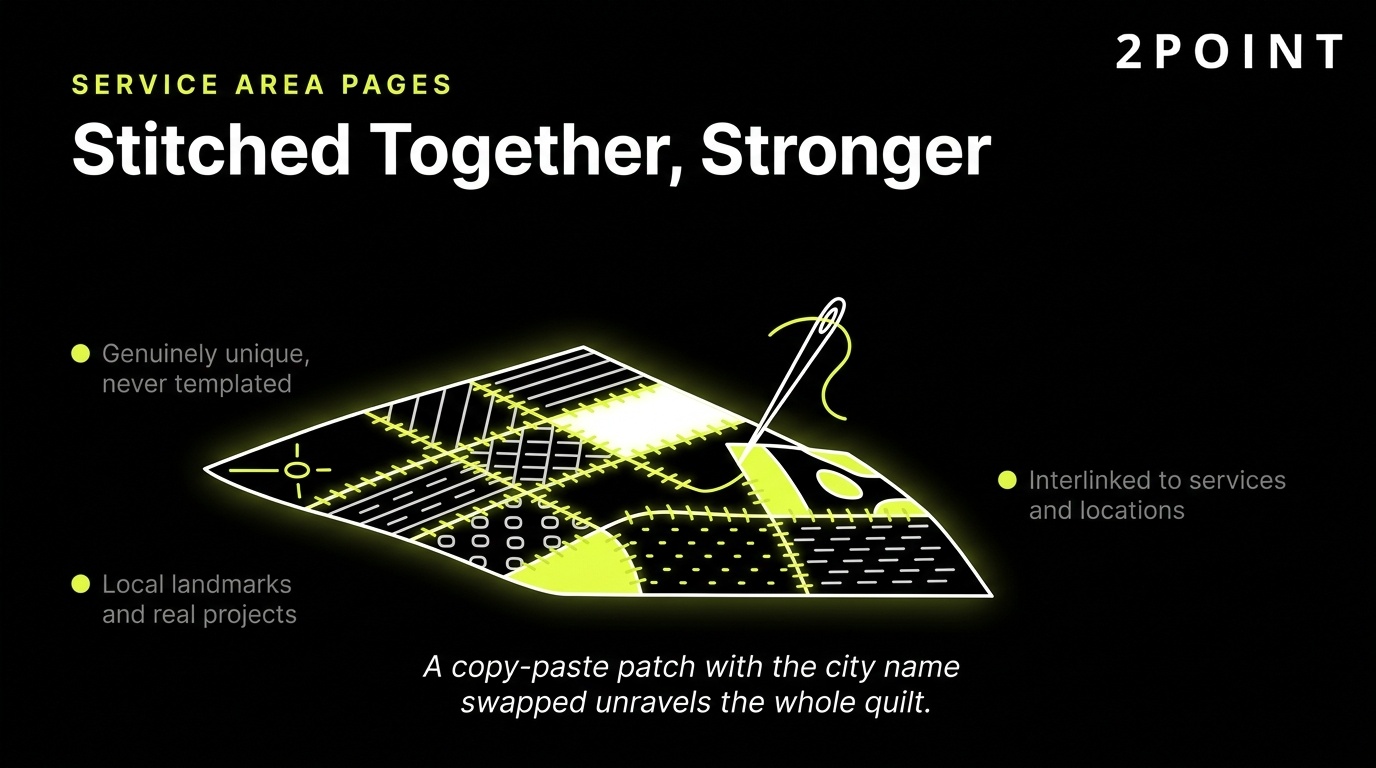
Each service area page needs to be genuinely unique, not a copy-and-pasted template with only the city name changed. Effective service area pages include locally relevant content such as references to local landmarks, neighborhood-specific service considerations, and genuine mentions of completed projects in that community. The page structure should follow a consistent template for scalability while incorporating enough unique content to avoid thin content penalties from Google.
Internal linking between your service pages and location pages creates a web of topical relevance signals that reinforces your authority across both dimensions. A page for HVAC service in a specific suburb should link to your main HVAC service page, your primary location page, and related service area pages. This architecture helps search engines understand the full scope of what you do and where you do it, supporting broader ranking across the local search landscape.
Review Generation and Reputation Management: The Trust Currency
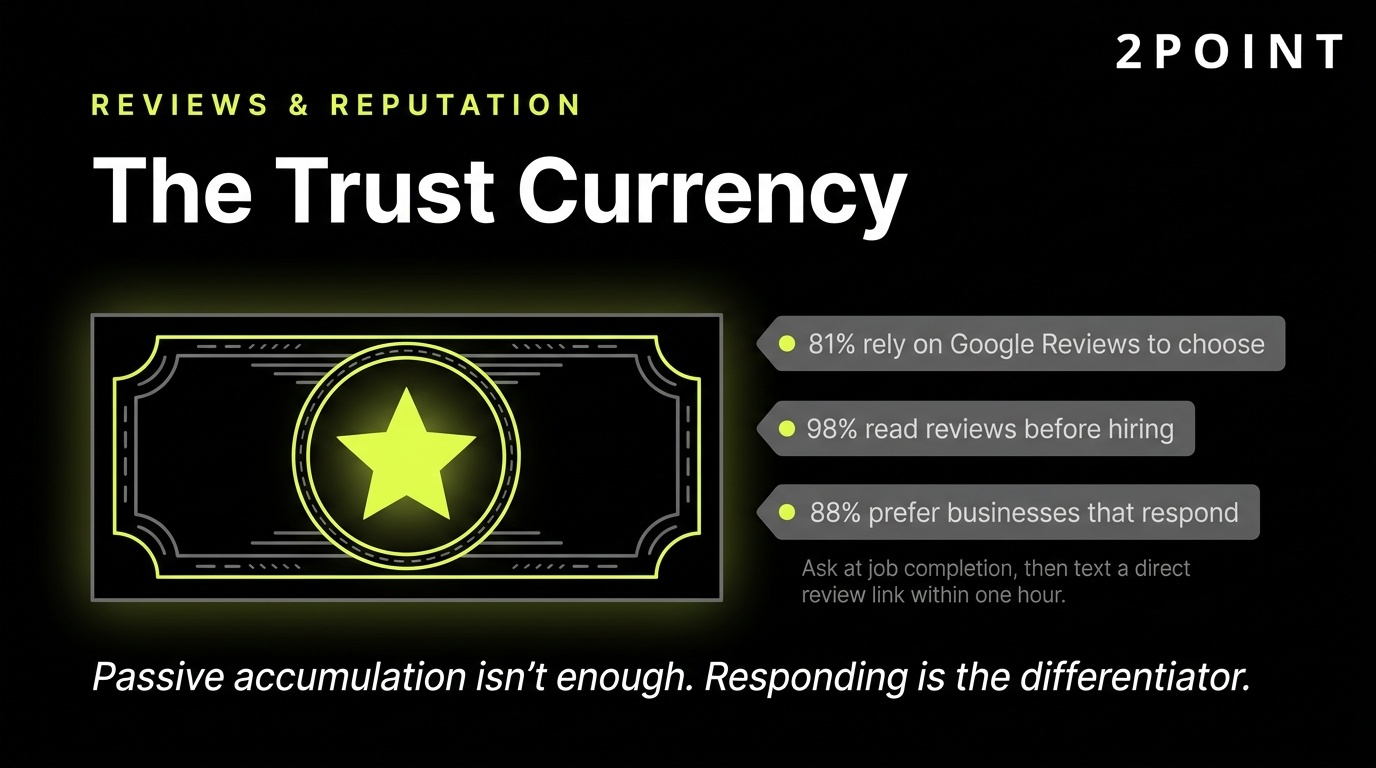
Online reviews have become the trust currency of home service marketing. Eighty-one percent of homeowners rely on Google Reviews when choosing a home service provider, and 98% read online reviews before making a hiring decision. Perhaps even more telling, 88% of consumers prefer to hire businesses that respond to their reviews, meaning that passive review accumulation is not enough. Active reputation management is a competitive differentiator.
Systematic review generation begins with the service completion moment. Technicians should be trained to mention the review request naturally at job completion, combined with an automated text message sent within one hour of the job closing that includes a direct link to the Google review form. This two-touch approach captures reviews at the highest point of customer satisfaction, before the natural friction of time reduces the likelihood of follow-through. Businesses that implement systematic review processes consistently outpace competitors whose review counts depend on voluntary customer initiative.
Response strategy matters as much as accumulation. Every positive review deserves a personalized, specific response that mentions the service provided and thanks the customer by name. Negative reviews, handled promptly and professionally with a genuine offer to resolve the issue, actually improve conversion rates compared to businesses that have only positive reviews with no responses. Potential customers understand that problems occasionally occur. What they are evaluating is how the business handles them. Displaying your testimonials across your website and social media amplifies the trust signals they generate beyond the Google platform where they originated.
Hyper-Local Targeting and Neighborhood Marketing
Homeowners do not think of themselves as living in a metropolitan area. They think of themselves as living in their specific neighborhood, subdivision, or community. The most effective home service marketers in 2026 reflect this neighborhood-level identity in how they target, message, and position themselves rather than presenting as generic regional service providers.
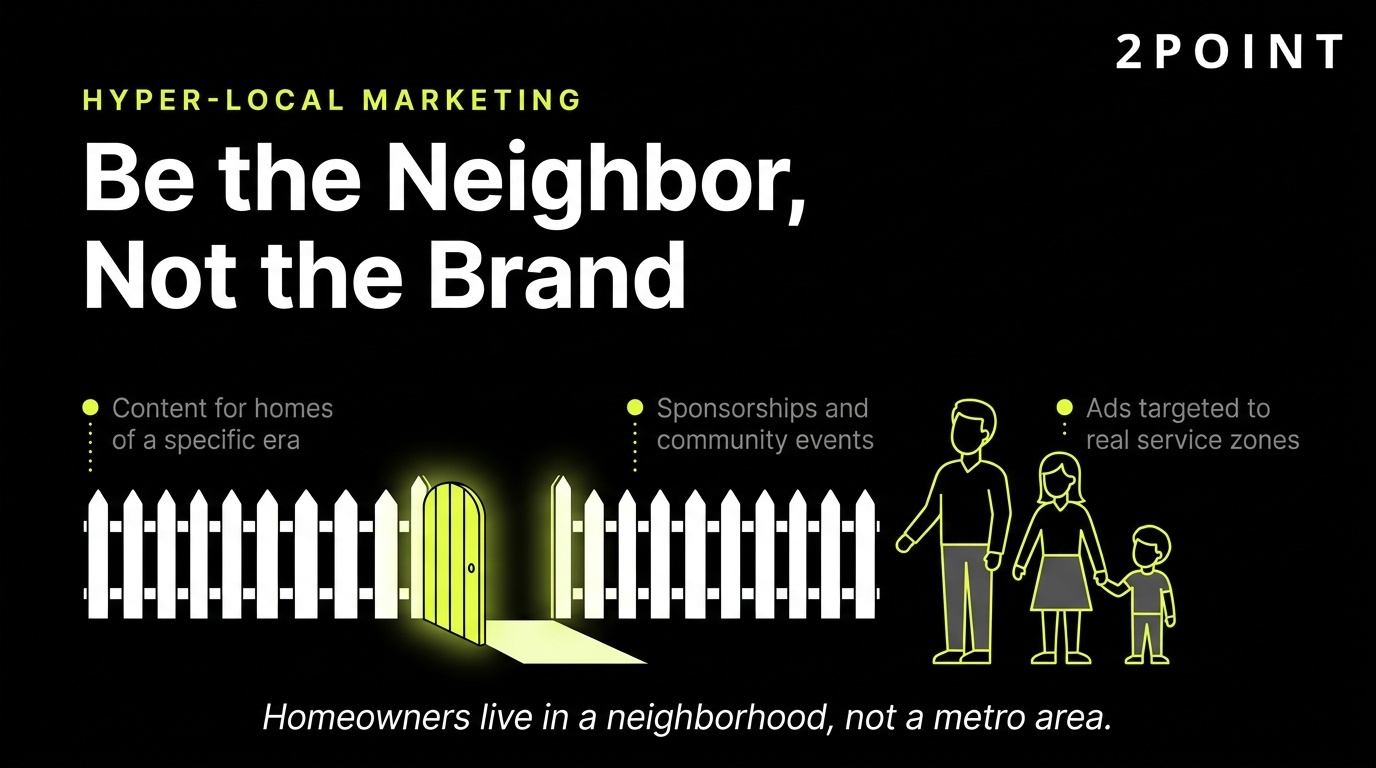
Neighborhood-specific content includes blog posts addressing issues common to homes built in a particular era (when an older subdivision was developed and what that means for plumbing or electrical systems), social media posts tagging local community pages, and direct mail campaigns targeted to specific zip codes where a technician is already working that day. Each of these approaches signals genuine local presence rather than a company that simply covers a broad geographic territory. Using your actual service zones in ad geographic targeting rather than broad metro areas reduces wasted spend and improves relevance scores simultaneously.
Community involvement and local sponsorships are offline activities that generate online trust signals. Sponsoring a local youth sports team, participating in neighborhood events, or donating services to a community organization creates authentic local stories worth posting about across every digital channel. These activities build the kind of genuine community relationships that no digital campaign can fabricate, and they often generate local press coverage and backlinks that strengthen your SEO position in precisely the markets you serve.
Paid Advertising Strategies That Generate Qualified Home Service Leads
Paid advertising functions as the complement to organic local SEO: it delivers immediate visibility and qualified leads while your long-term SEO authority builds steadily in the background. The two strategies work in a reinforcing cycle. Strong organic signals improve your Quality Scores in Google Ads. High-quality paid traffic increases website engagement metrics that benefit organic rankings. Businesses that rely exclusively on either channel are leaving significant opportunity on the table.
In 2026, the paid advertising landscape for home service businesses spans Google Local Services Ads, traditional Google Search and Display campaigns, social media advertising on Meta platforms, and emerging options across YouTube and streaming platforms. The optimal channel mix depends on your specific service type, geographic market, budget, and customer acquisition goals. What is universal is the need for deliberate channel strategy rather than opportunistic spending wherever a sales representative most recently pitched.
Understanding cost per lead by service type, and knowing your acceptable CPL ceiling based on customer lifetime value, is the analytical foundation that separates profitable paid advertising programs from budget-draining experiments. Every dollar allocated to paid advertising should be measured against clear lead quality and revenue benchmarks, adjusted regularly based on actual performance data.
Google Local Services Ads: The Trust Accelerator for Home Providers
Google Local Services Ads represent the most powerful paid advertising option available to home service businesses, and yet they remain underutilized by many operators who are more familiar with traditional Google Ads. LSAs appear above all other paid search results and organic listings, occupying the most prominent real estate on the search results page for high-intent local service queries. That positioning alone makes them worth serious attention.
What differentiates LSAs from traditional PPC is the Google Guaranteed and Google Screened badge program. When a business completes Google's verification process, including background checks for business owners and technicians, license verification, and insurance confirmation, they earn a badge that appears directly in their LSA listing. This trust signal is particularly powerful because it represents Google's explicit endorsement, telling searchers that this business has been vetted. For homeowners making trust-sensitive decisions about who enters their home, this verification badge can be the deciding factor.
The economics also differ meaningfully from traditional PPC. LSAs operate on a pay-per-lead model rather than pay-per-click, meaning you pay only when a verified lead contacts you through the platform, not for every click from a potentially unqualified searcher. You can also dispute invalid leads and receive credits, adding a layer of accountability that traditional click-based advertising does not provide. Optimizing LSA performance requires maintaining a high response rate to leads, accumulating positive reviews through the platform, and keeping your budget active during peak demand periods for your service category.
Google Ads for Home Services: Search and Display Campaign Strategy
Traditional Google Search campaigns remain a high-value channel for home service customer acquisition, particularly for service categories or geographic areas not yet fully covered by LSAs. The keyword strategy for home service search campaigns must account for the dramatic difference between emergency intent keywords and scheduled service keywords.
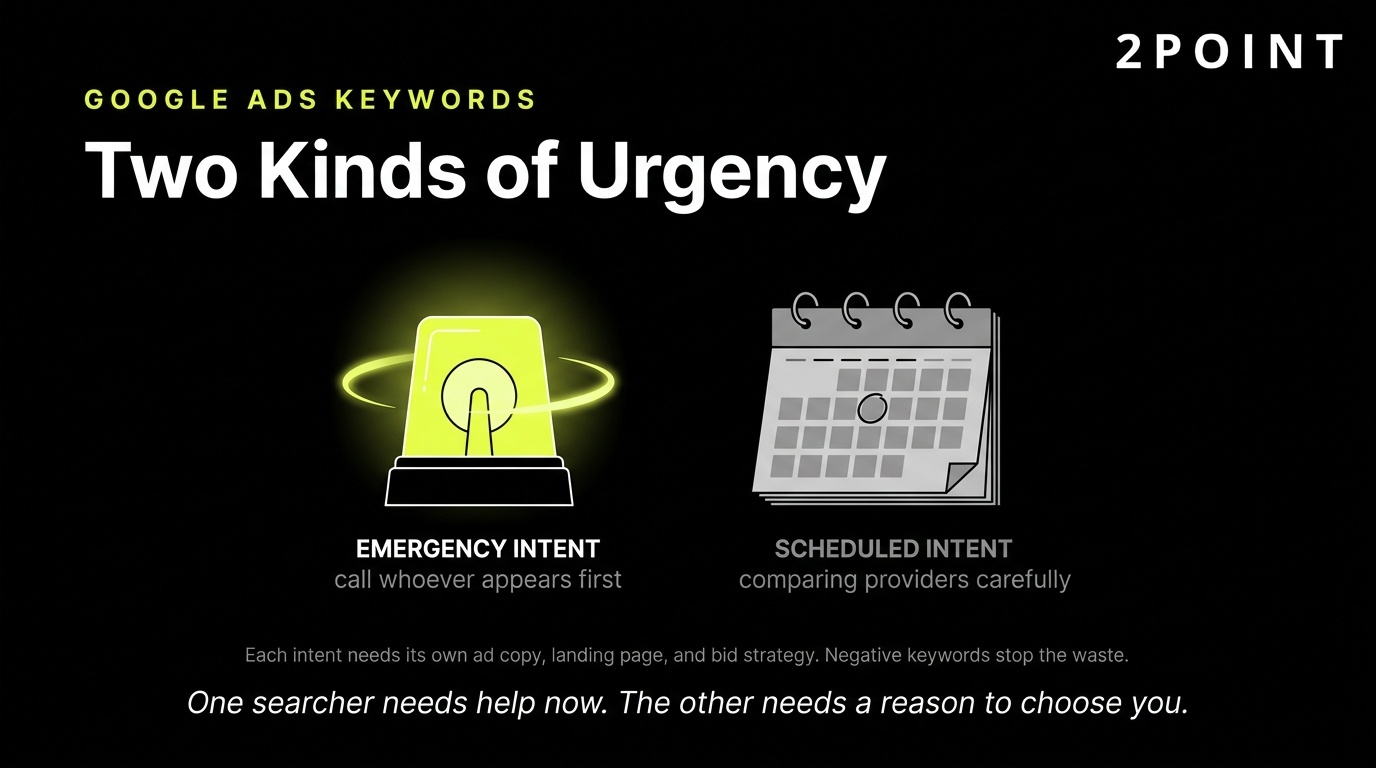
Emergency keywords like "emergency plumber near me," "AC repair same day," or "flooded basement help" carry extremely high conversion intent and justify higher bid prices because the searcher needs help immediately and will call whoever appears first. Scheduled service keywords like "HVAC tune-up appointment" or "annual furnace inspection" attract customers with longer decision windows who are comparing providers more carefully. These two keyword categories require different ad copy, different landing pages, and often different bid strategies to convert efficiently.
Ad extensions are critical performance levers for home service Google Ads. Call extensions displaying your phone number, location extensions showing your service area, structured snippet extensions listing specific services, and promotion extensions for current offers collectively increase click-through rates significantly compared to bare-bones text ads. A robust negative keyword list is equally important: broad match campaigns without negative keywords will waste budget on irrelevant queries from renters looking for landlord-responsibility services, DIY searchers looking for parts, or people in different geographic areas.
Facebook and Instagram Advertising for Home Service Businesses
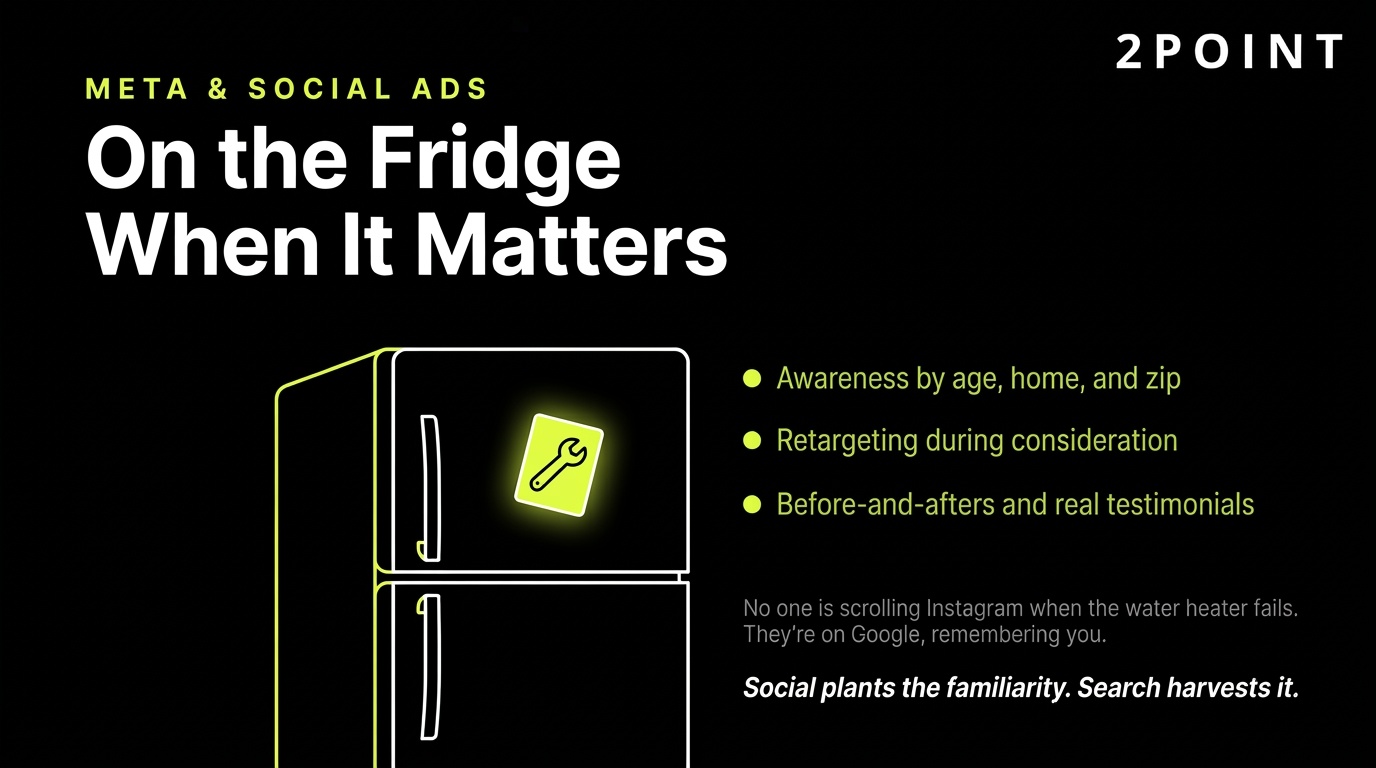
Meta advertising occupies a more nuanced position in home service marketing than it did even a few years ago. Many home service providers report that shifting budget away from Meta and toward Google-based channels has driven meaningful growth, reflecting the fundamental difference between search intent (active demand) and social media (passive scrolling). The most important distinction is that no one is on Instagram scrolling when their water heater fails. They are on Google.
That said, Meta advertising retains specific strategic value in home service marketing when deployed for the right objectives. Brand awareness campaigns targeting homeowners by age, homeownership status, and zip code build familiarity that improves conversion rates on other channels. Retargeting campaigns reaching people who visited your website but did not convert keep your business visible during their consideration period. Creative formats that leverage before-and-after project photography and genuine customer video testimonials perform significantly better than generic promotional ads on social platforms.
The audience targeting available through Meta, including homeowner demographics, household income indicators, and interest-based signals related to home improvement, makes it possible to reach genuinely relevant potential customers. The challenge is that reaching them on social media requires interrupting them rather than responding to active intent. This makes creative quality and relevance more important on Meta than on search, where intent does a significant portion of the qualifying work. For businesses with strong visual work to showcase, Meta remains a viable channel within a diversified media strategy.
Understanding Cost Per Lead by Service Type: Benchmarks and Targets
Setting realistic and strategically sound CPL targets is one of the most important analytical exercises in home service marketing. Without understanding what you can afford to spend acquiring a customer, paid advertising budgets either are set too low to generate meaningful volume or erode profitability when set too high. The right CPL ceiling is always calculated backward from customer lifetime value and gross margin, not forward from what competitors appear to be spending.
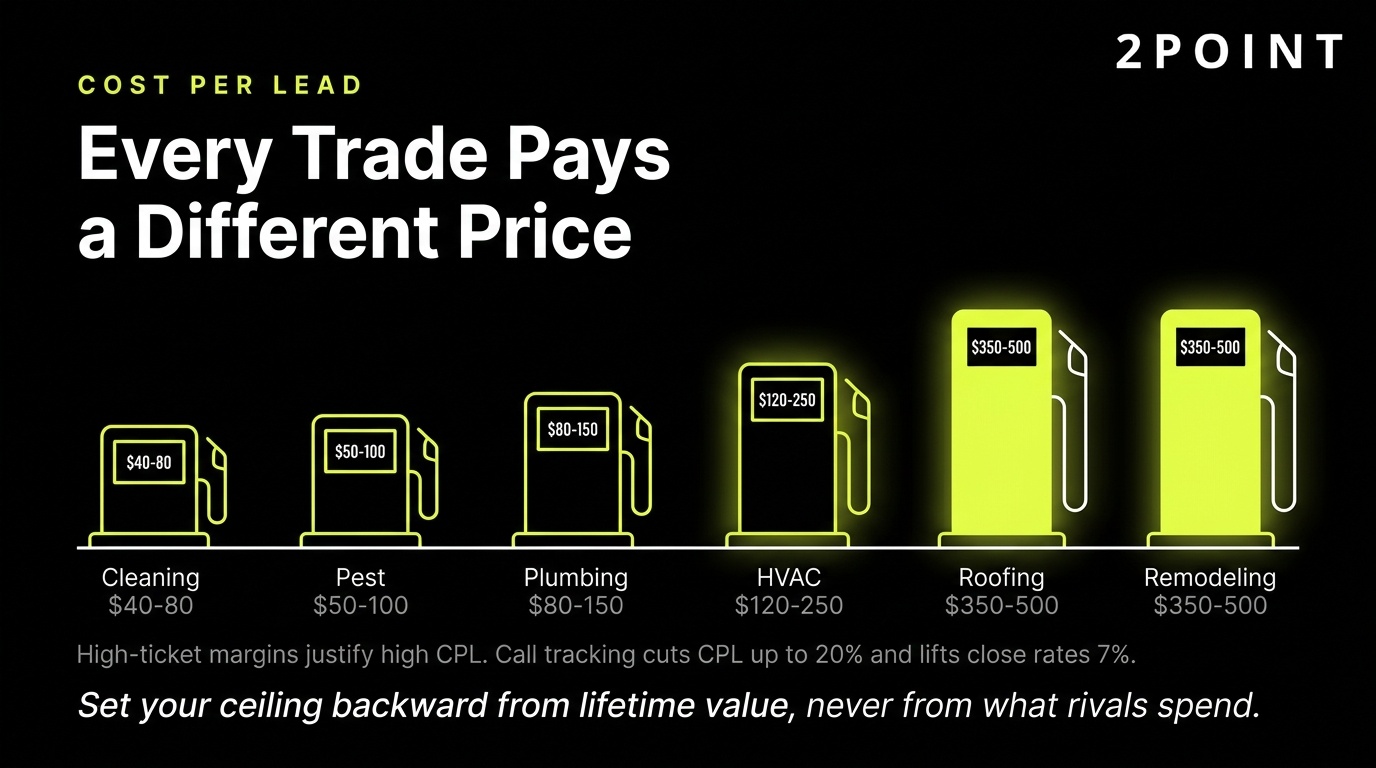
| Service Category | Typical CPL Range | Average Project Margin | Conversion Rate Benchmark |
|---|---|---|---|
| Kitchen Remodeling | $350 to $500 | 35% to 40% | 8% to 12% |
| Roofing (Full Replacement) | $350 to $500 | 35% to 40% | 8% to 12% |
| Plumbing Services | $80 to $150 | 40% to 55% | 12% to 15% |
| Pest Control | $50 to $100 | 30% to 45% | 12% to 15% |
| HVAC Repair and Replacement | $120 to $250 | 35% to 50% | 10% to 14% |
| House Cleaning (Recurring) | $40 to $80 | 25% to 40% | 15% to 20% |
The key takeaway is that premium, high-ticket services justify significantly higher CPL while high-volume recurring services must achieve lower CPL to maintain profitability. Implementing proper call tracking technology can reduce CPL by up to 20% by eliminating wasted spend on channels and keywords that generate calls but not booked jobs. The marketing effectiveness of any paid channel is only measurable when you have attribution systems that connect the original lead source to the completed job.
Website Optimization for Home Service Businesses: Converting Visitors into Booked Jobs
Your website is where every other marketing investment ultimately lands. Every dollar spent on local SEO, every click from a paid ad, every referral from a satisfied customer, and every social media post that generates curiosity leads back to your website as the conversion hub. A website that performs poorly at conversion is not just a missed opportunity. It is an active destroyer of every other marketing investment you make. Fixing it has a multiplier effect across all other channels.
The home service website of 2026 must excel across three fundamental dimensions: it must load quickly and display flawlessly on mobile devices, it must build trust rapidly through credibility signals and authentic content, and it must make conversion frictionless through clear calls to action and multiple contact options. A website that achieves all three reliably converts a meaningful percentage of visitors into phone calls, booking form submissions, and scheduled appointments.
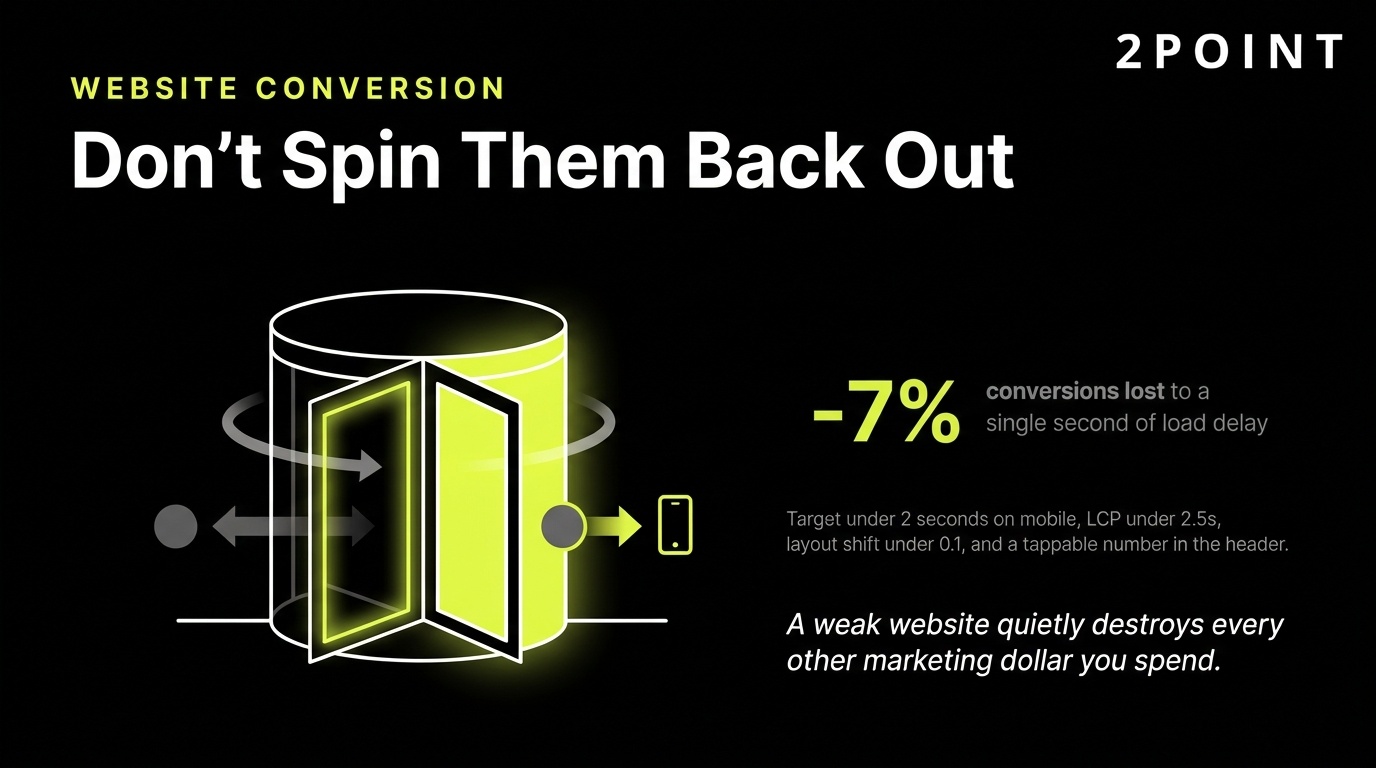
The consequences of getting this wrong are invisible to most business owners but devastating to results. A one-second delay in page load time can reduce conversions by 7%. A website that is difficult to navigate on a phone, where most home service searches happen, loses visitors in seconds. These are not hypothetical technical concerns. They translate directly into fewer calls, fewer booked jobs, and lower revenue from the same marketing spend.
Mobile-First Design and Core Web Vitals: The Technical Foundation
Mobile responsiveness is not a feature to add. It is a baseline requirement for any home service website that intends to compete. The majority of home service searches now originate on mobile devices, particularly for emergency services where a homeowner reaches for their phone the moment a problem occurs. If your website delivers a poor mobile experience, you are failing most of your potential customers at the most critical moment of their decision process.
Google's Core Web Vitals framework measures three specific dimensions of page experience: Largest Contentful Paint (how quickly the main content loads), Interaction to Next Paint (how responsive the page is to user input), and Cumulative Layout Shift (how stable the page layout is as it loads). These metrics directly influence both Google search rankings and visitor conversion rates, making technical website performance a marketing concern, not just a developer concern.
Specific technical benchmarks to target include a page load time under two seconds on mobile, a Largest Contentful Paint score under 2.5 seconds, and a Cumulative Layout Shift score under 0.1. Tools including Google Search Console, PageSpeed Insights, and GTmetrix provide free performance analysis with specific recommendations. Click-to-call functionality must be prominent and functional on every page. A phone number displayed only in tiny text in the footer is a conversion killer. Your phone number should appear in the header, be clickable on mobile, and remain visible as visitors scroll through longer pages.
Conversion-Focused Design Elements That Build Trust and Drive Action
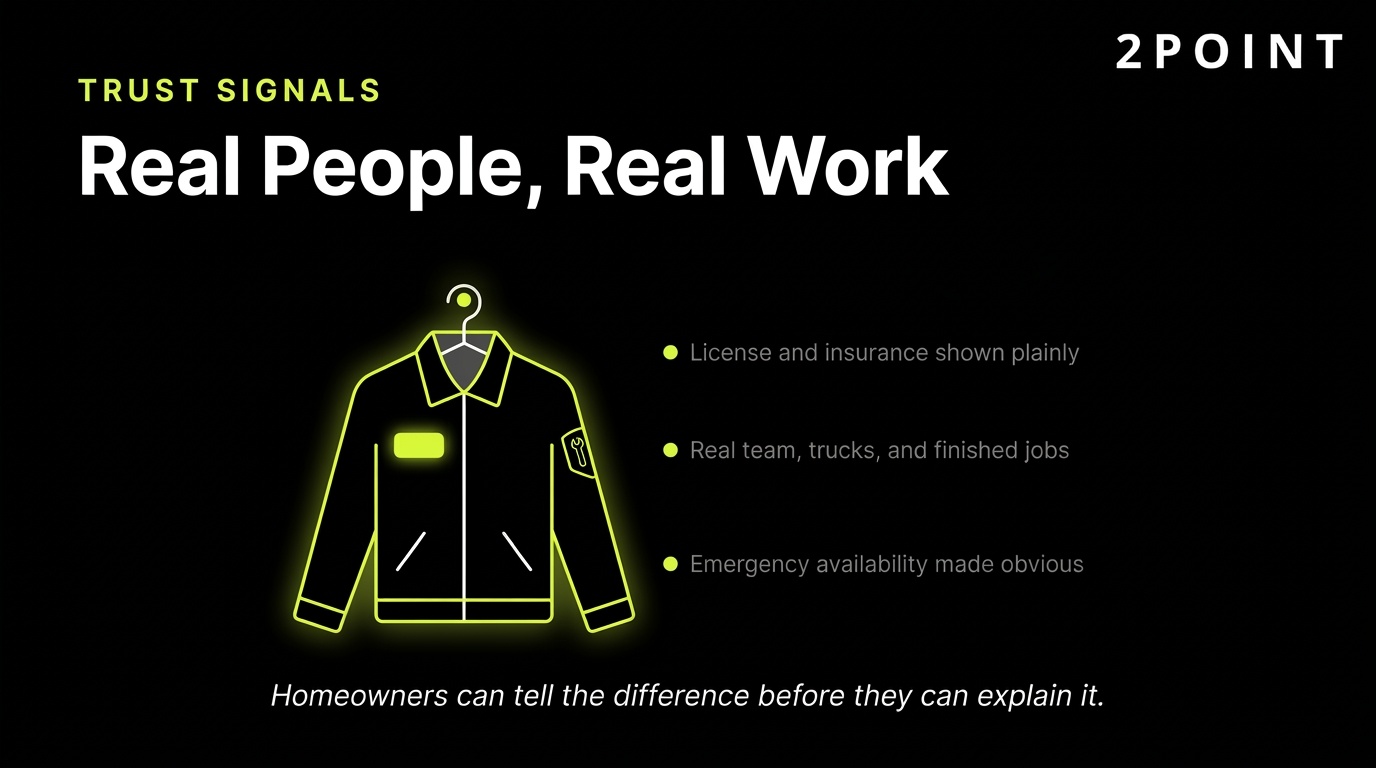
Trust signals are the most important design elements on any home service website. Before a homeowner picks up the phone to invite a stranger into their home, they need to feel confident that the company is legitimate, licensed, insured, and skilled. Strategic placement of license numbers, insurance certificates, industry certifications, and manufacturer authorizations throughout the site addresses these trust concerns directly rather than expecting visitors to simply assume that your business is properly credentialed.
Real photography outperforms stock images in every measurable conversion metric for home service websites. Photos of your actual team in uniform, your real service vehicles, and genuine completed projects communicate authenticity that homeowners consciously or unconsciously recognize. A visitor who sees real people doing real work is significantly more likely to call than one who sees generic stock photos of smiling people in hard hats. The investment in professional photography for your team and projects pays back through improved conversion rates on every page where those images appear.
Call-to-action strategy requires both prominence and variety. The primary CTA, typically a phone number and a "Book Now" or "Schedule Service" button, should appear above the fold on every key page. A sticky header that keeps these options visible as the page scrolls prevents conversion from depending on the visitor scrolling back to the top. Live chat or chatbot functionality captures visitors who prefer text-based communication, and for emergency service calls, a dedicated banner or button for "Emergency Service Available 24/7" taps directly into the high-urgency mindset of the most motivated potential customers. Enhancing the overall customer experience through thoughtful website design is one of the highest-return investments a home service business can make.
Service-Specific Landing Pages That Rank and Convert
A single generic "Services" page listing everything your company does is one of the most common and most costly website mistakes in home service marketing. Dedicated pages for each individual service, from water heater replacement to drain cleaning to HVAC preventive maintenance, dramatically outperform consolidated pages in both search ranking and conversion rate because they can be precisely optimized for the specific search query a potential customer uses and tailored to address that customer's specific concerns.
A high-converting service page structure includes: a clear headline incorporating the target service keyword, a brief description of what the service involves and why it matters, a transparent discussion of pricing ranges and what factors influence cost, an FAQ section addressing the most common objections and concerns, social proof in the form of relevant customer reviews for that specific service, and multiple conversion opportunities including phone number, booking form, and chat option. Pricing transparency on service pages consistently improves lead quality because it pre-qualifies visitors before they contact you, reducing time spent on calls with prospects whose budget does not align with your pricing.
SEO optimization for service-specific landing pages follows the same principles as any content optimization but with particular attention to local modifiers. A page targeting "water heater replacement" in your market should naturally incorporate your primary service city, include schema markup for local business services, and link internally to your location pages and related service pages. The combination of strong on-page content, technical SEO, and internal linking authority creates pages that both rank well for target queries and convert visitors at high rates once they arrive.
Content Marketing and Video Strategies for Home Service Business Growth
Content marketing is the long-term trust-building engine that separates home service businesses with sustained organic growth from those constantly dependent on paid advertising to generate every lead. While paid channels deliver immediate results, content marketing compounds over time, with each piece of valuable content building authority, attracting organic search traffic, and positioning your business as the expert resource homeowners turn to when they have questions about their homes.
The content marketing opportunity in home services is particularly rich because most homeowners have genuine information needs related to maintaining, troubleshooting, and improving their properties. They want to know when to replace rather than repair, how to choose between service options, what warning signs to watch for, and how to prepare their home for seasonal changes. Businesses that answer these questions with genuinely helpful content attract and engage potential customers during the research phase of their decision, building relationship and credibility before the customer has even made contact.
Eighty-six percent of marketers report that video content increased website traffic, and 81% say video directly generated leads for their business. For home service companies, video is not an advanced content strategy. It is increasingly a baseline expectation from consumers who want to see the quality of work and the character of the people they are considering hiring before they call.
Blog Content Strategy: Capturing Organic Search Traffic Year-Round
Effective blog content for home service businesses starts with systematic market trends analysis and keyword research to identify the exact questions homeowners are asking online. Topic selection should prioritize questions that indicate both interest and proximity to a purchasing decision. "How do I know if my water heater needs replacement?" targets someone who is already experiencing symptoms and may be hours from calling a plumber. "Water heater history and technology" attracts casual readers who may never need your services. Prioritize the former.
Seasonal content planning is one of the highest-leverage blog strategies for home service businesses. HVAC companies should publish content about air conditioning preparation in early spring, filter replacement and efficiency tips in summer, furnace inspection reminders in early fall, and emergency heating guidance in winter. Each piece of content published at the right time in the season captures search traffic at precisely the moment consumer interest is peaking. A seasonal content calendar developed three months in advance ensures consistent publishing and prevents the reactive, sporadic posting that characterizes underperforming content programs.
How-to guides and "when to call a professional" content serve a particularly valuable dual purpose. They provide genuinely useful information that attracts organic search traffic, and they simultaneously demonstrate your expertise while steering readers toward calling you for jobs beyond their DIY comfort level. A roofing company's blog post titled "5 Roof Repairs Homeowners Can Handle vs. 7 That Require a Professional" provides real value to the reader while clearly communicating the scope of professional expertise. Optimizing these posts for featured snippet capture through clear numbered lists, direct question-and-answer formatting, and concise definitions maximizes their visibility in search results.
Video Marketing That Builds Trust and Drives Engagement
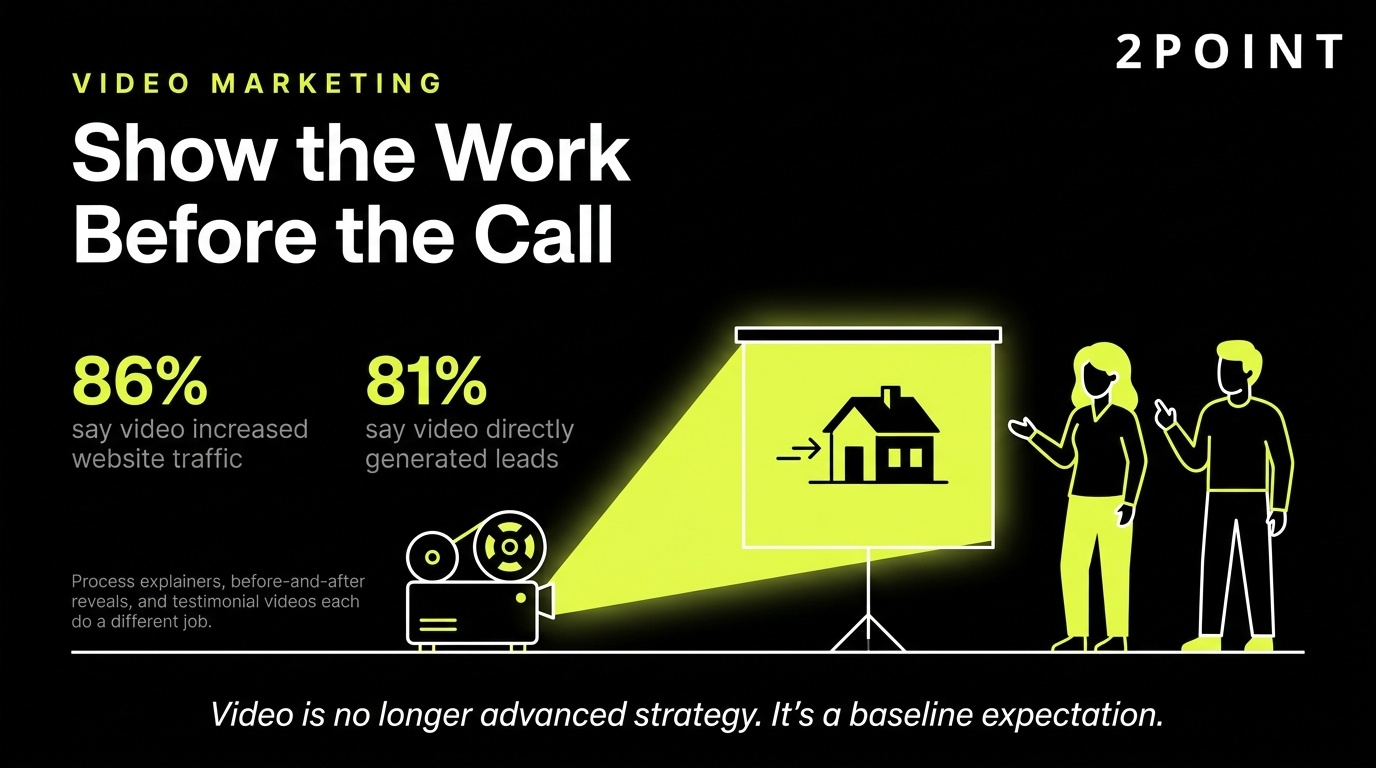
Video content serves a uniquely powerful function in home service marketing because it allows potential customers to evaluate your company's professionalism, quality of work, and character in ways that text and photos alone cannot achieve. The most effective video types for home service businesses include process explanation videos that show exactly what happens during a service visit, before-and-after transformation videos for visual services like painting, landscaping, and remodeling, and customer testimonial videos that put real faces and real voices behind the reviews on your website.
Short-form video content on platforms including TikTok, Instagram Reels, and YouTube Shorts has created a significant opportunity for home service businesses to reach local audiences organically without advertising spend. Quick tips, satisfying before-and-after reveals, and behind-the-scenes content resonate particularly well with the homeowner audience that follows home improvement content across these platforms. A plumber who posts genuinely helpful short videos about preventing drain clogs or identifying water pressure issues builds an audience of exactly the homeowners who will call when they eventually need a plumber.
YouTube channel strategy for home service businesses focuses on longer-form educational content that captures search traffic on the world's second-largest search engine. Video content optimization on YouTube follows many of the same principles as website SEO: keyword-rich titles that answer specific search queries, detailed descriptions with relevant keywords and links, organized playlists by service category, and consistent posting schedules that signal to the algorithm that your channel is actively maintained. A library of 50 to 100 informative videos creates a permanent content asset that generates views, website traffic, and phone calls continuously without additional investment.
Educational Content as a Home Service Lead Generation Tool
Educational content that requires an email address to access creates one of the highest-quality lead generation mechanisms available to home service businesses. Seasonal maintenance checklists, downloadable guides like "The Complete Homeowner's Spring HVAC Preparation Guide," or "7 Things to Inspect Before Your Roof Warranty Expires" provide genuine value that motivates homeowners to share their contact information willingly. These are not just name captures. They are qualified leads who have self-identified as homeowners actively thinking about the exact service category you serve.
Problem-diagnosis tools and interactive calculators generate particularly high engagement. An HVAC efficiency calculator that estimates annual energy costs based on equipment age and home size, or a roofing cost estimator that generates a ballpark replacement range, provides immediate value while capturing lead information and setting expectations for the sales conversation. These tools position your business as the expert resource and often motivate the visitor to request a professional assessment after seeing the calculator's output.
Email nurture sequences for leads who download educational content should provide additional value over four to six weeks before any direct promotional messaging. A homeowner who downloads an HVAC maintenance checklist is not necessarily ready to book a service visit immediately, but they are clearly interested in maintaining their system. A nurture sequence that delivers weekly tips, explains the cost of neglecting specific maintenance items, and builds familiarity with your technicians and company culture converts a much higher percentage of these leads into booked appointments than an immediate promotional email or a sales call the day after download.
Email Marketing and Customer Retention: Growing Revenue From Your Existing Customer Base
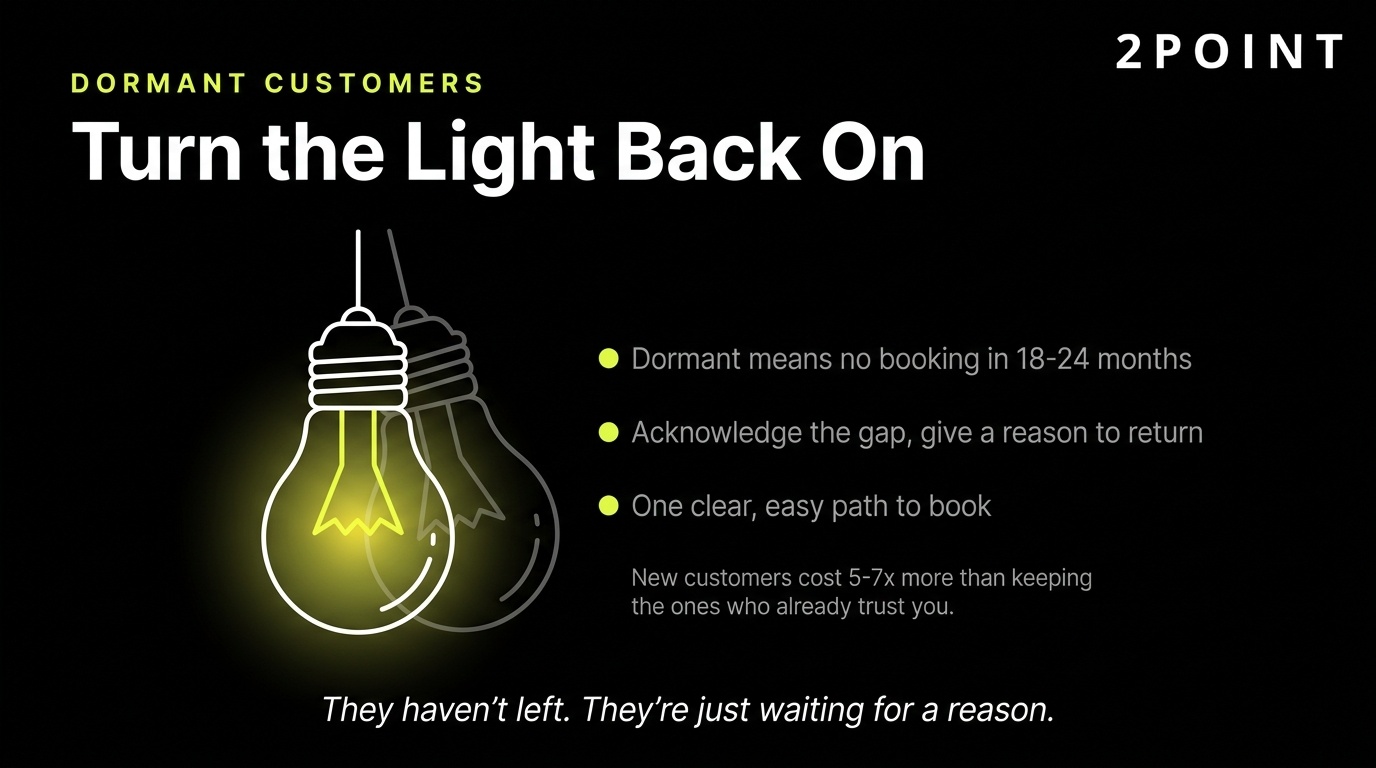
Acquiring a new customer costs five to seven times more than retaining and growing an existing one, yet most home service marketing budgets allocate the overwhelming majority of spending to acquisition channels. Email marketing is the most cost-effective channel for maintaining relationships with your existing customer base, generating repeat business from satisfied customers, and activating referrals that produce the highest-quality new leads. In an industry where customer lifetime value can span decades of recurring service relationships, the return on email marketing investment is extraordinary.
The home service customer relationship has a natural rhythm defined by recurring maintenance needs, seasonal service requirements, and the inevitable equipment replacement cycles. Email marketing that is aligned with this rhythm feels like genuinely helpful service communication rather than promotional interruption. An HVAC company that emails in September reminding customers to schedule their furnace inspection before the cold arrives is providing a service, not pushing a promotion. This framing transforms email from a marketing channel into a customer service channel, with dramatically better engagement and conversion rates as a result.
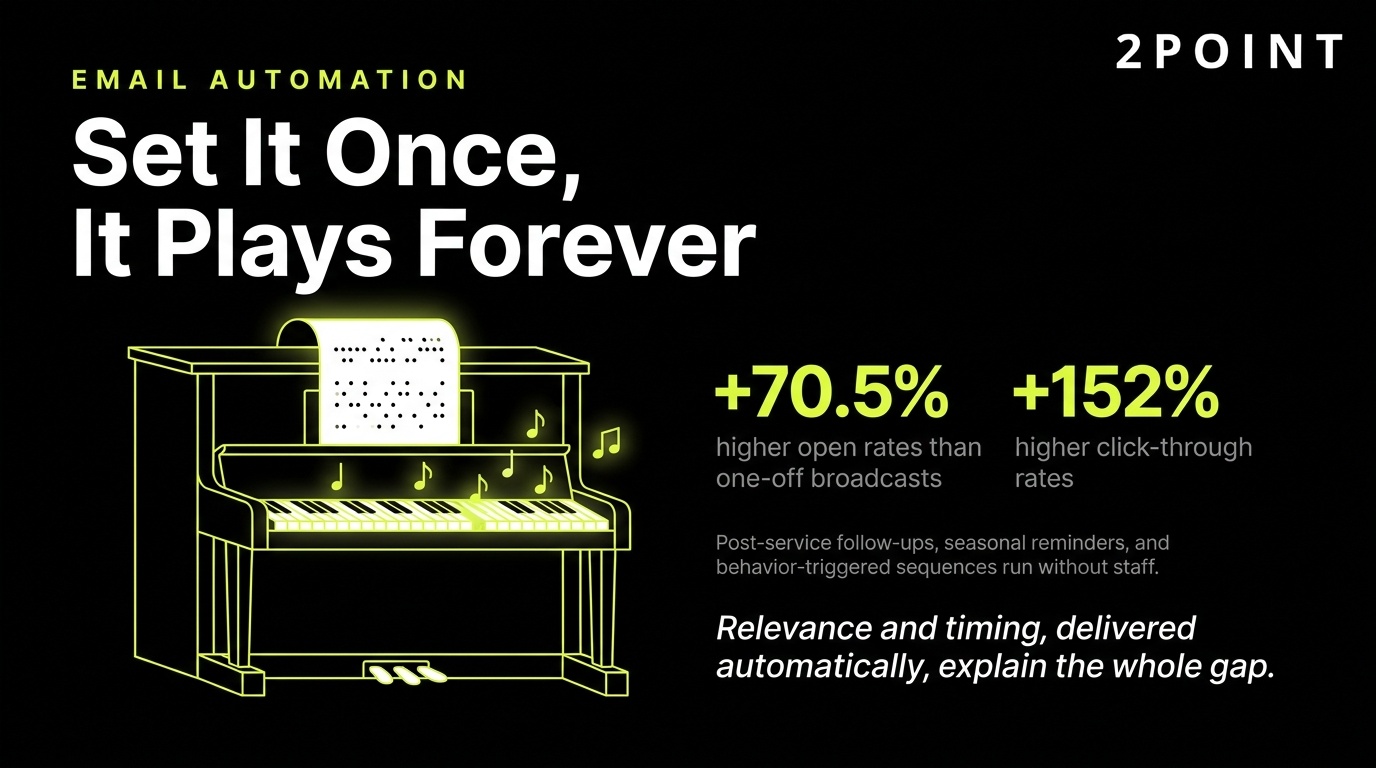
Automated email campaigns achieve 70.5% higher open rates and 152% higher click-through rates compared to one-off broadcast emails. This performance differential is not surprising. Automated emails are triggered by specific customer behaviors or time intervals that make them relevant to the recipient's specific situation. A customer who just had their furnace serviced receives a follow-up asking about their experience. A customer who installed a new AC unit two years ago receives a reminder about their first major filter replacement. Relevance and timing, delivered automatically at scale, explain why automation outperforms manual email by such a dramatic margin.
Building Your Email Database: Capturing and Segmenting Customer Contacts
A comprehensive email database begins with capturing contact information at every customer touchpoint without creating friction in the service delivery process. The most productive capture moments include the initial booking (request email for appointment confirmation and receipts), during service (technician ask for permission to send maintenance reminders), and post-service (automated text with link to service summary and review request that also captures email). Each of these moments has a natural business rationale that makes the email request feel like a service feature rather than data collection.
Website opt-in forms with compelling value exchanges, such as the seasonal maintenance guides discussed in the content marketing section, add a stream of prospect emails alongside existing customer contacts. These two categories require different segmentation and different email content. Existing customers receive service reminders, loyalty offers, and maintenance updates. Prospect subscribers receive educational content, introductory offers, and trust-building information about your team and work quality. Segmenting further by service type, average customer value, and geographic location enables increasingly relevant email communication that performs significantly better than unsegmented broadcast messaging.
List hygiene and compliance are ongoing maintenance requirements for any email program. Regularly removing invalid addresses and unengaged subscribers keeps deliverability rates high and prevents your domain from being flagged as a spam source. Email marketing regulations require clear opt-in consent, easy unsubscribe options, and honest subject lines. These are not obstacles to effective email marketing. They are standards that, when followed, ensure your emails are reaching inboxes and maintaining the trust of the customers who receive them. Monitoring data privacy requirements as they evolve is an essential part of maintaining a healthy, legally compliant email program.
Automated Email Campaigns That Generate Consistent Revenue
Automated email sequences are the highest-return component of any home service email program because they require time investment once but generate revenue continuously afterward. Post-service follow-up sequences beginning with a satisfaction check 24 hours after service completion, followed by a review request three days later, and a maintenance reminder tailored to the service performed at 30 days, consistently outperform businesses that follow up manually or not at all. These sequences run without staff involvement once configured, making them one of the clearest examples of marketing automation directly replacing manual effort.
Seasonal maintenance reminder campaigns represent the most straightforward revenue-generating automation for most home service categories. HVAC companies can set annual reminders for both spring cooling system checks and fall heating system inspections. Plumbing companies can send pre-winter pipe insulation reminders and spring irrigation system startup emails. Pest control companies can time emails to align with peak pest season in their geographic area. These reminders reach customers exactly when the service is most relevant, driving booking rates that dramatically outperform cold outreach or purely reactive marketing. Pairing these seasonal reminders with limited-time scheduling windows or early-bird pricing incentives increases urgency and accelerates booking decisions.
Re-engagement campaigns for dormant customers, defined as customers who have not booked service in 18 to 24 months, represent a significant revenue opportunity that most home service businesses completely ignore. A targeted email campaign acknowledging the gap, offering a compelling reason to return (inspection special, loyalty discount, or priority scheduling), and providing a clear easy booking path reactivates a meaningful percentage of dormant customers at a fraction of the cost of acquiring a new one. These customers already know and trust your company. They simply need a reason to re-engage. Effective email is that reason. Building sustained customer retention through email creates the recurring revenue foundation that makes a home service business genuinely recession-resilient.
Newsletter Strategy: Staying Top-of-Mind Between Service Visits
A monthly customer newsletter keeps your company visible during the long intervals between service visits that characterize most home service relationships. The content mix that performs best in home service newsletters balances genuinely useful homeowner information (seasonal tips, maintenance reminders, DIY guidance for minor issues) with relevant promotional content (service specials, new offerings, membership program information). When educational content outweighs promotional content by roughly three to one, open rates and engagement metrics reflect readers who look forward to receiving the newsletter rather than tolerating it.
Customer spotlight features, introducing team members and highlighting exceptional project results, build the personal connection that differentiates local home service businesses from faceless national operations. Subscribers-only offers, available exclusively to newsletter recipients, reward loyalty and provide a compelling reason to remain subscribed. Key metrics to track for newsletter performance include open rate (benchmark: 35% to 45% for home services), click-through rate (benchmark: 5% to 8%), and unsubscribe rate (keep below 0.5% per send). Declining open rates signal content relevance issues. Rising unsubscribe rates signal frequency or content problems. Both are manageable with regular performance review and content adjustments.
Speed, Responsiveness, and the Follow-Up Gap in Home Service Lead Generation
Generating leads through exceptional marketing is only half the battle in home service business growth. The other half, converting those leads into booked jobs, depends entirely on how quickly and persistently your team responds to incoming inquiries. The statistics defining this challenge are among the most important and most frequently overlooked data points in home service marketing, revealing a massive gap between what customers expect and what most businesses actually deliver.
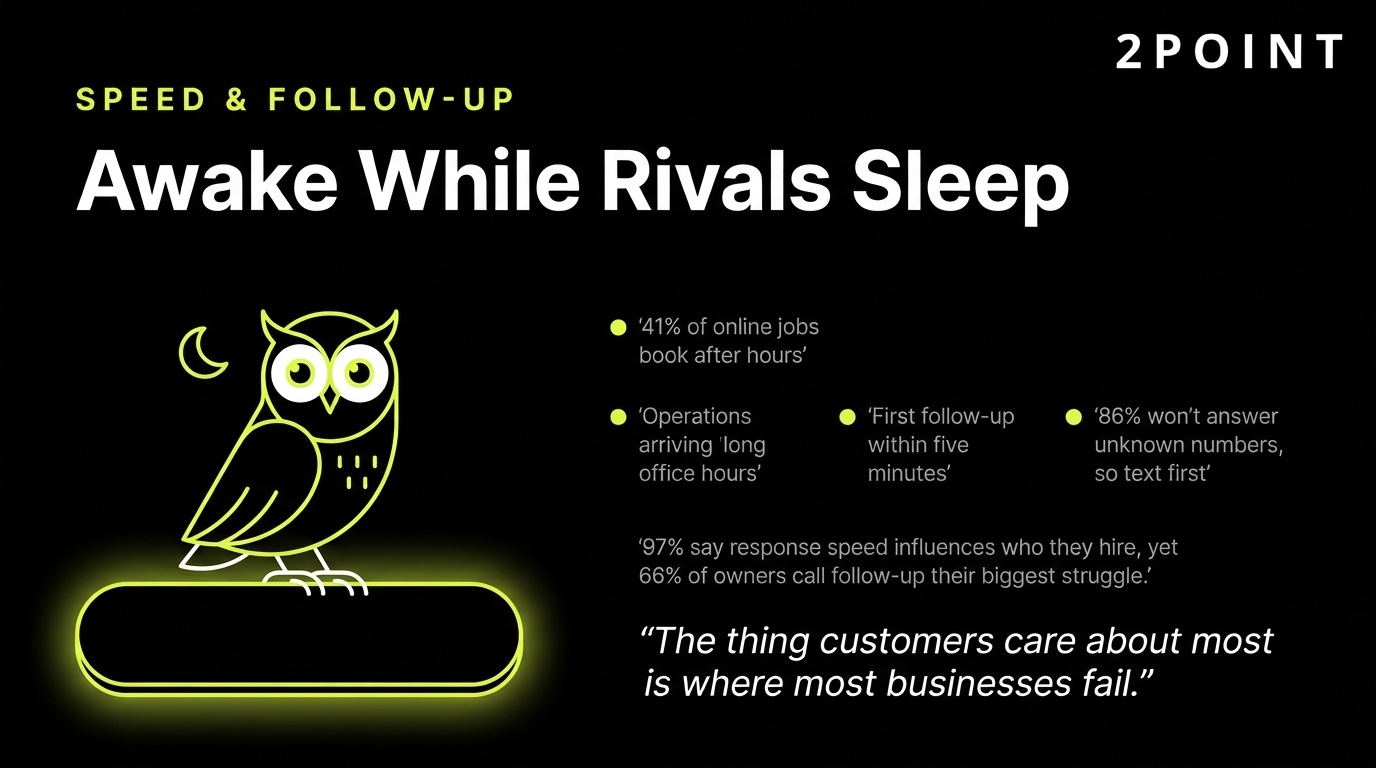
Ninety-seven percent of homeowners say response speed directly influences their hiring decision. Meanwhile, sixty-six percent of home service business owners identify lead follow-up as one of their most significant operational challenges. These two statistics together reveal the central operational problem in the industry: the thing that matters most to customers is also the area where most businesses consistently underperform. Solving this problem is not a marketing initiative. It is an operational one with profound marketing implications.
Forty-one percent of jobs booked online are requested after business hours, and eighty-six percent of customers will not answer a call from a number they do not recognize. These realities together define the infrastructure requirements for any home service business serious about capturing the leads its marketing generates. After-hours booking capability, call tracking with recognizable caller ID, and systematic follow-up sequences are not optional enhancements. They are the operational requirements for competitive lead conversion in 2026.
The After-Hours Opportunity: Capturing the 41% Who Book After Hours
The homeowner who realizes their dishwasher is leaking at 9 PM on a Tuesday is not going to wait until 8 AM to search for a plumber. They are searching right now, and the business that captures their attention and allows them to take action at that moment wins the job. With 41% of online job bookings coming in after traditional business hours, a business that offers only phone contact during working hours is structurally inaccessible to nearly half of its potential customers.
Online booking systems that allow customers to self-schedule service appointments at any hour are the foundational solution. These systems should integrate directly with your dispatch calendar to prevent double-booking and provide instant confirmation to the customer, satisfying their need for immediate acknowledgment. For businesses not ready to implement full online booking, automated text message responses triggered by after-hours website form submissions provide immediate acknowledgment while committing to follow up first thing the next morning. The acknowledgment itself significantly reduces the likelihood that the customer continues searching for an alternative.
AI-powered chatbots configured for after-hours operation can qualify leads, collect relevant information about the service need, and schedule preliminary appointments without any human involvement. For emergency services, clear protocols should route urgent requests to an on-call technician or after-hours answering service immediately rather than to voicemail. The businesses that build the operational infrastructure to capture after-hours demand are accessing a segment of the market that their less-prepared competitors are systematically abandoning.
Call Tracking and Lead Management Systems: Closing the Attribution Gap
Phone calls remain the primary contact method for home service customers, particularly for urgent and emergency services where customers want the immediate reassurance of speaking with a person. Implementing call tracking technology that assigns unique phone numbers to different marketing channels provides the attribution data necessary to understand which campaigns are generating calls, which calls convert to booked jobs, and where your marketing spend is actually producing revenue versus simply generating phone activity.
The technical and behavioral reality that 86% of customers will not answer calls from unrecognized numbers creates a specific problem for outbound follow-up. When your call tracking system uses an unfamiliar number, leads you are trying to re-contact will not answer. Solutions including branded caller ID display and text-first outreach address this problem by establishing recognition before asking for the customer's attention. A text message that identifies your company and asks for a convenient time to call dramatically improves live answer rates compared to cold outbound calling from unfamiliar numbers.
Businesses that implement proper call tracking reduce cost per lead by an average of 20% and improve close rates by 7% through the attribution clarity that allows them to reallocate budget from underperforming channels to high-converting ones. CRM integration connects call tracking data with customer records, ensuring that every interaction is documented and every follow-up opportunity is captured. Recording calls for training and quality assurance provides invaluable insight into what is and is not working in your customer communication, and it surfaces specific objections and questions that can be addressed in marketing messaging. Using customer insights from call recordings to refine marketing materials is one of the highest-value uses of the data your phone system generates.
Follow-Up Systems That Actually Convert Leads into Booked Jobs
The optimal follow-up approach combines speed, persistence, and channel diversity without crossing into the territory that feels harassing to potential customers. The first follow-up attempt should happen within five minutes of a lead coming in, a benchmark that most businesses fail to meet consistently. Response within five minutes can dramatically increase the likelihood of contact compared to response even an hour later, when the customer may have already booked with a competitor who responded faster.
A structured multi-channel follow-up sequence for leads that do not convert on first contact might look like this: immediate automated text acknowledging the inquiry, call attempt within five minutes, second call attempt with voicemail at two hours, email follow-up at four hours, second call attempt the next morning, second email at 24 hours, and a final outreach attempt at 72 hours. The combination of phone, text, and email across multiple contact points substantially increases the probability of successful connection while remaining within the boundaries of professional persistence rather than aggressive harassment. After 72 hours with no response, transitioning leads to a long-term nurture email sequence rather than continued active follow-up respects the prospect's apparent preference while maintaining the relationship for when they are ready to move forward.
AI Integration and Future-Proofing Your Home Service Marketing Strategy
Artificial intelligence has moved from an experimental technology that a few forward-thinking operators were testing to an active component of marketing and operations programs across the home services industry. The businesses that treat AI as a future consideration are already falling behind competitors who are using it today to reduce costs, improve lead conversion, and deliver more personalized service experiences. The competitive implications of this technology adoption gap will only widen over the next several years.
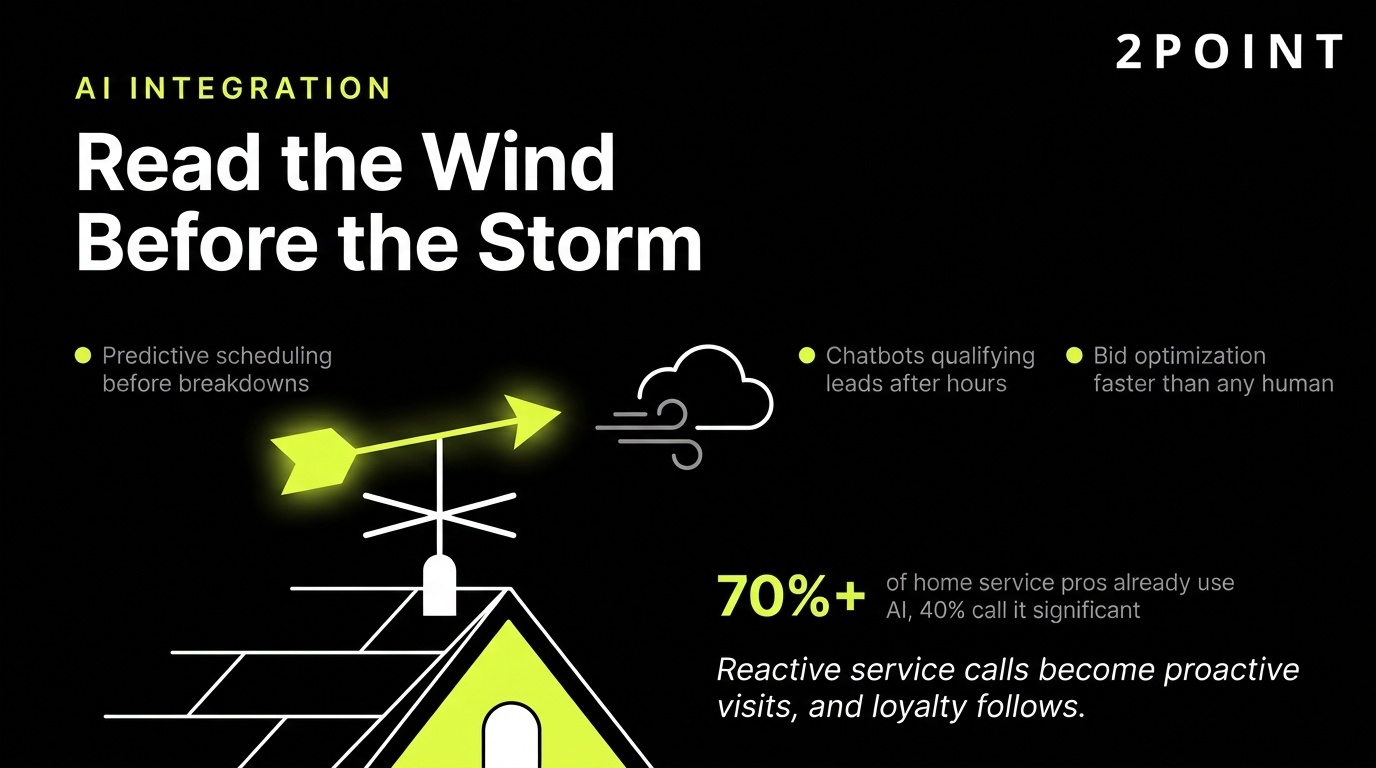
Over 70% of home service professionals were actively using AI tools in 2025, with nearly 40% describing it as a significant part of their business operations. AI adoption is accelerating across every dimension of home service business, from how companies schedule and dispatch technicians to how they communicate with prospects, generate marketing content, and analyze performance data. Understanding where AI creates genuine value in this context, and where it still requires significant human oversight, is the analytical challenge that every home service business owner faces in 2026.
The practical starting point for most businesses is not developing proprietary AI tools. It is integrating AI-powered features within existing software platforms: scheduling tools that use predictive algorithms, CRM systems with AI-powered lead scoring, marketing platforms with automated campaign optimization, and customer communication tools with AI chatbot capabilities. The barrier to entry for meaningful AI integration has never been lower, and the operational benefits available through these commercially accessible tools are significant enough to justify immediate evaluation and implementation.
AI-Powered Scheduling and Customer Service: Practical Applications
Predictive scheduling represents one of the highest-value AI applications in home service operations. AI-powered scheduling tools analyze equipment age, service history, local weather patterns, and seasonal demand signals to identify customers most likely to need service in the near future and proactively reach out with scheduling recommendations before the customer experiences a failure. This approach converts reactive service calls into proactive maintenance visits, improving customer satisfaction, reducing emergency dispatch costs, and enabling more efficient route planning.
AI chatbots configured for lead qualification and appointment booking handle a growing share of initial customer contact, particularly during after-hours periods when human staff are unavailable. Modern chatbots can collect detailed information about the service need, verify service area coverage, provide ballpark pricing ranges, and book preliminary appointments in a conversational format that customers find more engaging than traditional website forms. When a chatbot interaction results in a booked appointment, the human team receives a fully documented lead with all relevant information collected, significantly reducing the time required to prepare for the service visit.
The integration between AI scheduling tools and smart home appliances is an emerging frontier. As thermostats, water heaters, and HVAC systems increasingly connect to manufacturer monitoring platforms, home service companies that establish early relationships with these technology ecosystems can receive automated service alerts directly from customer equipment. An HVAC company notified by a connected thermostat that a customer's system is operating outside normal parameters can proactively reach out to schedule a diagnostic visit before the customer even knows there is a problem. This capability transforms the service relationship from reactive to genuinely predictive, a level of personalization that generates extraordinary customer loyalty.
AI-Driven Marketing Optimization: From Bidding to Personalization
AI-powered bid optimization in Google Ads and other paid platforms has made automated bidding strategies that maximize conversions within defined cost-per-acquisition targets significantly more effective than manual bidding for most home service advertisers. These algorithms analyze thousands of real-time signals including search query, device, location, time of day, audience membership, and historical conversion patterns to adjust bid prices in ways that human campaign managers cannot replicate manually at comparable speed or scale. The practical result is more booked jobs for the same advertising spend, or comparable job volume at lower cost.
Predictive analytics applied to your customer database can identify which customers are approaching natural replacement cycles for major equipment, which are most likely to accept an upgrade proposal, and which are at risk of churning to a competitor. AI-powered customer lifetime value modeling allows marketing investment to be allocated preferentially toward customer segments with the highest long-term revenue potential rather than treating all leads and customers as equally valuable. This kind of prioritization improves both marketing ROI and customer relationship quality by focusing human attention on the highest-value opportunities.
Content generation assistance through AI writing tools can accelerate blog content production, email campaign development, and social media content creation for home service businesses that struggle to maintain publishing consistency. The appropriate role for AI in content generation is as an accelerant and assistant rather than a replacement for human expertise and authentic voice. AI-generated content that has not been reviewed, refined, and verified for accuracy by a knowledgeable human can damage credibility and create liability issues in technical service categories. Using AI to generate first drafts, outline ideas, and suggest seasonal content topics while applying human expertise to finalize and verify content is the balanced approach that captures AI's efficiency benefits without sacrificing quality or authenticity. This is also an area where developing a distinctive brand narrative that AI tools can consistently reflect becomes especially valuable.
Adapting to AI-Powered Search Platforms: The New Search Landscape
The rise of AI-powered search interfaces including ChatGPT, Claude, Google's AI Overviews, and Perplexity is creating a new front in home service marketing visibility. A growing segment of homeowners now use AI chat interfaces as their first stop for home maintenance questions, asking conversational questions like "What are signs my water heater is failing?" or "How often should I have my HVAC serviced?" These queries do not always result in traditional Google searches, meaning businesses optimized exclusively for traditional SEO may miss opportunities in this emerging search environment.
The content strategies that perform best in AI-generated answers share specific characteristics with traditional featured snippet optimization: clear, direct answers to specific questions, well-structured content with logical headings, accurate and factual information without excessive marketing language, and authoritative citations from credible sources. Structured data markup and schema implementation help AI systems understand and accurately represent your business information, services, and service area in their generated responses.
The practical implication for home service marketing in 2026 is that content quality and topical authority matter more than ever, while purely technical keyword density becomes less important. A plumbing company that has published genuinely comprehensive, accurate, and well-structured content about pipe repair, water heater replacement, and drain maintenance is better positioned to appear in AI-generated answers than one with thinly optimized pages built primarily around keyword insertion. The shift toward AI search is, in this sense, an acceleration of a trend that has been building in traditional SEO for years: genuine expertise and helpfulness win, while search engine gaming loses. Staying ahead of industry trends in search technology is now an active component of competitive home service marketing strategy.
Building a Digital Marketing Strategy for Home Service Businesses: Integration and Prioritization
The breadth of available marketing channels, tactics, and technologies can feel overwhelming for home service business owners who are simultaneously managing operations, staff, customer relationships, and growth. The solution is not to tackle everything at once. It is to build a deliberately sequenced digital marketing strategy that establishes strong foundations first and then layers in complexity as each layer is performing well.
The sequencing principle is straightforward: start with channels that capture existing demand before investing in channels that create awareness. Local SEO and Google Business Profile optimization capture homeowners who are already searching for your services and are ready to hire. Paid advertising amplifies that capture. Content marketing builds long-term organic authority. Email retains customers and drives repeat revenue. Social media and community marketing build brand awareness that improves the performance of all other channels. AI and automation multiply the effectiveness of every human effort across all channels.
Effective integrating marketing with your broader business objectives ensures that your marketing investment is driving the specific growth outcomes your business needs rather than generating activity without clear connection to revenue. Setting specific, measurable marketing goals tied to revenue targets, and reviewing performance against those goals monthly, keeps the marketing program accountable and guides investment decisions with evidence rather than intuition.
Understanding Your Target Demographics to Focus Marketing Efforts
Effective home service marketing requires precise understanding of who your ideal customers actually are. Target demographics for home service businesses vary significantly by service type, price point, and geographic market. An upscale remodeling contractor serves a fundamentally different customer than a basic handyman service, and the marketing channels, messages, and platforms that reach each effectively are quite different.
Homeownership status, home age and value, household income, and life stage (new homeowners vs. long-term residents) are the primary demographic variables that define home service customer segments. New homeowners represent a particularly valuable segment because they are in the process of establishing relationships with every service provider they will use for potentially decades: their plumber, HVAC contractor, landscaper, cleaning service, and electrician. Capturing new homeowner relationships at the beginning of their tenure in a home creates customer lifetime value that can span 15 to 30 years of recurring service and referrals.
Using customer feedback from your best existing customers to define your target demographic profile is more reliable than generalized assumptions. Survey your top 20% of customers by revenue about how they found you, what motivated their initial hire, what they value most about your service, and who else they have referred. The profile that emerges from these conversations describes your ideal new customer with specificity that generic demographic data cannot achieve. Then build your marketing program to reach more people who look like your best existing customers.
Social Media Marketing for Home Service Businesses: Platforms, Content, and Community
Effective social media marketing for home service businesses focuses on building community, demonstrating expertise, and maintaining visibility with current and prospective customers rather than direct sales conversion. Social media users are not on these platforms to be sold to. They are there for connection, entertainment, and information. Home service content that provides genuine value within that context builds the brand familiarity and trust that converts into calls when need arises.
Platform selection should follow your target customer. Facebook remains the primary social platform for homeowners aged 35 to 65, the demographic with the highest home service purchase frequency. Instagram performs well for visually compelling service categories including landscaping, remodeling, painting, and cleaning where before-and-after content naturally resonates. Nextdoor is uniquely valuable for hyper-local home service marketing because it connects specifically with homeowners by neighborhood, making it the most geographically precise social platform available for trades businesses. TikTok and YouTube Shorts are growing opportunities, particularly for educational content that reaches homeowners researching solutions before they are ready to hire.
Consistency matters more than production quality in social media posting for home service businesses. A regular schedule of authentic, relevant posts, even if produced with a smartphone rather than professional camera equipment, outperforms sporadic high-production content in building genuine audience engagement. Posting three to five times per week, mixing educational tips, completed project showcases, team introductions, and customer stories, creates the rhythm of regular presence that builds familiarity over time.
Building a Winning Home Service Marketing Program: The Path Forward
The home services industry in 2026 presents a remarkable dual reality: extraordinary market opportunity running parallel to intensifying competitive pressure. With the market on trajectory to reach $1.42 trillion by 2030 and three quarters of businesses expecting revenue growth this year, the overall tide is rising powerfully. The critical question is whether your business is positioned to capture a growing share of that rising market or to be swept aside by better-positioned competitors.
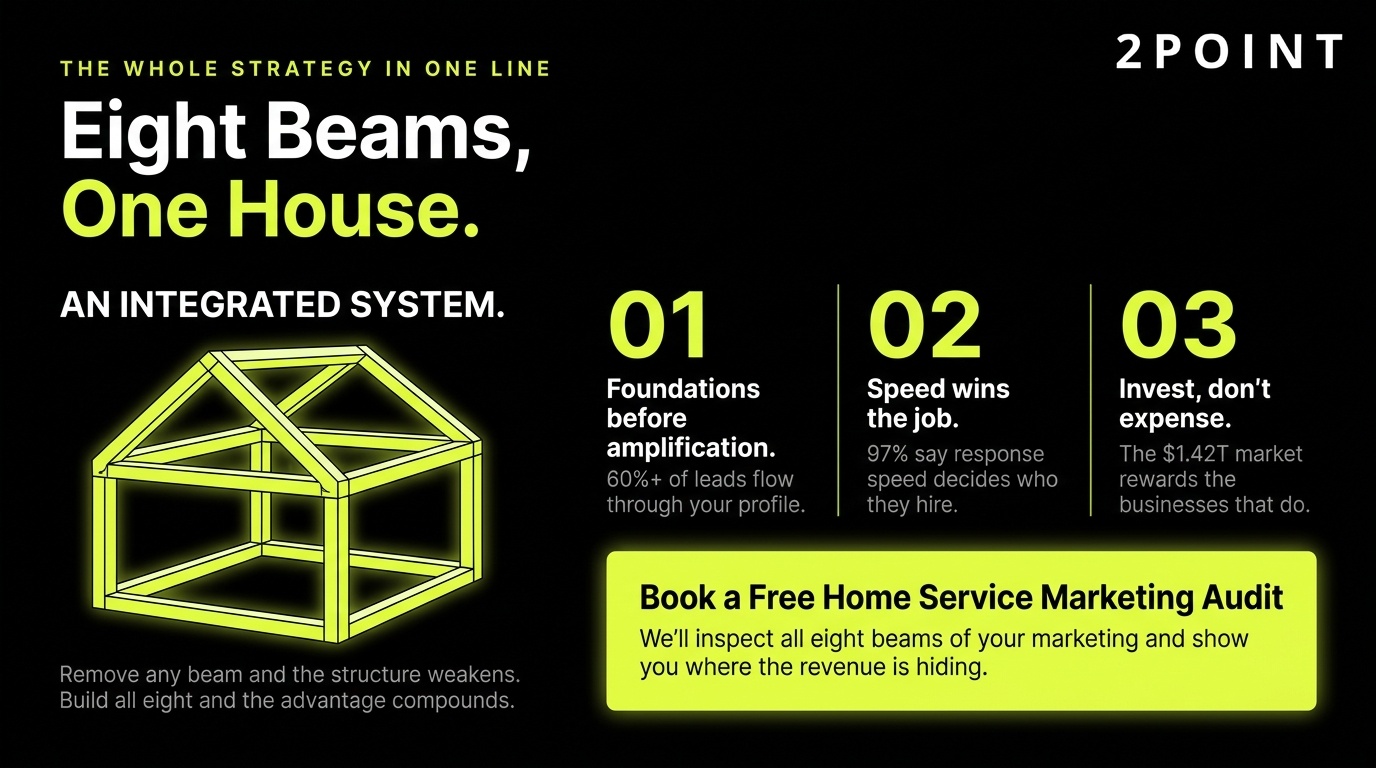
The eight strategic areas covered in this guide work together as an integrated system rather than a menu of independent options. Local SEO creates visibility when homeowners search. A high-converting website turns that visibility into contact. Paid advertising amplifies reach and captures emergency demand. Review generation and reputation management build the trust that converts contacts into hired jobs. Content marketing and video build authority and engage prospects during their research phase. Email marketing retains customers and generates repeat revenue. Speed and follow-up systems ensure that the leads your marketing generates are actually converted. AI and automation multiply the effectiveness of every human effort across all channels.
The trust factor has emerged as the defining competitive dimension in home service marketing. Homeowners are increasingly making hiring decisions based on trust signals rather than price alone, and those trust signals are constructed through consistent, professional execution across every marketing touchpoint: the quality of your Google Business Profile, the authenticity of your website photos, the volume and quality of your reviews, the speed of your response, and the professionalism of every customer interaction. No single element creates trust in isolation. The cumulative impression across all touchpoints determines whether a homeowner calls you or your competitor.
The businesses that will capture disproportionate market share in the coming years share a common orientation: they treat marketing as an essential business investment rather than an expense to minimize. They measure performance rigorously and reallocate budget based on results. They build operational infrastructure, booking systems, CRM, call tracking, automated follow-up, that supports their marketing programs rather than undermining them. They adopt new technologies deliberately and early rather than waiting until they become unavoidable. And they invest consistently rather than in reactive bursts triggered by slow revenue periods.
The path forward is clear even if the journey requires sustained effort. Start with the foundations: optimize your Google Business Profile, build your review generation system, ensure your website converts on mobile, and set up proper call tracking. Expand into paid advertising with Google LSAs as the highest-priority first channel. Layer in content marketing and email automation as operational capacity allows. Then continuously optimize with AI tools and performance data as your program matures. At 2POINT, helping home service businesses build exactly this kind of integrated, performance-driven marketing infrastructure is the work that drives results. The market opportunity is extraordinary. The businesses that invest now in professional, systematic marketing will look back at 2026 as the year that determined their competitive position for the decade ahead.
Frequently Asked Questions About Home Service Marketing
What is home service marketing and what types of businesses does it apply to?
Home service marketing refers to the strategies and tactics that businesses providing residential services use to attract, convert, and retain customers. It applies to HVAC companies, plumbers, electricians, roofers, landscapers, pest control companies, cleaning services, remodelers, and any other business that provides services directly to homeowners. It differs from standard B2C marketing because decisions are urgency-driven, locally focused, and heavily dependent on trust.
How much does home service marketing cost for a small business?
Home service marketing budgets vary widely by market size, service type, and growth goals, but most competitive small businesses allocate 5% to 15% of gross revenue to marketing. A realistic starting point for a small operator might be $1,500 to $3,000 per month covering Google Ads, local SEO maintenance, and basic content development. The key is measuring cost per lead and cost per booked job to ensure spend is generating profitable returns.
What is the most effective marketing channel for home service businesses?
Local SEO through Google Business Profile optimization consistently produces the highest return on investment for home service businesses because it captures active, high-intent searches at the moment a homeowner needs service. Google Local Services Ads complement organic local SEO by appearing above all other results and providing Google Guaranteed trust badges. The most effective programs combine both rather than relying on either channel alone.
How do online reviews impact home service marketing results?
Online reviews are among the most powerful conversion factors in home service marketing: 81% of homeowners consult Google Reviews before hiring, and 98% read reviews for local businesses. A systematic review generation process combined with active response to all reviews, both positive and negative, builds trust signals that improve both search ranking and caller conversion rates. Businesses with higher review counts and ratings consistently win more leads from the same search visibility.
How long does it take to see results from home service marketing?
Paid advertising through Google LSAs and Google Ads can generate leads within days of launch. Local SEO improvements typically begin showing ranking movement within two to three months and reach meaningful competitive impact within six to twelve months. Content marketing and email programs build audience and authority over six to eighteen months before delivering their full compounding return. The most effective programs run paid channels for immediate results while simultaneously building organic assets for long-term growth.
Is social media marketing worth the effort for home service companies?
Social media marketing for home service businesses delivers better results for brand awareness and community building than for direct lead generation. Facebook and Nextdoor perform best for reaching homeowners in specific neighborhoods. Social media complements search-focused channels rather than replacing them, and is most valuable for businesses that can post consistently with authentic content including real project photos, team introductions, and educational tips.
What is the difference between Google Local Services Ads and Google Ads for home services?
Google Local Services Ads use a pay-per-lead model and display above all other paid and organic search results with a Google Guaranteed badge earned through background checks and license verification. Traditional Google Ads use a pay-per-click model, appear below LSAs, and do not carry the Google Guaranteed badge. LSAs typically deliver higher-trust leads at lower cost for eligible service categories, while traditional Google Ads offer more control over keywords, geography, and ad messaging.
How important is website speed for home service marketing?
Website speed is critical for home service marketing because most searches happen on mobile devices where load time directly determines whether a visitor stays or leaves. A page that takes more than three seconds to load on mobile loses a significant percentage of visitors before they see any of your content. Core Web Vitals performance scores also influence Google search rankings, meaning slow websites rank lower and convert fewer visitors simultaneously, compounding the negative impact.
What is the cost per lead benchmark for home service businesses?
Cost per lead benchmarks vary significantly by service category: premium services like kitchen remodeling and roofing typically run $350 to $500 CPL with 35% to 40% margins justifying the investment, while high-volume services like plumbing and pest control target $50 to $150 CPL given higher booking frequency. The correct CPL ceiling for any business is calculated backward from average job value, gross margin, and customer lifetime value rather than set based on industry averages alone.
How does AI improve home service marketing results?
AI improves home service marketing through predictive scheduling that anticipates customer service needs, automated bid optimization in paid advertising that adjusts to real-time signals faster than human managers can, AI chatbots that qualify and book leads after hours, and content generation tools that accelerate marketing material production. Over 70% of home service professionals now use AI tools in their business, with the primary benefit being operational efficiency that frees human staff for higher-value customer interactions.
Home service marketing vs. traditional advertising: which delivers better ROI?
Digital home service marketing consistently outperforms traditional advertising like print, radio, and direct mail in measurable ROI for most service categories and market sizes. Digital channels offer precise targeting by geography, demographics, and search intent that traditional media cannot match, along with real-time performance data that allows continuous optimization. Traditional media retains value for broad brand awareness in specific markets, particularly for businesses targeting older demographics who consume less digital media, but digital-first strategies dominate lead generation ROI for home services in 2026.
What should a home service marketing strategy include as its first priorities?
The first-priority elements of a home service marketing strategy are Google Business Profile optimization with regular posts and active review management, a mobile-responsive website that loads quickly and makes calling or booking effortless, systematic review generation after every service completion, and call tracking to attribute leads to marketing channels. These foundational elements should be fully functioning before adding paid advertising or content marketing, because they determine the conversion rate of every lead those channels generate.
