

 let’s connect


What Is Content Marketing and Why Does It Matter in 2026?
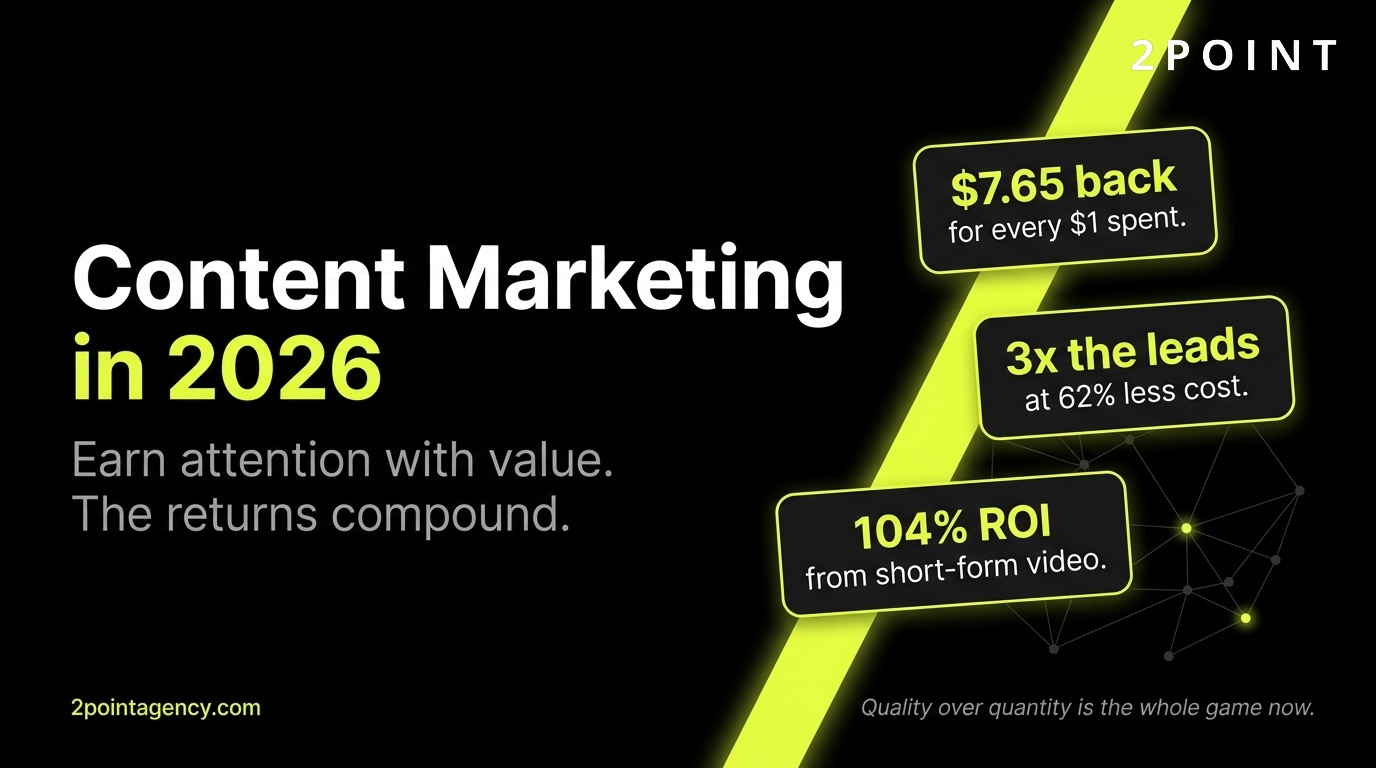
Content marketing is a strategic approach focused on creating and distributing valuable, relevant content to attract and retain a clearly defined audience, ultimately driving profitable customer action. Here is what every marketer needs to know right now:
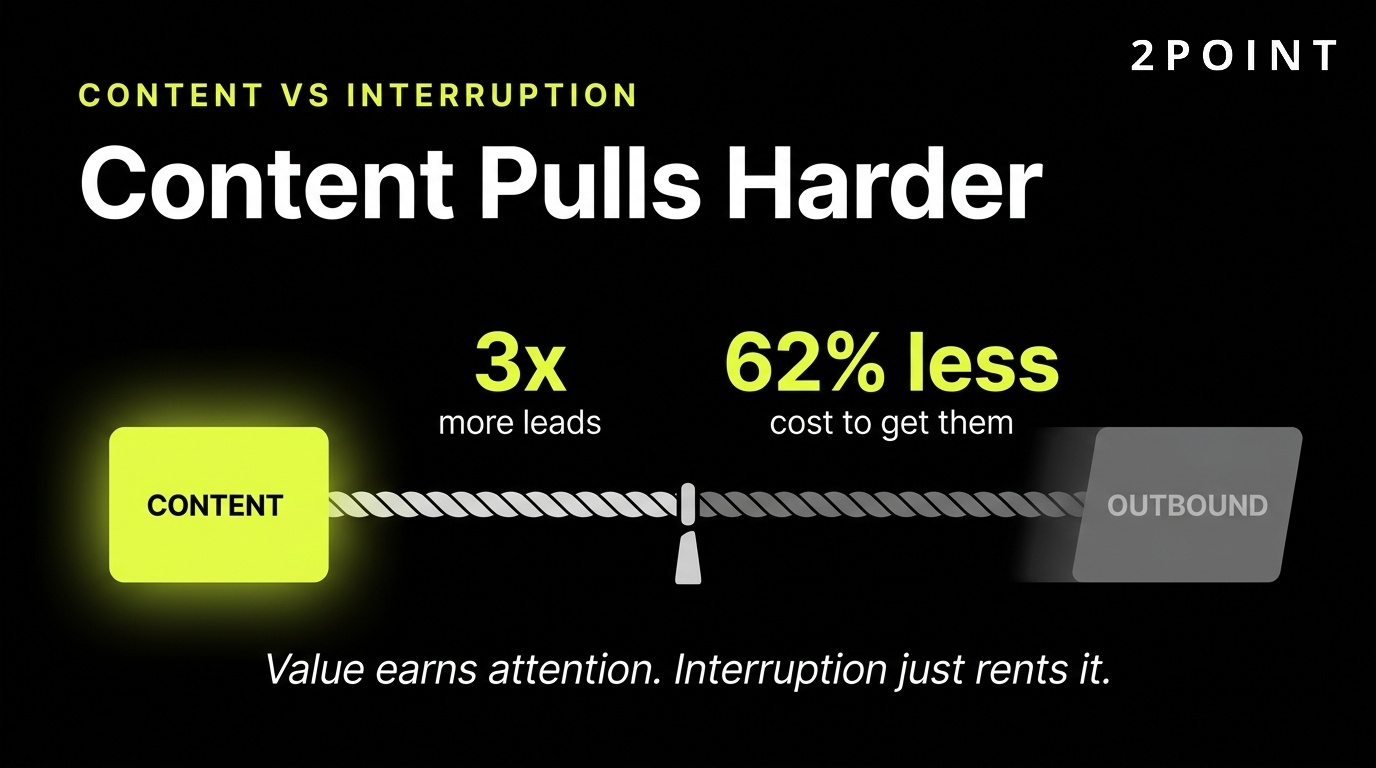
- Content marketing generates over three times as many leads as outbound marketing while costing 62% less.
- 73% of B2B and 70% of B2C marketers now maintain documented content strategies.
- 50% of B2B buyers now begin their purchasing journey inside AI chatbots, not Google.
- 94% of marketers now use AI tools in their content creation process.
- Short-form video delivers the highest ROI of any content format available today.
- Success in 2026 requires balancing AI efficiency with authentic human creativity.
- Optimizing for generative AI platforms is now as important as traditional SEO.
- Quality over quantity is the defining philosophy separating top performers from the rest.
How Content Marketing Works and Why It Outperforms Traditional Advertising
Understanding the mechanics behind content marketing helps explain why organizations continue shifting budget away from interruptive advertising and toward value-driven content. The numbers tell a clear story, but the logic behind them is just as compelling.
The Fundamentals: What Makes Content Marketing Different
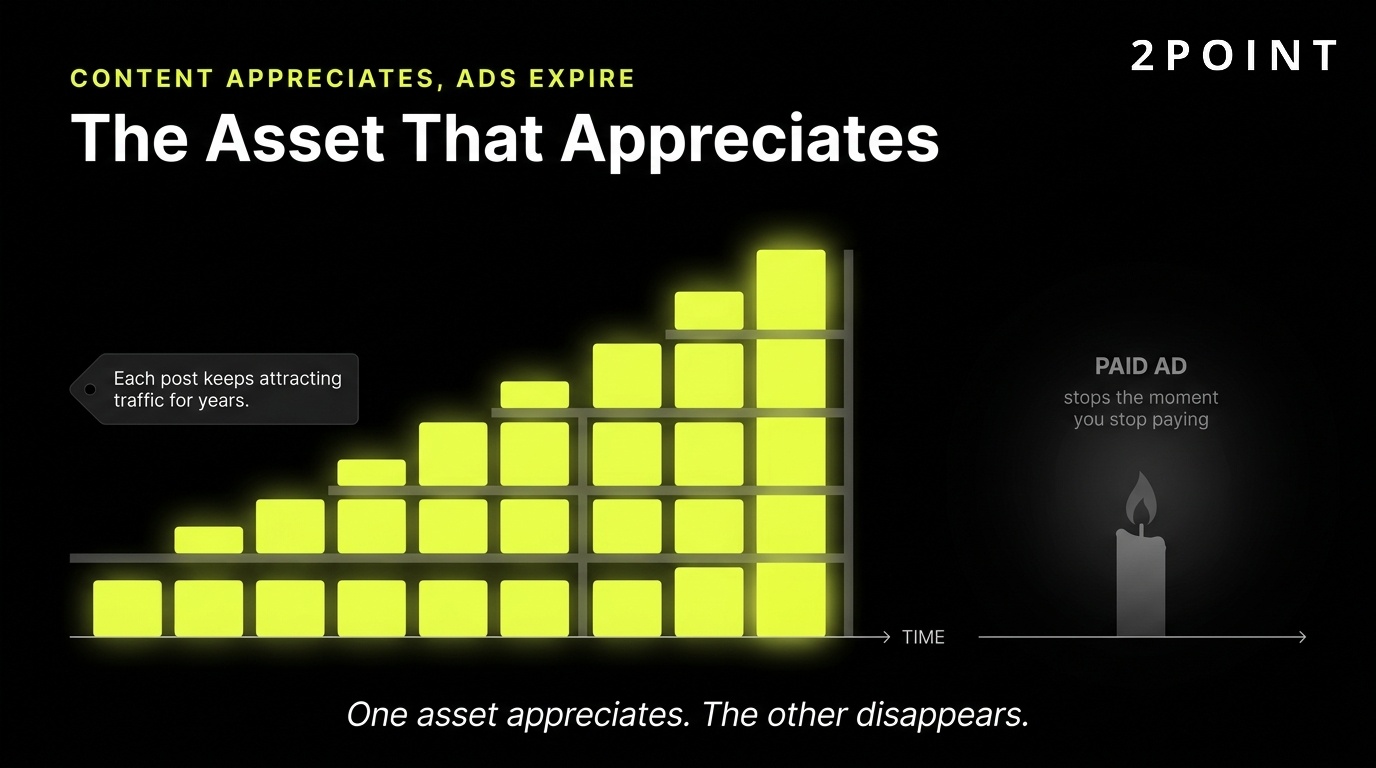
At its core, content marketing operates on a simple principle: provide genuine value before asking for business. Rather than interrupting someone's day with an ad they did not request, content marketing earns attention by answering questions, solving problems, and educating audiences at the exact moment they need help. This is a fundamentally different relationship between brand and buyer.
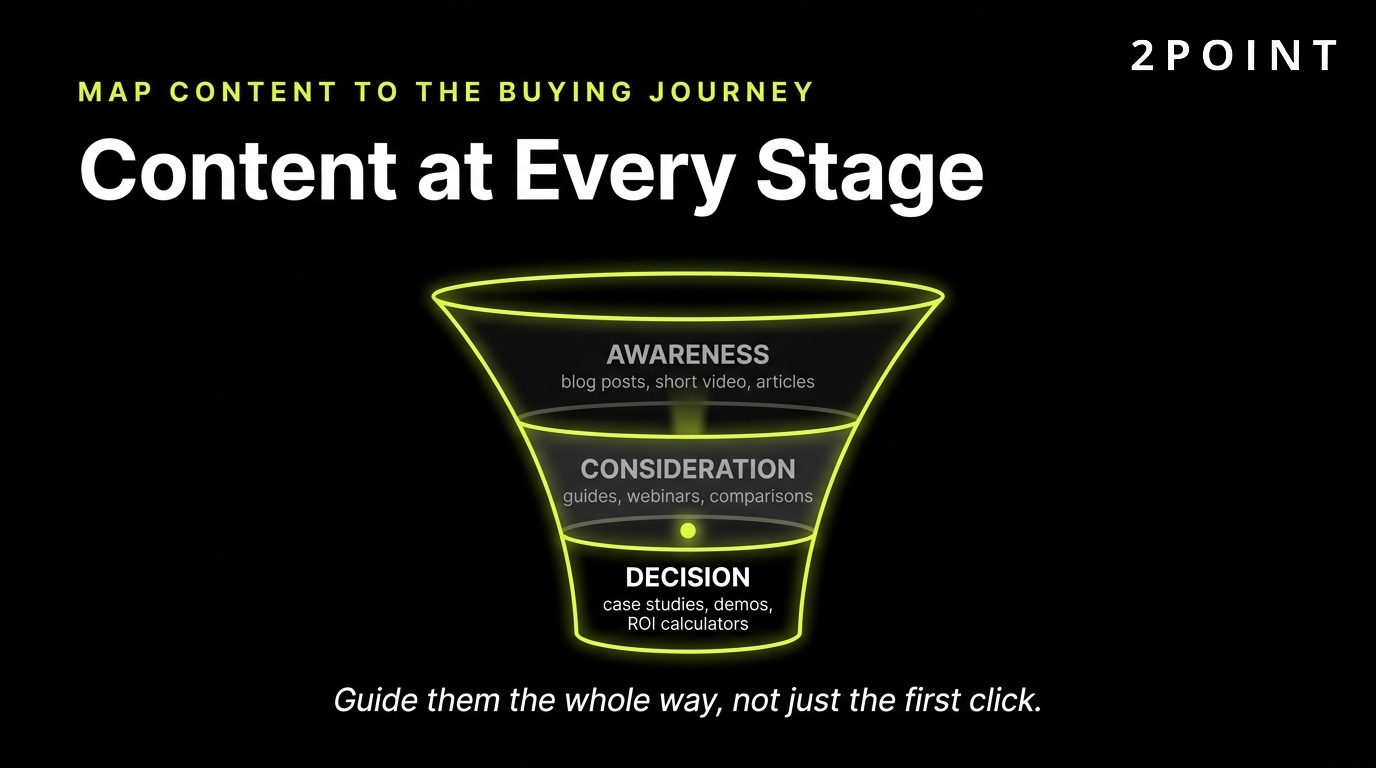
The buyer journey is where this difference becomes most visible. Educational blog posts attract strangers who have never heard of your brand but are searching for answers. Comprehensive guides and downloadable resources convert those visitors into leads. Case studies and detailed comparisons help prospects overcome hesitations at the decision stage. Every piece of content serves a specific purpose in moving someone closer to becoming a customer.

The Business Case: ROI That Justifies Investment
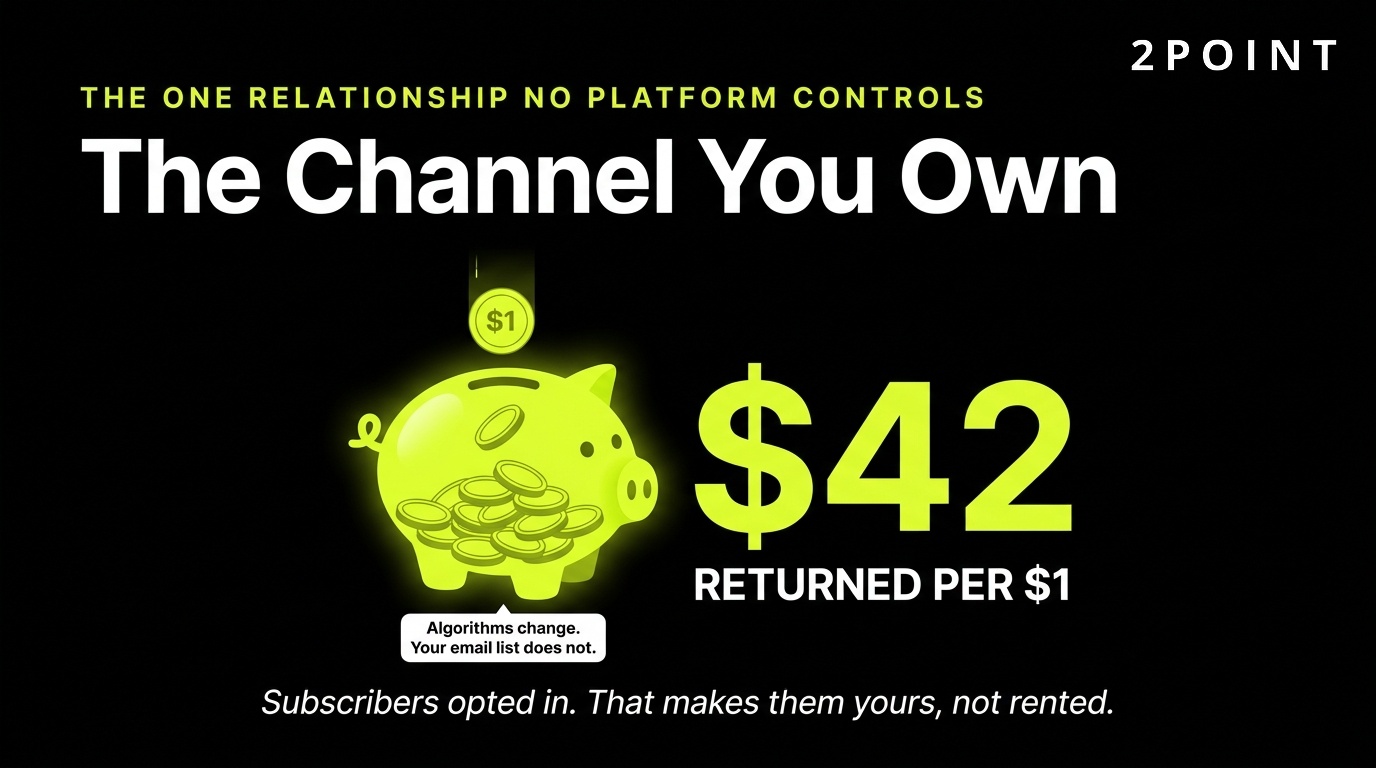
Organizations do not allocate significant portions of their marketing budgets to content marketing out of sentiment. They do it because the financial returns justify the investment, and the data from 2026 reinforces that case strongly. Content marketing now represents 26% of total marketing spend across organizations, a figure that reflects growing confidence in the channel rather than experimentation. The results vary considerably depending on how strategically organizations approach the work. About 12% of marketers exceed their content goals, while 47% meet most of them. The gap between top performers and average performers is dramatic. Organizations that rate their content strategies as highly successful are 37 times more likely to have documented, intentional approaches rather than ad hoc publishing schedules. Strategy is not just helpful; it is transformative. AI integration is reshaping the ROI conversation in meaningful ways. 68% of organizations now report seeing higher ROI since incorporating AI tools into their content workflows. Meanwhile, email marketing continues to deliver some of the most reliable returns in digital marketing, with an average of $42 in revenue generated for every single dollar invested. Budget confidence remains strong as well: 88.2% of businesses expect their content marketing budgets to grow or remain stable through the coming year. When the majority of organizations plan to maintain or increase investment despite economic pressures, it signals a discipline that has proven its worth.
From Awareness to Conversion: The Content Marketing Funnel
Content marketing does not operate in isolation from the broader sales process. It maps directly onto the buying journey, with different content types performing different roles at each stage. Understanding this structure helps organizations allocate creative energy strategically rather than producing content randomly.
Adoption Rates: Who Is Using Content Marketing and How
Content marketing has moved well past early-adopter status. It is now a standard component of marketing programs across industries, company sizes, and business models. 73% of B2B marketers and 70% of B2C marketers maintain documented content marketing strategies, signaling that the discipline has achieved genuine mainstream adoption. Among those organizations, 79% actively run and maintain blogs as part of their content mix. The distinction between having a documented strategy and simply publishing content occasionally is significant. Organizations with documented content strategies generate three times more leads per dollar than those without written plans. This is not a small margin. It represents the difference between content marketing as a productive engine and content marketing as an expensive hobby. The documentation forces clarity, alignment, and measurement that casual approaches simply cannot achieve. Developing a clear content marketing strategy is the single most reliable predictor of success. The 29% of marketers actively and intentionally using content marketing as a core channel consistently outperform those treating it as supplementary or reactive. For businesses evaluating where to invest, the adoption data and performance correlation together make a strong case for treating content as a primary channel rather than an afterthought.
The 2026 Content Marketing Landscape: AI, Zero-Click Search, and Search Evolution
The environment in which content marketing operates has shifted more dramatically in the past two years than in the previous decade combined. Generative AI, changing search behavior, and privacy regulations are rewriting the rules simultaneously. Understanding these shifts is not optional for marketers who want results in 2026.
The Rise of Generative Engine Optimization (GEO)
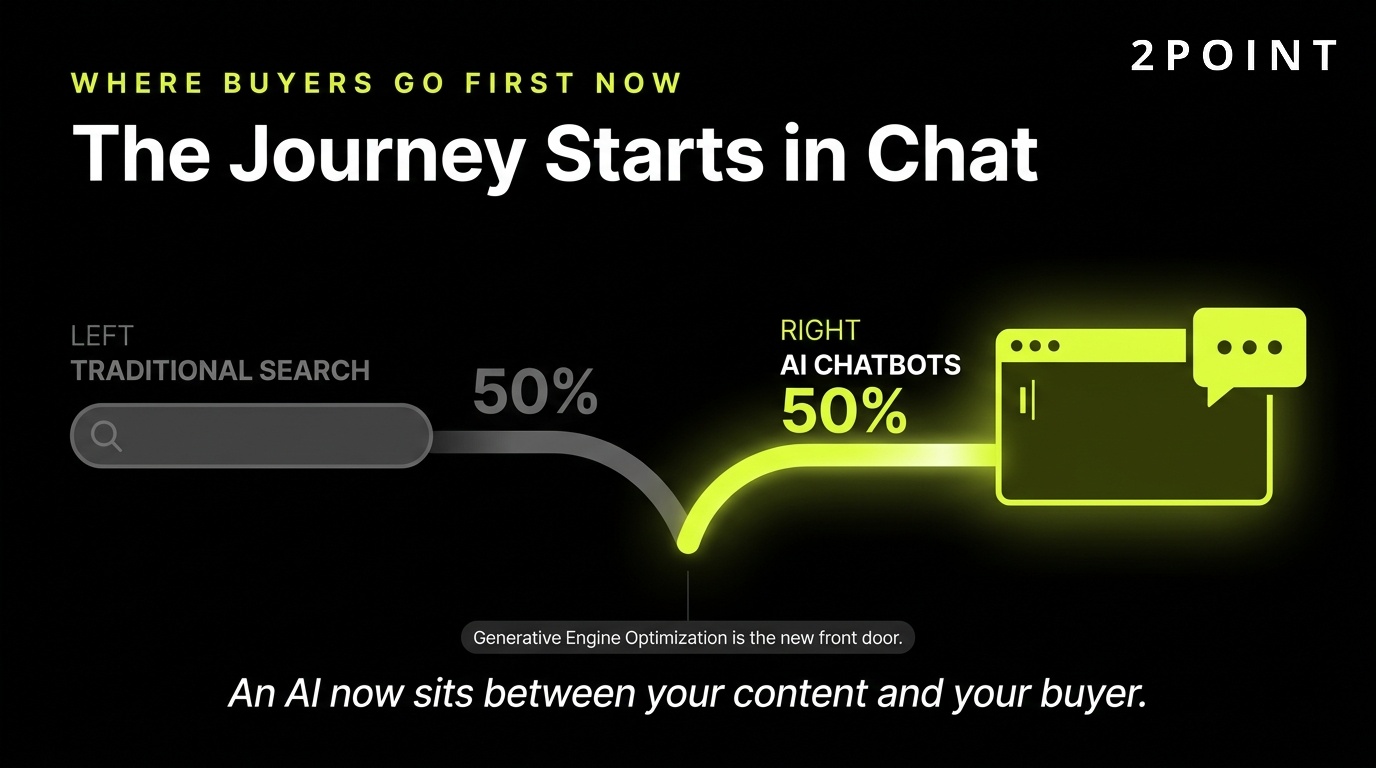
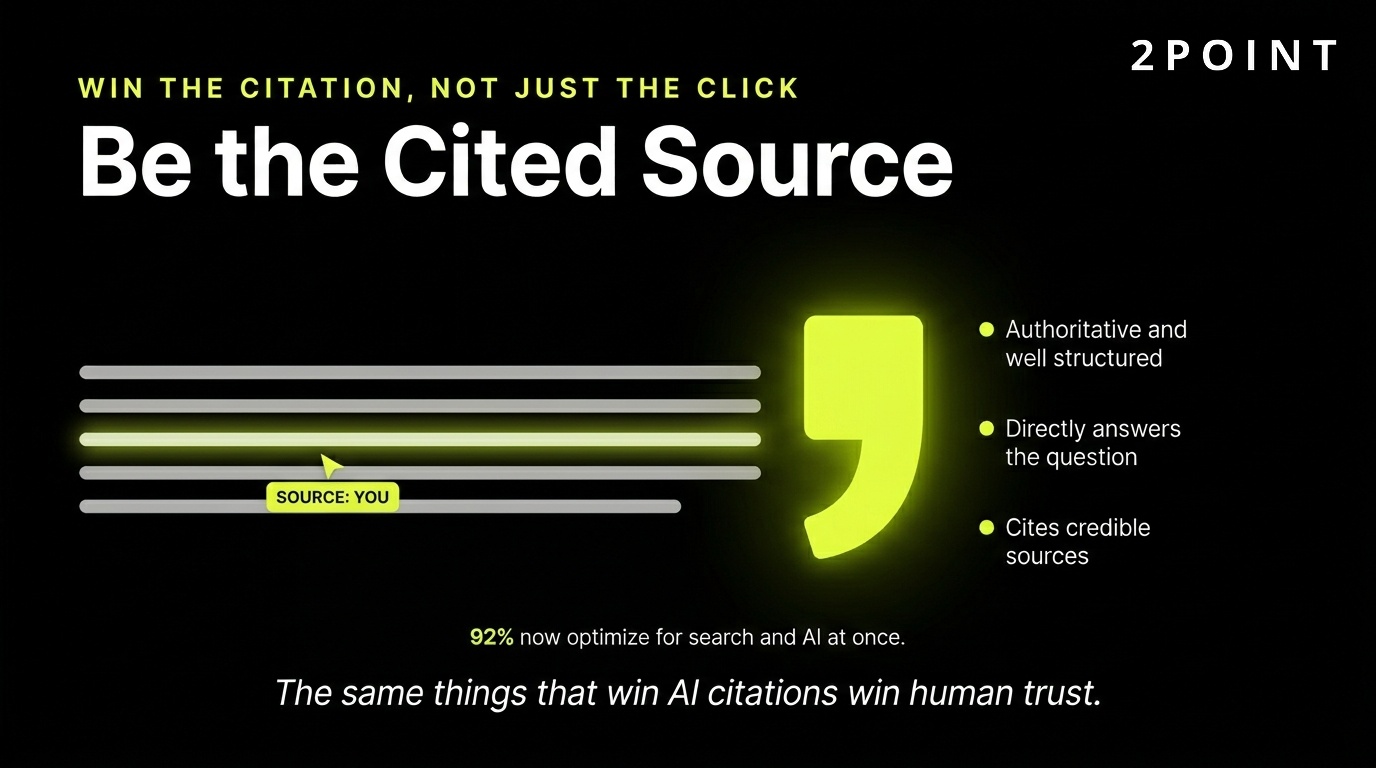
A seismic shift is underway in how people find information online. 50% of B2B buyers now begin their purchasing journey inside AI chatbots rather than traditional search engines. This is not a future trend to prepare for. It is the current reality that content strategies must address immediately. Generative Engine Optimization (GEO) describes the practice of optimizing content specifically to be cited, referenced, or recommended by AI systems like ChatGPT, Perplexity, Google AI Overviews, and similar platforms. Where traditional SEO focused on ranking in a list of ten blue links, GEO focuses on being the source an AI system trusts enough to quote when a user asks a relevant question. The strategic implications are significant. A generative AI model now sits between your content and your potential audience, acting as an intermediary that decides what information to surface and which sources to credit. 94% of marketers now use AI in content creation, and the competitive response is already underway. Over 92% of marketers plan to optimize their content for both traditional search and AI-powered search simultaneously. The content that wins AI citations tends to share specific characteristics: it is authoritative, well-structured, directly answers specific questions, cites credible sources, and demonstrates genuine expertise. These are also the qualities that make content excellent for human readers, which means the best approach for GEO and for audience engagement are more aligned than different.
Zero-Visit Visibility and Declining Organic Clicks
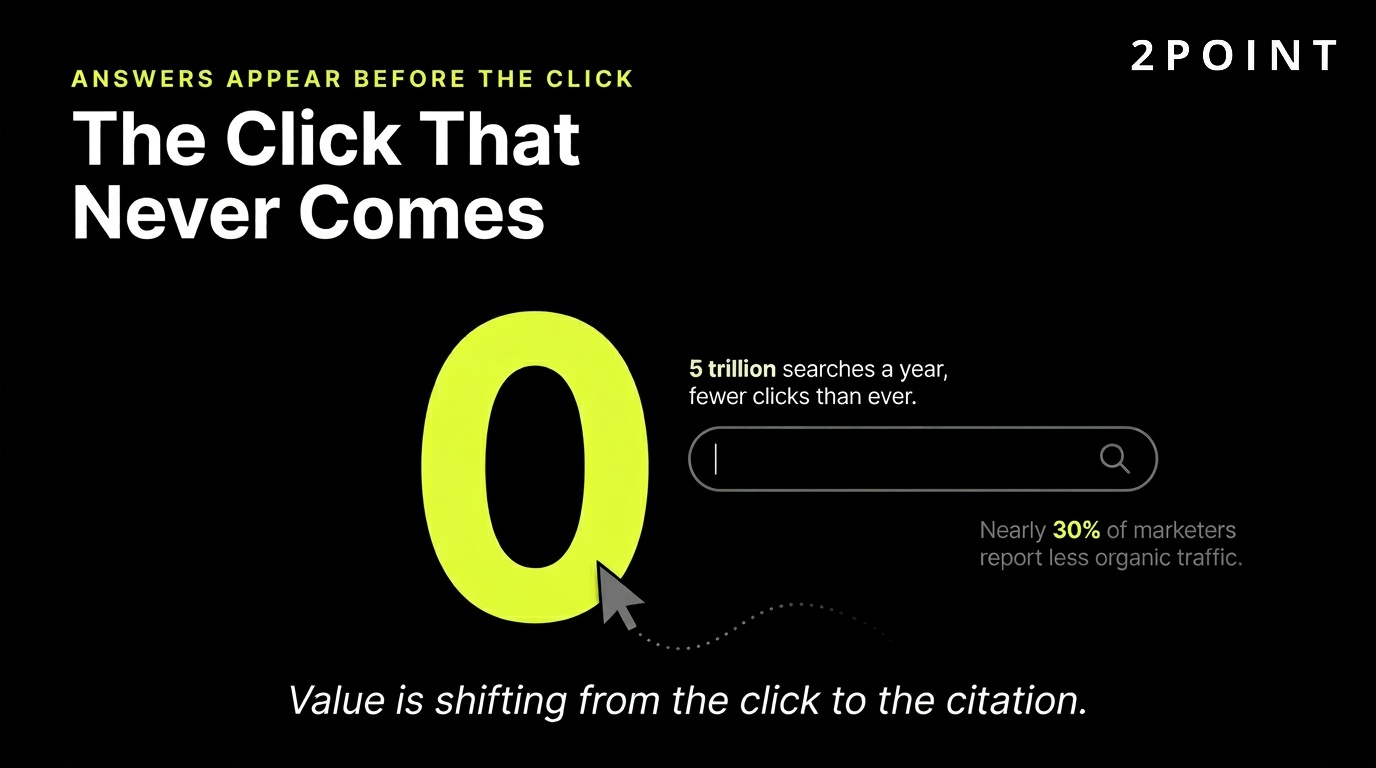
Google processes more than five trillion searches every year, but the relationship between those searches and actual website visits is changing. Answers increasingly appear directly within search results through featured snippets, knowledge panels, and AI Overviews, reducing the need for users to click through to source websites. Marketing analyst Rand Fishkin has projected that zero-click experiences will become the majority of search interactions, a shift with major implications for traffic-based content strategies. The evidence is already showing up in marketing metrics. Nearly 30% of marketers have reported decreased organic search traffic as consumers increasingly turn to AI tools for answers rather than clicking through to websites. This does not mean organic content is becoming worthless. It means the value is shifting from click-through traffic to brand visibility, authority signals, and AI citation. Marketers who understand this distinction can adapt their metrics and strategies accordingly. The practical response involves several adjustments. Optimizing content for featured snippets and position-zero answers keeps brands visible even without clicks. Building topical authority across a subject matter signals credibility to both search algorithms and AI systems. Creating content that is rich enough to be cited as a source rather than merely linked maintains brand presence in an environment where the click itself is no longer guaranteed. Ongoing marketing analysis helps teams identify which content is generating visibility and authority signals even when traditional traffic metrics tell an incomplete story.
AI Integration: The Human-AI Collaboration Model
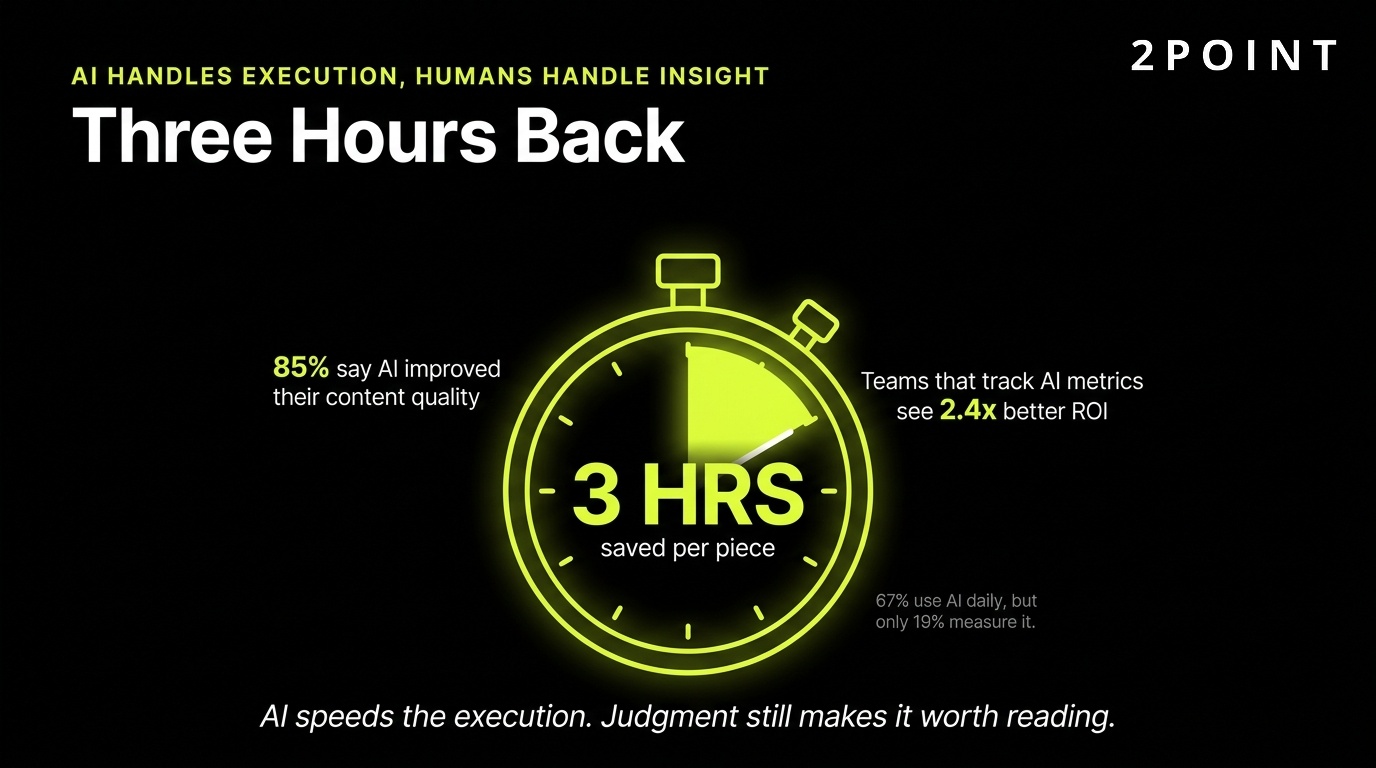
The appropriate relationship between AI tools and content marketing is one of collaboration, not replacement. The most effective teams use AI to handle the parts of content creation that benefit from machine efficiency while reserving human judgment, voice, and insight for the elements that define quality. This balanced approach is what separates organizations seeing strong returns from those experiencing AI-related quality problems. The efficiency gains are real and substantial. Marketers save an average of three hours per piece of content when using AI assistance, translating to approximately 2.5 hours saved per working day across a full content program. 85% of marketers report that AI has significantly improved the quality of their content output, primarily because the time saved on research and drafting can be redirected toward editing, insight development, and strategic thinking. The math makes AI adoption for content production essentially unavoidable for teams trying to remain competitive. However, the measurement side of AI-assisted content marketing still lags behind adoption. 67% of marketers use AI tools daily, but only 19% track AI-specific KPIs to evaluate performance. This gap matters because organizations that do track AI-specific metrics see 2.4 times better content ROI than those that do not. Meanwhile, the human factors remain dominant in determining success: 65% of successful content teams credit content relevance and quality as the primary driver of results, with technology serving as an enabler rather than the source of competitive advantage. AI makes execution faster and more scalable; human expertise makes the content worth reading.
Privacy-First Marketing and First-Party Data Strategy
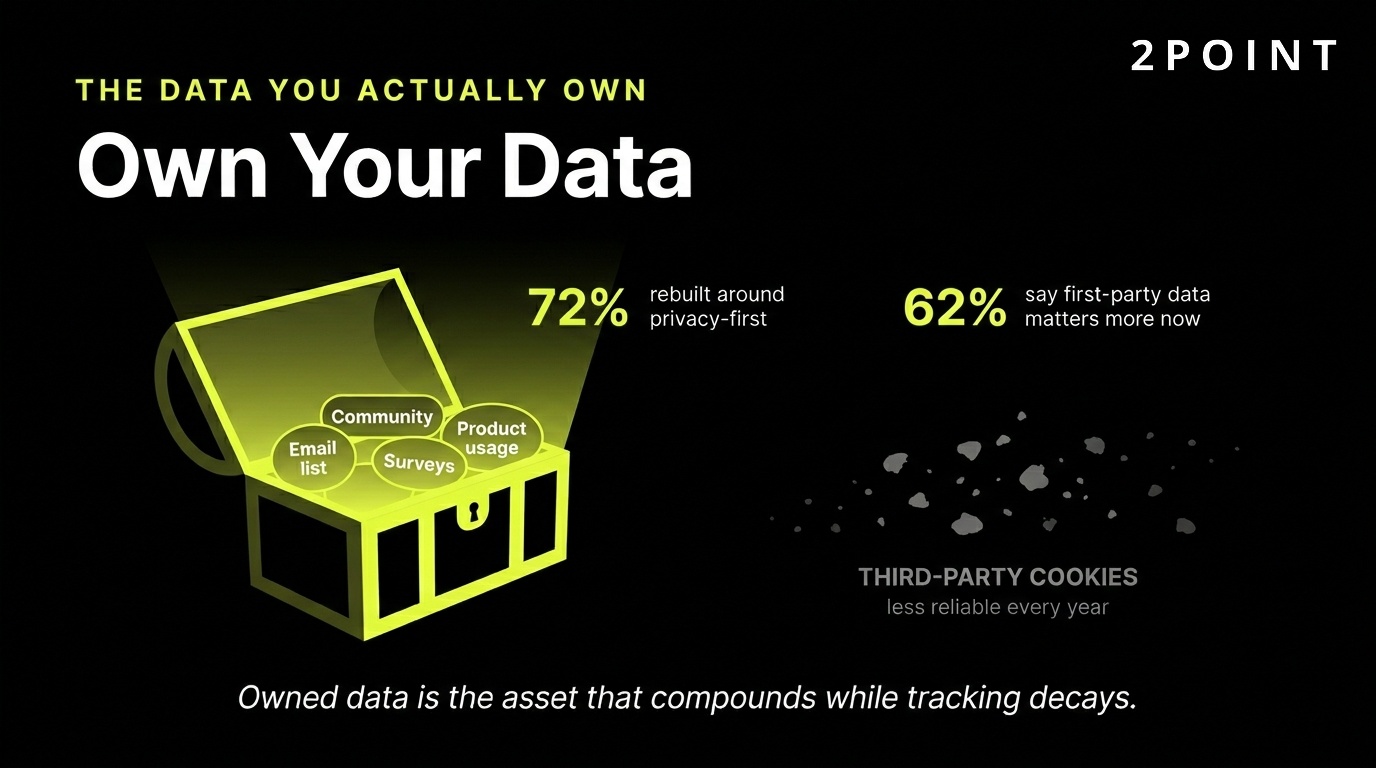
The deprecation of third-party cookies and the tightening of global privacy regulations have forced a fundamental rethinking of how marketers collect data, target audiences, and measure performance. 72% of global marketers have already rebuilt their strategies around privacy-first models that rely on first-party data rather than third-party tracking. This is not a minor tactical adjustment; it is a structural change in how the marketing ecosystem operates. First-party data includes everything a brand collects directly from its audience through consensual interactions: email subscriptions, form completions, product usage data, community participation, and direct surveys. 62% of marketers say first-party data will become more important to their strategy in the coming years, and the organizations building robust first-party data infrastructure now are establishing advantages that will compound over time. Email lists, private communities, loyalty programs, and owned media channels become increasingly valuable as third-party data becomes less accessible and less reliable. For newer organizations and startups, the privacy shift presents an unexpected opportunity. Companies building their marketing infrastructure from scratch can design first-party data collection correctly from the beginning, without needing to unwind years of third-party data dependency. Rather than viewing privacy regulations as a constraint, forward-thinking marketers treat them as a prompt to build direct, trust-based relationships with audiences. That foundation is far more durable than any tracking-based approach could provide. Understanding consumer behavior analysis becomes especially valuable in this environment, because it helps teams interpret the first-party signals they do have access to with greater precision.
Video Content Dominance: Why Video Marketing Delivers the Highest ROI
If there is a single format that defines content marketing in 2026, it is video. The data is not ambiguous on this point. Video outperforms other content types on engagement, ROI, brand recall, and platform reach by margins that have only widened over time. Understanding how to build a sustainable video strategy is now a core content marketing competency.
Why Video Delivers the Highest ROI in 2026
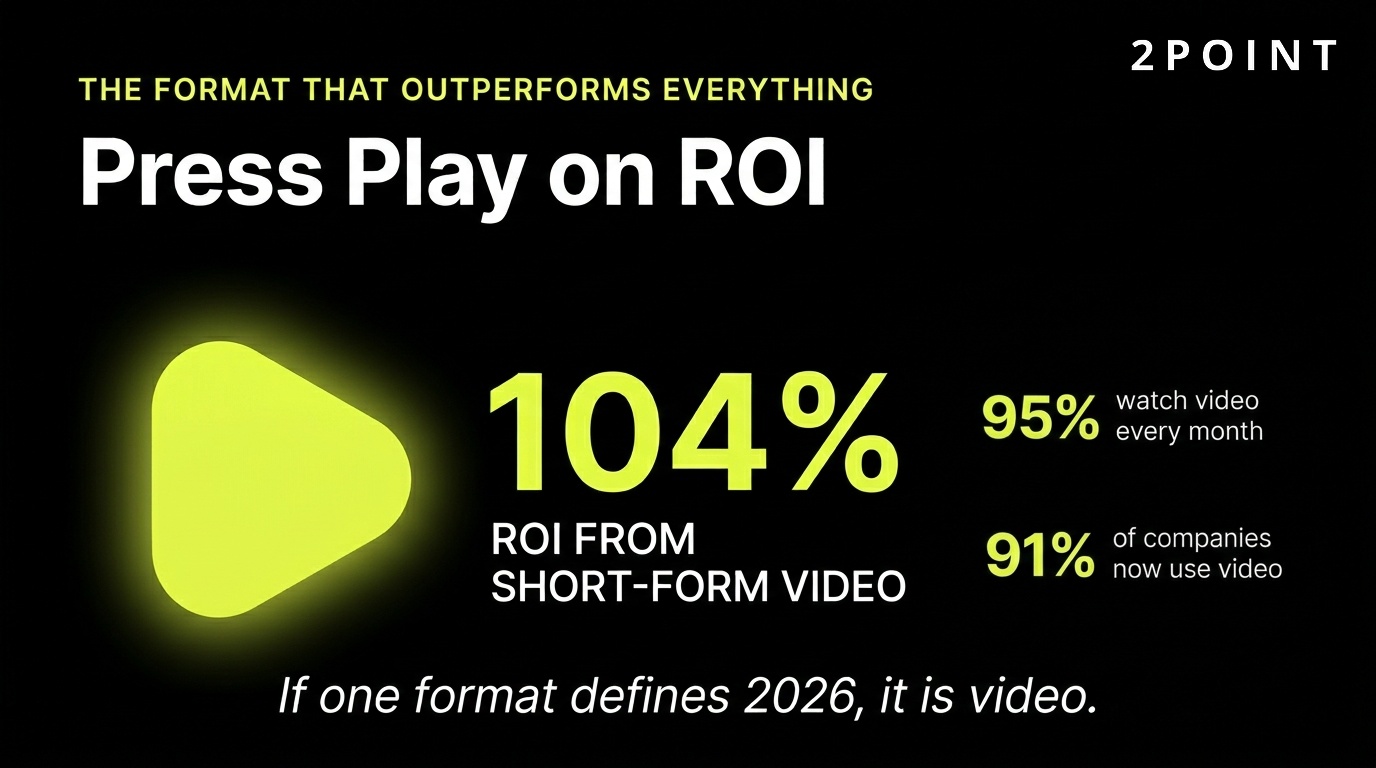
The performance data for video marketing continues to set records that other formats cannot match. Short-form video delivers the highest ROI of any content format at 104%, a figure that reflects both the massive reach of video-first platforms and the inherent engagement advantages that motion and audio bring over static text. Video is not just popular; it is disproportionately effective at driving the outcomes that content marketing exists to create. The reach numbers reinforce the ROI story. 95% of internet users watch videos monthly, making video the single content format with the widest potential audience. 45% of marketers credited video as their top-performing content type in 2025, and the investment is following the results. Understanding video marketing deeply is now a baseline requirement rather than a differentiator for content teams. The brands that invested early in video capabilities are now seeing compounding returns from the assets and audience relationships they have built. The broader web traffic impact of video is equally significant. 82% of marketers report that video has meaningfully increased their website traffic, and 61% of B2B marketers plan to increase their video spending over the next twelve months. The combination of high ROI, massive reach, and growing B2B adoption makes video not just a consumer marketing tool but a full-spectrum content strategy requirement.
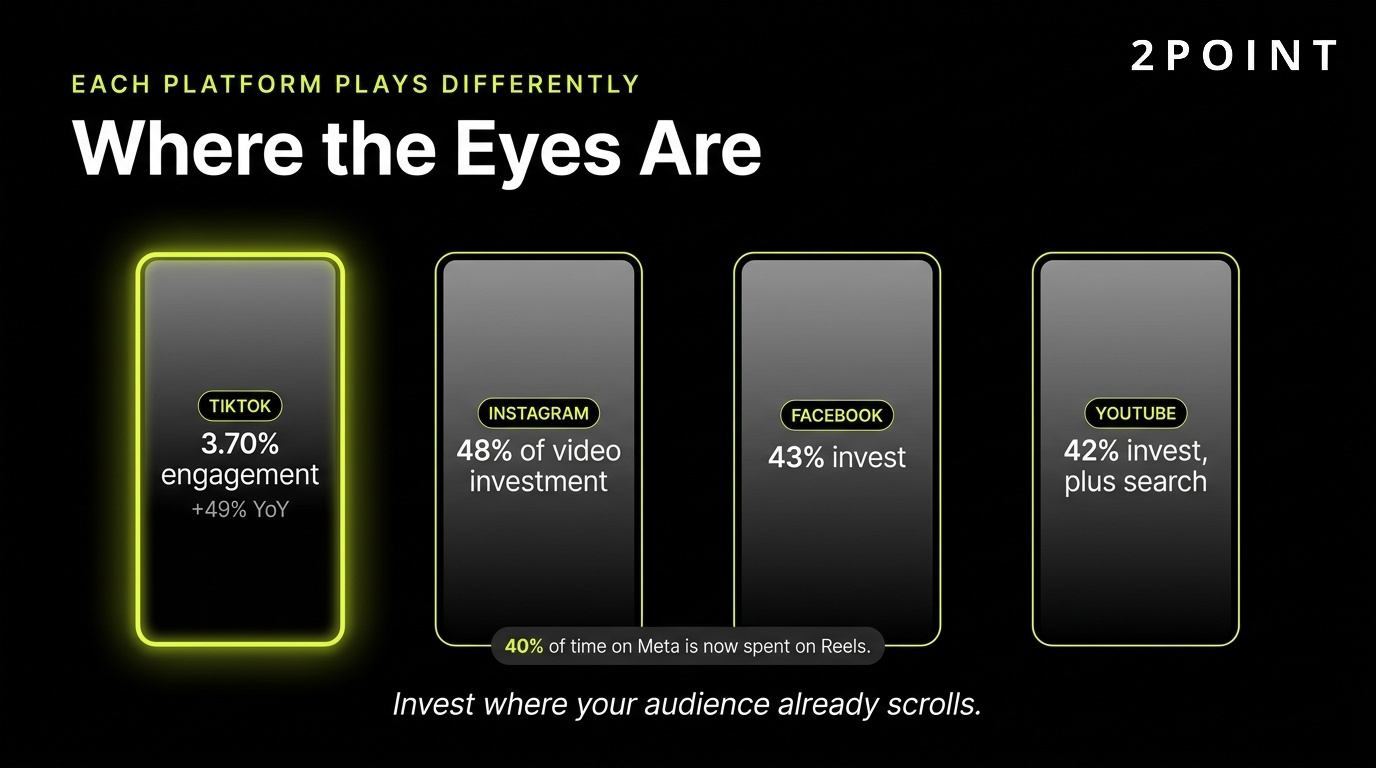
Platform-Specific Video Strategies: TikTok, Instagram, and YouTube
Not all video platforms operate the same way, attract the same audiences, or reward the same content approaches. Building an effective video marketing strategy requires understanding the distinct dynamics of each major platform and making deliberate choices about where to invest creative resources.
Long-Form vs. Short-Form Video: When to Use Each Format
| Video Format | Typical Length | Primary Goal | Best Platforms | Strengths |
|---|---|---|---|---|
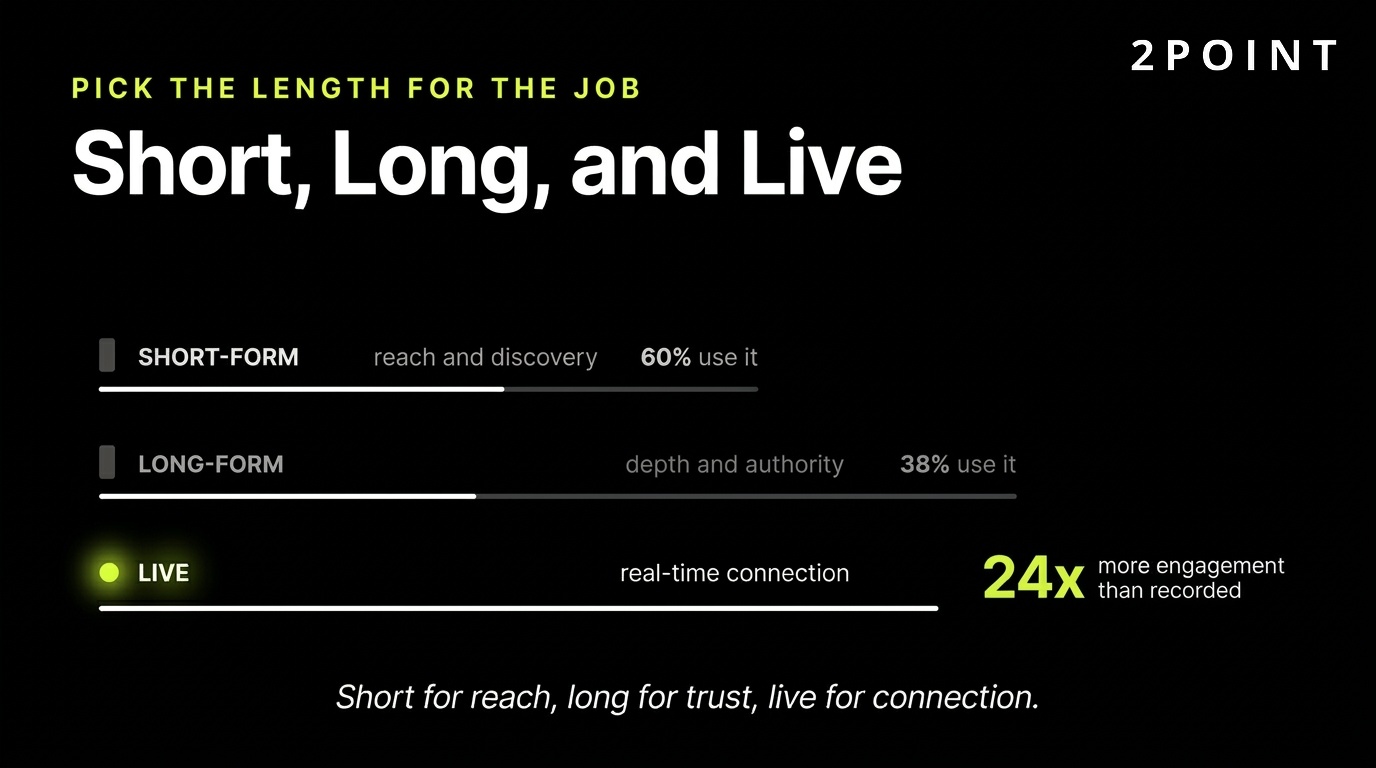
| Short-Form Video | 15 seconds to 3 minutes | Brand awareness, engagement, reach | TikTok, Instagram Reels, YouTube Shorts | Algorithm favorability, low production barrier, high shareability |
| Long-Form Video | 10 minutes to 60+ minutes | Education, thought leadership, trust building | YouTube, LinkedIn, brand website | Depth of engagement, SEO value, authority positioning |
| Live Video | Real-time, variable | Community building, real-time engagement | Instagram Live, LinkedIn Live, YouTube Live | 24x more engagement than recorded video, authentic connection |
| Webinar/Virtual Event | 30 minutes to 3 hours | Lead generation, mid-funnel nurture | Zoom, LinkedIn Events, dedicated platforms | High-quality lead capture, deep audience commitment |
The most effective video strategies combine short-form content for reach and algorithmic distribution with long-form content for depth, authority, and search discoverability. Live video generates 24 times more engagement than pre-recorded video, a differential that reflects the unique psychological pull of real-time interaction. Among top formats currently in use, both short-form video at 60% and long-form video at 38% rank among the most commonly used content types, with each serving genuinely different strategic purposes. The temptation to choose one and ignore the other typically results in leaving significant value on the table.
Production Reality: Making Video Sustainable for Your Team
One of the most persistent objections to video marketing is the perception that it requires expensive equipment, professional crews, and significant production time. The reality in 2026 is considerably more accessible. AI-powered editing tools, built-in smartphone camera capabilities, and audience preferences for authenticity over polish have dramatically lowered the barrier to effective video production.

Building a Content Marketing Strategy That Actually Works
The difference between content marketing that compounds over time and content marketing that feels like constant effort with inconsistent results usually comes down to strategy. Specifically, it comes down to whether the strategy exists in writing, whether it reflects genuine audience understanding, and whether the organization has built the operational infrastructure to execute consistently.
The Documentation Advantage: Why Writing It Down Multiplies Results
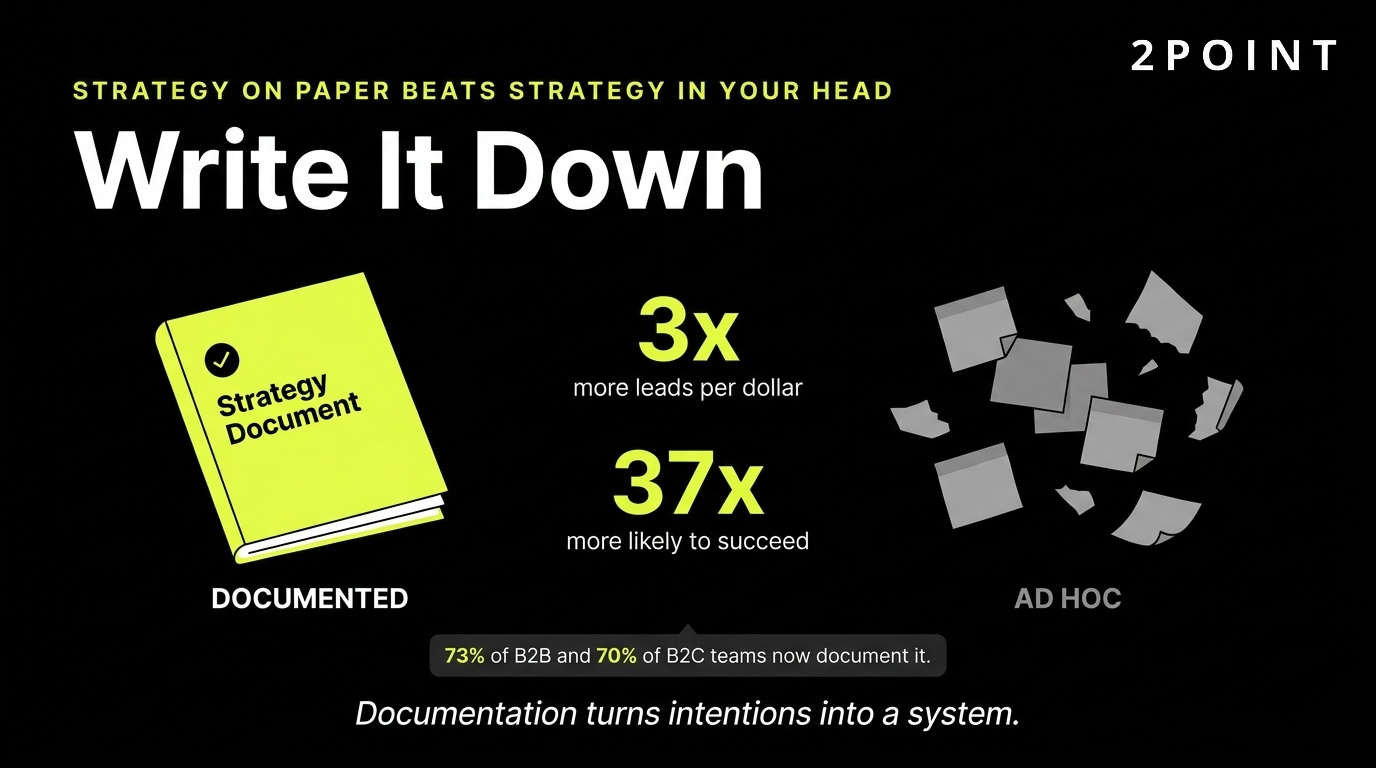
Documentation transforms intentions into a system. When a content strategy exists only in someone's head or as informal shared understanding, it is vulnerable to inconsistency, personnel changes, and scope creep. When it is written down in a comprehensive document that outlines goals, audiences, formats, distribution channels, and measurement criteria, it becomes an organizational asset that produces reliable results. The 73% of marketers with documented strategies consistently outperform those without them, generating three times more leads per dollar. A complete content strategy document addresses several core questions: Why does the organization create content? Who specifically is it created for? What unique value or perspective does the organization bring? How will content be created, distributed, and maintained? What metrics will define success? Answering these questions in writing forces the clarity that separates strategic content marketing from tactical publishing. Teams with documented strategies report feeling significantly less challenged across every dimension of content marketing, from ideation to measurement, than teams operating without written guidance. The framework for a strong documented strategy includes a business case section explaining how content supports organizational goals, an operations plan detailing workflows and responsibilities, and a measurement framework that connects content activity to business outcomes. Developing effective content development processes that the entire team understands and follows is the operational backbone that makes the documented strategy actionable rather than theoretical. Without execution infrastructure, even the most thoughtful strategy document becomes an aspiration rather than a system.
Audience-First Planning: Understanding Who You Are Really Serving
Every piece of content that performs well was created with a specific person in mind. Content that tries to speak to everyone ends up resonating with no one. The most successful content marketing programs begin with deep audience understanding rather than product features or brand messaging. Before deciding what to write, record, or publish, teams need to understand precisely who they are serving and what those people actually need. Buyer persona development involves more than demographic sketches. It requires understanding the questions an audience asks at different stages of their journey, the language they use when describing their problems, the platforms they inhabit, and the content formats they prefer. Pain point mapping reveals the frustrations that drive search behavior, while search intent analysis shows what information people are actually looking for when they type specific queries. Combined, these inputs create a picture of the audience that makes content creation dramatically more effective. Customer behavior analysis provides the data foundation that informs these decisions with precision rather than assumption. Top-performing content teams are 37 times more likely to rate their strategies as highly successful than average performers, and the primary differentiators are content relevance and quality, credited by 65% of successful teams, along with team capabilities, cited by 53%. Both factors trace back to audience understanding. When teams know their audience deeply, they create content that is relevant by definition. When that audience knowledge is shared across the team, everyone's capabilities align around the same goals. Engaging content strategies always begin with audience empathy, not content formats or publishing schedules.
Content Calendar and Operations: The Infrastructure of Consistency
Consistency is one of the most underrated factors in content marketing success. Sporadic publishing creates gaps in audience expectations, reduces algorithmic favorability across social and search platforms, and makes measurement unreliable. An editorial calendar is the operational tool that converts strategic intentions into a predictable production rhythm. It is not bureaucracy; it is the infrastructure that makes quality work sustainable over time. Content operations encompasses planning processes, role definitions, editorial workflows, review and approval systems, and quality control checkpoints. Each of these elements addresses a specific failure mode: without planning, content is reactive rather than strategic; without role clarity, tasks fall between responsibilities; without review processes, quality is inconsistent; without quality control, brand standards erode. The organizations producing the most effective content at scale have invested in operations infrastructure with the same seriousness they apply to any other business system. The scaling challenge is real. Content marketing cannot succeed long-term if it depends entirely on individual heroics or improvisation. Clear processes reduce burnout by creating predictable workloads, improve consistency by removing ambiguity about standards and timelines, and make onboarding new team members considerably faster. The research consistently shows that only 1 in 4 marketers achieves top-tier content marketing success, and the distinguishing factor is almost always operational discipline rather than creative talent alone. Creative excellence and operational rigor are both required; neither substitutes for the other.
Budget Allocation: Where Top Performers Invest Their Resources
How organizations allocate their content marketing budgets reveals their strategic priorities. In 2026, the investment patterns show a clear consensus around certain capabilities while maintaining diversity in format and channel approaches. Understanding where top performers direct their resources provides a useful benchmark for organizations building or refining their own investment decisions.
| Investment Category | Percentage Planning to Invest / Increase | Primary Benefit |
|---|---|---|
| AI-Powered Marketing Tools | 45% | Production efficiency, scale, quality improvement |
| Video Content Production | 61% of B2B marketers | Highest ROI format, platform reach |
| Thought Leadership Content | 52% | Authority building, trust, AI citation |
| AI Search Optimization | 40% | Generative engine visibility, GEO |
| Overall Content Budget Growth | 46% of B2B marketers expect increases | Program expansion, channel diversification |
The budget data confirms that AI tools, video, and thought leadership are the three pillars of content marketing investment in 2026, with AI search optimization emerging as a fourth critical priority. Content marketing now accounts for 26% of total marketing budget allocations, reflecting its maturity as a channel. 36.9% of businesses plan to spend more on content marketing in the coming year, while 46% of B2B marketers expect budget increases specifically for content programs. The implication for organizations still treating content as a low-investment activity is clear: competitors are intensifying their content investments, and the gap between adequately-funded and underfunded content programs will continue to widen.
Content Formats That Drive Results: From Blogs to Podcasts
Content marketing spans an enormous range of formats, each with distinct production requirements, audience preferences, and performance characteristics. Building an effective content mix requires understanding what each format does well, where it struggles, and how different formats complement each other within a broader strategy.
Blog Content: Still Relevant but Evolving
Reports of the blog's death have been greatly exaggerated. 79% of organizations actively run and maintain blogs, and blog posts rank as the third most popular content format with 38% usage. However, the blog landscape has changed significantly. The era of publishing thin, keyword-stuffed posts in high volume is genuinely over. What works today is substantively different from what worked five years ago. The challenges are real and widely acknowledged. 53% of content marketers struggle to attract meaningful organic search traffic, and 77.6% express frustration with getting their content to rank consistently in competitive search environments. The difficulty stems from the sheer volume of content being published daily, the increasing sophistication of search algorithms, and the growing competition for a finite amount of search visibility. These challenges are real, but they are navigable with the right approach. The strategy that works in 2026 is fewer, better posts. 83% of content marketers agree that quality over quantity is the correct approach even if it means publishing less frequently. This means investing in long-form, deeply researched content that answers questions more comprehensively than competing resources. It also means treating existing content as an asset to maintain. Regularly refreshing and reoptimizing published posts can generate as much organic traffic gain as publishing entirely new content, making it one of the highest-ROI activities available to content teams. Combining strong blog content with a well-developed niche content marketing approach helps organizations compete effectively in spaces where broad-topic content faces overwhelming competition.
Podcast Growth and Audio Content Strategy
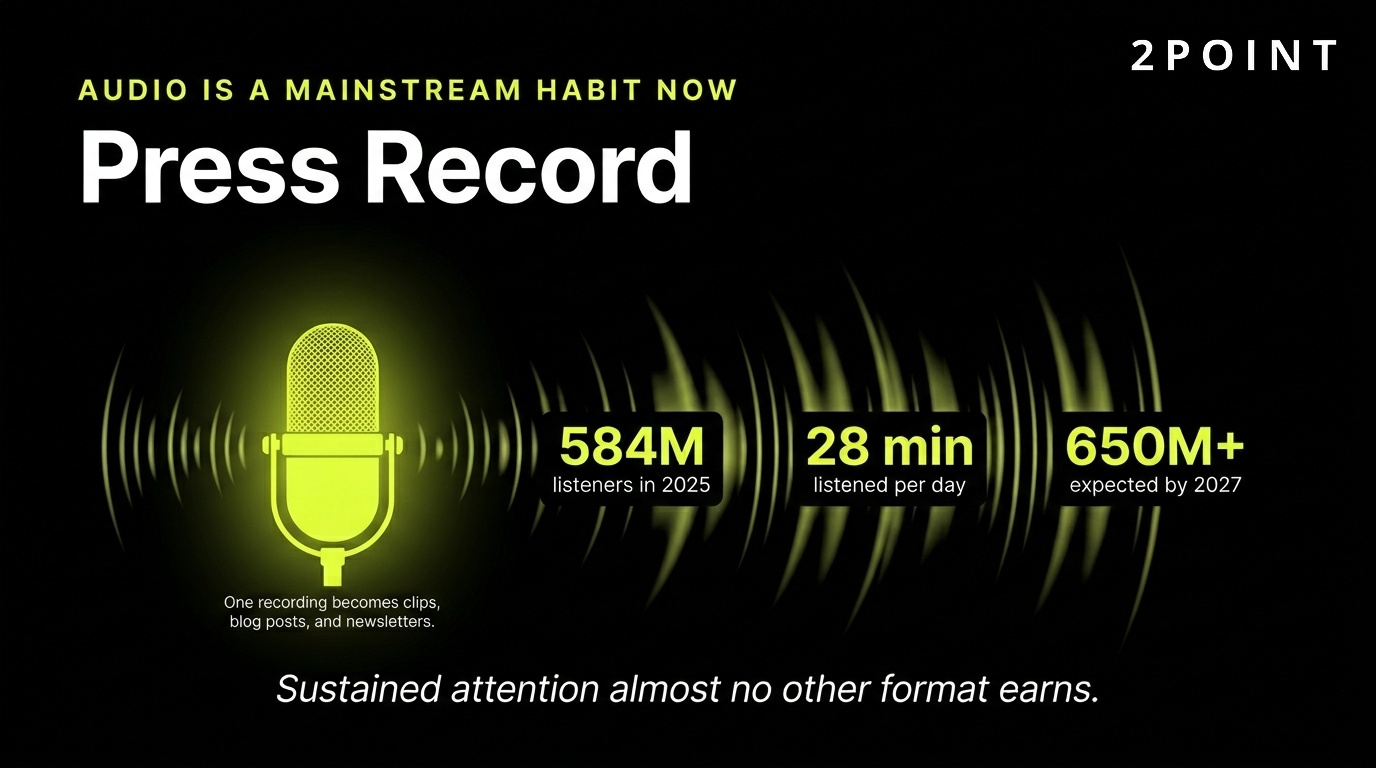
Podcast consumption has grown into a mainstream media habit at a scale that demands attention from any comprehensive content marketing strategy. Global podcast listeners reached 584 million in 2025, an increase of 6.8% year over year, and the trajectory points toward continued expansion. The global listener base is expected to exceed 650 million by 2027, making podcasting one of the fastest-growing content consumption categories in media. The engagement characteristics of podcast listening are particularly compelling for content marketers. US listeners spend nearly 28 minutes per day consuming podcast content, a level of sustained attention that virtually no other content format achieves. Podcast listeners are typically engaged, intellectually curious, and willing to commit extended time to content they find valuable. These are exactly the audience characteristics that content marketing seeks to attract and retain. Producing a podcast positions a brand or individual as an ongoing source of expertise rather than a one-time information source. The strategic positioning opportunities in podcasting extend beyond simple audience building. A podcast creates a structure for regular thought leadership that simultaneously builds SEO-valuable transcripts, generates social media clips, establishes guest relationship networks, and creates authentic storytelling opportunities that other formats struggle to match. Repurposing podcast episodes into blog posts, newsletter content, and short video clips dramatically multiplies the content output from a single recording session. For organizations considering audio content, the barrier to entry has never been lower while the potential reach has never been higher.
Interactive Content and User-Generated Content
Interactive content represents one of the clearest opportunities to differentiate content marketing programs in an environment where passive content consumption is increasingly fragmented across platforms and attention spans. Quizzes, calculators, assessments, interactive infographics, and decision tools all create active engagement rather than passive reading. 44.4% of marketers leveraging interactive content report strong success, compared to just 39.9% of those not using it. That gap represents meaningful competitive advantage, particularly for organizations in categories where audience education is a key part of the sales process. The value of interactive content extends beyond engagement metrics. Tools like ROI calculators and product recommendation quizzes serve a dual purpose: they provide immediate value to users while capturing highly qualified data about their needs, preferences, and purchase readiness. This makes interactive content particularly effective as a lead generation mechanism at the middle and bottom of the funnel, where understanding specific prospect needs accelerates the sales process. User-generated content provides a different but equally powerful advantage: authenticity that branded content cannot replicate. Reviews, testimonials, social mentions, and customer-created content carry implicit third-party endorsement that resonates with prospects in ways that self-promotional content simply cannot. User-generated content conversion data consistently shows that prospects who encounter authentic customer voices in the purchase process convert at higher rates and with greater confidence. Making it easy and genuinely rewarding for customers to share their experiences creates a sustainable source of high-trust content that supplements and amplifies produced content across the entire program.
Balancing Evergreen and Timely Content
A sustainable content program needs both types of content working in concert. Evergreen content addresses questions and topics that remain relevant over months or years, continuously attracting search traffic and providing enduring value to audiences regardless of when they encounter it. Timely content capitalizes on current events, emerging trends, and breaking news to generate short-term traffic spikes and demonstrate real-time relevance. The strategic question is not which to choose but how to balance the two based on specific business goals. Evergreen content forms the foundation of a content program's long-term SEO value. Comprehensive guides, definitional articles, how-to tutorials, and comparison pieces tend to accumulate authority and search traffic gradually over time. The investment in creating a truly excellent evergreen piece pays dividends for years. Content refresh strategies extend that value further: regularly updating evergreen posts with new statistics, examples, and information reactivates their relevance signals and can restore or improve search rankings that may have softened over time. Reoptimizing existing content can be more effective per unit of effort than creating entirely new pieces, particularly for established sites with content assets that have lost some of their ranking strength. Timely content serves different goals: demonstrating that the brand has a current perspective, participating in ongoing industry conversations, and capturing attention during moments when a specific topic has elevated search and social volume. The most effective editorial calendars blend a backbone of evergreen pieces with a responsive capacity for timely content, allowing teams to maintain consistency while remaining agile. Developing a coherent approach to tracking marketing campaign success across both content types ensures that teams have the data to evaluate what is working and refine the balance over time.
Content Distribution and Promotion: Making Your Content Actually Reach People
Creating excellent content and then doing nothing to promote it is one of the most common and costly mistakes in content marketing. Publication is not distribution. The internet contains an estimated 7.5 million blog posts published every day, and the vast majority of them are seen by almost no one. Active distribution is not optional; it is the work that separates content that performs from content that disappears.
The Promotion Imperative: Why Creation Is Only Half the Battle

A useful mental model for content marketing resource allocation is the 50/50 rule: spend as much time promoting content as creating it. This ratio challenges the instinct to focus almost entirely on production, but it reflects the reality of how content gains traction. The most beautifully written, comprehensively researched article reaches precisely zero people if no one is directed to it through intentional distribution. Promotion is not a nice-to-have addition to the content process. It is the other half of the process itself. Owned platforms form the foundation of any sound distribution strategy. Your website, your email list, and your social media profiles are channels where you control the relationship with the audience. The most effective content marketing channels in practice include in-person events at 52%, webinars at 51%, email at 42%, social media at 42%, and blog content at 41%, with email newsletters proving effective for 37% of marketers. SEO functions as a form of passive promotion, ensuring that content remains discoverable to people searching relevant terms long after the initial promotional push has subsided. Combining active promotion with strong SEO optimization creates both immediate reach and long-term discoverability. Earned distribution, including press coverage, social shares, backlinks from other publications, and mentions in newsletters, multiplies the reach of owned content without requiring additional budget. Building relationships with other publishers, contributing guest content to relevant platforms, and creating genuinely shareworthy pieces that others want to reference are the strategies that earn this amplification. Community engagement plays a significant role here, as active participation in relevant communities establishes credibility and creates natural opportunities to share content when it genuinely adds value to an ongoing conversation.
Email Marketing: The Channel You Own Completely
Among all content distribution channels, email marketing holds a unique position: it is the only channel where the brand owns the relationship entirely. Social media platforms can change algorithms, reduce organic reach, or shut down accounts without warning. Search engine rankings fluctuate with each algorithm update. Email subscribers, by contrast, have explicitly opted in to hear from you, and that relationship exists independently of any third-party platform's policies or business decisions.
Social Media Distribution Strategy by Platform
Social media distribution requires platform-specific thinking rather than a one-size-fits-all broadcast approach. Each major platform has a distinct audience composition, content format preference, algorithm behavior, and engagement dynamic. Effective social media content distribution means understanding these differences and tailoring both the content and the approach to fit each platform's native context. LinkedIn dominates B2B social content marketing. 76% of B2B content marketers publish their thought leadership content on LinkedIn, and the platform's 1.3 billion members across 200 countries make it the undisputed professional networking platform. LinkedIn rewards substantive content that generates discussion and demonstrates expertise. Personal posts from individuals tend to outperform company page posts in organic reach, making thought leadership from team members a particularly effective LinkedIn strategy. Instagram and TikTok excel in visual and video engagement. Instagram's engagement rate of 0.48% is approximately three times higher than Facebook's 0.15%, and TikTok's 3.70% remains the highest of all major platforms. Threads, Meta's text-based social platform, reached 400 million monthly active users by Q3 2025, making it an emerging distribution channel worth monitoring, particularly for brands already active in the Meta ecosystem. Platform selection should ultimately be driven by where the target audience spends time and which formats align with the brand's content production capabilities.
Multi-Channel Approach: Choosing Compatible Formats
A multi-channel distribution approach increases content reach while protecting against the platform risk that comes from relying too heavily on any single channel. The strategic principle is not to be everywhere simultaneously but to be present on the channels where the target audience is most active and most receptive. Three to five well-executed channels consistently outperform attempts to maintain a presence across ten platforms without sufficient resources to do any of them well. Content repurposing is the strategy that makes multi-channel distribution sustainable. One well-researched long-form blog post becomes the source material for a video summary, a thread of social posts breaking down key insights, an email newsletter edition, a slide deck for LinkedIn, and a set of pull-quote graphics for Instagram. Each piece of derived content is adapted to fit its destination platform's native format rather than simply copy-pasted. This approach multiplies the reach of original content investment without proportionally multiplying the creative workload. Data analytics for marketing improvement helps teams identify which channels are generating the best returns from their repurposed content and refine the distribution mix accordingly over time. Format compatibility with distribution channels is a strategic consideration that belongs in the content planning stage, not as an afterthought after creation. A piece of content planned with its distribution channels in mind from the beginning will be more effective in each channel than content retrofitted to platforms it was not originally designed for. The most efficient content operations teams think in terms of content systems, producing modular source material that can be efficiently adapted across multiple channels, rather than creating individual pieces in isolation.
Best Practices for Quality, SEO Content, and Performance Measurement
The technical disciplines of content quality, search optimization, and performance tracking are the mechanisms that convert creative effort into measurable business results. Understanding how these elements work together in 2026 and which practices have proven most effective separates teams that operate on evidence from teams that operate on assumption.
Quality Over Quantity: The New Content Philosophy
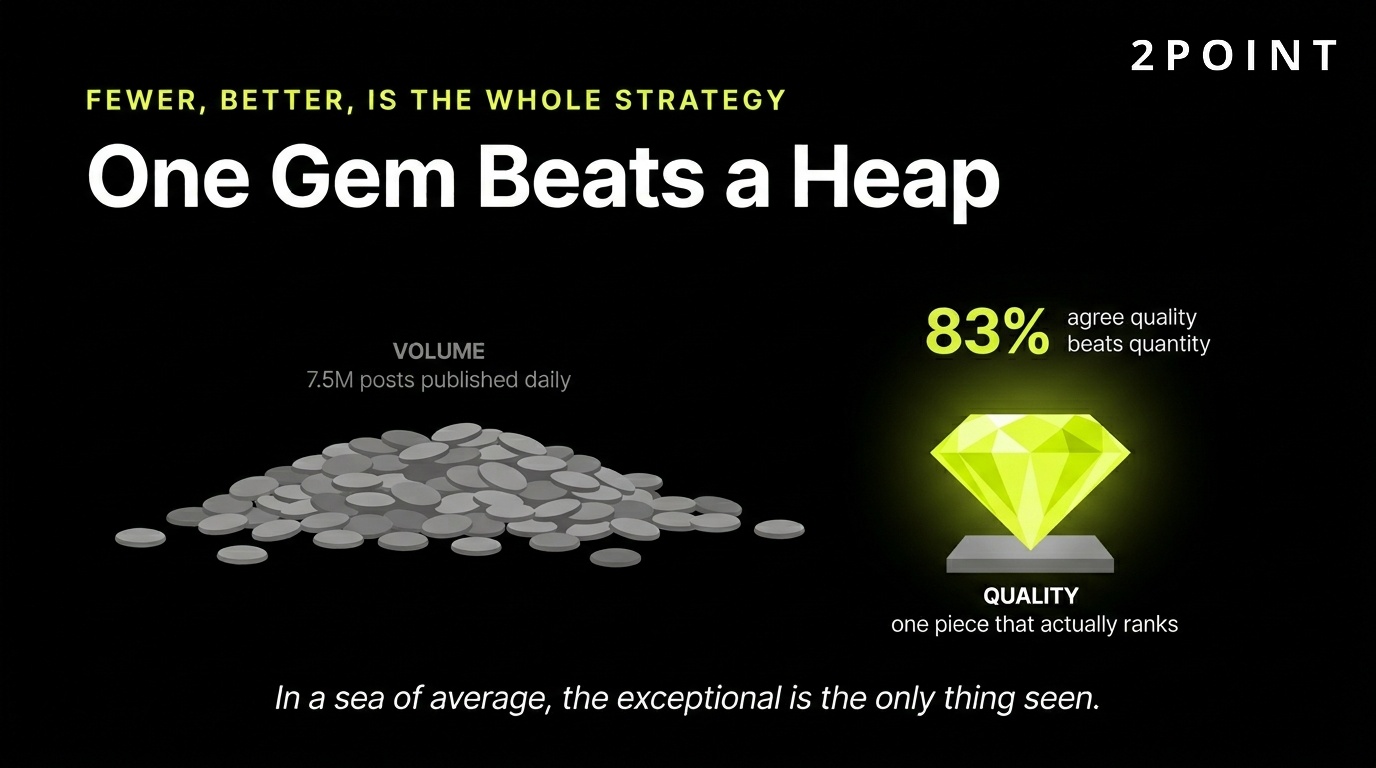
The content marketing world has reached a genuine consensus point on the quality-versus-quantity debate. 83% of content marketers now agree that focusing on quality over quantity is the correct approach, even if it means publishing less frequently. This shift reflects a meaningful change in how search algorithms evaluate content, how audiences respond to their content feeds, and how AI systems select sources to cite. In an environment saturated with average content, exceptional content is the reliable path to visibility and trust. Quality in content marketing means several specific things that are worth defining precisely. Depth involves covering a topic thoroughly enough that the reader does not need to look elsewhere for answers. Original research, proprietary data, or unique case studies provide differentiated value that cannot be found in dozens of similar articles. A distinctive perspective or voice makes content memorable rather than interchangeable. Practical, actionable takeaways ensure that reading the content moves the audience forward rather than simply informing them abstractly. Creating content that genuinely exceeds what already exists for a topic requires more effort per piece but produces disproportionate returns in reach, engagement, and authority. AI's role in quality is nuanced. 85% of marketers report that AI tools have significantly improved their content quality, primarily because AI assistance in research, drafting, and editing frees human attention for higher-order work. The creative insight, the unique perspective, and the genuine understanding of audience needs are still human contributions. AI amplifies the capacity to execute on those human inputs more efficiently. The brands producing the best content in 2026 are using AI to raise the quality ceiling, not to reduce the effort invested in meeting it.
SEO Content in 2026: Optimizing for Humans and Algorithms
SEO content in 2026 operates in a more complex environment than ever before, but the core principle that has always driven organic search success remains unchanged: create content that genuinely serves the person searching. 80% of content marketers prioritize writing for human readers rather than for search algorithms, and the two goals are more aligned than they used to be. Modern search engines are exceptionally good at evaluating whether content genuinely answers the question a searcher was asking, which means optimizing for humans and optimizing for algorithms have largely converged.
The persistent challenges in SEO content are worth understanding clearly. 70.6% of content marketers struggle with accurately matching user and search intent, which means the content they create does not align closely enough with what people are actually looking for when they type specific queries. 64% report difficulty adapting to frequent SEO algorithm changes, which creates uncertainty about optimization priorities. These challenges are real but addressable through consistent attention to search intent analysis and a commitment to content depth over optimization shortcuts. Data analytics for marketing improvement provides the ongoing signal that helps teams calibrate their SEO approach based on actual performance data rather than theoretical best practices alone.
AI as Assistant, Not Replacement: Setting the Right Boundaries
The conversation about AI in content marketing has matured past the initial period of breathless enthusiasm and existential concern into something more practical and nuanced. The clearest finding from practice is that AI performs best as a skilled assistant that handles execution-heavy tasks, while human expertise remains the irreplaceable source of insight, perspective, and authentic brand voice. Organizations that understand this boundary use AI to their advantage without surrendering the qualities that make their content distinctive. The measurement gap in AI-assisted content marketing represents both a problem and an opportunity. 67% of content teams use AI tools daily, but only 19% are tracking AI-specific KPIs to evaluate performance. This means most organizations do not actually know whether their AI tools are contributing to better outcomes or simply changing how outcomes are achieved. The organizations that do measure rigorously have found significant advantages: teams tracking AI-specific metrics see 2.4 times better content ROI than those that do not, which suggests that intentional AI deployment beats casual adoption decisively. Maintaining authentic brand voice in an AI-assisted production environment requires deliberate effort. AI-generated content defaults to a generic tone that reflects the statistical average of its training data rather than the specific personality, perspective, and values that make a brand recognizable. The solution is not to avoid AI but to treat it as a capable but voice-less drafting tool that requires human editing to become genuinely on-brand. Style guides, voice documentation, and editorial review processes preserve brand authenticity while capturing AI efficiency gains. Effective storytelling in particular requires the human element that AI alone cannot reliably replicate.
Measuring Content ROI: The Metrics That Actually Matter
Content marketing measurement is evolving to match the growing sophistication of the programs being measured. The metrics that matter depend fundamentally on the business objectives the content program is designed to support, which is why measurement frameworks must be developed from strategy first rather than retrofitted from available analytics tools. Marketing analysis that connects content activity to business outcomes is what separates programs that earn continued investment from those that remain perpetually underfunded.
| Funnel Stage | Primary Content Goal | Key Metrics to Track | Common Measurement Tools |
|---|---|---|---|
| Awareness (Top of Funnel) | Reach and brand visibility | Organic traffic, impressions, social reach, branded search volume | Google Analytics, Search Console, social analytics |
| Consideration (Middle of Funnel) | Lead generation and engagement | Email subscribers, content downloads, time on page, return visits | CRM, email platform, GA4 engagement metrics |
| Decision (Bottom of Funnel) | Conversion and revenue attribution | Assisted conversions, lead-to-close rate, revenue influenced | CRM attribution, Google Analytics conversion tracking |
| Retention and Advocacy | Customer lifetime value, referrals | Repeat visits, customer retention rate, NPS, UGC generated | Customer success platform, survey tools |
Aligning metrics to funnel stage and business objective ensures content measurement reflects actual contribution to outcomes rather than simply tracking activity volume. Content ROI calculation requires connecting investment inputs to revenue outputs through a clear attribution model. The inputs include creative time, tool costs, distribution costs, and management overhead. The outputs include revenue influenced by content at each funnel stage, customer lifetime value of content-sourced customers, and the compounding organic traffic value that accumulates over time. Marketing campaign success tracking must account for content's role in multi-touch attribution models, where a single customer conversion may have been influenced by six to eight content touchpoints across several months before a sale occurred.
B2B Content Marketing: Strategies for Complex Buying Journeys
B2B content marketing operates in a fundamentally different environment than B2C. Longer sales cycles, multiple decision-makers, higher purchase stakes, and more technically sophisticated audiences require content strategies specifically calibrated to those realities. Understanding the distinct demands of B2B content marketing is essential for organizations selling to other businesses.
The B2B Content Landscape: Longer Cycles, Multiple Stakeholders
The average B2B purchase decision now involves six to ten stakeholders, each with different priorities, different information needs, and different roles in the evaluation process. A technical buyer evaluating software infrastructure needs different content than the CFO evaluating budget implications or the end users considering daily workflow impact. Effective B2B content marketing addresses all of these perspectives rather than speaking to an imaginary single decision-maker. B2B buying cycles measured in weeks or months require content programs that nurture prospects through an extended consideration period rather than attempting to compress the process. This is precisely where content marketing's compounding value is most apparent: a prospect who discovers a useful resource from a brand six months before their purchase decision begins arriving at the sales conversation with established familiarity and a baseline level of trust. Consumer behavior analysis in B2B contexts helps marketers understand which content formats and topics engage each stakeholder type at different stages of the evaluation process, enabling more precise content planning. The most effective B2B content formats include detailed case studies that document proven outcomes, industry research and data reports that establish authority, webinars that allow live interaction with subject matter experts, and technical documentation that helps evaluators assess product capabilities. In-person events remain the most effective B2B content channel at 52%, reflecting the enduring value of face-to-face relationship building in complex sales environments. Combining event-based engagement with strong digital content follow-through creates a nurture system that keeps prospects engaged between direct interactions.
Thought Leadership as a B2B Content Marketing Cornerstone
Thought leadership has become the most strategically important content category for B2B brands seeking to differentiate in crowded categories. When products and services across competitors become functionally similar, the perspective, expertise, and insight that a brand demonstrates through its content becomes a primary differentiator. Thought leadership content does not sell; it establishes the authority and trust that makes the eventual sales conversation more productive. The most credible B2B thought leadership comes from genuine expertise expressed through specific, opinionated points of view. Generic industry observations do not qualify. Thought leadership that earns attention takes positions, challenges conventional wisdom, presents original research, or synthesizes complex information in ways that create genuine new understanding. 52% of organizations plan to increase their thought leadership content investment, recognizing that it serves the dual purpose of building human relationships and improving AI citation rates, both of which drive commercial outcomes in 2026. LinkedIn is the primary distribution platform for B2B thought leadership, with 76% of B2B marketers publishing thought leadership content on the platform. However, thought leadership distributed across multiple channels, including podcasts, speaking engagements, contributed articles, research reports, and video series, creates a presence that surrounds prospects with consistent evidence of expertise. The cumulative effect of encountering a brand's thoughtful perspective across multiple contexts builds the kind of familiarity and credibility that accelerates B2B sales cycles meaningfully.
Content and the B2B Sales Relationship
In B2B environments, content marketing and the sales function should be deeply integrated rather than operating as separate departments. Sales teams interact directly with prospects and customers every day, generating insight about objections, misconceptions, decision criteria, and competitive comparisons that is invaluable for content creation. Content teams produce materials that sales teams use to educate prospects, handle objections, and accelerate deal progress. When these functions are aligned, both become more effective. Sales enablement content, including battle cards, competitor comparisons, ROI calculators, and objection-handling guides, sits at the intersection of content marketing and sales. It is created by content teams based on insights from sales conversations and deployed directly in the selling process. Organizations that build strong sales-content alignment consistently see faster sales cycles and higher close rates because every prospect touchpoint is informed by accumulated learning from previous sales conversations. The intelligence flow should also run in the other direction. Customer success teams hold post-purchase insights about what customers valued most, what surprised them, and where they gained the most benefit. This information feeds directly back into content creation, producing testimonials, case studies, and success stories that resonate with prospects in the same category. Analyzing customer behavior in marketing creates a feedback loop that continuously improves content relevance and sales effectiveness simultaneously. Organizations that build these feedback systems outperform those treating content creation as a one-way broadcast activity.
Building Community and Social Proof Through Content Marketing
The most advanced content marketing programs extend beyond publishing and distribution to building genuine communities around the brand's area of expertise. Community-centered content marketing creates network effects that amplify reach, deepen loyalty, and generate a continuous stream of authentic social proof that no brand-produced content can replicate.
Why Community Is the Next Evolution of Content Marketing
A content marketing program that publishes to an audience is a one-way broadcast. A content marketing program that builds a community creates a two-way conversation ecosystem where the brand is the convener rather than the only speaker. The difference in engagement depth, audience loyalty, and content amplification between these two models is substantial. Communities generate their own content, provide peer-to-peer support that reduces customer service burden, and create social proof visible to prospects evaluating the brand. Building community around content requires consistent, high-value engagement over time rather than a single campaign or platform launch. It means creating spaces, whether on dedicated community platforms, social media groups, live events, or forum formats, where people with shared interests and challenges can connect with each other as well as with the brand. The brand's role in this ecosystem is to set the agenda, provide the most valuable content, facilitate connections, and maintain the quality standards that make the community worth participating in. Community engagement through marketing is a compounding investment: communities that have been nurtured for years become self-sustaining brand assets that generate ongoing content, social proof, and referrals with minimal ongoing intervention.
User-Generated Content as Social Proof and Reach Amplifier
User-generated content represents the convergence of community building and content marketing. When customers create and share content about a brand's products, services, or expertise, they provide three simultaneous benefits: authentic social proof that prospects trust more than brand-produced claims, extended reach into social networks the brand does not directly have access to, and a continuous stream of content production that supplements the brand's own publishing efforts. The strategic challenge is creating the conditions under which customers are motivated to create and share content voluntarily. Exceptional product experiences, recognition and reward systems, community challenges, branded hashtags, and featured customer spotlights are all mechanisms that encourage user-generated content creation. The benefits of user-generated content extend across the funnel: awareness through social sharing, consideration through authentic testimonials, and post-purchase loyalty through community recognition. Brands that systematically collect and amplify customer-created content build a credibility advantage that paid content simply cannot purchase. Reviews deserve specific attention as a form of user-generated content with outsized impact on purchase decisions. For B2C brands, platform reviews on Google, Trustpilot, and product marketplaces directly influence conversion rates. For B2B brands, reviews on G2, Capterra, and similar platforms are often consulted during evaluation processes. Encouraging satisfied customers to share their experiences through reviews, making the review submission process as simple as possible, and responding thoughtfully to all reviews, including critical ones, are content marketing activities that deliver significant commercial returns relative to the effort involved.
Conclusion: The Content Marketing Imperative for 2026 and Beyond
Content marketing in 2026 is not the same discipline it was five years ago, but its foundational logic remains unchanged. Organizations that create genuinely valuable content for clearly defined audiences, distribute that content intelligently across appropriate channels, measure what matters, and continuously improve based on evidence will outperform those that do not. The specific tactics, formats, and tools continue to evolve, but the core principle of earning attention through value endures.
The most important shifts shaping content marketing right now are the rise of generative AI as both a production tool and a content discovery platform, the dominance of video across virtually every audience segment, the growing importance of first-party data and owned channels in a privacy-first environment, and the elevation of quality over quantity as the defining philosophy separating top performers from average ones. Organizations that adapt to these shifts while maintaining their commitment to genuine audience service will build durable competitive advantages that paid advertising cannot match.
The data is unambiguous about what works. Documented strategies outperform ad hoc approaches by a factor of three to one. AI-assisted teams that measure their AI-specific performance see 2.4 times better ROI. Video generates the highest returns of any format. Email marketing delivers the most reliable revenue per dollar invested. These are not experimental findings but validated patterns from thousands of organizations operating content programs at scale.
For organizations at any stage of content marketing maturity, from building a first strategy to optimizing an existing program, the priority remains the same: know your audience deeply, create content that genuinely serves them, distribute it intentionally, measure what it contributes to your business, and invest in the formats and channels the data tells you are working. That process, executed with consistency and intelligence, is what content marketing success looks like in 2026 and beyond.
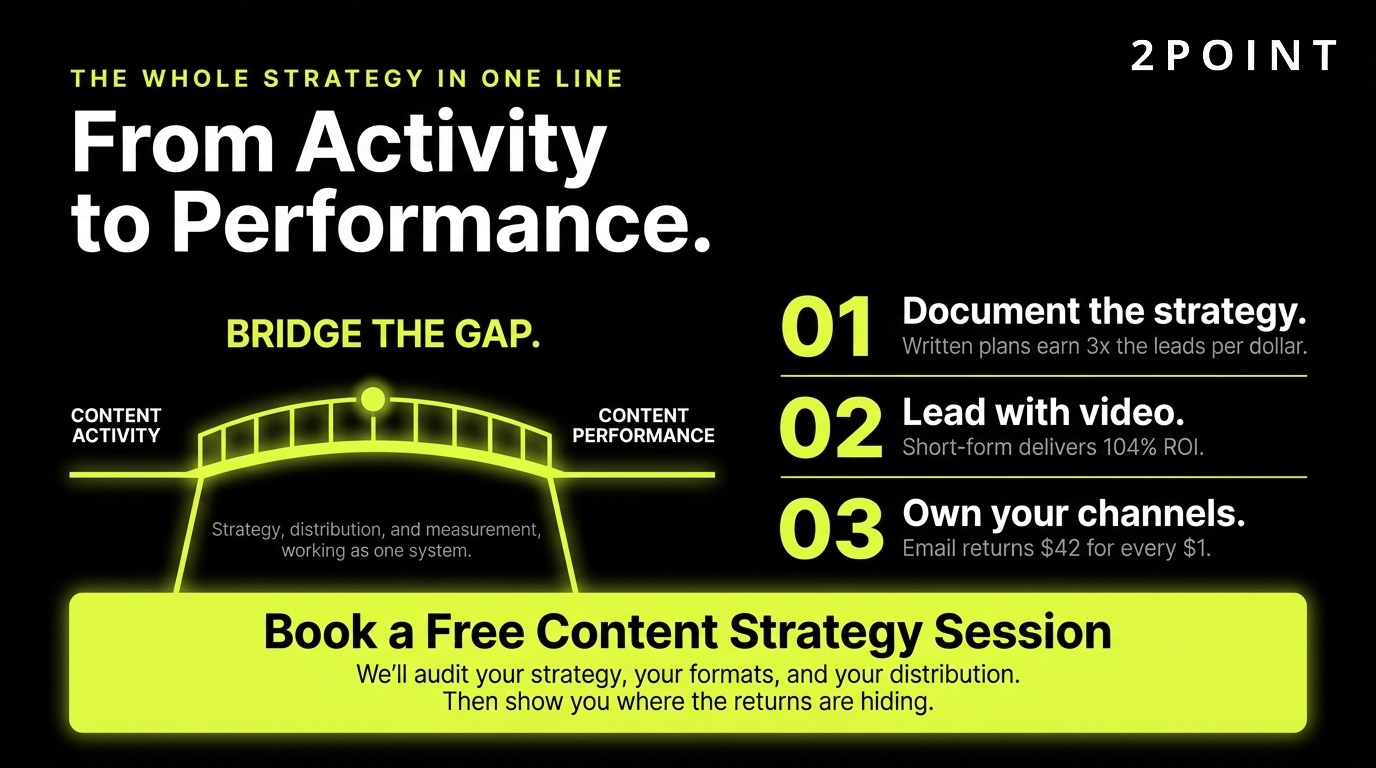
At 2POINT, building content programs that generate measurable, compounding returns is at the center of what we do. If your organization is ready to move from content activity to content performance, the strategic foundation described throughout this guide is where that work begins.
Frequently Asked Questions About Content Marketing
What is content marketing and how does it differ from traditional advertising?
Content marketing is a strategic approach that creates and distributes valuable, relevant content to attract and retain a target audience, generating profitable customer action without interruptive advertising. Unlike traditional ads that interrupt audiences to promote a product, content marketing earns attention by providing genuine value like education, entertainment, or problem-solving. Content assets also continue delivering returns long after creation, while paid ads stop working the moment spending stops.
How much does content marketing cost compared to outbound marketing?
Content marketing costs approximately 62% less than outbound marketing while generating over three times as many leads, according to multiple industry studies. The average content marketing ROI is $7.65 for every dollar spent, and email marketing specifically delivers $42 per dollar invested. The cost advantage grows over time as content assets accumulate and compound in value.
How long does it take for content marketing to show results?
Content marketing typically requires six to twelve months of consistent effort before generating measurable organic growth, as search authority and audience trust take time to build. Paid distribution can accelerate early results, but the compounding organic value of content accumulates gradually. Organizations that maintain consistent programs for two or more years consistently report the strongest ROI and lead generation numbers.
What is generative engine optimization (GEO) and why does it matter?
Generative engine optimization (GEO) is the practice of optimizing content to be cited or recommended by AI systems like ChatGPT, Perplexity, and Google AI Overviews. It matters because 50% of B2B buyers now start their purchasing journey inside AI chatbots rather than traditional search engines. Content optimized for GEO tends to be authoritative, well-structured, clearly sourced, and directly answers specific questions, qualities that also improve traditional SEO performance.
What type of content generates the highest ROI?
Short-form video currently delivers the highest ROI of any content format at 104%, followed by email marketing at $42 per dollar spent. Blog content and thought leadership pieces provide strong long-term compounding value through organic search traffic. The most effective content programs combine multiple formats to capture different audience segments and serve different stages of the buying journey.
Is content marketing effective for B2B companies?
Yes, content marketing is highly effective for B2B companies and is often more impactful in B2B than B2C contexts because of longer sales cycles and the need to educate multiple stakeholders. 73% of B2B marketers maintain documented content strategies, and in-person events, webinars, case studies, and thought leadership content are among the highest-performing B2B formats. B2B content marketing builds the trust and authority that accelerates complex purchasing decisions.
How does AI affect content marketing quality?
85% of marketers report that AI tools have significantly improved their content quality, primarily by handling research and drafting tasks so humans can focus on insight, voice, and editorial judgment. AI works best as an assistant that amplifies human expertise rather than a replacement for it. Organizations tracking AI-specific performance metrics see 2.4 times better content ROI than those that adopt AI tools without measurement.
Content marketing vs. SEO: are they the same thing?
Content marketing and SEO are related but distinct disciplines that work best when integrated. Content marketing focuses on creating valuable content to build audience relationships and drive business outcomes across all channels. SEO is specifically about optimizing content and websites for search engine visibility and organic traffic. Effective content marketing programs incorporate SEO best practices, but content marketing encompasses distribution channels beyond search, including email, social media, events, and AI platforms.
How do you measure content marketing ROI?
Content marketing ROI is measured by connecting content investment costs to business outcomes like leads generated, pipeline influenced, and revenue attributed. Key metrics vary by funnel stage: awareness content is measured by organic traffic and brand visibility, middle-funnel content by email subscribers and lead conversions, and bottom-funnel content by assisted conversions and revenue influenced. Multi-touch attribution models are essential because most B2B conversions involve multiple content interactions over extended periods before purchase.
What is the most important first step in building a content marketing strategy?
The most important first step is documenting the strategy in writing, as organizations with documented content strategies generate three times more leads per dollar than those without written plans. The documentation process forces clarity about who the content serves, what problems it addresses, how it differs from competitors, and how success will be measured. Without documentation, content marketing tends to be reactive and inconsistent, which limits its compounding effectiveness.
How much of a marketing budget should go to content marketing?
Industry data shows organizations currently allocate an average of 26% of their total marketing budget to content marketing, and 46% of B2B marketers expect that allocation to increase. The appropriate percentage depends on business goals, sales cycle length, and competitive dynamics, but organizations treating content as a marginal budget item consistently underperform those investing meaningfully in it. For businesses with longer sales cycles or strong search opportunity, higher allocations toward content typically generate strong compounding returns.
Does content marketing still work when organic search traffic is declining?
Yes, content marketing remains highly effective even as traditional organic click rates decline, because its value extends well beyond search traffic to include AI citation, email audience building, social media reach, thought leadership positioning, and first-party data collection. The strategic response to declining organic clicks is to optimize for visibility and authority signals rather than clicks alone, and to diversify distribution across owned channels. Brands with strong content programs maintain audience relationships regardless of search algorithm changes because they own direct channels like email lists and communities.
