

 let’s connect


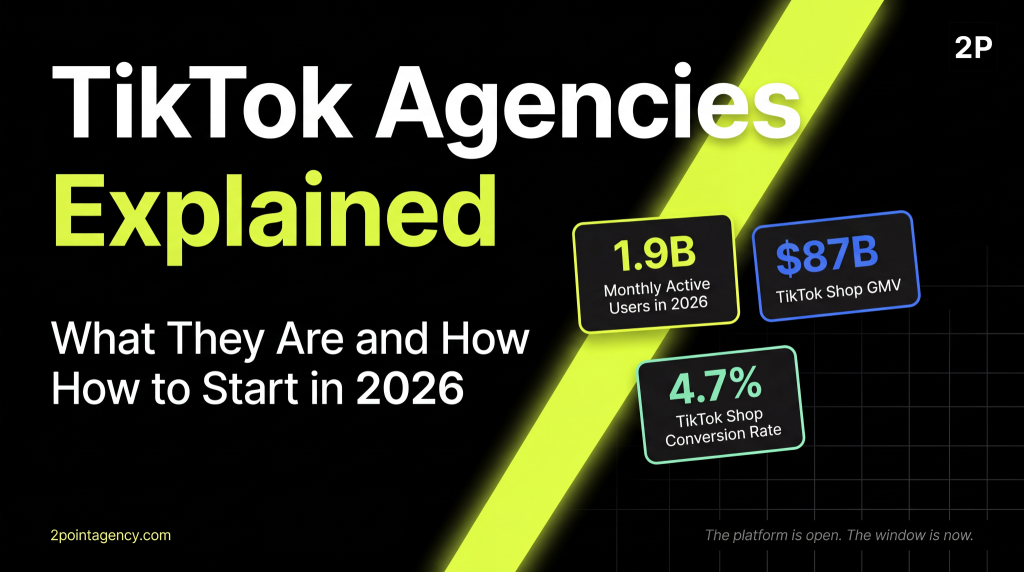
If you’re wondering how to start a TikTok agency, you’ve picked the right moment to explore the idea. The platform has crossed 1.9 billion monthly active users in 2026, and its global ad revenue now sits at $33.1 billion.
Brands, creators, and entrepreneurs all want in.
But opportunity alone doesn’t build a business. You need to know what a TikTok agency actually does, how to launch one from scratch, and how to market your business on TikTok with strategies that deliver real results.
This guide covers all of it. You'll also see how 2POINT brings creative strategy and digital expertise to keep clients ahead of the curve.
Key Takeaways
- A TikTok agency helps brands grow through content, paid ads, influencer partnerships, and commerce.
- Starting a TikTok agency in 2026 requires clear services, solid structure, and consistent branding.
- The TikTok agency 2026 landscape rewards entity authority, Watch Time metrics, and TikTok Shop expertise.
- A TikTok marketing agency blends organic content, paid campaigns, and influencer collaborations for results.
- Long-term TikTok Shop agency success comes from consistent posting, data-driven optimization, and genuine client relationships.
What Is a TikTok Agency?
A TikTok agency is a team or company that helps businesses and creators grow on TikTok. Instead of figuring out the platform on your own, you get experts who know what works, what doesn’t, and how to turn attention into results.
These agencies typically provide services such as:
- Content creation that feels native to TikTok.
- Influencer collaborations to expand your reach.
- Paid ad campaigns designed for measurable impact.
- TikTok Shop management to drive direct sales.
- Analytics and performance tracking to guide decisions.
So why do brands rely on agencies instead of keeping it all in-house?
It comes down to speed, experience, and consistency. An agency helps you react quickly to trends, stay true to your brand voice, and free up your time to focus on growth. And with TikTok's algorithm shifting constantly, having a dedicated team that lives and breathes the platform gives you an edge that's hard to replicate internally.
If you want to skip the learning curve, 2POINT’s social media marketing services are built for exactly that.
Why TikTok Agencies Are Different From Traditional Marketing Agencies
Traditional agencies might spend weeks perfecting a glossy commercial or a polished campaign.
By the time it's released, the cultural moment it aimed to capture could already feel dated.
TikTok agencies work differently because the platform rewards speed, cultural fluency, and real-time adaptability over production polish.
TikTok’s 2026 algorithm has widened this gap further. As Buffer’s algorithm breakdown explains, the platform now weights watch time and repeat views more heavily than simple likes or shares. Agencies that know how to create content people genuinely rewatch, and how to build topical authority around your brand’s niche, are the ones delivering the strongest results right now.
Why Start a TikTok Agency Now?
There has never been a better window to launch a TikTok agency. Businesses are pouring into the platform because it delivers reach and engagement other channels can’t match.
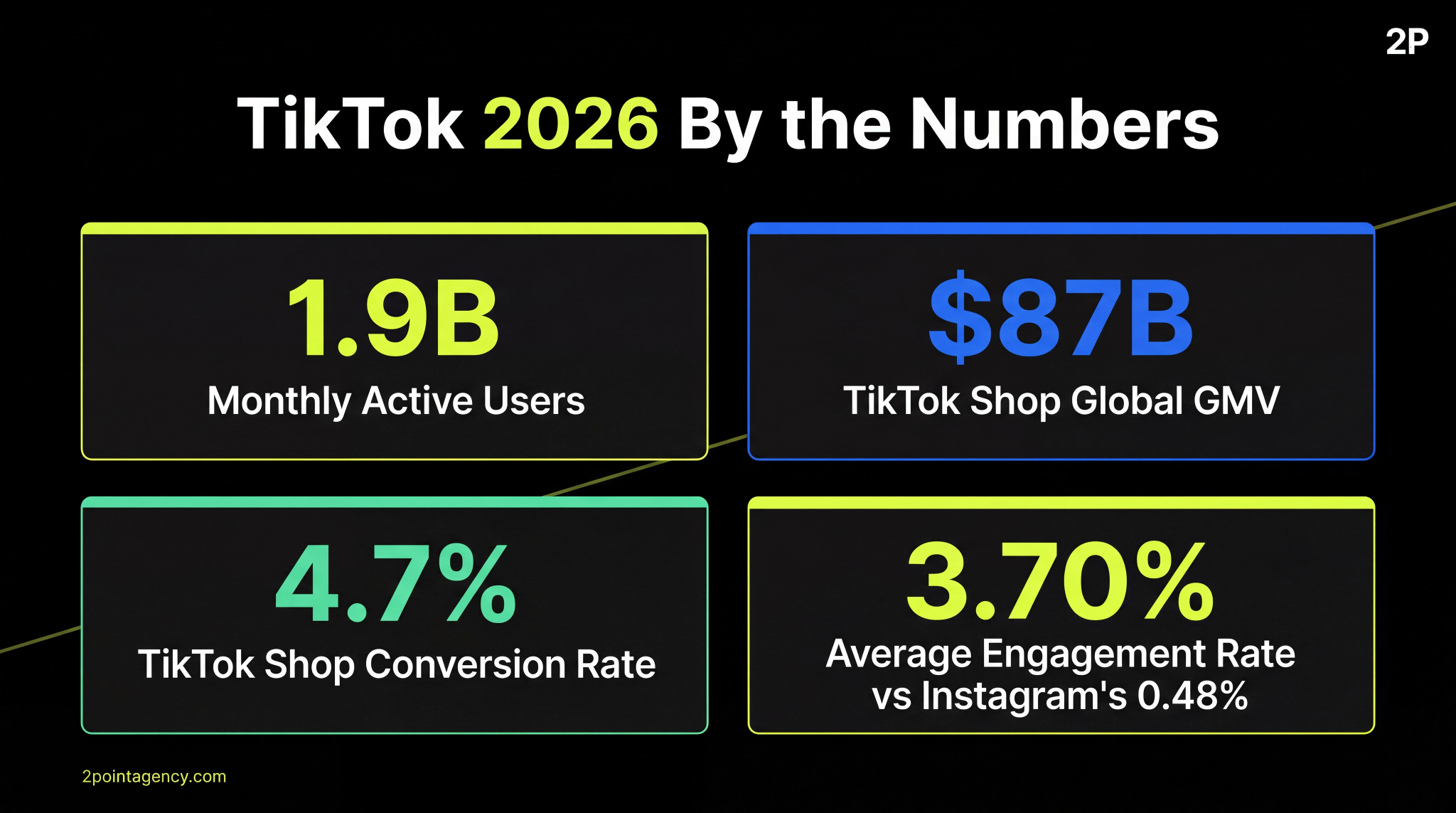
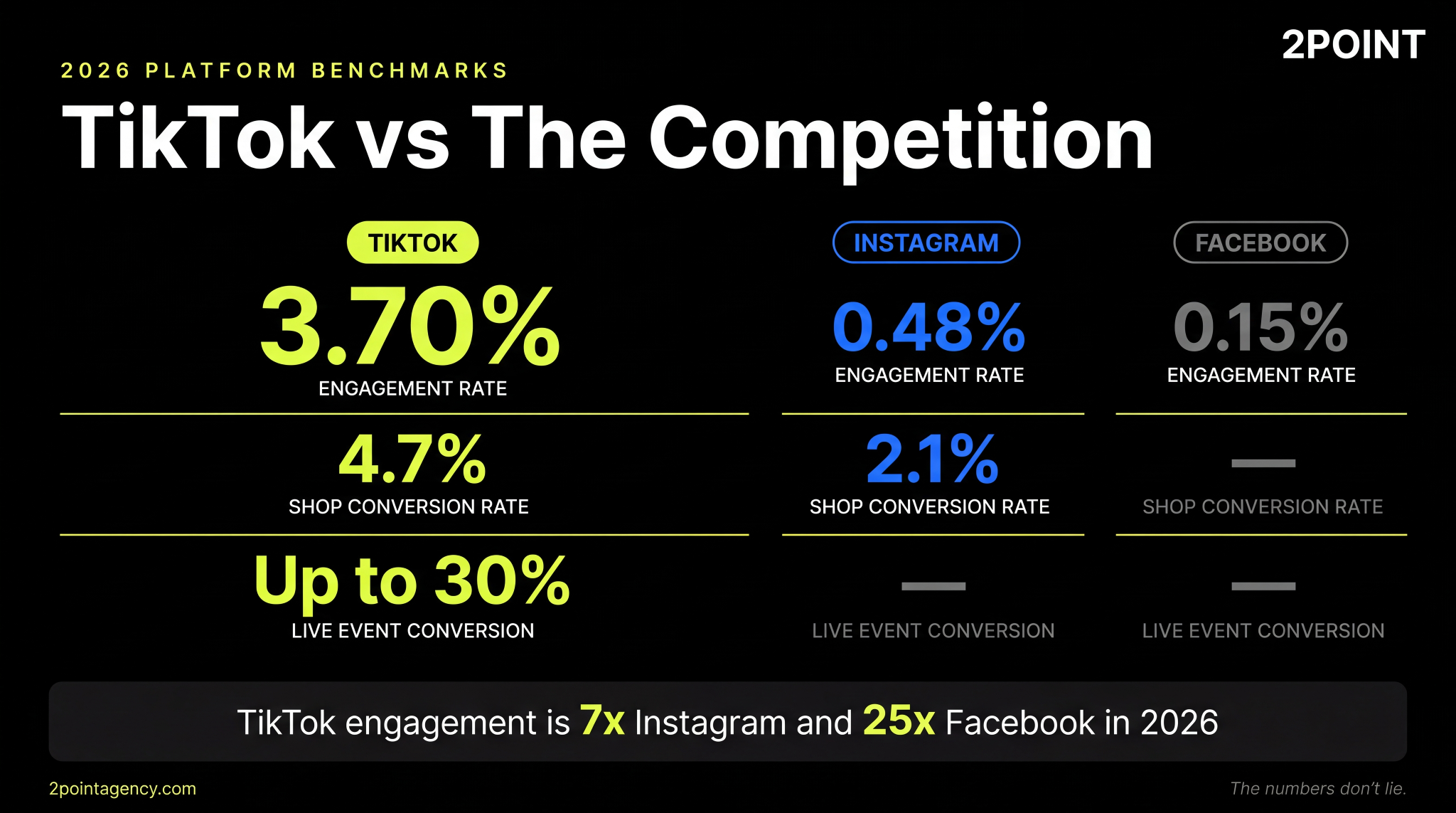
According to Social Insider’s 2026 benchmarks, TikTok’s engagement rate sits at 3.70% compared to Instagram at 0.48% and Facebook at 0.15%. Your content genuinely has a chance of being seen.
The commerce angle makes this even more compelling. As EMARKETER's forecast projects, TikTok Shop will reach $23.41 billion in US ecommerce sales in 2026, a 48% increase year over year. For agencies, that opens an entirely new revenue stream: helping brands sell directly through the platform, not just build awareness.
And the barrier to entry remains low. You don’t need massive budgets or legacy infrastructure. You need creativity, consistency, and a strong grasp of how the platform works.
The TikTok Agency Landscape in 2026: What's Changed
The TikTok you’re building an agency around in 2026 looks fundamentally different from 18 months ago.
The algorithm now rewards depth over breadth. As Sprout Social’s algorithm guide explains, Watch Time and Repeat Views carry more weight than raw view counts, and “Qualified Views” only count when a user watches at least five seconds. For agencies, this shifts the strategy from “post constantly” to “post with precision.”
TikTok Shop has also exploded into a full commerce platform. Short Form Nation’s 2026 report found live shopping events convert at rates up to 30%.
The creator economy has also matured through structured pathways like TikTok’s Agency OnRamp Program and Badged Partner designation, as highlighted in TikTok’s 2026 Partner Awards.
For agency founders, this means more revenue streams per client, higher value per engagement, and a bigger expertise bar to clear.
How to Start a TikTok Agency (Step-by-Step Guide)
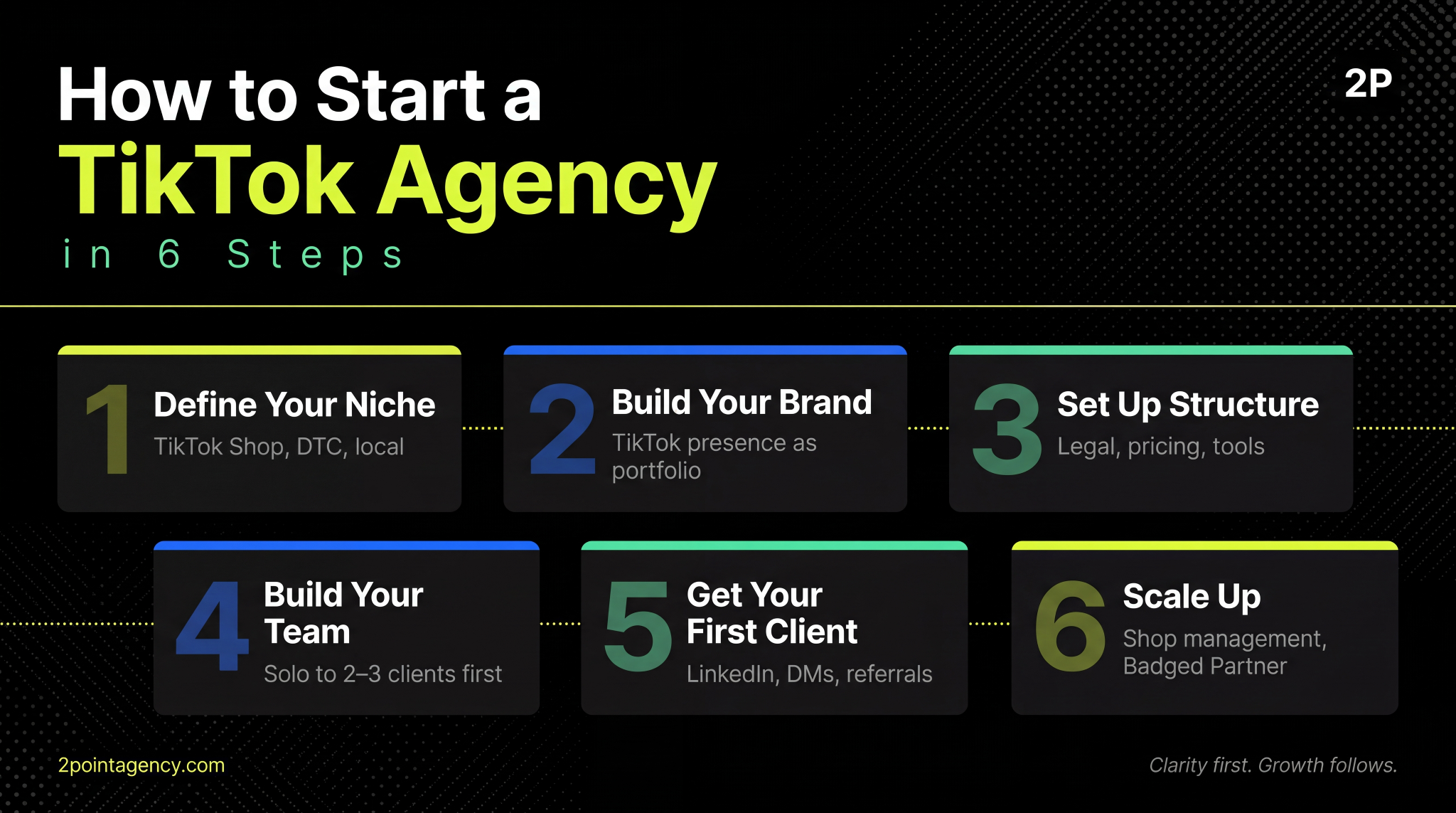
Now that you understand what’s changed on the platform, here’s how to actually build an agency around it. Learning how to start a TikTok agency begins with clarity and builds through branding, structure, outreach, and growth. Each step connects to the one that follows.
Step 1: Define Your Niche and Services
Learning how to start a TikTok agency begins with narrowing your focus.
You don't need to serve every industry at once. Instead, look at spaces where you already understand the audience. In 2026, a few niches stand out:
- TikTok Shop e-commerce, where brands actively need help managing live shopping and shoppable video campaigns.
- Local businesses like restaurants and salons that get outsized results from hyper-local content.
- DTC brands in beauty, fashion, and wellness that naturally fit TikTok's visual format.
Once you’ve chosen your niche, define whether you’ll focus on organic growth, paid ads, influencer campaigns, or a full-service package. TikTok’s own Agency OnRamp Program can help you structure your offerings and access platform resources as you build.
Step 2: Build a Strong Brand Identity
With your niche defined, your brand needs to reflect that focus. Choose a name that communicates your style, and design cohesive branding across your website and social channels.
Here’s what many new founders overlook: build your own TikTok presence before pitching clients. Your account becomes a living portfolio and prospects can scroll before booking a call.
Structure your content around four pillars:
- Educational posts teaching something specific about TikTok marketing.
- Results content showing campaign outcomes and data.
- Behind-the-scenes clips revealing your process and personality.
- Trend reactions proving you're plugged into the platform in real time.
When potential clients see your work, they should immediately recognize you understand the platform.
Step 3: Set Up Your Business Structure
With your brand in place, it’s time to build the operational foundation. Choose a legal entity that protects you, and draft contracts clearly outlining deliverables, timelines, and payment terms.
Pricing is where many new agencies struggle. Most TikTok agencies charge between $1,000 and $10,000 monthly depending on scope. Retainer models suit ongoing management, while project-based fees work for one-off campaigns. Pick what fits your service style and be transparent from day one.
Invest in the right tools early to keep your workflow smooth:
- Content scheduling: Sprout Social or Hootsuite.
- Analytics: Exolyt for competitor and trend tracking.
- Video editing: CapCut for free, TikTok-native editing.
- CRM: HubSpot for leads and client relationships.
Step 4: Build a Team (or Start Solo)
Your tools are set, but you still need to decide who does the work. Starting solo is completely viable, and most founders comfortably manage 2 to 3 clients before needing support.
Once you’re beyond that, consider bringing in key roles:
- A content strategist to shape campaigns and spot opportunities.
- A video editor to polish TikTok content quickly.
- An ad buyer to manage budgets and optimize performance.
- A community manager to engage followers in real time.
You don't have to hire full-time staff immediately. Outsourcing talent through platforms like Fiverr, Upwork, or TikTok creator communities can be a smart first step, letting you scale your services without the pressure of payroll.
Over time, you can decide if in-house roles make more sense for stability and long-term growth.
Step 5: Get Your First Client
With your team in place, the next challenge is landing your first client. Instead of spreading yourself thin, focus on a few proven channels:
- LinkedIn for connecting with business owners through value-driven content and outreach.
- TikTok DMs for reaching brands directly with personalized, helpful messages.
- Cold email that mentions something specific about their business and how TikTok could help.
- Referrals from colleagues, friends, or past clients for warm introductions.
One channel most agency guides overlook: TikTok itself as a client acquisition tool.
Post educational content about TikTok marketing consistently, and your ideal clients will find you organically. It's the most authentic way to demonstrate that you practice what you preach. To reduce hesitation, offer a pilot project or short trial. Once you prove results, clients are far more willing to commit to longer-term partnerships.
Step 6: Scale Your Agency
Once you've secured steady clients, scaling becomes the focus.
Start by refining your onboarding process so every new client feels supported from day one. Then automate repetitive tasks like scheduling and reporting to free up your time for higher-value work.
From there, the fastest way to increase your client value in 2026 is adding TikTok Shop management to your services. Most brands want to sell on the platform but lack the expertise to manage listings, live events, and shoppable content. When you handle all of it, you become indispensable.
As your track record strengthens, consider applying for TikTok's Badged Agency Partner program. The badge gives you platform credibility, access to beta features, and dedicated account management. More importantly, it signals to prospects that TikTok itself has vetted your agency's work.
TikTok Agency Tools and Tech Stack for 2026
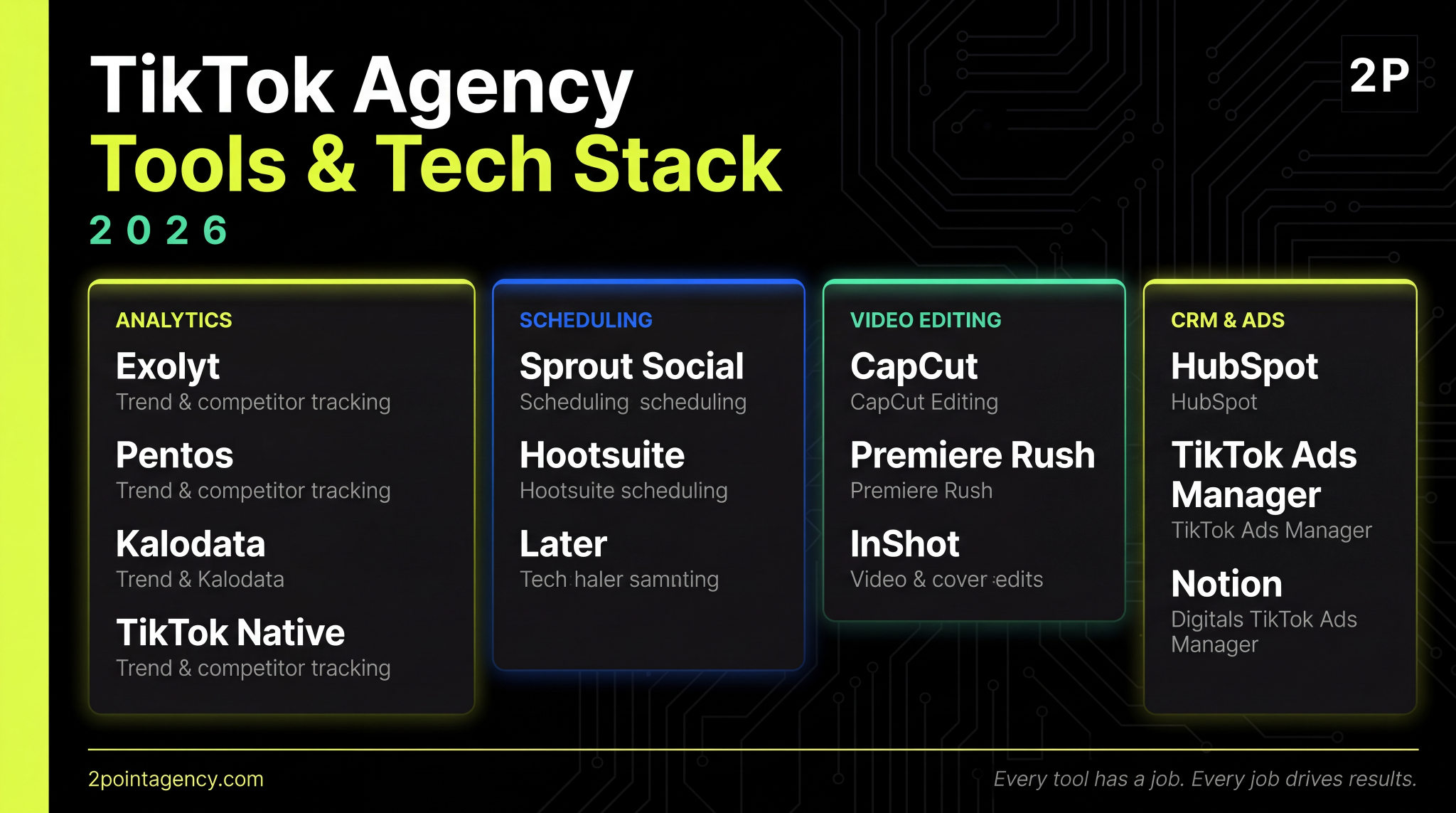
Scaling your agency is one thing. Doing it efficiently is another. The right tools make the difference between scrambling to keep up and growing smoothly. Here's what you should be running in 2026 to stay competitive.
Analytics and Insights
Your tools for creating content only matter if you can measure what's working. Here's what top TikTok agencies rely on for analytics:
- Exolyt for analyzing content trends, competitor performance, and identifying which emerging opportunities have real staying power in your niche.
- Pentos for tracking trending sounds, challenges, and viral formats so you know which trends are worth joining and which are already fading.
- Kalodata for robust creator intelligence and industry comparisons, especially useful when vetting influencers or conducting market research.
- TikTok's native analytics gives you the basics for free: engaged views, audience demographics, and content performance over time. The 2026 Creator Analytics dashboard emphasizes Engaged Views, per AgencyAnalytics' TikTok analytics breakdown.
Scheduling and Publishing
Analytics tell you what's working, but consistent publishing is what keeps your momentum going. These tools help you manage posting across multiple clients:
- Sprout Social for TikTok scheduling alongside other platforms, with team collaboration and unified inbox management.
- Hootsuite for bulk scheduling and approval workflows across larger teams.
- Later for visual calendar planning that helps maintain aesthetic consistency.
- TikTok's native scheduling for individual accounts, though it lacks the multi-client management features your agency will need as you grow.
Video Editing
Scheduling keeps you consistent, but your editing tools determine the quality of what you publish:
- CapCut is free, TikTok-native, and handles most editing needs with auto-captions, trending effects, and direct integration.
- Adobe Premiere Rush gives you more control over color grading and audio when clients need polished output.
- InShot works well for quick mobile edits, especially when your team handles real-time content.
Ad Management
Strong creative needs strong distribution behind it. These two tools are essential for your paid campaigns:
- TikTok Ads Manager is where all campaigns live. You set up, monitor, and adjust strategy in one dashboard.
- TikTok Business Center centralizes multi-client management, team collaboration, and payment handling across several accounts.
CRM and Client Management
As your client roster grows, staying organized becomes just as important as delivering results:
- HubSpot for lead tracking, client communication, and pipeline management in one platform.
- Notion for flexible client dashboards, content calendars, and SOPs in a single workspace.
- Asana or Monday.com for keeping deliverables, deadlines, and team assignments organized across multiple projects.
How to Market Your Business on TikTok (The Agency Playbook)
Now that your tools are in place, it's time to put them to work. Mastering how to market your business on TikTok takes creativity, consistency, and smart strategy. Here's the playbook your agency should follow, with each piece building on the one before it.
Organic Marketing Strategies
Organic growth on TikTok starts with speed. When you spot a trending sound or challenge gaining traction, adapt it to your brand's personality quickly.
Your content should feel native to the feed, not like a polished commercial.
What separates strong content from everything else is the 3-second rule. TikTok's 2026 algorithm rewards Watch Time above all other signals. Frontload value in those opening moments. Aim for 90%+ viewer retention through the first 5 seconds, because if people scroll past your hook, nothing else you've built in the video matters.
Consistency ties it together. Build a posting calendar balancing trends with original ideas, and explore interactive content formats that keep viewers actively involved rather than passively scrolling.
Paid Advertising Strategies
Organic content builds your presence, but paid ads let you scale it. TikTok Ads Manager gives you precision targeting across several formats worth knowing:
- In-Feed Ads blend into the scroll naturally, while TopView Ads grab immediate attention at app open.
- Spark Ads amplify content that already resonates with your audience organically.
- TikTok Shop Ads let you tag products directly in videos, creating a seamless path from discovery to purchase.
Your targeting approach matters just as much as your format.
Using TikTok's interest and behavior targeting keeps your spend efficient by reaching the right audience.
You can also run ads without a personal account, which is especially useful for agencies managing campaigns on behalf of clients. And if you're deciding where to allocate budget between channels, knowing the differences between search and paid social helps you make that call.
Influencer Collaborations
Paid ads give you control, but influencer partnerships give you credibility. The key is finding creators whose style fits your brand naturally, not just chasing the biggest following.
Check engagement rates, audience alignment, and content authenticity before reaching out.
TikTok’s Creator Marketplace simplifies this by providing searchable data on demographics, engagement, and past campaign performance. Once you’ve found the right partners, set clear agreements on rates, deliverables, and timelines.
Most importantly, track results. Measure engagement, conversions, and sales so you can double down on partnerships that deliver real impact.
Analytics and Optimization
Influencer partnerships and paid campaigns generate data, but that data only helps if you act on it. Track views for reach, engagement rates for resonance, and conversions for real business impact.
Tools like Exolyt and Pentos give you deeper insight than TikTok's native dashboard alone.
Let the numbers guide your decisions. If a certain format drives engagement, lean into it. If your call to action falls flat, test something new. Consistent optimization based on real data is what separates agencies that grow from those that plateau.
Real Results: What a TikTok Agency Can Achieve
Strategy only matters if the numbers back it up.
2POINT delivered a 6.5x return on ad spend for Mavwicks through social media management, paid advertising, and brand development. The full scope of that work reflects what a focused, platform-specific partnership can consistently produce when the creative strategy is right.
The broader industry numbers tell a similar story. TikTok delivers a 3.70% average engagement rate in 2026, which is more than 7 times Instagram's 0.48% and nearly 25 times Facebook's 0.15%, per Digital Information World's 2026 platform benchmark study.
For agencies managing TikTok Shop campaigns, the results are even more direct. TikTok Shop's conversion rate of 4.7% more than doubles Instagram Shopping at 2.1%, as reported by Retail Dive's social commerce growth analysis. Live shopping events can push conversion rates as high as 30%.
These aren't theoretical projections. They're the kinds of results that agencies are delivering right now, and they're the reason brands are actively seeking TikTok-specific partners.
Common Challenges TikTok Agencies Face (and How to Overcome Them)
TikTok moves fast, and staying ahead requires more than good content.
The challenges most agencies run into fall into a few clear areas:
- Trend cycles. What works this week may not work next. Monitoring the Discover page and trending sounds weekly keeps you from falling behind.
- Proving ROI. Not every client speaks TikTok. Dashboards showing engagement trends, cost per conversion, and audience growth make results tangible.
- Algorithm shifts. Policies and updates happen without warning. Flexibility and consistent testing keep you adaptable.
2POINT's social media marketing services are built around exactly these challenges. If you're also thinking through what switching agencies actually involves, understanding that process helps you build stronger client retention from the start.
Ready To Build Your Own TikTok Agency?
TikTok agencies are shaping the way brands, creators, and entrepreneurs grow. You've seen what they are, how to start one, and how to market your business on TikTok in a way that actually works.
The opportunity is wide open. With TikTok Shop projected to exceed $112 billion in global sales and the platform reaching 1.9 billion users, the window for building a TikTok agency has never been wider. But timing matters. Building your agency now means you can ride TikTok's momentum and grow alongside the audiences who influence tomorrow's trends.
If you want a partner who's already helping brands succeed on TikTok, connect with 2POINT. Our team can help you design a strategy, launch with confidence, and scale faster than going it alone.
FAQs
What Is a TikTok Agency?
A TikTok agency helps brands grow by creating content, running ads, managing TikTok Shop, and tracking analytics. They know how to market your business on TikTok and deliver faster, more consistent results than going solo.
How Much Does It Cost To Start a TikTok Agency?
Starting a TikTok agency in 2026 typically costs $2,000 to $5,000 for legal setup, tools, and branding. Many founders start with free tools like CapCut and TikTok's native analytics, then invest more as revenue grows.
How Do TikTok Agencies Get Paid?
Most TikTok marketing agencies earn through monthly retainers ranging from $1,000 to $10,000, project-based fees, or performance commissions. The model depends on your services, but clear contracts and transparent pricing build stronger client relationships over time.
How Long Before Clients See Results From TikTok Marketing?
Most clients see engagement growth within one to three months. Paid ads and TikTok Shop agency campaigns can accelerate results, while consistent organic posting builds sustainable, long-term brand visibility on the platform.
What Skills Do I Need To Run a TikTok Agency Successfully?
You need creativity, trend awareness, video editing, and storytelling skills. Understanding how to market your business on TikTok matters just as much as client communication, contracts, and data analysis, plus the flexibility to adapt as the algorithm evolves.
Is Starting a TikTok Agency Profitable in 2026?
TikTok's ad revenue is projected at $33 billion and TikTok Shop is growing over 50% year-over-year globally. Agencies that offer commerce management and paid ad services are especially well-positioned for strong profit margins as a TikTok agency in 2026.
What Tools Do TikTok Agencies Use?
Top TikTok marketing agencies use Exolyt and Pentos for analytics, Sprout Social or Hootsuite for scheduling, CapCut for video editing, and TikTok Ads Manager for campaigns. A CRM like HubSpot helps manage client relationships.
How Do TikTok Agencies Get Paid?
If you’ve ever asked yourself what is a TikTok agency and how they make money, the answer is simple. Most agencies earn through retainers, project-based fees, or performance commissions.
The model depends on your services and clients, but clear contracts and pricing that reflect value help maintain strong, sustainable relationships.